Browse by city
Date range
Search help

Search titles, summaries, topics and stored transcripts together. Keywords may match separately; put the whole query in double quotes for a phrase. Matching follows word analysis, so punctuation is not exact. Both dates are included. Documents are not searched.

SHOWING 201–205 ENTRIES
201
JUN 10, 2026 · NEW YORK CITY, NEW YORK · CITY COUNCIL
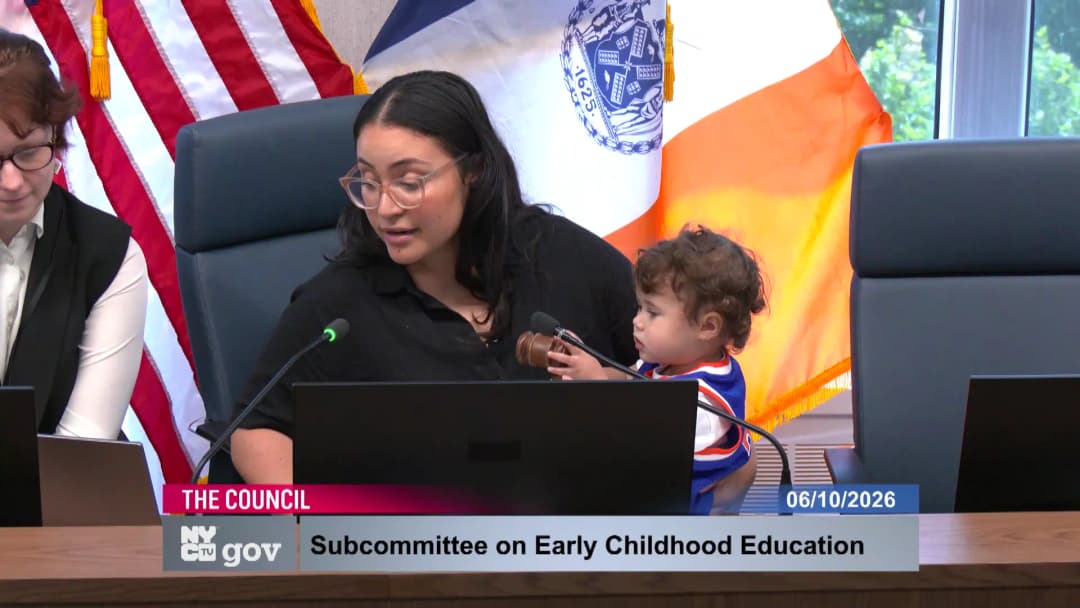
Subcommittee on Early Childhood Education Meeting - June 10, 2026: Package of Child Care Bills Approved

The New York City Council Subcommittee on Early Childhood Education, chaired by Jennifer Gutiérrez, met at 10:00 AM on Wednesday, June 10, 2026 at 250 Broadway, Hearing Room 2. The subcommittee considered and unanimously approved a package of four legislative items aimed at improving early childhood education access and streamlining child care operations. The vote was 5-0 with one member absent (Councilmember Won, medical leave) and one on parental leave (Councilmember Santosuosso). Deputy Speaker Natasha Williams also attended. Discussion Items - Int 0579-2026-A (Sponsored by Councilmember Gutiérrez): A local law requiring the Department of Education to develop and implement an annual education and outreach campaign to enroll students in early childhood education programs. The campaign would provide information on program benefits, options, the application process, and seat availability. Chair Gutiérrez noted that roughly the same number of parents applied to preschool programs this year as last, emphasizing the need to reach more families. - Int 0009-2026-A (Sponsored by Councilmember Linda Lee): A local law requiring the Mayor's Office of Child Care to study and report on the processes for obtaining permits, licenses, or registrations to operate a child care program—specifically from the NYC Department of Health and Mental Hygiene (DOHMH) and the NYS Office of Child and Family Services. The bill aims to identify overlaps, contradictions, and provide recommendations for streamlining, without weakening health and safety standards. A statement read on behalf of Councilmember Lee highlighted that delays in permitting force providers to spend months navigating paperwork, affecting families and children. - Res 0165-2026 (Sponsored by Deputy Speaker Natasha Williams): A resolution calling on the New York State Legislature to pass and the Governor to sign legislation amending the Workers' Compensation Law to allow unused Paid Family Leave to be transferred to grandparents and other designated caregivers. - Res 0365-2026-A (Sponsored by Councilmember Kevin C. Riley): A resolution calling on the New York State Legislature to pass S.1994/A.2218, which would remove the minimum wage and hours requirements for applicants of child care assistance. Chair Gutiérrez framed the legislative package as responding to everyday challenges families face when interacting with the early childhood education system, noting a recent landmark state investment in child care. Key Outcomes - All four items were coupled for a single roll call vote. The subcommittee voted 5-0 in the affirmative (Gutiérrez, Brewer, Felder, Joseph, Riley) with zero negative votes and no abstentions. Members absent: Won (medical leave) and Santosuosso (parental leave). - The approved items are: - Int 0009-2026-A (study on child care permitting) – approved and reported out. - Int 0579-2026-A (education and outreach campaign) – approved and reported out. - Res 0165-2026 (transfer of paid family leave to caregivers) – approved. - Res 0365-2026-A (remove minimum wage/hours for child care assistance) – approved. - The items now move to the full City Council for further consideration.

EDUCATION 100%
202
JUN 10, 2026 · NEW YORK CITY, NEW YORK · CITY COUNCIL
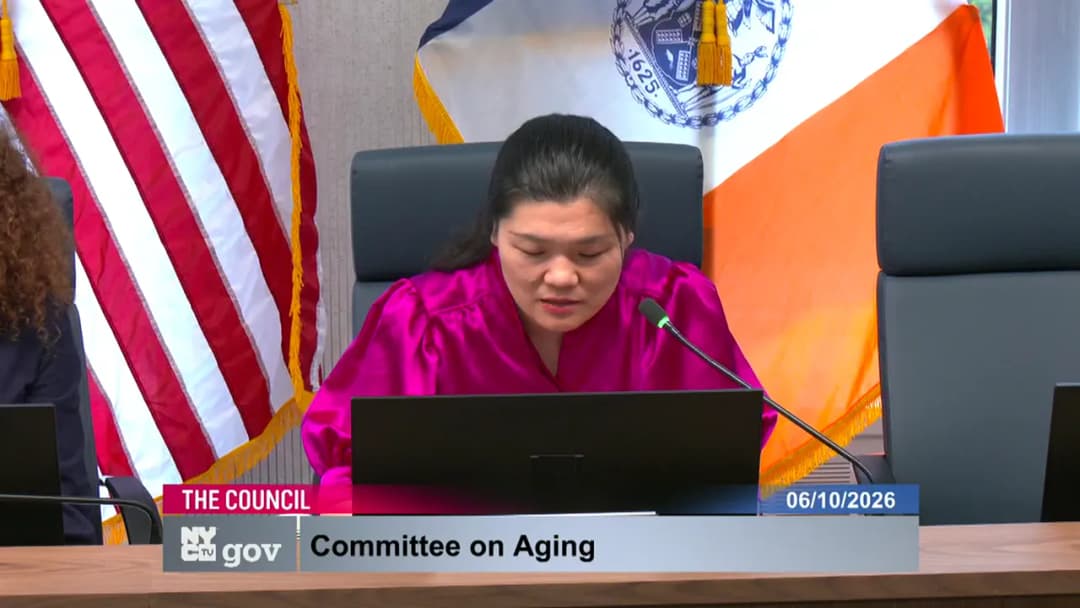
New York City Council Committee on Aging Votes on Digital Access and Transportation Resolutions - June 10, 2026

On Wednesday, June 10, 2026, at 11:00 AM, the New York City Council Committee on Aging, chaired by Councilmember Susan Zhuang, met in a hybrid format at 250 Broadway, 8th Floor, Hearing Room 1, to vote on two pieces of legislation: Intro 821-A and Resolution 421-A. The meeting lasted for a brief voting session, with six members present (Zhuang, Schulman, Hudson, Brewer, Mealy, Aldebol) and Councilmember Dinowitz absent. No public testimony was heard; the committee voted on previously debated items. Discussion Items - Intro 821-A (Proposed Int. No. 821-A) – Sponsored by Councilmember Lee: This bill would require the New York City Department for the Aging (DFTA) to ensure that forms, applications, and enrollment information for services available in digital or special applications are also accessible through non-digital means, such as paper or telephone. Chair Zhuang highlighted key statistics from DFTA’s most recent service needs assessment: approximately 12% of older adults do not have or do not know if they have internet access, and 30% do not own or use a computer or tablet. She noted that these disparities are more pronounced among low-income older adults, those with limited English proficiency, and those with lower formal education. The bill aims to prevent older New Yorkers from being left behind in accessing essential services. - Resolution 421-A (Proposed Res. No. 421-A) – Sponsored by Councilmember Millie: This resolution calls on the New York State Governor to sign S.8689/A.10055, which would authorize the New York State Office for the Aging (SOFA) to establish, operate, and maintain programs for transportation services, and to partner with area agencies on aging like DFTA. Chair Zhuang cited high prevalence of functional difficulties among older adults: 32% have at least one functional difficulty, nearly a quarter have ambulatory difficulty (difficulty walking or climbing stairs), and among those over 85, these rates jump to 65% and more than half, respectively. Councilmember Mealy, explaining her vote, expressed strong support for the resolution, arguing that no seniors should be forced into isolation due to lack of transportation to medical appointments, grocery stores, or visits with loved ones. She urged colleagues to support the resolution. Key Outcomes - Intro 821-A was approved by the committee with a vote of 6 in favor, 0 opposed, and no abstentions. Councilmember Dinowitz was absent. The bill was amended by the committee and adopted as Intro 821-A (the final version). - Resolution 421-A was also approved unanimously (6–0–0), with Dinowitz absent. The resolution was amended by committee and adopted as Res. 421-A. - Both items were coupled in a single roll call vote; all present members voted affirmatively. The committee will forward the approved legislation to the full City Council for consideration.

PERSONNEL MATTERS 59% · PROCEDURAL 41%
203
JUN 9, 2026 · NEW YORK CITY, NEW YORK · CITY COUNCIL
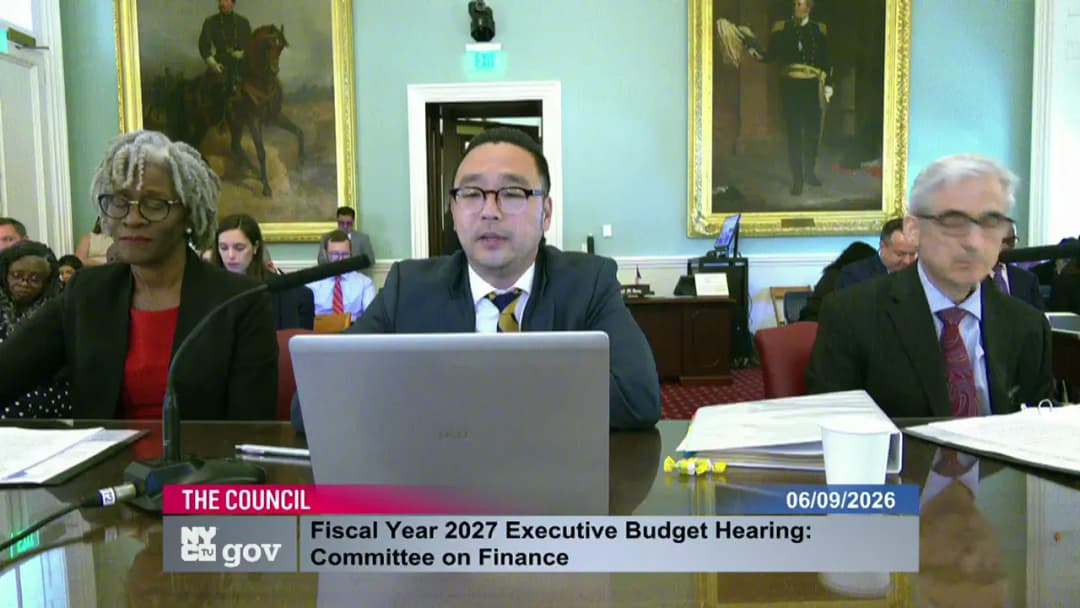
NYC Council Finance Committee Holds FY2027 Executive Budget Hearing on June 9, 2026

The New York City Council Committee on Finance, chaired by Councilmember Linda Lee, held an oversight hearing on the Fiscal Year 2027 Executive Budget on Tuesday, June 9, 2026, in Council Chambers at City Hall. The hearing featured testimony from the Department of Finance (DOF) and the Independent Budget Office (IBO). Councilmembers questioned DOF Commissioner Richard Lee and IBO Director Louisa Chaffee on a wide range of fiscal issues, including property tax reform, debt collection, new revenue proposals, housing policy, and budget uncertainties. Consent Calendar - No consent calendar items were considered during this hearing. Public Comments & Testimony - No public testimony was taken. The hearing focused on agency budget presentations and Council Q&A. Discussion Items - Property Tax Reform (DOF): Commissioner Lee stated that a comprehensive property tax reform proposal is being developed, building on the advisory commission’s recommendations, and will require state legislative action. He noted that the administration has not yet submitted a formal plan to Albany, citing the need to close a historic $12 billion budget gap. - ECB Debt Collection (DOF): DOF identified $573 million in potentially collectible outstanding debt and $744 million deemed uncollectible. The agency collected $70.1 million in FY27 (12%) and aims to improve first-year outreach. A recent case recovered $9 million from Amazon for idling violations. DOF also plans an ECB amnesty program in FY27, pending Council authorization. - Section 1127 Returns Error (DOF): DOF discovered a 10-year miscalculation where city employees living outside NYC improperly received a STAR credit on city tax returns. The error averaged $10–12 million per year in lost revenue. DOF corrected the calculation for tax year 2025 only and will not seek back payments. Approximately 40,000 employees are affected. - Block-by-Block Housing Plan (DOF): Commissioner Lee explained that the 2019 rent stabilization law changes were reflected in FY27 assessments by increasing capitalization rates by 50 basis points, reducing market value of rent-regulated properties by 3.3% on average and taxes by 1.3%. Further relief will phase in over five years. - Office-to-Residential Conversions (DOF): Of 30 office buildings converted to residential, only three were Class A. The 4% decline in Class A office parcels resulted in a 1.5% decrease in taxable assessed value, but DOF believes the impact on overall class shares will be minimal. - Racial Equity Plan (DOF): DOF’s plan aims for 100% of services to be accessible by end of 2026. The agency is working with the new Mayor’s Office of Deed Theft Protection and improving information equity. Deputy Speaker Williams questioned progress on outreach and digital barriers. Commissioner Lee cited ongoing efforts, including language access and a new notification program for deed recordings. - Lien Sale Cancellation (DOF): The administration paused the 2026 lien sale for a six-month review, ending this summer. DOF is evaluating equitable enforcement tools and preparing nominees for the new land bank board (deadline July 28, 2026). The current tax lien trust is unaffected. - Pied-à-Terre Surcharge (DOF): DOF is implementing a new surcharge on second homes valued over $5 million, expecting to raise $500 million annually from about 8,000 properties. The surcharge will appear on property tax bills. DOF will develop enforcement rules, including for LLC- and trust-held properties. Concerns were raised about seniors with fixed incomes; DOF offers payment plans. - Co-op/Condo Abatement Compliance (DOF): DOF mailed notices to owners potentially ineligible for the abatement, projecting $13 million in annual savings from those who cannot prove primary residency. - Deed Theft Prevention Office (DOF): Only one of five budgeted positions (director Peter White) has been filled. Three more (ombudsperson, deputy director, community coordinator) are in process. The office coordinates with agencies like HPD, DIFTA, and district attorneys. Commissioner Lee noted statutory limits on preventing fraudulent deed recordings and urged sign-ups for the notification program. - IBO Fiscal Overview (IBO): Director Chaffee summarized the FY27 executive budget ($124.7 billion), projecting a $1.1 billion gap. Key uncertainties include $149 million in untested due process savings, $21 million for class size bonuses under a newly extended state law, and a child care voucher funding cliff (from $1.8B in FY26 to $818M starting FY28). IBO calls this shortfall “nearly $1 billion annually.” - Fair Fares Expansion (IBO): IBO released a report estimating costs for five expansion scenarios, ranging from increasing the discount to raising eligibility to 400% of the federal poverty line. Take-up rates were estimated at 19–32%, with transit utilization up to 63%. IBO noted that Fair Fares already has a relatively large marketing budget but suggested automated enrollment using Department of Finance tax data could reduce barriers. - Class Size Compliance (IBO): IBO aligns with the administration’s $122 million FY27 plan to reach 70% compliance, but has not updated its estimate for 100% compliance by 2030. - Homeless Services Budget (IBO): IBO attributed persistently high shelter costs to elevated daily rates and a growing population of single adults and adult families, even as asylum-seeker arrivals slow. - Federal Health Cuts (IBO): Up to 450,000 New Yorkers may lose health insurance due to federal changes to the Essential Plan. Neither the state nor city budgets allocated additional funds. IBO warned of potential impacts on NYC Health + Hospitals. Key Outcomes - No formal votes were taken during the hearing; it was an oversight session. - The Committee filed the oversight on T2026-1912 (as noted in the minutes). - DOF committed to providing follow-up data on property tax reform timeline, ECB collection targets, the exact number of Queens homeowners receiving trash bin reimbursements, and details on the 1127 return correction notices. - IBO will brief the Council on the Fair Fares report and host a public webinar on June 16, 2026. - Next Steps: The Committee will hold public testimony on June 10, 2026, before finalizing budget recommendations for the FY27 executive budget.

FISCAL SUSTAINABILITY 38% · HOUSING 27% · RACIAL EQUITY 5% · ENGINEERING AND INFRASTRUCTURE 5%
204
JUN 8, 2026 · NEW YORK CITY, NEW YORK · CITY COUNCIL
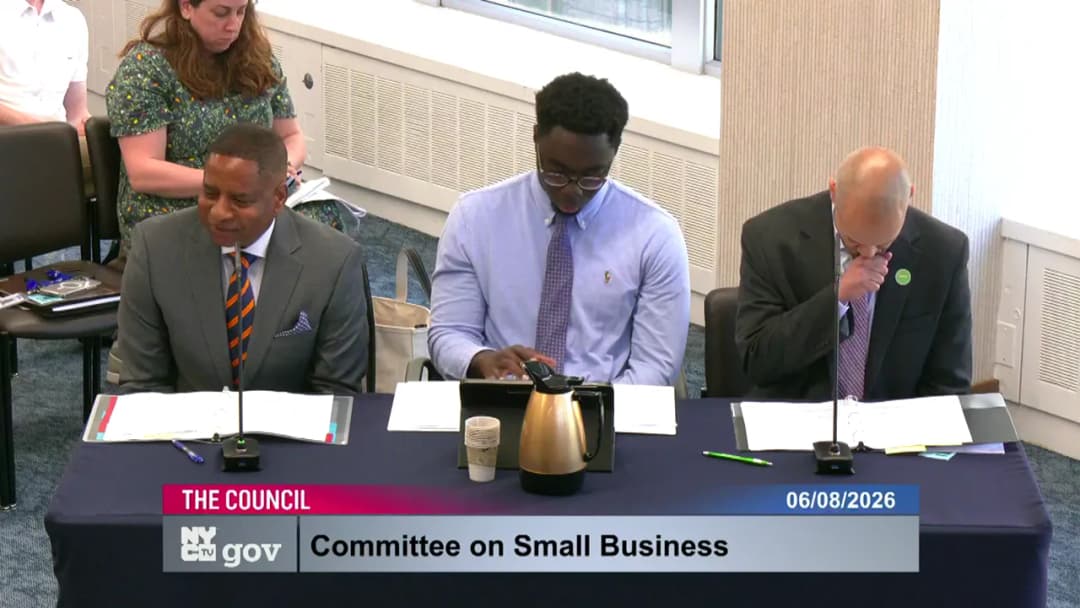
NYC Council Small Business Committee Hearing on Construction, Security Grilles, and Red Tape (June 8, 2026)

The New York City Council Committee on Small Business, chaired by Councilmember Shanel Thomas-Henry, held a hearing on Monday, June 8, 2026, at 1:00 PM in Hearing Room 1 at 250 Broadway. The committee discussed three bills and one resolution aimed at supporting small businesses: Int. 0799 (establishing a support fund for businesses affected by roadway construction), Int. 0910 (repealing retroactive security grille visibility requirements), T2026-2025 (coordinating inspections to accelerate business openings), and Res. 0328 (calling on the state for a tax credit for infrastructure-disrupted businesses). All four items were laid over after testimony and discussion. Public Comments & Testimony - Matthew Bauer (NYC BID Association) – Supported Int. 0910 but urged clarifications to ensure existing grilles are not deemed noncompliant; recommended extending the education timeline and holding installers accountable. - Mark Caserta (Brooklyn Chamber of Commerce) – Supported Int. 0910 and called for improved outreach, installer compliance, and consideration of character-based loans for businesses with poor credit. - Joanna Tallant (Parkside Fifth Avenue BID) – Supported Int. 0910, noting that micro-businesses face replacement costs of $2,000–$15,000; urged holding installers accountable and extending the education window. - Andrew Rigie (NYC Hospitality Alliance) – Supported Int. 0910 but argued it should grandfather all existing grilles installed before a future date (e.g., July 1, 2028); supported Int. 0799 and suggested expanding eligibility to disruptions from utilities and MTA. - Lisa Soren (Bronx Chamber of Commerce) – Supported Int. 0910, 0799, and T2026-2025, emphasizing that compliance costs threaten small businesses and that outreach should be prioritized over penalties. - Andrea Tan (Legal Aid Society) – Supported T2026-2025 (Red Tape Relief Act) but urged language access requirements and clearer program details; also noted that some delays are outside business owners' control. - Pedro Suarez (Third Avenue BID) – Supported all bills; estimated 30–50% of businesses in his district are noncompliant with Local Law 75; recommended city-wide mailers and site visits similar to DSNY’s recycling outreach. - Jessica Walker (Manhattan Chamber of Commerce) – Supported all four items; stressed that relief must be timely (14-day disbursement) and that coordinated inspections are the cheapest economic development tool. - Christopher Leon Johnson (public) – Fully supported Int. 0910, calling Local Law 75 a “cash grab” and urging repeal. - Nargis Basile – No testimony delivered (not connected). Discussion Items - Int. 0799 (Roadway Construction Small Business Support Fund) – Councilmember Salaam introduced the bill, which would provide loans (up to $50,000) and grants (up to $15,000) per storefront per year, plus services, to businesses impacted by city construction. SBS Commissioner Kenny Minaya supported the intent but raised operational concerns about prescribed timelines, underwriting standards, and scaling. Councilmember Salaam explored potential amendments such as annual aggregate ceilings, objective eligibility criteria (e.g., construction duration, proximity), and creditworthiness requirements. SBS indicated flexibility on these points but noted that partnering with a CDFI would be critical. - Int. 0910 (Security Grille Visibility Requirements) – Councilmember Stevens (statement read by Chair) explained that the bill would repeal the July 1, 2026 enforcement deadline for 70% see-through grilles, instead requiring compliance only when grilles are replaced. DOB Assistant Commissioner Reynaldo Hilton acknowledged insufficient outreach over 15 years, with no direct notifications to businesses. SBS supported the bill but advocated for giving business owners choice regarding grille visibility. Public testimony highlighted confusion about the bill’s language and urged that existing grilles be grandfathered in. DOB stated it would not enforce the current law while the bill is pending. - T2026-2025 (Red Tape Relief Act) – Councilmember Zhuang introduced the bill, which would establish a permanent interagency inspection coordination program, prioritizing restaurants and child care businesses, with an online portal and annual reporting. SBS supported the intent but noted that Executive Order 11 (due July 2026) already addresses time-to-open reforms and that the NYC Best Team has saved businesses over $6 million since the start of the administration. Councilmembers questioned the current average time to open and the fate of a previous version of the program that “secretly faded out.” - Res. 0328 (Tax Credit for Infrastructure-Disrupted Businesses) – Councilmember Salaam’s resolution calls on the state legislature to pass and the governor to sign a tax credit for businesses negatively affected by infrastructure construction. No detailed discussion beyond opening statements. Key Outcomes - All four items (Int. 0799, Int. 0910, T2026-2025, and Res. 0328) were laid over by the committee (no vote taken). The hearing was held to receive testimony; additional written testimony may be submitted within 72 hours. - DOB confirmed it will not enforce the 70% visibility requirement (Local Law 75 of 2009) while Int. 0910 is under consideration, providing a de facto grace period. - SBS will continue to work with the council on amendments to Int. 0799, particularly regarding eligibility criteria, loan underwriting, and timelines. - The committee will await the results of Executive Order 11 (due July 2026) before finalizing T2026-2025, with an eye to avoiding duplication. - Councilmembers emphasized the need for improved outreach—especially to non-English-speaking and offline businesses—and for holding grille installers accountable for compliance.

ECONOMIC DEVELOPMENT 57% · SMALL BUSINESS 20% · COMMUNITY ENGAGEMENT 10% · PROCEDURAL 4%
205
JUN 8, 2026 · NEW YORK CITY, NEW YORK · CITY COUNCIL
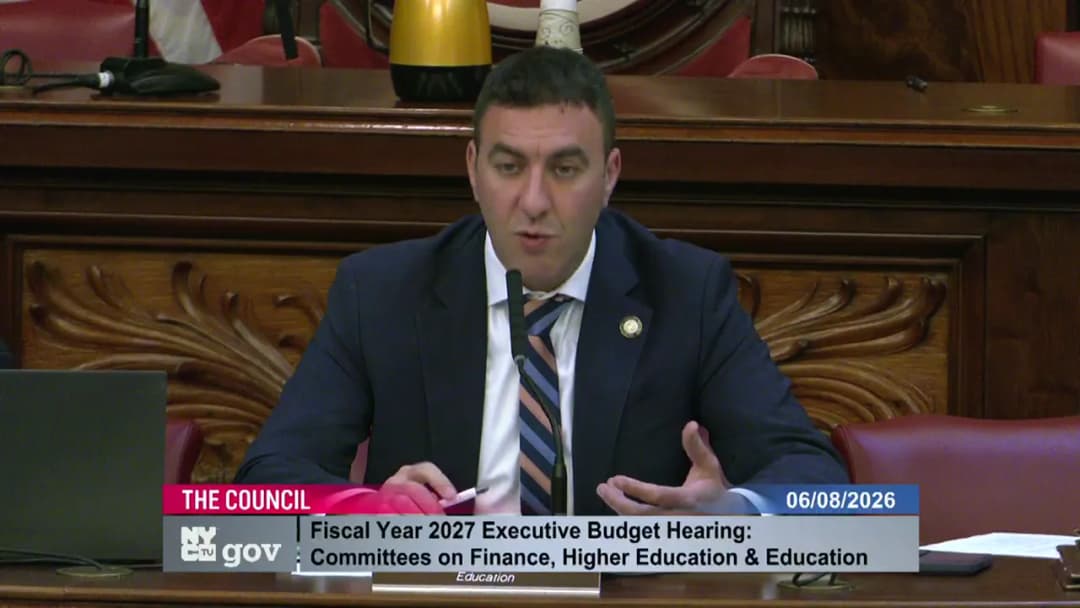
NYC Council Committees on Education and Finance FY2027 Executive Budget Hearing – June 8, 2026

On Monday, June 8, 2026, the New York City Council Committees on Education and Finance jointly held a day-long hearing on the Fiscal Year 2027 Executive Budget, starting at 12:00 PM in Council Chambers. The hearing first addressed the City University of New York (CUNY) budget, followed by the Department of Education (DOE) budget. Councilmembers Linda Lee (Finance Chair), Eric Dinowitz (Education Chair), Rita Joseph (Higher Education Chair), and Speaker Adrienne Menon led the questioning. The hearing featured testimony from CUNY Chancellor Felix Matos Rodriguez and his team, and later from DOE Chancellor Kamar Samuels and his senior leadership. The hearing highlighted significant funding gaps in student success programs, concerns over procurement transparency, and the need for sustained investments in special education, mental health services, and early childhood education. Public testimony was scheduled for a separate day on June 10, 2026. CUNY Budget Hearing (12:00 PM – approx. 1:45 PM) Opening Statements & Budget Overview - Councilmember Linda Lee reported that CUNY's proposed FY27 executive budget is $1.57 billion, a 1.4% increase ($21.1 million) from the preliminary plan, mostly due to $15 million in baselined operating support. She expressed disappointment that the mayor did not baseline funding for CUNY ASAP, ACE, and Reconnect programs. - Councilmember Rita Joseph noted that the executive plan did not restore funding for CUNY Reconnect, ACE, or ASAP, calling it “unacceptable.” She also highlighted the need for timely responses to council budget inquiries and emphasized capital repair needs at community colleges, including leaking roofs and broken elevators. - Chancellor Matos Rodriguez reported that CUNY enrollment grew nearly 4% over fall 2025, with three consecutive years of growth (9% since fall 2022). He noted that 72% of CUNY students attend tuition-free and 77% graduate without debt. He highlighted initiatives like CUNY Beyond (career readiness), the expansion of ASAP/ACE programs, and the constructive dialogue partnership. Key Discussion Topics - ASAP and ACE Programs: The council noted that the executive budget did not baseline the $10.1 million for ACE or provide recurring funding for ASAP. Chancellor Matos Rodriguez confirmed these programs are effective (ASAP doubles three-year associate degree completion rates) but need recurring funding for planning. The cost per student for both programs is approximately $3,440. - Enrollment and Tuition Adjustment: The FY27 budget includes a one-time $25 million reduction for tuition revenue reestimate due to actual enrollment patterns. CUNY reported total FTE enrollment of 179,000 (128,000 senior colleges, 51,000 community colleges) – up 4,400 from the prior year. - Capital Needs: The council questioned the $50 million in capital funding for community colleges (matched by state for up to $100 million). CUNY COO Batista explained prioritization based on facility assessments, but students and staff have reported mold, flooding, and broken elevators. Councilmembers pressed for more transparency on repair timelines and allocation. - Early Childhood Education: CUNY requested $6 million for early childhood apprenticeship programs and $2 million for a bilingual CDA program. The council noted low current enrollment (30 apprentices) and asked for performance metrics. - CUNY Reconnect: The $7.8 million program for adult learners was not restored in the executive budget. Over 25,000 students are currently enrolled, and 14,597 have graduated since inception. - OmniCard Pilot: The council urged $1.4 million for free transit for 3,100 students, citing transportation barriers. Currently, only ASAP, ACE, CHAMPS, and SEEK provide OmniCards. - Mental Health and Food Insecurity: CUNY requested additional funding for 14 mental health clinicians (2 per community college) and $2.5 million for food insecurity programs. The CUNY CARES model helped Bronx students enroll in SNAP, bringing in $2.96 million in benefits. - Federal Research Cuts: Chancellor expressed concern over cuts to pipeline programs for graduate students and research, affecting diversity and the future teaching workforce. - Accessibility and Adaptive Technology: CUNY reported that the CUNY Accommodate system reduced service enrollment wait times to two weeks, with a 25% increase in disability service enrollment. Key Positions and Concerns - Councilmembers voiced strong support for baselining ASAP, ACE, and Reconnect, emphasizing their proven impact on retention and graduation. - CUNY advocated for full baselining of these programs and additional capital funding for community colleges ($100 million requested, $50 million provided in executive budget). - Councilmember Restler noted a 10% decline in pedagogical headcount since pre-COVID and urged hiring restoration. Chancellor acknowledged the decline but said hiring cycles take time. - Councilmember Brewer pressed for affordable housing at John Jay's North Hall; litigation was cited as a barrier. Department of Education Budget Hearing (approx. 1:45 PM – 3:20 PM) Opening Statements - Councilmember Linda Lee noted DOE's proposed FY27 budget is $37.9 billion, a decrease of $105.8 million (0.3%) from the preliminary plan, largely due to a $922.2 million savings plan. She expressed disappointment that the mental health continuum ($5 million) and restorative justice were not fully funded. - Speaker Adrienne Menon highlighted the council's contract transparency concerns, noting that DOE contract spending totals $12.9 billion and that only 10% of contracts are reportedly non-competitively bid, but council analysis suggests 40% of spending is non-competitive. - Councilmember Eric Dinowitz emphasized the need for accountability, especially regarding procurement violations and the need for expanded K-12 special education programs (NEST, Horizon, AIMS). - Chancellor Samuels reported on initiatives: 2K expansion, New York City Reads/Solves, every child known (STH support), and a $7.2 million investment. He also noted that schools will continue to be held harmless for FY27 initial budgets. Key Discussion Topics - Procurement and Contracts: The council pressed for access to contract data, with Speaker Menon calling the delay in providing contracts “troubling.” DOE Deputy Chancellor Alicia Belowy explained that pulling contracts from a secure system is time-consuming. Councilmembers expressed concern about split contracts below $25,000 to avoid scrutiny. The DOE agreed to provide more data. The New Visions portal (cost $8.9 million) was identified as potentially duplicative; Chancellor Samuels said talks are ongoing to avoid disruption. - Restorative Justice: The executive budget did not include $6 million for restorative justice programs, which would affect approximately 250 of 960 schools currently served. Councilmember Dinowitz argued the program reduces conflict and improves academics. Chief Rampersad noted that restoration would sustain current levels; without it, services would be cut by 25%. Councilmembers urged full funding. - Special Education: The budget includes $67.5 million for pre-K special education expansion and $86 million for IESP support, but no expansion of K-12 programs like NEST, Horizon, or AIMS. Chancellor Samuels said 675 additional seats are planned. Council members cited high demand (e.g., 2,070 applicants for 510 AIMS seats). The DOE reported that due process cases dropped from 26,000 to under 16,000, and IESP cases from 18,000 to under 7,000. The council urged expanding these effective programs to reduce future due process costs. - Early Childhood Education (2K, 3K, Pre-K): The council praised the 2K expansion (2,000 seats this year, 12,000 planned next year). Deputy Chancellor Hawkins noted that 3K utilization is 85% (52,000 seats) and pre-K utilization is 80% (69,000 seats). 70% of families received their top 3K choice. Pay parity for ECE workers remains a key issue; DOE is working with the Mayor's Office of Child Care to collect data. - Mental Health: The mental health continuum program ($5 million) was not in the executive budget; it supports 50 high-need schools and 16 Article 31 clinics. Councilmember Lee urged restoration, noting it serves 2,330 students. Deputy Chancellor Hawkins highlighted that over 250 school-based health clinics serve 180,000 students. - School Safety and Personnel: The savings plan includes a reduction of 264 school safety agents. Councilmembers called for fully funding both restorative justice and safety agents. Teacher recruitment received $17 million, but pedagogical headcount is down by 2,936 compared to budgeted. Vacancy rates: 0.7% pedagogical, 16.4% non-pedagogical. - Class Size: The DOE received a two-year extension for class-size compliance. Chancellor Samuels outlined exemptions that qualify for differential payments (up to $8,500 for teachers in hard-to-staff or space-constrained classes). About a third of noncompliant classes are 1-3 students over the cap. Out-year savings depend on the extension. - Immigrant Family Services: The $4 million immigrant family engagement program was not continued in the executive budget. The council urged restoration, citing the need for language access and legal support given the current climate. - Capital Infrastructure: The DOE noted that only 60% of public assembly spaces (auditoriums, gyms) have air conditioning. The council requested updates on repair schedules. Key Outcomes and Positions - No formal votes were taken, but the council expressed strong intent to push for restoration of mental health continuum funding, restorative justice, immigrant family services, and student success centers ($3.3 million gap). - Councilmembers committed to working with DOE on procurement reform and contract transparency. - DOE committed to providing additional data on contracts, staffing vacancies, and special education program costs. - The council urged the administration to baseline CUNY’s ASAP, ACE, and Reconnect programs and to expand K-12 specialized autism programs. - Councilmember Williams emphasized equity in school budgets, urging analysis of fair student funding and class-size funding distribution to high-need schools. - The hearing concluded with thanks to the panels and an announcement of public testimony on June 10, 2026.

STUDENT SUPPORT SERVICES 24% · EDUCATION 17% · HIGHER EDUCATION 13% · MISCELLANEOUS 8%
← PREVIOUS
01…2021
OPENPUBLICA · PUBLIC MEETING INDEXUPDATED DAILY · openpublica.com