Browse by city
Date range
Search help

Search titles, summaries, topics and stored transcripts together. Keywords may match separately; put the whole query in double quotes for a phrase. Matching follows word analysis, so punctuation is not exact. Both dates are included. Documents are not searched.

SHOWING 11–20 ENTRIES
11
SEP 24, 2026 · OAKLAND, CALIFORNIA · CITY COUNCIL
Oakland Planning Commission Meeting – September 24, 2026

Note: The meeting transcript refers to September 23, 2026, but the user-provided metadata indicates the meeting occurred on September 24, 2026. This summary uses the latter date for the title but notes the discrepancy. The meeting was called to order at 3 p.m. with a quorum present. Agenda discussion, director's report, informational reports, and committee reports were all waived. The commission discussed a potential data center moratorium moving to City Council on October 6, 2026, and the director's upcoming visit was requested. Public Comments & Testimony - Layla Gall (Rockridge Neighbors for Sensible Housing) expressed strong opposition to the proposed 85-foot building at 6230 Claremont (plan 26025), arguing that city staff's density bonus calculations are overly liberal and that the project is a critical test case for density laws in Rockridge. She urged the commission to scrutinize the rationale and hold staff to legal standards. - Victoria Griffith (resident on Florio Street, adjacent to the project) stated that the 85-foot wall would block sunlight after midday, strip her home of warmth and natural light, obstruct airflow, eliminate privacy, and adversely affect her physical and psychological well-being. She argued the design threatens neighborhood health and safety. - Paul Laurie (Rockridge resident, two blocks from the site) characterized the developer as a large corporate entity with low risk in the project but high consequences for the community. He warned of material degradation to the neighborhood and implored close scrutiny. - Isaac Cos Reed (D2 resident, Parks and Recreation commissioner) advocated for Red Fox Resources, a green business facing a neighbor complaint, and asked for a hearing date. Staff noted that October 21, 2026, lacks a quorum, so the item will be rescheduled. Discussion Items Public Hearing – 1437 23rd Avenue (Conditional Use Permit for Alcoholic Beverage Sales) This item was continued from October 1, 2025, and July 15, 2026. Staff planner Mike Rivera presented the applicant's revised proposal following feedback from the Planning Commission and the City Alcohol Beverage Action Team (ABAT). Key modifications included: - Prohibiting anyone under 18 years old from the pool hall (removing youth activities). - Proposed on-site beer sales from 2 p.m. to 12 a.m. daily (the commission had earlier recommended 7 p.m.–11 p.m. weekdays, 2 p.m.–11 p.m. weekends). - Licensed security guard only on Saturdays from 6 p.m. to 1 a.m. (the commission had recommended a guard during all alcohol sales hours). - New clear glazing storefront, improved lighting, and security cameras. - A community engagement plan with posted contact information and staff training. Staff recommended approval subject to conditions in Attachment D. Commissioner Questions and Discussion: - Vice Chair Randolph raised concerns about the security guard not being present on Fridays, the lack of a sunset or reauthorization mechanism (staff explained temporary permits are not standard but applicants can later seek condition revisions), and enforcement of under-21 alcohol restrictions. She suggested visible identification (wristbands/stamps) for patrons 21+. - Commissioner Rank inquired about past code violations; staff confirmed two past cases (related to unpermitted music activities) had been closed with no recent issues. - Commissioner Lee visited the pool hall and noted the locked door, limited furniture, and need for a social area. The applicant agreed to add seating. The applicant, Julio Cervantes, stated willingness to implement identification systems but cited financial constraints for adding a Friday security guard. He confirmed on-site consumption only and ongoing communication with nearby Bay Tech Charter School. Commission Deliberation: Vice Chair Randolph proposed adding conditions to the staff draft: (1) licensed security guard from 8 p.m. until closing on Fridays and Saturdays, (2) alcohol sales restricted to on-site consumption, (3) video security footage retained for at least 30 days, and (4) a visible identification system (e.g., wristbands or stamps) for patrons 21 and older (method at applicant's discretion). Commissioner Rank and Chair Ahrens expressed concerns about over-prescription and financial burden, but a motion was made and seconded. Key Outcomes - Vote on 1437 23rd Avenue: The commission voted unanimously (4-0) to approve the major conditional use permit and variances, affirming staff's environmental determination, and adding the four conditions above. The decision is appealable to City Council within 17 days. - Minutes Approval: The minutes from the September 2, 2026, meeting were approved unanimously. - Next Steps: Staff noted that the data center moratorium draft ordinance will go to City Council on October 6, 2026. The SB 79 amendments are also scheduled for council on that date. The commission's next regular meeting will be duly noticed.

PROCEDURAL 20% · CODE ENFORCEMENT 20% · PUBLIC SAFETY 17% · ALCOHOL BEVERAGE CONTROL 13%
12
SEP 22, 2026 · OAKLAND, CALIFORNIA · CITY COUNCIL
Oakland Public Works and Transportation Committee Meeting - September 22, 2026

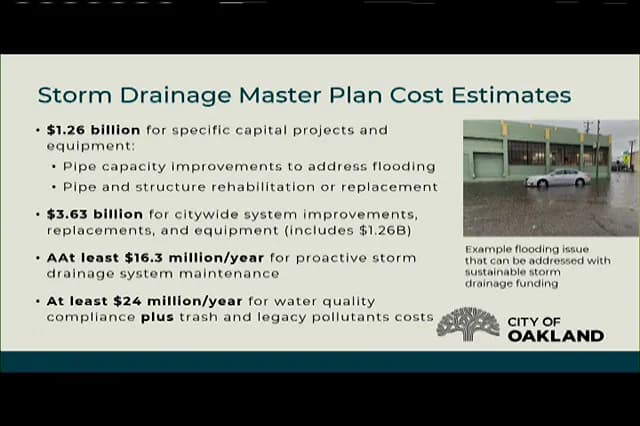
The Public Works and Transportation Committee of the Oakland City Council met on Tuesday, September 22, 2026, at 11:45 AM (scheduled for 11:30 AM) in the City Council Chamber. Chair Zac Unger presided, with Councilmembers Noel Gallo, Ken Houston, and Charlene Wang present (all four members). The committee reviewed 11 agenda items, including a major storm drainage master plan update, contract amendments, a parking zone change, an encroachment permit, and a solid waste ordinance amendment. The meeting adjourned at 1:50 PM. Consent Calendar - Item 1: Approval of Draft Minutes (July 14, 2026) – Approved unanimously (4-0). - Item 2: Determination of Schedule of Outstanding Committee Items – Approved as amended (4-0) to withdraw a duplicate pending item (File ID 25-0536) because it was superseded by Item 11 on the agenda. - Item 5: Park Restoration Services Contract – Approved (4-0) and forwarded to the October 6, 2026 City Council meeting on the consent calendar. The contract ($453,907.93) with McGuire and Hester is for post-storm trail repairs in Joaquin Miller Park and Diamond Canyon, funded 75% by FEMA, 18.75% by Cal OES, and 6.25% by the city’s sewer fund. - Item 7: Residential Parking Permit Zone Changes – Approved (4-0) and forwarded to the October 6, 2026 City Council meeting on consent. Modifications include adding Webster Street to Zone N and removing sections of Aileen Street (Zone P) and Ross Street (Zone C). - Item 9: 98th Avenue Crossing Improvements Construction Contract Award – Approved (4-0) and forwarded to the October 6, 2026 City Council meeting on consent. The $2,184,566.58 contract with Ray’s Electric (Gruendl Inc.) includes pedestrian safety improvements such as rapid flashing beacons and crosswalk enhancements. - Item 10: Martin Luther King Jr. Way Complete Streets Resurfacing Project – Approved (4-0) and forwarded to the October 6, 2026 City Council meeting on consent. The $7,306,798.13 contract with McGuire and Hester includes pavement resurfacing and safety improvements on MLK Way (47th St to Berkeley border). - Item 11: Ordinance Amending OMC Chapter 8.28 (Solid Waste) – Approved (4-0) and forwarded to the October 6, 2026 City Council meeting on consent, with Councilmember Wang added as co-sponsor. The ordinance strengthens waste disposal requirements, establishes a commercial special assessment for unpaid trash bills, and creates an on-site cleanup hauler permit program. Public Comments & Testimony - Sada Olabala (multiple items): Urged the city to address safety issues with 311 response times, tree limb hazards, and unused traffic signals; criticized the three-year delay in trail repairs and the lack of enforcement on illegal dumping; raised concerns about data center water contamination; and questioned the consistency of Park and Recreation Advisory Commission decisions that bypass council. - Kevin Daly (multiple items): Supported the storm drainage fee ballot but asked for clarity on property-owner-only voting and fund dedication; praised Diamond Canyon trail repairs; asked how to avoid future large change orders on the 19th St BART project; supported MLK project approval but urged expedited safety improvements; and noted that illegal dumping often stems from residents lacking sufficient trash service. - Kathy Adams (Items 6 & 10): President/CEO of Oakland African American Chamber of Commerce – demanded transparency on local and disadvantaged business participation in the 19th St BART contract amendment; asked for a report on actual subcontractor dollars paid and opportunities for Oakland businesses in the additional $4.185 million. - Stanley Cooper (Item 10): Local contractor – requested postponement of the MLK project contract to allow further review of the mentor-protege program, arguing the ordinance is ambiguous about whether Oakland-based companies must be the proteges. He noted that the protege (On the Level Concrete) has a San Francisco office and only recently established Oakland presence. - Edward Hemmat (Item 8): Property owner at 1021 45th Ave – thanked the committee and noted that the building also houses a repair shop and commercial kitchen, not just a cannabis facility. - David Boatwright (Open Forum): Questioned the timeline and cost of the storm drainage master plan, urging the council to prioritize higher-impact projects over trail repairs and park maintenance without new taxes. - Other speakers: Brief comments on parking fees and the need for better enforcement of hauling regulations. Discussion Items - Item 3: Storm Drainage Master Plan Update and Stormwater Fee Report – Staff (Terry Fashing, Watershed & Stormwater Division Manager) presented an informational report on the master plan (75% complete, final in 2027). Key estimates: $1.26 billion needed for specific capital projects; $3.63 billion for system-wide improvements; at least $16.3 million/year for proactive maintenance; and $24 million/year for water quality compliance. The city currently has no dedicated storm drainage fee, unlike Alameda ($88/year/home) and Berkeley ($42/year/home). A Prop 218 ballot process (18-36 months) could raise $10-15 million annually. Councilmembers expressed strong support but raised concerns about current funding from Measure U and Measure Q (only 5% for water quality), 311 response failures, and illegal discharges. The item was received and filed (4-0). - Item 6: 19th Street BART to Lake Merritt Project Construction Contract Amendment – Staff (Amit Silvan) requested a $4,185,426.69 increase (to a total of $10,624,575.44) due to unforeseen underground utilities (shallow gas lines, railroad ties with hazardous material), basement structures, and delays from utility companies, public events, and weather. The project timeline extended from June 2023 to December 2026. Councilmembers questioned the size of the change order and whether rebidding was possible. Staff explained that rebidding would jeopardize $4 million in federal grants and result in significant additional costs. Councilmember Houston raised concerns about the potential for underbidding and subsequent gouging, and asked about design-build alternatives. After public comment demanding local business transparency, the committee approved the item 4-0 but forwarded it to the City Council on the non-consent calendar (motion amended from consent to non-consent to allow further discussion). - Item 8: Major Encroachment Permit at 1021 45th Avenue – Staff (Reginald Bazil) recommended approval of a conditional encroachment permit for five outward-swinging doors and ten planters, leaving 9.5 feet of clear sidewalk. Councilmember Houston opposed, citing a pattern of non-compliance by cannabis facilities with community beautification agreements (OMC Title 5, Chapter 81, Section 70). He voted no but clarified his objection was not specific to this property. The item was approved 3-1 (Houston dissenting) and forwarded to the City Council on non-consent. Key Outcomes - Items 1, 2, 5, 7, 9, 10, 11 were approved unanimously and forwarded to the October 6, 2026 City Council meeting, mostly on the consent calendar. Item 11 includes Councilmember Wang as co-sponsor. - Item 6 was approved 4-0 but forwarded on non-consent to allow further City Council debate on the $4.185 million contract amendment and local business participation. - Item 8 was approved 3-1 (Houston no) and forwarded on non-consent due to broader enforcement concerns about cannabis facility agreements. - Item 3 (Storm Drainage Master Plan) was received and filed; staff will continue exploring a storm drainage fee ballot process (target 2027-2029). - Item 4 (Safe Oakland Streets Report) was withdrawn from the agenda and placed on the committee’s pending list. - Ongoing Referral: Councilmember Houston directed the City Administrator to enforce community beautification requirements for all cannabis facilities and requested a report on actual local business participation in the 19th St BART project. Councilmember Wong requested a review of the design-build project delivery model for future projects. The committee also noted the need for stronger enforcement of existing hauling and solid waste regulations.

PUBLIC WORKS 17% · WATER AND WASTEWATER MANAGEMENT 16% · PROCEDURAL 12% · ENGINEERING AND INFRASTRUCTURE 9%
13
SEP 22, 2026 · OAKLAND, CALIFORNIA · CITY COUNCIL
Finance & Management Committee Meeting – September 22, 2026

The Oakland City Council Finance & Management Committee convened at 9:30 AM on Tuesday, September 22, 2026, in the City Council Chamber. All four committee members were present: Councilmembers Brown, Unger, Wang, and Chair Ramachandran. The meeting addressed eight agenda items, including audits, revenue collection, parking operations, and salary classification changes. Several items were forwarded to the full City Council, while others were continued or withdrawn. Consent Calendar - Item 1 – Approval of Draft Minutes (July 14, 2026): Approved unanimously (4-0). - Item 2 – Determination of Schedule of Outstanding Committee Items: Approved as amended to withdraw the quarterly Cash Management Report and the Police and Fire Retirement System (PFRS) performance report from the pending list; these will be posted as informational memos on the city website. Motion carried 4-0. - Item 8 – Amendment to Salary Ordinance (Classification Title Changes): Approved staff recommendation to forward to the October 6, 2026 City Council consent agenda. Changes include renaming “Exempt Limited Duration Employee” to clarify 37.5-hour and 40-hour work weeks, and renaming “Principal Employee Relations Analyst” to “Principal Employee and Labor Relations Analyst.” Motion carried 4-0. Public Comments & Testimony - On Item 2: One staff speaker (unidentified) requested withdrawal of two quarterly reports to relieve a crowded calendar, noting the PFRS report is also reviewed by its board. One public speaker (Sadio Olabala) cautioned that absent periodic spending reports, the city administrator’s authority to spend up to $250,000 without council approval could lead to misspending, citing a recent example involving Oakland Police Department use of Measure Z funds. - On Item 3 (NeoGov HRIS contract): One public speaker (Sadio Olabala) criticized the report’s inconsistent racial/ethnic categories and questioned hiring outcomes, stating that Black/African American applicants are the largest group applying but may not be hired proportionally. - On Item 4 (Vacant Property Tax Audit): Three public speakers: Madeline Stacy praised the audit and urged the city to shift spending toward homelessness and housing services rather than primarily on illegal dumping. Another speaker (Kevin Daly) asked the auditor to consider underutilized properties (e.g., parking lots) and questioned whether the tax violates the Ellis Act, citing a California appeals court ruling striking down San Francisco’s empty homes tax. A third speaker (Sadio Olabala) noted the report found some vacancies may go undetected, questioned unspent funds, and criticized administrative cost tracking. - On Item 5 (Special Revenue Collection): Two public speakers: Sadio Olabala asked how sidewalk and mobile vendors are taxed, noting that liens cannot be placed on their property if they rent, and expressed concern about lack of enforcement and licensing. Another speaker (Derek Barnes) did not speak based on transcript. - On Item 7 (Parking Garages): Four public speakers: Kevin Daly urged adoption of dynamic pricing and occupancy targets, expressing disappointment that parking policy moved to the Finance Department. Another speaker warned of potential lawsuits related to automated license plate readers and pay-by-phone overcharges, and questioned the city’s validation arrangement with the ice center. David Boatwright recommended the city make public its monetization plan for the Clay Street parking lot. Sadio Olabala did not speak on this item. - On Item 8 (Salary Classification): One public speaker (Sadio Olabala) criticized the lack of detail on duties and responsibilities, noting that only 32% of city employees live in Oakland, which undermines local revenue generation. - Open Forum: Two speakers: David Boatwright urged more oversight of authorized projects and measures, citing Measure M’s slow implementation. A second speaker (unidentified) reported that the Budget Advisory Commission is reviewing a document for the 2027-28 budget that includes budget stabilization issues. Discussion Items - Item 3 – Authorization to Enter into Cooperative Agreement with NeoGov: Staff requested withdrawal due to outstanding questions and a need to change the title based on feedback from contracts. The committee voted unanimously to withdraw the item with no new date. Staff indicated a similar item could return on October 27 after review by Rules on October 1. No service impacts were noted. - Item 4 – Performance Audit of the Vacant Property Tax: City Auditor Michael Houston presented findings from a five‑year audit (FY 2021–2026). Key findings: administrative processes effectively identify vacancies; measurable goals and regular reporting are lacking; and the tax may be limited by a fixed-rate structure ($3,000 residential, $6,000 commercial). From FY 2021–2025, $29.8 million was collected, with 73% ($20 million) spent on illegal dumping through Public Works. Only 15% of revenue was spent on administration. Councilmembers requested supplemental data on residential vs. commercial vacancies, the reasons for spatial vacancy clusters, and the breakdown of exemptions in each cluster. The item was forwarded to the October 6, 2026 City Council consent agenda. - Item 5 – Special Revenue Collection Project: Revenue and Tax Administrator Nicole Welch reported that the Oakland Business Tax renewal rate stands at 83.9%. Property liens totaling $5.4 million were transferred to Alameda County. Outreach efforts, including 6,879 landlord audit notices mailed September 11, 2026, have identified new rental accounts. Staff noted the project is part of normal operations, not a special initiative. Councilmembers discussed digital outreach, the relationship between unregistered landlords and rent control compliance, and the high number of closed accounts (10,376) attributed to prior backlog. The report was received and filed. - Item 7 – Parking Garages Operations, Financial and Management Update: Assistant Revenue and Tax Administrator Osa Segura reported that parking revenues have declined 17% since the pandemic. The current gateless model relies on enforcement that only generates about 1% of garage revenue from citations. Deferred maintenance needs total $7.8 million. Staff will issue a new RFP to evaluate gated vs. gateless technology and other operational improvements. Councilmembers expressed strong preference for returning to a gated system or dramatically increasing enforcement. The committee continued the item to the November 10, 2026 Finance & Management Committee meeting with requests for: (1) analysis of gate technology options; (2) usage data per garage over time; (3) reasons for citation fluctuations; (4) lessons from other California cities; and (5) top deferred maintenance priorities. Key Outcomes - Item 1: Approved July 14, 2026 minutes (4-0). - Item 2: Approved amended schedule; two quarterly reports moved to informational memos (4-0). - Item 3: Withdrawn from agenda with no new date (4-0). - Item 4: Forwarded to October 6, 2026 City Council on consent, with supplemental data requested on residential vs. commercial vacancies, spatial clusters, and exemption breakdown (4-0). - Item 5: Received and filed as an informational report (4-0). - Item 7: Continued to November 10, 2026 Finance & Management Committee meeting with five specified information requests (4-0). - Item 8: Forwarded to October 6, 2026 City Council consent agenda (4-0). - Open Forum: Two speakers addressed the committee. The meeting adjourned at 11:05 AM.

PUBLIC ENGAGEMENT 22% · PUBLIC WORKS 14% · PARKING MANAGEMENT 13% · VACANT PROPERTY TAX 11%
14
SEP 22, 2026 · OAKLAND, CALIFORNIA · CITY COUNCIL
Oakland Public Safety Committee Meeting on Human Trafficking and Grant Funding - September 22, 2026

The Oakland City Council Public Safety Committee convened on September 22, 2026, at 6:56 PM and adjourned at 8:30 PM. The meeting included an informational report on human trafficking, a grant for the crime laboratory, and public comments on various public safety issues. All four committee members (Brown, Fife, Houston, Wang) were present. Consent Calendar - Item 1: Approved the draft minutes from the committee meeting of July 14, 2026 (unanimous 4-0). - Item 2: Accepted the determination of schedule of outstanding committee items (unanimous 4-0) after two public speakers. - Items 3 and 4 (Ceasefire reports) were withdrawn from the agenda per Rule 28 and placed on the pending list. Public Comments & Testimony - On Item 2: Jesse Rosemore and Asada Olabala spoke about the OPOA contract, Flock surveillance, and the need for accountability. - On Item 5 (Human Trafficking): Nine speakers, including survivors and advocates, expressed frustration that no fines have been collected under Ordinance 13873. Speakers included Nefea Hasan (Dream Youth Clinic), Janice Jacobs, Natisha Leon (survivor), Gabrielle Weil (Covenant House), Heidi Gherkin, Sean Sullivan, Vanessa Johnson (Love Never Fails), Annabelle (J Bell), and others. They urged the city to implement fines and direct revenue to survivor services. - On Item 6 (CHP Grant): Two speakers, Jesse Rosemore and Asada Olabala, questioned the timing of the grant and broader accountability issues. - Open Forum: Eight speakers addressed the OPOA contract, Flock surveillance, civilianization, police overtime, and the need for fair contracts for civilian city workers. Discussion Items - Human Trafficking Informational Report (Item 5): Acting Lieutenant Deshaun Spencer presented data: 27 proactive operations in 2026, resulting in 4 traffickers arrested, 103 Johns arrested, and an average of 30 juveniles rescued per year. The report was required by Ordinance 13873. Councilmember Wang noted the report did not meet statutory requirements regarding fine collection. A bureaucratic impasse between OPD, Finance, and the City Attorney's office has prevented any fines from being collected. City Attorney Ryan Richardson explained that a paralegal is being hired but payment processing infrastructure is not yet in place. Councilmembers expressed frustration but ultimately forwarded the report to the October 6 City Council meeting on consent. - CHP Toxicology Grant (Item 6): Esmeraldo Garecho presented the $270,942 grant for DUID testing, equipment, and overtime. Councilmember Brown requested future impact data, and Councilmember Fife confirmed lab staff are non-sworn. The grant was approved on consent. Key Outcomes - Item 5: Received and forwarded to the October 6, 2026 City Council meeting on consent (unanimous 4-0). - Item 6: Approved and forwarded to the October 6, 2026 City Council meeting on consent (unanimous 4-0). - Items 3 and 4 withdrawn from the agenda and placed on the Public Safety Committee pending list. - No further action was taken on other matters discussed in public comments.

PUBLIC SAFETY 38% · HUMAN TRAFFICKING 27% · PUBLIC COMMENT 8% · PUBLIC ENGAGEMENT 7%
15
SEP 22, 2026 · OAKLAND, CALIFORNIA · CITY COUNCIL
Oakland Life Enrichment Committee Meeting: September 22, 2026 - Data Center Moratorium Approved

The Oakland City Council Life Enrichment Committee met on Tuesday, September 22, 2026, convening at 4:04 p.m. in the City Council Chamber, Oakland City Hall, 1 Frank H. Ogawa Plaza. Chairperson Carroll Fife (District 3) presided, with Councilmembers Noel Gallo (District 5), Ken Houston (District 7), and Charlene Wang (District 2) present. Because of the large number of public speakers, Chair Fife limited public comment to one minute thirty seconds per speaker. The committee approved two routine items and two grant agreements, and voted 3-0 to approve an interim urgency ordinance establishing a 45-day moratorium on data centers in Oakland, forwarding it to the October 6, 2026 City Council meeting. When Councilmember Brown arrived, a quorum of the full City Council was noted; the committee meeting was adjourned and reconvened as a Special Meeting of the Full Council at 4:36 p.m. The meeting adjourned at 6:50 p.m. Consent Calendar - Item 1 - Approval of Draft Minutes (July 14, 2026): Approved unanimously, 4-0, on a motion by Councilmember Gallo, seconded by Councilmember Houston. - Item 2 - Determination of Schedule of Outstanding Committee Items: Approved unanimously, 4-0, on a motion by Gallo, seconded by Houston. Public Comments & Testimony - Item 2: Jesse Rosemore urged that the Public Safety Committee's long-pending proposal to civilianize Oakland Police Department positions be moved to the Life Enrichment Committee, arguing it would save the city millions of dollars that could fund resident services. - Item 3 (Meals on Wheels, 3 speakers): Sada Olabala, a senior, raised concerns about Meals on Wheels programs generally, citing waiting lists averaging three to four months and sometimes stretching to a year, service reductions, rising costs, reduced federal funding, and complaints about bland, repetitive food and small portions. Jesse Rosemore supported the grant but expressed concern that the Oakland Police Officers Association contract will strain future city budgets. Samuel Ramsey (California Oakland Union of Homeless Women Health Outreach and Community Garden) spoke about food insecurity and the importance of growing food, offering to help with the program. - Item 4 (Early Care and Education Grant, 2 speakers): Sada Olabala noted that Measure AA can be used for Head Start salaries, asked whether the grant covers private child care businesses (staff confirmed it does not), and said private providers are struggling with competition from OUSD's free transitional kindergarten. Jesse Rosemore criticized Councilmember Wang's questions as performative and raised concerns about the police contract and possible city worker strikes. - Item 5 (Data Center Moratorium, 45 speakers): The overwhelming majority supported the moratorium, with many urging a permanent ban. Common positions included: data centers threaten public health (air, water, noise, diesel backup generators); they would raise electricity and water rates; they consume resources at the expense of residents (one speaker cited that in 2024 AI data centers used 4.4% of U.S. electricity while supporting less than 1% of jobs); they serve tech billionaires and real estate speculators rather than Oaklanders; and they risk displacement and gentrification. Speakers cited successful actions elsewhere, including Monterey Park's 45-day moratorium followed by the first U.S. voter-approved data center ban, a New York moratorium and gubernatorial executive order, and a Texas pause on data center permits; one speaker said 7,000 people had signed a petition. Several speakers, including a public health nurse and an Oakland High School student, cited health, generational, and community harms. Speakers opposing or qualifying the moratorium included: Mindy Petchenuk, candidate for Oakland mayor, who cited Virginia figures (74,000 jobs, $5.5 billion in annual labor income, $9.1 billion in GDP, and $41 billion in assessed property value in Loudoun County, producing nearly half of county property tax revenue) and argued Oakland needs industry rather than more taxes; Gerald Petchnock, who noted 260 data centers exist in California and 3,000 in the U.S.; Eben Cambridge, an Oakland native who supported the 45-day pause but opposed a permanent ban, comparing it to resistance to Uber and Lyft; a union representative who supported the moratorium while urging a regulatory framework with community benefits, local hiring, and union jobs; and Eric Nagamair of the Silicon Valley Leadership Group, who offered industry partnership, noting data centers can bring tax revenues and infrastructure upgrades. Chair Fife acknowledged the range of views and said the 45-day period is the state maximum under Government Code Section 65858. Discussion Items - Item 3 - Grant Agreement for Service Opportunity for Seniors (SOS) - Meals on Wheels (FY 2025-2027): Human Services staff (Hakeem McGee) presented a resolution awarding SOS $150,000 for FY 2025-2026 and $150,000 for FY 2026-2027 to administer the Meals on Wheels food delivery program, and authorizing the City Administrator to negotiate the agreement and extend its term without increasing the amount. The funding was included in the two-year budget (Resolution 91061) but was mistakenly omitted from the list of community-based organization grants. Councilmember Gallo thanked the organizations and volunteers. Approved 4-0 and forwarded to the October 6, 2026 City Council consent agenda. - Item 4 - Early Care and Education Emergency Grant - Measure C: Human Services staff presented a resolution appropriating up to $500,000 from the First 5 Alameda County Early Care and Education Emergency Grant for stipends to eligible Early Childhood and Family Services Division staff and other allowable expenditures. The city had already passed Resolution 91029 authorizing the application. The funds support Measure C Goal 2 (recruiting, retaining, and supporting early educators). Staff said a 2024 third-party salary study found city educators are not paid on par with area educators; the $500,000 maximum award falls short of closing the gap even for one year. The program serves 672 children per year (622 funded through the Office of Head Start, 50 through the Oakland Children's Initiative) across 12 centers, two home-based visiting programs, and a family child care partner, serving children from prenatal/conception through age five. At least 10% of Head Start slots are reserved for children with diagnosed disabilities; the program currently serves over 13%. Councilmember Fife called the amount 'couch change' and expressed sadness that early childhood educators do not earn a living wage. Councilmembers asked about long-term pay strategy and partnerships; staff noted the city's direct federal Head Start grant is an anomaly (usually held by nonprofits or counties). Approved 4-0 and forwarded to the October 6, 2026 City Council consent agenda. - Item 5 - Moratorium on Data Centers: Councilmember Fife introduced an interim urgency ordinance under California Government Code Section 65858 imposing a 45-day moratorium - the state maximum - on approving any land use entitlements or agreements to allow development or operation of data centers of any size in Oakland, effective immediately. Fife said Oakland currently has no regulations governing data centers; that AI-era data centers are far more resource-intensive (electricity, water, diesel backup generators, noise, heat, vibration); and that Gilroy, Richmond, Hayward, and Pittsburgh have adopted similar moratoriums. She addressed controversy over her press conference with Bering Companies, stating it was held for transparency about an informal request for review of the 415 20th Street property and was not an endorsement; no formal application has been filed. She opposed additional amendments as redundant. Councilmember Houston read a September 18 email he sent requesting a preliminary environmental report on 415 20th Street (formerly a Lawrence Berkeley National Laboratory supercomputing complex). Planning Director William Gilchrist confirmed the submission was a 'request for determination,' not a project application. Councilmember Gallo expressed full support. Councilmember Wang proposed amendments (developed with Director Gilchrist) calling for a locally specific impact study and a work plan at the 45-day mark, arguing state law's 35-day report requirement would not produce adequate analysis; Fife countered that the amendments restated existing requirements and state law, and presented her own amendments. Deputy City Attorney Brian Miller confirmed Fife's amendments were needed for compliance with City Charter Section 213 and that state law requires a written report at least 10 days before the moratorium expires; the moratorium can be extended by a seven-vote council vote for up to two years. Councilmember Brown (not a committee member) voiced full support and asked about an inventory of existing data centers and their approval history; Gilchrist said the 45-day period would include baseline research, robust community engagement, and identification of needed consultants and expertise, in coordination with PG&E, EBMUD, and Ava Community Energy. Councilmember Brown cited online figures for the 415 20th Street site's prior use (4.5 kilowatts) and the Bering proposal (20 kilowatts), while a public speaker described the proposed data center as 20 megawatts, equivalent to the energy use of 20,000 homes; the transcript records both figures without reconciliation. Key Outcomes - Item 1: Approved 4-0 (motion Gallo, second Houston). - Item 2: Approved 4-0 (motion Gallo, second Houston). - Item 3: Approved 4-0 (motion Gallo, second Houston); forwarded to the October 6, 2026 City Council consent agenda. - Item 4: Approved 4-0 (motion Gallo, second Fife); forwarded to the October 6, 2026 City Council consent agenda. - Item 5: Approved 3-0 as amended (motion Fife, second Houston; Gallo excused at 5:03 p.m. per the minutes; Houston, Wang, and Fife voting aye). Adopted amendments included: a WHEREAS clause citing City Charter Section 213 (permitting introduction and adoption of an emergency ordinance at the same meeting with six affirmative votes); adding 'preliminary proposals, and application information' to the fourth WHEREAS clause; adding references to City Charter Section 213 and emergency necessity findings; striking 'allocated' and inserting 'existing' in the use definitions (Section 1) and in Section 5; adding a new Section 8 requiring the City Administrator to present a written report to the City Council no later than 10 days before the ordinance's expiration or any extension, per Government Code Section 65858(d); adding the affirmative-vote-of-six-members requirement; and renumbering subsequent sections. Forwarded to the October 6, 2026 City Council agenda as a non-consent item. - Open Forum: Three speakers spoke, including comments on the data center moratorium, city worker contracts (IFPTE and SEIU), roughly 1,000 vacant city positions, and police accountability. - Note: The draft minutes contain apparent boilerplate errors in committee names, describing the meeting at various points as the Finance and Management Committee and the Public Works and Transportation Committee; the agenda and transcript identify this as the Life Enrichment Committee meeting. The agenda notice stated that no final City Council action could be taken despite the Special Meeting of the Full Council convening at 4:36 p.m.

DATA CENTER REGULATION 45% · PROCEDURAL 15% · ENVIRONMENTAL PROTECTION 8% · PUBLIC ENGAGEMENT 6%
16
SEP 22, 2026 · OAKLAND, CALIFORNIA · CITY COUNCIL
Oakland Community & Economic Development Committee Meeting - September 22, 2026

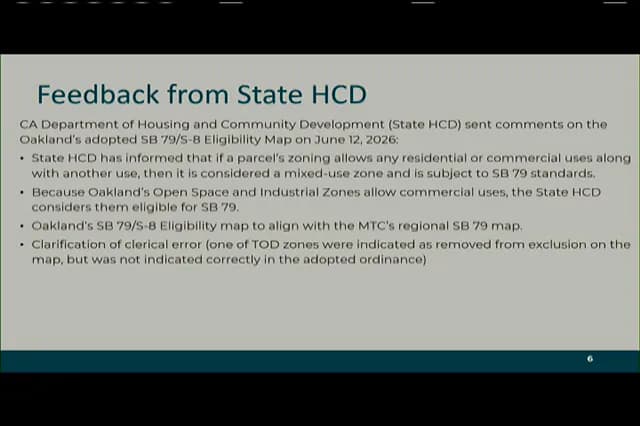
The Oakland City Council Community and Economic Development Committee met on Tuesday, September 22, 2026, in the City Council Chamber at Oakland City Hall. Although the agenda listed a 1:30 p.m. start, the meeting convened at 1:56 p.m., with Chairperson Rowena Brown presiding. Councilmembers Janani Ramachandran and Zac Unger were present; Councilmember Carroll Fife was excused. Because Councilmember Houston (District 7, not a committee member) was present, a quorum of the full City Council was noted; the committee adjourned at 2:16 p.m. and reconvened as a Special Meeting of the Full Council. No final City Council action could be taken at this noticed special meeting. The meeting adjourned at 2:52 p.m. Consent Calendar - Item 1 (Draft Minutes, July 14, 2026): Approved unanimously on a motion by Councilmember Unger, seconded by Councilmember Ramachandran. Vote: 3 ayes (Ramachandran, Unger, Brown); 1 excused (Fife). - Item 2 (Determination of Schedule of Outstanding Committee Items): Accepted as presented, with no changes to the pending list. Motion by Councilmember Unger, seconded by Councilmember Ramachandran. Vote: 3 ayes; 1 excused (Fife). Public Comments & Testimony - On Item 2, Sado Olabala said unemployment for foundational Black individuals in Oakland has been at 10% and in double digits for quite some time. She requested that workforce-related items include racial demographic representation, and that data separately identify foundational Black Americans (descendants of enslaved people) from Black people from the Caribbean, Africa, and Central and South America. - On Item 3, Sado Olabala argued the city reacted to SB 79 after its passage instead of shaping the bill to serve the city. She said the bill's purpose of increasing affordable housing near BART and AC Transit is a good idea, but noted some communities do not want high density, and criticized what she called a lack of consistency in the city addressing gentrification. - On Item 4, Sado Olabala disputed the director's statement that Oakland has a diverse economic base, saying the city does not support foundational Black Americans in employment. She cited unemployment statistics (as transcribed): 5.1% for African Americans in California, 7.5% unemployment, and 9% in Oakland; 15.9% for Black men in California without a high school diploma; and unemployment for Black women in California with college degrees tripling from 2.7% to 8.5%. She referenced a Budget Advisory Commission document stating crime and economic development are intertwined, and that Oakland residents spend roughly $1.5 billion annually in other cities due to crime concerns. She recommended focused job training and support for people re-entering from prison. - Open Forum: David Boltwright (also transcribed as 'David Botroye,' District 4) requested a housing presentation documenting housing funded with city and other sources over the last five years, including units completed, persons housed, total amount spent, average time from conception to occupation, and percentage by construction type. He cited a modular housing project on EDS Avenue (as transcribed) that took about 1.5 years to construct and six months to fully occupy, at roughly $350,000 per unit. Sado Olabala repeated concerns about gentrification and what she called continual redlining affecting foundational Black Americans. Discussion Items - Item 3 (S-8 Ordinance Amendments / SB 79): Kelly Cha of the Planning and Building Department presented amendments to Planning Code Chapter 17.86, the S-8 Abundant and Affordable Homes Near Transit combining zone (Senate Bill 79), with Laura Kaminsky, Strategic Planning Manager, also available. SB 79 was enacted in October 2025 with an effective date of July 1, 2026. Oakland adopted its local S-8 regulations in March 2026, then received comments from the Metropolitan Transportation Commission (MTC) on June 10, 2026, and from the California Department of Housing and Community Development (HCD) on June 12, 2026. HCD determined that Oakland's open space and industrial zones that allow commercial uses are mixed-use zones subject to SB 79. The proposed amendments would: remove the 20th Avenue AC Transit stop (map 28); remove open space and industrial zones from the ineligibility list; add parcels without Oakland permitting authority; redesignate all industrial parcels within TOD zones, including areas around the Coliseum BART Station and the 14th Avenue AC Transit stop, from ineligible to excluded; align TOD zones with MTC's final regional map; and add four additional transit stops, with analysis confirming all four are eligible for exclusion. The Planning Commission gave a unanimous recommendation in September 2026 without modifications. Councilmember Unger asked for clarification on the industrial zone changes; staff explained that industrial uses remain allowed under local zoning, and the changes only prevent SB 79 from mandating housing on those parcels at this time. Councilmember Houston requested that staff (Kelly Cha and Mr. Gilcrest) come to the East Oakland Gateway meeting before the October 6 or October 20 council dates to explain the maps, saying the many colors and outlines were confusing for constituents. - Item 4 (Economic Development Action Plan Implementation Status Update): Ashley Canett, Director of Economic and Workforce Development, presented the first annual implementation update for the 2025-2029 Economic Development Action Plan (EDAP) for fiscal year 2025/26, organized around five goals: attracting and growing key sectors; supporting existing businesses; connecting Oaklanders to jobs; investing in places; and arts, culture, and social activity. Key statistics included: more than 24,300 employers in 2025 (a peak, per EDD data); nearly 185,000 jobs in 2025, still below 193,000 jobs in 2023 and below the peak of nearly 200,000 in 2020; healthcare and social assistance as the largest employment sector with more than 46,000 jobs; information employment up 66% from 2010 to 2025, healthcare and social assistance up 54%, and public administration up 39%; more than 90% of businesses with fewer than 10 employees and most with annual revenues below $250,000; 21 neighborhood business corridors; $1 million dispersed for community-led safety initiatives and 47 city-funded positions on the street; 329 Neighborhood Business Assistance appointments across every council district; unemployment of about 9% for Black Oaklanders compared with 6% for Latino and Asian Oaklanders and 5% for white Oaklanders; the $240 million Samuel Merritt University project and the 4,000-square-foot Native American Health Center, both on city-owned land; five affordable housing projects (295 units) in the pipeline or under construction on city-owned property; 26 arts organizations supported through operating grants; 52 public art projects in development or completed; roughly 200 leases and licenses managed; reported crime down year over year and versus the five-year average in all six police areas in 2025; office rents beginning to stabilize in 2025 while downtown vacancy remains elevated and retail vacancy increased. Chair Brown asked about commercial rents and a decline in businesses from 2023 to 2025 (4,749 businesses in 2023, reduced by almost 700 by 2025, as she cited from the report), noted the county may place a $30 minimum wage measure on the ballot, and asked about collaboration with California GoBiz. Director Canett responded that GoBiz issues requests for information on behalf of companies seeking locations (the city is currently negotiating with a business that came through that process) and oversees state-level fiscal incentives such as tax abatements and waivers. Key Outcomes - Item 1: Draft minutes accepted unanimously (3-0; Fife excused). - Item 2: Outstanding committee items schedule accepted unanimously (3-0; Fife excused). - Item 3: Approved the staff recommendation on a motion by Chair Brown, seconded by Councilmember Ramachandran, and forwarded the ordinance to the October 6, 2026 Concurrent Meeting of the Oakland Redevelopment Successor Agency and the City Council as a public hearing, with a request that staff include the letters from state HCD and MTC in a supplemental report. Vote: 3-0 (Fife excused). - Item 4: Received and filed in committee (informational report) on a motion by Councilmember Unger, seconded by Chair Brown. Vote: 3-0 (Fife excused).

ECONOMIC DEVELOPMENT 35% · PROCEDURAL 20% · LAND USE AND ZONING 15% · RACIAL EQUITY 12%
17
SEP 16, 2026 · OAKLAND, CALIFORNIA · PUBLIC ETHICS COMMISSION
Oakland Public Ethics Commission Regular Meeting – September 16, 2026

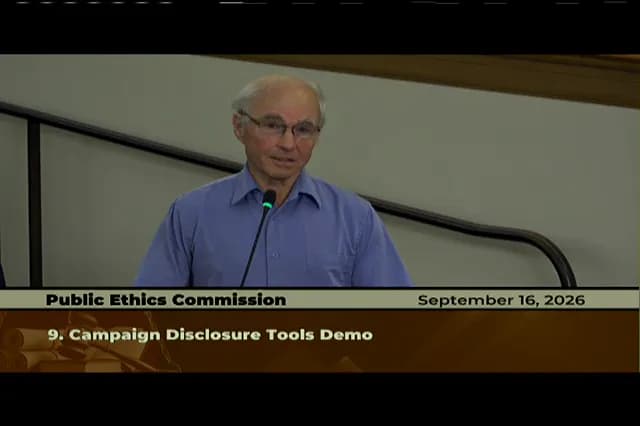
The Oakland Public Ethics Commission held its regular meeting on September 16, 2026, at 6:30 PM at City Hall, Hearing Room 2. The meeting addressed enforcement actions on misuse of Measure Z funds by OPD and a Sunshine Ordinance violation by the Oakland Police Commission, case closures under the backlog strategy, and informational items on commissioner recruitment, campaign disclosure tools, and staff reports. Public Comments & Testimony - Gene Hazzard (multiple occasions): Delivered extensive comments alleging unlawful actions by the City Council related to Rule 29 suspension and ballot measure alteration, criticized the PEC for dismissing his complaints, and threatened to file a lawsuit against the Commission. - Paula Hawthorne (former chair of the Safety and Services Oversight Commission): Stated that her commission discovered the improper use of $12,000 in Measure Z funds by OPD, emphasized that such funds are restricted to violence prevention, and commended the Commission's attention to the issue. - Unnamed speaker: Expressed concern that OPD is historically not held accountable for misconduct, argued that the Measure Z misuse was serious because funds were needed for youth and violence prevention, and urged strong consequences. - Rajni Mundal (Zoom): Requested a correction to the staff memorandum in Case 26-08, asserting that the characterization of former Commissioner Omar Farmer’s statement did not match the contemporaneous public record; asked that the letter distinguish Farmer’s interpretation from documented facts. - Another speaker (on Case 26-08): Argued that serial communications among OPC members did not cause harm because the recommendation was only advisory and accused some commenters of using the complaint to attack the Police Commission. Discussion Items - Approval of Minutes (July 15, 2026 & August 14, 2026): Two motions to approve the draft minutes were made and seconded. However, due to two abstentions (commissioners who were absent from those meetings), each motion received only three affirmative votes, failing to reach the required four votes. Minutes were not approved. - Case No. 24-30 – OPD Misuse of Measure Z Funds (Item 5): Enforcement Chief Tovah Ackerman presented the case. Eleven OPD officers used $12,000 in Measure Z funds for travel to a fallen-officer memorial in Washington, D.C., which is not a permissible use of Measure Z funds. The funds were later returned to the Measure Z account after the City Controller advised OPD. Staff found that the travel served a city purpose, so no GEA violation occurred, but recommended an advisory letter. Commissioners questioned whether the travel purpose justified all expenses, criticized the lack of itemized receipts, and expressed concern about OPD’s inability to produce expense reports. Commissioners also noted the citywide spending moratorium in effect at the time. A motion to continue the investigation (including obtaining expense reports and reviewing processes) was made and seconded. After public comment, the motion passed 4-0 (Upton, Tilak, Fisher, Micik; Apfeld excused, Bayeva excused). - Case No. 26-08 – Oakland Police Commission Sunshine Violation (Item 6): Staff presented evidence that four OPC commissioners (a quorum) exchanged emails and collaborated on a Google Doc regarding the BearCat armored vehicle recommendation outside a public meeting, violating Sunshine Ordinance § 2.20.030(F)(1). Staff recommended a finding of violation and an advisory letter directing OPC to agendize the matter for cure/correct. OPC had already taken corrective action (nullifying the November 20, 2025 vote). Commissioners discussed the severity of the violation and whether further interviews were needed. A motion to adopt staff recommendation was made and seconded. After public comment, the motion passed 4-0. - Complaint Backlog Case Closures (Item 7): Staff recommended closing two cases: PEC 22-26 (Trevelyon Jones) with no further action, and PEC 24-06 (former Commissioner Regina Jackson) with an advisory letter. Staff noted the complainant in 24-06 had withdrawn. Commissioners discussed the educational value of the advisory letter for other boards. A motion to approve staff recommendations passed 4-0 after public comment. - Commissioner Recruitment (Item 8): Senior Ethics Analyst Jelani Killings outlined the recruitment process for a PEC-appointed seat expiring January 2027. Deadline: October 30, 2026. Staff distributed flyers and requested commissioners to submit 30-second video testimonials. - Campaign Disclosure Tools Demo (Item 9): Ethics Analyst Niels Thorsen and volunteer Michael Ubel (OpenOakland) demonstrated the OpenDisclosure website (www.opendisclosure.io). Features include aggregated contribution and expenditure data, geographic breakdowns, independent expenditure tracking, and a searchable donor database. Commissioners suggested linking to raw data and improving presentation of independent expenditures. - Executive Director Report (Item 10): Executive Director Suzanne Doran reported that the PEC has reached full staffing for the first time in four years. A strategic planning retreat is scheduled for October 21, 2026. Work on the Democracy Dollars software platform (with MapLight) will begin in January 2027. Staff also conducted ethics training for department directors and explored new outreach methods. - Enforcement Program Report (Item 11): Enforcement Chief Ackerman reported that since July, 3 formal and 3 proactive complaints were received, bringing the total open caseload to 80. Two complaints were dismissed for lack of jurisdiction. A pending administrative hearing (Case 17-09) may proceed via default as the respondent has not responded. - Subcommittee Reports (Item 12): - Transparency Ad Hoc Subcommittee: Chair Upton reported recent meetings with IT staff and plans for a panel at CityCamp Oakland on October 17, 2026, focused on improving public records access and transparency dashboards. - Democracy Dollars Pilot Ad Hoc Subcommittee: Commissioner Micik reported that a meeting has not yet been held due to scheduling conflicts, but plans to convene soon. Key Outcomes - Case 24-30 (OPD Measure Z): Motion to continue investigation passed 4-0. Staff will seek expense reports and examine processes to prevent future misuse. - Case 26-08 (OPC Sunshine): Motion to adopt staff recommendation for a finding of violation and advisory letter passed 4-0. - Backlog Closures: Motion to close PEC 22-26 with no action and PEC 24-06 with advisory letter passed 4-0. - Minutes: Both the July 15 and August 14, 2026, draft minutes failed to receive sufficient votes and were not approved. - Strategic Planning Retreat: Scheduled for October 21, 2026, pending confirmation. - Democracy Dollars Development: Initiation moved to January 2027.

PUBLIC ETHICS 18% · PUBLIC COMMENT 15% · CAMPAIGN FINANCE 15% · PUBLIC ENGAGEMENT 14%
18
SEP 15, 2026 · OAKLAND, CALIFORNIA · CITY COUNCIL
Oakland City Council and Successor Agency Concurrent Meeting - September 15, 2026

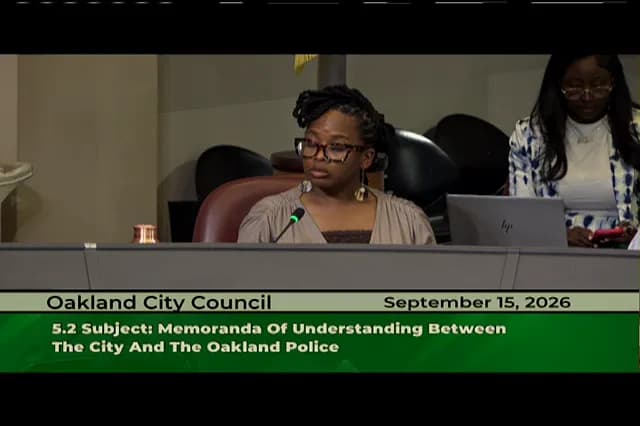
The City Council and the Oakland Redevelopment Successor Agency met concurrently on Tuesday, September 15, 2026, at 3:34 PM in the City Council Chamber. Council President Kevin Jenkins presided. Seven members were initially present (Councilmember Houston arrived late), and the meeting adjourned at 7:11 PM. The agenda was reordered to hear Items 5.1, 5.2, and 4.1 first, followed by the Consent Calendar. Key actions included approving the police commission slate, ratifying a five-year police union contract, and receiving the annual HUD performance report. Public comment was extensive, with 62 speakers during Open Forum and many more speaking on specific items. Consent Calendar - Minutes (Item 6.1): Approved for July 13 and July 21, 2026. - Emergency Declarations (Items 6.2-6.4): Renewed declarations for HIV/AIDS, medical cannabis access, and homelessness. - Cultural Affairs Commission Enabling Ordinance (Item 6.5): Final passage of amendments to commission operations. - Seminary Point Debt and Rent Forgiveness (Item 6.6): Final passage of up to $40,000 forgiveness contingent on property sale. - Celebrating Oakland Pride (Item 6.8): Resolution honoring LGBTQ+ leaders and the 16th Pride Parade. - Legal Settlement – Unauthorized Pursuit (Item 6.9): $17,000,000 settlement in Estate of Lolomania Soakai case. Councilmember Fife voted no. - Honoring Nicia De’Lovely (Item 6.10): Resolution honoring the poet and activist. - Public Nuisance Settlement (Item 6.11): Settlement with defendants totaling $114,000. - Kaiser Workforce Development Grant (Item 6.12): Accepted $1,000,000 grant (with authority to accept up to $2,000,000 more) for workforce and interim housing pilot. - Transformative Climate Communities Grants (Item 6.13): Authorized application for up to $55,000,000 and accepted $27,770,000 for West and East Oakland projects. - Hunger Action Month (Item 6.14): Recognized September 2026. - Domestic Violence Awareness Month (Item 6.15): Proclaimed October 2026. - Community Policing Advisory Board Appointment (Item 6.16): Confirmed Donald Dalke. - Children’s Fairyland Board Reappointment (Item 6.17): Confirmed Dr. Javay Ross. - OPD-U.S. Marshals MOU (Item 6.21): Extended through September 30, 2031. - League of Cities Delegate (Item 6.22): Appointed Councilmember Ramachandran as voting delegate, Councilmember Brown as alternate. - Withdrawn Items: Items 6.7 (signage contract), 6.18 (Head Start), 6.19 (OPD-ATF MOU), and 6.20 (OPD-DEA MOU) were withdrawn per Rule 28. The Consent Calendar was approved 8-0, with Councilmember Fife registering a no vote on Item 6.9. Public Comments & Testimony - Item 5.1 – Police Commission Appointments: Four speakers addressed the selection process. Some criticized the exclusion of candidate Omar Farmer, alleging politicization, while others urged approval of the slate (Ricardo Garcia-Acosta and Joey Harrison). - Item 5.2 – OPOA MOU: Fourteen speakers spoke, most in opposition. Critics from Local 21 and community groups argued the contract lacked overtime caps, ignored city auditor recommendations, disadvantaged other city unions, and would worsen budget deficits. A few speakers supported the contract, citing officer retention needs. - Item 4.1 – CAPER Public Hearing: One speaker (Ms. Sada Olabala) questioned whether HUD funds were being used in accordance with sanctuary city policies and if foundational Black Americans were being prioritized. - Open Forum / Public Comments: 62 speakers participated, the vast majority urging the Council to pass a moratorium on AI data centers in Oakland. They cited environmental harm (water/energy use), public health risks, noise pollution, job displacement, and the influence of tech billionaires. Many thanked Councilmember Fife for introducing an urgency moratorium (not on this agenda but upcoming). Additional speakers raised concerns about Flock cameras, the encampment abatement policy, and data justice. One speaker honored Nicia De’Lovely during the consent calendar public comment. Discussion Items - Item 5.1 – Selection Panel Nominations for Police Commissioner: City Administrator staff (Alex) detailed a rigorous recruitment process that yielded 45 applicants, narrowed to 10 interview candidates, and ultimately a final slate of Ricardo Garcia-Acosta and Joey Harrison. Councilmember Fife expressed disappointment, alleging the process was problematic and politically motivated. Councilmember Houston questioned why nominees could not be voted on separately (City Attorney cited Charter Section 604 requiring a slate vote). The nominees pledged independence and commitment to exiting federal oversight. Approved 7-1. - Item 5.2 – Police Officers’ Association MOU: Human Resources Director Mary Howe presented a five-year tentative agreement (2026-2031) covering rank-and-file and manager units. Key terms: 14% base wage increase, a 10% employee contribution to health care (ongoing savings), a 3% employee pick-up of retirement costs, increased longevity pay to retain officers, a “Me Too” clause linking future union gains, and clarified civilianization procedures. Finance Director Brad Johnson explained the long-term fiscal benefits, including an estimated $2.1 million annual savings on healthcare by year five. Councilmember Fife questioned the fairness to other unions and the impact of the Me Too clause. Councilmember Gallo sought controls on overtime; staff noted the agreement includes a future reopen option when staffing reaches certain levels. Public comment overwhelmingly opposed. Approved 7-1, with the salary ordinance to receive second reading on October 6, 2026. - Item 4.1 – Consolidated Annual Performance and Evaluation Report (CAPER): Housing and Community Development staff presented the 2025-2026 report for CDBG, HOME, ESG, and HOPWA grants (total $14 million). The report detailed outcomes for housing, anti-displacement, and economic development activities. Councilmember Fife inquired whether CDBG funds could support a social housing pilot; staff indicated they could be a future source. Public hearing opened and closed with one comment. Received and filed 8-0. Key Outcomes - Police Commission Appointments: Accepted slate of Ricardo Garcia-Acosta and Joey Harrison (7-1 vote; Fife no). - Police Union Contract: Approved three pieces of legislation (7-1; Fife no): 1. Rank-and-file MOU (PP1/PT1) 2. Managers MOU (UN2) 3. Salary ordinance amendment (first reading; final passage on October 6, 2026) - CAPER Report: Received and filed (8-0). - Consent Calendar: Approved (8-0) with Councilmember Fife voting no on Item 6.9 ($17 million settlement). - Other: The meeting was adjourned at 7:11 PM.

DATA CENTER REGULATION 23% · POLICE COMMISSION 11% · BUDGET AND FINANCE 11% · POLICE 11%
19
SEP 2, 2026 · OAKLAND, CALIFORNIA · CITY COUNCIL
Oakland Planning Commission Meeting - September 2, 2026

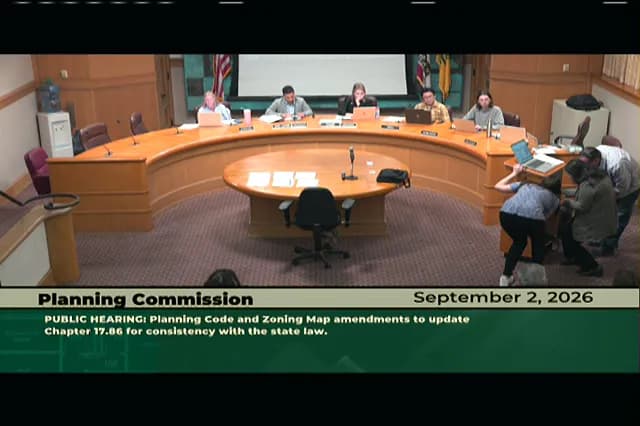
The Planning Commission met on September 2, 2026, at 3:00 PM at City Hall, Hearing Room 1. The meeting included recognition of outgoing commissioners, public comments on a proposed senior housing project, a staff presentation on SB 79 zoning amendments, and a discussion on data center zoning. The meeting adjourned at 4:00 PM. Commission Matters: Recognition of Commissioners Sandoval and Robb - Chair Ahrens and other commissioners expressed gratitude to Commissioner Sandoval (present) and Commissioner Robb (listening via phone) for their service over the past three years. Sandoval was praised for transparency and putting Oaklanders first. Robb was recognized for his architectural expertise and contributions to the Design Review Committee. Staff also thanked them for their work on the general plan updates and objective design standards. Certificates were presented. Public Comments & Testimony - Jack Gerson (Rockridge Neighbors for Sensible Housing, nearly 2,500 signatures on a petition) opposed the proposed senior care facility at 6230 Claremont Avenue, arguing it is too large. He claimed staff overestimated allowed units by more than 75% due to improper application of gross-to-net and mixed-use conversion factors. He warned that if allowed, the College Avenue corridor would see buildings over 100 feet tall, harming small businesses. - Tanya Pampoloni (Harwood Avenue resident) opposed the eight-story, 200+ unit building, citing parking impacts, loss of neighborhood character, and the fact that $13,000/month rent is not affordable for seniors. She requested fewer stories, stepbacks, ample parking, and design that reflects the neighborhood. - Michael Mayer (35-year resident) supported housing on the site but opposed the mass of the building. He noted the developer sought waivers from height and setback limits, making the project inconsistent with the general plan. He urged the commission to challenge the developer to prove that modest design modifications cannot pencil out. - Ellen Kohler (55-year resident) raised traffic safety concerns, citing two pedestrian deaths on Claremont Avenue in 2025-2026 (Roderick Nared, 67, and Billy Grant, 72). She noted seniors are three times more likely to be killed in traffic and urged the commission to require a binding traffic safety mitigation plan before approval, including daylighting, protected crossings, and speed reduction. - Paul Friedman (attorney) echoed traffic concerns and argued that the city's reliance on an administrative zoning bulletin for density bonus calculations is legally flawed. He said the density bonus exceeds what the general plan permits and urged the commission to hold the project to legal standards. - Connor (No Data Center Oakland Coalition) stated the coalition's petition has reached 7,000 signatures opposing data centers in Oakland. He urged the commission to consider community concerns about tech billionaires exploiting the city. - Khalid supported the data center opposition and asked that if data centers are inevitable, the city require resources for life skills classes and job training for underserved communities to prevent gentrification and displacement. Discussion Items - Update on 6230 Claremont Project: Chair Ahrens asked staff for an update. Staff reported the project is still under review, a completeness letter was sent, and the zoning consistency review is ongoing. The environmental document (SQL) is in draft form and not yet public. The project is not using AB 1398 (state streamline) but is being processed under SB 79. - SB 79 Zoning Amendments (Agenda Item 2): Kelly Cha presented staff recommendations to amend Planning Code Chapter 17.86 (SB 79 Combining Zone) to bring the city into full compliance with state law. The amendments address comments from HCD and MTC received in June 2026. Key changes include: - Removing AC Transit Tempo 20th Avenue stop (clerical error). - Removing open space and industrial zones from the list of ineligible sites, as HCD determined they allow commercial uses and thus must be subject to SB 79. - Adding parcels over which the city does not have zoning authority (e.g., state parcels, port properties) as ineligible. - Redesignating certain industrial parcels in the Coliseum BART and 14th Avenue stop areas as excluded pending the alternative plan process. - Aligning maps with MTC's regional SB 79 map and adding four new transit stops (Uptown Transit Center). - Staff confirmed that HCD has indicated these changes will bring the city into full compliance. - Commissioners discussed the relationship between SB 79 and the General Plan Phase 2, noting that the alternative plan will allow more nuanced density distribution. The commission also briefly discussed the potential for height waivers under density bonus law on top of SB 79. Key Outcomes - SB 79 Amendments: The commission voted unanimously (4-0) to forward staff's recommendation to the City Council. The motion included acceptance of the updated maps. The item will go to the Community and Economic Development Committee on September 22 and to City Council on October 6, with adoption anticipated on October 20. - Approval of Minutes: The commission unanimously approved the minutes from the July 15, 2026 meeting. - Data Center Zoning Discussion: Vice Chair Randolph raised concerns about the lack of a specific zoning category for data centers. He noted existing data centers operate under various permits and that there is no way to track or adequately review impacts on community, environment, and infrastructure. He requested a future informational item to discuss adding a data center use category to the zoning code for transparency and equitable management. The commission agreed to take this forward. Next Meeting The next regular meeting is scheduled for September 16, 2026, but it was noted that the September 16 meeting is canceled. The next meeting will be a special meeting on September 23, 2026.

LAND USE AND ZONING 24% · PROCEDURAL 20% · AFFORDABLE HOUSING 12% · COMMISSIONER APPOINTMENT PROCESS 10%
20
AUG 14, 2026 · OAKLAND, CALIFORNIA · PUBLIC ETHICS COMMISSION
Public Ethics Commission Special Meeting: LPF Fund Determination, August 14, 2026

On Friday, August 14, 2026, at 6:30 p.m., the Oakland Public Ethics Commission (PEC) held a special meeting to determine the distribution of funds under the Limited Public Financing (LPF) Act for the November 2026 City Council district elections. The commission unanimously found that the election campaign fund contained sufficient money to provide the maximum allowable amount ($48,000 per candidate) to all four eligible candidates, marking the first time since the program’s inception in 2010 that full funding was possible. The meeting also included an open forum and a welcome to the new program manager. Public Comments & Testimony - Jesse Lucas (founder of Fused Gaming, creator of DTravel) introduced himself during open forum, noting his background in technology and his skills that could complement candidates’ campaigns. He expressed interest in procurement opportunities and stated he would prepare bids in the future. Discussion Items - Limited Public Financing Act Program 2026 (Item 4): Staff presented that five candidates had qualified for the ballot in Districts 2, 4, and 6, but the candidate in District 4 was unopposed and therefore ineligible per LPF Act requirements. The four remaining eligible candidates (two in District 2, two in District 6) would each be eligible for up to $48,000 (30% of the $160,000 voluntary expenditure ceiling). The total available for distribution after administrative costs was $210,437, which exceeded the $192,000 needed if all four opted in. Commissioners asked clarifying questions about the fund’s history (typically $150,000 per cycle) and noted a discrepancy between the LPF Act version in the packet and the amended version in the guide. Staff acknowledged the outdated Muni Code text but confirmed the correct sunset provisions were in the guide. The commission discussed the importance of public financing in leveling the playing field, especially after the postponement of the Democracy Dollars program. Key Outcomes - Unanimous vote (6-0): The commission determined that the election campaign fund is adequate to provide the maximum amount of money to all potentially eligible candidates. Commissioners present: Luke Apfeld (aye), Tanya Bayeva (aye), L. Lawrence Brandon (aye), Angi Fisher (aye), Ryan Micik (aye), and Chair Francis Upton IV (aye). Vice Chair Karun Tilak was absent. The decision allows candidates to opt in by August 24, 2026, to receive up to $48,000 in public financing reimbursements for qualified campaign expenditures.

PUBLIC FINANCING 33% · PROCEDURAL 27% · ELECTION POLICY 17% · PUBLIC COMMENT 16%
OPENPUBLICA · PUBLIC MEETING INDEXUPDATED DAILY · openpublica.com