The Oakland City Council Rules & Legislation Committee convened at 10:32 AM and adjourned at 11:05 AM. All four members (Councilmembers Brown, Fife, Ramachandran, and Chair Jenkins) were present. The committee approved minutes, determined scheduling for outstanding committee items, processed 18 new scheduling items (including title changes and an urgency finding), reviewed draft agendas and pending lists, and forwarded a resolution adding Rule 33 (hybrid meetings) to the City Council's rules of procedure. All votes were unanimous (4-0). Consent Calendar - Item 1: Approval of Draft Minutes – Approved the minutes from the March 26 and April 2, 2026 Rules & Legislation Committee meetings. - Item 2: Determination of Schedule of Outstanding Committee Items – Approved the pending list. - Item 3: New Scheduling Items – Approved as amended (see Discussion Items for details). - Item 4: Review of Draft Agendas, Pending Lists, City Council and Committee Meetings – Approved as amended (see Discussion Items for details). - Item 5: Adding Rule 33 to the Council’s Rules of Procedure – Approved to be forwarded to the May 5, 2026 City Council meeting on non-consent. Public Comments & Testimony - Kevin Daly (speaking on item 2 and item 3 via Zoom) – Was unable to be heard due to technical difficulties; his microphone did not function. - Rajani Mandal (District 4, speaking on item 4) – Requested that the April 21 Public Safety Committee agenda include the end-of-independent-monitor’s most recent sustainability report, noting progress in OPD internal affairs investigations (minor cases meeting 85% timeliness goal, major cases close). - Kevin Daly (speaking on item 5 and open forum) – Encouraged the city to go beyond state minimums for two-way remote participation at commission meetings, and expressed concern that the parking administrator item was not on the finance committee pending list. - Rajani Mandal (speaking on item 5 and open forum) – Noted that Rule 33 requires two-way public participation, but the Police Commission currently limits Zoom to observation only. Asked council to ensure consistent implementation across all boards and commissions. Also raised points about the police commission alternate appointment process and noted that since 2020 about one in four city attorney legal opinions involved the police commission. - Paula Hawthorne (Open Forum, in person) – Asked that the city put a report on the public safety agenda regarding changes to the Oakland Police Officers Association MOU (expiring June 30, 2026), and urged an open, transparent discussion before the council votes on it. Discussion Items - Item 3.1: Floodplain Management Ordinance – Title change read: adopt ordinance replacing OMC Chapter 15.80, authorizing floodplain administrator, adopting CEQA findings. Scheduled to April 21 Public Works & Transportation Committee. - Item 3.2: L/SLBE Certification and Road Map Update – Title change: receive informational report on impact of Ordinance 13825 and draft roadmap. Scheduled to April 21 Life Enrichment Committee. - Item 3.3: Peregrine Technologies Contract – Resolution to authorize three-year agreement (not to exceed $1,024,000) for law enforcement records search platform, waiving competitive bidding and L/SLBE requirements. Scheduled to April 21 Public Safety Committee. - Item 3.4: Police Commission Appointment – Title change to “Mayoral Alternate Appointment”; urgency finding read due to recent resignations. Resolution to confirm Mayor Lee’s appointment of Doug Wong as alternate. Scheduled to April 23 Rules & Legislation Committee. - Items 3.5–3.14 – Various resolutions and informational reports scheduled to future committee meetings (dates and committees as per agenda). - Items 3.15–3.18: Recommendations from Special Education Partnership Committee – Four informational reports (Children’s Initiative, illegal dumping mitigation, Youth Commission, OUSD school safety) were received and filed. - Item 4: Draft Agendas and Pending Lists – Administration recommended: (1) Reschedule the April 28 Special City Council/Public Safety Planning/CPAB/Police Commission meeting to September 29, 2026; (2) Reschedule item 3 (Homelessness Strategic Action Plan) to May 5 City Council consent; (3) Schedule the OPD bi-annual crime data report (File 26-0591) to May 12 Public Safety Committee. All changes adopted. - Item 5: Adding Rule 33 – City Clerk Reed presented: SB 707 requires a policy on hybrid meeting disruptions. Rule 33 mandates hybrid format, outlines procedures for internet disruption, and allows limited exceptions. The resolution restates existing rules and adds Rule 33. Forwarded to May 5 Council on non-consent. Key Outcomes - All items approved unanimously (4-0). - The April 28 Special City Council, Public Safety Planning, CPAB, and Police Commission meeting was cancelled and rescheduled to September 29, 2026. - The 2026 Homelessness Strategic Action Plan informational report was withdrawn and rescheduled to the May 5, 2026 City Council meeting on consent. - The OPD Bi-Annual Crime Data Report was scheduled to the May 12, 2026 Public Safety Committee. - Rule 33 (hybrid meetings and technological disruptions) was approved and will go before the full City Council on May 5, 2026 as a non-consent item.
Public Meetings - Oakland, California
Public Meetings - Oakland, CaliforniaThe Residential Appeals Committee (RAC) of the Oakland Planning Commission met on April 15, 2026, at 3:00 PM to hear a single appeal. The appeal challenged the zoning manager's determination that revisions to an approved project at 1901 Asylomar Drive (case file PLN 23090) constituted a minor change. The revisions involved retaining walls (2–3 feet high) and grading adjustments to qualify the lower level as a basement for floor area ratio (FAR) compliance. The committee voted unanimously to uphold the staff determination and deny the appeal. Public Comments & Testimony - Whit Turner (Housing Action Coalition) opposed the appeal, arguing that delaying an ADU project well into construction undermines administrative finality and the housing crisis response. He urged the committee to uphold the determination. - Joshua Sanchez (resident at 6506 Colton Boulevard) supported the appeal, citing concerns about fire safety, neighborhood compatibility, the three-story massing, and the classification of the lower level as a basement. He requested a major design review. Discussion Items - Appeal of Determination DET 26003 (1901 Asylomar Drive) – The appellant (Robert Martinez, representing the Sarony Montclair Coalition) argued that the original permit was based on an incorrect lot size and that the revisions were part of a pattern of manipulation. They claimed the lower level did not meet the definition of a basement, the FAR exceeded the limit, and the grading created safety risks in the S9 fire zone. They requested revocation of the permit and a stop-work order. - Staff Presentation – Planner Kubulai Inanla explained that the revisions were minor grading changes, that the lower level qualifies as a basement under the code (more than 50% of perimeter ≤6 feet above grade, no point 12 feet), and that the FAR is 0.43 (within the 0.50 limit). The determination was based on objective standards. - Applicant's Response – Bobby Saklicha (co-owner) and architect Cindy Stay described the project as a multi-generational home with an ADU, noted the lot size error was inadvertent, and argued the revisions were substantially consistent with the approved plans. They emphasized vested rights and the Housing Accountability Act. - Commissioner Questions – Commissioners Lee and Randolph questioned both parties on the FAR calculation, the definition of basement, the S9 zone standards, and alternative approaches. The city attorney (Brian Mulrie) advised that the underlying project was vested, and that counting ADU floor area toward FAR would violate state law. Staff confirmed that even if the appeal were upheld, the project could be approved ministerially under objective design standards. Key Outcomes - Motion: Commissioner Lee moved to affirm staff's determination that the revised project constitutes a minor change, which can be approved administratively. Chair Randolph seconded. - Vote: 2–0 in favor (Commissioner Ahrens absent). - Result: The appeal was denied. The zoning manager's determination stands. The decision is not appealable. - Meeting Adjourned: 4:05 PM.
The Oakland Public Ethics Commission held a special meeting on April 15, 2026, at 6:35 PM. Commissioners Francis Upton (Chair), Taloc (Vice Chair), Brandon, Fisher, and Mitchik were present; Commissioners Apfeld and Baiva were excused. The commission addressed approval of previous meeting minutes, set biennial salaries for the elected city attorney and city auditor, and acted on enforcement backlog cases. Consent Calendar - Approval of January 21, 2026 minutes: Approved 3-0 (Commissioners Apfeld and Baiva absent). Public comment disputed the order of public comment, but staff confirmed the video showed public comment occurred before any action. The chair noted a member of the public disagreed. - Approval of March 18, 2026 minutes: Approved unanimously. Public Comments & Testimony - Ralph Cans (multiple times): Raised concerns about the mayor's charter reform working group, alleging lack of transparency, missing records, and potential Brown Act violations. He also referenced a lawsuit against the city regarding use of Signal for communications, and argued against the commission's handling of a redistricting commission complaint (December 2021) and other Brown Act issues, urging immediate cure-and-correct actions. - Auditor Michael Houston: Presented a memo arguing for a formulaic approach to setting the city auditor's salary, based on equal weighting of charter criteria. He recommended a salary of $252,544.78 (later corrected to $252,544.78). Discussion Items - Biennial City Attorney Salary Adjustment: Staff presented a memo with options: 2% (maintains 15% differential over top paid employee), 5.4% (in line with CPI), or 6.4% (aligns with 20% differential). Commissioners debated the city's budget constraints versus the need for competitive compensation. After discussion, a motion for 5.4% increase passed 4-0 (Commissioner Fisher voted no but later tally showed 4 ayes? Actually, the vote was: Taloc aye, Brandon aye, Fisher no, Mitchik aye, Chair aye – so 4-1). The motion passed. - Biennial City Auditor Salary Adjustment: Staff recommended a 5.4% increase (to $238,848). Auditor Houston proposed a higher amount ($252,544.78) based on equal weighting of four charter criteria. A motion for the higher amount failed 2-3 (Brandon aye, Fisher no, Mitchik no, Taloc no, Chair no). A subsequent motion for the staff recommendation (5.4%) passed 4-1 (Fisher no). - Enforcement Items 7 & 8 (Referral Cases): Two complaints against the commission itself were referred to the San Francisco Ethics Commission due to due process concerns. The commission voted unanimously to adopt staff recommendations. - Enforcement Item 9 (Closure with Warning Letters): Staff recommended closing 10 backlog cases (late filers and non-filers) with warning letters, noting all respondents no longer work for the city or are low-level, and cases are old. The commission approved unanimously, with discussion about deterrent effect and future compliance strategies. - Enforcement Item 10 (Case Closure Plan): Staff presented a plan to close remaining backlog cases, including referral of overlapping jurisdiction cases to the FPPC. The commission approved the plan, with discussion about timeliness of Brown Act complaints and the need for proactive outreach. Key Outcomes - City Attorney Salary: Set at a 5.4% increase, effective immediately (amount not specified in transcript). - City Auditor Salary: Set at a 5.4% increase, to $238,848 (effective immediately). - Enforcement Referrals: Two complaints against the commission referred to the San Francisco Ethics Commission. - Backlog Cases: 10 cases closed with warning letters; case closure plan approved. Staff noted this resolves approximately 70% of the backlog. - Future Meeting: Commission discussed scheduling a presentation on the Democracy Dollars program and a strategic planning retreat to discuss enforcement priorities and compliance strategies.
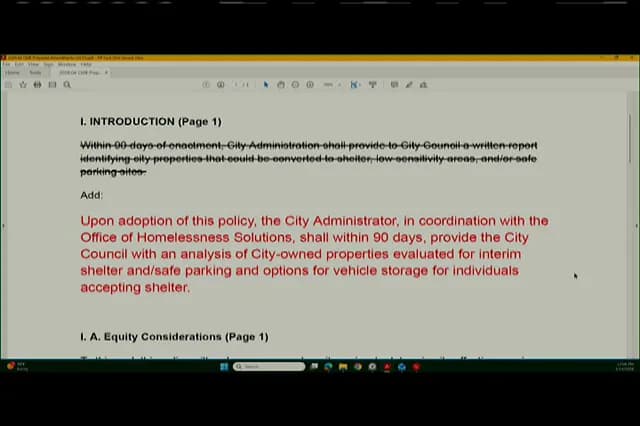
The Special Concurrent Meeting of the Oakland Redevelopment Successor Agency/City Council convened at 9:32 AM and adjourned at 12:40 PM on Tuesday, April 14, 2026. The council considered a single action item: a resolution to repeal the 2020 Encampment Management Policy and adopt a 2025 Encampment Abatement Policy (EAP). After extensive public testimony and debate, the council voted 5–1–1 (with one abstention and one excused) to adopt the resolution as amended. Seven council members were present: Noel Gallo, Zac Unger, Carroll Fife, Kevin Jenkins, Ken Houston, Rowena Brown, and Charlene Wang. Janani Ramachandran was excused. Modifications to the Agenda - Council President Jenkins moved, seconded by Councilmember Gallo, to reschedule Item 6.1 from the Consent Calendar to Non-Consent, allowing for public hearing and debate. The motion passed 7–0. Public Comments & Testimony - Supporters argued the current policy is failing, that the EAP provides needed clarity for enforcement, protects public health and safety, and helps reclaim public spaces. Speakers included representatives from BART (Henry Simons), Oakland Ballers (Laura Geist), Prescott Market (Mertz Development), neighborhood associations (David Johnson), business owners (Margarita Marin Parkin, Cindy Hart, Irena Itsexon), and the Oakland Metropolitan Chamber of Commerce (Joseph Guzman). Many emphasized the urgency of addressing encampments near schools, parks, and businesses, and noted that other cities have already adopted stricter policies. - Opponents contended the EAP criminalizes homelessness, lacks adequate shelter alternatives, will lead to costly litigation, and disproportionately impacts Black and brown communities. Speakers included members of the Homeless Advocacy Working Group (James Van), East Bay Community Law Center (Bridget Nicoletti, Carmen Hovella), St. Mary's Center (Renee Hayes, Al), Homefulness (including youth scholars), and numerous individuals with lived experience. They cited studies showing sweeps are ineffective, increase mortality, and violate constitutional rights, and urged investment in permanent housing and services. Some speakers questioned the legality of the meeting and the process, accusing the council of rushing the vote. - Neutral/ mixed positions: Some speakers supported the policy but requested changes, such as including West Oakland retail areas as high sensitivity, ensuring disability accommodations, and pairing enforcement with robust shelter investment. Discussion Items - Presentation by Councilmember Houston and staff: Councilmember Houston introduced the policy as a necessary update to address public health and safety, noting that the 2020 policy is not working. Patricia Brooks (policy staff) presented slides comparing Oakland to other cities, highlighting health risks (e.g., leptospirosis outbreak in Berkeley), fire hazards near BART tracks, and the need to align with state funding requirements. She emphasized that the policy balances compassion with accountability and includes standard operating procedures (SOPs) for humane treatment. - Expert testimony: Deputy Chief Tedesco (OPD) stated the policy provides clarity for limited resources; Director Josh Rowan (OakDOT) said it resolves confusion about whether towing inhabited vehicles is the responsibility of transportation or police; Fire Chief Covington noted RVs pose increasing fire dangers to firefighters and infrastructure; Assistant City Administrator Betsy Lake described administration-supporting amendments, including coordination with the Homelessness Strategic Action Plan. - Councilmember debate: Councilmember Unger expressed that the policy is a small necessary step—not a comprehensive solution—and that he was heartened by the removal of criminalization for homelessness and the inclusion of shelter offers. Councilmember Wang emphasized the need to protect families with children and ensure debris removal can happen without waiting for the EMAT team. Councilmember Brown proposed amendments for an equity analysis, a report on city properties for shelter/safe parking, and disability accommodations. Councilmember Fife strongly opposed the policy, arguing it does not answer the fundamental question of where people will go, and that it will disproportionately harm Black residents; she offered amendments to delay effectiveness until a shelter report is delivered and to document migration patterns. Council President Jenkins proposed a “Priority Zone Designation” allowing the City Administrator, in consultation with district councilmembers, to reclassify areas for enforcement based on objective criteria. Key Outcomes - The council adopted Resolution No. 91102 C.M.S. (amending Resolution No. 88341) by a vote of 5 ayes (Unger, Jenkins, Houston, Brown, Wang), 1 no (Gallo), 1 abstention (Fife), and 1 excused (Ramachandran). - Amendments adopted (incorporated into the policy): - Unger: Added language requiring SOPs for tow procedures, adequate notice, prioritization of dangerous vehicles (imminent hazards, highest priority zones), and citywide distribution of low-sensitivity areas. - Wang: SOPs must address families living in vehicles and avoid towing vehicles with children absent imminent risk; authorized OPW to conduct debris removal and sanitation; required EMAT to establish a method to contact displaced individuals for future shelter offers (voluntary). - Brown: Replaced the 90-day report requirement with an analysis of city-owned properties for interim shelter, safe parking, and vehicle storage; added an annual equity impact analysis conducted by the Department of Race and Equity and EMAT, including numbers of encampments addressed, residents served, recidivism, demographics, and resource expenditures; added disability accommodation provisions. - Fife: Policy effective the sooner of 90 days from adoption or the date the City Administrator presents the property report to council; added documentation requirements for closures, including findings of urgency, resources used, shelter offers, and migration tracking; disability accommodation language (similar to Brown’s). - Jenkins: Added Section II(C) establishing Priority Zone Designations by the City Administrator in consultation with the affected councilmember, based on objective criteria, with periodic public review. - The council also accepted the City Administrator’s request to reconcile Fife’s and Brown’s amendments on the effective date and report content, using Fife’s effective date language and Brown’s report requirements. - Next steps: The City Administrator, in coordination with the Office of Homelessness Solutions, must produce the property analysis within 90 days. The EAP becomes effective either 90 days from adoption or upon presentation of that report. Standard operating procedures are to be developed to guide implementation.
This special meeting of the Oakland City Council convened at 3:35 PM on Tuesday, April 14, 2026, and adjourned at 7:47 PM. Seven council members were present (Brown, Fife, Houston, Ramachandran, Unger, Wang, Jenkins); Councilmember Gallo was excused. The meeting featured a lengthy public hearing on a $915,135.40 proposed fine for illegal tree removal, a staffing report showing a 19.69% citywide vacancy rate, and unanimous approval of a lengthy consent calendar. Consent Calendar The consent calendar was approved 7‑0. It included: - Renewal of local emergencies for HIV/AIDS, medical cannabis access, and homelessness (Items 6.1–6.3). - Receipt of the City Auditor’s FY2024‑25 professional services contracts (Item 6.4). - Re‑appointment of Lisa Rasler to the Mosquito Abatement Board (Item 6.5). - Amendments to the Salary Ordinance: creation of a Constitutional Policing Administrator and Assistant Director of Human Services classifications, and salary adjustments for the Neighborhood Law Corps Attorney; the Parking Administrator position was removed per committee amendment (Item 6.6). - An ordinance to strengthen illegal dumping enforcement by increasing penalties and making it an offense to transport waste without a license plate (Item 6.7). - A license agreement with the Oakland Parks & Recreation Foundation for maintenance of Tyrone Carney Park at $0 fee for two years with five one‑year renewal options (Item 6.8). - A resolution supporting California Senate Bill 1218 to require payment of illegal dumping fines before vehicle registration can be completed; Councilmember Houston was added as a co‑sponsor (Item 6.9). - Commemorative street renaming of the intersection 39th & Telegraph Ave as “Bishop Charley Hames Jr., Way” (Item 6.10). - Authorization of a pilot program with Aerbits Inc. to use surveillance technology for illegal dumping detection, with a required report within one year (Item 6.11). - Approval of cooperative purchase agreements for citywide services up to $2.9 million (Item 6.12). - Authorization to purchase 3105 San Pablo Ave for $3,495,000 (plus $242,000 in Measure KK funds) for a future Hoover Branch Library (Item 6.13). - A two‑year contract with Law Enforcement Technology Solutions (LETS) for a phone system, total not to exceed $22,583.26 (Item 6.14). - Approval of the OPD Vehicle GPS Tracker policy and Surveillance Impact Report (Item 6.15). - Appointment of Razzu Engen to the Bicyclist Pedestrian Advisory Commission (Item 6.16). - Reappointments of Ingrid Severson, Cynthia Elliott, and Jacqueline Long to the Community Policing Advisory Board (Item 6.17). Public Comments & Testimony - Item 4.1 (Tree Ordinance Violation): 21 speakers, with many neighbors and environmental advocates expressing strong support for the full $915,135.40 fine. Multiple speakers from Trees for Oakland and Oakland Parks and Recreation Foundation described the 38 illegally removed trees (most were native oaks) as irreplaceable and urged enforcement. CAL FIRE’s urban forestry representative asked the city to “consistently enforce” the ordinance to protect state investments. Mr. Matthew Bernard (co‑owner) and his partner Lynn Warner argued that the trees were dead/dying and that they faced racial harassment from neighbors; they said they had applied for permits but never received responses. One neighbor, Peter Lee, described witnessing willful destruction and warned council members. - Item 4.2 (Citywide Staffing): 13 speakers, including city employees and union representatives, described the crisis. Seth Oyer (Oakland Firefighters) stated the fire department is budgeted for 500 positions but has only 418, forcing mandatory overtime; he said members are forced to work 14 consecutive days. An electrician reported that streetlight repairs take 6–8 months. Multiple Local 21 members highlighted a 29% vacancy in Oakland DOT and a 55% vacancy in tree services. They called for quarterly vacancy reports, faster hiring, and an end to expired eligibility lists. - Item 5.1 (Hazardous Materials Contract): One speaker asked about training to identify hazardous materials during volunteer clean‑ups. - Item 5.2 (Audit Recommendation Follow‑Up): Three speakers; Rajni Mandal urged council to ensure stalled audit recommendations are brought back with timelines until fully implemented. - Consent Calendar Open Forum: 14 speakers, overwhelmingly in support of the Hoover Durant Library property purchase. Speakers from Friends of Hoover Durant Library noted the neighborhood has been without a branch since 1981 and asked the city to fully fund library operations. Razzu Engen introduced themselves for the BPAC appointment. - General Open Forum: Two speakers; one criticized the parcel tax measure and asked for more attention to fentanyl and black community needs; another asked for discretionary funds to complete the library. Discussion Items 4.1 – Violation of Protected Tree Ordinance (38 trees removed at APN 48H-7672-18) - Staff Presentation: Kristen Hathaway (Public Works) presented the case. Staff recommended adoption of a resolution finding Matthew Bernard and Lynn Warner in violation and imposing a $915,135.40 fine (based on ISA tree valuation protocols). The property had 38 protected trees illegally removed between 2020 and 2022. The site is now prone to erosion and fire risk. Staff showed before/after photos. - Property Owner Testimony: Lynn Warner and Matthew Bernard maintained they acted in good faith, filed applications, and faced harassment. They alleged racial discrimination. - Council Deliberation: Councilmember Ramachandran (district 4) moved to adopt the full staff recommendation, noting the owners knew the law and continued cutting after six warnings. She emphasized enforcement of existing laws. Councilmember Brown summarized her analysis: the city lacked timely enforcement, permit denials may not have been properly communicated, and penalty estimates used stump measurements rather than direct tree diameter. Councilmember Houston asked about alternative penalty options (options 3 & 4 in the supplement). He made a substitute motion for option 4: a fine of $417,111.55 (based on 28 trees outside the building footprint, valued at 80% health, with stump‑to‑breast‑height reduction) plus a restoration plan. - Votes: The original motion (full fine) tied 4‑4 (Ramachandran, Unger, Wang, Jenkins in favor; Brown, Fife, Houston, Gallo absent against). The mayor declined to break the tie, so the motion failed. The substitute motion (option 4) failed 3‑4 (Brown, Fife, Houston in favor; Ramachandran, Unger, Wang, Jenkins against; Gallo absent). A third motion to continue the item to the May 5, 2026 council meeting passed 7‑0. 4.2 – Informational Report on City‑Wide Staffing (as of February 1, 2026) - HRM Presentation: Aaron Zadlow reported a 19.69% vacancy rate (839.75 vacant positions). The highest vacancy rates were in tree services (55%), HRM (45%), Police Commission (39%), and DOT (29%). Fire and police had the largest numbers of vacancies (121.5 and 114 respectively). Local 21 had the highest union vacancy rate (24.62%). Retirement separations were up 55.8% since 2021. The hiring process averages many months. - Labor Response: Union representatives (Local 21, SEIU, IAFF, IBEW) gave a joint presentation. They noted nearly 80% of vacancies are non‑sworn. They called for a citywide salary survey, renewal of the Vacancy Strike Force (funded at $250,000 in 2023 but never implemented), quarterly vacancy reports until the rate drops below 10%, and an end to expired eligibility lists. They pointed out that peer cities like San Francisco and San Jose have lowered their vacancy rates while Oakland’s remains stagnant. - Council Discussion: Councilmembers expressed frustration. Councilmember Wong asked why HR positions were only added in January 2026. Councilmember Unger urged HR to convene department heads for solutions. Councilmember Ramachandran cited public perception of hiring dysfunction. - Motion: President Jenkins moved to receive and file the report, and to require a biannual (twice‑yearly) informational report to the Finance & Management Committee. The motion passed 7‑0 (Gallo absent). 5.1 – Professional Services Agreement with Bayview Industrial Services (Hazardous Materials) - Staff presented a one‑year $500,000 contract (renewable for one year, total $1 million) for on‑call emergency hazmat collection and disposal. Council approved 6‑0 (Galloo and Ramachandran excused). 5.2 – Audit Recommendation Follow‑Up Report as of December 31, 2025 - City Auditor Michael T. Houston reported that 213 of 300 recommendations since 2014 (71%) are implemented. 87 remain open, including 13 from a 2019 OPD overtime audit that require IT investment or labor negotiations. The report includes examples of implemented items (e.g., police commission strategic plan, fire prevention enforcement). Council received and filed the report 6‑0. Key Outcomes - Item 4.1 continued to the May 5, 2026 council meeting without a decision on penalty. - Item 4.2 received and filed with a directive for biannual staffing reports to the Finance & Management Committee. - Item 5.1 (Bayview hazmat contract) approved 6‑0. - Item 5.2 (Audit follow‑up) received and filed 6‑0. - Full consent calendar approved 7‑0, including the Hoover Library property purchase and the illegal dumping enforcement ordinance (both to be introduced with final passage on May 5, 2026).
The Oakland City Council Special Education Partnership Committee convened at 3:36 PM on Monday, April 13, 2026, in the City Council Chamber, Oakland City Hall, and adjourned at 6:09 PM. Chairperson Councilmember Rowena Brown presided. Councilmembers Noel Gallo, Ken Houston (participating remotely), and Zac Unger were present. OUSD Board Members Rachel Latta, Jennifer Brouhard, Patrice Berry, and Valarie Bachelor were present. OUSD Youth School Board Members Marianna Smith (arrived at 3:47 PM) and Maximus Simmons were present. The committee received informational reports, heard public testimony, and voted unanimously (with one absence on Item 6) to receive and file all items. Consent Calendar - None. (Items 1 and 2 were action items on minutes and schedule; both were approved unanimously by roll call vote.) Public Comments & Testimony - Ms. Sada (multiple items): Criticized the committee for infrequent meetings (only two per year) and lack of follow-up on previous agenda items. Stated that the city and OUSD have failed African American children in education, housing, jobs, and policing. Challenged the process for approving $19 million in OCI funds for Garfield and Sancofa, alleging lack of proper city council approval. Also criticized school safety, illegal dumping mitigation, and the legitimacy of the Oakland Youth Vote process. Urged youth to challenge systemic problems. - Sam Davis (OCI Oversight Commission): Expressed initial skepticism about Measure AA but praised the work of OCI accountability officer Jennifer Caban and Oakland Promise’s Sandra Ernst. Highlighted increased early childhood access at Garfield and Sancofa as voter-worthy outcomes. - Laura Blair (Skyline parent): Thanked Nelson Alegria and Councilmember Brown. Asked that funding for the Violence Intervention Program (VIP) not be left to external sources, emphasizing the program’s importance after a shooting at Skyline. Called for collaborative funding from OUSD, county, and city. - Youth Commissioners (Item 5): Presented the 2024-25 annual report, highlighting the first Oakland Youth Vote (1,500 registered), grant-making work, and trainings on adultism. Ashley Chinyum defended the youth vote process as historic and legitimate. Discussion Items Item 3: Status of Oakland Children’s Initiative (OCI), Oakland Promise, and First 5 Alameda County - Presentation by Jennifer Caban (OCI Accountability Officer): Described OCI as a 30-year voter-approved investment (Measure AA) generating $30M/year for early childhood education and college access. Stressed system alignment, not just funding. Reported 1,900 children enrolled in early education (44% increase from FY22-23 to FY26-27), with 68% from top five high-need zip codes. Facing threats from federal uncertainty and budget deficits; emphasized sustainable investment and upcoming five-year guideline iteration. - Sandra Ernst (Oakland Promise): Reported since launch: nearly 3,400 babies enrolled in college savings accounts ($2M seeded), over $4M in scholarships to 7,000 students, and 45,000 kindergartners reached. OCI allocation to community subcontractors grew from $2.1M to $4M (28% of OCI allocation). Highlighted East Oakland Promise Neighborhood and leveraged state support via AB 1969. - Lisa Forti (First 5 Alameda County): Presented early education fund goals: universal preschool in Oakland, closing the enrollment gap for 2,700 unserved eligible 3-4 year olds. Reported 44% enrollment increase since OCI start. 51% of enrolled children are dual language learners, 50% from single-parent households, nearly 25% have IEPs. Maps showing enrollment aligned with high-need zip codes. - Councilmember and Board Questions: Councilmember Brown asked about hearing directly from families (referred to AIR evaluation on April 23). Vice President Bachelor and President Brouhard asked about data sharing agreements (challenging due to MOUs and FERPA). Youth Board Member Smith asked about proactive vs reactive cleanup and collaboration with students. Item 4: Oral Report on Illegal Dumping Mitigation Near School Campuses - Presentation by Liam Garland (Public Works Director): Described the “Three E’s” – Eradication (10,000 tons/year, 25,000 service requests), Enforcement (7 environmental enforcement officers, 36 cameras, new aerial imagery pilot to be approved) and Education (promoting free bulky pickup for residents; only 9-25% capacity used). School-specific: proactive abatement before school start, dedicated site contacts to escalate issues, and future prioritization of service requests near schools (3-6 months). Announced 34 crossing guards hired, 8 more joining, 31 vacancies remain. - Councilmember and Board Questions: Youth Commissioner Smith asked about proactive cleanup frequency (5-10% proactive due to encampment work). President Brouhard concerned about reliance on site staff reporting; suggested using aerial imagery to prioritize schools. Vice President Bachelor asked about bulky pickup per unit, camera locations, and possibility of returning to a zone system. Director Garland noted zone system being revived with new resources. Councilmember Houston asked about hazmat training for EEOs (Garland promised follow-up in 2-3 days). Item 5: Report from Oakland Youth Commission - Presentation by Sarah Tyrus (staff) and youth commissioners: Reported 19 commissioners in 2024-25, increased BIPOC representation to 95%, OUSD student representation to 79%. Highlights: 100% reported increased confidence; 1,500 youth registered for first Oakland Youth Vote (Nov 2024); published a youth vote toolkit; participated in grant-making with RECAST and Oakland Fund for Children and Youth; provided adultism trainings. Received Youth Organization of the Year award from Assemblymember Mia Bonta. Upcoming: May 2 event reimagining 980 freeway space; presentation to school board on April 22. - Councilmember and Board Reactions: Councilmember Brown praised the work and suggested a city council candidate forum. President Brouhard expressed interest in adultism training for school board. Vice President Bachelor noted training is available. School Board Member Simmons congratulated commissioners. Councilmember Houston voiced pride in their public speaking. Item 6: School Safety Update from Oakland Unified School District - Presentation by Nelson Alegria (OUSD) and student Iman Ibrahim: Outlined safety framework post-George Floyd Resolution (GFR) – removed school police, redirected $6M+ to site-based staff. Currently 419 FTE (535 including part-time) focused on counselors, restorative justice, social workers, culture keepers. Total investment increased despite budget challenges. Calls to police reduced from over 2,000 pre-GFR to significantly fewer. Launched CAT mental health crisis pilot (reduced crisis calls from 38 to 9). VIP program (violence interrupters, life coaches) funded by city DVP grant; OUSD studying transition plan as grant ends. Student Iman Ibrahim presented new Student Safety & Violence Prevention Committee collecting data on de-escalation and culture keeper behavior; data to be presented May 13. - Councilmember and Board Questions: Councilmember Brown asked about service impacts from OUSD budget (none on safety staff). Asked about VIP transition plan – OUSD assessing data and prioritizing sites; transition memo expected before next school year. Vice President Bachelor and President Brouhard called for stable funding for VIP, supported Measure E parcel tax extension. Councilmember Brown noted city listed VIP as a state/federal funding priority. Key Outcomes - Item 1 (Approval of Minutes): Motion by Gallo, seconded by Unger. Passed 4-0. - Item 2 (Schedule of Outstanding Committee Items): Motion by Unger, seconded by Gallo. Passed 4-0. - Item 3 (OCI Report): Motion by Unger, seconded by Brown. Received and filed 4-0. - Item 4 (Illegal Dumping): Motion by Brown, seconded by Houston. Received and filed 4-0. - Item 5 (Youth Commission Report): Motion by Brown, seconded by Gallo. Received and filed 4-0. - Item 6 (School Safety): Motion by Brown, seconded by Unger. Received and filed 3-0 (Houston excused). - Open Forum: One speaker (Ms. Sada) criticized Measure E and alleged corruption. - Meeting Adjourned at 6:09 PM. Note: The agenda stated the meeting was noticed as a Special Meeting of the City Council due to quorum, but no final City Council action was taken.
The Rules & Legislation Committee of the Oakland City Council convened at 10:33 AM on April 2, 2026, in the City Hall Council Chamber. The meeting adjourned at 10:57 AM. All three present members (Councilmembers Brown, Fife, and Jenkins) voted unanimously on all items, with Councilmember Ramachandran excused. The committee handled scheduling of appointments, rule changes, contracts, and land declarations to future meetings, and reviewed draft agendas and pending lists. Public comments focused on transparency, governance, and specific concerns about item scheduling. Public Comments & Testimony - On Item 3 (New Scheduling): Blair Beekman commented on items 3.1, 3.2, and 3.3, expressing hope for collaboration between the Bicyclist Pedestrian Advisory Commission and the Community Policing Advisory Board, and support for hybrid meeting rules (Rule 33). Kevin Daly requested clarity on how the City Administrator would determine a "critically needed position" for the 180-day waiting period exception (Item 3.4) and expressed interest in Zoom access for other meetings. Brianna Horton did not speak. - On Item 4 (Review of Draft Agendas): Rajni Mandal (District 4) requested that item 24036 (police oversight governance) be re-agendized for a future council meeting, citing structural problems and inconsistent processes. Kevin Daly requested that items related to the parking administrator position be placed back on the Finance Committee pending list before moving to full council. Blair Beekman commented on upcoming Finance Committee discussions on public safety and trash issues, and urged continued community dialogue. - Open Forum: Rajni Mandal criticized the Police Commission for making a decision in closed session without public agenda notice, questioning consistency with past practice and risking progress under federal oversight. Blair Beekman commented on upcoming SB 707 requirements for hybrid meetings and expressed hope for governance improvements. Discussion Items - Item 3 – New Scheduling Items (3.1–3.9): The committee considered resolutions to schedule various items to future meetings: - 3.1: Confirmation of Razzu Engen to the Bicyclist Pedestrian Advisory Commission – scheduled to April 14 Special City Council on consent. - 3.2: Reappointments to the Community Policing Advisory Board (Ingrid Severson, Cynthia Elliott, Jacqueline Long) – scheduled to April 14 Special City Council on consent. - 3.3: Adding Rule 33 to Council’s Rules of Procedure (hybrid meetings and technological disruptions) – scheduled to April 16 Rules & Legislation Committee. - 3.4: Exception to 180-day waiting period for retired annuitant – originally scheduled to April 21 Finance & Management Committee, but amended to May 12 Finance & Management Committee per the minutes. - 3.5: MacArthur Transit Village Phase One certificate of completion – scheduled to April 21 Special Public Works & Transportation Committee. - 3.6: Resilience Hub Grant funds disbursement to Oakland Parks and Recreation Foundation – scheduled to April 21 Special Community & Economic Development (CED) Committee. - 3.7: Surplus land declaration for four city-owned parcels – scheduled to April 21 Special CED Committee. - 3.8: Exclusive Negotiation Agreement with Museum of Jazz & Art – title change accepted; scheduled to April 21 Special CED Committee. - 3.9: Ceasefire-Lifeline contracts (amendment with University of Pennsylvania and grant to Faith in Action East Bay) – scheduled to April 21 Special Public Safety Committee. The committee voted 3-0 to approve the package as amended. - Item 4 – Review of Draft Agendas and Pending Lists: The committee noted cancellation of the April 7 City Council and April 9 Rules & Legislation Committee meetings. Councilmember Wang’s request to move the Outfront Foster Interstate LLC advertising signs relocation agreement (item 26-0293) from the April 21 CED agenda to the CED pending list with no date specific was accepted. Pending lists for Finance, Public Works, CED, Life Enrichment, Education Partnership, Public Safety, Rules, and Port Liaison committees were reviewed. The committee voted 3-0 to approve the pending lists as amended. Key Outcomes - Item 3 approved as amended (3-0): All scheduling items were assigned to their respective future meetings as listed above, with Item 3.4 moved to May 12 FMC. - Item 4 approved as amended (3-0): The Outfront Foster Interstate LLC item was withdrawn and rescheduled to the CED pending list; all other pending lists approved. - Meeting adjourned at 10:57 AM.
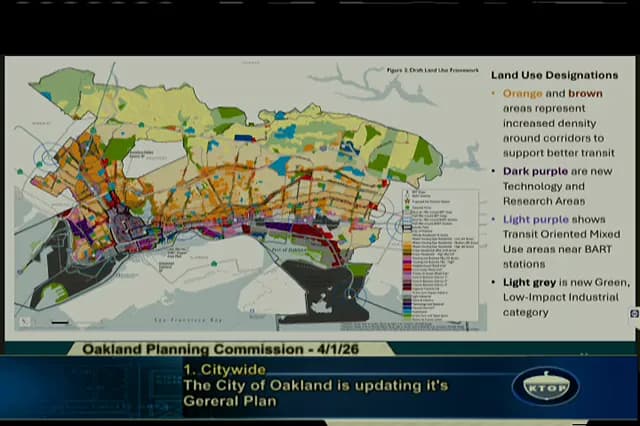
The Oakland Planning Commission met on April 1, 2026, at 11:00 AM. The meeting was called to order with all four commissioners present (Commissioners Maurice Rob, Zorzy Ahrons, Vice Chair Natalie Sadoval, and one additional commissioner). No director's report, informational reports, or committee reports were given. The chair noted that the April 15 planning commission meeting is canceled, but the residential appeals committee will meet. Commission matters included requests for data on deed-restricted unit rents and vacancies (to be reported in May), discussion of SB 79 where staff and planning commission recommendations differed from council's final decision, and an update on the conversion of 1428 105th Avenue from senior to family affordable housing (code violations resolved). Public Comments & Testimony - 6230 Claremont Avenue Project (Open Forum): Four speakers addressed the commission. Layla Goff (Rockridge resident, steering committee Rockridge Neighbors for Sensible Housing) stated that over 1,100 neighbors signed a petition against the project's height and mass, which she described as fundamentally out of scale with the neighborhood. She requested clarity on the review timeline, including CEQA evaluation and public notice. Kerry Goff (resident) raised legal concerns about the state density bonus law's constitutionality and argued it creates specific adverse impacts on evacuation, emergency vehicle access, and pedestrian safety. Paul Laurie (Rockwell Street resident) highlighted narrow streets and unsafe crosswalks, citing a recent fatal accident near the site, and urged an independent traffic and pedestrian safety analysis. Mary Biagini (60-year resident, employee at St. Paul's Towers) argued that 99 parking spots are inadequate for a luxury senior facility due to staff, service workers, and private caregiver needs. - General Plan Update (Public Hearing): Jules Brugier (resident, teacher, coordinator for South Prescott Lower Bottoms Neighbors Association) expressed support for the corridor and neighborhood center emphasis but advocated for more aggressive zoning liberalization, including opt-in zoning, to encourage development and housing. Commission Matters - Data Request: A commissioner requested data on rents and vacancies for deed-restricted units by income (moderate income). Staff confirmed this will be reported as part of the Annual Progress Report (APR) coming to the commission in May. - SB 79 and Staff Recommendation: A commissioner asked for clarification on the planning commission's motion regarding SB 79 and staff's differing recommendation to city council. Staff explained that the commission's recommendation was carried forward, and council ultimately made a decision different from both staff and commission recommendations. - 1428 105th Avenue Update: Staff provided an update on this property, approved in 2017 as senior affordable housing. The owner converted it to family affordable housing in 2024, permitted by the state. The city opened an enforcement case for code violations, which have been resolved. The project is now operational without active violations. General Plan Update – Draft Land Use Framework Staff (Khalila Haynes and Daniel Finley) presented the draft Land Use Framework, the next step from the "Options for How We Stabilize and Grow" report presented last fall. The framework is based on the "City of Neighborhoods" concept, which was the most popular option, and incorporates strategies from other options. Key proposals include creating complete walkable neighborhoods, major centers (Downtown, San Antonio, Fruitvale, Coliseum), increased density along corridors and near BART stations, new technology and research areas, green low-impact industry buffers, a greenway network, and anti-displacement measures. Community engagement reached over 1,300 people directly. Commissioners discussed several topics: - Public Lands Policy: Commissioners Lee and Ahrens stressed the need for a formal public lands disposition policy, noting the draft mentions it only once. Staff noted the Housing Element includes action items on using public lands for affordable housing. - Transit Collaboration: Commissioners emphasized close collaboration with AC Transit to align infrastructure and service improvements with land use densities. - Noise Element: A commissioner asked about coordination with enforcement staff; staff confirmed ongoing conversations and that the noise element will set high-level policy while planning code addresses specific decibel standards. - Trade-offs from Options: Staff explained that Option C (Waterfront District) was not fully carried forward; a new neighborhood center near the waterfront was included instead. - Anti-Displacement: Staff referenced the city's anti-displacement framework and ongoing research on green gentrification. - Racial Equity: Multiple commissioners praised the framework's continued focus on racial equity despite changing federal environment. Key Outcomes - Public Lands Policy Referral: Commissioners urged that a comprehensive public lands policy be strengthened in the final elements, suggesting ground-leasing models from other cities. - General Plan Update Next Steps: The draft framework will be open for public engagement until April 23, 2026. Several community workshops are scheduled in April. Staff will incorporate feedback and produce draft elements for each of the four phase-two elements (LUTE, OSCAR, Noise, Infrastructure/Capital Facilities) in fall 2026. - 6230 Claremont Avenue Update: The project (PLN26025) is still in completeness review. If deemed complete, staff will have 60 days to make zoning consistency findings. The project is eligible for staff-level design review, appealable to planning commission. - March 18 Minutes Approved: Unanimously approved (4-0). - Meeting Adjourned at 4:04 PM.
The Oakland City Council Rules & Legislation Committee convened on March 26, 2026, at 10:31 AM to approve minutes, schedule numerous items to future committee and council meetings, and receive an informational report on charter reform recommendations from the Mayor's Charter Reform Working Group. The committee approved all scheduling items unanimously and received the charter report, with extensive public comment. The meeting adjourned at 12:33 PM. Consent Calendar - Approval of Draft Minutes: Approved the minutes from the committee meetings of February 26, March 5, and March 12, 2026 (3-0). - New Scheduling Items (Item 3): Approved as amended (3-0) the scheduling of over 30 items to various committees and council meetings, including: - Items 3.1–3.4 scheduled to the April 13, 2026 Special Education Partnership Committee. - Items 3.5, 3.6, 3.7, 3.27, 3.28, 3.29, 3.30, 3.34, 3.35, 3.36, and 3.38 scheduled to the April 14, 2026 Special City Council agenda (most on consent, some on non-consent). - Item 3.8 moved to the May 12, 2026 Finance & Management Committee. - Items 3.17 and 3.18 moved to the Public Safety Committee pending list, no date specific. - Item 3.19 scheduled to the May 5, 2026 City Council agenda on consent. - Other items as detailed in the minutes. - Review of Draft Agendas (Item 4): Approved as amended (3-0), including scheduling changes to pending lists and the encampment abatement policy to the April 14, 2026 Special City Council agenda at 9:30 AM on non-consent. Public Comments & Testimony - On Item 3 (New Scheduling): Three speakers addressed the committee. Kevin Daly questioned the removal of the parking administrator from the salary ordinance. Rajni Mandal urged council to consider structural and performance reviews for police oversight bodies before adding resources. Blair Beekman spoke on multiple items, including police oversight and illegal dumping. - On Item 5 (Charter Reform): Approximately 26 speakers (as per minutes) provided testimony. Many opposed the strong mayor recommendation and advocated for a council-manager system or a "third option" combining a strong mayor on the council with a professional city manager. Speakers included Stephen Falk, Nancy Falk, Steve Cohn, Mark Sowicky, Pat Martell, and others. Supporters of the strong mayor recommendation included Keith Brown and Richard Fuentes. Former Mayor Libby Schaff shared her experience with the strong mayor system under Jerry Brown and cautioned against another hybrid. Debate centered on accountability, representation, and the appropriate structure for Oakland. - Open Forum: Seven speakers addressed topics including police overtime, permit fee enforcement, and the charter reform process. Discussion Items - Item 5: Informational Report on Charter Reform Recommendations: The Mayor's Charter Reform Working Group, co-facilitated by Gail Wallace and Nicole Neditch, presented its recommendations. The working group recommended that Oakland adopt a fully integrated strong mayor system, with a strengthened city council (including a legislative budget analyst office, return to an odd number of council seats, and a consistent salary-setting mechanism for all elected officials). The presentation highlighted four key themes from community outreach: severe fiscal distress, racial and geographic inequities, lack of decisive authority, and a highly engaged civic culture. Councilmembers heard public comments and expressed intentions to continue community engagement. Councilmember Brown stated she could not support eliminating the at-large seat and favored a "third option" model. Councilmember Ramachandran noted the need for further input. Councilmember Houston (not on the committee) also spoke in favor of a third option. The committee voted to receive and file the report. Key Outcomes - Votes: - Approved minutes (3-0). - Approved New Scheduling Items as amended (3-0). - Approved Review of Draft Agendas as amended (3-0). - Received and filed Item 5 (Charter Reform Report) (3-0). - Scheduling Changes: Numerous items were assigned to specific future meetings as detailed above. Key changes include moving items 3.17 and 3.18 to the Public Safety Committee pending list and rescheduling the encampment abatement policy for April 14, 2026. - Next Steps: The charter reform discussion will be continued at a future full City Council meeting, likely in the evening to allow broader public participation. Councilmembers committed to ongoing community engagement.
The Oakland City Council Public Works and Transportation Committee convened on March 24, 2026, at 11:34 AM, chaired by Councilmember Zac Unger, with members Noel Gallo, Ken Houston, and Charlene Wang present. The meeting was adjourned to a special meeting of the full council at 11:38 AM due to the presence of a quorum (Councilmember Brown joining via Zoom), but committee business continued. The agenda was reordered to items 4, 5, 7, 8, 6, and 3. All items received unanimous approval and were forwarded to the April 14, 2026 special city council consent agenda, with amendments noted. The meeting adjourned at 1:43 PM. Consent Calendar - Approval of Minutes (March 10, 2026): Approved unanimously (4-0) as presented. - Determination of Schedule of Outstanding Committee Items: Approved unanimously (4-0). Councilmember Gallo requested a future report from Public Works on staffing levels and vehicle availability. Public Comments & Testimony - Item 4 (BPAC Annual Report): One speaker, David Ralston (immediate past chair of BPAC), presented the report and answered questions. He emphasized the commission's support for safer streets, greenway networks, and equity in transportation. Councilmember Houston expressed concern about higher traffic fatality rates for Black Oaklanders (2-3 times more likely) and requested demographic data. - Item 5 (SB 1218 Support): One speaker, Mary Forte (East Oakland resident and activist), supported the bill but noted that vehicles without plates remain a problem. She also urged better enforcement. - Item 7 (Illegal Dumping Enforcement Ordinance): Three speakers: David Boatright (District 4) questioned enforcement capacity and funding; Kevin Dowley (BPAC member) praised progressive penalties; Mary Forte supported the ordinance but noted the fines were lower than county proposals and called for more enforcement officers. - Item 8 (Aerbits Pilot Program): Four speakers: David Boatright reiterated enforcement concerns; Mary Forte supported the pilot as a cleanup tool, not enforcement, and asked about San Francisco's experience; Kevin Dowley passed; one additional speaker from Zoom (not named) supported the pilot. - Item 3 (Climate Action Plan): One speaker, Kevin Daly (BPAC), raised concerns about the cost of building electrification for low-income homeowners and the need for state-level policy changes. - Open Forum: Three speakers: Kevin Dowley passed; David Boatright passed; Mary Forte announced an April 20 public meeting and requested a formal oversight committee for illegal dumping, asked about funding for the Aerbits pilot, and requested a report on the mayor's D.C. trip. Discussion Items - Item 4: 2025 BPAC Annual Report: Informational report received and filed. David Ralston presented seven key recommendations: (1) citywide greenway network, (2) reduce fatal traffic crashes, (3) implement immediate traffic calming, (4) prioritize complete streets, (5) balance traffic safety and emergency response, (6) fast-track waterfront connections to East Oakland, and (7) improve interagency coordination. Councilmembers discussed equity, enforcement, and community engagement. - Item 5: Resolution in Support of SB 1218 (Arreguín): The committee voted to forward the resolution to the full council. The bill would require payment of illegal dumping fines before vehicle registration can be completed. Councilmember Houston noted that many dumpers use unregistered vehicles; Councilmember Wang asked about the need for license plate readers and enforcement. Staff clarified that Public Works has 36 cameras with LPR capability. - Item 7: Ordinance to Strengthen Illegal Dumping Enforcement: The committee approved an amended ordinance that increases penalties (up to $1,500 first offense, $2,500 second, $5,000 third), makes transporting waste without a license plate a violation, and ties enforcement to the vehicle. Councilmember Wang added an amendment restoring daily civil penalties of up to $1,000 per day for commercial quantities, hazardous waste, mattresses, furniture, appliances, and e-waste. Councilmember Houston called for higher fines (up to $20,000 and jail time for hazardous dumping). The ordinance was forwarded to the full council. - Item 8: Resolution to Authorize Aerbits Inc. Pilot Program: The committee approved a six-month pilot ($150,000) using aerial drones to detect and report illegal dumping for proactive cleanup. The system is privacy-first (no facial recognition, no LPR, masks private property). The pilot will cover 5–10 square miles of hotspot areas. Councilmember Houston requested that the pilot location be determined in consultation with councilmembers. The resolution was forwarded to the full council. - Item 6: Commemorative Street Renaming for Bishop Charley Hames Jr.: The committee approved a resolution to rename the intersection of 39th and Telegraph Avenue as "Bishop Charley Hames Jr., Way" and install a plaque. The item was forwarded to the full council. - Item 3: 2023-2025 Progress Implementing the 2030 Equitable Climate Action Plan (ECAP): Informational report received and filed. Staff reported that 40 ECAP actions are progressing, with highlights including a 50% reduction in port black carbon, all-electric new construction, and over 200 miles of bikeways. Councilmember Wang emphasized the need for the energy transition to create jobs and support communities without college degrees. Key Outcomes - All items received unanimous approval (4-0) on motions by committee members. - Items 5, 6, 7, and 8 were forwarded to the April 14, 2026 special city council meeting at 3:30 PM on the consent agenda. - Item 7 (Illegal Dumping Ordinance) was amended to include daily civil penalties (up to $1,000/day) for commercial/hazardous waste, as proposed by Councilmember Wang. - Items 2, 3, and 4 were received and filed (informational). - Councilmember Gallo requested a report on Public Works staffing and vehicle availability at the next city council meeting. - Councilmember Houston requested demographic data on traffic fatalities among Black Oaklanders from the BPAC. - Councilmember Gallo and others emphasized the need for stronger enforcement, more personnel, and better coordination with other agencies. - Public comment called for a formal oversight committee on illegal dumping and regular agenda items on the topic.