Browse by city
Date range
Search help

Search titles, summaries, topics and stored transcripts together. Keywords may match separately; put the whole query in double quotes for a phrase. Matching follows word analysis, so punctuation is not exact. Both dates are included. Documents are not searched.

SHOWING 11–20 ENTRIES
11
SEP 22, 2026 · OLYMPIA, WASHINGTON · CITY COUNCIL & COMMISSIONS
City of Olympia Finance Committee Meeting Summary - September 22, 2026

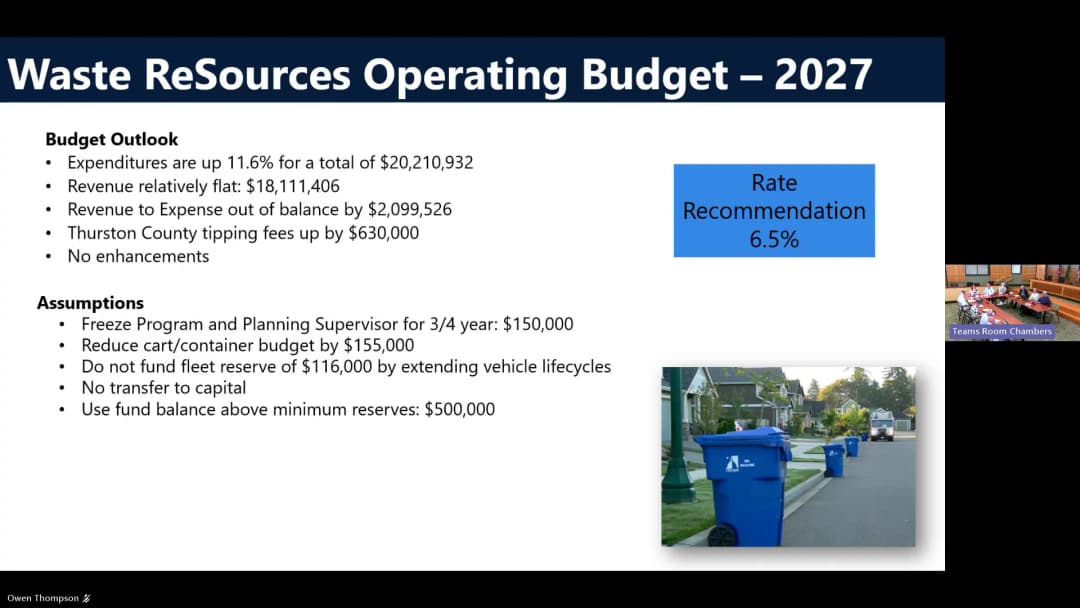
Date Note: The source agenda, minutes, and transcription all identify this meeting as having taken place on Monday, September 21, 2026, beginning at 4:30 PM. The date used in this title is provided per external directive and does not match the source material. Committee Members Present: Chair Clark Gilman, Kelly Green, Robert Vanderpool. The Olympia Finance Committee met to consider and approve the recommended 2027 Utility Rates, General Facility Charges, Impact Fees, and a suite of special (dedicated) revenue budgets, including Inspire Olympia, Lodging Tax, Parking & Business Improvement Area (PBIA), and Housing/Homeless Response programs. The Committee subsequently received an update on the 2027 General Fund budget balancing process, reviewing the projected deficit, department enhancements, and potential tools to achieve a balanced budget. Consent Calendar - Approval of Agenda: The meeting agenda was approved unanimously. - Approval of Minutes: The minutes from the August 17, 2026, Finance Committee meeting were approved unanimously. - Approval of 2027 Rates, Fees, and Special Revenue Budgets: Following the extensive discussion, a motion to approve and forward the entire package of 2027 Utility Rates, General Facility Charges, Impact Fees, and Special Revenues to the full City Council was made by Committee member Green, seconded by Committee member Vanderpool. The motion carried with a vote of 3-0 (Chair Gilman, Green, Vanderpool voting aye). Public Comments & Testimony - No members of the public signed up for comment, nor were any present in the gallery. Discussion Items 6.A: 2027 Utility Rates, General Facility Charges, Impact Fees, and Special Revenues The committee heard detailed presentations covering numerous funds and fee schedules: - Lodging Tax Fund (Amelia Leighton): Estimated 2027 revenue is $1.005 million. A minimum reserve of approximately $300,000 (20% of expected contracts) is recommended. The Washington Center will now apply for competitive funding alongside other applicants due to state law changes. City Manager Jay Burney noted early discussions with the Squaxin Island tribe regarding lodging tax offsets as their property develops. - Inspire Olympia / Cultural Access Fund (Mary Grace Gadoo): Funded by one-tenth of 1% of sales tax effective through 2029. A gradual spend-down plan is in place for a carryforward balance of $3.37 million, aiming to reach 15-20% of program obligations by 2030. - Parking & Business Improvement Area - PBIA (Jenica Machado): No collection is planned for 2027. A phase two evaluation is underway with heavy local engagement, with recommendations expected after March 2027. The fund has a small surplus from prior years to cover approximately $27,000 in planned expenses. - Housing & Homeless Response (Ashley Chambers): The 2027 budget projects approximately $5.3 million in revenue from over ten funding sources, with $5.2 million in expenses, resulting in a small surplus. Operational funding sustainability and the transition of the Jungle encampment were highlighted as major challenges. Councilmember Green requested that future presentations clearly separate housing encouragement/tenant protection funding from emergency shelter/homeless services funding. - Community Development Fees & Impact Fees (Nicole Floyd): The development fee fund (006) has a projected $977,000 deficit. Staff presented options for balancing, including an 8% increase in permit fees (rather than the baseline 4.5% CPI match) and increasing the technology fee from 4.1% to 5%. A comprehensive fee study is overdue. Proposed impact fee changes include a 10% increase for transportation impact fees, while the new parks impact fee methodology (based on square footage with a minimum) is already in practice. - Parking Rates (Mark Russell): No rate increase is proposed for on-street parking fees. Staff proposed increasing reservation fees for bagging meters to better recover coordination costs, including a $40 fee for less than 48 hours’ notice. Councilmember Green asked staff to follow up on disabling advertising prompts in the parking payment app. - Utility Rates (Gary Franks, Ron Jones, Mike Vesey): Staff presented the proposed 2027 rate increases across all four utilities, driven largely by rising PSE power costs, increased indirect costs, and high cumulative CPI. The proposed rate increases are: Waste Resources (6.5%), Drinking Water (4.5%), Stormwater (8.7%), and Wastewater (9.5%). This results in a total average bi-monthly utility bill increase of 5.5% ($19.51), bringing the total to $353.04. Staff presented affordability metrics (EPA 2% of median household income threshold and an 8-hour minimum wage threshold), noting the proposed rates remain under both benchmarks. - Councilmember Vanderpool raised the concept of income-tested utility tiers to create a more progressive rate structure. - Chair Gilman noted that rising energy costs may shift the financial calculus for capital investments in energy efficiency and local energy production. 6.B: 2027 Proposed Budget Update Finance Director Mike Githens and City Manager Jay Burney outlined the current state of the 2027 General Fund budget. The budget currently has a $3.8 million gap. Key elements of the discussion included: - Enhancements: A list of Category 1 (high-need) enhancements was reviewed, including a prosecuting attorney, an event planning staffing model (to be discussed in an October 13 study session), a signs and signal operations supervisor, an HR position, climate funding (a range of $100,000 to $500,000 was presented), and an engineer position in drinking water to also support transportation projects. Staff noted that if funded, the Plum Street corridor study and downtown strategy update likely cannot be done simultaneously due to capacity. - Balancing the Gap: City Manager Burney expressed confidence in closing the $3.8 million gap. Potential offsets include the new construction property tax levy ($200k–$700k), a surplus in the workers’ compensation reserve ($1M–$1.5M), lower than expected benefits rates, and adjustments to the development fee fund forecast. - Interest Sweeping: A concept was introduced by staff regarding sweeping interest earnings from specific funds into the General Fund. Staff stated this is a one-time tool used by other cities and estimated a potential of over $2 million in total available interest. The City Manager recommended a conservative approach, using small amounts ($100k–$200k) annually rather than large one-time sweeps, and noted the practice would require a council ordinance. - Year-End Projection: The 2026 projected year-end balance is approximately $2.24 million above the mandatory 10% minimum reserve. Key Outcomes - Approved Package (3-0): The committee approved and forwarded to the full City Council the recommended 2027 Utility Rates, General Facility Charges, Impact Fees, and budgets for the Lodging Tax Fund, Inspire Olympia, PBIA, and Housing/Homeless Response programs. - Directives to Staff: Prior to presentation to the full council, staff will add clarifying slides, including a summary of expenditures for the Housing/Homeless Response fund and a revenue/expenses overview for the Parking Fund. - Next Steps: A council study session is scheduled for October 13, 2026, to further discuss event planning staffing, budget balancing, and the proposed climate funding range. The preliminary budget document will be released on October 1, 2026. - Concept Referred: The concept of interest sweeping was introduced and will be explored further by the council as a potential balancing tool.
BUDGET EQUITY ANALYSIS 23% · AFFORDABLE HOUSING 8% · FISCAL SUSTAINABILITY 7% · WATER AND WASTEWATER MANAGEMENT 7%
12
SEP 21, 2026 · OLYMPIA, WASHINGTON · CITY COUNCIL & COMMISSIONS
Land Use & Environment Committee Meeting Summary - September 21, 2026

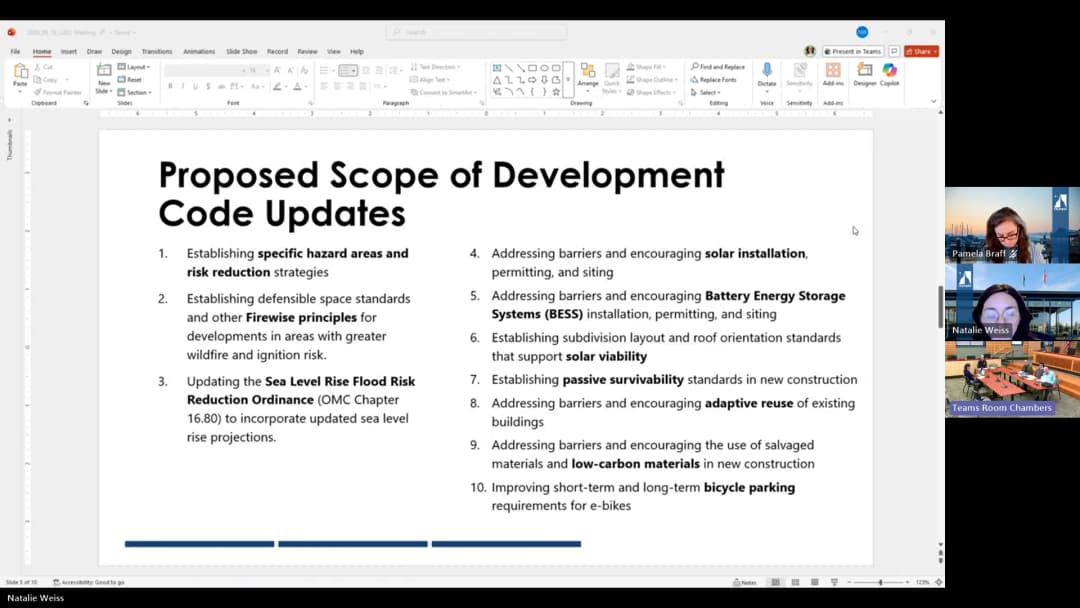
The Land Use & Environment Committee met on September 21, 2026 to discuss home-based business code amendments, tree protection measures, development code updates for climate implementation, and middle housing infrastructure policy. After public testimony and deliberation, the Committee voted to send the home-based business amendments back to the Planning Commission, endorsed staff's tree protection guideline changes with additional emphasis on large trees, reviewed the scope of climate code updates, and deferred a decision on middle housing utility requirements to a future meeting. Public Comments & Testimony - Courtney Nevitt (South Capitol neighborhood resident) opposed new rules that could make it easier for businesses to turn homes into office buildings, stating that non-resident corporations do not have a stake in the neighborhood and that such conversions remove housing permanently. - Marianne Tompkins praised the director's interpretation on tree, soils, and native vegetation, urging guidance to preserve trees 36 inches and over. - Lynn Fitzhugh supported the director's memo and called for stronger protection of the largest trees, noting they provide 50% of carbon drawdown in forests. She suggested three options: include 36-inch tree guidance in the interpretation, pass permanent protection now, or shorten the two-year timeline for the urban forest plan. - Christine Brewer (South Capitol homeowner and lobbyist) expressed disappointment at earlier comments about lobbyists and urged support for the Planning Commission's recommendation to send the home-based business ordinance back for more work, ideally integrating with upcoming small-scale commercial use discussions. - Heather Burgess (attorney for South Capitol Neighborhood Alliance) thanked staff and the Planning Commission but argued the current proposal remains problematic due to enforcement difficulties and the existence of existing codes addressing parking, paving, and commercial conversions. She urged remanding the proposal to the Planning Commission and deferring further regulation until small-scale commercial regulations are developed. Discussion Items - Home Based Businesses Code Amendments – Planning Commission Chair Greg Quetin summarized the Commission's concerns about enforcement and the distinction between regulated home business activity and remote work. Committee members discussed the need for clearer answers. A motion to send the consideration back to the Planning Commission for further work passed unanimously (3-0). - Tree Protection Measures Briefing – Community Development Director Tim Smith and Urban Forester Leanne Wells presented procedural changes to strengthen tree preservation during development review, including pre‑submission site visits, required urban forestry scoping meetings, certified arborist reports, and written analysis when tree removal is proposed. Committee members expressed support for preserving larger trees (36‑inch diameter or greater) and asked staff to incorporate that emphasis into the director's interpretation. Staff agreed to bring the updated interpretation to the next meeting. - Proposed Scope of Development Code Updates to Implement the Climate Element – Climate Resilience Coordinator Natalie Weiss outlined a one‑year grant‑funded project to analyze 10 focus areas including hazard risk reduction, solar infrastructure, passive survivability, adaptive reuse, low‑carbon materials, and e‑bike parking. The project would result in code amendment recommendations by June 2027. Committee members endorsed the scope and added interest in addressing extreme heat, vehicle miles traveled, and microgrids. No changes to the scope were requested. - Middle Housing Infrastructure Policy Discussion – Planning Director Nicole Floyd, Engineering Manager Susan Clark, and Plans Examiner Zulaika Kim presented challenges arising from the mix of ADUs, middle housing, condominiums, and unit‑lot subdivisions. Key issues included shared versus independent utility hookups, fire sprinkler requirements, step sewer systems, and frontage improvements. The Committee discussed the tension between affordability (shared lines) and avoiding future problems (independent lines). No decisions were made; staff will refine the policy options and bring a focused proposal on utility connections to the October 22 meeting. Key Outcomes - Vote: The Committee voted unanimously (3‑0) to send the Home Based Businesses Code Amendments back to the Planning Commission for further work, with a suggestion to coordinate with neighborhood and business stakeholders. - Tree Protection: Staff will amend the director's interpretation to explicitly encourage preservation of trees 36 inches or larger (considering health, species, and location) and will present the updated version at the October 22 meeting. - Climate Code Updates: The proposed scope was accepted as presented; staff will proceed with the project and continue engagement. - Middle Housing Infrastructure: The Committee deferred a decision. Staff will present a refined recommendation on utility hookup requirements at the October 22 meeting, with special attention to small‑scale retrofits. - Next Meetings: October 22, 2026 at 4:00 PM; a special November meeting scheduled for November 19 at 5:00 PM to address remaining items.

LAND USE PLANNING 27% · TREE MANAGEMENT 14% · CLIMATE ACTION PLANNING 11% · MIDDLE HOUSING 7%
13
SEP 16, 2026 · OLYMPIA, WASHINGTON · CITY COUNCIL & COMMISSIONS
Planning Commission Finance Subcommittee Meeting - September 16, 2026

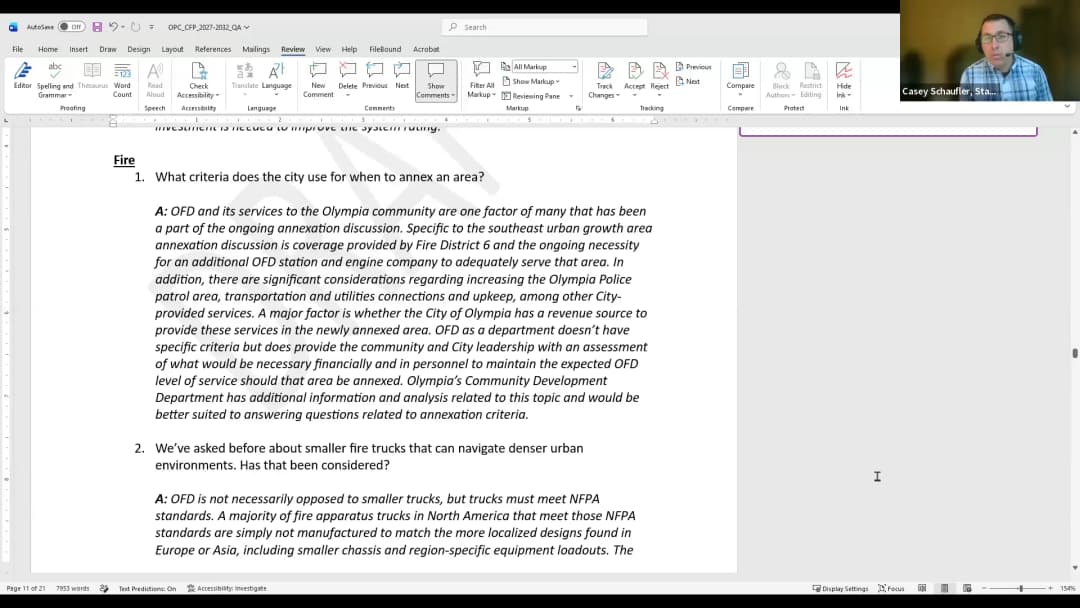
The Planning Commission Finance Subcommittee met at 6:33 p.m. on September 16, 2026, to review the preliminary draft of the 2026 Capital Facilities Plan (CFP) and prepare for the upcoming public hearing on September 21, 2026. The meeting was chaired by Commissioner Berger, with Vice Chair Daniel Garcia and Commissioner Ibrahimovich present. Staff from several departments introduced themselves and answered commissioner questions on CFP sections. Consent Calendar - The agenda and minutes from the previous meeting (September 2, 2026) were approved unanimously without discussion. No public comment was offered. Discussion Items - Parks (Tammy Ledou): Commissioners asked about the origin of the level-of-service (LOS) metric (parkland per 1,000 people). Staff explained it is a national standard adopted by the city and updated every six years as part of the Parks Plan. The Armory is categorized as a community park; specific performance measures will be developed once it reopens. Staff also referenced the city’s performance dashboard on the website. - Transportation (Joey Jones): Discussion focused on the CFP’s role as a financial document rather than a project-level document. Commissioners requested better cross‑referencing to source documents (e.g., the Transportation Master Plan) and noted that some linked PDFs were formatted incorrectly. The pavement management model (Street Saver) was explained; it models pavement condition index (PCI) but cannot predict mode‑shift impacts. Project prioritization is based on multiple factors (safety, community interest, emerging issues, grant opportunities) and is not formula‑driven. The sidewalk repair program uses a $500,000 baseline, adjusted annually based on identified locations. - Fire (Chief Flowers and Adam Cummings): Commissioners asked about the feasibility of smaller fire trucks. Staff noted that U.S.‑manufactured fire apparatus meeting NFPA standards are not significantly smaller, and that smaller European‑style trucks are not practical due to maintenance and equipment requirements. The discussion also touched on annexation of the South Urban Growth Area, which faces financial hurdles because of the need for a new fire station, sewer lift station, and other infrastructure; tax‑increment financing was raised but no immediate solution is on the horizon. The fire marshal’s office continues to evaluate single‑stair apartment designs in collaboration with Seattle Fire Department. - General Capital Facilities, Drinking Water, Stormwater, Wastewater, and Waste Resources: For sections without staff present, commissioners noted follow‑up questions. For drinking water, a question about rate‑increase projections was deferred to the Finance Committee meeting on September 19. For waste resources, commissioners asked about alternatives to constructing a new facility, such as renovating the existing one. The decline in cable‑tax revenue was also raised; no alternative revenue source has been identified, and staff acknowledged it is an ongoing concern. Key Outcomes - The subcommittee will forward the revised Questions & Answers (QA) document to the full Planning Commission by September 15, incorporating clarifications from the discussion. - The next meetings are: - September 21, 2026 – Full Planning Commission public hearing (including a retreat at 9:30 a.m., in‑person only). - September 22, 2026 – Final Finance Subcommittee meeting to draft the comment letter to the City Council. - Staff will continue to work on final line‑item adjustments for the CFP and will brief the subcommittee on changes after final adoption.

PUBLIC WORKS 26% · ENGINEERING AND INFRASTRUCTURE 14% · PROCEDURAL 11% · PARKS AND RECREATION 8%
14
SEP 8, 2026 · OLYMPIA, WASHINGTON · CITY COUNCIL & COMMISSIONS
Sea Level Rise Response Collaborative Executive Committee Meeting - September 8, 2026

Consent Calendar - Approved the meeting agenda (motion by Unsold, second by Barrett, unanimous). - Approved the June 5, 2026 meeting minutes (motion by Barrett, second by Unsold, unanimous). Public Comments & Testimony - No members of the public signed up for comment. Discussion Items - Approval of the 2027-2028 Sea Level Rise Collaborative Work Plan and Budget: Natalie Weiss (City of Olympia) presented the key items: evaluating long-term public financing mechanisms (continuation of 2024 report); modeling peak flow reduction for combined sewer separation (grant-funded); monitoring activities and publishing the first monitoring report by end of 2028; pursuing state/federal funding opportunities; and administrative/logistical support. The Executive Committee discussed no questions, then moved to approve (motion by Unsold, second by Barrett, unanimous). Reports and Updates - City of Olympia (Natalie Weiss): - Submitted a BRIC grant proposal to Washington Emergency Management Division for midterm sea level rise strategies along First Landing (design/engineering if awarded). - Received final report from AECOM on long-term monitoring strategy, including vertical land motion study and updated sea level rise projections (maps available upon request). - Began contract with KPF for climate resilient design guidelines (2025-2026 work plan item; ongoing through fall). - Thurston County (Lendy? and Amelia): - Completed 2025 greenhouse gas report. - Planning phases for capacity-increasing projects (long-term). - Thurston County Emergency Management to host Flood Awareness Week (Oct 19-23) and the All Hazards Exposition (Sept 26 in Lacey) — outreach events. Key Outcomes - Approved the 2027-2028 work plan and budget (unanimous). - Directive: Chair Madrone asked Commissioners Unsold and Barrett to champion the work plan within their respective jurisdictions to keep elected bodies informed. - Meeting adjourned early (approximately within the first hour).

ENVIRONMENTAL PROTECTION 54% · PROCEDURAL 31% · EMERGENCY MANAGEMENT 9% · GRANT FUNDING 6%
15
SEP 8, 2026 · OLYMPIA, WASHINGTON · CITY COUNCIL & COMMISSIONS
PBIA Phase Two Discussion and Board Election Results - September 8, 2026

The meeting focused on the ongoing Phase Two restructuring of the PBIA (Parking Business Improvement Area), with presentations from consultant Economic Development Council (EDC) and the Olympia Downtown Alliance (ODA). Key topics included the formation of a leadership advisory group, development of a ratepayer database, survey planning, and communication strategies. The board also announced election results and received updates on the Artesian Commons survey. Discussion Items - Phase Two PA Discussion (Item 6A): Michael from EDC introduced the team (Connor, research manager; Desiree from ODA) and provided an update. The project is on track to deliver a product to council in early 2027 (January/February). A leadership group of approximately 7-10 stakeholders (including the two PBIA advisory committee members) is being convened, with outreach underway. The first meeting is tentatively scheduled for the second Friday of the month at ODA offices. - Database and Survey Work: Connor described a database of current ratepayers as an internal city tool, but emphasized that key decisions (rate structure, assessment method, eligible square footage) will be guided by the leadership group. Surveys are in early development, with respect for business operational hours as requested. - Communication Strategy: Desiree outlined ODA's role in managing consistent, transparent communications across channels, and solicited board support in sharing information with their networks. - Board Feedback: Members raised concerns about paperwork burden (prefer simple invoicing), the need to educate new participants about PBIA history, rate structure, and comparisons with other cities. They emphasized highlighting past successes (murals, alley lights, ambassadors) and the challenge of limited funds ($100,000) for clean and safe initiatives. A suggestion to include a downtown resident in the leadership group was accepted. - Artesian Commons Update (Item 7): Jenica reported on focus groups and a community survey (open until September 7th) to gather input on site priorities and acceptable uses for the space. The most popular ideas were a mixed-use plaza with event programming. An interim use (pop-ups, parking lot) is also being considered. Results will be presented to city council on September 22nd. Key Outcomes - PBIA Board Election Results (Item 6B): Monique Osa, Sophia Landis, Anne Gazer, and Alana Carr were all elected with 29-30 respondents. The board is now at full capacity of 11 members, all serving three-year terms. - Next Steps: The EDC team will finalize the leadership group roster and convene the first meeting in late September. Survey development and database work will proceed with input from the advisory group. The board will continue to provide guidance as the project moves toward a January/February 2027 deliverable. - Other outcomes: No formal votes were taken; the meeting was informational and directive.

ECONOMIC DEVELOPMENT 45% · COMMUNITY ENGAGEMENT 17% · DOWNTOWN REVITALIZATION 14% · PUBLIC ENGAGEMENT 7%
16
AUG 28, 2026 · OLYMPIA, WASHINGTON · CITY COUNCIL & COMMISSIONS
Olympia Land Use & Environment Committee Meeting Summary – August 27, 2026

The Land Use & Environment Committee of the Olympia City Council met on Thursday, August 27, 2026, from 4:20 p.m. to 6:22 p.m. in Council Chambers and online. Chair Robert Vanderpool and Committee member Paul Berendt were present; member Clark Gilman was excused. Staff included Community Development Director Tim Smith, Housing Director Ashley Chambers, Senior Housing Program Specialist Christa Lenssen, and Housing Program Manager Jacinda Steltjes. The meeting covered land banking strategies, manufactured home community preservation, and public comments on tree protection. Consent Calendar - Approval of Agenda: The agenda was approved unanimously. - Approval of Minutes: The minutes from the July 23, 2026 Land Use and Environment Committee meeting were approved unanimously. Public Comments & Testimony - Lynn Fitz-Hugh: Expressed strong support for protecting large trees, urging the committee to expedite the tree ordinance timeline (currently two years) or adopt interim measures such as requiring tree surveys and protection plans with permit applications. She argued that larger setbacks for trees can create more affordable and livable housing and that Olympia cannot afford to wait two years to act. - Charlotte Persons: Detailed the climate, stormwater, air quality, and temperature benefits of mature trees, referencing a Thurston County tree tour where a subdivision with 20-year-old trees was shown to be 12°F cooler in summer and 6°F warmer in winter. She urged the city to include incentives and regulations in the tree code to preserve existing trees in both existing neighborhoods and new subdivisions. Discussion Items - Land Banking Strategies: Housing Director Ashley Chambers presented an overview of land banking as a tool for affordable housing, including benefits (preventing loss of strategic properties, reducing development costs, securing long-term community benefits), potential drawbacks (timing, competition for financing), and examples of city projects (Ity Commons, Lotus Court, The Landing, Franz Anderson PSH, 3900 Boulevard). She proposed creating a strategic framework with evaluation criteria (strategic alignment, public benefit, feasibility, market opportunity, funding capacity) and suggested next steps such as an inventory of city-owned property and development of a program framework. Committee members expressed strong support for a deliberate approach. Member Berendt requested a comprehensive inventory beyond city-owned property to include state, school district, port, and other public lands, as well as abandoned properties. He emphasized using land banking not only for affordable housing but also for other public uses (parks, public facilities). Chair Vanderpool agreed and suggested a tiered approach, prioritizing city-owned land first while also listing other public parcels. Both members supported developing the strategic framework simultaneously with the inventory, exploring funding sources (including impact fees and land swaps), and considering mixed-income housing and small-scale developers. - Manufactured Home Communities Preservation Recommendations: Senior Housing Program Specialist Christa Lenssen presented recommendations based on research and community engagement. She outlined challenges faced by manufactured home communities (risk of displacement due to redevelopment, rising rents, infrastructure costs) and relevant state legislation (SB 5198 offering right to compete to purchase, HB 1217 capping annual rent increases at 5%). Staff recommendations included: developing educational resources and workshops for residents (3-5 months), tracking funding opportunities (e.g., new Commerce infrastructure grants), exploring regional/local funding for infrastructure upgrades (e.g., revolving loan fund for septic-to-sewer conversions), creating a prioritization matrix for targeting interventions, and expanding affordable homeownership alternatives (starter homes, townhomes). Committee members expressed strong support for all recommendations. Member Berendt emphasized the importance of resident education and proactive intervention strategies to avoid crises. Chair Vanderpool noted the value of coordinating with Lacey and other jurisdictions, and highlighted the need to lay groundwork for cooperative ownership and to avoid burdening residents with multiple financial hits. The committee directed staff to bring the recommendations to City Council as a regular agenda item (not a study session) in October or November 2026. Key Outcomes - Land Banking: Staff directed to develop a planning-level inventory of city-owned property (6-9 months) and to include other public entities on a tiered basis; simultaneously develop a strategic land banking framework with evaluation criteria, funding options, and partnership models. - Manufactured Home Communities: Staff directed to pursue all four recommendation categories and present to City Council at a regular business meeting in fall 2026. - Next Meeting: The next Land Use & Environment Committee meeting is scheduled for September 18, 2026 at 1:00 p.m. Potential agenda items include: code concepts to implement the climate element, home-based business code update (with Planning Commission input), ADU/middle housing utility policy changes, and tree protection measures. - Adjournment: The meeting was adjourned at 6:22 p.m.

AFFORDABLE HOUSING 65% · ECONOMIC DEVELOPMENT 10% · PUBLIC ENGAGEMENT 6% · ENVIRONMENTAL PROTECTION 5%
17
AUG 27, 2026 · OLYMPIA, WASHINGTON · CITY COUNCIL & COMMISSIONS
Olympia Planning Commission Subcommittee Capital Facilities Plan Review - August 27, 2026

The subcommittee of the Olympia Planning Commission met on August 27, 2026, at 6:28 p.m. and adjourned at 6:42 p.m. Vice Chair Daniel Garcia and Commissioner Berger were present; Commissioner Ibrahimovich was absent. A quorum was established, and the meeting agenda was approved unanimously. The subcommittee took no public comment and spent the meeting assigning chapter reviews for the preliminary Capital Facilities Plan (CFP) and setting a question deadline for the September 8, 2026 chapter-contributor meeting. The transcript refers to the plan as both the preliminary 2027-2032 capital facilities plan and the preliminary capital facilities plan 2026-2031 financial plan, so the exact plan year/cycle is unclear in the record. Agenda Approval - The agenda was approved by unanimous voice vote after a motion and second. Public Comments - No community members provided public comment. The only non-commission attendee mentioned was a member of the media. Discussion Items - The subcommittee divided CFP chapter review assignments. Commissioner Garcia volunteered for transportation, fire, and parks, and offered to support the wastewater chapter. Commissioner Berger said transportation was also his favorite and volunteered for waste resources; he was willing to take the capital facilities chapter and offered support on wastewater. - Commissioner Ibrahimovich, absent, had earlier indicated willingness to review any chapters. He was asked to take drinking water and the general capital facilities chapter. - Commissioner Najati, not a subcommittee member, offered to review utility chapters where possible, including drinking water, wastewater, and storm/surface water. She had also requested public works documentation related to the new waste resources facility off Carpenter Road. - The group agreed that each chapter needed at least one definite assigned reviewer, while transportation in particular might draw additional reviewers from the full commission. Key Outcomes - The chapter assignment list will be sent to the full planning commission, and all commissioners are welcome to review any chapter. - Written questions for chapter contributors are due to staff by Tuesday, September 1, 2026. Staff will forward them to contributors before the September 8, 2026 meeting; written responses may follow after that meeting. - The chapter-contributor meeting is scheduled for September 8, 2026. Staff apologized for the tight timeline following the Labor Day holiday. - The regular planning commission meeting on September 7, 2026, is canceled due to the Labor Day holiday. - Staff will distribute prior years' QA documents and comment letters, including roughly the last 12 years of comment letters, to support the review.

PROGRAM MANAGEMENT 64% · PROCEDURAL 28% · WATER AND WASTEWATER MANAGEMENT 8%
18
AUG 27, 2026 · OLYMPIA, WASHINGTON · CITY COUNCIL & COMMISSIONS
Heritage Commission Meeting - August 27, 2026 (Actual Meeting Held August 26, 2026 per Minutes)

The meeting minutes and transcript indicate the meeting took place on August 26, 2026, but the provided date for the summary is August 27, 2026. This summary uses the requested date in the title but reflects the actual content from August 26. Heritage Commission Meeting - August 27, 2026 The Olympia Heritage Commission met on August 27, 2026 (per meeting summary instructions; actual meeting held August 26, 2026) from 5:30 PM to 6:33 PM. Commissioners Cotter, Bowman, Kimball, and Nace were present; Commissioners Becker, Patrick, and Stedman were excused. Two commissioners recently resigned, reducing the commission to seven members. The meeting covered the 2027 CLG grant application, upcoming public engagement events, reports on the South Capitol Historic District, and updates on advisory body restructuring. Consent Calendar - Agenda approved without opposition. - Minutes from the July 22, 2026 meeting approved as circulated. Public Comments & Testimony - None. Announcements - Staff (Brittany Gillia) announced attendance at a preservation field school the following week and will be remote for part of September. Business Items 26-0656: CLG Grant 2027 Application Briefing - Brittany Gillia presented a shift from a proposed survey (deemed too costly and time-consuming) to an outreach and education focus. Components include: funding for attendance at the Preserving Places conference, applying for future field school, printing communications materials (brochures, walking tours, code update flyers), developing a historic preservation zine through public art collection at Arts Walk, and funding for a home maintenance series (e.g., masonry workshop). The grant application will be presented to the review committee the following week. Commissioners expressed approval of the revised application. 26-0657: Upcoming Public Engagement/Volunteer Sign Ups - Brittany reviewed several upcoming events requiring volunteer commissioners: - Harper Days (Sandman Booth): August/September weekend; commissioners volunteered for Saturday morning. - Thurston County Heritage Day (Sept 12): 10 AM-2 PM; Commissioner Nace expressed interest in attending with materials; Commissioner Cotter may attend. - South Capitol Neighborhood Association Barbecue (Sept 13): 2-5 PM; Commissioner Bowman will be tabling for libraries and can also represent the commission; Commissioner Nace will attend; Commissioner Cotter may attend. The group agreed not to reserve a full booth, instead coordinating with existing city tables. - Historic Trivia with Three Magnets: Proposed for late September/early October. Kyle will follow up on dates (Sept 25, 30, or Oct 1). Preference leaning toward Sept 30. - Arts Walk (October): Volunteer sign-ups on sheet; Commissioners Kimball and Bowman for Friday; coverage for Saturday to be confirmed. Activity will be collecting illustrations for the zine. - Kyle noted access to a Risograph machine at Community Print for low-cost zine production. Reports POG Committee Report on South Capitol Historic District - Commissioner Cotter reported on a meeting with the South Capitol Neighborhood Association board regarding local historic district listing. Many questions and diverse opinions were expressed. The easiest path is to submit the 1991 national register survey as a local district with the same boundaries, which avoids expensive surveying. That survey contains 483 contributing and 200 non-contributing buildings. The process requires a majority (51%) of property owner approval via ballots and includes a public hearing before the commission and city council. Discussion ensued about who should submit the application (commission vs. neighborhood board), ballot distribution methods (mail vs. hand delivery), and the need for official city letterhead. It was agreed to wait for the neighborhood board's response to Brittany's email before deciding next steps. Moore Committee Report - Commissioner Kimball, the sole remaining member, reported on upcoming Moore committee activities including the trivia event and Arts Walk preparation. Commissioners Bowman and Cotter volunteered to assist. A large set of trivia questions has been provided by Ben from the Olympia Historical Society; they will be curated and likely use multiple choice. Heritage Review Committee Update - The next Heritage Review Committee meeting is scheduled for September 14. Because the usual staff person (Brittany) will be unavailable, either Kernan or another planner will fill in. An applicant is pursuing special tax valuation and local listing for a large rehabilitation project, with an October 1 deadline. Other Topics Commission Vacancies and Recruitment - With recent resignations, recruitment will begin in October. The commission needs expertise in history, architecture, and other CLG qualification areas. Targeted outreach to architecture firms was suggested. Commissioners were encouraged to recommend candidates. Advisory Body Restructuring Update - Brittany shared a memo from Councilmember Danny Madrone (CLIPS committee) thanking chairs for input. Changes are being considered: adjusting appointment timelines to align with work plans, shifting term lengths from three to two years with biennial recruitment, and introducing work plan check-ins. Groups being considered for restructuring include the Bicycle and Pedestrian Advisory Committee, Design Review Board, Social Justice and Equity Commission, and Parks and Recreation Advisory Committee. The chair/vice chair nomination and committee assignment for the Heritage Commission will be revisited at the next meeting. Key Outcomes - The CLG grant application briefing was received; staff will present to the review committee on September 4. - Volunteer commitments were made for Harper Days, Heritage Day, South Capital barbecue, trivia, and Arts Walk. - No formal decision on the South Capitol local listing application; will await neighborhood board response. - Recruitment for vacancies will proceed in October. - Meeting adjourned at 6:33 PM.

HISTORIC PRESERVATION 46% · COMMUNITY ENGAGEMENT 23% · PUBLIC ENGAGEMENT 18% · PROCEDURAL 9%
19
AUG 27, 2026 · OLYMPIA, WASHINGTON · CITY COUNCIL & COMMISSIONS
Community Livability and Public Safety Committee Meeting – August 26, 2026

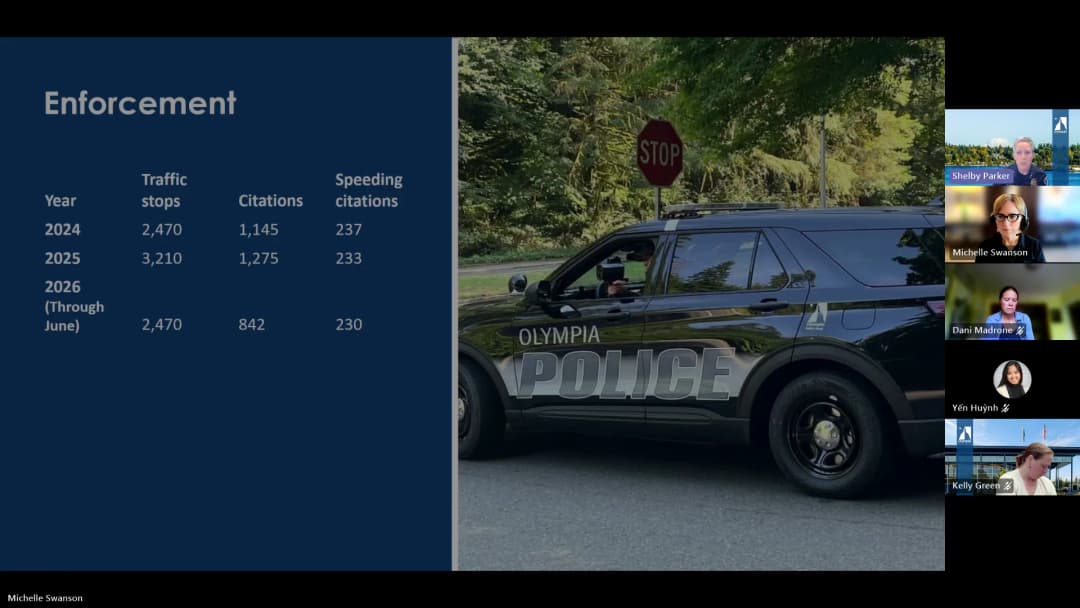
The Community Livability and Public Safety Committee of the Olympia City Council met on Wednesday, August 26, 2026, at 5:30 PM in Council Chambers and online via Teams. Chair Dani Madrone called the meeting to order. Present were Committee members Kelly Green and Yến Huỳnh. The agenda and minutes from June 24, 2026 were approved. Public comment was received, and the Committee discussed three major agenda items: the Olympia Youth Council update and appointments, pedestrian safety and speeding tools, and the Inspire Olympia Cultural Access Program improvements. Consent Calendar - Approval of Agenda: Unanimously approved. - Approval of Minutes (June 24, 2026): Unanimously approved. Public Comments & Testimony - Kate Jarvala (Olympia resident) expressed concerns about speed safety cameras, asking about the company, alternatives considered (e.g., speed bumps), and the impact of cameras near her property (located by two schools). She also referenced controversies around Flock cameras. The Chair acknowledged the questions and noted the Committee was still early in exploring the topic. Discussion Items 1. Olympia Youth Council Update and Appointments (6.A 26-0655) - Presenters: Assistant to the City Manager Susan Grisham, Youth Council Chair Donovan Jojola. - Donovan provided an update on the Youth Council’s accomplishments over the past year, including joint meetings with the Lacey Youth Council, co-hosting a youth summit, filming a transit PSA with Intercity Transit (to be released mid-September), receiving briefings on sanctuary city and public safety policies, developing recommendations for accessible public policy, and supporting the Youth Climate Action Fund grant process. Upcoming work includes a retreat, a third places for youth discussion, mental health briefings, and the 2027 work plan. - The Youth Council recommended appointing 14 new members and reappointing existing members for the 2026-2027 term. The applications received 21 applicants, interviewed over three nights. - Committee members expressed gratitude and support, discussed the importance of third places for youth, the upcoming transit PSA, and alignment of the Youth Council work plan with the City Council’s work plan. - Vote: Committee Member Huỳnh moved, seconded by Green, to approve the recommended appointments and reappointments for the 2026-2027 term and forward the recommendation to the City Council. The motion passed unanimously (3-0). 2. Update on Pedestrian Safety and Tools to Reduce Speeding (6.B 26-0645) - Presenters: Principal Planner Michelle Swanson, AICP, and Police Chief Shelby Parker. - Michelle presented data on speeding issues citywide, noting that speeds increase fatality risk exponentially (e.g., hitting a pedestrian at 40 mph yields a 46% fatality risk vs. 8% at 20 mph). She identified safety corridors and existing efforts: temporary speed feedback signs (deployed 144 times since 2023, now 8 signs), street redesign projects (e.g., Phones Road reducing limit from 35 to 25 mph), and requiring traffic calming in new developments. - Chief Parker discussed the three E’s: Education (social media, warnings, volunteer speed watch program that sent 325 letters in 2025 and 269 through June 2026), Enforcement (traffic stops increased from 2,500 in 2024 to 3,200 in 2025; citations issued in fewer than half, about 30% in recent periods), and Engineering (referring to Michelle’s work). She noted staffing challenges prevented a dedicated traffic unit until mid-to-late 2027. - Michelle then explained state law for speed safety cameras (different from Flock cameras): no continuous recording, no images of drivers/passengers, data exempt from public records, cannot be used in other court actions, vendor payment limited to equipment/services. Cameras can only be used in school zones, park zones, hospital zones, and designated crash prevention zones. Olympia’s population allows up to six cameras. Fines up to $145 (double in school/crash prevention zones), reduced 50% for those on public assistance. Revenue can cover program costs and traffic calming. Staff would need 1.5–2 FTEs. - Michelle also outlined a potential traffic calming program ($500k-$2M/year) and foundational work (update 20 mph school zones, revise speed limit policy). Staff requested direction to explore both programs and return in about a year with implementation details. - Committee members expressed interest in both speed safety cameras and traffic calming, discussed community concerns (vandalism in Bellevue, public skepticism), and emphasized the need for community engagement. Chair Madrone asked about staff lift and timeline; staff confirmed they could return in approximately one year with more information on funding and staffing. - Outcome: The Committee directed staff to explore both speed safety cameras and a traffic calming program and to return with a detailed report on implementation requirements, funding, and staffing needs. 3. Inspire Olympia Cultural Access Program Improvements and Updates (6.C 26-0636) - Presenters: Inspire Olympia Program Manager Marygrace Goddu, Senior Program Specialist Amelia Layton, Cultural Access in Public Schools Coordinator Molly Wilmoth, and Advisory Board Chair Melissa Mead. - The presentation covered administrative updates, policy topics, and a new competitive funding pathway for in-school programming. - Administrative Updates: Recommendations to add a line item for LTAC funding in the budget, add a question about alternate funding plans, and improve budget instructions. Committee generally supported these. - Program Timeline: Two proposed options to provide more time for council review – either send funding recommendations directly to council (skipping CLIPS) or retain CLIPS review but target council action on the second Tuesday in June. The Committee leaned toward direct council submission to avoid scheduling barriers, but agreed to explore shortening the application window (from 8 to 6 weeks) to build in buffer time for potential council changes. Committee member Huỳnh expressed concern about insufficient buffer if council sends recommendations back; others noted the risk is low and language can be added to manage expectations. - Grant Review Panel Selection: To address council concerns about non-appointed reviewers, the advisory board recommended formalizing recruitment (year-round, social media, website), using a strategic matrix, and allowing a CLIPS member to join the selection subcommittee. Committee members debated the complexity and workload, but after discussion, they tentatively supported the concept with a proposed touchpoint: CLIPS would receive a list of proposed review panelists (representing expertise) in February, prior to panel firings. - Location-Based Eligibility: The advisory board recommended keeping the current definition (organizations outside city limits can qualify if majority of programs are in Olympia or serve Olympia residents/OSD students), and adding a question for such organizations to explain their eligibility. Committee members expressed concerns about the “majority” threshold and the risk of funding going to too many outside organizations. They requested staff refine the definition (e.g., higher percentage or a cap on funding for outside organizations) and return with a proposal. Several members indicated they want the vast majority of funds to go to Olympia-based organizations. - Cultural Access in Public Schools (CAPS): Molly presented a new competitive grant pathway for in-school programming, building on existing field trip and transportation allocations. This was approved by council in June. The Committee received the information and did not raise objections. - Overall Outcome: The Committee provided direction on the timeline (preferring direct council submission with a shortened application window), supported most administrative and policy recommendations with refinement needed on location eligibility, and asked for a refined proposal on the grant review panel selection process including a CLIPS touchpoint. Key Outcomes - Youth Council Appointments: Unanimously approved (3-0) to forward appointments and reappointments for the 2026-2027 term to the full City Council for approval. - Speed Safety Cameras and Traffic Calming: Committee directed staff to explore both programs and return in approximately one year with a detailed implementation plan, including staffing, funding, and timeline analysis. - Inspire Olympia Program Improvements: Committee supported administrative updates, agreed to explore a shortened application window and direct council submission for funding awards, asked for refinement of location-based eligibility criteria (higher threshold or cap), and proposed a CLIPS touchpoint for review panel selection. Staff will incorporate feedback and return with updated recommendations for council study session.

COMMUNITY ENGAGEMENT 25% · PROCEDURAL 21% · TRANSPORTATION SAFETY 15% · ARTS AND CULTURE 13%
20
AUG 19, 2026 · OLYMPIA, WASHINGTON · CITY COUNCIL & COMMISSIONS
Olympia Planning Commission Meeting - August 19, 2026: Home-Based Business Code Amendments Rejected

The Olympia Planning Commission met on August 19, 2026, to hold a public hearing on proposed home-based business code amendments and receive a briefing on the Preliminary 2027-2032 Capital Facilities Plan. After extensive public testimony and deliberation, the Commission unanimously voted to recommend that the City Council not adopt the home-based business amendments. The meeting adjourned at 9:00 p.m. Consent Calendar - Approved the agenda for the August 19, 2026 meeting. - Approved the minutes of the July 20, 2026 meeting with one abstention. Public Comments & Testimony - Gordon White (South Capitol resident, 40 years): Expressed appreciation for the Planning Commission's prior work on middle housing and density, which he believes will lead to more affordable housing. Public Hearing on Home-Based Business Code Amendments (6A) – 7:01 p.m. to 7:31 p.m. - Christine Brewer (South Capitol homeowner, working mom of four): Opposed the amendments, stating they are a “direct attack on limiting working mothers” and described a small group of neighbors engaging in “bullying behavior” toward her family. - Michael Cade (Executive Director, Thurston Economic Development Council & Center for Business Innovation): Opposed the amendments, citing that about 92% of Thurston County’s 15,000 businesses are small and many start at home. He argued the amendments would restrict and inhibit small businesses. - Paul Bitar (Olympia resident): Supported the proposed change allowing on-site sales, stating it would enable his wife to sell antiques via Instagram with in-person pickup. - Gordon White (South Capitol resident): Generally supported the amendments but urged the city to ensure compliance mechanisms for homes used as offices, especially those owned by businesses where the owner does not live in Olympia. - Heather Burgess (Attorney, representing South Capitol Neighborhood Alliance): Opposed the amendments, citing legal concerns including enforceability, the targeting of single neighborhood and profession, and potential for litigation. She stated the existing code is adequate. - Doug Mah (Representing Thurston County Chamber of Commerce): Opposed the amendments, calling them “explicitly anti-business” and a barrier to entrepreneurs. He urged the city to embrace the part-time legislative activities and lobbyists that come with being the state capital. - Julia Gorton (Lifelong Olympia resident): Opposed the amendments, arguing they unfairly impact part-time residents (e.g., legislators, students, traveling physicians) and raise serious privacy concerns by requiring disclosure of private activities and guest lists. - Linda Kunze (South Capitol resident, 39 years): Expressed support for the neighborhood community and opposed houses used as businesses that stand empty most of the year, stating they “don’t build or support community.” - Holly Gadbaw (South Capitol resident, 45 years): Thanked the commission and submitted more extensive written comments; did not state a specific position during oral testimony. Discussion Items 6A – Home Based Businesses Code Amendments (Public Hearing) Senior Planner David Ginther presented proposed amendments to modernize the home occupation code (last updated 20 years ago), including: removing permit requirements, allowing on-site sales and structural renovations, adding mobile mechanic/detailer businesses, creating a definition for remote work, and removing the 500-square-foot limit. The impetus stemmed from complaints about lobbyists using homes in the South Capitol neighborhood as offices. Staff noted that approximately 20 homes in South Capitol are used for lobbying, out of 797 residences (about 10% of registered home-based businesses). Discussion centered on the principal residence requirement, enforceability, the definition of remote work, and whether the amendments disproportionately target one neighborhood. Commissioners expressed fundamental concerns about the strategy and scope. A motion by Commissioner Sauerhoff, seconded by Commissioner Ibrahimovic, to recommend not to adopt the amendments passed unanimously (8-0). The Commission will prepare a comment letter outlining concerns. 6B – Preliminary 2027-2032 Capital Facilities Plan (Briefing) Associate Planner Casey Schaufler briefed the Commission on the Preliminary CFP, which funds capital projects for parks, transportation, fire, water, wastewater, stormwater, and waste resources. Key highlights: - Year one (2027) total capital budget: $82.3 million. - Six-year total (2027-2032): $412.6 million (revised up 6% from prior year). - Major projects include: Hands-On Children’s Museum expansion ($14.3M in 2027), Percival Landing flood mitigation, new fire station(s), and a new waste resources maintenance facility on Carpenter Road. The Commission received the briefing; a public hearing will be held on September 21, 2026. Key Outcomes - Vote (unanimous, 8-0): The Planning Commission recommended that City Council not adopt the Home-Based Business Code Amendments as proposed. A comment letter will be drafted for the Land Use and Environment Committee meeting on September 24, 2026. - Information received: The Preliminary 2027-2032 Capital Facilities Plan briefing was received; the Commission will hold a public hearing on September 21, 2026, and forward recommendations to City Council. - Other: Vice Chair Garcia reported that the city is organizing focus groups related to the Artesian Well, with recommendations expected at a September 22 City Council study session. Chair Quetin shared an APA article on equitable zoning for home occupations.

HOME BASED BUSINESS REGULATIONS 31% · HOME BASED BUSINESS 18% · PROCEDURAL 12% · CAPITAL FACILITIES PLANNING 12%
OPENPUBLICA · PUBLIC MEETING INDEXUPDATED DAILY · openpublica.com