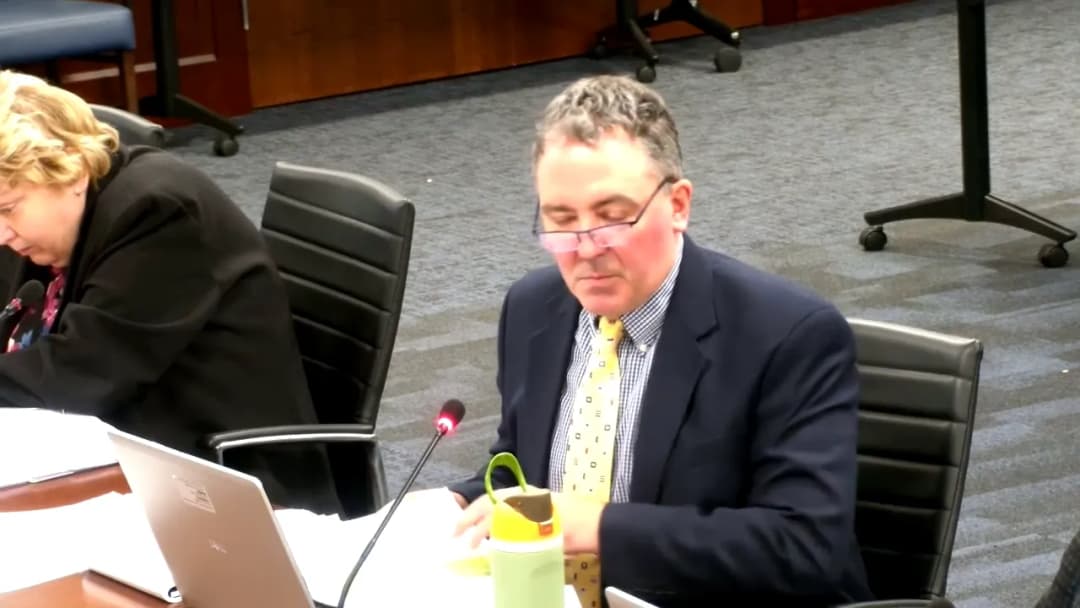
The Prince George's County Council met on September 22, 2026, at 5:00 PM in Committee Room 2027, with Chair Krystal Oriadha presiding. The meeting included approval of the consent agenda, introduction of several bills on second reading, a proposed correspondence letter to the Maryland Department of Transportation, and additional legislation added to the agenda. The meeting recessed at 5:56 PM and reconvened at 6:00 PM for continued business, adjourning at 6:05 PM. Council Vice Chair Eric Olson was excused due to a family medical emergency. Consent Calendar - Approval of County Council Minutes (September 15, 2026): Approved unanimously. - First Reading of Bills (Presentation): - CB-128-2026: An act aligning county parking code with Maryland Senate Bill 111 regarding out-of-state vehicle improper registration; referred to the Transportation, Infrastructure, Energy and Environment Committee. - CB-129-2026: A supplementary appropriation within the General Fund for unanticipated costs in Fiscal Year 2026; referred to the Government Operations and Fiscal Policy Committee. - Introduction of Resolutions: - CR-100-2026: A resolution amending the salary plan for certain exempt employees of the State’s Attorney’s Office, including 2% COLAs and merit increases for Fiscal Years 2025-2027; introduced by Council Members Oriadha, Ivey, Adams, and Blegay; referred to the Government Operations and Fiscal Policy Committee. - The consent agenda was adopted by a vote of 8-0 (with Olson, Burroughs, and Fisher absent). Discussion Items - CB-019-2026 – Qualified Data Centers: Removes the exemption from detailed site plan review for qualified data centers, restoring public input through pre-application neighborhood meetings and Planning Board hearings. The PHED Committee reported a 5-0 favorable vote with amendments. No additional sponsors; bill introduced. - CB-035-2026 – Day Care Centers for Children: Eliminates special exception approval for day care centers in all zones, reduces parking requirements, and allows on-street parking to meet standards. PHED Committee reported 5-0 favorable on Draft 2. No additional sponsors; bill introduced. - CB-064-2026 – Weeds and Conservation Landscaping: Updates definitions of weeds and conservation landscaping across three codes, establishes voluntary registration, certification, and signage for low-impact landscaping, and creates a rebuttable presumption that such plantings are not weeds. Four amendments were adopted (vote 9-0). Additional sponsors: Council Members Oriadha and Adams. Bill introduced. - CB-077-2026 – Community Service and Commercial Uses in RSF-A Zones: Permits restaurant and place of worship uses by right in existing commercial buildings in Residential, Single-Family-Attached zones, subject to compatibility review. PHED Committee reported 5-0 favorable. No additional sponsors; bill introduced. - CB-082-2026 – Cannabis Dispensaries – Use Regulations: Aligns county zoning with state law by adding “place of worship” to the 500-foot separation requirement for dispensaries. PHED Committee reported 5-0 favorable. Additional sponsors: Council Member Blegay. Bill introduced. - CB-083-2026 – Convenience Stores – Tobacco Product Sales: Prohibits convenience stores from selling tobacco and tobacco-related products, with amortization periods for existing uses. Office of Law noted potential state preemption risk. PHED Committee reported 5-0 favorable. No additional sponsors; bill introduced. - CB-084-2026 – Streamlining Site Plan Review Act: Allows simultaneous approval of detailed site plans and preliminary plans of subdivision, and concurrent review of related development plans. PHED Committee reported 5-0 favorable on Draft 2. No additional sponsors; bill introduced. - Proposed Correspondence – CTP Letter: A joint signature letter to Maryland DOT regarding the FY2027-2032 State Consolidated Transportation Program. During discussion, an amendment was offered to add the 717 Water Street Bridge Reconstruction Project to the priority list. The letter with that amendment was authorized by an 8-0 vote. - Additions to the Agenda (after reconvene): - CB-076-2026 – Commercial Reinvestment and Innovation Projects Act: Establishes an expedited review process for transit-oriented development projects in designated Regional Transit Districts and Local Transit Centers. PHED Committee reported 4-0 favorable with amendments. No additional sponsors; bill introduced. - CB-081-2026 – Sustainable Inclusive Mixed-Use Community: Creates a new use category by special exception in RE, RR, and RSF-95 zones. PHED Committee reported 5-0 favorable with amendments. Additional sponsors: Council Members Adams and Adams-Stafford. Bill introduced. - The additions package was accepted by a vote of 10-0. Key Outcomes - The consent agenda was adopted (8-0). - All second-reading bills (CB-019, CB-035, CB-064, CB-077, CB-082, CB-083, CB-084) were introduced after committee reports; no further votes on passage were taken during this meeting. - CB-064 was amended with four amendments (vote 9-0) before introduction. - The proposed CTP letter was authorized with an amendment adding the 717 Water Street Bridge project (vote 8-0). - Additions to the agenda (CB-076 and CB-081) were accepted (10-0). - The meeting adjourned at 6:05 PM. - An executive session on September 15, 2026, was summarized in the minutes (appointments to Police Accountability Board and Fair Election Fund Commission) but was not part of this meeting's proceedings.
Public Meetings - Prince Georges County, Maryland
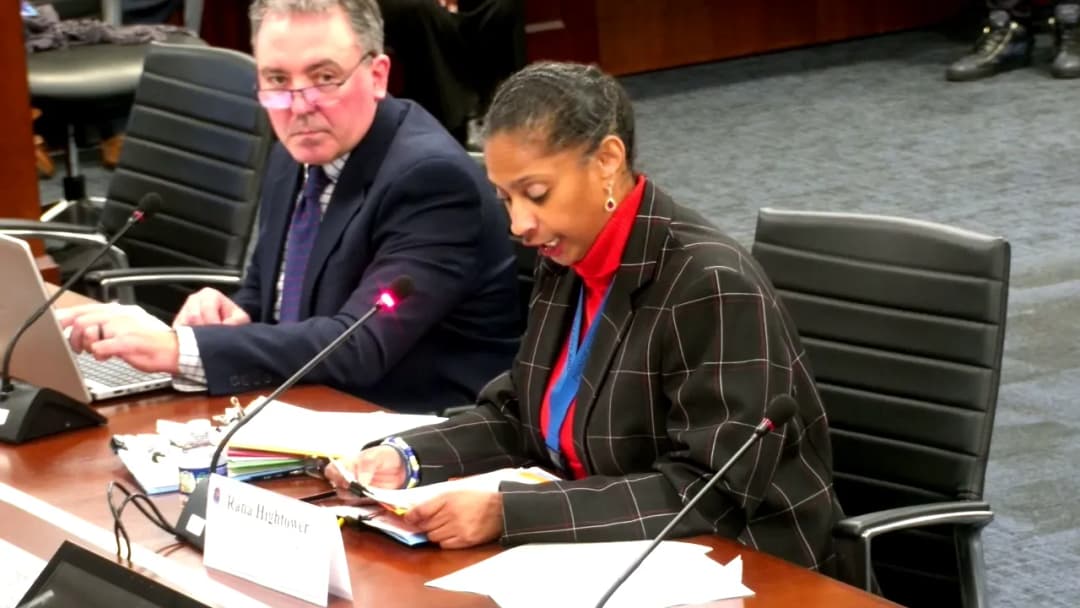
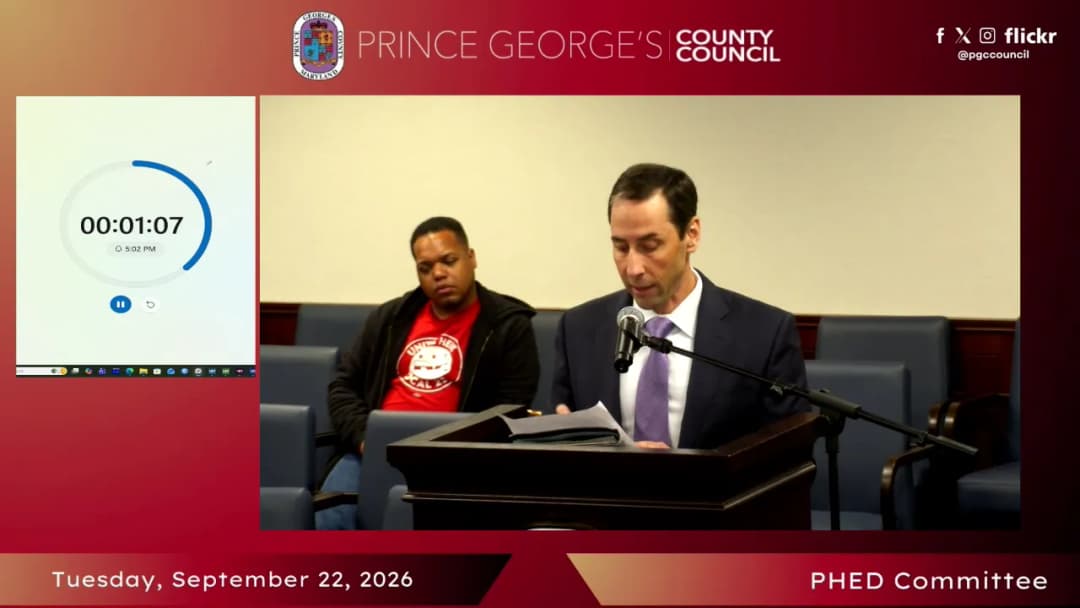
Public Meetings - Prince Georges County, MarylandThe Planning, Housing and Economic Development (PHED) Committee of the Prince George's County Council met on Tuesday, September 22, 2026, at 4:30 PM in Committee Room 2027. Chair Wala Blegay presided, with Vice Chair Krystal Oriadha, Council Member Shayla Adams-Stafford, and Council Member Thomas Dernoga present (4 of 5 members; Council Member Eric Olson absent). Council Member Jolene Ivey also attended. The committee considered two legislative items and voted to favorably recommend both to the full County Council. Public Comments & Testimony - CB-080-2026 (Universal Design for Housing): Peter Goldsmith, of the law firm Lerch, Early & Brewer, testified in support of the bill on behalf of the Housing Initiative Partnership, Green Street Housing, and team associates. He explained that the original universal design legislation had unintended consequences on multifamily development, potentially increasing unit square footage by over 20% and threatening housing affordability. He stated that the bill was a compromise reached after extensive collaboration with the Department of Permitting, Inspections and Enforcement (DPIE) and that it retains significant civil penalties to ensure compliance. He requested a favorable vote. Discussion Items - CB-087-2026 – Electrical Code of Prince George's County: Committee Director Rana Hightower presented the bill, which adds enforcement provisions to the electrical code (Subtitle 11) consistent with Subtitles 4 and 13, including administrative adjudication of appeals, additional civil and criminal penalties, citation issuance, and provisions to prevent property transfers with existing violations. The bill is sponsored by the County Executive, not Council Member Ivey as initially thought (a clarification was made during the meeting). No public speakers signed up. The committee moved to a vote without further discussion. - CB-080-2026 – Universal Design for Housing: Rana Hightower introduced the bill, which revises definitions, clarifies applicability, establishes exemptions, sets new universal design requirements for specified multifamily properties, updates waiver provisions, revises penalties, and makes technical corrections to strengthen universal design standards. Council Member Ivey, a co-sponsor (with Council Member Adams), noted that the bill addresses affordability concerns that arose after the original law took effect on July 1, 2026, by ensuring sufficient units for lower-income households. Peter Goldsmith's supportive testimony followed (see Public Comments). No amendments were offered. Key Outcomes - CB-087-2026: A motion by Council Member Dernoga, seconded by Vice Chair Oriadha, to favorably recommend the bill to the County Council passed unanimously (4-0; Blegay, Oriadha, Adams-Stafford, Dernoga voting aye). - CB-080-2026: A motion by Council Member Dernoga, seconded by Chair Blegay, to favorably recommend the bill to the County Council passed unanimously (4-0; Blegay, Oriadha, Adams-Stafford, Dernoga voting aye). - The committee adjourned after completing its agenda.
The Prince George's County Council's Planning, Housing and Economic Development (PHED) Committee, chaired by Wala Blegay, convened on September 21, 2026, for an extensive session lasting over eight hours. The committee deliberated the high-profile National Harbor Sphere project, passed a slate of tenant protection and housing development bills, and voted to indefinitely hold legislation aimed at regulating data centers. The meeting featured significant public testimony and intense debate regarding labor standards, MBE participation, and economic development priorities. Public Comments & Testimony - Sphere Entertainment (CB-111 / CR-090): Public testimony was sharply divided. Building trades unions (Baltimore-DC Building Trades, Unite Here, SEIU 32BJ) advocated for strong Project Labor Agreements (PLAs) and binding commitments for construction and operations. Conversely, local merit-shop contractors, including several Black-owned businesses and the Association of Builders and Contractors, urged the committee to reject a mandated PLA, arguing it would exclude local, non-union workers and firms. Community activists like Dr. Belinda Queen-Cunningham pressed for infrastructure investments and benefits for areas beyond National Harbor. Residents of South County spoke in favor of the project while urging the council to work out labor and traffic concerns. - Data Centers (CB-085): Public testimony was overwhelmingly opposed to the legislation. Farmers, residents, and environmental groups (Sierra Club, Food & Water Watch) cited risks to aquifers, noise pollution, PFAS contamination, grid strain, and the loss of prime agricultural land. The overwhelming sentiment was against allowing data centers in rural and agricultural zones. - Tenant Bills (CB-113, 115, 114): Aaron Kraut of the Apartment and Office Building Association (AOBA) expressed conditional support for CB-113 and CB-114, while opposing CB-115 as drafted for being too vague. Several other speakers voiced strong support for Councilmember Hunter's tenant rights package. Discussion Items - National Harbor Sphere Project (CB-111-2026 / CR-090-2026): The committee received a detailed presentation from the County Executive's office and Sphere Entertainment on the $1.4 billion immersive venue. The financing involves issuing up to $215 million in special obligation bonds, including $130 million in new money for the project, paid for through a tax increment financing (TIF) district. County officials touted a $1.6 billion annual economic impact and a supplier diversity plan targeting 50% participation from county-based small businesses and 40% from MBEs. - Council Positions: Several committee members expressed strong dissatisfaction with the developer's current stance on labor and the depth of the community benefits agreement. Councilmember Blegay (Chair) sharply criticized the developer for refusing to commit to a PLA, the structure of the MBE goals (calling them a subset of the larger target rather than a percentage of the full contract value), and the lack of guaranteed local hiring minimums. She stated the process was "disrespectful to the residents of Prince George's County." Councilmember Oriadha demanded binding labor commitments, stating "We are at Union Town." Councilmember Dernoga questioned public safety costs and the total county obligation. Councilmember Adams-Stafford inquired about concrete plans for minority business participation. - Data Center Zoning (CB-085-2026): Sponsor Councilmember Fisher argued the bill was a necessary regulatory framework to responsibly manage an inevitable industry, asking the committee to release it without a recommendation. The committee leadership strongly opposed the bill. Councilmember Blegay cited a promise to South County residents. Councilmember Oriadha stated she would "support a full ban" and that the county should not be a "dumping ground." Councilmember Dernoga criticized the bill for including specific project exemptions and lacking clear environmental safeguards regarding aquifers and noise, ultimately deeming it unworkable in its current form. - Tenant Protection Package (Sponsored by Councilmember Hunter): Three bills were discussed as a package: CB-113 (Tenant Relocation Rights Disclosure), CB-115 (Expedited Health & Safety Enforcement), and CB-114 (Tenant Rights Education and Accessibility Act). Amendments to the bills generally shifted primary enforcement responsibilities to the Office of Homeland Security (OHS). - Economic Development and Housing Package (Sponsored by Councilmember Oriadha): Vice Chair Oriadha moved a comprehensive set of bills focused on housing affordability (Opportunity Sites, Small Provider Financing, Public Land First, Air Conditioning mandate, Rental Portal) and economic development efficiency (Development Ombudsman, Shovel-Ready Sites, Performance-based EDI Fund). Key Outcomes - National Harbor Sphere (CB-111 / CR-090): No action taken. The committee did not vote on the legislation. Chair Blegay stated the matter would return to committee pending further negotiation on labor, MBE participation, local hiring minimums, and a strengthened community benefits agreement. - Data Center Zoning (CB-085-2026): Held indefinitely in committee (4-0). - Tenant Bills (Sponsored by Councilmember Hunter): - CB-113 (Relocation Rights): Favorably recommended to the County Council with amendments (5-0). - CB-115 (Expedited Health & Safety): Favorably recommended to the County Council with amendments (5-0). - CB-114 (Tenant Rights Guide): Favorably recommended with amendments. Note: The transcript and minutes contain a discrepancy on the final vote tally for CB-114. The transcript records a vote of 5-0 on the amendments and 4-0 on final passage, while the final written minutes record votes of 4-0 for both actions. - Oriadha Economic Development and Housing Package: - CB-091 (Development Ombudsman): Favorably recommended with amendments (4-0). - CB-097 (Affordable Housing Sites): Favorably recommended with amendments (4-0). - CB-099 (Small Housing Provider Financing): Favorably recommended with amendments (4-0). - CB-107 (Shovel-Ready Sites): Favorably recommended with amendments (4-0). - CB-108 (Public Land First): Favorably recommended with amendments (4-0). - CB-118 (A/C in Rentals): Favorably recommended (4-0). - CB-121 (Rental Housing Portal): Favorably recommended (4-0). - CB-088 (Concurrent Development Review): Favorably recommended with amendments (4-0). - CB-106 (Performance-Based EDI Fund): Favorably recommended with amendments (4-0). - CB-109 (Public Land Affordability Req.): Favorably recommended with amendments (4-0). - Zoning and Other Legislation: - CB-081 (Sustainable Inclusive Mixed-Use): Favorably recommended with amendments (5-0). - CB-076 (Comm. Reinvestment Projects): Favorably recommended with amendments (4-0). - CB-075 (Quiet & Clean Landscaping): Favorably recommended with amendments (4-0, 1 recused). - CB-065 (Senior Co-Housing): Favorably recommended with amendments (4-0, 1 abstained). - CB-079 (Vacant Attached Property): Favorably recommended with amendments (4-0).
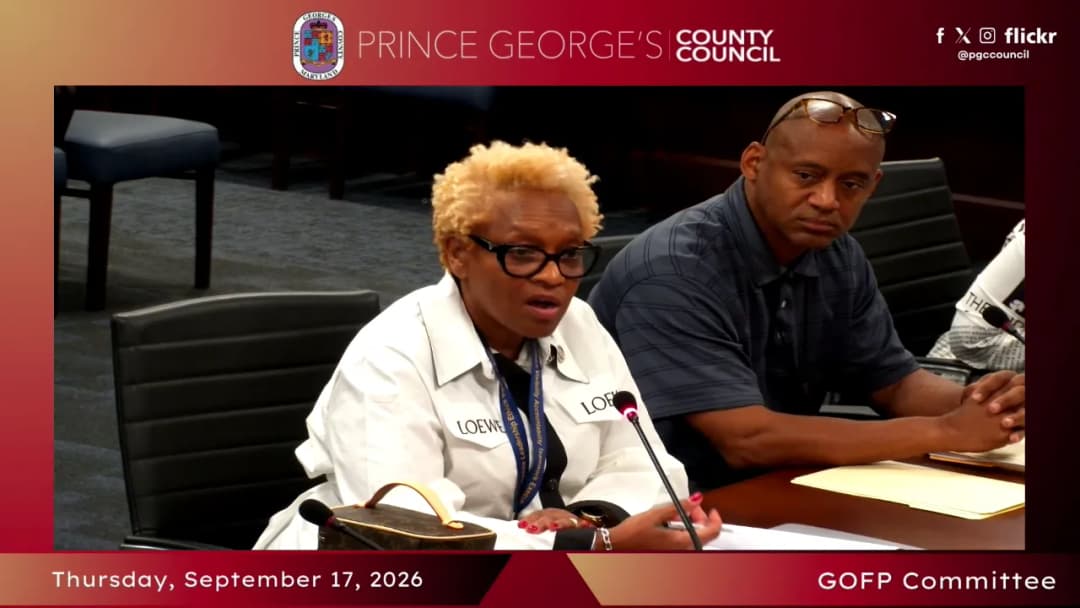
The Government Operations and Fiscal Policy Committee met on September 17, 2026, with four members present (Chair Burroughs, Vice Chair Adams, CM Ivey, CM Oriadha) and one excused absence (CM Blegay). The committee considered one appointment, eight bills, and one resolution. Key topics included an ethics appointment, a community safe spaces reporting portal, a package of elderly property tax relief bills, affordable housing requirements for surplus county property, and returning citizen employment initiatives. Appointment - APPT-17-26 – Board of Ethics: Krishnan Natesan, MPA, M.Div., was nominated to fill a vacant seat with term expiring 12/01/2030. After introduction by the County Executive’s office and remarks from Mr. Natesan, the committee voted 4-0 to recommend favorable appointment to the full Council. Legislation CB-086-2026 – Community Safe Spaces Act (Reporting Violations) - Sponsored by Dernoga and Olson. The bill broadens reporting of unauthorized use of county property and harmful conduct, creating an online platform for reports. Office of Law noted potential legal risks under Supremacy Clause; sponsor Dernoga argued the bill does not limit ICE activity but provides a reporting mechanism for existing law. The committee voted 4-0 to recommend favorable. CB-094-2026 – Property Tax Credit for Elderly Individuals of Limited Income - Sponsored by Oriadha and Hunter. Establishes a county tax credit equal to 50% of the state’s homeowners property tax credit, not to exceed the net county levy. The committee adopted an amendment clarifying the 50% language. Fiscal estimate from OMB: $700k/year by 2028 (based on 2024 data). The bill was held for further discussion at the next GOFP meeting (September 24, 2026) along with related tax bills. CB-095-2026 – Real Property Tax Deferral for Elderly or Disabled Homeowners - Expands eligibility, increases deferred amount, reduces interest rate. Held for September 24 meeting. OMB estimated potential annual deferral up to $13 million if all eligible homeowners participate, but noted current program usage is negligible (40-60k/year). CB-098-2026 – Property Tax Credit – Reduced Rent for Elderly or Disabled Tenants - Provides credit to owners who reduce rent. Held; OMB unable to estimate fiscal impact. CB-117-2026 – Property Tax Cap for Elderly Individuals - Establishes a tax cap in form of credit. Held. OMB estimated annual cost of $2.6 million. CR-091-2026 – Local Impact Grant Funds Multiyear Plan - Resolution to transmit the Multiyear Plan for review. Held for September 24 meeting. CB-100-2026 – Surplus County Property – Affordable Housing Development - Sponsored by Oriadha. Requires evaluation of surplus properties for elderly/affordable housing and mandates 1/3 affordable units in certain projects. The committee adopted amendments creating a financial feasibility waiver with a reporting requirement to the Council. The bill was voted favorably as amended (4-0). CB-101-2026 – Returning Citizen Employment Opportunities Act of 2026 - Requires 5% of work hours on contracts ≥$1M be performed by returning citizens. The committee adopted an amendment changing the requirement to 5% of new hires (rather than all work hours), and clarified it applies to new contracts rather than renewals/extensions, per Procurement’s recommendation. The bill was voted favorably as amended (4-0). CB-102-2026 – Re-entry Employment Incentive Program Modifications - Increases employer reimbursement from $5 to $10/hour, raises minimum qualifying wage from $15 to $25/hour, establishes 6-month payment schedule after 90-day probation, and creates a non-lapsing fund. The committee voted favorably (4-0). Key Outcomes - Appointment: Krishnan Natesan recommended favorably to full Council. - Passed favorably: CB-086, CB-100 (as amended), CB-101 (as amended), CB-102. - Held for September 24, 2026 meeting: CB-094, CB-095, CB-098, CB-117, and CR-091. - Amendments adopted: CB-094 (clarification of 50% credit language); CB-100 (feasibility waiver with reporting); CB-101 (new hires threshold, new contracts only). - Concerns raised: CM Oriadha expressed frustration with lack of timely fiscal data from Administration on tax bills. OMB and Finance officials requested more collaboration to balance senior tax relief with budget constraints. Chair Burroughs urged inter-branch meetings before next GOFP meeting. - Vote tally: All votes were 4-0 with one excused absence (CM Blegay).
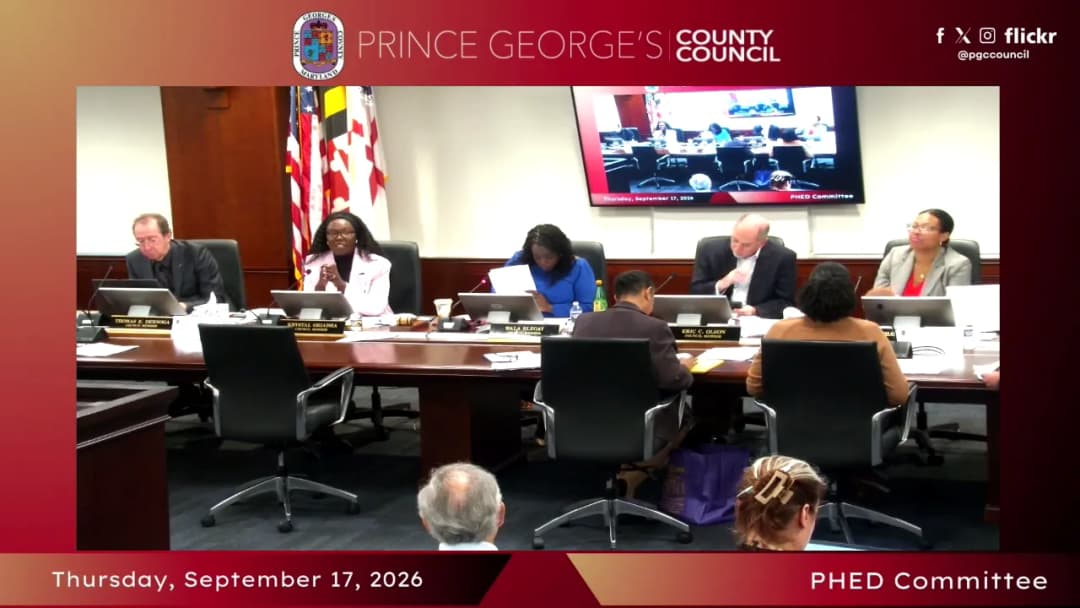
The Planning, Housing and Economic Development (PHED) Committee of the Prince George's County Council convened on Thursday, September 17, 2026, at 10:35 a.m., concluding at 12:20 p.m. The meeting, chaired by Council Member Wala Blegay, handled nine legislative bills with all final votes cast unanimously (5-0). Central themes included repealing the data center site plan exemption, streamlining development approvals for transit areas, and regulating tobacco sales. Public Comments & Testimony CB-019 | Data Centers: Several residents and advocates expressed strong support for repealing the site plan exemption. Beth Landry (CCAN Action Fund) asked for confirmation the bill would not undermine the existing two-year moratorium, which Chair Blegay and Vice Chair Oriadha affirmed. Nancy Feissner (District 4) reported a 100% rejection of data centers among sampled constituents. Taylor Frazier McCollum presented a petition with over 25,000 signatures against data centers. Speakers broadly urged stronger action, including a permanent ban. CB-076 | Commercial Reinvestment: John Robinson expressed concern that the bill accelerated developer-driven processes, advocating for community-led planning models instead. CB-083 | Tobacco & Convenience Stores: Industry representatives Mike O'Halloran (MAPDA) and Sarah Price (Maryland Retailers Alliance) asked the committee to distinguish legitimate convenience stores from illegal smoke shops, arguing the bill penalizes compliant businesses. CB-084 | Streamlining Site Plan: John Robinson and Kathy Bartolomeo opposed the bill, arguing it reduces transparency and risks environmental oversight given current departmental understaffing. CB-035 | Day Care Centers: Heather Dlhopolsky (Kingdom Fellowship AME Church) supported the bill. John Robinson cautioned against removing approval steps to maintain public safety. Discussion Items CB-019 | Data Centers (Favorably Recommended): Vice Chair Krystal Oriadha characterized the original 2021 exemption (CB-120-21) as a profound betrayal of public trust, labeling it a process done in the dark of night to circumvent community input. Proposed Draft 2A, explained by Legislative Attorney Josh Hamlin, closes the loophole by reaching back to projects with transitional provisions and requiring consistency with the General Plan. Chair Blegay emphasized transparency and apologized for not knowing about the loophole. CB-076 | Commercial Reinvestment (Held): This bill creates an alternate, streamlined review track for high-density mixed-use projects in transit districts. Discussion focused on the definition of qualifying areas. Chad Williams (M-NCPPC) corrected the record that as written the definition would not include Purple Line stations. The bill also removes the council's call-up power. Council members debated the scope, leading the committee to hold the bill for the sponsor to draft revisions. CB-077 | Community Service & Commercial Uses (Favorably Recommended): The bill permits commercial reuse of existing buildings in the RSF-A zone. David Warner (M-NCPPC) noted vague character standards are difficult for permit staff. Council Member Dernoga suggested applying commercial zone (CS) standards. Chair Oriadha committed to working on amendments. CB-083 | Tobacco in Convenience Stores (Favorably Recommended): Chair Oriadha described the bill as the culmination of a three-year battle against an epidemic of law-breaking shops. The bill prohibits tobacco sales in convenience stores without fuel pumps. CB-084 & CB-035 | Streamlining and Day Cares (Favorably Recommended): Both bills advanced with technical Draft 2 amendments. The childcare bill (CB-035) removes zoning hurdles such as special exceptions to increase capacity while preserving strict state safety licensing standards. Key Outcomes All motions carried 5-0. - Held Indefinitely: CB-089 (Tobacco Sales) - Held in Committee: CB-081 (Mixed-Use Community), CB-076 (Commercial Reinvestment) - Favorably Recommended with Amendments: CB-019 (Data Centers), CB-084 (Streamlining), CB-035 (Day Cares) - Favorably Recommended: CB-077 (Community Service RSF-A), CB-082 (Cannabis Dispensaries), CB-083 (Tobacco Convenience Stores)
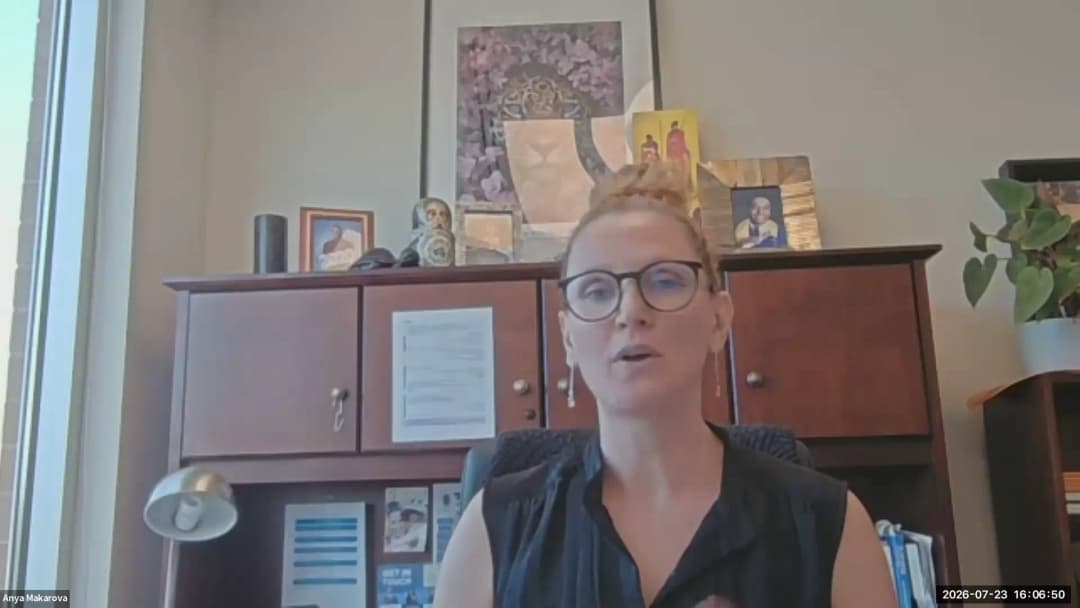
The Foster Care Youth Task Force held a virtual meeting on September 17, 2026, at 3:00 PM. The meeting was called to order by task force coordinator Anya Makarva, who introduced co-chairs DCO Reed (representing Health, Human Services, and Education) and Autumn Joy. The primary agenda included a presentation on the analytical framework for the task force's work, discussion and adoption of bylaws, and planning for future meetings and member engagement. Discussion Items - Analytical Framework Presentation: Anya Makarva presented a comprehensive research and analytical framework for the task force's work. Key elements included: - Guiding values: equity, collective responsibility, trauma-informed evidence-based decision making, rights fulfillment, and belonging/inclusion. - A four-phase timeline: pre-entry (prevention), in-care (lived experience), transition (readiness for independent living), and long-term outcomes. - Infrastructure and capacity analysis, including funding, data systems, and caseworker workforce. - Vulnerability of foster youth: national data showed 80% have experienced six or more adverse childhood experiences (ACEs), and 21.5% have a PTSD diagnosis vs. 4.5% of the general adult population. - Overview of legal statuses (shelter care, voluntary, committed) and placement types from least restrictive (family-based) to most restrictive (institutional). - Exit pathways: reunification, adoption, guardianship, and Another Planned Permanent Living Arrangement (APPLA). - Maryland codifies 34 rights for youth in out-of-home care. A September 2025 OLA audit found missed medical/dental exams and instances of registered sex offenders sharing addresses with approved guardianship homes. - The presentation relied on national, state, and comparative jurisdiction research; next steps include grounding data with county-specific information from the Department of Social Services (DSS) at the September meeting. - Bylaws and Scope Discussion: - Lisa questioned language in Article One of the bylaws referencing "children of justice involved parents." It was clarified that the resolution (CR 126) uses that language, but the task force's methodology will focus on foster youth whose parents are justice-involved as a subset. The bylaws were kept as is. - Yolanda Johnson suggested adding "inclusion of lived experience experts" to the scope of work goals to ensure accountability. - Jennifer Amaya Thompson (DSS Director) requested using "out-of-home care" terminology instead of "foster care" in official documents to align with state language. Anya agreed to use state-approved language in scope and reports but keep bylaws consistent with the resolution. - Vacancies and Engagement: Anya reported four vacancies on the 19-member task force. DSS recommended filling them with representatives from the circuit court (two magistrates present as experts), a specialist from the local behavioral health authority, and two members with lived experience. Anya introduced a draft alumni engagement plan and proposed a trauma-informed training for the task force, to be scheduled for the September meeting. - Task Force Member Intake Questionnaire: Anya distributed a questionnaire to leverage members' expertise and relationships, due by August 20, 2026 (note: this date precedes the meeting date of September 17, 2026, as stated in the transcript; the discrepancy is noted but the original statement is reported). - Next Meeting: Scheduled for Thursday, September 24, 2026, at 3:00 PM. The meeting will include a presentation from DSS and potentially a trauma-informed training. Key Outcomes - Bylaws Adopted: The task force voted on the bylaws as submitted. Roll call vote: Co-chair Autumn Joy Barrett (yes), Ms. Psalms Falkis (yes), Yolanda Johnson (yes), Lisa Dominguez (yes), Angela Smith (yes), Jennifer Thompson (yes). Motion carried with 6 votes. No quorum was initially present, but legal advisor Ramon confirmed that since no governing rules existed, the bylaws could be adopted without a quorum for this vote; subsequent votes will require a quorum. - Scope Memo: Not adopted; it will be submitted to the county council as a deliverable. Feedback on terminology and inclusion of lived experience experts will be incorporated. - Next Steps: Task force members to complete intake questionnaires by August 20, 2026 (as stated). The next meeting is set for September 24, 2026. Anya will work on filling vacancies, finalizing the alumni engagement plan, and coordinating trauma-informed training with a community partner.
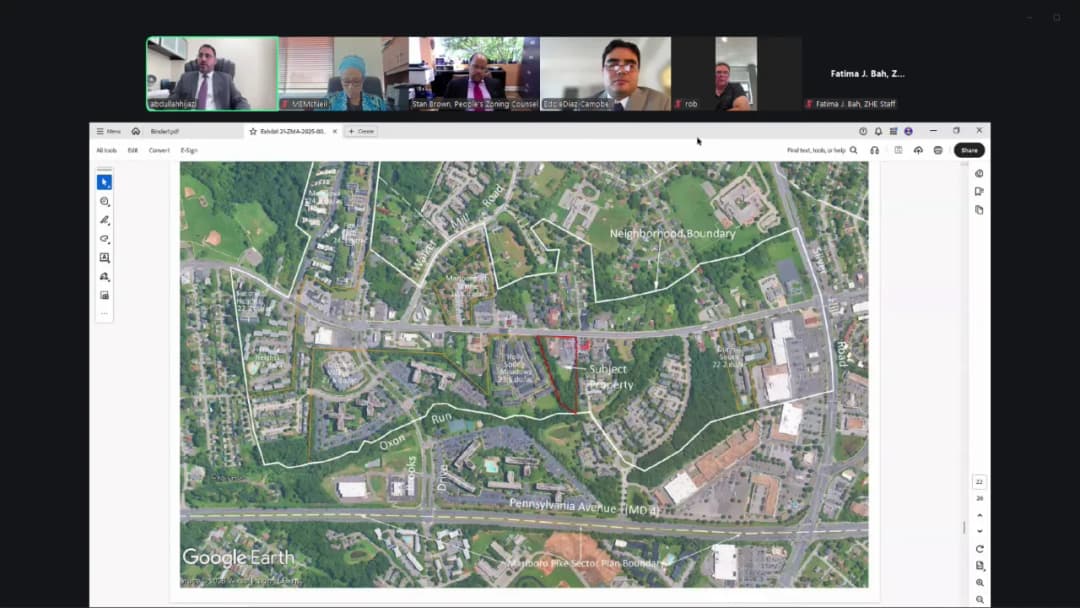
On September 16, 2026, the Zoning Hearing Examiner conducted a virtual hearing on ZMA-2025-007, a request by ZT of Maryland LLC to rezone approximately 1.68 acres at 5541 and 5545 Marlboro Pike, District Heights, Maryland, from the RMF-20 (Residential, Multifamily-20) Zone to the RMF-48 (Residential, Multifamily-48) Zone. The project is named Marlboro Station. The applicant argued that changes in the character of the neighborhood and a mistake in the 2009 Marlboro Pike Sector Plan and Sectional Map Amendment (SMA) justify the rezoning. No members of the public noted opposition. Consent Calendar - None. The hearing did not include a consent calendar. Public Comments & Testimony - No public comments were offered. The hearing examiner noted no opponents present. Discussion Items - Property Owner Testimony (Rob Tikoyan): Rob Tikoyan, sole owner of ZT of Maryland LLC, testified that the two parcels are currently a used car dealership and an auto repair shop. He purchased 5545 Marlboro Pike in 2022 for $1.4 million and 5541 Marlboro Pike in 2024 for $900,000, with over $2.6 million invested including consultant fees. He stated that without rezoning, redevelopment would not be profitable and the properties would continue operating as-is. The current zoning (RMF-20 on the front, RMF-48 on the rear) creates a split-zoning issue because the developable land is in the front (RMF-20) while the rear has environmental constraints (steep slopes, stream, wetlands). - Planning Expert Testimony (Eddie Diaz Campbell): Admitted as an expert in land use planning, Diaz Campbell testified that the character of the neighborhood has changed since 2009 due to the 2022 Marlboro Pike Pedestrian Safety Project, which reduced travel lanes from four to two, added bicycle facilities, wider sidewalks, and pedestrian crossings. These multimodal improvements make higher-density residential development more appropriate. He also identified a mistake in the 2009 SMA: the property is a single legal parcel under common ownership but was split-zoned (RMF-20 on tax parcels 12 and 95, RMF-48 on tax parcel 10) without recognition of this fact. The split zoning complicates unified development, as the rear environmental area is less developable. He argued that RMF-48 is appropriate given the improved corridor and the property's location. - Land Planner Testimony (Mark Ferguson): Admitted as an expert, Ferguson provided additional historical research, tracing the property's legal status to the 1800s. He concluded that tax parcels 10 and 12 are part of a single legal parcel, not two separate lots. He also noted that the 2009 sector plan miscalculated existing densities of surrounding multifamily developments, which are higher than what RMF-20 allows. This mistaken factual predicate supports the rezoning. Ferguson criticized the staff report for not giving sufficient weight to the cumulative effect of public investments and private reinvestments since 2022, including renovations at Holly Spring Meadows and Dunhill South Apartments. He asserted that RMF-48 would not automatically allow the maximum height (110 feet) or density due to neighborhood compatibility standards and site constraints. - Staff Report Acknowledgment: The hearing examiner noted that the technical staff report recognized some changes to Marlboro Pike but argued they were insufficient to justify RMF-48. The applicant's experts countered that the report underweighted the cumulative changes. - Issues Raised by Examiner and Opposing Counsel (Mr. Brown): Mr. Brown questioned whether the improvements to Marlboro Pike were merely routine maintenance (medians, curbs) rather than substantial change. He also challenged the mistake argument, noting that commercial uses on the site have been profitable and continue to serve the residential neighborhood, undercutting the claim that the 2009 SMA was factually mistaken. The examiner also raised a point about the property's ownership: Rob Tikoyan initially stated he was the sole owner but later acknowledged his wife is also an owner, requiring additional ethics affidavits. Key Outcomes - Record Held Open: The hearing examiner kept the record open for the applicant to submit the following documents: - LLC ownership documentation and, if applicable, an ethics affidavit for the wife. - An overlay of the PG Atlas generalized land use layer showing \"residential high\" for the neighborhood. - Excerpts from the historical case file A-7803 (1970) regarding the rear property. - No Final Decision: The examiner did not render a decision. The record will close once the requested documents are filed. - No Opposition: The hearing proceeded without any public opposition noted on the record.
The Prince George's County Literacy Commission met on Wednesday, September 16, 2026, from 2:02 PM to 3:02 PM. Chair Dr. Felton Moss presided. The meeting focused on high-leverage strategies to boost literacy outcomes, with presentations from commission members and a report on the July 17 Literacy Summit. Seven members were present at initial roll call, later ten after technical issues were resolved. Consent Calendar - The minutes from the July 15, 2026, meeting were approved by unanimous consent with no corrections or amendments. Discussion Items - Literacy Summit Report (Pastor Clarence Crawford): Crawford presented on the Literacy Summit held July 17, 2026, at Suitland High School. The summit had 400 RSVPs and a waitlist of 50; registration closed July 1. 569 books were collected and donated to the library system. Keynote: Delegate Martinez. Panel included Dr. Collins, Megan Sutherland, and others. Summit objectives: establish a grassroots initiative to transform literacy across Prince George's County's 130+ elementary schools. A phased approach was outlined: Phase 1 (now to early 2027) to set up a hub structure and advocacy; Phase 2 (early 2027) family engagement; Phase 3 (summer 2027) literacy ecosystem and district chapters. - Presentation by Ellen O'Neal and Michelle Koopman: Koopman, a teacher, presented on high-leverage phonics strategies, specifically "body coda blending," which reduces cognitive load for early readers. She emphasized teacher buy-in and training as critical for transformation. - PGCPS Presentation (Simone McQuage and Dr. Dean Collins): They identified tier one instruction as the high-leverage strategy, focusing on early identification, teacher-student-family partnerships, and quarterly literacy events at every elementary school. They also highlighted "Parent University" sessions and the need for equitable summer programming, especially for families with limited transportation. - Dr. Bowser (University of Maryland): Discussed tutoring at three Title I schools (Hollywood, Kingsford, Rosa Parks) using science of reading. He described a "Food for Thought" program at Thomas Stone Elementary targeting multilingual families, and work on adolescent literacy including writing and AI implications. - Megan Sutherland (Library System): Reported that the summer reading program had 5,300 registrants, over 2.17 million minutes read, and more than half completed the program. The "Books from Birth" program (Dolly Parton Imagination Library) saw 800 new registrants in August, with 120 opting for bilingual titles. - Dr. Ashanti Bryant Foster (Prince George's Community College): Highlighted adult education strategies: flexible scheduling, individualized intake assessments, and contextualized instruction blending literacy with career pathways (e.g., healthcare, construction). - Commissioner Candace Perkins: Noted the need for a public-facing platform to connect all resources across entities to avoid the perception of silos. Commissioner Allie Oliver Kruger echoed the importance of collaboration. Key Outcomes - The commission will submit preliminary recommendations to the County Council by September 30, 2026, based on initial discussions. Final recommendations are due December 15, 2026, with a vote at a future meeting. - The commission's initial term expires December 31, 2026. - Three remaining meetings are scheduled for October, November, and December to synthesize themes, refine strategies, deliberate, and vote. - Members who did not present were asked to send their notes and comments to staff for inclusion in the preliminary report. - No further business; the meeting was adjourned at 3:02 PM.
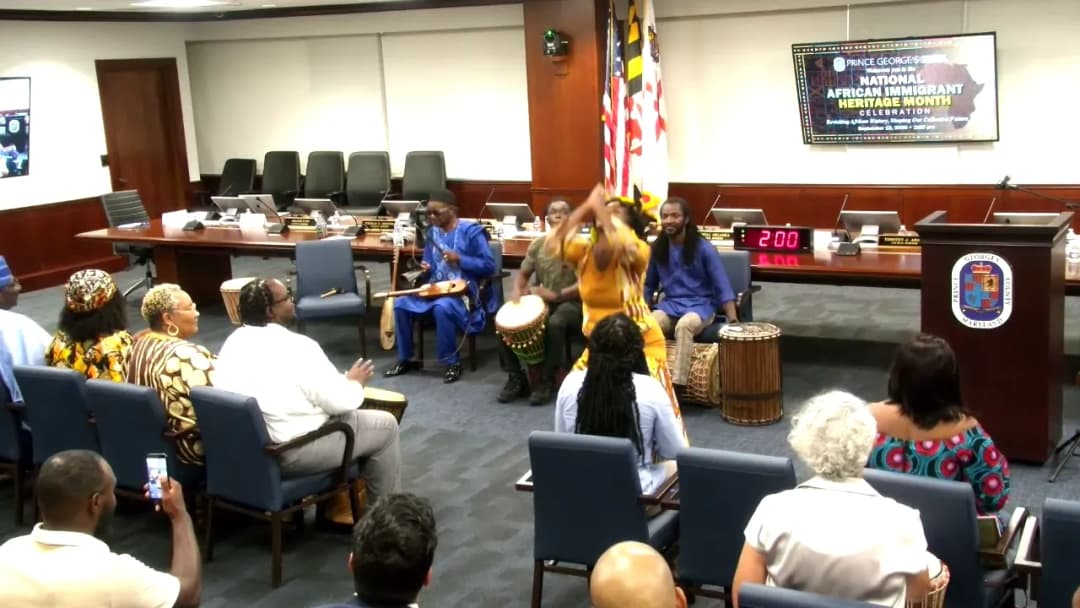
On September 15, 2026, the Prince George's County Council held a special event to celebrate National African Immigrant Heritage Month. The event, hosted by council members who are daughters of African immigrants, featured musical performances, a documentary screening, a proclamation reading, and remarks from council members. The meeting took place in the council chamber (the usual hearing room was under renovation) and was attended by council members, staff, and community members. Musical Performance by Fritite African Drum and Dance Ensemble - The event opened with a performance by the Fritite African Drum and Dance Ensemble (resident group of the Performing Arts Center for African Cultures). Drummers from Nigeria, Ivory Coast, and other regions led the audience in interactive drum cycles and dances, including a game based on the day of the week attendees were born. The performance also featured traditional dances from Zambia and seven tribes. Remarks by Council Members - Council Chair Crystal Oriada (District 7) welcomed attendees and highlighted the diversity of Prince George's County, noting that African immigrants represent the highest percentage of minority business owners in the county. She shared her personal story as a daughter of a Kenyan immigrant father and an American mother, and emphasized the importance of honoring African heritage. - Councilmember Walla Blagay (At-Large) spoke about her Liberian and Nigerian heritage, noting that the African community has become more involved in county boards and events. She stated that she has achieved her goal of bringing the African community to the table. - Councilmember Wanika Fisher (District 2) shared her family’s background: her father is Nigerian Yoruba and her mother is South African of Indian descent. She highlighted the unique immigrant stories of blending cultures and the importance of family in African culture. She also noted the historic visit of the Asantehene (king of the Asante Empire) to Bowie State University in Prince George's County. Documentary Screening: Council Members' Immigrant Stories - A 30-minute documentary produced by council staff was screened, featuring interviews with Councilmembers Oriada, Blagay, and Fisher. Each shared their family’s journey to the United States, challenges faced (e.g., misconceptions, separation from family, apartheid struggles), and their commitment to community service. The documentary aimed to connect personal narratives with the broader African immigrant experience in the county. Proclamation for National African Immigrant Heritage Month - The council read and adopted a proclamation recognizing September 2026 as National African Immigrant Heritage Month in Prince George's County. The proclamation highlighted the contributions of African immigrants in education, health care, government, business, and the arts, and encouraged residents to celebrate and support African-owned businesses and community organizations. Closing Remarks and Group Photo - After the proclamation, the council members posed for a group photo with the performing artists. The event concluded with closing remarks thanking staff and attendees.
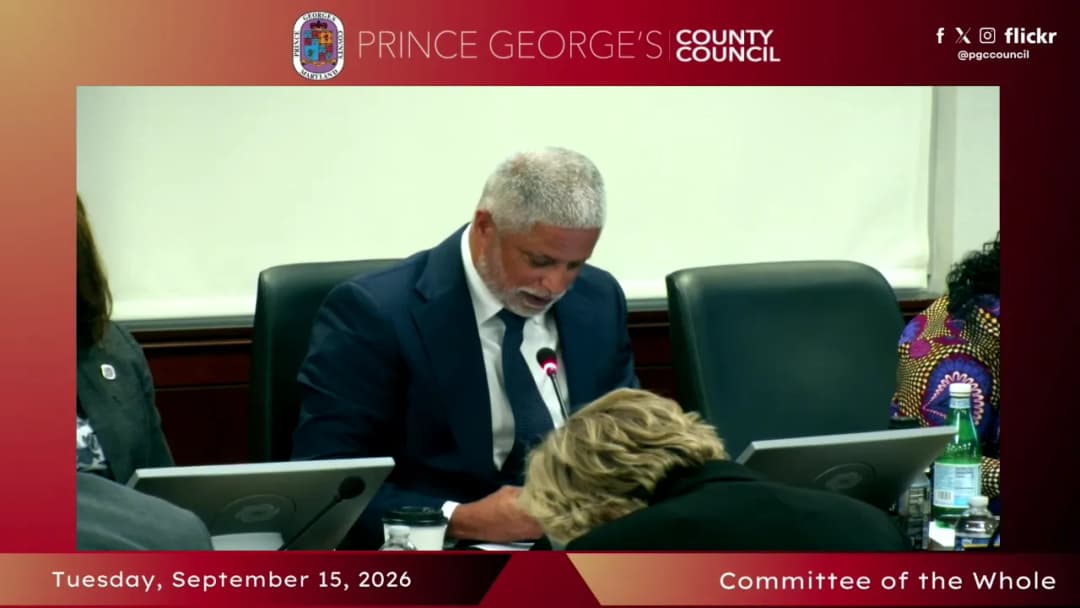
The Prince George's County Council, sitting as the Committee of the Whole, met on Tuesday, September 15, 2026, from 11:12 a.m. to 11:53 a.m. to consider the Minor Amendment to the 2013 Approved Subregion 5 Master Plan and the associated Sectional Map Amendment (SMA) (CR-028-2026). The meeting focused on a staff presentation summarizing public testimony, Planning Board recommendations, and council deliberation leading to two separate votes. The plan area lies entirely within Council District 9. Public Comments & Testimony - Thirteen speakers provided verbal testimony at the June 9, 2026 joint public hearing, generating over 32 pages of transcribed testimony. Additionally, 40 pieces of written testimony were received. - Testimony covered land use, environment, transportation, public facilities, and historic preservation, but not economic development. - While some testimony opposed specific rezonings (e.g., zoning changes 3, 4, 12, and 13), most testimony requested additional rezonings—often for higher density residential, industrial, or scattered commercial zones in rural and agricultural areas. Discussion Items - Staff Presentation: Korey Arsenault (Project Manager, M-NCPPC) and Michael Calomese (Deputy Project Manager) presented the process, key themes of the minor plan amendment (reimagining Brandywine as a transit-oriented hub, enhancing transit for the Southern Maryland Rapid Transit Line, concentrating retail at Akakeek Village, supporting the Medical Innovation District, and promoting agricultural preservation). The proposed SMA included 15 targeted zoning changes affecting less than 1% of the plan area. - Planning Board Actions (September 3, 2026): The Planning Board adopted the minor plan amendment and endorsed the SMA with three modifications: - Reduced the extent of zoning change 3 (commercial zoning at Akakeek Village) to create a more compact village scale. - Deleted zoning change 4 (multifamily housing at Akakeek Village) due to opposition. - Rezoned certain properties along Piscataway Road from AR/RR to RSF-95 to support single-family detached homes. - Clerical Error: Staff identified a minor error in the Planning Board’s resolution regarding tax account numbers for zoning changes 15 and 16 (three omitted numbers and one wrongly included). A correction was recommended. - Councilmember Harrison's Proposed Revisions: Councilmember Harrison moved to direct staff to prepare a resolution of approval for the SMA with four additional revisions: 1. Add a new strategy to the minor plan amendment based on Exhibit 28 to rezone the Dyson property to the RSFA zone. 2. Direct staff to evaluate a parcel (currently in the TACE zone) for potential IE (Industrial Employment) zoning, related to the Timothy Branch road and Brandywine Town Center connectivity. 3. (Implied from context) Possibly include a correction for tax account numbers—though Harrison also explicitly called for correcting the error on tax account numbers for endorsed zoning changes 15 and 16 (Parker properties). 4. (The fourth revision was not separately enumerated but was understood as part of the motion; the motion described “four revisions” including the above and the correction of the SMA resolution error.) - Council Discussion: Councilmember Adams requested clarification on the Timothy Branch property. Councilmember Oriadha stated she would abstain because she needed more time to digest the individual amendments. Key Outcomes - First Motion (Sectional Map Amendment): A motion by Councilmember Harrison, seconded by Councilmember Ivey, to direct staff to prepare a resolution of approval for the SMA with the four revisions (including staff’s noted correction) and in accordance with the Planning Board’s endorsements. Passed 8-0-1 (Ayes: Olson, Adams-Stafford, Blegay, Dernoga, Harrison, Ivey, Hunter, Adams; Nay: 0; Abstain: Oriadha; Absent: Burroughs and Fisher). - Second Motion (Master Plan Amendment): A motion by Councilmember Harrison, seconded by Councilmember Hunter, to direct staff to prepare a resolution of approval for the minor master plan amendment in accordance with the Planning Board’s adopted recommendations. Passed 8-0-1 (same vote tally). - Next Steps: Staff will draft resolutions incorporating the council’s directions. The council has 90 days from the Planning Board’s transmittal (September 4, 2026) to take final action.