The Government Operations and Fiscal Policy (GOFP) Committee of the Prince George's County Council met on Thursday, September 24, 2026, at 1:55 PM in Committee Room 2027. Chair Edward Burroughs presided with five members present (Burroughs, Blegay, Ivey, Oriadha, Adams). The committee considered 20 pieces of legislation, including amendments to the Cannabis Reinvestment and Restoration Board, a package of property tax relief bills for elderly and disabled residents, resolutions on council transparency and public participation, contract approvals, and a proposal to establish an independent Office of the Inspector General. Consent Calendar (Unanimous Actions) - CB-112-2026 (Fair Election Fund – Post-Election Retention and Distributions in Uncontested Elections): Favorably recommended (5-0) with a technical correction noted by the Office of Law. - CR-099-2026 (Contract Approval – State’s Attorney’s Office Discovery Management System): Favorably recommended (5-0). Fiscal impact: approximately $365,000 in FY2027, $2 million over five years. - CB-126-2026 (Classification Plan – amended titles, new/abolished classes): Favorably recommended (5-0). No salary ranges provided; potential increase for Executive Director class. - CB-094-2026 (Property Tax Credit for Elderly Individuals of Limited Income): Favorably recommended with amendments (5-0). Estimated first-year cost: $846,000; five-year cost: $4.616 million. - CB-098-2026 (Property Tax Credit – Reduced Rent for Elderly/Disabled Tenants): Favorably recommended with amendments (5-0). Maximum annual impact: $250,000; five-year cap: $1.25 million. - CB-095-2026 (Real Property Tax Deferral for Elderly/Disabled Homeowners): Favorably recommended with amendments (5-0). Amended to require 20 years of homeownership and an assessed value cap of $750,000. Estimated first-year deferral: $520,000; five-year cumulative: $2.824 million (based on 20-year ownership). - CB-117-2026 (Property Tax Cap for Elderly Individuals): Reported out with no recommendation (5-0) to allow further discussion between sponsor and administration. Estimated first-year cost: $2.034 million; five-year: $32.354 million as drafted. - CR-086-2026 (Government Transparency, Performance, and Accountability Workgroup): Favorably recommended (5-0). - CR-091-2026 (Local Impact Grant Funds Multiyear Plan): Favorably recommended (4-0-1, Ivey abstained). - CB-122-2026 (Orphans’ Court Judges Compensation): Favorably recommended (5-0). Sets associate judge salary at $80,000 and chief judge at $85,000; fiscal impact $117,100 included in FY2027 budget. - CR-092-2026 (Council Rules – Monthly Evening Meeting): Favorably recommended (3-0-2, Burroughs and Ivey abstained). - CR-093-2026 (Council Rules – Annual Countywide Listening Tours): Favorably recommended (4-0-1, Ivey abstained). - CR-096-2026 (Contract Approval – Emergency Communication Equipment & Public Safety Vehicles): Favorably recommended (5-0). Authorizes up to $120 million in debt for 911 radio system replacement ($70M) and annual public safety equipment lease ($30M). - CB-125-2026 (Homestead Property Tax Credit – 104% for FY2028): Favorably recommended (5-0). - CB-127-2026 (Capital Budget Transfers – District VI Police Station, Public Safety Infrastructure): Favorably recommended (5-0). No net fiscal impact; supplementary appropriation increases debt by approximately $62 million. - CB-129-2026 (Supplementary Appropriations – FY2026 Close-out): Favorably recommended (5-0). Reallocates $28.7 million between agencies. - CB-061-2026 (Surplus Property – Removing Redevelopment Authority, Adding Office of Central Services): Favorably recommended (5-0). - CB-001-2026 (County Equity Participation Authority Act): Postponed indefinitely. - CB-103-2026 (Qualified Data Centers Personal Property Tax Exemption): Held indefinitely (5-0). Public Comments & Testimony - CB-093-2026 (Cannabis Board): Several speakers opposed the original bill, arguing it would weaken the board’s authority and community voice. Crystal Carpenter (board chair) supported some amendments but raised concerns about unfilled vacancies and a 90-day deadline. Belinda Queen Cunningham (Coalition of Prince George’s County Community Organizations), Taylor Fraser McCullum, Beverly John, and others urged rejection, stating the bill was a “power grab” that would shift control from the community to the council. Council Member Oriadha responded, defending the need for deadlines and consistent staffing to ensure funds are spent, and noted an email sent by board members threatening to withhold a vote unless administrative fees were approved. - CB-119-2026 (Inspector General): Patricia Fenn (Legislative Committee Chair, M-NCPPC Retirement Association) testified in favor, citing similar offices in other jurisdictions. Chairman Hardy (Citizens for Accountability and Governance) supported with suggested amendments on independence, mandatory funding, and qualifications. Dr. Takisha Brown (resident and attorney) urged favorable recommendation, citing recent controversies. The County Executive’s Office raised concerns about overlapping responsibilities with the existing Office of Ethics and Accountability and the charter-mandated Office of Audits and Investigation. Discussion Items - CB-093-2026 – Cannabis Reinvestment and Restoration Board Amendments: The committee debated four amendments. Amendment 1 (Ivey) added a flat $5,000 annual administrative fund for the board (carried 5-0). Amendment 2 (Burroughs) extended the deadline for board recommendations from 90 to 180 days after the start of the fiscal year (carried 5-0). Amendment 3 (Burroughs) struck language allowing the council’s grants office to bypass the board if recommendations are late (carried 4-0-1, Oriadha abstained). Amendment 4 (Oriadha) changed the board’s name to “Community Reinvestment and Repair Board” (carried 5-0). The bill was favorably recommended as amended (5-0). - CB-094/095/098/117 – Elderly/Disabled Tax Credit Package: The committee discussed each bill. For CB-095, the administration requested amendments to add a 40-year ownership requirement and an assessed value cap; the committee adopted a 20-year ownership plus $750,000 cap (favorable). For CB-117, the sponsor (Oriadha) requested more time to work with the administration on fiscal impact; the bill was reported without recommendation. The Office of Finance estimated that limiting eligibility to those already in queue and using a fixed dollar amount could reduce cost, but no consensus was reached. - CR-083-2026 (Virtual Public Participation): Held in committee (2-0-3, Blegay and Oriadha aye; Burroughs, Ivey, Adams abstained). No motion to move forward. - CB-119-2026 – Independent Office of the Inspector General: Extensive discussion. Council Member Ivey proposed moving the bill without recommendation to allow further negotiations; no second was offered. Council Members Blegay and Adams expressed support for the concept but raised concerns about redundancy with existing offices and potential conflicts with the county charter. The Office of Ethics and Accountability director noted a planned legislative package for 2027 that could address some issues. The motion died for lack of a second, and the meeting was adjourned without further action on CB-119. Key Outcomes - CB-093-2026: Favorably recommended with amendments (5-0). - CB-094-2026, CB-095-2026, CB-098-2026, CB-125-2026, CB-126-2026, CB-127-2026, CB-129-2026, CB-061-2026, CR-086-2026, CR-096-2026, CR-099-2026, CB-112-2026, CB-122-2026, CR-092-2026, CR-093-2026: All favorably recommended (votes ranged from 5-0 to 4-0-1). - CB-117-2026: Reported without recommendation (5-0). - CR-083-2026: Held in committee (no motion passed). - CB-001-2026: Postponed indefinitely. - CB-103-2026: Held indefinitely (5-0). - CB-119-2026: No action; motion to move without recommendation failed for lack of a second. Meeting adjourned.
Public Meetings - Prince Georges County, Maryland
Public Meetings - Prince Georges County, MarylandThe Transportation, Infrastructure, Energy and Environment Committee met on Thursday, September 24, 2026, at 10:00 AM in Committee Room 2027. The committee considered ten legislative items, including bills on illegal vending, prohibited home businesses, parking enforcement, stormwater financing, and a resolution on utility shutoff protections. All votes were 4-0 in favor with amendments where noted. One bill (CB-104-2026) was held indefinitely. Public Comments & Testimony - Rochelle Durant, President of the Avon Ridge CDC, testified in strong support of CB-003-2026 and CB-013-2026, expressing opposition to allowing property owners to give permission for vendors to sell on their property. She cited concerns about property values, unfair competition for legitimate businesses, and public safety issues such as vendors using machetes and selling unregulated food. Discussion Items - CB-003-2026 (Illegal Vending Penalties): Introduced by Councilmember Fisher as a "stick" to complement the pilot program. The bill increases fines, requires permits, extends enforcement to private property, and assigns enforcement to the Office of Homeland Security (OHS). Discussion included exemptions in current code (e.g., cut flowers, fruits, baked goods) that may undermine enforcement. Councilmember Fisher proposed an oral amendment to require written permission from property owners for vending on private property but later withdrew it, agreeing to leave the bill as prohibiting vending on private property without permission. The committee voted to report favorably draft two with four technical amendments (4-0). - CB-013-2026 (Street Vending Pilot Program): Companion bill establishing a pilot program for regulated street vending, allowing the county executive to develop a simplified regulatory process. Only one change in draft two: enforcement agency changed from DPIE to OHS. Voted favorably (4-0). - CR-073-2026 (Rent Stabilization Fees): Reconsidered after being previously reported out with no recommendation. DPIE Chief of Staff Lori Parish presented information on proposed $250 application/approval fee, comparing fees in other jurisdictions (Montgomery County, DC, New Jersey, California). She noted the program is underfunded with only two FTEs. No action taken; information only. - CB-048-2026 (Prohibited Home Business): Sponsored by Chair Dernoga to increase civil fines and add property liens for illegal home businesses, also revising the definition of neighborhood nuisance. Draft two amends definitions and removes mandatory minimum fines. Sponsor noted it targets situations where contractors run businesses from homes with fleets of vehicles. Voted favorably on draft two with technical amendments (4-0). - CB-096-2026 (Residential Parking on Unpaved Areas): Clarifies prohibition on parking vehicles (including watercraft) on unpaved residential lots and gives enforcement authority to both Revenue Authority and OHS. Technical amendment added section name. Voted favorably on draft one with technical amendment (4-0). - CB-104-2026 (Consolidated Development Review): Sponsor moved to hold indefinitely due to unresolved issues. Motion passed (4-0). - CB-116-2026 (Stormwater Management Loan): Authorizes borrowing up to $38.5 million from Maryland Water Infrastructure Financing Administration at subsidized rates (estimated 2% interest with principal forgiveness). Funds will retrofit 250 impervious acres for MS4 permit compliance. Voted favorably (4-0). - CR-081-2026 (Utility Moratorium): Sponsored by Councilmember Adams-Stafford. Draft two changed focus from price increases to utility shutoff protections, requesting two moratorium periods (January 1–February 28 and June 1–August 31) for low/moderate income, senior, and medically vulnerable households. Also requests PSC study on data center impacts on rates. Voted favorably (4-0). - CB-124-2026 (Fine Increases): Administration bill raising maximum fines for building and zoning code violations from $1,000 to $5,000, as authorized by state law. Voted favorably (4-0). - CB-128-2026 (Vehicle Parking and Impoundment): Aligns county parking code with Maryland Senate Bill 111 on out-of-state vehicle registration, allowing enforcement and towing by Revenue Authority and police. Committee requested a future briefing on enforcement strategy. Voted favorably (4-0). Key Outcomes - CB-003-2026: Reported favorably (4-0) with technical amendments. - CB-013-2026: Reported favorably (4-0). - CB-048-2026: Reported favorably (4-0) on draft two with technical amendments. - CB-096-2026: Reported favorably (4-0) with technical amendment. - CB-104-2026: Held indefinitely (4-0). - CB-116-2026: Reported favorably (4-0). - CR-081-2026: Reported favorably (4-0). - CB-124-2026: Reported favorably (4-0). - CB-128-2026: Reported favorably (4-0). A briefing on enforcement strategy was requested for a future committee meeting. - The committee noted that upcoming meetings in October will focus on briefings, including potential briefings on stormwater management and solid waste fund funding formulas.
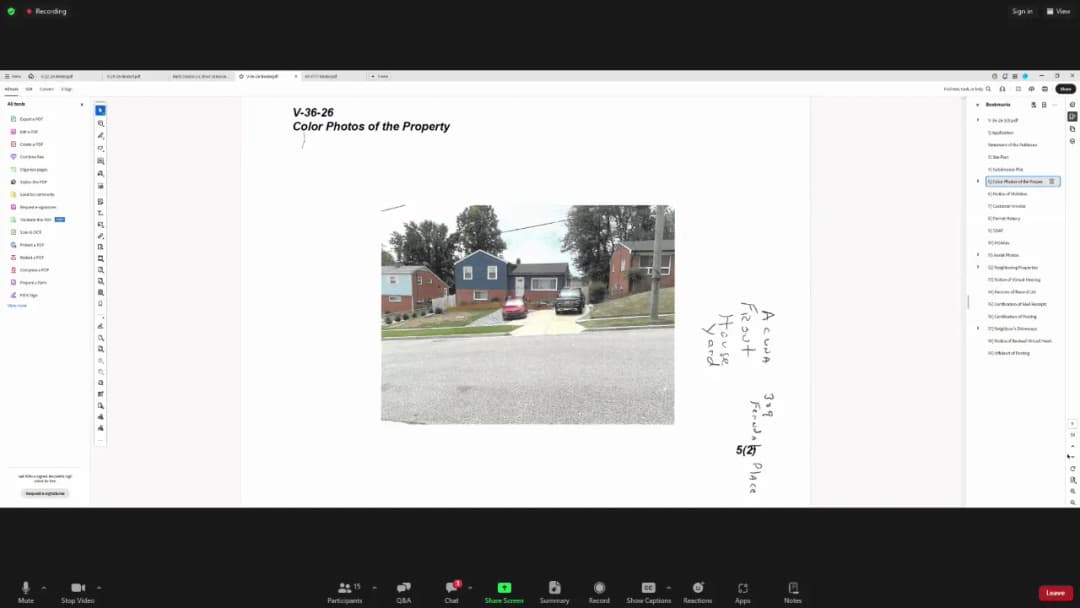
The Board of Appeals for Prince George's County, Maryland, met virtually on September 23, 2026, at 6:00 PM to consider four variance requests, one zoning appeal, and the approval of prior meeting minutes. All five agenda items were decided unanimously (3-0). The board approved variances for three properties, denied one variance due to self-inflicted hardship, and affirmed the Maryland-National Capital Park and Planning Commission's zoning interpretation on farm-based alcohol production. Announcements - V-9-26 (JAV General Service, LLC) was rescheduled after the petitioner submitted information changing the scope of the variance request. - V-21-26 (Suco Wash LLC) was rescheduled to October 7, 2026, at the petitioner's request. - The board corrected the spelling of appellant Robert Rose's name in AA-1777 (inadvertently omitted 't'). Consent Calendar - The board approved the minutes from the September 9, 2026, meeting by unanimous vote (3-0). Public Comments & Testimony - In V-29-26, neighbor Ann Williams (6009 43rd Avenue) testified in support of the project, expressing practical concerns about proximity and height that were addressed by the architect. She affirmed her support. - In V-31-26, contractor Nathaniel Wilson (8813 Jolly Drive, Fort Washington) testified that he was hired after the violation and assisted with paperwork; he was not involved in the original construction. - In AA-1777, appellant Robert Rose and planning attorney Laura Tallarico presented extensive arguments regarding the status of the homeowners association and the interpretation of subdivision plat notes. Discussion Items V-22-26: Masresha Wolde and Tiruwork Testu (Amharic translation provided) - Requested variances of 9,389 sq ft net lot area, 2.7% lot coverage, 5 ft front yard depth, 1 ft side yard width, a waiver of parking area location, and 1 ft side setback for an accessory building to validate an unauthorized 13' x 23.85' shed at 2603 Lackawanna Street, Adelphi. - Petitioners stated the shed was needed for storage due to lack of space, and that they had owned the home since 2015. The work was done without a permit, and they received a stop-work order, which they immediately complied with. A supervisor reportedly approved the quality of construction. - Inspector Swan confirmed no enforcement action on the property. - The board found the property had irregular shape and sloping issues, and that the owners acted in good faith. - Approved unanimously (3-0). V-29-26: Eric Winkler and Alison Roach - Requested variances of 483 sq ft net lot area, 4.98 ft lot width, 9.2% lot coverage, 2.5 ft front yard depth, and 1 ft left side yard width to construct a one-story addition at 6010 43rd Street, Hyattsville. - Petitioners explained the addition was to provide accessible housing for Alison's elderly mother, a retired nurse with health issues. They emphasized the immediate need and the lack of alternatives. - Architect Michael Romero detailed that the addition would replace a deteriorating porch and deck, and that the lot's irregular geometry and existing garage (built 70-80 years ago) contributed to the nonconformities. The addition was designed to be wheelchair accessible. - Neighbor Ann Williams voiced support but asked about setback and height; the architect clarified the worst-case rear setback was 20 ft 4 inches, and the new structure would be smaller than the existing deck footprint. - A letter of approval from Hyattsville was noted. - Approved unanimously (3-0). V-31-26: Floarine D. and Herman L. King - Requested a variance of 3% lot coverage to validate an existing 696 sq ft accessory building (shed) at 8603 Dorian Lane, Clinton. - Mr. King testified the shed was used for storage, an office, and exercise equipment. The original structure predated 10 years, with an extension added more recently (inspector confirmed the addition was from 2019). The Kings did not have a permit for the extension and were unaware of the lot coverage limit. - Inspector Swan stated the situation arose from a complaint; the original structure was oversized, and the addition made it more so. - Board members questioned whether the violation was self-inflicted. Mr. King admitted he did not investigate permit requirements. - The board determined the hardship was self-inflicted, as the construction was done by the owners without proper permits, and denied the variance unanimously (3-0). V-36-26: Mateo X Acuna - Requested a variance of 5 ft lot width and a waiver for a pad extension to validate a 10 ft by 23 ft driveway extension with gravel at 309 Ferndale Place, Oxon Hill. - Mr. Acuna stated the driveway was too narrow for two cars, causing one car to intrude onto the sidewalk. He removed a retaining wall and added gravel to expand the driveway. He received a violation notice in May 2026, applied for a permit the next day, and paid all fines. - His father, Frank Acuna, testified in support, noting no neighbor complaints and that the gravel was properly pitched. - Inspector Craig Johnson confirmed the violation notice was issued in response to a 511 service request. - The board noted the property's sloping and narrow lot, and approved the variance unanimously (3-0). AA-1777: Robert Rose v. M-NCPPC Zoning Interpretation - The appeal challenged the Planning Commission's Zoning Ordinance Interpretation (ZOI) regarding farm-based alcohol production on Lot 3, Queen Anne Meadows subdivision (18020 Queen Anne Bridge Road). Section 27-5102(b)(2)(A)(ii) prohibits such production on lots subject to a governance structure (e.g., an HOA). - Appellant Robert Rose argued that the HOA was forfeited by the state in 2004 and no longer exists, so the prohibition does not apply. He highlighted that the plat notes (Note 4 and Note 5) do not, on their own, establish a governance structure, and that the covenants are an individual responsibility of lot owners, not an HOA. He cited case law restricting interpretation to the text. - Planning attorney Laura Tallarico countered that the plat note requires an HOA to own the private road, and the easement and maintenance agreement constitutes a governance structure. She argued that allowing forfeiture to enable new uses would undermine the purpose of preventing commercial activity in residential subdivisions. - Board members discussed the distinction between forfeiture and dissolution; Vice Chair Johnston noted that the HOA had not been dissolved, only forfeited, and covenants could still be enforced. - The board voted to affirm the Planning Commission's interpretation, denying the appeal (3-0). Key Outcomes - V-22-26 approved 3-0 (Wolde/Testu shed variance). - V-29-26 approved 3-0 (Winkler/Roach addition variance). - V-31-26 denied 3-0 (King shed variance, self-inflicted hardship). - V-36-26 approved 3-0 (Acuna driveway variance). - AA-1777 affirmed (Rose appeal denied) 3-0, upholding the M-NCPPC zoning interpretation. - Minutes from September 9, 2026, approved 3-0. - Meeting adjourned at 8:06 PM. Next meeting scheduled for October 7, 2026.
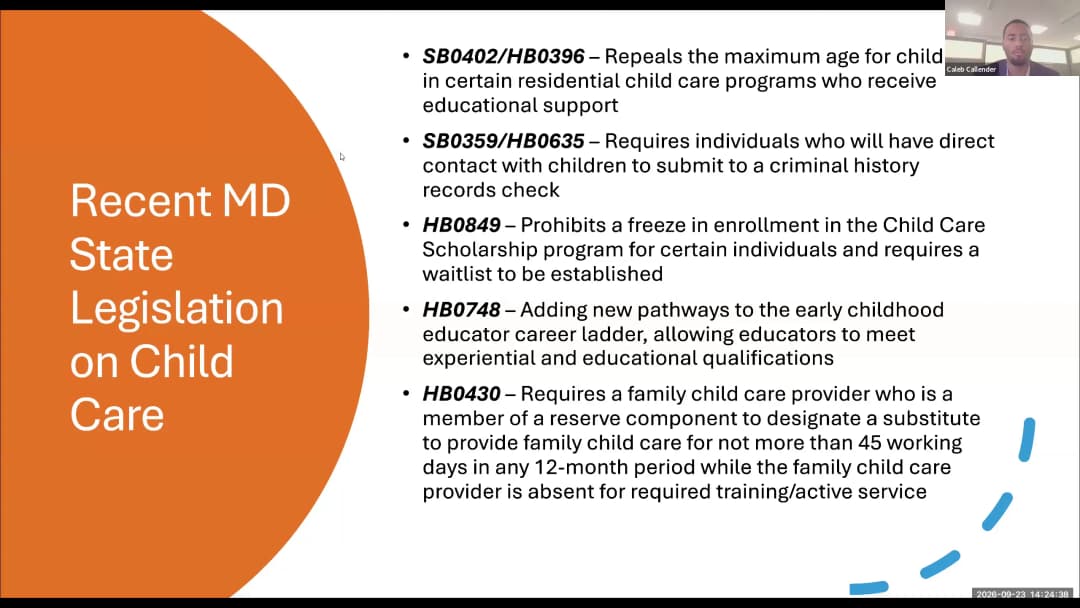
The Prince George's County Child Care Improvement Work Group met virtually on Wednesday, September 23, 2026, at 2:03 PM to continue its work on improving access to quality, affordable child care. Six members were present at roll call. The group approved the minutes from the September 9, 2026 meeting, reviewed the work group website, heard a presentation from the Department of Social Services on the new Child Care Navigator role, and discussed preliminary state-level legislative recommendations. Discussion Items - Agenda and Minutes: The agenda included approval of minutes from the September 9 meeting (correcting an earlier date error), a website overview, revisiting major themes from Meeting One, a presentation from the Prince George's County Department of Social Services (DSS) on the Child Care Navigator, discussion of state-level legislative recommendations, and next steps. The minutes were approved by a motion and second. - Overview of Major Themes from Meeting One: Key themes included: clarifying the scope of universal child care in Prince George's County, family child care expansion barriers, the child care scholarship program and provider stability, capacity versus enrollment mismatches, pre-K and child care continuity (including Maryland's mixed delivery system), early childhood workforce development (recruitment, credentialing, compensation, retention), coordination and implementation challenges, and the need for strong data and accountability. - DSS Presentation on Child Care Navigator: Jordan Anderson (Public Information Officer and Legislative Liaison, DSS) presented on the implementation of Council Bill 14-2026, which established the Child Care Navigator role. Key points: DSS serves about 400,000 families annually across Prince George's County with over 500 staff. The county council allocated $2 million to fund the navigator's salary. The job posting received 34 applicants in a five-day window, interviews are ongoing, and the navigator is expected to be onboarded by mid-October. The navigator will be housed in a new Strategic Partnerships and Community Impact Division and will develop a strategic plan and submit an annual report by February 1. The role focuses on business-to-business support for child care providers, connecting them with permitting, licensing, and space identification, though DSS is not a licensing entity. The navigator will work with agencies like Central Services, Office of Procurement, and others. - State-Level Legislative Recommendations Discussion: Dr. Paraken and Mr. Callender presented potential recommendations in several areas: - Family Child Care Expansion: Addressing the sprinkler requirement for homes serving 9–12 children, a financial barrier. Policy opportunities include examining county authority to modify or create alternative compliance pathways, or offering supports to meet the requirement. - Child Care Scholarship Program & Provider Stability: Advocating for sufficient state funding to reduce/eliminate wait lists, better prioritization of families with greatest need, and reducing administrative burdens on providers (payment corrections, enrollment changes, documentation). - Capacity vs. Enrollment: Using more detailed data to identify mismatches and targeting expansion efforts accordingly. Examining scholarship reimbursement structures that may limit access. - Pre-K and Child Care Continuity: Expanding participation of private providers in Maryland's mixed delivery pre-K system, aligning transportation and wraparound supports, and supporting infant/toddler care through improved reimbursement structures. Dr. Searcy noted that under the Blueprint for Maryland's Future, Prince George's County aims for 30% of pre-K seats in private settings, increasing to 50%. Currently 12 child care centers and 16 family child care providers offer free pre-K seats. She mentioned the "Push to Pre-K" sessions offered by MSDE. - Early Childhood Workforce: Building on existing state initiatives (paid training, credentialing, apprenticeships, partnerships with higher education, competitive compensation) to address shortages. - Coordination & Implementation: Establishing a clear implementation framework or interagency mechanism at the state level to track progress and ensure recommendations are acted upon. - Data & Accountability: Strengthening public reporting and data collection to identify actual gaps (e.g., available slots vs. accessible slots). - Child Care Navigator: Using the navigator model statewide, creating clear referral pathways, and tracking patterns to address systemic issues. - Group Discussion and Additional Input: - A work group member (Brianna) asked about wrap-around services for families (diapers, food, nutritionists) similar to DC programs. DSS noted no formalized program but highlighted partnerships and the Judy Centers (six early learning hubs in the county providing diapers and supports). Dr. Searcy added that Judy Centers serve families birth to five. - A public attendee (Lacey) suggested awareness of Montgomery County's Working Parents Assistance Program as a model to study, given border-sharing and frozen scholarship enrollment. - Another member emphasized the navigator role should include a synopsis of other agencies' roles (fire, zoning, approvals) to simplify processes. - Kiana Morant recommended creating a live, common data system for the navigator to track real-time slot availability, building on what Maryland Family Network offers but making it more dynamic. - Dr. Searcy raised concern that pre-K expansion could harm providers who subsidize infant/toddler care (lower ratios) with revenue from older children, urging intentional support for infants/toddlers. - Keisha Maxwell asked about opportunities to adjust licensing for school-age programs to include more pre-K children attending the same school building, noting current staff age requirements and ratios. Maxwell noted regulations are being amended (minimum age from 19 to 18, group size adjustments) and public comment is open. - Alejandra asked about a county inventory of county-owned buildings that could be leased to child care providers for expansion. Jordan Anderson responded that the navigator is mandated to identify and maintain such an inventory, and Dr. Paraken added that a state-level study is underway (DGS) on feasibility of using state government offices for child care. A work group member confirmed at least one provider is seeking such a partnership. Key Outcomes - Minutes Approved: The minutes from the September 9, 2026 meeting were approved by a motion (Keisha Maxwell) and second. - No Formal Votes: No recommendations were finalized. The group will refine state-level recommendations to be more action-oriented (with responsible parties, measurable outcomes) for the next meeting. - Next Steps: Work group members are encouraged to share relevant data and announcements via email. The next meeting is scheduled for Wednesday, October 14, 2026, at 2:00 PM virtually, where discussions will continue on concrete state-level actions and also begin on improving permitting and county review processes for child care facilities. - Adjournment: The meeting was adjourned at 3:02 PM.
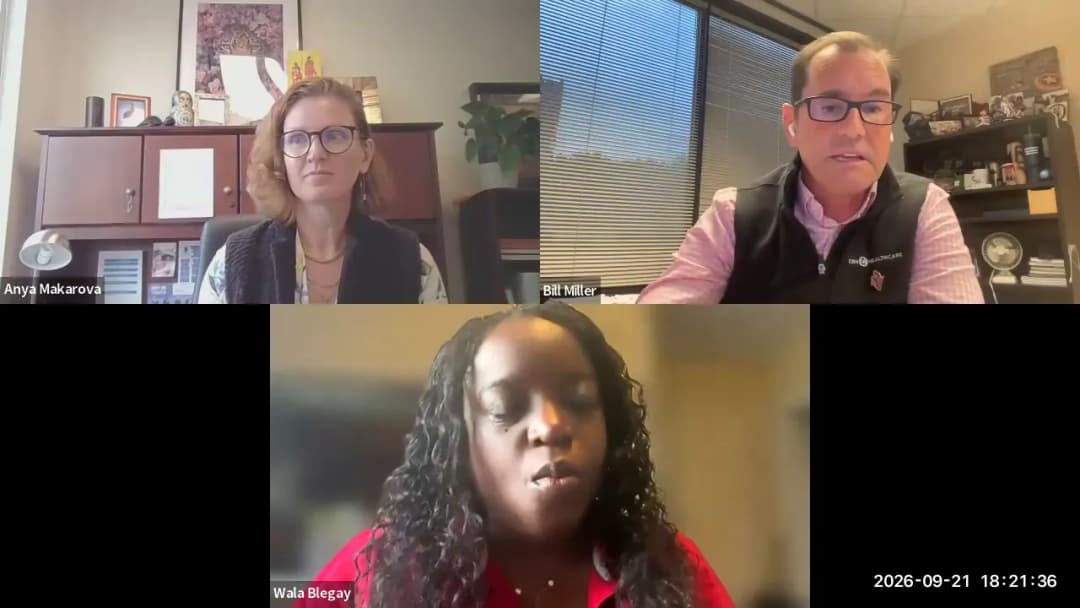
The Prince George's County Council Emergency Room Away Times Task Force met on September 22, 2026, at 4:45 PM ET to review and consider a revised draft report, address state concerns, and discuss next steps. The meeting included roll call, adoption of prior minutes, a presentation of the revised report, and extensive member discussion about the removal of key sections. The task force decided to invite HSCRC representatives to a future meeting to clarify state concerns before voting on the report. Consent Calendar - Minutes Approval: The task force adopted the minutes from the February 2, 2026 and April 13, 2026 meetings. Motion by [member], seconded. Roll call vote: 8 ayes, 1 abstention (Dr. Archinnard, who was not present at those meetings). Approved. Discussion Items - Revised Report Overview: Staff member Anya presented a summary of the revised draft report, which was condensed from the original 60-page, 32-recommendation version to a 19-page, 9-recommendation version. The revision was led by former Deputy Chief Administrative Officer Erica Turner in response to concerns from the state (specifically HSCRC and the Governor's office). Removed sections included analysis of HSCRC's role and global budget revenue methodology, bed capacity trend data, urgent care structural barriers, post-acute care, fire/EMS staffing, and equity infrastructure. The health department (Andrew Ballard) provided a comparative analysis, noting the revised report retains core data and direction but in a condensed format, and offered no objection to adoption. - Member Concerns: Mr. Bill Miller expressed strong concern that the original report represented two years of work and that removing sections (e.g., HSCRC payment program, urgent care access barriers) materially changed the findings. He questioned who requested a concise report and felt an outside force (state/governor) altered the task force's product. Councilmember Bligay acknowledged the political pressures—the Governor's office reached out, and county officials needed state buy-in—but argued the revised report still makes the key points. Dr. Archinnard suggested including an appendix or note acknowledging the longer version. Another member asked for clarity on why the full report was rejected, noting confusion about whether HSCRC or the Governor's office drove the changes. - Path Forward: Councilmember Bligay made a motion to adopt the revised report. However, due to lack of a second and member unease, the motion was not voted on. Instead, the task force agreed to invite HSCRC representatives to a virtual meeting within two weeks to explain their concerns directly. Councilmember Bligay noted her term ends in late November; if the report cannot be finalized by then, the task force may dissolve or be handed to another council member. Key Outcomes - Minutes approved from February 2 and April 13, 2026. - No vote on the revised report; motion was not seconded. - Directive: Task force staff to schedule a meeting with HSCRC representatives within two weeks (by early October 2026) to discuss state concerns. - Materials: A side-by-side comparison of the original and revised reports will be distributed to members. - Deadline: Councilmember Bligay indicated a desire to release a report before her term ends in late November 2026; if unresolved, the task force will be suspended and potentially reassigned.
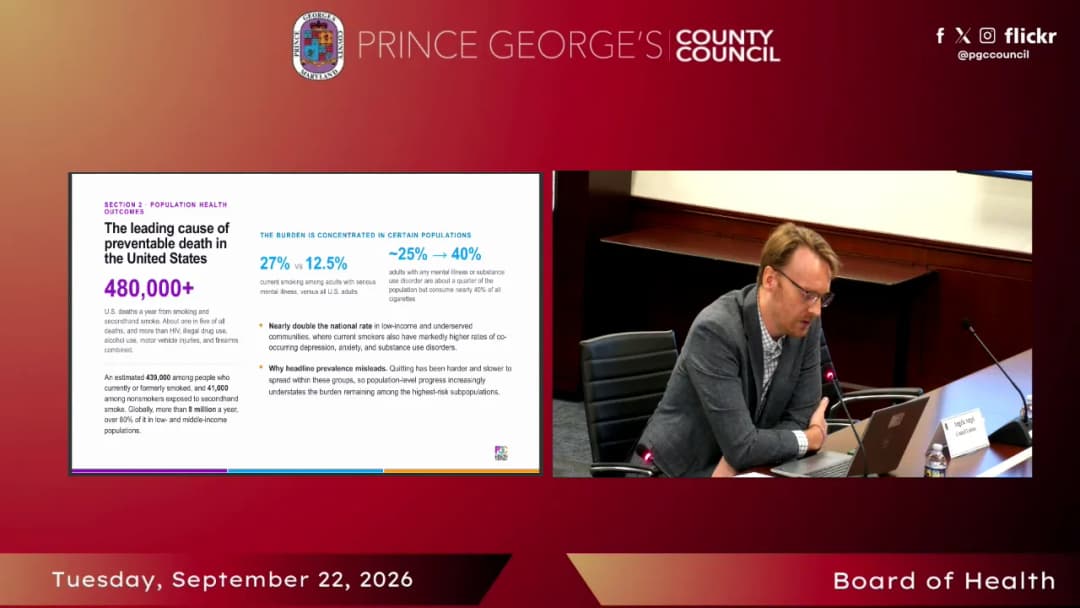
The Prince George's County Council, sitting as the Board of Health, convened on September 22, 2026, at 10:00 AM for a briefing on the community health effects of tobacco and alcohol retailers. The session began without a quorum but proceeded as a briefing until a quorum was established; seven members were present. The meeting featured presentations from staff and the Prince George's County Health Department on retailer distribution, health impacts, and associated costs, followed by questions and discussion among councilmembers. Presentation on Retailer Distribution - Anya Makarova, Committee Director, presented data on tobacco and alcohol retailer density by councilmatic district. - There are 932 active tobacco licenses in the county, averaging 9.5 per 10,000 residents, but distribution is uneven: District 7 has the highest density (16.6 per 10,000), nearly double the county average, while District 4 has the lowest (6 per 10,000). Approximately 86% of licensed tobacco locations are general retailers. - For alcohol, there are 142 active Class A licenses (liquor stores), averaging 1.4 per 10,000 residents. District 7 again has the highest density, District 4 the lowest. - Councilmember Fisher requested additional analysis by per-square-mile density to better reflect saturation, noting that geographic size varies by district. Ms. Makarova acknowledged the complexity due to urban, suburban, and rural areas and suggested the Health Atlas tool could provide a more comprehensive view. - Ms. Makarova highlighted two existing decision-making tools: the Health Atlas (a countywide evidence-based tool integrating health, land use, and demographic data, soft-launched August 26, 2026) and health impact assessments in the zoning process. She noted that retail density findings could feed into future health assessments to inform land-use decisions. Presentation on Health Impacts of Tobacco and Alcohol - Dr. Toin Okwesomi (Dr. O), Health Officer, and Dr. Andrew Ballard, Chief of Public Health Policy and Innovation, presented county-level statistics and documented harms. - Tobacco: About 8% of Prince Georgians smoke regularly, down from 14% a decade ago, but the decline has flattened since 2022. Smoking rates vary widely by community (6.7% in Woodmore vs. 17.7% in Langley Park), with highest rates inside the Beltway where retailer density is also highest. Youth cigarette use has collapsed to 2.1%, but youth vaping remains elevated (14.3% in Maryland high schools). Adult vaping is rising slowly. Nationally, tobacco causes 480,000 deaths and $600 billion in annual costs, with 60% of healthcare spending paid by government programs. Smokers die on average 10 years earlier. Quitting by age 30 eliminates nearly all excess risk. - Alcohol: Excessive alcohol use causes 178,000 deaths and $249 billion in annual costs nationally, with government paying nearly $100 billion. Alcohol is causally linked to at least seven types of cancer, including breast cancer (60% of alcohol-related cancer deaths among women). In 2023, 28.9 million people met criteria for past-year alcohol use disorder. Alcohol-related costs include $38 billion for criminal justice and motor vehicle crashes. In Prince George's County, 70% of arrests involve some form of intoxication. - Dr. Ballard noted that tobacco and alcohol burdens disproportionately affect low-income communities and communities of color. Discussion Items - Councilmember Sheila Adam Stafford requested data on treatment facility locations by district, cross-referenced with alcohol-related crime data, to better understand the impact of liquor store saturation on quality of life. She also asked about existing programs and gaps. - Councilmember Fisher emphasized the need to map resources intentionally to areas of highest need (e.g., Districts 7 and 8) rather than current patterns where resources may concentrate in northern parts of the county. - Caitlin Murphy (Associate Director, Health and Wellness) described current tobacco programs: a state-funded grant focused on preventing sales to minors through undercover compliance checks, and a small cessation outreach program. She noted limited funding and the need for community-based cessation services. - Dr. Alex Budenz (former program manager) added that there is a huge unmet need for smoking cessation services in the county, with few trained community organizations. She mentioned federal programs like the "Real Cost" campaign and smokefree.gov. - Councilmember Stafford inquired about school-based programs, especially for vaping and energy drinks with synthetic opioids (e.g., 7OH). Staff confirmed partnerships with schools, use of youth decoys for peer education, and ongoing work on safe storage and interactive programming. They noted recent state legislation (HB 1523) limiting 7OH concentration and requiring age restrictions, but enforcement funding remains a challenge. - Councilmember Fisher raised the upcoming ballot question that would allow the county to charge fees on certain industries (e.g., tobacco, alcohol) to fund health mitigation, similar to traffic or school fees. She expressed hope that dedicated resources could support health department programs. Key Outcomes - The Board requested follow-up data and analysis, including: - Retailer density per square mile by councilmatic district (per Councilmember Fisher's request). - Mapping of treatment facilities and cross-walking with alcohol-related crime data by district (per Councilmember Stafford). - An overview of potential programming options and associated costs to address gaps in funding and resources (per Chair Orieta). - No formal votes were taken; the meeting concluded with a motion to adjourn, seconded, and passed by voice vote. - Chair Orieta noted the council placed a ballot question on health impact fees, which if passed, could create a dedicated resource fund for health mitigation related to tobacco and alcohol retailers.
On September 22, 2026, the Prince George's County Cannabis Reinvestment and Restoration Board held its first community town hall at a location in District 6, hosted by Councilwoman Danielle Hunter. The meeting aimed to gather public input on how to allocate the county's cannabis reinvestment fund, currently at $12 million, derived from a 35% share of the 12% cannabis sales tax. Board members presented a timeline of their work since appointment in October 2024, highlighted the fund's purpose to support communities disproportionately impacted by past cannabis enforcement, and expressed concern over proposed legislation (CB093-2026) introduced by Council Chair Crystal Oriada that would restructure the board and shift control to the council. Public Comments & Testimony - Tamara McKinney (District 5 resident): Advocated for parenting classes for young parents starting in high school, including co-parenting and financial literacy, citing a lack of proper guidance contributing to school issues. - Beverly John (District 5 resident): Praised the board's transparency but raised alarm about Council Chair Oriada's proposed amendment, which she said would allow council staff to be appointed to the board and let the council override grant approvals if reports are not submitted on time. She questioned how this maintains a community-driven process. - Dawn Dalton (District 6 resident, Executive Director of the Justice Initiative): Expressed disgust at any amendment taking power from the community, stating the bill's original intent was to make communities whole, not pad pockets. She shared a story of a young man who committed suicide due to drug addiction and hopelessness, urging immediate resource deployment. She noted she personally met with Council Chair Oriada about appointments and called the delay unacceptable. - Dr. Darbencia Warren (District 8 resident, CEO of Core DMB): Emphasized the need for financial literacy programs that combine education with activation tools, citing that over half the country retires back to work or lives paycheck to Monday. She serves on Maryland's Financial Literacy Advisory Council and wants to bring such programs to Prince George's County. - Donna Dean (Treasurer, Lake Arbor Foundation): Asked about the protocol for fund disposition, who makes final decisions, and the board's ability to reject decisions. She later proposed intergenerational learning (STEM, history, ancestry), a swim team at the foundation's Olympic-size pool, and aquaponics to address food deserts. She noted the county cut their grant by 50% for FY27. - Patricia Brody (District 6 resident, retired educator): Supported parenting and youth programs, especially for black males, and called for mentoring, consumer math, and intergenerational learning. She highlighted that 27.4% chronic absenteeism in PGCPS is a community issue, not just a school problem. - Tracy Battle (District 9 resident, founder of Restorative Rebuild): Advocated for youth development and family engagement to address truancy, emphasizing preventative upstream investments like mentoring, after-school programs, and family engagement. - Karina Attrison (District 6 resident): Raised concerns about conflicts of interest between council members and nonprofits, urging that any government official or staff should not have vested interests in nonprofits receiving funds. Discussion Items - Board Timeline and Operations: Vice Chair James McDowell Jr. detailed the board's history: appointed October 2024, first meeting March 2026 (17 months later), elected chair and vice chair May 2026, approved six priority work areas, developed a funding methodology (approved 8-0 on June 1), and requested coordination with Council Chair Oriada and County Executive Aisha Braveboy for board vacancies and administrative funding. The board was denied administrative funds (<$5,000 for tablecloths, flyers, banners) and used personal resources. - Proposed Legislation CB093-2026: Board members stated the bill was introduced September 1, 2026 without their prior knowledge. It would remove all current board members upon passage, allow council staff to be appointed, and shift grant oversight to the council. Board members argued this undermines community control and creates conflicts of interest. - Funding Categories: The board outlined intended funding areas: behavioral health, education, housing, job training, youth support, small business development, re-entry services, and more. They emphasized equity-focused investments prioritizing the 18 zip codes deemed 150% disproportionately impacted by the war on drugs. - Oversight of Funds: In response to questions, board members expressed support for an independent grant management entity to ensure unbiased distribution, with community representation in the review process. They noted other counties (Montgomery, Anne Arundel) use such external entities. The board sought only modest administrative funds (under $5,000), not the full 15% ($1.8 million) allowed by state legislation. - Councilwoman Hunter's Remarks: Stated she does not want oversight of cannabis funds; the community should be involved. She committed to opposing the amendment and urged residents to attend the September 24 committee hearing and spread the word. Key Outcomes - The board committed to keeping a community survey open until mid-October to collect input on priorities. Results will be reported to the council. - Upcoming town halls: District 4 (with Council Member Adams) and District 1 (with Council Member The Novels) on September 29 and 30. - The next committee hearing on CB093-2026 is scheduled for September 24, 2026, at 1:00 PM. Residents were urged to attend in person or submit written testimony. - Board members called for public pressure on council members to reject the amendment and preserve community control. - Councilwoman Hunter pledged to support the board's efforts and provide logistical resources (tablecloths, water, etc.) for future outreach. - The board will continue to conduct outreach at community events, farmers markets, and churches to boost survey participation.
On Tuesday, September 22, 2026, the Public Safety, Health and Human Services Committee of the Prince George's County Council met at 10:00 AM in Committee Room 2027. The meeting was streamed live. Present were Chair Wanika Fisher, Council Member Edward Burroughs, and Council Member Krystal Oriadha. Vice Chair Wala Blegay and Council Member Danielle Hunter were absent. The committee considered a briefing on the implementation of Executive Order No. 13-2026 (transferring DPIE's enforcement division to the Office of Homeland Security) and legislation (CB-123-2026) codifying the transfer and increasing fines. Briefing: Implementation of Executive Order No. 13-2026 Director Katina Gomez of the Office of Homeland Security (OHS) presented the restructuring, highlighting that code compliance now includes divisions for single-family rental, short-term rental, multi-housing, vacant properties, zoning, and property maintenance. The transition began in early 2026, with Executive Order 13-2026 effective July 24, 2026. Ongoing steps include transferring HR and fiscal functions, rebranding fleet vehicles, and finalizing an MOU. Early achievements included the Golden Standard Initiative (all 39 senior living communities inspected regularly), tobacco/convenience store initiatives (over 300 stores), shopping center initiatives, and the clean lot program, which received FY27 funding after being unfunded in FY26. The clean lot program allows the county to abate conditions and place liens. OHS is also supporting illegal dumping strike force initiatives. Council Member Fisher asked about inspector safety in high-crime areas, noting that the transition to OHS under public safety could streamline police escorts. Director Gomez confirmed partnerships with police and health departments. Fisher also raised concerns about proactive enforcement versus complaint-driven responses, citing shopping cart violations at major retailers. She noted that a bill she sponsored requires retailers to have cart retention mechanisms; non-compliant stores should be cited. The committee discussed using 311 service requests, but Fisher argued that reliance on complaints disadvantages districts with lower report rates. Assistant Director Rease noted that nine new enforcement liaison positions (one per council district) were funded in FY27 budget, though OHS had not yet received details from OMB. Fisher also urged tracking data on fines to support future state legislation raising maximum fines to $10,000 for repeat offenses (currently $5,000). Deputy Director Hinton confirmed data tracking initiatives. Council Member Burroughs asked about enforcement of flashing light restrictions at tobacco/liquor stores. Director Gomez said a list of violations could be sent for action. Burroughs commended enforcement agent Santiago for responsiveness. Gomez clarified that the clean lot program applies to both vacant and occupied properties. Burroughs noted pending legislation to allow interior inspections with law enforcement accompaniment. Council Member Oriadha requested proactive enforcement and evening hours to address nighttime violations (e.g., lights). Director Gomez confirmed that new hires would have later shift hours. Oriadha also requested periodic evaluations of existing legislation (e.g., clean lot violation thresholds) to identify needed tweaks. Assistant Director Rease reported that OHS is working with police on issuing radios to inspectors for constant communication and is updating the 311 system. Deputy Director Bryant is meeting with council district staff to streamline constituent service referrals. Legislation: CB-123-2026 CB-123-2026 amends multiple County Code subtitles to transfer enforcement, licensing, and inspection authority from DPIE to OHS and increases civil fines and penalties. Committee Director Anya Makarova presented the bill. Budget analyst David Noto stated there would be no direct fiscal impact; the transfer is administrative, and increased fines may improve compliance and reduce litigation. The Office of Law confirmed legal sufficiency. Council Member Burroughs moved for a favorable recommendation, seconded by Council Member Oriadha. Key Outcomes - Vote on CB-123-2026: Motion carried 3-0 (Ayes: Fisher, Burroughs, Oriadha; Absent: Blegay, Hunter). The bill received a favorable committee recommendation. - Briefing acknowledged: The committee received the update on the transition under Executive Order 13-2026. No formal action was taken on the briefing. - Next steps: OHS will work with council offices and OMB on the nine enforcement liaison positions. The committee expressed interest in receiving a follow-up report in 90 days on enforcement gaps and legislative needs. The clean lot program funding for FY27 was noted.
The Prince George's County Council held a listening session on September 22, 2026, at the County Administration Building in Largo, Maryland, to gather public input on the proposed Sphere entertainment venue at National Harbor. Council Chair Krystal Oriadha opened the session, emphasizing that the council was in a listening posture and could not take any action that evening. Presentations were given by MSG Sphere Entertainment and council staff, followed by over 40 registered public speakers. The project involves a 6,000-seat, 302-foot-tall sphere-shaped venue with immersive technology, projected to cost $1.4 billion, with $130 million in county tax increment financing (TIF) and a $40 million county-owned parking garage. Public Comments & Testimony - Support with conditions: Many union representatives and members (carpenters, painters, hospitality workers) expressed conditional support, urging the council to require a Project Labor Agreement (PLA) and labor peace agreements before approving public subsidies. Speakers such as Lamar Motts (Eastern Atlantic States Regional Council of Carpenters) and David Washington (carpenter) highlighted the need for strong labor standards, local hiring, registered apprenticeships, and prevailing wages. Stacey Hartwell (environmental advocate) raised concerns about electricity grid impact, transportation, and lack of mass transit. Patricia Monroe (South Lawn Citizens Association) called for a community benefits fund of at least $5 million, local hiring at 50%, and environmental impact studies. Sharon Lawrence (Livingston Woods HOA) requested a community suite, ticket revenue sharing, and road improvements before construction. - Opposition: Some residents opposed the project entirely. Darlene Rainey argued the county should prioritize schools, healthcare, and churches over entertainment. Robin Bates asked for a delay, citing insufficient community engagement and unresolved traffic and cost issues. Imania Price called the project "tone-deaf" and questioned its environmental and aesthetic fit. Christopher Goins opposed what he called the "Abu Dhabiization" of the community and urged economic development from within. - Support with urgency: Delegate Jamila Woods (District 26) spoke in favor but urged labor agreements. Danny Moore King emphasized the project as a transformative legacy opportunity, warning that failure could harm the county's reputation. Aaron Charles (National Harbor resident) highlighted the value of shared community experiences. Darrell Morrison (former town council member) supported with a call for 40% minority contracting. - State and business perspectives: Deputy Secretary of Commerce Stephen Rice voiced strong state support, citing $1.85 billion in economic impact during construction and $1.5 billion annually after opening. Matt Teffaro (Associated Builders and Contractors) opposed a PLA, arguing 90% of the county's workforce is non-union and a PLA would limit competition. Several business owners and residents spoke in favor, contingent on addressing traffic, local hiring, and community benefits. Discussion Items - Sphere Entertainment Presentation: Paul Macchia, Senior VP, described the venue's technology (16K screen, beam-forming sound, 4D effects), economic projections from an Ernst & Young study, and community programs (digital tech training, exosphere local artist program). He stated Sphere Las Vegas generated $4.5 billion in economic impact in 2025, and the National Harbor venue would support 3,300 construction jobs and 7,000 operational jobs in Prince George's County, with over $60 million in annual tax revenue for the county. Macchia emphasized the company's union-friendly history and commitment to local hiring. - Council Staff Presentation: Marianne Albear, Director of Legislative Impact, provided a high-level overview of costs, financing, and unknowns. Key points: the $1.4 billion cost does not include furniture, fixtures, and equipment (FF&E) which could add 5–25%; the $130 million TIF results in approximately $400 million in principal and debt service through 2056; estimated annual tax revenue is $63 million (county and other jurisdictions), but net fiscal benefit requires subtracting debt service and costs for police, fire, EMS, road improvements, etc. She noted the Las Vegas Sphere's final cost nearly doubled from $1.2 billion to $2.3 billion, raising questions about who bears cost overruns. Albear outlined outstanding issues: need for a strong, measurable Community Benefits Agreement (CBA), minimum revenue guarantees, timeline for break-even, and transportation coordination. - Council Chair Remarks: Chair Oriadha reiterated the council's priorities: centering residents most impacted, strong CBA, support for local minority-owned businesses, living wage and labor standards, local hiring in both construction and operations, and clear, actualized commitments. She clarified that the $63 million tax revenue figure includes projected additional revenue from the project, not solely Sphere taxes. She also corrected a misconception that the final vote would occur next week, stating the process would include further committee sessions and a public hearing before a vote likely in October. Key Outcomes - No formal votes or decisions were made at this listening session. - The council will hold additional committee sessions and a public hearing before a final vote, expected in October 2026. - Council staff will provide a detailed revenue breakdown comparing full projected revenue versus taxes specifically from Sphere, and further refine cost-benefit analysis. - The council will continue negotiations with Sphere Entertainment on labor agreements, community benefits, and financing terms. Several speakers urged the council to mandate a PLA and labor peace agreements as conditions for TIF approval. - County agencies will be engaged to estimate costs for additional public services (police, fire, EMS, sanitation) and infrastructure improvements (roads, transit).
The Committee of the Whole met on Tuesday, September 22, 2026, in Committee Room 2027 at the Wayne K. Curry Administration Building. The agenda called for a 5:30 p.m. start, but the meeting was convened at 5:55 p.m. and adjourned at 6:00 p.m. Members reviewed draft agenda letter LTR 09222026, a proposed joint signature letter to Maryland Department of Transportation Secretary Katie Thomson regarding the county's 2026 Projects List priorities for Fiscal Years 2027-2032 State Consolidated Transportation Program (CTP). The committee voted 8-0 to favorably recommend the letter to the County Council. Briefing and Discussion - Alex Hirtle, Budget and Policy Analyst, provided an overview of the draft letter, filling in for Mr. Battle. - The letter expresses appreciation for the Moore-Miller administration's continued partnership, particularly on transit-oriented development, the New Carrollton Build Award, and efforts to secure the FBI headquarters in Greenbelt. - It highlights Prince George's County's multimodal networks — Metro, MARC, Amtrak, and the forthcoming Purple Line — as key to strengthening connections between communities and expanding access to jobs. - Major projects cited include The Sphere, the Six Flags redevelopment, the Blue Line Corridor, and New Carrollton, which are described as demonstrating the scale of opportunity and statewide benefit. - The letter emphasizes the importance of coordinated roadway maintenance through Project Elevate and the countywide strike force for litter removal, mowing, and beautification, especially on state roads, where collaboration with MDOT and SHA remains essential, including after the September 3rd storm. - Policy and regional priorities include ensuring Maryland's interests are protected as Virginia advances the I-495 South Side Express Lanes proposal, reinforcing the need for safe access along the Purple Line Corridor as it nears service, supporting MDOT's efforts to strengthen the Chapter 30 project prioritization process, and requesting flexibility in submission deadlines and scoring criteria that reflect equity, multimodal access, and economic development. - The county stated it stands ready to work with the state to advance a safe, equitable, and financially sustainable multimodal transportation system benefiting Prince George's County, Maryland, and the region. Key Outcomes - Council Member Dernoga moved, and Council Member Harrison seconded, that the agenda letter be favorably recommended to the County Council. - The motion carried by a vote of 8-0, with Council Members Oriadha, Blegay, Burroughs, Dernoga, Harrison, Ivey, Hunter, and Adams voting aye. Council Member Burroughs arrived at 5:56 p.m., and Council Member Adams participated remotely. Council Member Olson was excused; Council Members Adams-Stafford and Fisher were absent. - Council Member Dernoga moved, and Council Member Blegay seconded, to adjourn; the motion carried unanimously, and the meeting adjourned at 6:00 p.m.