Browse by city
Date range
Search help

Search titles, summaries, topics and stored transcripts together. Keywords may match separately; put the whole query in double quotes for a phrase. Matching follows word analysis, so punctuation is not exact. Both dates are included. Documents are not searched.

SHOWING 101–110 ENTRIES
101
NOV 4, 2025 · RAMSEY COUNTY, MINNESOTA · BOARD OF COMMISSIONERS & AUTHORITIES
Ramsey County Board Workshop on 2026-27 Budget Addenda – November 4, 2025

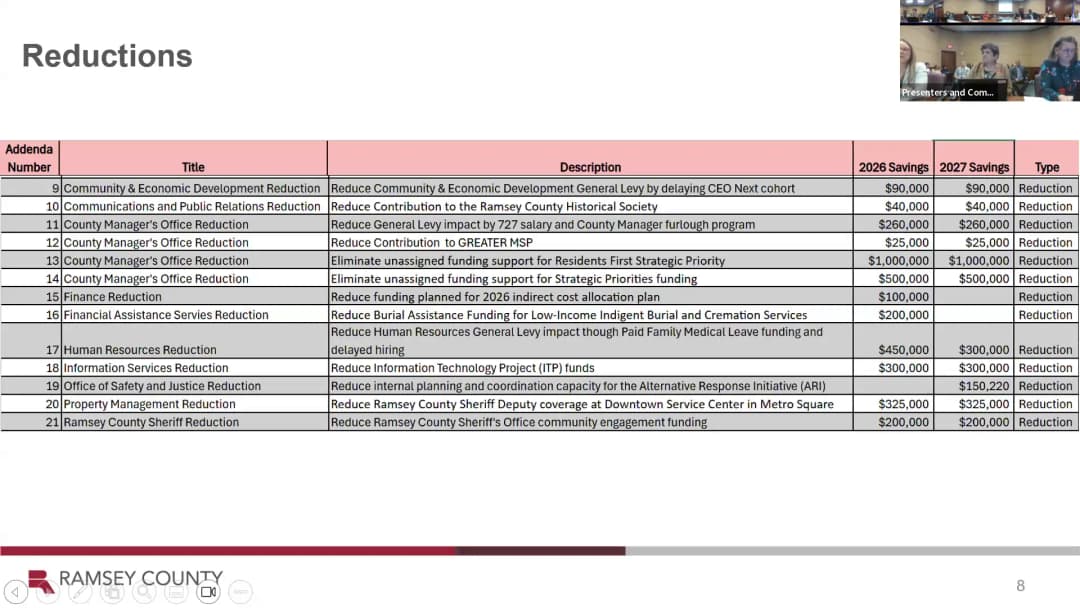
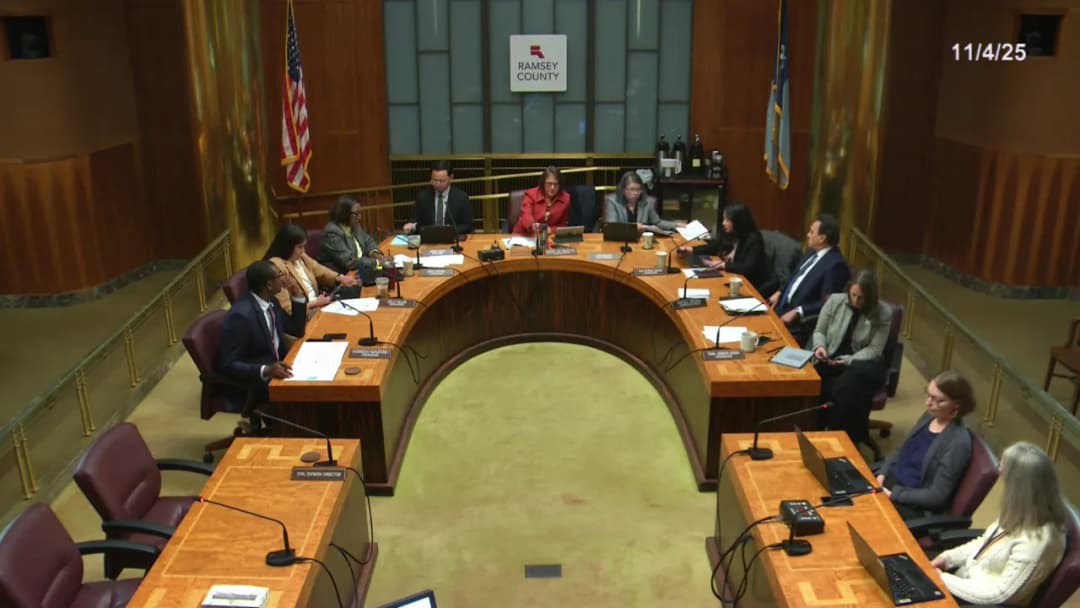
On November 4, 2025, starting at 10:30 a.m., the Ramsey County Board held a workshop in Courthouse Room 220 to review the 2026-27 budget addenda. County Manager Lynn Becker and staff presented options to reduce the general property tax levy after the board adopted a 9.75% maximum levy increase. No votes were taken; the morning session ran until about 12:15 p.m., with remaining reductions to be discussed in the afternoon. Budget Context - County Manager Becker explained that the addenda were developed from a 5% reduction exercise with department directors and from board feedback. - The addenda are grouped into three categories: budget shifts, additional revenue, and reductions, totaling approximately $6 million. One percent of the levy equals roughly $4 million. Discussion Items - Budget Shifts: - Six shifts reallocate levy-funded activities to other sources, including opioid settlement funds, HRA levy, state lottery funds, and wheelage tax. - Trade-offs include reduced budget flexibility and potential long-term sustainability concerns (e.g., grant funds may not be permanent). - Shift housing stability operating costs to opioid settlement funds: Commissioner Kervins and others expressed support for cross-departmental collaboration but asked for clarity on how the funds address the opioid epidemic. The County Manager noted the funding runway is around 10–15 years. - Use of unspent direct assistance funds for family services: Staff explained that forecasts of families served vary annually, leaving unspent funds; a commissioner asked whether this reflected unmet need. - Shift park maintenance funding to lottery-in-lieu funds ($40,000): A commissioner asked how residents would experience this, and staff cited delayed painting of shelters, floor refinishing, and pavement patching. A commissioner also referenced the state's failure to pay its full share for park maintenance. - Shift public works projects to wheelage tax: This may create more restrictive allowable uses; examples include limitations on community engagement funding (e.g., Rice Street) and project-related costs. Commissioner Jefferson noted the importance of maintaining engagement flexibility. - Additional Revenue: - Reclassification of navigators makes them eligible for the random moment time study, generating approximately $500,000 in federal revenue; this is considered a conservative estimate. - Increased investment revenue assumptions (2.5% return) on the county's investment portfolio, an ongoing revenue source. - Reductions: - Delay the CEO Next cohort to 2027, reducing the levy by $90,000; the program supports second-stage business leaders. Commissioners asked for program outcome data and exploration of sponsorships/partnerships. Staff noted possible HRA/EDA administrative percentage impacts, with a commitment to keep city-partner administrative expenses at 10%. - Reduce the operating contribution to the Ramsey County Historical Society by $4,000, from an $8,700 annual contribution. Staff noted the society's budget is in the low millions and that the society's leader understood the decision. Key Outcomes - No votes taken; workshop was for discussion only. - Staff will provide additional information on housing stability service demand and opioid fund alignment, CEO Next program evaluation, and HRA administrative percentage impacts. - Additional reductions were deferred to the afternoon session.
FISCAL SUSTAINABILITY 34% · BUDGET EQUITY ANALYSIS 30% · ECONOMIC DEVELOPMENT 11% · PUBLIC ENGAGEMENT 9%
102
NOV 4, 2025 · RAMSEY COUNTY, MINNESOTA · BOARD OF COMMISSIONERS & AUTHORITIES
Legislative Committee of the Whole Meeting – November 4, 2025: Approval of 2026 State and Federal Legislative Platforms

The Legislative Committee of the Whole met on November 4, 2025, at 10 a.m. to review and vote on the 2026 Ramsey County State and Federal Legislative Platforms. The meeting included approval of the agenda and previous minutes, detailed discussion of platform priorities, and unanimous votes on both platforms with an amendment to add elimination of the Medicaid exclusion for incarcerated individuals. Consent Calendar - Approval of the November 4, 2025 agenda: Motion by an unnamed member, seconded, roll call vote: all ayes (Commissioners Chapin Singh, McMurtry, Miller, Moran, Ortega, Zhang, McGuire). - Approval of the minutes from November 5, 2024: Motion and second, roll call vote: all ayes (same commissioners). Discussion Items - 2026 State Legislative Platform: Director of Government Relations Jennifer O'Rourke presented the platform, highlighting pursuit items (Park at River's Edge $20 million, Aldrich Arena $8.5 million), leading advocate items, and support items. Commissioner Jebinsing asked about the process for crafting bill language, and staff explained the partnership with the county attorney's office and legislative nonpartisan resources. Commissioner Moran asked about MAFA funding extension, and staff clarified a six-month extension is sought for the 2.5 million grant, plus moving case reviews to the state. Commissioner Jebinsing also inquired about the item on increased access to secure mental health treatment in the East Metro; staff noted ongoing collaboration with the county attorney's office and courts. - 2026 Federal Legislative Platform: Director O'Rourke presented the federal platform, which included items on SNAP, Medicaid, workforce, emergency management, homelessness, and affordable housing (CDBG, HOME, tenant-based rental assistance). Commissioner McMurtry confirmed tenant-based rental assistance refers to Section 8 vouchers. Commissioner Zhang proposed adding the elimination of the Medicaid exclusion for incarcerated individuals to the federal platform, noting the cost falls on counties. Discussion followed on the long-standing barrier of federal funding; staff and commissioners explored incremental approaches and mentioned state-level workarounds. The committee agreed to highlight this issue in both platforms. - Federal project funding: Commissioner McMurtry asked about the process for selecting projects for congressionally directed spending (CPF). Staff indicated they will work with the county manager and executive team to develop a selection process and noted past success with public safety projects. - Future strategy workshop: Commissioner Zhang requested a deeper workshop on legislative strategy, partners, and authors. The chair agreed to schedule a follow-up meeting to discuss implementation details. Key Outcomes - Motion to approve the 2026 Ramsey County State Legislative Platform, as amended to include elimination of the Medicaid exclusion for incarcerated individuals. Roll call vote: all ayes (Commissioners Jebin Singh, McMurtry, Miller, Moran, Ortega, Zhang, McGuire). Unanimous. - Motion to approve the 2026 Ramsey County Federal Legislative Platform, as amended to include the same Medicaid exclusion issue. Roll call vote: all ayes. Unanimous. - Both platforms will be forwarded to the full Board of Commissioners for final approval on November 18, 2025. - Staff will schedule a workshop on legislative strategy and tactics, and will provide a summary chart identifying lead organizations for support items.

GOVERNANCE STRUCTURE 35% · PROCEDURAL 21% · PUBLIC SAFETY 15% · PROCUREMENT 13%
103
NOV 4, 2025 · RAMSEY COUNTY, MINNESOTA · BOARD OF COMMISSIONERS & AUTHORITIES
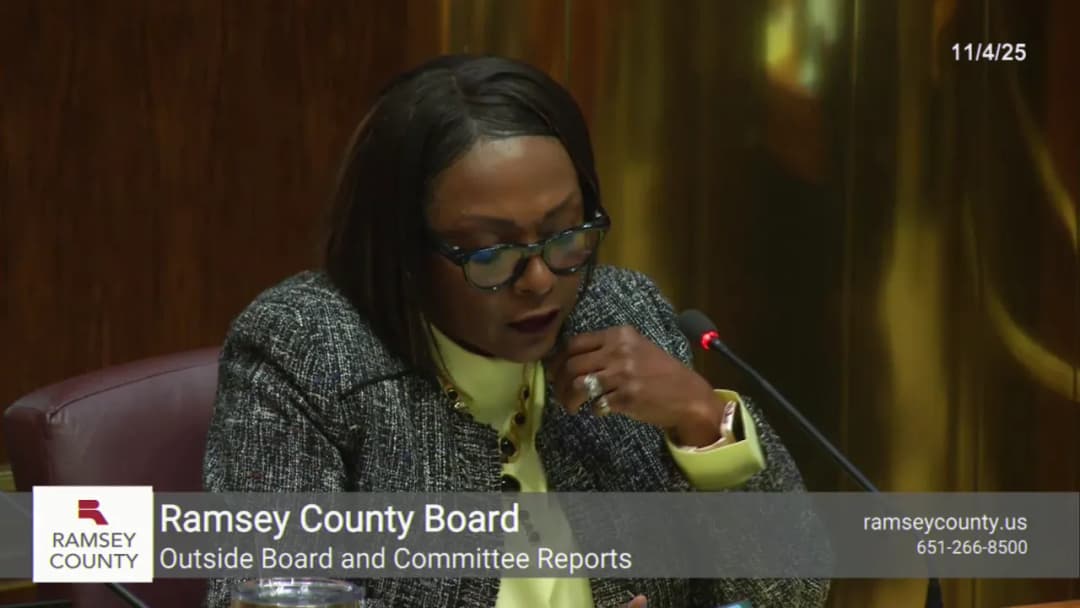
Ramsey County Board of Commissioners Meeting – November 4, 2025

The Ramsey County Board of Commissioners met on November 4, 2025, at 9:02 a.m. in Council Chambers, Courthouse Room 300. The meeting included a proclamation, a public hearing on a bond ordinance, several administrative appointments, an amended salary for the Sheriff, and an informational item on emergency food and infant nutrition support due to the ongoing federal shutdown. All seven commissioners were present. Proclamation: Native American Heritage Month - Commissioner Miller presented the proclamation declaring November 2025 as Native American Heritage Month. The proclamation recognized the enduring strength, sovereignty, and contributions of Indigenous peoples, including the Dakota, Ojibwe, and Ho-Chunk nations, and acknowledged the historical displacement and ongoing partnership with the American Indian community. - Several community leaders and members spoke in support of the proclamation, including John Trepart (activist), Sherry Reimers (co‑chair of St. Paul Indians in Action), Kristen Kinney (executive director of the American Indian Family Center), and others. They expressed gratitude for the county’s partnership, highlighted the creation of the American Indian Community Coordinator role in 2024, and emphasized the importance of continued engagement. Consent Calendar - Agenda of November 4, 2025 – Approved unanimously. - Minutes from October 21, 2025 – Approved unanimously. - Appointment to Ramsey‑Washington Metro Watershed District (Mark C. Gernes and Benjamin M. Karp, incumbents) – Approved unanimously. - Appointment to Rice Creek Watershed District (Marcie Weinandt, incumbent) – Approved unanimously. Commissioner Jebens‑Singh thanked all appointees for their service, and Commissioner Moran encouraged community members to apply for future vacancies. - Appointment to Valley Branch Watershed District Board of Managers (Rick Gelbmann, incumbent) – Approved unanimously. - Appointment to Ramsey County Extension Committee (Heidi Miller and Nancy Kasseth) – Approved unanimously. - Rename Metro Square to Ramsey County Government Center – Approved unanimously. Ordinance Procedures: 2026 Capital Improvement Program Bond Ordinance - Chair Ortega opened the public hearing at 9:20 a.m. No members of the public signed up to testify. The chair called three times for additional comments and closed the hearing at 9:25 a.m. - The board then voted to waive the second reading and approve the ordinance (Resolution B2025‑199). Discussion Items - 2026 Salary Rate for the Ramsey County Sheriff – The original recommendation set the salary at $203,510. Commissioner Xiong moved to amend the recommendation to $196,041, following discussions with the Sheriff. The amendment passed unanimously (7‑0). The board then approved the amended salary package, including the salary of $196,041 effective January 1, 2026, continued deferred compensation, and a uniform/clothing allowance of $1,375. Commissioners noted the Sheriff had taken no increases for several years and that the salary is among the lowest in the metro area. They also expressed a preference for future salary adjustments to be part of the regular budget process. - Food and Infant Nutrition Support in Response to Federal Shutdown – County Manager Ling Becker reported that the federal shutdown (day 35, tying the longest in U.S. history) is disrupting SNAP, MFIP, and WIC programs. In Ramsey County, approximately 35,000 households (70,000 individuals) receive SNAP, 3,500 households (10,000 individuals) rely on MFIP, and nearly 18,000 residents use WIC. The county is allocating $450,000 from its Strategic Priority Funds: $380,000 for local food shelves and $70,000 for infant and medicated formula to address potential WIC disruptions. Commissioners Miller, McMurtrey, Xiong, Jebens‑Singh, and McGuire expressed strong support, emphasized that this is a temporary, unsustainable intervention, and noted the county is working with community partners, the St. Paul Area Chamber, and the philanthropic sector. Chair Ortega stressed that the shutdown is just the beginning of federal budget challenges and that permanent federal resolution is needed. Key Outcomes - Proclamation unanimously adopted recognizing November 2025 as Native American Heritage Month. - 2026 Capital Improvement Program Bond Ordinance approved (Resolution B2025‑199) after a public hearing with no testimony. - Sheriff salary set at $196,041 for 2026, with continued deferred compensation and uniform allowance – approved unanimously after amendment (Resolution B2025‑205). - Emergency food and infant formula funding of $450,000 approved as an informational item; no formal vote required, but board consensus supported the allocation. - Consent items and appointments all approved unanimously. - Meeting adjourned at 10:28 a.m., followed by a Legislative Committee of the Whole and two budget workshops.

PUBLIC HEALTH 22% · PROCEDURAL 16% · PUBLIC ENGAGEMENT 16% · IMMIGRATION POLICY 12%
104
OCT 27, 2025 · RAMSEY COUNTY, MINNESOTA · BOARD OF COMMISSIONERS & AUTHORITIES
Ramsey County Board Workshop on Federal Shutdown Contingency Planning - October 27, 2025

The Ramsey County Board of Commissioners held a special workshop on October 27, 2025, to discuss contingency planning for the federal government shutdown and its impacts on the Supplemental Nutrition Assistance Program (SNAP) and the Women, Infants, and Children (WIC) program. The meeting, called by Chair Rafael Ortega, focused on funding timelines, administrative costs, staff impacts, and potential next steps. No votes were taken. County staff presented updates on the rapidly evolving situation, and commissioners provided direction on communication, advocacy, and further analysis. Discussion Items - Program Overview: Staff provided a summary of SNAP and WIC programs. SNAP serves about 440,000 Minnesotans, with over 34,000 active cases and an estimated 85,000 individuals in Ramsey County. WIC serves over 100,000 Minnesota residents, including nearly 18,000 in Ramsey County. - Funding and Timelines: SNAP funding is expected to run out by November 1, 2025, while WIC funding is available through mid-November. Both benefit and administrative funding are at risk if the shutdown continues. The county administers eligibility and processing but does not control benefit distribution; that is handled by state and federal agencies. - Financial Risk: For WIC, the county faces an estimated risk of $355,000 per month after grant and levy funds are exhausted. For SNAP, the risk is approximately $1.15 million per month. These costs cover administrative staff and operations, not benefits. Retroactive reimbursement from the federal government is uncertain, especially for SNAP due to the random moment study funding mechanism. - Staff Impacts: Over 260 FTEs work on SNAP and 47.8 on WIC. Staff may be reassigned to other programs, but cross-training and logistical challenges exist. There is no notice requirement for potential layoffs, but any reductions would follow standard layoff processes. Bumping rights could cause disruption if staff are moved to other roles. - Contingency Planning: Staff recommended a 30-day planning horizon, covering costs temporarily through fund balance or other grants, which would require board approval. They are exploring staff reassignment to non-disrupted programs. State coordination and guidance were requested, including potential funding guarantees. - Communication and Advocacy: Commissioners emphasized the need for clear, accurate communication with residents, community partners, and legislators. They called for a coordinated message that highlights the federal government's role and the county's inability to fund benefits. Commissioner Zhang urged the board to issue a collective statement calling on residents, philanthropic organizations, and community partners to step up and support food shelves, and to advocate at the federal level. - Broader Context: Several commissioners noted that this is one of many impacts from federal changes, and the overhead of contingency planning diverts resources from other county work. They requested demographic and financial breakdowns of program recipients and a broader analysis of budget and reserve impacts. Key Outcomes - Direction Given: The board affirmed the 30-day contingency planning approach. Staff will return with more detailed budget analysis, including the impact on fund balance and a breakdown of administrative versus benefit dollars flowing to residents. - Next Steps: County Manager Ling Becker committed to providing a written situational update within a week, prior to the upcoming AMC District 10 meeting. The team will enhance communication efforts, including a front-facing county webpage and talking points for staff and partners. - Future Meetings: The board requested more frequent updates, potentially biweekly, to stay abreast of developments. The next formal check-in is expected before Thanksgiving, but additional meetings may be scheduled as needed. - Coordination: Staff will work with metro counties and state agencies to advocate for statewide solutions and funding assurances. Commissioners will also engage with federal and state legislators to highlight the local impacts.

HUMAN SERVICES 28% · PUBLIC ENGAGEMENT 21% · FOOD ASSISTANCE PROGRAMS 20% · PUBLIC HEALTH 14%
105
OCT 23, 2025 · RAMSEY COUNTY, MINNESOTA · BOARD OF COMMISSIONERS & AUTHORITIES
Ramsey County Board Meeting - October 23, 2025: Proclamations, New Staff, and Federal Shutdown Impact on SNAP

The Ramsey County Board of Commissioners met on October 23, 2025, at 9:15 AM. The meeting included a proclamation honoring retiring public health leader Mao Hu Tao, discussion of several administrative agenda items, introduction of new county leaders, and a critical update on the federal government shutdown's impact on SNAP benefits. Commissioners also delivered community reports highlighting local events and ongoing challenges. Proclamation: Mao Hu Tao Retirement - The board celebrated the retirement of Mao Hu Tao after 39 years of service with St. Paul-Ramsey County Public Health (beginning in 1986) and over 46 years dedicated to public health. Commissioners and community leaders highlighted her pioneering work as the first Hmong refugee to return to a Thai refugee camp on behalf of the UN, founding the Hmong Healthcare Professionals Coalition, creating culturally responsive health education via TV/radio, and championing domestic violence prevention and scholarships for Hmong women. Mao Hu Tao accepted the proclamation on behalf of all who supported her, thanking the board, county staff, and the Hmong community. Discussion Items Item 4: Revenue Agreement with Monarch Healthcare Management - The board discussed a one-year pilot agreement to assign two county eligibility specialists (FTEs) to seven Monarch long-term care facilities in Ramsey County. Staff explained that Monarch would cover the 50% of salary costs not reimbursed by the random moment time study, with no levy impact. The pilot mirrors a similar long-standing agreement with Regions Hospital. Commissioners questioned selection process, quality control, and potential impacts on other clients. Staff noted the pilot aims to reduce turnover in medical assistance cases and faster service, with an evaluation after one year. Commissioners expressed support for the innovative approach but urged careful evaluation to avoid gaps for residents. Item 5: Grant Agreement with State of Minnesota for Maplewood Library Expansion - Commissioner McGuire highlighted that the grant will expand public and community areas at the Maplewood Library, creating inclusive spaces for learning and connection. The item was approved unanimously. Item 7: Amendment to Single Source Agreement with Youthprise - The Office of Safety and Justice presented an amendment to expand eligibility for youth services from youth already on probation to more upstream, preventative supports. Youthprise served over 200 youth and families in 2024, spending about $150,000 on rental assistance, therapy, school supplies, and other needs. The amendment allows use of state grant dollars (with a June 30, 2027 deadline) for broader prevention. Commissioners praised the partnership and sought details on community organizations involved (e.g., JK Movement, 30,000 Feet, YMCA). Staff also noted a forthcoming solicitation for respite shelter beds for youth experiencing interfamilial conflict, aiming to divert them from the juvenile detention center. Federal Shutdown Update (SNAP and MFIP) - Deputy Chief of Staff Andrew Greenley reported that the federal government shutdown, now in its fourth week, is affecting SNAP benefits. The USDA notified the state that SNAP funding is running out; starting November 1, no November SNAP benefits will be issued for new or existing recipients unless the shutdown ends. The state is required to issue a 10-day notice to recipients. MFIP cash benefits may not be impacted, but MFIP food benefits will be. Staff are working daily with state partners and coordinating internally. Commissioners expressed deep concern about the impact on families, noting that food shelves and other nonprofits are also strained. Commissioner Singh highlighted the interconnectedness of government and community food security systems. County Manager Becker noted that administrative cost impacts on payroll are being analyzed. Key Outcomes - Item 4 (Monarch Healthcare): Approved unanimously (6-0, with Moran excused) after discussion, as a one-year pilot with evaluation. - Item 5 (Maplewood Library Grant): Approved unanimously. - Item 7 (Youthprise Amendment): Approved unanimously with praise for the expanded prevention focus. - Federal Shutdown: Commissioners directed staff to continue monitoring and communicating with state and federal partners, and to keep the board updated on administrative cost implications. Community reports included plans for virtual office hours on the budget, and calls for residents to support local food security organizations. Community Reports and Announcements - Commissioners shared updates from district events, including the Burns Institute trip to Montgomery/Selma, lead testing at Battle Creek Rec Center, and ongoing budget discussions. Commissioner Miller reported on a successful CLUES gala raising funds for the food bank, and stressed the need for private philanthropy to bridge gaps during government paralysis. The meeting concluded with a schedule for the rest of the day including a rail authority meeting, a workshop on the abortion issue (led by Commissioner McGuire), a BOMA lunch, and a board workshop on continuum of care.

PROCEDURAL 23% · HUMAN SERVICES 21% · PUBLIC HEALTH 16% · FOOD ASSISTANCE PROGRAMS 12%
106
OCT 21, 2025 · RAMSEY COUNTY, MINNESOTA · BOARD OF COMMISSIONERS & AUTHORITIES
Ramsey County Legislative Workshop on 2026 Platform Priorities - October 21, 2025

The board workshop focused on finalizing the proposed 2026 legislative platform priorities, with government relations staff presenting a streamlined set of items reduced from 131 to 30. County Manager Becker highlighted the urgency of addressing federal SNAP/Medicaid changes and persistent property tax pressure, calling for bold and flexible approaches. The discussion centered on bonding requests, pursue items, lead advocate items, and support items, with commissioners providing feedback on coalition-building, timing, and county-specific impacts. Overview and Strategy - Chief of Staff Maria Sarabia introduced the goal of presenting a focused platform of five high-impact policy areas, with dozens of supporting items. - County Manager Ryan Becker noted that traditional technical fixes may not suffice given unprecedented fiscal shifts; he announced the creation of a Human Services Advocacy Team to improve coordination. - Government Relations Director Jennifer Rurk outlined the advocacy strategy: prioritizing the most critical, urgent, and realistically achievable items for a non-budget (bonding and policy) year. - The platform was developed through an LPAT process, reducing from 131 to 30 items, with clear roles for staff leading (pursue), co-leading (lead advocate), and supporting (support) each priority. Proposed Legislative Priorities - Bonding Requests (approved by board on Oct 7): Park at River's Edge ($20M) and Aldrich Arena ($17M total; state request $8.5M). Both have been submitted to MMB and site visits are scheduled. - Pursue Items (county takes the lead): - Capital Complex County Host Program (alternative to PILT) – conversations ongoing with Representative Gomez. - Amendments to Chapter 383A: clean up HR language, increase small contract threshold to $500,000, extend environmental response fund sunset (currently 2028). - Extension of funding for the Minnesota African American Family Preservation and Child Welfare Disproportionality Act (early implementer funding). - Establishment of a statewide homelessness funding program with a separate county pot (3rd year of bill; hearings held last session). - Adjust adult protection funding allocation formula (75/25 split; exploring 50/50 with other counties). - Lead Advocate Items (county supports but not primary lead): - Modernize state human services systems (led by AMC/MACA). - Preserve formula-based transportation funding for Ramsey County (defensive position). - Support Items (county provides active advocacy as needed): - Increased access to secure mental health treatment in the East Metro (no lead agency yet; staff to explore alignment with East Metro Mental Health Roundtable). - Public safety and reducing gun violence. - Catalyzing underutilized buildings tax credit (led by Rethos). - Protect counties from increased costs related to SNAP and MA. - Move case review responsibility for Child Welfare from counties to state (part of AMC platform). - County Attorney’s Office Priorities: - Replace automatic cost-of-living adjustments in child support with individual reviews to increase fairness and compliance. - Increase the state auto theft fund fee (currently $0.50 per policy) to support anti-theft efforts. Key Discussion Points - Commissioners stressed the importance of building coalitions with the City of St. Paul, suburban cities, and community advocacy groups to strengthen advocacy. Commissioner McMurtry noted suburban cities’ interest in the Capital Complex Host Program, as it could relieve property tax burdens on their residents. - Commissioner Jevne Singh raised the need for clear county-specific impact analysis for each support item, citing transportation funding formulas that disadvantage Ramsey County. - On the County Attorney’s proposals, commissioners requested clarification on the administrative costs and feasibility of shifting child support reviews from automatic to individualized processes. - Commissioner Miller requested an update on the status of the African American Family Preservation Act early implementer funding, including dollars spent. - Staff noted that the sheriff’s office did not submit a separate platform for inclusion, though Sheriff Fletcher was active at the Capitol in 2025. - The federal platform will be prepared separately; no immediate adoption needed before the session. Key Outcomes - The workshop provided direction for finalizing the 2026 platform; remaining questions will be addressed through written follow-ups (e.g., adult protection formula, child support cost analysis). - Next steps: Legislative committee of the whole on November 4 for further discussion; final vote on the platform scheduled for November 18. - Commissioners will attend the District 10 Metro Counties meeting on November 3 to vote on AMC’s proposed 12-item agenda; staff will recommend a human services–focused slate. - The board emphasized the need for ongoing legislative updates at each board meeting during the session.

GOVERNANCE STRUCTURE 30% · PUBLIC ENGAGEMENT 17% · PROCEDURAL 11% · HUMAN SERVICES 11%
107
OCT 21, 2025 · RAMSEY COUNTY, MINNESOTA · BOARD OF COMMISSIONERS & AUTHORITIES
Ramsey County Regional Railroad Authority Meeting - October 21, 2025

The Ramsey County Regional Railroad Authority met on October 21, 2025, at 10:31 a.m. in Council Chambers, Courthouse Room 300. Commissioners Jebens-Singh, McGuire, McMurtrey, Miller, Xiong, and Chair Ortega were present; Commissioner Moran was excused. County Manager Ling Becker and Assistant County Attorney Scott Schwahn also attended. The meeting lasted until 10:35 a.m. and included approval of the agenda and prior minutes, a lease agreement with Hertz, and brief corridor updates. Consent Calendar - Agenda Approval (2025-434): Motion by Miller, seconded by Xiong, passed unanimously (6-0). - Minutes Approval (2025-435): Motion by Xiong, seconded by McGuire, passed unanimously (6-0). Administrative Items - Lease Agreement with The Hertz Corporation (2025-411): Presented by Jean Krueger, Director of Property Management. The Authority approved a three-year lease (November 1, 2025 through October 31, 2028) for 434 square feet of retail space and a license area at Union Depot (Suite K090, 214 East 4th Street, Saint Paul). The total rent is $50,480, with two additional three-year renewal options at increased rates. Chair Ortega asked whether Hertz remains the busiest rental facility in the area; Krueger said she would confirm but noted that the addition of the Borealis train service has been mutually beneficial for Amtrak and Hertz. Motion by Xiong, seconded by Miller, passed unanimously (6-0). Resolution R2025-015. Corridor Updates / Additional Discussion - Chair Ortega reported taking the Borealis train to Chicago two weeks prior for the Large Urban County Caucus, noting the train was busy and encouraging ridership. Commissioner Xiong reported attending the Metropolitan Council’s Transportation Advisory Board (TAB) meeting, where staff publicly noted that West 7th Street is now on the list of arterial bus rapid transit (BRT) routes under consideration for future selection. Key Outcomes - Agenda and minutes approved (unanimous votes). - Hertz lease approved (unanimous). - Chair authorized to execute the lease as part of the resolution. - Meeting adjourned at 10:35 a.m.

PROCEDURAL 50% · TRANSPORTATION SAFETY 50%
108
OCT 21, 2025 · RAMSEY COUNTY, MINNESOTA · BOARD OF COMMISSIONERS & AUTHORITIES
Ramsey County Board of Commissioners Meeting - October 21, 2025

The Ramsey County Board of Commissioners met in regular session on October 21, 2025, at 9:01 a.m. in Council Chambers, Courthouse Room 300, with six commissioners present (Jebens-Singh, McGuire, McMurtrey, Miller, Xiong, and Chair Ortega) and Commissioner Moran excused. The meeting included a retirement proclamation, approval of four administrative items with discussion on three, introductions of new county leaders, and an update on the federal government shutdown impacting SNAP benefits. All votes were unanimous (6-0). Proclamation: Mao Heu Thao Retirement - The board presented a proclamation honoring Mao Heu Thao upon her retirement after 39 years of service (since 1986) as a public health nurse, Hmong Health Coordinator, and community leader. Speakers included Commissioner McGuire, Public Health Director Amy Karen, and Dr. Yang of the Hmong Healthcare Professionals Coalition. Mao thanked colleagues and community. The proclamation celebrated her work advancing health equity, founding the Hmong Healthcare Professionals Coalition, and pioneering culturally responsive care. Administrative Items - Item 4: Revenue Agreement with Monarch Healthcare Management IV LLC – Approved unanimously (Resolution B2025-196). The one-year agreement (October 21, 2025 – October 20, 2026) in the amount of $96,644 provides financial assistance processing services. The county will assign two new Eligibility Specialist FTEs (no levy impact as costs are shared 50% through random moment reimbursement and 50% paid by Monarch). The pilot will be evaluated; if not renewed, FTEs will be reabsorbed. Commissioner questions addressed selection process, resident demographics, and quality control. - Item 5: Grant Agreement with State of Minnesota for Minnesota Multi-Purpose Community Facility Project Grant – Approved unanimously (Resolution B2025-197). Accepts a $450,155 grant for expanding public and community areas at Maplewood Library, through December 31, 2026. Commissioner Miller highlighted the project in her district. - Item 6: Amendment to Agreement with Alia Innovations for Implementation of Minnesota African American Family Preservation and Child Welfare Disproportionality Act – Approved unanimously (Resolution B2025-195). Increases the not-to-exceed amount to $560,750 for professional services. Passed without separate discussion as part of the consent motion. - Item 7: Amendment to Single Source Agreement with Youthprise for Youth Services – Approved unanimously (Resolution B2025-198). Extends the agreement through June 30, 2027, in a not-to-exceed amount of $1,300,000. The amendment expands eligibility for ISF funds and violence prevention grants to upstream, preventive services for youth not yet in the justice system. Outcomes from 2024 include over 200 youth and families served with $150,000 spent on rental assistance, therapy, and other needs. Commissioner discussion highlighted community partnerships and ongoing work for respite shelter beds. County Connections - County Manager Ling Becker introduced two new leaders: - Michael Soto – Director of Policy and Administrative Services (formerly policy and planning). He oversees research, evaluation, racial equity, and strategic planning. Soto holds a PhD in sociology and previously led data analytics at Hennepin County. - Andrew Greenley – Deputy Chief of Staff. He previously worked at Ramsey County (finance and social services) and most recently at the Minnesota Department of Health. Greenley provided a federal shutdown update: if the shutdown continues, SNAP benefits will be halted starting November 1, 2025. The state is required to notify recipients by October 21. MFIP cash benefits may also be impacted. The county is meeting daily to coordinate response and processing as many renewals as possible before the deadline. Commissioners expressed concern about the cascading effects on food security and nonprofit partners. Outside Board and Committee Reports - Commissioner Xiong reported on a Burns Institute trip to Montgomery and Selma, reflecting on resilience and urgency of equity work. She noted upcoming lead testing at Battle Creek Rec Center. - Commissioner Miller highlighted community events and the federal shutdown’s impact on SNAP, including conversations with NACo and AMC. - Commissioner Jebens-Singh gave updates on meetings with AFSCME, CapRW, and a lunch-and-learn with East Side nonprofit leaders. She also noted Diwali and the upcoming Mpact conference. - Commissioner McGuire reported on the Rice Street reconstruction phase one celebration and virtual budget office hours. - Chair Ortega reported on a meeting with tribal leaders in Duluth and his own office hours. Key Outcomes - Approved agenda (10/21/2025) and minutes (10/14/2025) unanimously. - Adopted all four administrative items via resolutions B2025-195 through B2025-198 (each passed 6-0). - The board acknowledged the federal shutdown’s threat to SNAP and MFIP benefits, pledging continued coordination with state and federal partners. - Meeting adjourned at 10:31 a.m. Subsequent workshops and a closed labor negotiation session were scheduled.

PUBLIC HEALTH 23% · PUBLIC ENGAGEMENT 15% · HUMAN SERVICES 14% · PERSONNEL MATTERS 12%
109
OCT 21, 2025 · RAMSEY COUNTY, MINNESOTA · BOARD OF COMMISSIONERS & AUTHORITIES
Board Workshop on All Hands On Deck Update and Downtown Service Center Tour - October 21, 2025

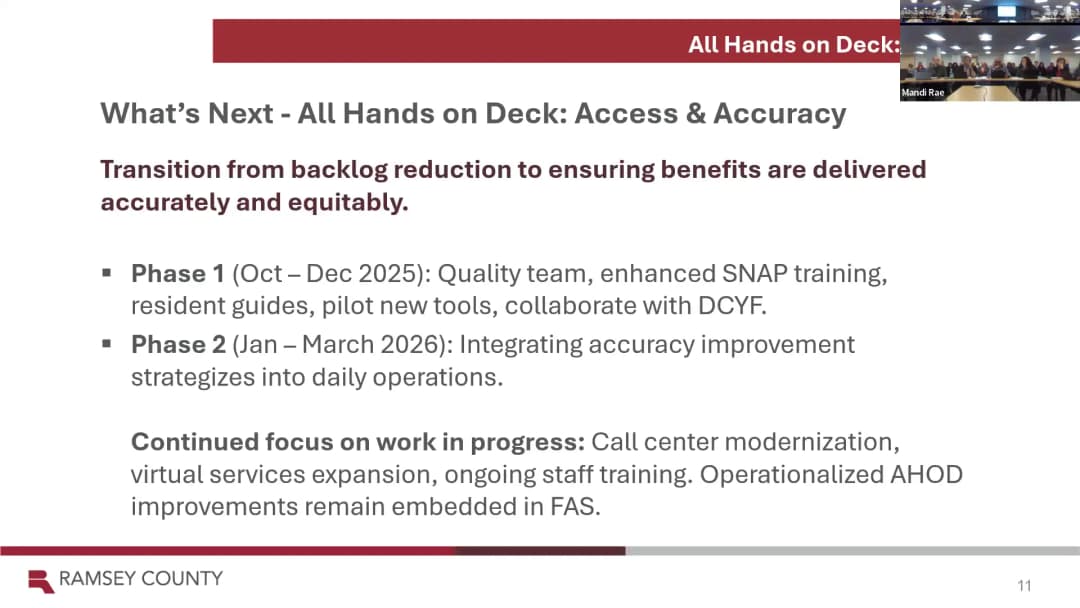
This workshop, held at Metro Square in Saint Paul, featured updates on the All Hands On Deck (AHOD) initiative, which focused on reducing backlogs in financial assistance programs, and a tour of the renovated Downtown Service Center. No votes were taken; the session was informational and focused on progress, next steps, and staff recognition. Discussion Items All Hands On Deck Initiative Update - Launch and Purpose: Launched December 2024 to address persistent backlogs in Medical Assistance and SNAP. Nearly one in three Ramsey County residents rely on Medical Assistance, more than one in ten on SNAP. - Operational Return Call Pilot: A 90-day pilot used 10 temporary staff to handle routine status checks. Results included nearly 4,000 calls returned within one business day, 5,700 live calls answered, and a 99.6% answer rate. Two-thirds of eligibility specialists reported spending less time on phone calls; over half had more time for casework. - Backlog Reduction: Application assignment improved to within one week. Over 100 new eligibility specialists hired since November 2024. - Service Center Wait Times: Average wait downtown under 20 minutes, under 10 minutes at Maplewood and Roseville. New check-in kiosks, digital displays, text alerts, and real-time wait times posted online and onsite. - Language Translation Device Pilot: Tested but failed for high-demand languages (Somali, Korean). Working with IS on alternative solutions. Language-specific navigators and Language Line remain in use. - Staff Development: Partnering with Saint Paul College for customer service training; first cohort scheduled November 2025. Leadership training also scheduled. Next Phase: All Hands On Deck Access and Accuracy - Phase one (starting October 2025) includes rapid response teams, checklists, and resident guides. Phase two (January 2026) embeds improvements into daily operations, expands call center modernization, virtual services, and customer service training. - Goal: Deliver the right benefit at the right time every time, with a focus on equity and accuracy. Metro Square Transformation and Naming Framework - Renovation Vision: One-door, multi-service location using trauma-informed design. Features include family spaces, improved wayfinding, digital kiosks, and flexible meeting rooms. - Building Occupancy: Lower level: conference center, wellness/prayer/lactation rooms. First floor: Community Corrections, Met Council. Second floor: Service Center, Workforce Solutions, CareerForce. Third/fourth floors: Financial Assistance, Social Services, IS, Housing Stability. Fifth floor (completing December 2025): Human Resources, Finance, drop-in center. - Naming Recommendation: Metro Square to be renamed Ramsey County Government Center. Service centers will keep their names: Ramsey County Service Center St. Paul, Maplewood, Roseville. Research included peer jurisdictions and resident input. Timeline: finalize name, update signage, grand opening spring 2026. - Wayfinding and Accessibility: County working on skyway signage (some owned by City of St. Paul). Commissioners raised concerns about digital kiosks and AI directing residents incorrectly. Staff emphasized multiple access points (libraries, malls, community partners). Key Outcomes - Continued Monitoring: County will track return call expectations (three-day goal) and use resident satisfaction surveys (text message survey after visits). Dashboards for public reporting in development. - Next Steps for Access and Accuracy: Rapid response teams and training programs in progress. Staff will provide further updates on guides and tools. - Building Renovation: Metro Square fifth floor completion by December 2025; departments will relocate through early 2026. - Naming Launch: Public grand opening and name launch planned for spring 2026. Signage audit underway. - Staff Recognition: County Manager and commissioners repeatedly thanked staff for innovation and collaboration, noting that the AHOD framework proved effective for rapid problem-solving.

COMMUNITY ENGAGEMENT 22% · HUMAN SERVICES 20% · PUBLIC ENGAGEMENT 19% · TECHNOLOGY AND INNOVATION 19%
110
OCT 14, 2025 · RAMSEY COUNTY, MINNESOTA · BOARD OF COMMISSIONERS & AUTHORITIES
Ramsey County Board Workshop on County Program Aid and PILT - October 14, 2025

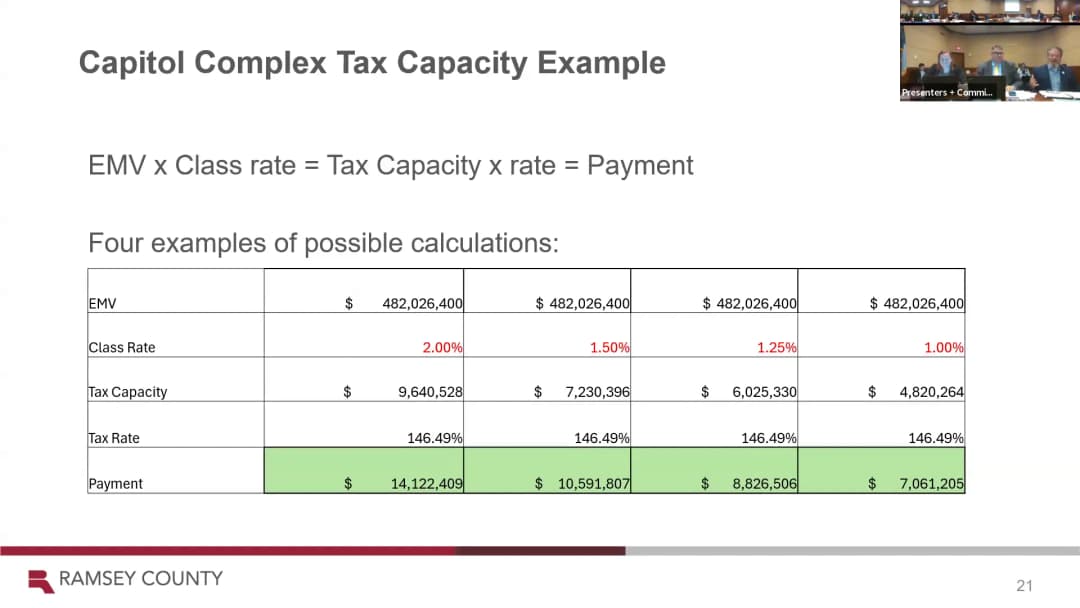
This workshop, held on October 14, 2025 from 10:30 a.m. in Courthouse Room 220, provided a deep dive into County Program Aid (CPA) and Payment in Lieu of Taxes (PILT) as part of developing the county's 2026 legislative agenda. No votes were taken; the session was recorded and live-streamed. Staff presented data on Ramsey County's unique fiscal challenges, including high tax-exempt property rates, the CPA formula's 0.25 multiplier, and limited PILT revenue. Board members discussed legislative strategies, including a proposed 'Capital Complex County Host Program' and modifications to the CPA formula. Discussion Items - Property Tax Levy and Budget Reliance: Staff noted Ramsey County relies on property taxes for roughly 46% of its budget, compared to a national average of about 26%. Hennepin County's 2026 budget sits at approximately 36%. The county faces pressure from federal funding shifts and the state budget deficit. - Tax-Exempt Property: Ramsey County has approximately 14.2% tax-exempt property value, higher than Hennepin (12%) and other metro counties (about 9%). The Capitol Complex, concentrated in downtown St. Paul, includes state-owned buildings, with an estimated market value of $480 million and 5.2 million square feet. - County Program Aid Formula: The CPA formula uses a population-based multiplier; Ramsey and Hennepin receive only 25% of the formula output. Ramsey County receives about $7 million annually from the tax-based equalization component, versus $27 million if treated like other counties. Over the past eight years, the county estimates it has missed $136 million (or $150 million inflation-adjusted) due to the multiplier. County need-based aid is about $19 million per year, but a single mandate (Anoka Metro Regional Treatment Center) costs the county $16 million annually. - PILT: Ramsey County receives $172,000 annually from state PILT (based largely on acreage) and no federal PILT. Federal PILT trends were noted as a potential risk for rural counties, possibly creating partnership opportunities. - Proposed Options: Staff presented four possible legislative approaches: (1) Change or phase out the CPA multiplier; (2) Create a mandated study for a more equitable formula; (3) Incorporate a capital complex payment into existing PILT; (4) Create a new 'Capital Complex County Host Program' based on square footage or estimated market value, potentially yielding $5–24 million annually. A fifth option is to advocate for increased resources in the need-based CPA component. - Commissioner Positions: Multiple commissioners expressed support for pursuing a legislative fix, emphasizing the need to tell Ramsey County's story of inequity. Commissioner McGuire recalled historical legislative compromises and stressed the importance of adding new funds rather than reallocating existing CPA dollars. Commissioner Ortega highlighted the need to quantify the extra costs of hosting the Capitol Complex (e.g., public safety). Commissioner Jadmins suggested partnering with advocacy groups to frame property taxes as regressive and seek support for less regressive revenue shifts. Chairman noted that every 1% of the levy is roughly $4 million, so added revenue could reduce taxpayer burden. Key Outcomes - No formal votes were taken. - Direction to staff to prepare a strategic communications plan to share data with the legislature and stakeholders, including a 'balancing strategies' slide to show multiple approaches. - Board members requested additional charts and analyses, including a county-by-county breakdown of tax-exempt property and a table of unfunded mandates. - The county manager indicated this topic will be featured in upcoming legislative budget workshops and advocacy with delegates. - Staff will refine options and prepare a legislative packaging workshop to further clarify priorities and next steps.

BUDGET EQUITY ANALYSIS 47% · FISCAL SUSTAINABILITY 35% · PUBLIC ENGAGEMENT 10% · PROCEDURAL 3%
OPENPUBLICA · PUBLIC MEETING INDEXUPDATED DAILY · openpublica.com