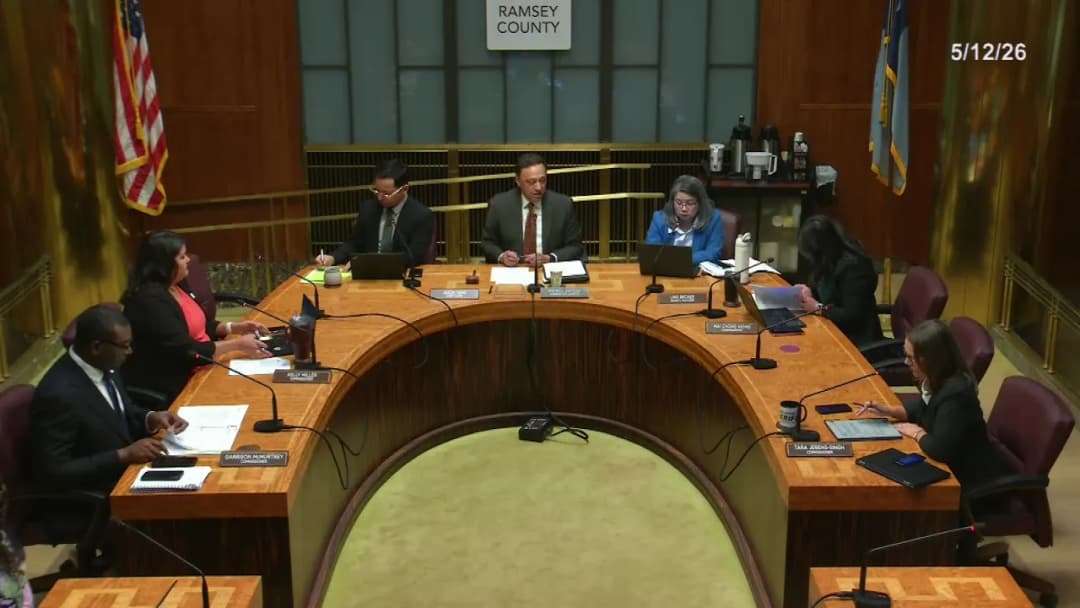
The Ramsey County Board of Commissioners met in regular session on May 12, 2026, at 9:02 a.m. in the Council Chambers. Commissioners Jebens-Singh, McMurtrey, Miller, Xiong, and Chair Ortega were present; Commissioners McGuire and Moran were excused. The meeting included two proclamations, discussion and approval of three administrative items, and a closed session on 3M property tax litigation. The open meeting adjourned at 10:08 a.m. Proclamations - Mental Health Awareness Month (presented by Commissioner Xiong): The board declared May 2026 as Mental Health Awareness Month in Ramsey County. Speakers from Public Health (Director Amy Karen, Pam Criggy Santoso) and community partners (Afghan Cultural Society, COPAL, NAMI Minnesota) highlighted the collective trauma from Operation Metro Surge and the need for community-based healing. They stated that recent federal activities caused widespread trauma and that mental health is inseparable from community conditions. Partners expressed gratitude for county support and emphasized that healing begins in community. - Police Week (presented by Commissioner Jebens-Singh): The board recognized May 11–16, 2026, as National Police Week. Sheriff Fletcher reported that 363 names are being added to the National Law Enforcement Officers Memorial, including 109 officers who died in 2025. He noted that crime in Ramsey County is dropping and that transit safety has improved. Chief Dotseth and Lieutenant Steiner (Maplewood PD) thanked the board for its support. A candlelight vigil was announced for May 15 at the State Capitol. Consent Calendar - Approval of the agenda for May 12, 2026 (motion by Miller, seconded by Xiong; passed 5-0). - Approval of the minutes from May 5, 2026 (motion by Xiong, seconded by Miller; passed 5-0). Discussion Items - Item 5 – Jurisdictional Transfers of Otter Lake Road and White Bear Parkway: Director Brian Isaacson (Public Works) explained that the swap gives the City of White Bear Lake more local control over White Bear Parkway and aligns with long-term planning. Commissioner Miller asked about operational impacts and consistency with the county’s capital plan. Isaacson noted no change in level of service. The motion (Miller, seconded Xiong) passed unanimously (5-0). - Item 6 – Joint Powers Agreement with Maplewood for Mental Health Outreach Team: Commissioner Jebens-Singh highlighted the partnership as an example of integrating mental health and public safety. Lt. Mike Dugas (Maplewood PD) described the program’s evolution over 10 years: specially trained officers and paramedics paired with county social workers to provide crisis response and follow-up services. He stated that the embedded social work model’s greatest impact is connecting people to long-term care. Commissioner Miller, representing Maplewood, expressed pride. The motion (Jebens-Singh, seconded Xiong) passed unanimously (5-0). - Item 7 – Single Source Agreement with Regions Hospital for Inpatient Services: The agreement covers inpatient hospital commitment services for three years (May 12, 2026 – May 11, 2029) at a not-to-exceed amount of $998,500 annually, with renewal options totaling up to $4,992,500. The motion (Miller, seconded Xiong) passed without discussion (5-0). County Connections & Reports - County Manager Ling Becker reported: (1) a data practices training session held with regional partners, which waived standard fees and promoted consistent standards; (2) CHRO Patience Ferguson won the Good Leadership HR Thrive Empower Award; (3) the fourth annual Youth Job & Resource Fair will be held May 16 at Maplewood Mall. - Commissioners provided updates on community events, including: Xiong’s receipt of the National Head Start Alumni Transformational Impact Award; attendance at the International Institute of Minnesota’s New Americans, New Beginnings event; participation in the Snelling-University Safe Strong Initiative; and upcoming office hours and festivals. Key Outcomes - Resolutions adopted: B2026-057 (Regions Hospital agreement), B2026-058 (Otter Lake/White Bear Parkway transfer), B2026-059 (Maplewood mental health JPA). - Proclamations: Both proclamations were officially made. - Closed session: The board met in closed session (10:40–11:07 a.m.) under Minn. Stat. § 13D.05, subd. 3(b) to discuss 3M campus property tax litigation. They approved outside valuation experts and the proposed budget (Resolution B2026-060) and authorized the County Manager to transfer funds.

Public Meetings - Ramsey County, Minnesota
Public Meetings - Ramsey County, MinnesotaOn May 5, 2026, the Ramsey County Board held a workshop from 10:30 a.m. to approximately 12:00 p.m. (morning session) to discuss the increasing utilization of state-operated mental health services and the associated rising costs for the county. The workshop featured presentations from Ramsey County Social Services staff, the state's Direct Care and Treatment agency, and detailed case studies illustrating systemic challenges. The afternoon session was scheduled to focus on cost trends and trade-offs. Discussion Items - Opening Remarks: Chair Jevon Singh and County Manager Becker welcomed participants. Presenters included Matt Clark (Health Monitor Unity), Karen Francisco (Manager of Medical Services), Monica Long (Director of Community Services), Christy Pops, and Deputy Director Walker. - State Operated Services Overview: Eric A. Dawson (Transitions and Liaison Director, Minnesota Direct Care and Treatment) explained that Direct Care and Treatment became a standalone agency on July 1, 2025, serving about 12,000 individuals annually, primarily those civilly committed. The system includes five core service lines: mental health and substance use treatment (hospitals and residential), forensic services (forensic mental health program with 400 beds), community-based services (adult foster care, crisis residences), clinical services (psychiatric care, pharmacy), and the Minnesota Sex Offender Program (800 beds). The agency operates 150 sites with a budget of $186 million and about 5,500 employees. Occupancy runs at 95% daily, with the 5% variance due to transport delays or temporary bed closures. - Civil Commitment Process: Kenya (deputy director) explained that under statute 253B.10, individuals are placed in the least restrictive setting, but those with highest needs or safety risks often go to state hospitals. Priority is given to individuals from jails or correctional settings and those needing competency evaluations. This prioritization creates a situation where people in the community may need to decompensate or become justice-involved to access care—a reality confirmed by presenters. - Case Study - Jordan: A 29-year-old male with serious mental illness, cognitive impacts from prenatal alcohol exposure, polysubstance use, and trauma history. He was civilly committed five years ago after assaulting shelter staff. He has had five provisional discharges revoked and has been recommitted multiple times. More than 20 programs declined to accept him due to behavioral intensity and liability concerns. He has been in a state facility since November 2025 and has not met criteria to remain there since June 2025. A customized placement was created through Ramsey County's Innovations Grant bed hold program, requiring a moratorium exception and extensive coordination. The process began in September 2025 and was ongoing as of the meeting. - Case Study - Derek: A 39-year-old male with mental illness and substance use, involved with Ramsey County's adult mental health system for over 15 years. He had periods of stability (worked in construction and a grocery store) but cycled through multiple hospitalizations, homelessness, and justice involvement. Despite ACT, supportive housing, and family involvement, he eloped from a specialized placement and was later arrested for sexual assault. He is currently at Anoka Metro Regional Treatment Center (AMRTC) awaiting a bed at the forensic mental health program in St. Peter, with pending commitment as mentally ill and dangerous. - Barriers to Discharge: Sophia (presenter) outlined that community supports are insufficient for the complexity of individuals. Housing remains a major barrier; for Jordan, a single-resident customized home was required due to lack of existing options. Workforce capacity and skills gaps in group homes were highlighted, with staff often paid in the high teens per hour despite risk of injury. Integration of mental health and chemical health services is lacking. - Ramsey County's Role: Two structured utilization meetings are held every Monday—one internal (morning) and one with external partners (afternoon). These meetings review all state hospital patients, identify discharge barriers, and coordinate funding pathways. A pilot position for MinChoices and financial assistance was added via grant funds to speed eligibility processes. The county reported a significant reduction in length of stay after patients no longer meet medical criteria, though exact numbers were not provided. - Commissioner Questions & Positions: - Commissioner McMurtry asked whether the gap is in provider capacity or specific services; presenters said it's multi-layered, including staffing, insurance pressures, and liability. - Commissioner Jennings asked about the historical shift from institutionalization to community-based care, noting the 1990s shift to managed care and the Olmstead v. LC Supreme Court decision without adequate resources. Presenters agreed the system was not fully actualized. - Commissioner Moran questioned whether the system is just making room for the next patient, but presenters explained policies like the 90-day max stay in ERTS facilities create bottlenecks. - Commissioner Ortega noted that after 25 years, the same issues persist: lack of capacity and private sector involvement. He emphasized the need to reshape the environment with private sector partnerships. - Commissioner Zhang highlighted the lack of incentives for providers due to insurance company determinations and the need for statewide solutions, not just property tax burdens. - Commissioner Shaw expressed concern about workforce shortages and group home viability, predicting more closures in 5-10 years. - Commissioner Singh asked about an ecosystem map of providers and gaps; presenters agreed to work on identifying gaps but noted that even with all services, individual fit is nuanced. - Data Points: Presenters noted that a very small subset of the 1 in 20 adults with serious mental illness are represented in these cases. The Innovations Grant bed hold program is a Ramsey County-led initiative funded three years ago, with a handful of other counties having similar programs. Hennepin and Ramsey are the highest utilizers of state-operated services. Key Outcomes - No formal decisions or votes were taken during the morning session, as it was a workshop designed to provide foundational understanding. - Directives: The board expressed interest in receiving a document with hot links to relevant state and national initiatives, reports, and work groups to support deeper learning. - Next Steps: The afternoon session was scheduled to focus on cost trends, financial burdens, and difficult trade-offs. Presenters indicated the workshop would inform future policy, investment, and advocacy decisions. - Recognition: Chair Jevon Singh thanked Eric Dawson and Direct Care and Treatment for their partnership. The board acknowledged the need for a multi-pronged approach involving legislative advocacy, private sector engagement, and system redesign to address chronic capacity and funding gaps.
The Ramsey County Board of Commissioners met in regular session on May 5, 2026, from 9:02 a.m. to 10:25 a.m. in Council Chambers. Commissioners Jebens-Singh, McGuire, McMurtrey, Moran, Xiong, and Chair Ortega were present; Commissioner Miller was excused. The board approved routine items, issued two proclamations, and unanimously passed four administrative resolutions. Consent Calendar - Agenda (2026-158): Approved with a motion by Moran, seconded by Xiong. Passed 6-0. - Minutes from April 28, 2026 (2026-159): Approved with a motion by Xiong, seconded by Moran. Passed 6-0. Proclamations & Public Testimony - American Indian Month (May 2026): Presented by Commissioner McMurtrey. The proclamation recognized May as American Indian Month, acknowledging the Dakota and Ojibwe peoples and the county's commitment to partnership. Several community members spoke: - Dakota (youth and two-spirit person from Heading Home Ramsey Advisory Board) expressed the need to move beyond recognition to responsibility, urging the county to center Native youth voices and invest in community-led solutions. - Lavon Lee (community member, read by proxy) celebrated the relationship between the American Indian community and Ramsey County, noting the importance of the proclamation. - Sherry Reimers (Chair, St. Paul Indians in Action) emphasized action over acknowledgment and thanked the county for supporting initiatives like St. Paul Indians in Action. - Other speakers included representatives from American Indian Family and Children's Services, the American Indian Family Center, and county staff. All speakers expressed support for the proclamation and ongoing partnership. - Correctional Officers Week (May 3–9, 2026): Presented by Commissioner Moran. The proclamation recognized the over 300 correctional officers and employees in Ramsey County. Speakers included: - Ashley Bryant (Under Sheriff, Detention Services) highlighted modernization efforts (tablets, no-cost calls, suicide prevention barriers) and the Project Bridge partnership with Community Corrections. - Jamie Brisch (Deputy Director, Community Corrections) noted the challenging work environment and the importance of supporting staff. - Several correctional officers introduced themselves, expressing gratitude for the recognition. Commissioners thanked them for their service. Administrative Items (All passed 6-0) - Item 5 – Third Amendment to Single Source Agreement with ESRI (2026-076): Approved an enterprise license agreement through April 6, 2030. Commissioner Jebens-Singh asked about uses and contract updates. Matt Koukol (IS) explained GIS applications (mapping, spatial analysis, use by assessors, sheriff, fire chiefs) and confirmed data security and open data policies. Motion by Jebens-Singh, seconded by McMurtrey. Resolution B2026-056. - Item 6 – 2026 Special Board of Appeal and Equalization (2026-110): Appointed members and chairs, approved procedural rules and ethics guidelines, and authorized the county manager to approve expenses. Motion by McMurtrey, seconded by Xiong. Resolution B2026-053. - Item 7 – Local Option Disaster Tax Abatement (2026-132): Approved an abatement of $10,000 or more for property at 80 Cottage Ave W, Saint Paul. Motion by McMurtrey, seconded by Xiong. Resolution B2026-054. - Item 8 – Property Tax Abatements (2026-134): Approved abatements of $10,000 or more for properties at 1125 Energy Park Dr and 1246 University Ave W, Saint Paul. Motion by McMurtrey, seconded by Xiong. Resolution B2026-055. Reports & Updates - Legislative Update (Commissioner McGuire): Noted the final weeks of the state session, including omnibus bills and potential bonding bill. The county is advocating for the Park at Rivers Edge. - County Connections (County Manager Ling Becker): Recognized a Metro Transit certificate of appreciation for the Safe and Strong partnership. Announced the grand opening of DG Pilot at Union Depot and the Flipping Tables youth event on May 12. - Outside Board Reports: Commissioners reported on various meetings: Ramsey/Washington Recycling & Energy Center annual report (mattress diversion, Gerdau site feasibility study, infectious waste legislation), Rice Creek Commons JDA, AMC Medicaid subcommittee, Generation Next, North End Community Council, and more. - Chair Update (Chair Ortega): Attended Science Museum gala and Regions Hospital ER expansion ribbon cutting. Announced board workshops on state hospital utilization after the meeting. Key Outcomes - All agenda items were approved unanimously (6-0, with Miller excused). - The board issued proclamations for American Indian Month and Correctional Officers Week. - The meeting adjourned at 10:25 a.m., followed by board workshops.
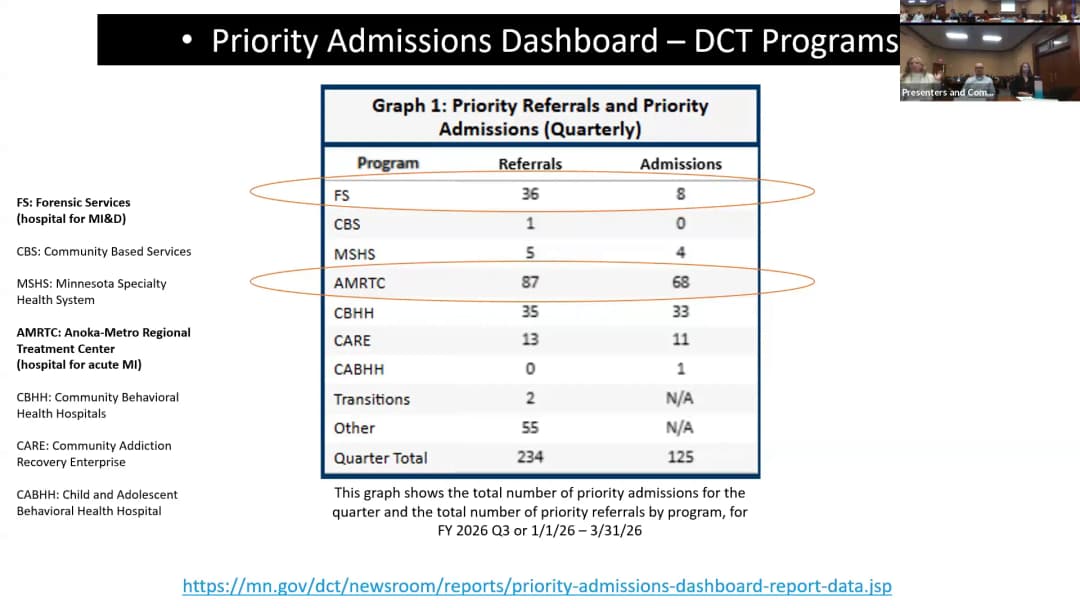
The Ramsey County Board held a workshop on May 5, 2026, to discuss state operated services, focusing on civil commitment processes, rising costs, and system challenges. Presentations covered the doubling of mentally ill and dangerous (MIND) commitments over the past decade, the financial burden of patients who no longer meet hospital criteria (DNMC), and extensive wait times for forensic services. No votes were taken; the session was informational and exploratory. Discussion Items - Civil Commitment Trends: The number of civil commitments for mentally ill and dangerous individuals has doubled in 10 years. In 2025, approximately 60 individuals were committed as MIND. The number of individuals served at the state forensic hospital (St. Peter) has decreased due to successful discharges and system strain, while the waitlist for admission has grown to over two years for some. - Cost Drivers: Costs for state operated services have risen 103% since 2021, driven by longer lengths of stay for patients who no longer meet hospital criteria (DNMC). DNMC costs increased 266% and now account for over 50% of total costs. The county pays $77,000 per month per DNMC individual. In 2025, Ramsey County’s total cost was $17 million, with 8 MIND clients representing 37% of DNMC costs. - Discharge Barriers: The average length of stay for DNMC patients is 357 days, compared to 33 days for those who leave when treatment ends. Barriers include lack of community placement options, criminal court holds, and insurance limitations. The federal IMD exclusion prevents billing Medicaid for state hospitals over 16 beds, and once a patient is DNMC, insurance cannot be billed. - Wait Times for Priority Admissions: Average wait time for admission to forensic services (St. Peter) is 299.9 days from referral. Some individuals wait over 500 days. The 48-hour rule for state acceptance has been ineffective due to bed capacity issues. A 50-bed expansion at AMRTC is planned but not expected until 2028–2029. - State and County Roles: The state’s priority admissions task force and review panel have improved data transparency and admission criteria (acuity-based), but disagreements remain over the 48-hour rule. Counties advocate for its retention to ensure state accountability, while the state argues it is unattainable given capacity constraints. - Community Resource Gaps: There is a critical need for step-down facilities between hospital and community care. The county is exploring partnerships with housing providers, grant-funded programs (e.g., AMHI, CSP, innovations grants), and targeted case management for high-risk individuals. Key Outcomes - No formal decisions or votes were taken during this workshop. - Next Steps: The board will continue cross-county collaboration to address system gaps. Potential advocacy areas include: (1) legislative action to redirect county payments ($17 million) into the continuum of care, (2) expansion of community-based step-down resources, (3) improving medical assistance eligibility processes, and (4) addressing workforce shortages. The county will also examine internal investments and partnerships to reduce reliance on jail-based care and improve discharge timelines.
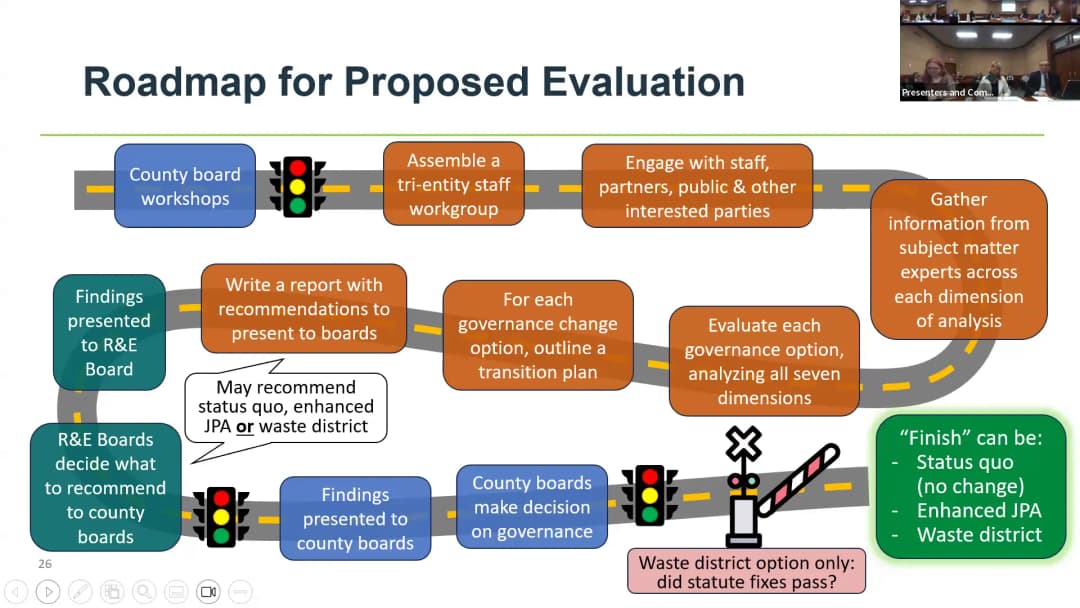
On April 28, 2026, from 10:30 a.m. to approximately noon, the Ramsey County Board met in Courthouse Room 220 at 15 West Kellogg Blvd., St. Paul, for a workshop on Solid Waste Governance Evaluation Workshop 2026-092, sponsored by Public Health. The workshop was live streamed over Zoom and no votes were taken. Ramsey Washington Recycling and Energy (RE) staff presented a review of the 50-year Ramsey–Washington solid waste partnership and requested direction on whether to form a joint study group to evaluate future governance structures. Discussion Items - RE Executive Director Martinson and RE planning staff led the presentation, describing the current joint powers agreement (JPA) between Ramsey and Washington Counties, RE's facility and program budgets, and RE's 10-year anniversary as facility owner. Staff stated the facility is 40 years old and the two counties have worked together for 50 years, with more than $50 million in public investment. - The primary alternatives presented were: maintaining the current JPA; pursuing an enhanced JPA; and establishing a solid waste management district. Staff emphasized that the workshop was not choosing a model but seeking permission to conduct a deeper evaluation. - RE staff highlighted recent achievements: 3.8 million pounds of waste divergence through Biz Recycling grants; 11.4 million pounds of edible food rescued; 19,000 mattresses recycled through a partnership with Second Chance; more than 2,000 people touring the RE Center, including every fourth grader in St. Paul Public Schools; and enough processed waste to power 12,000 homes. The current tip fee is $142 per ton and is scheduled to rise to $159 per ton in 2027; stressed staff said that tip-fee revenue supports the entire enterprise fund. The transcript includes both a statement of nearly 360 tons processed and a commissioners reference to 360,000 tons at $159 per ton, likely meaning 360,000 tons. - Staff said Ramsey and Washington counties rank among the best in Minnesota for landfilling and recycling: in 2024, the two counties landfilled the lowest percentage of waste in the metro and the eighth-lowest in the state, recycled nearly 50% of discarded waste, and ranked in the top 25% of Minnesota counties for recycling rate. The counties also reported carbon dioxide reductions equivalent to about 20,000 cars per year. Staff shared a jobs comparator: 50,000 tons landfilled supports about 5 jobs; the same amount of organics recycled supports about 25 jobs; and the same amount of recycled materials supports about 100 jobs, translating to over 500 jobs supported by current management versus about 38 jobs under landfilling. - Staff reviewed upcoming requirements: 2026 state rulemaking on construction and demolition and landfill; a 2030 statewide 75% recycling goal; 2035 organics recycling mandates for metro communities above 5,000 residents; 2040 carbon-free energy standard; and 2050 net-zero carbon emissions. By the end of 2026, every community in the service area is expected to have organic recycling available at no additional cost. - Executive Director Martson said JPAs can be more fragile than other structures and gave the dissolution of the metro-area joint power body in the past as a cautionary example. The RE staff recommended further evaluation and a study group involving Ramsey County, Washington County, and RE staff to research governance options. - Commissioner questions during the discussion included: whether a stronger district or alternative structure would be preferred; whether the current JPA limits liability; how Ramsey County would conduct its own risk and due diligence; whether the study could consider additional partners; whether a future district could expand beyond Ramsey and Washington counties; and whether the proposal is compatible with the counties own solid waste plans. Executive Director Martonors said future expansion partners would have to bring their own resources, and that other Minnesota counties are also conducting similar governance upgrades. - County Manager Becker said Ramsey County would need its own internal work stream, legal and financial analysis, and follow-up as the evaluation proceeds. Commissioner MacGuire and others underscored the importance of considering risks, rising county autonomy, and regulatory compliance before deciding. Several commissioners expressed support for continued analysis while emphasized that no governance choice had been made. - Staff also projected the process could take up to five years if all three governance options are fully evaluated, which is why they recommended starting now. They identified seven evaluation dimensions: governance structure, legal, finance, risk management, administration, community, and strategic partnership, with subteams from the counties and RE. Key Outcomes - No formal action and no votes. This was a discussion-era workshop. - Staff recommended forming a Ramsey County–Washington County–RE study group; however, board gave no formal directive and no final decision the today's workshop. - Several county commissioners expressed support for the deeper evaluation process, while asking that county-specific risks, legal exposures, and compliance questions be included in the eventual report. - County leadership noted that a possible three-prong internal structure, with each county doing its own work before joint recommendations, is under consideration.
The Ramsey County Housing and Redevelopment Authority (HRA) met in regular session on April 28, 2026, at 10:05 a.m., adjourning at 10:36 a.m. Members present: Jebens-Singh, McGuire, McMurtrey, Miller, Moran, Ortega, and Chair Xiong. Also present were County Manager Ling Becker and Assistant County Attorney Kathleen Ritter. The board approved the consent agenda and two administrative items: the 2026-2027 Community Development Block Grant (CDBG) and HOME Investment Partnerships Act Annual Action Plan, and a reallocation of HRA program income to support the Little Canada Senior affordable housing project. Consent Calendar - Agenda of April 28, 2026 – Approved unanimously (Motion by Miller, second by Ortega; all ayes). - Minutes from February 17, 2026 – Approved unanimously (Motion by Ortega, second by Miller; all ayes). Discussion Items Item 3: 2026-2027 Community Development Block Grant – HOME Investment Partnerships Act Annual Action Plan / Proposed Use of Funds - Presented by Max Holdhusen, Deputy Director, Community and Economic Development. The plan covers entitlement funds from HUD: $1,253,429 in CDBG and $502,833 in HOME funds. HOME funds are restricted to suburban Ramsey County (St. Paul receives its own allocation). The process includes community engagement, public notices, and surveys. The plan proposes the maximum allowed 15% for public services and the maximum for administration/planning (salary/staff), with the bulk directed to housing rehabilitation programs via competitive solicitation later in summer. - Commissioner Moran noted the county’s deficit of 15,000 units affordable to households at 30% of Area Median Income (AMI) or below, as cited in the Economic Competitiveness and Inclusion (ECI) plan, and questioned whether a minimum 10% of units in funded projects should be set aside for 30% AMI. She was directed to hold that question for Item 4. - Commissioner McMurtrey asked about $310,000 in previously unspent/unallocated CDBG funds from prior years. Holdhusen explained that these funds come from activities that could not spend down and are re-pooled; they span multiple years (e.g., from 2021 onward). - Commissioner McMurtrey also asked if HOME/CDBG funds could support multifamily projects. Holdhusen stated that federal rules make single-family owner-occupied programs more efficient; local funds are recommended for rental housing. - Commissioner Jebens-Singh highlighted that Ramsey County has one of the largest homeownership gaps between white and Black residents in the nation, per the mapping prejudice project and ECI plan. She asked about changes in HUD policy. Holdhusen noted no major changes from 2025 to 2026, but a “Build America, Buy America” injunction paused material tracking requirements; future executive orders on diversity, equity, and inclusion could affect nonprofit partners. - Commissioner Miller asked whether CDBG funding had been reduced. Holdhusen replied that the anticipated reduction under the second Trump administration has not yet occurred; funding has held steady. The item passed unanimously (Motion by Moran, second by Miller; Resolution H2026-008). Item 4: Reallocation of Housing and Redevelopment Authority Program Income Towards a Housing Development Project - Presented by Max Holdhusen. The project is Little Canada Senior, located near Highway 36 and 35E on County Road B. It proposes 106 apartments for low-income seniors, with 11 units (10%) reserved for households at or below 30% AMI, and the remainder at 60% AMI using Low-Income Housing Tax Credits. The developer, LUPA Development, received an unexpected state award that requires closing by July 2026. To meet that timeline, the HRA recommended reallocating previously awarded HOME funds (which are restricted to suburban areas) to another project and replacing them with more flexible HRA program income. - Commissioner Moran expressed concern that 10% at 30% AMI is low given the high growth of senior homelessness; she requested data on the rent for 60% AMI units and a portfolio-wide view of 30% AMI investments. She also questioned the practice of focusing HOME funds on suburbs, asking whether it is statutory or discretionary. Holdhusen explained that multiple funding sources (federal vs. local) allow investments countywide, and that the majority of local affordable housing aid has gone to St. Paul. County Manager Becker noted that the 15,000-unit deficit figure from the 2020–2021 ECI plan may have shifted due to ARPA and local investments, though cost-burdened households could increase the number. - Commissioner Jebens-Singh clarified that this particular fund is for suburban areas because St. Paul has its own allocation, but the county can braid funds to focus on greatest needs anywhere. She requested a “cheat sheet” for a single project showing total public dollars, return on investment per unit, and affordability period (minimum 30 years for HRA loans). Holdhusen confirmed such data is available. - Commissioner McGuire thanked Little Canada for its efforts to secure affordable housing, noting the city hired a county manager for economic development. He supported spreading affordability throughout the county. - Commissioner Miller added that such projects help offset property taxes for neighbors, referencing a previous Urban 3 presentation. Holdhusen noted the project is on a vacant flag parcel that will add tax revenue. - Commissioner Moran clarified she is not against suburban investment but wants data-informed decisions to lower the 15,000-unit deficit. Chair Xiong noted that deeper affordability requirements increase the development gap, affecting the number of projects funded. Commissioners agreed to schedule a workshop to review portfolio-wide data on units by AMI level, housing stability outcomes, and density considerations. The item passed unanimously (Motion by Moran, second by McGuire; Resolution H2026-009). Key Outcomes - Approved the 2026-2027 CDBG-HOME Annual Action Plan, authorizing the County Manager to accept $1,253,429 in CDBG funds and $502,833 in HOME funds, and execute related agreements (all ayes). - Approved the reallocation of HRA program income to replace HOME funds for the Little Canada Senior project, allowing the developer to meet a July 2026 closing deadline for state funds (all ayes). - Commissioners requested a future workshop to review detailed data on investments by income level, project-level funding sources, and strategies for deeply affordable housing. - The meeting adjourned at 10:36 a.m.
The Ramsey County Board of Commissioners met on April 28, 2026, at 9:00 a.m. in Council Chambers, Courthouse Room 300. All seven commissioners (Jebens-Singh, McGuire, McMurtrey, Miller, Moran, Xiong, and Chair Ortega) were present, along with County Manager Ling Becker and Civil Division Director Jada Lewis. The meeting included approval of routine items, an amendment to increase settlement authority, a legislative update, a detailed county connections report on the Metro Surge financial impact, and outside board and committee reports. The board adjourned at 10:03 a.m. Consent Calendar - Agenda of April 28, 2026 – Approved unanimously (motion by Xiong, seconded Moran; 7-0). - Minutes of April 21, 2026 – Approved unanimously (motion by Moran, seconded Xiong; 7-0). Discussion Items - Amendment to Administrative Code to Increase Settlement Authority (Item 3, 2026-144) – Commissioner McGuire moved, seconded by Xiong, to approve changes raising settlement authority thresholds: Enterprise Risk Manager and Civil Division Director from $15,000 to $50,000; County Manager, CFO, and County Attorney (jointly) from $30,000 to $100,000; and board closed-meeting authority from above $30,000 to above $100,000. The motion passed unanimously (7-0), and the resolution was adopted as B2026-052. - Legislative Update – Commissioner McGuire reported that the House Capital Investment Committee heard an informational presentation on local bonding requests, including the River's Edge project. He thanked Commissioner Moran for testifying and noted that both House and Senate leaders are working on the project, which requires a two-thirds majority. On federal updates, he mentioned the U.S. Senate adopted a budget blueprint for a $70 billion increase in immigration enforcement and DHS funding, with House Republicans planning to use budget reconciliation to avoid a shutdown. - County Connections / Metro Surge Update – County Manager Ling Becker provided a comprehensive update on the Metro Surge operation. She highlighted: - Total county costs: approximately $1 million, including $600,000 in employee hours diverted from other duties, $350,000 in lost revenue from reduced enrollments and event attendance, and miscellaneous costs for training and mental health support. - City of St. Paul impacts (based on similar methodology as Minneapolis): $129 million in small business losses (Jan–Feb), a rent gap of $15–16 million per month, and $118 million in lost household income (Jan–Feb). - Internal after-action review strengths: prior preparation with the County Attorney's Office, effective surge team coordination, consistent employee/public communication, and staff support. Areas for improvement: earlier activation of the response team, delayed guidance, and insufficient support for employees working outside regular hours. - The county will share the financial impact data with state and federal legislators. Commissioners expressed appreciation for the update and discussed the need for ongoing monitoring of ripple effects, improved real-time communication with the community, and collection of qualitative stories from staff and residents. Commissioner Moran asked about learning from other metro counties; Becker noted that Ramsey County’s strong interagency relationships (with city, port authority, chamber, etc.) were a key asset. Chair Ortega emphasized the importance of staff well-being and community partnerships. - Outside Board and Committee Reports – Commissioners reported attending various events and meetings, including: - Commissioner Xiong: Mayor Her's State of the City address, Minnesota African American Family Preservation Act meetings, Metropolitan Mosquito Control Board, Heading Home Ramsey, and a Jack and Jill legislative day panel. - Commissioner Miller: Mosquito Control Board, Tamarack Nature Center pancake dinner, Minnesota Association of Soil and Water Conservation District Spring Meeting, and Rising Together celebration. - Commissioner Moran: Hamline Midway neighborhood cleanup, meeting with Isaiah group about Metro Surge and economic development, and meeting with Downtown Alliance. - Commissioner Jebens-Singh: Battle Creek Park cleanup, Tamarack Nature Center volunteer appreciation, Friends of the Library book sale, Friends of the Boundary Waters event, Shoreview Spring Fest, Burns Institute cohort, and Direct Care and Treatment Advisory Board update. - Commissioner McMurtrey: Roseville Earth Day, St. Anthony Village cleanup, and Climate Smart Municipalities and Counties calls (including data centers discussion). - Commissioner McGuire: Capitol Region Watershed District exhibit, SNAP subcommittee meeting (HR1 error reduction, SNAP bill status), East Side Funders Group with Public Works Director Isaacson (construction impacts and $5,000 business grants, $60,000 gap on East 7th Street), and Burns Institute cohort. Key Outcomes - Approved Resolution B2026-052 amending the Administrative Code to increase settlement authority tiers (7-0). - Received and discussed the Metro Surge financial impact summary; directed County Manager Becker to share information with state and federal legislators. - Continued monitoring of Metro Surge ripple effects and community needs; staff encouraged to use available mental health resources. - Scheduled following meetings: Housing and Redevelopment Authority, Solid Waste Governance Workshop, Tax Increment Financing Lunch and Learn, and All Hands on Deck workshop.
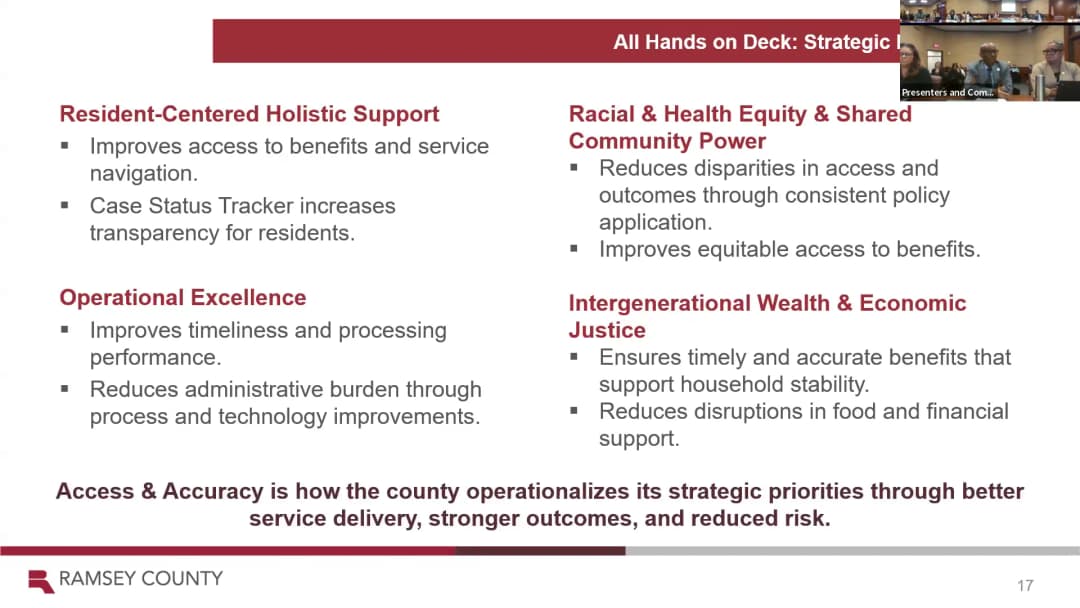
The Ramsey County Board held a workshop on April 28, 2026, receiving an update from Financial Assistance Services on the "All Hands on Deck: Access & Accuracy" initiative. The session focused on improving timeliness and accuracy of public benefit delivery amid new federal requirements under HR1. No votes were taken. Presentation & Discussion - Deputy County Manager Francis opened, highlighting the collaborative effort across departments and the shift from speed to both timeliness and accuracy. - Director Ali Ali outlined core goals: improve benefit determination accuracy (measured by federal payment error rate) and timeliness (current 30-day application timeliness at 75% vs. federal target of 95%). - HR1 policy changes include expanded work requirements, reduced exemptions, and changes to income/expense calculations, increasing complexity and administrative burden. Federal SNAP administrative cost reimbursement drops from 50% to 25%, with costs passed to counties. Commissioner Jevinsing confirmed Ramsey County will bear a 75% cost increase starting in late 2026. - Payment error rate: federal threshold to avoid penalties is 6%. Minnesota’s current rate is approximately 11-12% (speakers noted uncertainty). The state’s error rate is aggregated; Ramsey County holds 16% of the state’s SNAP caseload, creating disproportionate risk. Commissioners questioned whether the state might invest in high-caseload counties to reduce error rates. - Director Ali noted many calculations are still manual due to state system limitations, increasing error risk. Commissioners expressed frustration with the antiquated state system and the need for tech modernization. - Manager Curry Stats presented progress: the quality assurance team has been reestablished and is building a tracking tool; a new approach will review cases before processing to catch errors early. The expedited SNAP screening team improved timeliness from 8% in October to 40% in November, with individual workers achieving 73%. The state recognized this improvement and noted a reduction in calls to the state hotline. - A case status tracker pilot launched March 2026, allowing residents to check application status online 24/7. Partners receive quarterly newsletters; emails to the department have decreased significantly. - SNAP 4, a state-led modernization effort, is still in exploration stage with no set timeline. Commissioners urged faster progress. - Commissioner McMurtry asked about the impact of HR1 on residents; Director Ali acknowledged no internal assessment has been done on how many residents might lose benefits. Commissioner Moran stressed the need to document impacts for congressional advocacy. - Commissioner McGuire raised concerns about the federal government intentionally complicating the system to deter applications. Director Ali responded that the county focuses on what it can control—accessibility—while policy implementation is beyond its sphere. - Commissioner Marrin asked about preparation for worsening conditions; Deputy Manager Francois emphasized investing in the property tax base to create flexible dollars for augmenting programs. - Commissioners praised the team’s progress and acknowledged the difficulty of working within a complex, underfunded system. Key Outcomes - No formal votes or decisions were taken; the workshop was informational. - The board received updates on improved timeliness metrics and new tools (expedited screening team, case status tracker). - The financial impact of HR1 administrative cost shifts is estimated at $4 million annually for Ramsey County, equating to roughly 1% of the property tax levy (full impact felt in 2027). - The quality assurance team is being rebuilt; hiring for open positions is underway. - The county will continue to engage with the state on SNAP 4 modernization and advocate for investments in high-caseload counties. - Commissioners directed staff to document HR1’s local impacts for legislative outreach.
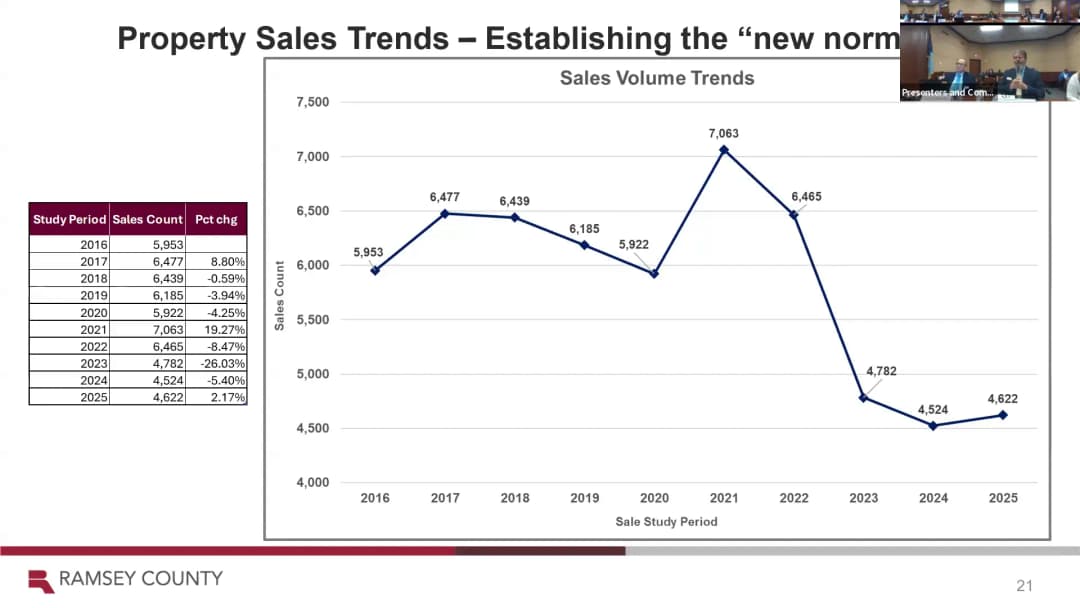
The Ramsey County Board held a workshop on April 21, 2026, to receive a presentation from the Assessor's Office on the 2026 assessed values that will be used for 2027 payable taxes. The meeting included detailed discussion of market value trends, tax capacity shifts, new construction, and resources available to residents for appealing their property values. No votes were taken during the workshop. Discussion Items - Presentation Overview: Deputy County Manager Carrie Collins and Deputy Assessor Corey Erickson presented the 2026 assessment, emphasizing the connection between economic development and the assessor's role. Total estimated market value reached an all-time high of $78 billion (taxable), with tax capacity also at a record $950 million. Residential property values showed approximately 1% growth (flat compared to prior years), while commercial and industrial values grew modestly. New construction countywide was $760 million, with notable apartment and exempt property projects. - Tax Classification Shifts: The presentation illustrated how property classification affects tax capacity. Residential properties make up 68% of taxable market value but only 60% of tax capacity due to a preferential rate, while commercial properties (10.3% of value) generate 17% of capacity. The '4D' low-income housing classification was highlighted as having the most beneficial rate in the state, resulting in a disproportionately low share of tax capacity. - Commissioner Questions: Several commissioners raised concerns about the burden on residents with fixed incomes, the need for benchmarking against comparable counties, and the potential for setting goals for a balanced tax base (e.g., mix of residential, commercial, industrial). Commissioners also inquired about tax-increment financing (TIF) and the impact of exempt properties (e.g., government, nonprofit). The assessor noted that a more detailed breakdown of exempt properties and tax capacity forgone would be provided. - Resident Resources: The presentation outlined the appeal timeline (deadline June 1, 2026), the open book process, and the availability of property tax refunds through the state. Commissioners warned about private companies (e.g., Ownwell) offering to help with appeals for a fee, stressing that the county's process is free. Key Outcomes - The board received the 2026 assessed values information as input to the 2027 budget process. - Follow-up items include: providing disaggregated data on exempt properties and tax capacity (including county-owned land), exploring benchmarks with other urban counties, and possibly setting goals for tax base composition as part of the next Economic Growth and Community Investment plan. - The next workshop (scheduled for the following week) will focus on TIF districts and related financial tools. - Commissioners encouraged residents to contact the assessor's office (651-266-2131) with questions and to be aware of potential scams.
The Ramsey County Board of Commissioners met on April 21, 2026, at 9:00 a.m. in Council Chambers. The meeting included a retirement proclamation, approval of routine items, discussion and approval of a property sale and a community responder pilot program, a presentation from the Metropolitan Mosquito Control District, legislative updates, and county connections. The board also held a closed meeting in the afternoon regarding the Tameca Williams matter. Consent Calendar - Agenda and Minutes: The board approved the April 21, 2026, agenda (2026-126) and the minutes from April 14, 2026 (2026-142) unanimously. - Public Online Auction of 34 Tax-Forfeited Properties: The board authorized the County Manager to hold a public online auction of 34 tax-forfeited properties via MNBid, approved the appraised values, certified that the parcels meet statutory requirements, and authorized the removal of any parcel prior to auction if needed (Resolution B2026-048). Passed unanimously. Proclamation - Brian Theine’s Retirement: The board presented a proclamation honoring Brian Theine for 30 years of dedicated service in Ramsey County Social Services, including roles in mental health, crisis response, and children and family services. Several colleagues and community partners spoke in tribute, highlighting his compassion, leadership, and impact on equity initiatives. Discussion Items - Sale of Ramsey County East Kellogg Property to LSBD Acquisitions, LLC: The board approved the sale of the East Kellogg property (and surrounding parcels) for $4,000,000 to LSBD Acquisitions, LLC, a local developer planning to convert the building into approximately 200 affordable housing units with some commercial space. The purchase and sale agreement includes a 14- to 18-month due diligence period, with a projected closing in the third quarter of 2027. Proceeds will be placed in the Capital Improvement Plan Holding Project for future board-approved projects. Up to $180,000 may be reallocated from the East Kellogg building improvement budget to the Metro Square Building improvement budget for relocation costs. Commissioner Zhang expressed support for the affordable housing conversion. (Resolution B2026-049, passed unanimously) - Joint Powers Agreement with City of Maplewood for Community Responders Pilot Program: The board approved a joint powers agreement with the City of Maplewood for the Appropriate Responses Initiative’s Community Responders Pilot Program, running through December 31, 2026. The program dispatches community responders (non-law enforcement) to non-criminal calls, with a focus on connecting at-risk populations to services. The pilot is co-designed with community members and will be operated by Roots Wellness Center. Commissioners praised the partnership and the thoughtful, evidence-based approach. (Resolution B2026-050, passed unanimously) - Presentation: Metropolitan Mosquito Control District (MMCD): Daniel Huff (Executive Director) and Alex Carlson (Public Affairs Manager) presented an overview of MMCD’s work. Key points included: - In 2025, 51 West Nile virus cases were confirmed in the metro area, with 28 hospitalizations and 3 fatalities — the highest on record. - MMCD focuses on larval control (safe for non-target species) and uses helicopters, drones, and ground treatments. In 2025, larval control acres were the highest since 2016. - For 2026, the district projects above-average cattail mosquito numbers and a slight increase in Lyme disease risk due to tick nymph emergence. - MMCD’s budget for 2026 increased by about $149,000 countywide; the median household pays approximately $11 per year. - A new tire recycling program will use county drop-off events (two per year in Ramsey County at Aldrich Arena) instead of curbside pickup due to a surge in requests. - Commissioners discussed potential partnerships with the county’s environmental center and legislative efforts for producer responsibility on tires. - The presentation also covered public education, the new language line, and the availability of a mosquito and tick safety kit. Key Outcomes - Votes: All resolutions (B2026-048, B2026-049, B2026-050) passed unanimously (7-0). The agenda and minutes were also approved unanimously. - Closed Meeting: The board held a closed meeting at 1:35 p.m. pursuant to Minn. Stat. § 13D.05, subd. 3(b) to discuss the Tameca Williams matter. The board authorized staff to proceed as discussed (Resolution B2026-051, passed 7-0). - Other Business: The board received a legislative update (focus on bonding request for Park at River’s Edge and tracking omnibus bills), a county connections update (including announcement of new CFO Amelia Kruover), and outside board and committee reports.