The Ramsey County Board of Commissioners met in regular session on April 14, 2026, at 9:01 a.m., adjourning at 10:15 a.m.. All seven commissioners were present: Chair Ortega, Commissioners Jebens-Singh, McGuire, McMurtrey, Miller, Moran, and Xiong. County Manager Ling Becker and Assistant County Attorney Stacey D'Andrea were also present. The meeting included a land acknowledgement, proclamation, approval of several administrative items, and a detailed presentation on the county's new economic development strategy. Consent Calendar - Agenda & Minutes: Approved the agenda of April 14, 2026 (2026-129) and the minutes from April 7, 2026 (2026-130) – both unanimously passed. - Agreement with Xcel Energy: Approved a scoping estimate agreement for $2,089,569 to relocate transmission towers for the Park at RiversEdge project (Resolution B2026-041). - Vacation of Unimproved County Road Right-of-Way: Approved vacation of a county road right-of-way along the eastern border of Ramsey County (Resolution B2026-042). - 2026 Unified Local Youth Plan: Approved the WIOA/Minnesota Youth Program plan for April 1, 2026 – March 31, 2027, including authorizations for the County Manager to execute agreements (Resolution B2026-043). - Appointment to Workforce Innovation Board: Appointed Alexandria Merritt to serve from April 14, 2026 to July 31, 2027 (Resolution B2026-044). - Food Services Agreements: Approved contracts with Taher, Inc. and Trinity Services Group, Inc. for the period May 18, 2026 – May 17, 2028, with renewal options (Resolution B2026-045). - CIP Contingent Fund Request: Authorized transfer of up to $200,000 from the Capital Improvement Program Contingent Account to the Saint Paul Campus Security Project (Resolution B2026-046). Proclamation - Administrative Support Professionals Week: Commissioner Xiong presented a proclamation declaring April 22, 2026 as Administrative Professionals Day and April 19–25, 2026 as Administrative Professionals Week. Multiple administrative staff from various county departments accepted and shared their years of service (ranging from 2 to 36 years). Discussion Items - Ramsey County Economic Development Strategy – Building Stronger Together (Item 5): Director of Community & Economic Development Josh Olson presented the strategy, which focuses on two areas: supporting a dynamic downtown St. Paul and strengthening countywide economic development through sale of county-owned land. The plan involves up to $320 million in county investments: up to $250 million for downtown initiatives (catalyzing projects like Park at RiversEdge, supporting residential growth, enhancing public spaces, and activating business growth) and up to $70 million for selling county-owned land (including Rice Creek Commons and other underutilized properties). Funding sources include existing project budgets, state awards, transportation funds, HRA programming, and strategic bonding – without increasing the property tax levy. Commissioners unanimously expressed strong support, emphasizing the need to grow the tax base, provide property tax relief, and partner with the City of St. Paul, state, business, and community groups. The board endorsed the strategy and authorized implementation (Resolution B2026-047). Key Outcomes - All consent calendar items (Items 1,2,3,4,6,7,8,9,10) approved unanimously (7-0). - Economic Development Strategy (Item 5) approved unanimously (7-0) via roll call. - Legislative Update: Commissioner McGuire reported on the state legislative session, including progress on supplemental budget bills, the capital investment request for Park at RiversEdge, and the Capital Complex County Host proposal seeking a state appropriation for non-taxable state property. - County Connections: County Manager Becker announced: - Ramsey County Attorney’s Office and Sheriff Fletcher are investigating a January 2026 incident involving federal agents for possible kidnapping, burglary, and false imprisonment of a U.S. citizen. - National Telecommunicators Week: A new
Public Meetings - Ramsey County, Minnesota
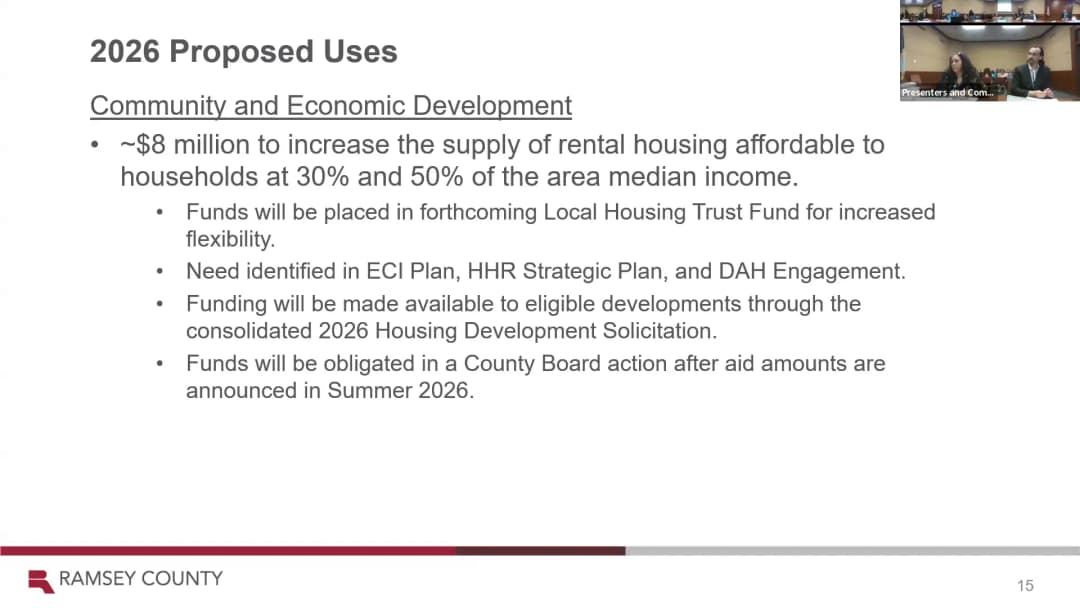
Public Meetings - Ramsey County, MinnesotaOn April 14, 2026, the Ramsey County Board held a workshop to review the Local Affordable Housing Aid (LAHA) program, past investments, and proposed uses for 2026. The workshop featured a joint presentation by the Housing Stability and Community & Economic Development (CED) departments. No formal votes were taken. Discussion Items - LAHA Overview: Staff explained that LAHA is a quarter-cent sales tax collected across the seven-county metro area. 50% of funds go to counties, 25% to eligible cities, and 25% to Minnesota Housing/MHFA for rental vouchers. The tax has no sunset clause. Ramsey County has about 19% of the region's cost-burdened households and receives about 19% of county-designated funds. The 2025 full-year allocation to Ramsey County was $15.9 million. Eligible uses include emergency rental assistance, financial support to nonprofit providers, construction/rehabilitation/preservation of affordable housing, operating financially distressed properties, supportive services, and emergency shelter operations. Local governments must obligate funds within three years and spend within four years. - Past Investments: In 2024 (partial year), Ramsey County received $6 million: $1 million supported the Project Home family shelter acquisition at Bandana Square, and $5 million stabilized 11 supportive housing properties via a support-and-stabilize program. In 2025, of the $15.9 million, $11.9 million was allocated through the housing development solicitation for preservation/rehabilitation, funding approximately 15 projects and preserving 849 units (including 212 previously unrestricted units). Examples included the Belero apartments in White Bear Lake (29 units restricted to 50% AMI) and the Bot building in Frogtown. Another $2 million supported eviction prevention, serving 2,375 eviction court cases; $2 million funded shelter operations and supportive services. - 2026 Investment Strategy: Staff described a new joint strategy between HSD and CED, rooted in existing plans such as the Heading Home Ramsey needs assessment, the Economic Inclusion Plan, and the deeply affordable housing initiative. Assuming a similar allocation ($15.9 million), the recommended split is approximately $8 million for affordable housing supply and $8 million for downstream services and prevention. - CED Proposal: $8 million would increase rental housing supply at 30% and 50% of area median income (AMI), allocated through the 2026 housing development solicitation (opened April 13, due May 26, 2026). Funds would be placed in a newly established local housing trust fund to meet obligation deadlines and provide flexibility. - HSD Proposal: $2 million for emergency shelter operations, including expanding capacity at the Project Home/Interfaith Action shelter and Catholic Charities' second floor (32 unused beds). $2 million for rental assistance and prevention, including a coordinated "Rent Help Ramsey" one-door approach and wraparound case management. $4 million for coordinated entry and housing support investments, including an overhaul of the coordinated entry system, efforts to reach "function zero" for homeless veterans (26 veterans currently on the list), pilot wraparound services, and added flexible assistance to the housing support program. - Commissioner Questions and Positions: Commissioners asked about the tax's duration, direct city allocations, whether smaller cities could access Ramsey County funds, and the impact of changing federal priorities on providers. Staff confirmed funds are flexible and must supplement, not replace, local investments. Commissioner McMurtry expressed support for the function zero goal and asked about strategic approaches for populations such as LGBTQ youth and seniors. Commissioner Devinson raised the need for cross-departmental staffing support for shelter operations. Commissioner Zhang asked how to connect with households before they reach eviction court, noting background-check discrimination; staff described the upstream Rent Help Ramsey approach. Commissioner Moran and others stressed the need for consistent, meaningful metrics to measure progress, particularly amid a stagnant housing market. Several commissioners praised the inter-departmental collaboration. Key Outcomes - No votes taken; workshop discussion only. - Next steps: 2026 housing development solicitation applications are due May 26, 2026. LAHA aid amounts are expected to be announced in June or July 2026. CED will bring recommended housing development awards with LAHA funding to the board in summer 2026, along with a board action to establish the local housing trust fund. HSD will incorporate its 2026 LAHA allocation through existing administrative and procurement processes. CED and HSD will monitor obligations and spending for the annual report to Minnesota Housing due in November 2026. - Future process: Starting in 2027, LAHA allocations will be integrated into the county's regular budgeting and procurement cycles rather than a board workshop process, with ongoing evaluation of program impacts.
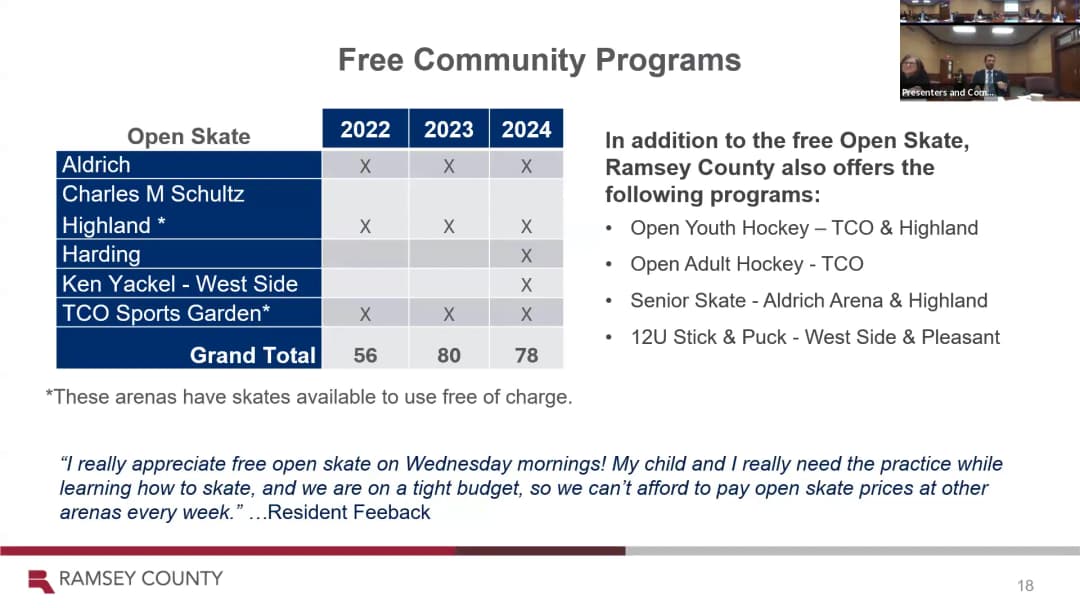
The Ramsey County Board convened a workshop on April 7, 2026, to review the county's ice arena portfolio, which includes 11 arenas with 13 sheets of ice. The presentation by Parks & Recreation Director Mark McCabe and his team covered operational performance, financial data, capital needs, and future strategic direction. No votes were taken. Commissioners engaged in detailed discussion, raising questions about financial transparency, community use, and long-term sustainability. Discussion Items - Portfolio Overview: Most arenas were built in the mid-1970s. The county operates only indoor facilities; outdoor rinks are provided by municipalities. Arenas generate operational profits (three-year average total $5.2 million) that subsidize other parks and recreation activities, allowing free parking and no user fees for dog parks and archery ranges. Non-ice events (cultural festivals, farmers markets, weddings) grossed $600,000 over three years, primarily at Aldrich Arena, though cancellations due to the metro surge (operational vetral surge) impacted that revenue stream. - Unique Agreements: Two arenas (Phalen and Harding) are on St. Paul school district land under 100-year leases that require them to be operated as ice arenas or revert to the district. Biff Adams Arena is leased to the Frogtown Curling Club (lease expires 2032), which handles all operations and has raised over $30,000 for community organizations. Naming rights agreements include TCO Sports Garden ($1.8 million from Twin Cities Orthopedics, 15 years) and a field house naming deal with City & County Credit Union ($300,000, 10 years). - Facility-Specific Highlights: - Aldrich Arena: Largest venue, seeking state bonding for major renovation (ADA upgrades, new entrance, locker rooms, refrigerant replacement). - Highland Arena: Two sheets but only one year-round; potential for increased revenue if both operated year-round. - Harding Arena: Serves non-county youth hockey (Woodbury, Moundview); non-ice uses include roller derby and indoor soccer. - West Side Arena: Considered for summer non-ice programming if air conditioning is installed. - Oscar Johnson Arena: Serves Roseville; day camp use ended due to lack of cooling. - Pleasant Arena: Sand floor, not designed for year-round ice; current year-round operation is financially and structurally unsustainable. - Shoreview Arena: Also used as staging area for parks maintenance crews. - TCO Sports Garden: Newest (2010), two sheets year-round, turf field house, highest operational profit ($650,000/year). Solar array installed. - White Bear Arena: Needs roof replacement. - Capital and Refrigerant Needs: Completed projects include solar arrays at Aldrich and TCO, LED lighting, and building management systems. All arenas except TCO use R22 refrigerant (no longer manufactured). Staff will contract for a cost assessment of replacing refrigeration systems. Deferred maintenance and ADA upgrades are also priorities. - Data and Analysis Requests: Commissioners asked for: - Total revenues and expenses per facility, staff counts, and advertising income. - A map showing all ice sheets (public and private) in the county. - Comparative market rates for ice time. - Parking lot utilization studies and potential for development (Commissioner Miller suggested exploring tax-generating uses at Aldrich; Commissioner Moran emphasized the asset's value for east-side communities). - Strategic Direction: County Manager Becker proposed a second workshop in late summer to review refrigerant cost data and discuss the portfolio's future, including possible consolidation. Commissioners stressed the importance of third spaces, public-private partnerships, and ensuring financial sustainability while preserving community access. Key Outcomes - Directives: Staff to provide follow-up data via the open data portal and prepare a comprehensive map of regional ice facilities. An assessment of refrigeration replacement costs will be contracted. - Next Steps: Continue pursuing state bonding for Aldrich Arena renovations. The board will hold a second workshop in late summer to evaluate strategic options, including potential changes to the number and configuration of arenas. - No votes taken (workshop format).
The Ramsey County Board of Commissioners met in regular session at 9:00 a.m. on April 7, 2026, with all seven commissioners present (Jebens-Singh, McGuire, McMurtrey, Miller, Moran, Xiong, and Chair Ortega). The meeting had a light agenda, including approval of the previous meeting's minutes, a proclamation for National County Government Month, approval of two administrative items, a legislative update, a county connections report featuring an update on a single mumps case, and outside board and committee reports. All formal actions were passed unanimously. Commissioner Xiong left at 9:42 a.m. after presenting her reports. The meeting adjourned at 10:10 a.m. Consent Calendar - Agenda of April 7, 2026: Approved (motion by Xiong, seconded by McGuire; all voted aye). - Minutes from March 17, 2026: Approved (motion by Miller, seconded by McGuire; all voted aye). - Charitable Gambling License with White Bear Township for White Bear Lake Hockey Association and Cooper's (Item 4): Approved to authorize a premises permit for Cooper’s at 1190 County RD J, Suite 700, White Bear Township, for lawful gambling activity supporting the White Bear Lake Hockey Association. Motion by Miller, seconded by Jebens-Singh; all voted aye. Resolution B2026-039. - First Amendment to the Single Source Agreement with Children's HealthCare Corporation (Item 5): Approved to amend the agreement for intervention services through Midwest Children’s Resource Center (2525 Chicago Avenue South, Minneapolis) for January 13, 2026 through March 31, 2030. Motion by Miller, seconded by Jebens-Singh; all voted aye. Resolution B2026-040. Proclamation - National County Government Month: Commissioner Miller presented the proclamation declaring April 2026 as National County Government Month in Ramsey County. The proclamation highlighted county services including 293 miles of roads, 67 bridges, over 30,000 traffic signs, 10,000 drainage structures, 360 traffic signals, the largest 911 center in Minnesota (handling nearly one million calls annually), elections across 148 polling places with over 1,200 election judges, libraries welcoming 1.4 million in-person and 10 million online visitors annually, and service centers supporting 65,360 residents in 2025. The board encouraged residents and employees to learn about county government and expressed appreciation to county employees. Legislative Update - Commissioner McGuire provided the legislative update. State update: The Minnesota Legislature returned from Easter/Passover break with a May 18 deadline. Key themes included fraud prevention, response to Operation Metro Surge (emergency rental assistance and business loans), transforming human services administration, and modernizing county IT systems for social services. A Senate bill (with bipartisan support) would establish a steering committee for human services IT. A bill related to SNAP changes due to HR1 would require the state to cover costs passed down to counties; bipartisan support has not yet been secured. - Federal update: The president's FY2027 budget request includes a 42% increase in military funding with steep cuts in domestic spending, which the board opposes. The administration intends to use reconciliation to pass budget priorities. The Save America Act (restricting voting) is being followed with concern. The partial shutdown of the Department of Human Services has not been resolved, and negotiations over immigration enforcement operations are ongoing. The board expressed gratitude for support from federal delegation. County Connections - No Kings March (March 28, 2026): County Manager Ling Becker reported that over 100,000 people participated in the march through St. Paul, ending at the state capitol. The Ramsey County team coordinated with the city, state, sheriff’s office, and other agencies, providing snow plows (used as barriers), deputies, and emergency operations center support. Thanks were extended to staff including Alex Kutza (acting county manager), Judd Freed, Christy Staffer, Phil Bainbroth, Brian Isaacson, Rich Pulfhaser, Jean Kruger, and Rose Lindsay. - First Mumps Case in Five Years: Dr. Lynne Ogawa, Medical Director of St. Paul-Ramsey County Public Health, reported a single case of mumps in Ramsey County (not an outbreak). She explained the reportable disease process: clinics notify Minnesota Department of Health (MDH), which refers the case to the local county. For mumps, epidemiologists must contact the patient within 24 hours, conduct a contact investigation, and recommend vaccination or booster for exposed individuals. The patient was isolated for 25 days. Dr. Ogawa noted that mumps vaccine (MMR) is 97% effective after two doses, and boosters are recommended for close contacts. The county uses multiple outreach methods (texts, social media, WIC, home visitors, media spots on Hmong TV) to promote vaccinations and address vaccine hesitancy. Commissioner questions addressed the impact of Operation Metro Surge on preventative care, partnerships with schools, and the importance of explaining the reasons for vaccination. The case did not expand into an outbreak. Outside Board and Committee Reports - Commissioner Xiong (left at 9:42 a.m.): Thanked colleagues and staff for coordinating advisory board interviews; reported on MELSA board (metropolitan libraries annual report), Ramsey County League of Local Governments (strategic plan, chloride reduction, housing instability forum this Friday), and upcoming Northland Cup hockey fundraiser for domestic violence prevention on April 12 at 12:30 p.m. at TRIA Rink. - Commissioner McMurtrey: Spoke at Metro Regional Parks and Trails bonding request (includes Tamarack Nature Center, Long Lake, Snail Lake, Bald Eagle Regional Parks); attended Twin Cities North Chamber public policy forum (Dr. David Schultz on polarization); met with ISAIAH members; visited Vadnais Heights community gathering on mutual aid (noting that ICE enforcement remains high); attended youth violence prevention network event; met with local elected officials (White Bear Township Supervisor Artner, Shoreview Councilmember Gardner); reported JDA advisory committee near recommendation on hybrid development for Rice Creek Commons; attended Land O’Lakes event at Second Harvest (40,000 pounds of mac and cheese donated); discussed HR1 impacts on mental health providers (Vail Communities Clubhouse facing tough decisions); participated in NAMI Day at the Hill; continued direct care and treatment advisory committee work. - Commissioner Jebens-Singh: Volunteered at Zion Community Commons in Hamline Midway (free food and meals); attended GIP tech joint property tax advisory committee (three jurisdictions' legislative priorities); spoke at Capitol Region Watershed District recognition awards; keynoted Micah policy breakfast on affordable housing; attended Generation Next event (data on achievement gap). - Commissioner Miller: Attended Ramsey County Sport Green Construction Training Cohort (Learn and Earn initiative, 45-hour HVAC training in partnership with St. Paul College); attended Association of Minnesota Counties Leadership Summit in Nisswa (keynote by Scott Dane Miller, focus on leading through change and trust-building); recognized workforce innovation board awardees Nardos Tesfay (Right Track program, Legacy Award) and Hal Reynolds (Rising Star Award for gaming initiative); announced in-district hours for April. - Commissioner Moran: Serves on work groups for Minnesota African-American Family Preservation and Child Welfare Disproportionality Act; testified on Senate File 4335 (modifications to the act) – passed Senate but not House; serves on Metropolitan Mosquito Control Board (mosquito-borne disease prevention); received Black Women Our Divine Minnesota Award; opened account at Independence Bank (first Black-owned bank, new St. Paul location on University Avenue); noted Iftar gatherings; attended Benjamin May's School (transitioning to Afrocentric learning model, fall 2026); participated in Cultural Awareness Center's cultural conclave (retreat for reflection on leadership and equity). Key Outcomes - Agenda and minutes approved. - Proclamation declared April 2026 as National County Government Month. - Administrative items approved (resolutions B2026-039 and B2026-040) with unanimous votes. - Legislative and county connections updates received; no formal action taken. - Outside board and committee reports received; no formal action. - Meeting adjourned at 10:10 a.m. Following the meeting were two workshops: Ice Arena Portfolio Overview (chaired by Commissioner Moran) at 10:30 a.m., and Human Resources Transformation: A Look Back and a Look Forward (chaired by Commissioner Jebens-Singh) at 1:30 p.m.
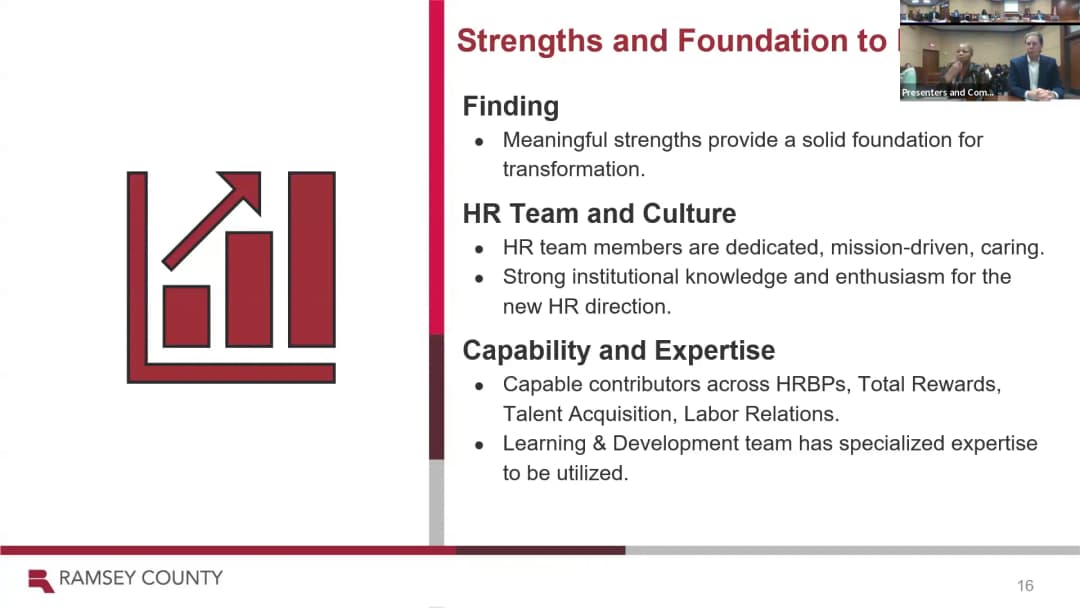
The Ramsey County Board held a workshop on April 7, 2026, focused on the Human Resources Department's transformation. Presenters included Chief HR Officer Patience Ferguson and consultant Michael Fisher. No votes were taken. The workshop reviewed the department's recent history, findings from an eight-month assessment, and a forward-looking roadmap. Presentation Findings - Patience Ferguson highlighted that 82% of Ramsey County's workforce is Generation X or Millennials, with 3,000 of 4,000 employees union-represented. She noted significant HR leadership turnover as a systemic challenge and emphasized the need for consistent leadership and a stable foundation. - Michael Fisher presented six key findings from interviews with over 80 stakeholders: (1) establishing a clear compass for HR, (2) aligning HR structure with county evolution, (3) improving service delivery and documentation (e.g., talent acquisition), (4) enhancing communication and trust, (5) filling gaps in core processes, and (6) leveraging the existing strong and dedicated HR staff. - Ferguson reported that HR leadership has developed a purpose statement, operating norms, and guiding principles (operational excellence, people first, accountability, partnership, growth, one Ramsey). Key hires include a Deputy Director of Total Rewards (Kristen Schultz) and a Division Director of Labor Relations (Lamanda Harrison); a Director of Talent and Workforce Development is being recruited. - Data analysis revealed concern about probation failure rates and turnover, especially among employees of color. Ferguson stated that data-driven decisions will guide future actions, with deeper analysis underway. Discussion Items - Commissioner McMurtry asked about the reasons behind HR leadership turnover. Fisher noted that interviewees emphasized the need for consistent leadership and support from the county executive; specific departure reasons were not commonly cited. - Commissioner Moran stressed the importance of protocols and procedures to ensure consistent employee experience, building trust. Ferguson agreed, noting ongoing monthly meetings with the Sheriff's Department and County Attorney's Office to address trust issues. - Commissioner Xiong raised turnover disparities among employees of color and asked about talent acquisition and workplace culture. Ferguson confirmed these are priorities and that data on probation failures are being analyzed to identify root causes. - Commissioner McMurtry (further) discussed the balance between organizational change and employee resistance. Ferguson outlined plans for all-staff meetings, team-level conversations, and clear expectations to manage resistance through communication and accountability. - Commissioner Moran (further) shared an example of delays in community partner payments, asking if HR should lead process standardization. County Manager Becker clarified that payment processes fall under finance, but HR can help set expectations for cross-department consistency. - Commissioner Jevning (Chair) summed up key themes: need for stable HR leadership, structural evolution, consistent service standards, improved communication, filling process gaps, and building on strong staff. Key Outcomes - No formal votes or resolutions were taken. - Upcoming workshops: June on HR strategic priorities, fall on total rewards, and a future labor relations session. - HR will launch a series of people-leader essential learning sessions (micro-learnings) and strengthen employee resource groups with executive sponsorship. - Workday implementation (Project North Star) continues, with HR staff serving as subject matter experts. - HR leadership will finalize and roll out departmental goals under four pillars (operational excellence, future-ready, data-informed, alignment/fiscal stewardship) by mid-2026. - The board and county manager acknowledged the need for consistent leadership support and pledged to hold themselves accountable to enable HR transformation. Note: The workshop concluded with a reminder of the broader political climate, but no further action was taken on that topic.
The Ramsey County Regional Railroad Authority convened on March 17, 2026, at the Council Chambers - Courthouse Room 300. The agenda listed a 10:00 a.m. start, but the minutes indicate the meeting was called to order at 10:44 a.m. Members present were Jebens-Singh, McMurtrey, Miller, Moran, Xiong, Chair Ortega, and Commissioner McGuire (participating remotely per Minnesota Statutes 13D.02). All seven members voted in favor of every motion, and the meeting adjourned at 10:49 a.m. Consent Calendar - Agenda Approval (2026-103): Motion by Moran, seconded by Miller, passed unanimously to approve the March 17, 2026 agenda. - Minutes Approval (2026-104): Motion by Miller, seconded by Moran, passed unanimously to approve the January 27, 2026 minutes. Administrative Items - Great River Rail Commission 2026 Funding Commitment (2026-053): Motion by Xiong, seconded by Moran, passed unanimously (Resolution R2026-006). The Authority accepted the Great River Rail Commission’s 2026 Work Plan and Budget, approved a $16,400 payment as Ramsey County’s funding commitment, and authorized the County Manager to establish a project budget. - Support for METRO J Line Arterial Bus Rapid Transit (2026-091): Motion by Miller, seconded by Xiong, passed unanimously (Resolution R2026-007). The Authority supported the METRO J Line contingent upon multi-jurisdictional commitment and collaboration among MnDOT, Metro Transit, the city of Saint Paul, and Ramsey County for significant infrastructure improvements along West 7th Street addressing safety, mobility, transit reliability, and long-term corridor functionality. One commissioner expressed pleasure at seeing the project move forward, noting it is a state road and that transit planning has been ongoing for decades. - Support for Revised Locally Preferred Alternative for METRO Bronze Line BRT (2026-094): Motion by Miller, seconded by Xiong, passed unanimously (Resolution R2026-008). The Authority supported the revised Locally Preferred Alternative, supported amending the Metropolitan Council’s Imagine 2050 Transportation Policy Plan to incorporate the revised project definition, and authorized the Chair to transmit the resolution. A commissioner said they were "super excited" and looked forward to moving out of the one-percent design phase. Corridor Updates - Chair Ortega shared an update from an East Metro Strong Board conversation regarding the organization’s future. Board members generally agreed that East Metro Strong, established about ten years ago to help the East Metro compete in Met Council regional solicitations, may have fulfilled its mission given the number of corridors now lined out. There was consensus to potentially sunset the organization, though the process for ending or transferring work remains unclear; for the immediate term, partners may not be invoiced for the next year. Chair Ortega commented that this conversation was overdue and that the organization may have become stagnant rather than part of a new vision. Key Outcomes - All three administrative items were approved unanimously with three separate resolutions: R2026-006 (Great River Rail funding), R2026-007 (METRO J Line support), and R2026-008 (METRO Bronze Line revised LPA support). - No public comments were made. - Meeting adjourned without further formal action.
The Ramsey County Board of Commissioners met in regular session on March 17, 2026, from 9:01 a.m. to 10:44 a.m. in Council Chambers. Commissioners Jebens-Singh, McMurtrey, Miller, Moran, Chair Ortega were present; Commissioner McGuire attended remotely; Commissioner Xiong arrived at 9:06 a.m. during the GREATER MSP presentation. County Manager Ling Becker and Civil Division Director Jada Lewis were also present. The meeting included consent items, an administrative item, a presentation from GREATER MSP, a legislative update, county connections report, and outside board/committee reports. Consent Calendar - Agenda of March 17, 2026 (2026-101): Motion by Moran, seconded by McGuire. Passed unanimously with Jebens-Singh, McGuire, McMurtrey, Miller, Moran, and Ortega voting aye; Xiong absent. - Minutes of March 10, 2026 (2026-102): Motion by Moran, seconded by Miller. Passed unanimously with the same vote. Administrative Items - Certification of Property Assessed Clean Energy (PACE) Charges for Energy Improvements (2026-072): The Board approved a resolution (B2026-038) to amend the interest start date for an assessment on property owned by 80 West LLC (80 4th Street W, Saint Paul, PIN 06.28.22.24.0012). The assessment is $1,530,000 at 7.49% interest over 24 years, with interest now starting January 1, 2027. The motion by McMurtrey, seconded by Jebens-Singh, passed unanimously (Xiong absent). Discussion Items - Presentation: GREATER MSP (2026-097): Peter Frosch, CEO of the Minneapolis‑St. Paul Regional Economic Development Partnership (GREATER MSP), presented the organization’s strategy to expand economic opportunity and increase tax base across the region. He highlighted that Ramsey County is the smallest geographic county in Minnesota and emphasized redevelopment opportunities at sites such as Gerdau (potential green steel facility), WestRock (potential med‑tech campus generating $1–1.5 million in additional annual property tax), and Snelling‑University (tech zone). He noted that GREATER MSP’s three‑year goal is to secure $5 billion in additional investment and at least 5,000 good jobs in the region. Commissioners asked questions and raised concerns: - Commissioner McMurtrey inquired about comparable regional partnerships in Columbus, Ohio and Syracuse, New York, and the role of local government. - Commissioner McGuire asked how GREATER MSP would partner on major Ramsey County projects (Rice Creek Commons, Park at River’s Edge, riverfront development). - Commissioner Moran expressed support for growing the tax base but stressed the need to avoid gentrification and displacement, prioritizing first‑time homeowners. She also asked about the organization’s decision‑making process and conflicts between urban and rural counties. - Commissioner Miller asked about the care economy (childcare, elder care) as a workforce enabler and about the impact of recent immigration‑related events on the region’s brand reputation for attracting global talent. - Commissioner Xiong (arriving late) questioned how high‑tech job creation would ensure wages are fair and asked about climate impact considerations in business attraction. He also asked about transit access to jobs across the metro. - Commissioner Jebens‑Singh requested a copy of the presentation slides and asked how technology (e.g., cybersecurity, deep tech) is integrated. She later asked about the harm to brand reputation from “Operation Metro Surge” and the federal government’s pressure on property taxes. - Chair Ortega emphasized the importance of listening to embedded communities, small businesses, and the need for GREATER MSP to better understand local workforce development beyond universities. Peter Frosch responded that GREATER MSP focuses on “governance light but leadership heavy,” building teams for specific projects. He acknowledged concerns about brand reputation but noted that some international investors still view Minnesota as a safe place to do business. He also mentioned the Groundbreak Coalition as an inclusive financial mechanism to support community wealth building. Legislative Update (Commissioner McGuire): The state legislature is about one month into session; a supplemental budget from the governor is expected today. The governor also proposed a major overhaul of state human services administration with fraud prevention and technology modernization. The House Taxes Committee heard the Ramsey/Hennepin bill to extend the mortgage registry tax (funding the Environmental Response Fund), likely included in the omnibus tax bill. The Senate passed emergency rental assistance, but House passage is uncertain. Bills on regulating infectious waste shipments are advancing. County Connections (County Manager Ling Becker): Becker reported on the winter storm response over the weekend. The county activated a coordinated incident team; 27 trucks operated 24 hours on primary roads. Five field service incidents occurred; the Sheriff’s Office assisted staff transport. He thanked public works, fleet mechanics, and all staff for their flexibility. Outside Board and Committee Reports: Several commissioners provided brief updates: - Commissioner Miller: Rice Creek Commons spine road design nearing finalization; White Bear Township annual meeting emphasized budget transparency; SHAC meeting on cannabis prevention; DCT advisory committee on sex offender program review; Landmark Center St. Patrick’s Day programming. - Commissioner McMurtrey: Tour of 911 dispatch center; Climate Action Working Group on chloride reduction; Active Living Ramsey Communities meeting on Met Council solicitation; new employee orientation. - Commissioner Moran: Welcomed Parks & Rec staff; small business collaborative at Capitol Commons; met with Isaiah on Operation Metro Surge and election security; noted demolition of CVS at Snelling‑University. - Commissioner Xiong: MESB board approved 2026 regional needs document and RFP for shared 911 study; Heading Home Ramsey; Waldo Grant opening; upcoming district hours. - Commissioner Jebens‑Singh: Heading Home Ramsey annual meeting; health center at 55 Cedar (needle exchange moving to Maplewood, county committed to maintaining St. Paul service); pretrial justice council update on navigator program; community meeting to be announced. - Chair Ortega: Met with ASAIA group; Landmark Center violence reduction group; hosted Humphrey policy students. Key Outcomes - Agenda approved (motion passed). - Minutes of March 10, 2026 approved. - Resolution B2026-038 (PACE assessment for 80 West LLC) adopted. - All other items were informational; no further votes were taken. - The Board then adjourned to the Regional Railroad Authority Meeting at 10:44 a.m., followed by workshops on economic growth and strategic planning.
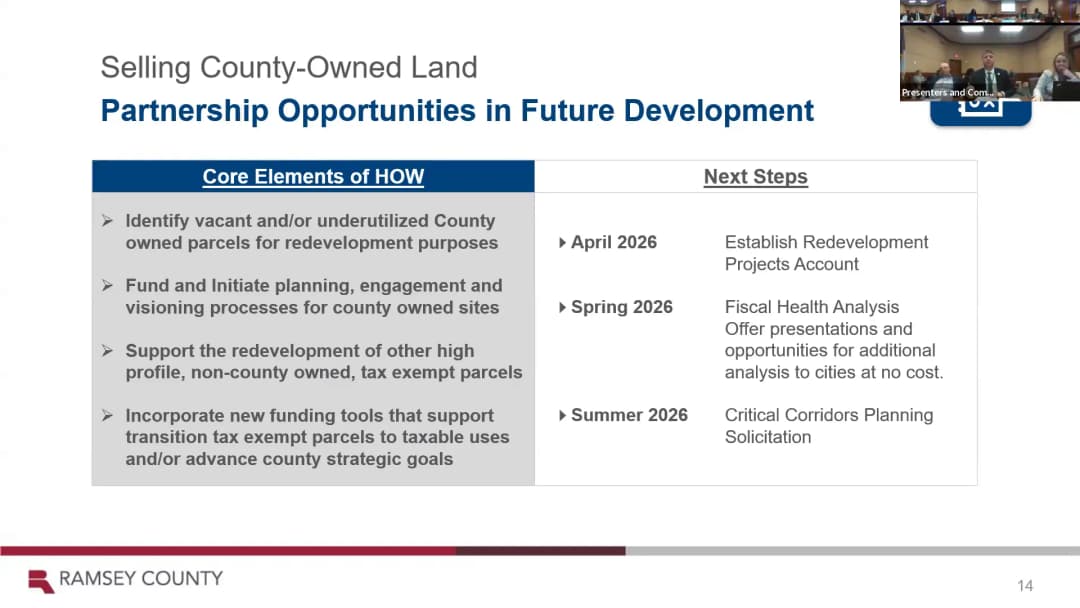
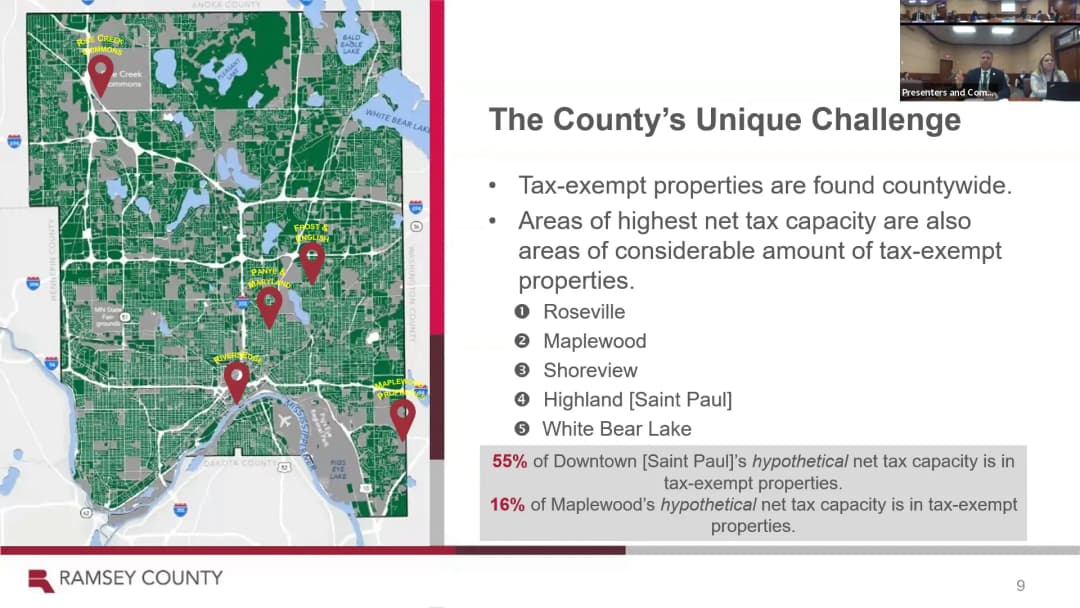
The Ramsey County Board held a workshop on March 17, 2026, from 1:30 p.m. in Courthouse Room 220, Saint Paul, to discuss a comprehensive economic development strategy titled "Building Stronger Together." The session featured presentations from the County Manager, Economic Growth and Community Investment staff, and Public Works director. No votes were taken; the workshop was recorded and live-streamed via Zoom. Discussion Items - Park at River’s Edge: Presenters described this as a "generational opportunity" to unlock the Mississippi riverfront on a five-acre site. The project will bring housing, jobs, and retail while linking downtown to the river. A key barrier is resources. The county has received $6 million in state seed funding but proposes a $20 million capital improvement bond to accelerate the project. A mini-workshop is scheduled for later in May to detail site improvements, including relocation of Xcel Energy power lines and railroad engineering. - Downtown Residential Development via HRA Levy: The county plans to deploy a new tool – using the Housing and Redevelopment Authority (HRA) levy – to fund downtown housing development, especially converting obsolete office buildings into residential units. Officials emphasized this would not diminish funding for other parts of the county; the HRA levy currently generates about $15 million annually, and the proposed bond would require roughly $3.5 million annual debt service, within the St. Paul share of the 50-50 split with suburban Ramsey County. The board discussed leveraging the county’s AAA bond rating and timing bond sales to project readiness. - Public Realm and Vibrancy: Presenters underscored the importance of sidewalks, public spaces, and placemaking (arts, culture) to improve the downtown experience and support new development. The county’s transportation and transit investment plan includes continued investment downtown. A one-pager summarizing the strategy for city partners was suggested. - Business Energy and Vibrancy: The county expanded its Critical Corridors program to include downtown but did not award funding in the fall 2025 cycle, opting to first conduct planning. A spring 2026 application round will include downtown for the first time. Longer-term, the county is pursuing Economic Development Authority (EDA) legislation, with a June 2026 opt-in deadline for city partners and full implementation expected in 2027. - Selling County-Owned Land: The second major prong focuses on disposing of underutilized county land to generate property tax revenue. Key sites include: - Rice Creek Commons (formerly 427 acres, now 417 acres after a 10-acre sale). The county is finalizing infrastructure plans (e.g., Rice Creek Boulevard) and considering a "hybrid" development model rather than a single lead developer. A decision on the model is expected within 60–90 days. - Maplewood South parcel (just closed, unlocking 90+ acres for 206 new units). - Frost and English (excess regional rail property) – partnership with Maplewood. - Payne and Maryland (vacant county-owned parcel in St. Paul) – to pilot the Emerging Diverse Developers program. - 555 Cedar and Ramsey County East – identified as prime transit-adjacent opportunities. - Boys Totem Town and other vacant/underutilized sites – will be cataloged via a redevelopment project account. - Partnerships and Fiscal Health: County staff noted proactive outreach from cities (e.g., Maplewood, White Bear Lake) seeking the fiscal health analysis presentation. The county will align its next Economic Competitiveness and Inclusion (ECI) plan with municipal comprehensive plan updates (due in a few years) to identify redevelopment opportunities. Commissioners stressed the need for collaboration with the City of St. Paul, especially given shared infrastructure investments. Key Outcomes - Next Steps: A board action is planned for April 14, 2026, to approve the proposed bond and other authorizations. A media event at Comcast overlooking the river is scheduled for the same day at 11:00 a.m. to launch a rebranded website and collateral. - Mini Workshops: The board will hold shorter check-ins (e.g., 45-minute sessions) on specific projects (River’s Edge, Bronze Line) to avoid consuming full workshop slots. - State Advocacy: Commissioners and staff will continue meeting with state legislators, including Senator Pappas, to seek bonding support for River’s Edge and other initiatives. - Metric Tracking: The county will monitor tax base growth, foot traffic, hotel occupancy, and other indicators in partnership with the assessor’s office and external organizations. - No Votes Taken: As a workshop, no formal decisions were made; the discussion informed future board actions.
This board workshop, held on March 17, 2026, built upon the previous week's discussion of Ramsey County's fiscal health. Staff and commissioners examined the county's unique property tax pressures, including a high percentage of tax-exempt property, limited developable land, and rising costs from unfunded mandates. They explored how the county can leverage its own assets, redevelopment tools, and partnerships to grow the tax base and reduce burden on residents and businesses. Discussion Items - Presenters outlined key fiscal challenges: Ramsey County has the lowest per capita net tax capacity in the southern metro area and is nearly fully built-out. The county saw property tax shifts from commercial to residential for the first time in years. Federal mandates could cost the county up to $21 million by 2027 based on worst-case scenarios. - Urban3 analysis was recapped: land productivity is critical to tax base growth; Ramsey County has 6,200 acres of institutional land, of which 900 acres (14%) are redevelopment opportunities. The county owns a significant share of key sites, including 427-acre Rice Creek Commons. - A hypothetical analysis by the assessor's office showed that if tax-exempt properties were classified by use, 55% of downtown St. Paul's tax capacity would be located in tax-exempt parcels (Maplewood: 16%). Downtown St. Paul's actual share of county tax capacity fell from 4.69% (2018) to 2.97% (2025), increasing the burden on other areas. - The Maplewood property sale was highlighted as a lesson: community compromise allowed townhomes and greater density, improving tax base potential. Zoning and upfront investment in site readiness were identified as key barriers. - Commissioners questioned how to project tax base gains from redevelopment and how to expedite projects. Staff responded that realistic projections require site-specific detail, and they will provide additional analysis. Barriers include funding, regulatory timing, and need for data-driven partnerships. - Commissioner Moran emphasized that Ramsey County should be its own primary messenger, leveraging strong relationships with cities and stakeholders rather than relying solely on partners like Greater MSP. Commissioner Jevinsing stressed connecting economic development to workforce opportunities and resident benefits. Key Outcomes - No votes were taken; the workshop served to align commissioners on strategy and set direction for future action. - Staff will develop a "cheat sheet" of key data points and conduct further analysis on potential tax base and property tax relief from redeveloping county-owned sites. - The county will advance its Economic Competitiveness & Inclusion (ECI) plan 2.0, utilizing new tools (EDA, HRA, housing levy) to accelerate redevelopment of institutional lands. - Commissioners affirmed a coordinated, county-led approach that builds on existing relationships and assets, with a focus on downtown St. Paul and suburban redevelopment corridors.
The Ramsey County Board of Commissioners met on March 10, 2026, at 9:00 a.m. in Council Chambers. The board approved the agenda and minutes, passed three administrative resolutions, received updates on the county's response to Operation Metro Surge, and heard a presentation on SNAP recertifications. The meeting adjourned at 10:38 a.m. followed by workshops on elections and fiscal health. Consent Calendar - Agenda Approval: Approved the agenda of March 10, 2026 (Motion by Moran, seconded by Miller, all ayes). - Minutes Approval: Approved the minutes of February 17, 2026 (Motion by Moran, seconded by Jebens-Singh, all ayes). - Purchase of Services Agreement (Item 3, Resolution B2026-035): Approved a service agreement with the Ramsey/Washington Recycling & Energy Board for employee benefits services for a term of January 1, 2026 through December 31, 2027, with a not-to-exceed amount of $10,000 per year. Motion by McGuire, seconded by Xiong, all ayes. - Fiscal Agent Agreement (Item 4, Resolution B2026-036): Approved a fiscal agent agreement with the Ramsey/Washington Recycling & Energy Board for a term of January 1, 2026 through December 31, 2030, in a not-to-exceed amount of $30,000 per year. Motion by McGuire, seconded by Xiong, all ayes. Discussion Items 1. Grant Agreement for Familiar Families Pilot Program (Item 5, Resolution B2026-037) - Staff explained this is a technical correction to a previously approved agreement, changing the grant partner from the City of Saint Paul to its Housing and Redevelopment Authority to align with fund source requirements. - The $500,000 grant (March10, 2026 – February28, 2027) funds a pilot program targeting families cycling in and out of homelessness. Up to 60 individuals ( approximately 20 every four months) will receive wraparound services and placement case management; a competitive solicitation will select a provider. - Commissioner Moranasked about the four-month focus period; staff clarified that eligible families have been homeless for four-plus years and are already on priority lists. The aim is housing readiness within four months, followed by long-term services through a continuum of support. - The board approved the resolution (all ayes) and rescinded prior Resolution B2025-236. 2.Updates on Ramsey County’s Response to Operation Metro Surge (Item6) - County Manager Ling Becker provided an informational update. The federal Operation Metro Surge, launched in December 2025, deployed an estimated 3,000 ICE and CBP agents to Minnesota. On February 3, 2026, the board unanimously passed a resolution condemning aggressive tactics. - Although the surge was announced to end in mid-February, impacts persist: heightened anxiety and fear among immigrant and refugee families, work disruptions, and economic loss. - Two new relief measures were announced: - $75,000 one-time funding to the Ramsey County Children’s Mental Health Collaborative to strengthen mental health supports and basic needs services. - Two-month temporary property tax payment extension for non-escrowed homestead properties, certain small businesses (annual property tax ≤$50,000), and residential non-homestead properties (1-3 units, annual tax ≤$20,000). Applications due by July15,2026; approved applicants may pay up to two months past the deadline without late penalties. Statutory penalties apply retroactively if payment is not made by the extended deadline. - Other actions included: posting signage at county facilities, designating nonpublic areas, issuing resident guidance, training 425 employees on interaction protocols, launching a new EAP mobile app, maintaining virtual services, creating a public resource website, distributing multilingual postcards, and updating the federal delegation. - Commissioner Singh asked about historical uptake of property tax extensions (Treasurer Tracy West noted 32 million qualified in 2020 and 18% participated; about 50% of residents escrow). Commissioner Xiongrequested an after-action report including program utilization and eviction tracking. Chair Ortega emphasized that the extension process should be simple for small businesses. 3. Presentation: Supplemental Nutrition Assistance Program (SNAP) Recertifications (Item7) - Director Ali Ali and Deputy Director Jason Hedin presented an overview.SNAP is a federal food assistance program administered by counties. Ramsey County has approximately34,000 active SNAP cases supporting over60,000 residents monthly. Staff process about 2,800 recertifications per month within a30-day window. - Commissioner Jebens-Singh asked about error rates. Common errors involve household composition, income, utility costs, and shelter costs. Minnesota’s official payment error rate is above 10% (federal threshold for penalties is 6%), which could trigger federal penalties up to15%. - Deputy County Manager Francois noted that the county is conducting an “all hands on deck” effort (Access and Accuracy) to reduce the error rate, with a deeper dive presentation scheduled for the April28 board workshop. - Discussion of HR1 impacts: proposed legislation would require recertification every six months for many programs, potentially adding 75staff positions at the county level with no federal administrative funding. - Commissioner Jebens-Singh highlighted that SNAP brought $126 million in benefits to Ramsey County in 2024, and disruptions would affect the local economy. Key Outcomes - Three resolutions were approved unanimously: B2026-035, B2026-036, and B2026-037. - Two relief measures for Operation Metro Surge impacts were announced: $75,000 for children’s mental health and a temporary property tax payment extension. - The board will receive an after-action report on Operation Metro Surge in approximately one month and a detailed SNAP error rate presentation onApril 28. - The meeting adjourned at 10:38 a.m.