Browse by city
Date range
Search help

Search titles, summaries, topics and stored transcripts together. Keywords may match separately; put the whole query in double quotes for a phrase. Matching follows word analysis, so punctuation is not exact. Both dates are included. Documents are not searched.

SHOWING 41–50 ENTRIES
41
JUN 16, 2026 · RAMSEY COUNTY, MINNESOTA · BOARD OF COMMISSIONERS & AUTHORITIES
Ramsey County Board of Commissioners Meeting - June 16, 2026

The Ramsey County Board of Commissioners met on June 16, 2026, at 9:03 a.m. in Council Chambers, Courthouse Room 300, Saint Paul, Minnesota. All seven commissioners were present: Jebens-Singh, McGuire, McMurtrey, Miller, Moran, Xiong, and Chair Ortega. Also present were County Manager Ling Becker and Civil Division Director Jada Lewis. The meeting included a public hearing on the proposed 2027 commissioner salary ordinance, approval of several resolutions, and recognition of retiring staff. Public Hearing – Proposed Commissioner Salary Ordinance for 2027 - The public hearing was opened at 9:05 a.m. Two members of the public testified in opposition: Rich Neumeister (St. Paul) and Greg Copeland (St. Paul). - Rich Neumeister strongly opposed the proposed 3% salary increase and nearly $10,000 annual expense allowance, arguing that the increase is inappropriate given recent budget cuts including 43 staff reductions, library cuts (loss of five FTE positions, Friday closure of Shoreview Library), and reductions to detox services and burial assistance for low-income residents. He urged the board to reject the increase and focus on restoring services. - Greg Copeland opposed the salary increase and criticized the county's spending and tax increases, citing a 16% property tax increase in his neighborhood and a proposed $320 million bond for a downtown park. He suggested replacing the current salary formula with a per-capita-based approach and advocated for a $1 per resident formula to reduce the budget by $263,618. - No other public testimony was offered. The public hearing was closed at 9:16 a.m. Consent Calendar / Routine Approvals - Agenda Approval (2026-214): The agenda was amended to correct the time of the closed meeting on the County Manager Performance Review from 1:30 p.m. to 10:30 a.m. The amended agenda was approved unanimously. - Minutes of June 2, 2026 (2026-215): Approved unanimously. - Appointment of Members to the Ramsey County Economic Development Authority for 2026 (2026-208): Approved unanimously. The board appointed itself as the EDA board; Chair Ortega nominated Mai Chang Jong as EDA chair for 2026. Discussion Items - Proposed Commissioner Salary Ordinance – Waiver of Second Reading: Following the public hearing, Commissioner Moran moved, seconded by Jebens-Singh, to waive the second reading of the proposed ordinance. The motion passed unanimously, adopting Resolution B2026-075. - Grant Agreement with MN Department of Health for Pediatric Mental Health Training (2026-204): Presented by Kenya Walker, Human Services Manager. The grant of $265,000 will fund training for Social Services and Public Health staff through May 31, 2028. Commissioners Moran and Jebens-Singh expressed strong support, noting the importance of early intervention for youth mental health. The motion passed unanimously (Resolution B2026-078). - Fund Transfer from Bond Interest to Park at RiversEdge (2026-211): Authorized the County Manager to transfer up to $1,200,000 from bond interest and premiums to the Park at RiversEdge project account. Motion passed unanimously (Resolution B2026-077). County Connections - County Manager Ling Becker announced that the Jackson Street entrance of the Ramsey County Government Center will close from June 18–24 due to construction; staff and residents will use alternate entrances. - Recognized Bobby Joe Potter, Deputy Director of Children and Family Services, for being selected as a 2026 Bush Fellow. - Highlighted Juneteenth events across the county and encouraged participation. - Honored retiring Emergency Management and Homeland Security Director Judd Fried, who served 23 years with the county. Commissioners McGuire, Ortega, and McMurtrey praised his leadership and national contributions. Fried thanked his family and staff. Outside Board & Committee Reports / Board Chair Update - Commissioners reported on community events attended, including Juneteenth celebrations, Pride events, and meetings of the AMC District 10, Audit Committee, MESB, and Extension Committee. Reports included updates on resource management, unfunded mandates, and emergency communications. - Commissioner Moran reported on the Audit Committee: the county recovered $738,687 in subrogation in 2025. - Chair Ortega read a proclamation recognizing Juneteenth (June 19, 1865) and the ongoing commitment to racial equity. Key Outcomes & Decisions - Agenda amended (closed meeting time corrected) and approved unanimously. - Minutes of June 2, 2026 approved unanimously. - Public hearing held on the proposed Commissioner Salary Ordinance for 2027; two speakers opposed. - Waiver of second reading of the salary ordinance passed unanimously (Resolution B2026-075). - Appointment of EDA members (the full board) approved unanimously (Resolution B2026-076). - Pediatric Mental Health Training grant accepted and agreement approved (Resolution B2026-078). - Fund transfer of up to $1,200,000 to Park at RiversEdge approved (Resolution B2026-077). - County Connections updates received. - Outside reports and Board Chair update received. - Meeting adjourned at 10:19 a.m. - Closed meeting (not open to the public) convened at 10:45 a.m. to discuss the County Manager Performance Appraisal; no action taken; adjourned at 12:14 p.m.
COMMUNITY ENGAGEMENT 39% · PUBLIC SAFETY 14% · PROCEDURAL 7% · PUBLIC ENGAGEMENT 7%
42
JUN 9, 2026 · RAMSEY COUNTY, MINNESOTA · BOARD OF COMMISSIONERS & AUTHORITIES
Board Workshop on 2025 Workforce Statistics – June 9, 2026

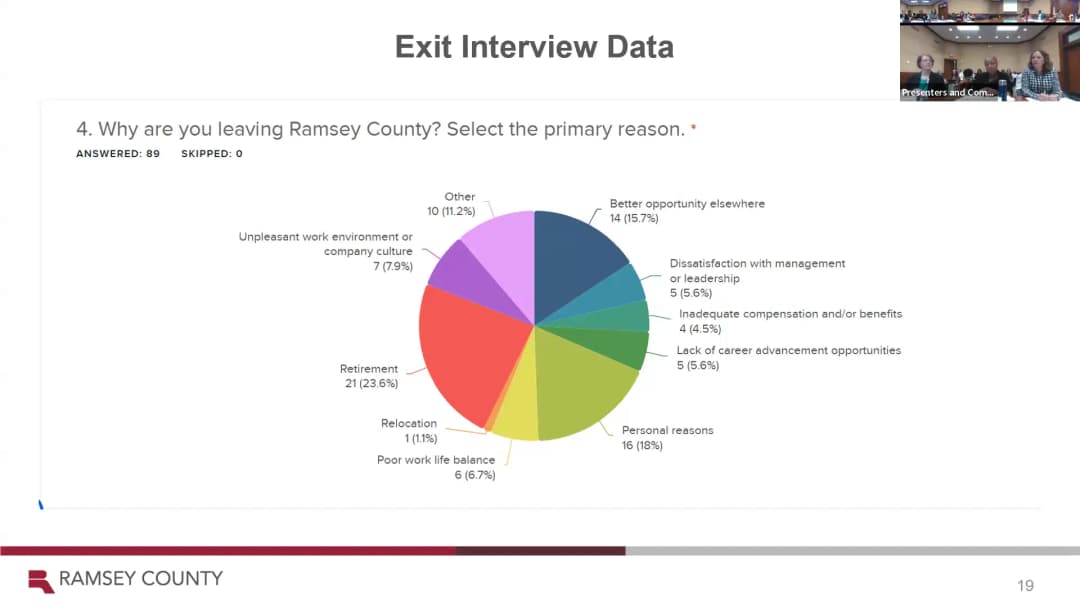
A workshop presentation by Human Resources on the county’s 2025 workforce statistics and progress on the Talent Attraction, Retention, and Promotion (TARP) strategic priority. The presentation covered demographic trends, turnover rates, exit interview data, and future workforce planning initiatives. Discussion Items - New HR Deputy Director: The CHRO announced the hiring of Abby Ludea, formerly Deputy HR Director for the City of St. Paul and a Ramsey County resident, to oversee talent services, learning, development, and talent acquisition. She will join the TARP presentation scheduled for July 28, 2026. - TARP Update: Human Resources highlighted TARP accomplishments since 2016, including 2023 inclusive workplace policies, 2024 benefit changes, 2025 hiring process improvements (time-to-hire reduced from 160 to under 80 days), and automated exit interviews. Upcoming priorities for 2026-2027 include people leader development, a total rewards survey (Phase 2 of comp and class modernization), and an employee engagement survey. - Workforce Demographics (as of Dec. 31, 2025): - 3,977 full- and part-time employees (excluding contractors). - 62% female; 55% of directors are female, 53% of formal leaders (600 directors, managers, supervisors). - Average age 44.9 (down from 45.3 in 2024). - Workforce diversity at 41.99% racially/ethnically diverse, up for the first time in four years. - Applications (21,000 annually) are the most diverse among Minnesota counties. - Generational Shifts: Baby boomers decreased to 13.4% of workforce. Generations Y and Z are the most diverse (51% racially/ethnically diverse each). Commissioner Jensing noted the need to track career paths and retention, particularly for Gen Z. HR responded that benefits were redesigned based on younger employee feedback. - Promotions and Separations: - 189 promotions in 2025 (38% diverse), down from 291 in 2024 due to fewer COVID-era vacancies. - 430 total separations, turnover rate 11.1% (down from 14.5% in 2024). Commissioner Zhang asked about probation failures among diverse staff; HR stated they are evaluating departments’ training and expectations. - Turnover by Department: Top four departments with high turnover in 2025: 1. Emergency Communications: 31.28% (stable from previous years). 2. Medical Examiner: 30.3% (small department of 17; DCM Reyes working with county manager and HR for support). 3. Libraries: 19.61% (significant retirements in leadership). 4. Financial and Administrative Services (FAS): 17.14% (improved from 21% in 2024). Public Health turnover dropped to 13.58% (from 19% in 2024). HR turnover improved to 14.71% (from 32% in 2023). Commissioners celebrated these improvements and discussed using data to trigger targeted HR support. - Exit Interviews: - Electronic exit interviews refined from 42 to 20 questions; response rate 39.5% (89 of 226 voluntary separations). - Top reasons for leaving: career advancement, compensation, personal reasons, and unpleasant work environment (7.9%). - Commissioner McGuire advocated for more in-person interviews; HR noted standardized electronic surveys provide consistent data and some employees prefer anonymity. - Commissioner Willow asked about follow-up actions; the CHRO described plans to create departmental dashboards combining exit data, investigations, safety data, and other metrics with DCM accountability. - Paid Family and Medical Leave (PFML): Discussed as an emerging issue. The state-mandated benefit offers up to 20 weeks of leave; employees can choose state benefit or accrued leave (100% pay). HR is monitoring impacts on service delivery, especially in high-stress positions. Commissioner Ortega noted private-sector trends away from such leave; Commissioner Xiong requested exit interview questions to distinguish external caregiving pressures from employer-driven reasons. - Next Steps: - Create workforce dashboards for departments. - Deepen leadership development and new manager orientation (risk mitigation focus). - Operationalize workforce planning with county manager and DCM support. - Implement 30/60/90-day check-ins for new employees (modeled after Hennepin County). Key Outcomes - HR will present a more detailed TARP workshop on July 28, 2026, where the new deputy director will be introduced. - The board received the 2025 workforce statistics report for planning and budgeting. - Commissioners directed HR to: - Investigate retention and career progression for Gen Z and diverse employees. - Disaggregate exit interview data to identify external vs. internal reasons for leaving, particularly related to PFML. - Consider integrating multiple data points (exit interviews, investigations, safety) into departmental dashboards for DCM-led action. - No formal votes were taken; the meeting was informational and advisory.

WORKFORCE DEVELOPMENT 68% · RACIAL EQUITY 11% · PERSONNEL MATTERS 10% · TECHNOLOGY AND INNOVATION 6%
43
JUN 2, 2026 · RAMSEY COUNTY, MINNESOTA · BOARD OF COMMISSIONERS & AUTHORITIES
Ramsey County Board of Commissioners Meeting - June 2, 2026

The Ramsey County Board of Commissioners met on June 2, 2026, at 9:00 AM in Council Chambers. All seven commissioners were present (Jebens-Singh, McGuire, McMurtrey, Miller, Moran, Xiong, and Chair Ortega), along with County Manager Ling Becker and Assistant County Attorney Stacey D'Andrea. The meeting included unanimous approval of the consent agenda, a presentation on aging and disability services, and reports from the county manager and commissioners. The board also held a closed meeting following the regular session. Consent Calendar - Agenda and Minutes: Approved the June 2, 2026 agenda and the May 26, 2026 minutes unanimously. - Personnel Review Board Appointments: Appointed Estelle Wright and incumbent Beth Bell Isle to four-year terms ending August 1, 2030 (Resolution B2026-070). - Corrections Advisory Board Appointments: Appointed eight individuals (Alexander Cleaveland, Ofir Germanic, Maria Mitchell, Gail Moerke, Robert Lokhorst, Cory Tennison, Dan Wolff, Tierre Caldwell) for terms June 1, 2026 to May 31, 2028 (Resolution B2026-071). - Community Health Services Advisory Committee Appointments: Appointed five individuals (Abdulkadir Mohamed, Krista Hutchinson, Kayla Nance, Alicia House, Katherine Mejicano) for terms June 23, 2026 to June 27, 2028 (Resolution B2026-072). - Parks and Recreation Commission Appointments: Appointed incumbents Reier Erickson (District 4), Christine England (District 5), and Mike Sachi (District 1) for terms June 4, 2026 to June 5, 2029 (Resolution B2026-073). Presentation: Aging and Disability Services Update Deputy Director Katy Molinare presented an update on the aging and disability services division, focusing on the impact of the 80 additional full-time equivalent (FTE) positions approved by the board on March 18, 2025. She reported that the division had moved from a state of crisis to operational stability: - Hiring and Retention: Four cohorts were hired (three in 2025, one in January 2026), including seven employees from Detox. New staff completed an eight-week onboarding program. The retention rate is 91% (only seven left, one via promotion). - Backlog Reduction: The initial assessment backlog peaked at approximately 2,500 residents in October 2025. As of May 2026, the backlog had dropped to just over 500, with wait times for residents under 65 and over 65 both reduced to within 20 working days (statutory requirement). The goal for 2027 was 700 backlog assessments, already exceeded. The developmental disability (QDDP) assessment backlog remains, with wait times around seven months. A focused effort using 15–20 volunteer assessors will target this backlog over the summer. - Operational Improvements: All reassessments are now completed timely each month, overtime has been eliminated, and initial assessments have resumed. The division is on track to end the initial assessment backlog by end of 2026. A pilot with mental health and financial assistance services expedites assessments for residents exiting state-operated facilities. - Vendor and Case Management: The division uses contracted case management to supplement capacity. Vendor support includes weekly consults, monthly training, grievance processes, and annual case file reviews. Commissioner Miller raised concerns about case manager turnover and consistency, noting that a state rate study and working group are addressing these issues. The board requested a deeper discussion on vendor/case management capacity at the September workshop. - Commissioner Comments: Commissioners praised the team's work and acknowledged the remaining challenge with QDDP assessments. Commissioner Jebens-Singh highlighted the importance of addressing all backlogs due to impacts on quality of life, families, and providers. Commissioner Xiong asked about grievance process accessibility—confirmed it can be submitted verbally or in writing. County Connections County Manager Ling Becker reported on the successful relocation of public health clinical services from 555 Cedar to 1850 Beam Avenue in Maplewood, which opened June 1. Services at the new location include Clinic 555, immunization clinic, TB clinic, and public health lab. House calls and sexual violence services moved to other county sites; syringe services remain downtown. Becker also recognized the chief clerk's office for supporting board processes and noted that board materials are posted by Thursday afternoon for the following Tuesday. Property Management Director Gene Kruger promoted Train Days at Union Depot (June 6–7), celebrating the depot's 100th anniversary. Expected attendance of 10,000 per day. The depot surpassed one million annual visitors for the first time since reopening. Outside Board and Committee Reports & Board Chair Update Commissioners provided updates on community events, board meetings, and collaborative efforts: - Commissioner Jebens-Singh: Attended Small Sums breakfast, White Bear Lake CNA pinning ceremony, Wakantipe Center opening, Flint Hills Family Festival, and Waterfest. Reported that Rice Creek Commons JDA approved a hybrid RFP approach; MOU with Army for TGRS system is in place. Announced that the Twin Cities received the JFK Profile in Courage Award for defending immigrant neighbors during Operation Metro Surge. - Commissioner Xiong: Volunteered at Zion Community Commons, met with International Institute of Minnesota and Payne Phelan Community District Council, attended Flint Hills Family Festival. Promoted a blood drive on June 3 at the courthouse. - Commissioner Miller: Attended Workforce Investment Board executive committee, Joint Powers Board (becoming vice chair), Ramsey/Washington Recycling & Energy Board (approved budget, learned about odor monitoring with a "Nasal Ranger" olfactometer), and ISD 622 state of the district. - Commissioner Moran: Met with women from Campford Memorial United Methodist Church about behavioral health; participated in St. Paul Children Collaborative strategic planning; re-elected chair of Heading Home Ramsey County Governing Board; attended Flint Hills Family Festival and Dave Winfield statue unveiling and banquet. - Commissioner Ortega: Attended St. Anthony and Little Canada city council meetings; noted Little Canada's new council member Nick Schwabach and senior housing development. Met with former colleague Nicole Fretham (now in county attorney's office) about restorative justice. Mentioned the Nasal Ranger olfactometer and the countywide food scrap collection rollout by end of 2026. Attended Active Living Ramsey Communities meeting and highlighted Roseville Area School District as first Green Step school district in the state. - Chair Ortega (via reports): Attended Regions Hospital board meeting; noted innovation and financial health of Regions; discussed potential for Ramsey County to foster employee innovation. Key Outcomes - All consent agenda items (resolutions B2026-070 through B2026-073) were approved unanimously by roll call vote (7-0). - The Aging and Disability Services update was received for information; a more in-depth workshop is planned for September 2026. - The board held a closed meeting at 10:36 AM (adjourned at 11:41 AM) pursuant to Minnesota Statutes 13D.05, subd. 3(b) to discuss the Wilson v. Ramsey County matter. The board authorized staff to proceed as discussed via Resolution B2026-074 (motion by Jebens-Singh, seconded by Moran; passed). - Upcoming events: Lunch and Learn on Purchasing and Contracting (12:00 PM), Board Workshop on Ramsey County Girls Report (1:30 PM). Next regular board meetings: June 9 and June 16, 2026.

AGING AND DISABILITY SERVICES 17% · PERSONNEL MATTERS 15% · PROCEDURAL 10% · PUBLIC ENGAGEMENT 10%
44
JUN 2, 2026 · RAMSEY COUNTY, MINNESOTA · BOARD OF COMMISSIONERS & AUTHORITIES
Ramsey County Board Workshop: Girls Report Update - June 2, 2026

This workshop, held on June 2, 2026, at 1:30 p.m. in Courthouse Room 220, provided an overview and update on the Ramsey County Girls Report, a five-year mixed-methods study examining the pathways of girls and gender-expansive youth through child welfare and youth legal systems. The study was conducted in partnership with Justice and Joy National Collaborative and Partnerships for Permanence. No votes were taken during this recorded workshop. Presentation Overview - Background: The report was initiated in 2020 to understand what girls need and to design systems to meet those needs. It is the first U.S. jurisdiction to examine girls' involvement across child welfare and youth legal systems with this depth. - Quantitative Findings: Data from 2018–2021 for youth aged 14–17 showed: - Racial and ethnic disparities: Girls of color, especially American Indian/Alaska Native and Black/African American, are overrepresented. Black girls account for 32% in child welfare and 54% in community corrections, despite being 12% of the county population. - Maltreatment: Significantly more girls than boys have histories of sexual abuse (855 girls vs. 350 boys), physical abuse, and neglect. - Out-of-home placement: 50% of girls who were removed experienced congregate care; 30% had four or more placements. - Dual system involvement: Girls in community corrections are more likely to be dually involved with child welfare. - Recidivism: 81% of girls had minimal system contact, while a smaller group (3–4%) had high needs. - Qualitative Findings: Focus groups and surveys with 54 participants (cis, transgender, and gender non-conforming youth and their parents) revealed: - Girls define safety as being heard, supported, and stable, not just protected. - Parents feel urgency, isolation, and shame; they want systems that support through crises rather than deepening trauma. - Reliving experiences, lack of cultural understanding, and language barriers were common themes. Discussion Items - Commissioner Questions & Comments: - Commissioners sought clarification on demographic comparisons with boys, geographic breakdown within the county, and the age range of girls (14–17). - Concern was raised about the age of data (2018–2021) and the need for more recent data. Elijah Norris Holliday presented 2025 data: 72 girls admitted to the Juvenile Detention Center, 67% Black; 102 on probation; 32% for misdemeanor domestic assault. - Several commissioners expressed frustration at the lack of upstream supports and the slow pace of action, emphasizing that the report confirms what communities already know. - Commissioner Miller noted that solutions already exist in communities and called for partnership rather than extraction. - Commissioner Moran highlighted the tension of investing in girls who may become mothers, perpetuating cycles without support. - Integration with Other Efforts: - Elijah Norris Holliday outlined how the report will inform Youth Justice Transformation (YJT), including response to the Minnesota African American Family Preservation Act, raising the delinquency age to 13 (effective Aug 1, 2026), and a media rollout in September. - A $200,000 planning grant from the Minnesota Department of Children, Youth, and Families (led by Justice and Joy) will support a metro-wide continuum of care for system-impacted girls, with collaboration from Dakota, Hennepin, and Anoka Counties. Key Outcomes - Directives & Next Steps: - The report will guide data-informed, gender-responsive reforms within YJT and across all relevant county departments. - A system-mapping and gap analysis is planned for September 9, 2026, to inventory female-responsive providers and culturally grounded resources. - A treatment home designated for girls (through Gen2Gen) is being licensed, with another through The Link. - The county will share the report with collaboratives (St. Paul Children’s Collaborative, Ramsey County Children’s Mental Health Collaborative, Suburban Collaborative) for broader implementation. - Commissioners urged action beyond planning, emphasizing immediate shifts in data collection, RFP design, and cross-system coordination. - No formal votes were taken, as this was a workshop.

YOUTH PROGRAMS 47% · RACIAL EQUITY 12% · COMMUNITY ENGAGEMENT 10% · PUBLIC ENGAGEMENT 10%
45
MAY 26, 2026 · RAMSEY COUNTY, MINNESOTA · BOARD OF COMMISSIONERS & AUTHORITIES
2026 Legislative Session Update Workshop – May 26, 2026

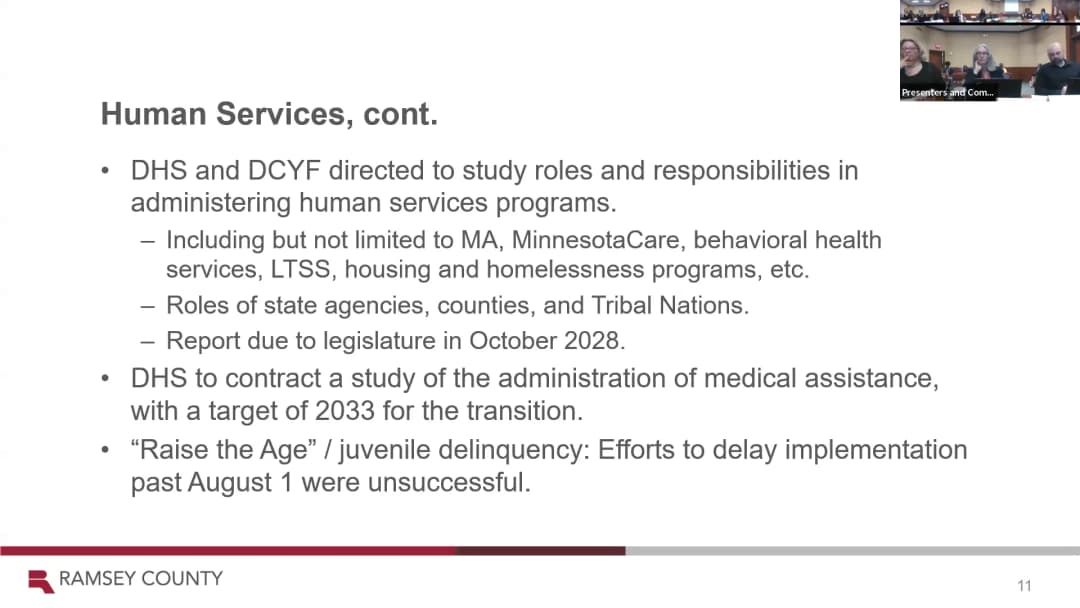
The Ramsey County Board held a workshop on May 26, 2026, at 10:30 a.m. in Courthouse Room 220 to receive a post‑session update from Government Relations on the outcomes of the 2026 legislative session and to begin planning for the 2027 session. The workshop was streamed live; no votes were taken. Presenters included Interim Government Relations Director Jolie Wood, Chief of Staff Maria Sarabia, County Manager Lane Becker, and other county staff. Commissioners introduced themselves at the start. Discussion Items 2026 Legislative Session Overview: Interim Director Wood noted the session was challenging due to a tied House, requiring bipartisan support for all bills. Many agreements were reached late in closed negotiations rather than through transparent conference committees. SNAP Administrative Cost Shift: The state provided $10.7 million statewide for counties to partially cover SNAP administrative costs shifted from the federal government. Ramsey County’s estimated annual cost increase is $4.1 million, but the shift takes effect October 2026 (only one quarter in FY2027). Commissioners questioned the distribution method and the long‑term sustainability, with County Manager Becker emphasizing the need to articulate trade‑offs between property tax burdens and service levels. MAPA/CWDA Funding: Counties received $15 million statewide for the Minnesota African American Family Preservation and Child Welfare Disproportionality Act. Funding will be allocated proportionally, with a minimum floor raised to $100,000 per county. Ramsey County also obtained an extension of its early implementation funding through December 2026. A planned transfer of case review to the state did not occur; instead, case review was delayed six months to allow time for additional state funding to be sought in the next session. Long‑Term Services and Supports (LTSS): Counties identified $122 million in cost savings, but the state allocated those savings to the general fund rather than crediting counties to avoid cost shifts. The structural deficit that initially drove proposed cost shifts has narrowed, so the issue may be revisited in 2027. Case Management Services: A bill that would have ended counties’ use of contracted waiver case management was replaced with a working group to study the entire case management system and conduct a rate study (the first in 15 years). Counties will be represented on the working group. Human Services IT Modernization: $90 million was allocated over two biennia, including $50 million into a new Human Services Systems Modernization Advisory Fund. An advisory council with county representation will approve major IT changes. $10 million is designated for MINET grants to counties. Housing & Homelessness Wins: The Family Homeless Prevention Assistance Program received $40 million for emergency rental assistance ($5.6 million projected for Ramsey County). The Local Homeless Prevention Aid program was extended from 2028 to 2032. Efforts to expand allowable uses for LHPA and SHPA (including administrative costs) did not succeed but may be revisited. Parks & Environmental Health: Metro Council received $10 million in bonding for regional parks and trails; Ramsey County expects $1.3 million for boat launch maintenance. The Ramsey‑Washington Recycling & Energy Center obtained $1.657 million to rebuild flail mills, and a study of infectious waste transport was funded instead of a ban. Another $5 million in metro‑wide tree‑planting grants was approved. Statute 383A Update: A bill to modernize human resources language in Ramsey County’s special statute passed both chambers in different forms but could not be reconciled due to procedural differences. No opposition exists; it will be reintroduced in 2027. Capital Requests: Neither Park at River’s Edge nor Aldrich Arena received bonding awards. The bonding bill prioritized water infrastructure projects (nearly half of total funds). St. Paul received significant bonding dollars for downtown redevelopment, which the county supports as beneficial to the broader property tax base. Property Tax Refunds: A one‑time 14.88% increase in the property tax refund tool was enacted, providing an average of $173 to homeowners earning under $143,000 annually. Commissioners criticized the program as inefficient because it requires residents to apply, and many eligible households do not claim the refund. Discussion included the possibility of automatic refunds and the broader issue of state underfunding counties. Raise the Age of Juvenile Delinquency: A law raising the minimum age for juvenile delinquency from 10 to 13 takes effect August 1, 2026. An effort to delay implementation failed. Commissioners raised concerns about placement options for young people committing serious offenses, noting the county is first in the nation to adopt this change. Federal Earmarks: A request for $772,700 for law enforcement technology equipment and training systems has been approved by the House Appropriations Committee and is under consideration in the Senate. Key Outcomes No votes were taken during this workshop. The county successfully launched conversations on the Capital Complex County Host Program, with bill language and a revenue note prepared for 2027. The Mortgage Registry and Deed Tax extension was secured, funding the Environmental Response Fund. $10.7 million in state aid for SNAP admin costs was won, but long‑term full cost coverage remains unresolved. MAPA/CWDA funding was won with proportional allocation, preserving Ramsey County’s share. The LTSS cost‑shift threat was deferred but not eliminated; counties will continue advocacy. A working group on case management systems and a rate study will include county representation. Human services IT modernization received substantial initial state investment; counties will have advisory roles. Housing programs received significant emergency funds, and the Local Homeless Prevention Aid program was extended to 2032. The 383A update bill failed due to procedural issues but will be revived in 2027. State property tax refunds were increased temporarily, but automatic refunds were not adopted. The juvenile delinquency age increase will take effect as scheduled; the board will hold future workshops on implementation. Government Relations will begin debriefing in June and developing the 2027 legislative platform over the summer, with a targeted timeline of finalizing by late summer/fall.

BUDGET EQUITY ANALYSIS 23% · PUBLIC HEALTH 14% · PROCEDURAL 11% · FISCAL SUSTAINABILITY 11%
46
MAY 26, 2026 · RAMSEY COUNTY, MINNESOTA · BOARD OF COMMISSIONERS & AUTHORITIES
Ramsey County Board of Commissioners Regular Meeting – May 26, 2026

The Ramsey County Board of Commissioners met on May 26, 2026, from 9:05 a.m. to 10:49 a.m. in Council Chambers, Room 300 of the Ramsey County Courthouse. All seven commissioners were present. The board unanimously approved consent items, issued a proclamation for Asian American, Native Hawaiian, and Pacific Islander Heritage Month, advanced a commissioner salary ordinance to a public hearing, approved trail easements, supported nominations for national leadership positions, and committed up to $11 million in local matching funds for the City of Saint Paul’s federal grant application to reconstruct the Eastbound Kellogg RiverCenter Bridge. Consent Calendar - Agenda of May 26, 2026 – Approved by roll call (7-0). - Minutes of May 19, 2026 – Approved by roll call (7-0). Proclamation - Asian American, Native Hawaiian, and Pacific Islander Heritage Month – Commissioners McGuire and Xiong presented the proclamation, declaring May 26, 2026 as AANHPI Heritage Month in Ramsey County. Members of the county’s Asian Descent Network accepted, highlighting the importance of safe spaces and community solidarity. Discussion Items - Recognition of County Engineer Brad Estosian – County Manager Becker introduced Brad Estosian, recipient of the national David P. Brand Safety Award from the National Association of County Engineers. Speakers from Washington County and the Minnesota County Engineers Association praised his career contributions to roadway safety. Estosian thanked his family and colleagues. - Proposed Commissioner Salary Ordinance for 2027 – The board voted to waive the first reading and set a public hearing for June 16, 2026, at 9:00 a.m. in Council Chambers. Motion passed unanimously (7-0). Resolution B2026-065. - Vadnais-Snail Lakes Regional Park Trail Easements – The board approved three temporary construction and permanent easement agreements with private residents (Wesley and Tara Crouch, $37,000; Lawrence and Tammy Swope, $4,800; Cynthia Segura and David Hodgson, $1,800) and two agreements with the City of Shoreview for trail segments. Authorized the Chair and County Manager to execute. Motion passed unanimously (7-0). Resolutions B2026-066 and B2026-067. - Support for NACo 2026 Leadership Nominations – The board expressed support for the candidacy of each commissioner for various National Association of Counties committees. Motion passed unanimously (7-0). Resolution B2026-068. - Support for City of Saint Paul’s Bridge Investment Program Grant Application – The board approved a letter of support and committed up to $11 million from county transportation funds as a local match for reconstructing the 90-year-old, structurally deficient Eastbound Kellogg RiverCenter Bridge. Presenters from Ramsey County Public Works and the City of Saint Paul described the project as nearly 100% designed, critical for downtown connectivity, and aligned with the Building Stronger Together economic development strategy. Commissioners discussed the project’s urgency (federal deadline May 28), funding proportions, pedestrian and bicycle improvements, and the need for cooperative agreements. The motion passed unanimously (7-0). Resolution B2026-069. External Reports and Board Chair Update - Commissioners reported on community events, including mental health awareness, the ongoing impacts of Operation Metro Surge, a tour of supportive housing at Kimball Court, Memorial Day observances, and visits to other cities’ riverfront parks. Commissioner McGuire noted a transportation advisory board discussion on speed cameras. Chair Ortega reported on a meeting with a county chair regarding data centers. No formal actions were taken. Key Outcomes - All consent items and administrative resolutions passed unanimously (7-0). - Proclamation for AANHPI Heritage Month adopted. - Public hearing for the 2027 Commissioner Salary Ordinance scheduled for June 16, 2026. - Up to $11 million committed as local match for the Kellogg Bridge grant, contingent on federal selection and future approval of funding agreements. - Board workshops on the 2026 legislative session and economic development (RiversEdge and Rice Creek Commons) were scheduled to follow the meeting.

TRANSPORTATION SAFETY 21% · COMMUNITY ENGAGEMENT 19% · ECONOMIC DEVELOPMENT 16% · ENGINEERING AND INFRASTRUCTURE 8%
47
MAY 26, 2026 · RAMSEY COUNTY, MINNESOTA · BOARD OF COMMISSIONERS & AUTHORITIES
Ramsey County Board Workshop: RiversEdge and Rice Creek Commons Updates – May 26, 2026

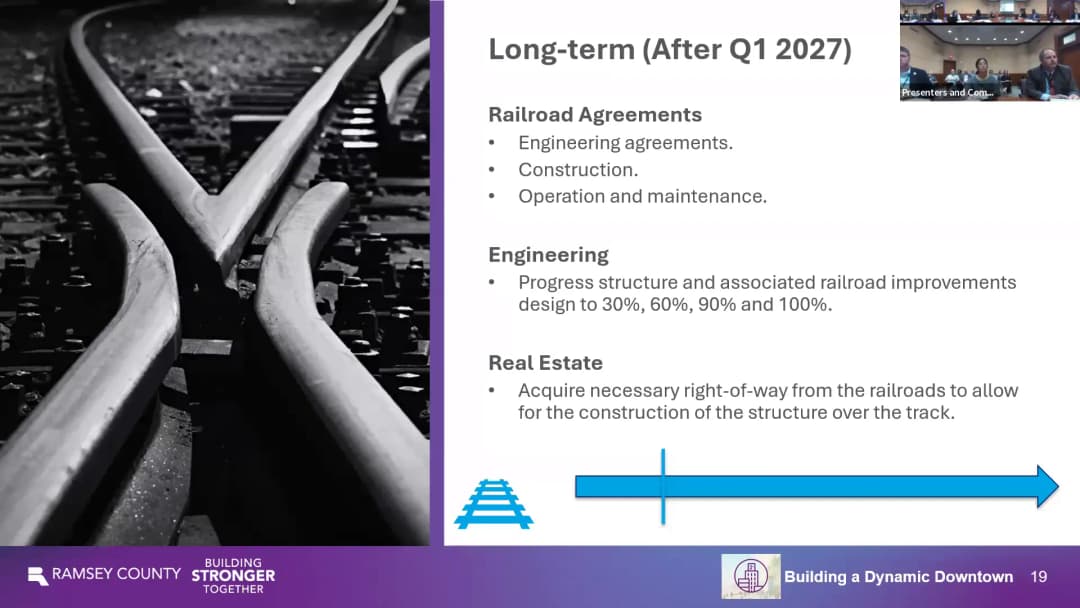
Ramsey County Board held a workshop on May 26, 2026, in Courthouse Room 220 to receive Community & Economic Development mini-workshop updates on two major projects: RiversEdge in downtown St. Paul and Rice Creek Commons in Arden Hills. The workshop was recorded and live-streamed on Zoom webinar. No formal votes were taken; the session was informational and part of an ongoing series tied to the county's Building Stronger Together initiative. RiversEdge Mini Workshop - Staff presented RiversEdge as a key Building Stronger Together project intended to reconnect downtown St. Paul to the Mississippi River, increase the county tax base, and support a dynamic downtown. - Project background: The Gateway to the Mississippi River Plan was adopted in the late 1990s; the Ramsey County West building and adult detention center were deconstructed, with work substantially completed in 2017; AECOM was selected through a competitive solicitation and completed schematic design in April 2025; the county received a $6.22 million state appropriation in 2023. - Staff reported progress on long-lead activities: an initial agreement with Excel to relocate transmission towers was approved and signed in April 2026, and preliminary engineering agreements with Union Pacific and CPKC railroads were approved and signed the prior week. - Next steps include competitively bidding a new design firm contract, with a solicitation later in 2026 and selection by early 2027, and partnering with CBRE to recruit a private developer for the vertical towers. A developer recommendation could come to the board at the end of 2026, with possible final approval in early 2027. - Commissioners asked about tower uses. Staff said density and street-level activation are key goals, while specific uses would be determined by the market; housing is likely to be among the first towers. Zoning updates with the city may be needed, including a historic height district, but staff said no major red flags have been raised. - Discussion addressed land sale versus ground lease. Staff said this question is not completely settled and will depend on financing, private developer proposals, and how the project comes together. - The public realm, park, and lid will be county/public responsibilities, while the vertical towers and parking below will be privately developed and operated. The estimated public investment is about $168 million, including tunnels and the park. - Transportation funding under Building Stronger Together is $100 million from Regional Railroad Authority, TAA, and local sales/use tax. About 70% of that is for the rail tunnel and structure over the rail line; remaining funds would support the vehicle tunnel, multimodal trail/ADA elements, a potential transit station, and a portion of the parking ramp. - No state bonding dollars were received in the current 2026 legislative session. Staff said this does not change the project timeline and that the county may pursue future bonding requests and use its capital fund as a flexible tool. - Commissioners raised long-term operations and maintenance for the park and lid. Staff cited examples such as Klyde Warren Park in Dallas, waterfront projects in Seattle and Washington, D.C., and caps in Calgary and Omaha, and said parks partners and downtown conservancies may help support operations. One commissioner encouraged building capital maintenance costs into planning. Rice Creek Commons Mini Workshop - Rice Creek Commons is a Joint Development Authority (JDA) partnership between Ramsey County and the City of Arden Hills. The vision is a vibrant, inclusive, sustainable community with housing, jobs, and tax base. - Outlot A, zoned for corporate campus, commercial, retail, and industrial uses, is being developed by Ryan Companies. Phase one, the Macro Controls company headquarters, is a 157,000-square-foot building with office, research and development, and manufacturing space on 10 acres. It supports about 240 jobs and has an estimated completed site value of $12.6 million. Construction is finishing around this week. Phase two discussions are active. - The purchase and sale agreement with Ryan was originally approved in January 2024, amended in April 2025, and currently extends to December 2026. - The California parcel remains undeveloped. The JDA is assessing a hybrid development approach with roughly four to five sub-developers, likely organized by zoning or development type, to provide flexibility, speed, and risk diversification. A recommendation is planned for summer 2026. - Rice Creek Boulevard, formerly known as the spine road, will be about 1.2 miles of county-state-aid highway from County Road H to County Road 96. It is proposed as a three-lane section generally, with five lanes near the town center, multi-use trails on both sides, stormwater management features, and a regional trail connection along the eastern boundary. The corridor is designed to be transit-ready. The total site preparation and infrastructure package is estimated around $63 million. - Timeline: initial site work is expected fall 2026; a small bid package will be released in about six weeks; completed design and infrastructure package is anticipated out to bid by the end of 2026; construction could begin around April 2027 and finish in 2028. - Sustainability is central to the project. Developers at Rice Creek Commons are expected to follow sustainability design guidelines including certification, energy efficiency, decarbonized buildings, rooftop solar, electric vehicle chargers, and water/energy reporting. The project received LEED for Communities pre-certification at the platinum level in March 2026. - Commissioners asked about ongoing road maintenance and future transit. Staff said they will request additional county-state-aid mileage designation once the road is built, and the corridor is being designed to accommodate future transit stops and connections. A transit link could be reinserted into regional planning if needed. - Commissioners thanked staff, the City of Arden Hills, and past JDA board members, and highlighted the value of pragmatic sustainability, housing voucher acceptance, workforce development, and opportunities for emerging and diverse developers. Key Outcomes - No votes were taken; the workshop was informational. - RiversEdge: Staff will continue design firm procurement and private developer recruitment, with board actions expected later in 2026 and early 2027. - Rice Creek Commons: The JDA will consider a recommended hybrid development approach for the California parcel this summer. - Rice Creek Boulevard: Initial site work is expected in fall 2026, with a bid package coming in approximately six weeks. - Additional mini-workshops will be scheduled to provide ongoing updates on these projects.

ECONOMIC DEVELOPMENT 39% · ENGINEERING AND INFRASTRUCTURE 24% · PARKS AND RECREATION 10% · TRANSPORTATION SAFETY 9%
48
MAY 19, 2026 · RAMSEY COUNTY, MINNESOTA · BOARD OF COMMISSIONERS & AUTHORITIES
Ramsey County Regional Railroad Authority Meeting - May 19, 2026

The Ramsey County Regional Railroad Authority met in regular session at 10:41 a.m. on May 19, 2026, in Council Chambers - Courthouse Room 300. All seven commissioners were present (Jebens-Singh, McGuire, McMurtrey, Miller, Moran, Ortega, and Xiong, who joined remotely). The meeting adjourned at 10:57 a.m. after approving consent items and discussing the RiversEdge project fund balance transfer and engineering agreements, plus a corridor update. Consent Calendar - Agenda Approval (2026-187): Motion by Miller, second by McMurtrey. Unanimously approved (7-0). - Minutes Approval (2026-188): Motion by Miller, second by McGuire. The minutes from March 17, 2026, were unanimously approved (7-0). Discussion Items - RiversEdge Project – Fund Balance Transfer & Engineering Agreements (2026-169): - Presented by Mike Rogers, Deputy Director of Public Works, and Brian Isaacson, Director of Public Works. The item authorized a $350,000 transfer from the Regional Railroad Authority fund balance to the capital fund for railroad review of preliminary engineering plans; approved preliminary engineering agreements with Union Pacific Railroad Company and Soo Line Railroad Company (doing business as CPKC); and authorized the Chair to execute agreements and the County Manager to enter subsequent agreements. - Commissioners requested clarification. Mike Rogers explained that the agreements are standard for working with railroads and allow the railroads to assign staff to review 20%-level plans. The process is estimated to take about 12 months to develop a memorandum of understanding (MOU). Title/right-of-way issues are complex due to historical ownership by predecessor railroads (Chicago Northwestern for UP, Soo Line for CPKC). - Chair Ortega emphasized that railroads could refuse any request, but Ramsey County has a strong working relationship with them (e.g., Union Depot). He noted the importance of this step for potential third train capacity and broader transit investment. Commissioner Moran confirmed that the $350,000 does not divert funds from other transit commitments. - Commissioner Xiong expressed support and thanked Chair Ortega, Commissioners McGuire and Moran for legislative advocacy. The motion carried unanimously (7-0; Resolution R2026-009). - Corridor Updates: - Commissioner Xiong reported on a meeting with the Real Life Co-op on the East Side, located near the proposed Bronze Line project. Community concerns were raised about a bridge over Johnson Parkway and Phalen Boulevard, with residents advocating for at-grade options. The meeting included City Councilmembers Yang and Ying. Project manager Stephen Smith attended and will follow up on questions. Chair Ortega noted the project is at approximately 1% engineering, with ample opportunity for further input. Key Outcomes - Approved the RiversEdge fund balance transfer and engineering agreements (unanimous, 7-0). - Noted ongoing community engagement for the Bronze Line corridor, with staff directed to report back to the community. - No other votes were taken; the meeting adjourned at 10:57 a.m.

ENGINEERING AND INFRASTRUCTURE 52% · TRANSPORTATION SAFETY 20% · PROCEDURAL 16% · COMMUNITY ENGAGEMENT 12%
49
MAY 19, 2026 · RAMSEY COUNTY, MINNESOTA · BOARD OF COMMISSIONERS & AUTHORITIES
Ramsey County Board Meeting Summary - May 19, 2026

The Ramsey County Board of Commissioners met on May 19, 2026 at 9:00 a.m. in Council Chambers. All seven commissioners were present: Jebens-Singh, McGuire, McMurtrey, Miller, Moran, Ortega, and Xiong (participating remotely). County Manager Ling Becker and Assistant County Attorney Stacey D'Andrea also attended. The meeting included approval of the agenda and minutes, three administrative items, a detailed presentation on the closure of the county's detoxification and withdrawal management facility, a legislative update, county connections, outside board and committee reports, and a board chair update. The meeting adjourned at 10:39 a.m., followed by a closed meeting regarding the Benjamin Hill v. Thomas Rudenick matter. Consent Calendar - Agenda of May 19, 2026 (2026-182): Approved unanimously (7-0). - Minutes from May 12, 2026 (2026-183): Approved unanimously (7-0). Administrative Approvals - Settlement Agreement in Tameca Williams v. Ramsey County (2026-189): Approved a $170,000 settlement and authorized the Chair and Chief Clerk to execute the agreement. Resolution B2026-061. Passed 7-0. - Salary Schedule for New Data Practices Officer (2026-170): Approved the salary schedule and grade allocation for a new unrepresented Data Practices Officer position (Grade 102A, Schedule 35, annual salary range $74,290.99 – $111,436.48). Resolution B2026-062. Passed 7-0. - Repurchase of Tax-Forfeited Property at 601 Annapolis Street East, St. Paul (2026-168): Approved the repurchase by the former fee owners, Meiby Maribe Artola and Dayana Y Artola, for $32,701, subject to execution of a repurchase contract within 90 days. Resolution B2026-063. Passed 7-0. Detoxification and Withdrawal Management Facility Update Presented by Sophia Thompson (Director, Social Services Department) and Jim Langer (Human Services Manager). The county's detox program closed on December 31, 2025, after operating since 1989. Key points: - The decision aligned with best practices to shift specialized services to community-based providers; the county was losing approximately $1 million annually due to low bed utilization (typically 20-22 of 50 beds). - A multi-pronged transition (Phase I) ran January–April 2026, providing on-site navigation, transportation coordination, and daily bed availability sharing with community providers. - Client contacts declined from 91 in January to 34 in April, with most handled by phone; on-site navigation ended April 30, 2026. - A local provider was selected via a competitive RFP to operate at the same location (402 University Avenue). The provider will offer low-barrier access and a sliding scale fee starting at zero. The county will lease the space at no cost and provide a $50,000 startup grant. - The provider must obtain state licensure (expected 6-month process), so services are anticipated to begin in late December 2026 or January 2027. - Commissioners discussed communication challenges, the importance of continued education for hospital partners, and the need for a continuum of care beyond detox. County Manager Becker noted the need for a broader organizational strategy for outreach. - The county continues to maintain a 24/7 phone line (651-266-4900) and updated website for referrals. Legislative Update Commissioner McGuire reported that the legislative session ended May 18, 2026. Key outcomes: - A bonding bill passed including $13 million for West 7th Street sewer infrastructure, $40 million for Roy Wilkins Auditorium renovations, and $10 million for the Grand Casino Ice Arena. Ramsey County did not receive funding for its top priorities (e.g., Parker's Rivers Edge). - The Health and Human Services Omnibus bill included funding for SNAP administrative costs, implementation of the Minnesota African American Family Preservation Act, $10 million for county IT modernization grants, and additional funding for homeless prevention and supportive housing. - Gun violence prevention and metro search compensation did not pass. - Further details will be provided in a board workshop. County Connections County Manager Becker reported on a convening of community collaboratives (St. Paul Children's Mental Health Collaborative, Suburban Ramsey Family Collaborative, and St. Paul Children's Collaborative) to strengthen partnerships and align resources for children, youth, and families. She also announced Train Days at Union Depot on June 6–7, 2026, celebrating the 100th anniversary of the depot, featuring free tours, exhibits, and a music festival. Outside Board and Committee Reports - Commissioner McGuire: Attended the Ramsey County Legal Local Government Collective Action Work Group (salt/chloride reduction), Rice-Larpenteur Alliance Community in Bloom event, NACo Board of Directors meeting (federal policy agenda on SNAP, Medicaid, disaster response), and AMC legislative update. - Commissioner Jebens-Singh: Attended Ramsey County Law Enforcement Memorial ceremony; toured Roots Wellness Center; participated in NAMI documentary screening "No One Cares About Crazy People"; highlighted mental health awareness month and community outreach events (Shoreview Water Safety Day, Rice-Larpenteur Alliance, etc.). - Commissioner McMurtrey: Spoke at Arbor Month tree planting (Pierce Butler Tree Canopy Improvement Project); attended Front Avenue Community Crawl, Rice-Larpenteur Alliance, Mighty Midway Festival, Falcon Heights Spring Together, and Snelling and University Alliance working group (discussing a business improvement district). Also attended Interfaith Action Annual Assembly. - Commissioner Miller: Attended Metropolitan Emergency Services Board meeting (approved 2025 financial audit, updates to armor participation plans, funding for regional flood program, school mapping grants); Ramsey-Washington Recycling & Energy Finance Committee (approved 2027 budget recommendations, tipping fee set at $159/ton); presented on food insecurity at White Bear Lake Area Food Shelf; attended Interfaith Action Annual Assembly. - Commissioner Moran: Reported on grand opening of the Ramsey County Government Center (121 East 7th Place East); attended NACo Economic Development Conference (noted challenges for Black elected officials in the South, need for representation); commented on the African American Family Preservation Act's case review requirement as an opportunity for counties to self-reflect on disproportionate impact in child welfare. Board Chair Update Chair Ortega adjourned the open meeting at 10:39 a.m. The board then entered a closed meeting (11:10 a.m. – 11:25 a.m.) under Minnesota Statutes 13D.05, subdivision 3(b) to discuss Benjamin Hill v. Thomas Rudenick. The board authorized staff to proceed as discussed (Resolution B2026-064). Commissioner Xiong was excused from the closed meeting. Key Outcomes - All open-session resolutions (B2026-061 through B2026-063) were approved unanimously (7-0). - The board authorized the closed meeting resolution (B2026-064) with a motion by Miller, seconded by McMurtrey; passed with Commissioner Xiong excused. - The detox facility transition will continue with a new community provider expected to begin services in late 2026/early 2027. - The legislative update noted that a detailed briefing will be provided at a future board workshop.

PUBLIC HEALTH 25% · HUMAN SERVICES 14% · PUBLIC ENGAGEMENT 14% · PROCEDURAL 9%
50
MAY 19, 2026 · RAMSEY COUNTY, MINNESOTA · BOARD OF COMMISSIONERS & AUTHORITIES
Ramsey County Board Workshop: AMC Update and Legislative Recap – May 19, 2026

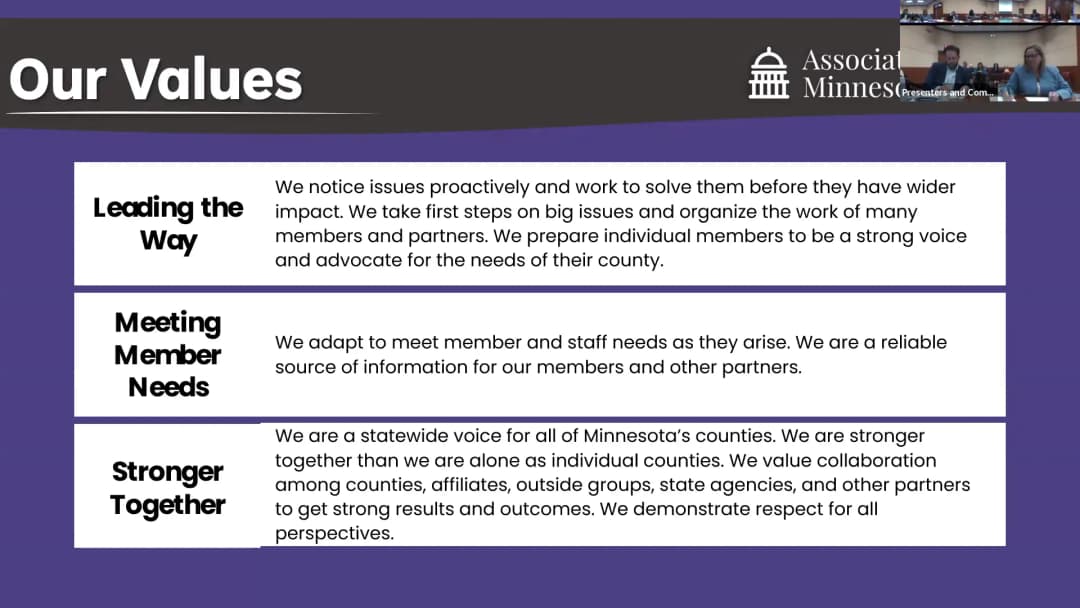
On May 19, 2026, the Ramsey County Board held a workshop to receive an update from the Association of Minnesota Counties (AMC). The agenda listed the meeting at 1:30 p.m., but the transcript opening references 'this morning'; this discrepancy was not reconciled. No votes were taken. Presenters included Julie Ring, AMC Executive Director, and Matt Hilgart, AMC Deputy Director, with board and staff participation. Discussion Items - AMC mission, values, and past work: Julie Ring described AMC's mission 'to unite Minnesota's counties to achieve public service excellence' and its values, crediting former Ramsey County Commissioner Tony Carter for leading a major AMC reorganization. She cited examples such as a pre-legalization cannabis task force, the 2018 'Bridging Divides' initiative, and statewide coalition work on health and human services cost shifts. - Diversity and inclusion: Several commissioners called on AMC to more actively include diverse perspectives, lived experience, and data on disproportionate impacts, noting that Ramsey County's board is one of the most diverse in the state. They also stressed the importance of staff diversity and bringing difficult or previously unaddressed topics to the table. AMC acknowledged the need and pointed to efforts to diversify speakers and programming. - AMC governance and policy process: Ring explained AMC's 33-member voting board, 10-district structure, and policy committees open to every county, with seven-member boards receiving extra appointments. She said AMC generally seeks broad consensus rather than narrow-majority policy positions. Commissioner Zhang raised concerns about voting weight disparities between large and small counties. - County Program Aid (CPA) and county finance: Matt Hilgart discussed the CPA formula created about a decade ago, noting it may need revision and that AMC is exploring alternatives such as better reflecting social-services costs and tax-exempt property. Ramsey County paid about $83,000 in AMC dues in 2025, roughly 4% of total dues. County officials, including County Manager Becker, asked for a clearer return-on-investment picture and a multi-year 'whole pie' strategy for reducing property tax pressure, rather than focusing only on CPA. - H.R. 1 and federal impacts: AMC described ongoing advocacy on federal H.R. 1 effects, including a SNAP administrative cost shift starting in October. AMC sought state funding to offset it but received only about $11 million in one-time money, leaving roughly $20 million unfilled. AMC said it will continue pressing the U.S. Senate and federal delegation. The transcript states the administrative cost share is 'roughly 33 billion dollars a year,' which appears likely to be a transcription error; the surrounding context indicates a much smaller figure. - Child welfare and case reviews: Commissioner Moran shared personal experience and urged AMC to support case reviews and active efforts for relative placement, pushing back against any effort to delay or abandon them. She emphasized racial disparities in child welfare and the need for stories and representation in AMC policy discussions. - Legislative session recap: AMC highlighted successes and unfinished business from the recently ended legislative session. Successes included $90 million for county technology modernization, passed 201-0 with no Republican opposition; extension of Homelessness Prevention Aid through 2032 (Ramsey County receives $2 million per year); and stopping property tax assessment changes that would have shifted burden to residential property. Unfinished items included a $125 million one-time homestead credit refund (averaging about $200 per homestead) instead of using roughly $20 million to cover the SNAP shift, plus continued concerns over long-term services and supports cost waivers and juvenile delinquency policy. Key Outcomes - No formal votes or decisions were taken during the workshop. - County officials requested that AMC provide a comprehensive multi-year strategy and data on state mandates, CPA alternatives, and regional coalition opportunities. - AMC committed to continuing federal H.R. 1 advocacy, monitoring technology modernization funds, and keeping Ramsey County engaged in future policy discussions, including child welfare case reviews. - Follow-up discussions are expected to continue at the AMC board level and through direct engagement between AMC staff and Ramsey County commissioners and staff.

COMMUNITY ENGAGEMENT 21% · GOVERNANCE STRUCTURE 18% · RACIAL EQUITY 12% · FISCAL SUSTAINABILITY 11%
OPENPUBLICA · PUBLIC MEETING INDEXUPDATED DAILY · openpublica.com