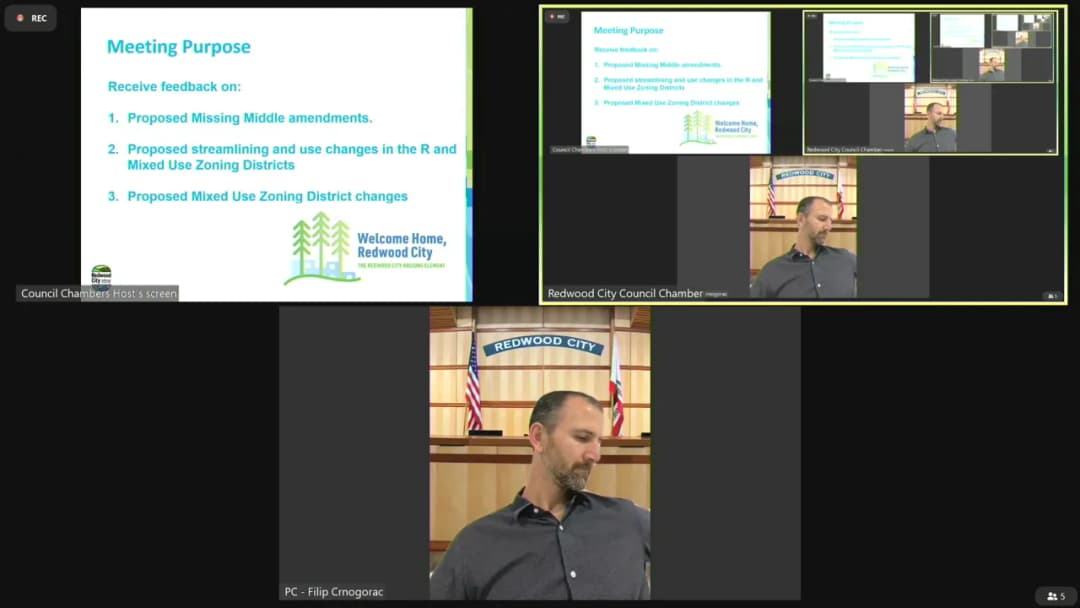
This was a study session (no formal action) of the Redwood City Planning Commission held on June 21, 2022, at 6:00 PM (actual start 7:15 PM) in Council Chambers. The session focused on proposed Zoning Code and Map Amendments associated with the Housing Element Update, including changes to facilitate missing middle housing and amendments to Mixed Use Districts to increase housing opportunities. The meeting lasted until 7:52 PM. Consent Calendar - No items were on the consent calendar. Public Comments & Testimony - No members of the public spoke during the public comment period or the public hearing for the study session. Study Session: Housing Element Zoning Amendments Principal Planner O'Dell presented the fifth study session on this topic, covering three main areas: 1. Missing Middle Housing Amendments: Proposed changes to allow duplexes, triplexes, and fourplexes more easily in R2–R5 zoning districts by removing minimum lot size/width restrictions, reducing parking to one space per unit, and simplifying open space requirements (per unit, not per bedroom). 2. Streamlining Review and Use Changes: Proposals to streamline 100% affordable housing projects (fewer public hearings) and other residential projects by eliminating the 35-foot/3-story threshold for Planning Commission review. Also, allowing senior residential care and general residential care facilities conditionally in R2–R5 districts. 3. Mixed-Use District Amendments: Rezoning commercial office areas to Mixed Use Corridor to allow residential, increasing density in all mixed-use districts (e.g., from 60 to 80 du/ac in Mixed Use Corridor, 40 to 60 du/ac in Mixed Use Transitional with community benefits), increasing building heights, eliminating minimum guest parking requirements, and modifying daylight plane setback requirements. Commissioner Comments and Discussion - Commissioner Meunier asked about definitions for missing middle and mixed-use transitional; staff clarified that draft ordinance will include definitions. - Commissioner Crnogorac asked about setback requirements for new residential development next to residential uses; staff confirmed daylight plane requirements would apply regardless of zoning if adjacent to residential use. - Commissioner Chu expressed support for increasing height limits but raised concerns about parking requirements for disability/elderly housing, and voiced strong concerns about concentrating housing along El Camino Real (a state highway) without traffic safety improvements, citing pedestrian death statistics (46% increase in past decade, 129 injuries per death). - Commissioner Martinez asked about adult day programs vs. child care centers; staff noted they may permit them differently due to transportation needs. She also asked about the pipeline of 100% affordable projects; staff noted success but did not provide a specific number. - Commissioner Crnogorac asked about open space requirements in R2–R5; staff explained recent changes allowing front yard open space and simplifying calculations. Commissioner Crnogorac expressed hesitation about rooftop gardens for small-scale projects due to privacy and accessibility concerns. - Commissioner Chu urged aligning parking reductions with SB9 and offering incentives for deed-restricted units near transit. Key Outcomes - No formal actions or votes were taken, as this was a study session. - Staff received feedback to inform the draft ordinance, which will be brought back for future Planning Commission consideration. - The Housing Element must be certified by the end of January 2023. - The meeting adjourned at 7:52 PM with a motion (6-0) to adjourn to the next meeting scheduled for July 19, 2022.
Public Meetings - Redwood City, California
Public Meetings - Redwood City, CaliforniaThis meeting, adjourned from June 7, 2022, included a public hearing on the Draft Subsequent Environmental Impact Report (SEIR) for the Transit District Downtown Precise Plan and General Plan Amendments, and a study session on Senate Bill 9 (SB9) implementation. The commission heard public testimony and discussed key issues, but took no formal votes on the SEIR or SB9 ordinance. Consent Calendar - Approved the March 15, 2022 regular meeting minutes (5-0). - Approved the April 5, 2022 special joint study session minutes (5-0). Public Comments & Testimony Public Hearing on Draft SEIR: - Gwen Litvak (Bay Area Council) provided statistics: within a quarter-mile of a fixed-line station, 11% of workers commute via transit vs. 9.5% of residents; each additional 1,000 sq ft of commercial space near a rail station generates 6 additional transit trips/day; each additional 100 employees/acre near transit raises rail ridership by 2.2%. She expressed support for the draft EIR. - Greg Greenway (Chamber San Mateo County) urged certification without delay, requested life science be included as a land use (studied project-by-project) and that natural gas be allowed per the REACH Code. - Evelyn Stivers (Housing Leadership Council) asked for certification, citing improved circulation, affordable homes, and jobs near transit. - Nadine Fogarty (Caltrain) noted that by 2040 a 40% increase in population/jobs within 2 miles of stations is expected; Redwood City is the ideal location for a four-track hub; the developer Lowe has agreed to dedicate land for track expansion; Caltrain supports the draft EIR. - Vince Rocha (Silicon Valley Leadership Group) supported the plan, noting the 2020 Measure RR for Caltrain electrification. - Adrian Brandt (Caltrain Citizens Advisory Committee) supported the plan, calling it critical for regional success and growth concentration at transit. - Rick Solis (Carpenters Local 217) expressed support for the plan and the construction jobs it would create. Study Session on SB9: - Wasi Wahid asked the city to evaluate multi-family lots that miss the minimum lot size by a small amount, as single-family regulations under SB9 appear more relaxed than multi-family regulations. - Adrian Brandt noted that adding a second story through a ministerial process would not add new housing units, unlike SB9 projects, and suggested retaining some review for such additions. - Sue Nix (Redwood Shores Architectural Design Board) asked about SB9's interaction with CC&Rs, noting that in Redwood Shores every property has CC&Rs and SB9 does not explicitly supersede them. Discussion Items Public Hearing - Draft SEIR: - Commissioner Chu echoed public support for quick approval, citing urgency of climate and housing crises. - Commissioner Crnogorac asked about REACH codes and natural gas. Karl Heisler (ESA) stated REACH codes apply, with some exceptions; the greenhouse gas impact was deemed significant and unavoidable because going beyond REACH codes may not be feasible. Alexandra Barnhill (Special Counsel) noted that eliminating natural gas is a political decision, and when significant unavoidable impacts exist, the city can consider legal, technological, social, and economic factors. A future decision will evaluate feasibility for commercial kitchens and affordable housing. - Commissioner Chu asked about economic trade-offs of eliminating natural gas. - Vice Chair Hunter (arrived at 5:52 PM) expressed concern about the jobs/housing imbalance. He argued the SEIR uses a flawed definition of planned vs. unplanned growth, does not consider cumulative effects of other projects, and uses an incorrect jobs-to-housing ratio (2.2 persons/household vs. BIA's 1.5 jobs per housing unit). He supported the altered land use mix alternative with more housing and less office. - Commissioner Chu responded that SB9 and other state laws can expand housing capacity beyond the transit district. - Commissioner Martinez wanted alternatives studied more and wanted to bridge downtown to a walkable destination. - Staff noted that citywide jobs/housing studies are underway and will be presented later. Study Session - SB9 Ordinance: - Senior Planner Rojas presented: SB9 allows two-unit projects and urban lot splits ministerially. Key items for commission input: whether to allow second-story additions through a ministerial process, floor area ratio (FAR) soft cap interaction, rear yard height standards (staff recommends 24 ft), parking (no parking required within 1/2 mile of major transit, otherwise max 1 space/unit), number of units per lot split (staff recommends limiting to 2 units per new lot, totaling 4 for both lots), and affordability requirements. - Commissioner Hunter agreed with staff on parking, height, and rear yards; supported restricting lot splits to 4 units; neutral on second-story additions after public comment; interested in affordability options (e.g., size-based affordability). - Commissioner Chu supported 4 as a starting point, concerned affordability requirements could blunt production but suggested trading density/parking concessions for affordable units; favored clear objective standards and reducing discretionary review. - Commissioner Crnogorac favored a carrot approach (voluntary affordability in exchange for reduced parking), agreed on uncovered parking, and raised concerns about greenery/screening and front-yard parking impacts. - Commissioner Martinez worried FAR soft cap triggering a public hearing would conflict with SB9, and that affordability requirements could be a barrier; suggested not adding restrictions before seeing SB9 in practice; opposed limiting lot splits initially. - Commissioner Chu asked about allowing alley access to qualify as street access. - Staff responded that they are exploring frontage and driveway curb-cut limits, and recommended uncovered parking and eliminating side-yard setbacks. Key Outcomes - No votes were taken on the Draft SEIR or SB9 ordinance. The SEIR will be finalized with written responses to comments and brought back to the Planning Commission and City Council for certification in fall 2022. - The SB9 ordinance will be drafted and brought back to the Planning Commission later in summer 2022 for a formal recommendation, then to City Council in September 2022. - The meeting adjourned at 7:02 PM, with a recess before the regular June 21, 2022 meeting.
The Redwood City Planning Commission held a study session on June 21, 2022, to discuss proposed zoning code and map amendments associated with the 2023-2031 Housing Element Update. The session focused on three categories of amendments: facilitating missing middle housing in multifamily districts, streamlining residential development, and increasing densities in mixed-use districts. No action was taken; the commission provided individual comments and feedback. Study Session on Proposed Zoning Amendments Staff presented proposed changes to address the city's Regional Housing Needs Allocation (RHNA) target. Key proposals included: - Missing Middle Housing: In R-2, R-3, R-4, and R-5 districts, staff proposed removing barriers such as minimum lot area and width requirements that have prevented duplexes, triplexes, and fourplexes. Over 75% of existing lots were found to be too small or narrow under current rules. Proposed changes would base density on General Plan density rather than lot size, reduce parking from 2 spaces per unit to 1, allow tandem parking, and eliminate additional open space requirements for extra bedrooms. - Streamlining Residential Development: Staff proposed ministerial approval for 100% affordable housing and other residential projects meeting CEQA exemptions, and allowing care facilities (senior and general residential care) in R-2 through R-5 districts, with skilled nursing care in R-4 and R-5. - Mixed-Use District Density Increases: Proposed increases of 20 dwelling units per acre in all mixed-use districts (e.g., MU-C from 60 to 80 du/acre, MU-N from 40 to 60, MU-T from 20 to 40 base). To accommodate, height limits would increase by 10-25 feet for residential projects, side and rear setbacks would be simplified, and guest parking would be eliminated. A minimum of 50% residential floor area would be required for mixed-use projects. Staff posed specific questions to the commission regarding concerns or recommendations on each category. Key Outcomes - No formal votes or decisions were made. The study session was for discussion and feedback only. - The commission provided individual comments and questions to staff. Specific commissioner comments were not recorded in the provided materials. - The next steps include further refinement of the amendments and eventual environmental review before formal adoption.
This meeting, originally scheduled for June 7, 2022, was held on June 21, 2022, at 5:00 PM in the Council Chambers. The Planning Commission conducted a public hearing to receive comments on the Draft Subsequent Environmental Impact Report (Draft SEIR) for the Transit District Downtown Precise Plan and General Plan Amendments, and held a study session on implementing Senate Bill 9 (SB 9) to allow two-unit developments and urban lot splits in single-family zones. No formal action was taken on the Draft SEIR; the study session was to gather feedback for a future ordinance. Public Comments & Testimony - Item 5.A – Transit District Draft SEIR: Public comments were received in writing and via email. Position summaries: - Support: Multiple individuals and organizations expressed support. Jason Mansfield (local engineer and resident) supported the Transit District and EIR, citing benefits for transit and the community. Amy Buckmaster, President & CEO of Chamber San Mateo County, enthusiastically supported the project, urging certification of the EIR and rapid progression. Clem Molony (40-year environmental manager) strongly supported the transit district as key to reducing emissions and fostering smart growth. Greenbelt Alliance conceptually endorsed the Sequoia Station project, noting the 500-640 residential units (including 200-240 affordable units) and climate-smart development. - Concerns/Opposition: Cary Bloomquist (third-generation resident) opposed the project due to the ongoing drought and water scarcity, arguing the city lacks water infrastructure for new development. He also criticized the transformation of Redwood City into an extension of San Francisco. Claire Felong raised specific questions about the clarity of the word "transit" in the goals and the lack of requirements for permeable surfaces and restoration of Redwood Creek. - Other: The Commission also received comments from the April 5, 2022 joint study session (not part of this hearing) but those were referenced in the staff report. - Item 6.A – SB 9 Study Session: No public comments were recorded specifically for this item. The study session was for discussion only. Discussion Items 5.A. Public Hearing on Draft Subsequent Environmental Impact Report (Draft SEIR) for the Transit District Downtown Precise Plan and General Plan Amendments - The proposed Transit District covers 16.6 acres including Sequoia Station (12 acres), the Transit Center (2.1 acres), and the Perry parcel (2.5 acres). - Key amendments include: establishing a new sub-area within the Downtown Precise Plan (DTPP) focused on transit-oriented development; capping office development at 1,630,000 sq. ft. and anticipating 1,100 residential units; lowering parking minimums (e.g., residential: no minimum, max 1.5 spaces/unit; nonresidential: min 1.5–3 spaces/1,000 sq. ft., max 3); adding contemporary design styles; modifying street widths and circulation (e.g., Hamilton narrowed to 60 ft, protected bike lanes on El Camino, James, Brewster, Arguello); and requiring ground-floor retail activation. - The Draft SEIR identified significant and unavoidable impacts in air quality (criteria pollutants) and climate change (GHG emissions) even with mitigation. Mitigation measures were proposed for water supply, recycled water, noise, and construction health risks. Three alternatives were evaluated: No Project, Reduced Development (1.1M sq. ft. office, 750 units), and Altered Land Use Mix (800,000 sq. ft. office, 1,500 units). The Reduced Development Alternative was deemed environmentally superior. - The public comment period for the Draft SEIR ended on June 21, 2022. Staff will prepare responses to comments and release a Final SEIR, followed by a 10-day comment period, then Planning Commission recommendation and City Council action. - The Commission held the hearing to receive comments and took no action. 6.A. Study Session on Senate Bill 9 (SB 9) and Required Ordinance Amendments - SB 9 requires ministerial approval of up to two residential units on single-family lots (R-1/RH) and allows urban lot splits (one-time subdivision into two lots). The City has 9,914 single-family lots; 929 lots are within half-mile of transit (El Camino Real or Caltrain) and thus cannot require parking. - Key policy questions discussed: - Review Process: SB 9 projects and urban lot splits must be ministerial (no public hearing, no neighbor notification, no appeal). Staff recommended extending the same ministerial process to second-story additions to avoid inconsistency. - Floor Area Ratio (FAR): Current FAR soft-cap (3,000 sq. ft. or 0.45 FAR) triggers public hearing. SB 9 prohibits public hearings, so staff is studying ways to retain FAR intent while complying with state law. - Height: A 24-foot height limit in the rear 20 feet of lots was proposed, consistent with ADU regulations. - Parking: SB 9 permits one parking space per unit; no parking can be required for lots near transit. Staff recommended requiring one uncovered space per unit, with no side-yard setback requirement for uncovered parking. - Number of Units on Urban Lot Split: State allows cities to limit to two units per parcel (including ADUs). Staff is studying feasibility; no recommendation yet. - Affordability: Staff noted that requiring one unit to be affordable (50% inclusionary) could hinder development due to high costs. Economic feasibility study may be needed. - The Commission provided feedback to guide the drafting of an ordinance, which will be brought back for adoption in summer 2022, followed by City Council consideration. Key Outcomes - No action taken on the Transit District Draft SEIR; the public hearing concluded the 45-day comment period. Staff will prepare the Final SEIR with responses to comments. - Study session feedback on SB 9 implementation will inform the development of a zoning ordinance amendment. The ordinance is expected to be presented to the Planning Commission for adoption in summer 2022. - The next Planning Commission meeting was scheduled to follow immediately (6:00 PM or later) the same evening, June 21, 2022.
The Redwood City Planning Commission meeting was originally scheduled for June 7, 2021, but was adjourned to June 21, 2022 at 5:00 PM according to the Notice of Adjournment. However, the user has specified that the meeting took place on June 8, 2022. This discrepancy is noted. The following items were listed on the agenda for the adjourned meeting. Agenda Items - Approval of Minutes: Discussion of minutes for meetings of March 15, 2022 and April 5, 2022. - Public Hearing: Public hearing to receive comments on the Draft Subsequent Environmental Impact Report (Draft SEIR) for the Transit District Downtown Precise Plan and General Plan Amendments. - Study Session: Study Session on Senate Bill 9 (SB 9) and required ordinance amendments to allow up to two-unit developments and urban lot splits within single-family zoning districts (R-1/RH) consistent with state law. No transcript, minutes, or additional details are available. Therefore, no public comments, discussion outcomes, or votes can be reported.
The Planning Commission meeting on June 7, 2022, was largely consumed by technical difficulties with audio equipment, preventing effective public participation. After receiving a public comment requesting postponement due to inaudible audio, the commission voted to continue the meeting to June 21, 2022, at 5:00 PM. No substantive agenda items were discussed or decided. Public Comments & Testimony - One remote speaker (via Zoom) reported that audio was extremely bad both on TV and Zoom, and asked if the meeting would be rescheduled, noting the importance of the issues. - The speaker's comment was partly inaudible to commissioners, but the gist of the request for postponement was understood. Discussion Items - The commission attempted multiple sound checks and troubleshooting (microphones, Zoom integration, speaker settings) but could not resolve the audio issues. - Staff suggested options: moving to a different room in City Hall, using Zoom with commissioners logging in individually, or continuing to a later date. - After testing, the chair proposed continuing the meeting to June 21 at 5:00 PM, which was accepted by the commission. The meeting was adjourned without addressing any other agenda items. Key Outcomes - Motion to continue: The commission unanimously agreed to continue the meeting to June 21, 2022, at 5:00 PM. The exact vote tally is not recorded, but all present commissioners (Bandana, Q, Martinez, Hunter, and Chair Backward) were in agreement. - Public comment period: It was noted that the public comment period for the Environmental Impact Report (EIR) related to an unspecified project remains open, and written comments submitted via email will be given full weight.
The Redwood City Planning Commission held a regular meeting on Tuesday, June 7, 2022, at 6:00 PM at the Downtown Library Community Room. The meeting included a public hearing to receive comments on the Draft Subsequent Environmental Impact Report (Draft SEIR) for the proposed Transit District Downtown Precise Plan and General Plan Amendments, and a study session on Senate Bill 9 (SB 9) implementation for single-family zones. No action was taken on the Draft SEIR; the study session was for discussion only. Consent Calendar - No items were on the Consent Calendar. Public Comments & Testimony Public Hearing on Draft SEIR (Item 5.A.) The public hearing was held to receive oral and written comments on the Draft SEIR. Members of the public submitted written comments prior to the meeting, which were included in the staff report: - Cary Bloomquist (third-generation resident): Expressed opposition to the Transit District project due to drought conditions and water scarcity, stating the city lacks the water resources to support new development. Also criticized the transformation of Redwood City into tall, dense urban canyons. - Claire Felong: Provided comments on the Draft Amendments, requesting clearer terminology (e.g., “micro mobility devices”), and noted the absence of requirements for permeable surfaces or restored Redwood Creek. - Additional written comments were received from the City Manager and forwarded to staff. - No speakers are recorded as having provided oral testimony during the meeting. Public Comment on Items Not on the Agenda - No public comments were made under this agenda item. Discussion Items 5.A. Public Hearing: Draft Subsequent Environmental Impact Report (Draft SEIR) for the Transit District Downtown Precise Plan and General Plan Amendments - Staff Presentation: Principal Planner Lindy Chan presented the proposed Transit District (16.6 acres) within the Downtown Precise Plan (DTPP) area, including Sequoia Station, the Transit Center, and the Perry parcel. Key elements include: - Office cap of 1,630,000 sq. ft. and anticipated 1,100 residential units (no change to maximum building heights). - Reductions in minimum parking ratios (e.g., no min for residential; 1.5–3 spaces/1,000 sq. ft. for other uses) and increased bicycle parking. - Circulation improvements (e.g., narrowing Hamilton Street, requiring protected bike lanes on El Camino Real, James, Brewster, Arguello). - Design: contemporary architecture, lower minimum ground-floor height from 35’ to 25’ to enhance pedestrian experience. - Environmental Review: The Draft SEIR identified 18 mitigation measures. Significant and unavoidable impacts remain for air quality (criteria pollutants) and greenhouse gas emissions. Three alternatives were evaluated: No Project, Reduced Development (1.1M sq. ft. office, 750 units), and Altered Land Use Mix (800K sq. ft. office, 1,500 units). The Reduced Development Alternative was considered environmentally superior. - Commissioner Discussion: Commissioners asked clarifying questions but took no substantive action, per staff’s recommendation to only receive comments. The public comment period ran from May 6 to June 21, 2022. 6.A. Study Session: Senate Bill 9 (SB 9) Implementation – Ordinance Amendments for Two-Unit Developments and Urban Lot Splits in R-1/RH Zones - Staff Presentation: Senior Planner Apollo Rojas provided an overview of SB 9, which requires ministerial approval of up to two units on single-family lots and allows urban lot splits. Staff highlighted key policy questions for Commission feedback: 1. Review Process: SB 9 eliminates discretionary review and neighbor notification for eligible projects; staff recommended also streamlining second-story additions to avoid inconsistency. 2. Floor Area Ratio (FAR): Current “soft cap” (3,000 sq. ft. or 0.45 FAR) triggers public hearing; SB 9 requires objective standards. Staff is studying how to retain intent without violating state law. 3. Height in Rear Yards: Propose a 24-ft. height limit for the rear 20 ft. of lots, consistent with existing ADU rules. 4. Parking: SB 9 limits parking to one space per unit, and prohibits requiring parking for lots within ½ mile of transit (El Camino Real or Caltrain). Staff recommended requiring one uncovered space per unit (with setback exemption) for SB 9 projects. 5. Number of Units on Urban Lot Splits: City may limit to two units per parcel (including ADUs). Staff is studying feasibility. 6. Affordability: Staff noted that requiring affordability could be a barrier (up to 50% inclusionary) and may require economic feasibility study; HCD has scrutinized such requirements. - Commissioner Feedback: Commissioners asked questions and offered input on the above topics, but no formal action was taken. Staff will develop an ordinance based on the discussion for future adoption by the Planning Commission and City Council. Key Outcomes - No action was taken on the Draft SEIR (Item 5.A.). The public comment period remains open until June 21, 2022. Staff will prepare responses and a Final SEIR for future Planning Commission recommendation and City Council action. - No decision was made on SB 9 (Item 6.A.). The study session provided direction for staff to draft an implementing ordinance, which will be brought back to the Planning Commission for a public hearing and recommendation. Next steps include a proposed ordinance in summer 2022. - The meeting adjourned with the next regular Planning Commission meeting scheduled for June 21, 2022.