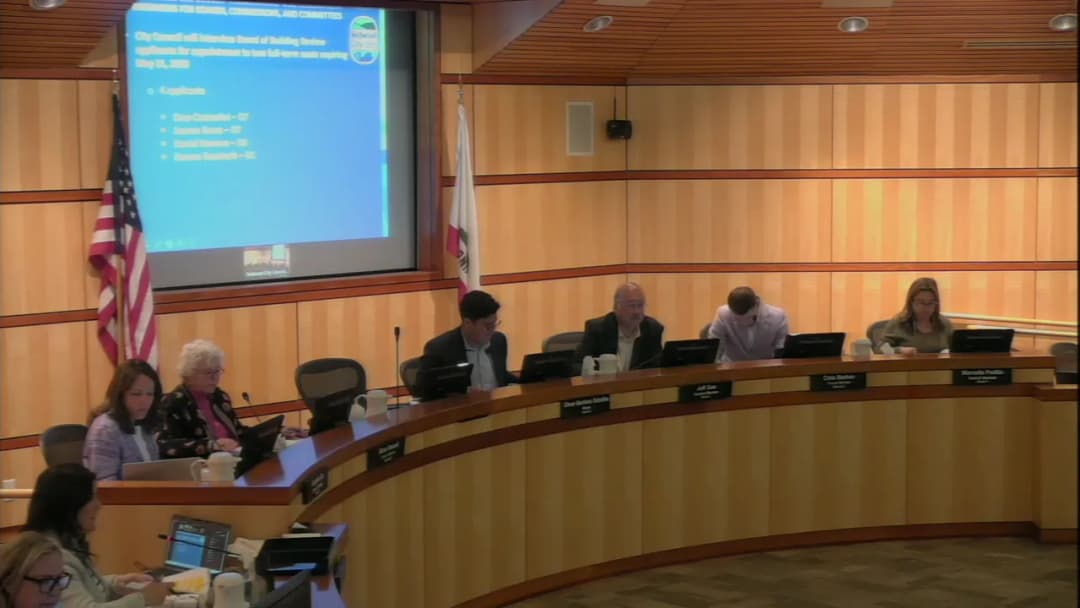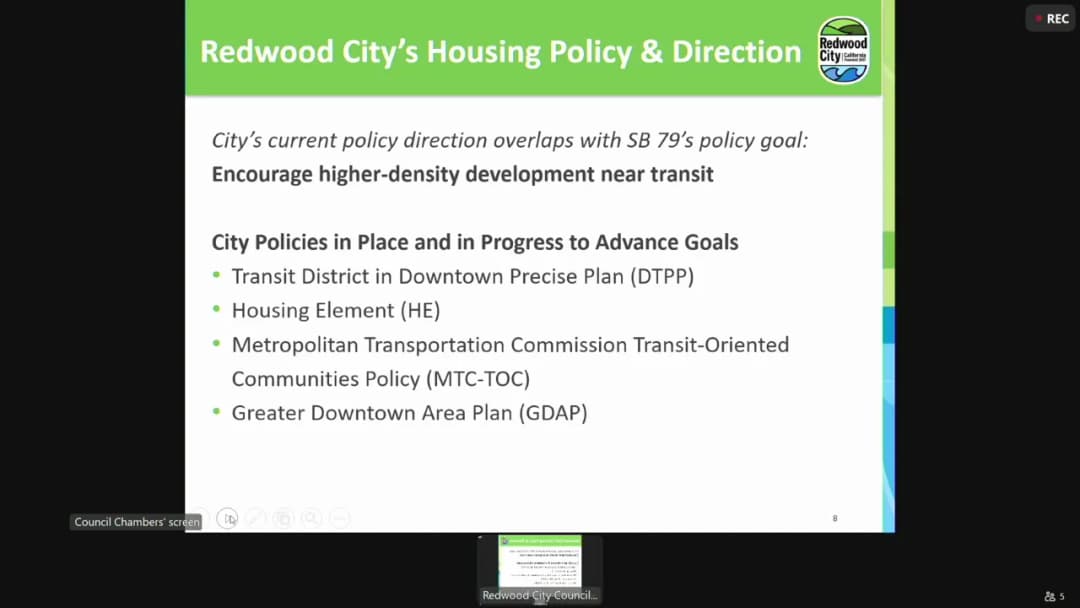
On June 16, 2026, the Redwood City Planning Commission held a regular meeting at 6:00 p.m. in Council Chambers, 1017 Middlefield Road, Redwood City, with participation available via Zoom. Six commissioners were present (Commissioners Bhat, Finch, Hunter, Robinson, Vice Chair Koch, and Chair Crnogorac); Commissioner Cornejo was absent. The meeting focused primarily on a public hearing to consider a recommendation to the City Council regarding Senate Bill (SB) 79, the Abundant and Affordable Homes Near Transit Act. The Commission also approved minutes from two prior meetings and received updates on upcoming City Council items. Consent Calendar - No items were listed on the consent calendar. Public Comments & Testimony - Michael Aruzo, volunteer lead for Yes in Redwood City, spoke in support of the staff recommendation. He emphasized that Redwood City is not on track to meet its regional housing goals and that SB 79 helps meet city goals. He supported adopting SB 79 as is and then developing a Transit-Oriented Development (TOD) Alternative Plan, suggesting density could be shifted from sites like Sequoia High School to other areas near the train station. Discussion Items Staff Presentation on SB 79 Senior Planner Ellen Yau presented an overview of SB 79, which requires housing as an allowed use on residential, mixed-use, or commercial sites within half a mile of a TOD stop. Key standards include: - Sites within half-mile: up to 65 feet in height and 100 dwelling units per acre. - Sites within 200 feet (inner red circle): up to 95 feet and 160 dwelling units per acre. - Minimum density of 30 dwelling units per acre and at least five residential units. - Projects with 11 or more units must provide affordable housing; affordability requirements are the greater of SB 79 or city requirements. - Projects over 85 feet must comply with prevailing wage and skilled workforce requirements. Staff noted that Redwood City has one eligible transit stop: the Redwood City Caltrain station. Many parcels already meet or exceed SB 79 standards (shown in green), while others (pink) would see increased height and density allowed. However, staff anticipates limited near-term impact due to recent development, small parcel sizes, and high construction costs and interest rates. Staff described four implementation approaches: baseline SB 79, a local temporary exclusion ordinance, a TOD Alternative Plan, or a combination. Staff recommended allowing SB 79 to take effect (baseline) and focusing on developing a TOD Alternative Plan, which would allow the city to tailor capacity while maintaining overall SB 79 capacity. The plan could align with ongoing efforts such as the Greater Downtown Area Plan (GDAP) and MTC's Transit-Oriented Communities (TOC) policy. Commissioner Clarifying Questions and Discussion - Commissioner Bhat asked about capacity numbers; staff said specific figures would be provided later, estimating a difference of a couple thousand units between current zoning and SB 79. - Commissioner Hunter asked about the implications of Caltrain service changes and affordability comparisons. Staff noted state law changes could affect applicability, and a separate department handles affordability compliance. - Commissioner Robinson asked about non-eligible sites near Sequoia High School; staff explained they did not meet exclusion criteria (e.g., 50% density threshold, historic status, low-resource designation). - Commissioner Finch asked about the transit station relocation; staff said future planning accounts for a potential move. - Commissioner Bhat questioned whether adopting a TOD Alternative Plan could cap densities at 200% above SB 79, but staff indicated existing higher densities would be justified. - Commissioner Koch asked about the relationship between SB 79 and a future TOD plan; staff clarified the TOD Alternative Plan would take precedence once adopted. Commissioner Finch expressed support for the staff recommendation, noting SB 79 aligns with city goals and near-term effects are likely limited. Commissioner Bhat concurred, arguing exclusions would make the rules complicated and patchwork. Commissioner Hunter initially supported a combination approach with a temporary exclusion ordinance to maintain flexibility, but ultimately supported the motion for the TOD Alternative Plan. Key Outcomes - Minutes Approved: The Commission approved the May 5, 2026 regular meeting minutes and the June 2, 2026 Planning Commission and Architectural Advisory Committee joint meeting minutes, both by 6-0 votes (Commissioner Cornejo absent). - Motion Passed: Commissioner Bhat made a motion, seconded by Vice Chair Koch, to recommend by minute order that the City Council direct staff to prepare a Transit-Oriented Development Alternative Plan in compliance with SB 79. The motion passed 6-0 (Commissioner Cornejo absent). This action allows the baseline SB 79 to take effect while staff works on the TOD Alternative Plan. - Next Steps: The item will be brought to the City Council on July 13, 2026. Staff noted that certain other planning items, including annual zoning code updates and a discussion on extending the Greater Downtown Area Plan boundary, are also on that Council agenda. The next Planning Commission meeting is scheduled for August 18, 2026; the July 21, 2026 meeting has been cancelled. Commissioner Bott was recognized for his service, as this was his last Planning Commission meeting.
Public Meetings - Redwood City, California
Public Meetings - Redwood City, CaliforniaThe regular city council meeting of June 8, 2026, was held in hybrid format. Councilmember Chu was absent. The agenda included a rent control initiative petition, the FY 2026-27 recommended budget, an ordinance adopting the county's tobacco retailer permit program, and continuation of sewer service charge collections on the tax roll. The meeting extended past midnight due to the number of items and extensive public comment. Consent Calendar - Item 7D (street repair report): Councilmember Padilla recused herself. The item was approved 5-0 (Chu absent, Padilla recused). - Remaining consent items: Approved 6-0 (Chu absent). Public Comments & Testimony - Rent Control Initiative (Item 8A): 31 speakers. Supporters (including Tenants Together, Faith in Action, youth organizations) argued that high rents are unsustainable, that the measure will protect families and prevent displacement, and urged council to adopt the ordinance outright. Opponents (including mom-and-pop landlords, the California Apartment Association, San Mateo County Association of Realtors) warned of unintended consequences: reduced housing supply, burdens on small landlords, increased costs for the city, and negative impacts on affordable housing providers. They urged the council to refer the measure to the ballot and to further study the economic impacts. - Budget (Item 10A): One speaker supported zoning reform to increase property tax revenue. - Tobacco Retailer Ordinance (Item 11A): 18 speakers. Hookah lounge owners, employees, and community members (including Arab Resource and Organizing Center) opposed adopting the county ordinance, calling it culturally insensitive and threatening small businesses; they proposed a city-run, self-funded program. Health advocates (American Heart Association, San Mateo County Tobacco Education Coalition) supported the county ordinance to protect youth from flavored tobacco and noted that hookah businesses can pivot to tobacco-free alternatives. - Sewer Service Charges (Item 11B): No public comments. Discussion Items - Rent Control Initiative (Item 8A): Staff presented the timeline: petition certified with 4,751 valid signatures (out of 6,045 submitted). The proposed ordinance caps annual rent increases at 60% of CPI (max 5%), includes just-cause eviction protections, relocation payments of $12,000+ for no-fault evictions, and a city-administered program funded by landlord assessments. EPS consultant Jason Moody presented the 9212 report: estimated program costs of $4–10 million annually (not including startup costs of $300k–$700k), with fees of $338–$445 per unit. The report noted challenges for affordable housing. Council members raised concerns about cumulative impacts on property owners, effects on nonprofit affordable housing, and the impossibility of exempting affordable housing without voter amendment. Councilmember G moved to accept certification and continue the item to a date certain (within 30 days) for a supplemental 9212 report covering cumulative impacts, affordable housing impacts, and general fund reconciliation. Motion passed 6-0. - FY 2026-27 Budget (Item 10A): Finance Director Beth Goldberg presented the recommended budget: $410M total operating, $36M capital. Key issues: loss of $5.3M VLF backfill, declining sales tax (down 8.6% from FY22-23), use of $4M from the Section 115 trust to balance, and projected deficits in future years. City Manager Heisinger highlighted new initiatives: Neighborhood Response Team (3-4 contract staff), unfreezing two police officer positions, mental health clinician expansion (discussed), and economic vitality strategy. Council comments: Councilmember G requested quarterly revenue reports and a spreadsheet tying initiatives to council priorities; Councilmember Padilla urged more road funding; Vice Mayor Aiken supported the budget and clinician expansion; Mayor supported exploring Prop 1 funding for supportive housing. Motion adopted to set June 22 as public hearing date for final adoption (6-0). - Tobacco Retailer Ordinance (Item 11A): Staff recommended adopting the San Mateo County ordinance by reference to gain enforcement without cost to the city. Councilmember Howard noted health concerns. Councilmember Sterkin and Padilla questioned the feasibility of a city-run option; staff explained a city ordinance would take 6-9 months and require police enforcement. Vice Mayor Aiken and Councilmember G supported immediate adoption to protect youth. The motion passed 4-2 (Sterkin and Padilla opposed). - Sewer Service Charges (Item 11B): Staff reported the fifth year of the pilot program; no adverse trends in utility assistance enrollment or tax default rates. Council approved continuation 6-0. - Subcommittee Reports: Climate Action Subcommittee met May 20; Transportation Subcommittee met June 2; Ad Hoc Special Events Committee reported summer events including World Cup watch parties and a new entertainment zone. Key Outcomes - Rent Control Petition: Council accepted certification and ordered a supplemental 9212 report to be brought back within 30 days (vote 6-0). - Budget: June 22 set for public hearing and final adoption (vote 6-0). - Tobacco Ordinance: Adopted the county'S tobacco retailer permit ordinance (vote 4-2). - Sewer Charges: Approved continuation of tax-roll collection for FY 2026-27 (vote 6-0).
The Redwood City Planning Commission and Architectural Advisory Committee (AAC) held a joint study session on June 2, 2026, to review and provide feedback on the proposed Draft Objective Design Standards Ordinance. The ordinance aims to implement General Plan policies, comply with state housing laws, and streamline residential project approvals by establishing clear, objective design standards. The meeting included a staff presentation, public comments, and extensive discussion by commissioners and committee members. No formal votes were taken; the session was intended to gather input for further refinement. Public Comments & Testimony - Sue Nix (Rabbit Shores Community Association) expressed frustration over lack of response to emails regarding the Redwood Live project and urged the commission to participate in a community walk. - Michael Arruza Cruz (Yes in Redwood City resident) expressed support for objective standards but raised concerns about the common space amenity requirement (1% of construction cost per 50 units) creating a cost cliff that discourages adding units, and about strict standards for projects under four units. - Alice Kaufman (Green Foothills) advocated for stronger exterior lighting standards, noting that the current draft allows color temperatures up to 5,000 Kelvin for parking areas and 6,500 Kelvin for sports courts, which can harm human health and wildlife. She requested reconsideration and offered to submit written recommendations. - Davena Fentry (San Mateo County Bird Alliance) highlighted the severe decline in bird populations and urged the city to adopt bird-safe building standards, noting that many nearby cities (San Francisco, Oakland, San Jose, etc.) have already done so. She also supported stronger light pollution standards. - Dash Leeds (Sierra Club Loma Prieta Chapter) supported adding bird-safe design language (citing Mountain View’s approach via CalGreen) and strengthening lighting standards, noting that the current draft’s color temperature floor (minimum Kelvin) could prohibit warm lighting (e.g., 2200K) and that high Kelvin values reduce visibility and increase glare. - Inna Magner (SMC Bird Alliance volunteer) echoed calls for bird-friendly design and dark sky lighting standards, emphasizing the impact on migratory birds along the Pacific Flyway. Discussion Items - Staff Presentation: Community Development Director Jeff Schwob presented the ordinance’s structure, including standards for lighting, bird-safe glass (not currently addressed), open space, amenities, and gateway areas. He noted that the ordinance applies primarily to residential development and creates a discretionary review option for projects seeking flexibility. - Commissioner and Committee Member Feedback: - Prescriptiveness vs. Flexibility: Multiple members (Committee Members Stewart, Jenkins, Tanakatsubo; Commissioners Finch, Hunter, Robinson, Cornejo) expressed concern that the standards lean heavily toward traditional design (pitched roofs, porches, bay windows) and may stifle contemporary or diverse architectural styles. They noted that homeowners wanting modern designs would be forced into discretionary review, which adds time and cost. Suggestions included focusing on bulk and massing rather than specific stylistic elements. - Lighting and Bird Safety: Several members supported strengthening lighting standards (lower color temperatures, dark sky considerations) and adding bird-safe glass requirements, but acknowledged the need to balance with residential feasibility. Staff noted that a comprehensive ordinance might be better addressed separately or as a future zoning code update. - Amenities and Cost Cliffs: Commissioners Butt, Finch, and Koch criticized the 1% construction cost amenity requirement and the prescriptive list of amenities, arguing it could discourage development, especially affordable projects. They suggested lowering or removing the requirement for affordable projects, or allowing more flexibility. - Specific Standards: Committee Member Stewart raised issues with matching neighbor heights, window proportions, garage door widths, and the requirement for front doors to face the street. Committee Member King questioned how split-level homes would comply with height comparisons. Commissioner Robinson questioned the 15-foot upper-story setback and tree spacing (20-40 feet). Chair Crnogorac questioned the personal storage requirement (80 cubic feet) and window transparency requirements, and provided extensive comments on tree standards (planting strips, tree grates, minimum box size, and requiring one tree per lot). - Missing Middle Housing: Commissioners Hunter and Finch emphasized ensuring the standards accommodate cottage courts and courtyard buildings. - Workshop Suggestion: Committee Member Tanakatsubo proposed a workshop with the local AIA chapter to test the standards on real-world scenarios, which was supported by Commissioner Finch. Key Outcomes - The study session concluded with no formal action; staff will use the feedback to refine the ordinance. - Next steps include: (1) possible review by the Airport Land Use Commission, (2) a public hearing before the AAC, (3) a recommendation to the Planning Commission, and (4) a City Council public hearing, with adoption targeted by the end of October 2026. - Staff will consider lowering color temperature limits, exploring a pilot project for low-spectrum lighting, and potentially developing a separate comprehensive ordinance for bird-safe glass and dark sky standards. - The suggestion to engage the AIA chapter for a design workshop will be explored by staff. - The next Planning Commission meeting is scheduled for June 16, 2026; no AAC meetings are scheduled for June or July 2026.
The meeting was scheduled for May 19, 2026 at 2:00 PM UTC. The provided agenda contained only a logo and a link to an online viewer with no visible agenda items. No minutes or transcript were available. Consequently, no information about the meeting's content, public comments, discussions, or decisions can be summarized.
The Redwood City Council held a special hybrid meeting on May 18, 2026, beginning at 5:00 PM. The meeting featured recognitions of outgoing board/commission members, a proclamation for Jewish American Heritage Month, public comments, and interviews for vacant seats on multiple boards, commissions, and committees (BCCs). No reportable action from closed session was announced. Recognitions and Proclamations - Two longtime Housing and Human Concerns Committee (HHCC) members were honored: Alma Montalvo (12 years of service) and Kate Adams Heaster (nearly a decade, including chair and vice-chair roles, and leadership on the tenant protection ordinance and anti-displacement strategy). Both expressed gratitude and encouraged community involvement. - Mayor Elmer Martina Sabayos proclaimed May 2026 and each year thereafter as Jewish American Heritage Month in Redwood City. Speakers David Ron and Alan Walker from Congregation Beth Jacob highlighted Jewish contributions to civil rights and the importance of visibility amid rising anti-Semitism. Consent Calendar - The consent calendar was approved unanimously (6-0, with Vice Mayor Aiken absent). No items were pulled or recusals noted. Public Comments & Testimony - David Grable (City Trees president): Reported that Redwood City's tree canopy declined from 15% (2018) to 13% (2022), with a loss of 200 trees per year. Urged the council to hire a tree advocate as Terrence Quise's replacement and to seek public input on the hire. - Roe V Antonio (California Apartment Association): Provided rental housing data: of 1,260 buildings (16,500 units), 79% are small (1–10 units), 89% built before 1980, 48% before 1960, and 91% are Class C (older buildings). Cautioned that tenant protection policies (e.g., right-to-return) could disincentivize repairs and harm housing quality. - Bill Newell: Paid tribute to honorees Alma Montalvo and Kate Adams Heaster, praising their commission service and broader community work. - Christina Lee (retired business reporter): Opposed plans to build affordable housing on the library parking lot, citing loss of green space, parking impacts on downtown businesses, and safety concerns based on experiences in other cities. - Shishir Batt (Planning Commissioner): Urged the council to adopt a formal data governance policy for automated license plate readers (ALPR) from vendor Flock, citing potential data abuses for immigration enforcement and misalignment with city values. - Jennifer Lebseck (Zoom, retired teacher): Expressed concerns about affordable housing next to the library, including loss of parking, strain on neighborhoods, affordability of rents, and impacts on library programs for children and seniors. Discussion Items Interviews for Boards, Commissions, and Committees The council interviewed applicants for six bodies: Board of Building Review (4 candidates), Housing and Human Concerns Committee (13 candidates), Library Board (8 candidates), Parks, Recreation and Community Services Commission (11 candidates), Planning Commission (14 candidates), and Senior Affairs Commission (11 candidates). Each applicant was given three uninterrupted minutes to answer three predetermined questions. The council will make appointments at the regular meeting on Monday, June 22, 2026. Several existing commissioners and community members (e.g., Bill Newell, Shishir Batt) offered endorsements for reappointments and new applicants. Key Outcomes - No appointments were made at this meeting. The council will announce selections at the June 22, 2026 regular meeting. The city clerk will notify all applicants. - The Governance Subcommittee (May 13, 2026) reviewed SB 707 (Brown Act Modernization), a draft technology disruption policy, and agenda translation in Spanish. Recommendations will be brought to the full council for approval in June. - The 84/1-1 Ad Hoc Committee (May 15, 2026) received project updates; next meeting scheduled for June 26.
The Redwood City Council held its first "Housing Night" on May 11, 2026, focusing on housing-related initiatives. The meeting included proclamations declaring May 2026 as Affordable Housing Month and celebrating the FIFA World Cup 2026. Key actions included adopting tenant protection ordinance (TPO) regulations and fees, approving the 2026 Community Development Block Grant (CDBG) Annual Action Plan, conditionally awarding over $17 million in affordable housing construction funds to two projects, and initiating community engagement for the potential redevelopment of the downtown library parking lot B. Consent Calendar - The consent calendar, consisting of routine items, was approved unanimously by a 7-0 vote. Public Comments & Testimony - Evelyn Weaver (with classmates) thanked the city for bike safety improvements (speed bumps, bike lanes) and requested a stop sign near the new senior center. - Raksheet Mandayam expressed support for creating an entertainment zone downtown and asked about hours of operation and review process. - Mark Ho described a homeless encampment near his home, reported drug paraphernalia, and requested help to prevent another fire like one that destroyed his house three years ago. - Denise (local property manager) argued the TPO creates a burden on small landlords, citing high repair costs and inability to recover them under the proposed rules. - Clara Jekyll (providing translation) and other speakers from Faith in Action expressed gratitude for the city's anti-displacement work but urged adoption of a stronger ballot measure (Redwood City Fair and Affordable Housing Ordinance) with rent control and comprehensive renter protections, noting 7,300 signatures gathered. - William Gomez (community worker) described poor housing conditions (broken windows, appliances, overcrowding) and harassment, emphasizing the need for enforcement. - Jeff Shabowski (lifetime resident and small landlord) requested an exemption for mom-and-pop owners, highlighting financial losses and insurance challenges. - Kai Stockwell (Sand Hill Property Company) thanked staff for partnership on the Rise City Apartments project (94 units, 24 for adults with IDD). - Molly Neighbor (Midpen Housing) thanked the council for funding recommendations for 1580 Maple Street, noting the high need for supportive housing. - Nicholas Kennan, Michael Arusa Cruz, and Dylan Finch spoke on the library parking lot B redevelopment: Kennan urged timely action; Cruz supported housing but questioned the high cost of parking replacement; Finch suggested studying alternatives to parking replacement given existing garage capacity. Discussion Items Item 8A: Tenant Protection Ordinance (TPO) Administrative Regulations, Fair Rate of Return Appeal Guidelines, and Fees - Housing Leadership Manager Alyn Lancaster and Management Analyst Victor Gaitan presented the proposed regulations and guidelines, which detail processes for no-fault evictions, right to return after substantial remodels, and relocation assistance. The fair rate of return appeals process uses a cap rate methodology rather than amortization to simplify and standardize decisions. - Staff recommended adopting a $172 relocation assistance administrative fee and a $4,500 deposit for fair rate of return appeals (actual cost basis, with refund or additional billing). - Council questions focused on the fairness of the cap rate method, inclusion of soft costs (excluded), lack of cost certainty for landlords, and potential burden on small property owners. Councilmember G expressed concern about the general fund backstopping any unrecovered costs. - Councilmember Howard suggested creating a fund to help small landlords with appeal costs and engaging the California Apartment Association for education. - Councilmember Padilla worried about unintended consequences, such as deferred maintenance. - Councilmember Chu raised concerns about financing costs not being recoverable and asked for tracking of housing stock deterioration and access for low-income tenants. - Councilmember Sturkin emphasized the value of the TPO in preventing displacement and supported a three-month check-in, a fund for mom-and-pop landlords, and low-cost loans. - Vice Mayor Aiken supported the staff recommendations, noting trust in staff and the discretion of the hearing officer. - City Manager Patrick Heisinger committed to a three-month update on key metrics. - Vote: Motion to adopt the resolution and confirm regulations passed 4-3 (Councilmembers Chu, G, and Padilla opposed). Item 8B: 2026 CDBG Annual Action Plan - Housing & Economic Development Specialist Medea Hawk presented the plan, allocating $777,639 in CDBG funds to public services (Bay Area Legal Aid, CORA, Mental Health Association, Project Sentinel, etc.), microenterprise (Renaissance Entrepreneurship Center, Upwards Care), minor home repair (Climate Resilient Communities, Rebuilding Together), and housing rehabilitation (Habitat for Humanity). - Public commenters from Samaritan House, Upwards, and Climate Resilient Communities thanked the council for funding recommendations. - Councilmembers praised the Housing and Human Concerns Committee's work and the two-year funding cycle for efficiency. - Vote: Motion to adopt the resolution and authorize funding agreements passed unanimously. Item 9A: NOFA for Affordable Housing Construction – Funding Recommendations - Housing Management Analyst Lee Macalino presented recommendations for two projects: - Rise City Apartments (1304 Middlefield) by Sand Hill Property Company: 94 units (including 24 permanent supportive housing for adults with IDD), requesting $12.3 million total ($7.6 million new + $4.3 million previously awarded, with funding source swap). - 1580 Maple Street by Midpen Housing: 79 units (23 for special needs/homeless), requesting $5 million ($500K predevelopment + $4.5 million permanent loan, conditional on housing impact fee receipt from Elco Yards). - Councilmember G stressed the importance of maintaining the proposed affordability mix (at least 15% extremely low-income) and urged no major changes. - Councilmember Chu supported family-oriented housing and noted the high need. - Councilmember Howard asked about two manager units at 1580 Maple (Midpen explained it supports the vulnerable population) and transportation access. - Vice Mayor Aiken inquired about management and on-site services. - Vote: Motion to adopt the resolution conditionally awarding funds and increasing per-unit subsidy limits passed unanimously. Item 9B: Library Parking Lot B Redevelopment Feasibility Study - Deputy City Manager Jennifer Yamaguma and Consultant Jim Simon presented five conceptual scenarios for redeveloping the 98-space parking lot at 1016 Middlefield Road into a mixed-use building with affordable housing, public parking replacement, and city office space. - The study found a financing gap of $14–$16 million for housing plus $5–$10 million for parking replacement, depending on the scenario. - Council discussion centered on the need for a clear project program before issuing an RFP, the value of community engagement and a charrette, concerns about parking costs (several members suggested exploring less parking or alternative investments), and the integration of the adjacent planned park and historic library. - Councilmember Padilla opposed moving forward until broader impacts on library patrons and seniors are addressed. - Councilmember Howard urged a holistic approach and community engagement. - Councilmember G emphasized the need for council consensus on programmatic priorities and suggested a future study session. - Motion by Councilmember Sturkin, seconded by Councilmember Howard: Direct staff to develop a process for community engagement and council priority setting before proceeding with surplus land act procedures or an RFP. Passed unanimously. Key Outcomes - Tenant Protection Ordinance (TPO) Administrative Regulations and Fee Resolution Adopted (4-3): Fees set at $172 for relocation assistance applications and $4,500 deposit for fair rate of return appeals. - 2026 CDBG Annual Action Plan Approved (unanimous): Allocations to 13 agencies for public services, microenterprise, home repair, and housing rehabilitation. - Affordable Housing Construction Funding Conditionally Awarded (unanimous): $12.3 million for Rise City Apartments (94 units) and $5 million for 1580 Maple Street (79 units), with a per-unit subsidy limit of $300,000. - Library Parking Lot B Redevelopment Next Steps (unanimous): Council directed staff to conduct community outreach and develop council priorities before issuing an RFP or initiating surplus land act procedures. A future study session will be scheduled. - Entertainment Zone Ordinance Introduction (previously approved May 4): Council adopted the ordinance establishing an entertainment zone on the Broadway pedestrian mall. - City Manager committed to a three-month update on TPO implementation metrics.
The Redwood City Planning Commission met on May 5, 2026, at 6:00 p.m. to consider two public hearings: a General Plan consistency finding for the Fiscal Year 2026‑2027 Capital Improvement Program (CIP) and a recommendation to City Council on comprehensive Zoning Code amendments to implement Housing Element programs, streamline development review, and make other code clarifications. The meeting lasted until approximately 8:20 p.m. Consent Calendar - There were no consent calendar items. Public Comments & Testimony - Item 6B (Zoning Code Amendments): - Michael Arruze (Redwood City resident and volunteer lead for Yes in Redwood City) expressed strong support for the proposed changes, particularly ministerial review and parking minimum reductions for 100% affordable housing, small lot incentives, and ADU alignment with state law. He encouraged adoption. - Dylan Finch (virtual speaker) supported the amendments overall but expressed regret at losing public hearings for 100% affordable projects. He noted that ministerial review is appropriate given limited discretion and that public input can still be provided via project websites. He also favored reducing parking minimums and suggested expanding the residential parking permit program to affected areas. He supported the extended entitlement period but recommended revisiting the data after implementation. Discussion Items - 6A: General Plan Consistency for the 2026‑2027 CIP - Assistant Planner Jonathan Turner presented the CIP, which includes 46 projects (41 carried over, 5 new). Staff found all projects consistent with the General Plan’s five elements. Commissioners asked clarifying questions about funding prioritization, license plate readers for a downtown parking garage, the facilities feasibility study, grade separation cost‑sharing with Caltrain, and restroom renovations at the library (conversion to all‑gender stalls with no loss of fixtures). Commissioner Bott expressed concerns about data privacy with the Flock license plate readers but acknowledged the consistency determination. The commission voted 6‑0 to adopt Resolution 26‑01 finding the CIP consistent with the General Plan. - 6B: Zoning Code Amendments (Housing Element Implementation, Streamlining, and Code Maintenance) - Senior Planner Apollo Rojas presented a comprehensive set of amendments grouped into three buckets: 1. Development Review Streamlining: - Ministerial (staff‑level) review for 100% affordable housing projects (no public hearing). - Increase the height threshold triggering AAC/Planning Commission review from 35 feet to 45 feet (still 3 stories). - Extend entitlement duration from three years (two‑year base + one‑year extension) to five years (three‑year base + two one‑year zoning administrator extensions). - Staff‑level review for condominium subdivisions. 2. Housing Element Implementation: - Small lot incentives: reduce daylight plane setbacks in mixed‑use districts, reduce front/exterior yard setbacks and open space requirements (from 300 to 125 sq. ft./unit) in multifamily districts, and allow open space within setbacks in mixed‑use districts. - Revised parking standards: eliminate parking minimums for 100% affordable housing, senior housing, group homes, and low‑barrier navigation centers. - Low‑barrier navigation centers: codify state law to allow ministerial review. 3. Code Maintenance: - Update ADU ordinance to align with state law, strengthen short‑term rental enforcement, update SB 9 ordinance, clarify ministerial review for state‑mandated projects (e.g., SB 35). - Codify bicycle parking standards, allow bicycle‑parking substitution for vehicle parking in certain zones. - Add food preparation/catering as a new land use, permit medical office by right within half‑mile of transit, harmonize health/fitness thresholds to 5,000 sq. ft. - Modify light industrial incubator zone to allow indoor recreation and adjust parking for retail/restaurant. - Rezone two parcels in Bear Island neighborhood (under transmission lines) from Mixed Use Waterfront to General Commercial with a residential overlay. - Commissioners raised clarifying questions on ministerial review, CEQA exemption, entitlement extensions, parking minimums, public notification, and the small lot program (less than half‑acre). Commissioner Hunter expressed concern about removing the daylight plane in mixed‑use districts adjacent to lower‑density residential (R1‑R3), arguing it could allow a 38‑foot vertical wall near homes and harm livability. Commissioner Robinson wanted more study on the daylight plane change and questioned whether non‑SB35 100% affordable projects might have a less favorable affordability mix if granted ministerial review. Commissioner Cornejo and Koch voiced concerns about parking availability in downtown and older neighborhoods. Other commissioners supported the package as a necessary first step. Key Outcomes - Motion to approve Resolution 26‑01 (CIP General Plan Consistency): Passed 6‑0 (Commissioner Finch absent). - Motion to remove the daylight plane amendment from the zoning code update (Articles 53, 54, 55): Passed 5‑1 (Commissioner Robinson opposed; Commissioner Finch absent). This removed the proposed changes to daylight plane setbacks in mixed‑use districts. - Motion to approve the remainder of Resolution 26‑02 (Zoning Code Amendments) as recommended by staff, excluding the daylight plane changes: Passed 5‑1 (Commissioner Hunter opposed; Commissioner Finch absent). - Motion to separately approve the daylight plane amendments (Articles 53, 54, 55) that were previously removed: Passed 5‑1 (Commissioner Hunter opposed; Commissioner Finch absent). This restored the full staff recommendation, resulting in a 5‑1 vote to recommend the entire package to City Council. - The meeting was adjourned at 8:20 p.m. The next regular Planning Commission meeting was scheduled for May 19, 2026 (later noted as likely canceled). A joint Planning Commission/AAC study session on objective design standards was targeted for June 2 or June 16, 2026.
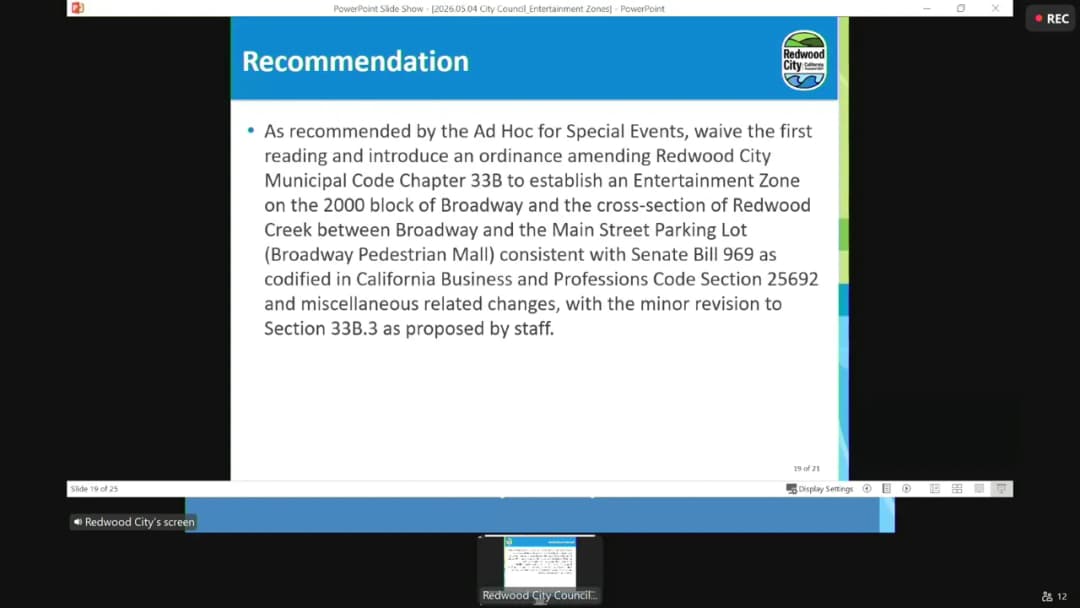
The Redwood City Council held a special meeting on May 4, 2026, at 6:00 PM. The meeting focused on two main items: a proposal to establish an entertainment zone in the downtown pedestrian mall and a resolution of an appeal regarding unpermitted construction at 2455 Carson Street. The council also took a brief recess between items. Public Comments & Testimony - No public comments were made during the general public comment period or on the entertainment zone item. For the appeal, the appellant's attorney accepted the settlement terms read into the record. Discussion Items - Entertainment Zone (Item 7A): Deputy City Manager Jennifer Yamaguma presented a proposal to establish an entertainment zone at the downtown pedestrian mall, authorized by SB 969. The zone would allow alcohol purchased from participating businesses to be consumed in a defined public space during city-managed activations. The pilot program would involve 2–3 activations of 2–3 hours each over the next 3–4 months, with allowable hours from 10 a.m. to 10 p.m. Only beer and wine would be permitted initially, in non-glass, non-metal, and non-plastic containers. The city would manage activations, coordinate with public safety, and maintain emergency access. Estimated cost per activation is $4,000–$5,000, totaling $15,000–$20,000 for the pilot. Council members expressed strong support for the program, noting its potential to boost local businesses and community enjoyment. Councilmember Sturgeon suggested future expansions including later hours, cocktails, third-party activations, and extending to the 2600 block of Broadway. Councilmember G. asked about costs, container materials, emergency plans, and communications strategy. Staff clarified that compostable cups would be used and that an emergency plan and comms plan would be developed. - Appeal of Administrative Citation (Item 6A): The council heard an appeal of a February 25, 2026 administrative citation for unpermitted construction of a garage addition at 2455 Carson Street. Staff and the appellant, Stephen Burns (represented by attorney), reached a settlement. The settlement terms: Mr. Burns will remove the unpermitted garage addition and legalize the ADU conversion; staff will rescind the citation regarding the garage improvements, refund the $100 deposit, and issue a permit for legalization and demolition with conditions; Mr. Burns must submit updated plans within 7 days; staff will waive plan check fees and extend an existing permit for six months. The settlement does not affect separate violations concerning creek setback and vision triangle, which will be heard later. Key Outcomes - Entertainment Zone: The council voted unanimously (5-0, with Councilmember Howard and Vice Mayor Aiken absent) to approve the ad hoc committee's recommendation to establish the entertainment zone, with a minor revision to section 33B3 as proposed by staff. The ordinance will be brought back for adoption on May 11, 2026, with an effective date in June 2026. - Appeal Settlement: The council accepted the settlement as read into the record, resolving the unpermitted garage improvements portion of the appeal. The next hearing on the remaining violations is scheduled for late May 2026. The meeting adjourned at approximately 6:45 PM. The next city council meeting is scheduled for May 11, 2026.
A regular city council meeting was held on April 27, 2026, at 6:00 PM. The meeting included recognition of retiring Public Works Director Terrence Shaw, a proclamation for Fair Housing Month, a presentation from Peninsula Clean Energy (PCE), public comments, and discussions on tobacco retailer regulations and the five-year Capital Improvement Program (CIP). Council also reported on conferences and committee meetings. Presentations & Acknowledgments - Retirement of Terrence Shaw (TK): The council honored Terrence Shaw for 34 years of service (1992-2026), rising from entry-level to Public Works Services Director. Council members, the city manager, and former Police Chief Dan Mohall praised his leadership, mentorship, and problem-solving. TK thanked his family, staff, and colleagues. His last day is May 1, 2026; the new leadership begins May 4, 2026. - Fair Housing Month Proclamation: Mayor Martinez Saballos proclaimed April 2026 as Fair Housing Month, marking the 58th anniversary of the Fair Housing Act of 1968. Laura Diaz of Project Sentinel highlighted ongoing housing discrimination. - Peninsula Clean Energy (PCE) Report: CEO Sean Marshall reported that PCE has saved Redwood City customers over $225 million in 10 years. He requested council approval of a Joint Powers Authority (JPA) amendment to rename PCE to "Westlight Energy" (on the consent calendar). The change is set for July/August 2026. Public Comments & Testimony - Several residents and business owners spoke on the tobacco retailer ordinance: - Hookah lounge operators (Ali Ahmad of Rack & Raps, David Kasuf of Sandwich Spot, and others) stressed cultural tradition, responsible operation (ID checks, 21+ only), and economic impact. They opposed the county’s full flavor ban. - Resident David Reber and public health advocates (Trisha Barr, Blythe Young from the American Heart Association, a ninth-grader from Carlmont High School) cited youth access, the dangers of flavored products and hookah, and the need for enforcement. - Two commenters spoke on other items: one supported lower speed limits in school zones, and another opposed the Laurie Duncan Park pilot project. Discussion Items - Item 7-0 (Consent Calendar Pulled): Oracle Fusion ERP and HCM Cloud services agreement. Councilmember Padilla noted multiple amendments and called for focused future management. The item passed unanimously. - Item 9A: Tobacco Retail Permits & Smoking Regulations - Economic Development Manager Amanda Anthony presented three options: adopt the San Mateo County Tobacco Retailer Permit Ordinance (verbatim), run a city-specific program, or maintain the status quo. The county’s ordinance prohibits all flavored tobacco (including hookah), bans new retailers within 500 feet of existing ones and within 1,000 feet of youth-populated areas, and prohibits sales of e-cigarettes. Enforcement and permit issuance by the county would be at no cost to the city. A city-run program would require several months to develop and cost the city more. - The county’s program charges retailers $372 for a new permit and $885 annually. - Council debated the impact on hookah lounges (three businesses allowed since 2021) and youth health. Councilmember Chu read a letter from a pediatrician that a one-hour hookah session equals smoking 100 cigarettes. Vice Mayor Aiken noted Redwood City’s adult smoking rate (8.5%) is more than double the county’s (3.3%). Councilmember G emphasized the city’s strategic priority of youth and children. Some members expressed concern for cultural traditions but favored public health and enforcement. - Motion to adopt the staff recommendation (first reading and set hearing for June 8). Vote: 5-2 (Councilmembers Padilla and Stirkin opposed). - Item 10A: Fiscal Year 2026-27 CIP and Five-Year Plan - Finance Director Beth Goldberg reported the total CIP budget for 2026-27 is $40.5 million, with a $427 million gap over five years. The main general government fund (Utility Users Tax) is stagnant at $11.7 million annually; after staffing costs, less than $10 million remains for projects. - Staff highlighted major projects: State Route 84/US 101 interchange ($384M, fully funded), Redwood Shores Sea Level Rise Protection ($200M, unfunded), Roosevelt Avenue traffic calming, and new library bathrooms. - The council discussed funding strategies, equity priority communities (EPCs), and deferred projects such as Hoover Park and Laurie Duncan Park. Councilmember Howard requested a neighborhood meeting on Laurie Duncan Park. Council members urged a comprehensive financial plan and revenue study; the Finance and Audit Committee will address this in October. - No action was taken (study session). Key Outcomes - Item 7-0: The council unanimously approved extending the Oracle Fusion maintenance contract with Cherry Road Technologies for three years (annual rate $525,755, total $1,577,265; total contract term 10 years, $8,805,421). - Item 9A: The council voted 5-2 (Padilla and Stirkin opposed) to introduce an ordinance adopting the San Mateo County Tobacco Retailer Permit Ordinance. A public hearing for second reading and adoption is set for June 8, 2026. - Closed Session: The council unanimously approved a settlement agreement with Juba Retail Redwood City Inc. regarding tax liability, authorizing the city manager to execute it.
No transcript content was provided. Unable to generate a summary of the meeting. The source material was empty.