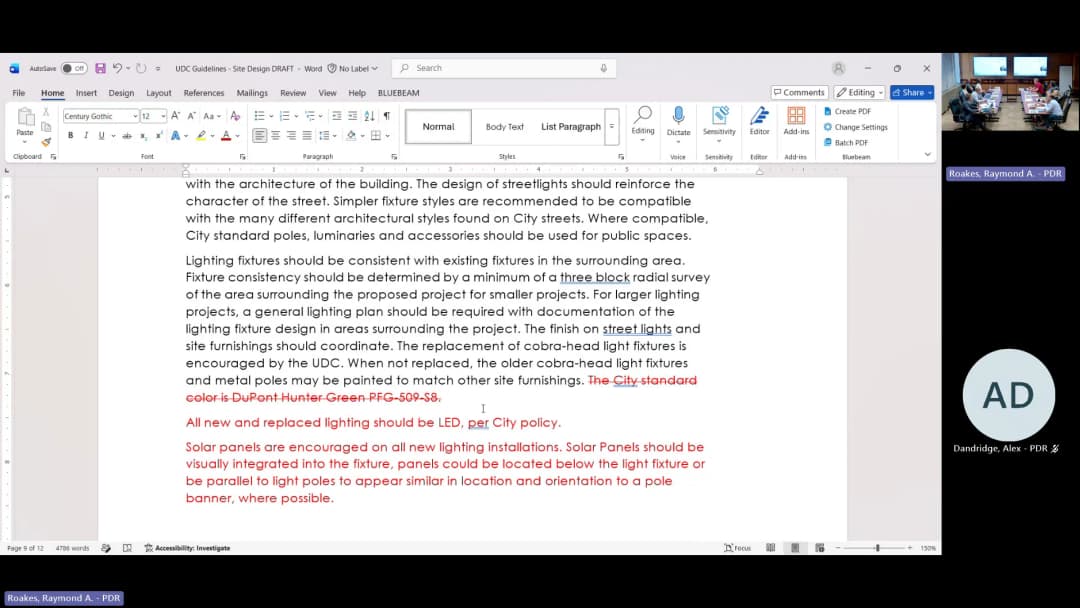
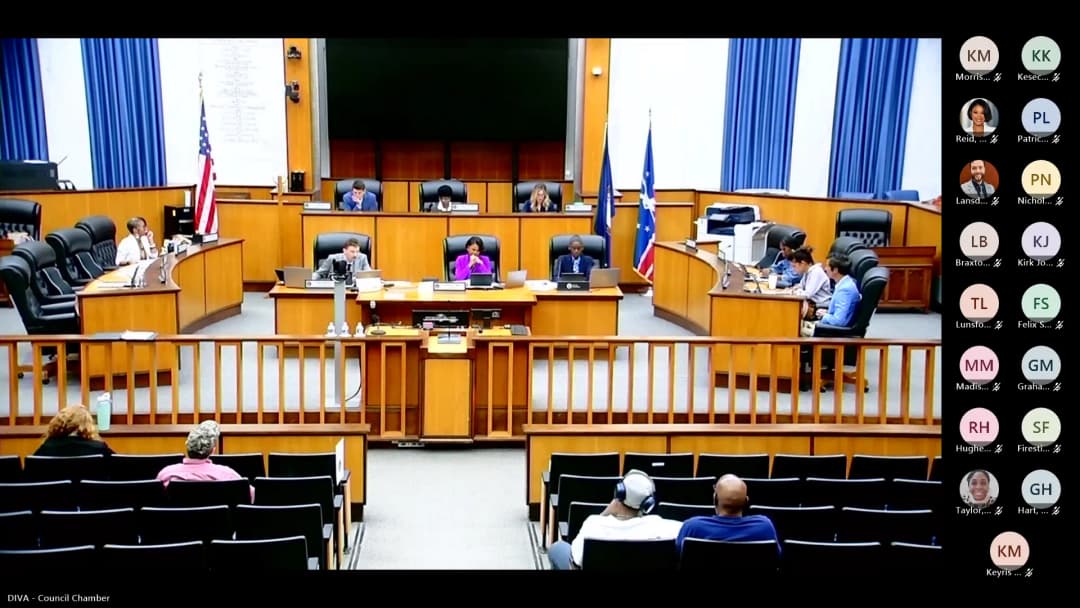
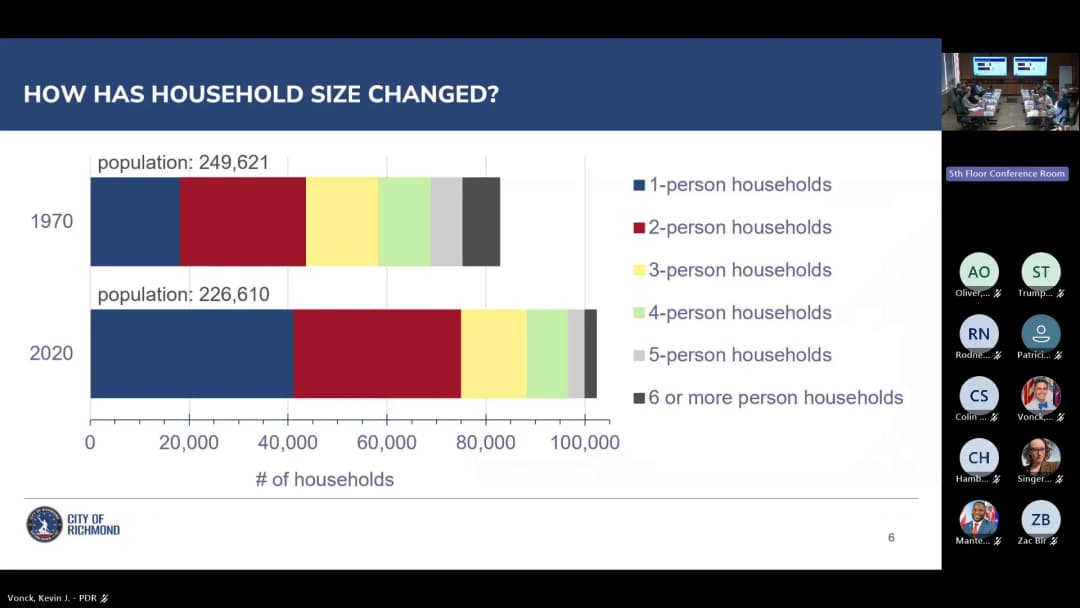
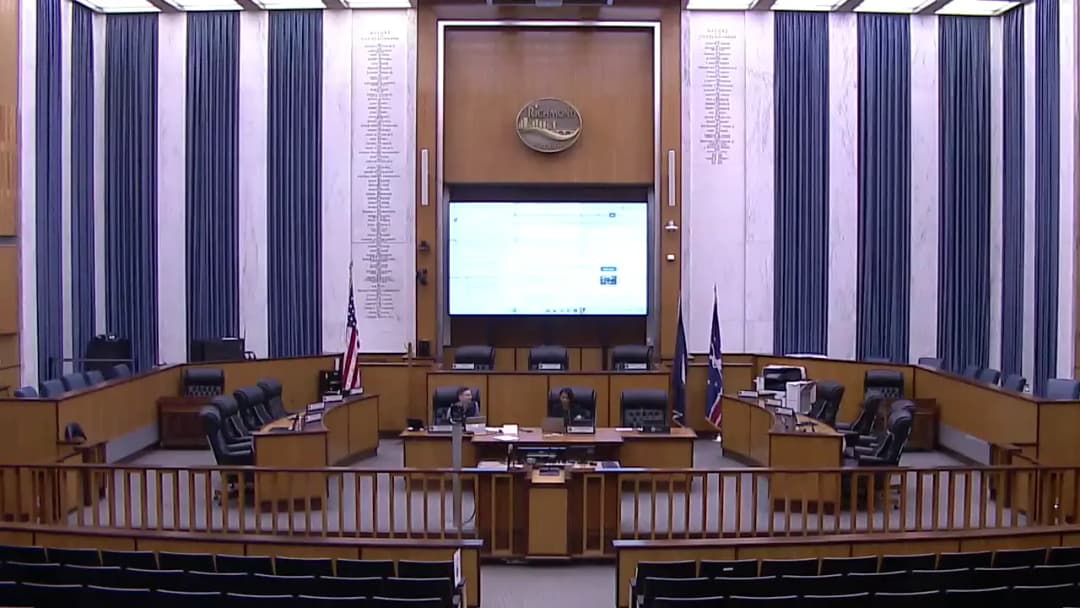
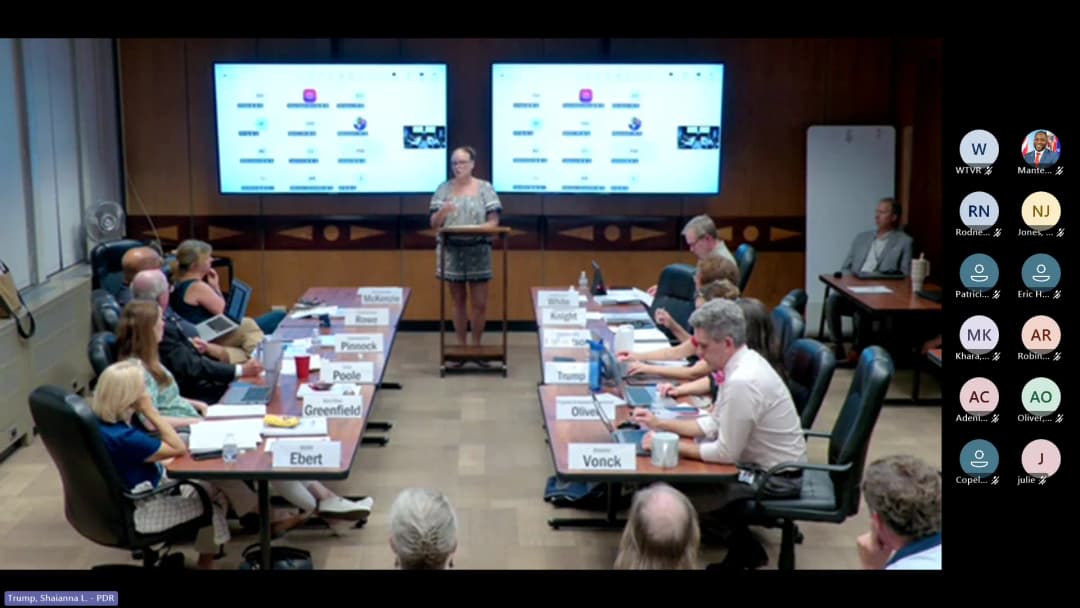
This meeting of the Urban Design Committee (UDC) was called to order at 2:30 PM on September 10, 2026. The committee reviewed a consent agenda item and conducted a regular agenda item focused on the conceptual renovation of Little John Park, followed by a discussion of proposed updates to the UDC guidelines for site plan and furnishing sections. Consent Calendar - The committee approved a request from Hot for Pizza for outdoor seating at 1301 West Lee Street without discussion or public comment. Public Comments & Testimony - No public comments were offered. Discussion Items - Little John Park Renovation (UDC 2026-13): The committee reviewed a concept location, character, and extent review for the proposed renovation of Little John Park at 1401 Little John Road. The park is a narrow strip adjacent to I-95, south of the Sherwood Park neighborhood. Staff presented plans including a meeting pavilion, water station, pet-waste station, new sidewalk, a Miyawaki forest (dense, fast-growing native planting) along the sound wall, a play space, and open space. The project is community-driven, spearheaded by the Sherwood Park Civic Association and its parks subcommittee. Neighbors contributed via two surveys (the second received 84-85 responses from 256 households, a high response rate). The community expressed a desire for accessible, multi-use green space to replace a barren lot that lost many pine trees to VDOT highway widening. Concerns about noise flanking the existing partial sound wall, air pollution, and lack of shaded gathering space were raised. Speakers included Ryan Wren (Capital Projects planner), Chris (unified neighborhood representative), Jim Bradur (Unification Committee chair), Don Hughes (SPCA president), and a resident who highlighted health concerns from highway proximity. The design incorporates the Miyawaki forest method (already used at Fonochello and Blackwell parks) to quickly reforest and buffer noise. No lighting is planned initially. The committee discussed accessibility of paths and playground, and the need to engage the adjacent private pool club about property lines. - UDC Guidelines Update – Site Plan & Furnishings Section Draft: The committee reviewed a draft update to the UDC guidelines covering site design, parking, lighting, landscaping, public art, and furnishings. Key additions included: universal design principles (considering women, elderly, children, disabled users), EV charging station placement, encouragement of solar-ready lighting and wireless phone charging, discouragement of artificial turf in parks unless absolutely necessary, and recommendations for public art integration (working with the Public Art Commission). Discussion touched on lighting color temperature (recommending 3000K), the role of surveillance cameras (contentious – some members wanted to remove a recommendation for parking lot cameras due to privacy concerns), and the need to maintain flexibility in matching lighting to context. The committee offered feedback but took no formal vote; the updated section will be folded into a full guideline document for future adoption. Staff also noted that an application for a demolition overlay in the Fan district is expected at the October meeting. Key Outcomes - Little John Park Conceptual Approval: Motion to recommend approval of the conceptual plan was made, seconded, and passed unanimously (all members present voted aye). The plan will proceed to the Planning Commission. - Guidelines Update – Next Steps: Staff will incorporate committee feedback and compile all sections (including the right-of-way/transportation section already written) into a complete draft for the next meeting. After that, diagrams and photos will be added. - Future Meeting Preview: The October meeting will consider a demolition overlay application for the Fan district, a relatively rare and significant item.
Public Meetings - Richmond, Virginia
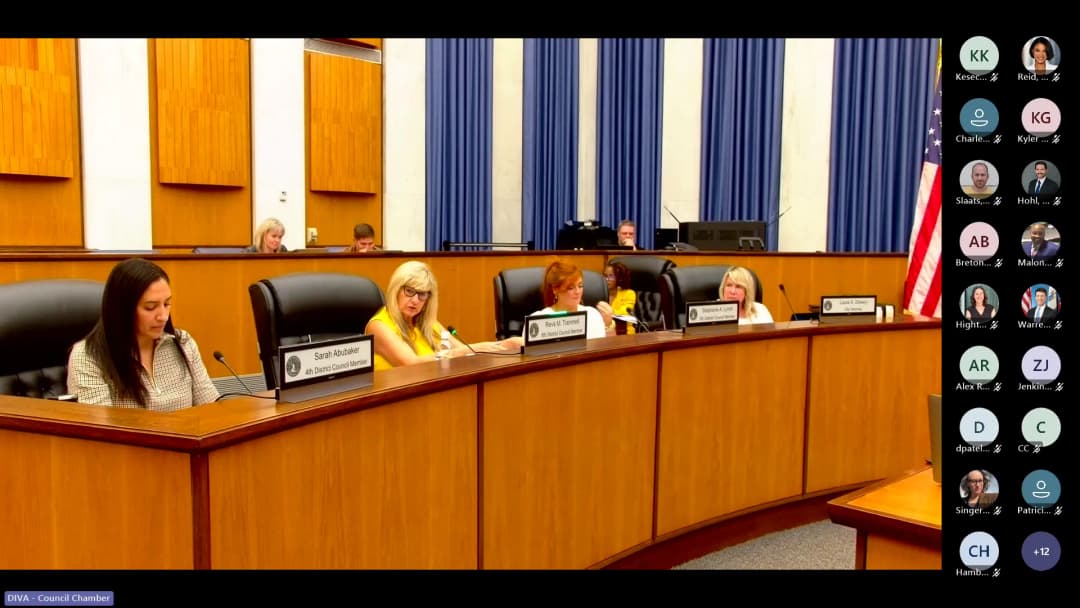
Public Meetings - Richmond, VirginiaA special meeting of the Richmond City Council was held on September 10, 2026, to consider Resolution 2026-R034, authorizing the city's participation as a respondent in State Corporation Commission Case No. PUR-2026-0012, regarding the joint petition of Dominion Energy Incorporated and NextEra Energy Incorporated for approval of a disposition and acquisition of control of a public utility. The meeting was called to order with a quorum present (five members, with four absent: Robertson, Lynch, Trammell, and Abu Bakr). Discussion Items - Resolution 2026-R034: Council President Newbill introduced the resolution, emphasizing the city's direct interest in the outcome due to the potential creation of the world's largest regulated electric utility, with one of two headquarters located in Richmond. Concerns were raised about impacts on rates, service reliability, and the city as a ratepayer. - Councilwoman Gibson expressed support, noting the vote is about affordability for working families. She cited that NextEra's subsidiary Florida Power and Light is facing a $7 billion rate increase, and a report found NextEra profits accounted for 27.4% of the average bill in Florida. She also highlighted the burden of data center growth on utility bills and thanked resident groups in Henrico and Hanover for organizing against the merger. - Vice President Jordan supported the resolution, appreciating the quick turnaround and noting that public hearings are now occurring as a result of public pressure. He added that Dominion has over 5,000 employees in Richmond and relayed concerns from a Dominion employee at a listening session about future protections. - Public Hearing: No members of the public spoke in favor or opposition. Key Outcomes - Resolution 2026-R034 was adopted unanimously by a vote of 5-0 (Breton aye, Gibson yes, Jones aye, Jordan aye, Newbill aye). The resolution authorizes the city to participate as a respondent in the State Corporation Commission proceeding to monitor and advocate for ratepayers and employees.
The Education and Human Services (EHS) Standing Committee met on September 10, 2026. The supplied timestamp indicates a 9:00 a.m. start, although several speakers in the transcript say "Good afternoon." Vice Chair/Acting Chair Jones presided, and Councilmember Breton was present. All committee members were present except Ms. Lynch, and the committee had a quorum. No agenda or minutes were available, so this summary is based on the raw transcript. The meeting included public comment, approval of the July 9, 2026 meeting minutes, a Richmond Thrives Grant Program presentation, a Richmond Public Schools facilities modernization update, an ordinance to accept juvenile detention center grant funds, and closing human services updates. Public Comments & Testimony - The public comment period for items not on the agenda was opened and closed with no speakers. - The public hearing for Ordinance 2026-191 was opened; no one spoke in opposition or in support. Discussion Items - Richmond Thrives Grant Program — Dominic Barrett, Senior Policy Advisor, Office of the DCO for Human Services. Barrett described the new competitive grant-making process replacing the former non-departmental grant process, with four priority areas (arts and culture; children and families; economic mobility; health) managed by three external grantmakers, including CultureWorks and United Way. He said the first two application windows close on September 11, 2026, and the new timeline from application closing to fund disbursement is about three to four months, compared with roughly 10 months under the previous model. Administrative costs were capped at 15% in the RFP process and are coming in closer to 10% across all four priority areas. The city will co-create guidelines, review applications for duplication, monitor grantmakers, report outcomes, and refine the process; grantmakers will provide equitable applications, community advisory input, and aggregate reporting. Grantees are expected to be announced in December, with an initial investment summary provided to council. A councilmember praised the program for increasing accountability and accessibility and suggested reviving a capacity-building training program for nonprofits; Barrett said the feedback was well received and that there remains a role for the city in supporting nonprofit training. - Richmond Public Schools Facilities Modernization — Patrick Harrell, Chief Operating Officer, with RPS Board Chair Fernandez. The superintendent sent apologies. RPS has held two community prioritization sessions and has seven remaining; the next is September 15 for District 9. Phase one is about prioritizing schools for modernization, not consolidation, rezoning, or specific capital projects; phase two would address implementation questions such as new construction versus renovation. Data cited by Harrell: enrollment is up about 1.8%; average building age is 62 years; over 20% of buildings are at least 100 years old. The transcript's sentence about buildings over 50 years old is garbled ("over 69% of our buildings, 36% of our buildings are over 50 years old"), so the exact percentage is unclear. An independent assessment identifies about $680 million in maintenance needs over 20 years, while projected annual funding is about $2.5 million; the nearly $10 million capital allocation from council averages out to about $2.5 million per year. Harrell credited meals tax funding for recent school construction and referenced the proposed 1% sales tax as a potential source. In the community activity, tables sort 26 school cards into high, medium, or low priority using building condition, enrollment trends, student need concentration, and historical context. Harrell and Fernandez said some parents and principals who arrived to advocate for their own schools instead recognized greater needs at other schools. Councilmember Breton, who attended a session, praised the activity and reported hearing an attendee say, "You convinced me, I'll vote yes." Acting Chair Jones said she planned to attend the District 9 session. - Ordinance 2026-191 — Juvenile Detention Center JAG Grant (Department of Justice Services Director Greg Hopkins). The ordinance authorizes the Chief Administrative Officer to accept $137,038 from the Virginia Department of Criminal Justice Services and to create and appropriate a new special fund for a juvenile detention center program. The transcript contains an amount discrepancy: it reads $137,038 for the accepted funds but $137,003 for the appropriation. Hopkins said the one-time grant would fund equipment, staff training, and facility upgrades to make the detention center more trauma-informed and youth-friendly, including replacing furniture that has not been upgraded since 2011 and improving intake and visitation areas. He noted that Richmond offers post-dispositional services, and youth can remain in custody for up to six months; he cited Cook County Juvenile Detention Center as a best-practice model. A councilmember asked whether the funding was for one-time activities; Hopkins confirmed it was. The public hearing had no speakers. - Human Services Office Updates — DCAO Ms. Popovich. Popovich introduced Lamont Barnes as the new Senior Policy Advisor in the Office of Gun Violence Prevention, described his previous work in violence prevention, juvenile behavioral health, and youth workforce development, and noted that the post-dispositional program recently visited the National Museum of African American History and Culture in Washington, D.C. She highlighted September as Library Card Month, a 35% increase in summer reading participation over four years with support from the Shea Berg Foundation, and the launch of the Central VA Resource Navigator website (centralvaresourcenavigator.org), a substance use and behavioral health resource hub developed with 1,500 hours of work by Monica Kelly and more than 130 organizations, in partnership with Henrico County and regional partners, during National Recovery Month. Acting Chair Jones praised the updates and introduced her liaison, Catherine Brown. Key Outcomes - The July 9, 2026 EHS meeting minutes, held at 2 p.m., were approved as presented. - The committee approved a motion to recommend approval of Ordinance 2026-191; no vote tally was recorded in the transcript. - No key action items or follow-up items were recorded in the staff report. - Next steps for Richmond Thrives: first application windows close September 11, 2026; grantees announced in December; an initial summary report to council; and the mayor's FY28 budget in March would propose allocations to the four priority areas. - The next EHS committee meeting is scheduled for October 8, 2026, with anticipated updates on early childhood enrollment from the Office of Children and Families and homeless services strategic planning.
The Organizational Development Standing Committee met on September 9, 2026, to discuss the Richmond 300 master plan annual report, a detailed review of the third draft of Code Refresh (zoning ordinance rewrite), and an ordinance to establish an Affordable Dwelling Unit Advisory Committee. The committee also approved the minutes, continued a resolution on emergency operations plan adoption, and reappointed a tenant representative to the Richmond Redevelopment and Housing Authority. Consent Calendar - Approval of Minutes: The minutes from the previous meeting were approved unanimously. - Continuation of Resolution 2026 R031 (Emergency Operations Plan Adoption): A motion to continue this resolution to the next Organizational Development Standing Committee meeting passed unanimously (7 ayes: Breton, Gibson, Jones, Trammell, Vice Chair Jordan, Chair Newbill — no nays recorded). - Reappointment to Richmond Redevelopment and Housing Authority (RRHA): The committee voted on the reappointment of Ms. Brody as a tenant representative. The vote: Breton aye, Gibson abstain, Jones aye, Lynch no, Trammell aye, Abu Baker aye, Vice Chair Jordan aye, Chair Newbill aye. The motion was approved. Public Comments & Testimony - On Ordinance 2026-190 (Affordable Dwelling Unit Advisory Committee): Annika Shun, housing policy advocate at Housing Opportunities Made Equal, spoke in favor of the paper. She recommended renaming the committee to "Inclusionary Housing Committee," adjusting the committee makeup to include two representatives from community-based organizations/tenant advocacy groups and one planning/housing professional not employed by the city, prioritizing Richmond residents for appointments, and simplifying deadlines to six months after ordinance enactment. She noted this was a recommendation from the Homes for All Our Neighbors Coalition. Discussion Items - Richmond 300 Master Plan Annual Report (presented by Mary Ann Pitts, Department of Planning and Development Review): Pitts provided an update on the citywide master plan adopted in 2020. Key progress included work on six "big moves": rewriting the zoning ordinance (Code Refresh), reimagining priority growth nodes (e.g., Diamond District, Jackson Ward, Southside Plaza), expanding housing opportunity (with affordable housing unit completions by fiscal year), greenways and parks (Fall Line Trail, parks master plan), reconnecting the city (Reconnect Jackson Ward, bridge projects, North-South BRT), and realigning city facilities (recreation centers, police/fire stations, school facility planning). Pitts noted that metrics from the American Community Survey one-year estimates for 2025 are not yet available; 2024 data may be provided. Councilmembers requested additional demographic data, school enrollment information, development impact data, and legal clarification regarding the five-year comprehensive plan review requirement (Virginia Code §15.2-2230). Councilmember Trammell expressed constituent concerns about infrastructure, public safety, and the pace of development in the 8th district. Councilmember Jones asked for more visualization of zoning changes to help residents understand potential impacts. - Code Refresh (Draft Three Overview) (presented by Kevin Vonk, Director of Planning and Development Review): Vonk outlined key changes from Draft Two to Draft Three based on public feedback. Major changes include: reducing maximum dwelling units per lot from three to one primary plus one accessory dwelling unit (ADU) under 1200 sq ft (detached ADU must be smaller than primary); defining household as no more than five adults over 18; adding minimum vegetation space and tree canopy requirements for new development; requiring special use permits for auto-oriented uses (gas stations, drive-throughs, car washes) in most districts (by right only in industrial); eliminating the CG district; separating food and beverage uses by square footage; converting many uses from special use permits to conditional use permits (with sunset provisions); zoning places of worship from MX3 to RM districts (RMA, RMB, RMC) to better fit neighborhoods; adjusting high-frequency transit corridor zoning to MX3 with select MX5 on corners/vacant lots; reducing RMA maximum units from six to four; adjusting minimum lot width for RDC lots from 25 to 30 feet; adding RMS (low-rise, no unit cap) and campus designation (CMP) for institutional layouts; and recalibrating mapping between RA and RMA districts. Vonk confirmed that the timeline for formal introduction is not yet firm. Lawson from the Mayor's Office (chief of staff) indicated a target of introducing the ordinance at the October 13 council meeting, with a possible vote before year-end, but noted the ordinance has not yet been formally submitted to the City Attorney's Office for legal review. Councilmembers Gibson, Jones, and Trammell raised concerns about: the lack of a formal interdepartmental review (fire, police, utilities); insufficient public understanding of visual impacts; potential property assessment increases from ADUs; infrastructure capacity (water, sewer, combined sewer overflow); and the need for data on ADU uptake and market effects. Councilmember Gibson requested a one-pager on overlay protection options from the cultural heritage stewardship plan. Councilmember Trammell recounted a specific example of auto-oriented development by right on Richmond Highway, noting that Code Refresh would require a special use permit for such uses in the future. - Ordinance 2026-190: Affordable Dwelling Unit Advisory Committee (introduced by Councilmember Breton): The ordinance would establish a temporary (six-month) advisory committee to craft recommendations for an affordable housing incentive program, enabled by state legislation effective July 2027. Committee members would be recommended by the Mayor and appointed by City Council. Councilmembers Lynch, Jones, Gibson, and Abu Baker raised concerns: the committee should have more direct community representation, the appointment process may be overly controlled by the Mayor, the paper came to OD instead of the Land Use Committee (staff noted consistency with other advisory committees), potential overlap with the existing Affordable Housing Trust Fund, and that the estimated $5,000 and 40 staff hours may be insufficient. Councilmember Breton indicated openness to amendments (e.g., requiring a council member as the 10th member, renaming the committee). Vincent Melone (Housing and Community Development) emphasized the committee's role in "pressure testing" incentives. Vice Chair Jordan commended the effort. The committee voted unanimously to continue the ordinance to the next OD meeting (7 ayes). Key Outcomes - Resolution 2026 R031 continued to next OD meeting. - RRHA reappointment approved with one abstention and one no vote. - Richmond 300 Report: Staff committed to provide updated metrics (2024 data if 2025 unavailable), a development mapper tool, baseline school enrollment data, and legal clarification on the five-year review timeline. - Code Refresh: Planning Commission will consider a resolution of intent in the coming month; the Mayor's Office targets council introduction by October 13, 2026, with a possible vote before year-end. Staff will maintain a redline of changes from Draft Three to the final ordinance and provide a one-pager on overlay protection options. - Ordinance 2026-190 continued to the next OD meeting to allow for amendments and further discussion. - New staff member introduced: Catherine Brown, new 9th District Liaison.
The Richmond City Council held a brief special meeting on September 9, 2026, at 2:15 PM ET. The primary agenda item was a motion to expedite consideration of Resolution 2026-R034, which would authorize the city to participate in a State Corporation Commission case regarding Dominion Energy and NextEra Energy. The motion to expedite failed, and the resolution will be introduced at the next regular meeting. Procedural Matters - Council President New Bill called the meeting to order. The clerk provided emergency evacuation and public speaker guidelines. - Councilor Andrew Breton requested to participate virtually due to a canceled return flight; the council unanimously approved his remote participation (motion passed 5-0, with members Gibson, Jones, Trammell, Jordan, and New Bill voting aye). - Members in attendance: Breton (via Teams), Gibson, Jones, Trammell, Vice President Jordan, and President New Bill. Three members (Robertson, Lynch, Abu Bakr) were absent; a quorum was present. Consideration of Resolution 2026-R034 - Vice President Jordan moved to expedite consideration of Resolution 2026-R034, which concerns the city's participation as respondent in State Corporation Commission Case No. PUR-2026-00112 (joint petition of Dominion Energy and NextEra Energy). Councilmember Jones seconded the motion. - The council voted on the motion to expedite: Mr. Breton (aye), Ms. Gibson (abstain), Ms. Jones (aye), Ms. Trammell (abstain), Vice President Jordan (aye), President New Bill (aye). The motion received 4 ayes and 2 abstentions, falling short of the required majority; it therefore failed. Key Outcomes - Motion to expedite Resolution 2026-R034: Failed (4 ayes, 2 abstentions). The resolution will instead be placed on the agenda for introduction at the next regular council meeting. - The meeting then adjourned.
The Organizational Development Standing Committee of the Richmond City Council met on Tuesday, September 8, 2026, at 4:00 PM in the Council Chamber. The meeting covered the Richmond 300 annual report, a detailed presentation on Code Refresh Draft 3, a reappointment to the Richmond Redevelopment and Housing Authority (RRHA), and an ordinance to establish an Affordable Dwelling Unit Advisory Committee. Councilmember Andrew Breton participated remotely due to weather-canceled travel. Consent Calendar - Minutes Approved: The minutes from the July 6, 2026 Organizational Development Standing Committee meeting were approved as presented. - Resolution 2026-R031 Continued: A motion to continue the resolution adopting the City's Emergency Operations Plan to the next committee meeting passed unanimously. Public Comments & Testimony - Affordable Dwelling Unit Advisory Committee: One speaker, Annika Shun from Housing Opportunities Made Equal, spoke in favor of the ordinance. She recommended renaming the committee to "Inclusionary Housing Committee," adding representatives from community-based or tenant advocacy groups, including a planning/housing professional not employed by the city, and simplifying deadlines to six months after ordinance enactment. She emphasized the committee's role in press-testing incentives and ensuring appropriate expertise. Richmond 300 Annual Report (Marianne Pitts, Senior Deputy Director) - Overview: The citywide master plan, adopted in 2020, is being implemented through six "big moves." Over the past fiscal year, staff engaged in over 90 meetings with more than 2,650 individuals, focused on Code Refresh, small area plans (Jackson Ward, node plans), and community plans (Oak Grove/Hillside/Bellmead approved; Mosby South approved). - Metrics Update: The plan requires biannual metrics updates; the 2023 numbers were reported in 2024, but 2025 data from the American Community Survey are not yet available. Staff will provide them later this year. - Key Big Moves Progress: - Rewrite Zoning Ordinance: Code Refresh underway. - Reimagine Priority Growth Nodes: Downtown transfer center RFP, Diamond District construction, Shaco Institute opening, Southside work (Oak Grove/Hillside/Bellmead plan approved). - Expand Housing Opportunity: Units completed (numbers provided but not detailed in transcript); affordable housing strategic plan update begun; Mosby South and Creighton Court redevelopments progressing. - Greenways and Parks: Fall Line Trail (Bryan Park segment under construction), James River Branch Trail complete, Parks Master Plan approved by Planning Commission, Urban Forestry Plan engagement completed. - Reconnect the City: Reconnect Jackson Ward project led by transportation division; bridge projects (Art Thur Ash, Mayo) proceeding; North-South BRT in planning. - Realign City Facilities: City center redevelopment, recreation centers (Southside, T.B. Smith, Lux, Calhoun) renovated or underway; Police Precinct 1 and Fire Station 21 finished; monthly meetings with public schools on facility planning and development impacts. - Future Work: Code Refresh nearing completion; node plans for Six Points, SEMS Hull Cordon, Westwood, and Five Points; master plan update process underway (data/insights report, review/refine amendments, public engagement, then Planning Commission and Council). - Council Discussion: Councilmember Gibson requested more detailed metrics (jobs, poverty, education, median income, transportation safety) and clarification on the five-year review required by Virginia Code §15.2-2230. Staff stated capacity constraints due to Code Refresh; city attorney's office indicated amendments qualify as review. Councilmember Jones asked about tracking growth vs. school enrollment and infrastructure capacity; staff committed to providing development data, school enrollment projections, and public safety/infrastructure metrics. Councilmember Trammell reported citizen concerns about city services, police staffing, water/sewer capacity, and property assessments. Code Refresh Draft 3 Presentation (Kevin Vonck, Director of Planning and Development Review) - Background: Draft 3 reflects public input from over 90 meetings and 2,650 individuals. Key changes from Draft 2: - Dwelling Units: Reduced from allowing up to three units to one primary + one accessory dwelling unit (ADU) up to 1,200 sq ft, detached ADU must be smaller than primary. Current code allows ADU up to 1/3 of primary; new code allows larger ADU but with height and footprint restrictions. - Household Definition: Changed to not more than five adults (over 18) to address overcrowding concerns. - Sustainability: Added minimum vegetation space requirements (real organic vegetation) for new development in most zones, supplementing tree canopy requirements. - Traffic Impacts: Uses generating substantial vehicular traffic (gas stations, drive-throughs, car washes) require a special use permit in all but industrial districts; eliminated CG district where many were by-right. - Use Tables: More conditional uses (with sunset clauses) instead of special use permits to better govern operators over time. Food and beverage uses differentiated by size (e.g., <1,500 sq ft allowed in more areas). - Places of Worship: Rezoned from MX3 to RM districts (RMA, RMB, RMC) to better fit neighborhoods and allow small-scale housing/commercial. - High-Frequency Transit Corridors: Some corridors changed from MX5 to MX3 with select MX5 on corners/vacant lots to avoid demolition and displacement. - Residential Districts: RMA reduced from six to four units; RDC lot splits adjusted (minimum lot width from 25 to 30 feet) to limit by-right splitting; added RMS (low-rise, no unit cap) for suburban-style apartment complexes; added CMP campus designation for institutional uses. - Timeline: Mayor's Chief of Staff Lawson indicated target introduction at Council's October 13 meeting with a vote before end of 2026, but stressed no firm date. The ordinance is still being drafted; formal legal review not yet submitted. Planning Commission resolution of intent expected within a month. - Council Discussion: - Councilmember Gibson questioned the timeline and legal review, emphasizing need for fire/police department vetting. Staff said formal assessments will be included with the final package. - Councilmember Jones requested visualizations of what new development would look like, better communication on capacity (water, utilities, police), and clearer distinction between ADU as affordable housing vs. market-rate rentals. Staff committed to providing redline changes and more graphics. - Councilmember Lynch raised concerns about ADU size and property value impacts, requested data on ADU construction rates and home value projections, and asked for a one-pager on overlay protections. She also advocated for allowing three unrelated persons as per Code of Virginia. - Councilmember Trammell cited a constituent example of a tree-cleared lot becoming a junkyard under current zoning; staff noted that under Code Refresh, auto-oriented uses would require a special use permit. She reported that at a September 1 meeting of 200 people, no one raised a hand in favor of Code Refresh. She urged more public conversation and not rushing to an October 13 introduction. - Vice Chair Jordan asked about impact fees; staff explained limitations under Code of Virginia and suggested internal discussions on updating fees, but no proposal in current package. She thanked staff for engagement and encouraged continued public input. Appointments to Boards, Commissions, and Similar Entities - RRHA Tenant Representative Reappointment: The committee reviewed and approved the reappointment of Ms. Brody as the tenant representative from the Fairfield community to the Richmond Redevelopment and Housing Authority. Vote: 6-1-1 (Ms. Gibson abstained, Ms. Lynch voted no). Paper for Consideration: Ordinance 2026-190 – Affordable Dwelling Unit Advisory Committee - Purpose: To establish an advisory committee to develop recommendations for an affordable housing dwelling unit program, as required by new state law (effective July 2027). The committee would be technical and time-limited (six months), with members recommended by the Mayor and approved by Council. - Public Comment: One supporter spoke, offering amendments (see Public Comments). - Council Discussion: - Councilmember Lynch questioned why the paper came to OD instead of Land Use (staff said for consistency with other advisory committees). She raised concerns about appointment process (Mayor recommendation), lack of community representation, and broad latitude of the committee. - Councilmember Jones expressed discomfort with the process and preferred the proper committee vetting. - Councilmember Gibson noted the paper's language does not align with the state code and questioned intersection with the Affordable Housing Trust Fund. - Councilmember Ottlebacher asked about resource allocation (estimated $5,000 and 40 staff hours) and whether it is adequate. - Councilmember Breton (patron) was open to amendments, including naming the committee, adding a Council member as a mandatory member, and clarifying extension options. Director Merrick Malone (HCD) emphasized the committee's role in pressure-testing incentives. - Outcome: The paper was continued to the next OD committee meeting by unanimous vote. Reports of Standing Committees - Council Chief of Staff reported no items due to cancellation of August committee meetings. New Staff Introduction - Councilmember Trammell welcomed Catherine Brown as the new Ninth District Liaison. Key Outcomes - Minutes Approved from July 6, 2026 meeting. - Resolution 2026-R031 continued to next meeting. - Motion to allow Councilmember Breton's electronic participation approved (unanimous). - RRHA tenant representative reappointment approved (6-1-1). - Ordinance 2026-190 continued to next OD committee meeting for further amendments and discussion. - Code Refresh timeline: Target introduction October 13, 2026, but no firm date; staff to provide redline changes, visualizations, data on ADU impacts, and formal departmental assessments. Planning Commission resolution of intent expected within a month.
Note: The official minutes record this meeting as occurring on September 1, 2026, but the summary is dated per the instruction provided. The Richmond Planning Commission convened at 6:00 PM on September 2, 2026, in the 5th Floor Conference Room of City Hall. Seven commissioners were present, two were absent. The meeting included approval of previous minutes, continuances of two special use permit items, a consent agenda referral, and a detailed presentation and discussion on the third draft of the city’s zoning code rewrite (Code Refresh Draft 3). No regular agenda items were heard. The meeting adjourned at 7:37 PM. Consent Calendar - Item 5 – Little John Park Renovation (UDC 2026-13): A conceptual Location, Character, and Extent review for the renovation of Little John Park at 1401 Little John Road was placed on the consent agenda. The Commission unanimously voted to refer the item to the Urban Design Committee meeting on September 10, 2026. No public comments were received. Public Comments & Testimony - No members of the public provided oral or written comments during the public hearing for the consent agenda. Discussion Items – Code Refresh Draft 3 Update Director of Planning and Development, Gavin Your Baum, presented an overview of the Code Refresh Draft 3, emphasizing the need to align zoning with Richmond 300 master plan goals—more housing, complete neighborhoods, economic vitality, and climate resilience. Key changes from Draft 2 to 3 included: - Dwelling units per lot: Reduced maximum to one primary dwelling unit plus one accessory dwelling unit (ADU) up to 1,200 square feet, with ADU size limited to be smaller than the primary unit and subject to contextual height and footprint limits. - Household definition: Changed to include not more than five adults (separate from Code of Virginia group living provisions). - Sustainability standards: Added minimum vegetation space and tree canopy requirements for nearly all development, with lot coverage percentages adjusted to capture 90% of existing lots as conforming. - Vehicular traffic uses: Uses that generate substantial auto traffic (e.g., drive-throughs, car washes, service shops) were removed as permitted uses in non-industrial districts, often requiring special or conditional use permits. - Conditional use permits: Expanded use of conditional use permits (with temporal limits) over special use permits (which run with the land) for uses like nightclubs and retail. - Places of worship: Rezoned from MX3 (mixed-use) to a variety of RM districts (RMA, RMB, RMC) based on location, allowing up to 4, 12, or unlimited units respectively, with height limits and contextual standards. - Transit corridors: High-frequency transit corridors with mostly two-story buildings were rezoned to MX3 (with select MX5 on corners) to avoid encouraging demolition and displacement. - New districts: Added RMS (garden-style low-rise apartments in more suburban context) and CMP (campus district for institutional uses like universities). - Lot subdivision: Minimum lot width for by-right subdivision in RDC (most dense detached) increased from 25 to 30 feet, reducing eligible lots to about 2-3%. Commissioners expressed concerns and raised questions: - Commissioner White and Commissioner Greenfield questioned the feasibility of requiring 10% open space for multifamily buildings, given costs, security, and maintenance. They argued that such mandates could deter development, especially for smaller infill projects, and that amenity space should be project-specific. Director responded that the percentage had been reduced from earlier drafts, that vegetated areas can double-count, and that savings from reduced special use permit costs might offset added expenses. - Commissioner Pinnock asked about housing shortage data; Director promised to provide city-specific numbers (average 2,500-3,000 units/year produced, but deficit remains). - Commissioner Knight inquired about the impact of allowing duplexes by right in residential attached districts, noting potential for major effects in historic neighborhoods like the Fan and Museum District. Director clarified that in RA (residential attached) districts, two principal units are allowed only within one building, not as separate buildings, and that most areas already permit duplexes under current zoning. - Commissioner Rowe asked about buffers and transitions between zoning districts; Director explained A, B, and C standards with setbacks and stepbacks, especially for taller buildings adjacent to lower-density areas, and noted that shadow studies showed minimal impact on nearby streets. - Commissioner Mckenzie Jr. sought clarification on the use of conditional versus special use permits, with Director providing examples (e.g., nightclubs timed to 18-month renewals). - Commissioner Burchell Pinnock (also BZA representative) asked whether all current special exceptions were included; Director confirmed they are in Section 6.2.8 and that city attorney’s office is ensuring compliance with Virginia code and charter provisions. - Commissioner Knight asked about protections against demolition on transit corridors; Director cited analysis showing demolition rates would likely remain similar to current levels (about 80 per year) due to high costs. - Commissioner Greenfield asked about tools to address displacement; Director noted the preservation bonus was removed because most districts now allow only one primary + one ADU, and that zoning appropriately, contextual height limits, and mapping corrections help preserve naturally occurring affordable housing and reduce incentives for demolition. Key Outcomes - Minutes Approved: August 18, 2026, meeting minutes were adopted by a vote of 5 in favor, 2 abstaining (Commissioners Mckenzie Jr. and Knight). - Continuances Granted: - Item 3 (3317 Rear Monument Avenue, special use for up to four single-family attached dwellings) continued to November 2, 2026 (unanimous). - Item 4 (5706 York Road, special use for up to eight single-family attached dwellings) continued to September 15, 2026 (unanimous). - Consent Agenda Adopted: Item 5 (Little John Park) referred to the Urban Design Committee on September 10, 2026 (unanimous). - Code Refresh Next Steps: Director indicated that a resolution of intent to formally amend and replace the zoning ordinance would likely be presented at the September 15, 2026 Planning Commission meeting. After that, a final ordinance would be prepared for City Council introduction, sent back to the Commission for deliberation, and then to Council for a vote. Public engagement will shift toward educating civic associations and council districts. Implementation is expected to include a 90-day delay after Council adoption to allow staff calibration and transition. - No Regular Agenda Items: No additional items were scheduled on the regular agenda. Director’s Report: Code Refresh Draft 3 Update A full presentation was given (detailed above), covering the rationale, key changes, and responses to commissioner questions. The Director committed to providing city-specific housing deficit data at the next meeting.
The meeting on August 26, 2026, consisted primarily of informal technical discussion and casual conversation among staff, with no formal agenda items, public testimony, or official decisions recorded. Discussion Items - Participants tested audio equipment, referencing a microwave encoder and a secondary device that boosts audio. They worked to determine appropriate sound levels for the stream. - The group discussed television shows such as "Widow's Bay" (described as a horror comedy) and "90 Day Fiancé," as well as the voice actor from "King of the Hill." - One participant mentioned their involvement with the Richmond Flying Squirrels (minor league baseball team) and the new stadium. - Participants commented on the capabilities of the audio system, including a timer feature and multiple microphones. Key Outcomes - No formal votes, directives, or referrals occurred. The session concluded with no substantive decisions or actions taken.
This meeting session on 2026-08-24 at 19:30 UTC consisted entirely of audio equipment testing with no formal agenda, discussion, or decisions. The transcript includes repeated 'testing' phrases and remarks about updating software and restarting devices. No public comments, deliberation, or votes occurred. No agenda or minutes were available, and the only content was technical setup dialogue.
The Richmond Planning Commission met on August 19, 2026, at 6:00 PM in the 5th Floor Conference Room of City Hall. The meeting covered continuances, a consent agenda, and several regular agenda items including special use permits and a conditional use permit for a nightclub. Key decisions included approval of a 131-unit apartment conversion of the historic Virginia Home building, approval of a veterinary clinic use, and a continuance for a proposed duplex development due to community engagement concerns. Consent Calendar - The consent agenda was adopted unanimously, including items 3–16. These included alley closures, amendments to special use permits, and various special use authorizations for dwellings, automobile sales, and multifamily projects, as well as several UDC reviews for street, sidewalk, and stormwater improvements. All items were recommended for approval to City Council, except for public art and UDC items which were approved directly. Public Comments & Testimony - Item 17 (Woodlawn & Grove Avenue – Veterinary Clinic): Chris Ogden (4401 Grove Avenue) opposed, citing existing parking shortages from nearby businesses and concern that adding a veterinary clinic would exacerbate the problem. He noted residents struggle with on-street parking due to employee vehicles from a dental office. - Item 18 (1003 Baywood Court – Duplex and Single-Family): Teresa Goyle (adjacent neighbor) opposed, arguing the proposed duplex would be out of scale with the small Cape Cod neighborhood, increase traffic, and lead to a rental property rather than affordable housing. She also noted the existing dwelling had been expanded and trees cleared. Steve Hur (1010 Baywood Court) echoed concerns about road maintenance, parking, and lack of infrastructure on Baywood Court. - Item 19 (3407 Lawson Street – Two Two-Family Dwellings): The Swansboro West Civic Association submitted a letter of opposition, objecting to the demolition of the original house and inadequate community engagement. - Item 21 (1101 Hampton Street – 131-Unit Apartment Conversion): Multiple speakers addressed the commission. Charlie Troquel (Powhatan Street) spoke in favor, noting the project would create competition for investor landlords and help preserve naturally affordable housing. Tonya Maus (1909 Blair Street, Randolph) spoke in opposition, requesting a continuance due to insufficient engagement with Randolph residents and concerns about traffic, parking, and safety. Claire Guthrie Gaston Yaga (1127 South Meadow) also opposed, citing discrepancies in the traffic study, potential overcrowding, and lack of affordable housing commitments. Robin Leddy (Bird Park) expressed support for adaptive reuse but asked for more defined parking and setbacks, and a continuance for further review. Discussion Items - Item 17 - Amendment for Veterinary Clinic at Woodlawn & Grove: Staff presented a request to amend an existing special use permit to allow a veterinary clinic (excluding boarding kennels). The property has been used for medical offices since the 1960s. Staff recommended approval, noting no anticipated traffic increase due to the specialized nature. The commission discussed parking concerns and resident-only parking permits. The item was approved unanimously. - Item 18 - Special Use for 1003 Baywood Court: The proposal was to split a 14,000 sq ft lot to retain an existing single-family home and add a new two-family detached dwelling (total 3 units). Staff recommended approval, citing consistency with the master plan. After public opposition, the commission amended the motion to require sidewalk repairs to city standards. The amended motion passed unanimously. - Item 19 - Special Use for 3407 Lawson Street: The applicant sought to demolish an existing house and build two two-family detached dwellings. The applicant acknowledged limited engagement with the neighborhood. Commissioner Pinnock moved to deny, citing lack of collaboration and affordable housing concerns. Commissioner Greenfield moved to continue for 60 days to allow further community engagement. The motion to continue passed 5-2 (Commissioners Pinnock and Rowe voting no). - Item 20 - Conditional Use for Nightclub at 2900 West Broad Street: The applicant requested a conditional use permit for a nightclub (Bingo Beer) with live music, limited to Thursday–Saturday 12:00 AM–2:00 AM. Staff recommended approval, noting a management plan including 5 security officers, an off-duty police officer, and 86 off-street parking spaces. The commission discussed previous sound ordinance compliance and the applicant’s proactive engagement. The item was approved unanimously. - Item 21 - Special Use for 131-Unit Apartment at 1101 Hampton Street: This was the most debated item. The Virginia Home, which has operated a nursing home for 130 disabled residents for nearly 100 years, plans to relocate to Hanover County. The property would be converted into 131 apartments (studio to 2-bedroom units) within the existing 7-story building, with 66 off-street parking spaces. Staff recommended approval, citing adaptive reuse, reduced traffic (50% fewer trips per a Timmons study), and consistency with Richmond 300 goals. The applicant emphasized net traffic reduction and no expansion of building footprint. Several commissioners praised the preservation of the historic Art Deco building and the housing opportunity. Concerns included parking adequacy, engagement with Randolph residents, and traffic safety on Meadow Street. The motion to approve passed unanimously. Key Outcomes - Item 2 (5706 York Road): Continued to September 1, 2026. - Item 22 (1209 Overbrook Road): Continued to September 15, 2026. - Item 19 (3407 Lawson Street): Continued to October 20, 2026, to allow additional community engagement. - Consent Agenda (Items 3–16): Adopted unanimously; all special use permits recommended to City Council; UDC and public art items approved directly. - Item 17 (Veterinary Clinic): Recommended for approval to City Council (unanimous). - Item 18 (1003 Baywood Court): Recommended for approval with amendment requiring sidewalk repairs (unanimous). - Item 20 (Nightclub at 2900 West Broad Street): Recommended for approval to City Council (unanimous). - Item 21 (1101 Hampton Street – 131-unit apartment): Recommended for approval to City Council (unanimous). The meeting adjourned at 8:30 PM. The commission also discussed scheduling a future work session to review the zoning code refresh document.