Browse by city
Date range
Search help

Search titles, summaries, topics and stored transcripts together. Keywords may match separately; put the whole query in double quotes for a phrase. Matching follows word analysis, so punctuation is not exact. Both dates are included. Documents are not searched.

SHOWING 61–70 ENTRIES
61
JUL 22, 2026 · RICHMOND, VIRGINIA · CITY COUNCIL
Richmond Planning Commission Meeting Summary - July 22, 2026

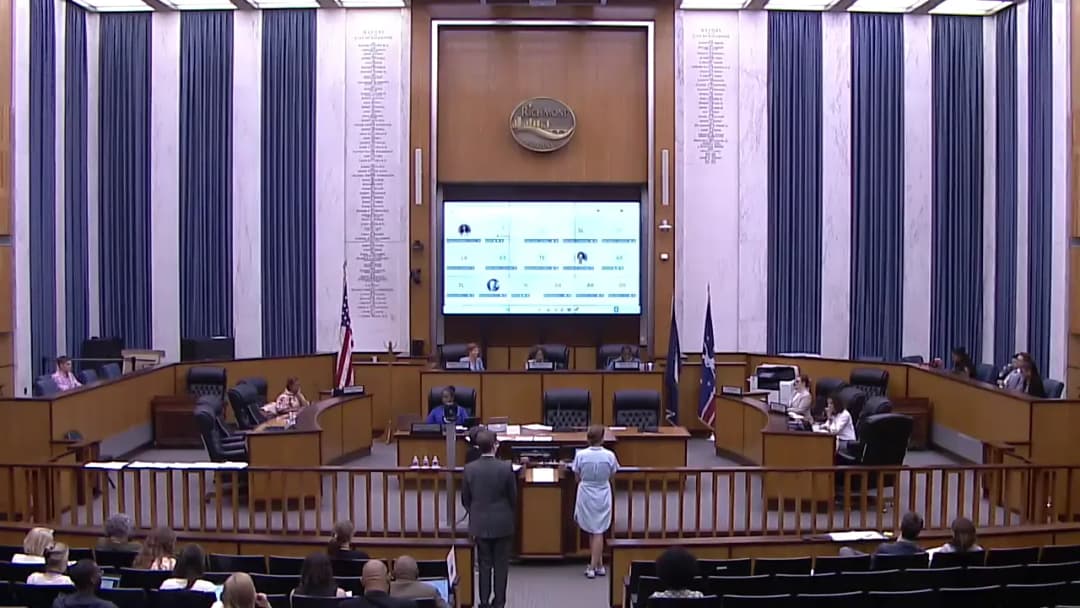
The City of Richmond Planning Commission met on July 22, 2026, to act on a light consent agenda. Discrepancy Note: The official meeting minutes list the meeting date as Tuesday, July 21, 2026, conflicting with the provided date of July 22, 2026. The provided date has been used as instructed. The meeting was called to order at 6:00 PM by Chair Poole. Nine commissioners were present, all voting members. The meeting was brief, adjourning at 6:06 PM. Consent Calendar The Commission considered three items on the consent agenda as a single block, with a combined staff presentation and public hearing. - Item 2 (ORD. 2026-167): Authorization for a special use permit to allow transitional housing at 1110 Oakwood Avenue (7th District). The Commission recommended approval to the City Council. - Item 3 (ORD. 2026-168): An amendment to a prior special use permit (Ord. No. 2025-152) for up to seven single-family attached dwellings at 2300 Ingram Avenue (8th District), modifying the addresses and plans. The Commission recommended approval to the City Council. - Item 4 (UDC 2026-08): A Location, Character, and Extent (LCE) review for the proposed architectural pavilion over the historic Lumpkin's Jail site, part of the larger Shockoe Campus project at 1500 East Franklin Street. Commissioner Pinnock, who identified himself as a senior project manager on the project team, recused himself from this vote. He expressed his enthusiasm for the project, calling it a "small but mighty piece of architecture" and noted the technical complexities of building near a sewer, floodway, Main Street Station, and I-95. The architecture was approved by the Commission. The consent agenda was adopted unanimously, with Commissioner Pinnock's abstention on Item 4 noted. Public Comments & Testimony There were no speakers during the public comment period for the consent agenda, either in person or online. Director's Report & Upcoming Items - Code Refresher: Chair Poole clarified at the start of the meeting that there were no code refresher items on the evening's docket, correcting a potential public misconception. - Council Action Update: The Director reported that the City Council had not met since the prior Planning Commission session. - Future Agenda: Potential items for the August 4, 2026 meeting were discussed. The Rezoning Monument Avenue case is set to appear as a continuation. The Shockoe Streets project is anticipated to appear, contingent on the schedule of the Public Art Commission. Key Outcomes - Minutes Approved: The minutes from the July 7, 2026 meeting were approved with 6 ayes and 3 abstentions (Commissioners Poole, Robertson, and McKenzie). - Consent Agenda Adopted: The entire consent agenda was adopted unanimously. Items 2 and 3 were forwarded to the City Council with a recommendation for approval. Item 4 received final architectural approval from the Commission. - Commissioner Recusal: Commissioner Pinnock formally abstained from voting on Item 4 (Lumpkin's Jail pavilion) due to his direct involvement as a member of the project team.

PROCEDURAL 75% · AFFORDABLE HOUSING 25%
62
JUL 21, 2026 · RICHMOND, VIRGINIA · CITY COUNCIL
Richmond Land Use, Housing and Transportation Committee Meeting - July 21, 2026

The Land Use, Housing and Transportation Standing Committee met on July 21, 2026, at 8:00 PM ET. The meeting covered board appointments, a five-year evaluation of the partial tax exemption program, amendments to the weed ordinance to allow native landscaping, adoption of the Oak Grove Hillside Bellmead community plan, a resolution to preserve the historic Westwood neighborhood, support for regional Smart Scale transportation projects, and a memorandum of understanding (MOU) between the city and Richmond Redevelopment and Housing Authority (RRHA) for public housing transformation. Consent Calendar - No consent calendar items were listed; all items were considered individually. Public Comments & Testimony - Item 1 (Ordinance 2026-113 – Native plants): Robin Allman (speaking in support) expressed gratitude for the amended ordinance, stating it is a "beautiful example of democracy in action" and praised collaboration with the Office of Sustainability. - Item 3 (Resolution 2026-R024 – Westwood neighborhood plan): Multiple speakers expressed support: - Jeanette Brown (president, Westwood Civic League) described the neighborhood's 150-year history and struggles with the city over infrastructure, urging approval. - Amy Addicts (homeowner, cultural preservationist) spoke in favor, citing her background and the need to protect the neighborhood. - Crystal Randolph (50-year resident) highlighted the community's resilience through Jim Crow and redlining, asking for protection. - Kate McHugh (new homeowner) described infrastructure issues (water pressure, sinkholes, construction debris) and asked for support. - Tammy Rose (long-time resident) expressed concern about potential rezoning of churches to mixed-use, which could lead to encroachment. - Robin Levy (resident of Bird Park) spoke in support, noting Westwood's vulnerability to redevelopment and displacement. - Ron Skinner (resident) emphasized the dignity and history of the community, calling it "worth saving." - Trina Lewis (trustee, Westwood Baptist Church) spoke about personal family history and the need to preserve the endangered historic community. - Cyan Crump (executive director, Historic Richmond) stated that the city's tax assessments increased land values by approximately 50% in the past year, driving displacement, and urged adoption of the resolution. - Items 4 and 5 (Smart Scale resolutions): No public comment. - Item 6 (MOU for Gilpin Court transformation): No public comment. Discussion Items - Boards and Commissions Report: Pamela Nichols presented current and projected vacancies through November 2026. The committee discussed appointments for the Affordable Housing Trust Fund Supervisory Board, Commission of Architectural Review, Community Transportation Advisory Committee, Public Arts Commission, Voice of Commission for RRHA, and Safety and Healthy Streets Commission. Several vacancies were continued to the October meeting. The committee voted to forward the recommended slate to council. - Presentation on Partial Tax Exemption Program (Five-Year Evaluation): Michelle Brown Peters (Deputy Director, DHCD) reported that the program has incentivized affordable housing creation and preservation. Key statistics: 20 applications received, 7 ineligible, 13 approved, 4 projects completed. Completed projects yielded 52 new affordable units, 117 market rate units, and 130 preserved affordable units. Pipeline includes 100 affordable units under renovation and 142 under construction. Current revenue impact positive ($86,009). Committee members asked about enforcement (annual reviews), anti-demolition conditions, and marketing. Concerns were raised about the 20% investment threshold for single-family homeowners at 80% AMI, with a suggestion to evaluate that requirement. - Item 1 – Ordinance 2026-113 (Weeds and native plants): Daniel Klein (Office of Sustainability) presented amendments removing the certification requirement and adding native plants to existing exemptions. Woody debris is allowed if part of a native landscape, and "cues to care" are included. The ordinance also includes a 90-day rollout and reporting. Committee members asked about the relationship between weed violations and native plants, and the need for education on maintenance. The committee voted to approve the amendment and forward to council. - Item 2 – Ordinance 2026-166 (Oak Grove Hillside Bellmead community plan): Mary Ann Pitts (PDR) presented the plan, which was developed 2023-2025, focusing on preserving the residential core while allowing development along corridors. Planning Commission approved in October 2025. Councilmember Robertson requested that the committee look at implementation benchmarks and timelines. The committee voted to approve and forward to council. - Item 3 – Resolution 2026-R024 (Westwood neighborhood plan): Councilmember Breton introduced the resolution, requesting PDR to work with residents to develop a community-driven plan to preserve the historic and cultural character of Westwood. Amendments were made to clarify boundaries and add historical context. Committee members expressed strong support, emphasizing the need to document history and protect marginalized communities. The committee voted to approve with amendments and forward to council. - Items 4 and 5 – Resolutions 2026-R026 and R027 (Smart Scale support): Mr. Wagner (administration) noted that these resolutions support regional partner projects. For Chesterfield, the city is partnering on a traffic calming project near River City Middle School. The committee voted to approve and forward to council. - Item 6 – Resolution 2026-R029 (MOU for Gilpin Court transformation): Thad Williamson, Sharon Ebert (DCAO), and Stephen Neismith (RRHA CEO) presented the MOU. Key provisions: creation of a joint Gilpin Transformation Working Group, a Jackson Ward Community Plan Steering Committee, one-for-one replacement of all 781 deeply affordable housing units, case management for residents, and a 10-year timeline. Councilmembers raised concerns about alignment with the code refresh, the people plan, and support for residents already moved out with vouchers. They requested an implementation strategy. The committee voted to approve and forward to council. Key Outcomes - Boards and Commissions: The committee approved the slate of appointments and reappointments as discussed, with some vacancies continued to October. (Vote: 3-0, all ayes) - Item 1 (Ordinance 2026-113): Approved with amendment to forward to City Council. (Vote: 3-0) - Item 2 (Ordinance 2026-166): Approved to forward to City Council. (Vote: 3-0) - Item 3 (Resolution 2026-R024): Approved with amendment to forward to City Council. (Vote: 3-0) - Items 4 and 5 (Resolutions 2026-R026 and R027): Approved to forward to City Council. (Vote: 3-0) - Item 6 (Resolution 2026-R029): Approved to forward to City Council. (Vote: 3-0) - Follow-ups: The committee will not meet in August. The next meeting is scheduled for September 22, 2026. Staff will follow up on: feasibility of anti-demolition conditions for partial tax exemption; evaluation of 20% investment threshold for single-family homes; 90-day report on native plant ordinance; implementation benchmarks for Oak Grove Hillside Bellmead plan; and implementation strategy, alignment with RPA Rising and code refresh, and support for voucher holders outside the Gilpin people plan for the MOU.

PUBLIC HOUSING 20% · HISTORIC PRESERVATION 18% · AFFORDABLE HOUSING 15% · SUSTAINABILITY 9%
63
JUL 21, 2026 · RICHMOND, VIRGINIA · CITY COUNCIL
Urban Design Committee Meeting – July 21, 2026: Shoko Valley Streets and Lumpkin's Jail Pavilion

Note on date discrepancy: The meeting minutes state the meeting was held on July 16, 2026, but the user-provided instructions specify the meeting date as July 21, 2026. This summary uses the latter date as instructed. The Urban Design Committee (UDC) convened on July 21, 2026, to review two major items: a Location, Character, and Extent (LCE) application for the Shoko Valley Streets Project (UDC 2026-07) and a final architecture review for the Lumpkin's Jail Archaeological Pavilion (UDC 2026-08). The committee also deferred a discussion on the Urban Design Guidelines Update for parks. The meeting lasted approximately three hours and included robust public comment and deliberation. Consent Calendar - No items were listed on the consent agenda. Public Comments & Testimony - Emily Shreer (Policy and Planning Manager, BikeWalk RVA at Sportsbackers) expressed support for the project's potential to calm traffic and improve safety, but raised concerns about bike infrastructure clarity and safety at the Mosby Street roundabout. She recommended a bike box, one-way bike lanes instead of a two-way cycle track, and clear wayfinding. - Craig Martin (Partner, Shako Records) supported the roundabouts and overall improvements, noting the area is currently dangerous. He emphasized the need for safe bike access to the Shako Arts and Culture area and upcoming events. - Cyan Crump (Executive Director, Historic Richmond) acknowledged positive elements (bike lanes, shared use paths, public art) but criticized the project's prioritization of cars, the widening of Oliver Hill Way, and the lack of meaningful public space. She urged a redesign of the primary roundabout and intersection with Broad Street. Discussion Items 1. Shoko Valley Streets Project (UDC 2026-07) - Staff Report (Ray, Planning Department): Presented a $50 million project funded largely by Smart Scale grants, featuring street improvements, bike lanes, shared-use paths, three traffic circles, and a new I-95 off-ramp. Staff recommended denial of the primary traffic circle layout due to poor use of residual land (a full city block converted to a roundabout with inaccessible green space). Staff recommended approval with six conditions, including adjusting the Lee Street/Mosby Street roundabout to be more pedestrian-oriented, adding gateway elements for the historic district, coordinating with the Shako Institute, and preparing for future art installations. Staff emphasized that the primary circle did not meet the 2019 conceptual condition to study residual land use. - Applicant Presentation (Lamont Benjamin, Public Works; Owen Peary, RK&K; Chris Daly, traffic engineer; David Beale, engineer): Detailed the project's history, outreach (34 engagements, 90% public acceptance), and engineering constraints. They defended the primary roundabout design, citing grade challenges, property impacts, and safety. They argued that the slip lane at Mosby/Lee Street provided a single-lane roundabout and that pedestrian crossings were improved. They requested approval to proceed to right-of-way acquisition. - Committee Discussion: Members raised concerns about the prioritization of vehicles over pedestrians and cyclists, especially at the Mosby roundabout (slip lane), the lack of placemaking at the primary entrance to the city, and the failure to integrate urban design principles. Some members favored a continuation or denial, while others argued for approval with conditions and a subcommittee to work with the applicant. The applicant requested no delays, warning of funding risks. 2. Lumpkin's Jail Archaeological Pavilion (UDC 2026-08) - Staff Report (Ray): The project involves a pavilion over the archaeological site of Lumpkin's Jail (a slave jail) as part of the Shako Institute campus. The architecture-only review (site plan to come later) was recommended for approval. The design features a brick masonry structure with integrated text panels, a perforated brick screen, and a reflection space. The pavilion is designed to withstand floodway constraints and preserve the archaeological remains. - Applicant Presentation (Genie Woolliver, City of Richmond; Bert Pennock, Baskerville): Explained the evolution from the 2019 concept, driven by floodway regulations and archaeological preservation needs. The design uses a "solid to open" metaphor, incorporates quotes from historical witnesses, and includes a bronze imprint of a cell floor. The pavilion is intended to be a gateway for the Richmond Slave Trail. - Committee Discussion: Members praised the design, noting it improved upon the concept. Questions covered materials, lighting, wayfinding, and integration with the future site. The committee commended the project's storytelling and sensitivity. Key Outcomes - Shoko Valley Streets Project (UDC 2026-07): Motion to recommend denial passed (7-0). The committee voted to recommend denial to the Planning Commission, citing: - Prioritization of vehicular traffic over pedestrian and bicycle modes. - Absence of human-scale placemaking at a primary city entrance. - Negative impact on future urban development. - Failure to satisfy the 2019 condition on residual land use. - The committee also recommended that if the Planning Commission approves the project, it should include the staff's six conditions and incorporate recommendations from BikeWalk RVA and Historic Richmond. - Lumpkin's Jail Archaeological Pavilion (UDC 2026-08): Motion to recommend approval passed unanimously (7-0). The committee found the architecture met the intent of the conceptual approval. - Urban Design Guidelines Update: Deferred to the August 16, 2026 meeting. - Next Steps: The Shoko Valley project will proceed to the Planning Commission on August 4, 2026. The applicant was urged to work with staff and community stakeholders before returning to UDC if changes are needed.

HISTORIC PRESERVATION 22% · TRANSPORTATION SAFETY 17% · ENGINEERING AND INFRASTRUCTURE 16% · PUBLIC ENGAGEMENT 13%
64
JUL 21, 2026 · RICHMOND, VIRGINIA · CITY COUNCIL
City Council Meeting Summary - July 21, 2026

The City Council convened on July 21, 2026, at 14:00 UTC to discuss zoning variances, public safety funding, and community development initiatives. The meeting proceeded without major disruptions, with focused deliberation on the proposed budget adjustments and environmental impact reports. Consent Calendar - Approved the minutes from the previous meeting dated July 7, 2026. - Approved the standard vendor contracts for municipal waste management services. Public Comments & Testimony - Jane Doe (Resident, District 4): Expressed strong opposition to the proposed reduction in street lighting budgets, arguing it would compromise public safety in residential zones. - Mark Smith (Representative, Local Business Alliance): Stated full support for the new commercial zoning overlay, noting that it aligns with 85% of current business needs in the downtown corridor. - Elena Rodriguez (Community Organizer, Green City Coalition): Raised concerns regarding the lack of community consultation for the riverfront park redesign, requesting a 30-day extension for public review. Discussion Items - Budget Adjustment: Councilmember Johnson presented a proposal to reallocate 15% of the remaining park maintenance fund to street repairs, citing urgent pothole data from the Department of Transportation. - Zoning Variance: The Planning Commission reviewed a variance request for a 4-story residential building in a 3-story zone, with the project sponsor requesting a density waiver based on affordable housing provisions. Key Outcomes - The consent calendar items were passed unanimously (7-0). - The street lighting budget reduction was deferred pending a review by the Public Safety Committee; motion failed on a 3-4 vote. - The commercial zoning overlay was approved with an 8-1 majority, contingent on a 2% annual revenue contribution to local arts programs. - The riverfront park redesign public review period was extended by 21 days as a direct result of the community organizer's testimony. - A task force was formed to address the 4-story zoning variance, with a final decision scheduled for the August 4, 2026 meeting.

66
JUL 15, 2026 · RICHMOND, VIRGINIA · CITY COUNCIL
Richmond Finance & Economic Development Committee Meeting - July 15, 2026

The Finance and Economic Development Standing Committee met on July 15, 2026, to consider several agenda items, including reappointments to city boards, a controversial ordinance amending the payment register, and resolutions related to housing trust funds and affordable housing developments. The meeting included detailed presentations, councilmember questions, and votes on multiple items. Consent Calendar - Reappointment of James Botion to the Participatory Budget Team Steering Commission and initial appointment of Ingrid Harding as a resident with a disability were approved unanimously. - Two reappointments to the Richmond Retirement System (Faith Philippo and Adam Grossman) were approved unanimously. Public Comments & Testimony - No public comments were made on any agenda item. Discussion Items - Ordinance 2026-081 (Payment Register): The administration presented proposed amendments based on lessons learned from producing the FY25 payment register. Key data points: 231,933 rows of payment data were reviewed; 34% (82,760 rows) contained redactable data via formulas; 66% (151,000 rows) required manual review by departments; only 1.2% (2,799 rows) were partially redacted after manual review. Temporary staff spent over 400 hours ($25,000 cost) and city staff spent 375 hours on training, data prep, and project management; Director Todd spent 80 hours personally. The proposed amendments would publish transaction-level data, exclude protected data proactively, and limit redactions to FOIA exemptions with supervisor review. Councilmember Gibson raised concerns about removing fields such as invoice description, check numbers, and the lack of P-card transparency. The ordinance was continued to the August 19 committee meeting to allow time for legal review of amendments. - Resolution 2026-R019 (Investigation of Payment Register Failures): Councilmember Gibson introduced a resolution for the Organizational Development Standing Committee to investigate the city's failure to publish monthly payment registers and the application of FOIA redactions. After discussion, the committee voted to forward the resolution to full council with no recommendation. - Ordinance 2026-164 (Affordable Housing Trust Fund): Amended city code to ensure all principal, interest, penalties, fees, and other receipts from affordable housing trust fund loans are reserved for the fund. Approved unanimously with multiple patrons added. - Ordinance 2026-165 (512 Hall Street Affordable Housing): Authorized a first amendment to a grant agreement to clarify requirements. Approved unanimously. - Ordinance 2026-170 (2811 Rady Street Affordable Housing): Authorized a grant agreement for construction of an affordable residential development. Approved unanimously. - Ordinance 2026-171 (Shuckle Legacy Foundation Grant): Authorized funding for planning the slavery and freedom heritage site. Approved unanimously. - Ordinance 2026-172 (Housing Cost Relief): Reappropriated $3.1 million from FY25-26 fund balance to fund housing cost relief initiatives, including $1 million to the Family Crisis Fund. Approved unanimously. Key Outcomes - Ordinance 2026-081 continued to the August 19, 2026 committee meeting for further review of amendments. - Resolution 2026-R019 forwarded to full council with no recommendation. - Ordinances 2026-164, 165, 170, 171, 172 all forwarded to council with recommendation to approve. - Reappointments for Participatory Budget Team and Richmond Retirement System approved. - The committee voted to cancel the August 2026 regular meeting.

TRANSPARENCY AND OVERSIGHT 75% · PROCEDURAL 13% · AFFORDABLE HOUSING 5% · PUBLIC ENGAGEMENT 4%
67
JUL 15, 2026 · RICHMOND, VIRGINIA · CITY COUNCIL
Richmond Finance and Economic Development Committee Meeting – July 15, 2026

The Richmond City Council Finance and Economic Development Standing Committee met on July 15, 2026, at 9:30 AM. The meeting covered board and commission appointments, a major ordinance on the city's payment register, a resolution to investigate payment register failures, and several housing and budget items. Boards and Commissions Appointments - The committee approved the reappointment of James Botion and initial appointment of Ingrid Harding to the Participatory Budgeting Steering Commission, and reappointments of Faye Flickpo and Adam Grossman to the Richmond Retirement System. All appointments were approved unanimously. - The committee voted to continue consideration of Economic Development Authority applications to the October meeting. Discussion Items - Ordinance 2026-081 (Payment Register) – The administration presented proposed amendments to the city code governing the payment register, following publication of the FY25 register on June 22, 2026. The FY25 register contained 231,933 rows of payment data. Of these, 82,760 records (36%) contained redactions: 80,000 rows (34%) redacted via formula (e.g., social services, tax payments, jurors) and 152,000 rows required manual review. The manual review of 151,000 rows resulted in only 2,799 partial redactions (1.2%). The process required 400+ hours of temporary staff time at a cost of $25,000, plus 80 hours of the Finance Director's time, 375 hours of city staff for training and data organization, and 192 hours of department staff for manual review. The proposed amendments would exclude certain fields (e.g., check numbers, invoice descriptions) and aggregate data at the transaction level rather than payee level, aiming to reduce the burden of redactions while maintaining transparency. Councilmember Gibson raised concerns about the scope of redactions, the exclusion of fields like payment document type, and the discretion given to the Finance Director in the new language. After debate, the committee voted to continue the ordinance to the August 19 committee meeting to allow for further refinement and legal review. - Resolution 2026-R019 (Investigation of Payment Register Failures) – This resolution would authorize the council's Organizational Development Standing Committee to investigate the city's failure to publish monthly payment registers as required by code, and to review application of FOIA exemptions. Councilmember Gibson noted that the FY25 register had tens of millions of dollars in redactions, and that the council as a governing body could review the document with fewer redactions than the public. The committee voted to forward the resolution to the full council with no recommendation. Other Agenda Items - Ordinance 2026-164 (Affordable Housing Trust Fund) – Amended code to ensure principal, interest, penalties, fees, and other receipts from trust fund loans and grants are reserved for the fund. Forwarded to council with approval recommendation. - Ordinance 2026-165 (512 Hall Street LLC) – Authorized amendment to a grant agreement clarifying affordable housing requirements. Forwarded to council with approval recommendation. - Ordinance 2026-170 (2811 Rady Street) – Authorized grant agreement for affordable residential development. Forwarded to council with approval recommendation. - Ordinance 2026-171 (Shockoe Legacy Foundation) – Authorized grant for planning and development of the slavery and freedom heritage site, including Lumpkins Pavilion and National Slave Museum. Forwarded to council with approval recommendation. - Ordinance 2026-172 (Housing Cost Relief) – Reappropriated $3.1 million from FY25-26 General Fund Committed Fund Balance for housing cost relief initiatives, including $1 million for the family crisis fund. Forwarded to council with approval recommendation. Key Outcomes - Appointments: Approved (unanimous) for Participatory Budgeting Commission (Botion, Harding) and Retirement System (Flickpo, Grossman). Economic Development Authority continued to October. - Ordinance 2026-081 (Payment Register): Continued to August 19 committee meeting for further amendment and legal review. - Resolution 2026-R019 (Investigation): Forwarded to full council with no recommendation (unanimous). - Ordinances 2026-164, 165, 170, 171, 172: All forwarded to full council with recommendation to approve (each unanimous). - The committee agreed to cancel its August 2026 meeting.

TRANSPARENCY AND OVERSIGHT 66% · PROCEDURAL 23% · AFFORDABLE HOUSING 5% · PUBLIC ENGAGEMENT 2%
68
JUL 9, 2026 · RICHMOND, VIRGINIA · CITY COUNCIL
Richmond EHS Committee Meeting July 9, 2026: RPS Deficit, Sales Tax Referendum, Grants

The Education and Human Services (EHS) Standing Committee of the Richmond City Council met on July 9, 2026, at 2:45 PM EDT. The committee heard a significant update from Richmond Public Schools (RPS) on a $9 million budget deficit stemming from the final state budget, considered a resolution to place a 1% local sales tax for school construction on the November ballot, and approved a major overhaul of the city's grant-making process. Additional items included board vacancies, a DCAO update, and scheduling decisions. Discussion Items RPS Budget Deficit Update - Superintendent Jason Kamras (present despite illness) reported that RPS faces a roughly $9 million deficit after the state budget eliminated $7.6 million in proposed one-time flexible funding and provided only partial funding for a 4% teacher raise. RPS will implement a 3.17% total increase (2% plus a 1.17% step increase) instead of the full 4%. He noted that for every 35 cents the state provides for raises, the city must provide 65 cents. RPS is exploring measures to close the gap while avoiding layoffs, furloughs, or pay reductions: reducing vacancies, increasing class sizes at the secondary level, selling non-mission-critical vehicles and equipment, and eliminating non-essential professional development, travel, and food for meetings. - School Board Chair Shabonda Fernandez stated that RPS had already planned for a $21 million shortfall; an additional $9 million cut would total $30 million, which she called "devastating." She requested consideration of emergency funding from the city, possibly from surplus rental tax funds, to restore critical items like mental health services and annual substitutes. She emphasized that a one-time infusion would give RPS time to plan for future cuts. The school board is scheduled to meet July 23 to make final decisions; Chair Fernandez noted that the earlier the city can show commitment, the less disruptive the cuts will be. - Council Chair Lynch acknowledged the need and asked administration and council leadership to explore a vehicle for ongoing collaborative budget discussions between council, schools, and administration. She and Vice President Jordan will work with the mayor’s office to develop a response to RPS’s memo. - Superintendent Kamras added that the state’s late budget passage (the day before the legal deadline) prevented RPS from managing the cuts through normal budget processes. He expressed gratitude for record city investments that have produced improved graduation rates and SOL scores. Ordinance 2026-169: Grant-Making Restructuring - Dominic Barrett, Senior Policy Advisor, presented the ordinance, which formalizes a new grant-making process developed over several years. After an RFP issued in December 2025, the city selected three grant makers: CultureWorks (arts/culture), United Way of Greater Richmond and Petersburg (children/families and economic mobility), and Richmond and Henrico Public Health Foundation (health). The city retains oversight, and grant makers will report annually. The ordinance transfers funds from reserve lines to the appropriate departments and authorizes the CAO to execute agreements. An information session for nonprofits is set for July 29; 120 RSVPs have been received. The committee voted unanimously to recommend approval. Resolution 2026-R20-028: Local Sales Tax Referendum for Schools - Council Vice President Jordan explained that the resolution would place a question on the November 2026 ballot asking voters whether to authorize a 1% local sales tax to fund capital projects for public school construction or renovation. If approved, the tax would be levied up to 1% for 20 years. She highlighted this as a new tool from the state to address persistent school facility needs. - Lawson Saria, Chief of Staff to Mayor Avula, expressed the mayor’s support and commitment to a thorough analysis. The mayor’s pillar of supporting children’s education aligns with this tool. A comprehensive briefing is scheduled for the council’s July 27 meeting, including revenue projections, budgetary impacts, and implementation details. - David Rose of Davenport & Company, the city’s financial advisor, presented initial revenue estimates. Based on the city’s 2025 comprehensive audit, the 1% local option sales tax would generate approximately $45 million annually (net after exemptions for food, beverage, and personal hygiene). With 2% average annual growth, this could reach over $65 million by year 20. The funds could be bonded to accelerate the existing $800 million, 20-year school capital program (of which about $450 million remains to be borrowed). Mr. Rose called this the most significant financial tool in his 30-year tenure. - Superintendent Kamras provided context on school facility needs: the average building age is 66 years, with 12 buildings over 100 years old. Immediate maintenance needs total $23 million, plus $30 million in annual deferred maintenance. Two major projects are in the current facilities plan: a new CTE Center on the south side (Phase 1: $65 million, Phases 1&2 total $145-165 million) and Woodville Elementary rebuild ($50 million, with $12.4 million in state funds at risk of reversion if construction doesn’t begin soon). The new master facilities plan will undergo community engagement in summer/fall 2026 with a draft to the school board in late 2026. - Councilmembers discussed the need for clear information on how funds will be used, transparency, potential impacts on other taxes (e.g., meals tax), and equity. The committee voted unanimously to recommend approval. Board Vacancies - Deputy City Clerk Kylie Kessaker presented a report of current and projected vacancies through November. The committee voted in block to forward the following appointments (with one continuation) to full council for approval: - Advisory Board of Recreation and Parks: Alexis Santistabon (6th District) - Aging and Disabilities Advisory Board: Mary Player (9th District), Christopher Roberson (attorney/paralegal) - Future of Workforce Commission: Noel Cortez (7th District) - Human Rights Commission: Drake Randolph (5th District, RPS student) - J. Sgt. Reynolds Community College Board: Lisa Harrison (2nd District) - Lewis Ginter Botanical Garden: Anna Aquino, Mary Parker – consideration of Lisa Harrison continued to allow CEO to discuss interest. - Maggie L. Walker Initiative Citizens Advisory Board: Kai Banks (7th District), Christian Washington (6th District) - Richmond Public Library Board: Linda Peaching (3rd District) and Samuel Runner (7th District) DCAO Update & Portfolio Changes - Amy Popovich, Deputy CAO for Human Services, noted that effective July 1, Parks, Recreation and Community Facilities moved to the Operations portfolio; Office of Community Wealth Building moved to Housing and Economic Development; and Office of Neighborhood Engagement moved to the CAO’s office. She highlighted summer youth programming (1,200+ youth) and new grants from the Virginia Opioid Abatement Authority: $300,000 for housing stabilization for substance-impacted individuals, $47,000 for EMS-initiated buprenorphine, and $76,000 to continue a resource mapping project. She also announced Governor Spanberger’s appointment of Greg Hopkins to the Virginia Criminal Justice Board. Committee Schedule - The committee agreed to cancel the August 2026 meeting but will continue work on the RPS budget issue via an ad hoc group. Discussion of the draft schedule through February 2027 was tabled to allow broader council input. Key Outcomes - Ordinance 2026-169 (grant restructuring) was approved by voice vote (2-0, with member Burton present? Actually recorded as Aye from Mr. Bredson? Wait transcript says "Mr. Bredson. Aye, aye. Chair Lynch. Aye." So both ayes. It will be forwarded to full council with a recommendation to approve. - Resolution 2026-R20-028 (sales tax referendum) was approved by voice vote (Mr. Bretzing? Actually transcript says "Mr. Bretzing. Aye. Chair Lynch. Aye.") and will be forwarded to full council with a recommendation to approve. Councilmember Jordan added herself as co-patron. - Board appointments were forwarded to full council for approval, with the exception of Lisa Harrison’s application for Lewis Ginter Botanical Garden, which was continued. - No August EHS committee meeting was scheduled; staff will continue to work on RPS budget response and other topics. - Draft EHS schedule through February 2027 was tabled. - The next EHS meeting is set for September 10, 2026, with agenda items including an update on non-departmental grant restructuring and a presentation from the Richmond Redevelopment and Housing Authority.

FISCAL SUSTAINABILITY 44% · PROCEDURAL 28% · ENGINEERING AND INFRASTRUCTURE 8% · PERSONNEL MATTERS 5%
69
JUL 9, 2026 · RICHMOND, VIRGINIA · CITY COUNCIL
Richmond City Council Education and Human Services Committee Meeting - July 9, 2026

The Education and Human Services (EHS) Committee met on July 9, 2026, at 10:00 AM to discuss Richmond Public Schools' budget deficit, a proposed sales tax referendum for school capital projects, board appointments, and updates from the Department of Human Services. Public Comments & Testimony - No public comments were made. The chair opened and closed public comment for items not on the agenda and for each agenda item with no speakers. Discussion Items - RPS Budget Deficit: Superintendent Cameras reported a $9 million deficit due to the state budget eliminating $7.6 million in one-time flexible funding and providing only partial funding for a 4% teacher raise, resulting in RPS offering a 3.17% increase. RPS is considering cuts including elimination of annual substitute roles, reducing vacancies, increasing class sizes at secondary level, selling non-mission-critical vehicles, and cutting non-essential professional development. School Board Chair Shabonda Fernandez requested emergency funding from the city, noting that RPS already faced a $21 million shortfall, making total potential cuts $30 million. Council members asked the administration to explore options and committed to forming a collaborative funding group. - Ordinance 2026-169 Non-Departmental Grant Restructuring: Dominic Barrett presented the ordinance to transfer funds from reserve lines to three grant makers (Culture Works, United Way, Richmond and Henrico Public Health Foundation) after a six-month RFP process. The committee approved the ordinance. - Resolution 2026-R028 Sales Tax Referendum: Council Vice President Jordan introduced a resolution to place a 1% local sales tax on the November ballot for school capital projects. David Rose of Davenport & Co. estimated initial annual revenue of $45 million (growing to over $65 million over 20 years). Superintendent Cameras outlined immediate maintenance needs ($23 million), deferred maintenance ($30 million annually), and specific projects: CTE Center phase 1 ($65 million, with $10 million gap) and Woodville Elementary ($50 million, with $37 million gap). Administration committed to providing a comprehensive plan by July 27. Council discussed potential reduction of the meals tax to offset impact on restaurants. The resolution was approved by the committee. - Board Vacancies: Deputy City Clerk presented applications for multiple boards. The committee approved appointments in block with one continuation for Lewis Ginter Botanical Garden. - DCAO Update: Amy Popovich reported on portfolio changes, youth summer programs (over 1,200 children), and new opioid abatement grants ($300,000 for housing stabilization, $47,000 for EMS buprenorphine initiation, and $76,000 for resource mapping). Key Outcomes - Ordinance 2026-169 was approved by the committee (recommendation to full council). - Resolution 2026-R028 was approved by the committee (recommendation to full council). - Board appointments were approved in block; one application continued. - No August EHS meeting was scheduled; next meeting is September 10, 2026. - Staff report noted that a follow-up memo on RPS funding and a comprehensive sales tax briefing are expected by July 27.

ECONOMIC DEVELOPMENT 36% · FISCAL SUSTAINABILITY 32% · PROCEDURAL 17% · PROCUREMENT 6%
70
JUL 8, 2026 · RICHMOND, VIRGINIA · CITY COUNCIL
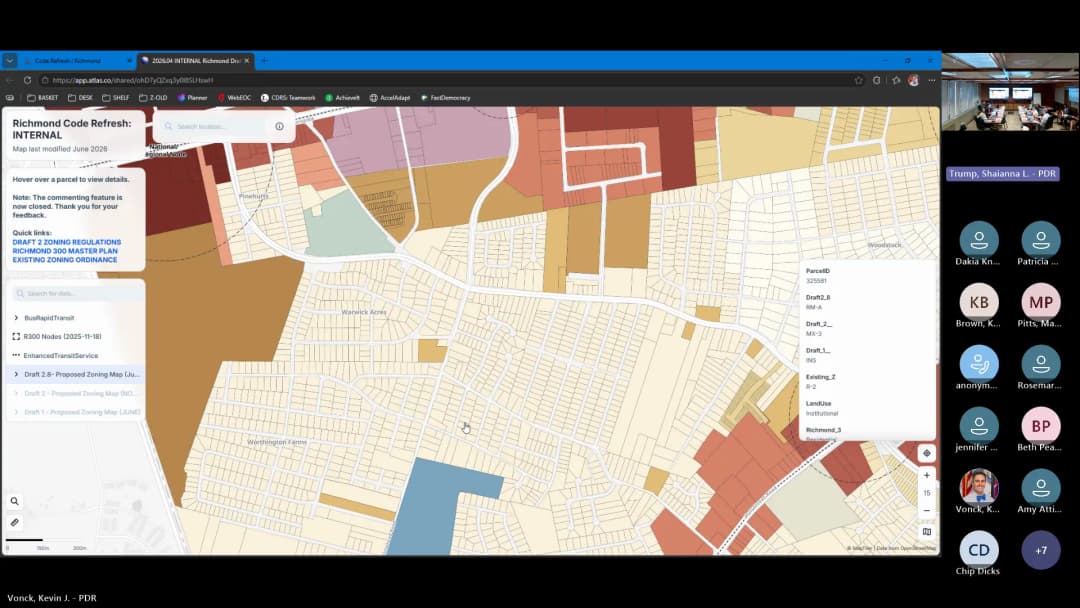
Richmond Planning Commission Work Session on Code Refresh – July 8, 2026

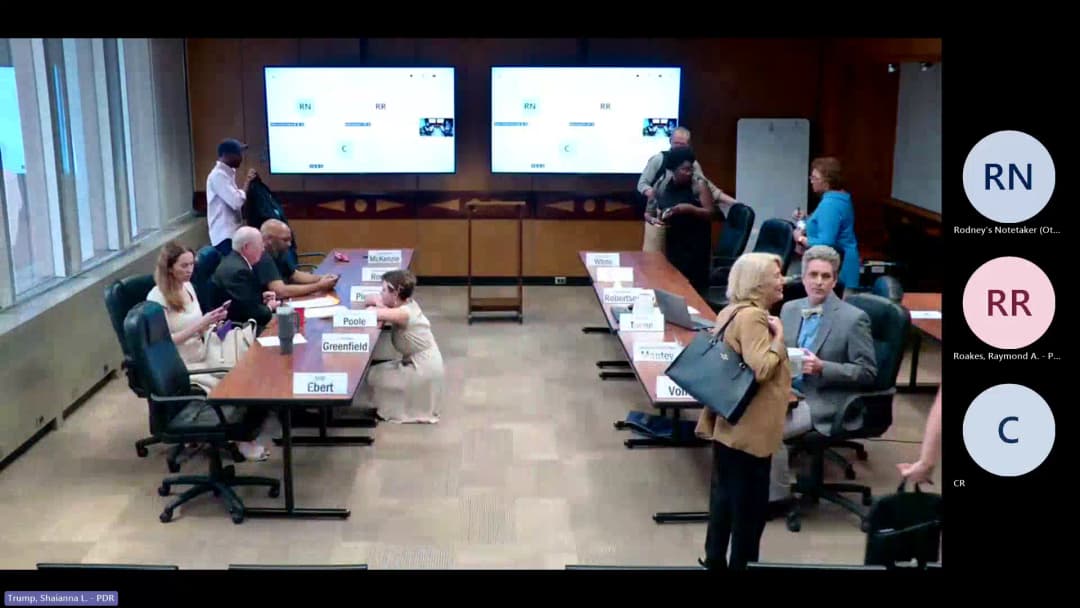
This work session of the Richmond Planning Commission focused on the zoning code refresh, marking the transition from draft two to draft three. Staff presented key questions and sought commissioner feedback on three contentious topics: household size limits, zoning of places of worship, and the number of dwelling units on a lot. The meeting began at 5:15 PM and concluded at 6:00 PM, with a virtual participant approved via roll call. Opening & Virtual Participation - Chair called roll; commissioners present: Poole, Greenfield, Ebert, Pennock, White, McKenzie. Ms. Knight joined virtually from Washington, D.C. for a work conference. A motion to allow her virtual participation passed unanimously. Staff Presentation - Director presented the code refresh rationale: the current 50-year-old zoning code does not align with the Richmond 300 master plan goals for housing choice, walkability, economic vitality, and climate resilience. - The code refresh process involved a pattern book study showing many existing properties are non-conforming, development scenarios from consultant RKG, input from a Zoning Advisory Committee (ZAC), and over 5,000 points of public engagement. - Three key questions for discussion: 1. Household size: Staff proposed moving from the current limit of three unrelated persons (or eight under certain Code of Virginia provisions) to relying on the building code’s occupancy standards based on square footage per bedroom. 2. Zoning places of worship: Staff shifted from zoning all worship properties as institutional (draft one) or mixed-use MX3 (draft two) to more contextual residential zoning (RMA, RMB, RMC, and RC – residential cottage) to allow housing while preserving neighborhood scale. 3. Dwelling units on a lot: Staff proposed allowing three dwelling units on a lot only if the existing structure is preserved (preservation bonus), with an accessory unit up to 1,200 square feet. If the existing structure is demolished, the lot reverts to current allowances (principal unit + ADU). For lots vacant for five years, three units are permitted by right. The preservation bonus applies uniformly citywide. Staff noted 2,337 parcels citywide that have been vacant for five years or more. Commissioner Discussion & Questions - Commissioner Pennock supported deferring to the building code for household size, praised the preservation bonus, and inquired about curb cuts for multiple units and the compatibility of church redevelopment with neighborhood form. He suggested that rebuilt structures on deteriorated foundations should be limited to the existing footprint. - Commissioner McKenzie asked about vacant lot verification (via assessor records) and raised concerns about the preservation bonus potentially encouraging teardowns for large single-family homes rather than duplexes. Staff noted lot coverage rules and maximum unit sizes (1,200 sq ft for secondary units) could address this. - Ms. Knight questioned the impact of increased density on emergency services and infrastructure. Staff responded that growth along nodes and corridors is planned, and project-specific reviews (fire, public works) will still apply. She also asked about tree canopy requirements in denser districts; staff emphasized retaining lot coverage limits and the option of off-site mitigation in the vicinity. - Commissioner White expressed concern that design standards (e.g., bicycle storage, bus stop pads, tree canopy minimums) would add significant costs and deter infill development. Staff confirmed draft three would simplify many standards, focusing on key elements like tree canopy thresholds for larger projects. - Ms. Ebert questioned the proportionality of ADU sizes relative to the primary dwelling, worried about upzoning worship properties out of context, and suggested that five years of vacancy for the demolition exception could create blighting influences. She recommended that any redevelopment of worship sites beyond context should require an SUP or rezoning. - Commissioner Greenfield echoed support for deferring to building code on occupancy, called for fairness across the city on dwelling unit allowances, and urged not losing sight of larger code refresh goals (modernization, reducing SUPs, legalizing non-conforming uses). She noted the RKG analysis shows limited production from the dwelling unit proposal and that most growth will occur on nodes and corridors. - Commissioner Robertson asked about industrial land opportunities for job creation and how city-owned surplus land will be zoned. Staff confirmed industrial zones are preserved and that city-owned parcels will be zoned per future land use, with the city retaining leverage for affordability in negotiations. - Chair asked about public engagement numbers: Richmond 300 had 8,500 attendees, 5,000 survey responses, 229 community meetings, and 2,000 map comments. Staff outlined plans for increased outreach on draft three, especially to underrepresented groups, and emphasized explaining technical details like how occupancy limits translate from building code square footage. The chair also questioned the jump in ADU size from 500 to 1,200 sq ft; staff explained it was based on housing partners’ feedback about family-sized units and proportionality to the principal dwelling. Key Outcomes - No formal votes were taken; the session was advisory for drafting the third iteration of the code. - Staff committed to incorporating feedback into draft three, including: - Simplifying design standards and reducing cost burdens on smaller infill projects. - Exploring an off-ramp for deteriorated structures via appeals to BZA. - Adjusting ADU size limits to ensure subordination to the principal dwelling. - Continuing contextual zoning for worship properties, balancing state legislation for affordable housing by right. - Ensuring citywide consistency on dwelling unit allowances. - The draft three is expected to be released in July 2026, with subsequent review by City Council and the Planning Commission for final adoption.

LAND USE AND ZONING 84% · COMMUNITY ENGAGEMENT 7% · ECONOMIC DEVELOPMENT 3% · PROCEDURAL 2%
OPENPUBLICA · PUBLIC MEETING INDEXUPDATED DAILY · openpublica.com