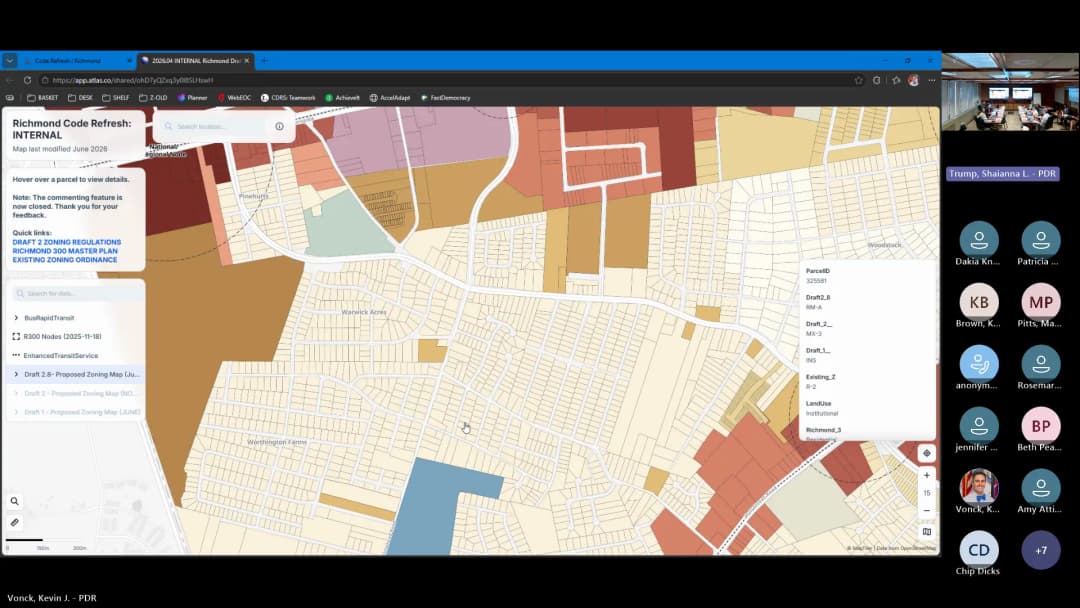
This work session of the Richmond Planning Commission focused on the zoning code refresh, marking the transition from draft two to draft three. Staff presented key questions and sought commissioner feedback on three contentious topics: household size limits, zoning of places of worship, and the number of dwelling units on a lot. The meeting began at 5:15 PM and concluded at 6:00 PM, with a virtual participant approved via roll call. Opening & Virtual Participation - Chair called roll; commissioners present: Poole, Greenfield, Ebert, Pennock, White, McKenzie. Ms. Knight joined virtually from Washington, D.C. for a work conference. A motion to allow her virtual participation passed unanimously. Staff Presentation - Director presented the code refresh rationale: the current 50-year-old zoning code does not align with the Richmond 300 master plan goals for housing choice, walkability, economic vitality, and climate resilience. - The code refresh process involved a pattern book study showing many existing properties are non-conforming, development scenarios from consultant RKG, input from a Zoning Advisory Committee (ZAC), and over 5,000 points of public engagement. - Three key questions for discussion: 1. Household size: Staff proposed moving from the current limit of three unrelated persons (or eight under certain Code of Virginia provisions) to relying on the building code’s occupancy standards based on square footage per bedroom. 2. Zoning places of worship: Staff shifted from zoning all worship properties as institutional (draft one) or mixed-use MX3 (draft two) to more contextual residential zoning (RMA, RMB, RMC, and RC – residential cottage) to allow housing while preserving neighborhood scale. 3. Dwelling units on a lot: Staff proposed allowing three dwelling units on a lot only if the existing structure is preserved (preservation bonus), with an accessory unit up to 1,200 square feet. If the existing structure is demolished, the lot reverts to current allowances (principal unit + ADU). For lots vacant for five years, three units are permitted by right. The preservation bonus applies uniformly citywide. Staff noted 2,337 parcels citywide that have been vacant for five years or more. Commissioner Discussion & Questions - Commissioner Pennock supported deferring to the building code for household size, praised the preservation bonus, and inquired about curb cuts for multiple units and the compatibility of church redevelopment with neighborhood form. He suggested that rebuilt structures on deteriorated foundations should be limited to the existing footprint. - Commissioner McKenzie asked about vacant lot verification (via assessor records) and raised concerns about the preservation bonus potentially encouraging teardowns for large single-family homes rather than duplexes. Staff noted lot coverage rules and maximum unit sizes (1,200 sq ft for secondary units) could address this. - Ms. Knight questioned the impact of increased density on emergency services and infrastructure. Staff responded that growth along nodes and corridors is planned, and project-specific reviews (fire, public works) will still apply. She also asked about tree canopy requirements in denser districts; staff emphasized retaining lot coverage limits and the option of off-site mitigation in the vicinity. - Commissioner White expressed concern that design standards (e.g., bicycle storage, bus stop pads, tree canopy minimums) would add significant costs and deter infill development. Staff confirmed draft three would simplify many standards, focusing on key elements like tree canopy thresholds for larger projects. - Ms. Ebert questioned the proportionality of ADU sizes relative to the primary dwelling, worried about upzoning worship properties out of context, and suggested that five years of vacancy for the demolition exception could create blighting influences. She recommended that any redevelopment of worship sites beyond context should require an SUP or rezoning. - Commissioner Greenfield echoed support for deferring to building code on occupancy, called for fairness across the city on dwelling unit allowances, and urged not losing sight of larger code refresh goals (modernization, reducing SUPs, legalizing non-conforming uses). She noted the RKG analysis shows limited production from the dwelling unit proposal and that most growth will occur on nodes and corridors. - Commissioner Robertson asked about industrial land opportunities for job creation and how city-owned surplus land will be zoned. Staff confirmed industrial zones are preserved and that city-owned parcels will be zoned per future land use, with the city retaining leverage for affordability in negotiations. - Chair asked about public engagement numbers: Richmond 300 had 8,500 attendees, 5,000 survey responses, 229 community meetings, and 2,000 map comments. Staff outlined plans for increased outreach on draft three, especially to underrepresented groups, and emphasized explaining technical details like how occupancy limits translate from building code square footage. The chair also questioned the jump in ADU size from 500 to 1,200 sq ft; staff explained it was based on housing partners’ feedback about family-sized units and proportionality to the principal dwelling. Key Outcomes - No formal votes were taken; the session was advisory for drafting the third iteration of the code. - Staff committed to incorporating feedback into draft three, including: - Simplifying design standards and reducing cost burdens on smaller infill projects. - Exploring an off-ramp for deteriorated structures via appeals to BZA. - Adjusting ADU size limits to ensure subordination to the principal dwelling. - Continuing contextual zoning for worship properties, balancing state legislation for affordable housing by right. - Ensuring citywide consistency on dwelling unit allowances. - The draft three is expected to be released in July 2026, with subsequent review by City Council and the Planning Commission for final adoption.
Public Meetings - Richmond, Virginia
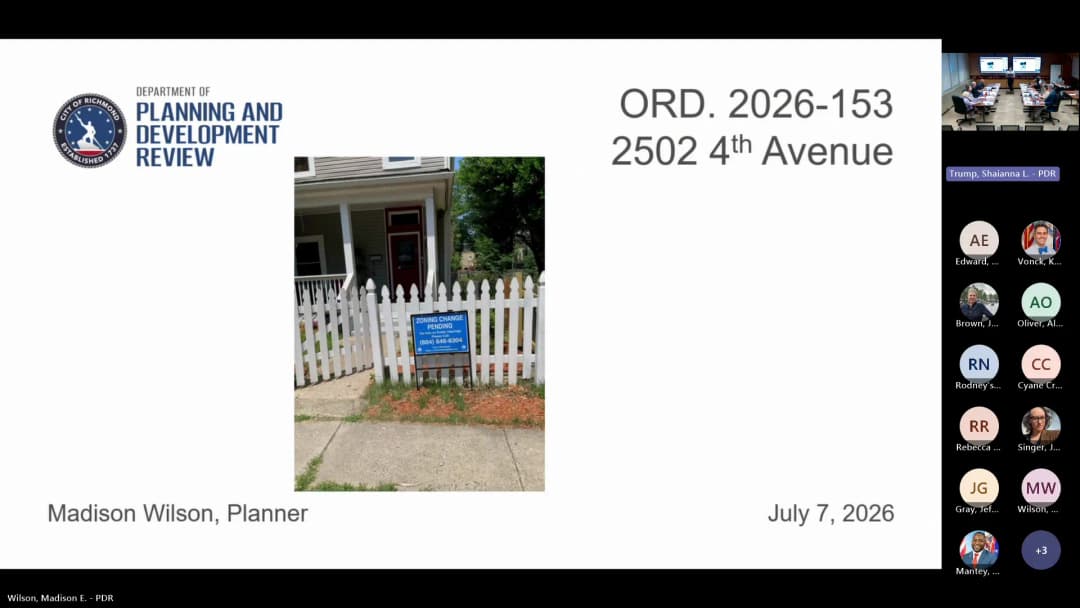
Public Meetings - Richmond, VirginiaThe Richmond City Planning Commission met on July 8, 2026 (noted discrepancy: the official minutes state the meeting occurred on Tuesday, July 7, 2026, at 6:00 p.m. The user-provided date of July 8, 2026, is used per instruction). The meeting was called to order at 6:00 p.m. and adjourned at 7:20 p.m. All seven present commissioners voted unanimously to allow Commissioner Rebecca Rowe to participate virtually due to a medical condition. Commissioners Ellen Robertson and Victor Mckenzie Jr. were absent. Consent Calendar - Item 2 – Continuance: Ordinance 2026-093 (3317 Rear Monument Avenue, special use for up to four single-family attached dwellings) was continued to the August 4, 2026, meeting (transcript references August 7, 2026; minutes state August 4 – discrepancy noted). Motion passed unanimously. - Consent Agenda Items (as amended): The following items were recommended for approval to City Council en bloc after one item (Item 4) was moved to the Regular Agenda upon a public comment request: - Item 3: Ordinance 2026-152 – Street closure of a portion of Lafayette Street (approx. 5,159 sq ft). - Item 5: Ordinance 2026-156 – Special use for up to six single-family detached dwellings at 5219, 5221, and 5221 ½ Euclid Avenue (7th District). - Item 6: Ordinance 2026-157 – Amendment to increase allowed dwelling units from 65 to 73 at 5300 Rear Hull Street Road, 5311, 5315, 5323 Warwick Road (9th District). - Item 7: Ordinance 2026-161 – Budget transfer of $480,000 from the Fire and Emergency Services Special Fund for a Burn Tower Replacement project. - Item 8: Ordinance 2026-162 – Acquisition for Hobby Hill Lake Dam Rehabilitation Project. - Item 9: Ordinance 2026-163 – Acquisition of 5624 Campbell Avenue for CSO-012 Storage Tank project. - Item 10: UDC 2026-07 – Referred to July 16, 2026 Urban Design Committee and July 23, 2026 Public Art Commission meeting. - Item 11: UDC 2026-08 – Referred to July 16, 2026 Urban Design Committee meeting. - Item 12: CPCR.2026.005 – Resolution approving the Public Art Commission Work Plan for FY2027 – Approved. Public Comments & Testimony - Consent Agenda – Item 4 (5 North Colonial Avenue Rear): Mark Kukowski, a neighbor, expressed concern about the proposed extension of an 18-foot portion of the alley into public right-of-way, stating that sanitation and emergency vehicles already struggle to maneuver. He requested the item be moved to the Regular Agenda for fuller consideration. The Commission unanimously granted this request. - Regular Agenda – Item 4 (5 North Colonial Avenue Rear): Mr. Kukowski reiterated his opposition, presenting a diagram showing turning radius challenges. After hearing testimony from the applicant (Mark Baker) that the Department of Public Works (DPW) had conducted multiple reviews, Mr. Kukowski acknowledged DPW’s approval but maintained his concern. - Regular Agenda – Item 14 (1235 North 36th Street): - Mary Fitzgerald (adjacent neighbor at 1233 North 36th Street) expressed confusion about the purpose of the project and concern about property line encroachment and a sign posted on her yard. She was assured the special use permit does not authorize encroachment. - Andre Fitzgerald (son of Mary Fitzgerald) opposed the project, stating the land has been undisturbed for decades, houses are “popping up” in spaces that were yards, and he distrusts that construction will not infringe on his mother’s property. He also cited potential harm to the local ecosystem and increased traffic congestion. - Inga Brown opposed the project, raising the possibility of unmarked graves on the property and arguing that recent development on the opposite side of the street has already caused severe traffic congestion, with cars occupying turnaround spaces and creating hazards. Discussion Items - Item 4 – Ordinance 2026-155 (5 North Colonial Avenue Rear): Staff (Ms. Oliver) presented the request for a special use permit to construct six attached garages that would replace an existing dilapidated garage. The new structure would exceed the 12-foot height limit and allow leasing to persons outside the block. Staff recommended approval, citing alignment with the master plan and DPW’s review of alley access. The applicant (Mark Baker of Baker Development Resources) stated that DPW reviewed the plans twice, including a truck maneuver test, and that the closure of 18 feet of alley (reducing it from 40 to 22 feet) was still greater than the typical 20-foot alley. He noted six letters of support from neighbors. Commissioners questioned DPW representative Kara (present) who confirmed the closing ordinance is under review in the City Attorney’s office. The Commission voted unanimously to recommend approval to City Council. - Item 13 – Ordinance 2026-153 (2502 4th Avenue): Staff (Ms. Madison Wilson) presented the special use request for an in-home daycare (“day nursery”) for up to 12 children. The property owner/applicant, Letitia Jones, explained that she has operated a licensed daycare for 16 years, recently moved to this property, and has been limited to four children since January 2026 while awaiting the special use permit. She described pickup/drop-off procedures (front door, 7:00–8:30 a.m. and 4:30–5:30 p.m.) and stated parking and traffic have not been issues. No public speakers commented. The Commission voted unanimously to recommend approval. - Item 14 – Ordinance 2026-154 (1235 North 36th Street): Staff (Secretary Shaianna Trump) presented the special use request to subdivide a 0.25-acre vacant lot into two lots for single-family detached dwellings. The lots would be substandard (5,400 sq ft each, 45 ft width vs. required 6,000 sq ft and 50 ft). Relief from the 25-foot front yard setback (proposing 15 ft) was also requested. The project includes extending North 36th Street pavement (approximately 102 feet) and paving a connection to the rear alley. Staff noted a drafting error in the written conditions (incorrectly stating “two single-family detached dwellings and one single-family detached”) but confirmed the intent is for two dwellings. The applicant (John Carlos, representing the property owner) said engagement was with the neighborhood association and city departments but not directly with neighbors. After public testimony (described above), the Commission voted unanimously to recommend approval to City Council. Key Outcomes - Votes and Decisions: - Motion to allow virtual participation for Commissioner Rowe: carried unanimously (7-0). - Adoption of June 16, 2026 minutes: 6-0-1 (Commissioner Rowe abstained). - Continuance of Item 2 to August 4, 2026 (minutes) or August 7, 2026 (transcript): carried unanimously. - Move of Item 4 to Regular Agenda: carried unanimously. - Consent Agenda as amended adopted: carried unanimously. - Regular Agenda – Item 4 (5 North Colonial Avenue Rear): approved unanimously; recommended to City Council. - Regular Agenda – Item 13 (2502 4th Avenue): approved unanimously; recommended to City Council. - Regular Agenda – Item 14 (1235 North 36th Street): approved unanimously; recommended to City Council. - Next Steps: All recommended items will be forwarded to City Council for final action. Secretary Trump noted that the second August 2026 Council meeting is expected to have a large docket (potentially up to 30 items), and commissioners were asked to inform staff of any vacation plans to ensure a quorum.
The Richmond City Council held a special meeting on July 7, 2026, at 2:30 PM. The meeting was called to order, and after a quorum was confirmed (with members Gibson, Jones, Robertson, and Lynch absent), the clerk introduced the emergency evacuation announcement. The sole agenda item was the introduction of legislation items 1 through 6. Introduction of Legislation - The council introduced six items of legislation as presented. A list of the legislation was made available for public inspection at the rear of the council chamber, and electronic copies were to be posted on the city's website on the same date. Key Outcomes - The meeting was adjourned immediately after the introduction of legislation, with no further discussion or action taken.
The Richmond City Council Organizational Development (OD) Standing Committee met on July 7, 2026, to approve previous minutes and receive two major presentations: a no-cost solar power purchase agreement (PPA) opportunity for city-owned buildings and an update on the transition of emergency medical dispatch calls to the Richmond Ambulance Authority (RAA). Council members expressed strong support for the solar initiative while raising concerns about the implementation timeline for the EMS transition, which was originally set to take effect 30 days after the June 8, 2026 ordinance (i.e., July 8, 2026). Consent Calendar - Minutes from the Monday, June 1, 2026 Organizational Development Standing Committee meeting were approved as presented without amendments. Discussion Items - Solar Power Purchase Agreement Presentation: Don Olesky, Energy Program Manager from the Office of Sustainability, presented a no-cost opportunity to install solar panels on city-owned buildings via a third-party PPA. The project would cover up to 5 megawatts across 27 sites (30 properties, including four at the wastewater treatment plant), with projected utility cost avoidance of more than $12 million over the 25-year term. Olesky noted that the city spent $18.7 million on electricity last year and faced a 23.5% rate increase as of July 1, 2026, with an additional 11.5% increase projected next July. The city would ride on Prince William County Public Schools’ existing cooperative procurement contract with Secure Solar Futures, a B Corp with a strong Virginia track record. The timeline requires council approval by the end of September 2026 to meet federal tax credit deadlines. Council members expressed enthusiasm for the project, with Councilman Breton questioning the 3% annual rate increase assumption and Councilwoman Abacher noting the need for broader energy reduction strategies. Councilwoman Trammel requested more input from Public Utilities Director Scott Morris. Vice President Jordan thanked staff and noted constituent interest. Councilwoman Trammel also asked about workforce development commitments, and Olesky confirmed partnerships with Bridging the Gap Virginia. No action was taken; the item will return for introduction on September 14, 2026. - Transition of Emergency Medical Call Services to RAA Update: Chip Decker, CEO of Richmond Ambulance Authority, reported that RAA is prepared to receive emergency medical calls, with additional staff assigned, continuous training, and quality assurance measures in place. He noted that two scheduled meetings with DECPR (Department of Emergency Communications) were canceled. Ms. Lawson, Chief of Staff to the Mayor, then provided an update: DECPR has developed a draft Memorandum of Understanding (MOU) currently under review by the city attorney’s office, expected to be shared with RAA by the end of next week. The MOU will require council approval before calls can be transferred. The proposed timeline is introduction on September 14, 2026, with passage at the second September meeting. Lawson also noted that 75% of current DECPR personnel have never processed medical calls using a transfer-to-EMS model and will require retraining. Council members expressed frustration, particularly Councilwoman Trammel, who argued that the ordinance passed on June 8, 2026, specified a 30-day effective date (July 8, 2026) and that the city had not acted in good faith. She demanded immediate action and requested a public safety committee agenda item on delays in police and fire response to 9-1-1 calls. Councilwoman Abacher questioned why an MOU was needed now when no such agreement was required when calls were transferred away from RAA in 2024. The city attorney indicated she would research the legal basis for the MOU requirement. Committee members directed Lawson to provide a written memo by July 15, 2026, and a substantive update on the transition timeline by Wednesday, July 8, 2026, following a meeting with RAA and DECPR leadership. Key Outcomes - Minutes Approved: June 1, 2026 OD meeting minutes approved. - Solar PPA: No action taken; presentation received. Item set for introduction at September 14, 2026 meeting, with adoption target September 28, 2026. - EMS Transition: Council directed the administration to provide a written update on the transition timeline by Wednesday, July 8, 2026, and a formal memo by July 15, 2026. A meeting between RAA, DECPR, and administration leadership is expected to occur before that date. Councilwoman Trammel’s request for a public safety committee agenda item on police/fire response delays was acknowledged. - Special Meeting: A planned special closed session meeting was canceled; a future date will be scheduled.
The Richmond City Council held a special meeting on July 6, 2026, to receive reports from the Organizational Development Standing Committee. The meeting featured two major presentations: a no-cost solar power purchase agreement (PPA) for city buildings and an update on transferring emergency medical dispatch calls to the Richmond Ambulance Authority (RAA). No formal votes were taken, but council members set expectations for future actions. Discussion Items Solar Power Purchase Agreement (PPA) Presentation Don Olesky, Energy Program Manager from the Office of Sustainability, presented a proposal to install solar panels on 27–30 city-owned buildings at no upfront cost through a third‑party PPA. The project would use the cooperative procurement contract of Prince William County Public Schools and the developer Secure Solar Futures. Key details included: - Over 10 megawatts of solar potential identified on city roofs. - Projected utility cost avoidance of more than $12 million over the 25‑year term, based on Dominion rate increases (23.5% effective July 1, 2026, plus an estimated 11.5% in July 2027, then 3% annual escalation). - The city would pay a fixed electricity rate to the developer, avoiding upfront capital costs. - Alignment with Richmond’s climate goals (RVA Green 2050) and workforce development through solar training partnerships. Council members expressed strong support for the proposal. Councilwoman Brighton questioned the 3% rate‑increase assumption; Councilwoman Alberbacher asked about broader energy‑efficiency efforts; Councilwoman Schrammel requested further briefing and input from the Director of Public Utilities. Councilwoman Gray highlighted workforce development opportunities for local solar trainees. The timeline targets introduction on September 14, 2026, and adoption on September 28, 2026, to meet expiring federal tax credits. Transition of Emergency Medical Dispatch Calls to RAA Chip Decker, CEO of RAA, provided an update on preparations to receive emergency medical calls currently handled by the Department of Emergency Communications (DEC). RAA has completed call‑volume analysis, assigned additional veteran call‑takers, and conducted refresher training using IAED protocols and AI‑based simulation. However, meetings between RAA and DEC to coordinate the transfer have been canceled. Later, Chief of Staff Watson (Mayor’s Office) reported that a draft Memorandum of Understanding (MOU) between DEC and RAA is under review by the City Attorney’s office, with a goal of finalizing by August 1, 2026. Under that timeline, the MOU would be introduced to council on September 14, 2026, and passed at the second September meeting. She also noted that about 75% of DEC personnel have never processed medical calls using the transfer model and will require retraining. Council members expressed frustration with the delay. Councilwoman Schrammel noted that the ordinance passed on June 8, 2026, included a 30‑day effective date (July 8, 2026), and that no action had been taken. Councilwoman Alberbacher questioned why an MOU is needed when the previous transition in 2024 occurred without council approval or a legal agreement. The City Attorney was asked to research the legal basis for the MOU requirement. Councilwoman Schrammel also raised concerns about delayed responses to 911 calls and requested that police and fire response times be placed on the Public Safety Committee agenda for July. Key Outcomes - Solar PPA: No formal action taken. Staff will return with legislation for introduction on September 14, 2026, and adoption on September 28, 2026. - EMS Dispatch Transition: Council directed the administration to provide a written memo by July 15, 2026, summarizing the transition plan. Additionally, a substantive update on the implementation timeline is due by Wednesday, July 8, 2026, including a meeting with RAA leadership. The administration committed to reporting back by that date. - The meeting adjourned without a closed session.
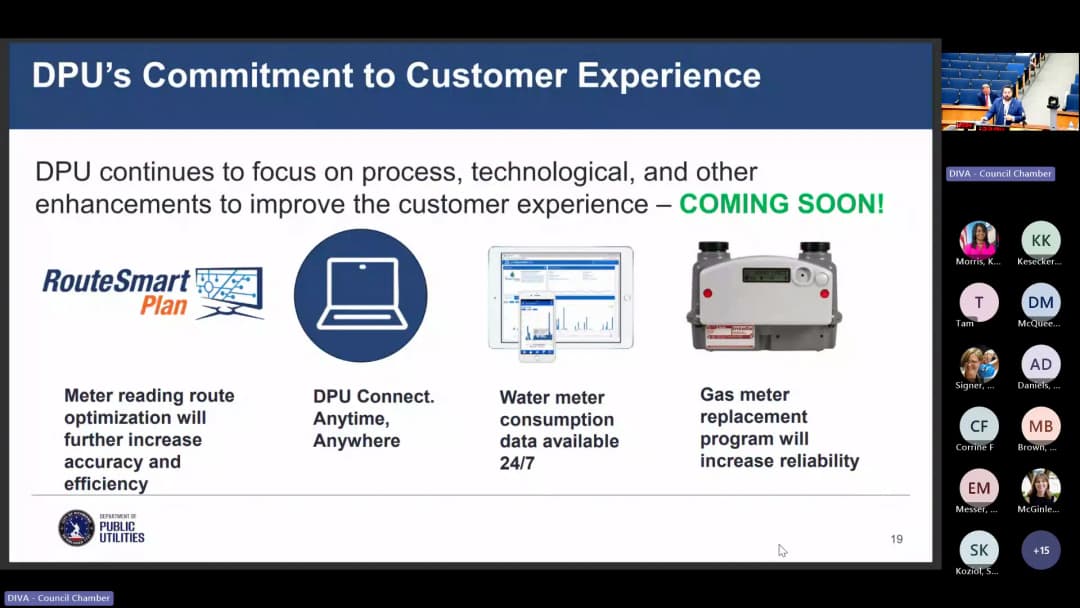
The Standing Committee for Governmental Operations met on June 24, 2026, at 1:00 PM. Chair Jordan presided, with Vice Chair Abelbacher and Councilmember Gibson present (Councilmember Gibson arrived later). The committee considered an ordinance to adopt a new city code, received updates from the Department of Public Utilities (DPU) on its new customer information and billing system, and heard from the Director of Elections on the upcoming August primary and office improvements. Consent Calendar - No consent calendar items were listed or voted on. Public Comments & Testimony - The public comment period for items not on the agenda was opened and closed with no speakers. No public comment was given on the ordinance or presentations. Discussion Items - Ordinance 2026-160 – Adoption of New City Code: Council Chief of Staff RJ Warren presented the ordinance, explaining it is required every five years per the city charter and state code. The new code updates the code adopted in 2020, removing redundancies and incorporating ordinances adopted up to October 2025. A supplement within 90 days will include legislation from October 2025 to present. Councilmember Gibson asked if this is a routine five-year update. Mr. Warren confirmed it is. The ordinance was moved to full council with a recommendation for approval, passed unanimously (3-0). - DPU Customer Information System and Billing Update: Director Morris provided an overview of the transition to a new customer information system (Oracle cloud-based) that went live on May 26, 2026, replacing a 40-year-old legacy system. The new system is designed to improve customer service, reduce training time (from 6-12 weeks to 3 weeks), automate calculations, and provide a customer self-service portal in Fall 2026. Challenges included a vendor changing servers without notice, causing 15,000 payments to be stuck in queue, leading to high call volumes and wait times up to 90 minutes. Late fees were automatically waived. The office temporarily paused flow restriction campaigns and disconnections. Director Morris noted progress on audit recommendations: from 45 when he started in January 2025 to nearly zero, with the final few expected to close within two weeks. Metro Care cap raised from $500 to $1,000 annually. Meter replacement program: 36,000 of 51,000 meters replaced (15-year-old ones); 16,000 remain. Bill accuracy metric: currently 98%, targeting 99.5% by FY28-29. Councilmembers raised concerns about communication (social media, billing inserts, postcards), vendor accountability, post-launch audits, and the flow restriction program protections. Director Morris stated that accounts under investigation or on payment plans are excluded from flow restrictions, and a 100% manual review is conducted before any restriction. - Elections Update: Director of Elections David Levine presented on the August 4, 2026 Republican primary for U.S. Senate (only contest on ballot). Key changes: Sunday early voting required (June 18 – August 1, with Sunday hours noon-5 PM on July 19 and 26); same-day registration begins July 25; Hickory Hill Community Center unavailable due to pre-existing commitments (one-time issue), so early voting only at the Office of Elections and City Hall. New state laws include firearm restrictions within 100 feet of voting locations. Director Levine highlighted office improvements: filling vacancies (deputy director, operations manager, communications coordinator, etc.), overhauled website, resumed in-person electoral board meetings, enhanced security at the office (two security officers, weapon detection systems), deployment of ballot-on-demand printing, and purchase of new ADA-compliant voting equipment in next fiscal year. Councilmember Gibson asked about communicating the Hickory Hill closure; Director Levine said signage and notices will be used, and noted that in the 2024 primary only 150 people voted in that race. Vice Chair Abelbacher inquired about contingency planning if Richmond Public Schools withdraw as polling locations; Director Levine said the office is compiling backup lists and noted the value of schools as polling places, suggesting use of school in-service days as a compromise. He also acknowledged budget pressures from multiple special elections and the need for more state and federal funding. - Staff Report and Committee Schedule: Staff noted an action item to follow up with DPU on water meter ages for Councilmember Gibson. The committee will next meet July 22, 2026 at 1:00 PM to hear from 311 about SOPs and service level agreements, and to review proposed fall presentation schedule. Chair Jordan floated moving meeting time to 1:30 PM; discussion deferred to ensure presenter schedules accommodate the change. Key Outcomes - Ordinance 2026-160 (new city code) approved unanimously (3-0) for forwarding to full council with recommendation to adopt. - DPU update noted; no formal vote. Director Morris requested follow-up on meter age data for Councilmember Gibson. - Elections update noted; no formal vote. Committee will follow up on budgeting and legislative advocacy for election funding. - Committee schedule: Next meeting July 22, 2026 at 1:00 PM; potential time change to 1:30 PM to be confirmed.
The Governmental Operations standing committee of the Richmond City Council met on June 24, 2026, at approximately 1:45 PM. The committee considered a routine code update ordinance and received presentations from the Department of Public Utilities and the Office of Elections. No public comments were made. Consent Calendar - No items were on the consent calendar. Public Comments & Testimony - The public comment period was opened for items not on the agenda; no one signed up to speak in person or virtually. The public hearing on Ordinance 2026-160 also drew no speakers. No public testimony was heard. Discussion Items Ordinance 2026-160 – City Code Recodification - RJ Warren, Council Chief of Staff, introduced the ordinance to replace the city code with an updated version that removes redundancies, reserves spacing, and incorporates ordinances adopted through October 2025. A supplement will follow 90 days after adoption to include legislation from October 2025 to the present. Councilmember Gibson inquired about the frequency of recodification; Mr. Warren confirmed it is required every five years. The ordinance was forwarded to full council with a recommendation for approval (4-0 vote). Department of Public Utilities – Customer Information System and Billing Update - Director Morris presented an update on the transition from a 40-year-old legacy system to two new Oracle cloud-based systems (customer cloud service and field service platform) that went live on May 26, 2026. Key improvements include automated rate calculations, 8-day training (down from 6-12 weeks), reduced billing estimates (from 131,010 in FY23 to 77,355 in FY26), and a new online customer portal expected in fall 2026. Challenges included a vendor changing servers without notice, causing 15,000 payments to be stuck in queue and high call volumes (up to 1.5-hour hold times). Late fees were automatically waived, and disconnections and flow restrictions were paused. The Metro Care cap was raised from $500 to $1,000. Director Morris noted that 36,000 of 51,000 aging meters have been replaced, with 16,000 remaining. An audit recommendation count dropped from 45 to near zero. Councilmembers discussed communication strategies, payment issues, meter replacement plans, and vendor accountability. Office of Elections – Primary Election and Operational Updates - Director of Elections David Levine provided an overview of the August 4, 2026 primary election (only a Republican U.S. Senate primary). Early voting began June 18, with expanded Sunday voting (July 19 and 26, noon to 5 PM) as required by new state law. Hickory Hill Community Center is unavailable due to scheduling conflicts; voting will occur at the Office of Elections and City Hall. A ballot-on-demand printing system was deployed to improve efficiency. Security enhancements include weapon detection systems at both entrances. New hires were highlighted, including a deputy director, election operations manager, and outreach coordinator. The office also revamped its website and election officer training. Councilmembers asked about communication to voters, security impacts, and contingency planning for potential closure of school polling places. Mr. Levine noted the office operated four special elections in a year under budget constraints and discussed the financial gap from the April special election. Standing Committee Schedule - Staff reported the next meeting will be July 22, 2026, at 1:00 PM, with presentations from 311 about SOPs and service level agreements. The committee discussed moving the meeting time to 1:30 PM; a decision was deferred pending confirmation with presenters. Key Outcomes - Ordinance 2026-160 (City Code recodification) was approved by a 4-0 vote and forwarded to the full council with a recommendation for approval. - Committee staff will follow up with DPU on Councilmember Gibson’s question about the age of water meters. - The committee will adjust the July 22 meeting time to 1:30 PM if possible; notification will be sent. - The meeting adjourned after approximately one hour.
No agenda or minutes were provided for this meeting. The only available transcript consists of unintelligible fragments, repeated nonsensical phrases (e.g., "Some of this," "Stop," "Oh"), and no coherent discussion, public comments, or decisions. As a result, it is impossible to identify any agenda items, speaker positions, votes, or outcomes. The meeting appeared to have no substantive recorded content. Note - The transcript contains no recognizable speech related to city business, making any summary speculative.
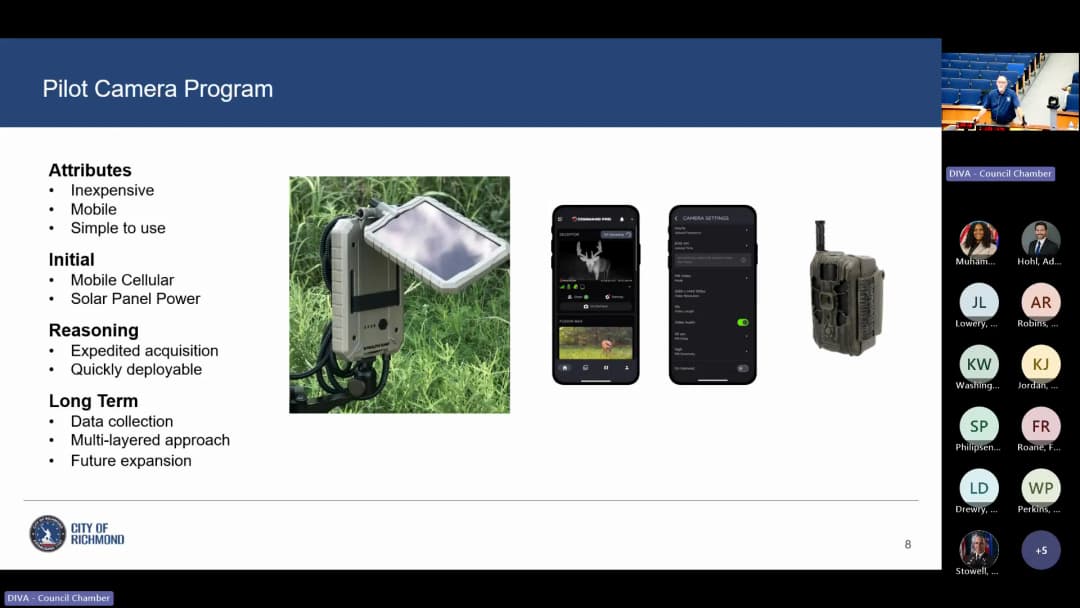
The Public Safety Standing Committee met on June 23, 2026, to receive presentations on hurricane season preparations and illegal dumping/graffiti. The meeting also included approval of previous minutes and a discussion about courthouse security. Council members expressed concerns about flood insurance, infrastructure resilience, and persistent neighborhood blight. Consent Calendar - The minutes from the May 28, 2026 Public Safety Standing Committee meeting were approved as presented without amendments. Public Comments & Testimony - No public comments were made during the designated period. Discussion Items - Hurricane Season Preparations: Edward Corner, Deputy Director of Emergency Communications Preparedness and Response, presented the 2026 hurricane outlook, noting a below-normal season due to El Niño (potentially a "Super El Niño"). He highlighted that water causes 86% of direct hurricane fatalities and that 60-90% of hurricane-related losses are water-related. Only about 2% of Richmond residents have flood insurance through the NFIP. The city is finalizing a comprehensive emergency operations plan (to be presented to council late summer/early fall), has opened a new Emergency Operations Center (MAC), and is expanding training and continuity of operations plans. Richmond Ready now has 16,003 subscribers. A council member from the 4th district asked about infrastructure flood liability and noted new floodplain maps have placed more homes in flood zones, with no program to help individual homeowners with increased insurance costs. Another council member from the 8th district raised concerns about seniors without computers or cell phones being left out of alert systems, and requested paper sign-up forms for Richmond Ready. She also noted residents in the Afton Avenue/Lynnhaven area are being told they need flood insurance but cannot obtain it. The Deputy Director agreed to investigate and attend her July 9th meeting. - Illegal Dumping and Graffiti: John Walsh, Programs and Operations Manager for DPW, presented statistics for fiscal year 2025 (since July 1, 2025): 677 litter collection locations (83 repeats), 652 public graffiti locations (55 repeats), 423 illegal dumping complaints, and 3,458 tires collected from 33 locations (50% repeats). Tires cost the city about $10 each to dispose (e.g., $35,000 over nine months). DPW has researched a pilot camera program using mobile cellular units with solar panels, costing around $100 per camera, to deter and catch illegal dumpers. Two recent tire dumping prosecutions resulted in convictions with restitution. A council member from the 4th district asked about regional prevalence and legal constraints (chain of custody), and suggested prioritizing environmentally sensitive areas like Reedy Creek. Councilwoman Trammell (8th district) expressed intense frustration about repeated dumping, overgrown lots, and quality-of-life issues in precinct 806 (Afton, Beauford, Cisco, Cortland, Dana, Glasgow, Brady Street areas). She said problems have persisted for 15-20 years and called for cross-departmental action, particularly from code enforcement. John Walsh acknowledged the frustration and said the camera program is a step toward getting ahead of repeat problems. - Courthouse Security: Councilwoman Trammell raised concerns about safety at the John Marshall Court building following recent incidents (an inmate escape, a break-in, threats to a judge and commonwealth attorney). She asked how council can help. The city attorney advised that specific security questions cannot be discussed in a public meeting due to legal sensitivity, but council can obtain recommendations from the sheriff, commonwealth attorney, and court officials in private. Councilwoman Trammell expressed that citizens are scared to go to court but must still appear. Key Outcomes - The minutes from May 28, 2026 were approved. - The committee received the hurricane preparedness presentation and directed staff to provide additional information on flood insurance access and infrastructure flood mitigation, as well as paper sign-up forms for Richmond Ready. - DPW will begin deploying 7-10 mobile cameras within weeks as a pilot program to deter illegal dumping, with future expansion possible. - Council members emphasized the need for a unified city alert platform and better coordination among departments to address illegal dumping and graffiti. - The committee took no formal action on courthouse security but committed to follow up through appropriate non-public channels.
The Richmond Public Safety Standing Committee met on June 23, 2026, to receive presentations on hurricane preparedness and illegal dumping/graffiti, discuss infrastructure liabilities, flood insurance challenges, and community notification systems. Council members raised concerns about recurring issues in Precinct 806 and courthouse security. Discussion Items Hurricane Preparedness Presentation - The Office of Emergency Management (OEM) provided a briefing on hurricane risks, noting that 86% of direct hurricane fatalities are due to water-related impacts, not wind. Flooding accounts for 60–90% of hurricane losses. - Only 2% of Richmond residents carry National Flood Insurance Program (NFIP) policies, despite many structures being in flood zones. The maximum FEMA individual assistance grant is approximately $43,600 for housing and $43,600 for other needs, which is insufficient to fully recover. - OEM is finalizing a comprehensive Emergency Operations Plan (EOP) to be presented to council in late summer/early fall 2026. A new Emergency Operations Center (MAC) has been opened and used for various events. - The OEM has expanded training, continuity of operations plans (COOPs), shelter operations, and after-action reports. Community outreach includes presentations to senior centers, civic groups, and events. - Richmond Ready, the city's emergency alert system, has 16,003 subscribers as of the meeting date. It requires opt-in, unlike IPAWS (Wireless Emergency Alerts). Council members raised concerns about accessibility for residents without internet or cell phones. The OEM offered to provide paper sign-up forms and attend community meetings. - Council members inquired about flood infrastructure liability. OEM stated they are mapping critical nodes and applying for hazard mitigation grants. The COOPs will include flood-specific plans. There is no program to assist individual homeowners newly added to floodplains with flood insurance costs. Illegal Dumping and Graffiti Presentation - John Walsh, Programs and Operations Manager for the Department of Public Works (DPW), presented on illegal dumping and graffiti. DPW investigates complaints, abates public right-of-way dumping, and coordinates with code enforcement for private property. - Statistics for the current fiscal year (since July 1, 2025): - Litter collection: 677 locations addressed, 83 repeat locations. - Graffiti: 652 public right-of-way locations (55 repeat), 116 private property locations (17 repeat). - Illegal dumping: 423 complaints, 379 abated, 44 pending. Tires: 3,458 tires collected from 33 locations (50% repeat). - DPW highlighted the cost of tire disposal: $4 per tire. One collection of 224 tires cost the city approximately $2,100; total tire-related costs over nine months were about $35,000. - Two successful prosecutions for tire dumping resulted in restitution and suspended jail sentences. - DPW is launching a pilot camera program using mobile cellular trail cameras (approx. $100 each) with solar panels to deter and document illegal dumping. Cameras will be placed at repeat locations and environmentally sensitive sites (e.g., Reedy Creek). Currently, 7–10 cameras are being prepared for deployment within weeks. - Council members raised concerns about specific areas, particularly Precinct 806 (Richmond Highway, Afton Avenue, etc.), citing ongoing problems with dumping, tall grass, vacant properties, and crime. DPW acknowledged the frustration and emphasized the need for interdepartmental cooperation. Courthouse Security Concerns - A council member expressed concerns about safety at the John Marshall Courthouse following recent incidents (escape, break-in, threats). The city attorney advised that due to ongoing litigation, the sheriff and court officials could not discuss security details in a public meeting. The council member was directed to meet privately with relevant officials. Key Outcomes - OEM will attend the council member's July 9 community meeting with paper sign-up forms for Richmond Ready. - OEM will provide additional information on flood insurance options for residents in newly designated flood zones. - DPW will proceed with the camera pilot program; deployment expected within weeks. Locations will prioritize repeat dump sites and environmentally sensitive areas. - No formal votes were taken during the meeting.