The Arts, Culture, and Creative Economy Commission met virtually on October 11, 2021, at 2:00 p.m. to discuss the Creative Economy Manager's first year, receive the Director's and Chairperson's reports, and hear public testimony. The meeting was held via Zoom due to the COVID-19 pandemic. Consent Calendar - Approval of Minutes (September 13, 2021): A motion to approve passed with Vice Chair Blumenstock abstaining. Public Comments & Testimony - Item 2 – Reflections on Creative Economy Manager’s First Year: Richard Falcon, executive director of Teatro Nahua, expressed support for the partnership with Megan Van Voorhis and urged commissioners to revisit the 2017 cultural equity task force statement, noting that it is not being fully implemented. - Item 3 – Director’s Report: Marie Acosta, speaking on behalf of a statewide coalition, opposed the California Arts Council’s proposed decentralization, stating it would cut Sacramento funding by over $300,000 and disproportionately harm BIPOC organizations. She requested the commission send a letter to the CAC. Richard Falcon echoed her concerns, urging the commission not to support the proposal without further discussion. Discussion Items - Reflections on Creative Economy Manager’s First Year (Item 2): Megan Van Voorhis reported on key achievements: securing a $500,000 mid-year allocation (with $189,000 for teaching artists, $280,000 for mentors, $60,000 for administration), a $2.6 million annual budget augmentation ($2 million for community investments), and partnerships with the county, Visit Sacramento, and other city departments. Challenges included a fractured support ecosystem, cost recovery policies hindering public art, burdensome permitting for live entertainment, and the need for sustainable funding beyond federal dollars. Commissioners praised the progress and raised concerns about equity, communications, and permit complexity. Commissioner Perez offered pro bono graphic design work to improve social media engagement. - Director’s Report (Item 3): Van Voorhis highlighted policy barriers such as the business occupancy tax burden on artists, insurance requirements, and ongoing work on guidelines, panelist recruitment, and a new community arts match fund. She noted progress on the CalTrans transportation art project and a pending $500,000 NEA grant for individual artists. The California Arts Council decentralization proposal sparked discussion: Commissioner Naranjo requested more data before taking a position, while Commissioner Enriquez clarified the commission had not voted on the matter and noted the proposal’s complexity. - Chairperson’s Report (Item 4): Chair Winlock thanked the mayor for supporting arts and culture, celebrated the opening of the community theater (featuring Hamilton), and announced plans for a strategic planning retreat for commissioners. Commissioners discussed the need for district tours, visits to the new theater, and renewed engagement with community events. Key Outcomes - Consent calendar minutes approved. - All discussion items were received and filed; no formal votes were taken. - Commissioner Naranjo suggested tabling any decision on the California Arts Council decentralization until more data is available. - Chair Winlock announced a future public strategic planning meeting for commissioners. - Commissioners expressed interest in organizing district-based tours and a tour of the new community center theater.
Public Meetings - Sacramento, California
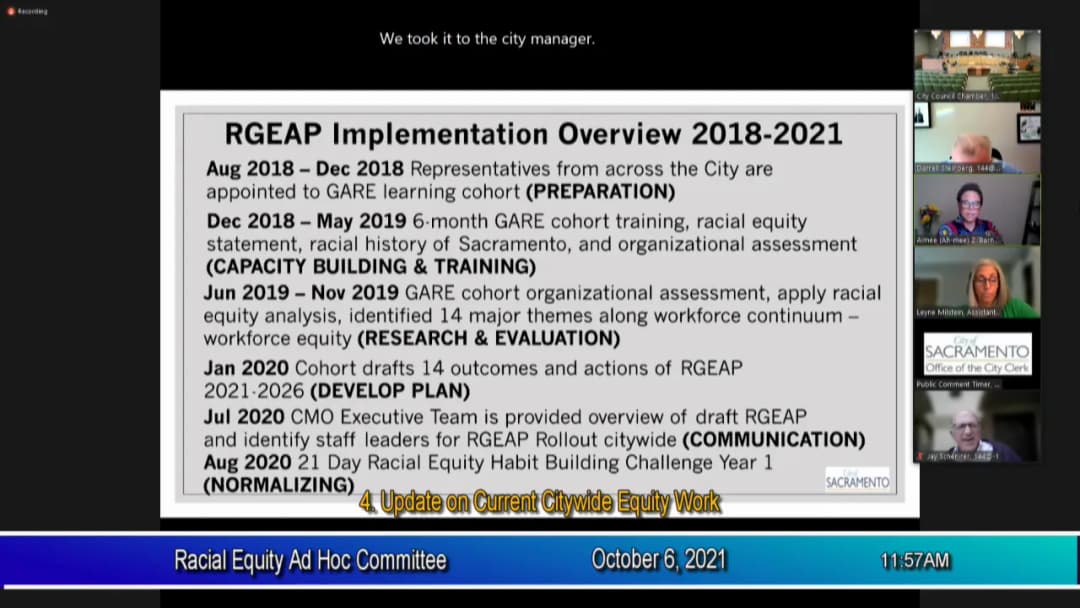
Public Meetings - Sacramento, CaliforniaThe Racial Equity Ad Hoc Committee of the Sacramento City Council held a special meeting on October 6, 2021, from 11:00 a.m. to approximately 1:00 p.m. via teleconference. The meeting focused on selecting a co-chair, approving the 2022 meeting schedule, discussing the committee's purpose and mission, receiving updates on citywide equity work, and considering a draft rapid response tool for American Rescue Plan (ARP) expenditures. The committee voted on three items and deferred action on the rapid response tool to a future meeting. Public Comments & Testimony - Richard Falcon (United Latinos, Police Review Commission, Teatro Nahual) expressed support for the proposed plan, emphasized the need for equitable outreach to grassroots organizations, and requested broader inclusion in the Race Forward engagement process. - Carolina Flores questioned how ad hoc committee members were selected and raised concerns about Latino staff retention, citing statistics that nine Latinos quit the city and requesting exit interviews. - Nia Mooreweathers (Youth Forward, Sacramento Kids First Coalition) emphasized the importance of trust and accountability, echoed Councilmember Schenirer's call for culture change, and urged accessible and creative engagement. - Chris L. (Sac Black Biz, American Redress Coalition of California) thanked the committee, expressed disappointment at not being included in initial Race Forward conversations, and indicated he would provide feedback on the three goals. - Angela E. Herring highlighted historic underinvestment in low-income communities of color, requested community involvement in setting benchmarks, and supported the committee's development of a racial equity framework. - Ejiro (Sacramento Housing Alliance) called for using trusted community brokers, targeted outcomes for housing and homelessness, metrics like wealth and asset poverty, and possibly a housing subcommittee. Discussion Items - Item 1 - Selection of Co-Chair: Mayor Steinberg recommended Councilmember Mai Vang as co-chair, proposing a less hierarchical approach. Councilmember Vang accepted and suggested starting future meetings with a land acknowledgment. A motion was made and seconded, with the vote delayed until Councilmember Guerra arrived. The motion passed 4-0. - Item 2 - 2022 Regular Meeting Schedule: The committee approved a quarterly schedule for 2022: January 25, April 26, July 26, and October 25, all at 10:00 a.m., with flexibility for special meetings. Motion passed 4-0. - Item 3 - Purpose and Mission: Kelly Rivas (Chief of Staff) presented the committee's mission: (1) align council intent with impacts of policy, budget, and service delivery; (2) coordinate city racial equity initiatives; (3) increase engagement, transparency, and accountability. The long-term SCORE initiative (Sacramento Centered On Racial Equity) with Race Forward was outlined, including community feedback about broken trust and the need for healing. A mid-term goal of racial equity workshops for the full council and a short-term rapid response tool for ARP funds were also discussed. Councilmembers emphasized embedding equity into everyday work, not treating it as a checklist. The committee voted 4-0 to approve the purpose and mission, with direction to report back on how the broader community can engage in the October 28 Race Forward meeting. - Item 4 - Update on Current Citywide Equity Work: Presentations covered: - The Race, Gender, and Equity Action Plan (RGAP) focused on workforce equity, including staff training and the 21-day racial equity habit building challenge. - Inclusive economic development efforts, such as the Project Prosper initiative, the inclusive economic development investment guidelines, and CARES funding outreach that resulted in 60% of loans going to underserved areas. - The Transportation Priorities Plan (TPP) developing an equity lens for infrastructure investments, with criteria including historic disinvestment, infrastructure quality, and beneficiary demographics. Discussions highlighted the need to avoid dollar-for-dollar comparisons and to focus on outcomes, not just inputs. No vote was taken. - Item 5 - Draft ARP Racial Equity Rapid Response Tool: Aimée Barnes (Manager, Office of Diversity and Equity) presented a proposed tool to guide ARP funding decisions with racial equity questions, a six-indicator Community Vulnerability Index (poverty, unemployment, education, health insurance, rent burden, disability), and guiding principles. The tool is intended to be used for both predetermined and undetermined funds. Due to the late hour, the committee agreed to schedule another meeting within weeks for a deeper discussion. No immediate action was taken. Key Outcomes - Item 1: Councilmember Mai Vang was selected as co-chair of the Racial Equity Ad Hoc Committee by a 4-0 vote. - Item 2: The 2022 Regular Meeting Schedule was approved by a 4-0 vote. - Item 3: The purpose and mission of the committee were approved by a 4-0 vote, with a directive to provide a report on how the community can engage in the October 28 Race Forward session. - Item 4: The update on current citywide equity work was received and filed; no action required. - Item 5: The committee deferred action on the draft ARP Racial Equity Rapid Response Tool and will hold an additional meeting in the coming weeks to continue discussion.
The Aggie Square Enhanced Infrastructure Financing District (EIFD) Public Financing Authority held a brief special meeting on October 5, 2021, from 10:03 a.m. to 10:05 a.m. via teleconference due to the COVID-19 pandemic. The sole agenda item was the consent calendar consideration of the Master Funding Agreement for Aggie Square Phase 1. Vice Chair Geta presided in the absence of Chair Shane. Members Jennings, Hernandez, and Titherington (arrived later) were present. Consent Calendar - Item 01 – Master Funding Agreement for Aggie Square Phase 1 [Continued from 09/21/2021]: The Authority considered authorizing the Chair or designee to execute a Master Funding Agreement among The Regents of the University of California, Wexford Development, LLC, the City of Sacramento Aggie Square Enhanced Infrastructure Financing District, and the City of Sacramento for Phase 1 of the Aggie Square project (Districts 5 and 6). The item was continued from the September 21, 2021 meeting. Key Outcomes - Motion to approve the consent calendar: Made by Member Jennings, seconded by Member Hernandez. The motion passed unanimously on a roll call vote of 3-0 (Members Jennings, Hernandez, and Vice Chair Geta voting yes; Member Titherington arrived after the vote; Chair Shane absent). The meeting adjourned immediately after approval without additional discussion or public comments.
On Tuesday, October 5, 2021, at 1:00 p.m., the Sacramento City Law and Legislation Committee convened via teleconference (Zoom) to address three main agenda items: a consent calendar, cannabis business ownership and delivery restrictions, and strategies to incentivize affordable housing. The committee took unanimous votes on the cannabis items and received public testimony on both cannabis and housing matters. The meeting adjourned at 2:17 p.m. Consent Calendar - Item 1 (Law and Legislation Log) and Item 2 (Legislative Advocacy Correspondence) were approved unanimously (4-0) via a single motion by Member Harris, seconded by Member Schenirer. Public Comments & Testimony - Cannabis Items (4 & 5): Seven public speakers testified, overwhelmingly opposing the moratorium extension and urging the committee to allow the suspension on ownership changes to expire. Speakers included dispensary owners (Kimberly Cargyle, Trey Ish), industry representatives (Joe Devlin of the Northern California Cannabis Alliance, Michael Hawkins), a core program recipient (Mindy Galloway), and community member Deanna Garcia. Assemblymember Kevin McCarty also urged expiration. The Power Inn Alliance supported the chair's recommendation to extend for a comprehensive study, noting the piecemeal approach has been problematic. - Affordable Housing (Item 3): Three speakers commented. Jameson Parker (Midtown Association) cautioned against overburdening housing with fees. Liz Laurent Williams (Downtown Sacramento Partnership) urged careful analysis. Cornelius Burke (North State Building Industry Association) opposed mandatory inclusionary zoning, citing a study predicting a 6.8% increase in home prices and an 8.4% increase in rents, along with a net loss of 700 units over 10 years. Discussion Items - Item 4 – Suspension of Changes in Ownership of Storefront Cannabis Dispensaries: Staff presented options to let the moratorium expire or extend it. Chair Schenirer recommended a six-month extension to await the EPS study on the city's cannabis industry. Several members expressed willingness to revisit ownership rules sooner if data allowed. - Item 5 – Limit on Authorized Cannabis Delivery Businesses in the Southeast Industrial Area: Staff reviewed the sunsetting cap (currently 50 delivery businesses) and options to extend, modify, or let it expire. The committee discussed consistency with District 2's request to wait for the EPS study. - Item 3 – Affordable Housing Strategies: Staff (Greta Soos and Ryan Dodge) provided a one-year update on the Ministerial Approval of Infill Housing program, noting that 9 projects applied under the city's ministerial permit (vs. 2 under SB 35), with 645 affordable units approved (80% of total affordable units under ministerial processes). They also presented a draft scope of work to review the Mixed Income Housing Ordinance, including an economic feasibility study. Staff corrected a table in the staff report that underreported affordable units. The committee discussed the need for data-driven decisions and the importance of understanding causality behind the uptick in affordable housing production. Key Outcomes - Item 4: Motion by Member Guerra, seconded by Member Valenzuela, to direct staff to draft an ordinance extending the suspension on ownership changes for six months and to waive ordinance review by the Law and Legislation Committee. Passed unanimously (4-0). - Item 5: Motion by Member Guerra, seconded by Member Valenzuela, to direct staff to draft an ordinance extending the prohibition on delivery businesses in the Southeast Industrial Area for six months and to waive committee review. Passed unanimously (4-0). - Item 3: The committee reviewed and commented on the affordable housing strategies. No formal action was taken; staff will incorporate feedback into the RFP and continue the review process. - Committee Comments: Member Guerra requested staff to add a safe storage for firearms item to the law and legislation log. Member Valenzuela requested an update on the Tenant Protection Program, which staff agreed to schedule.
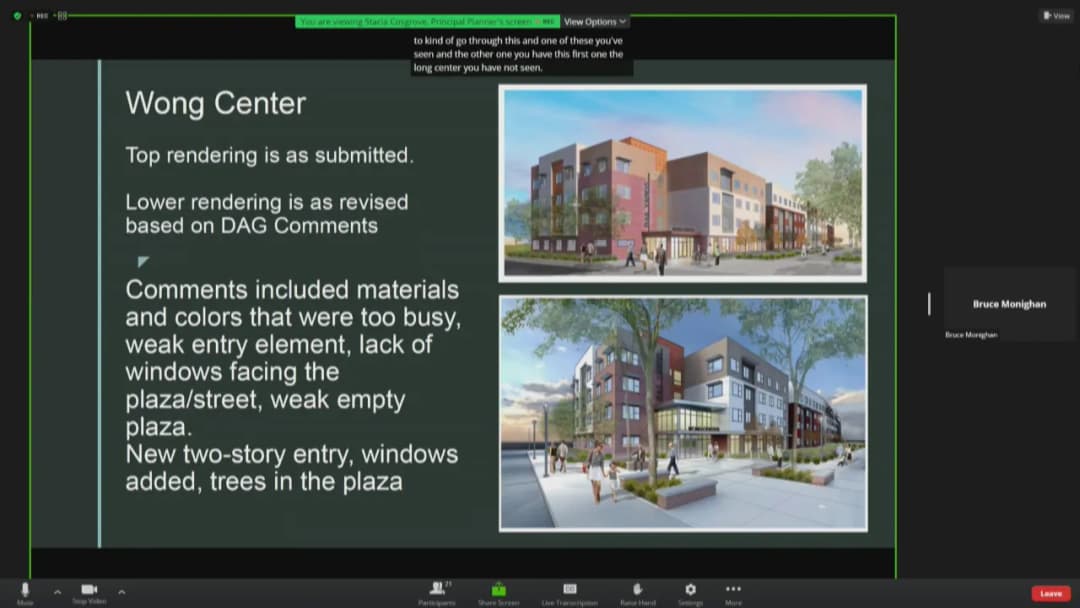
The Planning and Design Commission of Sacramento met virtually on September 23, 2021, at 5:30 p.m. to conduct public hearings on two development proposals, receive a one-year report on the implementation of the Ad Hoc Subcommittee’s code amendments, and review the draft 2022 Planning and Zoning Work Program. All agenda items were approved or discussed as summarized below. Consent Calendar - Approval of Minutes (September 9, 2021): Approved by unanimous vote. - Director’s Report (Oral): Noted that City Council approved a rezone for the Truxel 3P Planned Unit Development on September 21, 2021. Received and filed. Public Comments & Testimony - Item 3 (Sutter Greens 2.0): One e-comment was received after 5:00 p.m. and reviewed by the commission. No verbal public testimony was provided. - Item 4 (WHIRED Wine): No public comments were received. - Non-Agenda Public Comment: None. Sutter Greens 2.0 Apartments (Item 3) Proposal: Construction of a 190-unit apartment complex on 9.06 acres at 2450 Natomas Park Drive. The project required a Mitigated Negative Declaration, amendments to the Creekside Oaks PUD guidelines, site plan and design review, and a tree permit to remove eight private protected trees (five dead/diseased, three conflicting with building placement). Parking provided: 346 spaces (1.82 per unit), including 92 EV-ready garages and three Level 2 chargers. The developer, Demon Partners, highlighted community donations to Joey’s Food Locker, GNNA scholarship, and Stanford Settlement Neighborhood Center. Commission Discussion: Commissioners questioned ADA accessibility, EV charging, shuttle service, and crosswalk safety. Commissioner Chase requested exploring additional shading on west-facing elevations. Staff and applicant addressed all concerns. Public Testimony: No verbal comments. Vote: Motion by Commissioner Pluckebaum, seconded by Commissioner Lenzi. Approved unanimously (Commissioners Buckley and Wallace absent). WHIRED Wine (Item 4) Proposal: A conditional use permit for a 212-square-foot wine bar and outdoor seating at 1121 L Street within the Senator Hotel. Hours of operation for alcohol sales: 1:00 p.m. to 11:00 p.m. The use will activate the existing raised and covered patio. Commission Discussion: Questions focused on weather protection (shade, heaters), relationship to adjacent tenant, and operating hours. Public Testimony: None. Vote: Motion by Commissioner Chase, seconded by Commissioner Lenzi. Approved unanimously. One-Year Report on Ad Hoc Code Amendments (Item 5) Staff (Stacia Cosgrove and Bruce Monaghan) presented the first-year results of the 2020 Ad Hoc ordinance aimed at streamlining development review. Key highlights: - 29 projects were processed at staff or director level that would previously have come to the commission (a 40% reduction). - The Design Advisory Group (DAG) was formed with six members, reviewing six projects to date. Examples showed design improvements in the Wong Center and Opus Housing. - Community outreach enhancements include early notification signs, expanded mailing radius (300 to 500 feet), evening director hearings, and a new development tracker (Agency Counter) expected to launch soon. Commission Feedback: Commissioners praised the progress, discussed DAG recruitment, parking analysis from projects, and the need for consistent design quality citywide. Concerns were raised about the Healthy Places Index use; staff will return with a dedicated presentation. 2022 Planning and Zoning Work Program (Item 6) Planning Director Greg Sandlin presented the draft work program for 2022, covering 12 major initiatives including the Mixed Income Housing Ordinance review, SB9 implementation, 2040 General Plan update, parking code reform, missing middle housing standards, ADU permit-ready plans, and an existing building electrification strategy. The program also includes ongoing tasks like zoning code updates and community outreach evaluation. Commission Feedback: Commissioners emphasized the importance of addressing parking holistically with transportation demand management, expressed interest in an Ad Hoc committee on parking, requested clarifications on the Healthy Places Index, and urged early adoption of climate-responsive design. Staff will incorporate feedback and present a revised program to Council in January 2022. Key Outcomes - Sutter Greens 2.0 Apartments: Approved (unanimous). - WHIRED Wine: Approved (unanimous). - Ad Hoc Report: Received and filed; staff will continue DAG expansion and community outreach improvements. - 2022 Work Program: Draft reviewed; staff to revise based on commission comments and forward to Law and Legislation Committee in December.
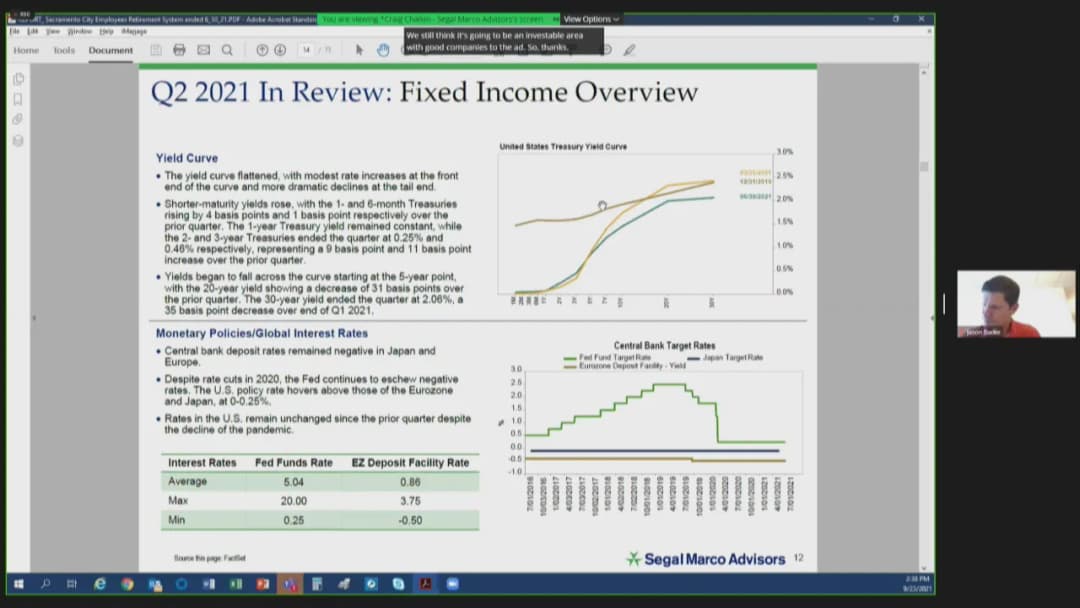
The Administration, Investment & Fiscal Management Board held a special teleconference meeting on September 23, 2021, at 1:30 p.m. to review investment performance reports for the Sacramento City Employees' Retirement System (SCERS). The board unanimously approved consent calendar items and accepted the quarterly performance and investment reports presented by Segal Marco Advisors and SCERS staff. Consent Calendar - Approval of Minutes (May 20, 2021): Passed unanimously. - SCERS Monthly Investment Report (May 31, 2021): Accepted unanimously. - SCERS Monthly Investment Report (June 30, 2021): Accepted unanimously. - Revised Pensioners’ Cost of Living Adjustment FY22: Accepted unanimously. Discussion Items - Item 5 – Segal Marco Advisors Quarterly Investment Performance Report (June 30, 2021): Craig Chaikin, Vice President of Segal Marco Advisors, presented a market overview. He noted strong equity returns, with large-cap growth leading in the second quarter, and fixed income benefiting from declining rates. The portfolio's total assets increased by approximately $10 million over the quarter to $313.5 million. For the fiscal year ended June 30, 2021, the portfolio returned 29.5%, slightly ahead of the policy index and the actuarial assumption. The 10-year return was 9.2%. Board members asked about the timing of potential interest rate hikes (expected sometime in 2022) and concerns about Chinese regulation; Chaikin stated it was not a specific concern for U.S. markets. The board unanimously accepted the report. - Item 6 – SCERS Quarterly Investment Report (June 30, 2021): Stacy Hussey, Chief Investment Officer, highlighted the reduction of the fixed-income underweight from 4% to just under 2% due to active rebalancing. She noted that the 10-year performance of 9.2% comfortably exceeded the actuarial assumption. Hussey reported that the funded status of SCERS may approach or exceed 100% based on the strong returns, and she is working with the actuary to model different scenarios. She compared SCERS’ 29.5% return to CalPERS (21.3%) and CalSTRS (27.2%). The board discussed the potential impact on city contributions; Hussey noted that contributions have already decreased from about $7 million to $3–4 million, and further improvement could lower them further, though the normal cost would still need to be paid. The board unanimously accepted the report. Key Outcomes - Votes: Both discussion items (Items 5 and 6) were approved by a unanimous roll call vote: Member Colville (yes), Vice Chair Bader (yes), Chair Leon (yes). Member Holm was absent. - Member Comments: Chair Leon noted that the December 2021 meeting would be his last due to term limits, and he thanked staff and advisors for their work. - No public comments were received on any agenda item. - Adjournment: The meeting was adjourned without a formal motion.
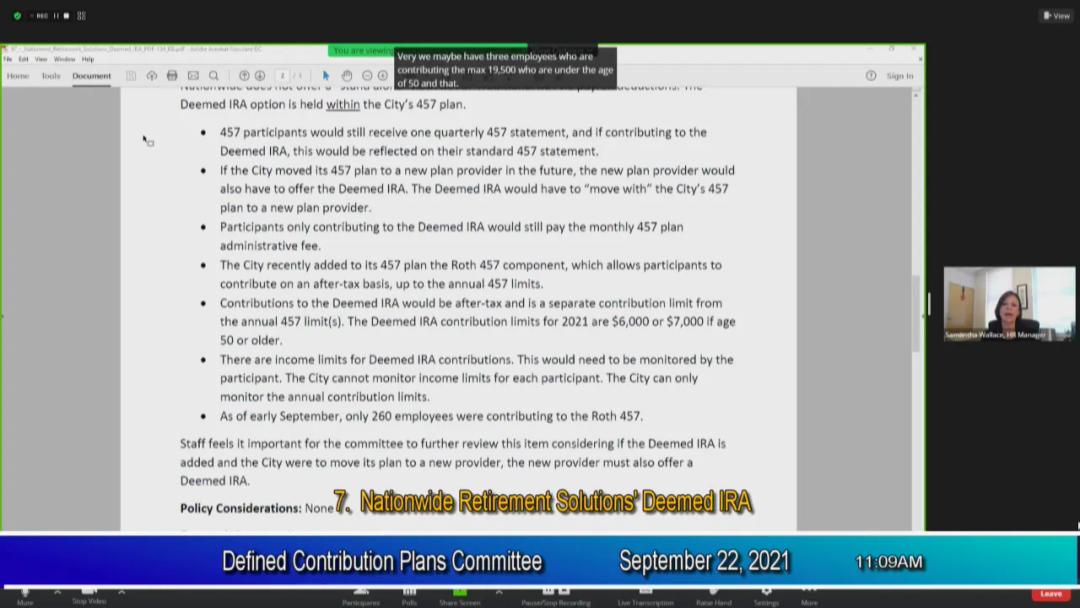
The Defined Contribution Plans Committee met in a teleconference-only special meeting on September 22, 2021. The agenda listed a 9:00 a.m. open session. Roll call established quorum with four members initially online; Members Boyd and Connolly Coleman were absent at the start, and Member Hoekstra joined after technical difficulties. The committee heard the 2021 second-quarter investment review, recommended investment policy statement revisions to the City Council, approved a subcommittee for participant communications, received annual retirement plan and fiduciary training presentations, and discussed eligible compensation and a proposed Deemed IRA. Consent Calendar - Item 1 – Approval of Meeting Minutes for June 23, 2021: The committee approved the minutes by roll call vote. Member Bader moved, Member Zalaski seconded, and the motion passed. The agenda listed the June 23, 2021 minutes for approval; no separate minutes document was included in the source materials. Public Comments & Testimony - No members of the public raised their hands to comment on any agenda item, and no speakers addressed matters not on the agenda. Discussion Items - Item 2 – Review of the 2021 2nd Quarter by Hyas Group: Hyas Group presented market themes centered on supply and demand, COVID-19/Delta variant impacts, and Federal Reserve policy and inflation. The consultant noted lumber price volatility, COVID-sensitive stock performance, and expectations that the Fed may begin tapering in early 2022. Sacramento plan assets passed $700 million, up from $660 million at the prior meeting. Roughly 58% of plan assets were moving to new funds, affecting $300–400 million in assets, with only three investment categories being removed. Q2 net cash flow was $12.2 million, 30% of which went to target date funds. The year-to-date market gain was $53 million, and the average account balance was $101,000, compared with a NAGDA survey average of about $65,000. The weighted expense ratio was 45 basis points and was expected to drop to about 30 basis points after the lineup changes. Hyas estimated participant savings of $104 per participant and $71,000 per year from the fund changes. Chair Levison raised questions about a roughly $1.5 million discrepancy between plan asset figures, requested backfilled historical performance data, and asked for more specific new-hire enrollment service-level reporting. Hyas and Nationwide agreed to follow up. - Item 3 – Revisions to the Statement of Investment Policies and Guidelines: Hyas Group walked through proposed revisions, including renaming the document the Investment Policy Statement, updating benchmarks, removing three little-used categories, and aligning the document with the new fund lineup. Chair Levison suggested changing language from “mission” to “obligation” with a state law reference, but after discussion about the committee’s advisory status, the language was left unchanged. The committee passed a unanimous motion recommending the revisions be forwarded to the City Council for approval. - Item 4 – MissionSquare Retirement Annual Presentation: MissionSquare presenters Michelle Martin and Amaya Fine reviewed the Retirement Health Savings Plan. They described mandatory contributions, tax-free reimbursements for eligible medical expenses, survivor/beneficiary rules, no rollovers or cash-outs, and the third-party administrator Meritane. MissionSquare said it administers over $2 billion in assets across more than 1,500 retiree health programs. Chair Levison asked about the plan’s relationship to IRS health reimbursement arrangement rules and whether the committee should provide more oversight of MissionSquare funds. MissionSquare said it would research the IRS question, and Hyas indicated additional oversight analysis was coming. - Item 5 – Subcommittee for Participant Communication Regarding Funding Lineup Changes: Staff requested a motion to create a subcommittee, not to exceed three months, to review participant communications for the 457(b) and 401(a) plan lineup changes held with Nationwide. Nationwide stated the fund change date is November 16, 2021, and communications must be finalized by October 16, 2021. The subcommittee was established with Members Mick Boyd, Amber Foster, and Murray Levison. The motion passed unanimously. - Item 6 – Eligible Compensation for the City’s 457(b) Plan: Staff reported that injury-on-duty pay, including 4850 time, had been set up as eligible compensation in the payroll system but was not eligible under the 457(b) adoption agreement. The city turned that off after a legal review. Staff also discovered that overtime was being allowed in practice even though the adoption agreement excluded it; the city corrected the adoption agreement retroactively to January 1, 2016, to allow overtime as eligible compensation. Chair Levison objected to the process, saying committee bylaws require review of plan document amendments and that the committee should have been involved. Staff responded that immediate correction was necessary because noncompliance put employees at risk. The committee took no formal action to reverse the overtime eligibility change. - Item 7 – Nationwide Retirement Solutions’ Deemed IRA: Staff reported that the proposed Deemed IRA would be a Roth IRA-like after-tax product wrapped into the 457(b) plan, subject to separate IRA limits and income limits, would still carry the plan administrative fee, and would have to move with the 457(b) plan if the city changed providers. Staff noted that only about 260 employees currently contribute to the Roth 457 and about three employees are maxing out the under-50 annual contribution. Staff and Hyas recommended focusing on growing participation in the existing Roth 457 rather than adding the Deemed IRA. Committee discussion did not produce a formal vote, but the consensus was to set the Deemed IRA aside at this time. - Item 8 – Annual Fiduciary Training: Hyas Group led the annual fiduciary training, covering ERISA background, California constitutional and statutory fiduciary duties, duties of loyalty and prudence, documentation of committee decisions, fee litigation risk, and recent legislation including the SECURE Act, SECURE Act 2.0, and CARES Act. Committee discussion addressed whether action-only meeting minutes are sufficient, the role of fee policy statements, record keeper revenue, and the need to understand all participant-paid fees before future RFPs. No action was taken. - Items 9 & 10 – Legal and Regulatory Updates and Committee Work Plan: These were standing informational items. Due to time, they were treated as receive-and-file items and scheduled to continue at the next meeting. Chair Levison expressed disappointment that the non-career employee voluntary 457 item had been removed from the work plan. Key Outcomes - Approved the June 23, 2021 meeting minutes. - Unanimously recommended the revised Investment Policy Statement/Statement of Investment Policies and Guidelines to the City Council for approval. - Established a three-member subcommittee for participant communications, with the Nationwide communication deadline of October 16, 2021 and fund change date of November 16, 2021. - Took no formal action on 457(b) overtime eligibility; the corrected adoption agreement remains in place. - Did not proceed with a Deemed IRA at this time; the committee’s direction was to focus on Roth 457 participation. - Received MissionSquare’s annual presentation and Hyas Group’s annual fiduciary training. - Next regular committee meeting is scheduled for December 2021.
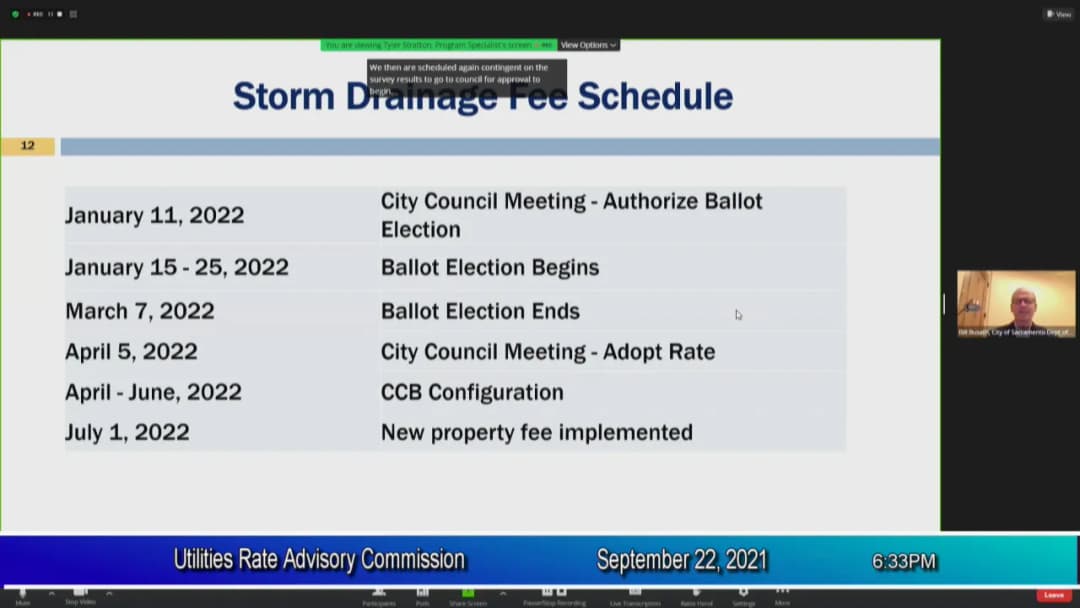
The Utilities Rate Advisory Commission held a special teleconference meeting on September 22, 2021, at 5:30 p.m. The meeting included a consent calendar item, two workshops on proposed rate adjustments (recycling/solid waste and storm drainage), an accountability plan update, and a financial update. No public comments were received. The commission voted to approve the minutes from September 7, 2021, and received and filed all other items. Consent Calendar - Item 1 – Approval of Minutes for September 7, 2021: The commission voted 4-0 (with one abstention from Commissioner Lee, who was absent from the previous meeting) to approve the minutes. Public Comments & Testimony - No members of the public provided comments on any agenda item, including consent, discussion items, or matters not on the agenda. Discussion Items - Item 2 – Workshop II on Proposed Rate Adjustment for Recycling and Solid Waste (RSW): Interim Integrated Waste General Manager John Febbo presented a 10-minute overview of the proposed rate adjustment. Key drivers include Senate Bill 1383 (unfunded mandate to divert organic waste), increased processing costs (from $42/ton to $73–$85/ton, rising to $100/ton with food waste), COVID-19 impacts (11% increase in residential garbage tonnage, 15% increase in household junk), and the need to replenish the 90-day reserve. Proposed increases total $11.49 over three phases: $3.83 in April 2022, January 2023, and January 2024. The current rate is $42.59. Outreach includes a Prop 218 mailer (multilingual in Spanish, Mandarin, Russian), 20 community meetings so far, and a SURA program with 8,500 participants. Commissioner Gutowsky asked about outreach to non-English-speaking communities and requested follow-up on accessibility. Commissioner Biering asked about the SURA program’s automatic enrollment process (confirmed via SMUD data exchange) and public feedback from community meetings (mostly positive, focused on food waste recycling). Vice Chair Vander Werf requested that commissioners be included in email lists for outreach events. - Item 3 – Department of Utilities Accountability Plan Update – 4th Quarter FY2021: Director Bill Busath presented updates on the SURA program (8,500 participants, $3.6M spent in FY21, with a proposed change to a flat 25% discount to keep the program sustainable), community engagement (bi-monthly reports, McKinley Water Vault project, stormwater pollution prevention outreach), climate change tools (American River Basin Climate Change Study predicting more hot days), and drought response (15% voluntary reduction, water alert tier 2 with doubled fines). The city’s residential water usage rebounded only 4% from the last drought, and rebate programs saved 25 million gallons in the quarter. Commissioner Fidell asked for the cost of saved water from rebates to be included in future reports. Commissioner Lee asked about the reduction in the SURA discount from 35% to 25% (response: to keep budget sustainable). Commissioner Gutowsky requested inclusion of commissioners in outreach emails. - Item 4 – Department of Utilities Financial Update: Supervising Financial Analyst Jackie Rice presented FY21 year-end projections and FY22 adopted budget. All three funds (water, wastewater, storm drainage) are projected to exceed the 120-day working capital guideline. No rate increases in FY22. The COVID-19 pandemic had minimal impact on revenues. No questions from commissioners. - Item 5 – Storm Drainage Rate Workshop 2: Director Bill Busath presented draft ballot language for a $20 million/year storm drainage fee increase (first increase since 1996). Proposed fees for single-family residential parcels: <0.1 acre ($3.00/month), 0.1–0.25 acre ($5.00/month), 0.25 acre ($7.00/month). Multi-family units: $2.60/unit/month. Non-residential rates based on impervious surface factors (e.g., commercial: 0.0195/sq ft/year). A second survey began September 21 to gauge support, with results expected mid-to-late October. The schedule includes a third workshop, protest mailer, rate hearing in December, council approval in January, and a ballot election ending in March 2022. Commissioner Fidell expressed concern that the multi-family rate (per unit) penalizes high-density vertical housing and said it would make him publicly argue against the measure. He requested examples comparing vertical vs. sprawling apartment complexes. Commissioner Lee suggested adding “no rate increase since 1996” to ballot language and questioned timing during a drought. Commissioner Gutowsky recommended showing current vs. proposed rates on the ballot. Commissioner Fidell also requested survey cross-tabs by city council district or neighborhood to assess equity. Key Outcomes - Consent Item: Approved (4-0-1). - Items 2, 3, 4, 5: All received and filed (no vote required). - Directives/Next Steps: - Staff will provide information on outreach accessibility for non-English speakers (Item 2). - Staff will include commissioners in departmental email lists (Item 3). - Staff will report the cost-effectiveness of water rebate savings (Item 3). - Staff will provide examples of storm drainage fee impact on vertical vs. sprawling multi-family properties (Item 5). - Staff will consider including “no rate increase since 1996” in ballot language and survey cross-tabs by district (Item 5). - The meeting adjourned without further business.
The Measure U Community Advisory Committee met virtually via Zoom on September 20, 2021, at 6:00 p.m. to discuss strategic planning for the next 12–18 months, receive updates from ad hoc committees, and approve routine items. The meeting focused on the committee's role in reviewing Measure U expenditures, improving public communication, enhancing performance metrics, and advancing participatory budgeting. Consent Calendar - Approved the August 16, 2021 meeting minutes (motion by Member Creswell, second by Vice Chair Williams; passed unanimously with members absent: Goris, Lujaan, Otto Kent, Perez, Thomas). - Approved the updated Agenda Log, which included items discussed during the meeting. Public Comments & Testimony - No public comments were made during the meeting. Discussion Items - Committee Work Plan Development and Strategic Planning (File ID: 2021-01056): The committee engaged in a lengthy brainstorming session on priorities for the next 12–18 months. Key themes included: - Improving Communications and Public Awareness: Members stressed the need to better communicate how Measure U funds are spent, including creating a standardized logo, signage (e.g., at parks and libraries), and materials to increase transparency and public trust. Member Mora and Vice Chair Williams emphasized that many residents misunderstand Measure U. Member Kivell suggested creating a branding logo and exploring city staff assistance for design. City staff (Lynette) offered to collaborate with the Communications Ad Hoc Committee. - Performance Metrics and Evaluation: Multiple members (Chair Cofer, Member Creswell, Member Sala, Member Dickinson) called for requiring funded programs to set goals and report outcomes, similar to the presentation from Youth, Parks, and Community Enrichment. Discussion included whether the city could provide technical assistance to departments for goal-setting. Assistant City Manager Millstein noted that Measure U now funds many programs (e.g., libraries, parks, Office of Community Response) and that staff are developing program-level data ("pods") to be available in early October. - Participatory Budgeting (PB) Pilot: The PB Ad Hoc reported that consultants have been hired for program design and evaluation. Timeline: planning through November 2021, community engagement January–February 2022, and voting in May 2022. Members of the committee were asked to help introduce PB staff to their respective council members. - Internal Organization: Member Dickinson proposed creating a committee manual with all principles, correspondence, and recommendations for new members. City Clerk Mindy Cuppy noted a citywide handbook is being developed and will be rolled out to all commissions in January 2022. - Revenue and Funding Outlook: Discussion touched on the impact of ARPA (American Rescue Plan Act) funds, the current Measure U fund being "upside down" (projected $8 million net loss), and the need to plan for the phase-out of one-time federal funds. Director of Finance Don Taylor explained that Measure U is currently spending more than revenue ($119 million expenditures vs. $108 million revenue), limiting new program expansion. - Updates to Ad Hoc Committees and Membership Composition (File ID: 2021-01057): No changes were made; all existing ad hoc committees continued: Participatory Budgeting, Annual Report, Communication, and Universal Basic Income (UBI) Research. Key Outcomes - Consent Calendar Approved: Minutes and Agenda Log adopted unanimously. - Strategic Planning Direction: The committee agreed to prioritize: 1. Enhancing communication and public visibility of Measure U-funded programs. 2. Developing performance metrics for funded programs, with staff to provide program-level data (pods) by October 2021. 3. Supporting the participatory budgeting pilot with member introductions to council offices. 4. Creating a committee manual and improving internal records. - Ad Hoc Committee Updates: - Participatory Budgeting: Consultants onboarded; bi-weekly meetings underway; outreach to council members requested. - Annual Report: No report; product expected next month. - Communication: Met between meetings; will report in October. - UBI Research: Investigating existing programs; brief expected in October; potential visitor in November. - City Manager's Report: Council approved a framework for ARPA spending; staff will return with implementation details. - Next Steps: The October and November 2021 meetings will include further discussion of performance metrics, participatory budgeting rulebook, potential mid-year budget recommendations, and UBI presentation.
The Sacramento Civil Service Board met virtually on September 20, 2021, at 1:00 p.m. The board considered one consent calendar item regarding revisions to Deputy City Clerk and Senior Deputy City Clerk specifications and received a staff update on a vacant board seat. No public comments were made. Consent Calendar - Item 1: Revision of Deputy City Clerk and Senior Deputy City Clerk Specifications – Board members discussed the removal of the Notary commission requirement, which had been a barrier in recruitment and resulted in a very small candidate pool. Commissioner Hunter noted the change aligns with the city's race and gender equity action plan by removing barriers. The item was moved by Vice Chair Amanfor, seconded by Commissioner Mayola, and passed unanimously on a roll call vote (4-0). Discussion Items - Staff Update on Vacant Board Seat – Staff reported that one nominee (for seat C) will be heard as item two on the next day's City Council meeting at 5:00 p.m. The board expressed hope for a full board and encouraged members to watch the council proceedings. Key Outcomes - Approved revisions to Deputy City Clerk and Senior Deputy City Clerk specifications (unanimous vote). - Noted that a single nominee for the vacant board seat will be considered by the City Council on September 21, 2021.