Browse by city
Date range
Search help

Search titles, summaries, topics and stored transcripts together. Keywords may match separately; put the whole query in double quotes for a phrase. Matching follows word analysis, so punctuation is not exact. Both dates are included. Documents are not searched.

SHOWING 1081–1090 ENTRIES
1081
OCT 28, 2021 · SACRAMENTO, CALIFORNIA · PLANNING & DESIGN COMMISSION
Sacramento Planning & Design Commission Meeting – October 28, 2021

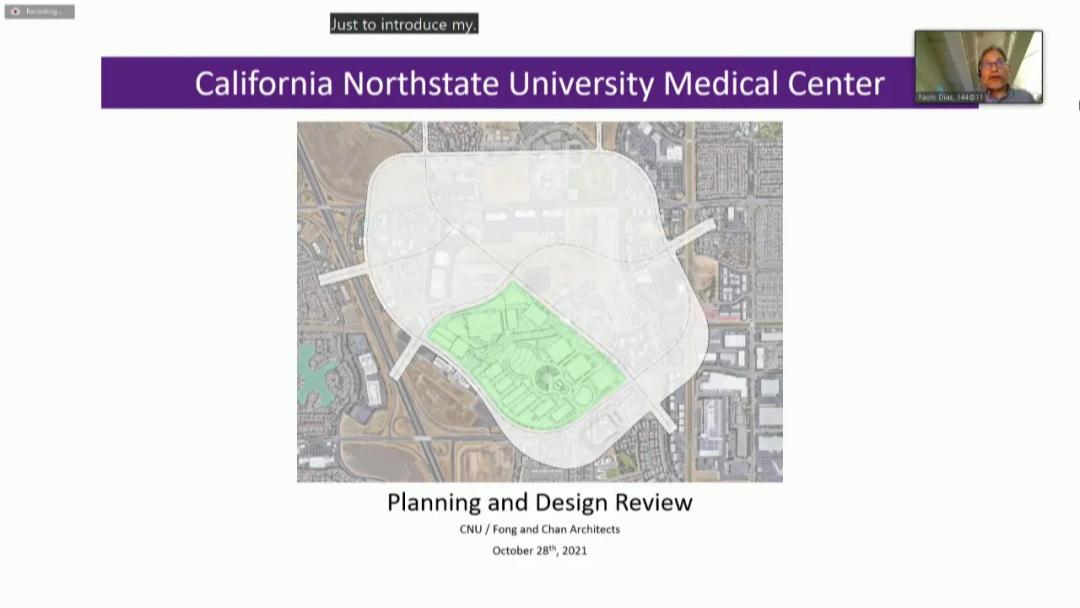
The Sacramento Planning and Design Commission met on Thursday, October 28, 2021, at 5:30 p.m. via teleconference. The meeting included approval of the consent calendar, a public hearing on a cannabis delivery-only dispensary, and a major discussion on the Innovation Park Planned Unit Development (PUD) and California Northstate University (CNU) Medical Campus. No votes were taken on the latter item, which was for review and comment only. Consent Calendar - Approval of Meeting Minutes of October 14, 2021: A motion by Commissioner Wallace, seconded by Commissioner Covell, passed unanimously (all present voted aye; Commissioner Buckley joined after the vote). - Director’s Report (Oral): Received and filed. The report noted that on October 19, 2021, City Council approved the Opus Student Housing Project on Folsom Boulevard and the Clear Channel Billboard Relocation project, which the commission had recommended in 2019. Public Hearings Item 3 – Aurum Translucence Delivery CUP (P21-035): A request for a Conditional Use Permit to establish a delivery-only cannabis dispensary and modify a previously approved cannabis production facility within an existing ±8,640-square-foot building at 108 Otto Circle. Staff recommended approval subject to conditions. No public comments were received (no e-comments or speakers). The item was approved by motion (Commissioner Macias Reed moved, Commissioner Pluckebaum seconded) with all present voting aye; Commissioner Buckley did not vote as she joined late. Discussion Items Item 4 – Innovation Park Planned Unit Development and California Northstate University Medical Campus (P18-077): This was a presentation and discussion only; no action was taken. The project proposes transforming the 183-acre former Sleep Train Arena site into a mixed-use development anchored by a teaching hospital and university campus. The applicant team (Sacramento Kings, CNU, and design consultants) presented the PUD districts, circulation network, open space plan, and detailed hospital design. Commissioners raised numerous questions and comments, including: - Concerns about the DAG (Design Advisory Group) process and whether comments were adequately addressed. Staff confirmed the applicant had responded thoroughly. - The commitment to the building design and the process for future changes: Staff stated the design for Phase 1A (hospital) will be conditioned and any substantial changes must return for site plan and design review. - Zoning: The request to change the general plan designation from Urban Center High to Urban Center Low and rezone to C2 with a PUD. Commissioners questioned the wholesale change and the appropriate zoning; staff and applicant explained the need for a PUD to prohibit incompatible uses and implement the city’s urban infill vision. - Parking: Discussion on parking needs for the hospital (approximately 306 spaces required by code, but applicant determined a higher number using operational methodology). The parking structure location and ground-floor activation were debated. - Central plant location: Concerns about its prominence near residential; applicant noted they are designing a more architectural facade and will address activation. - Flood risk: Questions about underground parking and flood mitigation. The hospital’s critical components will be elevated above the 200-year floodplain; surface parking will be at grade and may flood in a 200-year event. - Sustainability: Applicant committed to LEED Gold for the hospital. Commissioners encouraged use of native landscaping, dark-sky lighting, permeable paving, and biodiversity/climate sections in the PUD. - Housing strategy: Applicant stated a commitment to a mixed-income housing strategy, with 10% of total units (minimum 20 units/acre) as affordable. They are discussing with SHRA (Sacramento Housing and Redevelopment Agency) potential land dedication or developer obligations. Commissioner Young urged inclusion of affordable housing for students and service workers and dispersion throughout the site. - Community outreach: One commissioner noted the need for broader citywide outreach beyond the internet; staff said they will send information to community groups and use a project website and email. - Public comment: One speaker, Lori Bremner, owner at Bella Rose condominiums adjacent to the site, expressed excitement but asked for open space near her complex, a sound wall during construction, and a direct access gate to the bike/walking path. Key Outcomes - Consent calendar approved. - Item 3 (Aurum Translucence) approved with conditions. - Item 4 (Innovation Park PUD/CNU) was for review and comment only. The project will return to the Planning and Design Commission on November 29, 2021, for a recommendation to City Council, with City Council consideration expected in February 2022. Staff will incorporate commissioner feedback and continue working with the applicant on outstanding design and policy issues.
LAND USE PLANNING 24% · URBAN DESIGN 21% · COMMUNITY ENGAGEMENT 8% · PROCEDURAL 6%
1082
OCT 27, 2021 · SACRAMENTO, CALIFORNIA · UTILITIES RATE ADVISORY COMMISSION
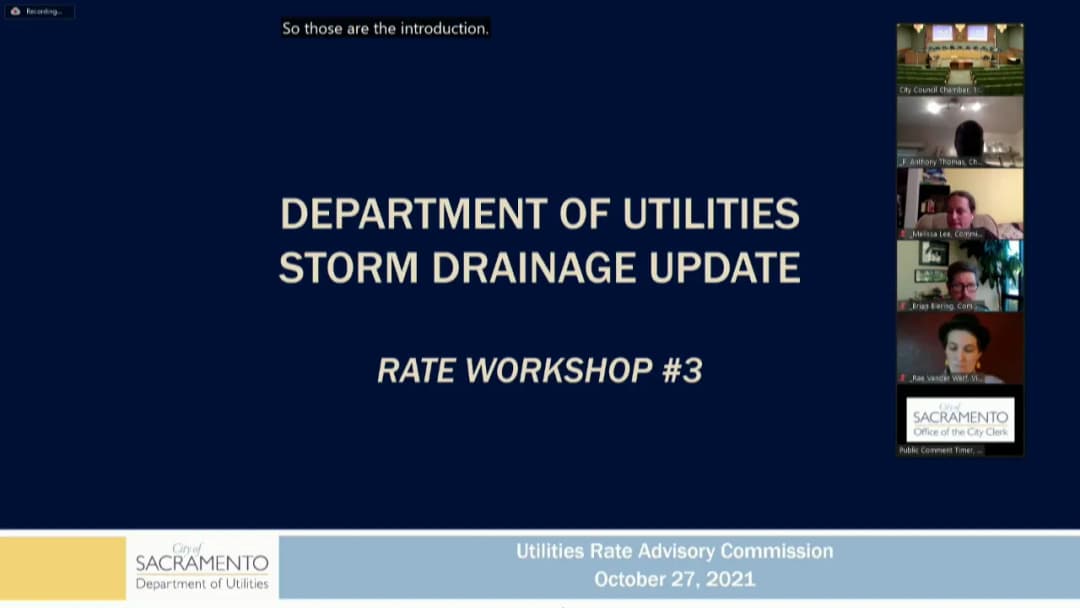
Utilities Rate Advisory Commission Meeting - October 27, 2021: Storm Drainage Rate Workshop #3 and Historic Storm Update

On October 27, 2021, the Sacramento Utilities Rate Advisory Commission (URAC) held a virtual meeting at 5:30 p.m. to discuss the Department of Utilities' Storm Drainage Rate Workshop 3, including a revised rate structure and an update on a historic storm event that occurred over the preceding weekend. Consent Calendar - Approved the minutes from September 22, 2021, by a vote of 4-0, with Chair Thomas abstaining. Public Comments & Testimony - No members of the public spoke during the meeting. One eComment was received, and staff is responding to it. Discussion Items - Historic Storm Update (October 23-24, 2021): Director Bill Busath reported that the city received 5.44 inches of rain in a 24-hour period, breaking a record set in 1888 (5.28 inches). The event was classified as a 500-year storm. The Department of Utilities activated its operations center on Saturday at noon, deploying 85-90 personnel on 12-hour shifts, including 70 field staff. While significant street flooding occurred, property flooding was minimal, attributed to system improvements such as the newly operational McKinley Vault, which captured 6 million gallons of water. The vault was designed for a 10-year storm but performed well during this extreme event. Busath noted that aging infrastructure (e.g., pump stations, communication systems) presented challenges, but redundancy kept impacts low. The storm underscored the need for continued system renewal and capacity improvements. - Storm Drainage Rate Workshop 3 (Item 2): Staff presented a revised rate structure for storm drainage fees, based on feedback from Commissioner Fidel at the previous workshop. Key changes: - Multifamily rates were restructured into three density tiers (high, medium, low) instead of a single rate, better aligning charges with impervious surface runoff. - Rates are calculated using impervious surface coefficients (ISCs) developed by the state. For example, a high-density apartment (50+ units/acre) would pay $0.67/unit/month; medium-density $2.41/unit/month; low-density $5.84/unit/month. Single-family rates remain based on parcel size. - Non-residential rates unchanged, with ISCs ranging from 0.19 (agriculture) to 0.86 (industrial/retail/commercial). A sample commercial property (53,000 sq ft) would pay $75/month. - Staff emphasized that no storm drainage rate increase has occurred since 1996 and will include this fact in outreach materials. - Outreach includes meetings with stakeholders (business, multifamily, labor, environmental groups) and six webinars planned for December 2021. - Schedule: Next URAC meeting November 17, 2021 (Workshop 4 with survey results); protest mailer sent shortly after; ballot election February-March 2022; rate adoption by City Council April 2022; implementation July 1, 2022. - Commissioner Q&A: - Vice Chair Vander Werf: Asked about exempt properties (vacant parcels without impervious surfaces) and confirmed commissioners can attend outreach webinars; will be invited. - Commissioner Fidel: Thanked staff for revising multifamily rates; will meet offline with staff and consultants to discuss tier thresholds (a meeting with less than a quorum of commissioners is permissible under Brown Act). - Commissioner Lee: Inquired about voting process. Staff explained it will be an issue-specific ballot initiative, with one ballot mailed per customer (property owner per bill). Results will be tabulated by a consultant and verified by the City Clerk’s office. - Commissioner Biering: Confirmed the new structure better approximates cost-of-service by linking runoff to impervious surface area per unit. - Commissioner Vander Werf (additional): Raised concern about renters indirectly impacted by rate changes. Staff agreed to consider renter outreach through webinars and broader advertising. Key Outcomes - Consent calendar minutes approved (4-0, Chair abstaining). - Storm drainage rate workshop presentation received and filed; no vote required. - Staff will share the multifamily density bar chart with all commissioners and schedule an offline discussion with Commissioners Fidel and Vander Werf (less than quorum) to refine tier boundaries. - Staff will explore renter outreach strategies for the rate adjustment. - Next meeting: URAC Workshop 4 on November 17, 2021.

UTILITIES 33% · RATE INCREASES 31% · STORMWATER MANAGEMENT 22% · PROCEDURAL 8%
1083
OCT 26, 2021 · SACRAMENTO, CALIFORNIA · RACIAL EQUITY COMMITTEE
Racial Equity Ad Hoc Committee Special Meeting - October 26, 2021

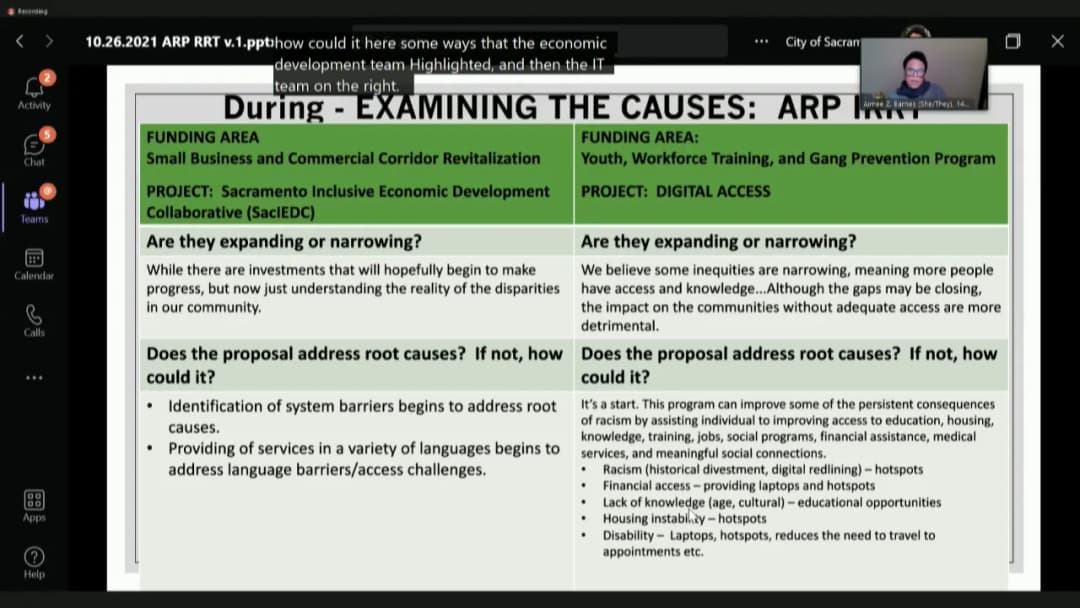
This special meeting of the Sacramento Racial Equity Ad Hoc Committee focused on two major agenda items: adopting a formal land acknowledgement for city meetings and approving a draft American Rescue Plan (ARP) racial equity rapid response tool. The committee heard presentations from tribal leaders and city staff, deliberated on goals and metrics, and passed both action items unanimously. Public comment addressed the need for intentionality and a racial wealth-based framework. Consent Calendar - Item 1 (Teleconferencing Meetings During COVID-19 State of Emergency): Received and filed unanimously. The committee approved the consent calendar motion with a 4-0 vote (Councilmember Gatta, Councilmember Schenirer, Co-Chair Vang, Co-Chair Steinberg). Public Comments & Testimony - Dr. Corrine Macintosh (resident, Councilmember Jennings district): Called in to urge the committee's white male members (Mayor Steinberg, Vice Mayor Schenirer) to be more intentional and not interrupt or ask for unpaid labor from presenters of color. She recommended they attend Showing Up for Racial Justice meetings. - Chris Logston (Sag Black Biz, ARCC, CJEC): Advocated for a racial wealth-based framework for the ARP tool and Community Vulnerability Index. He agreed with the mayor and vice mayor that the current tool appears backwards-looking and recommended setting specific goals, such as decreasing the relative racial wealth gap in Sacramento. Discussion Items Item 2: Land Acknowledgement Presentation and Recommendation - Presentation: Chairman Jesus Tarango of the Wilton Rancheria and Brita Guerrero (CEO, Sacramento Native American Health Center) presented. Chairman Tarango emphasized that land acknowledgements are about respect, recognition, and showing that Indigenous people are still here. He advised against asking tribes to write the acknowledgement and instead urged the city to educate itself. Brita Guerrero highlighted moving from acknowledgement to action—including hiring Indigenous staff and engaging in government-to-government relationships. - Deliberation: - Councilmember Guerra thanked the presenters and noted his family's Indigenous roots in Michoacán. He expressed support and moved the item. - Mayor Steinberg seconded and suggested adding an educational component—an hour-long history lesson from Chairman Tarango or Brita Guerrero for the full council—to prevent the acknowledgement from becoming rote. - Co-Chair Vang supported the motion and requested that staff work with the presenters on an educational presentation for the full council. - Vote: Motion passed unanimously (4-0). The committee directed that the land acknowledgement be adopted for all Racial Equity Ad Hoc meetings and forwarded to City Council for citywide adoption. Item 3: Draft American Rescue Plan (ARP) Racial Equity Rapid Response Tool - Presentation: Aimée Z. Barnes (Manager, Office of Diversity and Equity) reviewed the tool's three components: guiding principles, driving questions, and a Community Vulnerability Index (CVI) with six indicators (no health insurance, education, gross rent as percentage of income, poverty, unemployment, disability status). She reported two practice sessions with economic development and IT teams, showing how the tool can identify shared root causes of racial inequities. - Deliberation: - Vice Mayor Schenirer questioned how goals would be set and measured, emphasizing that the tool should be forward-looking to set targets (e.g., number of jobs created) rather than only measuring past outcomes. - Mayor Steinberg agreed, stressing the need for specific, measurable goals tied to dollar amounts (e.g., helping a certain number of at-risk small businesses). He argued that setting benchmarks would excite the community and drive accountability. - Councilmember Guerra supported requiring disaggregated data from external partners but cautioned against setting up community organizations for failure; he advocated for capacity-building assistance. - Co-Chair Vang noted the tension between urgency to deploy ARP funds and the need for council consensus on goals. She suggested a full council workshop on racial equity to build shared understanding before setting council-level goals. - ACM Laney and Aimée Barnes confirmed that the tool would be used iteratively for each project, that data disaggregation is being operationalized, and that external partners will be required to report demographic data. They are developing a shared repository for tool assessments. - Vote: Motion to authorize the City Manager to use the draft ARP racial equity rapid response tool and the CVI metrics passed unanimously (4-0). Key Outcomes - Land Acknowledgement: Adopted for Racial Equity Ad Hoc meetings; recommendation forwarded to City Council for citywide adoption (all meetings, committees, boards). Staff to coordinate an educational presentation for the full council. - ARP Racial Equity Tool: Approved for use in evaluating ARP funding decisions. Staff to continue applying the tool to all ARP projects and report back. The committee requested that the working definition of racial equity (as presented by staff) be used for ARP deployment until a community-informed definition is developed through the Race Forward process. - Future Meetings: - A presentation from Race Forward on their community engagement process will be scheduled for the next Racial Equity Ad Hoc meeting. - Staff will work with the committee to develop a full council workshop on racial equity, including a shared definition and goal-setting for ARP and future investments. - Public Data Collection: Confirmed that all ARP-funded programs and external partners will be required to collect and report disaggregated data by race, ethnicity, gender, and other demographics, with opt-out allowed but the question mandatory. Next Steps - The committee adjourned at approximately 4:00 p.m., with members noting they would proceed to a closed session.

RACIAL EQUITY COMMITTEE 52% · NATIVE AMERICAN HISTORY 19% · ECONOMIC DEVELOPMENT 8% · AMERICAN RESCUE PLAN ACT 8%
1084
OCT 21, 2021 · SACRAMENTO, CALIFORNIA · ACTIVE TRANSPORTATION COMMISSION
Active Transportation Commission Meeting - October 21, 2021

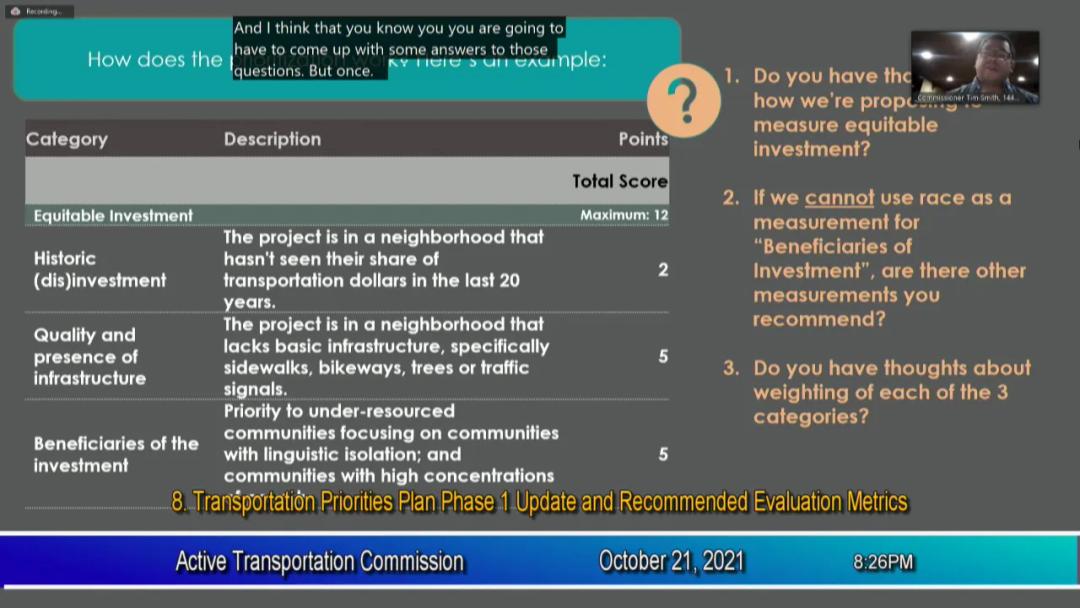
The Active Transportation Commission met on Thursday, October 21, 2021 at 6:00 p.m. via Zoom teleconference due to the COVID-19 state of emergency. The commission considered consent items, received staff reports, and discussed several major items including amendments to the Bicycle Master Plan for the Innovation Park development, applications for Caltrans Sustainable Transportation Planning Grants, the Transportation Priorities Plan, and commercial corridor studies. The meeting lasted approximately two hours and included roll call, public comment (none received), and commissioner comments. Consent Calendar - Item 1: Approved meeting minutes of September 16, 2021 (motion passed with one abstention—Commissioner Smith). - Item 2: Received and filed the Active Transportation Commission log. - Item 3: Approved continued teleconferencing under California Government Code section 54953(e) due to the COVID-19 pandemic, consistent with City Council action on October 12, 2021. Public Comments & Testimony - No members of the public spoke or submitted comments via Zoom during the meeting. Written eComments were accepted before and during the meeting. Discussion Items - Item 4 - Commission Staff Report: Jennifer Donlon Wyant provided updates: (1) The Active Transportation Audits for North, Broadway-Fruit Ridge, and South areas are paused due to staff capacity; consultant Alta Planning & Design has been selected. (2) The North 12th Street Complete Streets project (cycle track) is nearly complete; ribbon cutting announced soon. (3) Battle of the Ballards delineators were installed on J Street and 10th Street. (4) The letter regarding charging hubs was sent to City Council; no reply received. - Item 5 - Innovation Park Planned Unit Development – Amendments to the Bicycle Master Plan: The project team (Jeff Dorso, Mary Lux, Joe) presented a plan to redevelop the 183-acre Sleep Train Arena site with a new street network including a Class I shared-use path (Innovation Park Loop), Class II bike lanes on entrance roads, and Class IV separated bikeways on primary internal roads. Discussion focused on connections to existing bike facilities. Commissioners expressed concern that three connector roads were proposed as Class II when the existing Bicycle Master Plan showed Class I trails. The project team affirmed that the existing planned Class I connections on adjacent parcels would remain in the master plan. After debate, Commissioner Pollins moved to approve the amended bike plan with a strong recommendation that the project team evaluate eliminating on-street parking on connector roads and explore a higher-quality bikeway. The motion passed 7-3-1 (Commissioners Brazzle, Buenrostro, Garrow, Hopts, Pollins, Smith, and Chair Heim voted aye; Commissioners Carpenter, Dewar Westbrook, and Ward-Waller voted nay; Commissioner Granville abstained). City traffic engineer Dave Androslum noted opportunities for design improvements. - Item 6 - FY2022/23 Sustainable Transportation Planning Grant Program Applications: Jennifer Donlon Wyant presented five grant applications to Caltrans: (1) 15-Minute Neighborhoods Plan, (2) Active Transportation Plan (combining pedestrian and bicycle master plan updates), (3) Truxel Bridge Feasibility Study (multimodal bridge connecting North Natomas), (4) Transportation Demand Management Plan (update outdated 1980s ordinance), and (5) Street Design Standards Update. The commission voted unanimously to recommend City Council approve the applications. Commissioners noted the ambitious scope but supported all five. - Item 7 - Active Transportation Log Discussion: Drew Hart proposed a new format for the commission log with columns for date, sponsoring commissioner, specific request, commission duty, equity connection, and status. Commissioners identified items from the old log to carry forward: 3 (bike/ped collision data – Commissioner Carpenter), 4 (implementation of equity definition – Vice Chair Ward-Waller and Commissioner Dewar Westbrook), 7 (implementation of equity definition – Commissioner Buenrostro), 8 (Commissioner Dewar Westbrook), 9 (speed reduction measures – Commissioner Buenrostro), 10 and 11 (Commissioner Carpenter). No formal action was taken; staff will follow up individually. - Item 8 - Transportation Priorities Plan Phase 1 Update: Jennifer Donlon Wyant presented community engagement results and proposed scoring criteria. Phase 1 (April–June 2021) included virtual gatherings (140+ participants), online and paper surveys (available in five languages), and targeted outreach to underrepresented areas. Survey priorities were: air quality/health, equitable investment, connections to jobs/parks/schools, maintenance, safety, and technology (lowest). Proposed criteria weight equally the five values: Health & Air Quality, Equitable Investment, Access to Destinations, Transportation Safety, and Fixing & Maintaining. For equitable investment, staff proposed three sub-measures: (1) disinvestment (weight 2), (2) quality and presence of infrastructure (weight 5), (3) beneficiaries (weight 5 – based on race, or alternative: high poverty or linguistic isolation). Commissioners praised the work and offered suggestions: Vice Chair Ward-Waller noted that investment does not always equal benefit (e.g., freeway widening); Commissioner Buenrostro recommended using asset-focused language (e.g., “multilingual households” instead of “linguistic isolation”); Chair Heim asked about geographic scale of disinvestment analysis; Commissioner Carpenter requested collision data by race (staff responded 2018 Vision Zero analysis showed 44% of KSIs in disadvantaged communities but no racial breakdown). Staff will refine criteria based on feedback. - Item 9 - Commercial Corridors: Northgate Blvd & Freeport Blvd Transportation Plans: Drew Hart presented two corridor studies funded by a previous Caltrans grant. Freeport Blvd (Blair Ave to Sutterville Rd) and Northgate Blvd (I-80 to Highway 160) are both commercial corridors with similar land use and crash patterns. The 18-month planning process is in the community visioning phase, with virtual workshops (Oct 27 and Nov 3) and walking audits scheduled. Commissioners expressed support and offered to participate. Key Outcomes - Consent Calendar approved (Item 1 minutes, Item 2 log, Item 3 teleconferencing) with one abstention. - Item 5 (Innovation Park Bicycle Master Plan amendments) approved 7-3-1, with a strong recommendation to improve entrance bikeways. - Item 6 (Grant applications) approved unanimously, forwarded to City Council. - Item 7 (ATC log) was informational; commissioners claimed items for the new log format; staff will follow up. - Item 8 (Transportation Priorities Plan) was informational; staff will refine equity metrics and bring back for further input. - Item 9 (Commercial corridor studies) was informational; commissioners encouraged to attend workshops. - Next meeting: November 18, 2021 via teleconference.

TRANSPORTATION SAFETY 25% · BICYCLE SAFETY 21% · PROCEDURAL 10% · EQUITY 8%
1085
OCT 20, 2021 · SACRAMENTO, CALIFORNIA · PRESERVATION COMMISSION
Preservation Commission Meeting – October 20, 2021

The Sacramento Preservation Commission held a regular teleconference meeting on Wednesday, October 20, 2021, at 5:30 p.m. The meeting included a consent calendar, two public hearings on landmark nominations, and a director's report. All votes were unanimous among those present, with one commissioner absent for part of the meeting. Consent Calendar - Approval of Minutes (August 18, 2021): The commission voted 5–0–1 (Commissioner Miller-Cruiess abstained) to approve the minutes of the August 18, 2021 meeting. Commissioner Carter joined after the vote began. Public Hearings - Item 2 – Montgomery Way Landmarks (2666, 2701, 2730, 2751, 2770 Montgomery Way): Staff presented the five properties as eligible for landmark status under Criteria 3 (architecture) and 4 (association with master architects Dean & Dean). Commissioner Lemon inquired about the possibility of a future historic district; staff noted that a prior survey had been conducted but additional outreach was needed. No public comments were received. The commission voted 5–0 (Commissioner Carter absent) to recommend City Council adopt the ordinance listing the properties as landmarks. - Item 3 – 1121 40th Street Landmark: Staff presented the property as eligible under Criteria 1 (events – part of the Wright & Kimbrough tract), Criteria 2 (persons – Dalton family, founders of Fox & Goose restaurant and preservation advocates), and Criteria 3 (architecture – Craftsman style). No public comments were received. The commission voted 5–0 (Commissioner Carter absent) to recommend City Council adopt the ordinance listing the property as a landmark. Director’s Report - CLG Training: The commission hosted a virtual Certified Local Government (CLG) training for preservation commissioners, with about 60 registrants. Recordings available for 60 days. - CLG Grant: A public outreach grant is nearing completion; final deliverables will be presented to the commission at a later meeting. - African American Experience Grant: A National Trust grant has been awarded; oral history and research components are underway with graduate students from Sacramento State. - Commission Vacancies: Several applications for vacant seats (including Commissioner Carter’s) will be considered by the PPNE committee on November 9, 2021. Chair Valania’s term expires in January 2022. - Council Actions: On September 14, City Council approved three Mills Act contracts; on September 28, Council approved the Montgomery Way landmark nomination (as recommended by the commission). The Beehive item was continued to October 6. - Staff Updates: Carson Anderson has returned as a retired annuitant to assist with grants. Interns Caitlin Grabe and Robert Hackney are now on staff. Key Outcomes - Approved minutes of August 18, 2021 (5–0–1). - Recommended City Council approve landmark designation for five Montgomery Way properties (5–0). - Recommended City Council approve landmark designation for 1121 40th Street (5–0). - Meeting adjourned at 6:02 p.m.

HISTORIC PRESERVATION 54% · PROCEDURAL 31% · PUBLIC PARTICIPATION 15%
1086
OCT 19, 2021 · SACRAMENTO, CALIFORNIA · LAW AND LEGISLATION COMMITTEE
Law and Legislation Committee Meeting - October 19, 2021

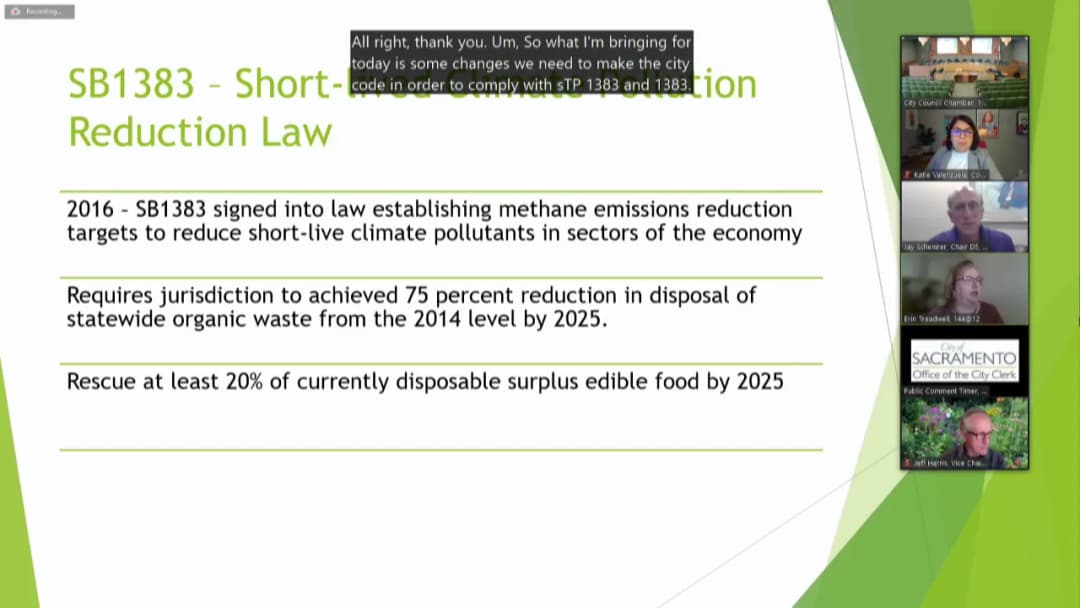
The Law and Legislation Committee held a regular meeting on October 19, 2021, starting at 1:01 p.m. and adjourning at 1:14 p.m. The committee reviewed and approved the consent calendar and discussed a major ordinance related to solid waste management required by California SB 1383. Consent Calendar - Approved the Law and Legislation Log (File ID 2021-00267) and received/filed Legislative Advocacy Correspondence (File ID 2021-00268) by a unanimous vote. Discussion Items - Ordinance Amending Solid Waste Management Code (File ID 2021-01128): Staff presented proposed code changes to comply with SB 1383, which mandates methane reduction targets, 75% reduction in organic waste disposal by 2025, and 20% food recovery. The ordinance requires residential food waste separation starting summer 2022 and establishes food recovery requirements for large generators. The commercial side was addressed earlier in 2021. Committee members expressed support and raised concerns: - Councilmember Valenzuela emphasized the need for community education on waste reduction and separating organic waste, noting excitement and questions from residents. - Vice Chair Harris inquired about metrics for household food waste; staff reported no standard metric is available. He thanked staff and moved the item. - Councilmember Guerra seconded the motion, adding direction for staff to work with landfills and haulers to address coordination issues between city and county regulations. He also highlighted the potential for biodigesters and university partnerships. Key Outcomes - The committee voted unanimously (4-0) to forward the ordinance to the City Council for consideration, with a target adoption by November 30, 2021, to meet the state deadline of January 1, 2022. The motion included additional direction from Councilmember Guerra for staff collaboration with waste haulers and landfills.

WASTE MANAGEMENT 58% · PROCEDURAL 31% · PUBLIC COMMENTS 11%
1087
OCT 18, 2021 · SACRAMENTO, CALIFORNIA · MEASURE U COMMUNITY ADVISORY COMMISSION
Measure U Community Advisory Committee Meeting - October 18, 2021

The Measure U Community Advisory Committee met on Monday, October 18, 2021, at 6:00 p.m. via Zoom. The meeting included discussion and votes on the FY2019/20 Annual Report and questions for the 2022 Community Survey, as well as updates from ad hoc committees and the City Manager's Office. The meeting adjourned early due to loss of quorum before acting on the consent calendar. Discussion Items - Item 1: Approval of the Measure U Community Advisory Committee Fiscal Year 2019/20 Annual Report – The committee discussed the draft report, which concluded that the city was in legal compliance with Measure U but recommended that future budgets present information on a programmatic basis to show the benefits enabled by the additional revenue. The report also noted the committee's work meeting with city departments. A motion was made to accept the report with the addition of a signature block, which passed unanimously (8 ayes, 5 absent). - Item 2: Approval of Questions to Submit to the City Auditor’s Office for the 2022 Community Survey – The committee discussed possible survey questions, noting that space on the survey was limited. Suggestions included asking about awareness of Measure U's impact or prioritization of funding categories, with a focus on supporting the participatory budgeting process. A motion to authorize the Measure U Community Communications Ad Hoc Committee to finalize and transmit questions to the City Auditor's office passed unanimously (8 ayes, 5 absent). Ad Hoc Committee Updates - Participatory Budgeting Ad Hoc: Reported progress on assessments, interviews with city staff and council members, and development of a rule book for the process. Plans to present the rule book outline at the November 15 meeting. - Annual Report Ad Hoc: Completed duties with the passage of Item 1; no additional updates. - Measure U Community Communication Ad Hoc: Working on strategies to communicate how Measure U funds are used, including creating a brochure and utilizing a city events calendar. Identified challenges in isolating Measure U funds from the general fund. - Research on Universal Basic Income Ad Hoc: Requested to agendize a presentation from the Mayor's office and United Way on guaranteed income programs, using ARPA funds, for the November 15 meeting. City Manager’s Office Report - Provided an update on the American Rescue Plan Act (ARPA) funding. The City received about $112 million, with council approving five priority areas: small business/commercial corridors, housing/homelessness, youth workforce/gang prevention, arts/creative economy, and organizational needs. Initial allocations were being brought forward the next day (October 19) for budget actions. Committee Member Comments & Ideas - Chair Cofer reported ongoing joint work with the Police Commission to request data on 911 calls to inform staffing recommendations for the Department of Community Response, which is funded by Measure U. A letter to council is being drafted. Consent Calendar (Not Acted Upon) - Items 3-5 (Ad Hoc Committees Membership Roster, Approval of Meeting Minutes from September 20, 2021, and Agenda Log) were not considered because the meeting lost quorum and adjourned early. Key Outcomes - Passed: Motion to approve the FY2019/20 Annual Report with a signature block (8-0-5 absent). - Passed: Motion to authorize the Communications Ad Hoc Committee to finalize and submit survey questions to the City Auditor (8-0-5 absent). - Deferred: Consent Calendar items to the next meeting. - Next Steps: The Participatory Budgeting Ad Hoc will present a rule book outline at the November 15 meeting. The Universal Basic Income Ad Hoc will request a presentation at that same meeting. The Communications Ad Hoc will work on finalizing survey questions and explore communication tools.

PARTICIPATORY BUDGETING 27% · MEASURE U 24% · PUBLIC ENGAGEMENT 12% · SURVEY METHODOLOGY 11%
1088
OCT 18, 2021 · SACRAMENTO, CALIFORNIA · CIVIL SERVICE BOARD
Civil Service Board Meeting – October 18, 2021

The Sacramento Civil Service Board held a virtual meeting on October 18, 2021. The board approved previous meeting minutes, heard an appeal regarding a candidate disqualification from an Integrated Waste Equipment Operator recruitment, addressed board comments, and welcomed a new board member. Consent Calendar - Approved the minutes of August 23, 2021 and September 20, 2021, with a correction for Chair Byrd's name spelling. Motion by Member Meola, second by Member Hunter, passed unanimously. Discussion Items - Appeal of Disqualification of Evetzequiel Paul Flores Beltran: The appellant was disqualified from the Integrated Waste Equipment Operator recruitment (open July 17–31, 2021) for failing to list qualifying experience in his application. Staff presented that the minimum qualifications require one year experience operating a two- or three-axle vehicle with a gross vehicle weight of 30,000 pounds or more, and the appellant acknowledged the requirement but did not include relevant experience. The appellant was not present at the meeting. The board voted unanimously to deny the appeal and affirm the director's disqualification. Board Comments - Chair Byrd inquired about the status of a previous appellant, Monica Willusa (from the August 23, 2021 meeting). Staff reported they are still awaiting a response from the appellant. - Member Meola raised a concern that the agenda statement that written public comments will not be read aloud may not comply with AB361. He requested staff consult with the city attorney for possible revision or removal. New Member Welcome - The board welcomed new member Joy Cabatic, who introduced herself as a 20-year state employee with management experience and a mother of two-year-old twins. Key Outcomes - Consent calendar approved unanimously. - Appeal denied unanimously; director's disqualification affirmed. - Staff to follow up on AB361 compliance for written public comment policy. - Status of prior appellant (Monica Willusa) remains pending.

PROCEDURAL 51% · PERSONNEL MATTERS 49%
1089
OCT 14, 2021 · SACRAMENTO, CALIFORNIA · PLANNING & DESIGN COMMISSION
Sacramento Planning and Design Commission Meeting on Council Call-Up Provisions - October 14, 2021

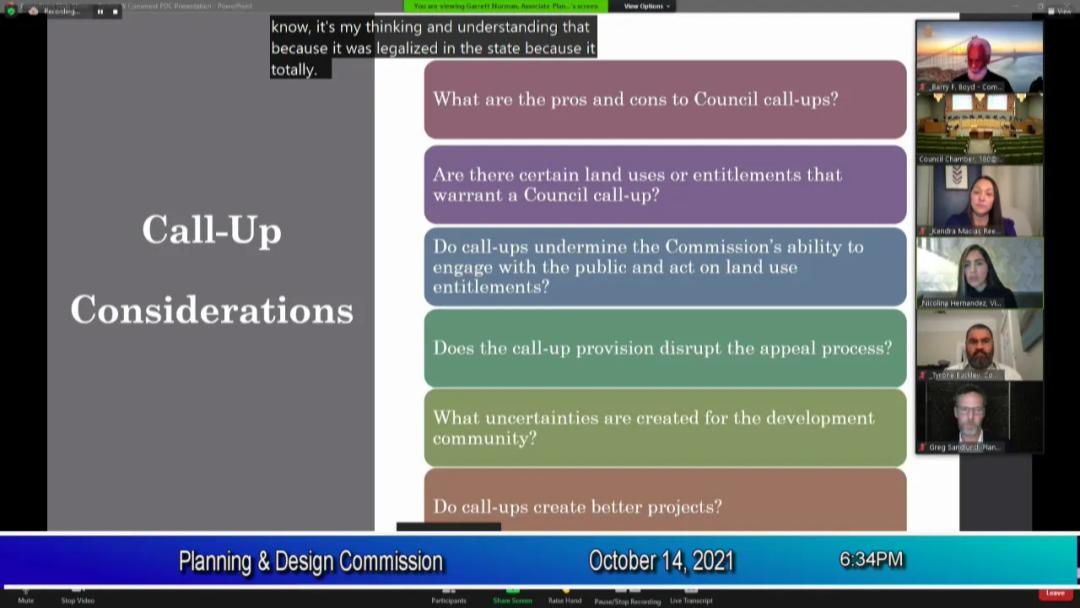
The Sacramento Planning and Design Commission held a teleconference meeting on October 14, 2021, at 1:30 p.m. UTC (via Zoom due to the COVID-19 pandemic). The primary agenda item was a discussion on the appropriateness of adding a council call-up provision for land use entitlements in Title 17 of the Sacramento City Code, as requested by the Law and Legislation Committee. The meeting included a consent calendar and a detailed discussion of historical call-up data, with commissioners providing comments to be reported to the committee. Consent Calendar - Approval of Meeting Minutes (September 23, 2021): Passed unanimously with a roll-call vote. Commissioner Wallace abstained, noting they had missed the prior meeting. - Director’s Report: Received and filed; no oral report was given. Discussion Items - Item 3: Review and Comment on Adding a Council Call-Up Provision in Title 17 for Land Use Entitlements - Staff (Associate Planner Garrett Norman) presented historical data on call-ups from 2005 to present. A total of 29 projects were called up: 24 from 2005–2013 (when call-ups applied broadly) and 5 cannabis-related since 2017. The average delay caused by call-ups was approximately 4.5 months, with the longest at 16 months and the shortest at 1 month. Of the 29 call-ups, 86% (25 projects) resulted in no change to the original decision; only 4 outcomes were altered. The majority of called-up projects were residential (14), followed by cannabis (5). - Commissioners discussed several questions posed by staff: pros and cons of call-ups, which land uses might warrant them, whether call-ups undermine the commission’s role, the relationship with the existing appeal process, uncertainty for developers, and whether call-ups create better projects. - Commissioner Positions (summarized): - Commissioner Pluckebaum, Wallace, Buckley, Chase, Hernandez, Young, and Wong-Connelly generally opposed broad call-up provisions, citing redundancy with the existing appeal process, additional delays (average 4.5 months), increased uncertainty for developers, and the risk of politicizing land use decisions, especially for housing. They emphasized the importance of the streamlined process adopted in 2013 and noted that 86% of call-ups did not change outcomes, indicating inefficiency. - Commissioner Coville initially supported the call-up for drive-through restaurants but later reconsidered, noting the historical trend of council removing call-ups to depoliticize decisions. - Commissioner Boyd supported call-ups as a necessary check by elected officials and the citizenry, arguing that the commission should not prioritize developer convenience over public input and that the city meets its housing inventory (as per HCD), though others disputed this. - Commissioner Lenzi supported call-ups for elected officials, particularly for controversial uses like alcohol sales, drive-throughs, and cannabis, asserting that council members have the best insight into district priorities. He opposed housing call-ups. - Commissioner Yee suggested call-ups might be appropriate for new or controversial uses (e.g., cannabis) where policy guidance is still evolving, but generally opposed broad call-ups due to uncertainty. He also noted that the lack of litigation after appeals suggests the current process works. - Chair Macias Reed and Vice Chair Hernandez echoed concerns about redundancy and the lack of evidence that call-ups create better projects, emphasizing the need to maintain streamlining and avoid undermining the commission’s work. - Staff clarified that the appeal process allows community members to challenge decisions for a nominal fee ($300), while developers pay higher fees ($4,000). Call-ups currently exist for cannabis and large gas stations near truck routes. Only the council member of the relevant district or the mayor can initiate a call-up. Key Outcomes - No formal motion or vote was taken on the call-up provision; the item was a discussion-only review and comment. - The commission’s comments and feedback will be compiled into a staff report to be presented to the Law and Legislation Committee and subsequently to the City Council for further consideration. - The City Council retains the option to consider a pending ordinance specifically establishing call-ups for drive-through restaurants while the broader policy discussion continues. - The meeting adjourned at approximately 7:30 p.m. UTC (based on the agenda timeline and transcript duration).

LAND USE PLANNING 40% · PROCEDURAL 13% · CANNABIS REGULATION 9% · COMMUNITY ENGAGEMENT 9%
1090
OCT 11, 2021 · SACRAMENTO, CALIFORNIA · COMMUNITY POLICE REVIEW COMMISSION
Sacramento Community Police Review Commission Meeting - October 11, 2021

The Sacramento Community Police Review Commission met via teleconference on Monday, October 11, 2021, at 6:00 p.m., with Chair Mario Guerrero presiding. Eight commissioners were present; two were absent. The meeting lasted approximately 51 minutes, adjourning at 6:52 p.m. Key topics included updates on ad hoc committee recommendations, approval of minutes and quarterly complaint reports, and public comment on crowd control and LGBTQ+ policies. Consent Calendar - Approved Minutes (September 13, 2021): Motion passed unanimously (8–0) to approve the meeting minutes from September 13, 2021. - 2021 Quarter 1 and Quarter 2 Police Complaint Activity Reports: Received and filed unanimously. Public Comments & Testimony - PJ (public speaker) commented on the Crowd and Riot Control Ad Hoc recommendations, commending the prioritization of measurable goals and evidence-based standards, and criticizing the SPD manual for prioritizing property over human life. On the LGBTQ+ policy, he appreciated the specificity for interactions with transgender individuals and recommended that the SPD complaints page automatically CC the Sacramento LGBT Center to ensure accountability. He also inquired about scheduling for the alternative 911 outreach forum. Discussion Items - Ad Hoc Committee Recommendations (Item 3): Chair Guerrero presented the commission’s recommendations to be taken up by City Council on October 19, 2021, including: independent legal counsel for the commission, additional OPSA staffing, direct liaison between SPD and commission leadership, quorum adjustments, an inspector general with subpoena power, commission review of inspector general findings before council, and a requirement for council to vote on commission recommendations within three months. Each active ad hoc committee provided updates: - Budget Ad Hoc (Commissioner Bliss): Continuing to meet; plans to request 911 call and dispatch data from January 2018 onward and to discuss a joint letter with the Measure U Committee, requesting agendization for the November meeting. - Community Engagement and Media Ad Hoc (Commissioner Castillo-Krings): Met twice with SPD, resolved many issues; still seeking public input from local media outlets, which has been challenging. Feedback from Mickey Umstender noted. - Crowd and Riot Control and De-escalation Ad Hoc (Vice Chair Carter): Document fluid, updated to reflect new state legislation restricting rubber bullets and chemical agents. Discussions ongoing on balancing First Amendment rights with officer safety, with emphasis on targeted use of force rather than blanket crowd suppression. - LGBTQ+ Ad Hoc (Chair Guerrero): Draft policy built from earlier work with ACLU, LGBT Center, and SPD; enhanced by the ad hoc. Plans for two to three community forums, especially to reach the transgender community. - Mental Health/Alternative Response Ad Hoc (Commissioner Falcon): Progress slower due to cross-departmental complexity (Office of Community Response, County of Sacramento). Scheduled meetings with OCR, SPD Captain Wendy Brown, Supervisor Patrick Kennedy, and community members. Recognized that recommendations may extend beyond SPD to other city and county entities. Commissioner Falcon requested adding a recommendation to expand the commission’s purview to cover the new alternative response department. - Commission Follow-Up Log (Item 4): Received and filed. Commissioners were reminded to submit follow-up data requests via email to staff. Key Outcomes - Consent calendar passed unanimously. - Ad hoc committees are working toward finalizing recommendations for a commission vote in November (submission deadline October 21) or December (deadline November 18). - Data request from Budget Ad Hoc to SPD for 911 call data will be submitted in writing. - Joint letter with Measure U Committee to be agendized for November meeting. - Commissioner Carter asked about possible connection between complaints in Q4 2020 report and George Floyd protests; staff indicated individual review would be needed. - Commissioner Falcon offered his personal email to community members interested in the alternative 911 response discussions. - Ad hoc lifespans (one year ending in December) noted; committees may be reconstituted next year.

PUBLIC SAFETY 32% · PROCEDURAL 26% · PUBLIC COMMENTS 13% · AD HOC COMMITTEES 7%
OPENPUBLICA · PUBLIC MEETING INDEXUPDATED DAILY · openpublica.com