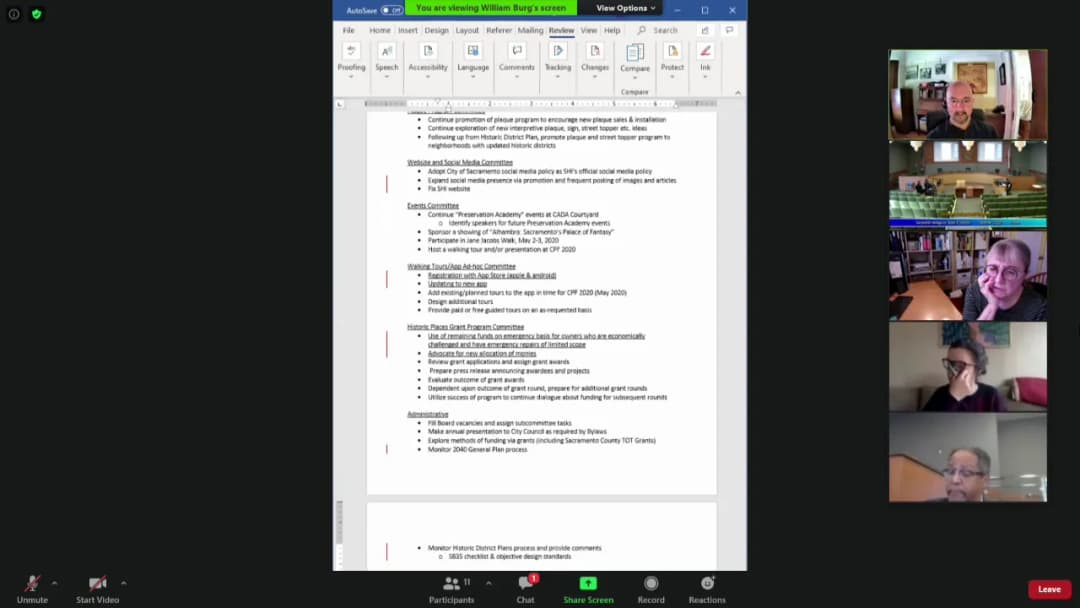
The Sacramento Heritage, Inc. Board of Directors held a special teleconference meeting on December 3, 2020, beginning at 12:00 p.m. to address year-end administrative items, financial reports, grant opportunities, and planning for 2021. Key actions included approval of prior meeting minutes, adoption of the 2021 meeting calendar, and receipt of information on several committee updates and grant awards. Consent Calendar - Item 1 – Approval of Minutes (February 6, 2020): The board voted unanimously to approve the minutes. Director Claire Flynn abstained as she was not a board member at that time. Roll call vote: Berg (yes), Isparza (yes), Farrell (yes), Flynn (abstain), Repka (yes), Whitelum (yes), Worthington (yes). Public Comments & Testimony - No public comments were received during the meeting. Discussion Items - Item 2 – Financial Report (Oral Report): Chair William Burg reported a checking account balance of $14,053.73 at the end of February 2020 and $13,328 at the end of September 2020. The board deferred detailed fiscal discussion to the next meeting due to the absence of Treasurer Melissa Gaudreau. - Item 3 – Walking Tour and Tour App Ad Hoc Committee Updates: Chair Burg and Member Jose Esparza reported that the tour app vendor (Tour Buddy) required organizations to register as vendors on Apple and Android app stores, which has not yet been done. The current app remains functional but cannot add new tours. A goal for 2021 is to upgrade to a new version with an updated look. - Item 4 – Certified Local Government Grant Award ($27,000): Preservation Director Carson Anderson presented the one-time federal grant (requires completion by September 2021). Funds are designated for promoting preservation through a website, social media, educational modules, a professionally produced postcard for historic property owners, and possibly a public service announcement. Board members discussed collaboration opportunities, including partnerships with realtors, Preservation Sacramento, and Sacramento Area Realtors for a historic homes certification program. No formal action was taken; the board received the information and offered comments. - Item 5 – Bronze Plaque Ad Hoc Committee Update: Chair Burg noted two new plaque opportunities: (1) Nathaniel Cauley Law Office (recently added to the Sacramento Register) and (2) Clifford Ford’s home at 2515 Capitol Avenue, designed by Rudolph Harold. The subcommittee reviews plaque content; no formal board approval is required. A replacement for outgoing member Gaudreau on the plaque committee will be needed. - Item 6 – Tax Filings and State Attorney General Charitable Exemption Filing: Board Member Kay Worthington reported filing the 990-EZ for fiscal year ending June 30, 2020, with ending net assets of $13,582 and beginning net assets of $12,046. The IRS accepted the filing on November 3, 2020. The annual registration renewal with the state Attorney General’s office was also filed. The board will need one more year of filings to qualify for the “Big Day of Giving” (targeting 2022). - Item 7 – 2021 Workplan: Chair Burg reviewed the 2019-2020 workplan accomplishments and outlined priorities for 2021, including: resolving the domain name issue for sacramentoheritage.org (lost to a third party), updating the website, adopting a social media policy, expanding Instagram/Facebook posts, developing online events and training, partnering on the CLG grant, and exploring funding sources. The board also discussed the 2040 General Plan update, the new SB 35 checklist for historic properties, and the need to fill board vacancies. No formal vote was taken; the workplan will be refined and presented to City Council in summer 2021. - Item 8 – 2021 Meeting Calendar: Director Anderson presented a proposed calendar: regular meetings in February, March, May, and June 2021 (no April meeting), summer recess, and reconvening in October 2021. Chair Burg recommended a special meeting in January to discuss the General Plan and elect officers. The board voted to adopt the calendar with those modifications. Key Outcomes - Approved Minutes: Consent calendar item 1 approved via roll call (7 yes, 1 abstain). - Deferred Financial Action: Detailed financial discussion and approvals postponed to the next regular meeting. - Adopted 2021 Meeting Calendar: The board approved the calendar, including a special meeting in January 2021, regular meetings in February, March, May, and June, and then resuming in October 2021. - Next Steps: Staff will schedule a special meeting in mid-January 2021 for General Plan review and board officer elections. The board plans to finalize a 2021-2022 workplan by June 2021 and present it to City Council. - Grant Partnership: Staff and board will explore collaboration on the $27,000 CLG grant to develop educational materials, postcards, and joint events with other preservation organizations.
Public Meetings - Sacramento, California
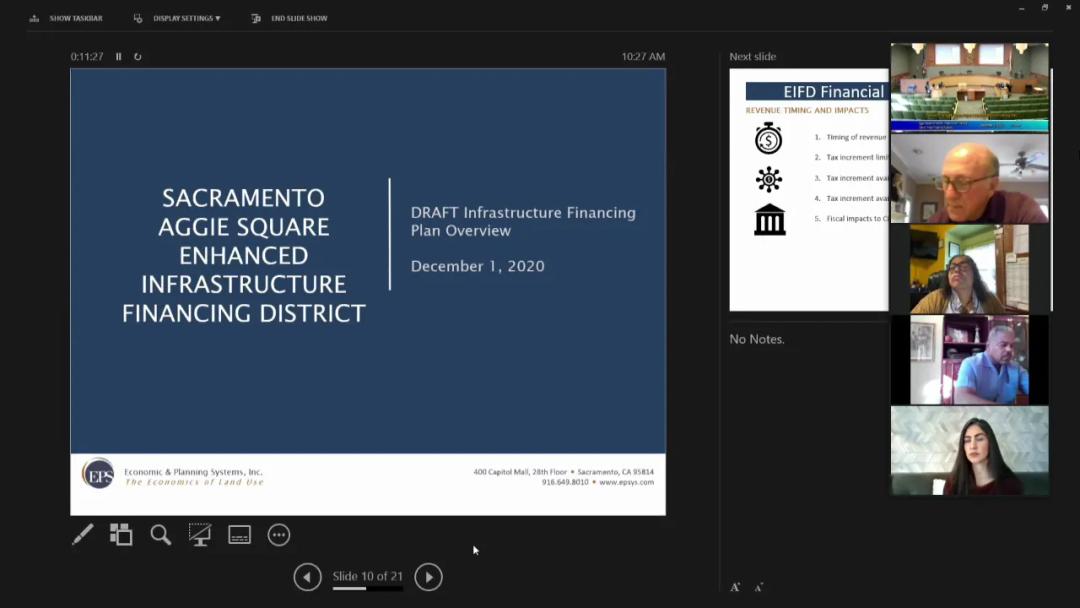
Public Meetings - Sacramento, CaliforniaThe Aggie Square Enhanced Infrastructure Financing District (EIFD) Public Financing Authority met on December 1, 2020, at 10:00 a.m. via teleconference to receive an overview of the Aggie Square project and review the draft Infrastructure Financing Plan (IFP). The meeting focused on financing mechanisms, fiscal impacts, community benefits, and next steps for the proposed development on the UC Davis Medical Center campus. Discussion Items - Project Overview & Draft Financing Plan: City staff (Leslie Fritzsche, Eric Frederick) and consultant Jamie Gomes (EPS) presented the Aggie Square project, which includes four buildings totaling approximately 1 million square feet, a parking garage, and public infrastructure. Phase 1 investment is estimated at $1 billion, expected to generate $2.6 billion in one-time construction benefits, 5,000 construction jobs, and 3,500–4,000 ongoing jobs (25,000 regionally). The draft IFP proposes dedicating 100% of the city’s property tax and vehicle license fee increment to the EIFD, with 20% set aside for city-led affordable housing investments. Tax increment revenues are projected to reach about $2 million annually after Phase 1A completion, $50 million cumulative by 2037, and $100 million by 2046. - Project Labor Agreement (PLA): Board members questioned the PLA details. Staff (John Dangberg) reported that negotiations are ongoing and that the PLA will include targets: 60% regional contracting, 20% small business subcontracting, 60% regional journeyperson hours, 70% regional apprentice hours, and targeted apprenticeships for disadvantaged workers (homeless veterans, ex-offenders, etc.). - Community Benefits & Gentrification: Chair Shineer and Councilmember Jennings raised concerns about displacement and rising costs. Staff noted that a gentrification study is planned as part of the Stockton Boulevard Specific Plan but will not be completed before the EIFD adoption. Board members requested that the analysis be accelerated and that best practices from other cities be presented at the next meeting. Councilmember Eric Guerra emphasized the need for workforce development, adult education, internships, childcare, tree canopy, traffic calming, and affordable housing—both on-site and in the neighborhood. - County Tax Increment Participation: Chair Shineer and Councilmember Jennings suggested approaching Sacramento County (Supervisors Phil Serna and Patrick Kennedy) to contribute county property tax increment to the EIFD, which could double available revenues. Staff agreed to prepare a briefing packet for that discussion. - Fiscal Impact Analysis: The draft IFP includes a preliminary fiscal impact analysis comparing city revenues and costs for serving the new development. The analysis shows a net fiscal gap if property tax revenues are redirected to the EIFD. Final results are pending. Key Outcomes - The board directed staff to schedule the next meeting in January 2021 (instead of February) to discuss: (1) updated IFP details, (2) progress on the community benefits agreement, (3) gentrification/displacement analysis and best practices, and (4) workforce connection measures including a job center. - Staff will prepare a briefing packet for meetings with Sacramento County Supervisors to request potential tax increment participation. - The draft IFP remains under review; additional public hearings and council presentations will follow before adoption. - No public comments were received on matters not on the agenda.
The Budget and Audit Committee met via teleconference on Tuesday, December 1, 2020, at 3:09 PM, with Vice Chair Guerra presiding, joined by Councilmembers Jennings, Schenirer, and Mayor Steinberg (who arrived later). The meeting covered the consent calendar, two audit reports on diversity/equity, and a presentation on participatory budgeting. The committee voted unanimously to forward the consent items and the two diversity reports to the full City Council. Item 5 (participatory budgeting) was received and filed, with a full council workshop planned for January 2021. Two members of the public gave comments on matters not on the agenda. Consent Calendar - Item 1 – City Auditor’s Activity Report for Q1 FY2020/21: Accepted and forwarded to City Council. - Item 2 – Whistleblower Hotline Activity Report (April–September 2020): Accepted and forwarded to City Council. - Both items were approved by a unanimous roll call vote (three ayes; Mayor absent). Discussion Items - Item 3 – 2020 Diversity, Equity, and Inclusion (DEI) Survey Results: City Auditor Jorge Oseguera presented the survey, conducted February 25–March 24, 2020, with 787 responses. Key findings: 70% of employees feel treated fairly in their department; 92% are proud to work for the city; 55% feel they have equal opportunity for growth; 37% believe promotions are fair; 23% witnessed discriminatory behavior in the past 12 months; 12% felt excluded due to ethnicity/race; 7% witnessed unequal treatment due to sexual orientation. Cross-tabulations showed 66% of LGBTQ employees feel they belong vs. 75% of heterosexual employees; 71% of white employees see ethnic diversity as a priority vs. 53% of employees of color. Over 400 written comments were received. - Item 4 – 2020 Audit of City Employees’ Workforce Diversity and Salary Trends: Oseguera presented the audit, which assessed workforce diversity compared to Sacramento residents (513,000 residents; 32% white, 31% Hispanic, 16% Asian; 50.4% female). The audit included trend analysis from 2016–2020. Highlights: female employees account for 34% of full-time/part-time workforce and 39% of management; male employees have average salaries $23,000 higher than females; when excluding part-time and sworn police/fire, the gap narrows to $3,500. White employees are overrepresented in higher salary brackets. New hires (post-July 2019) are more diverse than legacy employees. The audit included 130 figures and a dashboard. Diversity and Equity Manager Ami Barnes presented the city’s Race, Gender, and Equity Action Plan, which includes a 43-point division equity assessment, capacity building, and 14 outcome strategies. Councilmembers expressed support for the work, with Councilmember Guerra noting the need to address promotional opportunities for women of color. Councilmember Jennings requested better metrics and timelines. The committee voted to forward both items to the full City Council (motion by Guerra, second by Jennings; unanimous). - Item 5 – Measure U Community Advisory Committee Proposed Participatory Budgeting Pilot Timeline and Activities: The Measure U Committee (Kathy Crestwell, Deborah Oda Kent, Dana Cadill, Kim Williams, Flo Kaufer) and Christiana de Leon from the Participatory Budgeting Project presented a request for a $5 million allocation from the mid-year budget to start a participatory budgeting (PB) pilot. The proposed five-step process (planning, brainstorming, proposal development, voting, funding/evaluation) would take 10–12 months. The committee recommended a community-led implementation with a PB planning committee. They noted that Seattle recently increased its PB allocation to $30 million. Councilmembers discussed the need for metrics, equity in voting, and budget constraints. Councilmember Schenirer expressed hesitation about new spending given uncertain COVID-19 impacts. Councilmember Jennings wanted to see examples of cities that started small and grew. Councilmember Guerra raised concerns about ensuring equitable participation of underserved communities. Mayor Steinberg supported the concept but emphasized partnership and cultural change, suggesting the entire budget could be subject to PB principles. The item was received and filed; a full council workshop is scheduled for January 2021. Public Comments & Testimony - Stan Johnson (District 2): Expressed concern about homelessness, youth violence, and that community groups receiving city funds are not delivering services to all parts of District 2. He urged the committee to investigate and ensure programs reach broader areas. Mayor Steinberg responded that the PB process aims to deepen community engagement and suggested reaching out to incoming Councilmember Sean Lomeli. - Second caller (name not given): Called in but did not speak; the meeting proceeded to adjournment. Key Outcomes - Consent Calendar (Items 1 & 2): Approved unanimously and forwarded to City Council. - Items 3 & 4 (DEI Survey and Workforce Diversity Audit): Approved unanimously for forwarding to City Council for final approval. The committee emphasized the importance of continued work on diversity, equity, and inclusion, including promotional opportunities and metrics. - Item 5 (Participatory Budgeting Pilot): Received and filed. The committee will hold a full council workshop in January 2021 to refine the plan, discuss funding (including potential sources from mid-year and next budget year), and address equity in voting and community engagement. - Closed Session: Scheduled for 4:45 PM, but non-essential items were postponed; only essential items were heard. - Meeting adjourned at approximately 4:45 PM.
The Law and Legislation Committee of the Sacramento City Council met virtually on December 1, 2020, at 1:00 p.m. via teleconference due to the COVID-19 pandemic. The committee reviewed the 2021 Planning Work Program, discussed an ordinance related to commercial solid waste management, and handled routine consent items. Key decisions included forwarding the Planning Work Program to the City Council and continuing the solid waste ordinance to the December 15, 2020 meeting. Consent Calendar - Law and Legislation Log (Item 1) – Approved unanimously (3-0, with Councilmember Hansen absent) as part of the Consent Calendar. The log is a routine summary of legislative activities and positions. Public Comments & Testimony - No public comments were received for any agenda items or for matters not on the agenda. Discussion Items 2021 Planning Work Program (Item 2) - Greg Sandlund, Acting Planning Director, presented the 2021 Planning Work Program, developed with input from the Planning and Design Commission. Key elements included state-mandated documents (e.g., Housing Element due mid-2021), the 2040 General Plan update, climate action initiatives, and the Stockton Boulevard specific plan. The program also includes staff capacity of 11 full-time staff and highlighted commission-recommended changes such as eliminating parking minimums citywide. - Committee members discussed the value of reviewing the work program annually at this committee. Councilmember Schenirer questioned whether it should bypass the committee, but Councilmembers Guerra, Hansen, and Harris supported bringing it to Law and Legislation for substantive discussion before City Council. Councilmember Schenirer requested staff include an evaluation of community outreach methods and interdepartmental coordination in the work program. - The committee approved forwarding the work program to City Council (4-0). Commercial Solid Waste Management Ordinance (Item 3) - Erin Treadwell, Integrated Waste Compliance Manager, presented an ordinance to establish city regulations for commercial solid waste management, following the county's withdrawal from the Sacramento Regional Solid Waste Authority. The city must assume enforcement by July 1, 2021. Key points included franchise agreements, generator recycling requirements, enforcement procedures, and the use of franchise fees (proposed as a multi-year operating project rather than an enterprise fund). Treadwell cautioned that delays could jeopardize the timeline for issuing franchise agreements. - Councilmember Guerra moved to continue the item, citing haulers' requests for more time to review the code. Councilmember Harris supported a two-week continuance, noting haulers had already had a month and one meeting. Councilmember Hansen raised concerns about operational issues in mixed-use areas and the need for community outreach. After discussion, the committee voted unanimously to continue the item to the December 15, 2020 meeting, with staff to check in with the chair in about a week. Key Outcomes - Approved the Law and Legislation Log (3-0). - Forwarded the 2021 Planning Work Program to City Council (4-0). - Continued the Commercial Solid Waste Management Ordinance to the December 15, 2020 Law and Legislation Committee meeting (4-0).
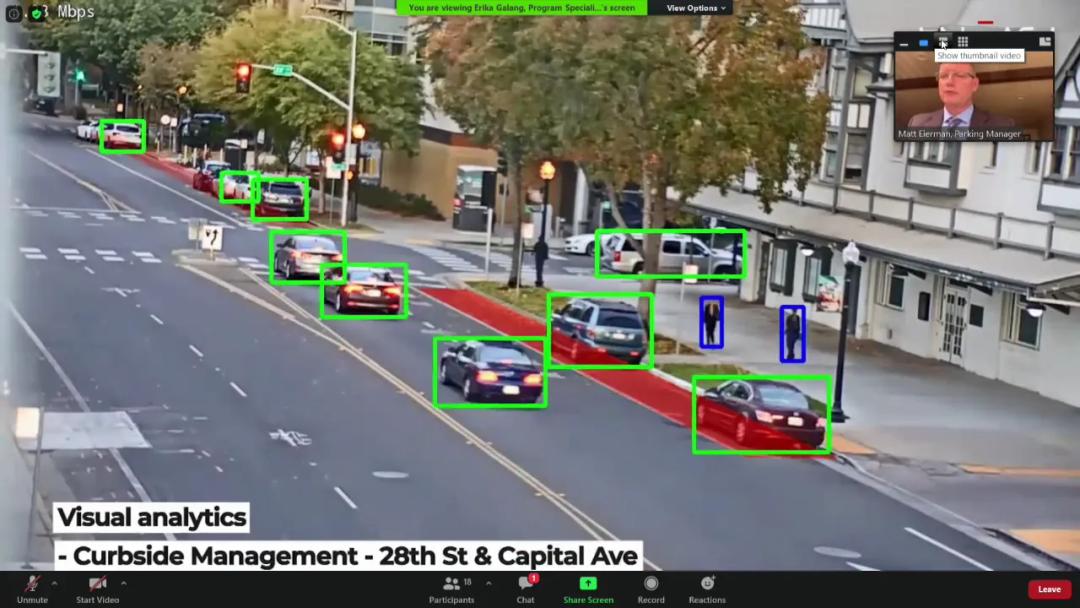
The Active Transportation Commission held a virtual special meeting on Thursday, November 19, 2020, at 6:00 p.m. The meeting was live-streamed, and public comment was available by phone and e-comment with a three-minute speaker limit. Commission Chair Haim and Commissioner Verdugo were absent; Vice Chair Wardwaller presided, and Commissioner Carpenter joined later. The agenda included a consent calendar, a staff report, an action item on the 2040 General Plan, an informational overview of the Transit-Oriented Development Ordinance, informational reports on parking curb management and daylighting, an action item on Caltrans planning grant applications, and committee comments. Consent Calendar - The commission approved the October 15, 2020 meeting minutes and received and filed the Active Transportation Commission log. The motion passed by roll call; all present members voted aye, with Chair Haim and Commissioner Verdugo absent and Commissioner Carpenter not yet present. Public Comments & Testimony - No public comments were offered on the consent calendar or on matters not on the agenda. - Dan Allison (District 4) commented after the 2040 General Plan vote: he supported the proposed lane changes, but urged that the General Plan include an ongoing mechanism, perhaps every five years, to identify and prioritize similar projects rather than treating the listed projects as all that will be done over the 20-year plan period. - On the parking and curb management item, Dan Allison said by phone that the city should give transit users an equivalent benefit to free holiday parking to avoid an implicit bias toward drivers. Written comments from Jennifer Ruiz and Dan Allison were read into the record. Ruiz described residential parking shortages in Boulevard Park, impacts from new apartment construction, and expensive street-sweeping tickets, asking what the city will do to provide more parking. Allison recommended one low-cost residential permit per household, market-rate permits for additional vehicles, and converting more private parking to delivery or loading zones to reduce bike-lane blocking. - On daylighting, Dan Allison supported daylighting and said any serious injury or fatality should trigger an investigation and a high-priority daylighting project. He added that local concerns should never prevent daylighting of an intersection because of its safety benefits. - On the Caltrans grants, Dan Allison supported both applications and hoped the 15-minute neighborhood plan would focus on South Sacramento and North Sacramento. Discussion Items Commission Staff Report - Jennifer Donlon Wyant reported on transportation items. There was no new update on the Del Rio Trail. The Envision Broadway Bicycle Master Plan Amendment was completed, adding a buffered bike lane to the bicycle master plan. The Vision Zero top-five corridor study and top-20 school safety study were delayed and are now expected to go to City Council in January. Shared rideable regulatory changes will be presented to the Disabilities Advisory Commission on December 2 and to the Active Transportation Commission on December 17. Slow Streets remains unfunded; staff will report to City Council on December 8 and likely bring the matter to the commission on December 17. 2040 General Plan Update – Proposed Roadway Changes and Key Transportation Strategies (Action Item) - Ryan Dodge and Jennifer Donlon Wyant presented the action item. The 2040 General Plan update includes key strategies to facilitate compact, mixed-use development along commercial corridors; use an equity framework to prioritize infrastructure; right-size streets to prioritize walking, biking, and transit; and eliminate citywide parking minimums while introducing parking maximums. - Staff reported on community feedback from virtual workshops in the 10 community plan areas. Notable feedback included: North Sacramento showed no concern; the central city was enthusiastic; South Sacramento was more auto-focused and ambiguous, leading staff to remove a proposed Bruceville Road lane reduction near Kaiser due to hospital access concerns; Land Park had some concerns based on perceived failure of the Freeport Boulevard road diet, though staff considered that road diet a success; East Sacramento generally supported the changes; and South Natomas requested continued emergency access. - Commissioner Hoff noted that the Florin Road protected bike lane was installed from Gloria to Riverside, but the section from Gloria to Greenhaven only received standard bike lanes; Jennifer Donlon Wyant said she would check on future plans for that segment. - Commissioner Smith asked about outreach differences among communities. Ryan Dodge said the city held online open-house workshops over about three weeks and used email, social media, radio, and council contacts. Jennifer Donlon Wyant acknowledged challenges in engaging disinvested communities and said community input would be sought again before implementation. - Vice Chair Wardwaller observed that several Vision Zero top corridors were not proposed for reallocation and hoped the commission's new subcommittee could discuss additional changes. - Commissioner Hoff moved to forward a recommendation to City Council to adopt a resolution directing staff to proceed with the proposed roadway changes and key transportation strategies for the draft 2040 General Plan, Climate Action and Adaptation Plan, and Master Environmental Impact Report. The motion was seconded and passed by roll call with all present members voting aye. Transit-Oriented Development Ordinance Overview (Information Item) - Ryan Dodge presented an overview of the Transit-Oriented Development (TOD) Ordinance, effective January 2019. It amended zoning text only, with no maps, and prohibits or requires conditional use permits for certain auto-centric, mini-storage, and warehouse uses near all existing and proposed light rail stations. It eliminated minimum off-street parking within one-quarter mile of light rail stations and reduced parking requirements by 50% within one-half mile. - In discussion, Commissioner Cole asked why auto-centric uses are difficult to deny without clear policies; Dodge explained that denials can be appealed or sued, especially where precedent exists. Commissioner Jesse asked about broader restrictions in active-transportation areas; Dodge noted the city uses specific plans and that large gas stations are effectively restricted citywide. Commissioner Hoff asked about future light rail stations; Dodge identified the Green Line extension to Natomas/airport and a possible south area extension. Vice Chair Wardwaller asked whether the ordinance applies to high-frequency bus stops; Dodge said it applies only to light rail stations, though broader policies may be considered in the General Plan update. Dodge also confirmed that existing grandfathered auto-centric uses can continue indefinitely unless they lapse. Parking Services Division Curb Management Plan (Information Item) - Matt Eierman and Erika Galang presented. The city has managed curbs for 76 years, with a full curb inventory in 2008 and modernization beginning in 2014. Programs include tiered meter pricing, special event zones, on-street EV charging, educational and merchant permits, car-share and shared-rideable spaces, commercial and passenger loading zones, and parklets. Since March, free meters have been offered after 4:30 p.m. on weekdays and all day on weekends. Since November 2019, the city has issued almost 5,000 citations to shared rideables. The division is testing AI-powered cameras and trailers to collect real-time data on vehicles, pedestrians, bicycles, and parking occupancy. - Commissioner Carpenter asked about flex zones and a curb-use hierarchy. Eierman said the city currently manages the curb reactively and wants the AI data to support better decisions, such as time-of-day delivery permits and adjusting loading zones. Jennifer Donlon Wyant noted that a de facto floating bike lane in front of McKinley Park functions during no-parking hours but was frequently blocked when she commuted. Increasing Pedestrian Safety Through Daylighting (Information Item) - Megan Carter explained daylighting, which removes visual obstructions at intersections. City standards follow California MUTCD guidance: no on-street parking for at least 20 feet at unsignalized intersections, at least 30 feet at signalized intersections, and at least 6 feet near alley and driveway openings. The city now typically uses signs rather than red curb because red curb fades. Carter said daylighting is implemented incrementally through development review, 311 traffic-safety requests, and corridor projects. She confirmed that fatal or serious-injury crashes trigger immediate investigations and that high-crash locations are addressed through safety projects. - Commissioner Carpenter cautioned that messaging around parking removal should reflect research showing bike lanes and cycle tracks generally do not harm businesses. No action was taken. 2021/22 Caltrans Transportation Planning Grant Applications (Action Item) - Vice Chair Wardwaller recused herself because of her work with Caltrans, and Commissioner Carpenter served as acting chair for this item. - Drew Hart and Valerie Hermanson presented two proposed Caltrans Sustainable Transportation Planning Grant applications. The first, “Reimagining Connections to and Through 12th Street,” would study 12th Street from L Street to C Street, a corridor on the high-injury network in one of Sacramento's most disadvantaged communities, with the goal of building on the North 12th Street Complete Streets project. The second, “15-Minute Neighborhood Plan Through Slow Active Streets,” would create a citywide plan for networks where daily destinations are reachable by a 15-minute walk or bike ride, using slow-streets concepts and community input. - Grant applications are due in mid-to-late January 2021; awards are expected in June 2021; work would begin in fall 2021; and projects must conclude by 2024. - Dan Allison's written support for both applications was read into the record. A phone caller did not connect. - Commissioner Hoff moved to forward a recommendation to City Council to approve applying for the grants. Commissioner Pollins seconded. The motion passed by roll call with all present members voting aye; Vice Chair Wardwaller recused herself and did not vote. Committee Comments, Ideas, Questions - Commissioner Brazzle proposed researching Swiftmile, a universal docking station system for shared rideables, and asked whether the commission should form a subcommittee. Jennifer Donlon Wyant noted a subcommittee could not be formed at that meeting because it would require an action item; Commissioner Brazzle said he would share the website and could bring the topic back to a future meeting. - Commissioner Smith asked whether the city had adopted an equity statement that should be compared with the commission's own equity statement. Staff said they were not aware of a recent city adoption and would confirm and report back. - Vice Chair Wardwaller asked that a follow-up conversation with the police department be added to the Active Transportation Commission log. Key Outcomes - The consent calendar was approved. - The commission recommended City Council adopt a resolution directing staff to proceed with the 2040 General Plan proposed roadway changes and key transportation strategies. - The commission recommended City Council approve filing the two Caltrans Transportation Planning Grant applications. - The Transit-Oriented Development Ordinance, Parking Services Curb Management Plan, and Daylighting reports were received as informational items; no formal action was taken. - No subcommittee was formed regarding Swiftmile, but the topic may return at a future meeting. - The next commission meeting is scheduled for December 17, 2020, and will include the shared rideable ordinance update, adoption of the 2021 calendar, and election of a new chair and vice chair.
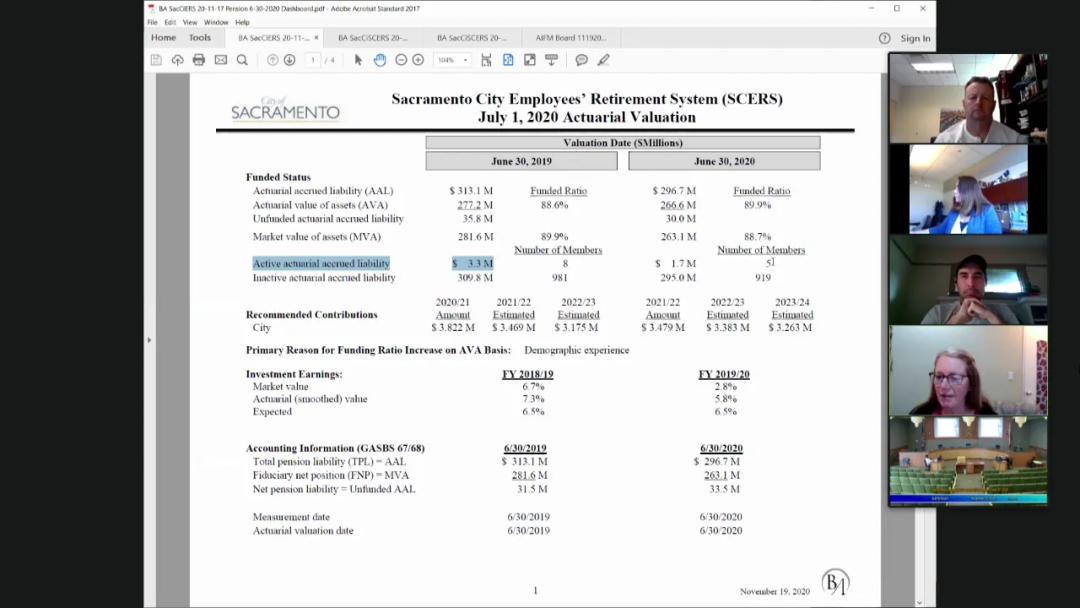
The Administration, Investment & Fiscal Management (AIFM) Board held a special meeting on November 19, 2020, at 9:45 AM (UTC), conducted via teleconference due to COVID-19. The board reviewed and approved investment performance reports, actuarial valuations, and administrative items. All votes were unanimous. Consent Calendar - Approved the September 17, 2020 meeting minutes. - Accepted the SCERS Monthly Investment Reports for July 31, August 31, and September 30, 2020. All items passed by a 4-0 vote (Bader, Colville, Holm, Leon). Discussion Items - Item 5 – Segal Marco Advisors Quarterly Investment Performance Report (September 30, 2020): Craig Chaikin presented market trends, noting a strong third quarter for equities (U.S. equities up 9.2% for the quarter, 15% year-over-year) and fixed income, but with a sharp divergence between growth and value stocks. The SCERS portfolio ended the quarter at approximately $274.7 million in assets, returning just under 6% for the quarter, outperforming the actuarial assumption and custom benchmark. The board accepted the report unanimously. - Item 6 – SCERS Quarterly Investment Report (September 30, 2020): Chief Investment Officer Stacy Hussey updated the board on asset allocation, describing a recent rotation from growth to value stocks following the election. She noted that the large-cap growth fund had been trimmed to stay within policy ranges and that fixed income returns are expected to moderate given low interest rates. The board accepted the report unanimously. - Item 7 – Bartel Associates SCERS GASB 67/68 Report (June 30, 2020): Mary Beth Redding presented the financial reporting numbers, showing a net pension liability of $33.5 million and a funded status of just under 89% as of June 30, 2020 (measured at market value). The board accepted the report unanimously. - Item 8 – Bartel Associates SCERS Actuarial Valuation Report (June 30, 2020): Mary Beth Redding also presented the actuarial valuation, which uses a smoothed asset value (three-year smoothing). Key metrics: accrued liability $297 million, actuarial value of assets $267 million, unfunded liability $30 million, funded ratio approximately 90%. The recommended contribution for FY 2021-22 is $3.479 million, slightly up from the prior year due to underperformance. The board accepted the report unanimously. - Item 9 – AIFM Board Regular Meeting Schedule for Calendar Year 2021: The board approved the proposed meeting schedule for 2021 unanimously. - Item 10 – Selection of Chair and Vice Chair: Manny Leon was re-elected as Chair, and Jason Colville was re-elected as Vice Chair, both by acclamation. Key Outcomes - All consent calendar and discussion items were approved unanimously (4-0). - The board re-elected Manny Leon as Chair and Jason Colville as Vice Chair for the upcoming year. - No public comments were received on any agenda items or matters not on the agenda.
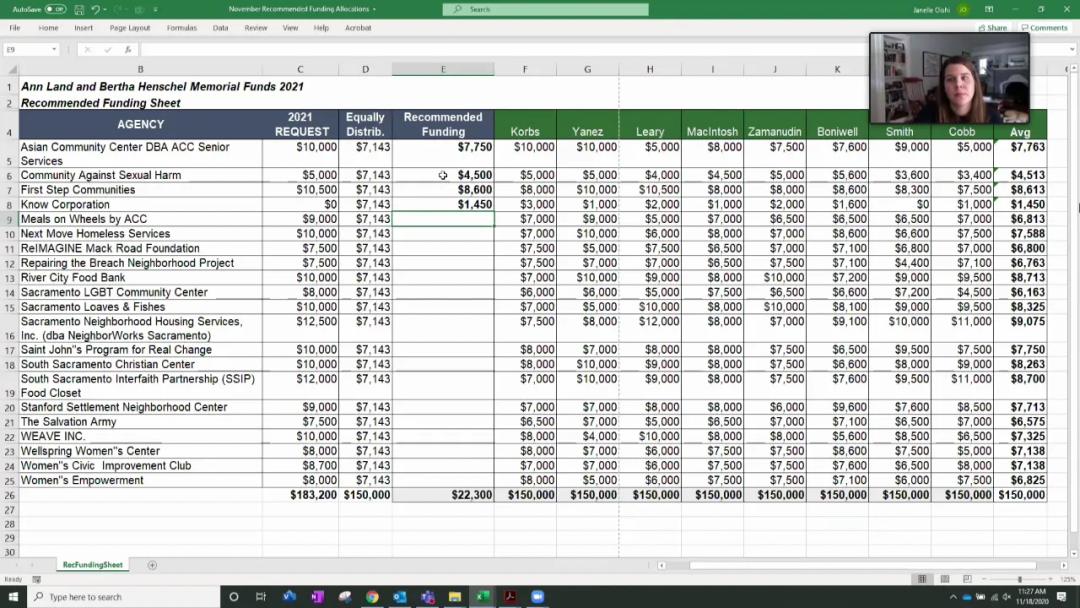
The Ann Land and Bertha Henschel Memorial Fund Commission met on Wednesday, November 18, 2020, via teleconference at 9:02 a.m. and adjourned at 12:10 p.m. The commission approved minutes from September 30, 2020, adopted the 2021 meeting calendar, received the City Treasurer’s Annual Report, and allocated $150,000 in 2021 funding to 21 local nonprofit organizations serving impoverished and vulnerable residents of Sacramento. Consent Calendar - Approval of Minutes (September 30, 2020): Passed with a friendly amendment to correct the spelling of Commissioner Smith’s name. A roll‑call vote resulted in unanimous approval. Discussion Items - 2021 Commission Meeting Calendar: Staff noted the schedule is tentative pending citywide coordination. The commission approved the calendar unanimously by roll‑call vote. - City Treasurer’s Annual Report & 2021 Funding Recommendations: John Colville, City Treasurer, and Stacy Hussey, Chief Investment Officer, presented. Key points: - Portfolio value: just under $4 million. - One‑year return (June 2019–June 2020): –2.7% vs. benchmark –19%. October‑to‑October return: –4.58% vs. benchmark –18%. - About 20% of the portfolio is in fixed income, yielding 3.67%; a 30‑year Treasury bond currently yields only 1.6%. - Over the life of the fund, nearly $5.8 million in dividend/bond income has been generated, with $5.8 million distributed. - The Treasurer recommended maintaining a $150,000 annual distribution for 2021. - Commissioner Leary requested earlier delivery of the report in future years. The commission voted to receive and file the report. - 2021 Funding Allocations (Main Agenda Item, 2 hours): - Staff noted that the California Attorney General’s registry website had been down since October 26, delaying verification of applicants’ charitable status. Any allocations are contingent on subsequent verification of good standing. - One member of the public, Tom Bush (Chair, South Sacramento Interfaith Partnership Food Closet), called in to speak, but was redirected to the applicant speaker queue. - Representatives from all 21 applicant organizations each gave a 2‑minute presentation describing their services and how they have adapted during the COVID‑19 pandemic. Key themes: sharp increases in demand for food, transportation, and housing support; reduced volunteer capacity; lost fundraising revenue; and the need for flexible funding to purchase PPE and pre‑packaged supplies. - Commissioners discussed each applicant’s proposal. Notable points: - Know Corporation: The application had missing dollar amounts. Commissioners debated whether to fund an organization that did not complete the application correctly. After discussion, a compromise average of $1,450 was approved ($1,000 was given in 2020). - The Salvation Army: Commissioner Talbot raised concerns about repeated audit findings (dated back to 2004) regarding compliance with state/federal grants. The representative responded that the organization continues to operate successfully with the California Department of Education. The commission approved the average of $6,600. - Commissioner Bonnewell’s absence: He had submitted funding recommendations in advance but was not present. After debate, the commission decided to include his recommendations in the averages, but to note his absence for any tie‑breaking votes. - Several commissioners prioritized funding for food‑related programs given the heightened food insecurity during COVID‑19. - After the presentations, commissioners submitted individual funding amounts. Staff calculated the average for each applicant. The commission then reviewed each average, with some adjustments (e.g., removing Commissioner Bonnewell’s outlier recommendations for certain applicants). The goal was to total exactly $150,000. - A substitute motion to adopt the final funding schedule (with the average amounts shown in the final spreadsheet, adjusted by $100 from Asian Community Center to balance) was made and seconded. The motion passed by roll‑call vote (7‑0). Public Comments & Testimony - Only one public caller was connected for Item 4: Tom Bush from South Sacramento Interfaith Partnership Food Closet. He was advised that his comments would be taken during the applicant presentation portion. No public comments were received for items not on the agenda. Key Outcomes - Minutes approved (with amendment). - 2021 Commission Meeting Calendar adopted – date changes require readoption at a subsequent meeting. - City Treasurer’s Annual Report received and filed – staff noted $144,000 was spent in FY 2019‑2020; the recommended 2021 distribution remains $150,000. - 2021 Funding Allocations approved – total $150,000 divided among 21 organizations (final amounts available in the official meeting record). Allocations are contingent on confirmation of each agency’s good standing with the California Attorney General’s Registry of Charitable Trusts. - Adjournment at 12:10 p.m.
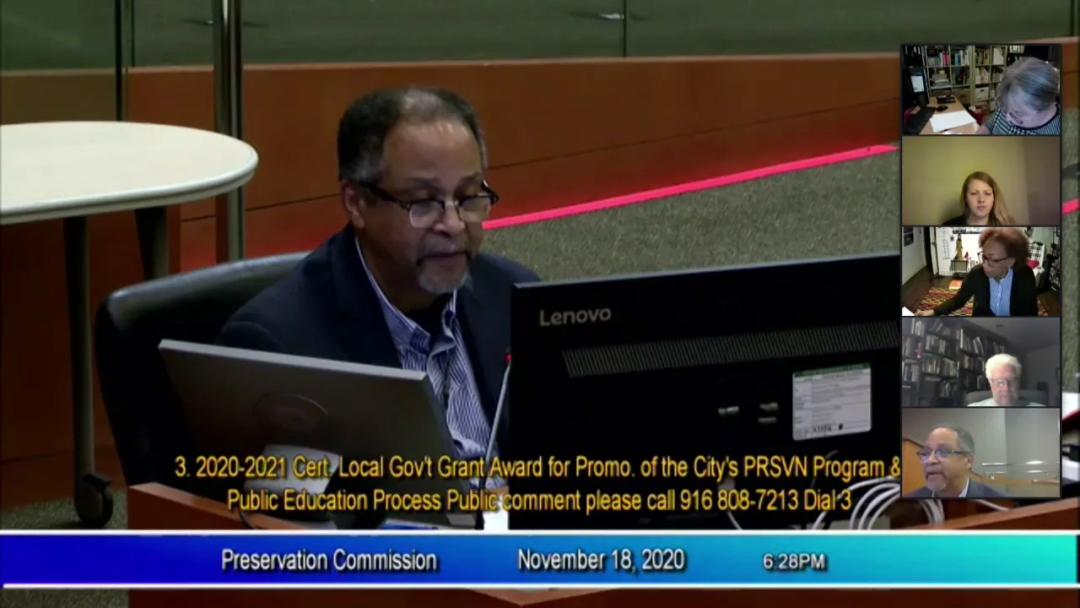
The Preservation Commission held a regular teleconference meeting on Wednesday, November 18, 2020, from approximately 5:33 p.m. to 6:52 p.m. The meeting included approval of prior minutes, discussion of draft objective design standards for historic districts, a grant award update, and a director’s report. No public comments were received. Consent Calendar - Item 1: Approval of the Preservation Commission Minutes of the October 21, 2020 Meeting. Motion by Commissioner Carter, seconded by Commissioner Valania, carried 7-0. Discussion Items - Item 2: Draft Objective Design Standards for Historic Districts (File 2020-01057) - Staff presenter Bruce Monighan, Urban Design Manager, explained that the draft standards are a response to SB 35 and SB 330, intended to provide objective, checklist-based criteria for multifamily housing (3+ units) within historic districts. The document consolidates common design guidelines from the Historic District Plan and tailors them for historic districts. - Commissioner Miller and Commissioner Miller-Cruiess submitted written comments; Chair Whitelam and Commissioner Bowns raised questions about clarity, the use of “should” vs. “shall,” missing checklist items, and the importance of clear communication to property owners about the limited scope (multifamily infill only). - Staff clarified that the standards are a first draft; outreach to neighborhood groups, AIA, and other stakeholders will occur over the next 30–45 days. A final draft is expected in 2021. - No public comments were received. - Item 3: 2020-2021 Certified Local Government Grant Award (File 2020-01365) - Preservation Director Carson Anderson announced a $27,000 grant from the Office of Historic Preservation for public education and outreach, including a redesigned city website, educational postcards for historic property owners, walking tours, and digital marketing. A communications consultant will be hired. - Commissioners discussed leveraging partnerships (e.g., Sacramento Heritage) and stretching funds. The grant requires City Council approval. - No public comments were received. Director’s Report - Carson Anderson updated the commission on the 2040 General Plan update, including a draft land use map that has raised preservation community concerns. Staff will hold a stakeholder meeting in early December; the commission will discuss the plan and the 2021–2029 Housing Element in January. - The preservation intern (Corey Kwan) resigned; a replacement will be sought. - Anderson highlighted a study by the Los Angeles Conservancy (“Preservation Positive Los Angeles”) that found positive economic impacts of historic districts. - The commission received a framed award from the National Alliance of Preservation Commissions for the Historic District Plan. - Commissioners were reminded to submit training records for the annual CLG report. Key Outcomes - Approved October 21, 2020 meeting minutes (7-0). - Reviewed and commented on the draft objective design standards; further comments to be submitted in writing. The document will be revised and brought back in 2021. - Reviewed and commented on the CLG grant; staff will proceed with City Council approval. - No action taken on other items.
The Aggie Square Enhanced Infrastructure Financing District (EIFD) Public Financing Authority (PFA) held its inaugural special meeting on Wednesday, November 18, 2020, at 3:00 p.m. via teleconference due to COVID-19. The board consists of Councilmember Jay Schenirer (District 5), Councilmember Eric Guerra (District 6), and public members Nicolina Hernandez and Joni Titherington; Councilmember Rick Jennings was absent. Staff introduced the board, and members shared their backgrounds. The meeting focused on organizational matters, election of officers, and an overview of the EIFD/PFA roles and responsibilities. Consent Calendar - Item 1 (Introduction to the Ralph M. Brown Act, Public Records Act, Council Rules, and Rosenberg's Rules of Order): Received and filed unanimously. This item provided background on the legal framework governing the PFA. - Item 2 (Resolution Directing the Preparation of an Infrastructure Financing Plan, Adopting a Conflict of Interest Code, Establishing a Regular Meeting Date, and Adopting CEQA Guidelines): This item was pulled from the consent calendar for discussion to allow election of the board's chair and vice chair. After electing officers, the board moved to the next agenda item without a separate recorded vote on the resolution itself; the transcript does not show a formal vote on the resolution's adoption, though the board proceeded as if it would be considered later. Public Comments & Testimony - No public comments were received via the phone line or eComment during the meeting. The presiding officer noted, "We had no callers for public comments on any agenda items." Discussion Items - Election of Chair and Vice Chair: Councilmember Guerra nominated Councilmember Schenirer as chair, citing that the EIFD boundaries are largely within District 5. Councilmember Schenirer nominated Councilmember Guerra as vice chair for easier access to staff. The motion passed unanimously (4-0). - Roles and Responsibilities Overview: David Fama of Jones Hall (legal counsel) provided an overview of EIFDs. He explained that an EIFD is a tax increment financing district that captures increases in property tax revenue (including possessory interest tax from private leases on UC Davis property) within a defined boundary to finance community-wide improvements. The PFA is the body that will form the district after three public hearings, each at least 30 days apart. At the third hearing, a formal protest process occurs: if more than 50% of landowners/residents protest, the district must be abandoned; 25–50% forces a vote; less than 25% allows the board to proceed. The Infrastructure Financing Plan (IFP) is being drafted by a consultant, with a first draft recently released; it is expected to come before the board around January 2021. - Fund Usage and Boundaries: Board members discussed that IFP funds must be spent per the plan, which can be amended annually, and that funds could potentially be used outside the EIFD boundaries for benefits like affordable housing. The proposed boundaries cover the UC Davis Health campus, some private parcels on Second Avenue, and a corner at Broadway and Stockton, with most property owned by UC Davis. - Next Steps: The board will hold its next meeting on December 1, 2020, at 10:00 a.m. via Zoom, where the draft IFP will be reviewed. The PFA will also hire separate legal counsel, as the city attorney's office cannot represent this separate body. Public outreach will include at least five or six meetings (three public hearings plus council and board reviews), and an annual report will be mailed to all owners and residents within the district. Key Outcomes - Elected Officers: Jay Schenirer as Chair and Eric Guerra as Vice Chair (unanimous). - Consent Item 1: Approved unanimously (receive and file). - No vote recorded on Resolution 2020-1330 (Item 2) in the transcript; the board elected officers and moved on, but the resolution's adoption was not explicitly called. - Next Meeting: Scheduled for December 1, 2020, at 10:00 a.m. to review the draft IFP. - Hiring of Legal Counsel: The PFA will contract separate legal counsel (to be presented on December 1). Note: The transcript indicates no formal vote on the resolution for preparing the IFP and adopting conflict of interest code, despite it being on the agenda. The board may have intended to handle it later; this discrepancy is noted.
The Sacramento City Council Law and Legislation Committee met on Tuesday, November 17, 2020, at 1:01 PM via teleconference due to the COVID-19 pandemic. The meeting, chaired by Councilmember Jay Schenirer, addressed items including approval of the consent calendar, a proposed ordinance on laid-off employee recall rights, a comprehensive fireworks ordinance amendment and illegal fireworks mitigation plan, and an update on the City Racial Equity Workgroup. The meeting adjourned at 2:32 PM. Consent Calendar - Item 1: Law and Legislation Log – Approved unanimously (3-0, with Councilmember Steve Hansen absent). - Item 2: Legislative Advocacy Correspondence – Received and filed. Public Comments & Testimony Item 4 – Fireworks Ordinance Amendment: Eleven callers provided public comment. Speakers included representatives of nonprofits that rely on safe-and-sane fireworks sales (e.g., Victory Outreach, Richmond Sacramento Inc., SAC Area Sports, Robla Education Foundation, etc.). Nearly all speakers expressed strong support for targeting illegal fireworks while opposing any reduction in the days of use or sale of legal, safe-and-sane fireworks. They emphasized that illegal fireworks are the primary problem and that legitimate fundraising by nonprofits should not be harmed. Some speakers, such as Lu Garcia and Annette Deglow (College Land Neighborhood Association), supported the Fire Marshal’s mitigation plan with robust enforcement and education, but cautioned against large fines that may be unenforceable. Several speakers noted that in 2020, illegal fireworks activity surged due to the pandemic and cancellation of professional shows. Discussion Items Item 3 – Laid-Off Employee Recall Rights Related to COVID-19: - Staff presented a proposal to amend the Sacramento City Code regarding recall rights for laid-off workers. Councilmember Eric Guerra expressed a need for further outreach to both worker advocates (e.g., Central Labor Council, UNITE HERE) and small business owners (particularly Vietnamese-American businesses) who face changing business models. Councilmember Jeff Harris noted concerns from small businesses about the lack of collective bargaining protections. The committee voted unanimously (4-0, with Hansen present) to continue the item and direct staff to conduct additional stakeholder outreach and bring back revised recommendations. Item 4 – Ordinance Amendment Relating to Fireworks: - Fire Marshal Jason Lee presented a detailed report on illegal fireworks activity and a proposed mitigation plan. Key statistics: In 2018 the city’s task force seized 2,300 pounds of illegal fireworks; 800 pounds in 2019; and less than 50 pounds in 2020 due to lack of funding. Over the last two years, illegal fireworks caused an average of 4–5 structure fires and 15–18 grass fires annually. The proposed plan includes: - A social host ordinance holding property owners responsible for illegal fireworks on their property (first offense fines $1,000–$2,500). - Proactive enforcement and patrols leading up to July 4th. - A comprehensive outreach and education campaign in multiple languages. - A budget of $563,000, including two full-time fire investigator positions. - Councilmember Schenirer directed that no fee increases be implemented until the city’s national equity work on fines and fees is completed, and asked the fire department to identify internal reallocations before seeking new funding. He opposed additional restrictions on safe-and-sane fireworks. - Councilmember Guerra supported the mitigation plan but opposed limiting safe-and-sane use to only July 3–4, arguing resources should focus on illegal fireworks. He supported the social host ordinance and suggested exploring community service as an alternative to fines. - Councilmember Harris favored restricting safe-and-sane use to July 3–4, citing nuisance complaints and potential mishaps, but supported the mitigation plan and social host ordinance. He noted that funding decisions would be made at mid-year budget. - Councilmember Hansen emphasized the need for a diversion program to address inequitable fines, and supported the fire marshal’s office receiving additional resources to combat both illegal fireworks and arson. He agreed that the funding discussion belongs at the Budget and Audit Committee. - Consensus: Proceed with the mitigation plan and bring back a social host ordinance for committee approval; examine alternative penalties (diversion, community service); and have staff analyze funding options within the fire department budget and outside sources. Item 5 – Update on City Racial Equity Workgroup (Oral Report): - Alison Joe (Chief of Staff for Councilmember Schenirer) and Coy Saturn (Chief of Staff for Councilmember Guerra) presented an update, joined by Diversity and Equity Manager Ami Barnes. The update followed a September 15, 2020 committee discussion with Race Forward. Key points: - Need to build shared definitions of racial equity, institutional racism, and structural racism through deep community engagement. - Proposed next steps: Bring a preliminary resolution to the full council in December 2020 for January 2021, acknowledging historical and recent systemic harms and affirming a sustained commitment to equity; conduct an inventory of existing city equity initiatives; and develop a draft outline for a year-long council development process focusing on community-centered engagement, data-driven racial equity plans, and benchmarks. - Councilmembers expressed strong support. Councilmember Guerra stressed the importance of recognizing Sacramento’s historic harms (e.g., impact on Indigenous, Chinese American, Latino, and African American communities) and the need for appropriate budgeting to support staff like Ami Barnes. Councilmember Schenirer noted the opportunity to better utilize boards and commissions for community engagement and linked the work to other city initiatives (e.g., Office of Community Response, redefined public safety). Councilmember Hansen praised the effort to normalize language around systemic racism and called the work an inflection point for the city. The update was received and filed. Key Outcomes - Consent Calendar (Items 1 & 2): Approved unanimously (3-0). - Item 3 (Recall Rights): Unanimous vote (4-0) to continue the item and direct staff to conduct further outreach to labor and business stakeholders. - Item 4 (Fireworks): No formal vote; committee provided direction to: - Advance the illegal fireworks mitigation plan and social host ordinance. - Explore diversion programs and alternative penalties for lower-income violators. - Freeze fee increases pending citywide equity analysis. - Analyze funding sources within the fire department budget and bring to Budget and Audit Committee. - Maintain current safe-and-sane fireworks use and sales days (no restriction to July 3–4) per majority sentiment. - Item 5 (Racial Equity Workgroup): Received and filed. Staff will bring a preliminary resolution and draft council development outline to the December 8, 2020 city council meeting.