The Measure U Community Advisory Committee met on Monday, November 16, 2020, from 6:00 p.m. via teleconference. The meeting included a consent calendar, updates on youth programs, economic development budget reports, midyear budget priority discussions, performance measure reviews, and agenda log updates. Public comments were received on youth pop-ups. Consent Calendar - Item 1 – Approval of Minutes (October 19, 2020): Approved unanimously. - Item 2 – FY2019/20 Measure U Program Carryover: Received and filed unanimously. Public Comments & Testimony - Davion Jinkson (age 16, North Sacramento resident): Expressed strong support for youth pop-ups, stating they provided free, productive activities for teens and low-income families. - Crystal Harding (parent, Impact Sac participant): Praised the youth-led approach, highlighting events on gun safety, mental health, and community engagement. - Chris Lodgson (Greater Sacramento ADOS): Asked about demographic breakdown of youth participants and whether COVID-19 caused a drop in participation among Black youth. Richard Dana responded that 89% of participants are youth of color and that tracking is done but harder for virtual events. Discussion Items - Item 3 – Update on Youth Pop-Up & Economic Mobility Program: Presented by Richard Dana (Sierra Health Foundation) and youth leaders (Safia, Amy, Kyla, Jasmine, Jesse, Haley, Darnell). In-person pop-ups (pre-COVID) had 32,000 participants from Feb 2019 to Feb 2020; virtual pop-ups (since March 2020) had 23,000 participants. 98% of survey respondents reported positive and safe experiences. The program expanded to an economic mobility training for 48 youth graduates. Youth testimonials emphasized leadership, mental health support, and community connection. Committee members praised the program and suggested it could serve as a model for other city departments. - Item 4 – Economic Development FY2019/20 Measure U Budget Update and FY2020/21 Overview: Presented by Melissa Anguiano (Deputy Director, Office of Innovation and Economic Development) and the NDAT team (Lynette Hall, Mikel Davila, Elizabeth Boyd). FY19/20 received $6.8M in Measure U funding ($4.9M for projects/staff, $1.9M one-time). FY20/21 received $4.2M (no one-time). Highlights included the Neighborhood Development Action Team (NDAT) focusing on underserved corridors (e.g., Stockton Boulevard), the Financial Empowerment Center serving 224 clients, free transit for youth, and the Kindergarten to College Savings Account (270 accounts opened). Committee members asked for clearer breakdown of staff vs. program costs, sustainability of programs, and impact metrics. - Item 5 – Committee Recommendations to City Council Regarding FY2020/21 Midyear Budget Priorities: The committee decided to send a cover letter to council emphasizing participatory budgeting as the top priority, along with requests to prioritize inclusive economic development and to receive a formal response. An ad hoc committee (Chair Cofer, Vice Chair Williams, Member Perez) was formed to draft the letter and seek a midyear presentation slot. - Item 6 – Measure U Department Performance Measures from FY2020/21 Approved Budget: Staff provided existing department performance metrics. Committee members criticized the metrics as activity-based rather than outcome-based, lacking cost data and clear connections to strategic goals. Staff noted that a city performance dashboard is forthcoming in a few months. The committee indicated they may recommend council direct staff toward more meaningful impact metrics. - Item 7 – Measure U Community Advisory Committee Agenda Log: Additions to the log included a dashboard update, participatory budgeting update, revenue data, and further discussion on FY2021-22 budget priorities. Motion approved. Key Outcomes - Consent calendar items (minutes and carryover) approved unanimously. - Committee voted (roll call) to establish an ad hoc committee (Cofer, Dickinson, Perez) to draft a cover letter to City Council on midyear budget priorities, focusing on participatory budgeting and inclusive economic development, and to request a council presentation and formal response. - Agenda log updated to include dashboard, participatory budgeting status, revenue data for December meeting, and budget discussion for upcoming meetings. - Committee expressed desire for more outcome-oriented performance metrics and will consider recommending council direction on this. - Youth pop-up program update received and filed with strong commendation. - Economic development budget update received and filed; questions about fund allocation to be addressed at future meetings.
Public Meetings - Sacramento, California
Public Meetings - Sacramento, CaliforniaThe Sacramento Civil Service Board held a special teleconference meeting on November 16, 2020, at 1:00 p.m. due to the COVID-19 pandemic. Board members present: Robin Moore, Amanda Ford, Vice Chair Byrd, and Chair Perez (all present, quorum). The meeting addressed a consent calendar, a waiver of formal rules, and two appeals of disqualification from city recruitments. Consent Calendar - Approval of Meeting Minutes, September 21, 2020: Approved unanimously. - Approval of Civil Service Board 2021 Calendar: Approved unanimously. Public Comments & Testimony - No public comments were made on matters not on the agenda. Public testimony was limited to the appellants during their respective appeal items. Discussion Items - Waiver of Formal Rules for All Appeals of Disqualification: The board unanimously voted to waive formal rules of procedure for conducting hearings on both appeals, pursuant to Civil Service Board Rule 4.11(c)(7). - Appeal of Disqualification – Ricardo Costa (Associate Civil Engineer): Staff reported that Mr. Costa met the experience requirement but did not provide proof of possession of a certificate of registration as a professional engineer in California, which was required for the associate position. The job was posted only for Associate Civil Engineer, not Assistant Civil Engineer. Mr. Costa argued that the job posting was confusing and that he intended to apply for the Assistant Civil Engineer position, which does not require the license. Staff noted that 22 applicants applied, and no other applicant raised similar confusion. The board denied the appeal, affirming the Director's disqualification (4-0). - Appeal of Disqualification – Matthew Galbreth (Geographic Information Systems Specialist I): Staff stated that Mr. Galbreth did not provide proof of education by the final filing date and had a total of five years of qualifying experience, short of the six-year combined education/experience requirement. Mr. Galbreth was not present at the meeting. The board denied the appeal, affirming the Director's disqualification (4-0). Key Outcomes - Consent calendar items approved unanimously. - Waiver of formal rules approved unanimously. - Both appeals of disqualification were denied, sustaining the Human Resources Department's decisions. - The board's next regular meeting is scheduled for December 21, 2020 (third Monday of December). - No update was available on the vacant board seat; staff will follow up with the City Clerk's office.
The Sacramento Planning and Design Commission met via teleconference on Thursday, November 12, 2020, beginning at 5:30 p.m. and adjourning at 9:30 p.m. The commission unanimously approved consent calendar items, heard a third‑party appeal of the Sacramento Country Day School master plan, reviewed the draft 2040 General Plan update, and discussed a framework for a new building electrification ordinance. All votes were 9‑0‑1 (Commissioner Ogilvie absent), except where noted. Consent Calendar - Item 1 – Approval of Meeting Minutes of October 22, 2020: Approved by motion (Pluckebaum/Kaufman); 9:0:1. - Item 2 – Initiate Amendments to the Central City Special Planning District: Approved by motion (Pluckebaum/Kaufman); 9:0:1. Public Comments & Testimony - Item 5 – Big Boss Alcohol and Tobacco Sales (1832 El Camino Avenue): No public comments were received. The commission approved the two Conditional Use Permits (CUPs) for alcohol and tobacco sales, subject to staff’s conditions and a minor correction to condition B2. - Item 6 – 300 El Camino Alcohol Sales: Several residents submitted written comments opposing the CUP, citing concerns about existing liquor store density, illegal dumping, loitering, and lack of health food options. No members of the public called in to speak. The commission approved the CUP and site plan review, noting the applicant’s commitment to clean up the adjacent public alley. - Item 8 – Third‑Party Appeal of Sacramento Country Day School Master Plan: Three appellants (Ann Evans, John Apostolo, Bruce Pomer) spoke in opposition, arguing that the school has not complied with a 1996 traffic mitigation agreement and that the proposed increase of 54 students (to 598 total) would worsen congestion and parking on Latham Drive and Saratoga Circle. Several neighbors and a former mitigation committee member expressed support for the school, citing consistent communication and efforts to manage traffic. Public callers included one opponent (sharing safety concerns) and two supporters (including a parent and a neighbor). - Item 9 – 2040 General Plan Update – Draft Land Use Map and Key Strategies: Public comment included both support and criticism. Support came from SACOG, House Sacramento, and a resident praising the FAR‑based land use approach, removal of parking minimums, and equity focus. Criticism came from a resident who argued the plan fails to account for COVID‑19 impacts, lacks financial details, and imposes one‑size‑fits‑all solutions. Representatives from Boulevard Park and Land Park neighborhood associations raised concerns about preserving historic districts and ensuring appropriate transitions near single‑family zones. - Item 10 – New Building Electrification Ordinance Framework: One caller urged earlier effective dates (2022 instead of 2023) to meet 2030 climate goals. Another caller opposed the mandate, citing cost, grid reliability, and feasibility questions. The Building Industry Association supported the phased approach and SMUD’s rebate program. Discussion Items - Item 8 – Sacramento Country Day School Master Plan Appeal: The appellant argued that increasing enrollment without renewing the 1996 traffic management plan (off‑site parking, carpooling, and parking restrictions) would revert to pre‑1996 conditions. The school (head Lee Thomsen and attorney Nick Avdis) contended that the 1996 agreement is a private contract independent of the city’s land‑use process; they met all development standards and have not received formal complaints. Staff recommended denying the appeal and approving the CUP modification. Commissioners questioned the lack of formal complaints and noted that enforcement of the private agreement lies with the parties, not the city. The motion to approve staff recommendation and deny the appeal passed 9‑0‑1. - Item 9 – 2040 General Plan Update: Staff presented the draft land use map (reducing designations from 27 to 11, using floor‑area‑ratio), proposed roadway reallocations, and key strategies including allowing duplexes/triplexes/fourplexes in all neighborhoods, eliminating parking minimums, all‑electric construction, and studying annexation of Fruitridge‑Florin and expansion of the Natomas sphere of influence. Commissioners asked about historic district protections, displacement risks, and the Natomas Joint Vision Area. After discussion, the commission voted to recommend the draft documents to City Council (motion by Kaufman, second by Pluckebaum); 9‑0‑1. - Item 10 – Building Electrification Ordinance Framework: Staff outlined requirements for all new low‑rise buildings (≤3 stories) to be all‑electric by 2023, all new high‑rise by 2026 (provided cost‑effectiveness), 20% EV‑capable spaces, and parking incentives. Commissioner questions covered cost effectiveness, SMUD rebates, impacts on housing affordability, grid capacity, and workforce transitions (including a letter from Plumbers & Pipe Fitters Local 447). Staff noted ongoing outreach and a planned return to commission in January 2021. The item was received and filed (Commissioner Hernandez recused herself). Key Outcomes - Item 4 – Kado Court (street name change): Continued to December 10, 2020 meeting. - Item 5 – Big Boss Alcohol and Tobacco Sales: Approved (9:0:1). - Item 6 – 300 El Camino Alcohol Sales: Approved (9:0:1). - Item 7 – Stanford Market ABC License Change: Continued to December 10, 2020. - Item 8 – Sacramento Country Day School Master Plan: Appeal denied, project approved (9:0:1). - Item 9 – 2040 General Plan Update: Commission voted to recommend the draft Land Use Map, Proposed Roadway Changes, and Key Strategies to City Council (9:0:1). - Item 10 – Building Electrification Ordinance Framework: Received and filed; framework to return for ordinance adoption in January 2021. - Public Comments – Matters Not on the Agenda: None. - Member Comments: None. Adjournment: 9:30 p.m.json {
The Water Committee of the Sacramento City Council met on Tuesday, November 10, 2020, at 1:00 p.m. via teleconference due to the COVID-19 pandemic. Chair Jeff Harris (District 3) presided, joined by Vice-Chair Eric Guerra (District 6); Councilmember Angelique Ashby (District 1) was absent. The committee received and filed presentations on five agenda items, including a sustainability policy, a national water efficiency award, a public awareness campaign, an update on the utility rate assistance program, and an update on a proposed drainage rate adjustment. No public comments were made. Discussion Items 1. Department of Utilities Sustainability Policy (Oral Report, File ID: 2020-01269) Roshini Das, Sustainability Program Manager, presented the draft policy, which is about 95% complete. The policy outlines three overarching goals: a carbon-neutral utility by 2045, climate resiliency of utility infrastructure, and equity/environmental justice. It identifies eight focus areas, including climate change, greenhouse gas emissions, energy efficiency, water conservation, waste management, sustainable infrastructure, equity, and innovation. Key statistics: 93% of climate change impacts are expected to affect the water sector; Sacramento currently faces about four extreme heat days per year, projected to rise to 19–22 by mid-century; the Department of Utilities accounts for 48% of the city’s energy use and 45% of energy costs, but only 4% of the city’s facilities; energy use intensity has been reduced by 18% from 2005 to 2019; 17% of the city’s municipal emissions come from water management. Das noted that the policy aligns with the Paris Climate Agreement and UN Sustainable Development Goals. Discussion touched on green stormwater infrastructure (bioswales), local procurement, and equity in investment. The committee received and filed the presentation. 2. US Environmental Protection Agency WaterSense Award (Oral Report, File ID: 2020-01278) Veronica Blett, manager of EPA’s WaterSense program, presented the 2020 WaterSense Partner of the Year Award to the Sacramento Department of Utilities. The award recognizes the city’s comprehensive water conservation efforts, including expanding “Fix a Leak Week” to a month, using AMI data for leak detection, a “Leak Free Sacramento” program, and collaboration with SMUD for instant rebates on WaterSense-labeled products. Nationally, WaterSense partners have saved more than 4.4 trillion gallons of water and $87 billion in consumer bills since 2006. Sacramento has 144 utility partners in California. The committee received and filed the presentation. 3. “Imagine a Day Without Water” – Awareness Campaign (Oral Report, File ID: 2020-01268) Pravani Vandeyar, Water Division Manager, reported on the department’s participation in the sixth annual national campaign on October 21, 2020. Due to the pandemic, the event was held virtually with four videos and webinars, including a popular water system tour. Total video views reached approximately 900. The campaign highlighted the value of water, wastewater, and stormwater services. The committee received and filed the presentation. 4. Sacramento Utility Rate Assistance (SURA) Program Update (Oral Report, File ID: 2020-01279) Tony Bertrand, Engineering Manager, provided an update. As of June 30, 2020, the program had 8,135 participants (including five nonprofits). In the last quarter, $819,192 was spent on monthly discounts for water, wastewater, and solid waste fees. Year-to-date spending was $3.19 million out of an annual budget of $3.78 million. Staff worked with SMUD to cross-reference eligibility lists. Modifications will be considered as part of the FY22 budget process. Councilmember Guerra encouraged targeted outreach to hard-to-reach populations, such as through Singtao newspaper and Diario del Valle. The committee received the update and made recommendations to the City Council for further program improvements. 5. Drainage Rate Adjustment Update (Oral Report, File ID: 2020-01267) Tony Bertrand reported that the drainage fund has not had a rate increase since 1996 (over 25 years). The current annual capital improvement budget is approximately $250,000, which is insufficient for the aging system. A proposed 20-year capital improvement program is estimated at $800 million, largely for rehabilitation and replacement, plus regulatory compliance. The department has selected a new rate model (consultant TBWB) and is beginning data collection, rate proposals, and public outreach. The process will include a Prop 218 election. No timeline was provided, as polling and pandemic conditions will influence strategy. The committee received and filed the update. Key Outcomes - All five oral reports were received and filed by the committee. - For the SURA program, the committee made recommendations to the City Council, including targeted outreach to underserved communities. - Staff will continue developing the drainage rate adjustment proposal and will report back to the committee as more information becomes available. - The meeting adjourned at 1:54 p.m.
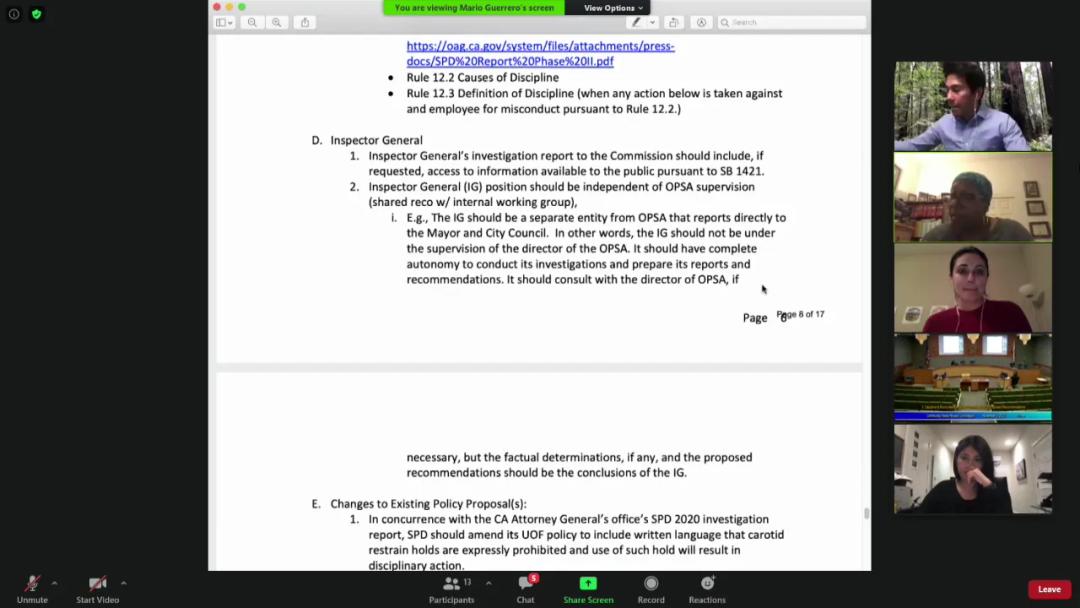
The Sacramento Community Police Review Commission met on November 9, 2020, via teleconference due to the COVID-19 pandemic. The meeting lasted from 6:01 p.m. to 9:09 p.m. Commissioners present included Graciella Castillo-Krings, Basim Elkarra, Eddie Escobar, Mariana Sabeniano, Kiran Savage-Sangwan, Renee Carter, and Chair Mario Guerrero. Absent were Richard Falcon, Michael Marion, Erandi Zamora, and Jay King. The commission approved consent items, supported a youth seat ordinance, adopted internal rules of procedure, and continued discussion on discipline recommendations. Consent Calendar - Approved the October 12, 2020 meeting minutes. - Received and filed the July–September 2020 Police Complaint Activity Report. Discussion Items - Ordinance for Youth Seats: Councilmember Schenirer and Youth Commissioner Naomi Piper-Pell presented a proposal to add youth seats to city commissions, including the Police Review Commission. After discussion on recruitment, support, and mentorship, the commission voted unanimously (7-0, 4 absent) to support the ordinance. - Internal Rules of Procedure: Co-chairs Castillo-Krings and Sabeniano presented the draft rules. Following extensive debate on communication protocols with city staff, the commission amended the language to clarify that commissioners are encouraged but not required to route requests through the OPSA director. The amended rules were adopted unanimously (7-0, 4 absent). - Discipline and Accountability Recommendations: Vice Chair Carter presented the ad hoc committee’s 2020 proposed recommendations covering qualified immunity, decertification, hiring standards, zero-tolerance discipline, and an inspector general. Commissioners offered several clarifications and edits. The item was continued to the December 14, 2020 meeting to allow further review and a meeting with the Sacramento Police Department. Key Outcomes - Approved consent calendar. - Passed motion supporting youth seat ordinance (7-0, 4 absent). - Adopted amended Internal Rules of Procedure (7-0, 4 absent). - Continued Discipline and Accountability recommendations to December 14, 2020. - Ad hoc committees scheduled meetings with the Sacramento Police Department to review recommendations before the December meeting.
The Sacramento Arts, Culture, and Creative Economy Commission met on Monday, November 9, 2020, beginning at 2:00 PM. Due to the presence of only five commissioners—below the required quorum—no formal votes or motions could be taken. The meeting proceeded as a discussion session, with staff and a councilmember presenting items for review and future action. Commissioners participated in dialogue and offered feedback, agreeing to postpone approval of pending items to the December meeting or a special meeting. Consent Calendar - No items were voted on due to the lack of a quorum. The approval of the September 14, 2020, and November 2, 2020, meeting minutes was deferred. Public Comments & Testimony - No public comments were recorded in the transcript. Discussion Items - Item 2 – Ordinance Amendment for Youth Seats on Commissions: Councilmember Jay Schenirer presented an ordinance to amend sections of the Sacramento City Code to add youth seats to the Parks & Community Enrichment Commission, the Arts, Culture, and Creative Economy Commission, and the Community Police Review Commission. He highlighted the city’s youth-friendly efforts and introduced a video from youth advocate Naomi Piper Pell. Commissioners expressed support but could not take action due to the quorum issue; the item will return at a future meeting with sufficient membership. - Item 3 – Rules of Procedure for the Arts Commission: Megan Van Voorhis, Cultural and Creative Economy Manager, reviewed the proposed rules. Commissioners asked clarifying questions and provided informal feedback. Formal approval was deferred. - Item 4 – Art in Public Places Mural Program / Community Murals Sacramento: Donald Gensler, Arts Program Specialist, presented the community murals project, the last creative economy program from the first funding cycle. He noted a mural speaker series and a planned citywide mural policy. Commissioners discussed the program’s timeline and supported its release; formal approval was deferred. - Item 5 – CARES Act Relief Fund for Nonprofit Arts Grant Guidelines: Ray Gargano, Arts Program Coordinator, presented the guidelines for a new relief fund from the California Arts Council. After discussion, staff confirmed they could release the guidelines and accept applications immediately, with final grant allocations to be approved by the commission in December retroactively. Commissioners agreed to this approach. - Item 6 – Director’s Report: Megan Van Voorhis gave an oral report on recent grants, budget updates, and staffing. She noted the office’s commitment to providing commissioners with data tools such as district fact sheets and online dashboards to support their duties. - Item 7 – Chairperson’s Report: Dr. Steven Winlock, Chair, commended staff and commissioners for their work on grants and CARES funding. He also mentioned the Friends of Sacramento Arts organization and its support for arts education, suggesting it be included in future presentations. Key Outcomes - No formal votes or motions were passed due to the lack of a quorum (only five of the required members present). - All pending agenda items (minutes, rules of procedure, mural program, CARES guidelines) were deferred to the December 2020 meeting or a future special meeting with a full quorum. - Staff will release the CARES Act Relief Fund guidelines and begin accepting applications, with final grantee approval scheduled for the December meeting (retroactive approval). - Commissioners provided informal direction and feedback on the youth seat ordinance, rules of procedure, and mural program, to be incorporated when the items return for a vote. - The meeting was adjourned at approximately 3:50 PM.
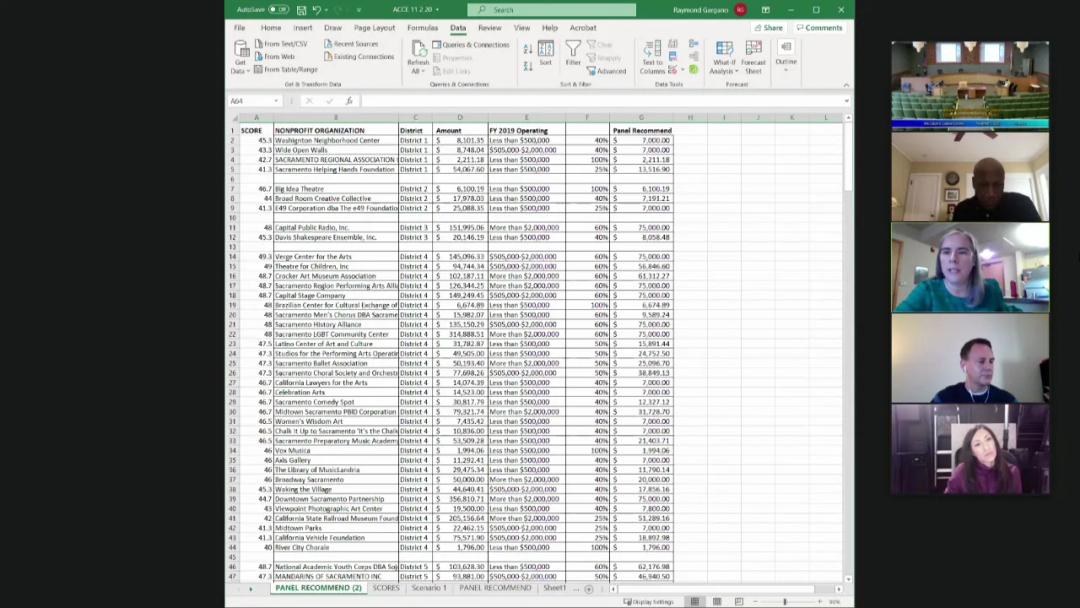
This special meeting of the Arts, Culture, and Creative Economy Commission focused on the review and allocation of $4.1 million in CARES Act Creative Economy Recovery Program Grants (Round 2). The commission received 266 applications requesting a total of $8.5 million. After reviewing staff presentations, panel recommendations, and discussing equity and district distribution, the commission voted to approve final grant allocations. Discussion Items - Staff Presentation (Raymond Gargano): Staff provided an overview of Round 1 outcomes (approx. $7.5 million distributed) and detailed Round 2 processes, including outreach, workshops, and panel scoring. Total requests: $8.5 million from 266 applicants (68 nonprofits asking $3.8M, 71 creative businesses asking $3M, 127 individual artists asking $1.5M). Available funds: $4.1 million (after $1.8M for cultural assets fast-track and $1M for Sacramento Heart Healthy Heart and Mind Collaborative). - Panel Recommendations: Each category panel proposed scoring cutoffs, caps, and tiered funding percentages. For nonprofits: score below 40 = no funding; requests $7,000 or less fully funded; cap $75,000; tiered percentages. For creative businesses: score below 35 = no funding; requests $15,000 or less fully funded; cap $75,000; tiered percentages. For individual artists: score below 30 = $1,000 flat; requests $2,000 or less fully funded; no cap; aim to fully fund if possible. - Commissioner Discussion: Commissioners debated equity, district representation, and honoring panel work. Key points: Maya Wallace and others emphasized the need to examine district breakdowns and mean scores to ensure equitable distribution. Donnie Blumenstock noted that service population is more relevant than business address. Steve Winlock proposed using scenario 2 (which incorporates panel recommendations for lower-tier full funding and tiered percentages) to ensure fairness. He also advocated for consistent tier percentages across categories. The commission discussed the importance of using data for future advocacy. - Amendments: Maya Wallace suggested giving staff the ability to redistribute any remaining funds to the next tier of unfunded nonprofit applicants, focusing on those just below the cutoff. This was accepted as a friendly amendment. Public Comments & Testimony - David Drellinger (District 6 resident, individual artist): Expressed gratitude for the commission's thoughtful process and emphasized the importance of arts funding for the community. He noted that the commission's careful consideration was appreciated. Key Outcomes - Motion and Vote: Commissioner Steve Winlock moved to adopt scenario 2 (as outlined by staff) with the amendment that any remaining funds after initial allocations be distributed to the next tier of unfunded nonprofit applicants. The motion was seconded by Donnie Blumenstock. The vote passed unanimously (all commissioners present voted yes). - Next Steps: Staff will finalize the allocation list, send to city council for approval (November 17, 2020), and begin contracting. The commission will receive a district-level data analysis for future advocacy. Next meeting scheduled for November 9, 2020.
The Ann Land and Bertha Henschel Memorial Fund Commission met in a teleconference-only special meeting on Thursday, October 29, 2020, beginning at approximately 3:59 PM. All eight commissioners were present and a quorum was established. The sole agenda item was review and comment on a draft regulation regarding grant award procedures, with direction to staff. No consent calendar items were considered. Consent Calendar - None. No items were listed on the consent calendar. Public Comments & Testimony - No public comments were received during the meeting. The dedicated public call-in phone lines were down, so no callers could participate; the commission noted that public comment could be submitted through the city's eComment portal. Discussion Items - Draft Regulation on Grant Award Procedures (Item 1): Staff and Senior Deputy City Attorney Joseph Cerullo presented a draft regulation that consolidated documents previously approved by the commission in November 2019, including commission priorities, updated grant guidelines, application form, grant evaluation matrix, and funding awards matrix. Staff stated none of those documents had changed. - Commissioners raised two clarifications to the draft standard funding agreement: (1) a reference to the city manager would remain valid regardless of the upcoming strong-mayor ballot measure, and (2) the "separate accounts" language should be clarified to mean separate accounting records, not separate bank accounts. The city attorney agreed to make this change. - Mandatory applicant attendance: A commissioner proposed removing the requirement in draft regulation sections 6.2 and 7.2 that grant applicants attend the funding meeting in person or virtually. Supporters argued the requirement is burdensome for small nonprofits, especially during the pandemic, and that attendance should be strongly encouraged rather than mandatory. Opponents argued that mandatory attendance allows commissioners to ask questions, prevents funding ineligible uses from escaping scrutiny, and that applicants can easily attend by Zoom or phone. The commission also discussed whether to retain semi-annual report requirements (section 6.6) and considered revisiting both issues following the next funding cycle. - Roll call vote on removing mandatory attendance: A motion to remove items 6.2 and 7.2 from the draft regulation did not pass. The mandatory attendance requirement was retained. - Zoom meeting procedures: In response to a commissioner question, staff explained that, for the November funding meeting, applicants will be invited to join the Zoom meeting, the chat feature will remain off for accessibility and documentation reasons, and commissioners can use the "raise hand" feature to communicate with the chair. Key Outcomes - The commission voted to forward the draft regulation to the City Council for approval, with a change to the standard grant agreement's item four to require separate accounting records rather than separate bank accounts. The motion passed 7-0-1, with Commissioner Bonnerwell abstaining and all other commissioners voting in favor. - The motion to remove the mandatory applicant attendance requirement failed, so the regulation continues to require attendance at the funding meeting. - The commission deferred further discussion of the semi-annual report requirement and attendance policy to next year's process review. - The meeting was adjourned at approximately 4:36 PM.
On October 28, 2020, the Sacramento Utilities Rate Advisory Commission (URAC) held a teleconference meeting starting at 5:30 p.m., chaired by Commissioner P. Anthony Thomas. The meeting focused on a revised rate proposal for Recycling and Solid Waste (RSW) services and a discussion of the City Council's 2019 rate adjustment decision. The consent calendar was approved unanimously, and no public comments were received. Consent Calendar - Approval of Minutes – The commission approved the minutes from the September 23, 2020 regular meeting and the October 6, 2020 special meeting by a single unanimous motion. Discussion Items - Workshop on Proposed Rate Adjustment for Recycling and Solid Waste (RSW) – Jerome Council, General Manager of Recycling and Solid Waste, presented a revised rate proposal driven by chronic service day interruptions and rapid growth. Key points included: - Service interruptions: In July 2020 alone, there were 5 open garbage routes, 22 open green waste routes, and 27 open recycle routes. From June 1 to October 12, 2020, cumulative totals were 9, 54, and 60 open routes respectively. - Proposed rates: Garbage from $22.13 to $23.20 (2022) and $24.63 (2023); recycling no increase (funded by reserves); organics/green waste from $11.88 to $16.51 (2022) and $17.91 (2023); street sweeping from $1.78 to $1.87 (2023). Total combined increase of $8.98 over two years. - Staffing: The previous rate adjustment approved only 8 of 21 requested staff; 5 equipment operators were hired, and 3 street sweeper operators are pending equipment delivery. The new proposal requests 13 additional staff. - Growth: The city added over 1,000 accounts per year since 2015, with 371 accounts added from July to September 2020. Growth is concentrated in North Natomas, leading to routes with over 2,000 containers versus a standard of 1,200. - Organics processing costs: Under new contracts required by Senate Bill 1383, tipping fees will rise from $43 per ton to between $70 and $97 per ton, adding $3.2 million in expenses in 2021–2022. - Commissioners questioned why new accounts do not cover their costs (no impact fees), route efficiency, and comparisons with other cities. Commissioner Fidel noted observed route combining, but staff stated it is not policy. Commissioner April Travis acknowledged the department's repeated need for rate increases and hoped the council would approve the full three-year term. - Discussion of Council Decision Related to 2019 Rate Adjustment – Commissioners reviewed the City Council's prior decision to approve only 1.5 years of the requested 3.5-year rate adjustment. Commissioner Fidel reported that during the council meeting, members expressed dissatisfaction, wanted more options (e.g., impact fee alternatives), and lacked information on past efficiency efforts. Staff noted that briefings were offered to all council offices but some vocal members did not attend. No formal motion or directive was issued by the council. Commissioners discussed the need to align future rate proposals with council expectations but cautioned against interpreting informal comments as directives. Key Outcomes - No votes were taken on the discussion items; the commission received and commented on both the revised RSW rate proposal and the council decision discussion. - Next steps: The commission will hold another workshop on December 9, 2020, mail Proposition 218 notices in January 2021, conduct a public hearing on February 24, 2021, and bring the rate package to the City Council in April 2021 for implementation on July 1, 2021. - Staff will follow up on Commissioner Fidel's question about aligning route scheduling changes (from 4/10 to 5/8 workdays) with the city's Climate Action Plan.
The Personnel and Public Employees Committee of the City of Sacramento held a teleconference meeting on October 27, 2020 at 3:07 p.m. to conduct interviews for multiple city boards and commissions and to make nominations for appointments. The committee approved consent calendar items, conducted interviews for seven boards/commissions, and deferred several items to a special meeting in November 2020. All votes were unanimous. Consent Calendar - Item 1: Approved the meeting minutes of June 16, 2020 and September 23, 2020. (Motion by Ashby, second by Hansen; passed 4-0.) Discussion Items - Item 2 – Capitol Area Development Authority Governing Board (Seat A): Interviewed one candidate (Emily Baime; second candidate Eva Slover absent). Staff reported that the 1717 S Street project closed construction financing that day. The committee nominated Emily Baime for appointment. (Motion by Hansen, second by Ashby; passed 4-0.) - Item 3 – Natomas Basin Conservancy Board of Directors (Seats A and D): Interviewed incumbent John Shirey (Seat A). Member Ashby also recommended Melinda Dorin Bradbury (Seat D) without an interview, citing her qualifications. The committee nominated John Shirey to Seat A and Melinda Dorin Bradbury to Seat D. (Motion by Ashby, second by Hansen; passed 4-0.) - Item 4 – Planning and Design Commission (Seats J, K, M): Eleven candidates applied including two incumbents. Member Ashby noted a lack of diversity from districts and moved to continue the item to a special meeting in November 2020 to reopen the recruitment period. Member Jennings agreed. The committee voted to continue the item and schedule a special meeting in November. (Motion by Ashby, second by Hansen; passed 4-0.) - Item 5 – Sacramento Disabilities Advisory Commission (Seats B, F, G): Three candidates were interviewed: incumbent Will Cannady (Seat B), incumbent Angelica Williams (Seat F), and Parshan Khosravi (Seat G). The committee nominated all three. (Motion by Jennings, second by Ashby; passed 4-0.) - Item 6 – Sacramento Yolo Mosquito and Vector Control District (Seat A): Interviewed incumbent Raymond LaTorre. The committee nominated him for reappointment. (Motion by Hansen, second by Ashby; passed 4-0.) - Item 7 – Utilities Rate Advisory Commission (Seats A and G): Five candidates applied including incumbents Megan Fidell (Seat A) and Melissa Lee (Seat G). Staff recommended reappointing the incumbents. The committee nominated Megan Fidell and Melissa Lee. (Motion by Hansen, second by Ashby; passed 4-0.) - Item 8 – Sacramento Housing and Redevelopment Commission (Seats B and D): The committee discussed nominations previously deferred. It was noted that applicant Philip Ung wished to be considered, and there was confusion whether Barbara Scranton had been appointed at a prior meeting. The committee deferred the item to the November special meeting to clarify past appointments and consider additional candidates. (Deferred by consensus.) - Item 9 – Update on Committee Request on Current Boards and Commissions: The oral report was continued to the November special meeting. (Deferred by consensus.) Key Outcomes - The committee made nominations for appointments to seven boards/commissions, all forwarded to the Mayor for appointment: Emily Baime (CADA), John Shirey and Melinda Dorin Bradbury (Natomas Basin Conservancy), Will Cannady, Angelica Williams, and Parshan Khosravi (Disabilities Advisory Commission), Raymond LaTorre (Mosquito and Vector Control District), Megan Fidell and Melissa Lee (Utilities Rate Advisory Commission). - The committee deferred action on the Planning and Design Commission, Sacramento Housing and Redevelopment Commission, and the update on boards/commissions to a special meeting in November 2020. - The committee requested the City Clerk to schedule a special meeting in November 2020 (tentatively on the 10th or 17th) to handle these deferred items. - All votes were unanimous (4-0) with all members present.