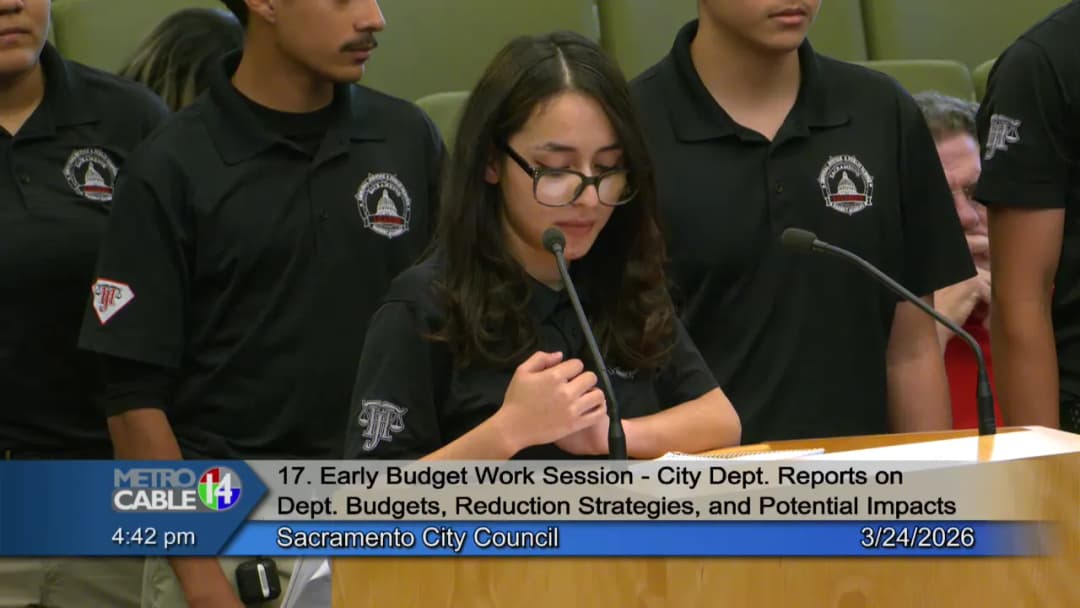
The Sacramento City Council met on Tuesday, March 24, 2026, at 2:05 p.m. in the City Hall Council Chamber. The meeting included a consent calendar, discussion items, and a budget work session. Key actions included approval of accessory dwelling unit design standards for historic properties (7-2), authorization to purchase 35 tiny homes for the Roseville Road North Campus (7-1), approval of the City Auditor’s Work Plan for FY2026/27 (8-0), and direction to proceed with a fiscal impact analysis for a District 2 Enhanced Infrastructure Finance District (EIFD). The meeting adjourned at 5:27 p.m. Consent Calendar - Items 1–6, 8–13 approved unanimously (9-0). Notable items: - February 2026 Monthly Investment Transactions Report – received and filed. - FY2025/26 Transportation Development Act claim for $606,195 – adopted Resolution No. 2026-0073. - City Auditor’s Whistleblower Hotline Activity Report (July–December 2025) – passed Motion No. 2026-0059. - Disabilities Advisory Commission, Preservation Commission, and Youth Commission 2025 Annual Reports and 2026 Workplans – received and filed. - Hollow Sidewalk Repair Project (District 4) – established as a capital improvement project with $1,200,000 transfer from Gas Tax Fund – adopted Resolution No. 2026-0075. - Contract Amendment with Innomotics LLC for $4,760,000 (total $5,000,000) – passed Motion No. 2026-0060. - Grant application for BSCC Proposition 64 Public Health and Safety Grant Program ($6 million) – adopted Resolution No. 2026-0076. - Direct Filing of Annual Reports for Assessment Districts – adopted Resolution No. 2026-0077. - Meadowview Navigation Center Restroom/Laundry Remodel contract ($278,800) – adopted Resolution No. 2026-0078. - Successor Labor Agreements with Stationary Engineers, Local 39 (three MOUs) and citywide salary schedule – adopted Resolution No. 2026-0079 by two-thirds vote. Public Comments & Testimony - Item 7 (ADU Standards): No public comments recorded. - Item 14 (EIFD): Seven speakers supported the EIFD, including Shantae Campbell (Roberts Family Development Center), Andy Hernandez (North Sac Chamber), Rob Kurth (former councilmember), and John Vignotchi (Urban Capital). Justin Wilson raised concerns about financial risk and equity, advocating for a more specific focus on Robla. - Item 15 (Auditor’s Work Plan): No public comments. - Item 16 (Tiny Homes): One speaker, Michael Melton, accused Brian Pedro of lying and mismanagement, claiming the program is not humanitarian and that apartments should be built instead. - Item 17 (Budget Work Session): 25 speakers addressed the council. Many urged restoration of $250,000 for a public bank viability study, citing benefits for local investment, equity, and climate goals. Several students and educators from Hiram Johnson High School’s Magnet Police Academy spoke in support of continued funding, emphasizing the program’s 100% graduation rate and positive impact on youth. Other speakers raised concerns about homeless services, code enforcement, and budget priorities. - Public Comments – Matters Not on the Agenda: Five speakers addressed issues including homelessness, apartment conditions, and code enforcement. Discussion Items - Item 7 – Resolution Enacting Accessory Dwelling Unit Design Standards for Historic Properties: Sean de Courcy (Preservation Director) presented the standards, which apply only to historic districts and aim to control a small percentage of poorly designed ADUs. Councilmember Maple expressed concern about added costs and complexity, voting no along with Councilmember Pluckebaum. Councilmember Dickinson supported the standards as a way to preserve historic character. The resolution passed 7-2 (Maple and Pluckebaum opposed). - Item 14 – District 2 Enhanced Infrastructure Finance District (EIFD) Discussion: Amanda Wallace (Office of Innovation and Economic Development) presented a high-level revenue analysis and requested direction to complete a full fiscal impact analysis (estimated 3 months, 20 staff hours plus consultant). Councilmembers Dickinson, Guerra, Maple, Vang, and Talamantes expressed support, noting the need to address decades of disinvestment in North Sacramento. The council provided direction to proceed with the analysis. - Item 15 – City Auditor’s Work Plan for FY2026/27: City Auditor Farishta Ahrary reviewed completed, ongoing, and proposed audits. Six new audits were added: homeless response, police overtime, code enforcement, downtown walkability, urban forestry, and financial management. The budget and audit committee recommended removal of three prior projects. Councilmember Vang thanked the committee for including the police overtime audit. The work plan was approved (8-0, Pluckebaum absent). - Item 16 – Purchase 35 Tiny Homes to Expand Roseville Road North Campus: Brian Pedro (Department of Community Response) requested authorization to suspend competitive bidding and contract with Boss Homes for $435,158, funded by Encampment Resolution Fund (ERF) grant. The campus currently has 71 of 135 units filled (89 people). Exits to permanent housing: 64 of 166 total exits (44% positive exit rate). Councilmember Kaplan questioned cost per person ($9,000/year vs. $8,300 for motel vouchers) and expressed concern about the lack of council oversight for emergency shelter contracts. She voted no. The motion passed 7-1 (Kaplan opposed, Pluckebaum absent). - Item 17 – Early Budget Work Session – Budget Context and Department Reports: Finance Director Pete Coletto outlined a $66.2 million structural deficit; the baseline balancing plan includes a 15% reduction target. Presentations from the Office of Public Safety Accountability, City Attorney, City Auditor, City Clerk, and City Treasurer followed. The City Attorney proposed hiring two litigators to bring 50 outside-counsel cases in-house, saving an estimated $1.48 million. The City Treasurer noted his office generated $3.9 million net revenue to the general fund and identified $3.5 million in ongoing savings. Councilmembers discussed the need for balanced cuts across departments. The item was received and filed. Key Outcomes - Consent Calendar (Items 1–6, 8–13): Approved 9-0. - Item 7 (ADU Standards for Historic Properties): Adopted Resolution No. 2026-0074 (7-2). - Item 14 (EIFD): Direction given to proceed with a fiscal impact analysis. - Item 15 (Auditor’s Work Plan): Approved Motion No. 2026-0061 (8-0, Pluckebaum absent). - Item 16 (Tiny Homes): Passed Motion No. 2026-0062 (7-1, Kaplan no, Pluckebaum absent). - Item 17 (Budget Work Session): Received and filed. - Information Item 18 (Parcel Map of 5221 9th Avenue): Received and filed.
Public Meetings - Sacramento, California
Public Meetings - Sacramento, CaliforniaThe Sacramento City Council convened a special closed session meeting on March 24, 2026, at 1:03 p.m. at City Hall Complex, 915 I Street, Sacramento. The sole purpose of the meeting was to enter closed session to discuss labor negotiations. The council had a quorum present. No public comments were received. The meeting adjourned into closed session at 1:04 p.m. Closed Session Item - Conference with Labor Negotiators (Gov. Code § 54957.6) – The council discussed strategy and matters pertaining to labor negotiations with designated representatives Leyne Milstein, Aaron Donato, and Tim Davis. Employee organizations included: Sacramento City Exempt Employees Association; Sacramento Police Officers Association; International Union of Operating Engineers, Stationary Engineers, Local 39; Sacramento Area Firefighters, Local 522; Sacramento-Sierra Building and Construction Trades Council; Plumbers and Pipefitters, Local 447; Auto, Marine and Specialty Painters, Local 1176; Western Council of Engineers; International Association of Machinists and Aerospace Workers; and all unrepresented groups. Key Outcomes - The council adjourned into closed session at 1:04 p.m. No votes or formal decisions were made in open session. Any actions taken during closed session are confidential and not recorded in this summary.
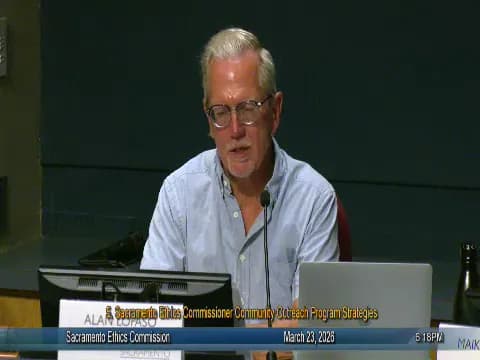
The Sacramento Ethics Commission met on Monday, March 23, 2026, at 5:30 PM in the City Hall Chamber. Commissioners present: Annette Emery, Maikhou Thao, and Chair Alan LoFaso. Commissioners Michael Kelly and Nicole Velasquez were absent. The meeting included a land acknowledgement, pledge of allegiance, approval of the consent calendar, discussion of the 2025 Annual Report, and a presentation on community outreach strategies. No public comments were received. The meeting adjourned at 6:31 PM. Consent Calendar - Approval of Ethics Commission Meeting Minutes (Feb. 23, 2026) – Approved unanimously (3-0). - Ethics Commission Complaint Log – Approved unanimously. - Sacramento Ethics Commission Follow-Up Log – Received and filed unanimously. Discussion Items - City of Sacramento Ethics Commission 2025 Annual Report (File 2026-00675) – Commissioners reviewed the report, which had been continued from the previous meeting. Two amendments were made: (1) changing the fifth outreach bullet from “Notomas Community Association” to “North Natomas Coalition” (per Commissioner Emery), and (2) adding the October 2025 no‑cause hearing and its evaluator costs to the list of commissioner deliberations (per Chair LoFaso). The commission voted 3‑0 to forward the amended report to the Personnel & Public Employees (P&PE) Committee for consideration and approval, with the report not requiring return to the Ethics Commission. - Sacramento Ethics Commissioner Community Outreach Program Strategies (File 2026-00683) – Commissioner Emery and Chair LoFaso presented their experiences conducting community outreach presentations in 2025. Key points included: the need to clarify the commission’s jurisdiction (e.g., not parking tickets), the difficulty of the complaint flow chart on small screens, and the importance of encouraging citizens to file complaints. Commissioner Thao suggested adding direct language about why the commission exists, targeting a broader range of community organizations beyond neighborhood associations, and making materials available in languages other than English (currently only English). City Clerk Mindy Cuppy noted that the PowerPoint is customizable and that the NDAT Community Ambassador Program could assist with translations. The commission discussed several outreach strategies proposed by Lynette Hall (June 2025), including podcast appearances, a feature in the city’s monthly communication toolkit, tabling at events, and ongoing visibility through the city’s link tree. Chair LoFaso expressed interest in a podcast, and Commissioner Emery supported the idea. Commissioners agreed to continue outreach efforts and to track pending presentations under Commissioner Comments. No formal vote was taken; the item was received and feedback provided. Commissioner Comments – Ideas and Questions - Commissioner Emery shared a historical note about Luella Johnston, the first woman elected to a citywide office in California (1912), for whom the meeting room is named. She highlighted the unethical tactics used against Johnston and the importance of ethics in government. Key Outcomes - Consent Calendar approved 3‑0. - 2025 Annual Report amended and forwarded to P&PE Committee (3‑0). - Outreach Strategies – received and discussed; no action required. Staff will follow up on podcast and translation opportunities. - No public comments were made. Note: The meeting transcript incorrectly states the date as May 23, 2026; the official agenda and minutes confirm March 23, 2026.
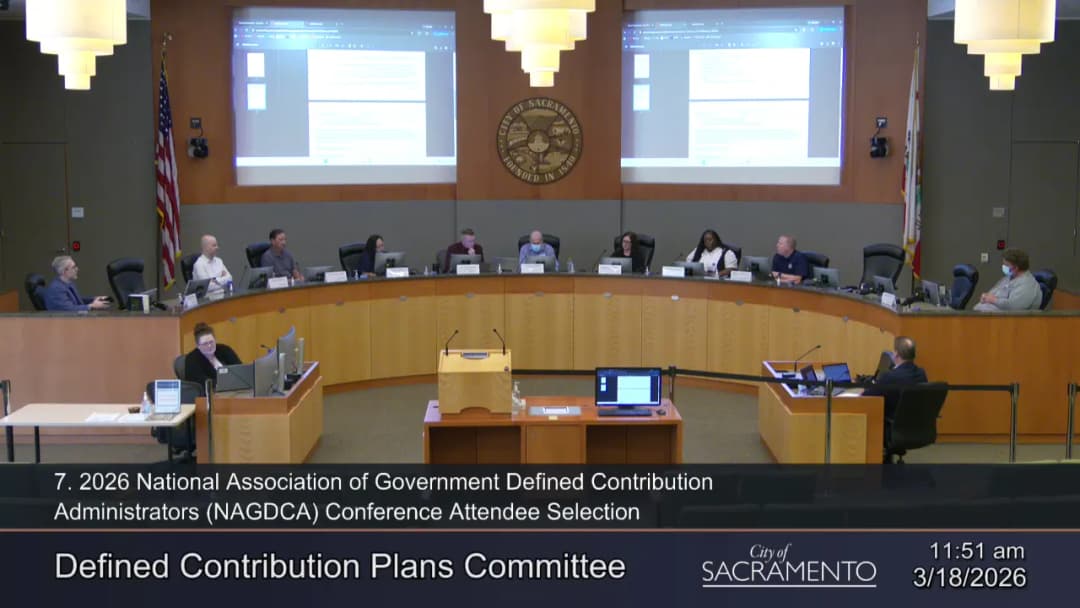
The Defined Contribution Plans Committee met on Wednesday, March 18, 2026, at 10:00 AM in the City Hall Complex at 915 I Street, Sacramento, CA. Vice Chair Murray Levison chaired the meeting in the absence of Chair Brad Hoekstra due to illness. The meeting lasted until 12:23 PM after a vote to extend past two hours. The committee addressed budgets, awards, plan reports, survey results, conference attendance, and officer elections. Consent Calendar - Approval of Meeting Minutes (File ID: 2026-00340): Approved minutes from December 10, 2025, and special meeting minutes of January 14, 2026. Motion passed 7-0 (Members absent: John Colville, King Tunson). Public Comments & Testimony - No public comments were made on any agenda item or on matters not on the agenda. Discussion Items - 2. Administrative Allowance Account Budget for CY 2026 and 2027: Vice Chair Levison presented an amended 2026 budget and proposed 2027 budget, accounting for lower investment consultant fees ($50,000 vs. budgeted $60,000) and no need for RFP savings. The budget also corrected prior errors and showed an unrestricted fund balance of about $118,000. The committee discussed potential uses for excess funds, such as temporarily suspending the $1.50 monthly participant fee. A motion to adopt the budgets passed 7-0. - 3. 2026 NAGDCA Art Caple President’s Award: John from Nationwide presented a draft award submission highlighting fee reductions and improved participant outcomes over 10 years. The committee directed that efforts focus on the Art Caple Award (due in June) rather than the general April award. Vice Chair Levison volunteered as the point person. Item was received and discussed; no vote required. - 4. Review Nationwide’s 2025 4th Quarter Plan Report: John presented the quarterly report covering plan assets ($889 million as of Dec 31, 2025), participation, distributions, loans, and engagement metrics. Key concerns included net cash outflows due to rollovers ($7.2M of $12M in distributions) and participants' high concentration in large-cap funds. The committee discussed strategies to retain participants, including tailored marketing campaigns and financial education. Item was received, commented on, and direction provided. - 5. Nationwide 2023 and 2024 Participant Survey Results: John reviewed survey results showing 76% of respondents were extremely or very satisfied in both years. Only 8% cited low fees as a reason for satisfaction, leading to discussion about participant awareness. The committee requested a sample survey for the next meeting and considered adding questions to promote plan features. Item was received, commented on, and direction provided. - 7. 2026 NAGDCA Conference Attendee Selection: The conference is Sept 27-30 in Orlando, FL. Budgeted $12,500 (approx. $2,400 per person). Members Gardella, Khang, and Levison expressed interest; two spots reserved for King Tunson and Matthew Anderson. Motion to allow up to five attendees passed 7-0. - 6. Selection of Chair and Vice Chair for 2026: Due to term limits in city code (no more than two consecutive years in either role), Chair Hoekstra and Vice Chair Levison were ineligible for re-election. After nominations, Patrick Zalasky was elected Chair (moved by Levison, seconded by Hoekstra) and Chee Khang was elected Vice Chair (moved by Levison, seconded by Hoekstra). Both motions passed 7-0. The new officers will preside starting next meeting. - Vote to Extend Meeting: A motion to extend the meeting past two hours passed 7-0 to allow completion of the agenda. Key Outcomes - Approved consent calendar (meeting minutes) 7-0. - Approved CY 2026 amended and CY 2027 administrative allowance account budgets 7-0. - Directed staff to focus on Art Caple Award submission and appointed a point person. - Received and discussed Nationwide’s Q4 2025 plan report and 2023-2024 participant survey results; provided direction on future surveys and participant retention efforts. - Approved selection of up to five attendees for the 2026 NAGDCA conference (three confirmed, two reserved) with $12,500 budget 7-0. - Elected Patrick Zalasky as Chair and Chee Khang as Vice Chair for calendar year 2026 7-0. - Extended meeting past two hours 7-0. - Chair Hoekstra announced this will be his last year on the committee; the city’s proposal to reconfigure the committee is on hold pending a new HR director.
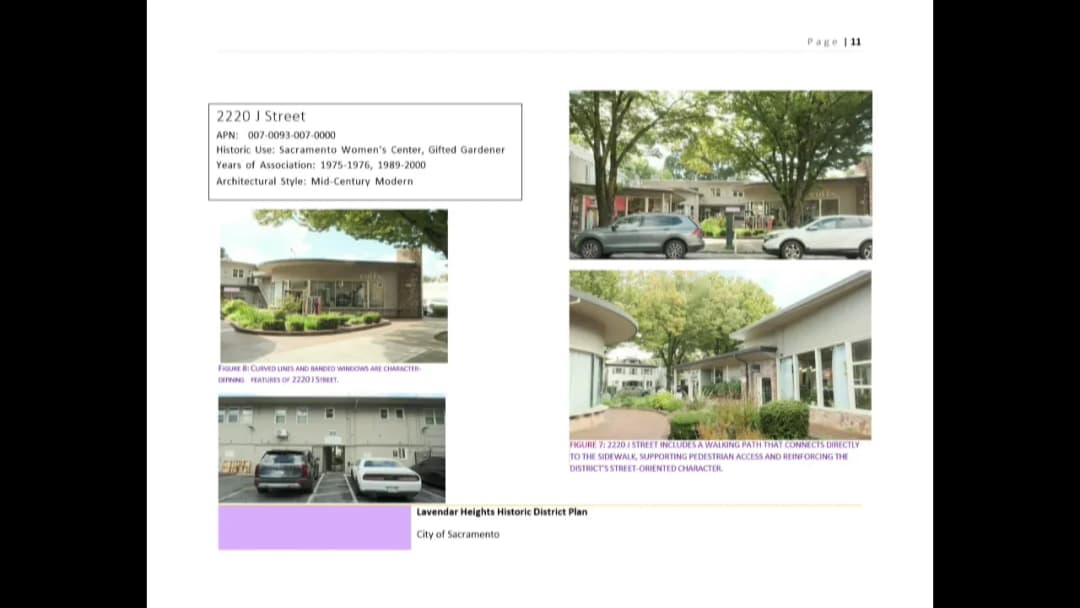
The Preservation Commission of Sacramento met on Wednesday, March 18, 2026, from 5:30 PM to 5:57 PM at City Hall. Chair Patricia Ambacher led the meeting with commissioners Ella Cross, Ian Merker, Salvatore Ricca present; Max McSlavkin was absent. The commission reviewed two discussion items: the 2024-2025 Certified Local Government (CLG) Program Annual Report draft and the draft Lavender Heights Historic District Plan. No public testimony was offered on any agenda item. Consent Calendar - Approval of February 18, 2026 Meeting Minutes (File ID: 2026-00039): Approved by a unanimous voice vote (4-0) with a motion by Commissioner Merker and second by Commissioner Cross. Discussion Items - 2024-2025 Certified Local Government Program Annual Report Draft (File ID: 2026-00686): Sean deCourcy, Preservation Director, presented the draft report covering the period October 2024 through September 2025. Key accomplishments included the designation of 17 new local landmarks and one historic district (Helvetia Historic District). The report demonstrates ongoing compliance with CLG standards (qualified commission, preservation ordinance enforcement, surveys, public participation). The commission provided feedback, including requests to correct email addresses (Commissioner Merker requested his work email be replaced with his personal email; Commissioner Cross noted her email address was missing the final 'm' in the domain) and to add training credits for attending the CPF conference and a CEQA training session in November 2025. The final report must be submitted to the Office of Historic Preservation by April 1, 2026. - Draft Lavender Heights Historic District Plan (File ID: 2026-00699): Preservation interns Hazel Bess and Hannah Toby presented the district plan, which identifies 12 contributing properties clustered around 20th and K Streets that are significant for Sacramento's LGBTQ+ history. The period of significance spans from the 1970s to about 2000. The plan describes these resources as bars, bookstores, churches, medical offices, and community centers that supported social connection, advocacy, and care during the AIDS crisis. Community engagement included multiple public meetings and listening sessions; staff sent letters to property owners and received two phone calls expressing support with no objections. Staff noted the action was for review and comment only (the nomination had already been approved by the city council). Commissioners offered comments: Commissioner Cross noted that 1900 K Street also housed the WEAVE organization (women's services), suggesting adding this women’s history dimension. Vice Chair Merker questioned the design standards for consistency, noting variations in phrasing (e.g., "do not obscure or demolish" vs. "do not obscure or alter") and asked about research on properties. Staff acknowledged the inconsistencies and agreed to adopt uniform language. Director’s Report - Sean deCourcy reported that on March 24, 2026, the city council is scheduled to review (on consent calendar) the accessory dwelling unit objective design standards for historic properties, which the commission had previously recommended for approval. - The landmark nomination for the former Orbit Gas Station at 2240 Northgate Boulevard is on hold pending discussions between the council office and property owner to address remaining concerns. Key Outcomes - Approved February 18, 2026 minutes (4-0). - Reviewed and provided comments on the CLG Annual Report; staff will incorporate corrections and submit by April 1. - Reviewed the Lavender Heights Historic District Plan and provided direction on language consistency; no vote taken (action was review and comment only). - No other motions or formal votes occurred. The meeting adjourned at 5:57 PM.
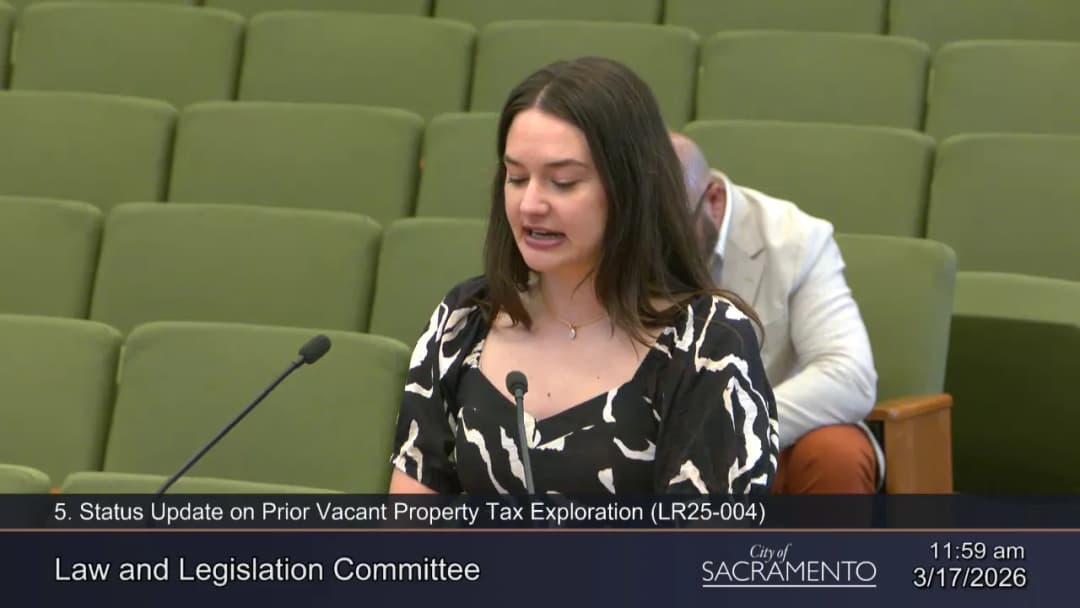
The Sacramento City Council Law and Legislation Committee met on Tuesday, March 17, 2026, from 11:01 a.m. to 1:32 p.m. at City Hall to discuss tobacco retailer ordinance revisions, a vacant property tax update, and an enhanced vacant lot and building enforcement program. The committee took action on three major items. Consent Calendar - Item 1: Approved the Law and Legislation Committee meeting minutes from January 13, 2026, and February 10, 2026. - Item 2: Approved the Law and Legislation Log. - Item 3: Received and filed the Legislative Advocacy Correspondence. Public Comments & Testimony - Tobacco Retailer Ordinance (Item 4): 14 speakers testified. Public health advocates (including Rachel Alvarez, Kimberly Bankston Lee, Liz Hendricks, Anisa Adams, and Dr. Alexandria Rymold) strongly supported ending the Healthy Food Exemption, citing research that only 6% of exempted retailers opened in food deserts, and 80% were non-compliant with healthy food requirements. Business owners (David Thule, Harman Handa, Jazz Zundel, Leticia Ramitas, Rocky Mulley, Sammy Chan, Dalbir Chahal, and Parmjit Kara) opposed the exemption's elimination, stating tobacco accounts for about 30% of convenience store revenue, and argued the change would devastate business values and retirement plans. A cannabis dispensary owner (Jacob) raised concerns about inconsistent land-use policies between tobacco and cannabis. A speaker (Gabriel) urged caution on banning kratom products, citing their use in opioid addiction recovery. - Vacant Property Tax Update (Item 5): Three speakers testified. Josh Oaken (Sacramento Association of Realtors) supported staff's recommendation against a tax, urging enforcement instead. Jeff Kessler (Vacancy Fee Project) criticized stakeholder outreach as one-sided and advocated for a citizen-initiated ballot measure. Dalen Gillentine supported continued monitoring and a potential 2028 ballot measure. - Enhanced Vacant Lot and Building Program (Item 6): 14 speakers testified. Property and business groups (Chris Valencia, Randall Hahn, Christian McGlade, Chris Little, Tish Mann, Matt McDonald, Josh Oaken, Karina Raimundo, John Vignaki, James Allison, Frank Louie) opposed broad fees and staff expansions, urging focus on bad actors. Jeff Kessler and Dalen Gillentine advocated for the strongest possible program, arguing high fees are necessary to combat intentional vacancy. Discussion Items - Item 4 – Ordinance Revisions to Tobacco Retailer Code: Staff proposed ending the Healthy Food Exemption, grandfathering existing license holders but prohibiting license transfer on sale. New fees to achieve 100% cost recovery would rise from $510 to $909 for new licenses and from $472 to $759 for renewals. Councilmember Dickinson supported reducing tobacco availability but expressed equity concerns for small businesses. Councilmember Pluckebaum favored a broader discussion on a citywide tobacco sales phase-out. Councilmember Maple noted concerns about cross-border sales with the county and suggested allowing license transfer with the property. The committee voted unanimously to forward the ordinances to the City Council for consideration, with a recommendation to discuss transferability of licenses under the Healthy Food Exemption. - Item 5 – Vacant Property Tax Update: Staff reported that outreach to stakeholders indicated opposition to a tax, emphasizing enforcement over taxation. Polling showed 57% support, short of the two-thirds voter threshold required for a city-referred measure. Staff recommended not moving forward with a tax at this time. The committee received the update without a formal vote. - Item 6 – Enhanced Vacant Lot and Vacant Building Program: Staff presented four enforcement models, recommending Model 3: 10 additional staff focusing on nuisance properties, with registration fees increasing from $70 to $133 and monthly monitoring fees for nuisance lots rising from $330 to $557, and for nuisance buildings from $380 to $903. Councilmembers expressed concerns about fee burdens and budget deficits, with Dickinson advocating for a middle-ground approach that targets bad actors without penalizing active developers. Maple suggested convening a working group with staff to refine the proposal before returning to committee. No formal vote was taken. Key Outcomes - Tobacco Ordinance: Unanimously forwarded to the full City Council with a note to discuss license transferability under the Healthy Food Exemption. - Vacant Property Tax: Received the status update; no further action recommended at this time. - Enhanced Vacant Lot/Building Program: Directed staff to work with committee members (Maple and Dickinson) to refine the proposal, focusing on compliance with existing registration, targeted enforcement on nuisance properties, and coordination with planning and building departments. A revised ordinance will be brought back to the committee for future consideration.
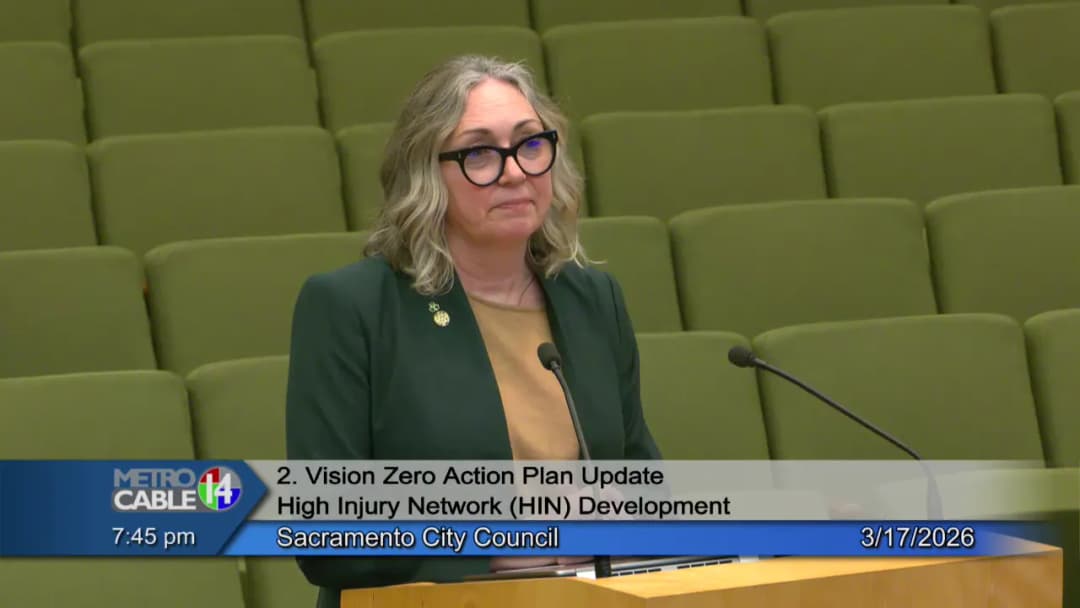
The Sacramento City Council convened on Tuesday, March 17, 2026, at 5:00 p.m. (regular session called to order at 6:36 p.m.) at City Hall. The meeting featured special presentations for Nowruz (Persian New Year) and Ramadan, a discussion on the Vision Zero Action Plan High Injury Network (HIN) development, the withdrawal of two agenda items, and public comment on teacher strikes in the Twin Rivers and Natomas school districts. Special Presentations - Nowruz (Persian New Year) – Presented by Mayor Kevin McCarty. The proclamation honored the Persian New Year celebration, which coincides with the vernal equinox and is observed by over 300 million people worldwide, including many in the Sacramento region. Speakers included Artavan Zahadani, who expressed gratitude for the city’s inclusivity. - Recognizing the Holy Month of Ramadan – Presented by Councilmember Roger Dickinson, Mayor Pro Tem Eric Guerra, and Councilmember Mai Vang. The proclamation recognized Ramadan as a sacred month of fasting, prayer, reflection, and generosity. Speakers from CARE/SVCC and Salam Center highlighted the Muslim community’s contributions and the upcoming Eid al-Fitr celebration at Cal Expo. They noted that over 100,000 Muslims live in the Sacramento region and dozens of mosques serve as community hubs. Public Hearings - Item 1 – Ordinance Listing 2240 Northgate Boulevard (Orbit Station) as a Landmark – Withdrawn and to be re-noticed. Vice Mayor Karina Talamantes noted ongoing conversations with property owners. - Item 3 – Memorandum of Understanding with Sacramento Zoological Society – Withdrawn; to be heard later in April. The Mayor noted the zoo’s 100th anniversary and commitment to community engagement. Discussion Items - Vision Zero Action Plan Update – High Injury Network (HIN) Development – Presented by Jennifer Donlon Wyant, Mobility and Sustainability Division Manager. Key data: over 22,000 injury crashes and 1,600 severe injury or fatal crashes in the past 10 years. 15% of killed or severely injured (KSI) involve bicyclists, 31% involve pedestrians. 48% of crashes occur in disadvantaged communities, which comprise only 31% of the street network. The current high injury network (HIN) is based solely on crash data; state law now allows inclusion of additional factors: vulnerable road users (people walking, bicycling, youth, older adults), sensitive areas near schools, and disadvantaged communities. Community engagement (nearly 1,000 survey responses, 10+ workshops) strongly supported including all factors. Staff recommended council direction to incorporate these criteria. Councilmembers unanimously supported the recommendation, with additional suggestions: Mayor Pro Tem Guerra asked to consider “near hit” data, road condition, and connectivity of bike routes; Councilmember Dickinson urged coordination with school districts and revisiting crosswalk policies; Councilmember Maple emphasized prioritizing vulnerable users and acknowledged the emotional weight of traffic fatalities; Councilmember Jennings highlighted enforcement and speed camera technology; Councilmember Vang noted that all major roads in her district (West El Camino, Truxel, San Juan, Northgate) are on the HIN. Mayor McCarty noted a $5 billion backlog in planned transportation improvements and the need for dedicated funding sources. Police Chief discussed ongoing enforcement efforts and the new SB 720 red light camera program (civil penalty, managed by Public Works), while AB 645 speed camera pilot does not yet include Sacramento. Public Comments – Matters Not on the Agenda Six speakers addressed the council, primarily regarding the ongoing teacher strikes in the Twin Rivers and Natomas Unified School Districts (day 9 of strike). Speakers included: - Santiago Vivas Rodriguez (parent): Called on council to pressure school districts to negotiate in good faith, citing broken systems and impact on students. - Raquel Guiera (teacher, 26 years): Described 100 unfilled positions, reliance on substitutes, and urged council to help facilitate bargaining. - Mary Carmen Vivas Aguilera (teacher, District 2 resident): Requested council to publicly call for good-faith negotiations and ask the Sacramento County Office of Education to review safety during the strike. - Pablo Gutierrez (substitute teacher): Stated that while not represented by the union, he joined the picket line and urged council to use its influence. - Other speakers: Caesar Nelson thanked past council for water issue resolution; Mike Snell presented a workforce model; all speakers emphasized the broader community impact of the strikes. Key Outcomes - Vision Zero: Council provided direction to staff to develop the High Injury Network incorporating all factors allowed by state law (vulnerable road users, sensitive areas, disadvantaged communities). Staff will return with a draft plan for adoption by the end of 2026. - Item 1 (Orbit Station landmark): Withdrawn; to be re-noticed after further stakeholder conversations. - Item 3 (Zoo MOU): Withdrawn; to be rescheduled for April after community engagement. - Public Comments: No direct action was taken on the teacher strike issue, but speakers’ concerns were entered into the record. - Adjournment: The meeting adjourned at 8:14 p.m. in memory of Howard Lawrence, a longtime labor advocate and community organizer.
The Sacramento City Council convened on Tuesday, March 17, 2026, at 2:34 p.m., adjourning at 6:24 p.m. The meeting included special presentations, a consent calendar, discussion of the City Auditor's community survey, approval of the Water Forum 2050 Agreement, and an early budget work session covering seven city departments. The budget session highlighted a $66.2 million general fund deficit and proposed reductions. Special Presentations - Declaring Child Care a Public Priority: Mayor Pro Tem Guerra presented a resolution recognizing child care as essential infrastructure. Speakers from Child Action, the Metro Chamber, and the city's child care project manager highlighted successes (e.g., 392 new child care slots, 22 apprenticeship graduates) and ongoing challenges (over 5,000 children waitlisted, licensed capacity for only 29% of children of working parents). - National Day of Play: A resolution designating the first Saturday after the spring equinox (March 21, 2026) as National Day of Play. Speakers encouraged residents to disconnect from devices and use the city's 243 parks. Consent Calendar - All 11 consent items were approved unanimously (9-0) by Motion No. 2026-0053. Key items included: - Acceptance of a $3.5 million GO-Biz Cannabis Equity Grant. - A cooperative agreement with Allstar Fire Equipment for up to $3 million for emergency equipment. - Authorization to apply for up to $1.5 million in state Prohousing Incentive Program (PIP) Round 4 funds. - Acceptance of $500,000 in state grant funds for North Natomas Regional Park Phase 7 improvements. - A resolution of intention to renew the Midtown Property and Business Improvement District, with a public hearing set for May 5, 2026. - Approval of $300,000 in HHAP-3 grant supplements for transitional age youth sheltering services. - Several other routine contracts, fee reports, and funding agreements. - Councilmember Kaplan noted that PIP Round 4 funding may not be awarded because the city already received previous rounds, and other jurisdictions that have not yet received funds would have priority. Kaplan and Mayor Pro Tem Guerra expressed support for continuing to apply. - Councilmember Kaplan highlighted that HHAP-3 funds extend 68 transitional age youth beds only through November 2026, after which programs may shut down unless new funding is secured. - One public speaker, Maisha Bahati (owner of Crystal Nugs, a cannabis dispensary), expressed strong support for the GO-Biz Cannabis Equity Grant, stating that the CORE program provided the only financial assistance she received and that it helped her become “the first black woman-owned dispensary here in Sacramento.” Discussion Items - Item 12: City Auditor’s 2026 Community Survey – Principal Fiscal Policy Analyst Joyce Chi presented results from the sixth community survey. A representative sample of 7500 households yielded 450 responses (6% response rate). Key findings: 68% of residents rated quality of life positively; parks and recreation were a strength (64% positive). Areas of concern included safety, mobility (only 26% positive for transportation system), economy, and governance. Cleanliness ratings trended down (23% positive). Councilmembers Dickinson, Guerra, Kaplan, and Vang noted the survey should inform budget and policy decisions, emphasizing the need to prioritize housing, homelessness, public safety, and parks. - Item 13: Water Forum 2050 Agreement – The council passed Motion No. 2026-0058 (8-0, Mayor McCarty abstaining) authorizing the City Manager to execute the Water Forum 2050 Agreement, including a Purveyor Specific Agreement, and a Third Interagency Agreement for administration. The agreement, negotiated over about six years, aims to ensure water reliability on the Lower American River and preserve environmental values. Speeches from Brett Ewart (DOU) and Ashley Casey (Water Forum Executive Director) highlighted successes over 25 years, including habitat projects, groundwater management, and collaborative science. Councilmembers praised the regional collaboration. Regarding a question from Vice Mayor Talamantes about El Dorado County’s proposed 40,000 acre-feet of water rights, staff clarified that El Dorado Water Agency is not signing the agreement due to opposition among members, but conversations are ongoing. Early Budget Work Session - The council received and filed the budget presentation, with no final decisions made. Departments presented baseline reduction strategies to close a $66.2 million general fund deficit. Key proposals and public comments included: - Youth, Parks, and Community Enrichment (YPCE) : Proposed baseline reductions of $4.8 million (11.2% of GF budget), eliminating 102 FTE (86 filled). Would reduce community center hours from six to four days per week (27% reduction), close four of six wading pools, reduce swim days at neighborhood pools from six to three days per week, and cut youth programs (e.g., Summer at City Hall, Semester at City Hall). Park maintenance would lose 54 positions (53% of maintenance staff). - Community Development : Proposed $3.3 million in reductions with no employee layoffs, mainly through fee increases and reduced spending on consultant services. The affordable housing impact fee assistance program (zero-dollar fee rate) would be reduced, potentially limiting affordability. - Finance: Proposed $1 million reduction by cutting two vacant positions and aligning revenue projections. - Human Resources: Proposed level 2 and 3 reductions, preserving core services but reducing capacity for personnel transactions, retiree communications, and DEI initiatives. - Information Technology: Proposed $1.1 million reduction through elimination of 3 filled and 1 vacant position (311, IT support, GIS), increasing response times and limiting data analytics. - Public Works: Currently a net contributor ($5.5 million) to the general fund. Proposed parking management changes to improve turnover and revenue, and emphasized $38.1 million in revenue generated vs. $32.7 million in GF support. - Department of Utilities: No general fund support; proactively proposed 8–9% reductions to address projected deficits, postponing critical infrastructure projects. Director Fadl emphasized the need for rate increases for water and wastewater funds (no rate increase in eight years) to address $2.2 billion in deferred maintenance. - Public testimony was heavily weighted toward protecting YPCE services. Over 30 speakers urged the council not to cut senior center operations (Bell Coolidge, Heart Senior Center), youth programs (Summer at City Hall, Semester at City Hall), Access Leisure for people with disabilities, and park maintenance staff. Many seniors described centers as lifelines preventing isolation and falls. Youth speakers described programs as essential for civic engagement and leadership. Key Outcomes - Approved: Consent Calendar (items 1–11) passed 9-0. - Approved: Water Forum 2050 Agreement (Item 13) passed 8-0 (Mayor McCarty abstaining). - Received and filed: City Auditor’s 2026 Community Survey (Item 12) and Early Budget Work Session (Item 14). No final budget decisions were made; further work sessions and hearings are scheduled for April, May, and June. - Direction: Councilmembers requested additional data, including a breakdown of baseline reduction percentages by department, a list of citywide contracts, and analysis of fee waiver utilization. Councilmember Vang urged exploring a potential park bond, while Councilmember Kaplan asked staff to review 311 service alternatives and the cost of room rentals. Councilmembers Jennings, Vang, and others stated they would not support cuts to youth and senior programs or to low-paid park maintenance staff. Councilmember Vang called for prioritizing vacancies (including police vacancies) over cutting filled positions. - Next steps: The proposed budget will be released at the end of April, with formal hearings in May and June.
This was the regular meeting of the Measure U Community Advisory Commission, held on Monday, March 16, 2026, beginning at 5:35 p.m. at Sacramento City Hall. Chair Teddy Georgeoff led the meeting, which featured a presentation from the Office of Diversity & Equity, discussions on FY2026/27 budget recommendations, and the creation of a new Budget Recommendations Ad Hoc Committee. The meeting was extended past the two-hour limit, concluding at 7:36 p.m. Consent Calendar The commission approved the following items by a 7–1 vote (Commissioner Cook voting no): - Item 1: Approval of the February 23, 2026 meeting minutes. - Item 2: Approval of the updated Measure U Agenda Log. - Item 3: Dissolution of the Metrics Ad Hoc Committee (required by city code after one year). Following the vote, Chair Georgeoff created a new 2026 Metrics Ad Hoc Committee with the same members (Georgeoff, Frye-Lucas, Johnston, Rosa, Smith, Cook, and Novello) to review the metrics dashboard and compile research. Public Comments & Testimony - Lambert Davis (speaking on the consent calendar) urged the commission not to dissolve the Metrics Ad Hoc Committee, stating it had been valuable during participatory budgeting for forcing transparency. He warned dissolving it without a successor could delay budget work. - Lambert Davis (on Discussion Item 5) criticized that some departments receiving Measure U funds had not appeared before the commission, calling this a pattern that undermines accountability. He argued Measure U had been co-opted since being placed in the general fund. - Dan Toskowski (Trees for Sacramento) requested that the commission recommend funding for urban forestry (currently $0 from Measure U), noting Sacramento’s canopy coverage goal of 35% by 2045 and poor air quality rankings (e.g., 7th worst for ozone in 2024). Discussion Items 4. Overview of Measure U Funded Departments and Programs: Office of Diversity & Equity Diversity & Equity Manager Aimee Zenzele Barnes presented on the office’s work, including: - Evolution of the Race, Gender, and Equity Action Plan (RGAP) from a workforce-only focus to include external equity efforts (procurement, budget, contracting). - Adoption of the Results-Based Accountability (RBA) framework (from Clear Impact/GARE) to shift from counting outputs (e.g., number of trainings) to measuring outcomes (e.g., “Is anyone better off?”). - Three planned citywide equity initiatives for 2026: an online equity impact planner/assessment tool, a Sacramento Equity Mapping Atlas, and an equity impact statement for all council staff reports. - The office is funded for three full-time positions by Measure U, requesting $517,000 for FY2026/27 (up from $503,000 the prior year). Commissioners asked about department equity teams, use of the GIS-based equity tool, and the challenge of collecting disaggregated demographic data. Commissioner Sala emphasized the need for interpreter services to be clearly posted on city materials. Commissioner Cook questioned how to link the office’s work to the North Star of residents feeling better off (citing a community survey showing only 22% positive rating for care of vulnerable residents). Commissioner Rosa asked how historical inequities are recognized and what the office’s unfunded wish list includes (research/data person, communications person, training/learning development specialist). 5. Development of FY2026/27 Measure U Budget Recommendations Staff outlined that departments are presenting 15% reduction strategies to council through March, and the commission must finalize budget recommendations by its May 18 meeting. Due to scheduling, only a limited number of departments can present in April. Commissioners expressed frustration that some departments had not prioritized presenting (e.g., Office of Public Safety had canceled since December). Commissioner Cook argued that failure to present should result in a recommendation of no funding support. Commissioner Sala noted that many department presentations are available from city council and budget committee meetings. Key Outcomes - Vote to extend meeting: Passed 6–3 (Commissioners Novello, Frye-Lucas, and Rosa opposed) to continue past the two-hour mark. - Creation of 2026/27 Budget Recommendations Ad Hoc Committee: Chair Georgeoff appointed Commissioners Cook, Goris, Miller, Rosa, Sala, Smith, and himself to draft the commission’s budget recommendations for discussion at the April meeting. - No formal position was adopted on requiring departments to present before receiving a funding recommendation, but several commissioners voiced support for such a policy. The new ad hoc committee is expected to consider this language. - Next steps: The commission will hear from a limited number of departments in April, and the Budget Recommendations Ad Hoc Committee will bring a draft to the May meeting for final approval.
The Civil Service Board of Sacramento met on Monday, March 16, 2026, at 1:01 PM in the City Hall Council Chamber. Chair Emmanuel Amanfor called the meeting to order. The board considered two appeals of applicant disqualifications, conducted a closed session regarding police officer discipline, and welcomed a new commissioner. Consent Calendar - Approval of Minutes (File ID 2026-00029): The board unanimously approved the meeting minutes from January 26, 2026. Members present were Gwynnae Byrd, Elena Gonzalez-Soto, Kathryn Meola, Julie Stein, and Chair Emmanuel Amanfor. - Welcome New Commissioner: Commissioner Elena Monique Gonzalez-Soto was formally welcomed to the board. Public Comments & Testimony No members of the public submitted comments or speaker slips for the consent calendar, discussion items, or matters not on the agenda. Discussion Items - Appeal of the Disqualification of Wendy Guerrero (Customer Service Specialist - Revenue Services): - Appellant Wendy Guerrero appeared and spoke, expressing confusion as her application was accepted for the exam (which she passed) but later disqualified for not meeting minimum qualifications. She noted she has been a city employee for almost 30 years and argued the disqualification was related to a clerical error on a previous application regarding CalPERS retirement status. - Staff from the Human Resources Department stated the disqualification was based on the application's "work experience" section not demonstrating "journey level experience" in customer service, as required by the classification. Staff emphasized the city processes over 55,000 applications annually and applies the same standard criteria to all applicants, requiring the applicant to enumerate their qualifications directly in the application form rather than relying on a resume or job title alone. - Commissioner Byrd summarized the issue as the applicant failing to fully enumerate her qualifications in the required section of the application. - Vote: Commissioner Meola moved, seconded by Commissioner Byrd, to waive formal hearing rules and adopt the Director's findings. The motion passed 3-0-2 (Byrd, Meola, Amanfor voted yes; Gonzalez-Soto and Stein abstained). - Appeal of the Disqualification of Reyes Ayon (Senior Code Enforcement Officer): - Appellant Reyes Ayon did not attend the hearing. The board confirmed that Ayon was notified of the hearing by email on January 20, 2026, and received a further follow-up reminder on March 11, 2026. - Vote: Commissioner Meola moved, seconded by Commissioner Stein, to waive formal hearing rules and adopt the Director's findings. The motion passed unanimously (5-0). - Closed Session (Police Officer Discipline): - The board adjourned to closed session at 1:23 PM pursuant to Government Code section 54957(b) to discuss a personnel matter involving the discipline of a police officer. - Reconvening at 2:29 PM, the board reported out three closed session votes: 1. By a 4-0 vote (1 abstention), the board voted to set aside its prior decision and reconsider the case in light of a POST (Peace Officer Standards and Training) determination letter. 2. By a 4-0 vote (1 abstention), the board denied the appellant's request to augment the record with court briefs. 3. By a 3-1 vote (1 abstention), the board adopted the arbitrator's proposed decision in the discipline case. Key Outcomes - The consent calendar was approved. - The disqualification of Wendy Guerrero was upheld by a 3-0-2 vote. - The disqualification of Reyes Ayon was upheld by a 5-0 vote. - In closed session, the board took three actions regarding the discipline of a police officer, including adopting the arbitrator's proposed decision. Member Comments and Questions - Board members provided comments. Commissioner Julie Stein requested that staff ensure materials and information requested by the board are sent to members in a timely manner.