The Law and Legislation Committee held a special meeting on August 30, 2022, from 1:00 p.m. to 2:12 p.m. The primary focus was a workshop on cannabis onsite consumption, featuring presentations from regulators in Palm Springs, West Hollywood, San Francisco, and Oakland. The committee also approved the consent calendar and provided direction to staff for developing a framework on potential regulations. Consent Calendar - Law and Legislation Log (File ID: 2022-01583): Passed a motion to approve. (Motion: Harris/Valenzuela; Yes: Harris, Valenzuela, Schenirer; Absent: Guerra) Public Comments & Testimony - Richard Miller (Americans for Safe Access): Expressed full support for consumption lounges as a safe space for medical patients to learn about cannabis, urging the committee to avoid a 30-minute limit like San Francisco and to allow modalities like yoga and massage therapy. - Maisha Bahati (Crystal Nuggs): Supported lounges, noting challenges hosting events at Cal Expo due to cost and lack of streamlined process. Encouraged the city to consider alternative locations or lounges to compensate for event limitations. - Kevin Hooks: Suggested requiring waivers for patrons to agree not to drive after consumption, supporting ride-sharing. Advocated for flexibility, including partnerships with deliveries, cannabis hotels, and massage parlors to boost tourism. - Michael Snell (Social Equity Applicant): Recommended the West Hollywood model over San Francisco’s, citing better safety from longer consumption times. Urged standalone lounges and inclusion of delivery and food options. - Malaki Sakou Amen (Institute for More): Questioned why West Hollywood did not intentionally award licenses to those harmed by racialized cannabis enforcement. - Kevin McCarty: Supported lounges, emphasizing education, ride-sharing discounts, and social equity built into criteria. Favorably noted co-location of food, music, and yoga. Advocated for eventual alcohol integration but not yet. - Jay (Gerard Johnson, License Holder): Asked the city to consider standalone lounges to allow equity applicants to participate, warning that attaching lounges only to storefronts would exclude many. Referenced the EPS study showing low crime impact of cannabis businesses. Discussion Items - Workshop on Cannabis Onsite Consumption (File ID: 2022-01523): Staff presented a panel of regulators from Palm Springs, West Hollywood, San Francisco, and Oakland. Key points: - Palm Springs (Veronica Goldhardt): 11 lounges attached to dispensaries; no caps led to saturation and struggling businesses; odor control and security funded by licensing fees; average tax revenue from lounges slightly less than dispensaries. - West Hollywood (John Leonard): 20 locations with diverse lounge types (full smoking, edible-only with ancillary smoking); merit-based selection of applicants; strict odor and security conditions; challenges include state restrictions on sales after 10 p.m. and inability to sell non-cannabis food/drink on site, but workarounds exist via adjacent restaurants; lounges integrate with tourism and generate significant revenue. - San Francisco (Douglas Obana): 12 lounges attached to dispensaries; three types of permits (A: prepackaged edibles, B: minimal prep, C: smoking/vaping); strict ventilation (negative pressure, MERV 11 filters, odor mitigation) costing up to $250,000; zero complaints on odor or noise; most lounges are free to use, with only two membership-based. - Oakland (via Greg Minor, reported by staff): No lounges currently operating; permitted lounges require attachment to retailer; soon considering standalone lounges; anti-impaired driving plans required; only one post-pandemic event. - Committee Deliberation: Councilmember Valenzuela favored capping on-site sales, requiring waivers, and protecting operators via civil liability provisions. She supported starting with lounges linked to existing delivery/retail licenses and expanding events. Councilmember Harris raised public safety concerns about lack of a cannabis sobriety test, questioning how business owners could determine intoxication and liability. Chair Schenirer proposed an incremental approach: staff to develop a framework of options (not a full ordinance) within about 45 days, followed by community outreach. Assistant City Manager Laney Millstein confirmed priority on licensure revisions and noted that the framework would be developed alongside ongoing zoning work. Key Outcomes - Consent Calendar: Approved (3-0). - Direction to Staff: Develop a framework for cannabis onsite consumption, including options for: - Security measures - Standalone vs. attached-to-dispensary lounges - Events outside Cal Expo - Medical/wellness lounges (e.g., spa, yoga) - Public safety information (sobriety testing, liability for operators) - Merit-based licensing considerations - Community outreach before drafting an ordinance. - Next Steps: Framework to be presented to the committee in approximately 45 days; staff will coordinate with the Planning Commission and other ongoing work.
Public Meetings - Sacramento, California
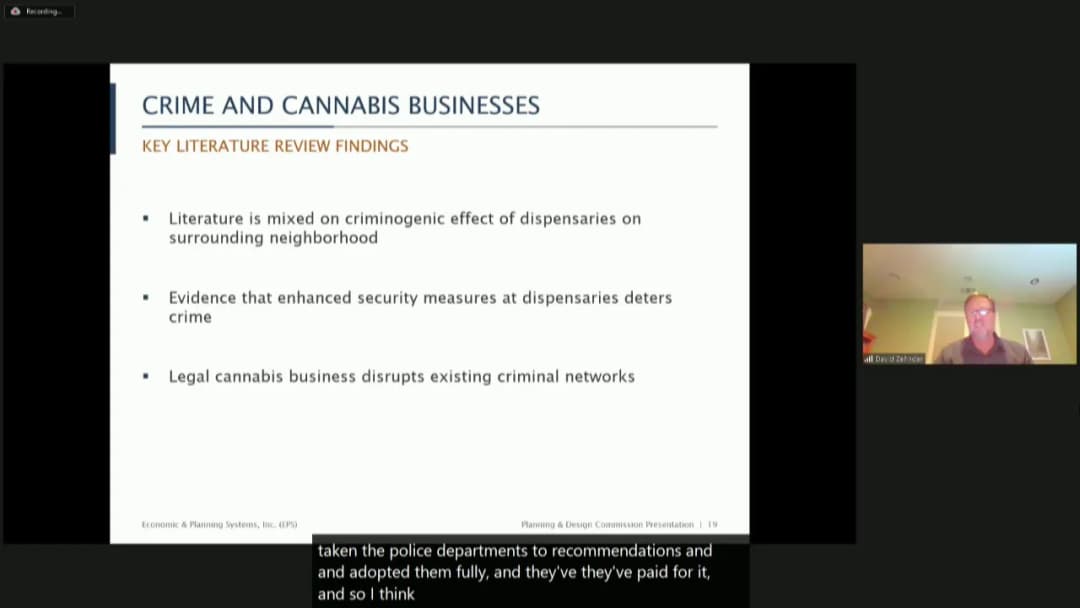
Public Meetings - Sacramento, CaliforniaThe Planning and Design Commission met on Thursday, August 25, 2022, at 5:30 p.m. via teleconference due to COVID-19. The meeting experienced technical difficulties, recessing at 5:32 p.m. and resuming at 6:10 p.m., and adjourned at 10:00 p.m. The agenda included a public hearing on a cannabis delivery and manufacturing conditional use permit (CUP) at 1717 Kathleen Avenue and a workshop on the citywide Cannabis Land Use Policy. Consent Calendar - Approval of Minutes: The minutes from the August 11, 2022 meeting were approved by a motion (Pluckebaum/Lenzi) with Commissioners Macias Reed and Wallace abstaining. - Director's Report: Received and filed; noted City Council approval of the Dutch Brothers project on Florin Road on August 16, previously recommended by the commission on June 23. Public Comments & Testimony Item 3: 1717 Kathleen Avenue CUPs - June (property owner): Expressed support, stating the building has been vacant due to tenant damage and she trusts applicant Scott Lockwood. Noted her family has owned the property since 1986 and that the area is zoned industrial. - Hali Retterer (District 6 resident, urban planner/biologist): Opposed the project, citing over-concentration in Districts 2 and 6, lack of public health consideration in the study, and potential for political corruption. Urged a moratorium. - D8 Neighborhood Vine: Opposed, arguing that cannabis businesses oversaturate disadvantaged districts while grocery stores and other essential services are lacking. Asked for equitable distribution across all districts. - Tara Kirse (Hagenwood community member): Supported the project, praising Lockwood’s community engagement and business model. Noted the area has vacant lots and poor sidewalks, and a responsible business would benefit the neighborhood. Item 4: Cannabis Land Use Policy Workshop - Hali Retterer: Criticized the EPS study as potentially biased, called for peer review, and emphasized the need to consider transit routes, public health, and social impacts in buffer zones. - D8 Neighborhood Vine: Argued that cannabis uses are prioritized over food access, water and energy consumption are high, and businesses do not hire locally. Urged the commission to evaluate best use for communities and require hiring ratios. - Deanna Garcia (cannabis advocate): Supported the study and the legal industry, noting its contributions to jobs, tax revenue, and elimination of the gray market. Urged continued safe access. - Rachel Brown (Executive Director, Power and Alliance): Thanked city staff and Sergeant Young for their work. Stated her organization is focused on maintaining traditional industrial space for repurposing and is open to removing distribution caps. Discussion Items Item 3: 1717 Kathleen Avenue - Cannabis Delivery & Manufacturing CUPs (P21-039) Staff recommended denial based on inconsistency with the M-T (Industrial and Transit-Area) zone, citing auto-oriented nature (delivery) and insufficient buffer from residential uses. The applicant, Scott Lockwood (High Top Company LLC), disputed the auto-oriented characterization and presented a micro-business model (delivery-only, non-volatile manufacturing) with community support (28 residents within 600 feet, 17 Hagenwood businesses, 26 District 2 businesses, and 7 signatures from the Hagenwood Community Association – totaling 78). He argued the EPS study shows no negative impact on nearby homes, crime (average 0.5 crimes per cannabis business), or industrial rents. Commissioner questions focused on hours (9am-9pm), number of vehicles (1-2), and routing. Discussion emphasized the building’s industrial use and the area’s need for occupied space over vacancy. A motion (Covill/Wallace) to deny staff’s recommendation (i.e., approve the project) was amended (Yee) to require a revised plan ensuring secure product transfer and to continue the item without a date certain, necessitating re-notification of the community. Item 4: Workshop on Cannabis Land Use Policy Staff (Kevin Colin) and EPS consultants (David Zender, Tom Martins) presented findings from the Comprehensive Cannabis Study. Key findings: cannabis businesses have not negatively impacted home values, retail/industrial rents, or crime beyond levels of other businesses. Concentrations in Districts 2 and 6 are a function of zoning. Council had directed the commission to evaluate seven points: (1) review sensitive use buffers; (2) consider additional zones for storefront/delivery-only dispensaries and non-volatile manufacturing; (3) allow dispensaries in RMX and C3 zones; (4) revise the list of sensitive uses and buffer distances (e.g., remove child care, tobacco retailers); (5) review mixed-light cultivation building type for repurposing; (6) consider permitting cannabis research and development; and (7) remove distribution from the district cap. Commissioners provided general support for expanding zones, reducing buffers, and removing distribution caps, while requesting further analysis on crime at perimeters, community engagement, and equity (including navigator services for core applicants). No vote was taken; direction was provided to staff to develop a scope and schedule for further work, including robust public outreach. Key Outcomes - Item 3 (1717 Kathleen Avenue): The commission voted 9-3 (Hernandez, Pluckebaum, Yee dissenting) to deny staff’s recommended denial and to continue the item to a future hearing. Staff was directed to prepare findings for approval (CEQA exemption, CUPs for delivery-only dispensary and non-volatile manufacturing), re-notice the project due to the absence of a set date, and require the applicant to amend the floor plan for secure product transfer. - Item 4 (Cannabis Land Use Policy Workshop): The commission conducted the workshop and provided staff with preliminary direction on the approach and scope for evaluating council’s recommendations. No formal action or vote was taken. Next steps include further analysis, community engagement, and subsequent commission meetings to refine policy changes.
The City of Sacramento Urban Forestry Tree Appeal Hearing convened via teleconference on Wednesday, August 24, 2022 at 10:00 a.m. The available transcript captures only roll call and the admission of participants, with no recorded public comments, discussion, or decisions. Appeal Items - 2313 5th Avenue — Appeal hearing listed on agenda. - 1891 Royal Oaks Drive East — Appeal hearing listed on agenda. - 1891 Royal Oaks Drive West — Supplemental appeal item added to agenda. No substantive proceedings beyond initial setup are documented in the transcript.
The Utilities Rate Advisory Commission meeting scheduled for Wednesday, August 24, 2022 at 5:30 p.m. was cancelled. No agenda items were discussed, no public testimony was taken, and no votes or decisions were made.
The Active Transportation Commission met teleconference-only on Thursday, August 18, 2022, at 6:01 p.m. and adjourned at 8:27 p.m. Commissioners considered consent items, received staff reports, discussed corridor projects, a grant application, the Transportation Priorities Plan, and a subcommittee report. Public comments addressed a wide range of active transportation topics. Consent Calendar - Item 1 – Approval of Minutes (June 16, 2022): Passed (7 yes, 1 abstain (Commissioner Paullins), 2 absent). - Item 2 – Adoption of Active Transportation Commission Log: Passed as part of the consent calendar. Public Comments & Testimony - Item 4 (34th Street / West El Camino): Nick Meyer (resident) requested a crosswalk on V Street at 34th, noting pedestrian conflicts. - Item 5 (Marysville Blvd Grant): Dan Allison (support) and Margarette (student, support) spoke in favor of the project. - Item 6 (Transportation Priorities Plan): - Dan Allison strongly supported the plan’s transparency but noted possible disagreement with specific criteria. - Troy Senke asked if the city considers temporary/cheaper materials to deliver projects faster. - Brian Henry requested context on spending on car infrastructure versus active transportation. - Steve criticized the lack of high-priority projects in South Sacramento, questioning the equity of the map. - Saba (Dev Banks) praised the effort and asked how grant applications (like Marysville) align with the TPP prioritization. - John Fritzie (audio issues) commented on the River City Bike Trail and equity concerns in the Pocket area. - Item 7 (Subcommittee on Walking/Biking): Dan Allison suggested a public dashboard; Matt Anderson supported funding emphasis and transformative ideas like street closures. - Public Comments – Matters Not on the Agenda: - Dan Allison urged combining pedestrian and bike master plans, ATC monitoring of Vision Zero, and regular council communication. - Brian Henry reported a pedestrian signal issue at 65th & Folsom and RT display problems. - Steve criticized the Pocket parkway process, alleging lack of transparency and use of PR firm. - Matt Anderson called for ATC to weigh in on budget and climate action plan, noting three pedestrian deaths in the past week. - Saba (Dev Banks) supported updating the bike/ped master plans and streamlined parklet programs. Discussion Items - Item 3 – Commission Staff Report (Oral): Received and filed. Staff announced new planner Jeff Gelsma, two vacant transportation planner positions, and nine traffic signal locations being upgraded for bicycle detection. - Item 4 – Transportation Corridor Program: 34th Street and West El Camino Rehabilitation: Staff presented planned improvements: buffered bike lanes, pedestrian refuge island at Niños Parkway, rectangular rapid flashing beacon at X Street, bus stop relocation, and pavement rehab. Commissioners discussed speed, bike facility type, creative crosswalks, and intersection safety. No vote – review and comment only. - Item 5 – Safe Streets and Roads for All Grant (Marysville Blvd Vision Zero): Staff presented the grant application for a $4 million local match from SACOG and a federal grant due September 15, 2022. The project would reduce the five-lane roadway to three lanes with separated bikeways, improved crosswalks, and bus stop spacing. Commissioners expressed strong support. Motion passed unanimously (8 yes, 2 absent) to forward recommendation to City Council. - Item 6 – Transportation Priorities Plan Initial Prioritization: Staff presented the data-driven prioritization of over 700 planned projects using values adopted by council. Key statistics: 41 miles of high-priority projects; 70% on the High Injury Network; 85% improve job connections; 90% on poor pavement serving many people; 95% benefit communities lacking basic infrastructure. Commissioners discussed funding challenges, engagement gaps (especially North Sacramento), and scoring of shared-use paths. No vote – review and comment. - Item 7 – Subcommittee on Status of Walking/Biking: Chair Westbrook reported subcommittee progress, including review of past agendas and brainstorming report topics. The subcommittee aims to highlight recent successes, identify transformative ideas, and produce a draft report by November 2022, final in January 2023. Commissioners offered suggestions (dashboard, metrics, council member outreach). No vote – received and filed. Key Outcomes - Consent Calendar approved (7-0-1, 2 absent). - Item 5 motion passed (8-0-0, 2 absent) to recommend City Council support for the Marysville Blvd Vision Zero grant applications. - Item 4, 6, and 7 received comments and were filed without vote. - Commissioner Houpt proposed adding the R Street al fresco dining/street closure issue to the commission log for future discussion; staff will accept the proposal for the next month’s log. - Commissioner Brazzle raised concerns about moving to in-person meetings without hybrid option; staff noted a decision is pending. - Staff will continue engagement on the Transportation Priorities Plan through September 6, 2022, with virtual workshops on August 24 and 27.
The Preservation Commission meeting scheduled for Wednesday, August 17, 2022 at 5:30 p.m. was cancelled as per the published notice. No agenda items were discussed, no public testimony was taken, and no decisions were made. Note: The user-provided timestamp (2022-08-17 13:30:00+00:00) differs from the agenda's stated start time of 5:30 p.m. (17:30 local). This summary uses the agenda's official time.
The Ann Land and Bertha Henschel Memorial Funds Commission met virtually via Zoom on Wednesday, August 17, 2022, at 4:00 PM. The meeting was called to order by President Alison Leary and adjourned at 4:33 PM. All eight commissioners present (Howard Chan absent) approved the consent calendar and received and filed reports on grantee performance and site visits. Commissioners discussed improvements to site visit forms, missing semiannual reports from three agencies, and the potential transition back to in-person meetings. Consent Calendar - Approval of Meeting Minutes (Item 1): Passed a motion (moved by Commissioner Smith, seconded by Vice President MacIntosh) to approve the minutes from February 16, 2022, and May 18, 2022, with a correction noted by President Leary regarding her attendance in May. The motion carried unanimously (8-0-1 absent). Public Comments & Testimony - No members of the public spoke during any portion of the meeting. Discussion Items - Semiannual Reports (Item 2): Staff presented a summary. Three organizations—Meals on Wheels by ACC, My Sister’s House, and Next Move Homeless Services—had not submitted their semiannual reports and therefore had not received their secondary grant payments. The Women’s Civic Improvement Club received a full single payment after notifying staff that their January payment was not received. The commission received and filed the reports; no vote was required. - Site Visit Reports (Item 3): Staff noted that most commissioner site visit reports were submitted; outstanding reports from Commissioners Smith and Zamanudin were largely received and will be included in the November agenda. One report for Stanford Settlement Neighborhood Center remained outstanding. Staff redacted personally identifying information from reports and removed those fields from future online forms. Commissioners discussed adding a dedicated comment section to the site visit report form. Staff was directed to include this change for the next grant cycle starting at the February 2023 meeting. - Commissioner Comments – Ideas and Questions: - Commissioner Smith inquired about the return to in-person meetings. Staff indicated that commissions are still meeting remotely only, though city council had a blended meeting; guidance is forthcoming. President Leary explained Brown Act requirements for in-person participation if emergency rules expire. - Commissioner Korbs noted difficulties with changing contact information at multiple agencies and requested that staff continue sending reminder emails with Zoom links and consolidated application materials before the November funding meeting. Staff agreed. - Several commissioners reported that two of their three site visit contacts had changed, while others had no changes. Key Outcomes - Consent Calendar: Approved 8-0-1 (Commissioner Chan absent). - Semiannual Reports: Received and filed; no vote required. - Site Visit Reports: Received and filed; no vote required. Staff will add a comment section to the site visit form for the next cycle. - Directives: Staff will provide a reminder email with the Zoom link before the November meeting and will compile and distribute grant applications and evaluation matrices after the application deadline (October 14, 2022). - Next Steps: The commission will next meet in November 2022 to review grant applications. The transition to in-person meetings remains under development.
No agenda, minutes, or transcript were provided for a meeting on this date. The only document supplied is a cancellation notice for a scheduled meeting on September 19, 2023. Therefore, no discussion topics or decisions can be summarized.
The scheduled meeting of the Personnel and Public Employees Committee for Tuesday, August 16, 2022, at 3:00 p.m. was cancelled. No agenda items were discussed, no public comments were received, and no decisions were made.
This notice announces the cancellation of the Personnel and Public Employees Committee meeting. The agenda indicates the meeting scheduled for Tuesday, November 15, 2022 at 3:00 p.m. was cancelled. However, the stated meeting date for this summary is August 16, 2022; this discrepancy is noted. No minutes or transcript are available. Cancellation Details - The meeting was cancelled, with no further information provided. - The committee members are: Angelique Ashby (Chair, District 1), Katie Valenzuela (Vice Chair, District 4), Sean Loloee (District 2), Jeff Harris (District 3). - Committee staff include: Mindy Cuppy (City Clerk), Wendy Klock-Johnson (Assistant City Clerk), Fhanysha Gaddis (Senior Deputy City Attorney). - Location: City Hall-Council Chamber, 915 I Street, 1st Floor, Sacramento, CA. Key Outcomes - No actions were taken, as the meeting was cancelled.