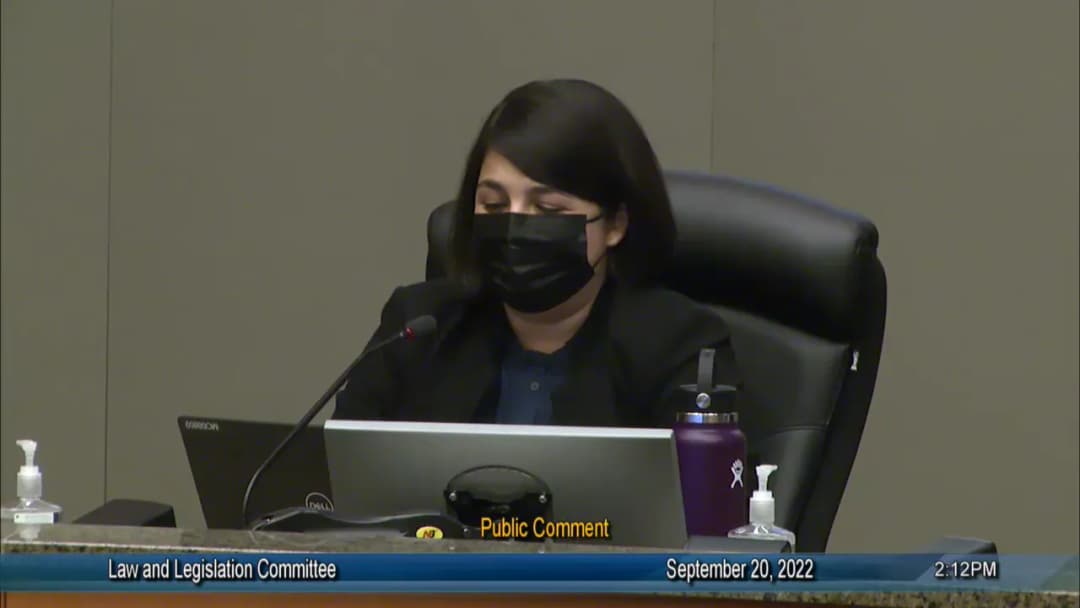
On Tuesday, September 20, 2022, the Sacramento City Law and Legislation Committee met in hybrid format at City Hall. The committee reviewed two major discussion items: a proposed Dual Plumbing Ordinance framework and an updated New Building Electrification Ordinance. After hearing public testimony and deliberation, the committee provided direction to staff on the dual plumbing framework and voted to forward the electrification ordinance to the full City Council. The consent calendar containing three administrative items was approved unanimously. Consent Calendar - Item 1 – Law and Legislation Log: Approved via motion. File ID: 2022-00196. - Item 2 – Legislative Advocacy Correspondence: Received and filed. File ID: 2022-00198. - Item 3 – Law and Legislation Committee Meeting Minutes: Approved for August 16 and August 30, 2022. File ID: 2022-01592. Public Comments & Testimony On Item 4 (Dual Plumbing Ordinance): - Todd Schiavo (Business Manager, Plumbers and Pipe Fitters Local 447) urged support for the compromise agreement, emphasizing job transition needs from the electrification ordinance. - Rob Fong supported the compromise, noting the water conservation benefits and the need to build infrastructure for multiple water uses. - Tim Murphy (CEO, Sacramento Regional Builders Exchange) expressed no opposition to phase one but raised concerns about phase two costs and the need for regional consistency. - Randy Young (Sheet Metal Workers) urged support for the compromise and referenced workforce standards. - Frank Louie (Stockable Partnership) highlighted concerns about restaurant impacts and requested technology readiness extensions. On Item 5 (New Building Electrification Ordinance): - Chris Noram (North State Building Industry Association) requested clearer infeasibility criteria, especially regarding supply chain and grandfathering, while noting industry is moving toward all-electric. - Matt Sutton (California Restaurant Association) acknowledged the technical panel’s work but asked for a longer appeal period (10 days was considered too short) and a firmer timeline for continuous improvement discussions. Discussion Items Item 4 – Dual Plumbing Ordinance Proposed Framework Staff presented a two-phase approach: Phase 1 required dual plumbing for gray water capture and outdoor irrigation in new non-residential buildings ≥50,000 sq ft (capturing 76% of commercial construction valuation), with an effective date of July 1, 2023. Phase 2 (2023-2026) would study indoor reuse and incentives. Local 447 proposed a tiered compromise: pre-plumbing for non-potable uses in buildings ≥50,000 sq ft, and simple gray water systems for buildings ≥10,000 sq ft with landscaping. Committee members expressed general support for the compromise, with concerns about state regulation timing. Chair Schenirer directed staff to draft an ordinance and resolution based on the compromise, continue stakeholder engagement (including with Regional San and builders), and return in November for another hearing. Councilmember Valenzuela also requested that staff meet with labor to design workforce benefits for pilot projects and include stormwater capture in Phase 2. Item 5 – New Building Electrification Ordinance Staff presented an updated ordinance aligning with the 2022 California Building Standards Code. Key changes: adopted as a local amendment to CalGreen, simplified definitions, removed obsolete EV charging requirements (state now more stringent), and retained the limited exemption for water heating in regulated affordable housing. The ordinance phases in all-electric requirements: by Jan 1, 2023 for buildings ≤3 stories, and by Jan 1, 2026 for buildings ≥4 stories. Limited exemptions for restaurants and manufacturing last until 2026. Staff also developed an infeasibility waiver guidance document. Committee members discussed restaurant concerns, supply chain issues, and ensuring the timeline syncs with the dual plumbing ordinance. Chair Guerra offered a second motion with additional directions: extend the appeal period from 10 business days, meet with builders on infeasibility criteria, and address supply chain concerns. Key Outcomes - Consent Calendar passed unanimously by voice vote (all members present). - Dual Plumbing Ordinance: Staff directed to prepare an ordinance and resolution based on the compromise proposal, with a target return to the Law and Legislation Committee in November 2022. Staff will also engage with Regional San, builders, and labor on pilot projects and stormwater capture in Phase 2. - New Building Electrification Ordinance: Motion to forward the ordinance to City Council for consideration passed 3-0 (Councilmember Schenirer absent). Additional directions: staff to meet with the restaurant association and builders to address appeal timeline, infeasibility criteria, and supply chain issues. The ordinance is scheduled for council adoption on November 15, 2022. - Committee adjourned at 2:24 p.m.
Public Meetings - Sacramento, California
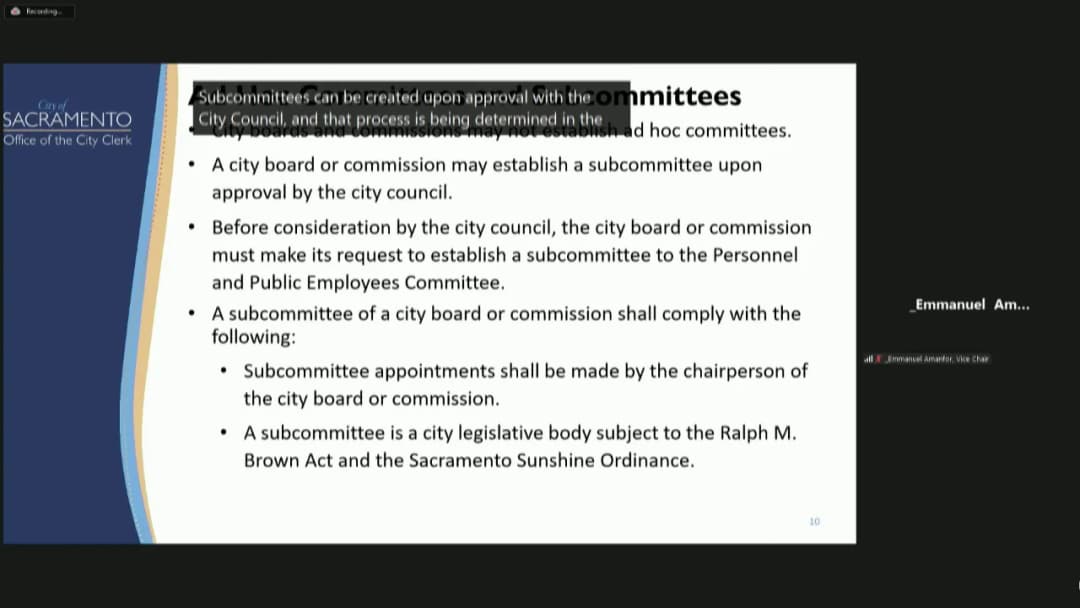
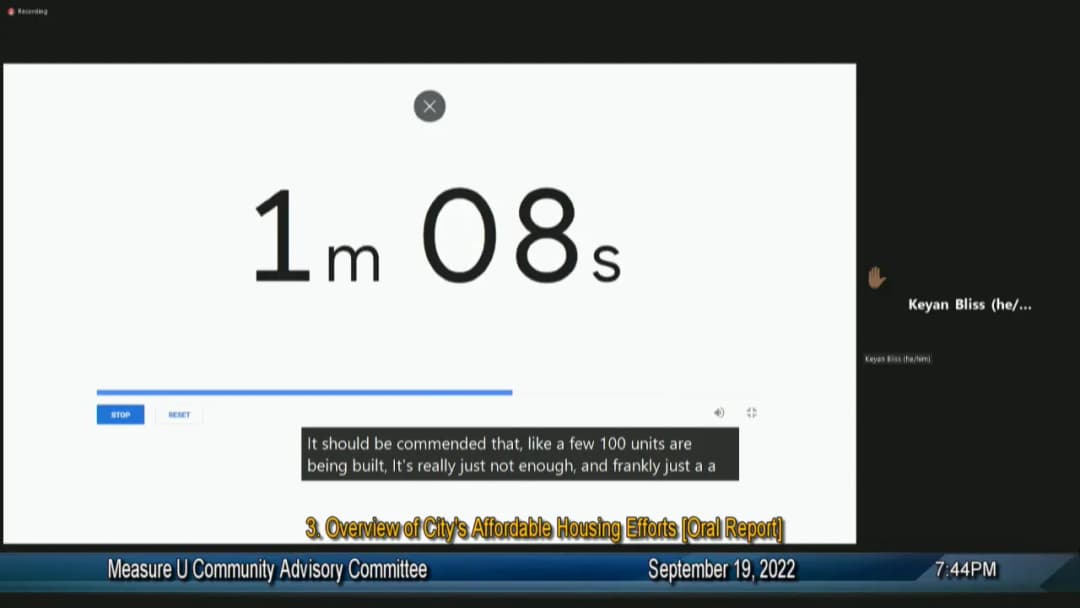
Public Meetings - Sacramento, CaliforniaThe Measure U Community Advisory Committee met via Zoom on Monday, September 19, 2022, from 6:04 p.m. to 8:58 p.m. Chair Flojaune Cofer presided until 7:01 p.m.; Vice Chair Kimberly Williams then chaired the rest of the meeting. Cathy Creswell and Alice Perez were absent; Noel Mora arrived at 7:58 p.m. and Dana Kivel left at 8:24 p.m. Special Presentation - Chair Cofer recognized former committee member Gina Alatorre Lujan for her service since April 2019. Members Dana Kivel and Marjorie Dickinson added thanks. Consent Calendar - The committee approved the August 15, 2022 meeting minutes and the updated Agenda Log in one motion. The live roll call was unanimous; the draft minutes are internally inconsistent, listing Noel Mora and Alice Perez as both voting yes and absent, while the live roll call recorded them as absent. Public Comments & Testimony - On Item 6, Keon Bliss, vice chair of the Sacramento Community Police Review Commission, opposed the City Council's elimination of ad hoc committees, saying it was intentionally designed to stymie effective volunteer bodies; his commission had produced over 100 recommendations since 2016 with only one up-or-down vote. Lambert Davis and Barry Boyd also criticized the council action. - On Item 3, Dr. Diane Wolfe asked whether the city had considered buying into market-rate housing to create affordable units and whether $100 million planned for a mobility center could instead support transit to make housing areas more affordable. Keon Bliss, as a District 4 resident, criticized the lack of downloadable presentation materials and said a few hundred units were not enough given about 9,200 unhoused residents, a 67 percent increase in unsheltered residents since 2019, including about 1,300 families with children and 464 youth, and an average studio rent of $1,958 versus an average income of $34,000. - On Item 4, Lambert Davis stressed the importance of tracking public funds, saying untracked money could have gone anywhere, and praised staff for acknowledging that some FY2020/21 recommendations could not be traced. - On Item 5, Lambert Davis said he and about ten people he invited were not selected as participatory budgeting delegates despite attending multiple outreach meetings, called the process suspect, and opposed directing PB funds to services for unhoused residents. Barry Boyd, a Southeast proposal delegate, asked for confirmation that an entrepreneurial program and a combined arts/culture proposal remained on the ballot and supported the proposed implementation review panel. - During Matters Not on the Agenda, Lambert Davis asked for an audit of Measure U spending in Del Paso Heights and said the neighborhood should receive a PBID like District 2. Barry Boyd publicized the Planning and Design Commission's September 22, 2022, 5:30 p.m. meeting on the proposed 2023 planning and zoning work program. Discussion Items Item 6 – Future Committee Workload Needs and Ad Hoc Committees Membership Roster - Chair Cofer reported that City Council voted 5-4 on August 29-30, 2022, to end ad hoc committees for boards, commissions, and committees effective January 1, 2023. She drafted a memorandum to the Personnel and Public Employees Committee requesting formal subcommittees. - Committee members expressed disappointment. Dana Kivel said she was inclined to leave the committee; Marbella Sala urged members not to resign and hoped a new council would revisit the decision; Marjorie Dickinson said the committee should file its request promptly. - Assistant City Attorney Brett Witter confirmed that subcommittee meetings would be Brown Act meetings requiring quorums, while informal gatherings below a quorum are generally permissible if not a concerted effort to discuss committee business. - The motion passed 9-1-0, with Theresa Riviera abstaining; Creswell, Mora, and Perez were absent. Item 3 – Overview of City's Affordable Housing Efforts - Danielle Foster, Housing Policy Manager, and Greta Seuss, Associate Planner, presented. Housing is affordable when a household pays no more than 30 percent of gross income for rent and utilities; a two-person household earning $45,000 annually would find $1,000 monthly rent plus $100 utilities affordable. - Sacramento's area median income is $102,200 for a family of four, up 12 percent in one year. Income categories: extremely low 0-30 percent AMI, very low 50 percent and below, low 80 percent and below, moderate up to 120 percent. - A 2019 California Housing Partnership study found 91 percent of extremely low-income households in Sacramento County pay over 30 percent of income for housing, and 81 percent of those pay over half. More than 58,000 low-income renter households countywide lack access to affordable housing. - The regional housing needs allocation for 2021-2029 is 45,580 units, about 5,700 units per year, with production about 2,000 units behind. Meeting the lower-income housing need would cost about $7.5 billion, with a city share near $2.5 billion using about $100,000 per unit in leverage. - The city uses Measure U and other funds for its housing trust fund, is reviewing the mixed-income housing ordinance, and supports ADUs and missing-middle housing. In the Aggie Square area, $5 million in city funds and $5 million from the university support anti-displacement programs. - Committee members asked about stalled lots in Oak Park, transit access in North Natomas, and extending Aggie Square-style anti-displacement programs to neighborhoods like Gardenland/Northgate. The report was received and filed; no vote was required. Item 4 – Approval of the Measure U FY2020/21 Annual Report - The Spending Oversight and Budget Development 2022-23 Ad Hoc Committee presented the draft report. Members found that roughly $60 million in the committee's FY2020/21 recommendations could not be traced to the final budget because the city was not tracking them programmatically at that time. The auditor was later identified as Masias, Jeannie and O'Connell, LLP. - Members supported the report and future tracking. The motion to allow the ad hoc committee to finalize and forward the report to City Council passed with 11 yes votes; Creswell, Perez, and Cofer were absent. Item 5 – Consideration of Amendments to the Participatory Budgeting Pilot Program Playbook - Christania Dilian, co-executive director of the Participatory Budgeting Project, reported that more than 550 ideas were collected and Northeast and Southeast delegate groups developed proposal slates. Northeast proposals include youth services, education, parks, elder services, and community gardens; Southeast proposals include education, parks, library services, services for unsheltered residents, and community gardens. - Proposal delegates recommended that after the public vote, a review panel with equal numbers of proposal delegates and Measure U committee members select implementation partners through funding solicitations, with conflict-of-interest rules and priority for focus-area-connected participants. - The committee voted to amend the Playbook to add the implementation review panel. The roll call transcript records 8 yes votes and Theresa Riviera abstaining, with Cofer, Creswell, Kivel, and Perez absent; the minutes list Riviera as absent rather than abstaining. Committee Reports and Updates - Participatory Budgeting Implementation Ad Hoc: the community vote is scheduled to begin October 3, 2022 and run about three weeks, with multilingual ballots and events. - Marketing and Communications Ad Hoc: Member Sala asked that the proposed Measure U logo be agendized for approval next month; 52 community survey respondents volunteered for focus groups to inform FY2023-24 budget recommendations. - Investment Committee: the next meeting will be October 3, 2022, to discuss community benefit agreements for city-supported projects. - City Manager's Office: staff outlined a Measure U communications campaign with a web page, quarterly articles, social media, signage, flyers, and digital toolkits. Denise Malvetti noted small business technical assistance programs and Economic Gardening 2.0 applications are due October 4, 2022. - The committee welcomed new District 8 member Duke Cooney and discussed recruiting a youth member for the vacant seat. Theresa Riviera also requested that staff and contractors turn on cameras when presenting. Key Outcomes - Approved the consent calendar, including the August 15, 2022 minutes and the Agenda Log. - Approved Item 6 (9-1-0) authorizing the chair to finalize and submit the subcommittee memorandum to the Personnel and Public Employees Committee. - Received and filed the affordable housing overview. - Approved Item 4 (11 yes votes) granting the Spending Oversight and Budget Development Ad Hoc Committee authority to finalize and forward the FY2020/21 Annual Report to City Council. - Approved Item 5 (8-0-1 per roll call transcript; minutes show Riviera absent) amending the Participatory Budgeting Pilot Program Playbook to include the implementation review panel. - Received updates on participatory budgeting, communications, the Investment Committee, and economic development programs.
The Sacramento Civil Service Board held a virtual meeting on September 19, 2022, with a quorum present. The board approved the consent calendar and received an update on revisions to Chapter 2.40 of the Sacramento City Code, which governs boards and commissions. Commissioners discussed term lengths and the anticipated return to in-person meetings. Consent Calendar - Approval of Meeting Minutes (August 15, 2022): The board approved the minutes from the previous meeting. - Revision of Program Supervisor (Older Adults) Specification: The board approved a motion to revise the classification specification to include a substitution option for the education requirement. Discussion Items - Update on Chapter 2.40 of the Sacramento City Code: City Clerk Mindy Cuppy presented an oral report outlining recent updates to the code, including appointment procedures, attendance requirements, term limits, and meeting protocols. The clerk noted that the city council approved the update on August 30, 2022, as part of efforts to standardize commission operations. Commissioner Miola questioned the stated term length for the Civil Service Board, noting that the board's term is four years, not five as indicated in the presentation. The clerk agreed to follow up and correct the website. - Return to In-Person Meetings: Commissioner Miola asked about plans to resume in-person meetings. Staff responded that the city anticipates returning to in-person meetings in January 2023, with at least one month's notice. Remote participation would not be available initially, but Commissioner Miola referenced new state law (AB 2449) effective January 1, 2023, which may allow limited remote attendance. Staff said they would review the law with the city attorney. Key Outcomes - The consent calendar was approved unanimously (three ayes, two absent). - The board received and filed the oral report on Chapter 2.40 without a formal vote. - Staff will clarify the correct term length (four years) and update the city website. - In-person meetings are expected to resume in January 2023, with remote participation options to be evaluated under new legislation. No public comments were received on any agenda items.
According to the agenda, this meeting was officially canceled. No minutes or transcript are available, and no proceedings took place. A discrepancy exists between the agenda (which states the meeting was canceled and scheduled for 6:00 p.m.) and the metadata provided for this summary (which indicates the meeting occurred at 14:00 UTC on September 15, 2022). As a result, there were no consent calendar items, public comments, discussion items, or key outcomes.
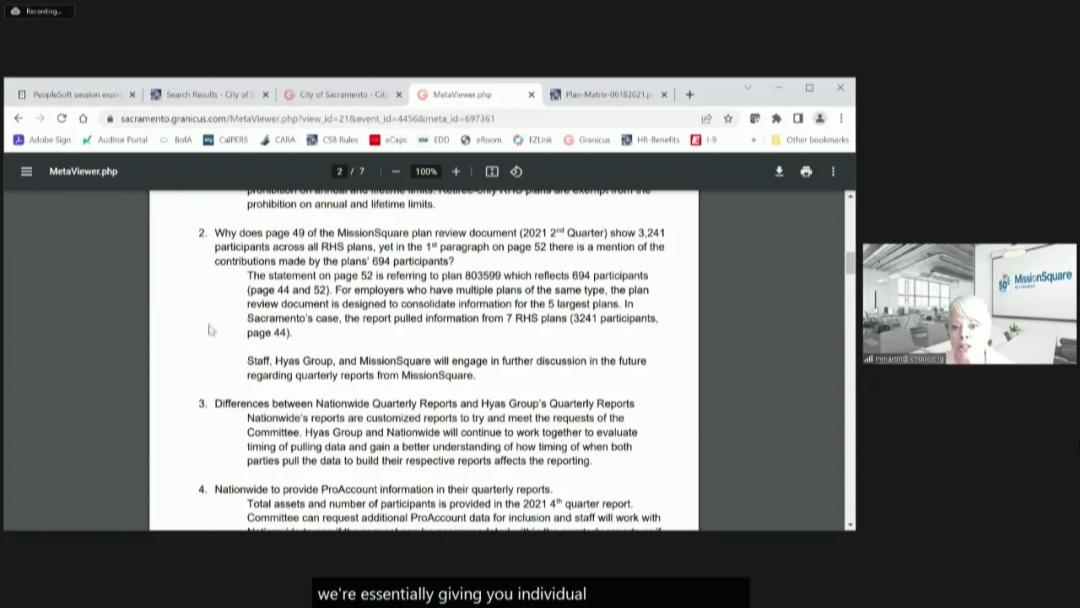
The City of Sacramento Defined Contribution Plans Committee met virtually via Zoom on September 14, 2022, beginning at 17:15 UTC. Chair Levison presided, with members Bader, Conerly-Coleman, Foster, Zalasky, Vice Chair Boyd, and Chair Levison voting; Member Hoekstra was absent. The meeting opened with roll call, a land acknowledgement, and the pledge of allegiance. The committee approved the consent calendar, adopted revisions to the fee and expense policy, received investment and legal updates, approved extending loan eligibility to separated participants in certain 401(a) plans, and discussed fiduciary and work-plan issues. No members of the public spoke during the meeting. Consent Calendar - Approved the March 23, 2022 meeting minutes as amended: corrected verb tense for two agenda items and directed staff to include alternate members’ names in future minutes. Motion by Bader, second by Conerly-Coleman; passed 6-0. Public Comments & Testimony - No public speakers raised hands for the consent calendar, any agenda item, or matters not on the agenda. Discussion Items Opening Remarks - Chair Levison asked the City Clerk’s office to fix agenda packet formatting, including landscape/portrait orientation and a master page-number system, and raised concern that the June 29, 2022 meeting was canceled at the last minute, leaving the committee nearly six months between meetings. Item 02 – Revisions to the Fee and Expense Policy Statement - Chair Levison presented proposed changes, including a purpose section, a description of participant fees (3-basis-point Nationwide asset fee, MissionSquare retiree health savings account administrative fee, $18/year or $1.50/month 457 administrative allowance fee, and fund expense ratios), an Appendix A reserve/fund-balance policy, and fiduciary-duty language from the California Constitution and Government Code. - The committee agreed to restore deleted investment-advisory expense language and reduce the reserve for unanticipated expenses from 75% to 50% of the approved budget. With an $86,000 annual budget, that 50% reserve equals $43,000; a combined maximum of $65,000 was identified for future RFP reserves. The theoretical maximum before excess revenue is $194,000. - Motion by Boyd, second by Bader; passed 6-0. The revisions will go to the City Attorney’s office for review. Item 03 – Review of 2022 First and Second Quarters by Hyas Group - Hyas Group’s consultant reviewed Q1/Q2 2022 market conditions, noting that stocks and bonds declined together and describing 2022 as “divorcification” rather than diversification. As of June 30, 2022, plan assets were $608 million, down about 10% from $673 million at the beginning of Q2. - Only $1.6 million (0.02% of assets) was transferred into fixed income, which Hyas cited as evidence that Sacramento participants are staying the course. The plan had about 30% in fixed income, 29% in large-cap equities, and 13% in target-date funds; 25% of new money is going to target-date funds. - Weighted fees are 34 basis points, down from 44 basis points two years earlier, saving participants about $608,000 per year. Russian exposure was 0.01%. - Vanguard US Growth fell out of compliance: five-year ranking dropped from 22 to 53 versus peers, and it was 327 basis points below its benchmark. American Century Mid-Cap Value returned to compliance and outperformed its benchmark by 81 basis points over five years. No fund actions were taken. - Nationwide’s John Stegle answered questions about transfers out of the plan, call-center delays, and website outages, and agreed to correct report language, dates, and administrative-allowance account reporting. - The ProAccount discussion was described as educational; the city is not proposing changes. Item 04 – Legal and Regulatory Updates - Hyas Group presented the quarterly legal update. SECURE Act 2.0 has broad bipartisan support (414-5 in the House; expected roughly 90-10 in the Senate) and could eliminate the first-of-the-month rule, phase the required minimum distribution age from 72 to 75, and require Roth treatment for catch-up contributions, possibly as early as 2025 or as late as 2029. The 2023 elective deferral limit is expected to rise from $20,500 to $22,500. No action was taken. Item 06 – Information on 457(b) Plan Loan Terms - Staff clarified that 457(b) loan interest is variable (prime rate plus 1%), 100% of the interest paid is credited back to the participant’s account, and Nationwide retains a 0.03% annual finance charge—the same as the negotiated asset management fee. A $50 loan initiation fee also appears on the disclosure. - Chair Levison said she was not comfortable relying on verbal presentations when approving loan provisions and would require written plan documents and disclosures in the future. Item 05 – Adding Loans for Separated Participants to the City’s 401(a) Plans - The committee approved recommending that the city work with Nationwide to allow separated participants to take loans from the 401(a) plans that currently permit loans: management, miscellaneous confidential Local 39 supervisors/WCE, and SAC Sierra Building and Construction Trades. The Mayor/Council plan was excluded because it does not permit loans. - Nationwide confirmed the loan terms are identical to the 457(b) loan terms. Motion by Bader, second by Foster; passed 6-0. Item 07 – MissionSquare Retirement Annual Presentation - MissionSquare presented its annual update, including its 50th anniversary, the MissionSquare Research Institute, and a participant/plan-sponsor digital upgrade launching in October 2022. The retiree health savings plans are mandatory plans established by employee/bargaining group; contributions are predetermined, and most participants remain in target-date funds. - Chair Levison asked about RHS target-date funds that ranked below the median. Staff said a possible fund-lineup change is being evaluated, but any change must be reviewed with the City Attorney’s office and labor agreements; no action was taken. Item 08 – Committee Work Plan and Updates - Staff reported that an outside law firm has begun reviewing the 457 and 401(a) plan documents. A proposed subcommittee item was removed because the Sacramento City Council amended the City Code on August 30, 2022, to prohibit boards, commissions, and committees from establishing ad hoc committees. The City Clerk is expected to provide a December review of that action. - Staff and the committee noted that informal working groups of fewer than a quorum can still meet and report back to the committee, as long as the committee or chair does not formally create them. - Chair Levison raised long-standing fiduciary concerns about a 2003 ICMARC contract extension and more than $1.6 million in “administrative reimbursement” payments from participant funds to the city, as well as missing or incomplete plan documents. She stated that her goal is to ensure the plans can withstand an IRS audit and protect participants’ tax-advantaged status, and she offered to share her documents and questions with outside counsel. Key Outcomes - Consent calendar approved 6-0. - Fee and expense policy revisions approved 6-0 and referred to the City Attorney. - Item 05 approved 6-0, authorizing staff to work with Nationwide to add loans for separated participants in the three eligible 401(a) plans. - Items 04 and 06 received and filed; Items 03 and 07 received with no formal action. - Staff will make report corrections, continue outside-counsel plan document review, and follow up on informal working-group processes and the December City Clerk presentation. - No public comment was offered on any item.
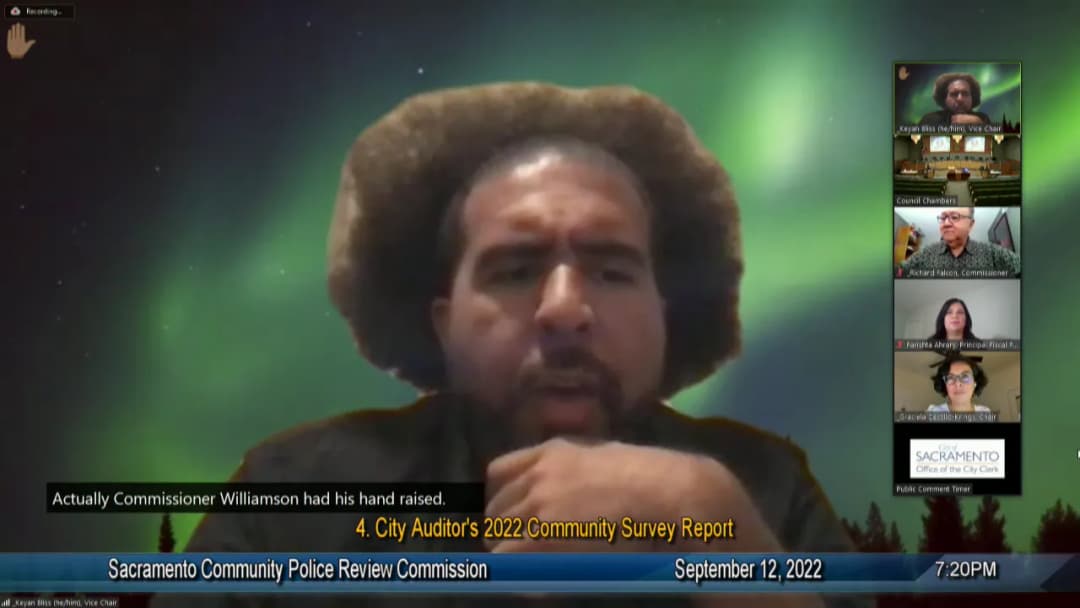
The Sacramento Community Police Review Commission met via teleconference on Monday, September 12, 2022, from 6:05 p.m. to 7:50 p.m. Chair Graciella Castillo-Krings presided, with eight commissioners present (Quorum achieved: Commissioners Carter, Falcon, Jefferson, Marion, Rose-Haymer, Williamson, Vice Chair Bliss, and Chair Castillo-Krings). Three commissioners were absent: Guerrero, Espinoza Salazar, and Elkarra). The meeting included updates on the elimination of ad hoc committees, military equipment policy, the City Auditor’s 2022 Community Survey, and the Inspector General’s Officer-Involved Shooting report. Consent Calendar - Approval of Meeting Minutes (May 9, 2022 and August 8, 2022) and Follow-Up Log: The consent calendar was continued to a future meeting because the draft minutes were not attached for review. Commissioners noted this was the second consecutive meeting without accessible minutes. No action was taken. Public Comments & Testimony - Barry Boyd (community member) spoke during matters not on the agenda and again during discussion items. He expressed strong opposition to the city council’s decision (5–4 vote) to eliminate ad hoc committees, stating the change originated from the Mayor’s office and undermines community engagement, particularly for persons of color. He also raised concerns about the lack of a formal process for handling commission recommendations and parking policy impacts under state law SB9. - Meg White (concerned community member) spoke in support of the commission’s recommendations for the Military Equipment Use (AB 481) policy but expressed concern about the commission taking over community outreach, questioning whether the police department would be accountable without direct engagement. Discussion Items - Chair’s Update – Ad Hoc Committee Elimination: Chair Castillo-Krings reported that the City Council (by a 5–4 vote on August 23, 2022) approved an ordinance eliminating the ability of boards and commissions to form ad hoc committees. Effective end of 2022, no new ad hoc committees can be created; existing ones will disband. Commissions may petition for standing committees through the Personnel and Public Employees Committee, but without guaranteed staffing. Chair Castillo-Krings and Vice Chair Bliss expressed disappointment, noting the ad hoc system was effective for policy work and enhanced transparency. Commissioner Bliss criticized the ordinance for potentially increasing Brown Act violations by removing formal mechanisms for subgroup coordination. Commissioner Williamson questioned the rationale; Senior Deputy Attorney Audreyell Anderson-White noted legal questions could be addressed case-by-case. - Military Equipment Use Policy (AB 481): Chair Castillo-Krings updated that the policy will be heard by City Council on September 13, 2022. Five commissioners signed a letter calling for stronger transparency (demographic reporting of equipment use, independent oversight by OPSA/Inspector General/Commission, and restrictions on spending without Council approval). The Police Chief agreed to collaborate with the commission on a community outreach plan for 2023. Commissioner Bliss added that state law (AB 481) requires independent oversight entities, which the current policy lacks. - City Auditor’s 2022 Community Survey Report: Farishta Ahrary, Principal Fiscal Policy Analyst, presented the survey methodology and key results. A random sample of 7,000 households (increased from 5,500 in 2021) yielded 700 representative responses (95% confidence, ±4% margin of error) and 1,319 open-participation responses. Key findings: Only 59% rated overall quality of life excellent/good; 33% felt safe overall (80% during the day in their neighborhood, 57% in downtown). Affordability and safety were top concerns. Measure U priority spending: community-based mental health and wellness ranked highest, followed by community response services, affordable housing, and homeless services. Commissioners Falcon, Williamson, and Bliss discussed response rates (10% representative), benchmarking (cities over 400,000 population), and suggestions for increasing engagement, including stipends, community-led surveys (e.g., Black Brilliance Research Project in Seattle), and extending outreach to historically disenfranchised groups. - Inspector General OIS Report Update: Mary Opler from OPSA reported that the Inspector General has completed the report on officer-involved shootings, but it is pending review by the City Attorney’s office before being presented to the City Council. No firm timeline was provided; the report will be agendized for the next available meeting once released. - Introduction of New Commissioner: Commissioner Robynne Rose-Haymer (District 5) introduced herself and expressed eagerness to serve. Key Outcomes - No formal votes were taken on any discussion calendar items; all were received and filed or heard as oral reports. - Consent calendar continued to a future meeting due to missing meeting minutes. - Ad hoc committees will be phased out by December 31, 2022; commissioners were encouraged to self-organize in groups fewer than five for policy work outside formal meetings. - Military equipment policy recommendations will be presented to City Council on September 13, 2022; the commission will draft a community outreach plan for 2023 in coordination with the Police Department. - City Auditor’s survey will be used by city management for budgeting; commissioners committed to sharing results with their networks. - Inspector General’s report is expected to be released after City Attorney review; a timeline will be communicated to the chair and vice chair.
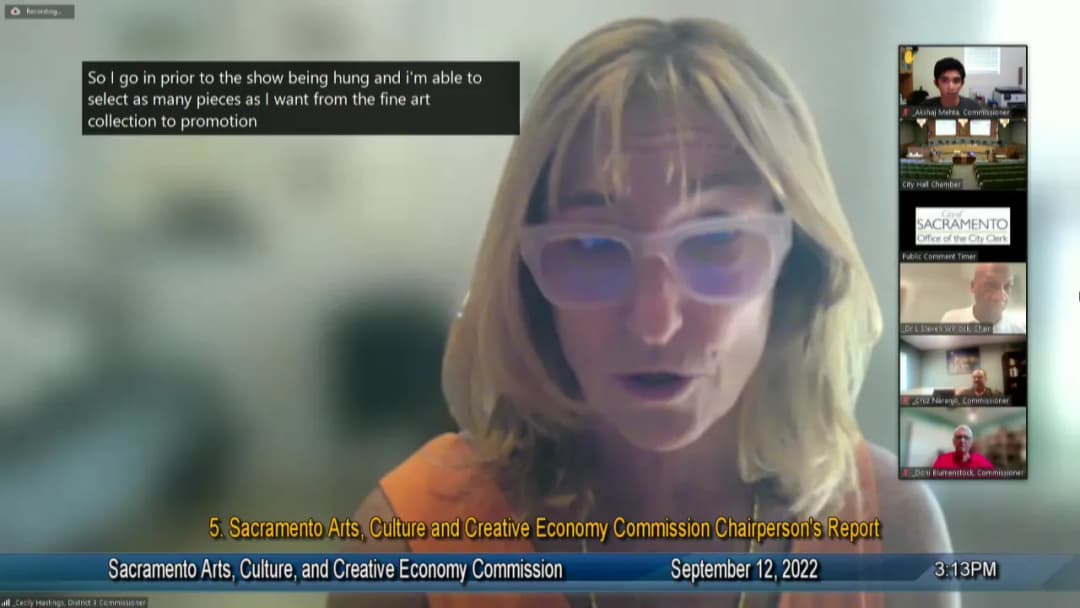
The Sacramento Arts, Culture, and Creative Economy Commission met on Monday, September 12, 2022, at 2:04 p.m. via teleconference, adjourning at 3:31 p.m. The meeting covered a proposed Guaranteed Basic Income (GBI) pilot for individual artists, the city budget process, and staff and chair reports. Commissioners also introduced a new member and discussed community arts initiatives. Consent Calendar - Approved the meeting minutes of August 8, 2022, by a unanimous vote (9-0; Commissioners Gott, Perez, and Vice Chair Enriquez absent). Public Comments & Testimony - Lambert Davis (speaking on Item 3, Office of Arts and Culture Budget): Urged staff to follow up with artist Al Wilson, describing him as an icon deserving of funding. He noted that Wilson had previously spoken at a meeting with the mayor and staff. - Lambert Davis (speaking on Item 5, Chairperson’s Report): Welcomed new Commissioner Kristen Blair, promoted his cheesecake business in District 2, and called for more attention to the Marysville Corridor and District 2's talent. - Lambert Davis (during Public Comments – Matters Not on the Agenda): Highlighted Grant High School's drumline's recent achievements and again urged support for District 2, noting his family's long history there. Discussion Items 1. American Rescue Plan Act (ARPA) Funding Priorities: Guaranteed Basic Income for Individual Artists Funding Approach (Oral Report) - Staff (Megan Van Voorhis and Melissa) presented a proposed GBI pilot program: 200 artists, $450 per month for 24 months, funded by ARPA city-only dollars. The program aims to address economic instability among creative workers, reduce barriers, and explore structural equity. An advisory committee of artists and organizations will help shape eligibility, documentation, selection (randomized or community-based), and payment methods. The program is expected to launch in early 2023. - Commissioners expressed support for the concept but raised concerns about accountability and reporting. Commissioner Hastings stated, "I'm not even probably gonna vote for this because I just don't think this is a good approach," and advocated for monitoring and reporting on artist outcomes. Commissioner Naranjo called for built-in quality control and performance measures. Commissioner Blumenstock agreed that some accountability is needed to reassure the public, but cautioned against onerous reporting. Commissioner Lepore urged not overburdening artists, noting the purpose is to free them to work. Commissioner Wilson Ramey suggested quarterly progress reports and a public dissemination of final projects (e.g., exhibit, performance). Chair Winlock emphasized the importance of clearly communicating the program's purpose to the public. - No vote was taken; the item was for review and discussion. 2. Office of Arts and Culture: Budget, Annual City Budget Process and Timeline (Oral Report) - Staff (Megan Van Voorhis) explained the city's annual budget cycle: mid-year requests due in December, budget augmentation requests in January, city manager's proposed budget in April, and council approval in June. The Office of Arts and Culture's annual operating budget is about $800,000 (salaries, services, and the Cultural Arts Awards match). Additional funding for grant-making (e.g., Creative Edge) requires annual budget change proposals. In FY22, $2.6 million was added; in FY23, a $10 million ARPA allocation supported the creative economy. The office also secured external grants: $500,000 from the National Endowment for the Arts (for Seeding Creativity), $5 million from Clean California, and $4.75 million from the California Creative Corps program. - Commissioner Blumenstock expressed concern about reliance on one-time funds and asked about the Transient Occupancy Tax (TOT). Chair Winlock noted that the mayor had initiated a discussion on TOT uses, and staff confirmed that the City Council recently approved an update expanding allowable TOT uses. Commissioner Naranjo asked if staff would share the budget strategy with the commission in December; staff agreed. - The item was received and filed. 3. Sacramento Arts, Culture and Creative Economy Commission Director’s Report - Staff (Megan Van Voorhis) reported on the upcoming Sacramento Music Census (launching first week of October), over 400 applications for the Seeding Creativity program (45 grants), the completion of the Community Murals Sacramento project, a public art survey by consultant Alita Bray, and the California Creative Corps grant focusing on climate, public health, social justice, and civic engagement in underserved areas (North and South Sacramento). - The report was received and filed. 4. Sacramento Arts, Culture and Creative Economy Commission Chairperson’s Report - Chair Winlock welcomed new Commissioner Kristen Blair (District 2) and highlighted his involvement in selecting a replacement for departing commissioner Jody. He noted the collaborative spirit of the city. - The report was received and filed. Introduction of New Commissioner - Commissioner Kristen Blair (goes by "Ten") introduced herself as a small business owner in Del Paso Boulevard and founder of a nonprofit. She expressed a desire to help her community and bridge gaps between arts organizations and businesses. - Each commissioner then introduced themselves to Commissioner Blair, sharing their backgrounds and districts. Commissioner Blumenstock also urged support for Proposition 28 (arts education funding) on the November ballot. Commissioner Comments – Ideas and Questions - Commissioner Naranjo: Discussed the need for grant-writing workshops for artists, restoration of murals at Southside Park and Washington Neighborhood Center, and lighting for outdoor stages. He praised the Community Murals program and noted that controversy over the Northgate mural led to better protocols. - Commissioner Hastings: Announced partnerships with the California State Fair Fine Arts Competition and KVIE's art auction to feature local artists on the covers of Inside Sacramento. - Commissioner Mehta: Shared that he wrote an article about the commission for N Magazine and praised the play The Color Purple. - Chair Winlock: Expressed concern about Broadway Sacramento's budget shortfall and encouraged support for the organization. - Commissioner Wilson Ramey: Asked about the commission returning to in-person meetings (not yet decided) and suggested exploring ways to help underserved communities and youth attend arts events. - Commissioner Lavulo: Thanked the organizers for inviting commissioners to The Color Purple and stressed the importance of exposing her children to diverse art forms. Key Outcomes - Consent Calendar approved unanimously. - No votes were taken on discussion items; they were received and filed or discussed. - Staff will incorporate commissioner feedback on GBI reporting and accountability into program design. - Staff will share budget strategy with the commission in December. - The commission welcomed new member Kristen Blair. - The meeting adjourned at 3:31 p.m.
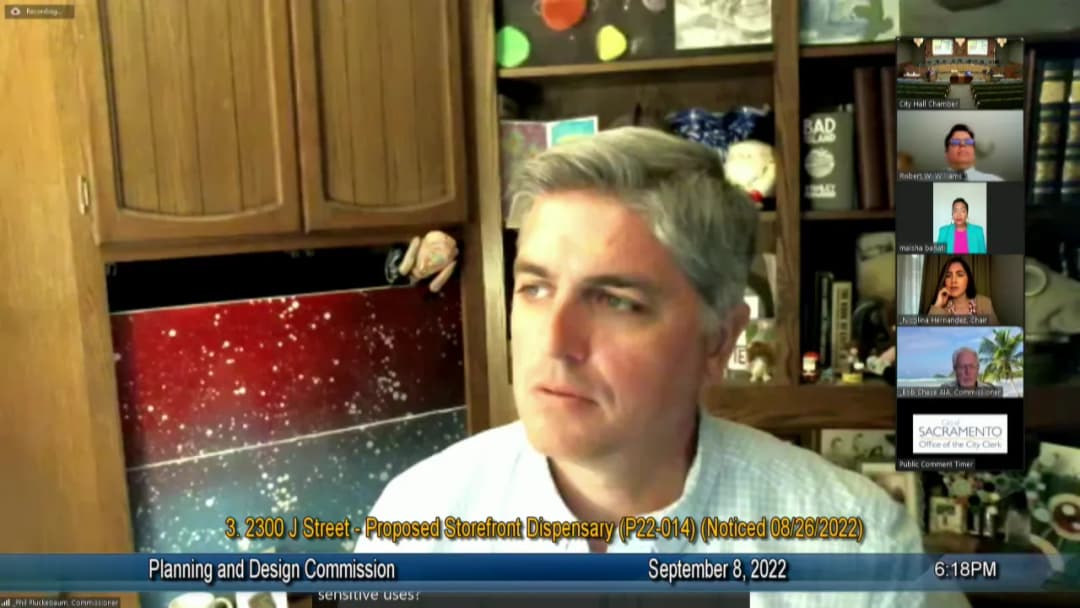
The Sacramento Planning and Design Commission met on Thursday, September 8, 2022, at 5:30 p.m. via teleconference to consider a consent calendar, a director's report, and two public hearing items: a conditional use permit for a cannabis dispensary at 2300 J Street and a conditional use permit for an Oilstop auto service facility at College Square. The meeting was adjourned at 7:18 p.m. in memory of Queen Elizabeth II. Commissioners present: Barry Boyd, Tyrone Buckley, Robert Chase, Lynn Lenzi, Phillip Pluckebaum, Joseph Yee, Enoch Yeung (arrived at 6:16 p.m.), Maya Wallace, and Chair Nicolina Hernandez. Commissioners absent: Douglas Covill and Kendra Macias-Reed. Consent Calendar - Approval of Minutes (File ID 2022-00865): Approved the minutes of the August 25, 2022, meeting. The motion passed unanimously (8-0, with Commissioners Covill, Macias-Reed, and Yeung absent). Director's Report - Director's Report (File ID 2022-00555): Received and filed. Staff noted that the September 22, 2022, meeting will include a discussion of the 2023 draft planning and zoning work program. Commissioners were encouraged to review the report and prepare policy priorities. Public Hearings & Discussion Items Item 03: 2300 J Street – Proposed Storefront Dispensary (P22-014) - Project Description: A conditional use permit to establish a cannabis dispensary (storefront with delivery) in an existing ±13,374-square-foot, two-story retail building with ground-floor parking and a third-floor penthouse on 0.15 acres in the General Commercial Zone (C-2-SPD) at 2300 J Street (District 4). The project also includes minor exterior building and site work. - Staff Presentation: Associate Planner Robert Williams presented the project, noting that the site is within 600 feet of two child care centers, one church, two tobacco retailers, and within 300 feet of a residential zone. The police and fire departments reviewed the project. Staff recommended approval, citing that the use would replace a vacant building with employment and tax revenue. - Applicant Presentation: Maisha Fahati, CEO and co-founder of Crystal Nuggs, described herself as a lifelong Sacramento resident, a graduate of the City's CORE program, and a Black woman-owned business owner. She highlighted community outreach, including an open house with 60-70 attendees, meetings with the Midtown Association, and discussions with nearby businesses. She stated that the dispensary would employ 9 current staff and hire 10-12 more, and that the building would receive a full facade renovation. - Public Comments: Eleven members of the public spoke. Ten speakers expressed strong support, including representatives from the Midtown Association, the Institute for Marijuana Opportunity Reinvestment and Equity (CORE), and local business owners. One speaker (Gary Orr, a nearby property owner) opposed the project, citing concerns about property values, use of product in public, and excessive concentration of dispensaries in Midtown. Written comments included 27 letters of support and 7 letters of opposition. - Commissioner Discussion: Commissioners discussed sensitive uses, parking, security, and the applicant's community engagement. Commissioner Yee raised concerns about the security of the existing wrought-iron overhead door on the ground-floor parking garage, proposing a condition to replace it with an opaque door. Commissioner Chase added a condition to ensure parking garage ventilation meets building and health codes. The maker of the motion (Commissioner Pluckebaum) and seconder (Commissioner Chase) accepted the friendly amendments. Commissioner Lindsay referenced the EPS study (presented August 25, 2022) showing that cannabis businesses have not negatively impacted nearby property values, retail, or crime levels. - Key Outcomes: The commission approved the project as amended by a vote of 8-0 (Commissioners Boyd, Buckley, Chase, Lenzi, Pluckebaum, Yee, Wallace, and Hernandez in favor; Commissioners Covill, Macias-Reed, and Yeung absent). Conditions include: (1) replacing the existing overhead door with an opaque design to prevent visibility into the secure parking area, and (2) ensuring parking garage ventilation meets building and health department codes. Item 04: Oilstop at College Square (P22-006) - Project Description: A conditional use permit to establish an oil change facility (auto service) on a ±2.1-acre site at 7451 West Stockton Boulevard (Council District 8) within the General Commercial (C-2-PUD) zone and College Square Planned Unit Development. The project includes a deviation to trash enclosure standards for a slatted rather than a solid gate design. - Staff Presentation: Associate Planner Danny Abbes presented the project, noting that the site is a vacant lot in an existing shopping center. Staff received multiple letters of support, and the project incorporates suggestions from the air quality district (cool pavement, building electrification, future pedestrian connections). The applicant partner with Cosumnes River College’s Automotive Mechanics Technology program for internships and training. - Applicant Presentation: Ryan Hooper (Thatch and Hooper) spoke on behalf of Oilstop, highlighting similar partnerships with De Anza College in the Bay Area and the project's role in providing jobs and convenient services. - Public Comments: One speaker (Juan McKnight, a former labor union president) spoke in support, citing community enhancement and job opportunities for local youth. - Commissioner Discussion: Commissioner Lindsay inquired about the slatted trash enclosure gate; staff confirmed it is a standard police department condition to allow visual surveillance and that the City is considering a code amendment to make it standard. Commissioner Boyd asked about ingress/egress. No other questions or concerns were raised. - Key Outcomes: The commission approved the project by a unanimous vote of 9-0 (Commissioners Boyd, Buckley, Chase, Lenzi, Pluckebaum, Yee, Yeung, Wallace, and Hernandez in favor; Commissioners Covill and Macias-Reed absent). Commissioner Comments – Ideas and Questions - Commissioner Boyd asked about the upcoming APA California conference (October 1-4) and the status of the Parking Code ad hoc committee. Planning Director Greg Sandlund noted that ad hoc committees must conclude by end of 2022; the Parking Code update RFP is expected to be released in mid-October, with a consultant likely on board by January 2023. Public Comments – Matters Not on the Agenda - None. Key Outcomes - Consent Calendar: Approved minutes of August 25, 2022. - Director's Report: Received and filed; next meeting agenda previewed. - Item 03 (2300 J Street Dispensary): Approved with conditions (8-0). - Item 04 (Oilstop at College Square): Approved (9-0). - Adjournment: Meeting adjourned at 7:18 p.m. in memory of Queen Elizabeth II.
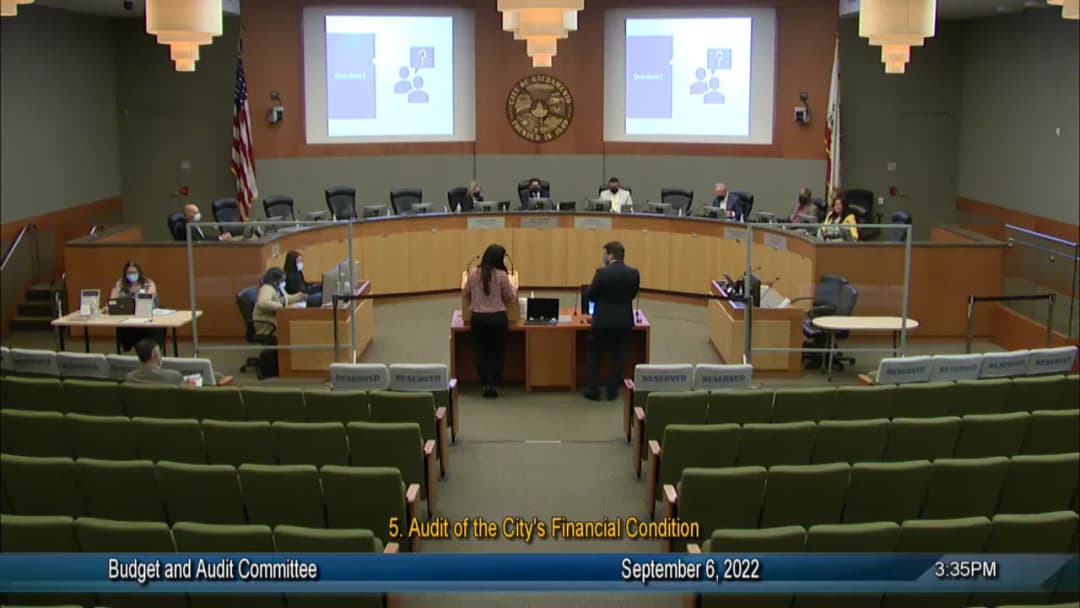
The Budget and Audit Committee of the Sacramento City Council met on September 6, 2022, at 3:00 PM in the City Hall Council Chamber. The meeting was chaired by Vice Chair Eric Guerra, with Mayor Darrell Steinberg arriving at 3:03 PM. The committee reviewed and approved three consent calendar items, discussed two major agenda items, and forwarded recommendations to the full City Council. The meeting adjourned at 3:44 PM. Consent Calendar - Item 1: Approved the Budget and Audit Committee meeting minutes from May 31, 2022. - Item 2: Accepted the City Auditor’s Recommendation Follow-Up Report for the period January 1, 2022, to June 30, 2022, and forwarded it to the City Council for final approval. - Item 3: Accepted the City Auditor’s Activity Report for the 4th Quarter of Fiscal Year 2021/22, and forwarded it to the City Council for final approval. - All consent items were approved unanimously via a motion by Councilmember Vang, seconded by Councilmember Jennings. Mayor Steinberg was absent for this vote. Public Comments & Testimony - No public comments were made on the consent calendar, discussion items, or matters not on the agenda. Discussion Items - Item 4: Amending the Master Fees and Charges Schedule for Building Electrification Infeasibility Waiver Fees - Bob Latz, Interim Chief Building Official, presented the proposed fees for the infeasibility waiver process required under the Building Electrification Ordinance (Phase 1, effective January 1, 2022). The waiver applies to new construction buildings three stories or less. Fees include a $492 administrative processing fee (based on $164/hour) and a $1,500 technical consultant fee (based on $250/hour), totaling approximately $1,992. Appeal fees are $1,640. The process relies on a technical consultant to review applications and provide recommendations to the Building Official. - Mayor Steinberg expressed concern about the fairness and transparency of the process, suggesting that businesses, especially restaurateurs, should have input into the selection of the technical consultant. He emphasized the need to avoid perceptions of unfairness. - Councilmember Jennings raised concerns about the fee burden on small and minority-owned businesses, noting that nearly $2,000 could be a hardship for smaller developments. He asked staff to explore options to reduce or bifurcate fees for such businesses before the item reaches the City Council. - Staff clarified that the waiver is expected to be rarely used before 2026 due to exemptions for restaurants and manufacturing, and that the fee and process will be reviewed before the 2026 cycle. The item will proceed to the Law and Legislation Committee on September 20, 2022, and then to the City Council on November 1, 2022, for final action on the ordinance, fee schedule, and guidance document. - The committee voted unanimously (4-0) to forward the proposed fee amendment to the City Council. - Item 5: Audit of the City’s Financial Condition - City Auditor Jorge Oseguera and Principal Fiscal Policy Analyst Farishta Arrari presented the audit, which examined the city’s financial well-being in four areas: financial position, revenues and expenditures, debt, and capital assets. The audit used two models: the modified 10-point test (comparing Sacramento to six peer California cities) and the ICMA handbook. - Key findings: Sacramento scored 5 out of 10 in 2021 ("better than most"), dropping from "among the best" in 2020 due to pandemic impacts on short-term indicators. The city’s liquidity ratio improved to 6.3, but debt ratios were the lowest scoring: per capita debt burden was $2,790 (above benchmark average since 2016) and enterprise fund debt coverage was below peers. Net pension liability grew from $453 million to over $690 million over the period. - Discussion: Councilmember Jennings asked why other cities performed better on enterprise fund debt coverage and whether the city could learn from them. Mayor Steinberg asked if there were any red flags; the auditor and Treasurer Colville (via phone) noted that the debt issuance for the Golden 1 Center (2016) skewed ratios, and that the city’s investments in quality-of-life projects (e.g., Golden 1 Center, C3) are not fully captured. The auditor stated there is no specific threshold indicating a major problem, but ongoing monitoring is recommended. - The committee voted unanimously (4-0) to accept the audit and forward it to the City Council for approval. Key Outcomes - Consent Calendar: All three items (minutes, auditor follow-up report, activity report) approved unanimously. - Item 4 (Building Electrification Waiver Fees): Motion to forward the proposed fee amendment to the City Council passed 4-0. The item will next go to the Law and Legislation Committee on September 20, 2022, with final City Council action expected November 1, 2022. - Item 5 (Audit of Financial Condition): Motion to accept the audit and forward to the City Council passed 4-0. - No committee comments or public comments on matters not on the agenda were made.
The regularly scheduled Law and Legislation Committee meeting for Tuesday, September 6, 2022, at 1:00 p.m. was cancelled. No agenda items were discussed, no public testimony was taken, and no decisions or votes occurred.