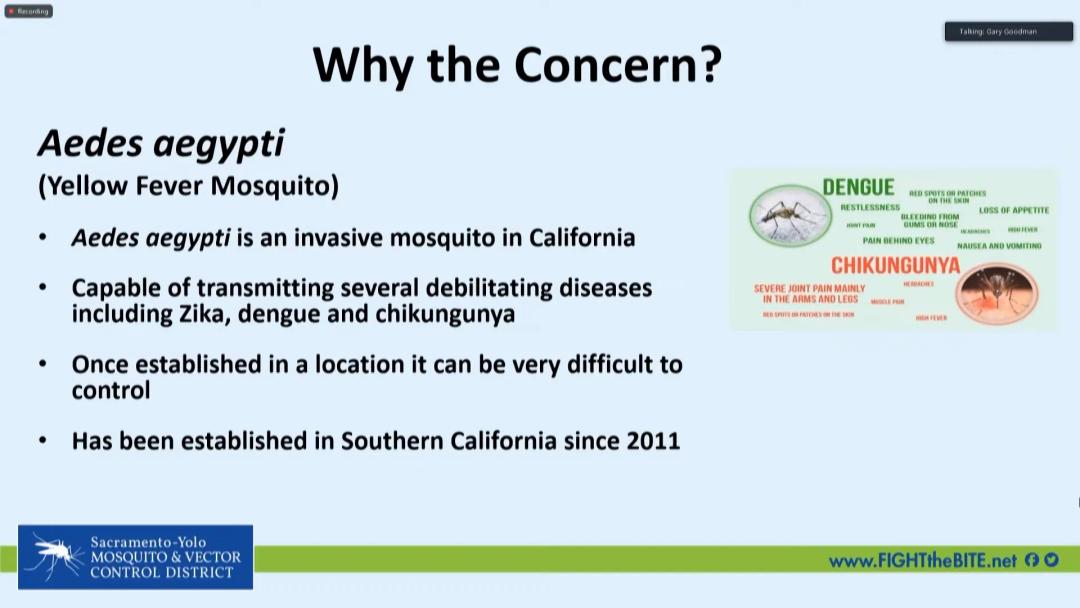
The Sacramento Environmental Commission held its regular meeting on April 26, 2024, at which members were welcomed, new commissioners introduced themselves, and the commission heard annual presentations from the Sacramento-Yolo Mosquito and Vector Control District and received updates from Sacramento County sustainability staff. The commission also approved its revised mission/vision statement, authorized sending membership invitation letters to two cities, approved corrected minutes from the previous meeting, and discussed commissioner liaison assignments and the scope of the commission's ordinance. Public Comments - No members of the public offered comments. Discussion Items - Mosquito and Vector Control District Annual Presentation: District Manager Gary Goodman presented an overview of mosquito control operations in Sacramento and Yolo Counties, covering district history, mosquito biology, disease risks (especially West Nile virus), surveillance methods, integrated pest management, invasive mosquito species (Aedes aegypti and Aedes albopictus), and emerging techniques such as sterile insect technique (SIT). He emphasized that the district relies on property tax funding (about $7 per $1,000 of property tax), and that 2023 was the worst year for West Nile virus locally since its introduction, with 53 human cases in Sacramento County and 29 in Yolo County. Commissioners asked about funding adequacy, dead bird reporting, tick surveillance (Lyme disease) along the American River, and partnerships with bat programs. Goodman noted that bats are not a significant mosquito control tool and encouraged residents to dump standing water weekly. He also asked the commission for letters of support if needed for future SIT pilot projects. - Sustainability Manager Update: John Lundgren reported four items: (1) free compost giveaway now available at the Branch Center and Gibson Ranch Park (self-serve); (2) Sacramento County participation in Eco Surf Day on April 21 with nine departments; (3) submission of a Phase 2 CPRG grant application (approx. $94 million) to the EPA for green mobility and carbon farming; and (4) a new podcast (“County Conversations”) now available. He also summarized a recent Board of Supervisors infill workshop and encouraged commissioners to share the podcast. - Approval of Final Mission/Vision Statement: The commission voted unanimously (roll call vote 9-0) to approve the final revised mission/vision statement after three months of revisions. - Letters of Invitation to Citrus Heights and Rancho Cordova: The commission voted unanimously (9-0) to send letters inviting these cities to join the commission as member jurisdictions. Discussion noted that adding a city would require amending the ordinance, a process estimated to take 3–6 months, and that a champion on each city council is needed. - Approval of March 18 Minutes: The minutes were approved with corrections: adding Commissioner Eugene Lee to the header and correcting the spelling of Commissioner Christine Casey’s name. Vote was unanimous (9-0). - EMD Director’s Report: Director Janae Monasterio provided updates on Earth Day booth activities, free pool and spa training workshops for commercial operators throughout the summer, and a new compliance school program for hazmat facilities (replacing a previous enforcement credit program). She noted that the department’s programs cover all cities countywide and that the new compliance school aims to achieve higher voluntary compliance. - Commissioner Monitoring of Agencies: The chair noted that a list of agencies for commissioner liaison assignments would be redistributed to new commissioners. Commissioner Richard Hime summarized key points of the SEC ordinance (Chapter 2.135), stating that the commission’s primary purpose is to advise the Sacramento County Board of Supervisors and city councils of Sacramento County on environmental protection management programs, and that it has specific duties to assist the Environmental Management Department (EMD). Discussion ensued about whether the commission can directly advise cities that are not member jurisdictions (e.g., Citrus Heights, Rancho Cordova); consensus was that such communication should be done cautiously and only after consultation with county counsel on a case-by-case basis. - Commissioner Comments on Awards Program: Commissioner Christine Casey reported that the awards subcommittee is actively doing outreach using a tracking spreadsheet, and that the commission can nominate or directly submit applications for deserving individuals, businesses, or organizations. The deadline is approaching. Commissioners encouraged attending Earth Day booths to promote the awards. Key Outcomes - Mission/Vision Statement: Approved unanimously (9-0). - Letters of Invitation: Approved unanimously (9-0) to send to Citrus Heights and Rancho Cordova. - Minutes of March 18, 2024: Approved with corrections (9-0). - Next Meeting: Scheduled for May 20, 2024 (the following meeting will be in July, as the commission meets quarterly). - Agency Monitors: The list of liaison agencies will be re-sent to all commissioners for assignment; new commissioners were invited to select agencies of interest. - Scope Clarification: Commissioners were reminded that direct contact with non-member cities should be reviewed for compliance with the SEC ordinance and may require county counsel input. - SIT Support: The chair and members offered to provide a letter of support for the mosquito district’s sterile insect technique program if needed.
Public Meetings - Sacramento County, California
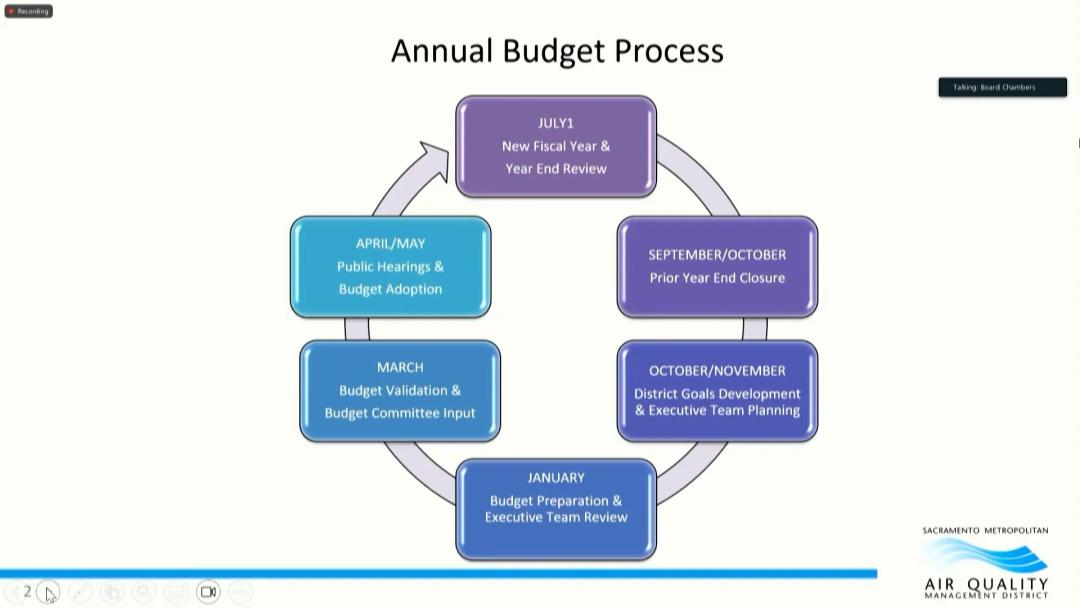
Public Meetings - Sacramento County, CaliforniaThe Sacramento Metropolitan Air Quality Management District (SMAQMD) Board convened on April 26, 2024, at 9:22 AM. The meeting included a special recognition of two hearing board members, approval of the consent calendar, a public hearing on the fiscal year 2024-2025 proposed budget and fee schedule, a discussion item on a new alternate member appointment, a program update on Clean Cars for All, an Air Pollution Control Officer (APCO) report, and a closed session with no reportable actions. Special Presentation: Recognition of Service - Recognized Dr. Stephen Wires for his service as a medical professional on the hearing board, serving over 40 years. He presided over approximately 350 hearing board proceedings and over 60 emergency variance hearings. - Recognized Mr. John German (posthumously) for nearly 30 years of service. His wife Lois and daughter Denise accepted the token on his behalf. He had been a guest lecturer at CSUS, served on the Southgate Parks and Recreation district, the Franklin Business Association, was president of the Valley High Rotary Club, and worked at Amador County Public Works. Consent Calendar - Items 2 through 6 were approved unanimously without discussion. - Motion by Director Desmond, second by Director Frost. All present directors voted 'Aye'. Directors Maple and Vang joined during or after the vote. Item 7: Public Hearing on Fiscal Year 2024-2025 Proposed Budget and Fee Schedule - Patty Kepler, District Controller, presented the proposed budget and fee schedule. - Key budget items: - Total FTE: 105.8 (increase of 4 from the 2324 amended budget). - General Fund: Using $3.1 million of fund balance, largely to cover the AB617 expanded grant. - Special Revenue Fund: Using $5.5 million of fund balance for incentives. - Proposed stationary source fee increase of 4.17%, effective July 1, 2024. - General fund structural deficit projected to grow from $3.1 million in FY 24-25 to $3.2 million by FY 28-29. - Items not included in the budget: CPRG implementation grant ($93 million, competitive, decision expected July-August), building sale/relocation, and proposed increase of Moyer admin fund from 6.25% to 12%. - Public hearing was opened and closed with no public comments. - Motion to approve and set a second public hearing for May 25, 2024, passed unanimously. Item 8: Sacramento Valley Basin Air Pollution Control Council – New Alternate Member Appointment - Director Papineau was appointed as alternate member. - Motion by Chair Kennedy, second by Director Guerra. Passed unanimously. Item 9: Clean Cars for All Program Update - Presented by Cidy Mann, Program Supervisor. - Program achievements: As of Q1 2024, nearly 1,100 award letters issued; 901 vehicles purchased; over half of recipients received an additional $2,000 for charging support. These vehicles will reduce 9,573 tons of greenhouse gas emissions and 8.42 tons of criteria pollutants over 30 months. - 38% of purchases were battery electric vehicles; 90% of survey respondents reported spending less on fuel. - Program changes: Income eligibility expanded to all Sacramento County residents at 0-300% of federal poverty level (down from 400%); base grant for PHEVs and BEVs increased to $9,500 (from $5,000); residents in disadvantaged communities can receive up to $12,000 for BEVs or fuel cell vehicles; conventional hybrids eligible only until December 31, 2024. - E-bike option introduced: $7,500 grant for e-bike(s) and accessories from brick-and-mortar dealers. - Program will pause in May 2024 for transition, with soft launch in June 2024. - Director Hume expressed preference for e-bikes over scooters, citing replacement of vehicle trips, but acknowledged the program is legislatively limited. - No public comments on this item. Air Pollution Control Officer (APCO) Report - APCO Alberto Ayala reported: - Expansion of the Sacramento Emergency Clean Air Transportation (CCAT) program to include light, medium, and heavy-duty vehicles, with no requirement to scrap a vehicle. Launching May 9, 2024, on a first-come, first-served basis. - Building relocation progress: Building for sale with a potential buyer; five potential new locations under review, all within walking distance of transit and capable of accommodating EV charging. Relocation expected in 2024. - Community engagement: District participated in multiple events around Earth Day. Key Outcomes - Unanimous approval of the consent calendar (Items 2-6). - Unanimous approval of the FY 2024-2025 proposed budget and fee schedule direction, with a second public hearing set for May 25, 2024. - Unanimous appointment of Director Papineau as alternate member to the Sacramento Valley Basin Air Pollution Control Council. - APCO report received and filed. - Closed session held with no reportable actions. Note: The speaker in the transcript mentions the meeting date as April 25th, but the actual meeting date per the instruction is April 26, 2024. The repeated broadcast is noted for April 29, 2024.
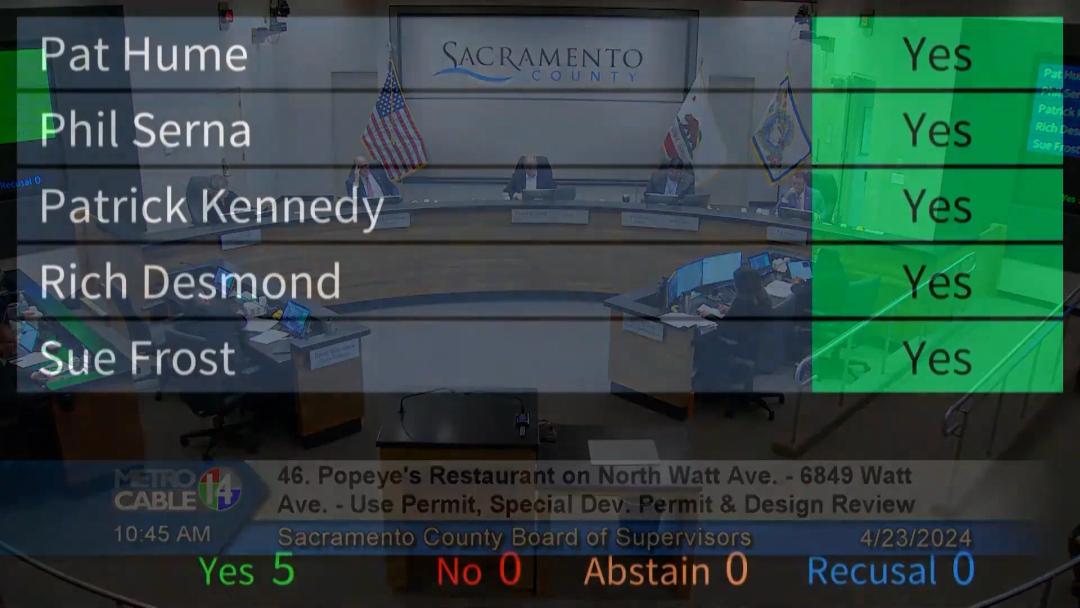
The Sacramento County Board of Supervisors met on April 26, 2024, with Chair Kennedy presiding. The meeting covered a consent calendar, public comments, presentations on mosquito control, bike month, and therapy animals, public hearings on benefit changes, affordable housing funding amendments, land use permits for several commercial projects, and board appointments. All votes were unanimous except one item on consent. Consent Calendar - Items 2 through 39 were approved unanimously with one dissenting vote on Item 30. Supervisor Frost called out several items: Item 3 (approve $2,145,000 in ARPA district directed funding for District 4, including parks and businesses), Item 17 (award bid of $541,950 for Rio Linda area street lights to Bear Electrical Solutions Inc.), and Item 29 (approve $1,100,000 in ARPA funds for Metro Fire’s mobile integrated health program to improve patient outcomes and reduce emergency department visits). Supervisor Hume and Supervisor Cerna expressed support for Item 29. On Item 30 (amendment with On Track Program Resources, Inc. for $256,669 to continue health and racial equity efforts), Supervisor Frost voted no, stating the racial equity training plan is counter to the California Constitution. Public Comments & Testimony - Pete Spaulding spoke during off-agenda public comments, raising concerns about the Army Corps of Engineers Contracts 3B and 4B. He noted that nearly 300 people attended an April 8 community conversation, but the Corps did not adequately address questions. He quoted County Parks Director Liz Bellis, who called for a stop to proposed work east of Howe Avenue pending more review and public engagement. Supervisor Desmond thanked Spaulding and indicated continued discussions. Discussion Items - Item 40 – Sacramento Yolo Mosquito and Vector Control District Annual Presentation: Gary Goodman, district manager, presented. He reported that in 2023, Sacramento County had 53 human West Nile virus cases, about 10 times the three-year average, and 428 cases statewide (double the typical number). The district uses integrated mosquito management including fish breeding, surveillance, and public education. Goodman noted concerns about invasive mosquito species capable of transmitting diseases like malaria. Board members asked about canal systems and susceptibility to severe illness. Supervisor Frost requested a newsletter insert for public outreach. - Item 41 – May is Bike Month 2024 Presentation: Deborah Banks, executive director of Sacramento Area Bicycle Advocates, reported that in 2023, participants rode over 500,000 miles, made 38,000 trips by bike, and saved 61,000 tons of CO2. She invited supervisors to promote the month through newsletters. - Item 42 – Proclamation for National Therapy Animal Day: Chair Kennedy presented a proclamation to Janet and Henry (a therapy dog) for their volunteer work at Kaiser Roseville. Henry demonstrated a 'no barking' trick. - Item 43 – Public Hearing on Benefit Category Change for 7945 Sorrento Road: Joe Grassick (County Engineering) presented. The property owner requested a change from safety light only to enhanced street and safety light non-residential, increasing annual assessment from $2.56 to $1,352.60. A ballot was mailed; the sole ballot (100%) was in favor. The board opened and closed the hearing, received zero written protests, and approved the change unanimously. - Item 44 – Approval to Amend CDBG and HOME Loan for Saybrook Apartments: Christine Wikert (SHRA) requested an additional $4,900,000 for rehabilitation and new construction of 27 units at Saybrook Apartments, a 60-unit affordable housing complex for families with disabilities and formerly homeless. Total project cost increased by $13 million due to construction costs, insurance, and delays. The board approved unanimously. - Item 45 – Approval to Amend HOME Loan for Cornerstone North and South: Christine Wikert requested an additional $2,000,000 in HOME and affordable housing funds for a 108-unit affordable project. Construction costs rose by over $10 million. The board approved unanimously. - Item 46 – Board Appointments to Commissions and Committees: The board made numerous nominations, reappointments, and continuations for various advisory bodies, including the Children’s Coalition, Community Review Commission, and others. All were approved unanimously. - Item 47 – Popeyes Restaurant on North Watt Avenue (Use Permit, Special Development Permit, Design Review): Leanne Mueller (Planning) presented a redesigned project (2,600 sq ft with drive-thru) after the board remanded it in March 2023 for better consistency with corridor plans. Improvements include a covered patio, enhanced landscaping, themed sculpture, and reduced parking. The North Highlands Foothill Farms CPAC and DRAC recommended approval. Staff recommended approval. The board voted unanimously. - Item 48 – Arco at Larchmont Village (Use Permit Amendment, Special Development Permit, Design Review): Leanne Mueller presented a proposal to reconstruct a gas station and convenience store with 24-hour operation, adding new landscaping, relocating the car wash, and providing EV charging stations. The project received a mitigated negative declaration. The board approved unanimously. - Item 49 – Stockton and Gerber 76 Service Station (Use Permit, Special Development Permit, Design Review, PCN for Beer and Wine): Emma Patton presented. The project includes a 3,500 sq ft convenience store, fueling station, car wash, and EV charging infrastructure (two Level 3, one Level 2, plus future conversion). A public convenience or necessity (PCN) letter for beer and wine sales was requested. The South Sacramento CPAC recommended denial, but the Planning Commission recommended approval (3-1). The applicant accepted conditions from the Sheriff’s Department limiting alcohol sales to 10 p.m.–7 a.m. and prohibiting singles. The board voted unanimously to approve both the development and the PCN. Supervisor Desmond expressed support due to conditions. Supervisor Cerna highlighted the forward-thinking EV design. - Item 50 – County Executive Comments: A video showcased a disaster preparedness clinical skills refresher for public health nurses in partnership with Sacramento State School of Nursing. Supervisor Desmond also thanked staff and the Sheriff’s Department for recent enforcement operations on massage parlors in District 3, noting many were found engaging in illicit activity, and that ordinance strengthening is forthcoming. Key Outcomes - All consent items except Item 30 passed unanimously; Item 30 passed with Supervisor Frost voting no. - Presentations and proclamations were received and accepted. - Benefit category change for 7945 Sorrento Road approved. - Additional funding for Saybrook Apartments ($4.9M) and Cornerstone North and South ($2M) approved. - Land use permits for Popeyes (North Watt), Arco (Larchmont), and 76 service station (Stockton/Gerber) approved unanimously, each with conditions. - Board appointments were made to various commissions and committees. - The board adjourned to closed session.
Note on date discrepancy: The meeting transcript indicates the meeting was called to order on April 22, 2024, but the provided metadata states the meeting took place on April 25, 2024. This summary uses the metadata date per the instruction, but the discrepancy is noted. The Sacramento County Planning Commission held a regular meeting on April 25, 2024, to consider two major items: a zoning code amendment package to comply with state law and a residential development project (Hazel Ridge) in the Orangevale community. The commission also received a report from the Planning Director on recent board direction regarding infill housing. Both items were recommended for approval to the Board of Supervisors. Consent Calendar - No consent calendar items were considered. Public Comments & Testimony - Item 1 (Zoning Code Amendments): No public comments were received. - Item 2 (Hazel Ridge): No public comments were made in chambers. The meeting format no longer allows remote public comments. Discussion Items - Item 1: Zoning Code Amendment Package (County Initiated) - Staff presented a comprehensive set of amendments to Chapters 3, 5, 6, and 7 of the Zoning Code to bring the county into compliance with state law changes effective January 1, 2023. The amendments covered: - Multifamily housing in commercial zones (AB 2011, SB 6): Allowing multifamily by right in certain commercial zones with additional requirements (affordable units, prevailing wage, etc.). Staff noted minimal expected impact as most commercial zones already permit multifamily. - ADU standards: Changes to allow taller ADUs, deviations to front and side yard setbacks for ADUs up to 800 sq. ft. (administrative process), and restrictions on short-term rentals for ADUs (permitted only for ADUs built before 2020) and junior ADUs (never permitted). - Off-street parking: AB 2097 eliminates parking minimums within half-mile of major transit stops; another bill limits parking replacement requirements for religious institution-affiliated housing. - State density bonus law: Updates to the county's affordable housing incentive program, including removal of CEQA review for density bonus projects (moving from discretionary development plan review to non-discretionary design review). A public comment letter from a law firm argued that CEQA review should still apply. County Counsel acknowledged the letter but stated the county's legal interpretation differed, citing HCD guidance. The commission decided to forward the recommendation to the Board of Supervisors, with County Counsel to provide a formal response before the board hearing. - EV chargers: Exempt from local codes except health and safety; count as one parking space. - Hydrogen fueling stations: Exempt from local codes except health and safety, with location and equipment restrictions. - Family daycare homes: No distinction between small and large; treated as residential use. - Sidewalk vendors: Exempt from county temporary use permit requirements (still need health permit). - Staff recommended approval. The commission voted unanimously to recommend approval to the Board of Supervisors. - Item 2: Hazel Ridge – Community Plan Amendment, Rezone, Tentative Subdivision Map, Conditional Use Permit, Special Development Permit, and Design Review - Location: 6416, 6420, 6422 Hazel Avenue, Orangevale (approx. 1,400 ft north of Greenback Lane). - Proposal: Rezone 4.63 gross acres from RD5 to RD10 (actual density 7.6 du/ac). Subdivide into 23 single-family lots, 12 half-plex lots, and a drainage basin (total 36 lots). A conditional use permit is required for 10 half-plex units. A special development permit allows deviations from minimum lot sizes (corner and interior half-plex lots) and driveway widths. - Environmental review: Mitigated Negative Declaration (public review period ends April 29, 2024). Mitigation measures address tree loss, nesting birds, cultural resources, noise (construction and interior sound levels from Hazel Avenue traffic) via an 8-foot masonry wall and mechanical cooling. - Traffic: DOT reviewed and found no warrant for a traffic signal at the project driveway. - Community input: Orangevale CPAC (Sept 5, 2023) heard 16 speakers in opposition, expressing concerns about noise, traffic, pedestrian safety, and inconsistency with rural character. CPAC members opined the project did not fit the rural lifestyle. Design Review Advisory Committee (DRAC) found the project in compliance with design guidelines. - Applicant team (Ryan Hooper, Jim Luce, Jim McVay, Kent Baker) presented, emphasizing the project as infill at a density lower than the county's previous RD30 proposal (up to 130 units). The development includes private streets and an HOA for maintenance. - Commission discussion: Several commissioners noted they had visited the site and met with the applicant. Concerns about deviations were addressed by staff explanation that such deviations are common for missing middle infill projects. The commission voted unanimously to recommend approval to the Board of Supervisors. Planning Director's Report - Todd Smith reported on the April 10, 2024 Board of Supervisors workshop on housing and infill. The board gave direction to: - Amend zoning code development standards to streamline infill housing. - Eliminate the minor use permit requirement for apartments over 150 units. - Establish a $5–10 million impact fee offset program. - Create an infill coordinator position (principal planner) to focus on infill along commercial corridors. - Staff will bring a resolution of intention to the board and then work on code amendments, which will come to the Planning Commission for review. - Commissioner questions noted that drainage is often a critical path for infill; staff responded that the Department of Water Resources is reviewing its processes. Key Outcomes - Item 1 (Zoning Code Amendments): Motion to recommend approval to the Board of Supervisors carried unanimously (5-0). - Item 2 (Hazel Ridge): Motion to recommend approval to the Board of Supervisors (including all entitlements: community plan amendment, rezone, tentative map, conditional use permit, special development permit, and design review compliance) carried unanimously (5-0). - Scheduling: Upcoming meetings: May 6 and May 20, 2024. Items include the countywide RHNA rezone program and the five-year capital improvement plan review. Next Steps: Both items will proceed to the Board of Supervisors for final action. The zoning code amendment package will be accompanied by County Counsel's review of the CEQA comment letter. The Hazel Ridge project will be subject to final board approval and compliance with all conditions.
The Sacramento County Equal Employment Opportunity Advisory Committee met on April 25, 2024, at 3:30 PM. The meeting focused on reviewing workforce statistics reports for three departments (Environmental Management, Finance, and First Five Commission), discussing data limitations, and planning future meetings and presentations. Consent Calendar - Approval of absences: Motion by Amanda, second by Patrice, approved unanimously. - Approval of minutes: Motion by Patrice, second by Paul, approved with one abstention (Patrick) and no non-approvals. Public Comments & Testimony - No public comments were received. Discussion Items - Workforce Statistics – Environmental Management (2022): The committee reviewed the 2022 report. Highlights: 106 employees, 50% minority, 15.9% female (down from 51.3% female in 2017). Management had 6 positions, with 16.7% female. Committee members noted zero African American or Latino in management, and expressed concern about lack of data on classification breakdowns and supervisory vs. management roles. A member noted that the dashboard does not provide age or classification data for 2022, but such data will be available for 2024 onward. The committee discussed the need for more granular data to assess upward mobility. - Workforce Statistics – Finance (2022): The 2022 report showed 203 employees, 62.6% minority, 66% female. The top job categories were office clerical (112) and professionals (43). Hires: 46 hires, 73.9% minority, 67.4% female. Terminations: 42, with top reasons retirement and employee-initiated. Promotions: 45, with 71.1% minority, 77.8% female. Some members praised the representation numbers, but others cautioned that without classification data, it is impossible to tell if diversity is limited to entry-level positions. The committee agreed to invite the Finance department to present on their practices. - Workforce Statistics – First Five Commission (2022): The 2022 report showed 12 employees, 41.7% minority, 83.3% female. The committee discussed whether small departments should be evaluated differently. Some members argued that small numbers can skew representation and that the committee should apply uniform percentage-based standards. Others noted that based on census data, the department's representation appeared reasonable. A motion to adopt a policy of evaluating all departments by percentages (rather than size) was made and seconded, but the meeting ended before a vote was taken; the item was to be agendized later. Key Outcomes - Invitation to Finance: The committee agreed to invite the Finance department to present on their recruitment, training, and promotion practices, and to provide demographic data by classification (including pay scales) prior to the meeting. - Memo to Departments: The committee will send a memo to Environmental Management noting concerns about the lack of African American and Latino representation in management and encouraging further diversity efforts. - Future Meeting Locations: The committee agreed to hold the May 20 meeting at the 700H building (due to presenter convenience) and the June 24 meeting at Green Haven. A rotating schedule of sites will be used thereafter, with flexibility for presenter locations. - Policy on Evaluation: A motion was made to adopt a policy of evaluating all departments uniformly based on percentages rather than department size. The motion was not voted on due to time constraints; it will be agendized for a future meeting.
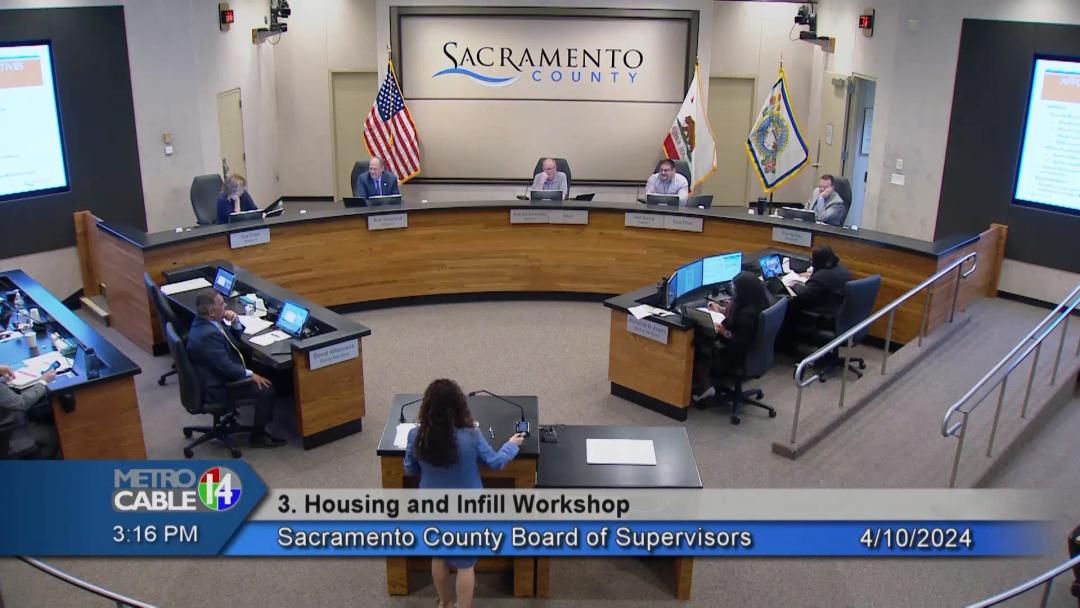
This special meeting, which the transcript identifies as taking place on Wednesday, April 10, 2024 (though the instruction specifies April 11, 2024), consisted of two main agenda items: the General Plan Annual Report for calendar year 2023 and a Housing and Infill Workshop. The board received the annual report and provided extensive direction to staff on a series of policy and funding proposals to accelerate housing production, particularly infill and affordable housing. Consent Calendar - No consent calendar items were listed or discussed. Public Comments & Testimony - No public comments were made for item 2 (General Plan Annual Report), as the chair confirmed no speakers were present. - For item 3 (Housing and Infill Workshop), public comments were taken at several points: - Chris Norem (North State BIA) expressed general support for the proposed measures and encouraged the board to be open to alternatives. - George Carpenter (Wyn Communities) praised the planning team and urged continued support and open-mindedness on development standard changes; he noted a specific ready-to-build multifamily site still hung up on process issues. - Nick Abdis (attorney) commended the new culture of accountability and suggested exploring tax-based incentives like tax increment loans; he encouraged staff latitude to bring back concepts. - Ralph Propper (Ecosystem Council of Sacramento) supported infill development for climate and housing goals and noted that homelessness is largely local, exacerbated by Bay Area migration. - Kent Baker (Baker Williams Engineering Group) highlighted that the zoning code lacks flexibility for infill, especially for townhouses and small lots, and praised the current staff's efforts to improve. - No other public speakers were present for the later sections. Discussion Items - Item 2: General Plan Annual Report for 2023 - Jacob Daw (Associate Planner) presented the report, covering the housing element, environmental justice element, and the energy element (rotating). Key statistics: the county issued building permits for 2,080 units in the first three years of RHNA Cycle 6 (2021–2029), far short of the 19,340-unit allocation; 58 environmental justice measures are being tracked; the rezone program is on track for fall 2024 deadline; the climate action plan CAP is being revised with a notice of preparation published in December 2023. Staff noted that 38% of general plan implementation measures are complete, with 62% incomplete or pending. Issues include staff turnover, aging policies (some from 1993), and an unwieldy 686 implementation measures. - Supervisors Serna, Hume, and Desmond commented on the anemic production numbers, the cumulative nature of housing need, and the importance of not losing sight of practical housing needs beyond RHNA compliance. - Item 3: Housing and Infill Workshop - Dave Defonte (Community Development Director) and Todd Smith (Planning Director) led the workshop, emphasizing the need for board direction on policy changes to achieve the goal of being the best place to build. The workshop was structured around three buckets: process, hearing body authority, and funding/incentives. - Development Standards & Ministerial Approvals (Slide 1 questions): - Question 1: Revise multifamily development standards (height, setbacks, landscaping, parking) to maximize use of already-zoned land. Supervisors expressed broad support but with caveats: Supervisor Desmond emphasized careful transition to single-family neighborhoods and preserving design review; Supervisor Hume supported but noted concentric zoning may allow different standards; Supervisor Frost stressed design quality; Supervisor Serna supported with concerns about parking spillover; Supervisor Kennedy strongly supported, particularly for commercial corridors. - Question 2: Similar revisions for non-residential uses. Support was unanimous. - Question 3: Allow missing middle housing (duplexes, triplexes, fourplexes) in single-family zones. Support was mixed; Supervisor Desmond wanted more analysis; Supervisor Hume supported but opposed SB9; Supervisor Frost supported with design sensitivity; Supervisor Serna and Kennedy supportive. - Question 4: Allow SB9 units combined with ADUs (up to 4 units per lot). Several supervisors expressed concerns about infrastructure and neighborhood character; Supervisor Hume was against; Supervisor Frost had concerns about real estate values; Supervisor Kennedy was curious but cautious. - Question 5: Allow independent sales of ADUs via condo map (AB 1033). Similar concerns; supervisors generally hesitant. - Infill Coordinator Position: Staff proposed repurposing a budgeted development program manager to an infill coordinator with an associate planner. Supervisors supported the concept but insisted it be an additive position, not a repurposing, and requested funding in the 2024-25 budget. Supervisor Desmond also asked to include Kiefer Boulevard area. - SPA/NPA Updates: Staff presented a hierarchy for updating 68 SPAs and NPAs. Supervisors supported revising or eliminating outdated or hindering SPAs, but wanted to preserve community identity in older neighborhoods. They requested sensitivity and robust public engagement. - Hearing Body Authority: Staff asked whether the board would support by-right ministerial approvals for multifamily projects consistent with adopted plans, and whether authority for subdivision maps consistent with specific plans could be delegated to the Subdivision Review Committee. Supervisors generally supported ministerial approvals for projects that have already passed policy review, but expressed caution about removing community input. Supervisor Serna raised accountability concerns; Supervisor Frost wanted to retain CPAC voices; Supervisor Hume suggested using a litmus test of prior public process. - Affordable Housing Incentives & Fee Offsets: Claudia Wade (County Engineer) presented options for offsetting impact fees. Current average county impact fees are $4,300/unit (24% of total fees). Options: a specified dollar amount (e.g., $3M/year) or unit targets (100 or 400 units/year). Supervisors agreed to pursue a pilot program funded by a combination of $5M from the Williamson Act reserve and affordable housing fund/trust fund dollars, total $10M over three years. They directed staff to focus on county impact fees only, explore deferring fee payment to occupancy, work with special districts to do the same, and consider extending eligibility to missing middle/workforce housing. Supervisor Hume suggested a target of 800 units/three years. - Tax Increment Loans: Dave Defonte introduced a novel concept: loaning the county's portion of future property tax increment from a project to the developer as gap financing, repaid with interest. Supervisors expressed interest and directed staff to explore further, including a policy framework and a specific project proposal. Concerns were raised about impacts on other taxing entities and budget constraints. - Supervisor Hume also suggested exploring zoning yield flexibility and infrastructure financing districts (EIFDs) as future tools. Key Outcomes - Item 2: The board unanimously voted to receive and file the 2023 General Plan Annual Report, direct staff to submit it to state agencies, and proceed with the work program. - Item 3: Staff were directed to compile the board's feedback into a Resolution of Intention to be brought back in short order, outlining the policy changes and financing mechanisms to pursue. This will include: - Revising multifamily and non-residential development standards to allow more ministerial approvals (with design sensitivity). - Exploring missing middle housing (duplexes, triplexes, fourplexes) while preserving neighborhood character. - Adding an infill coordinator position (additive, not repurposed). - Updating SPAs/NPAs with priority on high-potential corridors and community engagement. - Considering delegation of subdivision map approvals for consistent master plans to the Subdivision Review Committee. - Establishing a three-year pilot fee offset program for affordable housing (county impact fees only) using $5M from the Williamson Act reserve and additional funds from the housing trust fund/affordable housing fund, with a target of 800 units over three years and possible inclusion of missing middle. - Exploring fee deferral to occupancy for all county fees and encouraging partner agencies to do the same. - Developing a policy framework for tax increment loans and a proposed project. - Continuing work on EIFDs as a future tool. Note: The transcript states the meeting was held on Wednesday, April 10, 2024, but the instructions specify April 11, 2024; this summary uses the latter date as directed.
Note: The meeting transcript indicates the meeting was called to order on Tuesday, April 9, 2024. However, the official meeting date is specified as April 11, 2024, per the user instructions. This summary uses the April 11 date as directed, with the discrepancy noted. The Board of Supervisors convened at approximately 9:30 a.m. (morning session) and reconvened after a break in the afternoon to address a full agenda including consent items, public hearings, proclamations, presentations, and policy discussions. Notable actions included approval of a $585,980 peer review contract for the Main Jail Intake and Health Services Facility, approval of a design-build contract for the Sacramento International Airport Terminal B parking garage (up to $229 million), and continuation of a requested liquor license (PCN) for Brothers Market after extensive public testimony. Consent Calendar - Items 2 through 32 were approved unanimously on consent, with several items pulled for discussion: Item 3 (ARPA fund reallocation) – clarified that unspent ARPA funds will be redistributed to health/homeless pots and new projects will come back to the board; Item 6 (Wildfire County Coordinator Grant) – acknowledged by Supervisor Frost; Item 10 (certification of March 5, 2024 presidential primary results) – congratulations offered; Item 23 (Mental Health Board bylaws) – sent back to the Community Wellness Response Team (CWRT) for revisions after all five supervisors expressed concerns about the seven-to-ten-year term and the categorical exclusion of law enforcement; Item 26 (Crisis Receiving for Behavioral Health grant) – supportive comments and request for a report on the “crib” program. - Item 4 (appointment of Anita Maldonado as SETA Executive Director) was approved; Ms. Maldonado made brief remarks. Public Comments & Testimony - Mr. Stinson (Wilton resident) expressed frustration with zoning regulations and costs to split parcels; requested board consider changes to allow two-acre parcels in his area. He noted an estimated cost of $65,000 to split a property. - Monica Madrid (National Union of Healthcare Workers) spoke about workers at Sutter Center for Psychiatry, alleging bad-faith bargaining, understaffing, and a suicide; she requested the board urge good-faith negotiations. - Ryan Harris complained about the removal of remote public comment and voiced general criticisms of county leadership. - On Item 44 (Brothers Market PCN), 17 community members spoke overwhelmingly in support, highlighting the owner’s positive community involvement, safety, and cleanliness. One speaker (Robert) brought a bottle of alcohol to illustrate economic opportunity. No speakers opposed. - On Item 43 (Laguna Creek CFD funds), two speakers (Walter Hoppe and Tracy Slavin) opposed using funds for the McCormick Williamson Tract Weir Project, arguing it would not adequately mitigate flooding in the Beach Stone Lake area and that funds were originally intended for Lambert Road bridge improvements. - On Item 45 (Jail peer review), three speakers from Decarcerate Sacramento (Keon Bliss, Courtney Hansen, Teddy Georgeoff) urged the third-party review to focus strictly on May’s consent decree compliance, not jail expansion, and noted that 63% of decree demands are already met. Discussion Items - Items 33 & 34 – Proclamations: The board recognized April 2024 as Sexual Assault Awareness Month (presented by Sacramento State’s Title IX Office) and Child Abuse Prevention Month (presented by Child, Family and Adult Services and the Child Abuse Prevention Center). Key statistics shared: 238 instances of sexual misconduct reported at Sacramento State in 2023; 63% reduction in monthly foster care entries over nine years; 56.8% reduction in children in foster care; 60% reduction since 2015 through the Black Child Legacy Campaign. - Items 35 & 36 – CSA Hearings: Public hearings for subdivisions (Gerber Creek Unit 2 & 3, Villages at Elder Creek 2) to change benefit categories and establish service charges; all ballots were in favor; motions approved unanimously. - Item 37 – Technology Improvement Plan: CIO Rami Zakaria presented the five-year $54 million plan. Highlights: new property tax system replacement (on time, under budget, $48 million total, 40% complete, 25.4% spent). Project is on target for September 2025 go-live. Approved unanimously. - Item 38 – Capital Improvement Plan: New and newly funded projects reviewed and forwarded to Planning Commission for consistency with General Plan. Approved unanimously. - Item 39 – RAD Program Update: Informational. The Housing Authority is converting public housing to project-based vouchers; 104 units (Auburn Falls) in progress, with significant rehab costs. Supervisor Hume requested a workshop on voucher programs and financing. - Item 40 – Auburn Falls (RAD): TEFRA hearing, bond issuance, and loan commitment approved unanimously. - Item 41 – Terracina at Wildhawk: New construction of 145 units affordable to 30-70% AMI; bond and loan commitment approved unanimously. - Item 42 – Airport Parking Garage: Contract awarded to Auto Construction (Sacramento-based, women-owned) in amount up to $229 million for a six-story, 4,500-5,500 space garage. Approved unanimously after public comment and recognition of local workforce. - Item 43 – Laguna Creek CFD Funds: Approved use of $3.4 million plus interest for the McCormick Williamson Tract Weir Project (flood control alternative) after debate over fund origin and flood mitigation efficacy. - Item 44 – Brothers Market PCN: Continued to a future date (likely May 2024) to allow exploration of mechanisms to impose conditions from the Sheriff’s Office on the liquor license. The board expressed concern about precedent, overconcentration, and equitable treatment of Environmental Justice communities. - Item 45 – Jail Peer Review: Approved contract with CGL Companies for $585,980 to review the Main Jail Intake and Health Services Facility design. The review will assess May’s consent decree compliance, operational efficiency, and cost; results expected by September 2024. - Item 46 – Jail Population Reduction Plan Update: Informational. Jail population down 6% since 2021 (mostly due to federal contract reduction); bookings up. Six strategies consolidated from 33 original components. Next report will be in six months. Discussion on court backlogs and need for pre-arraignment release. Key Outcomes - Approved consent calendar (items 2-32) with modifications: Item 23 sent back to CWRT for revision; Item 26 accepted with request for report. - Approved all proclamations. - Approved CSA service charge changes (items 35-36) and technology plan (37), CIP referral (38), RAD update (received), and bond/loan items (40-41) unanimously. - Approved airport parking garage design-build contract (42) unanimously. - Approved CFD fund use for flood control (43) unanimously after public comment. - Continued Brothers Market PCN (44) to allow further exploration of conditions; board seeks to avoid setting precedent for future Environmental Justice communities. - Approved jail peer review contract (45) unanimously. - Received jail population reduction update (46); six-month reporting schedule adopted. - Completed own-rank and nomination appointments (items 47-48). - Adjourned in memory of Craig Rutledge, owner of Vick’s Ice Cream.
The Sacramento Area Sewer District (SASD) board met in regular open session. The meeting included approval of a consent calendar, a public hearing on proposed rate increases, an update on the biosolids emergency at the Echo Water facility, and an update on the cash reserves investment program. All actions were taken as noted below. Consent Calendar - Items 1–3: Approved unanimously by voice vote. No items were pulled or commented on. Public Comments & Testimony - No public comments were made on consent items or on items not on the agenda. - No public comments were made during the biosolids or investment presentations. Discussion Items - Rate Increases (Item 6): Staff presented a proposed three‑year rate increase for the collection system (no increase since 2010) and treatment system (no increase since 2018). Outreach efforts included mailing over 600,000 newsletters, a dedicated website, phone/email responses, translated materials (Spanish, Russian), four in‑person and one virtual community meeting (total attendance: 15 customers), and an industrial customer meeting (1 attendee). As of the meeting, 121 protests were received for collection rates and 159 for treatment rates, with zero industrial protests. Staff noted that some protest letters appeared to be AI‑generated. The board introduced the ordinance to amend the rates and continued the public hearing to May 8, 2024, for adoption. The motion carried unanimously. - Rate Assistance Program: Communications Director Nicole Coleman reported that enrollment in the Sewer Lifeline Rate Assistance Program doubled in Q1 2024 compared to Q1 2023 (422 vs. 209 new enrollments). The board expressed support for continued outreach. - Biosolids Emergency Update (Item 7): Operations Manager Sunny Lundy presented an update on the ongoing biosolids disposal challenges caused by upgrades required under the 2010 discharge permit. Key points: - The BNR (biological nutrient removal) process increased solids production by an estimated 50%, leading to solid storage basin (SSB) capacity issues and risk of overflow. - An emergency declaration was made in August 2023, with Phase 1 ($5 million) and Phase 2 ($7–9.3 million) supplemental harvest operations using geotextile bags to dewater and temporarily store solids. - Mitigation measures include a mobile belt press, containment booms, and a remote‑controlled agitator (the “Wolverine”) to redistribute solids. - Annual operating costs for biosolids disposal are expected to rise by $13.5 million (about 10% of the operating budget). - A technical memorandum is on file; future upgrades and a potential additional dedicated land disposal site are being evaluated. - Cash Reserves Investment Program (Item 8): Finance Director Tepabanda and Carlos Abluitas from Chandler Asset Management reported on the program launched in 2022. As of December 2023, $223.1 million in reserves had been transferred to a separately managed portfolio, which had grown to $235 million—$1.1 million more than if the funds had remained in the county pool. The portfolio is invested primarily in U.S. Treasuries (40%), federal agency securities (26%), corporate bonds, asset‑backed securities, and a small allocation to supranational bonds. The board received and filed the update. Key Outcomes - Consent Calendar: Approved. - Rate Increases: Ordinance introduced and public hearing continued to May 8, 2024, for adoption. - Biosolids Emergency: Update received and filed. - Cash Reserves Investment: Update received and filed. - Adjournment: The meeting was adjourned after the final item. Note: Although the chair opened the meeting as April 10, 2024, the official meeting date used per instructions is April 11, 2024.
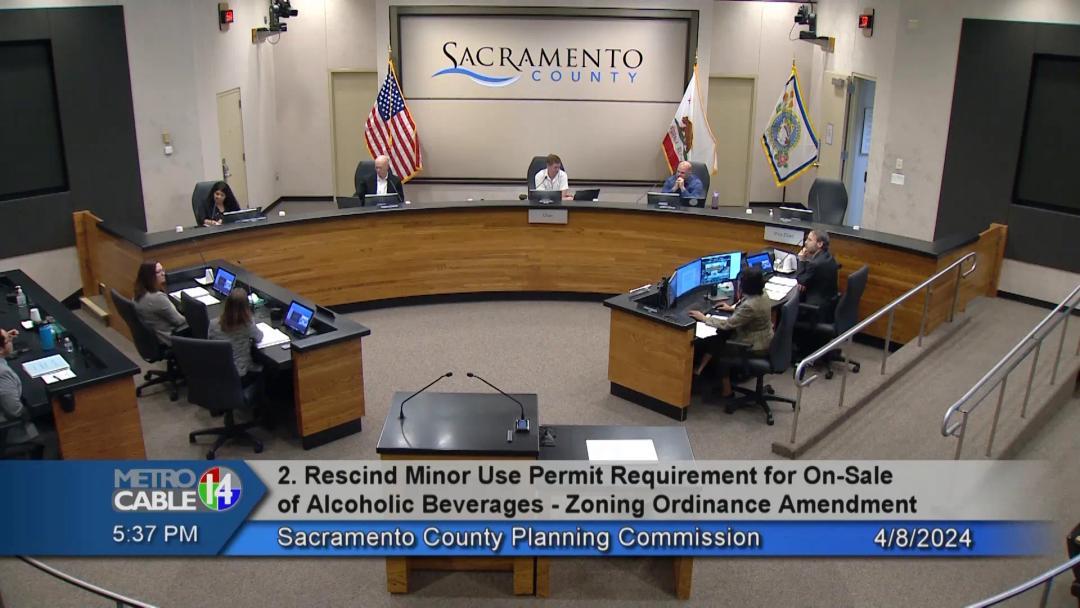
Note: The meeting transcript references April 8, 2024, but the provided metadata indicates the meeting took place on April 11, 2024. This summary uses the provided date. The Sacramento County Planning Commission met on April 11, 2024, to consider two non-contested items: a time extension for a subdivision and a zoning ordinance amendment to eliminate a redundant minor use permit requirement. Both items were approved unanimously. The meeting also included the Planning Director's report, noting staff changes and previewing upcoming agenda items. The meeting was adjourned at a record-setting 5:46 PM. Consent Calendar / Non-Contested Items - Item 1 – Time Extension (Florin Road and South Watt Avenue): Approved unanimously. The item extended the time for a subdivision map by six years, with an addendum to the Environmental Impact Report deemed adequate. Public comments regarding roadway improvements had been resolved prior to the meeting. The applicant, Rick Langdon, testified under oath and confirmed acceptance of updated conditions. - Item 2 – Zoning Ordinance Amendment (Countywide): Approved unanimously. The amendment rescinds the requirement for a Minor Use Permit for on-sale alcoholic beverages, as the County found the requirement redundant with California Department of Alcoholic Beverage Control (ABC) regulations, business licensing, and nuisance abatement codes. The change eliminates a $1,300 processing fee and approximately three months of permitting time. Public Comments & Testimony - No public comments were received on any agenda item. Written comments were accepted prior to the meeting. Discussion Items - Item 1 – Time Extension: Commissioner questions focused on whether community feedback had been resolved. Staff confirmed concerns about roadway improvements were addressed with the Department of Transportation. - Item 2 – Zoning Ordinance Amendment: Commissioners inquired about the information lost by removing the Minor Use Permit requirement. Staff (Irving Huerta, Assistant Planner) explained that ABC receives the same sheriff’s data and that county code enforcement tools remain intact. The amendment was described as a redundancy removal that saves applicants time and money. - Planning Director's Report: Jessica Brandt (Planning and Environmental Review) announced her departure to the City of Folsom. She noted upcoming agenda items: legislative updates to the zoning code, the Hazel Ridge subdivision (anticipated to be moderately controversial), a wireless facility, the countywide rezone project, and the five-year capital improvement plan review. Commissioners expressed appreciation for Ms. Brandt’s service. Key Outcomes - Item 1 – Time Extension: Motion to approve staff recommendation carried unanimously (5-0). The subdivision was found consistent with the General Plan. - Item 2 – Zoning Ordinance Amendment: Motion to approve staff recommendation carried unanimously (5-0). - Adjournment: Meeting concluded at 5:46 PM.
The Sacramento First Five Commission met on April 11, 2024. The meeting included approval of the consent calendar, appointments to advisory committees, updates from various committees, approval of the FY 2024-25 budget and 10-year financial plan, authorization of contracts for strategic plan programs, and a presentation on the FY 2022-23 annual evaluation report. All actions were approved unanimously. Consent Calendar - Approved the March 4, 2024 draft action summary. (Unanimous vote) Public Comments & Testimony - None. Discussion Items - Executive Director's Report: Julie highlighted staff changes, including the retirement of Eric Harold (Chief of Administration) and recruitment for his replacement. She reported on the Guaranteed Basic Income program approval, staff retreat focusing on participatory grant making, attendance at the First Five California summit, and state budget and policy updates including a $100 million ask and two sponsored bills. - Advisory Committee Update: Appointed Sylvia Rodriguez to the community-at-large seat and Carolyn Curtis to the education and early care seat. Approved unanimously. - Evaluation Committee Update: The committee met March 18; reviewed referral increases to portal agencies and began review of evaluation procedures and results-based accountability plans for new programs. Scheduled a special meeting on April 19. - Financial Planning Committee Update: Met March 28; approved the recommended budget for FY 24-25 and 10-year financial plan. Noted an end-of-year reserve balance of $13.5 million. - Systems Optimization and Sustainability Committee Update: No meeting since last commission; next meeting April 16. - Public Hearing: FY 24-25 Budget and 10-Year Financial Plan: Staff presented an operating budget of $22.15 million (6% admin, 2% evaluation, 92% program). Anticipated revenue of $18.5 million plus $3.6 million from reserves, leaving $13.6 million reserve. Budget approved unanimously. - Authorize Contracts for 2024 Strategic Plan: Staff recommended contracts totaling $2,402,996 for health and well-being, child care quality, and systems improvement. Contracts included parent leadership, parent coordinator, health systems liaison, an MOU with the county for the RAACD steering committee, a data management system contract, and an evaluation contract. Approved unanimously. - FY 2022-23 Annual Evaluation Report: Jordan Cati presented results. Nearly 10,000 caregivers and 6,000 children were served (a 20% increase). Highlights included zero newborn deaths for the fourth consecutive year from Black Mothers United, high breastfeeding rates exceeding state targets, and significant improvements in parenting skills and school readiness. System change efforts were noted. Commissioners discussed the need for deeper analysis on family engagement, differentiation between neglect and abuse in CPS data, and evaluation capacity. Commissioner Wirtz noted that the evaluation budget is only 2.4% of the total budget. Commissioner Wesley asked about integration with school governance and teasing out neglect from abuse. Commissioner Fernandez y Garcia asked about measuring community spread of knowledge. Staff committed to further exploration. Key Outcomes - Approved the consent calendar, advisory committee appointments, budget, and contracts all by unanimous roll call votes. - Directed staff to provide clarity on funding sources for court-mandated parenting classes at the next meeting. - Recognized the retirement of Eric Harold. - Acknowledged the 25th anniversary of First Five California.