Browse by city
Date range
Search help

Search titles, summaries, topics and stored transcripts together. Keywords may match separately; put the whole query in double quotes for a phrase. Matching follows word analysis, so punctuation is not exact. Both dates are included. Documents are not searched.

SHOWING 11–20 ENTRIES
11
NOV 6, 2026 · SAN DIEGO, CALIFORNIA · CIVIL SERVICE COMMISSION
San Diego Civil Service Commission Meeting - November 6, 2026

The Civil Service Commission of the City of San Diego met on November 6, 2026. Commissioners Freeman, Merrill, and Moore were present, while Commissioners Famp and Portio were absent. Personnel Director David Dallagar, Assistant Personnel Director Onan, Deputy City Attorney Alma Robbins, and Assistant to the Personnel Director Sava Lie were also in attendance. The meeting covered a report from closed session, multiple leave of absence requests, special salary adjustments, and a report from the Personnel Director. Note on Date Discrepancy: The raw transcript of the meeting states the date as November 5, 2026. The user has specified the date as November 6, 2026, which is used in this summary. Closed Session Report - Conference with legal counsel (withdrawn) and labor negotiators (nothing to report). - Public employment disciplinary appeals were addressed. Case 2024-1 (police officer termination) was continued. Appeals from James Vice (custodian) and Kenneth White (laborer) were denied 4-0. Consent Calendar - The consent agenda, including the regular minutes of the September 3, 2026 meeting, was initially approved 3-0. The Commission later reconsidered this vote to formally allow for public comment, after which it was re-approved 3-0. Public Comments & Testimony - Troy B. spoke during non-agenda public comment but was advised that his item (Item 15) would be heard later. No other members of the public provided comment during this period. Discussion Items Item 15: Leave of Absence Without Pay – Troy Bloxon - Request: Troy Bloxon, a heavy duty truck driver, requested a one-year special leave without pay (ending October 15, 2027) with his job saved. Mr. Bloxon stated he was experiencing severe breathing issues related to silica dust exposure, requiring multiple emergency room visits, and needed time for his lungs to recover. - Department Position: The Transportation Department (represented by Assistant Deputy Director Johnny Navarro) recommended modification to "name on eligible list," citing the critical nature of the position for upcoming concrete work and El Niño storm response. - Outcome: A motion to approve the one-year special leave with job saved passed 3-0. Item 16: Leave of Absence Without Pay – Nina Teasley - Request: Administrative Aid 1 Nina Teasley requested a four-month special leave without pay (ending January 4, 2027) with her job saved. Ms. Teasley explained her 10-month-old daughter had undergone two invasive kidney surgeries and required extensive ongoing medical appointments. - Department Position: The Development Services Department (Deputy Director Leslie Gallagher) requested a modification to a three-month leave, stating the department was "woefully behind" in records obligations and needed the position filled. - Outcome: A motion to approve the four-month leave with job saved passed 3-0. Item 17: Leave of Absence Without Pay – Aureli Walsh - Request: Deputy City Clerk 1 Aureli Walsh requested a one-year special leave without pay for child care. - Department Position: City Clerk Deanna Fuentes strongly recommended modification to "name on eligible list," noting that 42% of her workforce was on some form of protected leave and the position was critical for upcoming elections and legal compliance. - Complication: It was discovered during the hearing that Ms. Walsh had already submitted her resignation, effective October 30, 2026, due to the loss of childcare. - Outcome: A motion to deny the request on the grounds that it was mooted by the resignation passed 3-0. Ms. Walsh was advised she could apply for the re-employment list. Item 18: Special Salary Adjustments and New Classifications - Subitems 1-5 (Recommended for Approval): The Commission unanimously approved staff recommendations for new classifications and salary adjustments for FY2028 for Building Service Technician, Crime Scene Aid, Forensic Laboratory Technician, Senior Building Maintenance Supervisor, Building Maintenance Supervisor, and Supervising Record Plan. - Subitem 6: Legislative Recorder Series (21% Adjustment): - Department Position (Deanna Fuentes): Argued the nature of the work had fundamentally changed to complex legislative quality control, with significant consequences for error, and requested approval of the full 21%. - Union Position (Nick Wright, MEA): Supported approval of a 15–21% adjustment, stating that compounding equity adjustments had disenfranchised the clerical series. - Personnel Position (David Dallagar): Recommended denial, determining no significant changes in duties and responsibilities had occurred under the criteria. - Outcome: A motion to approve the 21% special salary adjustment passed 3-0. Item 19: Report from the Personnel Director - Audit Recommendations: The audit committee accepted two recommendations as implemented (annual workforce report, streamlined background checks). Several remain outstanding, including one requiring a municipal code change and another that is on hold due to budget constraints. - SAP Modernization: Workflow automation for personnel transactions has reached 80% completion, with organizational reassignment and pay change workflows recently developed. - City Leadership Changes: Bethany Bizak was appointed as the new Chief Operating Officer, and Franklin Cooper Smith was appointed as the new Director of Human Resources. Key Outcomes - Leave of Absence (Bloxon): Approved (3-0). One-year special leave with job saved. - Leave of Absence (Teasley): Approved (3-0). Four-month special leave with job saved. - Leave of Absence (Walsh): Denied (3-0) due to employee resignation. - Salary Adjustments (Subitems 1-5): Approved (3-0). - Legislative Recorder Series Adjustment: Approved (3-0) at 21%. - Closed Session Disciplinary Appeals (Vice, White): Denied (4-0).

PERSONNEL MATTERS 70% · AUDIT FOLLOW-UP 11% · PROCEDURAL 7% · PUBLIC SAFETY 7%
12
NOV 5, 2026 · SAN DIEGO, CALIFORNIA · ECONOMIC DEVELOPMENT & INTERGOVERNMENTAL RELATIONS COMMITTEE
Economic Development and Intergovernmental Relations Committee Meeting - November 5, 2026

The Economic Development and Intergovernmental Relations Committee met on November 5, 2026, to consider revisions to the city's naming and marketing partnership policies, adopt the 2027-2028 Federal and State Legislative Platform, and receive informational updates on state legislation and citywide grants. The committee heard public testimony spanning a wide range of topics including homelessness, public safety, energy affordability, and youth prevention. Two action items were approved, both with amendments or requests for further refinement. Consent Calendar - Item 1 – Approval of Minutes (September 2, 2026): Approved unanimously 3-0 (Councilmember Campbell absent). Public comment was heard on this item. Public Comments & Testimony - Non-Agenda Public Comment: Speakers addressed a variety of topics: - A speaker criticized the new rules at the Neil Good Day Center (requiring an orange card and limiting bags) and urged clarity on ALPR (flock) use. - Another speaker warned against smart technology and surveillance, arguing it could be used for internal control. - Liam Burton reported housing 17 people from an unsupported encampment in seven weeks, asking the city to review its shelter programs. - Becky Rapp highlighted the dangers of cannabis-impaired driving, citing a November 2026 study estimating 5,000 traffic fatalities linked to cannabis and 55% higher odds of fatal crash for THC-positive drivers. - Kathleen Lippitt urged the council to support AB 762 (banning disposable battery vapes) and to include marijuana in tobacco-free zone policies. - John Stump played a video opposing SDG&E's proposed 8.6% rate increase (adding $22–$60 to monthly bills), noting impacts on affordability. - Other speakers discussed the structural budget deficit, the need for youth drug prevention as an economic investment, and urged using the term "unsheltered" instead of "homeless." - Item 2 (Naming & Marketing Policies): Multiple speakers expressed support for the policy revisions but raised concerns about authority for renaming, the mayor's power, and the need for robust community engagement. Some urged caution in removing historical names, while others supported time limits and reviews. - Item 3 (Legislative Platform): Speakers echoed frustration with the phrase "preserving local control," citing state overrides and developer influence. One speaker requested the platform better address affordability (food, energy, housing) and noted the disparity in gas taxes between jet fuel (2¢/gal) and motor vehicle fuel (63¢/gal). - Item 4 (State Legislative Update): Commenters thanked the committee but raised concerns about specific bills (e.g., AB 1358, SB 960) that could impede emergency vehicle access, and called for careful oversight of the Midway Rising project's affordable housing component. - Item 5 (Grants Report): Speakers noted challenges with federal funding and urged the city to align grant priorities with areas of high liability (e.g., flood control). One speaker criticized the city's trust in grantees, citing the "Dreams for Change" contract and alleged failures. Discussion Items - Item 2 – Proposed Revisions to Council Policies 900-20 (Naming of City Assets) and 000-40 (Marketing Partnerships): Assistant Deputy Director Sarah O'Brenna presented the revisions, which aim to modernize the programs, align approval thresholds with municipal code ($3 million for council approval), allow unsolicited offers, shift evaluation authority to the mayor/designee, and create a proactive model for naming and partnerships. The Department of Race and Equity raised equity concerns, including the need to balance revenue generation with community recognition, potential barriers for low-resource groups, and the absence of explicit prohibitions on naming after individuals with harmful histories. Committee members debated the $3 million threshold, community engagement responsibilities, and whether a 30-day council feedback window was sufficient. The committee voted to approve the revisions 3-0, with a request for further refinement of the process narrative and language to ensure meaningful public input and council involvement before final approval by the full council. - Item 3 – 2027-2028 Federal and State Legislative Platform: Director of Government Affairs Walt Bishop presented the platform, which continues three guiding principles: promoting social justice/equity, preserving local control, and supporting fiscal stability. Key additions include a new section on artificial intelligence and data centers, positions opposing certain Trump administration policies (e.g., TPS changes, public charge rule, 2030 census interference), support for El Niño preparedness funding, a federal film/TV tax credit, and federal permitting reform. Councilmember Foster proposed two amendments: (1) restore language in the state section to include “prevent federal intervention” regarding ALPR technology, and (2) add language to both state and federal sections supporting cleanup efforts at Market Creek Plaza and Euclid Terrace Apartments after toxic contamination. Both amendments were accepted. The platform was approved 3-0. Key Outcomes - Consent Calendar (Item 1): Approved 3-0. - Marketing Partnership & Naming Policy Revisions (Item 2): Approved 3-0 with a request that staff work with council offices to clarify the process for community engagement and provide a more detailed narrative before the item goes to full council. - Legislative Platform (Item 3): Approved 3-0 with amendments, including restoring the federal-intervention language in the state section and adding cleanup-support language for Market Creek Plaza/Euclid Terrace. - Informational Items (Items 4 & 5): No action taken; committee received updates on the 2026 state legislative session and the FY26 citywide grants report. - Next Meeting: The committee will next meet on Wednesday, December 9, 2026, at 2:00 p.m.

PUBLIC COMMENT 23% · ECONOMIC DEVELOPMENT 16% · PUBLIC ENGAGEMENT 11% · PUBLIC SAFETY 10%
13
OCT 28, 2026 · SAN DIEGO, CALIFORNIA · RULES COMMITTEE
San Diego Rules Committee Meeting Summary: October 28, 2026

The San Diego City Council Rules Committee met on October 28, 2026, with Chair La Cava presiding. The committee approved two consent items, advanced an ordinance updating the Rules of Council, and heard an informational Ethics Commission presentation about expanding oversight to classified employees who file Form 700 statements of economic interest. All formal votes were unanimous. Consent Calendar - Item 1: Approval of committee minutes from October 14, 2026. - Item 2: Amendment to San Diego Municipal Code Chapter 2, Article 2, Division 26 updating city clerk and department directors' records management responsibilities. - Councilmember Moreno moved approval and Councilmember Campio seconded; the consent agenda passed unanimously. Councilmember Elo-Rivera was absent for this vote. Public Comments & Testimony - In non-agenda public comment, Max Schmidt described being left homeless after a DMV ID delay and called for a federal investigation; Chair La Cava responded that DMV matters are state jurisdiction and mentioned Think Dignity's ID assistance program. - Joyce Sanyata questioned water-rate policy, conservation assumptions for high-end users, and why Proposition 218 was not connected earlier. - Liam Burton reported that his managed-encampment pilot housed 17 people in seven weeks and criticized law enforcement for arresting people instead of offering shelter. - Several speakers addressed surveillance and policing: Blair Beekman urged reducing or ending Flock ALPR cameras; Tony criticized the police chief for not following the Commission on Police Practices' recommendation to end racially motivated pretext stops; Francine Maxwell described pretextual stops targeting Tesla drivers and criticized Councilmember Kent Lee. - Crypto Bradley proposed renaming Highway 94 the "Reparations Highway" for five years with doubled infrastructure spending south of it. - John Stump discussed water sustainability, employee residency, and school quality; Judy Strang and Terry Ann Skelly asked about enforcement of rules regulating marijuana/hemp products and youth protections. - On the consent agenda, Max Schmidt opposed both items, Joy Sanyata supported the records-management change, and other speakers commented on records management, contract accountability, and public-comment time. - On Item 3, public comments included support for the updates, questions about the newspaper-of-general-circulation change, concerns about quasi-judicial bias, and a suggestion to consider 90-second public-comment periods. - On Item 4, commenters questioned why implementation took so long, asked whether the employee faced discipline, and expressed both support and concern about the proposed cost and local oversight. Discussion Items Item 3: Updates to the Rules of Council - Senior policy advisor Abby Reuter presented a package of technical updates: clarifying quasi-judicial applicant/appellant 10-minute presentation time; clarifying staff presentations; making the January 2026 temporary work-plan flexibility permanent; removing the repealed city official newspaper reference; allowing council-president selection at the first regular meeting after inauguration; allowing meeting shifts between council and committee chambers; allowing evening meetings at times other than 6 p.m.; clarifying that revenue measures can be heard by other committees; and administrative cleanup including removal of the Select Committee on the Cost of Living. - Chair La Cava called the changes technical edits rather than policy changes. Councilmember Elo-Rivera noted an inconsistency between in-person and virtual public-comment rules (Rules 2.6.1 and 2.6.2) and asked that the virtual rule include the same representative-identification requirement; Chair La Cava agreed to align the language with the City Attorney's office. - The City Clerk clarified that the newspaper of general circulation used for required notices is the Daily Transcript, not the Union-Tribune. Item 4: Informational Presentation on Ethics Commission Jurisdiction - Ethics Commission Executive Director Bryn Kervin and legislative manager Megan Curran presented. They explained that a 2015 city auditor hotline investigation found a classified city employee received about $3,000 in gifts from vendors and awarded those vendors option contracts worth millions of dollars. The case was referred to the FPPC, which closed it in 2021 with "violation found, no action." - Expanding the Ethics Commission's jurisdiction to classified employees who already file Form 700 would add approximately 919 classified positions in 25 departments, a 65% increase in the Commission's regulated community from about 1,500 people. It would not change who must file Form 700; it would add local enforcement and education. - Kervin estimated adequate funding would require roughly $700,000 to $880,000 annually for one additional investigator, one program manager, and one program coordinator. Implementation would require meet-and-confer obligations under the MMBA because most affected employees are in recognized employee organizations. - City Auditor Andy Henau confirmed the findings and noted the employee said they did not know the gifts had to be reported because classified employees did not receive Ethics Commission training. A separate city fact-finding recommendation was implemented. - Committee members discussed the need for resources and appropriate rules, and noted the threshold question of whether all approximately 919 employees should be included or only a subset. No formal action was taken. Key Outcomes - Consent items 1 and 2 passed unanimously (with Councilmember Elo-Rivera absent). - Item 3 passed unanimously, 5-0, recommending City Council adoption of an ordinance amending the Rules of Council; the City Attorney will also align virtual and in-person public-comment identification language. - Item 4 was informational only; no vote was taken. The committee will continue conversations about implementing the auditor's recommendation. - The meeting was adjourned to the next regularly scheduled meeting on January 27, 2027.

PUBLIC COMMENT 28% · ETHICS COMMISSION 25% · PROCEDURAL 17% · PUBLIC SAFETY 8%
14
OCT 27, 2026 · SAN DIEGO, CALIFORNIA · CITY COUNCIL
San Diego City Council Meeting – October 27, 2026: Data Center Moratorium, Water Rates, and Affordable Housing

The City Council convened at 10:00 a.m. on October 27, 2026, to address a special docket including proclamations, an emergency moratorium on data center development, water rate adjustments due to litigation, and affordable housing loan agreements. The meeting drew extensive public testimony, particularly on the data center issue. Public Comments & Testimony - Proclamations: Multiple speakers honored Mary Scott Knoll for fair housing advocacy, recognized the Mission Beach Women's Club centennial (S501), and highlighted Domestic Violence Awareness Month (S505). Supportive comments were made by community members and colleagues. - Data Center Moratorium (S510): Over 45 speakers in person and 32 remote callers voiced strong opposition to new data centers, supporting the temporary moratorium but calling for a permanent ban. Speakers cited concerns over electricity rates, water consumption, noise pollution, habitat destruction, and the proposed 400-megawatt data center at the Navy's NAVWAR site. Several speakers noted the lack of public support (only one satirical comment in favor). Many urged the council to extend the moratorium beyond 45 days and to oppose Proposition 45. - Water Rate Adjustments (S330): Public comment included frustration over the shift to a unitary rate, which penalizes conservation. Some speakers opposed the increase, while others acknowledged the legal necessity. Advocacy groups requested a new cost-of-service study and expansion of customer assistance programs. - Affordable Housing Loans (S506, S507): Most commenters supported the projects, emphasizing the need for affordable housing, though some questioned cost per unit and loan repayment expectations. Discussion Items - Temporary Moratorium on Data Centers (S510): The council debated an urgency ordinance to pause data center development for 45 days while staff develop permanent regulations. Councilmember Elo Rivera introduced amendments requiring: (1) staff to notify council within 7 days of any developer inquiries; (2) a framework for permanent policy including no cost shifting to ratepayers, 100% renewable energy, no potable water for cooling, skilled workforce, community input, and minimum separation from sensitive uses; (3) updates at 45 days; and (4) the Office of Government Affairs to lobby against a large-scale data center at NAVWAR. The council stressed the limited jurisdiction over federal land but committed to using all available tools. The moratorium requires a four-fifths vote and can be extended up to an additional 10 months and 15 days after further hearings. - Water Rate Adjustments (S330): Staff presented the need to transition from tiered to unitary water rates to comply with the PATS litigation ruling. The change does not increase total revenue but reallocates costs: low-volume users see a 7.1% increase (approx. $5.62/month) while high-volume users see a 4.5% decrease (approx. $19.52/month). The city previously settled for $40 million. The IBA recommended approval to avoid further litigation and potential default on bonds. Councilmember Elo Rivera moved to approve with an additional directive for Public Utilities to work with the IBA on expanding customer assistance programs using non-rate revenue. - Affordable Housing Loans (S506, S507): Staff presented two loans of $5 million each from the Low and Moderate Income Housing Asset Fund: $5 million for the Jule project (208 units for families, 30-60% AMI) in District 7, and $5 million for the Salvation Army Rady Center Phase 2 (89 units for seniors) in District 3. Both are part of the Bridge to Home program and include 55-year affordability covenants. Key Outcomes - Proclamations: Approved unanimously for items 30, S500, S501, S505. - Data Center Moratorium (S510): Adopted 9-0 with amendments. The 45-day moratorium takes effect immediately, prohibiting new data center permits within city jurisdiction. The council will receive updates and consider extension and permanent regulations. - Water Rate Adjustments (S330): Passed 6-2 (Councilmembers Foster and Lee voting no; Councilmember Von Wilpert absent). The ordinance adopts a unitary water rate structure effective January 1, 2027, in compliance with court orders. Staff will develop enhanced customer assistance programs and report back. - Affordable Housing Loan for Jule Project (S506): Approved 8-0. - Affordable Housing Loan for Salvation Army Rady Center Phase 2 (S507): Approved 8-0. The meeting adjourned at approximately 2:30 p.m., with the next regular meeting scheduled for November 9, 2026.

DATA CENTER REGULATION 26% · PUBLIC COMMENT 25% · WATER AND WASTEWATER MANAGEMENT 10% · AFFORDABLE HOUSING 9%
15
OCT 26, 2026 · SAN DIEGO, CALIFORNIA · CITY COUNCIL
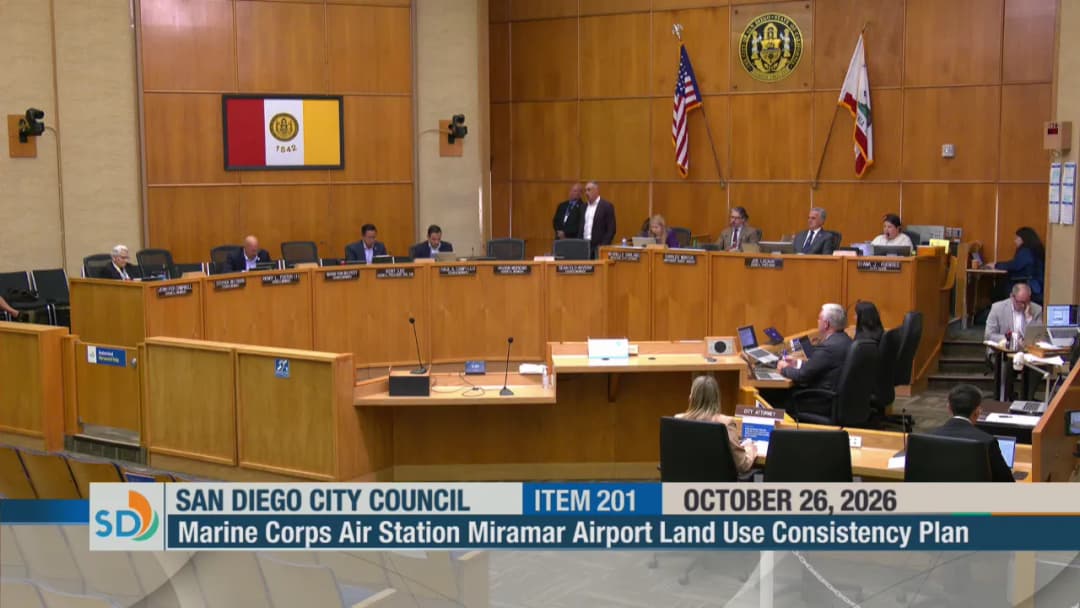
San Diego City Council Regular Meeting - October 26, 2026

The San Diego City Council convened on Monday, October 26, 2026. The meeting included a closed session on litigation, the continuance of an agenda item, the Fiscal Year 2026 year-end financial report, approval of new labor standards enforcement fees, initiating the process to overrule an airport land use commission decision, and non-agenda public comment. Closed Session (Morning) - The council met in closed session to discuss two lawsuits: Deborah Hartwick vs. City of San Diego (a sidewalk trip-and-fall) and Victoria Hayes et al. vs. City of San Diego (a high-speed police pursuit resulting in the deaths of two young brothers, Malachi and Mason Orasco Romero). - The City Clerk corrected a typographical error on the closed session date. Public Testimony on Closed Session Items - Several commenters expressed deep condolences to the family of the two boys killed in the pursuit and strongly urged the council to settle the case and reform the city's high-speed pursuit policy. - Commenters on the sidewalk lawsuit criticized the city's maintenance backlog, arguing that deferred repairs lead to costly litigation. - One speaker requested a highway memorial for the two children. Continuance of Agenda Item S401 - The council announced that item S401, originally on the agenda, has been continued to Tuesday, October 27, at 10 AM, where it will be heard as item S510. Public comment was taken on the item, but no discussion or action occurred. Fiscal Year 2026 Year-End Financial Performance Report (Item S400) - The Department of Finance and the Independent Budget Analyst (IBA) presented the unaudited year-end report. - Key Data: - Revenues ended $4.1 million (0.2%) above and expenditures $10.5 million (0.5%) above third-quarter projections. - A $4.7 million draw on the General Fund Stability Reserve is required to balance the budget, the first such draw in recent history. - This lowers combined reserves to $202.4 million (10.9% of operating revenues), below the 14.1% policy target. - A primary driver is the delay of $7.4 million in Cal OES storm reimbursements, now expected in FY 2027. The city committed to using those funds to replenish the reserve. - Property tax revenue decreased due to lower collection rates and a $2.8 million increase in assessment appeal refunds. Risk management reserves declined by $20 million (33%). - Council Discussion: Council President Pro Tem Lee noted the reserve draw was anticipated in the budget. Council President Lacava praised the finance department's accuracy. - Public Comment: Speakers questioned the city's spending priorities on homelessness and police overtime given the deficit. User Fees to Support the Office of Labor Standards and Enforcement (Item 200) - The council approved two cost recovery fees to fund an additional compliance officer and proactive enforcement of minimum wage and labor laws. - Fees: 1) Minimum Wage Enforcement Fee increased from $1.47 to $2.82 per covered employee. 2) A new tiered Compliance System Usage Fee ($144.35 to $4,853.24) assessed on prime contractors for city contracts over $15,000. - Public Comment: Marshall Anderson of the San Diego County Lodging Association expressed support but requested a one-year report back on the fee's implementation and accounting for transparency. Other speakers expressed support for protecting workers' rights. - Council Action: Councilmember Foster moved the item, seconded by Councilmember Ila Rivera. Council President Lacava requested a dedicated first-year report to build industry confidence. Councilmember Campillo suggested increased penalties for egregious violators to reduce the burden on compliant businesses. - Vote: Passed 7-0. (Absent: Whitburn, Von Wilbert.) Overruling the Airport Land Use Commission on Child Care Centers (Item 201) - The council voted to initiate the formal process to overrule the Airport Land Use Commission's (ALUC) determination of inconsistency in order to allow new child care centers in the MCAS Miramar Transition Zone. - Context: The change would allow new centers at the same intensity limits already permitted for existing centers (300 people per acre, implemented through a 0.42 Floor Area Ratio). The Transition Zone is an extra buffer created by the ALUC and is not recommended by state or military planning documents. - Process: This was the first of two required hearings. The item will go to the Planning Commission for a recommendation before returning to the City Council for a final vote, which requires a two-thirds majority. - Public Comment: Speakers largely opposed the overrule, citing safety risks from the airport's accident potential zone. - Council Action: Council President Pro Tem Lee moved the item, framing it as a technical fix to address a child care shortage near major employment centers. Councilmember Ila Rivera seconded. Council President Lacava clarified the action is a zoning correction to align new development with existing rules. - Vote: Passed 6-0. (Absent: Whitburn, Von Wilbert, Moreno.) Non-Agenda Public Comment - Residents raised several issues, including: opposition to the city's use of ALPR (Flock) surveillance cameras and calls for civil rights protections; requests to fill vacancies on the Human Relations Commission; complaints about the DMV's 60-day wait for identification cards; support for Red Ribbon Week and youth substance abuse prevention; and criticism of the city's public comment media submission procedures. Key Outcomes - FY 2026 Close: Council accepted the report acknowledging a $4.7 million draw on the General Fund Stability Reserve. - OLSE Fees: New labor standards enforcement fees were approved to fund proactive compliance and enforcement. - ALUC Overrule: The process was initiated to allow child care centers in the MCAS Miramar Transition Zone. - Adjournment: The council adjourned to the regularly scheduled meeting on Tuesday, October 27, 2026, at 10:00 AM.

PUBLIC COMMENT 20% · BUDGET 13% · PUBLIC SAFETY 8% · CHILD CARE 8%
16
OCT 26, 2026 · SAN DIEGO, CALIFORNIA · CITY COUNCIL
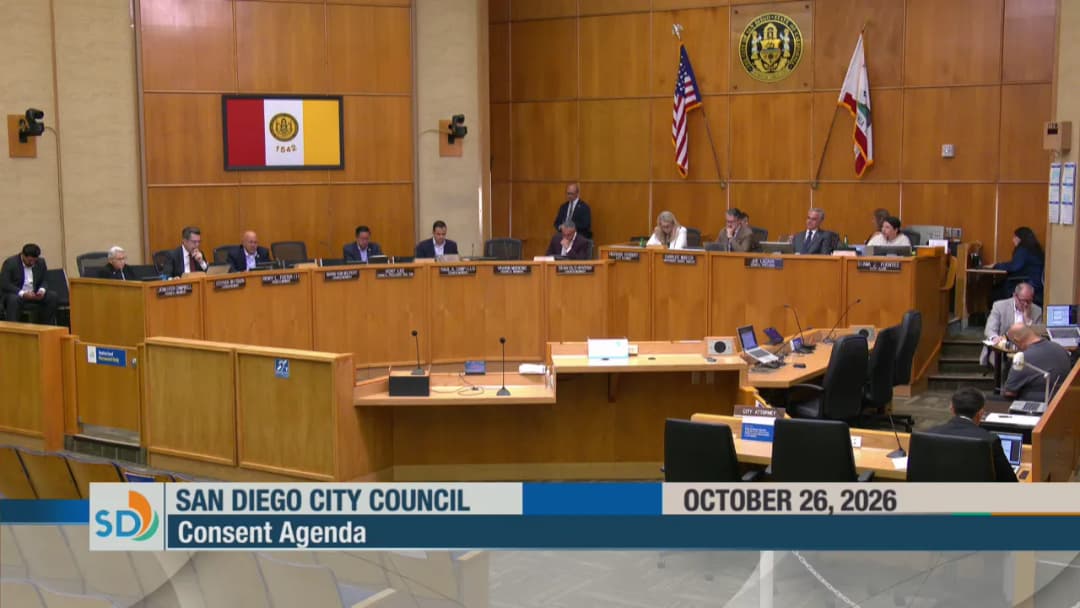
San Diego City Council Consent Agenda & Regular Meeting - October 26, 2026

The San Diego City Council convened a special meeting on Monday, October 26, 2026, to address its consent agenda before the regular Monday session. The meeting saw unanimous approval of 15 items covering public health, labor protections, infrastructure, and arts funding. The council heard extensive public testimony and held a detailed discussion on the new arts funding model. Consent Calendar - All items (600–614) were approved unanimously (8–0, with Councilmember Moreno absent). No items were pulled for separate discussion. Public Comments & Testimony - Audrey: Questioned the environmental alignment of a petroleum franchise agreement (Item 605) with the city's Climate Action Plan. Expressed concern that undocumented workers would fear deportation if they reported wage theft under the new ordinance (Item 604). Criticized the handling of the Tijuana River sewage crisis (Item 610), suggesting economic pressure on Mexico. Encouraged creative recycling for items like cigarette butts (Item 602). - Speaker 8700: Supported the wage theft protections (Item 604) and the wastewater treatment contract (Item 611). Opposed litigation settlements for La Jolla Terrace (Item 607) and another case (Item 608), calling them wasteful. Was 'on the fence' regarding the arts funding policy revisions (Item 613). Questioned whether the Tijuana River emergency (Item 610) has become a normalized state of governance. - Speaker 3: Discussed Item 607, arguing the La Jolla stormwater settlement highlights systemic infrastructure neglect worsened by climate change. Characterized the Tijuana River pollution (Item 610) as a predictable outcome of past city decisions, not a true emergency. Expressed concerns about groundwater pressure on wastewater pipelines (Item 611). - Blair Beekman: Supported the smoking ban in outdoor dining (Item 601) but questioned its effect on hookah bars. Questioned the high cost of the footwear contract (Item 602, $7 million). Supported wage theft and wastewater treatment items (Items 604, 611). Called for more collaborative dialogue with Mexico on the Tijuana River issue (Item 610). - Speaker 5: Expressed strong frustration with government leadership over the Tijuana River pollution (Item 610). Called for tracking lawsuit settlement payouts (Items 607, 608). Characterized the Division of Race and Equity's work on the arts funding policy (Item 613) as 'racist'. Discussion Items - Item 601 – Smoking/Vaping in Outdoor Dining (Councilmember Campbell): Campbell presented the ordinance as a public health measure to protect diners and workers from secondhand smoke. She thanked stakeholders for their input. The item received widespread support from council members. - Item 604 – Wage Theft Ordinance (Councilmember Von Wilpert): Von Wilpert praised the amendments as essential for protecting working families and ensuring all earned wages are paid. - Item 612 – Surplus Land Declaration (Council President LaCava): LaCava requested the Economic Development Department prioritize leasing the property at 4069 30th Street to leverage it for deeply affordable housing rather than a market-rate sale. - Item 613 – Arts and Culture Funding Model Revisions: This item was the primary focus of council discussion. - Lisa Ann Kim (Division of Race and Equity, IBA): Presented an equity analysis. Noted the shift to 100% upfront payments and a scoring model based 60% on impact and 40% on budget is an equitable change that will benefit smaller, emerging organizations. Recommended the council evaluate the new model's outcomes in the future. - Councilmember Campillo: Strongly supported the move toward transparent, impact-focused funding and reduced bureaucracy. - Councilmember Foster: Expressed intent to closely monitor the process to ensure small, grassroots organizations in districts like District 4 benefit, noting past failures of inclusion. - Council President Pro Tem Lee: Commended the shift to upfront payments as a significant help for smaller organizations. - Council President LaCava: Confirmed extensive community outreach was conducted. Acknowledged the policy shift is expected to help smaller organizations, potentially reducing funds for larger institutions. The council will monitor the policy's effectiveness. Key Outcomes - Consent Agenda Approved Unanimously (8–0): All items were adopted. - Smoking Ban Enacted (Item 601): A citywide ban on smoking and vaping in outdoor dining areas was passed. - Wage Theft Ordinance Strengthened (Item 604): Amendments to the wage theft ordinance were approved. - Arts Funding Policy Revised (Item 613): Revisions to Council Policy 100-3 were adopted, shifting to a more equitable, impact-based funding model. - Surplus Land Designated (Item 612): 4069 30th Street was declared surplus. Staff was directed to consider leasing for affordable housing. - Item Rescheduled: Item S401 was moved to Tuesday, October 27, 2026, as Item S510.

ARTS AND CULTURE 25% · PROCEDURAL 19% · PUBLIC COMMENT 18% · STORMWATER MANAGEMENT 17%
17
OCT 22, 2026 · SAN DIEGO, CALIFORNIA · ACTIVE TRANSPORTATION & INFRASTRUCTURE COMMITTEE
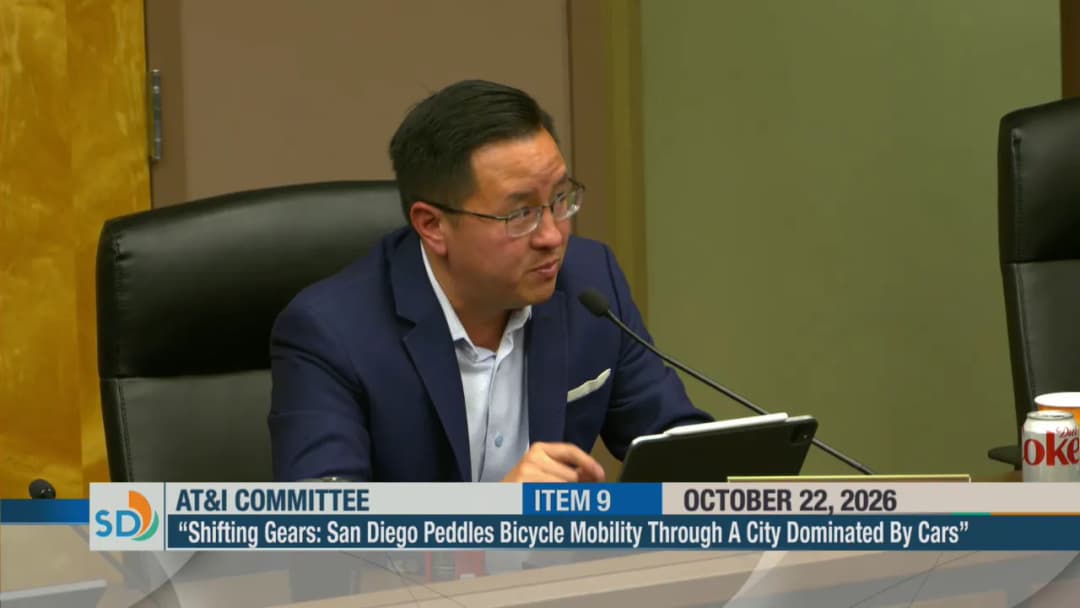
San Diego Active Transportation and Infrastructure Committee Meeting - October 22, 2026

The Active Transportation and Infrastructure Committee of the San Diego City Council held a meeting on October 22, 2026, at 9:00 AM. Chair Whitburn presided, with Vice Chair Foster and Council President Pro Tem Lee present. Councilmember Von Wilbert was absent. The meeting covered non-agenda public comment, a consent calendar, a mill and pave project authorization, and the city's response to a Grand Jury report on bicycle mobility. Consent Calendar The consent agenda comprised Items 1 through 7, including approval of previous meeting minutes, contracts for concrete pumping and paving materials, change orders for emergency repairs, and airport planning agreements. No items were pulled by committee members. The consent calendar was approved unanimously (3-0) on a motion by Vice Chair Foster, seconded by Councilmember Lee. Public Comments & Testimony Non-Agenda Testimony: - Audra spoke against surveillance technology (ALPR and Flock cameras), raising concerns about data misuse and vendor backgrounds. - Jason (Downtown resident) urged better enforcement of safe detour rules when construction closes bike lanes, citing a dangerous experience on Pacific Highway. - Terry Ann Skelly (Parent/volunteer) discussed the dangers of e-bike use among teens combined with alcohol and marijuana. - Blair Beekman advocated for a broad, legally-framed conversation on city technology and surveillance. - Joy Sanyata requested balanced dialogue on surveillance and announced an intention to research city debt. - Michael Schmidt supported removing Flock cameras and requested double-lane paving. - Kathleen Lippitt highlighted a CalMatters investigation into DMV oversight of commercial truck drivers. - Madison emphasized the need for consistent safe driving campaigns to address driver behavior. - Sanjay Stone called for enhanced driver education and enforcement, particularly near schools. - Natalie Ratchke thanked the committee for reconsidering Flock, raised safety concerns about Waymo vehicles, and flagged privacy risks at family entertainment venues. Consent Calendar Testimony: - Audra criticized the city's reliance on emergency contracts and lack of progress on street maintenance, warning of future gridlock from airport plans. - A speaker (phone 870) reviewed items individually, supporting most contracts while questioning workforce data and inspection practices. - Hector suggested the city mine sand from the Tijuana River for concrete needs. - Blair Beekman thanked previous speakers for their testimony. - Michael Schmidt expressed agreement with the sand mining suggestion. Item 8 (Mill and Pave) Testimony: - Audra criticized shifting city forces from stormwater to paving, arguing for dedicated contract crews. - Hector advocated for private contractors to save on long-term pension costs. - Sanjay Stone supported the item and requested integration of bike and pedestrian improvements. - Joy Sanyata strongly supported using city forces for the $12 million paving project. - Blair Beekman asked how the paving considers sea level rise and requested sustainable materials. - Michael Schmidt supported the item. Item 9 (Grand Jury Response) Testimony: - Audra opposed prioritizing bike infrastructure over cars and defended parents driving children. - Ian Hembry (San Diego County Bicycle Coalition) strongly criticized the city's response to Recommendations 1 and 5, calling them disrespectful to cyclists, and submitted a list of proposed changes. - Jason (D3 resident) disagreed with the city's claim of a connected network, citing major gaps. - David Soles urged a grant application for the Mission Hills bikeway, calling University Avenue a dangerous gap. - Victoria Bruzos (Cyclist, Fricks Ranch) rejected the city's refusal to implement routine bike lane maintenance (Recommendation 5). - Hector dismissed the grand jury report and asked for funding to be directed elsewhere. - Harry Bobbins supported the grand jury, arguing the city's response of "implemented" for connectivity is insufficient. - Joy Sanyata supported improved communication on the bike network for underserved communities. - Sanjay Stone cited the 15-year planning of the Mission Hills bikeway as evidence that planning has not sufficed. - Anar Salayev (Bike San Diego) asked the city to change Recommendation 1 from "implemented" to "requires further implementation." - Nicole Burgess (D2 resident) supported changing Recommendation 1 and expressed dismay over the loss of experienced bike program staff. - Blair Beekman emphasized the need for a regional focus on bike projects. - Kathleen Lippitt noted that 34% of city streets are rated poor or worse and highlighted the nexus between pavement conditions and safety for all road users. Discussion Items Item 8: Authorize City Forces for FY27 Mill and Pave CIP Deputy Director Philip Lowry presented the request for committee approval to use up to $12 million in city forces spending for approximately 30 line miles of paving. The authorization is required under the municipal code when personnel expenditures for a CIP project exceed $500,000. Lowry highlighted the flexibility of city forces to pivot from storm response to paving. Vice Chair Foster and Councilmember Lee spoke in favor, emphasizing efficiency and responsiveness to resident complaints. The motion passed unanimously (3-0). Item 9: Proposed Response to Grand Jury Report on Bicycle Mobility IBA representatives Trisha Tackey and Jordan Moore presented the draft responses to the eight findings and eight recommendations from the Grand Jury report "Shifting Gears." The proposed responses generally disagreed with findings regarding network connectivity and pavement conditions, and stated that recommendations for routine maintenance (R5) and a 70% PCI goal would not be implemented as unreasonable. Councilmember Lee led a detailed discussion, arguing the responses were overly defensive and recommending that Findings 1, 4, and 8 be acknowledged as true while contextualizing the city's efforts. He proposed changing the response to Recommendation 5 from "will not be implemented because it is unreasonable" to "requires further analysis." Chair Whitburn supported this direction. Vice Chair Foster strongly dissented, arguing that committing to implementation or analysis without a viable budget path creates a disservice to the public and an administrative burden of reporting back to the Grand Jury every six months without making progress. Staff clarified that a change to "requires further analysis" would trigger a six-month follow-up requirement. Key Outcomes - Vote on Item 9 Motion: Councilmember Lee's motion to amend the staff recommendation (changing responses to Findings 1, 4, and 8, and changing the response to Recommendation 5 to "requires further analysis") passed with a vote of 2-1 (Lee and Whitburn in favor, Foster opposed). - Procedural Outcome: Because the motion did not receive unanimous support, the item will advance to the full City Council without a recommendation from the committee. Staff will work with the Mayor's office and the IBA to refine the proposed language before the council hearing. - Consent Calendar and Item 8: Both items were approved unanimously by the committee. - Next Meeting: The committee is scheduled to meet next on Thursday, November 19, 2026, at 1:00 PM.

BICYCLE INFRASTRUCTURE 45% · PAVING 10% · PUBLIC SAFETY 9% · PUBLIC COMMENT 7%
18
OCT 21, 2026 · SAN DIEGO, CALIFORNIA · BUDGET & GOVERNMENT EFFICIENCY COMMITTEE
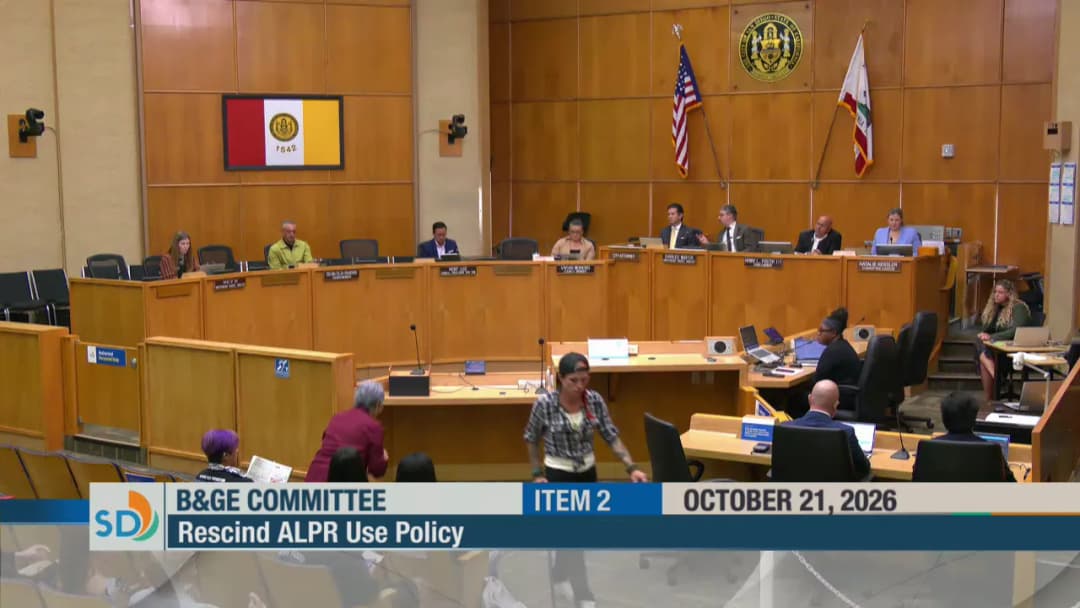
San Diego Budget and Government Efficiency Committee Meeting Summary - October 21, 2026

The Budget and Government Efficiency Committee met on Wednesday, October 21, 2026, with Chair Henry L. Foster III presiding. The committee reviewed the FY 2026 year-end financial performance report, approved a measure to begin rescinding the city's ALPR use policy, adopted a cannabis delivery service permit fee, and renewed the city treasurer's investment authority. All action items passed. The public participated in person and by Zoom; the online live stream was not working. Consent Calendar - Item 1, approval of committee minutes from September 23, 2026, was approved unanimously, 4-0. During public comment, one speaker raised the $7 million "bootworld" contract, another said the minutes did not fully capture her previous comments about diesel shortages and El Niño, and one virtual speaker reported that agenda document links on the city website were not working. Public Comments & Testimony - In non-agenda public comment, speakers raised a wide range of topics. Blair Beekman emphasized community accountability in trash and RFID technology. Audra questioned why the city focuses on vehicle surveillance while broader tracking of people remains unaddressed. Anthony Ralphs thanked council members for raising SDPD body-worn camera compliance concerns and urged greater accountability for the police budget and technology requests. Other speakers commented on youth vaping prevention, cannabis tax underperformance, police overtime, vape shops near schools, and infrastructure maintenance. One speaker criticized the committee for starting late. Discussion Item: FY 2026 Year-End Financial Performance Report (Item 5) - Department of Finance staff presented the unaudited year-end results. Revenues were expected to finish $4.1 million (0.2%) above third-quarter projections; expenditures were expected to finish $10.5 million (0.5%) above; and net projected activity decreased by $6.4 million. The projected available fund balance moved from a positive $1.7 million to a negative $4.7 million, requiring a $4.7 million draw from the General Fund Stability Reserve to balance FY 2026. After the draw, combined general fund emergency and stability reserves are expected to total $202.4 million, or 10.9% of operating revenues, below the 14.1% reserve policy target. - The report identified a $7.4 million delay in Cal OES reimbursements for the January 2024 storms, now expected in FY 2027. Staff said reimbursements will first replenish the stability reserve, and any remaining balance could support unanticipated expenditures. - The IBA noted this was the first general fund reserve draw in recent memory, that risk management reserves ended about $21 million below adopted budget and nearly $50 million below their combined policy targets, and that one-time budget mitigation options are increasingly limited. - In discussion, Pro Tem Lee asked about revenue trends; staff said property tax growth is softening to about 3% while sales tax is rebounding. Vice Chair Moreno expressed disappointment at the reserve draw and stressed the importance of rebuilding reserves toward the 16% target. Staff said updated reserve policy proposals are expected next month along with the five-year financial outlook. Chair Foster requested a follow-up on unbudgeted positions. This was an information item; no vote was taken. Discussion Item: Rescind ALPR Use Policy (Item 2) - Tiffany Harrison, Deputy Chief of Staff for Council District 4, presented the request for the City Attorney to work with Councilmember Foster's office to rescind the ALPR use policy and amend the TRUST ordinance to prohibit ALPR technology. She reviewed the history of the TRUST ordinance, the 2023 Flock/Ubiquia contract, the June 2025 disclosure that outside agencies accessed San Diego's ALPR data, and national examples of misuse. - The City Attorney's office advised that changes to technology use policies may trigger collective bargaining obligations under the Meyers-Milias-Brown Act and recommended a labor relations assessment before council consideration. - Dozens of public speakers testified, overwhelmingly in support of ending ALPR/Flock. Speakers cited privacy violations, risks to immigrant communities, false arrests, racial disparities, and the need to redirect the roughly $2 million annual contract to community services. Many asked the committee to extend the prohibition to Ubiquia, smart streetlights, and future surveillance technologies, and some urged building a veto-proof supermajority. - SDPD answered questions remotely. The department said it does not track misread rates, that officers must visually confirm a plate and verify it through a records check before a stop, that the "other" search category has been removed, and that weekly audits are conducted. Councilmember Ilo Rivera pressed on a community relations officer email urging residents to oppose cancellation, called it advocacy rather than information, and criticized the absence of SDPD leadership in the room. He also noted the 2024 surveillance report showed data shared with Homeland Security Investigations and CBP ten times, though SDPD said those were not immigration enforcement cases. - Chair Foster made the motion, saying the action was about safeguarding fundamental rights and fostering trust, and noted that the Flock contract was negotiated by a then-SDPD captain who later became a Flock employee. - The motion passed 4-0. It directs the City Attorney to work with Councilmember Foster's office, the IBA, and purchasing/contracting to prepare a resolution rescinding the ALPR use policy and an ordinance amendment to prohibit ALPR technology. The City Attorney confirmed both the resolution and ordinance are subject to mayoral veto, and that once the policy is rescinded, use of the technology must cease. Discussion Item: Cannabis Delivery Service Permit Fee (Item 3) - Ricardo Ramos of the City Treasurer's Office proposed a $51 annual cannabis delivery service permit fee for out-of-town businesses delivering into San Diego, effective January 1, 2027. The fee covers application processing and registry maintenance but excludes enforcement costs because of limited enforcement capacity. The ordinance includes a private right of action with penalties split 65% to city enforcement and 35% to plaintiffs. - Public comment was mixed. Phil Rath, executive director of UMMC, a trade association of city-permitted cannabis retailers, expressed support, saying permitted retailers pay taxes and follow labor laws while unpermitted outside delivery services do not. Other speakers questioned whether $51 covers actual costs, argued the city should not rely on private lawsuits, opposed another cannabis fee, or suggested banning deliveries if enforcement is not feasible. - The committee approved the fee and directed the Department of Finance to amend the user fee rate book by a 3-0 vote, with Vice Chair Moreno absent. Discussion Item: City Treasurer's Investment Policy and Delegation of Authority (Item 4) - The City Treasurer's office requested renewal of the authority to invest city funds for January 1 through December 31, 2027, and presented annual investment policy updates. As of September 30, 2026, the pooled investment fund had a market value of $2.23 billion and an annualized yield of 4.05%. FY 2026 investment income was $93.7 million, the second-highest annual total on record. - Proposed policy changes were administrative: adding mandatory investment officer training, electronic Form 700 filing, removing 2031 sunset clauses on negative-rate securities and commercial paper limits, extending commercial paper maximum maturity from 270 to 397 days, and clarifying pool investment language. - Public comment was minimal. Councilmember Ilo Rivera asked about screening out investments in private prisons and companies profiting from immigration detention, similar to the city's earlier fossil fuel divestment. Staff confirmed the city does not currently invest in CoreCivic or GEO Group and agreed to work with the IBA and Rivera's office to bring options to council. - The committee approved the investment policy and delegation of authority by a 3-0 vote, with Vice Chair Moreno absent. Key Outcomes - Consent calendar approved 4-0. - Item 5 was received as an information item; staff committed to providing a supplemental positions update and a Cal OES update in the first quarter budget monitoring report. - Item 2 passed 4-0, directing preparation of a resolution to rescind the ALPR use policy and a TRUST ordinance amendment to prohibit ALPR technology. - Item 3 passed 3-0, adopting a $51 cannabis delivery service permit fee effective January 1, 2027. - Item 4 passed 3-0, renewing the investment delegation through December 31, 2027, approving the 2027 investment policy updates, and beginning work on socially responsible investment options. - The next regular meeting was scheduled for Wednesday, November 18, 2026, at 9:00 a.m.

SURVEILLANCE TECHNOLOGY 23% · PUBLIC COMMENT 16% · PUBLIC SAFETY 14% · CANNABIS REGULATION 11%
19
OCT 21, 2026 · SAN DIEGO, CALIFORNIA · COMMUNITY & NEIGHBORHOOD SERVICES COMMITTEE
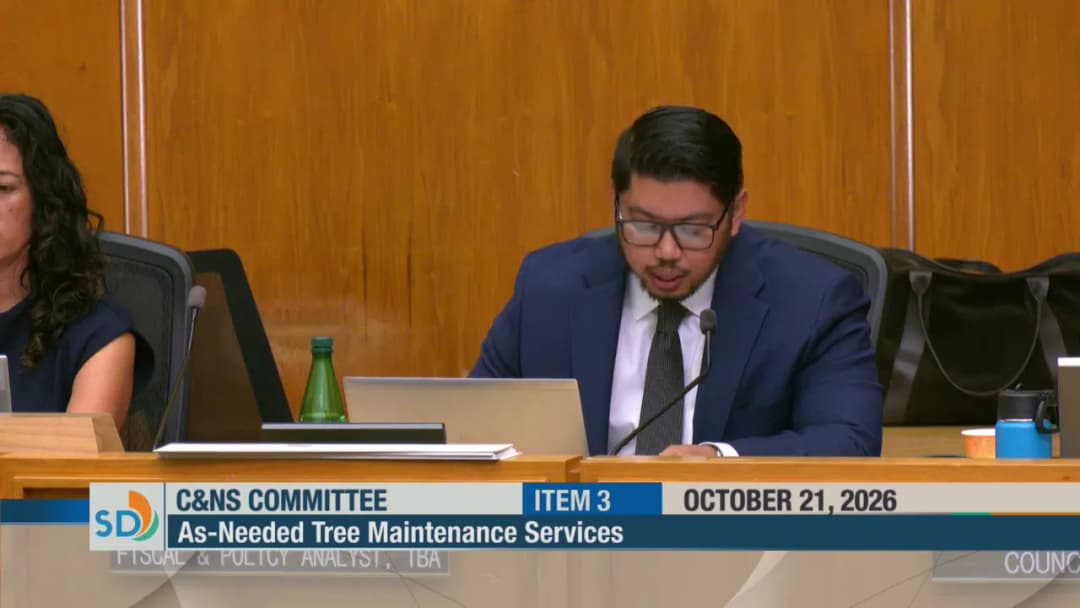
San Diego Community Neighborhood Services Committee Meeting Summary – October 21, 2026

On October 21, 2026, beginning at 10:00 UTC, the City of San Diego Community Neighborhood Services Committee met. Chair Jennifer Campbell presided, joined by Councilmember Campillo and Councilmember Foster; Vice Chair Von Wilpert was absent. The committee heard non-agenda public comment, approved the consent agenda, received an information-only presentation, and voted 3-0 on each action item. Consent Calendar - Item 1 – Approval of committee minutes from September 23, 2026: Approved 3-0. Public comment on the minutes included a request to more accurately reflect a prior speaker’s diesel shortage point, support for the committee’s smoke-free outdoor dining progress, and a question about how hookah bars would be treated under smoking rules. Public Comments & Testimony Non-Agenda Public Comment - Audra urged the committee to support Councilmember Foster’s proposed recision of the ALPR use policy and to also rescind the smart streetlight surveillance use policy, saying the council should not circumvent the will of the people. - Blair Beekman discussed cannabis equity, the city budget deficit, and the transition away from Flock ALPR technology, asking for clarity on how many Flock cameras would be removed and how they differ from Ubicua smart streetlight cameras. - Catherine Rhodes urged the city to change the word host to host/owner in the municipal code to close a loophole she said would allow the Turquoise Tower project to convert apartments into short-term vacation rentals. She also proposed using an economic opportunity approach for Midway Rising and placing affordable housing downtown. - Crypto Bradley said the city should spend some of its roughly $2 billion in reserve funds on community programs instead of letting inflation erode purchasing power. He also opposed state ADU and bike lane mandates. - Kathleen Lippett urged that city investments reflect council values, opposed fossil fuel investment, and criticized marijuana equity licenses and billboards on public health grounds. - Tony thanked the budget committee for voting to rescind the Flock contract, described opposition to Flock cameras as bipartisan, and questioned why the city council continued supporting them. - Becky Rapp asked the committee to agendize the sale and transfer of cannabis business permits, saying residents currently lack notification and participation when a cannabis business changes ownership. - Terry Ann Skelly supported park maintenance and expansion of smoke-free and vape-free public spaces, especially near playgrounds. - Francine Maxwell called for city education and race-equity outreach to owners of mixed-use properties, particularly around trash fees and homeownership opportunities. - Judy String said delivery service ordinances need enforcement, and raised concerns about cannabis products being delivered into neighborhoods. - Stephanie McCoy and Michael Schmidt also offered brief community comments. Information Item: San Diego LGBT Community Center (Item 7) - Karina Pugh, Senior Policy and Advocacy Analyst, presented an overview of the center. She said the center was founded in 1971, is one of the largest LGBTQ+ centers in the nation, and has grown from a $6.5 million budget in 2018 to $17 million. Service visits are up 33% since 2018, from 82,000 to more than 109,000 visits annually. More than 345,000 people in San Diego County identify as lesbian, gay, or bisexual. The center has over 800 volunteers and provides housing, youth, behavioral health, veterans, and civic engagement services. - Public comment included Audra opposing minors receiving services without parental consent; Madison supporting the center and citing CDC data on tobacco use disparities; Francine Maxwell raising concerns about HRC accessibility; Kathleen Lippett urging that services not exclude non-LGBTQ people who face similar challenges; and Tony expressing support but arguing that Flock surveillance would target the LGBTQ community. - In response, Pugh clarified that the center does not provide medical procedures or prescriptions; it connects people to medical and gender-affirming care providers. The item was information-only and required no vote. Discussion Item: Short-Term Residential Occupancy Ordinance Amendments (Item 6) - Venus Molina, Chief of Staff for Councilmember Campbell, presented amendments to the Short-Term Residential Occupancy (STRO) ordinance. She reviewed the history of the 2021 Campbell compromise, the 1% whole-home cap outside Mission Beach, the 30% cap in Mission Beach, the May 1, 2023 implementation date, and $167 million collected from STR operators since the ordinance began. - Proposed amendments included defining primary residence, clarifying tier two home sharing, requiring county assessor/residential building records, barring licenses for tenant protection ordinance violators, strengthening utilization and reporting requirements, improving safety and land use compliance, and extending the coastal overlay sunset clause from January 2030 to January 2038. - Numerous hosts and industry supporters testified, including Mark McDonald, Fabiola Murphy, Eric Wilson, Kimberly Jackson, Sean Murphy, Larry Webb, Fred Sue, Ben Lyon, Bill Brewer, Suzanne Christensen, Rachel Kretzer, Liz Lerner, and representatives of the Carpenters Union and Local 619. Many supported the amendments while asking the city not to burden responsible hosts. - Jay Goldberg of Nice Neighbors said 12–15% of active whole-home Airbnbs are in multifamily buildings that were vacated and converted, and called for closing the fake host loophole and enforcing one owner, one license. Catherine Rhodes also supported one owner/one license and opposed corporate ownership. Gary Wanacut argued the city has broad police power to amend the ordinance. Audra said the rules target working families and infringe on property rights. Kevin Hastings disputed Councilmember Campbell’s historical estimate of 22,000 vacation rentals and opposed extending the sunset. Dan opposed increased regulation, and Crypto Bradley said the city should focus enforcement on large operators. - Councilmember Campillo asked detailed questions about the difference between host and owner, proxy licenses, and enforcement against tenant protection ordinance violators. City Treasurer staff and the Deputy City Attorney explained that the ordinance allows one license per host, including lessees, and that proxy abuse can be treated as a violation subject to revocation, while TPO enforcement is often initiated through complaints. Councilmember Campbell noted that short-term rental TOT payments have contributed $247 million to the general fund since 2022. - The committee voted 3-0 to adopt the STRO amendments. Discussion Item: As-Needed Tree Maintenance Services Contract (Item 3) - Michael Jones, Assistant Deputy Director, Parks and Recreation Department, presented the RFP for as-needed tree maintenance services. The recommended contract is with West Coast Arborist for a not-to-exceed amount of $30 million over five years, with $3.62 million allocated for fiscal year 2027, $26,399,800 for the remaining contract period, and $1,000 for the parks and recreation maintenance assessment districts management fund. - The Independent Budget Analyst’s office noted that the fiscal year 2028 contract value increases by roughly $2.4 million, or about 66%, compared to fiscal year 2027, followed by average annual increases of about $437,000 or 6.9%. The IBA said the not-to-exceed amount is the maximum, not a guaranteed annual expenditure. - Public comment included Audra criticizing the vendor and alleging incentive problems in tree maintenance; Mike Pallett, Vice President of West Coast Arborist, expressing support for the contract; Calvin Barrios of LIUNA Local 89, representing West Coast Arborist workers, supporting the award; Crypto Bradley urging consultation with the Balboa men’s club before tree removals; and Raynal supporting use of a San Diego business but raising concerns about underfunded MADs in flood-prone areas. - The committee voted 3-0 to approve the contract and funding actions. Discussion Items: Mission Bay Beach Bar and Mooring Fee Changes (Items 4 & 5) - Patrick Hadley, Deputy Director for Mission Bay and Shoreline, presented two linked items stemming from a fraud hotline complaint about beach bar permit management. The audit produced 10 recommendations; the proposed changes move the beach bar program from perpetual annual renewal to a two-year lottery, prioritize San Diego residents and mooring holders, actively maintain a waitlist, and adjust fees based on benchmarking against Long Beach, Santa Barbara, Delray Beach, and San Diego Bay mooring operators. - The proposed beach bar fee would increase from $266 to $347. The annual mooring fee would remain $1,244 in January 2027, with an increase planned for July 2027. A new replacement sticker fee and annual CPI adjustment were also proposed. - Matt Helm, Assistant City Auditor, said the items align with the audit recommendations. He noted the prior waitlist had more than 400 people, some waiting as long as 200 years, and praised the department for completing the fee benchmark study in-house ahead of schedule. - Public comment included Audra questioning the size and timing of the fee increase and demanding transparency about where fee revenues go. Crypto Bradley commented on neglected city leases and said the city had been giving permit holders a bargain. - The committee approved Item 4 (beach bar program code changes) by 3-0 and Item 5 (fee updates) by 3-0 as separate votes. Discussion Item: Ocean View Hills Zone A/Nicano Maintenance Assessment District Formation (Item 2) - Michael Jones presented the proposed Ocean View Hills Zone A, or Nicano, Maintenance Assessment District (MAD). The district is required as a condition of development by property owner Tri-Point Homes, will be separate from the adjacent Ocean View Hills MAD, and will fund enhanced medians, rights-of-way, open space maintenance, and related services. Formation requires two council dates: approving intent and mailing ballots on the first date, and ordering formation and authorizing funds on the second date after a public hearing. - Public comment included Audra raising a point of order about quorum and the Brown Act; Raynal expressing concern that the new MAD could receive funding while other communities remain underfunded; and Crypto Bradley saying poor maintenance citywide, including streets near Mission Bay, shows the city’s neglect. - The committee voted 3-0 to approve staff’s recommendation for the formation process. Key Outcomes - Consent agenda approved 3-0. - Information item on the San Diego LGBT Community Center received; no vote required. - Item 6, amendments to the Short-Term Residential Occupancy Ordinance, approved 3-0. - Item 3, the $30 million West Coast Arborist tree maintenance services contract, approved 3-0. - Item 4, Mission Bay beach bar program changes, approved 3-0. - Item 5, beach bar and mooring fee updates, approved 3-0. - Item 2, Ocean View Hills Zone A/Nicano MAD formation process, approved 3-0. - All votes were 3-0 with Vice Chair Von Wilpert absent. The meeting was adjourned to the next regular committee meeting, scheduled for January 2027 after next year’s legislative calendar is approved.

SHORT TERM RENTALS 29% · PUBLIC COMMENT 18% · LGBTQ RIGHTS 10% · PUBLIC LANDS MANAGEMENT 9%
20
OCT 20, 2026 · SAN DIEGO, CALIFORNIA · CITY COUNCIL
San Diego City Council Meeting – October 20, 2026

The San Diego City Council convened on Tuesday, October 20, 2026, for a regular meeting. The session opened with a land acknowledgement and the Pledge of Allegiance, followed by the approval of proclamation items and consent agenda items. Public comment was heard on both the proclamations and the consent agenda, and non-agenda public comment covered a range of community issues. All items were passed unanimously. Consent Calendar - Proclamations (Items 30–32, S500, S502, S504): The council approved proclamations recognizing Filipino American History Month, Captain Alberto Leos Day, Dr. Maria Carriero Ceniceros Day, California Flood Preparedness Week, Colonel R. Eric Herman Day, and Bill Walton Tie-Dye Day (November 6, 2026). - Consent Items (Items 10, 60, 100–104, S501, S503): The consent agenda included adoption of a municipal retention schedule, a future budget legislative calendar, conflict-of-interest code amendments, and adoption of the 2025 California Fire Code. Notably, Item S501 established a warning sign requirement for cryptocurrency ATMs. Public Comments & Testimony - Proclamation Public Comment: Speakers offered a mix of support and criticism. Joy Sanyata spoke in favor of the Filipino American and Bill Walton proclamations. Audra criticized the council for spending time on proclamations while ignoring pressing issues such as flood preparedness and police accountability. Others supported the flood preparedness week and the recognition of Captain Leos and Bill Walton. The city’s Filipino American Employees Association also testified in support of the Filipino American History Month proclamation. - Consent Agenda Public Comment: Barry Berman (AARP) and William P. Toom (Senior Affairs Advisory Board) spoke in support of the cryptocurrency ATM warning ordinance, describing it as a practical safeguard for older adults. Blair Beekman and Hector also commented, with Hector expressing skepticism about the council’s agenda and referencing “Gloriaville.” Bob Kazuski questioned the need for renaming the “master records schedule” to “municipal retention schedule,” calling it wasteful. - Non‑Agenda Public Comment: Topics included concerns about the Dreama for Change contract at the OLOT (21 deaths reported), criticism of Flock surveillance cameras and Ubiquita, public safety and wildlife issues at La Jolla Cove (request for consistent ranger presence and enforcement), the proposed county cannabis expansion, the bicycle master plan’s omission of impairment data, youth substance use prevention, and a request to preserve the Ethos Exchange community space in Ocean Beach. Discussion Items - Council members spoke in favor of the proclamations. Councilmember Campillo highlighted flood preparedness and the city’s work to go beyond federal floodplain standards. Councilmember Campbell shared personal memories of Bill Walton and promoted the Bill Walton Classic. Council President Pro Tem Lee and Councilmember Foster celebrated Filipino American contributions. Councilmembers Ilo Rivera and La Cava stressed the importance of the cryptocurrency ATM ordinance. - The council recognized the city clerk’s office for its diligent work and treated public commenters with respect despite occasional hostility. - No substantive debate occurred on consent items; the council accepted them as a block. Key Outcomes - Votes: All proclamation items passed 7–0 (Councilmembers Whitburn and Von Wilpert absent). The consent agenda, including the cryptocurrency ATM warning ordinance and fire code adoption, passed 7–0. - Next Steps: The cryptocurrency ATM warning sign requirement will take effect after passage. The office of the council president will conduct a day of action to inform businesses. The council will not hold its scheduled 2 p.m. session; the meeting was adjourned upon completion of non-agenda public comment. - Notable: Council President La Cava noted that the nomination of Bethany Bzack as Chief Operating Officer was docketed for the council’s consideration on Monday, October 19, 2026, which appears to precede this meeting date; this discrepancy was not resolved in the record.

PUBLIC SAFETY 20% · PUBLIC COMMENT 19% · PARKS AND RECREATION 9% · HOMELESSNESS 8%
OPENPUBLICA · PUBLIC MEETING INDEXUPDATED DAILY · openpublica.com