Browse by city
Date range
Search help

Search titles, summaries, topics and stored transcripts together. Keywords may match separately; put the whole query in double quotes for a phrase. Matching follows word analysis, so punctuation is not exact. Both dates are included. Documents are not searched.

SHOWING 21–30 ENTRIES
21
OCT 19, 2026 · SAN DIEGO, CALIFORNIA · CITY COUNCIL
San Diego City Council Confirms COO Bethany Bizak, Approves Loans, October 19, 2026

The San Diego City Council met on Monday, October 19, 2026, reconvening from closed session at 2 p.m. The council unanimously confirmed the appointment of Bethany Bizak as Chief Operating Officer, approved two $50 million state revolving fund loans for critical water and sewer infrastructure, and voted on litigation strategies stemming from the January 2024 flooding and a national assault weapons case. Public Comments & Testimony - Item S400 (COO Confirmation): A large majority of speakers supported the confirmation. Supporters included representatives from the San Diego Municipal Employees Association, Downtown San Diego Partnership, SDG&E, ASME Local 127, Hillcrest Business Association, La Jolla Friends of Coastwalk, San Diego Firefighters Local 145, the San Diego Padres, the San Diego Police Officers Association, and Teamsters 986. They cited Ms. Bizak's responsiveness, operational expertise, and collaborative leadership. Opposing speakers criticized the $460,000 starting salary as excessive and questioned the nominee's independence from the mayor. - Items 200 & 201 (Infrastructure Loans): Joyce Yata expressed support for the low-interest loan terms. A speaker criticized the loans as a consequence of long-term infrastructure neglect. Blair Beekman urged the city to maintain community accountability when working with state agencies. Lori Saldania questioned the risk of stormwater and saltwater infiltration at Pump Station 2. - Non-Agenda Public Comment: Several speakers addressed the use of Flock automated license plate reader (ALPR) cameras, with Anthony Ralphs discussing his viral protest and Blair Beekman advocating for leaving Flock as a vendor. Other topics included a call for a ban on disposable nicotine vapes, a request for discretionary review of cannabis business ownership transfers, and a plea for youth prevention education based on UC San Diego research on cannabis and cognitive development. Discussion Items Item S400: Confirmation of Bethany Bizak as Chief Operating Officer Mayor Todd Gloria presented the appointment, stating Ms. Bizak had earned his "highest confidence" by delivering results in previous roles leading the Stormwater, Transportation, and Performance and Logistics departments. Bethany Bizak stated her priorities would be strengthening city operations, supporting employees, and maintaining infrastructure. The Office of the City Auditor and the Director of Personnel praised her cooperation and commitment to accountability. Councilmembers broadly praised her knowledge, blunt communication style, and focus on execution. Councilmember Foster questioned her on plans for equity, transparency, and clearing the backlog of audit recommendations, while expressing broader reservations about the administration's culture. Councilmember Elo Rivera discussed the COO's operational authority over homelessness and efforts to improve community volunteerism. Councilmember Moreno asked for her top three priorities, which Bizak listed as listening to field teams, monitoring the FY27 budget, and delivering near-term milestones like Midway Rising and storm preparedness. Items 200 & 201: State Revolving Fund Loans - Pump Station 2 (Item 200): Staff requested approval for a $50 million Clean Water State Revolving Fund loan at an estimated 2.3% interest for the modernization of Sewer Pump Station 2, which serves 2.3 million residents and has not had a major upgrade since 1992. The total project cost is $160 million. - El Monte Pipeline (Item 201): Staff requested approval for a $50 million Drinking Water State Revolving Fund loan at an estimated 2.3% interest to replace aging pipes. The total project cost is $66 million. Key Outcomes - COO Confirmation (S400): Bethany Bizak was confirmed by an 8-0 vote. Her total annual compensation is $541,000. She was sworn into office immediately following the vote. - Infrastructure Loans (200 & 201): Both $50 million loans were approved unanimously by 8-0 votes. - Closed Session Item CS3 (Amicus Curiae): The council voted 7-0 to join an amicus brief in support of Cook County, Illinois, in the U.S. Supreme Court case defending its regulations on assault weapons and large-capacity magazines. - Closed Session Item CS6 (Flooding Litigation): The council voted 7-0 to authorize the initiation of litigation related to the January 22, 2024, flooding event.

PERSONNEL MATTERS 30% · PROCEDURAL 11% · PUBLIC SAFETY 11% · PUBLIC COMMENT 10%
22
OCT 16, 2026 · SAN DIEGO, CALIFORNIA · LAND USE & HOUSING COMMITTEE
Land Use & Housing Committee Meeting on Midway Rising DDA and EIFD, October 16, 2026

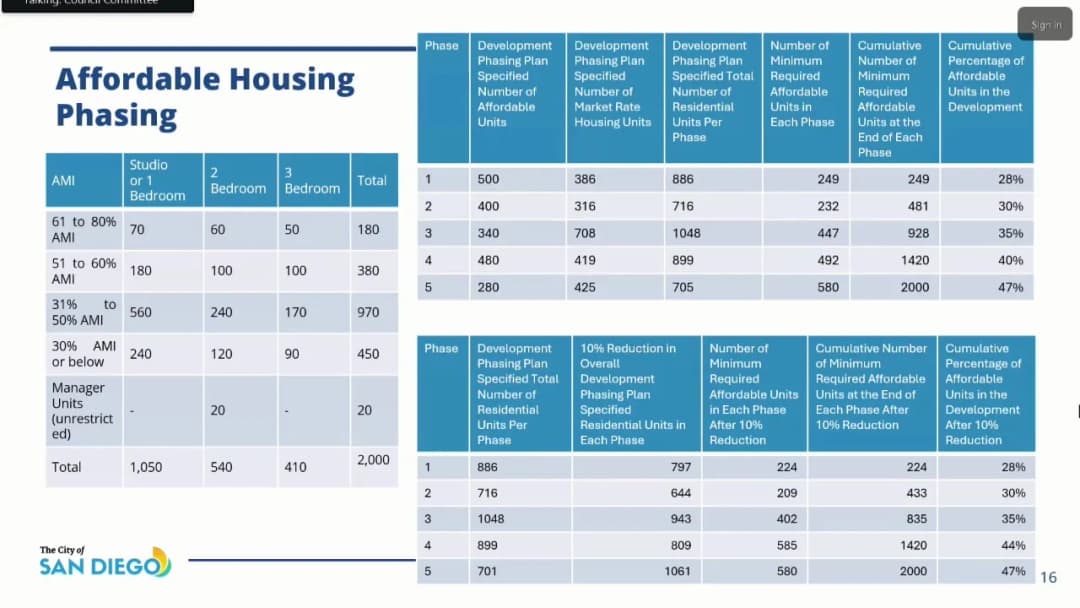
The Special Land Use and Housing Committee of the San Diego City Council met on October 16, 2026 (Chair Lee presiding) to consider the disposition and development agreement (DDA) for the Midway Rising project on the Sports Arena site and the related Enhanced Infrastructure Financing District (EIFD). The committee heard extensive public testimony and received presentations from city staff and the Independent Budget Analyst (IBA). Both items were unanimously approved for forwarding to the full City Council. Consent Calendar The committee unanimously approved the consent agenda (4-0), including approval of prior meeting minutes, acceptance of endowment funds for the Clayton Vernal Pool Preserve, acceptance of 8.56 acres of land in East Elliott from the Mission Trails Regional Park Foundation, the declaration of city-owned property at 4069 30th Street as surplus land (with Councilmember Whitburn noting it was requested to prioritize affordable housing development on the site), and a 25-year franchise agreement with Jet Infrastructure Holding IA LLC. Public Comments & Testimony Consent Agenda: Public commenters raised a range of issues. One speaker urged government shutdown. Others expressed support for the land donations and the surplus land declaration. Discussion Items (Items 6 & 7): The committee heard approximately 70 speakers spanning several hours of testimony. - Supporters: A large coalition of labor unions (IATSE Local 122, Carpenters Union, Laborers Local 89, Unite Here), affordable housing developers and residents (Chelsea Investment, Pacific Southwest CDC, Serving Seniors, San Diego Regional Center), pro-housing advocates (YIMBY Democrats, Build SD, Circulate SD), the San Diego Regional Chamber of Commerce, the Midway Pacific Highway Community Planning Group, and other community organizations argued the project would deliver urgently needed housing (especially the 2,000 affordable units), create thousands of good union construction and permanent jobs, revitalize a blighted area with parks and infrastructure, and was a fair deal for the city. - Opponents and Concerns: Several residents voiced strong opposition or serious concerns. They cited significant environmental risks, including the site's location on a floodplain, sea level rise, high groundwater, and soil contamination from toxic waste. Speakers argued the long-term financial return to the city was insufficient, the 85-year lease was too long, the risk of off-siting affordable housing was not adequately addressed, traffic gridlock was unmitigated, and the project would primarily benefit developers. Michael Aguary specifically called for a Project Labor Agreement before approval. Discussion Items - Midway Rising DDA (Item 6): Christina Bibler (Economic Development) presented the $4.2 billion project, including 2,000 affordable housing units (at 30-60% AMI), an expansion-ready 16,000-seat arena, 14.5 acres of parks, and 7,000 parking spaces. The developer assumes all construction and financing risk. The city retains land ownership under 85-year ground leases. Revenue to the city includes ticket fees on arena tickets (starting year 11) and participation rent from market rate housing, projected to be between $880 million and $1.2 billion in nominal value ($23-69 million in present value). - Enhanced Infrastructure Financing District (Item 7): Richard Eyre (Finance) explained the EIFD would capture $1.2 billion in future property tax increment (city and county shares) over 45 years to reimburse the developer for approximately $370 million in eligible upfront public infrastructure costs (roads, parks, utilities). The IBA noted this functions as a low-interest (3%) financing mechanism for the city. - Independent Budget Analyst (IBA) Presentation: The IBA concluded the agreement represented a "fair and reasonable balance of risks, financial returns, and public benefits." They noted the developer bears the primary risk but flagged potential vulnerabilities in the affordable housing tax credit market and the long-term reliance on EIFD revenue. Key Outcomes - Item 6 (DDA) – Approved 4-0: The committee approved the DDA with an amendment proposed by Chair Lee and seconded by Vice Chair Rivera. The amendment requires the DDA to be revised to prohibit Midway Rising's 2,000 affordable units from serving as receiver sites to satisfy other projects' affordable housing requirements unless all other available funding options for gap financing have been pursued and exhausted, as verified by the city. - Item 7 (EIFD) – Approved 4-0: The committee approved the resolution of intention to form the Midway Rising Enhanced Infrastructure Financing District. - Post-Meeting Referrals: - Councilmember Whitburn requested the IBA provide an analysis to the full City Council on the potential scope of affordable units that could be offsited to Midway Rising under current rules. - Councilmember Rivera requested city staff (Economic Development) work with the committee to bring forward a Land Development Code amendment restricting city-owned or city-leased sites from serving as receiver sites for another development's offsite affordable housing obligation.

AFFORDABLE HOUSING 46% · PUBLIC COMMENT 8% · ECONOMIC DEVELOPMENT 8% · PUBLIC ENGAGEMENT 6%
23
OCT 15, 2026 · SAN DIEGO, CALIFORNIA · ENVIRONMENT COMMITTEE
San Diego Environment Committee Meeting, October 15, 2026

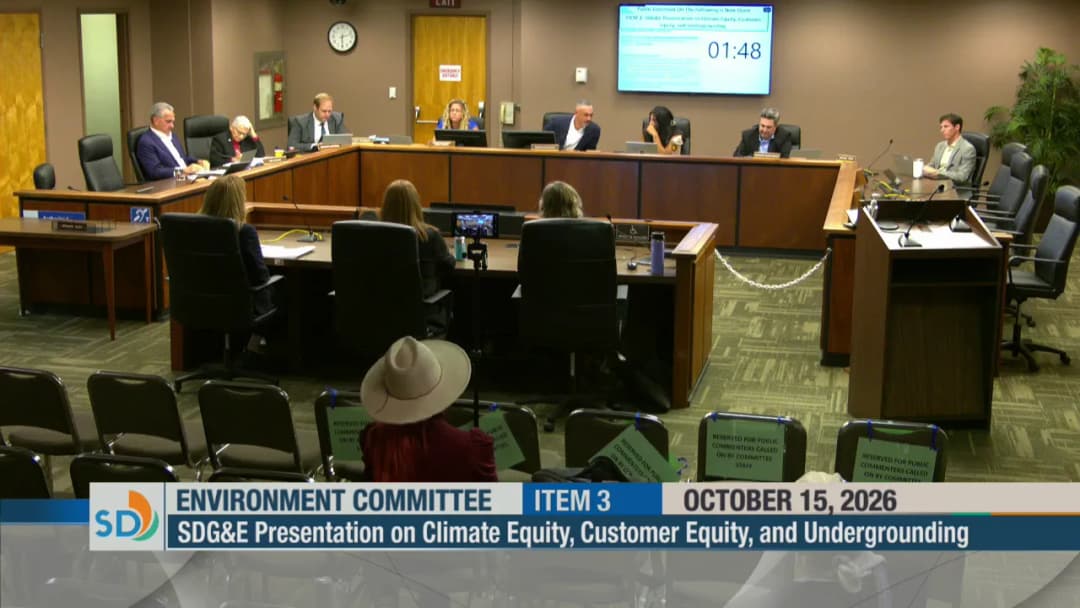
The Environment Committee of the San Diego City Council, chaired by Elo Rivera, met on October 15, 2026. The committee unanimously approved a consent agenda for a wastewater pumping contract and received a comprehensive annual presentation from SDG&E covering climate equity, customer equity, and the undergrounding program. Public testimony addressed a wide range of issues including conditions at homeless shelter sites, sea level rise, tobacco waste policy, and concerns over the potential grid and rate impacts of a proposed massive data center. Consent Calendar - Item 1: Approval of the committee minutes of September 17, 2026. - Item 2: Authorization of a contract with Patriot Environmental Services for as-needed vacuum pumping services at public utilities wastewater treatment facilities. - Public Comment: Joyce Sanyata raised concerns about workforce diversity reporting on the contract. John Stump criticized the staff report format. Hector expressed support for private contracting to avoid long-term municipal pension liabilities. - Council Discussion: Council President Joe Lakaba moved the items, defending the staff report and clarifying the scope of the pumping contract. - Outcome: Motion passed unanimously. Public Comments & Testimony Non-Agenda Public Testimony: - Multiple speakers (Amy Wiedenhoff, Cecilia Portal, Daniel, and others) described severe environmental and health hazards at the city's safe sleeping site, including flooding, rat infestations, and inadequate tents. Chair Rivera committed to following up on the concerns raised. - Joyce Sanyata celebrated the Port of San Diego's Maritime Clean Air Strategy and its new electric harbor cranes. - Lori Saldania linked recent street collapses and sewage leaks in the Midway area and La Jolla Shores to sea level rise and groundwater intrusion, urging the committee to consider these factors when approving new housing. - Becky Rapp urged the committee to address the exclusion of cannabis single-use vapes from state ban AB 762. - Terry Ann Skelly and Judy Strang requested the Environment Committee's support for a citywide ordinance banning smoking and vaping in outdoor dining areas. - Hector requested a live, 24-hour webcam at the Tijuana River to monitor sewage flows. Consent Agenda Testimony: - Speakers reiterated concerns about infrastructure neglect, contracting processes, and sea level rise risks as they related to the pumping contract. Item 3 (SDG&E Presentation) Testimony: - Joyce Sanyata praised the undergrounding and wildfire safety programs but questioned how SDG&E parent company Sempra's mission of "Building America's leading utility growth business" translates to real customer equity. - Allegedly Audra strongly condemned the clean energy narrative as toxic and unworkable, citing lithium battery fire risks and non-recyclable infrastructure, and expressed deep distrust of SDG&E's cost structure. - John Stump criticized the staff report for lacking required Equal Opportunity details and key stakeholder input, demanding workforce zip code data for climate accounting. - Lori Saldania questioned the wisdom of coastal undergrounding given rising groundwater and noted her family's six-year wait in Claremont. - Hector criticized SDG&E's delivery charges as 80% of the bill and the utility's opposition to rooftop solar. - Lori Lipsman asserted that SDG&E's actions lack climate and customer equity. - Natalie Ratchke expressed concern about underground trenching harming tree root systems. - Jay Powell questioned the city's capacity to lead the undergrounding program given budget cuts and criticized IOUs for opposing plug-in solar. Discussion Items Item 3: SDG&E Annual Update on Climate Equity, Customer Equity, and Undergrounding - Presentation: SDG&E (Megan Ong, Alex Moffitt, Kelly) presented on their work under the Energy Cooperation Agreement. Topics included support for the Climate Action Plan (CAP) via electrification of 41 city sites, customer assistance programs (CARE at 267k customers, 98% eligible enrollment), and the undergrounding portfolio (31 active projects covering 220 miles, $39 million spent in FY26, $78 million projected for FY27). - Council Discussion & Positions: - Chair Elo Rivera challenged SDG&E on the contradiction between equity goals and rate increases, specifically questioning the utility's attempt to exit the regional energy efficiency program (denied by the CPUC). - Chair Rivera raised a recent Voice of San Diego report regarding a developer request for an engineering study for a 400-megawatt data center at the Naval Training Center. SDG&E representatives stated they were unaware of the specific request but acknowledged that major grid upgrades required to serve such a load would likely be absorbed by all ratepayers through standard rates. Chair Rivera called the prospect of ratepayers subsidizing such a project "incredibly alarming" and stated it would likely be "offensive" to San Diegans. She committed to following up with SDG&E for a formal public response. - Council President Lakaba discussed customer equity, noting the connection between 211 calls for energy bill assistance and homelessness, and encouraged better program enrollment coordination. He also discussed undergrounding project delays and the frustration caused by premature notices sent to residents. Key Outcomes - Consent Calendar (Items 1 & 2): Approved unanimously. - Item 3 (SDG&E Update): Received and filed as a formal information item to the committee. - Directives & Next Steps: - Chair Rivera will follow up with city staff on conditions at the safe sleeping site. - Chair Rivera committed to following up directly with SDG&E regarding the proposed data center and its potential impact on residential ratepayers and the climate action plan. - Council President Lakaba will follow up with the city's UUP team on the specific status of the Muirlands undergrounding projects. - The next Environment Committee meeting is scheduled for Thursday, November 12, 2026, at 1:00 PM.

ENERGY AND SUSTAINABILITY 15% · UTILITIES UNDERGROUNDING 13% · PUBLIC COMMENT 13% · ENVIRONMENTAL PROTECTION 9%
24
OCT 14, 2026 · SAN DIEGO, CALIFORNIA · RULES COMMITTEE
San Diego Rules Committee Meeting Summary — October 14, 2026

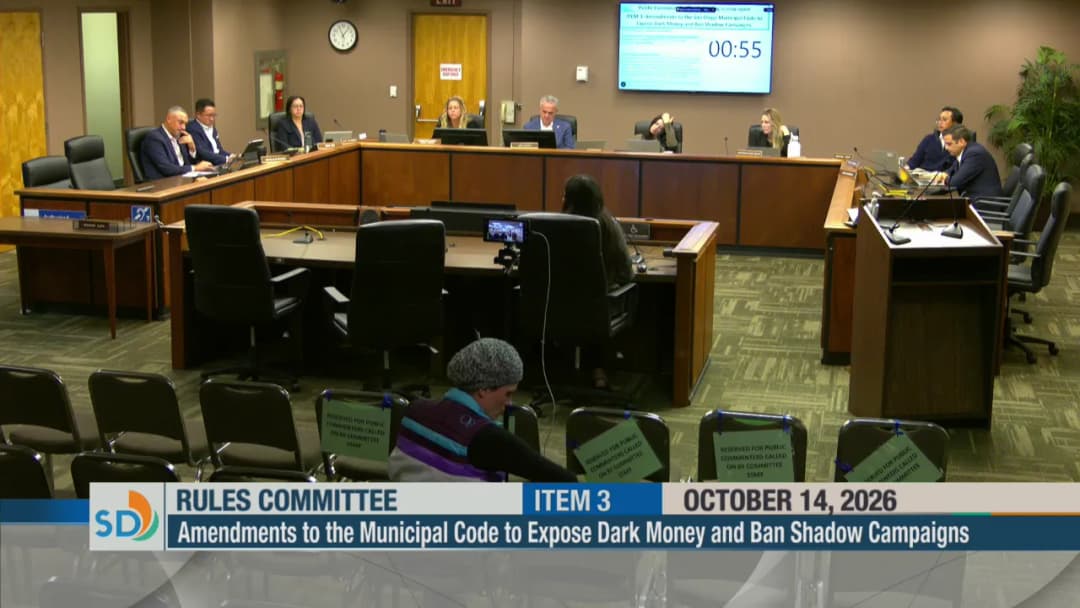
The Rules Committee met on October 14, 2026, with Chair Joe LaCava presiding. Council President Pro Tem Lee, Councilmember Elo Rivera, and Councilmember Campillo participated; Councilmember Moreno was absent. No agenda or minutes were included in the source material, so this summary is based on the raw transcript. The committee took the agenda out of order: after non-agenda public comment and the consent calendar, it heard the Funds Commission information item, then the two campaign-finance discussion items. Consent Calendar - Item 1 — Approval of the committee minutes of September 16, 2026. No member pulled the item. After public comment, Councilmember Elo Rivera moved approval, seconded by Council President Pro Tem Lee. The motion passed unanimously; Councilmember Moreno was absent. Public Comments & Testimony - Non-agenda, in person: Joyce Anyatta said rapid, large municipal-code changes and resource constraints made it hard for the public to trust the process. Max Schmidt opposed the city government and called for a government shutdown. Audra urged the city to revoke contracts with Dreams for Change and the Downtown San Diego Partnership over safe-sleeping-site conditions, alleging a federal lawsuit, deaths, and hidden sexual assaults. Anthony Rouse criticized a $3.1 million police-station fence and urged redirecting SDPD funds to faster response times and programs such as No Shots Fired. - Non-agenda, virtual: Catherine Rhodes urged the council not to approve Midway Rising on Friday, citing the lack of a final geotechnical investigation and deep foundation recommendations down to 60 feet. Madison encouraged city public-health messaging on high-potency cannabis risks. Becky Rapp asked for a municipal-code ban on marijuana billboards, citing AB 2249. Natalie Ratchke described a desperate housing plea and called for low-cost, outside-the-box supports. Crypto Bradley alleged lease mismanagement and proposed a public, weekly lease-review committee. Judy Strang said she was missed in virtual public comment because of the flow around a no-quorum decision. Blair Beekman discussed SeaWorld, Dreams for Change, Flock ALPR contract questions, and the need for positive community-government communication. - Item 1 (minutes): Max Schmidt opposed; Audra said the minutes omitted words that changed meaning; Blair Beekman asked a clarifying question about SB 707 and boards/commissions; Natalie Ratchke praised citizens who participate; Lori Saldania warned about sea-level-rise liability tied to the SeaWorld agreement; Crypto Bradley said he had trouble accessing the minutes. - Item 4 (Funds Commission): Audra cautioned against redirecting donor-restricted funds; Max Schmidt opposed; Joyce Anyatta said she generally trusted the funds management and thanked the donors; Catherine Rhodes said the city has $2.3 billion in funds, criticized the presentation for omitting pension funds and fund-balance information; Blair Beekman noted loud library elevators; Crypto Bradley suggested following Nancy Pelosi’s stock picks; Becky Rapp asked the commission to refer a cannabis-tax audit request to the Rules Committee. - Item 2 (Fundraising ordinance): Audra questioned enforcement; Max Schmidt opposed; Joyce Anyatta supported; Anthony Ralphs strongly supported. Virtual speakers included support from Blair Beekman and Natalie Ratchke, skepticism from Crypto Bradley, a suggestion from Renault to use a 14-month window, and opposition from Catherine Rhodes, who called the rule unconstitutional and requested a written city attorney opinion. - Item 3 (Dark money/shadow campaigns): Audra questioned whether fines would deter violations; Max Schmidt opposed; Joyce Anyatta said she remained on the fence; Anthony Ralphs supported. Virtual comment included support from Blair Beekman, Natalie Ratchke, and Renault; opposition and a request for written constitutional analysis from Catherine Rhodes; and skepticism from Crypto Bradley. Item 4 — Funds Commission Presentation (Information Item) - City Treasurer (the transcript alternates between 'Liz Carey' and 'Liz Gray') and Funds Commission Chair Skylar McCurin presented. The commission supervises seven trust funds under Charter Section 41A: Benjamin Memorial Library, Effie Earle Sargent Memorial, Los Peñasquitos Canyon Preserve, Gladys Edna Peters Memorial, Jane Cameron La Jolla Library, Philip L. Green Memorial, and Mount Hope Cemetery Perpetuity Fund. - The non-cemetery funds use a target allocation of 65% stocks and 35% bonds. Mount Hope has a separate charter-based policy designed for income, with 36% allocated to risk assets such as stocks and real estate. - Performance: Mount Hope gains were driven by equity exposure, with Northern Trust slightly overweight versus the policy index. The other funds’ net returns were approximately 9–10% over 7 and 10 years, double-digit over 1 and 3 years, and near 9% year-to-date through August 31, 2026. - Chair LaCava said this was the first year under the amended Council Policy 000-26 requiring departments to report how restricted fund dollars were spent, in addition to investments and revenue. This was an information item, so no motion was required. - Councilmember Elo Rivera asked about reports that Mount Hope Cemetery burials would end. Parks and Recreation Director Andy Field said the city is only beginning discussions and no decision is imminent. Chair LaCava also told public commenters seeking an audit to take the request to the Audit Committee. Item 2 — Ending Perpetual Fundraising Ordinance - Deputy Chief of Staff Rosa Lasquaga, on behalf of Councilmember Elo Rivera, presented a proposed amendment to San Diego Municipal Code Section 27.2938. Because the state moved the presidential primary to March, current rules allowed odd-numbered districts to fundraise for 14 months before the primary and even-numbered districts for 17 months. The proposal would create one consistent start date exactly one year before the election for every candidate. - Councilmember Elo Rivera said the City Clerk first identified the inconsistency. The city attorney’s office cautioned that the draft is not final. - Councilmember Campillo raised questions about the original ethics commission rationale, self-financing, incumbent-challenger equity, and which committees would be covered; Council President Pro Tem Lee noted a possible roll-over surplus loophole. - The committee moved the recommendation unanimously; Councilmember Moreno was absent. Item 3 — Amendments to Expose Dark Money and Ban Shadow Campaigns - Rosa Lasquaga presented a draft framework to: expand the definition of candidate and electioneering communications to capture pre-candidacy spending; require disclosure of the true original source and top five funders on communications; label AI-generated or AI-altered content; and require copies of public communications to be filed with the City Clerk. The proposal draws on Arizona Proposition 211, Rhode Island and Los Angeles disclosure rules, and California AB 2355. - The Independent Budget Analyst said the Ethics Commission may need additional enforcement resources; no significant fiscal impact to the Clerk’s office was identified. The city attorney again noted the draft is under legal review. - Councilmember Campillo expressed constitutional concerns about compelled speech, independent expenditures, nonprofits being retroactively treated as electioneering, short advertisements, and donor phone numbers; he requested a city attorney legal memo before final council action. - The Ethics Commission executive director asked to be included in the drafting process and cited enforcement-resource and law-overlap concerns. - Council President Pro Tem Lee raised definitional questions about 'clearly identified,' lookback periods, original-source tracing, disclosure text size, and feasibility. - Councilmember Elo Rivera moved approval of the staff recommendation, plus a request for the City Clerk to work with the city attorney on establishing a cost-recoverable campaign filing fee similar to the Secretary of State’s. Chair LaCava seconded. The motion passed unanimously; Councilmember Moreno was absent. Councilmember Elo Rivera said the item should return to committee if significant changes are made during legal review. Key Outcomes - Approved the September 16, 2026 committee minutes unanimously (Moreno absent). - Took no action on the Funds Commission information item. - Approved the ending-perpetual-fundraising ordinance recommendation unanimously (Moreno absent), advancing it to full council. - Approved the dark-money/shadow-campaign staff recommendation and the campaign-filing-fee request unanimously (Moreno absent); final legal review and drafting remain, with possible return to committee if the draft changes substantially. - The next regularly scheduled Rules Committee meeting is Wednesday, October 28, 2026, at 9:00 a.m.

PUBLIC COMMENT 30% · CAMPAIGN FINANCE 29% · CAMPAIGN FINANCE REFORM 16% · FUNDS COMMISSION 8%
25
OCT 14, 2026 · SAN DIEGO, CALIFORNIA · PUBLIC SAFETY & LIVABLE NEIGHBORHOODS COMMITTEE
San Diego Public Safety Committee Meeting Summary - October 14, 2026

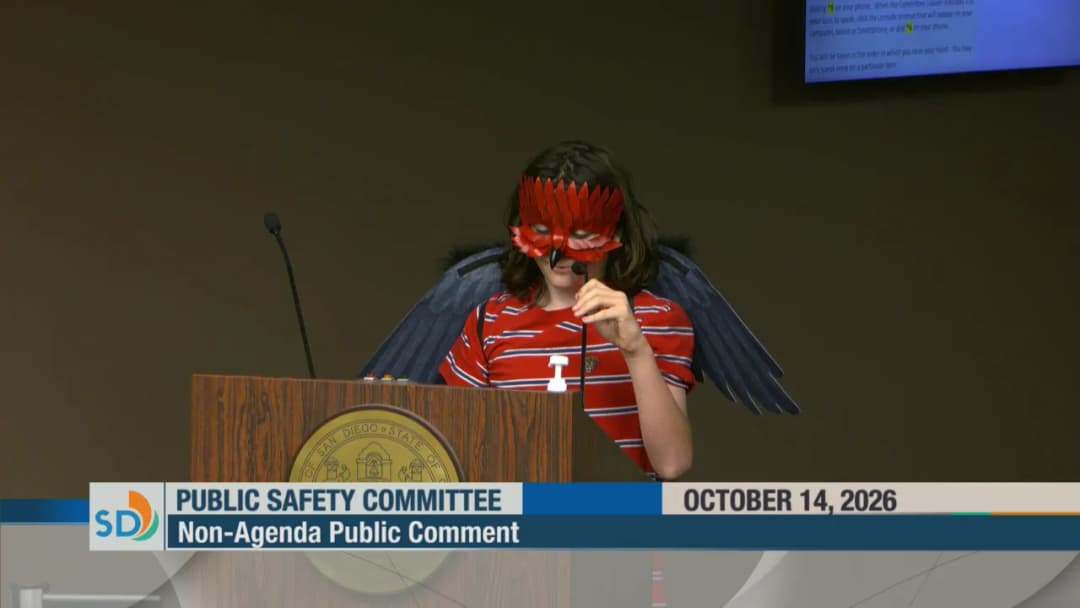
The San Diego City Council's Public Safety Committee met on October 14, 2026, chaired by Chair Von Wilbert, with Vice Chair Kimpio and members Campbell and Whitburn present. The agenda included the approval of the consent calendar, discussions on proposed responses to two grand jury reports (concerning the Commission on Police Practices and fire safety inspection compliance), and non-agenda public comment. Consent Calendar The consent calendar included the approval of committee minutes from September 16, 2026, and the authorization of a contract with Rotorcraft Support Incorporated for police helicopter maintenance. Item 2, a contract for tow management dispatching software, was pulled from the agenda and returned to staff. The consent calendar passed unanimously. Public Comments & Testimony - Consent Calendar: Speakers expressed concerns about contractor accountability and questioned the police department's use of AI technology. Some speakers opposed the helicopter contract due to noise pollution, while another suggested the city explore using local San Diego companies for the maintenance work. Criticism was also directed at the repeated removal of Item 2 (Flock-related) from the agenda, which speakers alleged was politically motivated. - Item 4 (Commission on Police Practices): Multiple speakers criticized the city's proposed response to the grand jury report. Speakers argued the Commission on Police Practices (CPP) has operated under interim procedures for over two and a half years and lacks genuine authority. A resident shared grievances about specific police brutality cases (Kanoa Wilson, Christopher De Arman) and stated that no city council members or law enforcement personnel attend CPP meetings. One speaker called the city's response "shameful" and stated police are not cooperating with the commission. A speaker also alleged that a significant portion of body camera footage is unaudited and complaints are miscategorized. - Item 5 (Fire Inspection Compliance): Speakers sharply criticized the city's response. A speaker labelled the argument that inspection quality trumps completion rates a "massive failure," noting a 42% backlog in state-mandated inspections. Another speaker expressed complete trust in Fire Chief Logan and defended the fire department against the grand jury's findings, arguing the department needs more resources. Speakers also highlighted the impacts on low-income residents living in uninspected buildings. - Non-Agenda Public Comment: Extensive testimony was provided against the use of Flock ALPR cameras, citing privacy violations, data leaks, and sharing with federal immigration authorities. A speaker claimed audit logs show San Diego Police sharing data with federal agencies in violation of state law SB 34. Other speakers addressed issues at the Tent City shelter operated by Dreams for Change, the need for a police vehicle pursuit review board, fire hazards from dry vegetation along freeways, and the lack of grid capacity inspections for new developments. Discussion Item: Response to Grand Jury Report on Commission on Police Practices Trisha Tackey of the Office of the Independent Budget Analyst (IBA) presented the city's proposed response to the grand jury report on the CPP. The city's proposed response largely disagreed or disagreed in part with the grand jury's findings, noting that the CPP operates under interim procedures, has appointed an executive director (Roger Smith), and that independent investigation capabilities are pending the completion of collective bargaining. Councilmember Whitburn confirmed with Executive Director Smith that a $200,000 budget allocation for CPP software is progressing through the RFP process. Captain Judd Campbell of SDPD Internal Affairs noted improved communication and the timely sharing of investigation files with the CPP. Councilmember Campilio requested the final response to council clearly distinguish the CPP's current staffing from the staffing needs required for independent investigations. The committee unanimously voted to forward the response to the full city council. Discussion Item: Response to Grand Jury Report on Fire Inspection Compliance Trisha Tackey (IBA) presented the response to the grand jury report, "Playing with Fire," which focused on fire safety inspection rates. The city's response disagreed with key findings, arguing that inspection quality is a more critical factor than completion rates alone. The Fire Marshal stated that a multi-year staffing analysis is being finalized for council review and that a 95% inspection compliance rate is a realistic target given the dynamic nature of the inspection inventory. The committee unanimously voted to forward the response to the full city council. Key Outcomes - Consent Agenda: Approved unanimously (Motion Kimpio, Second Campbell). - Grand Jury Response on Commission on Police Practices: Approved unanimously for forwarding to full council (Motion Whitburn, Second Campbell). - Grand Jury Response on Fire Inspection Compliance: Approved unanimously for forwarding to full council (Motion von Wilbert, Second Campbell). - Next Meeting: Adjourned to November 18, 2026.

PUBLIC SAFETY 32% · POLICE OVERSIGHT 21% · FIRE SAFETY 14% · PUBLIC COMMENT 12%
26
OCT 13, 2026 · SAN DIEGO, CALIFORNIA · CITY COUNCIL
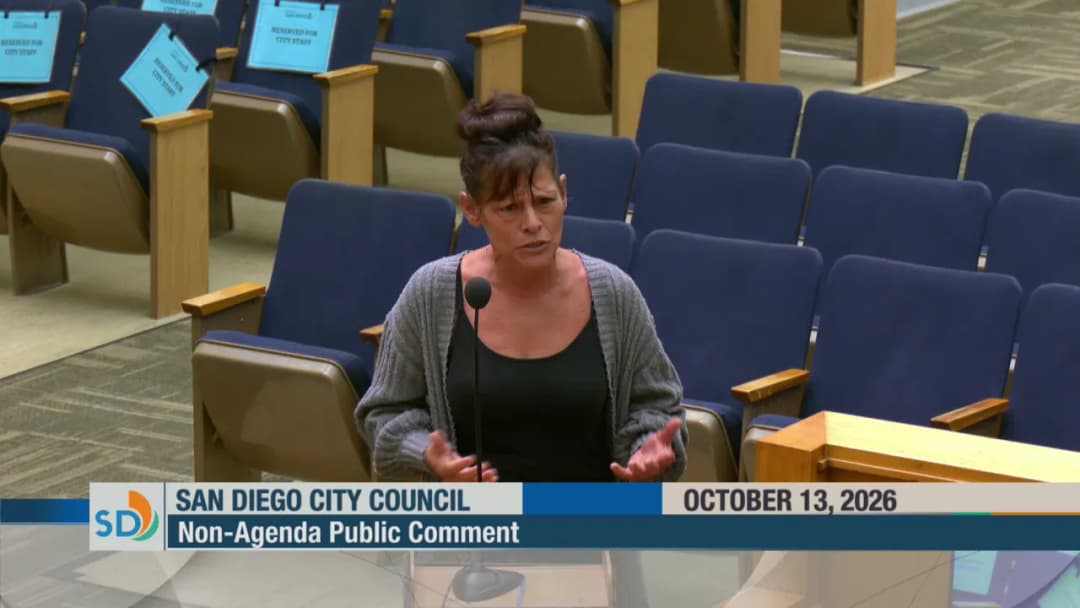
San Diego City Council Meeting Recap: October 13, 2026

The San Diego City Council met on Tuesday, October 13, 2026, in a session that ran from the morning into the afternoon. The council unanimously approved a series of proclamations adopting the consent agenda, passed amendments to the Earned Sick Leave and Minimum Wage Ordinance to strengthen local wage theft enforcement, and approved the long-awaited update to the SeaWorld Master Plan with a formal commitment to transition from fireworks to drone displays. Public testimony covered topics including redevelopment at Midway, sea-level rise adaptation, homelessness policy, and drug regulation. Proclamations - Item 30 (Employee Appreciation Month): Recognized over 13,000 city employees. Councilmembers highlighted specific departments and individuals. - Item 31 (E.G. Maxilum Day): Honored the football coach and community mentor from Allied Gardens for his service to youth sports. - Item S500 (Breast Cancer Awareness Month): Councilmember Marnie Von Wilpert shared her personal Stage 2 breast cancer diagnosis and successful treatment this summer, strongly urging preventative screenings. - Item S501 (Pregnancy and Infant Loss Remembrance Day): Councilmember Sean Ila Rivera shared a personal story of loss. The proclamation notes that approximately 1 in 4 known pregnancies end in miscarriage. - Item S503 (William Bagayan Madamba Day): Recognized the 100th birthday of the WWII guerrilla fighter and retired U.S. Navy Chief Petty Officer. Consent Calendar - Item 10: Approval of Council Minutes. - Item 50: Authorization of a contract with Bootworld Inc. for safety footwear for city personnel, increasing the not-to-exceed amount to $7 million. - Item S504: Setting a public hearing for November 17, 2026 at 2 PM regarding the creation of an underground utility district in Claremont. - Item S505: Amending the Municipal Code to consolidate the Department of Cultural Affairs into the Economic Development Department. Discussion Items - Item S502: Strengthening Wage Theft Enforcement: Councilmembers Von Wilpert and Ila Rivera introduced amendments to the city's minimum wage and sick leave ordinance to expressly authorize the city to bring civil action to recover unpaid wages on behalf of workers and to clarify overtime pay recovery. Staff noted that in FY2025 the U.S. Department of Labor recovered over $259 million in back wages nationwide. Supporters (San Diego Building and Construction Trades Council, Center on Policy Initiatives) stated that 87% of surveyed local workers report experiencing wage theft. Opponents argued the city should resolve its own internal labor disputes and city employee overtime abuse before expanding enforcement authority. - Item 330: SeaWorld 2020 Master Plan Update: The council approved the park's first master plan update in over two decades, shifting its framework from specific project designations to criteria for five planning areas. The key amendment, introduced by Council President Lacava and accepted by the motion maker, formalizes the transition away from fireworks. Under the amendment, once the California Coastal Commission permits drone shows, SeaWorld can conduct a maximum of 30 fireworks displays per year. SeaWorld President Tyler Carter stated the park is a tenant in good standing and highlighted that the park rescued over 500 animals in 2025. Key Outcomes - All votes were 8-0 (Councilmember Moreno absent). - Item S502: Adopted. The city gains explicit authority to pursue civil wage recovery actions on behalf of employees. - Item 330: Approved with amendment. Fireworks capped at 30 annually upon Coastal Commission approval of alternative nighttime entertainment (drones). - Next Meeting: The council adjourned to Monday, October 19, 2026, at 10 AM. Public Comments & Testimony (Non-Agenda and General) - Midway Rising: Catherine Rhodes strongly opposed the Midway Rising project, calling affordable housing funding a "$1.6 billion gifting of taxpayer funds." Lori Saldania urged integration of sea-level rise adaptation into the development plan, citing flooding and traffic hazards. - Homelessness: Amy Wiedenhoff and Audra described severe conditions at the Dreams for Change tent city, alleging contract violations and inhumane conditions. John LEA advocated for qualitative data collection from homeless individuals to improve the response system. - Drug Policy: Becky Rapp and Barbara Gordon urged the council to address Kratom and marijuana use, citing reports that 91% of youth arrestees reported marijuana use and 48% of adults surveyed by SANDAG reporting driving after use. - City Governance: Francine Maxwell criticized council engagement and the brevity of public comment periods. Crypto Bradley criticized city management of leases, alleging millions in lost revenue. - SeaWorld/Mission Bay: Speakers were divided, with many supporting the fireworks transition to protect wildlife and reduce noise. The San Diego Bird Alliance requested fireworks end immediately to protect nesting birds like elegant terns.

PUBLIC COMMENT 35% · PROCEDURAL 11% · WAGE THEFT 9% · REPRODUCTIVE HEALTH 6%
27
OCT 12, 2026 · SAN DIEGO, CALIFORNIA · CITY COUNCIL
San Diego City Council Meeting - October 12, 2026

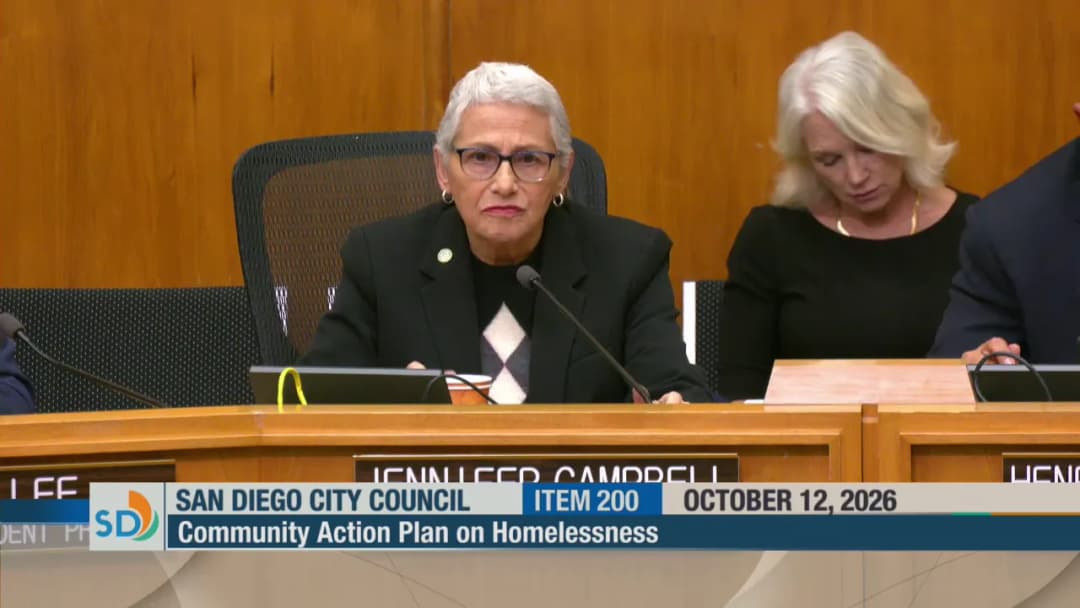
The San Diego City Council met on Monday, October 12, 2026, with Council President La Cava presiding and City Clerk Deanna Fuentes conducting roll call. No separate agenda or minutes were supplied with the transcript, so this summary is based on the spoken record. After the invocation, land acknowledgement, and Pledge of Allegiance, the council took up two docketed items: the appeal of the Hearing Officer's approval for the 10509 Vista Sorrento Parkway project (Item 201) and an informational update on the Community Action Plan on Homelessness (Item 200). No consent calendar was presented. Procedural Matters - The Clerk called the roll and a quorum was present. - The Clerk explained public testimony rules: one minute per person for docketed items, two minutes for non-agenda public comment; remote speakers can press star 9; once virtual testimony begins, no in-person testimony is taken. - No requests for continuance were made. Item 201 - Appeal of Hearing Officer Decision, 10509 Vista Sorrento Parkway Project - Development Services project manager Martin Mendez presented the appeal. He noted that a memorandum was distributed that afternoon containing the applicant's response to the appellants, the applicant's presentation, and a staff correction to permit condition 47. - Staff described the project: a 5.58-acre site in the Mira Mesa Community Plan area, zoned IL-3-1; demolition of an existing four-story, 84,000-square-foot office building; phased construction of a four-story, approximately 112,400-square-foot office building and a six-story, approximately 189,780-square-foot parking garage; vacation of a four-foot-wide easement never used for its intended purpose; and associated site improvements. Approvals included a coastal development permit, a neighborhood development permit for alternative square footage calculations within the MCAS Miramar APZ2, a site development permit for environmentally sensitive lands/MHPA, and a public service easement vacation. - The Mira Mesa Community Planning Group voted 11 to 1 on April 17, 2023, to recommend approval with a condition that the project be consistent with the Mira Mesa Community Plan. The Hearing Officer approved the project with modifications on June 10, 2026. On June 24, 2026, SAFER, represented by Lazau Jury LLP, appealed the decision and the environmental determination on grounds including factual error, findings not supported, and new information. - Staff argued that the environmental determination was a CEQA Guidelines Section 15162 consistency evaluation, not an appealable environmental determination, and that none of the conditions requiring a subsequent or supplemental EIR were present. Staff also said project-specific VMT, air quality, noise, and biological analyses were consistent with the Mira Mesa Community Plan Update PEIR, and that operational noise in the MHPA would not exceed 60 decibels. - The applicant, Tim Ward of Health Peak Properties, presented the "Sereno Summit South" project: about 113,000 square feet of office space, roughly 30,000 square feet per floor, about 250 anticipated employees, LEED Gold certification, and parking garage EV/bike charging and shade. He said Health Peak has been in San Diego since 1985, manages about 1.7 million square feet of local life sciences space, and owns nearby Wateridge development. Item 201 - Public Comments and Appellant Testimony - A speaker identified as Audra opposed the project, arguing that demolition of a former laboratory building could release biohazards into the air and soil, and that the city focused on GHG, VMT, and noise impacts while ignoring biohazard and public health risks. - Joy Sanyata supported the project, praised the city's analysis and the Mira Mesa Community Planning Group's vote, and urged the council to deny the appeal and affirm the Hearing Officer's decision. - Maximilian Schmidt opposed the project and made additional unrelated allegations about council members and downtown San Diego. - Remote speaker Lori Saldania asked whether the design would incorporate updated LEED heat-resilience standards, including outdoor cooling stations, emergency backup power, paving with solar reflectance of 0.33, open-grid pavement systems, and shaded exterior spaces. - Another remote speaker raised concerns about VMT, public transit, and possible contamination from prior uses such as gas stations or data centers. - After the initial public comment period, appellant attorney Aleha Kretcher of SAFER argued that the council should grant the appeal. She said the city cannot rely on the 2022 Mira Mesa PEIR and a Section 15162 memo because the project has a recognized significant and unavoidable transportation impact. Citing Communities for a Better Environment v. California Resources Agency, she argued the city must make project-level findings or adopt a statement of overriding considerations. She also argued that the city failed to consider feasible noise mitigation such as rubberized asphalt, which can reduce tire-pavement noise by about three to five decibels, and asked the council to require additional environmental review before reconsidering the project. Item 201 - Council Action - Council President Pro Tem Lee, representing District 6, moved to approve staff's recommendation: deny the appeal, affirm the Hearing Officer's approval, and correct permit condition 47 to identify Vista Sorrento Parkway rather than Sorrento Valley Road. Councilmember Campbell seconded the motion. - The council voted to approve the motion. The Clerk announced that the vote passed unanimously; the transcription then says "five to four" while naming four absent members, so the vote appears to have been 5-0 among members present. Item 200 - Community Action Plan on Homelessness Update - Sarah Jarman, Director of Homelessness Strategies and Solutions; Casey Snell, Senior Vice President of Homelessness and Housing Stability Initiatives at the San Diego Housing Commission; Lisa Jones, President and CEO of SDHC; and Tamar Kohler, CEO of the Regional Task Force on Homelessness, presented the update. - The Community Action Plan is the city's 10-year strategic plan, approved in October 2019 and updated in November 2023. - Progress metrics since 2023: supportive housing increased by 419 beds to 6,804, described as 12% of the total inventory needed to reach the 2029 goal; rapid rehousing declined by 172 beds to 1,352, with 3,252 additional beds needed by 2029; crisis response increased by 319 beds to 3,061, with another 146-611 beds needed; prevention reached 1,016 resources compared with the 2,025 annual need, about 50% of the annual goal; diversion reached 1,114 resources compared with the 2,700 annual need, about 41% of the annual goal. - Compared with the 2019 baseline, overall system capacity increased 95%, from 5,924 to 11,572 resources. Supportive housing increased 11%; rapid rehousing increased 54%; crisis response increased 75%; and safe parking increased 196%. Transitional housing decreased 42%, with reinvestment expected to begin in 2027. - In calendar year 2025, 211 received about 19,000 housing instability calls, a 30% increase over 2019. About 84% of callers needed help within one week, more than 90% were not currently experiencing homelessness, and callers were more likely to be Black, to have a disability, or to receive Medi-Cal or CalFresh. - Cost figures included: FY26 SDHC prevention averaged $7,735 per household; diversion averaged about $2,939-$3,269 per household; housing instability prevention averaged just over $11,000 per household; crisis response averaged $48-$67 per bed night; rapid rehousing averaged $17,721 per household annually; supportive housing averaged $22,801-$35,942 per household annually; and FY26 supportive housing capital costs were about $564,953 per unit. SDHC advised that new permanent supportive housing units are difficult to develop for under $600,000 due to interest rates, tariffs, and economic conditions. - System performance measures: length of homelessness increased 27%; returns to homelessness decreased 0.7%; exits to permanent housing increased 36%; and the gap between households entering homelessness and households successfully housed has narrowed each year since FY23. - Racial equity data showed that Black San Diegans are about 5% of the county population but 15-43% of participants in city/SDHC programs, with overrepresentation in prevention, diversion, and rapid rehousing. The presentation noted HUD data changes make Hispanic/Latino comparisons difficult, and that seniors are a growing share of people experiencing homelessness. Staff also corrected a typo in the safe sleeping slide regarding minors. - The IBA's Division of Race and Equity, through Kim Desmond, requested disaggregated data from all partners and suggested considering an update to the 2022 report on homelessness among Black San Diegans. Tamar Kohler said federal constraints prevent the regional continuum from continuing that equity work, but public dashboards and data remain available to the city. - Tamar Kohler also highlighted that the city's plan anchored the regional plan and helped the region access state HAP funding. Item 200 - Public Comments - A speaker in chambers called the update "propaganda," alleged about 40 deaths at a safe sleeping site, and said providers were failing; she called for audits of Dreams for Change and the Downtown San Diego Partnership. - Joy Sanyata praised the presentation and asked for qualitative metrics in addition to quantitative data. - Maximilian Schmidt asked for an investigation into the Alpha Project Bridge Shelter and made unrelated allegations. - Natalie Rashke said prevention helped her avoid eviction, and asked whether the city is using AI and think tanks to improve homelessness policy. - John Brady commended frontline workers, said the mayor's leadership team on homelessness no longer exists, raised disability accommodation concerns, and noted the growing number of homeless seniors. - Anthony Ralphs thanked staff and council members with lived experience and highlighted racial and intergenerational disparities in homelessness. - Remote speaker Lori Saldania asked for an update on the Bradley v. City of San Diego lawsuit regarding safe sleeping sites and raised concerns about flooding, humane conditions, and abuse at tent camps. - Catherine Rhodes cited affordable housing built at about $260,000 per unit elsewhere, asked about 24-hour safe sleeping at H Barracks, and proposed placing 10,000 affordable housing units onto the successor agency obligation schedule. - Kathleen Lippett said parks and open spaces feel less safe and argued homelessness services must be accompanied by deterrence. - Julia Porter, who said she had been housed after years on the street, urged more senior-specific services and preparation for disabilities. - One remote speaker said the city team ignored immigration and called for deportations; another speaker praised PACT and urged flexible and negotiable encampment leadership. - Judy Strang, a retired social worker, asked for logistical details about the coordinated shelter intake process and the client feedback system, including hours, in-person availability, response times, and staffing. Item 200 - Council Discussion and Directives - Council President La Cava said the item was docketed outside the budget conversation so the council could take a larger role in homelessness policy. She noted the item was informational only and required no motion. - Councilmember Elo-Rivera stressed prevention, diversion, and permanent housing; called housing a human right; and criticized overlapping efforts among city departments, SDHC, and the county. He asked about deaths at safe sleeping sites and whether the city is providing substance use disorder services. Staff said they make on-site referrals, held a recovery effort at OLAT that transitioned 19 people into recovery, and are working to place a 24/7 substance-use provider on site, with a commitment to notify council once secured. Staff also said contracts for Dreams for Change and the Downtown San Diego Partnership expire June 30, 2026 with one option year, and that complaints about 20th and B are taken seriously and considered in contract renewal. - Councilmember Campbell called homelessness a health care problem, praised progress, and emphasized five needs: uniting providers, outreach, wraparound services, housing and shelters, and auditing. She also asked about county behavioral health and public housing laws; the City Attorney offered to discuss the housing law questions offline. - Councilmember Whitburn said people experiencing street homelessness are sometimes told no when they ask for shelter, called that inhumane and unacceptable, and prioritized getting people off the streets today. He cited medical examiner data showing deaths among people experiencing homelessness fell from 627 in 2023 to about 495 in 2024 and 375 in 2025. - Councilmember Foster questioned whether progress is visible in his district, said the point-in-time count is a flawed minimum count, and requested documentation of outreach in creeks, canyons, and open spaces. He asked for a clear org chart and accountability structure, district-level deployment data for outreach, HOT teams, and PATH, and follow-up on Universal Terms of Service concerns, shelter length of stay, and case-management expectations. Staff agreed to provide memos and district-level data. - Council President La Cava said she would consider whether the Community Action Plan should be updated and how service provider performance measures could be discussed. Non-Agenda Public Comment - Because the afternoon ran long, the council took non-agenda public comment in chambers and deferred remote non-agenda speakers to 10:00 a.m. the following morning. - Speakers included one who made allegations about the "deep state," a University of San Diego student who thanked the council for democratic engagement, a speaker who praised the Audit Committee, a speaker who raised police accountability and criticized the settlement paid to Cano Wilson's family, and speakers who discussed AI, homelessness prevention, and unrelated conspiracy claims. Key Outcomes - Item 201: The council denied the appeal and affirmed the Hearing Officer's decision approving the 10509 Vista Sorrento Parkway project, with permit condition 47 corrected to reference Vista Sorrento Parkway rather than Sorrento Valley Road. This was the only formal vote of the meeting. - Item 200: No vote was taken. The council received the update and issued follow-up requests for data and reports, including outreach deployment documentation, district-level deployment data, continued work on racial disparities in homelessness, and notification once on-site substance use services are secured. - Administrative note: Remote non-agenda public comment was scheduled for 10:00 a.m. the next morning.

HOMELESSNESS 45% · PUBLIC COMMENT 20% · PUBLIC ENGAGEMENT 6% · ENVIRONMENTAL PROTECTION 6%
28
OCT 7, 2026 · SAN DIEGO, CALIFORNIA · AUDIT COMMITTEE
Audit Committee Meeting - October 7, 2026: Follow-up Report and Discussion on Open Recommendations

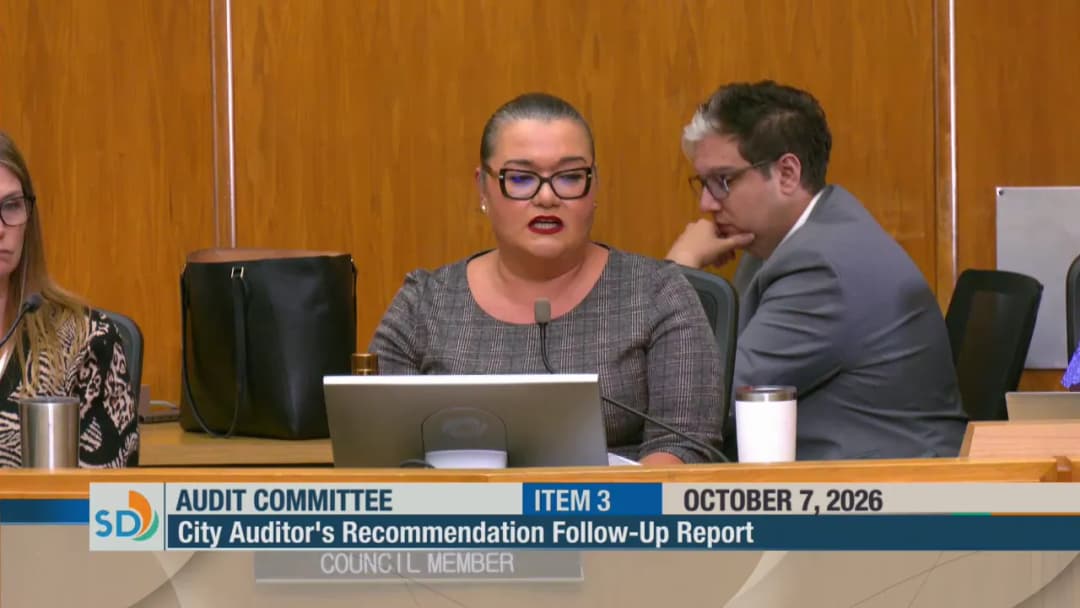
The Audit Committee of the San Diego City Council convened on Wednesday, October 7, 2026, at 5:00 PM (17:00 UTC). The meeting was chaired by Council Member Moreno, with Vice Chair Foster, Committee Member Halpern, and Committee Member Mafia present. The primary agenda item was the Office of the City Auditor's Recommendation Follow-up Report, which reviewed the status of 189 open audit recommendations, including 107 past their original implementation dates. The committee discussed implementation progress, revenue opportunities, and challenges across multiple city departments. Consent Calendar - Item 1: Approval of the committee minutes from September 2, 2026 – Approved unanimously (4-0, with one member absent). - Item 2: City Auditor's monthly activity report – Approved as part of the consent agenda. Public Comments & Testimony - Non-Agenda Public Comment: - Maximilian Schmidt described being homeless and targeted by organized persecution, alleging torture and ID theft. He demanded an end to the alleged harassment. - A speaker (name not provided) criticized a $3.1 million fence at the downtown police station (1401 Broadway), questioning the expenditure and urging an audit of the cost. He argued the fence sends a wrong message and that police should not need such protection from the public they serve. - Becky Rapp called for a comprehensive performance audit of the Cannabis Business Division, noting it was identified as a risk area in the FY2023 risk assessment but no audit has been conducted. She questioned the transparency of the city's process for evaluating identified risks. - Joyce Sanyata expressed excitement about the Draft Performance Management Principles and Practices, highlighting principles such as purpose, outcomes, transparency, and adaptive systems. - Madison requested an audit of marijuana edible exposures among children in San Diego County, asking for detailed data on product types, THC concentrations, and packaging to inform prevention efforts. - Blair Beekman spoke about open participatory democracy and the need for public oversight on surveillance technology, advocating for local government leadership in setting best practices. - Consent Agenda Public Comment: - Maximilian Schmidt opposed approval of the minutes, alleging “liberal fascism” and requesting lie detector tests for council members regarding Second Amendment enforcement and occult practices. - Blair Beekman commended the committee’s work and commented on the monthly audit report, noting the complexity of the street light repair program and the importance of tech accountability. - A caller (phone ending 870) thanked Blair and asked questions about the street light audit (surveillance connection), cybersecurity (AI and FBI hack), and SDPD internal affairs (lawsuit and Supreme Court decision). - Discussion Item (Item 3) Public Comment: - Maximilian Schmidt opposed the recommendation follow-up report, calling for city hall to be shut down due to alleged “underground genocide.” - Hector commended the auditor for exposing fraud and suggested hiring convicted white-collar criminals to help recover money. - A caller (phone ending 870) praised the 26 new recommendations and asked why 107 recommendations are past due, what obstacles exist, and expressed concern about the city's operating principles lacking explicit core values. - Blair Beekman stressed the need for better communication between city government and the community. - Tony (phone) criticized the discrepancy between staff-provided information and actual performance, and referenced a San Diego Union-Tribune report on unenforced tenant violations and mismanaged real estate. Discussion Items - Item 3A: Office of the City Auditor's Recommendation Follow-up Report – Section A (Recommendations for Committee Action) - Building Acquisitions Audit (Recommendation 7): The committee discussed the ongoing issue of ensuring city staff provide complete and accurate information to the council. Management declined to implement attestations. The city attorney’s office had added charter section 32.1 to the personnel manual, and HR updated the employee code of conduct. The auditor recommended closing as “partially implemented, no further action,” but committee members expressed concern that the risk was not fully mitigated. Council Member Foster argued that performance evaluations should incorporate accuracy requirements. The motion was modified to keep Recommendation 7 open (not closed) pending further action. - Code Enforcement Audit (Recommendations 2, 7, 8): The department requested consolidation of recommendations 2, 7, and 8 into recommendations 9 and 10, citing budget cuts and staffing losses (50% reduction over two years). The auditor proposed closing them as “will not implement” with the understanding that the underlying risks would be addressed through remaining recommendations. The committee questioned how the department ensures cases needing attention are identified under the current manual process (using Power BI instead of automated reports). The motion passed to close recommendations 2 and 8, but keep recommendation 7 open. - Item 3B: Discussion of Audits Recommended for Committee Discussion (Led by Committee Members Halpern and Mafia) - Real Estate Portfolio Management (Audit 1902): Discussion centered on the lack of a comprehensive Real Property Management Plan (PMP) since 2011. The economic development department reported that a consultant is needed but not resourced. The committee expressed frustration that the city does not know the total value of its real estate portfolio, potentially leaving millions in revenue uncollected. Staff noted a 91% increase in real estate transactions over two years and an internal analysis that an additional $10 million per year could be generated if properly resourced. - Lease Management (Audit 2207): Several priority-one recommendations remain open since 2022. The department reported progress on holdover leases (reduced from 25% to 17.5%) and on centralizing lease management. However, recommendation 9 (oversight of non-competitively priced leases) is tied to the PMP and remains outstanding. - Leased Golf Courses (Audit 2605): The Fairbanks Ranch Country Club lease rent was increased by 41% (from 5% to 7% of revenues) following an appraisal. The IBA review of the appraisal is pending due to focus on other large projects. The committee questioned whether the rate is below market compared to Torrey Pines (9.9%). A new fee for inspections and investigations is being developed, with a target of end of FY2027. - SDPD Body-Worn Cameras (Audit 2301): Six recommendations are past due, all stuck in meet-and-confer with the police union. The audit found officers fail to record body camera video 40% of the time. The recent police union contract did not include this topic. The committee expressed strong disappointment over the delays, noting the issue has been open since July 2022. - SDPD Overtime (Audit 2408): Recommendations on eight-hour between shifts and centralized overtime are also in meet-and-confer. The department has centralized plug-and-play overtime via PD Enterprise, saving $6.8 million in FY26. A new scheduling system is in the RFP process but stalled. - Equity in Recreation Programming (Audit 2205): All 12 recommendations are past due. The Community Recreation Needs Assessment was completed in September 2026 with 10,000 responses. The department plans to present findings to the Community and Neighborhood Services Committee in January 2027 and complete a strategic plan by mid-2027. The committee noted that a $1 million funding request was not approved in FY27 and that a dedicated recreation specialist position was eliminated. - Boat Storage Permits (Audit 2505): Fees have been increased up to 50% through inflation adjustments. A fee update and municipal code amendments for a lottery system will go to committee in October 2026, with full implementation expected by spring 2027. - Stormwater Reinspection Fee (Audit 18023): This recommendation dates to June 2018. The department is reassigning existing staff to develop the fee, now targeting June 2027. The fee could generate $1.45 million to $1.5 million per year. The committee noted that every month of delay costs $100,000–$300,000 in lost revenue. - Fire-Rescue Emergency Medical Response (Audit 2606): The department is developing a dashboard to track turnout times and response times. The standards of coverage study is near completion. A budget request for capital purchases is planned for mid-year or FY28. The department will return in November 2026 with a detailed presentation on dispatch triage tools. Key Outcomes - Consent Agenda: Approved unanimously (4-0). - Section A Motions: - Motion to close Recommendation 7 (Building Acquisitions) as “partially implemented, no further action” was modified to keep Recommendation 7 open (pending further action on incorporating accuracy into performance evaluations). The motion passed (4-0). - Motion to close Recommendations 2 and 8 (Code Enforcement) as “will not implement” passed (4-0). Recommendation 7 from that audit remains open. - Section B Discussion: No formal motions taken; discussion highlighted ongoing challenges and progress. Key follow-ups include: - The IBA is to provide a review of the Fairbanks Ranch lease appraisal. - Fire-Rescue is to present a detailed dispatch and response time analysis at the November 2026 meeting. - Stormwater department is to brief council offices on the reinspection fee in the coming months. - Parks and Recreation will present the Community Recreation Needs Assessment to committee in January 2027. - Public Member Appointment: The IBA reminded the committee that applications are open for a public member position on the audit committee (requirements: 10+ years as CPA, CIA, or equivalent experience). - Next Meeting: Scheduled for Wednesday, November 12, 2026, at 9:00 AM.

AUDIT FOLLOW-UP 26% · REAL ESTATE 18% · PUBLIC COMMENT 14% · PROCEDURAL 6%
29
OCT 6, 2026 · SAN DIEGO, CALIFORNIA · CITY COUNCIL
San Diego City Council Meeting Summary: October 6, 2026

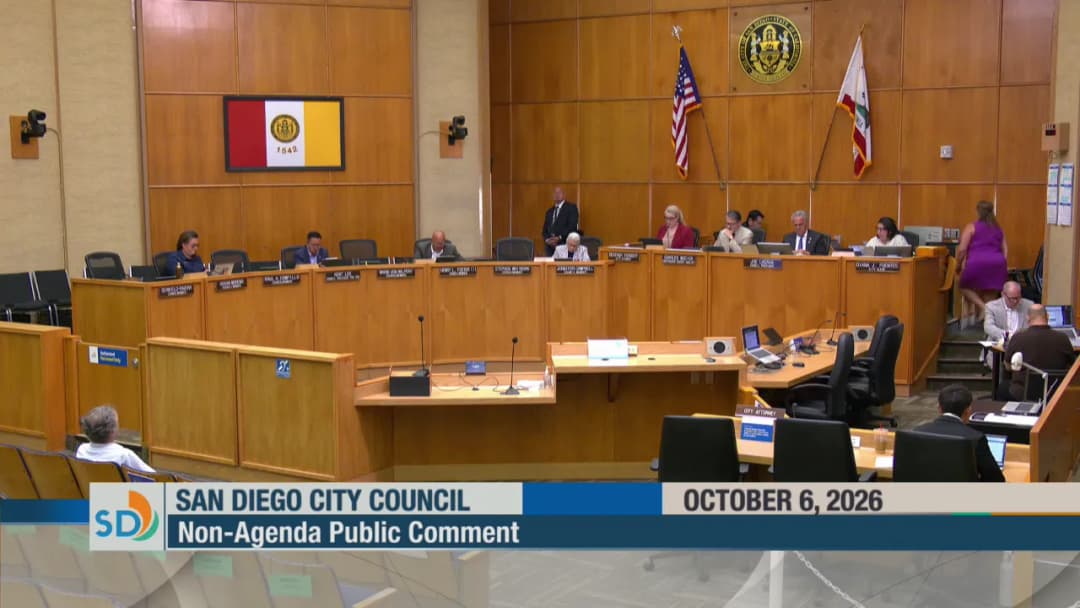
No agenda or minutes were available, so item numbers reflect statements made during the meeting. The San Diego City Council met on Tuesday, October 6, 2026, in morning and afternoon sessions. Councilmember Von Wilpert attended remotely under the Brown Act for medical reasons and disclosed that no other adults were present with her. The council approved proclamations and consent items, declared a local emergency for El Niño, and continued the water rate decision to October 27, 2026. Consent Calendar - Item 10 (approval of council minutes) and items 100-106 were approved except item S501, which Councilmember Foster pulled for separate discussion. - Clerk Deanna Fuentes listed potential appointments/reappointments on the consent agenda: item 102, Leonardo Fuel to the Mobility Board; item 103, Reagan Lawson, Matt Mengano, and John O'Malley to the Board of Building Appeals and Advisors; item 104, Lacasia Suwani and Nick Galino to the Homeless Revenue Accounts Citizens' Oversight Committee; item 105, Joel Sulestein and Peter Main Klein to the Community Reinvestment Advisory Review Committee; and item 106, findings under SB 707 to allow certain boards and commissions to meet remotely. - Public comment referenced item 100 as a third-party contract for Microsoft procurement; the clerk did not otherwise describe it. - Councilmember Campbell moved approval of the consent calendar except S501; Council President LaCava seconded. The vote passed unanimously 6-0, with Councilmembers Whitburn, Campillo, and Ila Rivera absent. - Discrepancy note: Councilmember Campbell described item 102 as a $1.6 million congressional grant for pump station 2 in District 2, while the clerk earlier identified item 102 as a Mobility Board appointment; no agenda was available to reconcile the conflicting descriptions. Public Comments & Testimony Proclamations: - Jen LaBarbera, interim executive director of Lambda Archives of San Diego, expressed gratitude for the LGBTQ+ History Month proclamation. - Kimberly Umgrady of Think Dignity thanked the council for the 20th anniversary recognition, described the organization's services, and invited councilmembers to the October 11 celebration. - Damian Robertson praised Think Dignity and described a proposal to partner with the organization on multifamily housing and apprenticeships. - Blair Beekman supported both LGBTQ+ History Month and Think Dignity, and noted that the U.S. Department of Education rescinded Title IX protections for LGBTQ students on September 28. - Maximilian Schmidt opposed the LGBTQ+ proclamation, called for more Christian proclamations, and made anti-LGBTQ statements. - Another remote speaker supported both proclamations, describing LGBTQ+ identity as part of nature and praising Think Dignity's work. Consent and S501: - Bob Kazuski questioned the need for a third-party Microsoft procurement contract and asked why the Tory Pines City Park Advisory Board was not reactivated. - Maximilian Schmidt opposed approval of council minutes and a homeless oversight appointment, making unrelated allegations. - A remote speaker supported the Microsoft/IT contract with a caveat about workforce underrepresentation, supported homeless revenue oversight, and supported remote meeting rules. - Blair Beekman urged the council to set parameters for Waymo, preserve older buildings, and ensure accountability in homeless revenue spending. - On S501, Maximilian Schmidt opposed the emergency declaration; Blair Beekman, Joy Sanyata, and Hector offered conditional support and stressed preparation, coastal waves, and cross-border sewage concerns. Water rates: - Courtney Brown (San Diego Coastkeeper) said the city must adopt a unitary rate but argued that AB 2180, signed last week, provides a faster, lower-risk path back to conservation-based tiered pricing; she asked the city to begin a new cost-of-service study. - Jack Keene said conservation should be treated as a supply resource and that it is unfair for conserving customers to be penalized. - Helen Beaupre said she paid about $450 more than expected in her first year with water in her own name and paid twice as much as neighbors; she wanted to pay for actual use. - Andrew Meyer (San Diego Bird Alliance) supported Coastkeeper and urged the council to adopt the unitary rate as explicitly temporary with a mandatory review clause. - Rachel Stewart (Coastal Environmental Rights Foundation) called the unitary rate a temporary step and urged the city to use its 10 seats on the San Diego County Water Authority board to pursue regional funding for projects such as Pure Water. - Michael Dwyer (District 2) calculated that low-volume single-family rates would rise 30% year-over-year, from $8.51 to $11.9 per HCF, adding about $25 per billing cycle. - Maria Conrad said her water bill had nearly doubled in 20 years despite using rain barrels, and she asked for rebates or offsets. - Wayne Rosenbaum (Utility Consumers' Action Network) said a flat rate removes the price signal that encourages conservation and recommended commissioning a new tiered cost-of-service study using AB 2180. - Hector said his 350-unit condo, served by one meter, might see a lower bill, but he was concerned about fixed-income residents. - Ty said he no longer saw a reason to conserve and would drain his swimming pool more often. - Dana Givitt alleged that the city had been charging meter fees and volumetric rates that the council did not approve. - Joy Sanyata asked whether the rates absorb the $40 million settlement and what a true unitary rate would be. - An iPhone caller asked about a $31 million gap after $9 million in lower water costs and whether Stantec independently audited the city's data. - Maximilian Schmidt opposed the item and made unrelated rights claims. - Anthony Ralphs said he supported the independent budget analyst's recommendation and wanted more public outreach. Non-agenda public comment: - Christopher Partridge, accompanied by his service dog Rudy, alleged that more than 300 massage parlors in San Diego facilitate sex trafficking and asked the city to shut them down. - Damian Robertson described his nonprofit and employee-owned corporations and requested a public meeting on a housing/outreach proposal. - Bob Kazuski criticized City Clerk Fuentes for not playing pre-submitted videos, requiring virtual unmuting, and requiring media to be submitted through an online portal at least two hours before the first session; he asked the council to reverse those policies and reactivate the Tory Pines City Park Advisory Board. - Maximilian Schmidt made conspiracy allegations and advocated a trade embargo on every country. - Blair Beekman spoke about responsible technology and ALPR use. - Joy Sanyata defended City Clerk Fuentes and library verification practices. - Madison urged the city to protect youth from marijuana harms, citing DEA findings including risks from edibles. - Becky Rapp cited Assembly Bill 2249 on cannabis packaging and marketing and asked the city to develop an implementation work plan, including removing marijuana billboards. - Natalie Rashke criticized the Midway Rising lease renewal, saying it deferred housing and revenue and surrendered city leverage. - Hector criticized several mayoral policies and made crude and derogatory statements. - Judy Strang, a social worker, urged city coordination with county programs designed to keep children in their homes. - Terri Ann Skelly, a public health educator and parent, raised concerns about marijuana storefronts and young adults, citing the Monitoring the Future survey. - Lori Saldonia criticized the scheduling of the Land Use and Housing Committee and warned that the Midway project could face flooding similar to Oakland's Coliseum Connections. Discussion Items Proclamations: - Item 32 (Kiwanis of La Jolla 100th Anniversary Day) was returned to staff at the request of the honoree before action on the remaining proclamations. - Councilmember Campbell, a self-described member of the Stonewall generation, spoke in support of LGBTQ+ History Month and read Councilmember Whitburn's remarks on the Busalaki family's 40 years in business and 60 years in San Diego. - Councilmember Von Wilpert seconded the motion and spoke about continuing discrimination against the LGBTQ+ community. - Council President Pro Tem Lee, Councilmember Foster, and Council President LaCava also commented, praising Think Dignity and the importance of preserving LGBTQ+ history. - The proclamations passed 6-0, with Whitburn, Campillo, and Ila Rivera absent. State of local emergency (S501): - Councilmember Foster pulled S501 and questioned staff about the District 4 community meeting, her request for a mayor's office response, district-specific flood plans, emergency chain of command, contractor lists, coordination with SDG&E and Caltrans, and temporary housing. - Staff responded that the memo response was in draft, community engagement was ongoing, and the El Niño Preparedness Working Group had met since June. They cited coastal berms, sandbag distribution, evacuation routes, EOC staffing, council training, and weekly coordination with Caltrans and the National Weather Service; district plans would not be delayed. - Council President LaCava described the move of the Office of Emergency Services under Fire-Rescue and explained that the declaration uses government code authority to make the city more nimble. - The resolution passed 6-0 on a motion by Foster, seconded by Campbell. Water rate public hearing (Item 330): - PUD staff explained that the PATS litigation required moving from tiered to unitary water rates after the California Supreme Court denied review about one year ago. The city also must pay a $40 million settlement. The proposed adjustment does not increase total water revenue, and the previously adopted 14.5% rate increase for January 1, 2027 remains in place; no additional capital project deferrals are needed. - Estimated average monthly bill impacts were presented: single-family low-volume users would see an increase of about $5.62, or 7.1%, while single-family high-volume users would see a decrease of about $19.52, or just under 6%. - Outreach included legally required notices to approximately 286,000 customers, a webpage, flyer, explainer video, UT article, and social media. The clerk noted the e-comment form received zero comments in favor and three in opposition. Staff received 27 written legal objections and provided responses; potential objections submitted incorrectly were not counted but raised no new issues. - Independent Budget Analyst Charles Modica strongly recommended approval, warning that rejection could expose the self-supporting water fund to additional liability and litigation costs. - The council voted 5-1 to find that the timely legal objections did not warrant reducing, clarifying, or further reviewing the rates, allowing the protest hearing to proceed. Councilmember Foster voted no; Whitburn, Von Wilpert, and Ila Rivera were absent. - City Clerk Fuentes reported 3,644 protests received during the 45-day period from July 24, 2026 to October 6, 2026, including two received during the hearing. She stated that 132,968 protests would represent 50% plus one of affected properties or customers, so the protest count was clearly below the majority threshold. - The public hearing was then closed. Councilmember Foster asked staff to review the Prop 218 outreach and protest-return process, saying the public may not understand how to participate. Councilmember Campillo requested updated online water rate information before the continued meeting. - The council voted 5-1, with the same absent members and Foster again voting no, to continue the item to the 2 p.m. session on Tuesday, October 27, 2026. Key Outcomes - Proclamations for LGBTQ+ History Month, Think Dignity's 20th Anniversary, and Busalaki Day were approved 6-0; item 32 was returned to staff. - Consent calendar approved 6-0, with S501 pulled for separate consideration. - State of local emergency declared due to the historic El Niño season, approved 6-0. - Water rate adjustments were not approved at this meeting. The item was continued to October 27, 2026 at 2 p.m.; the protest period is closed, and public comment will reopen when the item is heard. - The next regularly scheduled city council meeting is Monday, October 12, 2026, at 10 a.m.

PUBLIC COMMENT 40% · PROCEDURAL 20% · WATER AND WASTEWATER MANAGEMENT 11% · HOMELESSNESS 6%
30
OCT 5, 2026 · SAN DIEGO, CALIFORNIA · CITY COUNCIL
San Diego City Council and Housing Authority Meeting - October 5, 2026

The San Diego City Council convened on the afternoon of Monday, October 5, 2026. The meeting was called to order by the Council President (the transcript initially identifies this person as Joel Agua but the roll call lists Council President Lacava as a separate member). Councilmember Von Wilpert participated remotely due to a COVID-19 illness. The agenda included an appeal of a CEQA environmental determination for a single-family home, the Fiscal Year 2026 Affordable Housing Fund Annual Report, and a subsequent Housing Authority meeting featuring reports from the Executive Director and on the loan portfolio. The meeting concluded with non-agenda public comment. Public Comments & Testimony - Item S400 (Environmental Appeal): Appellants John and Debbie Kay requested a slight adjustment to the house location to preserve five pine trees, citing habitat for 14 species of birds including mating hawks. Public speakers supporting the appellant echoed the request for compromise. The applicant, Claudia Cito, described years of delays and over $51,000 in costs. Public speakers supporting the applicant argued for property rights, criticized CEQA processes, and called the trees a fire hazard. - Item 200 (Affordable Housing Fund): Speakers emphasized the need for equitable fund distribution, supported moderate-income housing creation, and criticized perceived inefficiencies in government housing programs. - Item HA1 (Housing Authority Report): Speakers raised concerns about the city contracting with Catholic Charities for Rachel's Promise given their bankruptcy filings. Issues at Tent City, including reported deaths and restricted Narcan access, were highlighted. Others praised the Housing Commission's voucher conversion work. - Non-Agenda Public Comment: Speakers addressed police use of ALPR technology, criticized government handling of homelessness and shelter conditions, discussed mental health trauma, raised vaccine safety concerns, and called for greater transparency and accountability. Discussion Items - 11370 Pamogo Court Environmental Determination Appeal (Item S400): The council considered an appeal of a staff decision that the project was categorically exempt from CEQA. Staff presented a survey showing three of the five disputed pine trees were on the applicant's property and will be removed, while two on the appellant's property will be preserved. Staff concluded the trees are ornamental Tier 4 habitat with no significant biological, air quality, or aesthetic impacts under CEQA. The appellants asked for a compromise to save the trees. The applicant detailed significant financial burdens and years of delays due to site constraints. Councilmember Von Wilpert stated there was no legal basis for the appeal. - Affordable Housing Fund FY 2026 Annual Report (Item 200): The San Diego Housing Commission presented the report. Revenues totaled $5.8 million, down from $19.5 million in FY25. Expenditures of $9.2 million leveraged over $219 million in non-city capital (a 23-to-1 ratio). The fund assisted over 1,100 households experiencing homelessness and financed 251 affordable units. The IBA noted a historic low in Inclusionary Housing fee collections. Council discussion focused on the need for moderate-income housing programs. - Housing Authority Executive Director Report (Item HA1): Executive Director Lisa Jones reported that a federal continuing resolution allowed over 300 Emergency Housing Voucher families to convert to Tenant Protection Vouchers. New family contribution rates (32% for elderly/disabled, 40% for others) took effect to stabilize the rental assistance program. The report highlighted the signing of AB 2518 to expedite utility connections for affordable housing, the expansion of Rachel's Promise to 210 beds, and the launch of the Diversion Collective, which served 48 households with a 91% exit rate to permanent housing at an average cost of $2,557 per household. - Housing Authority Loan Portfolio Report (Item HA2): Vice President Sujata Rahman presented the portfolio, totaling $596 million across 1,714 active loans with a default rate of 0.08%. In FY 2026, $31.4 million in new funding produced 420 units, and 603 affordable units completed construction. Key Outcomes - Appeal Denied (Item S400): Councilmember Von Wilpert moved to deny the appeal. The motion passed unanimously 6-0 (Councilmembers Elo Rivera, Campillo, and Whitburn absent). The project will proceed to a hearing officer for approval. - Housing Authority Minutes Approved: The minutes from June 29 and July 13, 2026 special meetings were approved 6-0. - Information Items Received: The Affordable Housing Fund Annual Report (Item 200), the Housing Authority Executive Report (Item HA1), and the Loan Portfolio Report (Item HA2) were received and filed as informational items.

PUBLIC COMMENT 27% · AFFORDABLE HOUSING 25% · HOMELESSNESS 12% · PROCEDURAL 10%
OPENPUBLICA · PUBLIC MEETING INDEXUPDATED DAILY · openpublica.com