The Rules Committee met on January 18, 2023, to discuss priorities for 2023 and review Council Policy 100-06 regarding community project funding (CPPS). The meeting included public comment on several topics and unanimous approval of previous committee actions. Consent Calendar - The committee unanimously approved the committee actions from October 19, 2022, and November 4, 2022. Public Comments & Testimony - On Consent Calendar Approval: Lori Soldania expressed concerns about the ethics commission investigation into Gil Cabrera, a mayoral appointee, for failing to produce lobbying reports on behalf of Midway Rising until after the full council vote. She noted that over $150,000 in lobbying activity was paid for by Midway Rising and questioned whether the council could revisit votes taken without full information. - Non-Agenda Public Comment: - Peggy Walker (deferred to item 1). - Lori Soldania raised concerns about state-provided trailers for emergency housing that have been sitting unused for three years at a city utility yard. She urged the committee to investigate why they were not deployed and to expedite the opening of a safe parking lot on Marina Boulevard. - Kathleen Lippitt criticized the lack of open government, citing the city's disregard for community voice on the Rancho Bernardo marijuana project. - Judy Strang asked about the process for selecting committee chairs and requested better public information dissemination. - On Item 1 (2023 Rules Committee Priorities): - Peggy Walker urged the committee to address ex parte communications by planning commissioners and ensure transparency, especially regarding marijuana businesses. - Becky Rapp described a lack of public outreach in the approval of a marijuana outlet in Sabre Springs, noting that residents and businesses within 300 feet were not notified. - Speaker (phone ending 7968) supported integrating state and federal policy into the city code and requested more information on participatory budgeting and housing authority protocols. - Lori Soldania called for developing social media communication policies for elected officials and staff to maintain professionalism. - Judy Strang appreciated Councilmember Moreno's priority on the city auditor having independent counsel and raised concerns about municipal code changes being bundled and treated as policy changes. - On Item 2 (Council Policy 100-06): - Corinne Makapuga (in person) detailed barriers to CPPS, including insurance requirements (minimum $1 million liability) and the reimbursement-based process, which disadvantages smaller nonprofits. She advocated for a grant-based system. - Lori Soldania recommended creating a matrix to evaluate prior CPPS effectiveness, prioritizing organizations that have not previously received funds, and screening for potential quid pro quo with campaign contributors. - Speaker (phone ending 7968) called for more accountability and clarity on funding thresholds. Discussion Items - 2023 Rules Committee Priorities: Committee members presented their priorities, many focusing on customer service, open government, and public outreach. Council President Pro Tem Montgomery Steppe highlighted the need for equitable public engagement, improving the Get It Done application (noting that 90% or one in five customers receive inaccurate closure details), and expanding outreach to underrepresented communities for boards and commissions. Councilmember LaCava emphasized participatory budgeting, donation acceptance policy (Council Policy 100-02), and refresher training on the Brown Act. Councilmember Lee stressed transparency and equity in boards and commissions. Councilmember Moreno prioritized the city auditor's independent counsel ballot measure, a transit occupancy tax increase, centralizing a 311 phone-based intake for customer service, and improving public records request response. The committee discussed the importance of archiving cultural history (e.g., impacts of highway construction on African American communities) and facilitating public-private partnerships for infrastructure. - Council Policy 100-06 (CPPS): The committee discussed possible amendments to make CPPS more transparent, accessible, and efficient. Staff presented that the current policy is 12 years old. Key issues: lack of clear goals, reimbursement process burdensome for smaller organizations, and outdated eligibility categories. In FY 2022-2023, total CPPS funding was over $1.6 million (a 90% increase from the prior year), with 345 applications submitted and 230 awarded. The committee considered changing from reimbursement to grants, clarifying eligible activities (e.g., food, beverages, travel), and establishing a fixed annual line item in the budget rather than relying on savings from office budgets. Staff noted that insurance requirements may be waived again next year. Councilmembers agreed on the need to balance accountability with accessibility, and to avoid discouraging small nonprofits. Key Outcomes - Approval of Committee Actions: Unanimously approved the minutes of October 19, 2022, and November 4, 2022. - 2023 Rules Committee Priorities: The committee approved the discussion item (motion by Council President Pro Tem Montgomery Steppe, second by Councilmember LaCava) and will bring back a work plan at a future meeting. - Council Policy 100-06: No vote was taken; this was an informational discussion. The committee will use feedback to draft amendments for future consideration. - Next Meeting: The Rules Committee will meet again on February 22, 2023, at 9:00 a.m.
Public Meetings - San Diego, California
Public Meetings - San Diego, CaliforniaThe Public Safety Committee (PSC) convened for its first meeting of 2023, chaired by Councilmember Von Wilpert. The committee addressed the ongoing FALC ambulance contract challenges, adopted the 2022 California Fire Code with local amendments, and set priorities for the year. All votes passed 3-0 with Councilmember Campbell absent. Consent Calendar - Item 1: Resolution authorizing grant process for the National Urban Search and Rescue Preparedness Cooperative Agreement. Approved unanimously. Public Comments & Testimony - Non‑agenda public comment: - Molly Sylvester described witnessing a fatal pedestrian collision on the freeway on September 22, 2022, and urged the committee to establish ordinances to keep encampments farther from freeways, improve lighting and fencing, and explore using hospital ships for mental health and addiction services. She expressed that the lack of support for witnesses added to her trauma. - Sunyada (District 3) thanked Vice Chair Montgomery Step for past work and welcomed Chair Von Wilpert. - Peggy Walker asked the committee to address fentanyl, marijuana potency caps, and warning labels, asserting that marijuana is a gateway drug to fentanyl. - Item 4 (FALC contract): - Tony Sorcy (President, San Diego Association of Pre-Hospital Professionals) stated the workforce is severely overworked and understaffed; urged competitive wages through collective bargaining. - Jeff Baim (Managing Director, FALC San Diego) reported the $50,000 sign‑on bonus had attracted 15 new paramedics since late November, with 9 more in orientation; FALC continued to negotiate a collective bargaining agreement with the union. - Item 3 (2023 priorities): - Mark (Point Loma resident) criticized lack of traffic enforcement by SD police, saying officers are instructed not to prosecute traffic laws, and urged the committee to adopt a clear objective statement. - Judy Strang requested the committee receive reports from tobacco policy workgroups and consider health effects of secondhand smoke. - Kelly McCormick (public health educator) supported priorities on youth development and mental health, but asked for expanded prevention education on marijuana and its risks. - Sunyada voiced support for first responder wellness, youth diversion, hate crime response, police retention, homelessness programs, and the committee name change. Discussion Items - Item 4: FALC Mobile Health Corporation Contract Update (Informational) - Fire Chief Colin Stoll and Deputy Chief Jody Pierce presented. Compliance for July–September 2022 (Q1 FY23) showed 14 response‑time zones below 90%, 119 outliers (double the allowed response), and one incident with no paramedic ambulance dispatched. Penalties for that quarter exceeded $900,000. From October to December 2022, the system lost over 10,000 paramedic unit hours, and time spent at “level zero” (no ALS ambulance available) remained high. FALC hired 20 paramedics but saw 24 departures. - Chief Stoll noted the fire department is developing recommendations for system improvements—including subcontracting and a nurse‑navigation pilot—that will be brought to committee in February 2023. - Chair Von Wilpert expressed frustration that the system has not met contract obligations after one year. She opposed raising patient charges and played a video of a high school student, Jasmine Nelson, describing how high ambulance costs forced her family to choose between medical care and other necessities. The Chair supported subcontracting to relieve overwork and called for a sustainable solution that does not burden patients. - Councilmember Campillo questioned FALC’s $50,000 sign‑on bonus (paid out over 36 months at $8.67/hour extra) and asked whether a wage increase for existing employees would have improved retention. He noted the net gain of only four paramedics after sign‑ons and departures. - Vice Chair Montgomery Step asked about recruitment efforts and the current paramedic shortfall (approximately 32 full‑time paramedics). - No action taken; the item was informational only. - Item 2: Adoption of 2022 California Fire Code with Local Amendments - Fire Marshal Tosca presented. The update aligns with state law and addresses local wildfire resiliency, defensible space, and water supply requirements. The changes include updating municipal code to maintain current 35‑foot zone one defensible space standards and improving ingress/egress for at‑risk communities. - Chair Von Wilpert inquired about evacuation plans for communities like Scripps Ranch; the Fire Marshal confirmed that building‑specific emergency plans are not affected, but community wildfire protection plans will be updated every five years. - The item passed 3‑0. - Item 3: Public Safety Committee Priorities for Calendar Year 2023 - Each member highlighted priorities: Vice Chair Montgomery Step emphasized building a “public safety ecosystem” with first‑responder wellness, youth diversion, and traffic safety. Chair Von Wilpert stressed gun violence prevention, fentanyl response, and staffing for police and fire. Councilmember Campillo focused on improving emergency response times, reopening police station front counters, and addressing homelessness. Councilmember Campbell (absent) had submitted priorities on hate crimes, mental health, and police retention. - The committee voted unanimously to adopt the staff recommendation, which will be used to develop a formal work plan. Key Outcomes - Consent agenda (Item 1) approved 3‑0. - 2022 California Fire Code (Item 2) adopted with local amendments 3‑0. - 2023 committee priorities (Item 3) adopted 3‑0; staff will compile a work plan. - FALC contract (Item 4): No formal action; an amendment strategy (including subcontracting and system changes) is expected at the February 15, 2023 meeting. - Next meeting: Wednesday, February 15, 2023, at 2:00 p.m.
Mayor's State of the City Address - Mayor Todd Gloria delivered a speech emphasizing the fentanyl crisis, homelessness, and housing affordability. He shared personal stories of Natasha and Gabriel Martin, who overcame addiction and homelessness, and Aidan Lynn, a student concerned about housing costs. The mayor announced doubling homelessness prevention funding to $4 million, a new tenant protection ordinance, and an executive order requiring 100% affordable housing projects to be reviewed within 30 days. He also highlighted the passage of Measure C for the Midway district redevelopment, which will include 4,000 homes (half affordable), and a citywide project labor agreement. Consent Calendar - Approval of Committee Actions (November 17, 2022): Unanimously approved (3-0, with Councilmember Moreno arriving later). Public Comments & Testimony - Non-Agenda Public Comment: Speakers included Dan Feder (support for LDC update), Terry Ann Skelly (opposition to aligning marijuana regulations with state), Kathleen Lippett (alignment of city priorities with residents), and Kelly McCormick (ban on smoking in multi-unit housing). - Item 1 – Land Development Code Update: Over 20 speakers addressed the Sustainable Development Area (SDA) definition. Supporters (including Circulate San Diego, San Diego Housing Federation, NAIOP, and BIA) argued it would increase housing capacity near transit and further fair housing. Opponents (including Neighbors for a Better San Diego, Normal Heights for Smart Growth, and several residents) contended the one-mile walkable distance was too far, would discourage transit use, and lacked adequate CEQA analysis. Concerns about fire hazard zones and infrastructure were also raised. - Item 3 – Housing Affordability Analysis: Four speakers (Dante Golden, Matt Adams, Craig Benedetto, Jeff Hudder) generally supported the IBA's recommendations, emphasizing the need to streamline permitting, reduce costs, and address the housing crisis. - Item 2 – 2023 Priorities: Several speakers urged the committee to reject any proposal to weaken marijuana regulations (citing youth protection) and to focus on homelessness, housing production, and process improvements. Discussion Items - Item 1 – 2022 Land Development Code Update: Staff presented 53 citywide amendments and 31 downtown-specific amendments. Key items included the Sustainable Development Area (SDA) definition, which would replace the Transit Priority Area (TPA) for city incentive programs, adding 5,224 developable acres near transit. Other amendments addressed battery energy storage facilities, prime industrial lands, and on-site affordable units for Complete Communities. Councilmember Whitburn moved to approve the staff recommendation but requested a city attorney opinion on whether off-site units are allowed and a planning analysis of off-site alternatives. Councilmember Lacava offered a substitute motion to remove the SDA item for separate consideration with the housing action package. The substitute motion failed, and Whitburn's motion passed 3-1 (Lacava opposed). - Item 3 – IBA Analysis on Housing Affordability: The Independent Budget Analyst presented a report identifying barriers to housing production, including duplicative financing processes, complex permitting, understaffing at DSD, outdated code library, and lack of enforcement of source-of-income ordinance. Recommendations included consolidating affordable housing funding, modernizing the code library, extending code update implementation to 60-90 days, and exploring modular housing. The item was informational; no vote was taken. - Item 2 – 2023 Committee Priorities: Committee members discussed their priorities. Councilmember Lee highlighted middle-income housing and child care. Councilmember Whitburn focused on safe camping locations, shelter expansion, housing stability fund, and preservation of SROs. Chair Moreno emphasized increasing housing production, first-time homebuyer programs, and permitting improvements. The committee adopted the work plan (motion by Lee, seconded by Whitburn) with a vote of 3-0-1 (Lacava absent). Key Outcomes - Vote on Item 1 (LDC Update): Approved 3-1, with the SDA definition included. The effective date for citywide amendments is 60 days from final passage; downtown amendments take effect in 30 days. A one-year pipeline provision allows projects to choose between prior and new regulations. The committee requested written opinions from the city attorney and planning department on off-site affordable units. - Vote on Item 2 (2023 Priorities): Work plan adopted 3-0-1. - Next Steps: The committee will reconvene on February 2, 2023. The SDA definition will be part of the upcoming housing action package. DSD will provide progress reports on process improvements.
The Budget and Government Efficiency Committee met on January 11, 2023, to approve minutes, hear public comment, discuss contracts for plan check and inspection services, and set the 2023 work plan priorities. The meeting was conducted via hybrid format under California Government Code Section 54953E. Consent Calendar - The committee unanimously approved the committee actions of December 7, 2022, without public comment. Public Comments & Testimony - Non-Agenda Public Comment: William Beekman spoke about a federal court decision in San Francisco regarding unhoused persons and sweeps, urging the city to adopt similar practices such as providing seven to ten days' notice and storing property during sweeps. He emphasized direct dialogue and services. - Item 1 & 2: Blair Beekman spoke in support of hiring temporary workers for development services, advocating for mass transit and progressive government workforce planning. - Item 3: Becky Rapp, a parent and public health educator, expressed support for Councilmember Lee's budget priorities on public safety, citing national concerns about marijuana-related crime and urging sufficient funding for police and fire staffing. Blair Beekman spoke about the importance of budget planning for 2023 as a lead-in to 2024-2025, focusing on housing and community programs. Discussion Items - Items 1 & 2: Agreements with NV5 Inc. and Interwest Consulting Group for Plan Check and Inspection Services - Staff presented: Gary Geiler (DSD Assistant Director) and Elise Lowe (DSD Director) explained the need for two-year, $2.5 million per contract as-needed services to address a permit processing backlog caused by increased workload, new building codes, pandemic turnover, and 85 vacancies in plan check and inspection. The contracts are cost-recoverable through permit fees. Committee members discussed recruitment strategies, vacancy rates (18% overall, 85 vacant for relevant functions), and the impact of training new hires. Vice Chair Moreno requested an update at a future committee meeting on hiring progress. Councilmember Lee asked about benchmarks for backlog reduction. The committee also discussed diversity in contracting (EOC program) and future software improvements for permitting (e.g., Excela and potential RFP for new software). - Item 3: 2023 Committee Work Plan Priorities - Chair Montgomery Steppe opened discussion, noting alignment in member priorities (staffing, vacancies, state/federal funding, pay equity, contracting). IBA Charles Monica provided context on overtime and staffing analysis, focusing on public safety. Committee members shared their priorities: Vice Chair Moreno highlighted outside contracts oversight, vacancy review, and contracting procedure improvements (citing outdated auditor recommendations). Councilmember Lacava emphasized shedding past constraints and delivering excellent city services. Councilmember Lee noted the importance of addressing public safety and other areas. The committee directed the chair to create a work plan based on input. Key Outcomes - Items 1 & 2: Motions to authorize agreements with NV5 Inc. and Interwest Consulting Group each passed unanimously (4-0). The motion included an amendment by Vice Chair Moreno requiring the department to provide an update on hiring progress at a future committee meeting. - Item 3: The committee voted unanimously (4-0) to direct the chair to develop a 2023 work plan incorporating member priorities and public input. - Next meeting scheduled for Wednesday, February 8, 2023, at 9:00 a.m.
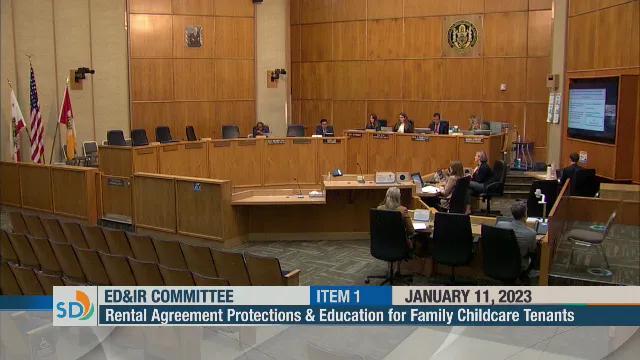
The committee met virtually and in person to discuss two agenda items: rental agreement protections for family child care tenants and the committee's 2023 priorities. Both items passed unanimously. Public testimony focused on child care access and opposition to expanding cannabis businesses. Consent Calendar - Approved the minutes of the special meeting of November 17, 2022. No public comment. Motion passed unanimously (3-0). Public Comments & Testimony - Non‑agenda public comment: One speaker raised questions about fee structures for corporate events at the Rady Shell. A second speaker thanked the committee for prioritizing workforce development. - Item 1 (Rental protections for family child care): Five speakers addressed the item. - Molly Kirkland (Southern California Rental Housing Association) expressed concern that adding more legalese to rental agreements would be less effective than education and outreach; she noted she had never received a complaint about a landlord evicting a child care provider. - Corina Lego (Child Care Law Center) voiced support for the proposed ordinance. - Courtney Baltiski (YMCA Childcare Resource Service / Children First Collective) spoke in support, noting that 1,520 active family child care providers exist in San Diego, the majority of whom are women of color and renters. - Aaron Hogaboom (Every Child San Diego) supported the measure, emphasizing the need for awareness of SB 234 protections. - Kathleen Lippitt requested that protections also extend to church‑based child care and flagged threats from marijuana businesses and sex offenders. - Item 2 (2023 Committee Priorities): Seven speakers commented, with several opposing the inclusion of marijuana business expansion as a priority. - Barbara Gordon, El Del Mastro, Terry Ann Skelly, Peggy Walker, and Kelly McCormick cited studies on marijuana’s negative impacts on youth and urged the committee to focus on workforce development and internships instead. - Becky Rapp asked for updates on the cannabis social equity program while maintaining the current cap on dispensaries. - Judy Strang (parent advocate) supported the posted priorities but noted the absence of an update on the Mayor’s “Employ and Empower” program. Discussion Items Item 1 – Rental Agreement Protections for Family Child Care Tenants Sophie Barnhorst Darma (Senior Policy Advisor, Council District 7) presented the proposal. She cited a San Diego Foundation/USD study showing that 48% of children ages 0–5 with working parents lack licensed child care, the annual cost for two children is nearly $34,000, and 75% of parents find it challenging to find care. Family child care homes are a vital source of supply, but providers frequently face harassment and eviction from landlords who object to home‑based child care. State law (SB 234, the Keeping Kids Close to Home Act) already protects providers, but awareness is low. The proposal would require landlords to include a notice of these protections in rental agreements. Councilmember Campillo made a motion to direct the City Attorney to work with District 7 staff to draft an ordinance. Councilmember Lee seconded, noting the importance of educating tenants and landlords. Item 2 – 2023 EDIR Committee Priorities No formal presentation. Vice Chair Montgomery Steppe highlighted support for small businesses, cannabis social equity, youth employment (including the Mayor’s “Employ and Empower” program), and the Black Arts and Culture District. Councilmember Lee emphasized small business and nonprofit support, the growing economic impact of the AAPI community, and state/federal grant opportunities. Chair Campillo noted ongoing work on cannabis equity, the Black Arts District, and city contracting disparities. A motion to adopt the combined priorities was made by Vice Chair Montgomery Steppe, seconded by Councilmember Lee. Key Outcomes - Item 1: Motion passed unanimously (3‑0) to direct the City Attorney to work with Council District 7 to bring forward an ordinance requiring notification of SB 234 protections in rental housing agreements. - Item 2: Motion passed unanimously (3‑0) to adopt the 2023 committee priorities as submitted by members. - The next regular meeting was scheduled for Wednesday, February 8, 2023, at 2:00 p.m.
The committee met to consider several financial items including ratification of an emergency food service contract, an amendment to a citywide security agreement, a state revolving fund loan for a water valve station, and an informational presentation on proposed water rate increases. The meeting also included non-agenda public comment and farewell remarks for the outgoing chair. Consent Calendar - Item 1: Fourth amendment to cooperative agreement with Herc Rentals Inc. for rental of large equipment. Approved unanimously (3-0, with Councilmember Montgomery Steppe absent). Public Comments & Testimony - John Stump (City Heights) urged the elimination of tiered rates that privilege homeowners over renters, calling for one affordable housing rate for all. He also requested the committee consider climate change, equity, and transparency in its decisions. - Joy Sanyata (District 3) spoke in support of security at Central Library, noting officers are professional and necessary, but expressed sadness that the library feels overly secured. - Lori Saldania raised concerns about private security guards lacking state-level training and accountability, citing past settlements for excessive force and deaths. - Lori Saldania (again on water items) questioned the city's borrowing practices and urged analysis of total debt sustainability. She also argued that proposed water rate increases disproportionately impact low-income residents and that the city should ensure compliance with state and federal regulations. - John Stump (on water) questioned the need for multiple residential water tiers and suggested the city should have saved for infrastructure rather than borrowing. - Daryl agreed with others that the four-tier water structure should be reworked. - IBA (Charles Modica) thanked Chair Kay for his service and noted the IBA would continue to review the water cost of service study with Stantec. Discussion Items - Item 2: Ratification of emergency sole source contract with Service America Corporation (dba Centerplate) for food services at Operation Shelter to Home. Director Claudia Barca presented, apologizing for the delayed ratification (should have been brought in late 2021) due to staffing changes. The emergency contract was initiated in April 2020 during COVID-19 to provide individually boxed meals at the Convention Center shelter. The committee expressed concern about the delay and urged better contract tracking. Councilmember Moreno suggested a contract management system. The item passed unanimously. - Item 3: Second amendment to citywide security services agreement with Invictus Security CA Corporation (dba Allstate Security). The amendment increases the contract amount from $24.9 million to $28.9 million. Drivers included increased use for homeless initiatives, adding armed guards trained to administer naloxone at Central Library (17 lives saved since Nov 2021), and a living wage increase exceeding the typical 5% cap. Library staff noted additional guards needed due to suicide attempts. Council President Elo Rivera highlighted the need for mental health crisis response alongside security. Concerns were raised about workforce diversity underrepresentation (Asian and female in admin; African American, Asian, Native American in security guard roles). The item passed unanimously, with an expectation that a diversity plan be presented at full council. - Item 4: Authorizing a Drinking Water State Revolving Fund loan up to $55 million for the Lakeside Valve Station Replacement Project. Alison Falkenstein (Finance) presented. The loan is at an estimated 2% interest (saving $20 million over 30 years compared to bonds). The valve station is old and deteriorating. The item passed unanimously. - Item 5 (Informational): Water Cost of Service Study. Public Utilities staff (Lisa Slaya, Adam Jones) presented a proposed rate adjustment study. Key points: - Last rate increase was in 2020; rates were kept flat using one-time revenues ($78 million from local water savings, Qualcomm sale, MWD settlement). - Proposed increases: monthly service charge and commodity rates; a typical customer using 9 HCF would go from $81 to $95 in year 1, up to $103 in year 2. - Tier structure changing from four tiers to three tiers, with first tier up to 5 HCF based on state indoor use recommendations. - The study is the first step; a public hearing is expected in June 2023, with effective date November 1, 2023. - IBA will release a review with Stantec in February 2023. - Councilmembers expressed concerns about affordability and urged robust community outreach. The committee took no action; the item was for discussion. Key Outcomes - Approved Consent Calendar (Item 1) unanimously (3-0). - Approved ratification of emergency food service contract (Item 2) unanimously. - Approved security services contract amendment (Item 3) unanimously, with expectation of a diversity plan at full council. - Approved state revolving fund loan for Lakeside Valve Station (Item 4) unanimously. - No action on the informational water cost of service study; further review and outreach planned. - The meeting adjourned at approximately 11:00 AM, with the next regular meeting scheduled for January 11, 2023.
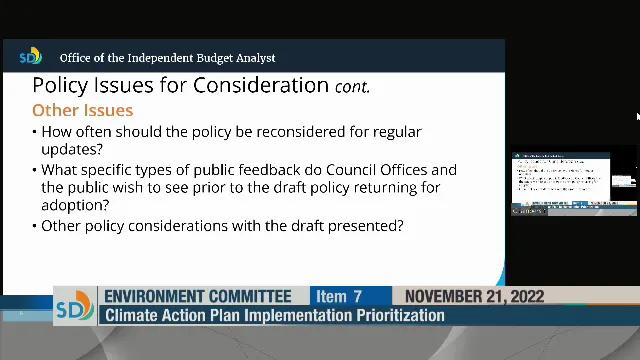
The San Diego City Council Environment Committee held a special meeting on November 21, 2022, from approximately 9:00 AM to 12:00 PM. The meeting addressed several critical climate and environmental items, including the implementation of SB 1383 (organic waste diversion), a new organics processing facility, the Climate Action Plan (CAP) implementation plan, a proposed council policy for CAP prioritization, and the creation of two new advisory boards. The committee also heard extensive public testimony on a range of topics. Votes were taken on consent items and two action items, all passing unanimously (3-0). Consent Calendar - Items 1 & 2: Approved a contract amendment with Clean Harbors Environmental Services Inc. for sanitation services and hazardous waste removal, and the ninth amendment to the Miramar Recycling Center lease. Motion passed 3-0. Public commenter Kelly Linden asked about electrification of the recycling center; staff noted existing solar panels and no natural gas connections. Public Comments & Testimony - Non-Agenda Public Comment: Multiple speakers addressed secondhand smoke in public spaces (Barbara Gordon, Mark Wilcox), the need for a management plan for sea lion interactions at Point La Jolla (Carol Toy, Robin Davidoff of Sierra Club SEAL Society), and concerns about marijuana business regulations (Kathleen Lippett, Judy Strang, Keywalker). - Item 8 (SB 1383): Masada Dizonhouse (San Diego 350) and Joyce Lane expressed support for the program and requested regular reporting on diversion rates. - Item 3 (Organics Processing Facility): Kelly Linden asked about compliance with the Zero Emissions Municipal Buildings and Operations Policy (ZEMBOP) and urged all-electric design. - Item 6 (CAP Implementation Plan): Multiple speakers (Kelly Linden, Corina Contreras, Adam Aron, Mikey Nabb, James Sallis, Masada Dizonhouse, Dr. Z Nguyen, Katie Christ, Sonia Robinson, Ann Fegey, Joyce Lane, Amber Gunser, and others) called for transparent benchmarks, robust funding, alignment with the Master Mobility Plan, and prioritization of communities of concern. Speakers emphasized the need for measurable GHG reduction targets, tree canopy goals, and mode shift requirements. - Item 7 (CAP Prioritization Policy): Public speakers (Kelly Linden, Corina Contreras, Mikey Nabb, James Sallis, Masada Dizonhouse, Ann Fegey, Sandra Robinson, Laurie Saldani) provided feedback on weighting criteria, suggesting GHG reduction, equity, and feasibility as key factors, and cautioned against deprioritizing costly but transformative actions. - Items 4 & 5 (Advisory Boards): Numerous speakers (Kelly Linden, Mikey Nabb, Masada Dizonhouse, Jay Powell, Lucero Sanchez, Ann Fegey, Mitch Silverstein, Sandra Robinson, Karina Gonzalez, Joyce Lane, Laurie Saldani) supported the creation of the Climate Advisory Board and Resiliency Advisory Board. They requested adequate staffing, youth representation, longer terms, and explicit inclusion of energy independence goals. Discussion Items - Item 8: SB 1383 Implementation Update (Information): Renee Robertson (Environmental Services Director) presented the rollout plan. Key points: organic waste collection for city-serviced homes begins January 11, 2023, with 95-gallon green carts and kitchen pails. Delivery prioritized by climate equity index. Food recovery program and educational materials in multiple languages. Staff reported 144 presentations and 32 community planning group engagements. The existing Miramar Greenery can handle current tonnage while a new facility is built. Vice Chair Von Wilpert requested a mid-year and end-year update. Chair Locava noted the program's $25 million additional cost. Staff confirmed full driver staffing and truck deliveries beginning December 2022. - Item 3: Organics Processing Facility (Action): Renee Robertson presented the project to build a new compost facility on the North Miramar Landfill. Cost: $77.223 million. Awarded to SUKA Construction LLC. Base project handles 127,000 tons/year; additive alternate expands to 251,850 tons/year. The project frees up landfill space worth $100 million in revenue. Construction expected July 2024. Motion to approve passed 3-0. - Item 6: Climate Action Implementation Plan Update (Information): Shelby Rust Bousseau (Chief Sustainability Officer) and Mariah Sadania presented the draft plan. It includes annual departmental work plans, an implementation cost analysis (ICA) by EPIC, and an administrative regulation for CAP liaisons. The ICA will estimate costs for 18 departments over five fiscal years (2024-2028). The full plan is due February 2023. Committee members emphasized the need for key performance indicators, regular reporting, and alignment with the budget process. - Item 7: Proposed Council Policy for CAP Implementation Prioritization (Information): Jordan Moore (IBA) presented a draft policy based on the CIP model, using weighted scores (GHG reduction, equity, feasibility, etc.). The IBA requested feedback on weighting and funding criteria. The policy aims to be completed by early 2023 to inform the FY2024 budget. Discussion included aligning with existing council policies (800-14, 0-32) and using the climate equity index. - Items 4 & 5: Creation of Climate Advisory Board and Resiliency Advisory Board (Action): Brian Elliott (Councilmember Locava's staff) presented the proposal. The Climate Advisory Board (15 voting members, 6 appointed by mayor, 9 by council) will focus on CAP implementation, energy, and environmental justice. The Resiliency Advisory Board (11 voting members, 2 by mayor, 9 by council) will focus on climate adaptation, wetlands, and conservation. Both boards replace the Sustainable Energy Advisory Board and Wetlands Advisory Board, which have not met in two years. A third of seats reserved for communities of concern. Non-voting seats from other boards. Motions passed 3-0. Key Outcomes - Consent Agenda (Items 1 & 2): Approved 3-0. - Item 3 (Organics Processing Facility): Approved 3-0. Staff directed to execute the agreement with SUKA Construction for $77,223,000. - Items 4 & 5 (Advisory Boards): Approved 3-0. City Attorney directed to draft ordinances creating the Climate Advisory Board and Resiliency Advisory Board, and repealing the Sustainable Energy Advisory Board and Wetlands Advisory Board. - Items 8, 6, 7 (Information Items): No vote required. Staff will continue work on SB 1383 rollout, CAP implementation plan (due February 2023), and the CAP prioritization policy (due early 2023). - Items 10 & 11: Postponed due to time constraints; will be rescheduled.
The Budget and Government Efficiency Committee of the San Diego City Council met on November 18, 2022, from approximately 9:00 AM to discuss several key financial items. The meeting included a first-quarter budget monitoring report, two five-year financial outlooks (general fund and public utilities), revisions to the city's reserve policy, and an update to the user fee policy. The committee approved the reserve policy revisions and the user fee policy update unanimously, while the budget reports and outlooks were informational items. Consent Calendar - The committee unanimously approved the minutes from the November 3, 2022 meeting (Council President Ila Rivera absent). Public Comments & Testimony - Non‑Agenda Public Comment: - Kathleen Lippitt expressed concern about the city attorney’s memo on redistricting and cannabis, arguing that the city attorney’s office should not suggest ways to increase cannabis outlet caps. She also criticized the marijuana industry’s influence on city decisions. - Lori Seldanium congratulated committee members on their re‑election, urged funding for oversight staff to ensure compliance with lobbying rules, and cited the Midway Rising project as an example where lobbying reports were filed late, affecting council decisions. - On Item 3 (Budget Monitoring Report): - Joyce Sanyata thanked the finance team, stressed the importance of trust and transparency, and asked about the quality of service levels given vacancies. - Lori Seldanium linked public safety overtime costs to responses to homelessness and argued that criminalizing homelessness is inefficient, urging investment in housing and social services. - Kathleen Lippitt criticized the city’s reliance on cannabis revenue, stating that it comes with significant costs to public safety and staff resources, and cited the Rancho Bernardo example of a project ignoring buffer ordinances. - On Item 4 (Five‑Year General Fund Outlook): - Joyce Sanyata appreciated the outlook’s explanation of factors shaping the budget, but questioned how to balance a structural deficit. - Lori Seldanium emphasized the need to address homelessness disparities and the high cost of SDG&E’s franchise, called for diversifying revenue sources beyond tourism, and advocated for local public power. - On Item 2 (Reserve Policy Revisions): - Joyce Sanyata praised the adjustments as positive and understandable. - Lori Seldanium warned against repeating past mistakes of cutting social services during recessions, noting that the city’s homelessness crisis is a major drain on the budget. - On Item 1 (User Fee Policy Update): - Lori Seldanium criticized the antiquated process for challenging fee increases, which requires in‑person attendance or paper submissions, and requested an electronic option to improve accessibility. - On Item 5 (Public Utilities Five‑Year Outlook): - Lori Seldanium highlighted the high cost of water and power for low‑income residents, called for on‑site solar generation at pump stations, and questioned the cost of tourism on water and power. - Michael Dwyer noted that the proposed water pass‑through rate had been reduced from 3% to 2.5%, and asked the committee to confirm this reduction. Discussion Items - Item 3: Fiscal Year 2023 First Quarter Budget Monitoring Report - Presentation by Department of Finance: Major general fund revenues are projected to exceed the budget by $35.4 million, driven by higher property tax (+$14.2M), TOT (+$14.7M), and sales tax (+$5.7M). Cannabis business tax is projected to fall short by $4.1 million. Public safety overtime is projected to have a net impact of $19.2 million (fire rescue $9.3M net, police $9.9M net). The report noted risks from inflation, recession, and the ongoing SDSERS decision on Prop B. - IBA Comments: The IBA highlighted the need to better anticipate public safety overtime and noted a $5 million underfunding in the public liability reserve. - Committee Discussion: Councilmember Moreno expressed concern about police vacancies (213 officer vacancies) and attrition outpacing hiring. Chief Neslage confirmed that the department is not keeping pace, with 197 officers short of budgeted strength and 116 civilian vacancies. Council President Pro Tem Montgomery Steppe called for alternative response methods to reduce officer burden. Chair Kate asked about confidence in revenue projections: staff expressed confidence in property tax, but cautiously optimistic about sales tax and TOT due to potential recession. - Item 4: Fiscal Year 2024–2028 Five‑Year Financial Outlook (General Fund) - Presentation by Department of Finance: The baseline forecast shows a $50.5 million deficit in FY24, with deficits continuing through FY26. The outlook includes $52.1 million in remaining ARPA funds and $72.1 million in excess equity to help cover early deficits. Above‑baseline needs (new facilities, homelessness programs, stormwater debt) increase the FY24 deficit to $75.9 million. The report assumes 3.05% salary increases for pending MOUs and notes the need for ongoing revenue sources to address structural deficits. - IBA Comments: The IBA considered the revenue growth assumptions reasonable for the medium term, but stressed that to expand services, new revenue sources are critical. Measure B (if certified) could free up general fund dollars from residential trash pickup. - Committee Discussion: Council President Ila Rivera emphasized investing now to reduce future costs (e.g., housing to reduce shelter costs) and diversifying revenue. Councilmember Moreno thanked staff and noted the importance of the reserve schedule. Council President Pro Tem Montgomery Steppe appreciated the breakdown of plan commitments and new facility costs. Chair Kate asked about fire rescue staffing and the relief pool; Chief Stole (or Assistant Chief) stated that the department expects to be fully staffed by end of FY23, with a third academy helping to build a relief pool. The committee also discussed the SDSERS board’s positive move toward a 20‑year amortization of Prop B transition costs. - Item 2: Revisions to the City’s Reserve Policy (Council Policy 100‑20) - Presentation by Department of Finance: The proposed revisions extend the timeline to reach the 16.7% general fund reserve target from FY25 to FY2030, acknowledging the impact of the pandemic. The FY23 budget includes a $1.5 million reserve contribution, with contributions increasing to $5 million in FY24. The pension payment stabilization reserve would be funded after the general fund reserve is fully funded. The emergency reserve component would be phased in at lower percentages initially. - IBA Comments: The IBA supported the approach but noted the committee may wish to ask about the reduction in emergency reserve percentage in early years. The IBA also noted that the proposed policy balances the speed of reaching the target with maintaining service levels. - Committee Action: Motion by Council President Ila Rivera, seconded by Councilmember Moreno, to approve the resolution. Passed unanimously. - Item 1: Council Policy 100‑05 User Fee Policy Update - Presentation by Department of Finance: The update memorializes process improvements and incorporates recommendations from the city auditor’s performance audit. Key changes: comprehensive user fee study frequency changed from every 2‑5 years to every 3‑5 years; special revenue funds included; benchmarking with other jurisdictions; identification of fees not updated in five years; and a single consolidated report for city council. - IBA Comments: The IBA thanked DOF for collaboration and supports the item. - Committee Action: Motion by Councilmember Moreno, seconded by Chair Kate, to adopt the resolution. Passed unanimously. - Item 5: Public Utilities Fiscal Year 2024–2028 Five‑Year Financial Outlook - Presentation by Public Utilities Department: The outlook covers water and wastewater funds. Key drivers: Pure Water Program, dam repairs, regulatory compliance, and purchased water costs from the San Diego County Water Authority (projected to increase from $1,900 to over $2,000 per acre foot). Water sales volumes are projected to decline due to drought and conservation (7% reduction from FY21 levels). The outlook assumes cumulative water rate increases of up to 17.6% over FY24‑25, with a cost of service study coming before the committee. Wastewater rates are assumed to increase 5% in January 2023, with additional increases through FY28. The utility plans to use rate stabilization reserves to smooth rate increases. - IBA Comments: The IBA noted that a more detailed review will be conducted with consultant Stantec, and that the cost of service study will be presented to the full council. - Committee Discussion: Chair Kate confirmed that the water pass‑through rate increase scheduled for January 2023 has been reduced from 3% to 2.5%, as noted by a public commenter. The committee deferred detailed questions to the next month’s cost of service study presentation. Key Outcomes - Approved: Revisions to the Reserve Policy (Council Policy 100‑20) – unanimous vote. - Approved: Update to the User Fee Policy (Council Policy 100‑05) – unanimous vote. - Informational: The Fiscal Year 2023 First Quarter Budget Monitoring Report, the General Fund Five‑Year Outlook, and the Public Utilities Five‑Year Outlook were received and filed; no votes required. - Next Steps: The committee will meet next on December 7, 2022, at 9:00 AM. The Public Utilities Department will present the water cost of service study at a future meeting. The IBA will release detailed reviews of the general fund and public utilities outlooks before they go to the full council.
This special meeting of the Audit Committee was held on Friday, November 18, 2022, via teleconference under California Government Code Section 54953E. Present were Vice Chair Moreno, Committee Member Halpern, and Committee Member Tabshuri; Chair Whitburn presided. Committee Member Mafia was absent. The committee approved prior minutes, reviewed a performance audit of the city's towing program, received the auditor's monthly activity report, and held a closed session for the performance evaluation of the City Auditor. Consent Calendar - The committee unanimously approved the committee actions of October 12, 2022. No public comment or discussion. Public Comments & Testimony - No public comments were offered for any agenda item, including the consent calendar, non-agenda public comment, item 1 (towing audit), item 2 (monthly activity report), or item 3 (closed session). Discussion Items - Item 1: Performance Audit of the City's Towing Program - City Auditor Andy Hannow, Principal Performance Auditor Nathan Otto, and Senior Performance Auditor Megan Jaffrey presented the audit, requested by Chair Whitburn to examine financial, equity, and transparency issues. - Key findings: - SDPD has strong internal controls but has not presented a comprehensive program report to council since 2013. - Towing decreased 39% from fiscal year 2017 to 2021, but parking complaints increased. - The city's towing and storage rates are the lowest among benchmarked cities. - The top towing reasons (expired registration over six months, 72-hour parking violations, five or more unpaid citations) are three to five times more likely to result in a lien sale compared to other tows. - Nearly 32,000 vehicles were sold at lien between July 2016 and March 2022. - Council Districts 4 and 8 had significantly higher rates of disproportionate impact tows; these districts have the two lowest median household incomes. - The city subsidizes the program by approximately $2 million annually due to low cost recovery and losses from lien sales. Lien sales recover less than 50% of accrued fees; for the top two tow reasons, the average sale price recovers only 25% (e.g., average fees owed $2,200 vs. sale price $524 for 72-hour violations). - SDPD agreed to two of three recommendations (comprehensive reporting and updating council policy) but disagreed with the third (compiling information on alternative policies). The auditor encouraged the council to request that information. - Committee discussion: - Vice Chair Moreno expressed concern about disproportionate impact on low-income residents, noted the $2 million subsidy could be redirected to other programs, and supported exploring alternatives such as a "text before tow" system, booting instead of towing for expired registration, and income-based payment plans. She offered a friendly amendment to the motion to include the Chief Operating Officer, SDPD, Office of Race and Equity, and other departments. - Committee Member Tabshuri noted that working poor and military members are disproportionately affected and suggested towing should be a last resort with notification. - Committee Member Halpern questioned the trade-off between cost recovery and social equity; the auditor clarified that eliminating lien sales could reduce losses but may be constrained by state law. - Chair Whitburn thanked SDPD for strong controls. - Motion: Chair Whitburn moved to accept the report, request a presentation at a full City Council meeting, and direct Council District 3 to work with stakeholders to explore impacts and bring recommendations. The motion was amended to include the COO, SDPD, Office of Race and Equity, and other relevant departments. The amended motion passed unanimously (4-0). - Item 2: City Auditor's Monthly Activity Report - City Auditor Andy Hannow reported that since the last meeting, one report was issued (towing audit). Audits in progress: IT audit of Fire-Rescue 911 system (exit conference held, expected December 2022), homeless services contracts, CIP program, classified employee hiring; one in planning (fire prevention); eight not started. One topic selected for re-review: pedestrian safety (originally audited in 2016). Since FY23 start, eight reports issued with 25 recommendations. The office will undergo peer review by ALGA in December 2022. - This item was informational; no motion required. - Item 3: Closed Session – Public Employee Performance Evaluation (City Auditor) - The committee adjourned to closed session to evaluate the City Auditor’s performance under California Government Code Section 54957. No reportable action was announced. The next regular meeting is scheduled for Wednesday, January 25, 2023 at 9:00 AM. Key Outcomes - Unanimous approval of previous meeting minutes. - Unanimous adoption of the motion to accept the towing audit report, present it to the full City Council, and direct a multi-departmental effort to develop policy changes to address impacts on vulnerable populations and improve program transparency. - The City Auditor's monthly activity report was received and acknowledged. - The committee entered closed session for the performance evaluation of the City Auditor; no reportable action was announced.
The San Diego City Special Audit Committee convened on November 18, 2022 at 10:00 AM. The meeting included roll call, a report from the City Attorney on closed session, and adjournment to the next regularly scheduled meeting. Consent Calendar - No items were presented on the consent calendar. Public Comments & Testimony - No public comments were made. Discussion Items - No discussion items were addressed. Key Outcomes - The City Attorney, Mara Elliott, reported that no reportable action occurred in closed session. - The meeting was adjourned. The next regularly scheduled audit committee meeting will be on Wednesday, January 25, 2023 at 9:00 AM.