Browse by city
Date range
Search help

Search titles, summaries, topics and stored transcripts together. Keywords may match separately; put the whole query in double quotes for a phrase. Matching follows word analysis, so punctuation is not exact. Both dates are included. Documents are not searched.

SHOWING 721–730 ENTRIES
721
OCT 21, 2020 · SAN DIEGO, CALIFORNIA · AUDIT COMMITTEE
San Diego Audit Committee Meeting – October 21, 2020

The Audit Committee met on October 21, 2020, to review audit follow-ups, the city auditor's activity, fraud hotline results, and an industrial wastewater control program update. Members participated via Zoom under executive order due to the pandemic. The meeting included public comments and detailed department-by-department review of outstanding audit recommendations. Consent Calendar - Approval of Minutes (September 30, 2020): Motion by Vice Chair Moreno, second by Halpern, passed unanimously. Public Comments & Testimony - Non-Agenda Public Comment: Two callers spoke. The first criticized the city's reliance on seller appraisals (citing 101 Ash Street and Mission Valley Stadium) and called for independent appraisals and criminal prosecution. Martha Welch demanded financial audits and accused the city of not acting in the public interest. - On Item 4 (IWCP): Martha Welch again questioned the plan for treating heavy metals and alleged the city withholds information. - On Item 2 (Auditor's Activity): Martha Welch demanded performance audits and said she has not seen a financial audit since 2016. - On Item 3 (Fraud Hotline): Martha Welch referenced a missing $13 million and accused the city of embezzlement. - On Item 1 (Recommendation Follow-up): Lucera Sanchez of San Diego Coast Keeper urged the committee to ensure the stormwater funding report stays on track for January 2021. Discussion Items - Staff Update on CARES Act Expenditures: Chief Compliance Officer Matthew Holmes reported $177 million in total expenditures (first cycle $93M, second cycle $83M), on track for December 30 deadline, flowing through Operation Shelter to Home, PPE, rental assistance, and small business relief. - Item 4: Industrial Wastewater Control Program (IWCP) Audit Update: Shauna Lorenz presented progress on all nine recommendations. Key actions include drafting policies, completing a fee study, sending invoices for unbilled costs, and selecting a new billing system. Target dates range from December 2020 to June 2021. Committee members praised staff's responsiveness. Councilmember Halpern requested probability assessments; staff expressed high confidence except for items requiring council adoption or renegotiation with participating agencies. - Item 2: City Auditor's Monthly Activity Report: Interim Auditor Kyle Elser highlighted three audit products issued, a memo requesting independent legal counsel, and ongoing audits (IT legacy apps, purchasing/contracting, sustainability, human capital part 2, CARES Act, real estate/101 Ash). The human capital audit on employee discipline and incentives is expected in November. Committee reiterated strong support for independent legal counsel. - Item 3: Quarterly Fraud Hotline Activity Report: Andy Hanao reported 60 total reports, 39 city-related, 47 closed, 41 open. One substantiated report involved a delayed replacement container due to erroneous close-out via Get It Done app. Corrective actions addressed hazardous materials, theft of time, and other issues. - Item 1: Recommendation Follow-up Report: Kyle Elser and Andy Hanao presented the semi-annual follow-up. Of 170 outstanding recommendations, 18 were implemented, 8 deemed no longer applicable, 144 carry forward. They highlighted 13 attention items, including superseded recommendations and two from the Business Cooperation Program (BCP) audit. The BCP recommendations were controversial: Economic Development staff (Christina) argued they lacked resources and the program is stalled due to budget cuts and pandemic; committee members (Moreno, Halpern, Tab Shuri, Valdivia, Chair) strongly supported keeping the recommendations in process, noting potential revenue from large developments like Sports Arena and Ballpark redevelopment. Moreno read extensive criticism of the department’s survey methodology. - Department-by-Department Review: Led by Councilmember Valdivia, the committee systematically reviewed attachment C recommendations with department representatives. Many departments reported progress or near-completion; some had delayed updates due to turnover or pandemic. Key exchanges included: - Human Resources: Pay equity study contract awarded, final report due December 2020. - Communications: Records request policies in progress. - Risk Management: Two recommendations considered implemented pending documentation. - Convention Center: Funding uncertain due to Measure C legal challenges. - Economic Development: All recommendations implemented; documentation pending. - Fleet Operations: Draft regulation nearing city process. - Human Resources (TAP program): Proposal withdrawn due to COVID; will be reproposed for FY22. - Parks and Recreation: Logic implementation delayed; new database overlay planned. - Planning: Waiting on council policy revision docketed by city attorney. - Public Utilities: Several recommendations in progress; water billing improvements reduced implausible reads from 190 to 30 per day; AMI implementation paused to align support systems. - Purchasing and Contracting: Most items expected by December 2020; corrected a target date typo from 2022 to 2020. - Real Estate Assets: Two recommendations advanced to council policy; one still tied to Park and Rec. - Police Department: Patrol operations recommendation nearly implemented, likely will be cleared. - Transportation and Stormwater: Street light repair recommendation met intent; Vision Zero enforcement targets on track; stormwater pipe repair and reinspection fee requests unfunded; tree trimming memo in progress. - Process Improvement Discussion: Committee members (Halpern, Tab Shuri, Valdivia) noted discrepancies between reported dates and actual progress, turnover causing loss of continuity, and the need for action plans with milestones. Matt Helm (Chief Compliance Officer) acknowledged shortcomings and committed to improving reporting consistency. The auditor’s office proposed requiring detailed action plans for each recommendation, which the committee endorsed. Key Outcomes - Votes: Motion to accept the recommendation follow-up report with a friendly amendment endorsing the new recommendation follow-up procedure (action plans with milestones, responsible parties, and timelines) passed unanimously. The Business Cooperation Program recommendations remain classified as “in process.” - Directives: The city auditor will work with departments to implement action plans and improve update timeliness. The committee urged faster resolution of long-outstanding items and clearer categorization of delays due to external dependencies (e.g., council action, legal review). - Next Steps: A possible November meeting may be called to review the human capital audit on employee discipline and incentives. The committee chair (Sherman) noted this might be his final meeting after six years of service.
AUDIT FOLLOW-UP 26% · PROCUREMENT 11% · WATER AND WASTEWATER MANAGEMENT 9% · PUBLIC WORKS 7%
722
OCT 15, 2020 · SAN DIEGO, CALIFORNIA · LAND USE & HOUSING COMMITTEE
San Diego Land Use and Housing Committee Meeting - October 15, 2020

The Land Use and Housing Committee of the San Diego City Council met virtually on October 15, 2020, at 9:00 AM. Chair Ward presided, with Vice Chair Kersey, Councilmember Campbell, and Councilmember Sherman present. The meeting addressed several items related to city property disposition, surplus land declarations, a property sale for affordable housing, the annual municipal code update, a rezone for Tailgate Park, and an informational update on the age-friendly initiative. All votes were unanimous unless otherwise noted. Consent Calendar - Item 1: Approval of Committee Actions (September 17, 2020) – Approved unanimously. - Item 2: Consent Agenda – As-Needed Environmental Services Agreements – Approved unanimously. Staff from Real Estate Assets (Mary Carlson) presented the item. Public Comments & Testimony - Non-Agenda Public Comment: Martha Welch (or Wells) expressed concerns about HUD funding for seniors, Section 8 availability, and alleged city corruption. - Item 2 (Council Policy 700-10): Martha Welch opposed city rental practices, calling them illegal and accusing the city of being “gangsters.” - Item 3 (Surplus Land Declaration): Martha Welch advocated for income-based housing and criticized property tax increases. - Item 4 (Cortez Hill Sale): Martha Welch urged the city to ensure property ownership transparency but supported the affordable housing plan. Mary Jane Jacatsinski and Steve Swazicki (Community Housing Works) expressed eagerness to proceed. Matt Basilakis (Climate Action Campaign) supported the sale and urged maximizing housing units. - Item 5 (Municipal Code Update): Multiple callers spoke. William Perno (Central Region Prevention Coalition) opposed reducing the CEQA appeal time from 10 to 5 days, citing insufficient time for planning groups. Wally Wolfe (Chair of Community Planners Committee) echoed this, recommending retaining the 10-day period for item 30. Rebecca Lieberman (San Diego Regional Chamber of Commerce) supported the entire package, especially item 30. Kelly McCormick opposed the reduction, noting increased costs for appeals. Another caller urged postponing until city attorney review is complete. Nicole Burgess supported items 31, 39, and 43 for outdoor dining and bike parking. - Item 6 (Tailgate Park Rezone): Matt Basilakis (Climate Action Campaign) supported the rezone, urging maximized housing and minimized parking. - Item 7 (Age-Friendly Initiative): Bob Pratt (AARP volunteer) supported the initiative and urged inclusion of city planners. Nicole Burgess supported the work and advocated for safe bike facilities. Discussion Items - Item 2: Revisions to Council Policy 700-10 (Disposition of City-Owned Real Property) and Repeal of Policy 700-12 – Mary Carlson presented. The policy updates include: annual portfolio management plan, 30-day department clearance process, clearer sales process for affordable housing, and revised leasing terms (e.g., percentage leases adjusted every 5 years, minimum rent at 100% of market rate). The committee approved the staff recommendation unanimously. - Item 3: Declaration of Various City-Owned Properties as Surplus Land – Mary Carlson presented. The state’s new Surplus Land Act requires council to declare land surplus before disposal. Ten properties were proposed for surplus declaration. Councilmember Sherman questioned the Area Median Income (AMI) for affordability requirements; staff promised to follow up. Unanimous approval. - Item 4: Sale of 1449 9th Avenue (Cortez Hill Family Shelter) to Community Housing Works – The property was purchased for $11,593 (to satisfy a deed of trust held by the Housing Commission). Community Housing Works plans to demolish the existing building and construct 75–110 affordable housing units, with 44 units at 30% AMI and the rest at 30–80% AMI, with 55-year affordability restrictions. The sale was approved unanimously. Chair Ward noted the property will remain vacant for two years, and the city will conduct weekly site visits and seek interim use. - Item 5: 2020 Update to the Municipal Code, Local Coastal Program, and Rezones – Presented by Renee Mezzo, Brad Richter, and Alex Frost. The update includes 46 items: cleanup items, 17 regulatory reforms, one new regulation, and one state law compliance. Notable proposals: allow FAR transfers between adjoining sites, eliminate 500-foot height limit downtown, eliminate minimum parking in Gaslamp Quarter, streamline airport compatibility zones, increase dwelling unit cap from 20 to 60 per acre in MCAS Miramar transition zone, and reduce CEQA appeal time from 10 to 5 days. The planning commission approved all items; the community planners committee opposed the appeal time reduction. City Attorney Leslie Fitzgerald noted ordinances are still under review. After public testimony and discussion, Vice Chair Kersey moved to approve staff recommendation as is, but staff will work with the committee’s comments regarding the appeal time reduction. The motion passed unanimously, with Councilmember Sherman voting yes with reservations. - Item 6: Amendments to General Plan, Downtown Community Plan, Center City Plan District Ordinance, Local Coastal Program, and Rezone for Tailgate Park – Brad Richter (Civic San Diego) presented. The goal is to apply consistent zoning across all four blocks of the Tailgate Park site (currently mixed zoning). The changes were recommended unanimously by the Downtown Community Planning Council and Planning Commission. Chair Ward confirmed the Park-Sun Access Overlay will not be affected and that the RFP process informed bidders of the potential zone change. Unanimous approval. - Item 7: Update on the City’s Age-Friendly Initiative – Presented by Laurie Clark and Masha Keller (SDSU Social Policy Institute) and Christy Fenick (Parks and Recreation). The initiative began in 2018, midway through process. Over 3,300 survey responses and listening sessions revealed priority themes: outdoor spaces (safety at night, parking), housing (lack of affordable modifications, racial disparities in perception), transportation (overreliance on cars due to discomfort with Uber/Lyft and public transit), social participation (desire for intergenerational activities, 38% of parks offer such), respect and inclusion (one-third felt age discrimination, varied by race), health (one-third feared running out of food, higher among Hispanics). A COVID-19 survey showed a digital divide (Hispanic older adults less likely to access virtual programming) and 84% willingness to attend in-person events with precautions. Next steps include virtual action planning sessions and an action plan for city council vote. Committee members commended the work and noted implications for housing, transportation, and parking policies. Key Outcomes - All action items (Items 1, 2, 3, 4, 5, 6) were approved unanimously, with no votes against. Item 5 included an understanding that staff will refine the CEQA appeal time reduction based on committee feedback before going to full council. - Item 7 was informational only, no vote taken. - The meeting adjourned at approximately 1:00 PM, with the next meeting scheduled for Thursday, November 12, 2020, at 1:00 PM.

MISCELLANEOUS 35% · PUBLIC COMMENT 22% · LAND USE AND PLANNING 11% · REAL ESTATE 7%
723
OCT 14, 2020 · SAN DIEGO, CALIFORNIA · BUDGET & GOVERNMENT EFFICIENCY COMMITTEE
Budget and Government Efficiency Committee Meeting - October 14, 2020

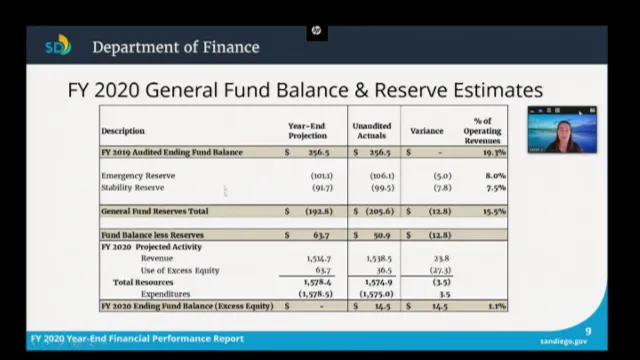
The Budget and Government Efficiency Committee of the San Diego City Council met on Wednesday, October 14, 2020, via Zoom. The meeting was called to order by Chair Bree. Councilmembers Campbell, Montgomery Steppe, and Vice Chair Kate were present. The committee approved the minutes from September 16, 2020 unanimously, and then took up four agenda items: the annual treasurer's investment policy, two cooperative procurement agreements for cellular services and radio systems, and the fiscal year 2020 year-end financial performance report. Consent Calendar - Approval of committee actions from September 16, 2020. Motion by Councilmember Campbell, seconded, passed unanimously. Public Comments & Testimony - Non‑agenda public comment: - Lewis Rotolico criticized the city for relying on seller‑supplied appraisals for 101 Ash Street and buyer‑supplied valuations for the Mission Valley stadium site, arguing that corporate interests harm taxpayers and that the city needs its own appraisals and criminal prosecutions. - Martha Wells questioned how a budget could be based on missing Mission Bay funds and absent financial audits, asserting that the city cannot claim to have balanced numbers without those audits. - Item 1 (Investment Policy): - Laura Walsh (Surf Rider Foundation) strongly encouraged the committee to consider fossil fuel divestment and a socially responsible investment policy. She noted that the city tripled its investments in Chevron and Exxon from $30 million to almost $90 million within three months of a city council request for divestment, and pointed to actions by other entities. - Martha Wells (again) urged paying off bonds rather than rolling them over, and called for a state audit. - Marie Chen (San Diego 350) supported fossil fuel divestment, stating that it reduces greenhouse gas emissions, lowers investment risk, and aligns with the city's climate action plan. She advocated for ESG strategies. - Item 4 (FY2020 Financial Report): - Martha Wells expressed disbelief in the city's financial reporting without audited financial statements, alleging hidden issues. - Michael Zutet (San Diego Municipal Employees Association) noted that the city routinely finds roughly $20 million more than projected between May and October (this year $27 million), and argued that withdrawing a 3% cost‑of‑living adjustment for employees was unnecessary. He urged addressing the 15% vacancy rate. Discussion Items Item 1 – Annual Presentation of the City Treasurer's Investment Policy and Delegation of Authority to Invest Funds Kent Morris (Chief Investment Officer) and Manny Labrinus (Senior Investment Officer) presented the annual update. As of August 31, 2020, the pooled fund had a market value of $2.33 billion and an annualized yield of 1.76%. Two minor policy changes were proposed: updating benchmarks to Bloomberg‑Barclays indices (equivalent to previous ones) and removing the prohibition against investing in U.S. government securities that could result in zero or negative interest rates, in compliance with SB 988. The Investment Advisory Committee had unanimously approved the changes. Staff requested a one‑year delegation of investment authority beginning January 1, 2021. Public comment raised calls for fossil fuel divestment. Councilmember Campbell made a motion to approve, seconded by Councilmember Montgomery Steppe. The motion passed unanimously. Item 2 – Authorization for As‑Needed Citywide Cooperative Agreements with AT&T, Verizon, and T‑Mobile for Cellular Equipment and Services Jonathan Banke (CIO) and Denise McConnelli (Deputy Director, Department of IT) requested approval of a resolution for cooperative agreements not to exceed $20 million through June 30, 2024. The contracts allow departments to select carriers based on coverage and reliability, support digital transformation (e.g., Get It Done app), and provide public safety communications. The COVID‑19 pandemic increased reliance on cellular services. The contract was selected after evaluating 14 cooperative options. No public comment was received. Councilmember Campbell made a motion to approve, seconded by Councilmember Montgomery Steppe. The motion passed unanimously. Item 3 – Cooperative Procurement Agreement with Motorola Solutions for Radio Systems Infrastructure Network, Equipment, and Support Services Jonathan Banke and Denise McConnelli requested approval of a five‑year cooperative agreement not to exceed $25 million. The city’s radio system supports public safety and regional interoperability. The new contract aligns with the County of San Diego's network and includes an appropriation adjustment of $1.575 million for water‑damaged radios and FCC compliance. No public comment was received. Councilmember Campbell made a motion to approve, seconded by Councilmember Montgomery Steppe. The motion passed unanimously. Item 4 – Fiscal Year 2020 Year‑End Financial Performance Report (Informational) Rolanda Trevell (CFO), Matt Fetsky (Finance Director), Nikki Shalfont, and Sarah Mayen presented the report. FY2020 general fund revenues (excluding CARES Act) were $1.45 billion, a $38 million (2.5%) decrease from FY2019, driven entirely by COVID‑19 impacts in the last four months. Compared to the May revised projections, actual revenues were $23.8 million (1.6%) higher and expenditures were $3.5 million (0.3%) lower, resulting in a net improvement of $27.3 million. Key revenue variances: property tax lower by $1.6 million (collection rate dropped to 98.6%), sales tax higher by $6.7 million (due to business sector volatility and state deferrals), TOT higher by $1.8 million (partial reopening), franchise fees higher by $2.2 million (increased trash tonnage), and departmental revenues higher by $16 million (largely from Mission Bay properties ($4.4 million) and cannabis taxes). Expenditure variances included $5.8 million in police overtime due to civil unrest. After achieving the reserve target of 15.5% (contributing $5 million to emergency reserve and $7.8 million to the stability reserve), $14.5 million in excess equity remains available for FY2021‑22. Staff noted that CARES Act funds provided $84.8 million to the general fund. The IBA supported using the excess equity for future shortfalls. Councilmembers praised the accuracy of projections given uncertainty, but acknowledged ongoing challenges (pension cost increases, unknown federal stimulus, reopening pace). Michael Zutet’s concerns about conservative revenue estimates and lack of employee raises were discussed. No vote was required; the item was received as information. Key Outcomes - Unanimous approval of the city treasurer's investment policy and delegation of authority for 2021 (Item 1). - Unanimous approval of the cellular equipment and services cooperative agreements up to $20 million (Item 2). - Unanimous approval of the Motorola radio systems cooperative agreement up to $25 million (Item 3). - FY2020 year‑end financial report presented and discussed; $27.3 million favorable variance vs. projections, with $14.5 million held as excess equity for future budgets. No formal action required (Item 4). - The committee will next meet on Friday, November 13, 2020 at 9:00 a.m.

BUDGET 35% · PUBLIC COMMENT 17% · TECHNOLOGY AND INNOVATION 13% · MISCELLANEOUS 12%
724
OCT 14, 2020 · SAN DIEGO, CALIFORNIA · ACTIVE TRANSPORTATION & INFRASTRUCTURE COMMITTEE
Active Transportation & Infrastructure Committee Meeting - October 14, 2020

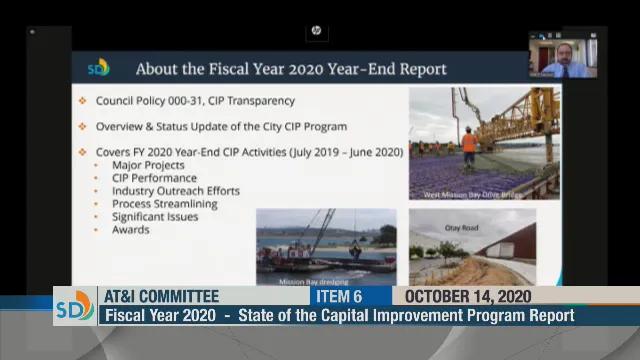
The Active Transportation and Infrastructure Committee of the San Diego City Council met virtually on October 14, 2020, due to Executive Order N-29-20 suspending certain Brown Act requirements. The committee considered five agenda items, including consent items, budget adjustments for capital projects, construction change orders, a policy update on unimproved streets, and an informational report on the capital improvement program. All votes were unanimous. Consent Calendar - Items 1 and 2 (Freeway Agreement with Caltrans for State Route 163 and Design Cooperative Agreement with Caltrans/Engineering Services Contract for Palm Avenue and I-805 Interchange) were approved unanimously without discussion. Public Comments & Testimony - Non-Agenda Public Comment: - A North Park resident (Ms. Deller) urged the council not to approve $2 million for a pipeline project, arguing that restaurants need outdoor seating areas to survive during COVID-19 and that pipelines should not take precedence over restaurant survival. - Lewis Rodolico criticized the influence of corporate money in politics, citing the Citizens United ruling and alleging that Westfield Mall lobbyists pitted neighbors against each other over road projects, resulting in delayed roads and increased deaths. - Martha Wells expressed distrust in city leadership, claiming the city does not build projects, does not deposit checks, and still uses outdated website information. - Item 3 (CIP Budget Adjustments): - Martha Welch (caller) urged the city to complete projects and hire workers, criticizing Proposition B and pension issues. - Item 4 (Construction Change Orders): - Marissa Borges supported approval, emphasizing the need for road safety improvements and asking the city to accommodate both bike lanes and outdoor dining. - Pat Sexton opposed the 30th Street funding, arguing it would hurt businesses and that bike lane money should come from SANDAG. - Nicole Burgess supported completion of street work to help outdoor dining thrive. - Matthew Vasilakis (Climate Action Campaign) supported the change order, stressing that resurfacing is separate from bike lanes and that protected bike infrastructure is critical for climate goals. - Andy Hanshaw (San Diego County Bicycle Coalition) supported the resurfacing and bike lanes but urged coordination with outdoor dining. - Ariana, a Day 3 resident, supported the change order for a more bikeable and walkable city. - Item 5 (Unimproved Streets Policy): - Matthew Vasilakis supported the policy amendments, stating all communities deserve safe infrastructure. - Item 6 (State of CIP Report): - Martha Wells commented on various projects, criticizing delays and questioning funding checks. Discussion Items - Item 3: Fiscal Year 2021 First Quarter CIP Consolidated Budget Adjustments - Staff presented a request to add $6.9 million in new appropriations, reallocate $7.7 million from completed or closing projects, and reallocate another $7.7 million from various projects to fund emergency stormwater repairs (including G Street, First Avenue Bridge, and others). The $7.7 million would be diverted from the Coastal Rail Trail, streetlights, walkways, parks, and signal projects. Staff noted that lending projects would be backfilled with the next commercial paper issuance. - The IBA (Jillian Kate) highlighted that $7.7 million is being diverted from planned projects, continuing a trend of emergency stormwater projects displacing high-priority work. In FY2020, $26 million was allocated to stormwater emergencies. - Committee members expressed concern about repeated emergency diversions. Vice Chair Ward requested staff find $500,000 elsewhere to avoid delaying a traffic signal at Alcalm Boulevard and Kansas (a Vision Zero intersection). Councilmember Kate asked about the commercial paper timeline; Finance staff said it would take a few months, likely in the fall. Councilmember Moreno requested that the resolution include a clause stating the intent to refund diverted projects with commercial paper. The motion was amended to include that clause. - Item 4: Approval of Construction Change Orders (CCOs) for Various CIP Projects - Staff requested change orders for three projects: Water Group 939 ($1.4 million for unforeseen tunneling obstacles), 38th Street Pipeline Replacement ($2.6 million for additional resurfacing and striping, including a bike lane on 30th Street from Polk to Juniper), and La Jolla Scenic Drive Pipeline ($728,713 for additional water main installation to improve system reliability). - Committee members discussed coordinating with businesses and the North Park Main Street association to minimize impacts on outdoor dining. Vice Chair Ward asked staff to continue working with the community; staff agreed. - Item 5: Updates to Council Policy 200-01 Regarding Unimproved Streets - Councilmember Moreno’s staff (Eddie Padilla) presented proposed policy changes to allow the city to fund improvements to unimproved streets and alleys (dirt or semi-paved roads not up to city standards). The city has 33.1 miles of unimproved streets and 28.07 miles of unimproved alleys, disproportionately in Council Districts 4 (10.57 miles) and 8 (12.79 miles). Upgrading one mile can cost $10–15 million. The proposed policy creates an exception for improvement, contingent on available funding, and clarifies that unimproved streets will continue at current maintenance levels until upgraded. The IBA noted total cost to improve all 61 miles could be in the mid-to-high hundreds of millions. Committee members expressed support, noting the policy addresses historical inequity. The city attorney (Cassandra Moogen) advised that the policy does not commit the city unequivocally to upgrade all streets. - Item 6: Fiscal Year 2020 Year-End State of the Capital Improvement Program (CIP) Report (Informational) - Staff presented the annual review, noting that total CIP expenditures reached $584 million in FY2020, more than double FY2014 levels. Key highlights: Pure Water Phase 1 design completed, 37 of 50 promised parks built, 190 miles of street repairs completed, water main replacement met its five-year goal (163.4 miles awarded), sewer main replacement beat its goal (217.3 miles). The report also discussed emergency projects ($33.9 million total, $20.3 million for stormwater), a 20% staff vacancy rate, and ongoing process streamlining. Committee members thanked staff; Councilmember Moreno requested analysis of a potential stormwater enterprise fund and expressed opposition to reducing council authority on contract awards. Key Outcomes - Item 3: Motion to approve the budget adjustments, with an amendment to include a resolution clause expressing intent to refund diverted projects through the next commercial paper issuance. Passed unanimously. - Item 4: Motion to approve the construction change orders. Passed unanimously. - Item 5: Motion to approve the proposed revisions to Council Policy 200-01 and forward the item to the full City Council. Passed unanimously. - Item 6: Informational only; no vote required.

CAPITAL IMPROVEMENT PLANNING 26% · PUBLIC COMMENT 17% · PUBLIC WORKS 11% · STORMWATER MANAGEMENT 8%
725
OCT 9, 2020 · SAN DIEGO, CALIFORNIA · RULES COMMITTEE
San Diego City Council Rules Committee Meeting - October 9, 2020

The San Diego City Council Rules Committee met virtually on October 9, 2020, with all members present. The committee approved changes to council policy on conflict of interest waivers and to the Ethics Commission audit manual, and received an informational update from the Performance and Analytics Department. All votes were unanimous. Public Comments & Testimony - Non-agenda public comment: No callers spoke. - Item 1 – Conflict of interest waivers: Joey Sonata spoke in favor of the proposed changes, praising increased transparency but noting a need for continued collaboration on the details. - Item 2 – Ethics Commission audit manual: No public speakers. - Item 3 – Performance and Analytics update: Joyce (last name not given) expressed concern that "city vehicle accidents" were the second-highest category in the ClaimStat dashboard, suggested a mobile app for homeless residents to provide feedback, and congratulated the department on its Prism Eagle Award and Bloomberg What Works Cities recognition. Discussion Items - Item 1 – Proposed amendment to Council Policy 00-34 (Conflict of Interest Waivers): Council President Gomez introduced the amendment, which would remove the delegation of authority for conflict of interest waivers and instead require all waivers under the City Council's purview to be brought before the full council for approval, likely as consent items. Ruth Martin, rules committee consultant, explained that the 2017 policy delegated authority to the city attorney's office and that this change aims to increase accountability and public transparency. Deputy City Attorney Ken Stowe presented additional clarifying language to guide waiver decisions, emphasizing flexibility and consideration of risks such as disclosure of confidential information and the need for screening measures in law firms. The committee discussed the possibility of noticing informational items when waivers fall under the mayor's purview; Senior Deputy City Attorney (name) said this could be explored. Council President Pro Tem asked this question. Public comment was limited to one supportive speaker. The motion to approve the amendments and work with the city attorney's office to prepare materials for full council consideration passed unanimously. - Item 2 – Amendments to the Ethics Commission Audit Manual: Stacy Fulhorst of the Ethics Commission presented proposed changes to the audit manual, last updated in 2007. The amendments adjust audit selection thresholds to account for inflation and increased contribution limits. Under the new structure, committees raising over $100,000 would be audited at a 100% rate, committees raising $50,000–$99,999 at 75%, and committees raising $15,000–$49,999 at 25% (the previous threshold for the bottom tier was $10,000). The commission expects the number of audits to increase by approximately 3–5 per election cycle, with no additional staffing needed because larger committees tend to have professional treasurers and are less labor-intensive. Minor housekeeping updates to legal references were included. The motion to approve passed unanimously. - Item 3 – Performance and Analytics Department Update: Kirby Brady, director of the Performance and Analytics Department, along with team members Alex Hempton, Andrew, and John, presented an informational update. Highlights included upcoming updates to the Get It Done mobile app (Spanish language support, AI-assisted category selection, improved map functions, and a confirmation page), the COVID-19 emergency needs portal that received over half a million dollars in fair market value donations since April, and the data analytics lifecycle. Examples of data-driven improvements included the Environmental Services Department reducing its container delivery backlog by roughly half in about three months after monitoring dashboard metrics, and the illegal dumping mobile worker app yielding 9.4% higher volume, a 9.4% reduction in closure time, and a 10.6% increase in customer satisfaction. The department also received the statewide Prism Eagle Award for its ClaimStat tool and Bloomberg What Works Cities recognition for three consecutive years. Upcoming initiatives include a COVID-19 sentiment survey using the newly procured Medallia platform (funded by CARES), a pay equity study expected by December 2020, migration of Parks and Recreation onto Get It Done, and a customer service 2.0 plan. Councilmembers offered suggestions, including a near-miss reporting widget from Councilmember Ward and improved "closed referred" status communication raised by Councilmember Montgomery Steppe and the Council President. No vote was taken; the item was for information only. Key Outcomes - Approved the amendments to Council Policy 00-34 on conflict of interest waivers, unanimously (5–0). - Approved the amendments to the Ethics Commission Audit Manual, unanimously (5–0). - Received the informational update from the Performance and Analytics Department; no action taken. - The next Rules Committee meeting was scheduled for October 21, 2020, at 2 p.m.

TECHNOLOGY AND INNOVATION 35% · PROCEDURAL 20% · CONFLICT OF INTEREST 17% · PUBLIC COMMENT 16%
726
OCT 7, 2020 · SAN DIEGO, CALIFORNIA · PUBLIC SAFETY & LIVABLE NEIGHBORHOODS COMMITTEE
Public Safety and Livable Neighborhoods Committee Meeting - October 7, 2020

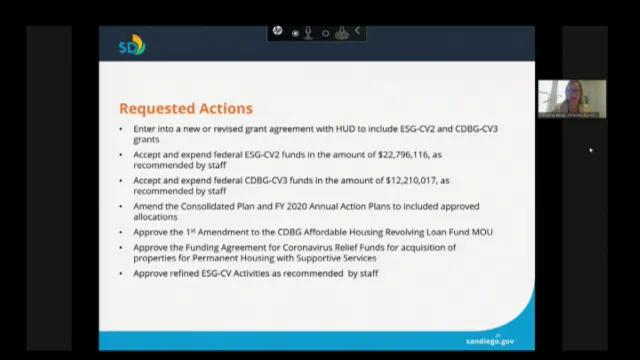
The Public Safety and Livable Neighborhoods Committee met on October 7, 2020, at 5:00 PM UTC via Zoom due to the COVID-19 pandemic. Committee Chair Councilmember Montgomery Steph presided, joined by Vice Chair Councilmember Barbara Bree, Councilmember Kate, and Councilmember Moreno. Staff from the San Diego Housing Commission, city departments, and the San Diego Police Department presented several items. All agenda items were approved unanimously. Consent Calendar - The committee approved the actions from the previous meeting via a motion by Councilmember Moreno, seconded by Vice Chair Bree, with all members voting yes. Public Comments & Testimony Non-Agenda Public Comment: - Barbara Gordon, advisor for a Hispanic youth group, expressed concern about secondhand tobacco and marijuana smoke in multi-unit housing, urging the committee to consider prohibiting smoking in such buildings. - Lois, a taxpayer, criticized city reliance on seller appraisals (e.g., 101 Ash Street) and buyer assessments (e.g., Mission Valley Stadium), calling for independent appraisals and criminal prosecutions. - Kelly McCormick, a youth mentoring program director, cited the 2019 National Survey on Drug Use and Health showing increased teen marijuana use and low perceived harm, urging more education and enforcement against marijuana ads and products. - Martha Wells accused the city of lying about police pensions and hiring, demanding accountability. - Joy Sunata encouraged public participation and thanked officials. Public Comment on Items 1 & 2 (Hotel Acquisitions & CARES Act Funds): - Marshall Anderson (Downtown San Diego Partnership) supported the item, noting downtown’s disproportionate burden as a shelter location and urging the committee to address conservatorship and enforcement. - Monica Ball expressed concern about administrative fees ($4.7 million) and lack of a safe exit gap plan for families in COVID-response motels (e.g., Pacific Inn and Travelodge in Point Loma) being asked to exit October 25, while Golden Hall shelter reopens in December. - Martha Wells echoed skepticism about conditions at the Convention Center and Golden Hall. - Diana Catalano (Mission Village condo owner for 30 years) opposed the Hotel Circle acquisition, citing safety, property values, and increased costs to secure her complex. - Alexandra Walker (Mission Village resident) objected to the Hotel Circle location due to a single bus route, pedestrian-unfriendly roads, lack of amenities, and potential liability near freeway exits. - Matthew Basilakis (Climate Action Campaign) supported moving the item to full council, emphasizing the need for affordable and supportive housing. - Gina Catalano (Mission Village resident) urged consideration of full impact on residents, including safety, mental well-being, property values, and security costs. - Joy Sunata praised collaboration and encouraged public participation. No public comment was received for Items 3, 4, or 5. Discussion Items Items 1 & 2: Residence Hotel Acquisitions and Allocation of CARES Act Funds - Staff from the Mayor’s office (Francis Barraza), San Diego Housing Commission (Lisa Jones, Michael Pavco, CEO Rick Gentry), and Economic Development (Christina Bibler) presented a joint package to purchase two hotels and convert them into permanent supportive housing for up to 400 homeless individuals, funded by federal, state, and local sources. - Hotel Circle (190 units): Located near the 8 freeway, built 2003, renovated 2018, with 1- and 2-bedroom units with kitchenettes. Funding: $27.7 million state Home Key funds, $50 million permanent loan from Chase Bank (secured by 332 project-based housing vouchers), plus CDBG and Housing Commission funds. - Kearny Mesa (142 units): Located off the 163 freeway, built 1990, renovated 2013, studios and 2-bedroom units. Funding: $10 million state Home Key funds, permanent loan from Chase, $10 million CARES Act from city, plus Housing Commission funds. - Total acquisition cost $11 million (city portion), with $37.7 million state Home Key as keystone. Operating agreements: PA (Passages) for Hotel Circle ($2.79 million for services and property management) and Father Joe’s Villages for Kearny Mesa ($2.09 million). - The city also accepted $22.7 million in ESG-CV Round 2 and $12.2 million in CDBG-CV Round 3 for shelter operations, rental assistance, and program administration. $5 million of CDBG-CV Round 3 allocated to the Emergency Rental Assistance Program; staff reported 13,158 applications received with 4,400 qualified, using $15.1 million initially approved. - Administrative fees: 20% for CDBG ($4.7 million) and 10% cap for ESG, justified by increased workload (budget rose from $34M to $79M) and strict compliance requirements. - Councilmember Moreno noted the 332 vouchers were redeployed (not new), with Section 8 waitlist typically 7-10 years. Councilmember Kate asked about community engagement; staff promised a “good neighbor committee” for stakeholder meetings. Item 3: 2020 DNA Capacity Enhancement for Backlog Reduction (CEBR) Grant - Lieutenant Daniel Meyer (SDPD Crime Lab) requested authorization to apply for $369,460 in grant funding from the Bureau of Justice Assistance. Funds would cover overtime for staffing ($139,621), accreditation-mandated training ($33,954), and new technology ($195,788). The lab’s current backlog is 632 cases (91% property crimes, plus 9 sex crimes, 5 murders, 30 assaults, 14 gang/firearms, 2 robberies). Grant period: October 1, 2020 – December 31, 2022. Item 4: Fiscal Year 2021 Sexual Assault Evidence Submission (SAFES) Grant - Lieutenant Meyer presented a request for $138,204 from the California DOJ to augment SB22 compliance, including $23,986 for SART consumables and $114,218 for outsourcing current SART cases. The current backlog of sexual assault kits is 9 (recent kits); historical SB22-related kits have been sent to contract lab Bodie, with returns at 73-75 per month. Item 5: 2020 Internet Crimes Against Children (ICAC) Task Force Grant - Detective Sergeant Garrett Nugent (SDPD ICAC Task Force Commander) requested acceptance of $950,000 from Cal OES for salary, technology, training, travel, outreach, and investigator wellness. The San Diego ICAC Task Force includes 33 agencies across three counties. Cyber tips addressed: 3,058 as of August 2020, rising to 4,201 by the meeting date (October 7, 2020). Grant funds support the entire task force network. Key Outcomes - Items 1 & 2: Motion by Councilmember Kate, seconded by Vice Chair Bree, with all members voting yes. The committee recommended approval to the full City Council for the hotel acquisitions and funding allocations. - Item 3: Motion by Vice Chair Bree, seconded by Councilmember Kate, passed unanimously. - Item 4: Motion by Vice Chair Bree, seconded by Councilmember Kate, passed unanimously. - Item 5: Motion by Vice Chair Bree, seconded by Councilmember Kate, passed unanimously. - The meeting adjourned at approximately [time not specified in transcript], with the next committee meeting scheduled for October 28, 2020, at 9:00 AM.

HOMELESSNESS 33% · AFFORDABLE HOUSING 23% · PROCEDURAL 19% · PUBLIC COMMENT 9%
727
OCT 7, 2020 · SAN DIEGO, CALIFORNIA · ECONOMIC DEVELOPMENT & INTERGOVERNMENTAL RELATIONS COMMITTEE
San Diego Economic Development Committee Meeting - October 7, 2020

On October 7, 2020, the Economic Development and Intergovernmental Relations Committee of the San Diego City Council met virtually via Zoom, in compliance with Executive Order 29-20, to discuss four agenda items: an update from the Port of San Diego, digital equity initiatives, the Welcoming San Diego strategic plan, and a creative economy study. The meeting was chaired by Councilmember Kate, with Vice Chair Montgomery Steppe, Councilmember Ward, and Councilmember Kirsey present. The committee approved the previous meeting's actions unanimously and received public comments on several items. Consent Calendar - Approval of Actions (September 9, 2020): The committee unanimously approved the actions from the previous meeting. Motion by Councilmember Ward, seconded by Councilmember Kirsey. Votes: Vice Chair Montgomery Steppe (yes), Councilmember Ward (yes), Councilmember Kirsey (yes), Chair Kate (yes). Public Comments & Testimony - Non-Agenda Public Comment: - Martha Welch expressed concerns about the city's tax payments to state and federal governments, and referenced former Supervisor Bill Horn (indicted and in jail). She also criticized MTS and the county for alleged mismanagement. - Port of San Diego Update (Item 1): - Joy Sanyata thanked the port commissioners for the presentation, praised the North Embarcadero Visionary Plan, and expressed support for the Port's work. (Position: supportive) - Digital Equity Initiatives (Item 2): - Joy Sanyata spoke in support of the digital equity program, noting its importance for seniors and the community. She urged continued help for low-income seniors to access the internet. (Position: supportive) - Creative Economy Study (Item 4): - Joy Sanyata thanked the presenters, called the presentation a learning experience, and highlighted the economic value of the creative economy. (Position: supportive) Discussion Items - Port of San Diego Update: - Commissioners Michael Zuquette, Rafael Castellanos, and Marshall Merrifield provided an update. Key points: - Financial Impact of COVID-19: Port revenues declined 15% ($30 million) from March to June 2020 compared to budget, and a $60 million shortfall is projected for FY2021. The Port is ineligible for CARES Act funding because it is a special independent agency. Concession rent from hotels dropped 84% from March to July 2020 (from $27 million to $4.2 million). Convention center hotels saw a 90% decline. The Port has $120 million in reserves and has enacted hiring freezes and cost-cutting measures; no full-time layoffs occurred. - Maritime Clean Air Strategy (MCAS): A four-phase initiative to improve air quality in port-adjacent communities (Barrio Logan, Logan Heights, Sherman Heights, National City). These communities rank among the worst air quality in California (top 10% per CalEnviroScreen). The Port allocated $500,000 for window and air filter replacements at Perkins Elementary School. Also, $100,000 was spent on hotel rooms for residents affected by the USS Bonhomme Richard fire in July 2020. - Port Master Plan Update: A discussion draft of the updated plan is expected for public comment later in October 2020, with CEQA review in 2021 and Coastal Commission approval in 2022. The concept of "Harbor Drive 2.0" (dedicated freight haul road) is being studied with SANDAG, Caltrans, and the Navy. - Seaport Village Revitalization: Occupancy increased from 84% to 92% since 2018. New tenants include Sam the Cooking Guy, Louisiana Charlie's, and Malibu Farms (pending approval). Portside Pier (North Embarcadero) opened two months prior, serving 90,000 parties and generating $5 million in revenue despite the pandemic. - CEO Search: Following CEO Randa Conley's retirement announcement, the Port has launched a national search, with a target to have a new CEO by early 2021. - Councilmember questions focused on the Port's ineligibility for CARES Act, small business inclusion, rent deferment programs (deferral of minimum rent to October 2021, with conditions including worker rehire policies), and the outlook for the cruise industry (likely return in mid-2021). - Digital Equity Initiatives: - Presented by Jonathan Banke (CIO) and Sam Alice Crespo (Economic Development). Key points: - The City Council allocated $500,000 in one-time funds to bridge the digital divide. A working group (SD Access for All) has been formed. - Partnership with San Diego Futures Foundation: 2,200 end-of-life computers donated for refurbishment. The Foundation has provided over 53,000 computers to date. - Outdoor community computer labs opened at four library locations (Central, Skyline Hills, San Ysidro, Malcolm X). Seven more are in progress. Parks Wi-Fi: 10 of 25 sites active, with Parks Foundation funding. - A grant application to the Economic Development Administration (EDA) for $380,000 (plus matching funds, total $500,000) was submitted to support digital inclusion in the Promise Zone (covering East Village, Barrio Logan, Logan Heights, Southeastern San Diego, Encanto). The project includes digital navigators, device distribution, and outdoor computer access labs. - Councilmembers requested metrics on usage and emphasized collaboration with schools and ISPs. - Welcoming San Diego Update: - Presented by Denise Garcia and Rita Fernandez (Immigrant Affairs Manager). Key points: - The city hired its first-ever Immigrant Affairs Manager in November 2019. The Welcoming San Diego Strategic Plan (developed over five years) is in implementation phase. - COVID-19 impacts: 36,000 foreign-born essential health care workers and 32,400 foreign-born essential food/agricultural workers in San Diego. Many immigrants are ineligible for federal aid due to lack of Social Security numbers. - Key initiatives: resource guide for new San Diegans, advocacy on DACA (30,000 DACA recipients in health sector), naturalization (fee increases opposed), public charge rule, refugee resettlement (Mayor signed consent letter), and comprehensive immigration reform. - The plan has six sections: cross-sector, economic opportunity, education, inclusive access, civic engagement, and public safety. Examples include creating an Office of Immigrant Affairs, leveraging data, facilitating career advancement (re-credentialing), and expanding library services. - Councilmembers requested outreach to hard-to-reach immigrant populations and emphasized multilingual communications. - Creative Economy Study: - Presented by Christina Bibler (Economic Development), Jordan Latchford (San Diego Regional EDC), and Jonathan Glus (Commission for Arts and Culture). Key points: - The study is the first comprehensive analysis of San Diego's creative economy, based on 2019 data (pre-COVID). - Creative industries (71 sectors) have an $11 billion regional economic impact (4.5% of regional economy) and support 17,000+ jobs (7% of total employment). For every job in creative industries, 1.1 jobs are supported elsewhere. - Creative occupations (77 types) employ 70,000 workers, with a median annual income of $75,000. Self-employed creatives (13,000) earn about $40,000/year. - Key findings: Creative firms value experience over degrees; top challenge is high cost of living; demand for more physical space (theaters, studios) and better marketing (e.g., film commission). - COVID-19 impact: As of August 2020, creative industry employment declined by 14,500 jobs, resulting in a $2.1 billion economic loss. - Councilmembers noted the importance of supporting the creative sector in recovery efforts and discussed branding and regional collaboration. Key Outcomes - All items were informational; no motions or votes were taken on the agenda items. - The committee approved the consent calendar (meeting actions from September 9, 2020) unanimously. - Chair Kate announced that the next two meetings (October 28 and a later date) will cover rent increases for city lessees and will be the last meetings of the year. - The committee will continue to monitor the Port's financial situation, digital equity progress, immigrant integration efforts, and creative economy recovery.

PUBLIC COMMENT 30% · IMMIGRATION 13% · ARTS AND CULTURE 13% · DIGITAL EQUITY 11%
728
SEP 30, 2020 · SAN DIEGO, CALIFORNIA · AUDIT COMMITTEE
San Diego Audit Committee Meeting: September 30, 2020

The San Diego Audit Committee convened virtually on September 30, 2020, at approximately 9:00 AM, with members participating via teleconference per the executive order suspending certain Brown Act requirements due to the COVID-19 pandemic. Chair Sherman presided, joined by Committee Members Tufik Tabshuri, Ricardo Valdivia, Stuart Halpern, Vice Chair Councilmember Marino, Interim City Auditor Kyle Elser, and staff from the Mayor's Office, IBA, and City Attorney's Office. The meeting included a closed session, four audit presentations, a compensation discussion, appointment process updates, and public comments. The meeting was televised and live-streamed on the city's website, with public comment accepted via phone (619-541-6310, access code 877-861). Closed Session (Morning) - The committee discussed candidates for city auditor in closed session. Public comment was taken prior to adjournment, with Joy Sanyata stating she wants the new auditor to: be ever vigilant, leave no stone unturned, and tell it like it is. Martha Wells expressed concerns about the lack of pension for the auditor position and demanded financial audits. - The committee adjourned to closed session and reconvened at approximately 12:30 PM. The report out indicated the committee voted 5-0 to recommend three candidates for city auditor to the city council, as required by the San Diego City Charter. Non-Agenda Public Comment - Lewis Rodolico spoke about the U.S. Supreme Court's 2010 Citizens United ruling, arguing corporate influence on politicians has led to a "collapsed economy" and over 200,000 deaths nationally from COVID-19. He stated corporations pit citizens against each other on issues like masks and bridges. - Martha Wells demanded financial audits, expressed concerns about pensions for city auditors, and criticized the city's legal compliance and tax collection practices. Discussion Item: Performance Audit of San Diego Police Department Data Analysis - Steve Grom, Joe Pisick, and Zoya Ahmed of the City Auditor's Office presented the SDPD data analysis audit. Key findings included: SDPD accounts for one-third of general fund expenditures and employees, but has fewer officers per resident than other major cities. - The audit found internal controls for crime data and RIPA stop reports, but could not directly test data accuracy due to COVID-19. SDPD received unofficial notice from the FBI of successful completion of NIBERS (National Incident-Based Reporting System) certification. - Minor inconsistencies in RIPA training and guidance were noted, with risk that some stop reports may not include all outcomes (e.g., verbal warnings). - The audit found SDPD uses data primarily for tactical purposes (researching individuals/locations) rather than evaluating operational outcomes like community policing effectiveness or response times against Part 1 crime rates. - Citizen complaint procedures may inadvertently discourage anonymous complaints; the online CRB form requires name and address. The Community Review Board on Police Practices (CRB) lacks access to data systems to independently verify complaints. - Nine recommendations were made; SDPD agreed with all nine. Recommendations 8 and 9 target July 2021, and recommendations 2, 4, 5, and 6 target June 2022. - Chief Nisleit thanked the committee and said his team would implement the recommendations. Chris Haley (program manager) noted that training models and curriculum need development for recommendations 2, 4, and 5, with milestones to be communicated to the audit team. Chief Nisleit noted that some CRB-related recommendations may be affected by the November ballot initiative on a new oversight commission. - In response to Committee Member Tabshuri's question about complaint trend analysis, Chief Nisleit stated he meets weekly with internal affairs and professional standards teams to review trends and best practices. - Committee Member Valdivia asked about the use of the word "should" in the report; Joe Pisick clarified this was due to the inability to directly test data during the pandemic. - Stuart Halpern moved to accept the report, seconded by Valdivia. The motion passed unanimously. Discussion Item: Consideration of Compensation for City Auditor Appointees - Per Charter Section 39.1, the audit committee recommends annual compensation of the city auditor to the city council. The FY2021 adopted budget has an annual salary range of $63,127 to $239,144 for the city auditor (unclassified executive 4 position). - Public comment: Joy Sanyata urged the committee to set compensation at the high end, stating "let's go on the high end if possible." Martha Wells expressed concerns about pensions and financial audits. - Chair Sherman moved to recommend a salary range of approximately $190,000 to $239,000, citing comparisons to other large city auditors. Committee Member Halpern abstained, stating he would prefer to see an actual salary survey before voting. Valdivia seconded the motion. - The motion passed 3-0 with one abstention (Halpern). Discussion Item: Performance Audit of Transportation & Stormwater Department Street Sweeping - Megan Garth, Chris Kime, and Danielle Kish presented the audit. The street sweeping section has 17 motor operator positions, 27 sweeping machines, and sweeps 2,700 miles of improved streets across 215 routes (ranging from 1 to 62 miles, average 24 miles). - Findings: Route priority levels in the jurisdictional runoff management plan were based on 2015 existing frequencies and historical anecdotal information, not actual debris volume. High priority routes are swept weekly (above the planned twice per month); low priority routes are swept every other month (above the planned once per year). - Analysis of FY19 data showed 86 routes with high debris per mile: 18 high, 21 medium, and 47 low priority. Many routes in Los Penasquitos and Tijuana River watersheds have high debris but are designated low priority. Regenerative air sweepers were used on only 25% of those watersheds, similar to the citywide average. - Only 24% of the 215 routes are posted routes; none have been added since 2012. Posted routes increase debris removal by over 50%. - The current KPI (annual miles swept, target 117,000) has not been met in the last four years; routes are incomplete primarily due to heavy debris, equipment problems, and staffing issues. - Four recommendations were made: develop a periodic report, perform a comprehensive reassessment in the next permit cycle, create additional KPIs (including total debris collected and percent of miles completed), and request budget approval for selective posted routes. - Chris McFadden, director of Transportation & Stormwater, agreed with all recommendations. He noted the program underwent a 2012 management competition and won, and that $186,000 was included in FY21 for street sweeping efficiency but was eliminated during budget reductions. He noted 56 new median routes and 11 enhanced sweepers were added. - McFadden stated posting additional routes requires budget approval for signage, parking enforcement, and public outreach, as parking enforcement officers are already fully taxed with current posted routes. - Valdivia asked if work was outsourced; McFadden confirmed all work is performed by city employees in-house. - Halpern moved to accept the report, seconded by Tabshuri. Passed unanimously. Discussion Item: Central Stores Inventory Agreed Upon Procedure Review - Kevin Starkey from MGO presented the review, conducted on behalf of the city auditor's office to comply with city municipal code requiring annual inventory. The inventory was conducted June 29, 2020. - 223 stock items were sampled (213 per procedure plus 10 additional). Total sampled inventory value: $227,500. Net errors found: approximately $8,500. Extrapolated population error: approximately $49,000 net ($106,000 over, $58,000 under), significantly higher than last year's $9,500 net error. - A recurring recommendation was made to procure handheld devices compatible with the SAP inventory module to improve record accuracy. - Five negative write-off adjustments and one positive adjustment were noted, attributed to staff errors. - Christiana Gagger, interim director of purchasing contracting, noted the pandemic created a "perfect storm" of increased PPE/cleaning item demand and reduced staffing. She identified line item 50 (thermal zebra) overstated by $8,000 because the stock was physically present but misplaced. - Halpern asked about the cost of handheld scanners versus variance losses; Gagger stated she did not have a cost figure available but would provide one later. Valdivia noted the scanner issue was previously considered a budgetary matter and should be reconsidered given the increased variance. - Halpern moved to accept, seconded by Tabshuri. Passed unanimously. Discussion Item: 2020 City Auditor Appointment Process Status Update (Informational) - Lisa Byrne of the IBA presented IBA report 2020. The appointment process began with a June 17 committee direction; the job announcement was posted June 26. Applications were accepted until September 9, with 36 applications received, but only 20 possessed the charter-required CPA or CIA licenses. - A numerical scoring mechanism was used by the subcommittee (Stuart Halpern and Ricardo Valdivia) and IBA team. Top applicants were interviewed; closed session selections were made, contingent on pending background and reference checks. - The city targets filling the position by November 2020. - Joy Sanyata thanked the IBA and added a fourth quality she wants in the new auditor: "spike the work with a dash of lightness and fun." - Chair Sherman noted the recruitment effort cost only $1,125 on outreach, compared to approximately $50,000 spent on a headhunter in a prior recruitment, and thanked the IBA office for its cost-effective work. Discussion Item: City Auditor's Monthly Activity Report - Interim City Auditor Kyle Elser presented the monthly activity report. Since the last meeting, four audit products were issued: a memo requesting independent legal counsel (to be brought to city council in October), the Central Stores Inventory audit, the Street Sweeping audit, and the SDPD Crime Data Analysis audit. - Two audits are in report writing stage: IT audit of legacy applications and equal opportunity contracting program audit. Two in field work: sustainability climate action plan and human capital audit (employee discipline and incentives). Two in planning: IT service delivery effectiveness and industrial waste control program part two. - Elser stated the human capital audit is targeted for issuance by November, potentially requiring a special audit committee meeting. - Halpern asked about COVID-19 impacts on data access and audit scheduling. Elser noted delays but stated no anticipated issues that would prevent eventually obtaining data; carryover of two to three projects to the next fiscal year is expected. Key Outcomes - Accepted the SDPD Data Analysis Performance Audit with nine recommendations (unanimous). - Recommended city auditor salary range of $190,000 to $239,000 to city council (passed 3-0, one abstention). - Accepted the Street Sweeping Performance Audit with four recommendations (unanimous). - Accepted the Central Stores Inventory Agreed Upon Procedure Review (unanimous). - Committee voted 5-0 in closed session to recommend three city auditor candidates to the city council. - Next meeting scheduled for Wednesday, October 21, 2020 at 9:00 AM.

AUDIT FOLLOW-UP 17% · INVENTORY MANAGEMENT 17% · PUBLIC COMMENT 15% · STORMWATER MANAGEMENT 11%
729
SEP 24, 2020 · SAN DIEGO, CALIFORNIA · ENVIRONMENT COMMITTEE
San Diego Environment Committee Meeting - September 24, 2020

The Environment Committee of the San Diego City Council met on September 24, 2020, via teleconference due to the COVID-19 pandemic. The meeting covered a consent agenda item on solid waste collection franchises, a discussion item on the Southern California Coastal Water Research Project (SQRP) joint powers agreement, an informational presentation on the Municipal Energy Strategy, and a follow-up performance audit of the Industrial Wastewater Control Program. Public comment was received on agenda items and during a non-agenda period. Consent Calendar - Item 1: Transfer of Non-Exclusive Solid Waste Collection Franchises – Approved unanimously. One public speaker (Montferrals) opposed the franchise, stating it was "the worst thing I ever heard of." Another caller inquired about non-agenda public comment. Discussion Items - Item 2: Tenth Amended Joint Powers Agreement for Southern California Coastal Water Research Project (SQRP) – Presented by Ryan Kempster, Senior Marine Biologist. The JPA would fund SQRP at just over $2.7 million over five years starting fiscal year 2022. The project conducts unbiased coastal water quality research and is required by city permits. Public comment: Martha Welch criticized the city's environmental record and alleged corruption without stating a clear position on the item. The committee unanimously approved the item. Chair Campbell praised SQRP as a world-renowned organization. - Item 3: Returned to staff without objection. Informational Item - Item 4: City of San Diego Municipal Energy Strategy – Presented by Cody Hoovin (Director of Sustainability) and Lindsay Haas (Municipal Energy Program Manager). The strategy outlines a path to zero emissions for city facilities, with targets to reduce energy use by 15% by 2020 and an additional 25% by 2035 from a 2010 baseline. Key strategies include energy efficiency, building energy management systems, renewable energy, zero-emission policies, smart distributed energy resources, workforce training, and an equity focus using the Climate Equity Index. The city has achieved only half the required reductions so far. Public comment: Seven callers. Supporters included Barbara Gunther (Center for Sustainable Energy), Rosalind Hurst (Sustainable Energy Advisory Board), Jason Anderson (Cleantech San Diego), and Matthew Vasilakis (Climate Action Campaign) who expressed support but disappointment that a related funding item (energy savings performance contracts) was pulled. Several callers attempted to speak on non-agenda topics (gas leaf blowers, sea lion protection) and were redirected. Committee discussion: Councilmember Moreno asked about timeline and equity priorities, suggesting use of CalEnviroScreen. Chair Campbell noted this was an informational item only. No vote was taken. Key Outcomes - Consent agenda approved unanimously. - Item 2 (SQRP JPA) approved unanimously. - Item 3 returned to staff. - Item 4 was informational; staff committed to bringing an implementation plan by the end of the fiscal year. - Item 5: Follow-up Performance Audit of the Industrial Wastewater Control Program (IWCP) – Presented by Andy Hanow (Interim Assistant City Auditor) and Shadi Mittar. The audit found that cost recovery issues from 2013 remained unresolved: 86% of program costs ($30 million over 10 years) were passed to non-regulated wastewater customers, potentially violating Proposition 218. Fees had not been updated since 1984. Additionally, billing lapses resulted in $850,000 in unbilled costs from fiscal years 2008-2012, and new lapses occurred since fiscal year 2017. Public Utilities Director Shauna Laurence accepted all nine recommendations and reported progress: back invoices sent, cost-of-service study underway, and negotiations with participating agencies. The committee (led by Councilmember Moreno) expressed strong concern and requested a six-month update. Staff aims to bring updated fees to City Council in January 2021. Non-Agenda Public Comments - Sea Lion Protection at La Jolla – Carol Archibald, Robin Davidoff (Sierra Club/Seal Society), and Alan Shively requested a municipal code amendment defining a safe viewing distance from sea lions. They reported ongoing harassment and cited NOAA recommendations. They requested the item be placed on a future committee agenda. - Gas-Powered Leaf Blower Ban – Patty Kushner, Marjorie Nass, and others requested a ban in La Jolla, citing noise, health, and environmental impacts. They noted that neighboring cities (Coronado, Encinitas, Solana Beach, Del Mar) have already enacted bans. - Energy Franchise Agreement Opposition – Joyce Lane (San Diego 350), Tara Hammond (Hammond Climate Solutions), and Matthew Vasilakis (Climate Action Campaign) strongly opposed the mayor's proposed 20-year franchise agreement with SDG&E, calling it a "sweetheart deal" that undervalues public assets and lacks accountability or an exit strategy. They urged rejection and a one-year extension. - Other – Martha Wells made general allegations of corruption and improper handling of funds.

PUBLIC COMMENT 30% · WATER AND WASTEWATER MANAGEMENT 24% · NULL 16% · ENERGY AND SUSTAINABILITY 16%
730
SEP 17, 2020 · SAN DIEGO, CALIFORNIA · LAND USE & HOUSING COMMITTEE
Land Use and Housing Committee Meeting – September 17, 2020

The Land Use and Housing Committee met on Thursday, September 17, 2020, at approximately 1:00 PM to consider several items including community plan updates, housing preservation strategies, code amendments, and a UC San Diego deed restriction removal. All items passed unanimously with some modifications. The meeting was conducted via teleconference per Executive Order 2920, with public comment by phone. Consent Calendar - Approval of committee actions from July 30, 2020: Passed unanimously. - North Park Community Plan Amendment and rezone: Passed unanimously without discussion. One public comment supported the change. Public Comments & Testimony - Martha Welch (non-agenda) criticized the city’s housing policies, alleging misuse of HUD funds and lack of family-sized units. - Brett Stevens (non-agenda) supported the Techolody Road street dedication item. - Ricardo Flores (non-agenda) deferred his comment to a later agenda item. - Joy Sanyata (non-agenda) thanked Gary and Mary West Senior Wellness Center for assisting seniors. - Andrew Maywick supported the North Park Community Plan Amendment. - Tim Hardinger (property owner) supported zoning changes in Kearney Mesa. - Jeffrey Davis encouraged more housing in Kearney Mesa, noting the plan falls short near Babboa Avenue and Convoy. - John Gruber asked about zoning for Convoy Court area. - Matthew Adams (Building Industry Association) strongly supported the Kearney Mesa update. - Robin Madaffer (attorney) thanked staff for changes benefiting Hebrew Academy and a Walmart site at Claremont Mesa and Shaw Line. - Shiram Harmer praised staff for thorough community outreach on Kearney Mesa. - Gil Bishop (affordable housing developer) supported the update but suggested rezoning three large city parcels near Convoy and the 52. - Matthew Basilakis (Climate Action Campaign) supported the update but requested more detailed mode share analysis and increased deed-restricted affordable housing. - Susan Baldwin (affordable housing advocate) urged requiring more affordable units in Kearney Mesa. - Craig Benedetto (NAOP San Diego) supported the plan. - Martha Welch (repeat) criticized housing department and county policies. - Diane Kane (architectural historian) supported using older buildings for affordable housing and suggested using the State Historic Building Code. - Laura Ann Fernia (City Heights CDC) supported preserving affordable housing and requested a tenant relocation fund and inclusion of community organizations in the working group. - Ricardo Flores (LISC San Diego) highlighted an existing CDFI fund and offered partnership with the city. - Joy Sanyata supported preservation recommendations and urged prioritizing the interagency working group (recommendation 9). - Martha Welch (repeat) criticized housing department. - Catherine Rhodes supported moving all former redevelopment funds into the housing trust fund. - Jeffrey Forrest observed only. - Gil Bishop supported code updates. - Sherman Armer supported land use code updates to reflect state laws. - Catherine Riz criticized the city’s historical approach to emergency shelter zoning; asked where emergency shelters are allowed by right in downtown. - Andrew Malick supported code updates for infill development. - Matt Hamilton (property owner) requested that detached ADUs also be exempt from Coastal Commission permits. - Craig Benedetto (NAOP) supported all code update recommendations. - Martha Welch praised aligning with state rules. - Jane Emerson (La Jolla Shores Association) opposed removing deed restrictions on UCSD land, citing potential for non-educational uses. - Gabrielle Goodman (homeowner and alumna) opposed lifting deed restrictions, citing traffic impacts and questioning the appropriateness of hotel/retirement housing on campus. Discussion Items - Item 6: Dedication of Street Right-of-Way at Techolode Road and West Marina Boulevard – The city will dedicate 11,000 sq ft of property for an ADA-accessible ramp to connect the new Mid-Coast Trolley station to Mission Bay. Construction funded by SANDAG/FTA, maintenance by the city. Passed unanimously. - Item 2: Kearney Mesa Community Plan Update – A comprehensive update to the 1992 plan, increasing residential capacity to 25,000 units (90% in transit priority areas), preserving industrial land, adding mobility improvements, and implementing a Community Plan Implementation Overlay Zone (CPAS). The plan reduces VMT and increases active transportation. The Planning Commission recommended approval with a later study of Convoy area. Passed unanimously with direction to provide more detail on mode share projections at City Council. - Item 3: Affordable Housing Preservation Implementation Strategy – Presentation by Housing Commission staff covering redirecting former redevelopment funds (RPTTF), adopting a preservation ordinance (right of first offer/refusal to nonprofits), offering incentives to owners of naturally occurring affordable housing (NOAH), and creating an interagency working group. The IBA noted fiscal challenges due to COVID-19 and recommended delaying the funding recommendation. The committee amended the motion to set an annual target of 20% of FY2021 RPTTF plus growth, reported through the budget process, rather than a binding commitment. Passed unanimously. - Item 4: Housing Legislation Code Update – Implements several state housing laws: low-barrier navigation centers, expanded emergency shelter zones, density bonuses for 100% affordable and student housing, revised ADU regulations (including incentives for affordable ADUs), removal of parking requirements for ADUs, employee housing provisions, and SB 330 dwelling unit replacement requirements. Supported by ad hoc working group, Community Planners Committee, and Planning Commission. Passed unanimously. - Item 5: Removal of City Deed Restrictions on UC San Diego Land – Request to release city-imposed deed restrictions on approximately 510 acres of UCSD campus land to allow public-private partnerships for faculty/staff rental housing, life science research, wellness center, retired faculty housing, and on-campus lodging. UCSD argued that the land would continue to be used for university purposes under UC constitutional authority. Estimated $80M in new tax revenue over 20 years. The committee voted to direct Real Estate Assets, City Attorney, Mayor's Office, and Council District 3 to draft documents for council consideration, with further community engagement. Passed unanimously. Key Outcomes - Consent items approved (minutes, North Park plan) unanimously. - Techolode Road street dedication approved unanimously. - Kearney Mesa Community Plan Update recommended for City Council approval unanimously, with a request for additional mode share analysis. - Affordable Housing Preservation Strategy advanced with modified funding language: annual target for 20% of RPTTF plus growth, reported through budget process. Preservation ordinance, incentives, and interagency working group (including community organizations) also recommended. - Housing Code Update recommended for City Council approval unanimously; staff to follow up on detached ADU exemption from Coastal Commission and ensure student housing bonus targets genuine students. - UC San Diego Deed Restriction Removal advanced for further document drafting and community review before City Council consideration.

PUBLIC COMMENT 27% · AFFORDABLE HOUSING 22% · NULL 12% · PUBLIC PRIVATE PARTNERSHIPS 8%
OPENPUBLICA · PUBLIC MEETING INDEXUPDATED DAILY · openpublica.com