Browse by city
Date range
Search help

Search titles, summaries, topics and stored transcripts together. Keywords may match separately; put the whole query in double quotes for a phrase. Matching follows word analysis, so punctuation is not exact. Both dates are included. Documents are not searched.

SHOWING 731–740 ENTRIES
731
SEP 16, 2020 · SAN DIEGO, CALIFORNIA · BUDGET & GOVERNMENT EFFICIENCY COMMITTEE
San Diego Budget & Gov't Efficiency Committee Meeting Summary - September 16, 2020

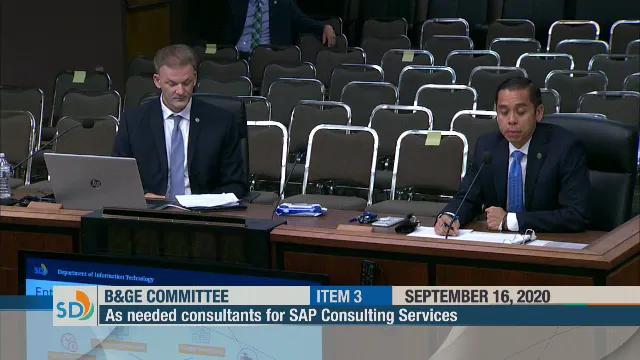
The Budget and Government Efficiency Committee of the San Diego City Council met on September 16, 2020, via teleconference due to the COVID-19 pandemic, to discuss fiscal impacts, budget processes, and technology contracts. The committee reviewed an informational update on major general fund revenues, set key dates for the FY2022 budget, and approved four contracts related to parking meters, SAP consulting, SAP licensing, and Microsoft software. All votes on actionable items were unanimous. Consent Calendar - Approved the minutes from the July 29, 2020, meeting unanimously (motion by Councilmember Campbell, seconded by Chair Brie). Public Comments & Testimony - Non-agenda public comment: Martha Wells expressed concerns about the city's budget management, stating that without proper financial audits, budgeting is not transparent. She called for better financial oversight. - Item 6 (Revenue Update): Martha Welch testified, claiming that the city is misleading the public about cable franchise fees, stating that Spectrum does not pay fees on cable and that the 5% fee amounts to about $12 million, which she said raises bills unfairly. - Item 1 (Budget Dates): Joy Sanyata praised the IBA's work and suggested that appropriation dates be included in the key dates calendar, as they are important for public tracking. Discussion Items Item 6: Major General Fund Revenue Informational Update - Matt Vesby (Director of Finance), Adrian Del Rio (Assistant Director), and Nikki Shalfont (Financial Operations Manager) presented an update on the four major revenue sources: property tax, sales tax, transient occupancy tax (TOT), and franchise fees, which together comprise about two-thirds of general fund revenues. - FY2020 Results: Actuals came in less than 1% above projections made during the height of the pandemic. Sales tax was under budget by $15.6 million, TOT lost over $90 million citywide, and property tax collection rates declined from 99.2% to 98.6%. Franchise fees performed better due to increased refuse tonnage. - FY2021 Revisions: TOT projections were revised downward by $48.3 million (including $25.3 million to the general fund) due to extended group travel cancellations and lower room rates. Sales tax and franchise fee projections were unchanged. Property tax collection rates are assumed at 97.6% for the first six months. - The IBA agreed with the assumptions but emphasized independent monitoring. Staff noted a total revenue loss of approximately $300 million compared to pre-COVID projections. - Vice Chair Kate raised concerns about the convention center's financial viability and the potential need to extend the homeless shelter beyond November. CFO Rolando Sherval noted that CARES Act funding for the shelter is currently projected to last through November, and options for extension are under review. - No vote was required as this was an informational item. Item 1: FY2022 Budget Development and FY2021 Budget Monitoring Key Dates - Angela Colton (IBA) presented proposed key dates for the FY2022 budget process, developed with input from multiple departments. Highlights include: - Council CIP priorities due October 16, 2020 (extended from the original date). - Five-year financial outlooks and first quarter FY2021 report released November 4, 2020. - FY2022 budget released April 15, 2021; council approval scheduled for June 14, 2021. - Vice Chair Kate noted that the December 15 council meeting will include new members. - The committee unanimously approved the proposed key dates and forwarded the item to full council. Item 2: Contract with IPS Group Inc. for Parking Meters - Deputy Director Didi Alari and Parking Program Manager Jonathan Carey requested approval of a five-year contract with IPS Group for parking meter operations and maintenance, consolidating two existing agreements. The not-to-exceed amount is $12.1 million. - The city operates about 5,700 metered spaces; parking revenue fell from $11.6 million in FY19 to $8.4 million in FY20 due to suspended enforcement. Enforcement resumes October 1, 2020. - Councilmember Montgomery Stepp asked about the selection process and the use of vehicle detection sensors; staff explained the sensors provide utilization data for rate setting. - Councilmember Montgomery Stepp also noted underrepresentation in ELCP categories and asked for follow-up on workforce diversity improvements. - The contract was approved unanimously. Item 3: SAP Consulting Services Contract (22 Vendors) - CIO Jonathan Bankey and Deputy Director Arlo Magpanty presented a five-year contract for as-needed SAP consulting services with a not-to-exceed amount of $23 million (later corrected to $21 million in presentation, but the motion reflected staff recommendation). - The contract replaces an existing agreement with 14 vendors; no minimum spend is required. Historical average spending was $4.4 million per year. - Councilmember Montgomery Stepp asked about minimum spending; staff confirmed there is none. - The contract was approved unanimously. Item 4: Third Amendment with SAP Public Services (Software Licensing) - Presented by Jonathan Bankey and Arlo Magpanty. The ordinance authorizes a five-year contract for SAP software licensing, maintenance, and support with a not-to-exceed amount of $30.5 million. - The presentation noted SAP R3 end-of-life in 2027 and included an 18% contingency for modernization to S4/HANA. - Councilmember Montgomery Stepp asked whether the system can fully interface with the ELCP software for DBE tracking; staff indicated current capability is limited and promised follow-up. - The ordinance was approved unanimously. Item 5: Dell Marketing Microsoft Software Contract - Presented by CIO Jonathan Bankey and Sean Kilpak. The resolution authorizes a three-year cooperative contract with Dell for Microsoft software subscriptions and services, not to exceed $14.032 million. - The contract covers 12,000 computers, 800 servers, and 44,000 emails daily. It includes volume pricing and new cybersecurity enhancements. - Councilmember Campbell asked about support for remote workers; staff noted CARES Act funding will provide teleworking bundles. - The contract was approved unanimously. Key Outcomes - Unanimous approval of the consent calendar. - Unanimous approval of the FY2022 budget key dates calendar (forwarded to full council). - Unanimous approval of the IPS Group parking meter contract ($12.1 million over 5 years). - Unanimous approval of the SAP consulting services contract ($23 million over 5 years). - Unanimous approval of the SAP licensing amendment ($30.5 million over 5 years). - Unanimous approval of the Dell/Microsoft contract ($14.032 million over 3 years). - Staff will provide follow-up on the convention center shelter extension timeline and ELCP/SAP interface capabilities. - The committee adjourned to its next meeting on October 14, 2020, at 9 a.m.
BUDGET 42% · PUBLIC COMMENT 17% · TECHNOLOGY AND INNOVATION 14% · PROCUREMENT 9%
732
SEP 16, 2020 · SAN DIEGO, CALIFORNIA · ACTIVE TRANSPORTATION & INFRASTRUCTURE COMMITTEE
Active Transportation and Infrastructure Committee Meeting - September 16, 2020

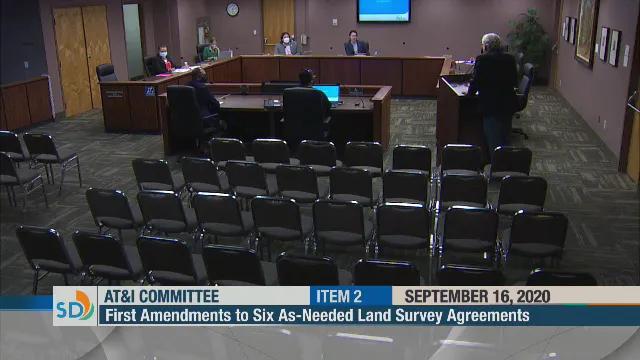
The Active Transportation and Infrastructure Committee of the San Diego City Council met remotely on Wednesday, September 16, 2020, at 2:00 p.m. Due to Governor's Executive Order 29-20 suspending certain Brown Act requirements, councilmembers participated via teleconference, and no members of the public were present in the committee room. The meeting was televised and live-streamed, with public comment available by phone and electronically. The committee approved consent calendar items, heard public comment, and debated two major discussion items regarding consultant contracts for land surveying and transportation engineering. Public Comments & Testimony - Non-Agenda Public Comment: Two speakers addressed the committee. Ron Marcus, a resident of an unspecified council district, requested assistance to clean up Miramar Road, which he described as an eyesore. He proposed sending a video of the area, personally picking up trash, and asked the city to collect large debris. He noted that his prior inquiry to Councilmember Kate's office indicated that such cleanup might conflict with union jobs, but argued that the area is not currently being maintained. Martha Welch (spelling unclear) complained that city road repairs are not thorough and that garbage collection practices are unfair; she also mentioned that storm drains are not properly connected. Consent Calendar - Minutes Approval: The committee unanimously approved the minutes from the July 29, 2020 meeting. - Consent Agenda Item: The committee approved a single consent agenda item: council authorization to approve and execute various construction change orders to American Asphalt South Inc. for slurry seal groups (17-03, 18-03, 19-23, 19-24, 19-25) and to increase the total contract authorization for groups 19-23, 19-24, and 19-25. No public comments were received. Motion by Councilmember Moreno, seconded, passed unanimously. Discussion Items - Item 2: First Amendment to As-Needed Land Survey Agreements (H197042 through H197070) - Staff from Engineering and Capital Projects (Myrna Dayton, Assistant Director; Alex Garcia, Deputy Director) presented a request to increase each of six existing consultant agreements by $1 million and extend them by one year (total of $2 million and two years per agreement). These contracts supplement city surveying staff during peak workloads and for specialized expertise such as aerial surveys. The original one-year approval was given in August 2019 due to concerns about unfilled city surveyor positions. - Staff reported progress: five recruitment processes were conducted; 13 hires and promotions were made; salary increases (8% additional assignment pay for registered land surveyors in Jan 2020, plus a 10% special salary adjustment in April 2020) were implemented; and a new survey apprentice program with Cuyamaca College is being developed. In FY20, city staff (approx. 52 FTE) delivered 191 projects, while consultants delivered 108 projects. The aerial surveys are fully contracted since the city lacks aircraft. Staff noted ongoing recruitment challenges due to COVID. - Councilmember Moreno expressed satisfaction with the department's recruitment efforts and moved to approve the amendment. Vice Chair Ward requested data on cost efficiency, noting that consultant costs appear higher than in-house; he suggested exploring partnerships with police helicopters for aerial imagery. James Nagelvoort (City Engineer) added that the department is investigating drone technology, inspired by the Port District's use. The motion passed unanimously. - Item 3: As-Needed Transportation Engineering Consultant Agreements (Chen Ryan Associates, Fair Peers, Kimley Horn Associates, WSP USA Inc.) - Staff from the Planning Department (Samir Hadgeri, Senior Traffic Engineer; Alyssa Muto, Deputy Director) presented a request to authorize up to $2 million per agreement (total $8 million) for four firms over 36 months, with an option to extend to 48 months. These consultants provide specialized modeling, technical analysis, and access to proprietary software for community plan updates and corridor studies. Similar contracts were used successfully in 2015 for projects like Mission Valley, Midway, and Balboa Avenue. - Councilmember Moreno acknowledged the specialized nature of the work and supported the motion, but requested that the department try to hire in-house staff for modeling collaboration with SANDAG. The motion was seconded and passed unanimously. Key Outcomes - Approvals forwarded to full City Council: - Consent calendar items (slurry seal change orders). - First amendment to as-needed land survey agreements (increase to $2 million and two years per contract). - As-needed transportation engineering consultant agreements (four firms, up to $2 million each, 36-48 months). - Next Steps: Staff will continue recruitment for surveyor positions and develop the apprentice program. The transportation engineering contracts will support community plan updates. The next committee hearing is scheduled for October 14, 2020 at 2:00 p.m.

PUBLIC COMMENT 32% · PROCUREMENT 23% · ENGINEERING AND INFRASTRUCTURE 17% · PUBLIC WORKS 11%
733
SEP 9, 2020 · SAN DIEGO, CALIFORNIA · PUBLIC SAFETY & LIVABLE NEIGHBORHOODS COMMITTEE
Public Safety and Livable Neighborhoods Committee Meeting - September 9, 2020

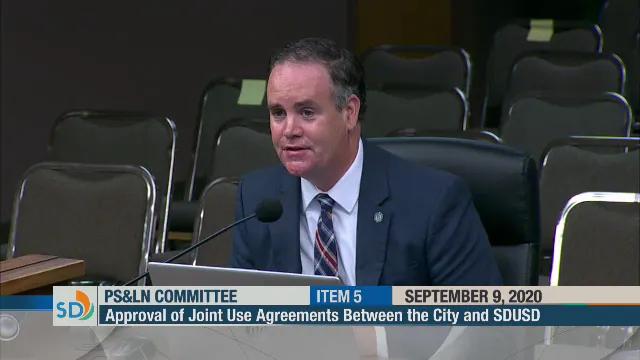
This meeting of the City Council's Public Safety and Livable Neighborhoods Committee was held via teleconference due to Executive Order 29-20 suspending certain Brown Act requirements during the COVID-19 pandemic. The committee addressed a consent agenda, public comments, and four discussion items, including the repeal of an unconstitutional seditious language ordinance, joint-use agreements with the school district, and a computer-aided dispatch system contract. Consent Calendar - Item 1: Landscape contract with Aztec Landscaping Inc. for the Torrey Hills Maintenance Assessment District. - Item 2: Landscape contract with West Turf Landscape Management Inc. for the Carmel Valley Maintenance Assessment District. - Both items were approved unanimously. Public Comments & Testimony - Non-Agenda Public Comment: - Ann Saggy (Community Force Advisory Board) urged the committee to prioritize tree planting in underserved communities, noting $300,000 added to the budget for tree planting, and requested a future agenda item. - Francine Maxwell requested a joint memo to the police department to enforce solid-color face coverings for officers, citing concerns about "Blue Lives Matter" masks at protests. - Kelly McCormick (parent and public health educator) expressed concerns about marijuana businesses, citing neighborhood safety issues and asking for stronger enforcement. - Rebecca Repp (mother and youth group mentor) referenced a fatal shooting at a marijuana operation near Temecula and noted research showing 84.8% more property crime near marijuana shops, urging close scrutiny. - Martha Wells (caller) criticized police overtime, lack of response, and park conditions. - Ali Afshan (co-founder of Lands for Equity) opposed surveillance initiatives targeting marginalized communities. - Consent Agenda Public Comment: None. - Item 3 (Street Light Sensors) - Pulled, no public comment. - Item 4 (Repeal of Seditious Language Ordinance): - Jerry Hall supported repeal and urged expungement and restitution for those cited under the ordinance. - Arturo (District 9) echoed support for repeal and expungement, citing targeting of people of color. - David Miller (District 3) supported repeal and called for expungement and refund of fines. - Michelle Cohn supported repeal, noting the ACLU's position that the law was used against people who insult officers. - Genevieve Jones Wright supported repeal but urged the city attorney to do more to address racial injustice, including police brutality. - Cecilia Kabuha (District 3) noted 83 citations since 2013, with one officer issuing five citations; called for expungement and refund of fines from police budget. - Item 5 (Joint Use Agreements): - Martha Wells criticized the lack of park bathrooms and questioned payments to schools. - Item 6 (Computer Aided Dispatch System): No public comments. Discussion Items - Item 3: Street Light Sensors (Pulled): The sustainability department (Cody Hooven) requested to pull the item to further assess options, noting that the community and council members want a surveillance ordinance in place before continued use of the technology. The mayor's office also supported waiting for a surveillance ordinance and oversight framework. No action taken. - Item 4: Repeal of Seditious Language Ordinance (Section 56.30): Paige Folkman (Chief Deputy City Attorney) presented the ordinance, adopted in 1918, which made it unlawful to use seditious language. The city attorney's office does not prosecute under this law due to constitutional concerns, as free speech jurisprudence has evolved. The ordinance is overly broad and likely unconstitutional. The committee voted unanimously to repeal it. Councilmember Moreno and others requested expungement and restitution for those cited; the city attorney noted that expungement is under court jurisdiction but the office would not oppose it. Councilmember Kate noted that 8 of the 11 recent citations were given to Black San Diegans (about 80%). - Item 5: Joint Use Agreements with San Diego Unified School District: Andy Field (Director of Parks and Recreation) presented agreements for five schools: Audubon K-8 (2.13 acres), Innovation Middle (Claremont), Longfellow K-8 (Claremont), Rolando Park Elementary (5.4 acres), and Sherman Elementary (expansion). The agreements are 25-year terms, with public use after school hours. The city will reimburse $1 million in development impact fees for Rolando Park construction. Maintenance costs for Rolando Park are higher ($100,000) due to its size. The committee approved unanimously. Councilmember Kate raised questions about gate access; staff agreed to work on a tracking system with the school district. - Item 6: Computer Aided Dispatch (CAD) System Contract: Chris Haley (SDPD Program Manager) presented a master services agreement with Intergraph/Hexagon for continued use of the CAD system, which was implemented in 2017 to replace a 26-year-old system. The contract is for 3-5 years (initial 3 years with two 1-year options), totaling approximately $5.9 million over five years, including maintenance, a resident systems advisor, a planned software upgrade in FY22, and minor change orders. The committee approved unanimously. Key Outcomes - Consent Agenda: Approved unanimously. - Item 3 (Street Light Sensors): Pulled from agenda; staff to assess options and return with updates. - Item 4 (Seditious Language Repeal): Approved unanimously. Direction given to work on expungement and restitution for those cited. - Item 5 (Joint Use Agreements): Approved unanimously. Staff to explore online tracking system and address gate access issues. - Item 6 (CAD System Contract): Approved unanimously. - Next committee meeting scheduled for Wednesday, October 7, 2020, at 9 a.m.

PARKS AND RECREATION 22% · PUBLIC SAFETY 21% · PUBLIC COMMENT 18% · RACIAL EQUITY 15%
734
SEP 9, 2020 · SAN DIEGO, CALIFORNIA · ECONOMIC DEVELOPMENT & INTERGOVERNMENTAL RELATIONS COMMITTEE
San Diego ED&IR Committee: Tourism, Convention Center, Federal Affairs, Biocom – Sept 9, 2020

The San Diego City Council's Economic Development and Intergovernmental Relations (ED&IR) Committee met on September 9, 2020, via teleconference to receive updates on the tourism economy's COVID-19 impacts, the San Diego Convention Center Corporation, federal affairs, and Biocom's annual economic impact report. The committee heard public testimony and discussed key industry challenges. Consent Calendar - The committee approved the actions from the July 15, 2020 meeting by a 4-0 vote. Public Comments & Testimony Non-Agenda Public Comments: - Martha Welch expressed criticism of the city's financial management, alleging stolen checks and improper use of funds. - Rebecca Rapp (mother and youth group mentor) and Kelly McCormick (public health educator and parent) spoke against marijuana businesses, citing safety incidents, increased crime, and economic burdens. Item 1 (Tourism Economy): - Namara Mercer (Executive Director, San Diego County Lodging Association) urged the city to proactively assist the tourism sector, including expedited permits and fee waivers, and criticized the timing of the presentation relative to recent city decisions. - Martha Welch reiterated concerns about budget and tax revenue declines. Item 2 (Convention Center Corporation): - Namara Mercer requested that the city defer rent repayments for tourism-related leaseholds until after a full summer of business and rescind rent increases that occurred during 2020. - Martha Welch praised the homeless shelter operation at the convention center but criticized lack of housing solutions. Item 3 (Federal Affairs): - Martha Welch commented on federal issues, referencing whistleblower claims. Item 4 (Biocom): - Christina Wright (homeless individual at the convention center) reported being threatened with eviction for distributing food from Father Joe's outside the convention center. Discussion Items Item 1: Tourism Economy and COVID-19 Impacts - Colleen Anderson (San Diego Tourism Marketing District), Julie Coker, and Carrie Capich (San Diego Tourism Authority) presented: - TMD assessment projections decreased for the fifth consecutive month, from $24M forecasted to $16M best-case. - TOT collections: $249M in FY19, estimated $176M in FY20, and at best $100M in FY21 – a loss of $150M in two years. - Hotel occupancy in July 2020 was under 50%, down 43% from last year; July TOT collections were $7M vs. $29M last year. - 50,000 jobs lost in the visitor industry; 70% of visitor spending occurs outside hotels. - Recovery is not expected until 2023; group and convention business is crucial but currently unavailable. - Committee members (Montgomery, Ward, Kirsey) discussed the need for safe reopening plans, advocacy to the state, and potential city actions such as 'do no harm' policies and supporting convention center marketing. Item 2: San Diego Convention Center Corporation Update - Rip Rapattoni (President/CEO) and Martin Maddox (CFO) reported: - Since March 2020, the convention center lost over 100 events, 628,000 attendees, 671,000 hotel nights, $707M direct spending, $24.5M in city tax revenue, and $1.2B total regional impact. - The facility is currently operating a homeless shelter (Operation Shelter Home) with over 1,000 residents; CARES Act funding runs through October 31. - The center earned Global BioRisk Advisory Council STAR certification for infection control. - An amended budget will be presented to the board on September 22; another phase of layoffs will reduce workforce by 85%. - A financial shortfall is expected beginning in February 2021, requiring city support. - In response to questions, Rapattoni said the center needs 21 days to transition from shelter to convention use, and decisions on first-quarter 2021 shows must be made by October/November. Item 3: 2020 Federal Affairs Update - Adrian Granda (Government Affairs Director) and Pamela Welsh (Squire Patton Boggs) presented: - The city has received nearly $300M in direct CARES Act funding, including $248M from the Coronavirus Relief Fund. - Status of additional stimulus remains uncertain; disagreements between parties over size and state/local aid. - Updates on CDC eviction moratorium (through Dec 31), USMCA implementation (including $300M for Tijuana River Valley), immigration policies (DACA, public charge, border restrictions), and environmental issues (PFAS, WOTUS). - The Census Bureau will adhere to a December 31 deadline; no multiplier for low response rates. - Committee members asked about Community Reinvestment Act rule changes and postal service concerns. Item 4: Biocom's 2020 California Economic Impact Report - Joe Panetta (President and CEO) presented: - San Diego is home to 600+ life science establishments supporting 84,000 jobs with an average salary of $142,000. - In 2019, the industry brought $995M in NIH funding and contributed $19.6B to the city's economy. - Many local companies are active in COVID-19 testing, vaccines, and therapeutics (e.g., Pfizer, Moderna, Illumina, Thermo Fisher). - Biocom advocates for utility access, land use incentives, streamlined permitting, and transportation/housing policies. - Committee members discussed opportunities for diversity, workforce development, and retaining the industry's competitive edge. Key Outcomes - All items were informational; no formal votes or actions were taken on agenda items. - The committee scheduled its next meeting for October 7, 2020, at 2:00 p.m. - Several members expressed intent to continue advocacy for safe reopening of tourism and convention facilities, and to support the life science cluster through policy and partnership.

TOURISM 24% · PUBLIC COMMENT 17% · PUBLIC HEALTH 13% · BIOTECHNOLOGY INDUSTRY 12%
735
JUL 30, 2020 · SAN DIEGO, CALIFORNIA · LAND USE & HOUSING COMMITTEE
San Diego Land Use and Housing Committee Meeting - July 30, 2020

The Land Use and Housing Committee of the San Diego City Council met on July 30, 2020, via teleconference in accordance with Executive Order 2920 (suspending certain Brown Act requirements) due to the COVID-19 pandemic. The committee considered three main items: a proposed pet-friendly housing ordinance, amendments to single-room occupancy (SRO) hotel regulations, and a lease agreement for Horton Plaza Park. The meeting included public comments, staff presentations, and committee votes. Members present: Councilmember Ward (Chair), Councilmember Sherman, Councilmember Campbell, and Councilmember Kercy (via teleconference). The committee approved committee actions for the June 24, 2020 special meeting, and moved non-agenda public comment to the end. Consent Calendar - Approved the committee actions for the special meeting of June 24, 2020, unanimously. Public Comments & Testimony - Item 1 – Pet-Friendly Housing Ordinance: 17 public callers spoke. Most expressed strong support, citing personal stories of housing difficulties with pets, the importance of pets as family members, and the impact on shelter surrenders. A few opposed, including Molly Kirkland from the Southern California Rental Housing Association (representing landlords), who cited liability, insurance, and damage concerns; and Jean Froning, a Mission Beach apartment owner, who cited past negative experiences. - Item 2 – SRO Regulations: Public comment was limited (3 callers). Joe Lakava supported the proposal but expressed concern about allowing replacement outside the community and potential loss of SROs before adoption. Marshall Anderson (Downtown San Diego Partnership) supported the effort and encouraged economic evaluation. Martha Welch expressed distrust in the city's handling of housing. Joy Sanyata thanked the Housing Commission and asked for clarification on relocation amounts. - Item 3 – Horton Plaza Park Lease: Public comment was limited (2 effective callers). Marshall Anderson (Downtown San Diego Partnership) supported the item. Martha Welch gave brief, somewhat unclear remarks. - Non-Agenda Public Comment: Several callers spoke against changes to the municipal code regarding marijuana businesses, specifically a measure reducing the distance between marijuana businesses and homes to 100 feet, arguing it negatively affects children and vulnerable populations. Joy Sanyata raised a procedural question about late agenda updates. Discussion Items - 1. Proposed Pet-Friendly Housing Ordinance (Item 1): Councilmember Ward presented a proposal to permit pets in rental housing, aiming to eliminate or cap pet rent, address breed/weight restrictions, and require good pet policies. The motion was initially to direct the City Attorney to draft an ordinance. Councilmembers Sherman and Campbell expressed strong opposition, citing landlord costs, insurance issues, and allergy concerns. Councilmember Kercy was on the fence but voted no, preferring to wait until after the pandemic. Councilmember Ward amended the motion to limit the scope to affordable housing and to conduct further study, directing staff to return with data. The amended motion passed unanimously. - 2. Amendments to SRO Hotel Regulations (Item 2): The San Diego Housing Commission (presented by Sikhet Thayal and Wendy DeWitt) proposed amendments to strengthen SRO preservation regulations, including administrative determinations, updated relocation assistance (proposed $6,330 or 3x rent, whichever is higher, plus $2,000 for special needs tenants, adjusted annually by CPI), and various preservation incentives (e.g., rent covenants at 60% AMI, conversion of up to 20% of units, right of first offer for nonprofits, and use as receiver sites). Councilmembers provided feedback: Sherman requested analysis on a 50% conversion option and CPI adjustments; Campbell expressed concerns about relocation outside the community and the in-lieu fee; Kercy raised concerns about conversion incentives and the 1990 threshold. The item was informational, and no formal action was taken; staff will conduct stakeholder meetings and return to committee. - 3. Horton Plaza Park Lease and Second Implementation Agreement (Item 3): Christina Bibler (Economic Development) presented the proposed ground lease with Stockdale for the redevelopment and operation of Horton Plaza Park substitute. The lease includes a 24-month redevelopment period, a 40-year term (with two 10-year extensions), a rent structure where revenues offset operating expenses and then split 50/50, and a rent credit based on the developer's investment. Councilmember Campbell expressed concerns about the lack of fixed rent amounts and voted no. Councilmember Sherman moved to approve, seconded by Councilmember Kercy, and the item passed 3-1. Key Outcomes - Item 1: Motion amended to focus on affordable housing and further study, directed staff to return with data; passed unanimously. - Item 2: No formal action; staff will incorporate comments and return after stakeholder engagement. - Item 3: Motion to forward to City Council passed 3-1 (Campbell dissenting), council members expressed intent to review the appraisal. - Non-agenda public comments noted; no action taken.

PET FRIENDLY HOUSING 34% · PUBLIC COMMENT 14% · SINGLE ROOM OCCUPANCY 11% · AFFORDABLE HOUSING 8%
736
JUL 29, 2020 · SAN DIEGO, CALIFORNIA · BUDGET & GOVERNMENT EFFICIENCY COMMITTEE
San Diego Budget and Government Efficiency Committee Meeting - July 29, 2020

The Budget and Government Efficiency Committee met on July 29, 2020, at 5:00 PM UTC, conducted via teleconference under Order 29-20, which suspended certain Brown Act requirements due to the COVID-19 pandemic. Chair Bree presided, with Vice Chair Kate, Councilmember Campbell, and Councilmember Montgomery participating remotely. The meeting covered the FY2021 Statement of Budgetary Principles, a 5G fee exemption and refund program, and a presentation on COVID-19 tourism impacts. All roll call votes were unanimous. Consent Calendar - The committee unanimously approved the minutes from the March 11, 2020 meeting (3-0). Public Comments & Testimony - Non-Agenda Public Comment: Martha Welch criticized the city's actions, claiming illegality and lack of audits. Joy Sonia thanked the committee for the budget process and encouraged public participation. - Item 1 (Budgetary Principles): Joy Sonia noted a last-minute revision and asked for clarification, and also pointed out missing words in the staff report. - Item 2 (5G Fee Exemption): Martha Welch again criticized the city's lack of audits and questioned the financing. - Item 3 (Tourism Impacts): Martha Welch commented on Mission Bay and urged proper budgeting. Joy Sonia expressed support for the tourism industry, emphasizing realism and equity. Discussion Items - Item 1: Proposed FY2021 Statement of Budgetary Principles - Presented by Angela Colton and Andrea Tevlin of the Office of the Independent Budget Analyst (IBA). The document, IBA report 20-16, preserves the intent of the appropriation ordinance and establishes communication between the City Council and the Mayor. Key principles include: prior written notice to council before service level reductions, no unilateral changes to the appropriation ordinance, the mayor must fulfill legislative intent, and council needs the mayor's funding recommendation for budget changes. It also includes structural budget deficit principles from 2010, a five-year financial outlook update in November, and a performance dashboard (Perform SD). Councilmember Montgomery moved approval, Vice Chair Kate seconded, and the motion passed unanimously (3-0). - Item 2: Authorization to Exempt General Plan Maintenance Fee on 5G Right-of-Way Permits and Establish Refund Program - Presented by Diane Medella (Planning Department), with Marco Camacho and Tom Thomlinson. The FCC order preempts the city's General Plan Maintenance Fee (GPMF) of $451 on right-of-way permits for small wireless facilities (5G). The proposed actions: exempt the GPMF for such permits, establish a refund program for permits paid since September 2015 (estimated $950,000 total), and appropriate $734,040 (plus $734,040 from previously appropriated funds) to cover refunds. The inflationary adjustment for the GPMF would shift from May CPI to January CPI to improve budget planning. Councilmember Montgomery questioned whether the FCC had reviewed the city's fees; the city attorney confirmed no review. Councilmember Campbell moved approval, Councilmember Montgomery seconded, and the motion passed unanimously (3-0). - Item 3: COVID-19 Tourism Related Budget Impacts (Information Only) - Presentations by Colleen Anderson (San Diego Tourism Marketing District), Namara Mercer (Mission Bay Lessees Association), and Maurice Robinson (hotel consultant). Key statistics: TMD assessments dropped to $16 million from a $24 million forecast in May; TOT revenue fell from $249 million in FY19 to approximately $176 million in FY20; May 2020 visitation was 14% of normal; June occupancy was 36.2% (58% decline); group occupancy fell 94% year-over-year; and group business may not recover until 2021. Mercer and Robinson requested the city work with its lessees: pay percentage rent based on current revenue, defer minimum annual rent, and forbear defaults. They proposed repaying deferred rent starting October 2021 to June 2022. Committee members expressed support, emphasized employee protections, and noted upcoming discussions in September 2020 at the Economic Development Committee. No vote was taken. Key Outcomes - Approved the minutes from March 11, 2020. - Unanimously approved the FY2021 Statement of Budgetary Principles. - Unanimously approved the exemption and refund program for 5G permits, including a $734,040 appropriation. - No action on the tourism impacts presentation; the committee noted the need for ongoing updates and discussions with the Real Estate Assets Department and City Attorney's office. - The next meeting is scheduled for September 16, 2020, at 9:00 AM.

TOURISM 17% · COVID-19 17% · PROCEDURAL 14% · PUBLIC COMMENT 14%
737
JUL 29, 2020 · SAN DIEGO, CALIFORNIA · ACTIVE TRANSPORTATION & INFRASTRUCTURE COMMITTEE
San Diego Council Committee Meeting: July 29, 2020 - Infrastructure, Trees, and Liability Audit

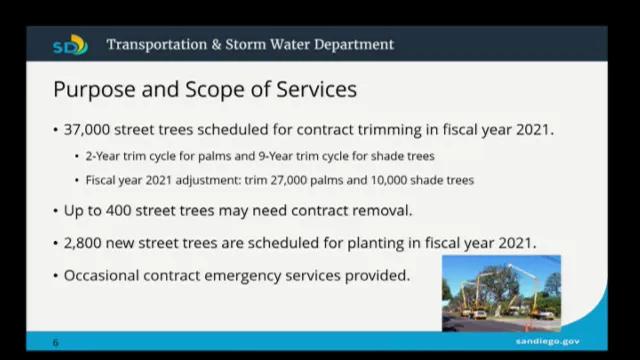
The Active Transportation and Infrastructure Committee (or similar) met on July 29, 2020, starting at 10 a.m. (Pacific) with members participating via teleconference due to COVID-19. The committee approved minutes, consent items, and discussion items including undergrounding utility contracts, a street tree maintenance contract renewal, policy changes for unimproved streets, and an informational audit on public liability management. All votes were unanimous except noted. Consent Calendar - Item 1: Approved second amendment to consultant agreement H146059 with Michael Baker International for design of the 69th and Mohawk Pump Station project. - Item 2: Approved reimbursement agreement with Carmel Village LP for design and construction of infrastructure project L1 Village Green in Pacific Highlands Ranch. - Both items approved unanimously (4‑0). Public Comments & Testimony - Non‑agenda public comment (Martha Welsh): Criticized the city’s hiring practices, referenced a case involving Bill Horn, and complained about bus stop relocation. - Item 3 (Undergrounding contracts) – Martha Welsh: Opposed contracting out, arguing the city uses too few employees. - Item 4 (Tree maintenance) – Martha Welsh: Again criticized lack of city employees and alleged dishonesty. - Item 5 (Unimproved streets) – Martha Welsh: Supported the proposal, noting District 8 is treated unfairly. - Item 6 (Liability audit) – Martha Welsh: Asserted the city does not do its job, lacks employees, and alleged illegality. Discussion Items Item 3 – Professional Service Agreements for Utilities Undergrounding Program - Staff presentation (Claudia Barca, Deputy Director): Requested authorization to award two 8‑year, $3 million each, as‑needed electrical engineering service contracts for SDG&E undergrounding. Firms selected: Engineering Partners Inc. (ETI, minority‑owned, 25.5% SLBE) and TSAC Engineering (woman‑owned, 30% SLBE). Work will be rotated; each firm receives no more than one consecutive task order. - Public comment: One caller opposed contracting out. - Committee motion and vote: Approved staff recommendation unanimously. Item 4 – West Coast Arborist Street Tree Maintenance Contract Renewal - Staff presentation (Patrick Hadley, Interim Deputy Director; Brian Widener, City Forester): The city is a Tree City USA (10th year). Staff recommended a one‑year renewal (first year of existing contract) with options for three additional years, totaling $15.8 million over five years ($12.88 million for the four‑year renewal). In FY2021, 2,800 new street trees are scheduled for planting, and up to 400 street trees may require removal. The contract provides emergency services and supplements city forces. - Discussion: Councilmember Moreno noted the funding was restored after being proposed for elimination. Vice Chair Ward clarified that future renewals depend on budget approval. Councilmember Kate stressed ongoing advocacy for continued service. - Vote: Approved unanimously. Item 5 – Updates to Resolution 107424 and Council Policy 200-01 (Unimproved Streets and Alleys) - Sponsor (Councilmember Moreno): Introduced changes to allow the city to repair 40 miles of dirt streets (mostly in District 8). Current policy from 1952 prohibits city work on unimproved streets and places responsibility on abutting property owners. Proposed revisions delete that prohibition and add language making unimproved streets eligible for funding through the annual budget, subject to a finding of public benefit. - Presentation (Eddie Padilla, Council Rep): Showed photos of flooding, mudslides, and poor conditions. Eight residences on Payne Street and Durant, and seven on Island Avenue/34th Street and South Bancroft/Greeley Avenue affected. The changes would enable uniform level of service and allow the city to prioritize high‑need streets. - Committee discussion: Councilmember Ward supported further analysis. Councilmember Kate requested legal analysis of liability implications. The city is compiling a map of all 40 miles of unimproved streets (expected within a month). - Motion: To request that city staff, city attorney, and IBA work with District 8 to conduct financial and legal analysis and return within 45 days. Approved unanimously. Item 6 – Performance Audit of the City’s Public Liability Management (Informational) - Presentation (Andy Hanow, Interim Assistant City Auditor; Jeff Teal, Performance Auditor): The city spent $220 million on public liability claims closed FY2010‑2018 (avg. $25 million/year). Trip‑and‑fall claims cost $10 million in FY2016‑2018. Transportation & Stormwater Dept. (TSW) accounted for 81% of claims and 93% of costs. The audit found the city lacked enterprise risk management (ERM) and data‑driven prioritization. - Key findings: Sidewalk damage in high‑pedestrian areas is nearly 4× more likely to cause a claim than in low‑pedestrian areas. 60% of claims occur in high‑pedestrian areas, but only 38% of sidewalk replacements and 27% of slicing are done there. Larger uplifts (1.5 inches) cause 55% of claims and average $71,000 vs. $13,000 for smaller uplifts. The city has developed a claims dashboard (ClaimSTAP) and created a chief compliance officer and risk oversight committee. The audit made 9 recommendations; staff agreed to implement all. - IBA comment (Jillian Cassie): Sidewalk repair backlog exceeds 81,000 locations, estimated cost $94 million; FY2021 budget provides $3.3 million capital funding. - Committee discussion: Chair Kirsey asked about current prioritization process. TSW Director Chris McFadden noted that current criteria include high pedestrian usage, reported accidents, ADA complaints, but not risk‑based data. The city updated its approved street tree list to avoid aggressive roots that damage sidewalks. Councilmember Ward stressed integrating metrics. Councilmember Moreno requested an update on implementing recommendation 3 (prioritization procedure) by December 2020/January 2021. The item was informational; no vote required. Key Outcomes - Consent calendar and all action items approved unanimously (4‑0). - Undergrounding program: Two contracts awarded to Engineering Partners and TSAC Engineering (each $3 million, 8‑year terms). - Tree maintenance contract: One‑year renewal with three optional years approved; total authorization of $15.8 million. - Unimproved streets policy: Committee directed staff, city attorney, and IBA to conduct financial/legal analysis, report back within 45 days. - Liability audit: No formal action; committee requested an update on sidewalk prioritization procedures by January 2021. - Next meeting: September 16, 2020 at 2 p.m.

PUBLIC LIABILITIES 25% · PROCEDURAL 22% · ROAD MAINTENANCE 14% · PUBLIC COMMENT 11%
738
JUL 22, 2020 · SAN DIEGO, CALIFORNIA · AUDIT COMMITTEE
San Diego City Audit Committee Meeting - July 22, 2020

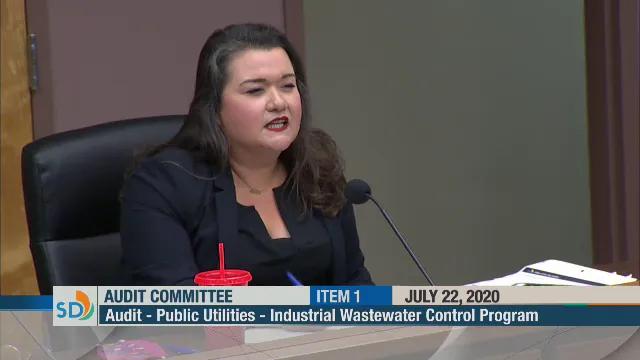
The Audit Committee of the City of San Diego met on July 22, 2020, via teleconference per Executive Order N-29-20. The meeting covered the auditor's monthly activity report, the city auditor recruitment update, a follow-up performance audit of the Public Utilities Department's industrial wastewater control program, the quarterly fraud hotline report, the FY2021 IT audit risk assessment and work plan, and the FY2021 citywide audit risk assessment and work plan. Several votes and directives were issued. Public Comments & Testimony - Non‑Agenda Public Comment: - Lewis Rotoliko expressed concerns about the Measure G ballot measure for the SDSU Mission Valley project. He argued that the land cost was improperly reduced from $508 million to $86 million through inflated deductions, resulting in a $400 million subsidy to SDSU. He questioned the fairness and legality of the process. - Martha Welch made brief, disconnected comments about audits and city hiring. - Item 6 - City Auditor Recruitment Update: Martha Welch commented that the city cannot hire auditors because it eliminated pensions, and that the recruitment effort is flawed. - Item 1 - Follow‑up Audit of PUD Industrial Wastewater Control Program: Martha Welch criticized the city’s handling of audit recommendations and the lack of progress since 1984. Discussion Items - Item 5 - City Auditor’s Monthly Activity Report: - Kyle Elser, Interim City Auditor, reported that since the last meeting, five audit products were issued (including a follow‑up audit of PUD’s industrial waste control program, quarterly hotline report, FY21 citywide and IT risk assessments, and a memo on office improvements). Three audits are in report writing (police crime data, street sweeping, central stores inventory), four in fieldwork (equal opportunity contracting, legacy IT applications, climate action plan, employee discipline and incentives), one in planning (IT service delivery), and three not yet started (real estate leasing, public works engineering charges, homelessness services). The homelessness audit was dropped because a prior audit was completed in February 2020. In FY20, 11 audit reports with 89 recommendations were issued. The committee discussed the annual central stores inventory audit, which is mandated by municipal code. Chair Sherman asked about freeing up staff time. - Item 6 - City Auditor Recruitment Update: - Lisa Byrne (Office of the Independent Budget Analyst) presented the update. A subcommittee (Stuart Halpern and Ricardo Valdivia) was formed. The job posting was completed June 26 and posted on governmentjobs.com and LinkedIn. Outreach included the Association of Local Government Auditors, National Association of State Auditors, and Institute of Internal Auditors. 21 applications have been received, nearly half from the IIA posting. A tentative timeline: application cutoff August 9, first round interviews (subcommittee) mid‑August, second round (full committee) late September/early October, city council appointment October 27 (with possible extension to November). The committee praised the effort. - Item 1 - Follow‑up Performance Audit of PUD’s Industrial Wastewater Control Program (IWCP): - Andy Henau (Interim Assistant City Auditor) and staff presented. The audit found that many fees have not been updated since 1984, and program cost recovery is very low: from FY10‑FY19, 86% of costs ($33.3 million) were passed on to other wastewater customers (residential/commercial), while only 14% ($5.5 million) was recovered from regulated businesses. This practice may violate city regulations and Proposition 218. The audit made six recommendations to achieve cost recovery and proper fee setting, plus recommendations to consolidate billing processes. PUD has begun a fee study (expected draft end of August) and plans to move IWCP costs to the Metro Fund. Shauna Lawrence (PUD Director) and Johnny Perkins (Deputy Chief Operating Officer) acknowledged the issues and committed to implementing all recommendations. Councilmember Moreno expressed shock that the issues from 2013 remained unresolved and questioned why three prior fee studies were never finalized. The committee discussed the need to accelerate negotiations with 12 participating agencies. A motion was made to accept the report and forward it to the City Council, with amendments: (1) that PUD staff return to the September 30 audit committee meeting with a granular project management work plan, and (2) that the City Attorney provide a closed‑session update to the City Council on potential litigation exposure. The motion passed unanimously. - Item 2 - Quarterly Fraud Hotline Report: - Andy Corita (Fraud Investigator) presented. In FY20, 229 reports were received (similar to prior years). In Q4, 48 reports were received; 28 were within hotline purview. 80 reports were open at the start of the quarter, 59 were closed, leaving 49 open. Two city auditor investigations were substantiated (one involving an employee who accepted $3,000 in gifts from vendors). Six department‑referred cases were substantiated (including unrecorded snack sales, water billing issues, falsified inspection). Corrective actions were taken. The committee accepted the report unanimously. - Item 3 - City Auditor’s IT Risk Assessment and Audit Work Plan for FY21: - Steve Gomez (Principal IT Auditor) presented. The risk assessment uses eight risk factors to rank IT applications and processes. Planned audits: audit of IT procurement and vendor management, and audit of the fire department’s emergency response management system. Two carryovers: legacy applications (in fieldwork) and IT service delivery (in planning). Three IT audits were issued in FY20. The committee approved the plan unanimously. - Item 4 - City Auditor’s Annual Risk Assessment and Audit Work Plan for FY21: - Kyle Elser presented the FY21 plan, which includes 22 projects: 7 carryovers (including the IWCP audit just presented), 10 new proposed audits (e.g., SDPD crime data reliability, PUD reservoir recreation, user fees, CARES Act funding, real estate acquisition, community policing, park and recreation equity), and other activities (fraud hotline, follow‑up, IT plan, mandatory audits). Councilmember Moreno highlighted the park equity audit, noting that Carmel Valley’s rec center budget is 23 times larger than Robert Eger South Bay Rec Center. The committee discussed real estate acquisition audit (Item 16) and governance best practices. The plan was approved unanimously. Key Outcomes - Item 1 (IWCP Audit): Unanimously voted to accept the report and forward to the City Council, with amendments: - PUD staff to present a detailed project management work plan at the September 30 audit committee meeting. - City Attorney to provide a closed‑session update to the City Council on potential litigation exposure. - Item 2 (Fraud Hotline): Unanimously accepted the quarterly report. - Item 3 (IT Audit Plan): Unanimously approved the FY21 IT audit risk assessment and work plan. - Item 4 (Citywide Audit Plan): Unanimously approved the FY21 citywide risk assessment and audit work plan.

AUDIT FOLLOW-UP 28% · WATER AND WASTEWATER MANAGEMENT 23% · PUBLIC COMMENT 9% · FRAUD PREVENTION 8%
739
JUL 22, 2020 · SAN DIEGO, CALIFORNIA · RULES COMMITTEE
San Diego Rules Committee Meeting: Privacy Advisory Commission Ordinance, July 22, 2020

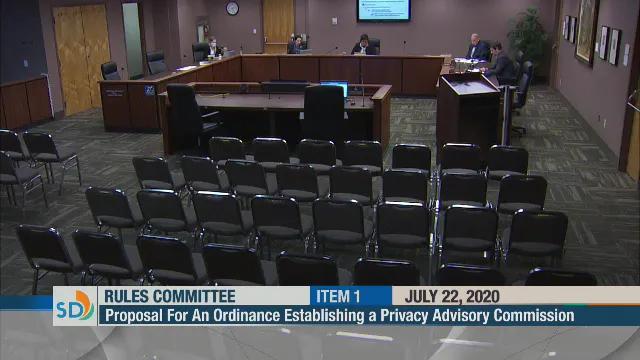
The San Diego City Council Rules Committee met on July 22, 2020, at 10:00 AM, via teleconference due to the COVID-19 state of emergency (Executive Order N-29-20). The committee considered a single discussion item: a proposal to establish a Privacy Advisory Commission, which would provide oversight and community input on the acquisition and use of surveillance technology by the city. The meeting was chaired by Council President Georgette Gómez. After extensive public comment and deliberation, the committee voted 5-0-2 to direct the City Attorney to draft the ordinance for full council consideration. Public Comments & Testimony - Over 39 callers queued for public comment, with a one-minute limit per speaker. The vast majority expressed strong support for the Privacy Advisory Commission, citing concerns about mass surveillance, lack of transparency, and disproportionate impacts on communities of color, immigrants, and activists. - Key speakers included: - Megan Land (Executive Director, Privacy Rights Clearinghouse) – supported the commission and offered expertise. - Alfredo Cusack (criminal defense attorney) – criticized the City Attorney, alleging conflicts of interest and obstruction. - Paloma (Mid City CAN) – urged support, emphasizing the need for oversight before deployment. - Neema Ghan-Afshan (co-founder, Borderlands for Equity) – highlighted risks to Muslim and minority communities. - Lauren Brown (UCSD Office of Local Affairs) – supported the commission as crucial for public input. - Carmela Prudencio (Asian Solidarity Collective) – urged council to control surveillance measures. - Kevin Lorenz (San Diego Progressive Democratic Club) – stressed that white council members may not experience consequences. - Fadilma Abdul Kadir (SDSU student) – supported for good governance. - Ariana Federico (Mid City CAN Youth Council) – called for community voice in policy. - Kelly Gates (UCSD faculty) – emphasized civil rights protections. - Mario Vencos (Defend School SD) – argued impacted communities need a seat at the table. - Jacqueline Magazine (Mid City CAN Youth Council) – said San Diegans are not lab rats. - Aisha Osman (youth organizer) – said building trust requires public involvement. - We Tran (We the People) – advocated against financial conflicts of interest. - Ismahan Abdullahi (MAS San Diego) – stressed need for expertise. - David Loy (ACLU of San Diego/Imperial Counties) – said no legal reason to delay; advisory board allowed by charter. - Melanie Ortiz (Mid City CAN Youth Council) – supported for control over surveillance. - Lisa LeVasseur (Meetabee Alliance) – described commission as a needed light. - Magdalena Dania (UCSD PhD student, tech worker) – shared personal experience of surveillance. - John Mattis (Hillcrest Indivisible) – referenced the Smart Streetlights program as example of oversight failure. - Christina Capella (District 7 resident) – supported to prevent future violations. - Janai (Defund Police SD youth organizer) – said trust requires community organizations. - Aaron Sermonograssi (District 7 resident) – described surveillance near his home. - Patrine McShane (Change Begins with Me/Indivisible) – supported for good governance. - Cody Oze (Mid City CAN) – said tech, legal, and community experts must deliberate. - Shakriya (youth organizer) – said surveillance harms minority communities. - Alina June Wabi (CAIR) – said ordinances prevent bad contracts. - Blair Uberstreet (Showing Up for Racial Justice) – highlighted targeting of Black and brown communities. - Yvan Sillas Navarro (People Over Profit San Diego) – demanded community voices. - Peg Al Parsi (UC San Diego privacy officer) – said privacy linked to civil liberties. - Ramon Espinan (teacher, District 9 resident) – supported to prevent abuses. - Sandra Lovato (San Diego Border Dreamers) – supported. - Sarah Kennedy (Indivisible San Diego Persist) – supported. - Wendy Galenter (Pacific Beach Democratic Club) – supported for transparency. - Weston (Youth Will organizer) – said surveillance disproportionately affects Black, brown, Muslim communities. - Tadija (youth organizer) – also noted disproportionate surveillance. - Dulce Garcia (Border Angels) – as an undocumented immigrant, cited grave consequences for data sharing. - Candy (Asian Solidarity Collective/Trust SD) – said organizers and BIPOC communities are under surveillance. - Ashley Solace (The Utility Reform Network, District 6) – supported. - Darwin Fishman (Racial Justice Coalition) – said harm already done to minority communities, ICE involvement. - Matthew Bostilakis (Climate Action Campaign) – supported as proven model. - Cameron Toe (UCSD student) – supported. - Andrea Spadam (Center on Policy Initiative, District 8) – supported for democratic oversight. - Abby Reuters (UCSD Associated Students) – supported. - Brenda Piazza (IT audit/cybersecurity director) – supported, cited need for data protection. - Dan Stephon (UCSD computer science professor) – supported, said tech experts can help. - No speakers opposed the ordinance during this period. Discussion Items - Proposal of an Ordinance Establishing the Privacy Advisory Commission: Presented by Hamira Yousafy (Partnership for the Advancement of New Americans) and Seth Hall (Trust SD coalition). They argued that the commission would provide technical expertise, community input, and annual review of surveillance technologies, citing the Smart Streetlights program as an example of cost overruns, mission creep, and lack of transparency. The commission would consist of nine members: four community experts from equity-focused organizations and four subject-matter experts (e.g., legal, technology, open government), with no financial conflicts of interest. A 90-day review process for new proposals and a monthly review of existing technology were outlined. - Councilmember Monica Montgomery moved to direct the City Attorney to draft the ordinance, with amendments: (1) require at least seven of nine commission members to be San Diego residents (instead of six), and (2) remove specific mention of ACLU in Section 4G1 to avoid singling out an organization. She emphasized need for local representation. - Councilmember Christopher Ward raised technical questions: requested a clause for periodic review of the ordinance, suggested flexibility in the 90-day timeline given initial workload, and recommended stronger language for staff assistance (changing “may” to “shall”). He expressed support for the motion and noted the value of a commission for ongoing outside perspective. - City Attorney Sharon Spivack acknowledged the amendments and stated they would be considered during drafting. - Council President Pro Tempore (Barbara Bry) and Councilmember (likely Chris Cate) voted affirmatively without additional comments. Key Outcomes - Motion passed 5-0-2 (Councilmembers Gómez, Bry, Ward, Montgomery, and Kerch voted yes; two councilmembers were absent or not voting—likely due to teleconference participation). The exact vote tally: Council President Gómez (yes), Councilmember Pro Tempore Bry (yes), Councilmember Ward (yes), Councilmember Montgomery (yes), Councilmember Kerch (yes). Two members (Councilmember Bree and another) were on teleconference but their votes were not explicitly recorded in the transcript? The roll call showed unanimous approval: “Council President Portemore. I vote yes. Councilmember Ward. Councilmember Montgomery. A vote yes. Councilmember Kercy. Yes. Ruth, please call the role. That passes unanimously.” However, earlier roll call for approval of minutes had all present voting. For the motion, the chair stated “the motion passes five two zero.” This likely indicates five votes in favor, two absent/not voting, zero opposed. - Directive: The City Attorney’s office, in coordination with Council District 4 (Montgomery) and the Office of Boards and Commissions, will conduct legal analysis and draft the ordinance language, considering the policy direction from the Public Safety and Livable Neighborhoods Committee and the Rules Committee. The draft will be forwarded to the full City Council for consideration. - The next Rules Committee meeting was scheduled for September 30, 2020, at 2:00 PM. - Non-agenda public comment: No callers participated; the period closed with no comments.

SURVEILLANCE TECHNOLOGY 61% · PROCEDURAL 14% · PUBLIC SAFETY 9% · PUBLIC COMMENT 8%
740
JUL 16, 2020 · SAN DIEGO, CALIFORNIA · ENVIRONMENT COMMITTEE
Environment Committee Meeting - July 16, 2020: Consultant Report on Gas and Electric Franchise Proposals

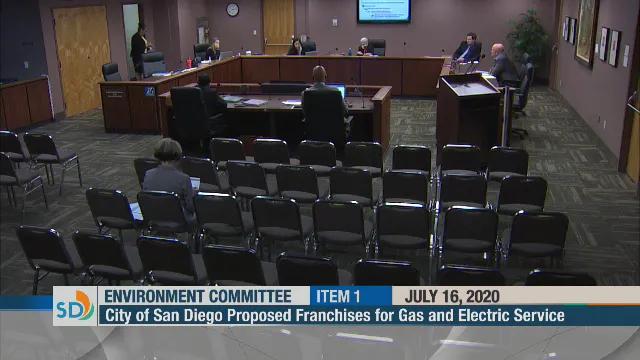
The San Diego City Council Environment Committee met on July 16, 2020, to discuss the city's upcoming gas and electric franchise agreements, which are set to expire in 2021. The committee received a detailed presentation from city staff and consultant Howard Goleb recommending terms for a new franchise, including a 20-year term, a $62 million minimum bid, and various provisions for city benefits. Over 78 public callers provided testimony, with opinions split between support for municipalization and support for renewing with San Diego Gas & Electric (SDG&E). After discussion, the committee voted 3-1 to draft a resolution of intention incorporating the consultant's recommended terms with additional amendments for worker protections, a climate equity fund, and performance metrics. Consent Calendar - The committee unanimously approved the actions from the meeting of February 13, 2020 (motion by Councilmember Moreno, second by Sherman, with Bree voting aye remotely). Public Comments & Testimony - Support for Municipalization: Many callers (e.g., Kara Powell, Alex Hahn, Michael Gaffney, John Hartley, Nathan from DSA, and others) argued that public ownership would lower rates, support the Climate Action Plan, keep profits in San Diego, and provide local accountability. They urged the committee to explore municipalization thoroughly and not rush into a long-term franchise. - Support for Renewing with SDG&E: Several union members and community leaders (e.g., Alan Valenzuela, Myra Alvaro, Pete Perino, Nate Fairman, Arman King, Pastor G.A. Williams, Joyce Lane, and business representatives) emphasized SDG&E's reliability, safety record, community investments, and the importance of protecting 2,700 union jobs. They urged a long-term agreement (25-30 years) to provide certainty for workers and infrastructure investment. - Concerns and Requests for Better Terms: Multiple callers (e.g., Michael Aguirre, Evelyn Andrade, Marie Chen, Libby Breidoff, Craig Rose, and the Coalition for Better Franchise Agreements) requested stronger accountability clauses, penalties for violations, a shorter term (5-10 years), a higher minimum bid (7% of gross receipts), and dedicated climate equity funding. They criticized SDG&E's past behavior and high rates. - Other Speakers: A representative from Berkshire Hathaway Energy expressed interest in bidding on the franchise. Several callers also addressed non-agenda items later in the meeting regarding sea lion safety at La Jolla and a ban on gas-powered leaf blowers. Discussion Items - Consultant Presentation: Eric Caldwell (Deputy COO) and Howard Goleb (JVJ Pacific Consulting) presented an overview of the franchise history, valuation studies, and recommendations. Key proposals included: - Term: 20 years (instead of the previous 50 years), balancing investor interest and city flexibility. - Franchise Fee: 3% for electric (unchanged) and 3.5% for natural gas (an increase of 0.5%, generating $1.2M/year for sustainability programs). - Minimum Bid: $62 million for electric and $8 million for gas, to ensure fair value; bidders could pay lump sum or over 10 years. - Other Compensation: City to collect sales tax on utility purchases; free use of utility poles and unused land; right of first refusal on property sales. - Elimination of Surcharge: Require the utility to drop the 0.35% surcharge on city ratepayers, saving consumers $110M over 20 years, though costing the city $3.3M in franchise revenue. - Operational Improvements: Mandatory relocation at utility expense, biennial permit reviews, as-built diagram sharing, and a dispute resolution process. - Safeguards: Quadrennial performance audits and a right to purchase through an appraisal process. - Municipalization Alternative: Consultant Howard Goleb recommended pursuing a franchise first, but noted that municipalization is financially feasible and could be considered if franchise negotiations fail. - Committee Deliberation: - Councilmember Campbell (Chair): Supported the $62M minimum bid as a safety net, agreed with the 20-year term, and emphasized protecting union workers. She made a motion to draft a resolution of intention with the consultant's terms, adding a provision requiring the prevailing bidder to make reasonable efforts to retain employees and maintain wages/benefits for 10 years post-sale, subject to existing collective bargaining agreements. - Councilmember Sherman: Seconded the motion and offered a friendly amendment to allow bidders to meet the minimum bid with a combination of cash and services (e.g., undergrounding, streetlights, EV chargers, sidewalk repair). The amendment was accepted. - Councilmember Moreno: Supported the motion with two additional amendments: (1) exploring a climate equity fund funded by an annual fee from the franchisee for infrastructure in low-opportunity areas, and (2) requiring staff to develop concrete metrics for performance audits before full council consideration. Both amendments were accepted. - Councilmember Bree: Expressed concern about the rushed timeline, lack of peer review, and absence of input from the Sustainable Energy Advisory Board. She voted no, stating more time was needed for analysis and public input. Key Outcomes - Motion Passed 3-1: The committee voted to direct staff to draft a resolution of intention for full council consideration, incorporating: - All terms from the consultant's term sheet (20-year term, 3% electric franchise fee, 3.5% gas fee, $62M minimum bid, etc.). - Worker protection clause (10-year retention and wage/benefit continuation). - Allowance for bidders to meet minimum bid with cash and in-kind services. - Exploration of a climate equity fund. - Development of concrete performance audit metrics prior to council hearing. - Next Steps: The draft resolution will be brought to the full City Council for further debate and final action. The city aims to advertise the Invitation to Bid before the summer recess. - Non-Agenda Public Comments: The committee heard testimony on sea lion safety at La Jolla (requesting stair closure and improved signage) and a proposed ban on gas-powered leaf blowers. No action was taken. Additional: Non-Agenda Public Comments - Several volunteers and docents (Carol Archibald, Robin Davidoff, Alan Shively) requested immediate measures to protect sea lions and visitors at La Jolla Point and Boomers Beach, including closing the stairway during pupping season (June-September) and improving enforcement of existing 2017 Coastal Management Plan recommendations. - Patricia Kushner requested a citywide ban on gas-powered leaf blowers to reduce noise, emissions, and health risks, citing recent bans in nearby cities.

ENERGY AND UTILITIES 43% · PUBLIC COMMENT 16% · PUBLIC POWER 11% · CLIMATE CHANGE 7%
OPENPUBLICA · PUBLIC MEETING INDEXUPDATED DAILY · openpublica.com