The San Francisco Police Commission met on June 8, 2022, to discuss the San Francisco Police Department's (SFPD) morale, crime trends, and departmental operations. The meeting included reports from Chief William Scott, DPA Director Paul Henderson, and commission reports on pretext stops and community policing. Public comment addressed racial profiling, lack of community engagement, and urgency for policy changes. The commission unanimously voted to enter closed session and not to disclose discussions. Public Comments & Testimony - Francisco De Costa (35-year attendee) urged commissioners to unite the department and develop the ability to perform needs assessments, criticizing some commissioners' approach. - Wesley Saver (Glide, Senior Policy Manager) spoke on behalf of the coalition to end pretext stops (over 60 organizations), requesting a clear timeline for working groups on DGO 9.01 revision and inclusive community participation. - A caller from North Beach requested resumption of community meetings with the precinct; Chief Scott confirmed meetings have resumed and will provide details. - Gene Bridges (Wealth and Disparities in the Black Community) quoted founder Felicia Jones, citing anti-blackness in use of force, arrests, and racial profiling by SFPD. He noted a Black San Franciscan is six times more likely to be stopped than a white person, and urged ending routine traffic stops, citing Berkeley's model. - During the morale discussion, a public commenter advised commissioners to stop criticizing and focus on uplifting the department, warning that with low morale, the department could lose 400-500 officers. Discussion Items - Chief’s Report (Item 2): Chief Scott reported crime trends: homicides up 11% (20 year-to-date), rapes up 9%, assaults up 11%, property crime up 8% (driven by larceny up 20%, burglaries down 26%). Firearm seizures down 11% (409 year-to-date); ghost gun recoveries at 91 (down from 99). A notable trend of stabbing-related assaults and homicides. Arrests made in several homicide cases and organized retail thefts (suspects aged 14-16). Strategies focused on Bayview, Ingleside, Southern, and Tenderloin districts. He also noted the success of preventing side shows through proactive coordination. - DPA Director’s Report (Item 3): Director Henderson reported 294 cases opened, 291 closed, 262 pending, 32 sustained, 10 mediated. 20 cases past 9 months (14 tolled, 12 pending with commission, 5 with chief). Allegations breakdown: 29% for failing to take required actions, second highest for failing to make arrests. Decreases in complaints from Southern and Tenderloin stations. He announced the Civic Bridge project for a new transparent case-tracking website at no cost to DPA budget, and updates on POST certification process. - Commission Reports (Item 4): Commissioner Benedicto updated on the Preventing Crime Through Community Policing Act (passed Board of Supervisors) and efforts to revise DGO 9.01 (pretext stops). He requested formal working groups be convened. Commissioner Yannis requested a presentation on recruitment outreach for women and local officers, and community policing plans. Commissioner Yi reported attending an API forum and stressed the need for adequate funding. - Discussion Regarding SFPD Morale (Item 5): Chief Scott presented a detailed analysis of morale factors, including internal procedural justice, external socio-political factors, staffing, equipment, and training. Strategies included wellness apps (Cortico), behavioral sciences unit diversity, FTFO and CIT training, discipline matrix, retention unit, and work with Stanford Spark for evaluation. He noted 54% of 916 respondents in a POA survey said they plan to leave the department. POA representative Lt. McRae and OFJ representative Lt. Williams spoke about low morale, feelings of being undervalued, overwork, inconsistent discipline, lack of communication, and systemic exclusion of black and brown officers from promotions. Commissioners discussed the need for better feedback mechanisms, early intervention systems, and leadership development. Key Outcomes - Unanimous vote (6-0) to enter closed session (Item 7) and to assert attorney-client privilege for items 8(a) and 8(b). - Unanimous vote (6-0) not to disclose any discussion from closed session (Item 9). - Commission directed follow-up on North Beach community meetings (Chief Scott to provide schedule). - Commission agreed to convene working groups for DGO 9.01 (pretext stops) with Commissioner Benedicto, Carter Overstone, and Vice President Elias as members. - Chief Scott committed to provide a timeline for the next phase of the Stanford Spark morale evaluation and report back on CMCR training resumption. - Commission noted the need for a formalized system for officer feedback (e.g., suggestion boxes) and a presentation on the promotional process to the public.
Public Meetings - San Francisco, California
Public Meetings - San Francisco, CaliforniaThe Government Audit and Oversight Committee of the San Francisco Board of Supervisors met on June 2, 2022, at 11:15 AM PT (18:15 UTC). Chaired by Supervisor Dean Preston, with Vice Chair Connie Chan and Supervisor Raphael Mandelman, the committee considered two main agenda items: an ordinance to amend environmental and health codes for edible food recovery and organic waste collection, and a series of successor memorandums of understanding (MOUs) and collective bargaining agreements with city labor unions. The committee also handled amendments for police and fire MOUs, unrepresented employee compensation, a letter of agreement with medical interns/residents, and a holiday carry-forward amendment. Discussion Items Item 1: Ordinance on Edible Food Recovery and Organic Waste Collection - Sponsored by Board President Shamann Walton, the ordinance aligns San Francisco with state Senate Bill 1383, which aims to reduce methane emissions by diverting organic waste from landfills. It requires commercial food generators to donate surplus edible food and mandates 20% of currently wasted edible food be recovered for human consumption by 2025. - Natalie G. from President Walton's office presented, noting that one in four San Franciscans face food insecurity and that 11.2 billion pounds of food are sent to California landfills annually. She highlighted a pilot program in District 10 that recovered over 400,000 pounds of edible food. - Charles Sheehan from the Department of Environment presented further details: the ordinance targets approximately 800 edible food generators (tier one: 172 businesses starting Jan 2022; tier two: 500 businesses starting 2024). The department estimates 3 million pounds of food were recovered in a pilot over three years, equivalent to 2.5 million meals. The city is eligible for a $1.1 million grant from CalRecycle if the ordinance passes in time. - Department of Public Health will partner for inspections. Enforcement will focus on education and technical assistance first. - Supervisors Preston and Mandelman requested to be added as co-sponsors. Items 2-26: Successor Memorandums of Understanding (MOUs) and Collective Bargaining Agreements - Approximately 30 successor agreements covering two-year terms (July 1, 2022 – June 30, 2024) for most city labor unions. All agreements were voluntarily reached and ratified by union members, a first since the 1990s charter amendment for interest arbitration. - Human Resources Director Carol Isen and Employee Relations Director Artists Graham presented the terms: a general wage increase of 5.25% on July 1, 2022; 2.5% on January 1, 2023; and 2.25% on June 30, 2023 (with off-ramp provisions for emergencies). Other improvements include codifying Juneteenth as a paid holiday, hybrid/remote work provisions, tuition reimbursement increases, and health and safety language. - The agreements also include a hiring framework with SEIU and IFPTE to address the city's roughly 2,500 vacancies, focusing on faster recruitment. - A speaker from Transport Workers Union Local 250A expressed support, noting that all five of their contracts were ratified and members were satisfied, though they preferred a three-year term. Items 28-32: Amendments to Police and Fire MOUs - These items restore deferred wage increases originally due July 1, 2020. For police (item 30), additional changes include: eliminating the first entry-level step, moving step two to step one to boost starting pay; adding longevity premiums of 2% at 5 and 15 years; and a total estimated cost of $16 million (including $1.5 million for step changes and $4 million for restoration). The fire items (28, 29, 32) contained only the restoration. - Director Isen noted that the police department faces a critical retention crisis: over 100 officers have left via lateral transfers since July 2020, and fewer than 10 applicants applied for the last academy. The changes aim to make the city more competitive among 12 regional agencies where it currently ranks 7th in total compensation. - Deputy City Attorney Ann Pearson confirmed that the long title's focus on deferred increases is not required to list every amendment. Item 27: Compensation for Unrepresented Employees - This annual ordinance sets wages for about a small group of employees not covered by unions, including some mayor's office staff, DHR staff, the controller, and two city attorney's office employees. HR Director Isen explained that terms follow the general pattern of union agreements. - Supervisor Preston requested a more detailed breakdown of titles and positions, noting that the current classification labels (e.g., "Mayor's Staff 11") lack transparency. He expressed concern about the board's oversight role for unrepresented employees. Item 33: Letter of Agreement – Committee of Interns and Residents - This unusual agreement, with the union representing UCSF medical interns/residents, updates the bargaining relationship. The city will maintain a training/education component and space provision while the primary employment relationship shifts to UCSF. Item 34: Amendment for Carry-Forward of Accrued Holidays - An amendment to allow carry-forward of up to 160 hours of comp time for Local 21 and up to 80 hours for floating holidays for other unions, due to pandemic-related challenges in taking time off. The item was amended and referred to the Rules Committee. Public Comments & Testimony - Items 28-32 (Police and Fire MOUs): Multiple public commenters spoke in favor, citing the need for more police officers to address crime and understaffing. Tracy McRae, acting president of the San Francisco Police Officers Association, emphasized that retention is critical to maintain foot patrols and response times. Other callers referenced a Chamber of Commerce poll showing 80% of San Franciscans want more police. No public comments opposed the police amendments. - Items 2-26 (MOUs): One speaker, the president of TWU Local 250A, expressed support for the ratified contracts and urged full board approval. - Other items: No public comments were received on items 1, 27, 33, or 34. Key Outcomes - Item 1 (Edible Food Recovery): Unanimously moved to the full Board of Supervisors with positive recommendation (3-0). - Items 2-26 (MOUs): Unanimously moved to the full Board with positive recommendation (2-0, with Vice Chair Chan absent). - Items 28, 29, 32 (Fire MOUs): Unanimously moved to the full Board with positive recommendation (2-0). - Items 30, 31 (Police MOUs): Moved to the full Board without recommendation (2-0), after Chair Preston expressed concern over the lack of accompanying police reforms and the $59 million proposed increase in the mayor's budget. - Item 27 (Unrepresented Employees): Moved to the full Board without recommendation (2-0), pending additional details on job classifications. - Item 33 (Interns/Residents): Unanimously moved to the full Board with positive recommendation (2-0). - Item 34 (Holiday Carry-Forward): Amended and referred to the Rules Committee to meet procedural deadlines. All votes were taken in the committee's hybrid format. The full Board will consider these items at subsequent meetings.
The San Francisco Police Commission held its regular meeting on June 1, 2022, at approximately 5:45 PM. The meeting covered crime trends, a disciplinary review board report, a proposed department general order on major incident evaluation, and public comments on racial disparities in policing. Consent Calendar - Adopted minutes from the meetings of May 4 and May 11, 2022 (unanimous vote: 5-0). - Received and filed the consent calendar, including SB 1421 and SB 16 reports, CRI monthly update, and the first quarter 2022 Safe Streets for All report (unanimous vote: 5-0). Public Comments & Testimony - General Public Comment (Item 1): Francisco de Costa criticized the commission for failing to address quality-of-life issues. Several speakers from the group "Wealth and Disparities in the Black Community" expressed urgent concerns about racial profiling and traffic stops. Susan Buckman, David Aronson, and Kit Haj cited data showing Black San Franciscans are six times as likely as white residents to be subject to a traffic stop. They demanded the elimination of routine low-level stops by SFPD and noted that other cities have already enacted similar policies. - Public Comment on Chief’s Report (Item 4): Paulette Brown spoke about her son’s unsolved homicide from 2006, calling for more resources for cold cases. - Public Comment on DRB Report (Item 7): Francisco de Costa urged respectful treatment of officers, while another speaker highlighted officer fatigue due to overwork. - Public Comment on DGO 8.01 (Item 8): Susan Buckman criticized the proposed DGO for lacking guidance on department values and referenced an incident on May 19, 2022, involving two unhoused individuals killed by police. Discussion Items - Chief’s Report (Item 4): Chief William Scott reported overall violent crime up 4% compared to the previous year. Homicides were down 11% (16 this year vs. 18 last year) but noted two recent deaths: an overnight shooting involving a security guard and a morning stabbing. Other statistics: rapes up 13%, robberies down 3%, assaults up 12%, burglaries down 26%, motor vehicle theft up 3%, and larceny-theft up 24%. Gun violence was down 14%. He discussed ghost gun seizures (80 year-to-date vs. 79 last year) and the upcoming NBA Finals. The chief also addressed the May 11 town hall regarding an officer-involved shooting, responding to concerns about late posting of the event. Commissioners asked about the use of less-lethal weapons and the number of knives involved in the incident. - DPA Director’s Report (Item 5): Acting Director Sarah Hawkins reported 281 cases opened in 2022, 283 closed, 257 pending, 28 sustained, and 8 mediated. The number of cases past 270 days dropped from 32 to 23. - Commission Reports (Item 6): Commissioner Benedicto will serve as liaison for the DPA audit and requested an agenda item on CIT training. Commissioner Carter-Oberstone requested a presentation on recruiting female officers. Commissioner Yi reported on a community policing plan. Commissioner Byrne discussed a recent visit to the Tenderloin and increased police presence. - DRB Report (Item 7): Acting Chief of Staff Robert O’Sullivan and Sarah Hawkins presented the 4th Quarter 2021 Disciplinary Review Board findings. Trends included failure to make an arrest, failure to activate body-worn cameras (BWC), and inappropriate behavior. One policy failure involved cell phone searches. Recommendations included updating training on searches of electronic devices, reissuing an expired department bulletin on public safety statements, and providing more detailed complaint data to analyze BWC violations. - DGO 8.01 (Item 8): Captain John Jemarena and Deputy Chief Daniel Perea presented proposed revisions to Department General Order 8.01, "Major and Critical Incident Evaluation and Notification." Acting President Elias and Commissioner Benedicto expressed that the language "take appropriate steps to address the situation" was too vague and requested more concrete procedures. They also asked that the Field Tactical Force Operations (FTFO) unit review the order and that best practices be provided to the commission. The department agreed to revise the order. Key Outcomes - Adopted minutes and consent calendar. - Commissioners directed the department to revise DGO 8.01 with more specific guidance and to seek input from FTFO. - Agenda items scheduled for future meetings: update on CIT training (including refresher requirements), presentation on recruiting female officers, and continued review of DGO 8.01. - The commission voted 5-0 to hold Item 11 in closed session and subsequently voted 5-0 not to disclose any discussion from that session. - Meeting adjourned at approximately 8:00 PM.
The Public Safety and Neighborhood Services Committee, chaired by Supervisor Gordon Maher and joined by Supervisor Catherine Stefani, Supervisor Myrna Melgar, and guest Supervisor Raphael Mandelman, met on May 26, 2022. The committee considered four items: an ordinance requiring community policing plans (Item 1), a resolution supporting state behavioral health legislation (Item 2), an ordinance for a "Place for All" shelter and housing program (Item 3), and an ordinance on hospital patient transfer reporting (Item 4, filed). All items were advanced to the full board or filed. Consent Calendar - No items were considered on the consent calendar. Public Comments & Testimony - Item 1 – Community Policing Plans: Bill Barnacle (president, Outer Sunset Merchant Association) expressed full support, citing recent arson, burglaries, and assaults on Irving Street. He thanked Supervisor Maher for the ambassador program but stressed the need for more police officers. - Item 3 – Place for All Program: - Yolanda Katsalko, a formerly homeless individual, urged no sweeps and called for housing rather than forced programs. She referenced an article criticizing the mayor’s homelessness spending. - Mark Nagel (co-founder, Rescue SF) urged support, stating the plan would identify funding and services for shelter/housing. - Bill Barnacle supported the concept but noted civil rights barriers prevent forced treatment, citing the low number of conservatees. - Eliana Finder (policy associate, organization not named, but likely from a homeless advocacy group) thanked supervisors for amendments but remained concerned about sweeps and insufficient housing. She called for prevention, rapid acquisition, and direct shelter access. - Charles Head (president, Coalition for San Francisco Neighborhoods) urged passage, saying “people are dying.” - Item 2 – Behavioral Health Resolution: - Carolyn Kennedy (resident, District 8; core team member, Rescue SF) supported the resolution, citing a poll showing 70% support for expanded conservatorship. She noted the Street Crisis Response Team left 60% of people on the street. - Patrick Manette Shaw supported the resolution, calling it long overdue. - Bill Barnacle supported, thanking Supervisor Mandelman and noting the need to help the homeless. - One unidentified caller opposed SB 1416, calling it “the beginning of fascism” and urging against forced medication. - Item 4 – Hospital Transfer Reporting: - Dr. Teresa Palmer (geriatrician, former Laguna Honda employee) supported the ordinance, stating the need to track transfers out of town. - Patrick Manette Shaw urged against filing the item, asking for immediate expansion of scope, and expressed frustration with Supervisors Safai and Ronen. Discussion Items - Item 1 – Community Policing Plans (Ordinance): Supervisor Maher introduced the ordinance, which would require SFPD to create station-level community policing plans including foot and bike patrols, developed with community stakeholders. Deanna Olivar Arroche (SFPD Director of Policy and Public Affairs) voiced support, noting alignment with existing strategic plans but stressing dependency on budget and staffing. Supervisors Melgar and Stefani expressed support and emphasized the need for adequate police staffing. The item was heard a second time due to earlier amendments. - Item 3 – Place for All Program (Ordinance): Supervisor Mandelman described the program as requiring HSH to submit a plan to ensure every unsheltered person has access to shelter or permanent supportive housing within three years. He thanked Rescue SF and neighborhood groups. Supervisor Melgar supported, noting that people living in cars/RVs (including families) need a continuum of services including safe parking. She thanked Mandelman for accepting amendments. Supervisor Mandelman acknowledged staff work. - Item 2 – Resolution Supporting State Behavioral Health Bills: Supervisor Mandelman detailed eight bills (SB 929, 965, 970, 1035, 1154, 1227, 1238, 1416) modernizing California’s behavioral health system. He reviewed each bill’s purpose: data collection, conservatorship court procedures, county accountability, court-ordered medication for assisted outpatient treatment, bed capacity dashboard, longer holds, regional needs assessment, and adding “medical care” to the grave disability definition. He argued the state abandoned mental health care and must re-engage. Supervisor Melgar expressed discomfort with SB 1416, citing historical misuse of medical power against women and people of color, but supported the resolution overall due to the ongoing crisis. She stated she is “watchful” about civil rights rollback. Supervisor Mandelman acknowledged historical abuses but argued current protections (judicial oversight, public defenders) make risks lower than the harm of failing to care for people. - Item 4 – Hospital Transfer Reporting (Ordinance): Supervisor Maher explained the board previously passed a version requiring acute-care hospitals to report out-of-county transfers for subacute/skilled nursing care. He introduced amendments to broaden the scope but moved to file the item, intending to revisit after receiving initial reports in fall. He noted the Laguna Honda crisis may reveal gaps. Supervisor Melgar clarified Laguna Honda’s issue is federal funding certification, not license revocation. Key Outcomes - Item 1 – Community Policing Plans: Motion to forward to full board with positive recommendation passed 3-0 (Stefani aye, Melgar aye, Maher aye). - Item 3 – Place for All Program: Motion to forward to full board with positive recommendation passed 3-0 (Stefani aye, Melgar aye, Maher aye). - Item 2 – Behavioral Health Resolution: Motion to forward to full board with positive recommendation passed 3-0 (Stefani aye, Melgar aye, Maher aye). - Item 4 – Hospital Transfer Reporting: Motion to table and file the item passed 3-0 (Stefani aye, Melgar aye, Maher aye).
This meeting of the San Francisco Board of Supervisors Budget and Appropriations Committee, chaired by Supervisor Hillary Ronin, was held on May 25, 2022, from approximately 10:30 AM to 1:30 PM. The committee reviewed the Mayor’s Proposed Budget for selected departments for FYs 2022‑2023 and 2023‑2024, heard reports from the Budget and Legislative Analyst (BLA), accepted trailing legislation, and voted on multiple items. Committee members present included Vice Chair Asha Safai, Supervisors Gordon Maher and Connie Chan, and President Shamann Walton (joined after roll call). Member Mar was absent for several later votes. Public Comments & Testimony - David Pilpel spoke multiple times: He criticized the lack of up‑to‑date budget information on city websites, the absence of posted BLA reports for most departments, and the timing of fee legislation under Charter Section 2.109. He also expressed support for the Port’s ARPA grant but urged the Board to consider unwinding all “Friends of” city department entities, citing potential corruption concerns. He requested a comprehensive report on PUC real estate and facility needs. - Mark Gleason (Teamsters Local 665) expressed support for the Proposition J contract certification resolution (Item 4), stating that union members work in many of the contracted services and that the resolution has historically been supported. Discussion Items - Airport Commission Budget (Items 1-3): BLA recommended reductions of $7,468,045 in FY22‑23 and $6,011,839 in FY23‑24. The airport agreed. Committee accepted the budget with BLA recommendations. - Department of Building Inspection (DBI) Budget: BLA recommended reductions of $418,950 in FY22‑23 and $200,000 in FY23‑24. DBI agreed. Committee accepted. - Port of San Francisco Budget: BLA recommended reductions of $393,836 in FY22‑23 and $44,144 in FY23‑24. The port agreed. Committee accepted. - San Francisco Public Library Budget: BLA recommended reductions of $496,724 in FY22‑23 and $145,000 in FY23‑24. The library agreed. Committee accepted. - San Francisco Public Utilities Commission (SFPUC) Budget: BLA recommended reductions totaling $4,268,603 in FY22‑23 and $3,730,071 in FY23‑24, revised from the initial report. SFPUC agreed. During discussion, supervisors questioned the high number of vacant funded positions (529). SFPUC General Manager noted plans to hire 234 positions per year and that attrition savings (227 FTE in FY22‑23, 229 in FY23‑24) are already budgeted. Committee accepted the budget with BLA recommendations. - Retirement System Budget: BLA recommended reductions of $506,319 in FY22‑23 and $65,200 in FY23‑24. The retirement system agreed. Committee accepted. - Trailing Legislation for Port (Item 7): Resolution to accept and expend $100.8 million in ARPA funding from the California State Lands Commission to support port operations and capital. Passed unanimously. - Trailing Legislation for Library (Item 6): Resolution to accept and expend $1,002,647 in‑kind grant from Friends of the San Francisco Public Library for FY22‑23. Passed unanimously. - SFPUC Trailing Items (Items 8-14): The committee heard and voted on a series of ordinances related to CleanPowerSF, Hetch Hetchy water and power, wastewater, and water capital projects and bond issuances. All were amended as recommended by BLA (requiring reporting on bond issuances, rate increases, and facility dispositions) and forwarded to the full board with positive recommendations. Specific amendments included: - Item 10 (Power Revenue Bonds): Amended to require that the report on bond issuance be included in the legislative file. - Items 13-14 (Water Revenue Bonds, Water Capital appropriations): Amended to require reporting on the disposition of Rollins Road facility and to place $2.5 million for a new administrative building on reserve pending a report. - The committee also requested an annual report on wastewater enterprise expenditures and a report on Hetch Hetchy and CleanPowerSF customer rates prior to June budget decisions. - Proposition J Contract Certification (Item 4): Resolution concurring with controller’s certification that 13 contracted services (airport, MTA, port, PUC) are more cost‑effective. Forwarded unanimously. - Board of Appeals Surcharges (Item 5): Ordinance to adjust surcharges on permit fees: DBI and Planning increase from $22.50 to $37; DPW from $7 to $9; Department of Public Health decrease from $46 to $43; Police from $6 to $3; Entertainment Commission from $4 to $2. Forwarded unanimously. Key Outcomes - Budgets Accepted: The committee accepted the Mayor's Proposed Budget for the Airport, DBI, Port, Library, SFPUC, and Retirement System, incorporating all BLA-recommended reductions. - Trailing Legislation: All trailing items (6-14) were approved with amendments and forwarded to the full Board of Supervisors with positive recommendations. - Item 1 (Hearing): Heard and filed. - Items 2-3 (Budget and Salary Ordinances): Amended to include BLA reductions and continued to the call of the chair. - Votes: Most votes were unanimous among present members; Member Mar was absent for several votes but the outcomes were not affected. - Next Steps: The full Board of Supervisors will consider these items on June 7, 2022. The committee requested additional reports from SFPUC on rates and facility plans before final budget adoption.
The San Francisco Public Utilities Commission (SFPUC) held a regular meeting on May 24, 2022, at 9:30 AM. The Commission addressed a range of items including drought declarations, power rate adoptions, real estate leases, and routine approvals. All voting items passed unanimously with three commissioners present (President Moran, Commissioner Maxwell, Commissioner Paulson; Vice President Ajami excused). Consent Calendar - Item 10a: Approved appointment of Commissioner Newsha Ajami as Alternate Commissioner on the San Joaquin Tributaries Authority Commission. - Item 10b: Awarded Job Order Contract No. JOC-88 for general engineering construction in four counties, with a total contract amount not-to-exceed $5,000,000. - Item 10c: Approved a $2,700,000 increase to cost contingency and a 74-calendar-day extension for Contract No. WW-682R (Southeast Community Center). Public Comments & Testimony - Peter Dreckmeyer (Tuolumne River Trust): Urged the Commission to improve the advance calendar by including request dates and expected fulfillment dates; noted outstanding requests from November 9, 2021 (environmental metrics) and February 22, 2022 (workshop schedule). Supported Bosca’s request for a water supply security plan. - Nate Rangel (California Outdoors): Seconded Mr. Dreckmeyer’s comments on the advance calendar. - Unnamed caller (dayus, former Commissioner Ed Harrington): Noted that 30 years ago the PUC had no debt, but now the PUC’s deputy CFO manages a $6 billion debt portfolio; questioned city liability if the PUC defaults on revenue bonds; urged the PUC to report on the closed meeting with Governor Newsom. - Jeremy Pollock (San Francisco LAFCO): Requested renewal of the MOU between LAFCO and the PUC, originally established in 2009 for CleanPowerSF oversight. - Ms. Sancula (Bosca – Bay Area Water Supply and Conservation Agency): Requested a plan to protect the Tuolumne River water supply for 1.8 million residents, 40,000 businesses, and hundreds of communities; asked for urgency and involvement in negotiations with the state. - Dave Warner (Palo Alto): Noted that at a recent Bosca board meeting, 21 public speakers opposed Bosca’s legal work against the Bay Delta plan and FERC licensing, and the assessment increase to fund litigation passed despite no public support. - Public comment on item 8C (budget): Peter Dreckmeyer reminded the Commission that a 10% rate increase leads to roughly a 2% demand decrease, and with Bosca rates rising 30% over two years, demand is unlikely to reach Urban Water Management Plan projections. - Public comment on item 8F (GM report): Peter Dreckmeyer thanked GM Herrera for meetings and welcomed the design drought workshop on August 23. Another caller urged listening to the First People (Ohlone) and including them in dialogues. Discussion Items - Item 3 & 4 (Hybrid meeting findings & minutes): Adopted renewed findings for hybrid meetings under state urgency legislation; approved minutes of May 10, 2022. (Unanimous) - Item 6 (Communications): Commissioner Maxwell asked about creation of green jobs related to OneWaterSF; staff committed to exploring quantification. - Item 7 (Bosca Update): Ms. Sancula reiterated Bosca’s request for a plan to secure water supply. Commissioners asked no questions. - Item 8A (Drought Update – Steve Ritchie): As of May 16, 2022, Hetch Hetchy Reservoir held 341,000 acre-feet of storage. Total deliveries peaked at 202 MGD; target is ≤200 MGD to achieve 10% reduction. Snowpack nearly gone; precipitation unlikely for rest of May. Governor Newsom’s meeting on May 23 urged urban water agencies to intensify conservation. - Item 8B (Quarterly Audit – Irella Blackwood): 33 audits in portfolio; 40% completed, 28% in progress. Phase one of revenue bond audit completed with nine open recommendations, target completion by Dec 31, 2022. New audit bureau director welcomed. - Item 8C (Quarterly Budget – Laura Bush): Projected operating shortfalls for water ($26.6M), wastewater (negative), and CleanPowerSF ($4M) due to drought conservation, COVID economic recovery, and rising power purchase costs. All policy targets for coverage and reserves still met. CleanPowerSF will report new reserve ratio (target ≥50% of operating costs within three years). - Item 8D (Water Enterprise CIP – Katie Miller): 36 projects with $2.7B total budget; 34% completion. No new cost variances in Q3. Highlighted Harry Tracy Water Treatment Plant ahead of schedule. Stern Grove Festival restored on time and within $20M budget. - Item 8E (WISIP – Katie Miller): Program 98% complete; only three projects remain in construction. Calaveras Dam Replacement closed out. Delays due to COVID-related procurement issues (lithium-ion batteries, steel, valves). Corrosion discovered on an old steel pipe at Alameda Creek Recapture Project; redesign required via change order. - Item 8F (GM Report – Dennis Herrera): Announced reinstitution of Bay Area Water Stewards Program (first Zoom meeting June 2, 2022). Scheduled design drought workshop for August 23, 2022 commission meeting. Commended staff for budget work. - Items 11 & 12 (Power Rate Public Hearings): Staff proposed adopting CleanPowerSF rates for one year (FY23) with decreases below current rates and below PG&E. Hetch Hetchy Power rates for two years (FY23-24), standardizing rate classes and moving toward cost-of-service. Rate Fairness Board Chair Howard Ash endorsed the proposals. Key changes: moving away from PG&E rate tracking; building reserves; 3 cents/kWh annual increase for general-use municipal customers; retail rates capped at 10% annual increase; all proposed rates lower than PG&E. Approved unanimously (Item 11: 3-0; Item 12: 3-0). - Item 13 (Hungry Kitchens Lease): Five-year lease for food concession at 1550 Evans Community Center, $8,400/year with 3% annual increases. Selected via RFP; Hungry Kitchens scored 93 out of 100. Approved unanimously. - Item 14 (Parkmerced Easement Termination): Conditional termination of sewer/water easements to allow development; developer to relocate assets into public right-of-way at no cost to city. Approved unanimously. - Item 15 (Drought Level 2 Declaration): Adopted system-wide water use reduction of 11% compared to FY2019-2020 baseline, moving from Level 1 (voluntary 10%) to Level 2 (mandatory). Retail (San Francisco) reduction remains 5%; wholesale (Bosca) average 16% (range 7-35%). Takes effect July 1, 2022. Supported by Bosca. Approved unanimously. - Item 16 (Credit Facility Agreements): Replaced two expiring credit agreements for wastewater interim funding program ($750M total). Competitive bidding resulted in lower fees (TD Bank at 0.22% and Sumitomo Mitsui at 0.30%). Approved unanimously. - Item 17 (Contract Amendment CS-109): Time-only extension of 18 months (total 13.5 years) with no cost increase for specialized engineering services on recycled water projects, needed for commissioning delay. Approved unanimously. - Item 18: Continued to next meeting. Key Outcomes - Drought Action (Level 2): Commission declared a system-wide water use reduction of 11% effective July 1, 2022, aligning with state executive order N-7-22. Retail customers face no new restrictions; wholesale customers will receive tiered allocation letters. Next step: issue monthly water budgets by August 15. - Power Rate Adoptions: Approved CleanPowerSF rates for FY23 (one year) and Hetch Hetchy Power rates for FY23-24 (two years), both incorporating cost-of-service principles. Rates are lower than PG&E equivalents. - Contracts & Leases: Authorized lease with Hungry Kitchens LLC; approved conditional easement termination at Parkmerced; approved two new credit facilities (TD Bank and Sumitomo Mitsui); extended contract CS-109 for recycled water support. - Workshop Scheduled: General Manager Herrera announced a design drought workshop will be held on August 23, 2022 during the regular commission meeting. - Bay Area Water Stewards Program: Reinstated, with first kickoff meeting on June 2, 2022 via Zoom. - Advanced Calendar Improvements: Commissioners acknowledged public requests for better tracking of outstanding items; staff committed to enhancing the advance calendar. Adjournment: The meeting adjourned at approximately 12:30 PM.
The San Francisco Board of Supervisors Government Audit and Oversight Committee met on May 19, 2022, at 18:15 UTC, chaired by Supervisor Dean Preston, joined by Vice Chair Connie Chan and Supervisor Mirna Melgar (filling in for Raphael Mandelman). The committee addressed a consent calendar, regular agenda items including grant authorizations, hearings on a child care center at Zuckerberg San Francisco General Hospital and the affordable housing funding gap, and multiple contract amendments for behavioral health services. The meeting concluded with a closed session on litigation settlements. Public Comments & Testimony - Item 2 (Japanese Tea Garden): Lucy Fisher, member of Friends of the Japanese Tea Garden and Japantown Task Force, expressed strong support, noting community fundraising via QR codes and donations from visitors. Louise Mazingo, a landscape architecture professor and Friends member, emphasized the project is not just an improvement but a reparation for past racist destruction of a Shinto shrine. - Item 3 (Child Care Center at SF General): Multiple SEIU 1021 members and retirees testified in support of the hearing, criticizing the decades-long delay. Speakers included Kristen Hardy (Vice President of SEIU SF General Chapter), Maria Gien, Judy Beck, Nicole Christian, and others. They stressed the need for on-site or nearby child care for retention and recruitment, and urged city-level oversight to unstick the project. - Item 4 (Affordable Housing Funding Gap): Several public commenters called for full funding of Prop I (transfer tax revenue for housing) and Prop K (social housing). Speakers included Charlie Shamas (Poder), Berman Delmar (Council of Community Housing Organizations), Alex Lansburg (Housing Stability Fund Oversight Board), Simone Manganelli, Patrick Lynette Shaw, and Patricia Corin. They emphasized the crisis, the need for innovation (e.g., social housing, land acquisition, modular construction), and criticized the lack of progress on Prop I funds. - Items 5-8 (Contract Amendments): No public comment was offered on these items. Discussion Items - Item 1 (Crane Cove Park MOU – Up to $7,000,000): The committee considered a resolution authorizing the Port to execute an MOU and accept grants from the San Francisco Parks Alliance for Crane Cove Park. Vice Chair Chan expressed concerns about conflicts of interest with the Parks Alliance and referenced a recent mayoral letter pausing philanthropic fundraising. She proposed amendments to cap the authorization at $3,250,000 (the amount already raised) and require future funds to return for board approval. The Port representative, Michael Martin, supported the amendments. The BLA recommended approval. The committee voted unanimously to adopt the amendments and recommend the resolution to the full board. - Item 2 (Japanese Tea Garden Restoration – Up to $400,000): The resolution authorized Rec and Park to accept grants from the San Francisco Parks Alliance for restoration projects. Vice Chair Chan confirmed the funds were raised by the Japantown Task Force and included in-kind donations. The committee heard supportive public comments and voted unanimously to recommend the resolution. - Item 3 (Hearing on Status of Child Care Center at SF General Hospital): Supervisor Melgar sponsored the hearing, noting the city's contractual obligation from a 2019 arbitration award. DPH's Terry Saltz presented challenges: the preferred site (CHN building) faces structural issues (seismic separation needed), a funding gap from $5.1M to $13.6M (or $19.9M for demolition and rebuild), inadequate play areas, and unresolved parking conflicts. Alternatives were reviewed but all have drawbacks. SEIU 1021's Ed Kinchley testified that the city has delayed for decades, and the July 1, 2021 deadline was missed. He called for city-level oversight. Graham Dobson from the Office of Early Care and Education noted obstacles: lack of natural light, temporary fencing for infant play areas, and seismic concerns. Recreation and Parks offered to work on a fencing MOU. The committee voted to continue the hearing to the call of the chair. - Item 4 (Hearing on Funding Shortfall for Affordable Housing Goals): The hearing examined the gap between available funding and the need to meet city and state housing goals. Planning's Maya Small presented that the city produced 1,000 new affordable units per year over the last five years (48% of RHNA goals) while exceeding market-rate goals (151%). The next RHNA cycle (2023-2030) nearly triples affordable targets. MOHCD's Lydia Ely outlined funding sources (LIHTC, tax-exempt bonds, local funds) but noted volatility: state/federal sources are highly competitive, and local sources (inclusionary fees, bonds) are volatile. The funding gap is projected at $1.3–$2.4 billion per year from 2023 onward, even with state/federal leverage. Deputy Director Ely stated that all currently available local funds are committed to projects; Prop I funds ($74M) are pending budget decisions. Chair Preston criticized the lack of transparency and data on uncommitted balances, and called for fully funding Prop I. Supervisor Chan requested clarity on funding sources and reporting requirements. The committee voted to continue the hearing to the call of the chair. - Items 5-8 (Contract Amendments for Behavioral Health Services): These items were presented and approved with discussion on contingencies, performance monitoring, and extension terms. - Item 5 (Health Right 360 – Up to $163,930,879): Amendment extends the contract three years (to June 2025) and adds $79M for residential SUD and mental health outpatient services. DPH noted the contingency is 5.4% ($8.8M) and explained their 12% methodology. The BLA reported no red flags. Approved unanimously as a committee report. - Item 6 (Felton Institute – Up to $77,605,232): Amendment extends five years (to June 2027) and adds $41M for behavioral health services for children, youth, families, and older adults. DPH explained the 14.6% contingency aligns with their 12% calculation. Services include intensive case management and Full Service Partnerships. Performance data showed 93.8% target achievement. Approved unanimously as a committee report. - Item 7 (Mental Health Plan Amendment – $0): Technical amendment to the state agreement to memorialize federal parity regulations. No fiscal impact. Approved unanimously as a committee report. - Item 8 (BAART – Up to $98,283,105): Amendment extends five years (to June 2027) with one optional year and adds $62M for opioid treatment services (methadone/buprenorphine). DPH noted expanded hours funded by Prop C. Performance monitoring showed 90% of objectives met; the FACE pregnancy program had 34% service delivery due to population challenges. Approved unanimously as a committee report. Key Outcomes - Items 1 & 2: Resolutions approved with amendments to cap Crane Cove grant at $3.25M and accept Japanese Tea Garden grant as amended. Both recommended to full board (unanimous). - Items 3 & 4: Hearings continued to the call of the chair (unanimous), allowing further investigation and follow-up. - Items 5-8: All contract amendments approved as committee reports for the full board (unanimous). - Closed Session (Items 9-20): The committee convened closed session to discuss 12 settlement/litigation matters (totaling over $9.7M). Upon reconvening, the committee voted unanimously not to disclose the closed session deliberations. - Other Motions: The committee excused Supervisor Mandelman and allowed Supervisor Melgar to serve. A two-minute recess was taken during the child care hearing due to a technical issue.
The Budget and Appropriations Committee, chaired by Supervisor Hillary Ronen, convened on May 18, 2022, to hold hearings on the Mayor's proposed budget for selected departments for fiscal years 2022-2023 and 2023-2024. Committee members present included Supervisors Connie Chan, Gordon Mar, Ahsha Safai, and Board President Shamann Walton. The committee received presentations from representatives of the following departments: Airport, Board of Appeals, Department of Building Inspection (DBI), Child Support Services, Department of Environment, Law Library, Municipal Transportation Agency (SFMTA), Port of San Francisco, San Francisco Public Library, San Francisco Public Utilities Commission (SFPUC), Residential Rent Stabilization and Arbitration Board, and the San Francisco Retirement System. The committee asked each department to discuss staffing levels, vacancies, and hiring plans. No public comment was offered on any item. The committee voted unanimously to continue all items to the May 25, 2022 meeting. Department Budget Presentations - Airport (SFO): Presenters reported passenger traffic at 58% of pre-COVID levels through April 2022, with domestic recovery at 65% and international at 35%. The airport forecast an annual service payment to the city general fund of $31 million for FY2022, $7 million above budget. The proposed budget includes 24 new positions in FY2023 and 4 additional in FY2024. The vacancy rate is currently 21%, with a historical average of 11%; 185 positions are in recruitment, with a goal of reducing vacancies to 15% by end of FY2023 and near historical levels within a year. The airport intentionally held vacancies during the pandemic to avoid layoffs. Their communications and outreach programs include a customer care team, translation services, and internships. Supervisor Safai expressed disappointment that City College eliminated an aircraft mechanic training program that served as a pipeline to airport jobs. - Board of Appeals: Executive Director Julie Rosenberg presented the budget. The 10-year average for appeals is 164 per year, with 112 anticipated this fiscal year. The budget proposes an increase for FY2023 primarily due to interdepartmental work orders. The department has one vacancy (a position vacant since July 2021) and no current service impact. The proposal includes increasing surcharge rates for Planning Department and DBI permits from $22.50 to $37, with reductions for other departments. Filing fees have not changed for 10 years. - Department of Building Inspection (DBI): Director Patrick O'Riordan presented. Revenues are increasing $7.4 million from services, including $1.8 million in building permits and $4 million in plan check, though still below pre-pandemic levels. The department uses fund balance and reserves to balance. It has 287 filled positions: 243 permanent civil service, 20 project exempt, and 24 temporary exempt. There are 35 vacancies (12% vacancy rate), with 18 in active recruitment. The budgeted attrition rate is 12%. DBI communicates via multiple languages and hosts a quarterly public advisory forum averaging 74 participants. Chair Ronen raised concerns about the SRO Collaborative program, alleging potential conflict of interest when the landlord operates tenant organizing; the director said he would investigate if complaints are received. - Child Support Services: Department head Karen Roy reported the department is 100% funded by federal and state funds. Caseload decline over the years resulted in a more than 15% funding reduction. For federal FY2021, it collected approximately $26 million and established paternity for 98% of children. It ranks fourth among the state's 58 counties in collections. There are 4 true vacancies; 16 vacant positions are unfunded and represent attrition. The department restructured its service model from punitive to family-centered. - Department of Environment: Acting Director Tyrone Jue presented. The budget is flat, with no new positions. The $6.6 million increase from FY22 to FY23 is due to new grants and construction/demolition debris fees. Funding is predominantly impound (restricted), 28% grants, and 11% pass-through. The department has 97 positions and 22 vacancies (22% vacancy rate). Jue noted that 90% of emissions come from buildings and transportation but only 27% of budget can be spent on those sectors. The department requested $3.2 million in FY23 and $4.1 million in FY24 to begin implementing the Climate Action Plan; the request is under consideration. Supervisors Chan and Mar expressed strong support for additional staffing to implement the climate plan. - Law Library: Director Marcia Bell said the library was founded in 1870 and is autonomous, funded by a portion of civil court filing fees. The city provides only quarters, utilities, and three positions, one of which is vacant. Due to declining filing fees, the library had to lay off three staff during COVID. It provides free legal resources and MCLEs. No supervisor questions beyond appreciation. - Municipal Transportation Agency (SFMTA): Director Jeffrey Tumlin presented. The budget includes no fare increase for two years and a new accumulator pass product. It funds 22 additional transit ambassadors on top of 20 hired in December. The agency has 1,000 vacancies out of 6,700 budgeted positions; current headcount is 5,600. The budget assumes filling nearly 100% of vacancies by the end of the two-year cycle, with hiring accelerated through HR investments. Fare revenue recovery is at 27% while ridership is over 50%, partly due to Free Muni for Youth. The structural deficit rises from $50 million to $76 million annually, requiring new sustained revenue by calendar year 2024. The budget relies heavily on one-time federal relief. Supervisor Safai asked about safety and fare evasion; Tumlin noted crime is at historic lows but people feel unsafe, and investments in ambassadors and a gender safety equity initiative. Supervisor Walton requested a detailed quarterly hiring plan for next week. - Port of San Francisco: Director Elaine Forbes presented. The port faces $30 million in unpaid rent, 10 times pre-pandemic levels. The proposed FY23 budget is $193.2 million, up from $92.5 million, due to ARPA funds; FY24 is $149 million. The port projects a $10 million ongoing deficit beginning FY2025. It has 230 employees and 56 vacancies against 286 funded positions; average time to fill a vacancy is 19 months. The budget invests $110.4 million in capital over two years. To re-tenant vacant commercial spaces, the port plans to use broker placements and potentially percentage-rent-only leases. Supervisor Chan asked about ensuring local business equity; Forbes said they will subdivide spaces and require DEI plans. Supervisor Safai noted the city attempted $25 million in back rent relief last year and supports additional funds. - San Francisco Public Library: City Librarian Michael Lambert and CFO Mike Fernandez presented. The budget invests $1.1 million for racial equity and nearly $1 million for digital access. The Library Preservation Fund provides 94% of the budget. Key items include $200,000 for BIPOC collections, $500,000 for book giveaway programs, $300,000 for a racial equity manager's contracts, and $523,000 for eMedia collections. The library has 109 vacant FTEs compared to 60 at end of 2019. It is on track to restore all 28 locations to seven-day service. Supervisors Chan, Mar, and Safai praised the library's work, especially during the pandemic, and Safai noted the upcoming Library Preservation Fund ballot measure. - San Francisco Public Utilities Commission (SFPUC): General Manager Dennis Herrera presented. The SFPUC plans $10 billion in capital investment over 10 years. There will be no retail rate increase for water/wastewater in FY23, though a temporary 5% drought surcharge began in April 2022. Power rates will decrease in July. The agency secured $11 million in federal/state funding for bill relief and extended the moratorium on shutoffs through June 30, 2022. A new customer assistance program offers 25% discounts on water/wastewater and 30% on power for low-income households; applications doubled from about 2,100 to over 4,200 in six weeks. The agency has 660 vacant positions (529 in active recruitment), with about 24 recruitments and 37 eligible lists. Hiring timelines range from 6 to 18 months. The operating budget is $1.6 billion. Supervisor Chan asked about emergency contracts; Herrera explained contingency practices. Supervisor Safai questioned vacancies vs new positions; Herrera said some new positions are for emerging needs like cybersecurity. - Residential Rent Stabilization and Arbitration Board (Rent Board): The Rent Board presented its budget, which increases positions from 47 to 50. The new housing inventory is scheduled to go live June 1, 2022, starting with property owners of 10 or more units. The board added a chief information officer and is hiring. Outreach focuses on small property owners, LEP, and seniors. Supervisors praised the department's work during the pandemic. - San Francisco Retirement System: The executive director presented. The trust has $35 billion in assets and is 112% funded, the first time fully funded since 2008. Active membership declined from 34,521 to 33,640. There are 20 vacancies (16% vacancy rate), with a new internship program for six positions at $34/hour; 25 candidates were being interviewed. The system pays about $145 million per month in pensions, totaling over $1.5 billion annually. They asked for additional staffing to improve service levels. Key Outcomes - The committee voted unanimously (5-0) to continue File Nos. 220490, 220491, and 220492 (the hearing, budget appropriation ordinance, and salary ordinance for selected departments) to the May 25, 2022 Budget and Appropriations Committee meeting. - The committee also voted unanimously (5-0) to continue File No. 220494 (Administrative Code – Board of Appeals Surcharges on Permit Fees) to the May 25, 2022 meeting. - No public comment was received on any item.
On Thursday, May 12, 2022, the San Francisco Board of Supervisors Public Safety and Neighborhood Services Committee met at 18:15 UTC. The committee was chaired by Supervisor Gordon Mar, with Vice Chair Catherine Stefani and Member Connie Chan (substituting) present. The agenda included five items: two liquor license transfers, a proposal to expand shelter ("Place for All"), a skilled nursing care reporting ordinance, and a community policing plan ordinance. Consent Calendar - Item 1 (220252): Liquor License Transfer to Blue Ice Entertainment LLC (doing business as Roccapulco) at 3140 Mission Street, District 9. The SFPD Alcohol Liaison Unit recommended approval with four conditions. No public comment. The committee voted unanimously to send a positive recommendation to the full board. - Item 2 (220253): Liquor License Transfer to Bear Eagle Inc. (doing business as SFGIFTBASKETS.COM) at 2 Embarcadero Center, Suite R-2105, District 3. The ALU recommended approval with no additional conditions. The applicant described the business as mail-order and delivery. No public comment. The committee voted unanimously to send a positive recommendation to the full board. Public Comments & Testimony - Item 3 (Place for All): Approximately 45 public speakers (in person and by phone) commented. Supporters included Rescue SF, the San Francisco Marin Medical Society (representing 3,500 physicians), the Coalition for San Francisco Neighborhoods, GROW SF, and several district residents. They argued that the city lacks adequate shelter, that encampments are inhumane and unsafe, and that a shelter plan is a necessary first step. Opponents included the Coalition on Homelessness, GLIDE, HomeRise, Compass Family Services, and many individuals with lived experience. They contended that the legislation is an unfunded mandate, would divert funds from permanent housing, and would be used to criminalize and sweep unsheltered people without providing meaningful housing exits. Several speakers urged adopting Supervisor Melgar's amendments to tie shelter expansion to permanent housing and to restore a telephone shelter registration system. - Item 5 (Community Policing): One speaker in person (Maria Dura Michelle) asked for clarification on "non-criminal" activities and community notification. Three remote speakers: Francesca Pestine supported community policing but warned against creating new bureaucracies; Larry Yi (Police Commissioner) supported foot patrols; Tyler expressed concern about increased police funding and suggested ambassador programs instead. Discussion Items - Item 3 (Place for All – Administrative Code Amendment): Supervisor Mandelman, the chief sponsor, introduced the ordinance. He stated that the city's shelter capacity is severely lacking, with 73% of unhoused people in the Bay Area unsheltered (highest in the nation). He noted that the 2021 All Home Regional Impact Council framework (124 framework) suggests San Francisco needs at least 2,000 additional shelter beds. He presented amendments: requiring HSH to prepare an implementation plan by December 31, 2022; including a geographic equity strategy; adding safe parking sites; reducing the cap on safe sleep sites from 20% to 10%; and adding services to expedite moves from shelter to housing. Supervisor Melgar offered amendments to add "permanent supportive housing" alongside shelter throughout the legislation, to require a telephone-based shelter registration system, and to add definitions for homelessness prevention, permanent supportive housing, and safe overnight parking. Supervisor Safai proposed amendments to include vehicle navigation triage centers and to clarify that safe sleep sites, safe parking lots, and vehicle triage centers are short-term options. The committee debated the amendments. Vice Chair Stefani and Supervisor Mar supported the bill as a step forward, while Supervisor Chan expressed reservations about the lack of a funding mechanism and the need to integrate housing. After public comment, the committee voted on amendments. Supervisor Mandelman's amendments were approved unanimously. Supervisor Safai's amendments were approved unanimously. Supervisor Melgar's amendments were divided into three votes: the first (adding "permanent supportive housing" throughout) passed 2-1 (Stefani no); the second (telephone registration system) passed 2-1 (Stefani no); the third (definitions and remaining non-substantive changes) passed 2-1 (Stefani no). Because the amendments were substantive, the item was continued to the May 26, 2022 PSNS meeting. - Item 4 (Health Code – Skilled Nursing Care Transfer Reporting): This was a duplicate file of an ordinance already adopted by the full board. Supervisor Mar proposed continuing it to the call of the chair to consider possible amendments from community health advocates. The clerk noted that the original had not yet taken effect, so a continuance was permissible. The item was continued to May 26, 2022. - Item 5 (Administrative Code – Community Policing Plans): Supervisor Mar presented the ordinance, which would require each police district to create a community policing plan incorporating foot and bike patrols, language access, and alternatives to law enforcement for non-criminal quality-of-life issues. He introduced three amendments: (1) providing deployment flexibility subject to budget and staffing availability; (2) ensuring continuity during district captain changes; (3) requiring identification of alternatives to law enforcement. The committee voted unanimously to adopt the amendments and continue the item to the May 26, 2022 PSNS meeting. Key Outcomes - Item 1 & 2: Approved unanimously and sent to the full Board of Supervisors with positive recommendation. - Item 3: Amended with all three sets of amendments (Mandelman, Safai, and Melgar) and continued to the May 26, 2022 PSNS meeting. - Item 4: Continued to the May 26, 2022 PSNS meeting. - Item 5: Amended and continued to the May 26, 2022 PSNS meeting.
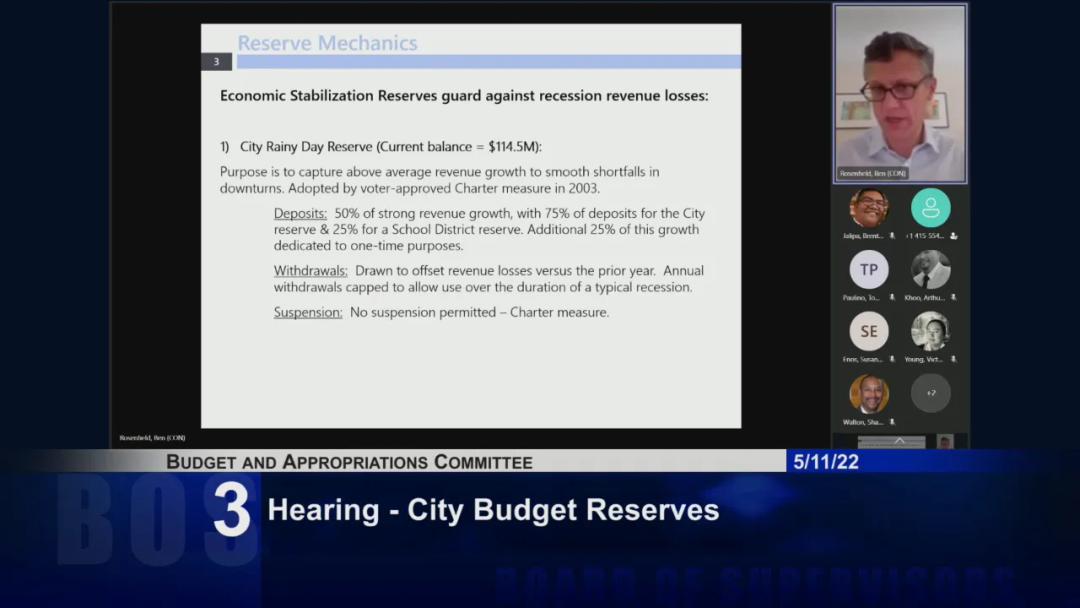
The Budget and Appropriations Committee convened on May 11, 2022, at 10:00 AM to hear three items: an update on direct small business relief programs and the Office of Economic and Workforce Development's (OEWD) equity plan for recovery; a hearing on racial equity in city employment (continued without discussion); and a presentation on the city's budget reserves. The meeting was chaired by Supervisor Hilary Ronin and included committee members President Shamann Walton, Supervisors Gordon Marr (later excused), Connie Chan, and Vice Chair Asha Safai. Supervisor Aaron Peskin also participated. Public Comments & Testimony - William Ortiz-Cartagena (founder of Pledge, Latino Task Force Small Business subcommittee chair) expressed strong support for OEWD's partnership in the Mission district, stating the department was instrumental in saving businesses during the pandemic. - Jenny Long (executive director of Chinese Culture Center) advocated for including the Chinatown Be Successful festival in OEWD's equity plan and budget, noting that Chinatown small businesses continue to struggle and need equitable support. - Claire Lau (Chinese Progressive Association) urged OEWD to triple investments in economic recovery and equity programs, particularly for unhoused residents, undocumented individuals, and SRO residents, and called for earn-and-learn pilot programs. - Ivan Coron (manager, Latino Task Force) echoed support for OEWD's partnership and expressed hope for increased funding to reach more communities. No public comment was offered on the budget reserves hearing. Discussion Items 1. Direct Small Business Relief Update and OEWD Equity Plan (Item 210350) Supervisor Peskin introduced the hearing, noting it was a follow-up to a February 2021 community letter to the mayor recommending prioritization of equity in OEWD's work. Director Kate Sofis, participating remotely due to quarantine, presented OEWD's equity vision and reported that since the pandemic, the department has dramatically increased direct grants and loans. Key statistics from the presentation: - OEWD's total budget has grown to $153 million, with nearly $48 million (roughly one-third) explicitly for small business through the Invest in Neighborhoods and Office of Small Business divisions. - Over 3,000 awards of grants and leveraged loans were distributed, including $12.1 million in grants in FY 2021-22 and $20 million in 0% interest loans (leveraged from a state loan program). - 75% of grant and loan recipients were from BIPOC communities. - The department has 102 community partners and currently faces a 21% vacancy rate (about 20% of positions unfilled). Supervisors asked detailed questions: - Supervisor Chan challenged the definition of small business (using the state's 100-employee threshold vs. the city's typical 25-employee/ $2.5M revenue threshold) and requested a breakdown of the $60 million in city loans to micro-businesses. - President Walton asked about support for BIPOC entrepreneurs without Dreamkeeper funding and underscored the need for universal definitions of micro-business (the department uses 5 or fewer employees). - Supervisor Safai questioned the organization chart (9 direct reports for the director) and requested specifics on investment in District 11, noting persistent storefront vacancies and a perceived lack of vision. He also contrasted the $2 million commercial rent relief fund (with $15 million in demand) against a $7.3 million loan fund, expressing concern. - Supervisor Peskin requested demographic breakdowns of grant recipients, outcomes from technical assistance, and a list of all street festival/event grants. He noted that Black-owned businesses in his district (northeast corner) could not access certain equity funds concentrated in Bayview and Fillmore. Director Sofis acknowledged the need for better metrics, a standardized definition of micro-business, and more transparent reporting. She stated the department is hiring a full-time director of racial equity and working to unify tracking systems. 2. Racial Equity in City Employment (Item 220472) – This hearing was continued to the call of the chair because the department head was unable to attend. The committee voted 4-0 to continue it. 3. City Budget Reserves (Item 220437) Controller Ben Rosenfield presented an overview of the city's 15 reserve funds, organized into four categories: - Economic stabilization reserves: Rainy day reserve ($114.4M) and Budget stabilization reserve ($285.5M), both designed to cushion recession revenue losses (combined cap at 10% of general fund revenues). - General reserve ($43.8M): Flexible fund for unanticipated costs within a fiscal year; must be replenished the following year. - One-time purpose reserves: Budget stabilization one-time reserve ($54.8M) and Rainy day overflow ($0). - Other risk reserves: Fiscal cliff reserve ($229.8M), Federal/state revenue loss reserve ($81.3M, about 12.4% of FEMA revenue), Public health revenue reserve (10% of DPH revenue, used at Laguna Honda risk), Free City College reserve ($5.3M), and smaller funds. Supervisor Safai noted that the fiscal cliff reserve was designed to bridge projected gaps in FY 2024-25 and 2025-26 as federal stimulus is spent down. The public health reserve may be needed if Laguna Honda loses federal reimbursement ($16M/month). The Free City College reserve cannot be used for general funding but could be repurposed by board action. Mayor's Budget Director Ashley Groffenberger confirmed the administration is still balancing the budget and will provide details on June 1. Key Outcomes - Item 1 (Small business relief/OEWD equity plan): Continued to the call of the chair on a 3-0 vote (Vice Chair Safai absent, Supervisor Marr excused). - Item 2 (Racial equity in city employment): Continued to the call of the chair on a 4-0 vote (all present members aye). - Item 3 (Budget reserves): Filed on a 3-0 vote (Vice Chair Safai absent, Supervisor Marr excused). - Prior to the items, the committee voted 3-0 to excuse Supervisor Marr for the remainder of the meeting.