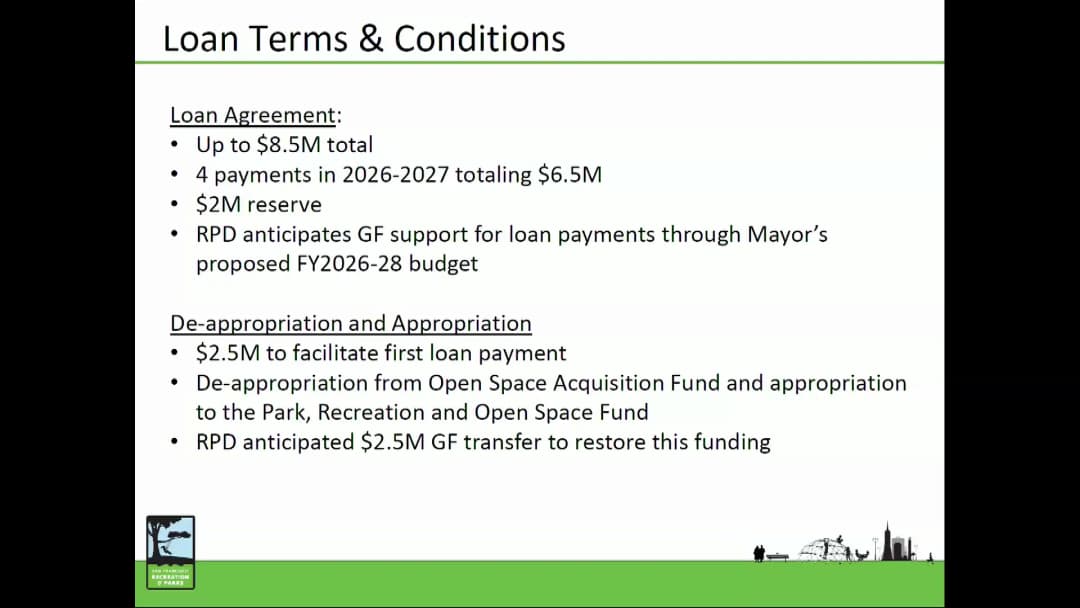
The Budget and Finance Committee, chaired by Supervisor Connie Chan with Vice Chair Supervisor Dorsey and Supervisor Sauter, met on May 6, 2026 to consider 13 items. The meeting focused on a proposed $8.5 million loan to the San Francisco Zoological Society, along with routine approvals for disaster funding, a Castro Theatre grant, fire department overtime, affordable housing bonds, health department grants, and multiple homeless services contract amendments. Supervisor Malgar attended for the zoo items. The committee voted on each item, with the zoo loan resolution continued to the next meeting. Consent Calendar - Item 1: Resolution authorizing city agents for state/federal disaster assistance funding (passed unanimously). - Item 4: Resolution for a $5 million state grant to preserve the Castro Theatre, amended to specify the venue (passed unanimously). - Item 5: Ordinance reallocating approximately $10 million in the fire department, emergency management, and PUC for overtime, funded by salary savings and revenue (passed unanimously). - Item 6: Resolution authorizing up to $30 million in multifamily housing revenue notes for the 1687 Market Street 94-unit affordable artists housing project, with no city subsidy (passed unanimously). - Items 7 & 8: Resolutions accepting grants for water quality testing ($87,000) and Chinese Hospital oncology center ($1 million) (passed unanimously). - Items 9 & 10: Second amendments to agreements with Tenderloin Housing Clinic for the Abigail Housing Ladder program ($15.5 million) and Garland Hotel supportive housing ($17.3 million), extending terms through 2029 (passed unanimously). - Item 11: Second amendment with Five Keys for the Ellis Street shelter, extending 24 months and increasing by $12.2 million to $39.5 million (passed unanimously). - Item 13: Resolution approving a 10-year lease for the Drug Market Agency Coordination Center at 33 8th Street, with annual rent starting at $448,224, for a hardened law enforcement facility (passed unanimously; Vice Chair Dorsey recused). Public Comments & Testimony Public comment was heard only on Items 2 and 3 (San Francisco Zoo loan). Twenty speakers addressed the committee: - Support for the loan and new leadership: Union representatives (Teamsters 856), zoo staff (veterinarians, keepers, educators, conservationists), board members, and volunteers cited improvements under CEO Cassandra Costello, including transparency, cost reductions, and strengthened animal care. They emphasized the zoo’s role in education, conservation (e.g., releasing 10,000 amphibians), and community access (free field trips, camps). - Opposition or caution: Fleur Doors (Panda Voices/SF Zoo Watch) urged rejection, citing a city audit revealing $12 million in unauthorized spending and risks tied to a panda plan under federal investigation. Michelangelo Torres (Animal Commission chair) requested a delay to evaluate the zoo’s response to the audit. Discussion Items: San Francisco Zoo Loan (Items 2 & 3) The committee considered two linked items: an ordinance de-appropriating $2.5 million from the open space acquisition fund for an initial loan payment (Item 2), and a resolution authorizing a loan of up to $8.5 million to the San Francisco Zoological Society (Item 3). Key details: - Presentations: Supervisor Malgar (District 7) introduced the items, highlighting the zoo’s financial crisis—a projected $11.9 million deficit through 2027—and a performance audit with 49 recommendations. Interim Rec Park General Manager Sarah Madeline outlined loan terms: $8.5 million over 10 years, disbursed in four payments tied to milestones (e.g., 10% expense reductions, strategic plan, AZA accreditation, board expertise, quarterly reporting). Repayment would come through reductions in the city’s $4 million annual management fee. - Zoo CEO Cassandra Costello detailed operational improvements: new promotions that boosted January 2026 attendance to a record, reintroduced education programs, cost savings (pausing raises, reorganizing leadership, saving $1 million), and a focus on board governance. She stressed the loan would allow time for a financial turnaround, including a master plan and potential pandas. - Budget Legislative Analyst (BLA): Nick Menard reported the zoo has $9 million in unrestricted cash but an ongoing deficit. The loan carries no collateral, and the financial plan hinges on pandas boosting attendance from 600,000 to 1 million annually —a risk. The city would incur $15 million/year if the zoo closed. - Committee discussion: Chair Chan emphasized worker inclusion, urging union representation on the board and competitive bidding. She requested a joint letter from Rec Park and the zoo detailing a timeline to update the 33-year-old lease/management agreement. Supervisor Sauter praised creative attendance initiatives. Supervisor Malgar committed to continued oversight and revisiting the MOU. Key Outcomes - Item 2 (Ordinance): Passed unanimously (3-0) and forwarded to the full Board of Supervisors for May 12. - Item 3 (Resolution): Continued to the May 13, 2026 Budget and Finance Committee meeting (3-0) to allow public review of the loan agreement and receipt of a joint letter from Rec Park and the zoo on lease agreement updates. - All other items (1, 4-13): Passed unanimously and referred to the full board (Item 12 was amended to a one-year extension as recommended by the BLA). - Ongoing directives: Supervisor Chan requested that the zoo incorporate union and animal care expertise into its board, and that Rec Park and the zoo submit a joint letter outlining a timeline for modernizing the lease and management agreement.
Public Meetings - San Francisco, California
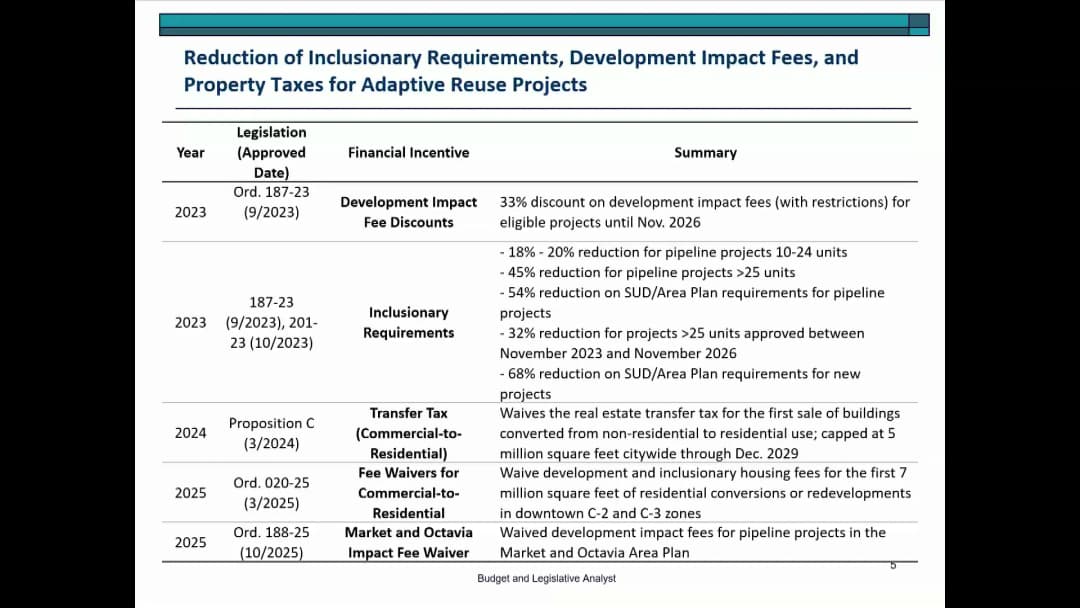
Public Meetings - San Francisco, CaliforniaThe Budget and Appropriation Committee, chaired by Supervisor Connie Chan and joined by Supervisors Danny Souter and Cheyenne Chin, met on May 6, 2026, to hear two reports from the Budget and Legislative Analyst (BLA): a performance review of financial incentives for housing and an analysis of San Francisco's debt capacity. The committee excused President Raphael Mendelman, Vice Chair Matt Dorsey, and Supervisor Shaman Walton from the meeting. Chair Chan framed the hearings as a broader context for upcoming budget discussions, emphasizing the need to consider the city's debt management, bond ratings, and housing production together. Discussion Items Debt Capacity Report (Item 2) - Nick Marinaro from the BLA presented findings on the city's capacity to issue general obligation (GO) bonds and certificates of participation (COPs). Under current policies, the GO bond property tax rate is capped at the 2006 rate (0.1201% of assessed value), and COP debt service is limited to 3.25% of general fund discretionary revenue. The analysis showed that the city will hit the GO bond debt limit in 2032 and the COP limit in fiscal year 2028-2029 based on projected revenues. - Relaxing the GO bond rate by 0.01% would allow one additional $410 million bond, raising the median single-family homeowner's property tax by about $75 per year, and push San Francisco from the 8th to the 6th highest property tax rate in the state. For COPs, a 0.25% increase would support a $128 million issuance but add $13 million annually in debt service, exacerbating the structural deficit and risking a credit rating downgrade. - The BLA identified $1.18 billion in unissued GO bond authorizations and $352 million in unissued COPs. Within the GO bonds, about $300 million (excluding passthrough bonds) is assigned to projects that have not begun construction. For COPs, $1.9 million from the 2023 community facility bond is unprogrammed. - The Hall of Justice project was discussed at length. BLA estimated the total cost at $367 million (minimum), with $55 million in authorized but unissued COPs for repairs and $367 million in planned COPs. Heather Green from the Office of the City Administrator detailed three pillars: keeping the existing building operational, severing dependencies from the adjacent jail at 425 7th Street, and relocating remaining tenants (primarily police units and sheriff services). She noted that the state courts are awaiting state funding, with earliest acquisition/design funding possible in fiscal year 2028. For police investigations, she is exploring purchase/lease options but cautioned that tenant improvement costs could exceed the $450/sq ft estimate in the report, potentially reaching $700/sq ft or more. - Chair Chan expressed interest in using available COPs to prioritize funding for aging fire apparatus (over two to three decades old) and the Chinatown Preservation Fund. She also questioned why certain authorized bonds (e.g., from 2016) have not moved forward and called for a more accurate accounting of bond and COP funds. - Supervisor Souter asked about unissued GO bonds; the BLA explained that some projects (e.g., HSH adult supportive housing from the 2020 Health and Recovery Bond) have no immediate plan, while others (seawall bond, Rec and Park) are delayed but still moving. - The potable emergency firefighter water system (EFWS) was estimated to cost $1.58-1.78 billion for the west side, with $154 million from a 2020 ESER bond and $190 million from the PUC's capital plan, leaving an unfunded cost of $1.28-1.44 billion. BLA projected 25 years to fully fund the system under current capacity constraints. Brian Strong noted that federal grants have been difficult to secure because the system is used for non-emergency fires, and state resilience bonds primarily focus on wildfire, not earthquake-related fire risk. Performance of Financial Incentives for Housing Report (Item 1) - Nick Marinaro presented findings on the impact of reduced inclusionary requirements (18-68% reduction since September 2023), 33% reduction in development impact fees, and waivers for downtown adaptive reuse projects. The BLA also highlighted $3.8 billion in direct funding for large developments (e.g., Treasure Island COPs, Balboa Reservoir loan, infrastructure financing districts). - Macroeconomic conditions have made most development financially infeasible: interest rates rose from 2.7% to 4.1% (2019-2025), construction costs increased 53%, and median rents and condo prices remained flat in nominal terms. The financial feasibility gap is estimated at $80,000 to $308,000 per unit, with macroeconomic factors accounting for up to $232,000 of that gap. Current fee and inclusionary reductions save $4,000 to $90,000 per unit but are insufficient to close the gap. - Building permit activity has continued to decline; the housing pipeline showed an 18% increase in projects since late 2023, but that increase is primarily in projects seeking entitlements, not building permits or units under construction. Of 113 stalled projects in late 2023, 65 (more than half) were deleted from the pipeline by late 2025. Among remaining projects tracked, 37% moved forward, 31% had no change, and 23% were canceled. - San Francisco had the lowest building permit activity per capita among the 10 largest California cities in 2024, issuing only 127 units. Other cities (e.g., Los Angeles, San Diego) have recovered to or exceeded 2019 levels, likely because their rents rose, improving development feasibility. - Chair Chan asked about the recommended three-year reporting cycle; the BLA explained it aligns with the existing cycle for baseline inclusionary review and provides enough data to detect trends without yearly noise. - Supervisor Chen asked about the 18% pipeline increase and whether canceled projects re-enter the pipeline; the BLA confirmed that some cancellations are actually re-filed for different entitlements (e.g., due to state density bonus changes), so those projects may reappear. - Chair Chan noted that upcoming budget conversations will be framed by these reports, including discussions of transfer tax waivers, EIFDs, and unspent bond dollars. Public Comments & Testimony No members of the public spoke on either item. Public comment was closed. Key Outcomes The committee voted unanimously (3-0) to hear and file both reports. Chair Chan stated that the reports would serve as a framework for upcoming budget discussions in June, including capital improvement funding, planning department merger with Building Inspection, and the budgets of OEWD, MOHCD, and other departments with unspent bond dollars.
The Board of Supervisors held its regular meeting on May 5, 2026, at 10:15 AM (starting at 10:15 AM according to the agenda, though the transcript begins with "Good afternoon"). The meeting included a consent calendar, unfinished business, new business, special orders for Asian American and Pacific Islander (AAPI) Heritage Month and Small Business Week, a hearing on blighted properties, roll call introductions, and general public comment. Supervisors Fielder and Mahmoud were excused from the meeting. All items on the consent calendar (items 1–5) were approved unanimously (9–0). Consent Calendar - Items 1–5 (routine ordinances) were passed unanimously (9–0). Unfinished Business - Item 6 (ordinance authorizing police department grant of $6.25 million for 50 new officer positions, retroactive to October 1, 2025–September 30, 2030) was passed without objection. - Items 7–9 (three memoranda of understanding with police and firefighter unions, effective July 1, 2026–June 30, 2030) were passed without objection. - Item 10 (ordinance temporarily excluding certain sites from SB 79 transit-oriented development requirements, permanent exclusion of industrial employment hubs, and amending planning code for density/height) was passed without objection. - Item 11 (ordinance authorizing SFMTA to establish a curbside electric vehicle charging station permit program) was passed without objection. New Business - Item 12 (ordinance appropriating $1.5 million from the General Reserve to the Public Defender for salary increases, requires two-thirds approval) was passed on first reading without objection. - Items 13–14 (resolutions approving agreements with Department of Disability and Aging Services: Home Bridge Inc. for $158 million, and San Francisco In-Home Supportive Services Public Authority for $991 million) were adopted without objection. - Item 15 (resolution authorizing Department of Public Health to accept $408,000 grant from NIH for HIV/AIDS interventions) was adopted without objection. - Item 16 (resolution authorizing Office of Economic and Workforce Development to accept $50,000 grant for ADA restroom improvements) was adopted without objection. - Item 17 (ordinance authorizing Director of Transportation to approve temporary street use permits and street closures for community benefits districts) was passed on first reading without objection. - Item 18 (ordinance amending housing code for structural maintenance inspections) was passed on first reading without objection. - Item 19 (ordinance accepting dedication of real property for East Clementina Street segment) was passed on first reading without objection. - Item 20 (ordinance authorizing Public Utilities Commission to purchase utility infrastructure from customers) was passed on first reading without objection. - Item 21 (resolution adding commemorative street name "Helen Wokazu Way" to Julian Avenue) was adopted without objection. - Item 22 (ordinance regarding site-based permanent supportive housing and drug use policies) was continued for one week at the request of Supervisor Dorsey, who cited ongoing discussions with the recovery community and medical professionals. Discussion Items - JROTC Resolution (Item 23): Supervisor Wong introduced a resolution supporting the Junior Reserve Officers Training Corps (JROTC) program in San Francisco public schools, which operates at six high schools serving over 900 students. Supervisor Walton expressed concern about urging the school district to preserve a federal program when facing budget deficits, and proposed an amendment to clarify that the resolution does not call for additional spending. Supervisor Wong declined the amendment. The resolution passed 8–1, with Supervisor Walton voting no. - Blighted Properties Hearing (Items 26–27): Public Works reported that from May 2025 to December 2025, 3,298 notices of violation were issued for graffiti; 110 (3%) resulted in blight fees, 21 (19%) of those fees were paid. Initially 82 unpaid invoices totaling $32,192 were submitted; after payments and waivers, 58 invoices totaling $22,712 remained. Public comment included several property owners requesting leniency, citing ongoing graffiti issues. The board approved the amended report (removing 10 addresses) and adopted the resolution unanimously (9–0). Public Comments & Testimony - A speaker (Barbara Bella) urged the board to sponsor legislation to ban the sale of cigarettes with plastic filters, noting over 5,500 petition signatures and support from 29 neighborhood associations and eight world experts. She cited Supervisor Sauter’s request for a Budget and Legislative Analyst study on the ban. - Vince Ewan (Refuse Refuse) emphasized that cigarette butts are the top plastic pollutant and called for upstream prevention, referencing Santa Cruz’s successful ban. - A speaker recognized missing and murdered indigenous women, and criticized the mayor’s approach to homelessness, cuts to social services, and lack of action on transgender genocide. - Bob Hall (Keep Crocker Real) requested a resolution to initiate a City Landmark nomination for Crocker Amazon Playground, arguing that a proposed demolition and artificial turf replacement would destroy a historic New Deal landscape and harm the community. - Additional speakers highlighted upcoming cleanups, a career transition conference, storefront grants, and concerns about PG&E gas bills. Key Outcomes - JROTC Resolution: Adopted 8–1 (Supervisor Walton dissenting) after Supervisor Wong declined amendments. - Blighted Properties Resolution: Adopted unanimously (9–0) with amended report removing 10 addresses after public comment and department waiver. - Item 22 (Supportive Housing): Continued for one week to allow further negotiations. - Resolutions on consent (items 31–33): Adopted unanimously; item 34 (Jewish American Heritage Month) was also adopted without objection. - Special Orders: Recognitions were made for AAPI Heritage Month (including Claudine Chang, Al Perez, Yao Gongwen Lion Dance masters, Mr. Ding Lee, Leslie King, Harrison Anderson, Amy Kai, Lisa Zhu, and Binny’s Kitchen). - Roll Call Introductions: Supervisor Dorsey called for a hearing on relocating the Hall of Justice to Market Street; Supervisor Melgar introduced an in memoriam for Larry Mazzola Sr.; Supervisor Sauter introduced legislation to ban retail sale of nitrous oxide, co-sponsored by Supervisors Wong, Cheryl, and Melgar; Supervisor Cheryl introduced an in memoriam for Doris Fisher. The meeting was adjourned in memory of Jim Garcia, Larry Mazzola Sr., and Doris Fisher.
The San Francisco Board of Supervisors Rules Committee, chaired by Supervisor Shamann Walton and joined by Vice Chair Stephen Sherrill and President Rafael Mandelman, met on May 4, 2026. The committee considered a major ordinance from the Commission Streamlining Task Force to reform the city's commissions and advisory bodies, and conducted appointments to the Behavioral Health Commission. Public Comments & Testimony Item 1: Commission Streamlining Ordinance - Mary MacFarland and Jennifer Friedenbach (Coalition on Homelessness) urged the committee not to eliminate the Shelter Monitoring Committee and the Shelter Grievance Advisory Committee, arguing they provide crucial independent oversight and due process protections for shelter residents that city staff cannot replicate. - Lila Holzman, Juliana, Jugal Patel, Graham Griffin, Graham Jack (Abundant San Francisco), and other residents expressed strong support for the ordinance, stating it improves government accessibility, equity, and efficiency, making the system navigable for everyday San Franciscans. - Lucas Illa, Solange, Lisa Wynne, and Miguel Carrera (Coalition on Homelessness) opposed the elimination of the Shelter Monitoring Committee, arguing it is the only true accountability mechanism for people experiencing homelessness and that removing it creates instability. Item 2: Behavioral Health Commission Appointments - Andrea Gallardo (SF Young Democrats) and Carlotta Jackson Lane (current BHC holdover) spoke in strong support of applicant Michael Fitro, citing his recovery journey and dedication to public service. Discussion Items Item 1: Ordinance to Streamline Commissions and Advisory Bodies - The committee heard a presentation from Mr. Harrington, Chair of the Commission Streamlining Task Force. The task force, created by Prop E in 2024, reviewed 152 bodies, received over 1,000 public comments, and proposed an ordinance to standardize term lengths and limits, add sunset clauses for 12 groups, eliminate 11 advisory bodies (including the Shelter Monitoring Committee, Food Security Task Force, and Urban Forestry Council), and codify 30 inactive bodies. - President Mandelman thanked the task force, noting the ordinance represents useful cleanup. Chair Walton and Vice Chair Sherrill agreed the full Board of Supervisors should weigh in on the complex legislation. Walton moved to send the ordinance forward without a recommendation. Item 2: Behavioral Health Commission Appointments - Over a dozen applicants presented their qualifications, including individuals with lived experience (consumers and family members), clinical backgrounds (social workers, nurse practitioners), and policy expertise. Several candidates, such as Harriet Stevens, were noted as ineligible due to term limits, and others were absent. - Supervisors thanked all applicants for stepping forward. President Mandelman emphasized the need for the commission to be high-functioning. Chair Walton acknowledged the spirit of the streamlining ordinance in encouraging turnover and broad participation. Key Outcomes Item 1: Commission Streamlining Ordinance - Vote: The committee voted unanimously to send the ordinance to the full Board of Supervisors without recommendation. - Next Steps: The ordinance will appear on the Board's agenda on May 12, 2026. If not disapproved by a two-thirds vote, it will take effect 90 days after introduction. Item 2: Behavioral Health Commission Appointments - Vote: The committee unanimously recommended the following appointments: - Amelia Harman (Seat 6) - Brandon Fountain (Seat 3) - Jasper Verduin (Seat 10) - Keisha Mason (Seat 11) - Michael Fitro (Seat 5) - Sam Yoshranski (Seat 8, with a residency waiver) - Stephanie Gonzalez (Seat 9) - Tara Gamboa Eastman (Seat 12) - Deferred: Appointments for Seats 2 and 7 were continued to a future date due to applicant absences. Note: The provided timestamps suggested the meeting took place at 6:15 PM, but the transcript confirms it was a morning session on May 4, 2026.
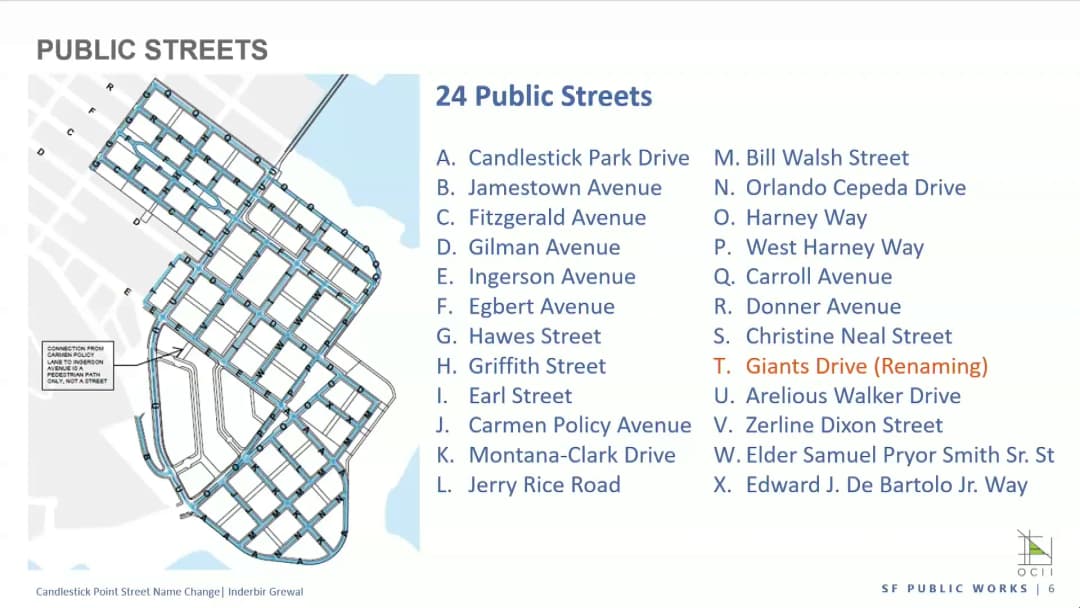
This regular meeting of the San Francisco Board of Supervisors’ Land Use and Transportation Committee, chaired by Supervisor Erin Melgar and joined by Vice Chair Cheyenne Chen, convened on May 4, 2026, at 9:45 AM UTC. The sole agenda item was a resolution to approve the official naming and renaming of public and private streets at Candlestick Point, a major redevelopment project. The committee unanimously voted to forward a positive recommendation to the full Board of Supervisors. Public Comments & Testimony - Dr. Veronica Honeycutt, Chair of the Hunters Point Shipyard Citizens Advisory Committee (HPS CAC), expressed strong support for the street naming resolution. She noted that the names were approved through a thorough community process in 2017 and reaffirmed by the HPS CAC on March 17, 2026. She emphasized that the approval is a critical milestone for economic revitalization, job creation, workforce development, and housing opportunities in the Bayview and Southeast sectors. Discussion Items - Presentation by Flora Law (Public Works) and Mindra Garriwal (Office of Community Investment and Infrastructure, OCII): They provided an overview of the Candlestick Point redevelopment, including the history of the site (home to the 49ers and Giants until 2015), the 1997 redevelopment plan, and the 2010 agreement with FivePoint. The project aims to build over 7,200 housing units (34% below market rate), over 3 million square feet of commercial space, 185,000 square feet of community/cultural space, and 16 acres of new parks. At full build-out, it is expected to create 12,000 permanent jobs and generate $23 million in annual surplus for the city’s general fund. - Street naming details: The resolution covers 24 public streets (suffixed with drive, avenue, road, or way) and 13 private streets with public access (suffixed with lane). Most public streets are extensions of existing roads; new streets are named after community leaders (Christine Neal, Elder Samuel Pryor Smith Sr., Zerline Dixon) and 49ers/Giants legends (e.g., Bill Walsh, Jerry Rice). The community selection process began in 2015, included two public meetings, door-to-door outreach, and 116 ballots with 44 unique nominations. A selection committee of CAC members, community stakeholders, and OCII representatives chose the final names. An event with Mayor Ed Lee in 2017 commemorated the names. - Supervisor comments: Chair Melgar noted that the process took 11 years and expressed pleasure in naming streets after community leaders, though she joked about the 49ers leaving the city. Vice Chair Chen similarly applauded the community process and thanked Supervisor Walton for his stewardship of the complex development. Key Outcomes - Motion to excuse Supervisor Mahmood: Approved unanimously (2 ayes) with Supervisor Mahmood absent. - Motion to approve the resolution (as a committee report with a positive recommendation): Passed unanimously (2 ayes) – Vice Chair Chen and Chair Melgar voted aye. - Next steps: The resolution will be sent to the full Board of Supervisors for consideration. The agenda indicated a May 5, 2026 hearing, but the clerk earlier stated that items acted upon today would appear on the May 12, 2026 agenda. This discrepancy is noted without resolution in the transcript.
The Budget and Finance Committee, chaired by Supervisor Connie Chan and joined by Supervisor Souter (Vice Chair Matt Dorsey excused), met on April 29, 2026, to consider six items. The committee approved resolutions for retroactive grant acceptance, contract amendments for in-home supportive services, and a supplemental appropriation for the Public Defender’s office. One item regarding a historic LGBTQ+ venue grant was continued to the next meeting. Consent Calendar - No consent calendar was presented; all items were considered individually. Public Comments & Testimony - No members of the public provided comment on any agenda item. Discussion Items 1. Item 1 – HIV/AIDS Research Grant (Approved) A resolution retroactively authorizing the Department of Public Health to accept and expend a grant increase of approximately $172,000 from the National Institutes of Health (via Florida State University) for the Adolescent Medicine Trials Network for HIV/AIDS Interventions. Total grant amount is $408,000 for the period January 25, 2023, through January 14, 2027. The committee moved the item to the full Board with a unanimous recommendation (2 ayes). 2. Item 2 – Homebridge In-Home Supportive Services Contract Amendment (Approved) A resolution approving a $118.8 million increase to the contract with Homebridge Inc., raising the total not-to-exceed amount to $158.4 million (term July 1, 2025 – June 30, 2029). Shannon Morgan, Program Director for IHSS, detailed performance challenges, including serving only 54% of authorized hours due to recipient refusals, lockouts, and safety concerns. She noted that the 65% target will be removed from future agreements. Supervisor Souter requested future creative approaches to increase utilization. The committee approved the item unanimously. 3. Item 3 – IHSS Public Authority Contract (Approved) A resolution approving a five-year contract (July 1, 2026 – June 30, 2031) with the San Francisco IHSS Public Authority for independent provider mode services, for a total not-to-exceed amount of $991 million. The contract funds health and dental benefits for about 30,000 IHSS workers. The Public Authority met most objectives; three mentorship-related targets lacked data. The committee approved the item unanimously. 4. Item 4 – Historic LGBTQ+ Venue Grant (Continued to May 6, 2026) A resolution to accept and expend a $5 million grant from the California Natural Resources Agency for preservation and revitalization of a historic LGBTQ+ venue in the Castro neighborhood. Ben Van Houten (OEWD) requested a one-week continuance to finalize details with the state and the City Attorney. The committee voted to continue the item to the May 6, 2026 meeting. 5. Item 5 – ADA Restroom Improvements at Charity Cultural Services Center (Approved) A resolution retroactively authorizing OEWD to accept and expend a $50,000 grant from the California Natural Resources Agency for ADA restroom design at the Charity Cultural Services Center (District 3). Alessandra Lozano (OEWD) explained that funds cover design/planning only. Chair Chan added herself as co-sponsor. The item was approved unanimously. 6. Item 6 – Public Defender Supplemental Appropriation (Approved) An ordinance appropriating $1.5 million from the General Reserve to the Public Defender’s office to cover projected increases in salaries and fringe benefits for fiscal year 2025–2026. A representative from the Public Defender’s office described a workload crisis with a 56% increase in active felonies and 78% increase in active misdemeanors, stating that the office cannot absorb vacancies without violating constitutional obligations. Chair Chan noted the difficulty of mid-year supplements and urged collaboration with the mayor for the upcoming budget. The item, requiring two-thirds board approval, was moved to the full Board unanimously. Key Outcomes - Items 1, 2, 3, 5, and 6 were referred to the full Board of Supervisors with a recommendation for approval (all votes 2-0). - Item 4 was continued to the May 6, 2026 meeting of the committee. - All actions are expected to appear on the Board of Supervisors agenda on May 5, 2026, unless otherwise noted.
The Budget and Appropriations Committee, chaired by Supervisor Connie Chan and including Vice Chair Matt Dorsey and members Danny Sauter, Shamann Walton, and Shaiyan Chin, held a hearing to examine proposed changes to the budget affecting homelessness and supportive housing systems. The hearing featured presentations from the UC Berkeley Terner Center, the People's Budget Coalition, the Mayor's Budget Office, and the Department of Homelessness and Supportive Housing (HSH), followed by extensive public comment. No binding votes were taken; the hearing was heard and filed. Public Comments & Testimony - Dozens of speakers addressed the committee. Several tenants and advocates urged the city to allocate $39 million from a $400 million reserve to backfill Emergency Housing Vouchers (EHVs) for 920 households facing subsidy end in October 2026. Speakers described the stability vouchers provided and fear of returning to homelessness. - Multiple speakers expressed strong opposition to Supervisor Dorsey’s proposed “drug-free housing” expansion, calling it a punishment policy that undermines housing first and harm reduction. Others supported drug-free options, arguing they give people in recovery a real choice and that only 42 of 9,000 supportive housing units are drug-free. - A representative from the Coalition on Homelessness noted that non-congregate shelter closures (Cova Hotel, Bayview Vehicle Triage Center, Mission Cabins, Monarch Hotel, Adante) totaled 373 beds lost between January 2025 and April 2026, while the department cited a net increase of 187 shelter and transitional beds in the same period. - Several providers and residents from SOMA West called for equitable distribution of supportive housing, noting that 60% of city services are concentrated in SOMA and the Tenderloin while the west side has few. A speaker filed a fair housing complaint over segregation. - Personal stories included a previously homeless worker who credited stable SRO housing for their recovery and job; a mother of six who feared returning to an SRO; and a law student currently homeless who called budget cuts a political choice, not a necessity. Discussion Items - Ryan Finnegan (UC Berkeley Terner Center) presented research showing that permanent supportive housing (PSH) reduces homelessness by 88% and improves housing stability by 41% compared to treatment-first models, but 40–60% of older PSH properties in major California cities face negative cash flow due to operating funding shortages. Cuts to federal Continuum of Care funding would ripple through the system, reducing shelter turnover. - Jennifer Friedenbach and Colleen Rivecca (People’s Budget Coalition) highlighted that federal housing funding was cut 76% from 1978–1983, driving homelessness. In San Francisco, they reported a loss of nearly 50% of semi- and non-congregate shelter beds for single adults (from 1,019 to 527) under the Lurie administration. They noted 920 EHV households will lose subsidies in October, and HUD cuts may affect $25 million for PSH. They urged fully funding cost-of-doing-business increases, right-sizing subsidies to eliminate operating deficits, and using healthcare funding (Medicaid) for supportive services. - Sophia Kittler (Mayor’s Budget Office) said the mayor’s proposal asked HSH to find $4 million in general fund savings via source swaps without service impacts. She stated the city will not seek additional Prop C (Our City, Our Home) fund reallocations at this time, but will use the $19 million reallocation authority already granted. She confirmed a large one-time Prop C surplus (over $10 million, with estimates up to $68 million in current year and $93 million in budget year from March revenue updates). The surplus is from higher-than-expected gross receipts tax and fund balance from the lawsuit period. She argued the budget reduction from year to year is not a service cut but reflects one-time spending falling off. - Shireen McSpadden (HSH Director) presented the department’s proposed $728 million budget for FY 2026-27 (down 7% from FY 2025-26 adopted). She stressed the budget protects core services, maintains shelter capacity, and includes a 1.4% COLA in year one and 3% in year two for providers. The decrease is largely driven by revenue shifts (one-time state/federal funds ending) and a technical accounting change moving $14 million from grants to professional services. She showed a net increase of 221 treatment/residential care beds and 187 shelter/transitional beds since January 2025. The PSH pipeline includes 1,500 future units, though only 182 are under construction due to funding constraints. She addressed the consolidation of street outreach under DPH, moving 11 HSH staff and three contracts. On legal services contracting, she said HSH does not typically fund legal services but is exploring prevention-based legal aid; a controversial contract with one provider is part of a multi-year procurement plan. - Supervisor Walton questioned why HSH is reducing its budget when Prop C has a surplus. Director Kittler reiterated that the reduction is in general fund support, offset by Prop C revenue, and is not a service cut. Supervisor Walton and Chair Chan pressed on the potential to invest more in subsidies, especially for families and prevention. - Supervisor Dorsey discussed housing first, noting it is flexible and can include drug-free/recovery housing. He cited a test case at 1174 Folsom Street (illicit-drug-free supportive housing) and asked for mid-year performance data. He raised the issue of underfunding security in PSH, arguing that spending on police responses could be better used for preventive on-site security. Key Outcomes - The hearing was heard and filed by a 5-0 vote (with Supervisor Mandelman excused). - No binding decisions were made, but the committee signaled intent to advocate for increased funding for prevention, rental subsidies, and backfilling EHVs using the Prop C surplus and other one-time funds. - Chair Chan noted the city now has an additional $100 million from the Airbnb lawsuit settlement, plus Prop C revenue increases, creating substantial fiscal room. - The mayor’s final budget is due June 1; further hearings and negotiations will follow.
The San Francisco Port Commission met on April 28, 2026, starting at approximately 11:00 AM and adjourning at 11:44 AM. Commissioners present included President Gail Gilman, Vice President Stephen English, Commissioner Willie Adams, Commissioner Stephen Lee, and Commissioner Ken McNeely. The meeting covered approval of minutes, a closed session disclosure, land acknowledgment, consent calendar items, and new business updates. Consent Calendar - Item 9A (Resolution 2620): Approved a grant of up to $2,200,000 to Enterprise for Youth for employment administration, internship payroll, and related services for port internship programs, for an original term of five years, with ability to amend based on operational need. - Item 9B (Resolutions 2621 and 2622): Authorized a settlement agreement with Pacific Waterfront Partners, LLC regarding its former tenancy at two separate port facilities, and an amended and restated exclusive negotiations agreement with San Francisco Waterfront Partners, LLC for a proposed development at Piers 38 and 40. - Item 9C (Resolution 2623): Modified construction contract number 2796R (South Beach Marina Repairs) to retroactively extend the substantial completion date and increase the authorized not-to-exceed amount from $4,028,711 to $4,128,711. - Item 9D (Resolution 2624): Approved an amendment to the as-needed hazardous materials abatement services contract with KM 106 Construction, increasing the contract value by $300,000 from $999,000 to $1,299,000. - Item 9E (Resolution 2625): Approved travel for the Vice President of the Port Commission to attend the Milken Institute's 29th Annual Global Conference in Los Angeles, California from May 3–6, 2026, at a cost not to exceed $4,000. All consent calendar items were approved unanimously. Executive Session Disclosure - The commission disclosed a discussion from closed session regarding the search for the next director of the Port of San Francisco. Due to unforeseen circumstances, several applicants withdrew, reducing the pool of candidates. The commission decided to recast some aspects of the search but still plans to conclude by summer 2026. The acting director and leadership team will continue to operate seamlessly during the pause. New Business - Pier 23 Waterfront Restaurant: Commissioner Adams inquired about the status of negotiations with the tenant. Acting Director Martin reported that the port has asked the tenant for a business plan proposal, due in June, to frame the negotiation. He noted the port’s interest in keeping tenants in place due to difficulty replacing them, but acknowledged there is an endpoint to such efforts. Commissioner Adams expressed a desire for resolution, stating it is “good to just get it settled so we can all either way move on.” - Strategy Overview Request: Commissioner Adams requested an informational strategy overview, possibly before the end of the year, to update the commission on the port’s approach to delinquencies, tenant retention, and the trade-offs between litigation and re-tenancy costs. Acting Director Martin agreed this would be a valuable session, both backward- and forward-looking. Key Outcomes - All consent calendar resolutions (2620–2625) were adopted unanimously. - The commission agreed to schedule an informational strategy overview on tenant-related matters. - The port will continue to engage with the Pier 23 tenant, expecting a business plan proposal in June. - The meeting was noted informally as the “shortest meeting in the history of the Port Commission,” lasting approximately 44 minutes.
The Board of Supervisors held its regular meeting on April 28, 2026, at 10:15 AM. The meeting included roll call (10 members present, Supervisor Fielder excused), land acknowledgment, approval of minutes, consent calendar, unfinished business, special order recognitions, introduction of new business, public comment, and a closed session. Key actions included passage of the SB 79 alternative plan with a last-minute amendment, approval of the Sheriff's Office military equipment use policy over one dissenting vote, and recognition of community leaders and public servants. Consent Calendar - Items 1–5 (routine ordinances) and items 6–10, 12–19, 21, 23–38, 44–47 were approved unanimously without objection. These included extensions of SFPUC grant authority, zoning changes for the One Oak Street project, establishment of entertainment zones, creation of the Pacific Islander Cultural District, MOU with police and fire unions, lease amendments, HUD grant acceptances, performance audit of the Sheriff's Office, electric vehicle charging station permits, support for state speed limitation legislation, landmark designations, and various appointments. Discussion Items - Item 11: Police Grant for 50 New Officers – Chair Chan requested verification that accepting the $6.25 million COPS grant does not conflict with San Francisco's sanctuary city law. Deputy City Attorney Brad Russi confirmed a preliminary injunction prevents the city from having to comply with contested conditions. The item passed on first reading without objection. - Item 20: Sheriff's Office Military Equipment Use Policy – Sheriff Miyamoto presented the request to approve the policy and purchase of a DFR drone and an OC pepper spray canister (tear ball grenade). He stated the drone would be used for missing persons and perimeter monitoring, and the canister for controlled indoor deployment. Supervisor Walton expressed concerns about drone civil rights violations and voted no. The resolution passed 9-1 (Walton dissenting). - Item 22: SB 79 Alternative Plan (Zoning Exemptions) – Supervisor Dorsey introduced a last-minute amendment authorizing the Planning Director to update exemption tables if HCD determines any parcels ineligible, preserving the alternative plan. After debate, the amendment passed 9-1 (Chan dissenting). Supervisor Dorsey expressed reservations about permanent exemptions but supported the amendment. The amended ordinance then passed 10-0. Supervisor Chan criticized state overreach. Special Order – Recognitions - Susan Gage (District 3) – Honored for community volunteer work in Russian Hill, including street cleanups, the Great Neighborhood Trash Off, and coordinating Francisco Park's anniversary celebration. - Lowell High School Girls Varsity Soccer Team – Recognized by Supervisor Wong for winning the CIF Division 5 state championship (first in program history), finishing with a 15-2-0 overall record and an undefeated league season. - Mika Kie Weisbuck (District 5) – Recognized during Autism Acceptance Month for co-directing the San Francisco Disability Cultural Center, the first publicly funded disability cultural center in the U.S., and for community organizing in Nicaragua. - Val Canaparoli (District 6) – Honored for 54 years as a dancer and choreographer with the San Francisco Ballet, including performances as Uncle Drosselmeyer in The Nutcracker. He continues choreographing globally. - Sam Dodge (District 10) – Recognized for nearly 12 years of public service, including creating the Navigation Center, Pit Stop Program, Healthy Streets Operations Center, and HART team. Multiple supervisors praised his compassion and effectiveness. Public Comments & Testimony - Several speakers addressed the board on various topics: urging wildfire prevention and vegetation management; criticizing Supervisor Mahmoud for lack of community engagement on a farmer's market proposal; honoring a murdered trans elder; alleging systemic exclusion in HSA HR; demanding faster action on homelessness and open drug use in Lower Polk; expressing distrust of Navy oversight at Hunters Point Shipyard; advocating for recognition of Black Hebrew people; and requesting longer public comment periods. Key Outcomes - Passed SB 79 alternative plan (10-0 after amendment) to permanently and temporarily exempt certain sites from state housing mandates, with administrative flexibility for HCD determinations. - Approved Sheriff's Office military equipment use policy and acquisition of a drone and OC pepper spray canister (9-1). - Approved five-year extensions of police, fire, and other union MOUs (unanimous). - Accepted $6.25 million federal grant for 50 new police officer positions (unanimous). - Adopted 13 landmark designations for historic sites (item 29 re-referred to committee). - Introduced new legislation: downtown community benefit district renewal, paid family leave expansion (Stroller Act), Compton's Cafeteria full building landmarking, Star Wars Day recognition, AAPI Heritage Month proclamation, Jewish American Heritage Month, and in-memoriam adjournments for DeWayne Gaines Sr. and Michael Tilson Thomas. - No action taken in closed session; deliberations not disclosed.
The San Francisco Public Utilities Commission (SFPUC) held a regular meeting on April 28, 2026, at 9:45 AM. The meeting included a land acknowledgment, approval of the consent calendar, public comments, and deliberation on proposed water, sewer, and power rate increases, as well as contract contingencies. The Commission approved all agenda items. Consent Calendar - Items 7A, 7B, and 7C were approved unanimously via a motion by Vice President Leveroni, seconded by Commissioner Thurlow. The items were routine approvals; no objections or comments were raised. Public Comments & Testimony - General Public Comment (Item 4): - Francisco de Costa alleged that three innocent employees were fired and that city reservoirs are filthy. He stated that he is taking the matter to the media due to the Commission's lack of response. - Rev. Ronnie Chisholm criticized the water system, claiming poor drinking water quality (e.g., dark water from faucets) and questioned the use of hundreds of millions of dollars. He called for accountability. - Johnny Chanon objected to a bond from 2002 appearing on bills, demanded to know when it would expire, and argued that rate increases should be placed on the ballot, not set by unelected commissioners. He also criticized the stormwater component charge as "ludicrous" for being charged year-round. - Eileen Boken (Coalition for San Francisco Neighborhoods) questioned whether the emergency firefighting water system is "dedicated" or "potable," citing an April 14, 2026 agenda item that conflicted with public statements. She called it a "bait and switch." - Denise Lewis (California Native Plant Society) urged a hearing to uncover why staff did not adopt the full build-out of the emergency firefighting water system recommended by AECOM. She noted that a 2026 ballot measure includes only $130 million, while full build-out would exceed $3 billion. - Peter Dreckmeyer (Policy Director, Yosemite Rivers Alliance) argued that the Commission is not receiving timely water supply planning information, referencing a 2021 workshop that occurred after the Urban Water Management Plan was filed. He stated that the design drought (8.5-year scenario) is outdated and that the long-term vulnerability assessment found no drought as severe in 25,000 model runs. - Comments on BAWSCA Report (Item 6): - A speaker (caller) asserted that water is being doled out in violation of the Raker Act, which primarily intended water for San Francisco municipal use. - Peter Dreckmeyer reiterated that the design drought is unrealistic and urged the Commission to use the next month and a half wisely before approving the Urban Water Management Plan. - Comments on Water & Sewer Rates (Items 8 & 9): - Masood Samari expressed concern for small businesses, urging a phased approach and lower annual caps. - Denise Lewis warned that exaggerated water needs could justify unnecessary alternative water supply projects. - Francisco de Costa argued that customers who conserve should not be penalized and called for transparency on staff salaries. - Mary Butterwick (ratepayer) stated that rates may triple in 15 years and that debt service will exceed 50% of costs within 10 years. She urged realistic demand projections. - Johnny Chanon repeated opposition to rate-setting by unelected bodies and called for ballot measures. - Eileen Boken opposed rate increases based on outdated population projections and drought modeling, presenting a resolution from the Coalition for San Francisco Neighborhoods urging two alternative scenarios using flat population growth and shorter drought durations (6.0 and 7.5 years). - Albert Chow (candidate for District 4 supervisor) noted cumulative rate increases from PG&E and Ecology, calling for stretching operating expenses to provide relief. - Ted Lowenberg stated that the last hike already doubled his bill and that the stormwater charge is a "free money" scheme since no refund is given in dry months. He accused the Commission of being the "worst enemies" in the fight against inflation. - Donald Driscoll (attorney) argued that the hearing procedures under Government Code 53759.1 are inadequate, lacking sworn testimony, cross-examination, and impartial fact-finding. He reserved rights to challenge the rate adoption. - Heather Wilson (laundromat owner) detailed how reduced rebates for energy-efficient machines make it impossible to renovate essential laundry services. She noted that her utilities are 21% of revenue and that a nearby laundry closed due to costs exceeding revenue. - Rev. Ronnie Chisholm called the system "broken" and urged the Commission to be responsible. - Dave Warner (caller) proposed using $24 million from reserves to reduce the combined increase from 12.5% to 10%, plus a 2.6% budget cut. - A representative of the Hispanic Chamber of Commerce (caller) stated that the increases will disproportionately impact Latino and minority-owned small businesses, forcing staff cuts or closures. - Alex (Bayview resident) argued that the rate structure lacks a gravity credit for lower-elevation parcels, causing them to subsidize pumping costs for higher-income areas. - Comments on Power Rates (Item 10): - Eileen Boken opposed rate increases based on fund balance and outdated population projections, referencing a $200 million West Side substation project and concerns about blended water, saltwater intrusion, and recycled water (toilet-to-tap). - Comments on Wholesale Water Rates (Item 11): - Peter Dreckmeyer noted that projected water sales in the plan are lower than those in the Urban Water Management Plan and questioned the need for the $747 million Pure Water Peninsula project, given that alternative water supply needs are only 92-122 MGD. He urged a workshop on demand and drought modeling. Discussion Items - Item 6 – BAWSCA Report: Mr. Smeagel presented the annual report, noting that the BAWSCA region uses 26% less water than in 1986-87 despite a 35% population increase. Residential water use dropped from 79.3 gpcd (2012-13) to 58.9 gpcd. Eight agencies now have residential use below 45 gpcd. The region's reliance on the SFPUC regional water system is projected to decline from 67% to 61% by 2050 as other sources develop. No questions from commissioners. - Items 8 & 9 – Water and Sewer Rate Proposals: - Matthew Freiberg (Rates Manager) presented the two-year rate proposals for water (7% increase each year for FY27 and FY28) and sewer (15% in FY27, 14.5% in FY28). The sewer increase includes a stormwater component phased in over seven years, with a 53.3% increase in FY27 and 43.1% in FY28 for stormwater alone, offset by lower wastewater component increases (10.8% and 10.1%). The average single-family combined bill would rise from $165/month currently to $209/month by FY28. The proposals were developed under 2023 rate study and comply with Proposition 218 and AB 2257 exhaustion of remedies requirements. Outreach included 40 group presentations, 7 in-person application drives (850 attendees), and multilingual ads generating 1.4 million impressions. - John Cote (Communications Director) highlighted rebates, grants, and the Customer Assistance Program (CAP) offering 25-40% discounts. Enrollment is 7,000 accounts; an estimated 35,000 households are eligible. Commissioners Thurlow and Jamdar asked about fund balance durability, CAP sustainability, rate structure, and federal funding. Staff noted that fund balance buffers near-term rates, but large-scale CAP enrollment would require rethinking. - After public comment, the Commission voted to overrule objections (27 water protests, 1 sewer protest; majority threshold not met) and adopted the rate schedules effective July 1, 2026. - Item 10 – Power Rates: Freiberg presented a 6% average increase for Hetch Hetchy Power retail rates (FY27), with cost-of-service adjustments causing variations (cap of 9% for individual tariffs). General Use (subsidized) rates will increase by 3 cents/kWh annually to reach parity with retail. A new Municipal Airport rate was created for SFO to avoid socializing project costs. Green tariff surcharge increased from 8 to 9.5 cents/MWh. Typical residential bill would go from $95 to $102/month, still below PG&E rates ($127). The Commission approved the rates unanimously. - Item 11 – Wholesale Water Rates: Freiberg proposed a 7.4% increase to $6.23/CCF for FY27, driven by lower wholesale usage projections (3.2% decrease) and increased operating/debt service costs. The balancing account shifted from owing $13.4M to BAWSCA to anticipating a $3.4M owed to SFPUC. The Commission approved the rates unanimously. - Item 12 – Snow Valley Chloramination Facility: Project Manager Alicia Reinhardt requested a $2 million cost contingency increase and 700 calendar day extension due to an unforeseen operational event during the Hetch Hetchy system shutdown. One treatment plant experienced performance issues, requiring the facility to be brought back online four weeks early, preventing completion of shutdown-related work. The Commission approved the request unanimously. - Item 13 – Channel Force Main Intertie: Project Manager Carmen Luke requested a $2.8 million cost contingency increase and 243 calendar day extension for additional pipe modifications and dewatering required during the dry weather season of 2025. The Commission approved the request unanimously. Key Outcomes - Consent Calendar (Items 7A-7C): Approved unanimously. - Water Rates (Items 8 & 9): The Commission overruled 27 written objections and 3 oral protests (majority protest threshold not met). A motion to confirm that no objections warranted revising the proposed rates passed unanimously. The revised water rate schedule (7% increase each year for FY27 and FY28) was adopted, effective July 1, 2026. - Sewer Rates (Items 8 & 9): The Commission overruled 1 written objection (majority protest threshold not met). The revised sewer rate schedule (15% increase for FY27, 14.5% for FY28) was adopted, effective July 1, 2026. - Power Rates (Item 10): The proposed increase of 6% for Hetch Hetchy Power retail rates was adopted unanimously, effective July 1, 2026. - Wholesale Water Rates (Item 11): The proposed rate of $6.23/CCF (7.4% increase) was adopted unanimously, effective July 1, 2026. - Contract Amendment (Item 12): Approved $2 million cost contingency increase and 700 calendar day extension for Snow Valley Chloramination Facility improvements. - Contract Amendment (Item 13): Approved $2.8 million cost contingency increase and 243 calendar day extension for Channel Force Main Intertie. - Other Items: Items 14 (communications) and 15 (commissioner-initiated items) were noted with no action. The meeting adjourned at 4:04 PM.