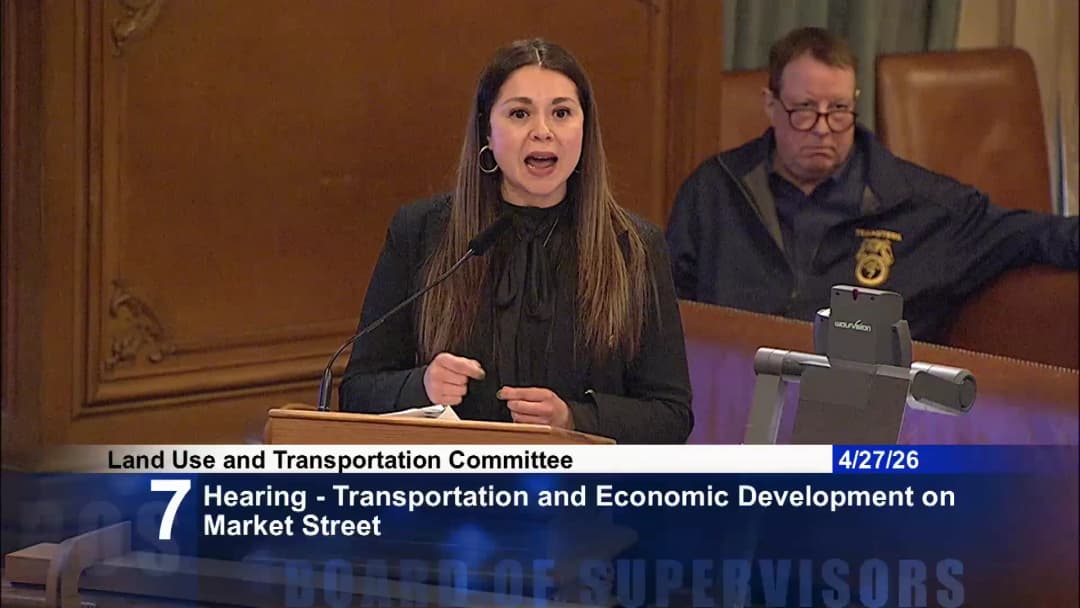
The Land Use and Transportation Committee of the San Francisco Board of Supervisors met on April 27, 2026, at 9:45 AM. Chair Miranda Melgar presided, joined by Vice Chair Cheyenne Chen and Member Balam Mahmood. The committee considered seven agenda items: a commemorative street naming, a plaque for Carlos Santana (continued), acceptance of street infrastructure, PUC electric facility purchase authority, temporary street use permits, structural maintenance inspections, and a hearing on Market Street corridor. All votes were unanimous. Commemorative Street Naming: Helen Wakazo Way - Presentation: Sasha Gaona (Chief of Staff for Supervisor Jackie Fielder) presented a resolution to add the commemorative street name "Helen Wakazo Way" to Julian Avenue in the American Indian Cultural District. Helen Wakazo founded Friendship House in 1963, which has served over 6,500 clients and is nationally recognized for integrating Native healing practices with substance use disorder treatment. The resolution honors her legacy. - Committee Discussion: Chair Melgar and Vice Chair Chen expressed strong support, both adding themselves as co-sponsors. They highlighted Friendship House’s importance to the urban Native American community. - Public Comment: Eleven speakers testified in support, including Patricia Shirley (friend), Catherine Collins (alumni), Sheree Apadaka Duarte (HR manager), Javerne Shirley (Chief Administrative Officer), Nona Claypool (discharge coordinator), James Williams (facilities assistant), Athuservantas (program co-lead), Andrew Cloud (graduate), Peter Brett (Village SF lead), Juliet Lee (reducing disparities initiative), and Hector Patty (ceremonial son). Many shared personal stories of healing and emphasized Helen Wakazo’s compassion and impact. - Key Outcome: The committee voted unanimously (3-0) to recommend the resolution to the full Board of Supervisors. Commemorative Plaque for Carlos Santana – Continued - Action: Supervisor Fielder’s office requested a continuance for item 2 (resolution authorizing a commemorative street plaque for Carlos Santana at 205 Mullen Avenue) to allow further community discussion. - Public Comment: No speakers. - Key Outcome: The committee voted unanimously (3-0) to continue the item to the call of the chair. Acceptance of East Clementina Street and Public Improvements - Presentation: Kalhal Hinsey (Department of Public Works) presented an ordinance conditionally accepting a segment of East Clementina Street between Beale and Main streets, along with public improvements from Trans Bay 2 (senior housing with 151 units and family housing with 184 units, both 100% affordable). The project includes street dedication, easements, and CEQA findings. - Public Comment: None. - Key Outcome: The committee voted unanimously (3-0) to recommend the ordinance to the full board. PUC Authority to Purchase Electric Infrastructure from Customers - Presentation: Renil Bijoy (Supervisor Mandelman’s office) and Catherine Spaulding (SFPUC Deputy Assistant General Manager) introduced an ordinance amending the Administrative Code to allow the PUC to purchase electric infrastructure from customers (e.g., Cordia’s steam loop electrification project). The ordinance retains prevailing wage, local hire, and nondiscrimination requirements. The PUC stressed that this authority would reduce delays and support electrification goals. - Committee Discussion: Chair Melgar and Vice Chair Chen supported the ordinance, noting protections for labor and equity. Chair Melgar added herself as a co-sponsor. - Public Comment: Three speakers supported: Brendan Green (IBEW Local 6), Rudy Gonzalez (Building and Construction Trades Council), and Mike Yerkis (Cordia Energy Center). They emphasized skilled jobs and efficient infrastructure delivery. - Key Outcome: The committee voted unanimously (3-0) to recommend the ordinance to the full board. Temporary Street Use Permits and Street Closures - Presentation: Ben Van Houten (OEWD), Hava Cronenberg (SFMTA), and Katie Tang (Office of Small Business) presented an ordinance to authorize administrative approval of certain temporary street use permits, bypassing the ISCOT hearing for events contained within three blocks, not requiring Muni rerouting, and keeping intersections open. The goal is to simplify permitting for small events and reduce ISCOT workload by an estimated 80–90%. - Committee Discussion: Chair Melgar and Vice Chair Chen supported the reform, noting it helps small organizations. The committee duplicated the file with a technical amendment (reorganizing ISCOT provisions) and continued the duplicate to the call of the chair. - Public Comment: Three speakers supported: Jill Linwood (Buena Vista Partnership), Simon Bertrang (SF New Deal), and Griffin Lee (Connected SF). Griffin Lee asked for clarification on “certain circumstances.” - Key Outcome: The committee voted unanimously to amend the duplicate and continue it, and separately voted unanimously (3-0) to recommend the original ordinance to the full board. Structural Maintenance Inspections – Alignment with State Law - Presentation: Christine Gasparek (DBI Assistant Director) presented an ordinance aligning local requirements for exterior element inspections (e.g., balconies) with state law. Key changes: flexible submission timeline to match the state’s five-year cycle, aligning inspector qualifications, clarifying that the extended timeline is a one-time adjustment, and reinstating fire escapes inadvertently dropped during drafting. - Committee Discussion: Vice Chair Chen confirmed the rationale: avoiding duplicative inspections. The committee adopted an amendment (restoring fire escapes and clarifying one-time extension). - Public Comment: None. - Key Outcome: The committee voted unanimously to adopt the amendment and then unanimously (3-0) to recommend the amended ordinance to the full board. Hearing on Market Street Corridor (Transportation, Economic Development, and Public Engagement) - Call for Hearing: Supervisor Mahmood outlined three questions: future of transportation on Market Street, public realm investment plans, and strategies for small business activation. He noted optimism (e.g., theater district, downtown development corporation) and concerns (vacancies, reduced transit service, private vehicle reintroduction). - Presentations: - Planning Department (Jeremy Shaw): Described zoning changes, housing expansion downtown, and public realm improvements. Investments include $32M for Embarcadero (with $16M from downtown development corporation) and $22M for Powell Street ($16M from DDC). No centralized vision for Market Street was identified; multiple plans guide investments. Office-to-housing conversion pipeline includes two projects. - SFMTA (Hava Cronenberg, Jenny DeLumo, Jessica Garcia): Reported on transportation operations. Muni service cuts in summer 2025 reduced service by 2%, but ridership shifted to rapid routes. The car-free Market Street (since 2020) reduced crashes by 40% and transit travel times by up to 14%. A loading evaluation for TNCs (Uber Black, Lyft Black, Waymo) began in 2025, with limited operations. As of March 2026, TNCs average under 250 trips/day (about 10/hour), and no significant changes in safety or transit performance were observed. However, private vehicle compliance is a concern. The evaluation is ongoing, with a public intercept survey and operator interviews planned. - OEWD (Diana Ponce de Leon): Highlighted programs: entertainment zones (including one on Market at 5th-6th), SF Live calendar for smaller venues, $4M from Community Investment Fund for arts space, storefront opportunity grants, business recruitment, and partnerships with Mid-Market CBD and Foundation. Noted that mid-market and Tenderloin receive significant investment but less than the core downtown. - Committee Discussion: Supervisors pressed for a unified vision and equitable investment. Chair Melgar emphasized that Market Street is both a thoroughfare and a destination, and that public safety and fun factor are critical. Supervisor Mahmood questioned the prioritization framework for investment, noting that mid-market (west of Powell) appears underfunded relative to Embarcadero and Powell Street. He also raised concerns about the TNC pilot being exploited by private vehicles. Vice Chair Chen asked about the health of mom-and-pop businesses and displacement pressures. - Public Comment: 17 speakers addressed the committee. Major themes: - Support for maintaining or strengthening car-free Market Street (many from Keep Market Street Moving Alliance: Walk SF, SF Bicycle Coalition, Transit Riders, Taxi Workers Alliance). They reported increased private vehicles, safety risks, and called for closing the commercial passenger vehicle loophole. - Need for improved public safety, cleanliness, and law enforcement presence (business owners, residents). - Support for Supervisor Mahmood’s arts and entertainment district vision. - Call for a coordinated, citywide vision for Market Street with equitable investment across the corridor. - Key Outcome: The committee voted unanimously (3-0) to hear and file the hearing.
Public Meetings - San Francisco, California
Public Meetings - San Francisco, CaliforniaThe San Francisco Planning Commission held a regular hearing on April 23, 2026, at 8:15 PM. The meeting included a consent calendar approval, department announcements regarding website updates and a corrected housing database revealing 40,000 additional residential units, recognition of staff awards, a report on Board of Supervisors actions, and a unanimous approval of a conditional use authorization for a romance bookstore and tea room with wine service at 284 Noe Street. Consent Calendar - Item 1 (Case 2025-010376 CUA) – Conditional use authorization for 4620 Mission Street was approved unanimously (7-0) as routine. No public comment was made to remove it from consent. Department Matters - Director’s Announcements (Item 4): The Planning Department completed an update to its website to improve accessibility, page load times, and navigation. A major update to the land use database corrected an undercount of approximately 40,000 residential units citywide by cross-referencing assessor, co-star, DBI, and planning data. The database now also accurately counts home-based businesses and commercial uses. Several staff awards were announced: the Ocean Beach Climate Change Adaptation EIR received an Award of Merit from the Association of Environmental Planners; the Family Zoning Plan received an APA Northern California Award for Planning Excellence; the Design Standards received an Urban Design Award of Merit; and staff member Lisa Chen received a Mid-Career Planner Special Recognition Award. In response to questions from Commissioner Braun about the 40,000 additional units, Interim Director explained that the undercount was identified through data synthesis but could not confirm if the magnitude was previously known. Commissioner Imperial requested a future presentation on navigating the department website; the Director agreed. Commissioner Moore suggested creating a training video. Review of Past Events at the Board of Supervisors - The Land Use and Transportation Committee initiated 15 landmark designations in District 3 as part of the Family Zoning Plan. The committee also amended SB 79 legislation to incorporate Planning Commission recommendations and forwarded it to the full board. The full board passed 14 landmark designations in District 8 on second read, and the One Oak ordinance passed on first read. Regular Calendar – Item 6 (Case 2026-000475 CUA) – 284 Noe Street - Description: Request for conditional use authorization to establish a bar use (ancillary wine service) at 284 Noe Street, a two-story mixed-use building in the Upper Market Neighborhood Commercial Transit District. The proposed business is Love Potion Library, a romance bookstore and tea room with on-sale beer and wine (Type 42 license). No exterior alterations are proposed; interior improvements include lounge seating, bookshelves, lighting, and a back-of-house area. - Neighborhood Association Input: The DeBose Triangle Neighborhood Association (DTNA) submitted a letter of support with concerns about potential noise. They recommended three conditions: (1) limit alcohol service hours to 9 a.m.–10 p.m. Sunday–Thursday and 9 a.m.–11 p.m. Friday–Saturday; (2) no alcohol consumption outside the building; (3) restrict backyard access to employees only. The project sponsor agreed to these conditions. - Staff Recommendation: Staff found the project consistent with zoning and recommended approval with the three additional conditions. - Public Testimony: No members of the public came forward to speak. - Commission Discussion: Commissioner So made a motion to approve with conditions, seconded. Commissioner Braun expressed support, noting the balance between neighborhood vitality and noise mitigation. - Vote: The motion passed unanimously (7-0). Key Outcomes - Consent Calendar: Item 1 approved unanimously. - Database Correction: 40,000 additional housing units identified; staff will present website navigation to the Commission. - Staff Awards: Multiple honors received; recognition of staff excellence. - Conditional Use Authorization: Approved for 284 Noe Street (Love Potion Library) with three conditions limiting alcohol service hours, prohibiting outdoor consumption, and restricting backyard access to employees. - Item Withdrawn: Case 2024-008383 CUA for 394 Naples Street was withdrawn by the applicant and not considered.
The Public Safety and Neighborhood Services Committee of the San Francisco Board of Supervisors met on April 23, 2026, at approximately 9:15 AM (Pacific) to consider four agenda items: a liquor license for a new music venue, an ordinance to create drug-free permanent supportive housing, a resolution supporting JROTC programs, and a resolution condemning recent ICE actions. The committee voted unanimously to forward all items to the full Board with positive recommendations. Consent Calendar - No consent calendar was presented. All items were discussed individually. Public Comments & Testimony - Item 2 (Drug-Free PSH Ordinance): Over 30 public speakers testified. Supporters, including members of the recovery community, argued that drug-free options are needed and that current drug-tolerant housing perpetuates addiction. Opponents, including housing providers and tenant advocates, warned that evictions for drug use could lead to increased homelessness and urged that recovery housing be additive, not exclusive, and that replacement housing be guaranteed. Several speakers noted that 26% of overdose fatalities occur in permanent supportive housing and that there are approximately 9,000 drug-tolerant units versus only 42 drug-free units. One speaker read the names of over 960 people who died in PSH. - Item 4 (ICE Resolution): One speaker from the public urged the strongest possible sanctuary policy and denounced federal immigration enforcement actions. Discussion Items - Item 1 – Type 90 Liquor License for Mellow SF (1401 H Street): Officer Brandon Erickson of the SFPD ABC Liaison Unit presented the application. The area is designated high crime and high concentration, but Park Station has no opposition. Conditions include noise limits and litter control. The applicant expressed gratitude, and Vice Chair Sauter noted visiting the venue. The committee voted unanimously to prepare a resolution finding that the license serves public convenience or necessity. - Item 2 – Ordinance to Expand Drug-Free Permanent Supportive Housing (File No. 210003): Chair Matt Dorsey presented the ordinance, which applies only to future city-funded site-based PSH. It would prohibit illicit drug use on site (allowing alcohol and marijuana), require a survey of current residents’ preferences, and establish a policy to meet demand for drug-free options. The ordinance includes rulemaking by HSH and DPH and provides that a single relapse cannot trigger automatic eviction. The committee discussed concerns about exclusivity and evictions; Chair Dorsey noted that state law prevents using state funds for drug-free housing and that the ordinance preserves flexibility via an escape clause. The motion to forward passed 3–0. - Item 3 – Resolution Supporting JROTC: Supervisor Alan Wong introduced the resolution. Presenters included instructors and students from Galileo and Lowell High Schools, who described how JROTC builds leadership, discipline, and community. The program serves six high schools with nearly 1,000 cadets. The resolution affirms the Board’s support for preserving the program as currently constituted. No public comment. The motion passed 3–0. - Item 4 – Resolution Condemning ICE Actions and Reaffirming Sanctuary City Policies: Chair Dorsey proposed three amendments to correct factual descriptions of a recent incident, replace “recommit” with “continue to abide,” and adjust the title. The committee adopted the amendments and forwarded the resolution to the full Board with a positive recommendation, voting 3–0. Key Outcomes - Item 1: Motion passed 3–0 to prepare a resolution and forward with positive recommendation. - Item 2: Motion passed 3–0 to forward the ordinance to the full Board with positive recommendation. No amendments were adopted at this hearing; the ordinance will be debated further. - Item 3: Motion passed 3–0 to forward the resolution with positive recommendation. - Item 4: Motion passed 3–0 to adopt Chair Dorsey’s amendments and forward the resolution with positive recommendation.
On April 22, 2026, the Budget and Finance Committee of the San Francisco Board of Supervisors met at 6:15 PM. Vice Chair Matt Dorsey chaired the meeting, joined by Supervisors Danny Sauter and Cheyenne Chen. Supervisor Connie Chan was excused unanimously. The committee reviewed and approved several items including a lease amendment for the Chinatown Public Health Center, federal HUD grant acceptances, labor agreements with police and fire unions, the release of police overtime reserve funds, and a federal COPS grant for 50 new officers. No public speakers appeared on any item. All items were passed with positive recommendations to the full Board of Supervisors. Discussion Items Item 1 – Lease Amendment for Chinatown Public Health Center - The committee considered a resolution to amend the lease at 845 Jackson Street, fourth floor, with Chinese Hospital Association. The amendment increases the tenant improvement allowance by $400,000 (from $300,000 to $800,000) for fire safety upgrades required by the state, and extends the lease term by about seven months to align with the change-of-use permit. No change to the total lease amount of $3.9 million. BLA recommended an amendment to correct the title by removing the phrase "with no change to the total lease amount of $3,880,292.20." The committee approved the amendment and forwarded the resolution to the full board with a positive recommendation. (3-0 vote) Items 2–5 – HUD Entitlement Grant Acceptances - The committee reviewed four resolutions authorizing the city to accept and expend federal HUD funds for fiscal years 2026‑2027: Community Development Block Grant ($21.5 million), Home Investment Partnerships ($6.6 million), Emergency Solutions Grants ($1.7 million), and Housing Opportunities for Persons with AIDS ($7.7 million). Julia Sabory, Deputy Director of Community Development, presented the funds' impact, noting they served over 13,000 residents last year. Supervisor Dorsey asked about eviction prevention eligibility. The committee approved all four items unanimously. (3-0 vote) Items 6–8 – Police and Fire Labor Agreements - The committee considered three memoranda of understanding (MOUs) for the San Francisco Firefighters Union (Local 798, Units 1 and 2) and the San Francisco Police Officers Association (POA). The four-year agreements (July 1, 2026 – June 30, 2030) provide 3% annual wage increases plus a 2% increase on the last day (total 14%). Key provisions include: for police – retention payments at 8 and 10 years, a $25,000 signing bonus for lateral hires (funded by a one-time grant), five additional floating holidays for laterals, enhanced field training officer pay, and a behavioral health program. For fire – an incentive for a San Francisco‑specific training program, a wellness program, behavioral health funding, and increased tuition reimbursement. DHR Director Carol Eisen and Employee Relations Director Artis Graham presented. POA President Louie Wong and Officer Ashley Slomowitz spoke in support, emphasizing recruitment and retention. Chief Liu also expressed support. The committee approved all three MOUs unanimously. (3-0 vote) Item 9 – Release of Police Overtime Reserve Funds - The committee held a hearing on releasing $537,583 in fiscal year 2025‑2026 and $652,130 in fiscal year 2026‑2027 (total approximately $1.19 million) from the Budget and Finance Committee reserve for the Police Department's overtime needs. The BLA noted the department projects a salary surplus of just under $1 million and that the funds are needed to cover overtime for the remainder of the fiscal year. The committee approved the release and filed the hearing. (3-0 vote) Item 10 – COPS Hiring Grant for 50 New Officers - The committee considered an ordinance retroactively authorizing acceptance of a $6.25 million U.S. Department of Justice COPS grant to fund 50 new police officer positions. The grant covers 75% of entry-level salary and benefits for three years, with a 12-month retention requirement. The city provides matching funds (estimated $18 million over the grant period) through vacancy savings. As of April 2026, 27 of the 50 positions have been filled. The City Attorney's Office secured a preliminary injunction blocking certain unlawful grant conditions. The BLA recommended approval. The committee approved the ordinance unanimously. (3-0 vote) Key Outcomes - All items were approved with positive recommendations to the full Board of Supervisors (scheduled for April 28, 2026). - No public testimony was offered on any agenda item. - The committee excused Supervisor Connie Chan and amended the lease resolution title as recommended by the Budget and Legislative Analyst.
The Budget and Appropriations Committee, chaired by Supervisor Shimon Walton (Pro Tem) and joined by Supervisors Alan Wong, Cheyenne Chan, and Danny Sauter (until excused), met on the afternoon of April 22, 2026, to conduct two hearings: the first on workforce programming across city departments and the second on family affordability and the impact of proposed budget cuts on vulnerable communities. The committee heard presentations from multiple city departments and extensive public testimony, and both hearings were ultimately filed. Public Comments & Testimony - Workforce Programming Hearing: Numerous speakers, including representatives from the People's Budget Coalition, SF YouthWorks interns, and nonprofit workers, strongly opposed proposed budget cuts. Youth interns testified that a proposed $2 million cut to SF YouthWorks would eliminate 80% of paid internships, affecting 200 summer positions and 120 school-year positions. Speakers argued that workforce programs are essential for public safety, economic stability, and family support. Several speakers criticized the layoff process, noting that cuts disproportionately impact people of color and that the city should use reserves rather than lay off staff. - Family Affordability Hearing: Community members, including SRO residents, domestic workers, and nonprofit leaders, shared personal stories of how MOHCD-funded services (e.g., case management, legal aid, food assistance, housing counseling) are lifelines. They urged the committee to reject the $8.5 million in cuts to community-based services, digital equity, and capital programs, which would affect immigrant families, low-income households, and youth. Speakers also criticized the mayor's office for leaving before public comment and questioned the equity of the budget decisions. Discussion Items Hearing on Workforce Programming - Department of Children, Youth and Families (DCYF): Director Sharice Dorsey Smith reported that DCYF funds $23.3 million in youth workforce development, serving 3,764 unique participants in 24-25 (primarily ages 14-17, Latinx 33.5%, Asian 29.9%, African American 18.5%). No cuts were made to these programs. Performance measures showed high achievement rates (e.g., 89% completion for CityBuild). - Human Services Agency (HSA): Deputy Director Susie Smith presented HSA's $34.6 million workforce budget (from a total $43 million), with only $2.1 million in cuts to sub-specialty populations (e.g., LGBTQ+ and homelessness programs) redirected to larger-scale programs. She noted the elimination of the Working Families Tax Credit (state/federal credits still available) and discussed the impact of HR1 work requirements, projecting 19,000 CalFresh clients needing placements. The jobs now program has a 72% unsubsidized placement rate. - Office of Economic and Workforce Development (OEWD): Director Topier rejected merger rumors with HSA. OEWD faces $10 million in cuts; $3.8 million in program cuts (including $1.5 million in job center operational efficiencies) and 19 personnel cuts (13 actual people: 8 from workforce, 11 from econ). She reported 3,600 job placements, 89% completion rate for CityBuild (average starting wage $31/hr), and 2nd lowest unemployment in CA at 3.9%. Supervisor Walton expressed concern that layoffs disproportionately affect people of color and questioned the lack of data on racial breakdown of layoffs. Supervisor Sauter asked about AI integration in training. - Human Rights Commission (HRC): Director Tugbinho reported that HRC proposes a $2 million reduction to the Youth Works program (80% of its $2.5 million budget), which would eliminate about 200 summer internships and 120 school-year internships, affecting 250-500 youth placements. The broader OFA program would continue. Public comment from JCYC and youth interns strongly opposed this cut. - Public Comment Highlights: Joe Wilson (Hospitality House) argued that cuts weaken investments in housing and behavioral health. Katia Farilla (Latino Task Force) noted that 94% of their workforce clients are Latino and face barriers. Marnie Regan (Larkin Street) warned that work requirements starting June 1 will harm unhoused people. Multiple speakers highlighted the value of culturally competent CBOs and the need to avoid layoffs. Hearing on Family Affordability - Mayor's Budget Office: Director Sophia Kittler stated the budget process is in the mayor's phase, with a $640 million general fund deficit (down from previous projections). She acknowledged that cuts are difficult but necessary, and the office is coordinating across departments to avoid duplication. - Mayor's Office of Housing and Community Development (MOHCD): Director Dan Adams reaffirmed a commitment to family affordability, with 30,000 affordable housing units and 2,700 under construction. Deputy Director Julia Sabori presented MOHCD's $8.5 million ongoing reduction, concentrated in community-based services (69 grants), digital equity, and capital programs. The cuts would affect 80% extremely low-income clients and 18% large families. She noted that performance monitoring was not used to determine cuts. Supervisor Chan pressed on equity and cross-department coordination; Director Kittler explained the mayor's office uses new data to track CBO-level impacts. - People's Budget Coalition Presentation: Multiple speakers (e.g., Gentel Laborento, Elaine Villasper) provided context on housing affordability, noting that the family zoning plan delivers only 10-15% affordable units and that Proposition I repeal would lose $390 million over four years. They highlighted that nonprofit workers (80% people of color, 69% women) are the safety net, and cuts would destabilize families. SRO families and domestic workers shared testimonies of relying on CBOs for language access, legal aid, and emergency assistance. - Public Comment Highlights: Speakers opposed cuts to MOHCD-funded services, arguing they violate Sanctuary City ordinances and disproportionately harm immigrant and low-income families. Gabriel Medina (La Raza) noted that programs like the parent support program and rapid response would be eliminated, and urged the city to restore funding. Multiple speakers criticized the mayor's office for not staying to listen. Key Outcomes - Motion to Excuse Members: At the start, the committee voted (4-0) to excuse Chair Connie Chan, Vice Chair Matt Dorsey, and President Mandelman. Later, the committee voted (3-0) to excuse Supervisor Danny Sauter for the remainder of the meeting. - Hearing on Workforce Programming: The committee voted (4-0) to hear and file the item. Supervisor Walton stated that layoffs are not necessary given the reduced deficit and that workforce development is integral to fighting homelessness and crime. - Hearing on Family Affordability: The committee voted (3-0) to hear and file the item. Supervisor Chan committed to fighting for young people and families, and Supervisor Walton emphasized that budget decisions reflect city values.
The San Francisco Board of Supervisors held its regular meeting on April 21, 2026, at 10:15 AM. The meeting covered approval of minutes, consent agenda, unfinished business, committee reports, roll call introductions, special orders, public comment, and adoption of resolutions without committee reference. Key actions included sending an airport surveillance technology ordinance back to committee, passing an ordinance establishing a fire code advisory council (8-1), and adopting multiple resolutions honoring community members and designating special days. Consent Calendar - Items 1 through 14 were approved unanimously as a consent calendar, considered routine and passed without objection. Public Comments & Testimony - Jerry Dratler raised concerns about the city's purchase of 1660 Mission Street, alleging an expired building permit and illegal occupancy by city departments, and called for a GAO subcommittee investigation. - Multiple residents of Thomas Paine Square apartments complained about management company Domus, including missing rent payments, inadequate security, theft, and alleged conflicts of interest involving board chair Bobby Sisk. They urged the city attorney to investigate and replace the security company. - Harris Edgley spoke about the need for help in the Fillmore, including the closing of Safeway, and called for a hearing on grocery stores. - Jalen Tillis raised issues of public defecation/urination, drug activity, and theft, calling for more public bathrooms, stricter laws, and increased police presence. - Ryan Ortiz (intern in Supervisor Dorsey's office) spoke in support of Arbor Day resolution (item 34). - Denise Heitzenroder (Department on the Status of Women) expressed support for Sexual Assault Awareness Month resolution (item 38), emphasizing funding for support services and addressing AI-generated deepfakes. - Joyzanne (acting director, San Francisco Youth Commission) supported the same resolution and urged budget funding for prevention education. - Peter Warfield discussed library issues, including alleged open government violations by the Library Commission and concerns about social media promotion. - Other speakers raised issues about a transit fine, charter preservation, and bike helmet availability. Discussion Items - Item 15 – Airport Surveillance Technology Policy: Supervisor Melgar moved to send the ordinance back to committee due to unresolved questions about privacy and impacts on immigrant drivers. The motion was seconded by Supervisor Walton and passed without objection. - Item 16 – Fire Code Technical Advisory Council: Ordinance passed on final reading with 8 ayes and 1 no (Supervisor Walton). - Items 17-27 – Various ordinances and resolutions passed on first reading or were adopted, including extension of SFPUC grant authority (item 17), contract with Archer Energy Solutions (item 18), appropriation limits (items 19-20), election funds (item 21), Peninsula Corridor JPA agreement (item 22), zoning change for 1 Oak Street (item 23), liquor license transfers (items 24-25), resolution supporting civilian oversight of Police Commission (item 26), and appointment of Supervisor Chen to LAFCO (item 27). - Item 28 – Opioid Settlement: Resolution adopted 9-0 to authorize settlement of claims against pharmaceutical distributors, with abatement funds in the range of $250,000 to $350,000. - Items 29-30 – Entertainment Zones: Ordinances creating Glen Park and Upper Fillmore entertainment zones passed on first reading. - Item 31 – Pacific Islander Cultural District: Ordinance passed on first reading with co-sponsors added. - Roll Call Introductions: - Supervisor Cheryl introduced a hearing on reactivating the city's Vicious and Dangerous Dogs Unit, citing a vacant hearing officer position and rising dog bites. - Supervisor Wong honored his grandmother. - Supervisor Mahmood introduced resolutions recognizing Autism Awareness Month (with focus on inclusion) and Arab American Heritage Month. - Supervisor Melgar introduced a resolution declaring April 20-24, 2026 as Public Works Week, and moved an in memoriam for Reverend Roland Gordon (Rev G) on behalf of the entire board. - Special Order (2:30 PM): Recognitions for meritorious service: - UCSF ALS Center and Dr. Catherine Lohmann Hearth for ALS care and research. - Hayes Valley Neighborhood Cleanup crew, which has removed over 5,700 bags of trash and 74,000 gallons of waste across 150+ weekly cleanups. - Soma Pilipinas for 10 years of service as the Filipino Cultural Heritage District. - Curtis Family C-Notes for musical excellence and community service, including work during COVID-19. Key Outcomes - Item 15: Sent back to committee for further review. - Item 16: Ordinance passed (8-1). - Items 17-27: All passed as noted, with item 27 approved 8-0 (Supervisor Chen excused). - Items 28-31: All adopted or passed on first reading. - Items 34, 37, 39 (severed from adoption without committee reference): - Item 34 (Arbor Day) adopted. - Item 37 (Armenian Genocide Commemoration Day, 111th anniversary) adopted. - Item 39 (Honoring Vicha Ratanapakdi on 5th anniversary of his death, condemning anti-Asian hate) adopted. - Items 35, 36, 38, 40: Adopted en bloc. - Memorials: Meeting adjourned in memory of Han Ching Pa (grandmother of Supervisor Wong) and Reverend Roland Gordon.
The Rules Committee of the San Francisco Board of Supervisors met on April 20, 2026, at approximately 10:15 AM (transcript starts at 18:15 UTC, but the meeting is morning local time). Chair Supervisor Shimon Walton presided, joined by Vice Chair Supervisor Stephen Sherrill and President Supervisor Raphael Mandelman. The clerk was Victor Young. The committee considered eight items: appointment continuations, cultural district designation, entertainment zones, and board appointments. Consent Calendar - Item 8 (Behavioral Health Commission) was continued to the call of the chair without public comment. - Item 6 (Jeanette Howard reappointment to Treasure Island Development Authority) was continued to the call of the chair because the candidate was not present. Public Comments & Testimony - Item 2 (Glen Park Entertainment Zone): Shane, co-owner of Glen Park Station Bar, spoke in favor, stating the zone would boost community engagement and revenue for local businesses, and noted the success of prior night markets funded by the Civic Joy Foundation. - Item 7 (Sugary Drink Distributor Tax Advisory Committee): No public comments were made. - No public comments were made on any other items. Discussion Items - Item 1 (Pacific Islander Cultural District): Chair Walton presented the ordinance to establish the district in Visitation Valley and Sunnydale. He noted it had passed unanimously at the Historic Preservation Commission. President Mandelman added himself as a co-sponsor. The item was moved to the full board as a committee report with positive recommendation. - Item 2 (Glen Park Entertainment Zone): President Mandelman described the zone as permitting restaurants and bars to sell alcohol for outdoor consumption during events, inspired by COVID-era adaptations. He credited the Merchants Association and Glen Park Association for the plan. No questions were raised by colleagues. The item was sent to the full board. - Item 3 (Upper Fillmore Entertainment Zone): Vice Chair Sherrill presented the zone, emphasizing support for events like the Fillmore Jazz Festival. He thanked Ben Van Houten, the Fillmore Merchants Association, and Supervisor Mahmood. No questions were raised. The item was sent to the full board. - Items 4–6 (Treasure Island Development Authority Reappointments): - Item 4: Timothy Rayoff spoke, citing phase two projects including behavioral health buildings and Bay FC breaking ground. - Item 5: Linda Fadiki Richardson spoke, highlighting her experience in community development, transportation, and her focus on housing and sustainability. She mentioned an upcoming major announcement about scaling housing. - Item 6: Jeanette Howard was not present. The committee voted to continue the item. - For items 4 and 5, the committee amended the motions to replace "rejecting" with "approve" and sent them to the full board with positive recommendation. - Item 7 (Sugary Drink Distributor Tax Advisory Committee): Two applicants presented: - Dr. John Ma, a general surgeon and former committee member (2019–2021), described his work on the San Francisco soda tax (Prop E and Prop V) and cited global progress from 20 to nearly 120 taxing nations since 2016. He advocated for doubling the tax and making it a special tax, referencing a 2025 JAMA paper. - Rodha Galeb (called as "Rada Belet"), a registered dental hygienist with a master's in public health, works at Health Right 360 and leads a food pharmacy program. She emphasized integrating nutrition into oral health care and applying a community-based perspective. - Vice Chair Sherrill moved to forward Dr. John Ma to the full board. The motion passed without objection. Key Outcomes - Item 1 (Pacific Islander Cultural District): Moved to full board as committee report with positive recommendation (unanimous: Sherrill aye, Mandelman aye, Walton aye). - Item 2 (Glen Park Entertainment Zone): Moved to full board as committee report with positive recommendation for consideration on April 21, 2026 (unanimous). - Item 3 (Upper Fillmore Entertainment Zone): Moved to full board as committee report with positive recommendation for April 21, 2026 (unanimous). - Item 4 (Timothy Rayoff reappointment): Motion to amend (strike "rejecting", insert "approve") and recommend passed (unanimous). - Item 5 (Linda Fadiki Richardson reappointment): Same amendment and recommendation passed (unanimous). - Item 6 (Jeanette Howard reappointment): Continued to the call of the chair (unanimous). - Item 7 (Sugary Drink Distributor Tax Advisory Committee): Dr. John Ma forwarded to full board for seat three (unanimous).
The Land Use and Transportation Committee of the San Francisco Board of Supervisors met on April 20, 2026, at 9:45 AM, chaired by Supervisor Mirna Melgar, joined by Vice Chair Supervisor Cheyenne Chen and Supervisor Bilal Mahmud. The committee considered landmark designations, a resolution supporting state speed-limiter legislation, an EV charging ordinance, and a high-stakes ordinance implementing an alternative plan to SB 79 for transit-oriented development. Landmark Designations (Items 1–15) Supervisor Sauter introduced 15 resolutions to designate new historic landmarks in District 3, including the California Masonic Memorial Temple, the Transamerica Pyramid, Vesuvio Cafe, the Great China Theater, and others. Shannon Ferguson, Senior Preservation Planner, explained the phased Family Zoning Plan landmarking effort, noting that San Francisco currently has 320 individual landmarks and 14 Article 10 districts, with District 3 already containing 77 landmarks. The proposed properties are non-residential or single-family homes outside RH zones and have already been identified as Category A historic resources through prior surveys. Items 2 and 12 (Chinese Telephone Exchange Building and Mona's Candlelight) were continued to the call of the chair to allow more owner engagement. The remaining 13 items were recommended to the full Board of Supervisors with a positive recommendation via a 3–0 vote (Chen aye, Mahmoud aye, Melgar aye). Support for Assembly Bill 2276 (Item 16) Supervisor Sauter presented a resolution supporting California Assembly Bill 2276, the Stop Super Speeders Act, which would establish a pilot program requiring severe speeders (e.g., those driving 100 mph or engaging in contests) to install active intelligence speed assistance (ISA) devices that prevent exceeding the speed limit. Supervisor Sauter noted that a New York City pilot showed a 64% reduction in time spent speeding, and that eight pedestrian fatalities had occurred in San Francisco in the first four months of 2026. She introduced amendments to include San Francisco in the pilot program after the bill’s author indicated they would add the city. Supervisor Mahmoud moved to adopt the amendments and recommend the resolution as amended to the full board. The motion passed 3–0. Curbside EV Charging Permit Program (Item 17) The committee considered an ordinance authorizing the SFMTA to establish a curbside electric vehicle charging station permit program, removing the requirement for a separate sidewalk encroachment permit from the Department of Public Works. No public comment was offered. The committee voted 3–0 to recommend the ordinance to the full board. SB 79 Alternative Plan for Transit-Oriented Development (Item 18) This ordinance, continued from the previous week, implements an alternative plan to California Senate Bill 79, which requires jurisdictions to allow residential uses near transit stops. The planning department’s proposal permanently exempts industrial employment hubs (zones M, SALI, PDR, WMUO, and P) and adopts an alternative plan providing equivalent development capacity. Supervisor Matt Dorsey (District 6) proposed an amendment to change the permanent exemption to a temporary exemption sunnseting in either 2028 or 2032, arguing that the city should not forever exclude transit-oriented development from industrial areas and that a sunset would force future accountability. Public comment was extensive and divided: - Supporters of the amendment (including Griffin Lee from Connected SF, several West Soma residents, and the SOMA West Neighborhood Association) argued that the permanent exemption blocks urgently needed housing in transit-rich neighborhoods like SOMA, perpetuates economic stagnation, and violates state fair housing laws. They urged a 2028 sunset at the latest, calling the permanent exemption a “containment zone.” - Opponents of the amendment (including Anna Herrera from District 9 Supervisor Fielder’s office, YCD, SOMA Pilipinas, United to Save the Mission, and the Potrero Boosters Neighborhood Association) stressed that these industrial hubs provide high-paying blue-collar jobs for low-income and minority communities without college degrees. They noted that communities of color in the Eastern neighborhoods have already absorbed over 80% of new housing production in two decades, and that removing protections would accelerate displacement and job loss. They called for preserving the permanent exemption, emphasizing that any rezoning should result from a robust, community-led planning process rather than a blunt sunset. During committee debate, Supervisor Mahmoud supported the amendment, arguing a 2028 sunset would align with the housing element’s production targets and force the city to find alternatives. Chair Melgar and Vice Chair Chen opposed the amendment. Chair Melgar stressed that permanent prohibitions are poor planning and that a thoughtful, inclusive process is needed; she noted that the Eastern Neighborhoods Plan 25 years ago involved extensive community input and that the current proposal had not been similarly vetted. Vice Chair Chen emphasized the importance of protecting PDR jobs and working-class families, and noted that SB 79 itself allows for permanent exemptions. The vote on Supervisor Dorsey’s amendment failed 1–2 (Mahmoud aye, Chen no, Melgar no). The committee then adopted minor, non-substantive amendments from planning staff (to allow table updates as transit station data is refined) and voted 3–0 to recommend the ordinance as amended to the full board. Key Outcomes - Items 2 and 12 were continued to the call of the chair. - Items 1, 3–11, 13–15 were recommended to the full board with a positive recommendation (13 landmark resolutions). - Resolution supporting AB 2276 was amended to include San Francisco and recommended to the full board (3–0). - Ordinance authorizing curbside EV charging permits was recommended to the full board (3–0). - Ordinance implementing the SB 79 alternative plan was amended with minor planning staff corrections, but the Dorsey amendment to sunset the industrial hub exemption was rejected (1–2). The amended ordinance was recommended to the full board (3–0).
The San Francisco Planning Commission met on Thursday, April 16, 2026, to consider continuances, consent items, a planning code amendment on institutional master plans, an informational presentation on affordable housing production, a conditional use authorization for a self-storage facility, and an SB 423 project update. The meeting included public testimony on layoffs, housing affordability, and land banking, and concluded with a unanimous vote to approve the self-storage project and a 4-3 vote to recommend approval of the institutional master plan amendment with anticipated amendments. Consent Calendar - Item 1 (77 Broad Street, DRP): Continued indefinitely by a unanimous 7-0 vote. - Items 2 and 3 (3001 Mission Street CUA and 3822 24th Street CUA): Approved as part of the consent calendar by a unanimous 7-0 vote. Public Comments & Testimony - General Public Comment: - Michael Turan (owner at 2722-2724 Folsom Street) requested that the Commission Secretary calendar his withdrawal request for a merger CUA, stating a 78-day delay and arguing that the settlement agreement obligates the city to process the application. He provided documents to the Secretary. - Jessica Nuti (union organizer, Local 21) urged commissioners to advocate against layoffs of three planning department employees, reading a statement from Jonathan Seo (principal analyst) who noted that layoffs would erode institutional knowledge and that permit revenues have reached 85% of last year’s totals. - Diane Livia (Prop F retiree in current planning) stated she is being laid off effective May 6, 2026, and argued that the TDM program would suffer; she expressed concern that Mayor Lurie intends to privatize government work. - An additional speaker discussed potential de facto mergers of ADUs and urged that permits for flats be stamped with new planning code restrictions (Section 317). - Item 9 (IMP Update): - Calvin Welch (Haight-Ashbury Neighborhood Council) opposed exempting post-secondary educational institutions in commercial zones from IMP requirements, citing the Academy of Art’s history of demolishing housing and the need for public accountability. He requested a delay and further community discussion. - Item 10 (Affordable Housing Progress): - Several speakers from community organizations (SOMCAN, Poder, Chinatown CDC, MEDA, Soma Filipinas) expressed concern that the city is not meeting its low-income RHNA goals and called for land banking, stable local funding, and a comprehensive affordable housing production plan. They noted that over 8,600 applicants sought 95 units at one development and criticized proposed cuts to inclusionary housing and transfer tax repeal. - Zachary Friol (D5 resident) shared his experience paying 60% of income on rent and urged the city to pursue land banking and new funding sources. - Priya (People Power Media) cited a report showing the city overbuilt market-rate housing while underproducing affordable units, with large cost gaps in low-income neighborhoods. - Sharon Ng (Chinatown CDC) argued that relying on inclusionary housing alone will not meet low-income RHNA and called for site acquisition and funding. - David Wu (Soma Filipinas) emphasized that land banking is a proven success (citing 967 Mission Street / Capo Gardens) and urged action. - Items 11A/B (Self-Storage): No public comment. - Item 12 (SB 423 Texas Street): No public comment. Discussion Items - Commission Matters: - The Commission read a land acknowledgement recognizing the Ramaytush Ohlone as the original inhabitants. - The minutes for March 19 and March 26, 2026, were adopted unanimously (7-0). - Commissioner Imperial proposed ending the hearing in memory of John Elberling (founder of TODCO, passed April 1, 2026), highlighting his role in Prop M, Prop X, and housing balance ordinances. Commissioners Williams and others paid tribute. - Vice President Moore questioned whether a complaint-based system is sufficient for enforcement and asked the department to explore comprehensive solutions, especially regarding legalization of past violations. - Director’s announcements included an SF Survey event at Divisadero Farmers Market (April 19) and a Fillmore Community Action Plan meeting (April 21). - Staff (Veronica Flores) reported on Board of Supervisors actions: a CU appeal for 524-526 Vallejo was denied unanimously after debate; the board also initiated 14 landmark designations in District 8 and recommended approval of the One Oak ordinance. - Item 9: Planning Code Amendment – Institutional Master Plans (IMP) - Presentation: Madison Tan (Supervisor Dorsey’s office) and staff (Veronica Flores) described the proposal to exempt post-secondary educational institutions in non-residential districts from IMP requirements, while retaining them in residential districts. Amendments to align definitions for “school” and “PSEI” were anticipated, including accreditation in progress and removal of student housing. The department recommended approval with amendments. - Commission Debate: - Vice President Moore opposed the change, citing the Academy of Art’s past abuses and the value of IMPs as a civic framework. - Commissioner Imperial expressed concerns about losing public accountability and the three-month hold on CUAs. - Commissioner Braun initially had concerns but ultimately supported the legislation after noting that hospitals remain subject to IMPs and that project-level approvals still apply; she clarified that two-year updates are progress reports, not full new plans. - Commissioner So supported the legislation, emphasizing the need to attract universities downtown and create vibrant neighborhoods. - Commissioner Williams opposed, arguing IMPs provide essential public accountability and that “democracy dies in the dark.” - Commissioner McGarry supported, saying the update is a necessary tweak to allow progress and downtown vibrancy. - Commissioner Campbell supported, citing practical changes to remove procedural barriers. - Vote: Motion to adopt a recommendation of approval with anticipated amendments passed 4-3 (Commissioners McGarry, So, Braun, Campbell in favor; Commissioners Williams, Imperial, Moore opposed). - Item 10: RHNA Progress and Affordable Housing Informational Presentation - Presentation: Staff (Lisa Chen, James Papas) and MOHCD (Sheila Nicolopoulos) reported that San Francisco has produced about 31% of its overall RHNA goal in the first three years, with 37-38% of very low/low-income goals achieved. The city has invested $1.5 billion locally since 2020, adding 3,000 new affordable units and 1,000 acquired units. However, funding challenges loom: after 2027-28, MOHCD will have minimal local funds unless new sources are identified. The presentation highlighted the need for stable local funding, land banking strategy, and ongoing policy efforts (inclusionary housing adjustments, EIFDs, social housing studies). - Commission Comments: - Commissioner Imperial emphasized the need for a reconvened Affordable Housing Leadership Council and bold strategies like social housing. - Commissioner Williams strongly expressed frustration over lack of urgency and called for dedicated effort akin to streamlining market-rate housing; he urged exploring new ideas including land banking and small sites acquisition. - Commissioner Braun noted the need for stable, continuous funding and pointed to enhanced infrastructure financing districts as a promising tool. - Commissioner So highlighted the difficult market environment and appreciated that staff does not count ADUs toward low-income RHNA. He supported exploring missing-middle housing and social housing. - Commissioner McGarry said the missing piece is dedicated funding; he supported Seattle’s model of taxing itself for housing. - Commissioner Campbell asked what the commission can do; staff suggested using their voice to advocate for funding. Vice President Moore underscored the importance of public testimony from affected residents. - No action taken; informational only. - Item 11A/B: Conditional Use and Variance – Self-Storage at 535-537 Jesse Street / 1026-1028 Mission Street - Presentation: Staff (Joseph Sackey) and project sponsor (Frank Fung) described converting a vacant 35,000 sq ft commercial building to self-storage with interior improvements and no exterior changes. The project requires a CUA (self-storage not allowed by right in C-3) and a variance from active use requirements. Staff recommended approval, noting the building has been vacant since May 2024. - Commission Debate: - Commissioner Braun acknowledged self-storage is not ideal but noted the building can be easily reconverted; she supported the project. - Vice President Moore requested the sponsor consider a community message board or art to maintain community ties; she stressed stewardship and lighting. - Commissioner Imperial supported with conditions for activation and lighting. - Commissioner Campbell requested ensuring loading occurs on Jesse Street and adequate lighting on both facades. - Commissioner So noted the low percentage of storage per capita in SF and supported the project as a family-owned property trying to survive. - Vote: Motion to approve Item 11A with conditions (including maintaining lobby and storefront) passed unanimously (7-0). The Zoning Administrator granted the variance with the condition that the front lobby and reception area be maintained while used for self-storage. - Item 12: SB 423 Informational – 1053-1055 Texas Street - Presentation: Project sponsor John Kevlin apologized for missing the previous hearing and presented a revised project: two buildings, six total units (three each), three floors, about 10 feet below height limit. Units range from 1,500-2,000 sq ft. The project will improve Texas Street. Plans were distributed late. - Commission Comments: - Commissioner McGarry criticized the reduction from 25 to 6 units, stating SB 423 was not intended for fewer than 10 units; he called it “just for profit.” - Commissioner So found the design “really ugly” and noted confusion about two addresses; she stressed the need for public transparency. - Commissioner Braun expressed disappointment at density reduction but appreciated street improvements. - Vice President Moore suggested including context and materials details; she offered supportive suggestions. - Commissioner McGarry said he would have voted no or continued due to incomplete plan sets. - Commissioner Campbell noted six units are better than none. - Commissioner Williams acknowledged the process highlighted SB 423’s shortcomings but welcomed the housing. - No action required; informational only. The meeting adjourned in memory of John Elberling. Key Outcomes - Item 1: Continued indefinitely (7-0). - Items 2-3: Approved on consent (7-0). - Minutes: Adopted (7-0). - Item 9: Approved recommendation to approve ordinance with anticipated amendments (4-3). - Item 10: Informational; no action. - Item 11A/B: Approved with conditions (7-0). Variance granted with condition to maintain lobby area. - Item 12: Informational; no action. - Tribute: The hearing was adjourned in memory of John Elberling.
The Government Audit and Oversight Committee of the San Francisco Board of Supervisors met on April 16, 2026, at 6:00 PM (UTC). Vice Chair Sauter presided, with Member Sheryl present; Chair Fielder was excused. The committee considered a motion to audit the Sheriff's Office, a resolution accepting the Sheriff's Military Equipment Use Policy annual report and approving new equipment, and a consent calendar of settlement items. No public comments were made on any agenda item. Consent Calendar - Items 3–8 (Settlement of Lawsuits and Unlitigated Claims): Five ordinances and one resolution authorizing settlement of claims against the city were advanced without discussion. Items 3–7 were forwarded to the full Board with a positive recommendation; Item 8 was referred as a committee report for the April 21, 2026 Board agenda. All passed unanimously (2–0). Discussion Items - Item 1 – Motion for Performance Audit of the Sheriff's Office (2026): Francis Shea (Supervisor Chan's office) and Dan Goncher (Budget and Legislative Analysts) presented a motion to direct the BLA to conduct a performance audit of the Sheriff's Office. Goncher noted the last such audit was in June 2015 (11 years prior) and that the motion specifically asks for review of overtime and other risk areas. The Sheriff's Office, represented by Sheriff Miyamoto, expressed openness to the audit but highlighted resource constraints: the department is currently down 29 supervisory positions and has a challenged planning division. Vice Chair Sauter asked about cost drivers and resource impacts. The motion was forwarded to the full Board with a positive recommendation (2–0). - Item 2 – Resolution Accepting Sheriff's Office Military Equipment Use Policy 2025 Annual Report and Approving Additional Equipment: Sheriff Miyamoto presented the annual report and requested approval for two new equipment platforms: a Drone as First Responder (DFR) system (estimated $250,000 per unit, one-time implementation cost, mirroring existing police department technology) and tear ball grenades (a new delivery method for existing OC pepper spray). The sheriff stated the resolution does not appropriate new funds but authorizes purchases from existing budgets. A required community meeting was held on January 6, 2026. Vice Chair Sauter confirmed cost drivers and that the DFR system is a complete rooftop unit, not a consumer drone. The resolution was forwarded to the full Board with a positive recommendation (2–0). Key Outcomes - Item 1: Motion to forward to full Board (positive recommendation) passed 2–0 (Sauter and Sheryl in favor; Fielder excused). - Item 2: Resolution forwarded to full Board with positive recommendation passed 2–0. - Items 3–7: Forwarded to full Board with positive recommendation (2–0). - Item 8: Forwarded as committee report to full Board for April 21, 2026 consideration (2–0).