151

MAR 3, 2025 · SAN LEANDRO, CALIFORNIA · CITY COUNCIL
San Leandro Finance Committee Meeting Summary - February 26, 2025
BUDGET 69% · PUBLIC SERVICES 13% · ENGINEERING AND INFRASTRUCTURE 7% · PUBLIC SAFETY 4%
The San Leandro Finance Committee met on February 26, 2025, at 4:00 PM in the City Council Chambers. The meeting covered updates to investment policies, year-end and mid-year financial reports, and discussions on fees related to public works and environmental services. The committee made several recommendations to forward items to the City Council, with some items lacking consensus and requiring further discussion.
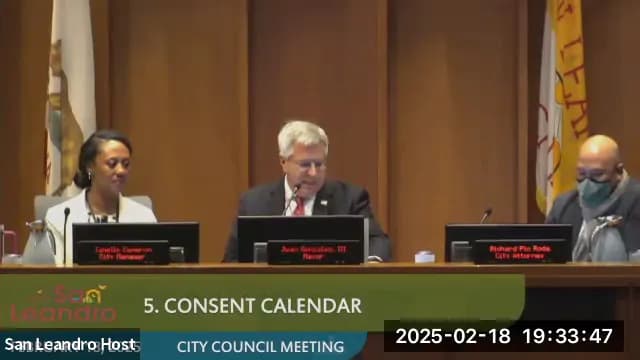
The San Leandro City Council met on Tuesday, February 18, 2025, at 7:00 PM in the City Council Chambers. Councilmember Bowen participated via teleconference from South Lake Tahoe. Councilmember Boldt was absent. The meeting included a proclamation declaring Scouting America Day, appointment of boards and commissions, approval of the consent calendar, public comments on a variety of issues, and councilmember reports. The meeting was adjourned at 8:01 PM in memory of former Councilmember Kent Meyer. Consent Calendar - 5.a: Adopted Resolution 2025-011 accepting the audited financial statements for the fiscal year ending June 30, 2024. - 5.b: Adopted Resolutions 2025-012 and 2025-013 approving amendments to consulting services agreements with Monarch Consulting (new total $189,500) and Willdan Engineering (new total $164,500) for code enforcement services. - 5.c: Approved the minutes of the February 3, 2025 City Council meeting. - One public comment was made by Douglas Balding, who noted the city’s solid financial footing but questioned whether consulting rates (e.g., $135/hour for a code enforcement manager, $90/hour for an officer) represent responsible management. The consent calendar was approved 6-0-1 (Boldt absent). Public Comments & Testimony - Douglas Balding (online) raised concerns about safety on Lake Chabot Road (Hill Country), reporting new cracks and ground movement. He also described racist harassment against a Black woman who purchased a home in unincorporated San Leandro (Oakhill), and invited the community to a welcoming rally on Saturday, February 15 (corrected to Hillcrest Knowles Park by next speaker). - Karen Fernandez (in person) corrected the rally location and urged the council to be loud and proud in opposing such hate, noting it reflects poorly on San Leandro even though the incident is outside city limits. - Deborah Acosta (Mission Bay Residents Association) criticized the city for failing to prioritize a rewrite of the mobile home rent stabilization ordinance, stating park owner BSM has imposed unlawful restrictions and fees. She announced residents have hired legal counsel to draft a new ordinance and urged the rules committee to move forward. - Mike Katz Lak (in person) criticized the passive language used in a press release about a February 16 officer-involved shooting (three SLPD officers shot, no injuries) and called for greater transparency and clarity in police communications. - Leo West (in person) criticized the consent calendar process for limiting public discussion, predicted federal funding cuts for sanctuary cities, and called on the city to rescind its sanctuary city declaration. - Darlene Evans (in person) raised concerns about the Walgreens closing (March 27), trash on streets, a 7-Eleven sign still up after the business closed, and asked about future use of the high school campus. - Mayor Gonzalez responded to the officer-involved shooting, stating the investigation is led by the Alameda County Sheriff’s Office (since the incident occurred in unincorporated area) and that the city will release video per its policy. Discussion Items - Proclamation (4.a): Mayor Gonzalez read a proclamation declaring February 8, 2025 as Scouting America Day in San Leandro, recognizing the 115th anniversary and the involvement of 130 youth in seven local troops. Scoutmaster Robert West and Eagle Scouts from the Class of 2024 accepted the proclamation. - Appointment of Boards and Commissions (10.a): The council unanimously (6-0-1) approved a motion to appoint members to fill vacancies from the 2024 election. The appointees were then sworn in by the City Clerk. Key Outcomes - Proclamation adopted and presented to representatives of Scouting America. - Boards and commissions appointments approved; appointees sworn in. - Consent calendar approved (Resolutions 2025-011, 2025-012, 2025-013; minutes accepted). - Meeting adjourned at 8:01 PM in memory of former Councilmember Kent Meyer; the mayor requested flags be lowered to half-staff through Friday, February 21, 2025. Council Reports - Vice Mayor Bowen reported on appointments to the Alameda CTC, National League of Cities Human Development Policy Committee, and the NLC Council on Youth Education and Families. She also highlighted concerns about the national climate affecting mental health and transgender youth, and encouraged nominations for StopWaste Environmental Champions. - Councilmember Aguilar reported on the Alameda County Mosquito Abatement Board meeting (No West Nile virus, AI-based resident communication platform discussed) and attendance at an LGBTQ constituency group meeting via the National League of Cities. - Councilmember Viveros-Walton reported on the San Leandro Improvement Association meeting, noting new board president Deborah Cox and increased participation in the Cherry Festival. - Mayor Gonzalez reported on the Black History Month celebration, a respite care facility operated by La Familia, and reappointment to the Bay Area Air Quality Management District. He also highlighted a StopWaste online resource (resource.stopwaste.org) to help residents properly sort recyclables.

This special meeting and annual planning session focused on setting council priorities for the upcoming biennial budget. The council heard public comments, received presentations on capital assets and the city's financial forecast, engaged in team-building exercises to refine council working norms, and conducted a prioritization exercise to determine the top focus areas and specific referrals for the coming years. The meeting took place from 9:00 AM to 1:56 PM (actual date per transcript was February 1, 2025, but the provided date is used per instructions). Public Comments & Testimony - Maylin Dorman (District 1): Expressed concern about the unfilled sustainability manager position and urged progress on the climate action plan, including replacing gas vehicles with EVs. - John Minat Schwartz (Ace Bay for Everyone): Advocated for muscular rent control, land use reforms to increase housing density, complete streets, and warned against spending on Lake Chabot Road. - Susan Erb: Urged council to focus on long-term infrastructure and capital improvement needs rather than pet projects. - Peter Van Oosting (Lake Chabot Road resident): Asked council not to spend scarce city funds to reopen Lake Chabot Road for one-way traffic, calling for equitable distribution of funds. - Stephen Tao: Urged council to prioritize staff expertise and not rush to reopen Lake Chabot Road, noting fire and public works departments oppose the move. - Craig Williams (Big Tent San Leandro): Reiterated calls for passage of rent stabilization and tenant protections, and revisions to the mobile home rent stabilization ordinance. Cited over 100 members and a dozen allied organizations. - Mark Janowitz: Spoke in support of rent stabilization, noting that both council and residents support it, and urged moving forward. - Douglas Spaulding: Emphasized that community security cannot exist without housing security, and urged council to take action on tenant protections and mobile home tenants. - Ryan Jasinski: Called rent stabilization a fundamental right, criticized failure to pass it, and urged a strong ordinance. - Ryan Jaczinski (Property manager, Mission Bay mobile home community): Opposed proposed revisions to mobile home rent stabilization, stating current ordinance provides stability and there is no evidence of crisis. - Sarah Bailey (spoke on Lake Chabot Road): Cited fire chief's warning that opening one lane would hinder firefighting and could have disastrous consequences; urged council to keep road closed to daily traffic. - Kathleen Kelly (San Leandro Art Association president): Urged restoration of arts commission funding to 2024 levels ($75,000 cut from $150,000) and adoption of a 1% for public art ordinance for major developments. - Bernard Ashcraft (Big Tent member): Supported progressive housing ordinance drafted by the people. - Rita Young (San Leandro Art Association member): Shared personal experience teaching art classes funded by the arts commission and urged continued funding. - Bridget Lawley: Advocated for arts funding, comparing 1% of the city budget to a penny, and noted transformative effect of small, ongoing art events. - Stephen Cassidy (former mayor): Advocated for arts funding and a 1% public art ordinance, noting current arts spending is far less than 1% of the general fund. - Ginny Madson: Urged renter protections as a civil rights issue, referenced redlining in district maps, and praised the return of the disaster council. Discussion Items Council Working Norms and Team-Building - Facilitator Claire Laughlin led an exercise to refresh council commitments. Council members shared personal goals for the day: respect, clear priorities, open mind, financial addressing challenges, clear direction to staff, collaboration, and deep listening. - The group reviewed attributes of a high-functioning council (fair decision-making, open communication, proactive preparation, etc.) and refined commitments. Additions included: focus on analyze facts and data, consider all stakeholders in decision-making, respectful communication (including tone, word choice, active listening), effective candor (direct and kind), relationship building, and respect for each other's votes. - The council agreed to add these to the existing list of commitments and will later combine and simplify. Capital Assets Presentation (Sheila Marquises, Public Works Director) - Provided an overview of major capital assets: water pollution control plant (125 miles sewer, 10-year need $92M), stormwater system (71 miles, $79.6M for all priority projects), parks (80.5 acres, $14M), facilities (34 buildings, most systems beyond useful life), and streets (382 lane miles, PCI 59). - Pavement condition: 36% of residential streets have failed. Current funding of $4.5M/year is insufficient; maintaining current PCI of 59 would require $12.5M/year initially then $8M/year; achieving industry-standard PCI of 80 would require much higher investment. - Highlighted root causes: underfunding, deferred maintenance, workforce challenges, and political decisions. - Proposed order of operations: finish funded projects, fund roof repairs, focus on failure and public safety assets, increase revenue, perform parks and facility assessments. Financial Forecast (Heather Rowden, Interim Finance Director) - General fund budget FY24-25: $149.9M expenditures, $147M revenues, but after capital transfers, a $4.6M deficit. Fund balance policy 20% ($29M); current balance is 53.9% but projected to drop below 20% by FY2030 without action. - Major cost drivers: staffing (43% of budget), pension (unfunded liability growing, annual payment to rise from $20.5M to $25.86M by 2030), and other post-employment benefits (95% funded). - Capital needs summary: facilities backlog $19M by FY28, parks $14M over 10 years, stormwater $80M, water pollution control plant $58.85M over 5 years, streets $12.5M first 5 years then $8M/year. Also fleet ($6M by 2030) and IT ($11.5M by 2035). - ARPA funds ending: $1.2M/year needed to continue programs like enhanced street cleanliness, volunteer San Leandro, alternative response unit, median maintenance. - Factoring all needs leads to a projected $21.8M annual deficit. Staff working on reserve policies, fee study, ERP replacement, and refining performance measures. Priority Work Plan Updates (City Manager Fran Robustelli) - Reviewed accomplishments in five priority areas: public safety (police staffing now 80%, sworn-in ceremony); infrastructure (tree master plan, waste franchise, park master plan upcoming); housing/homelessness (navigation center construction complete, winter warming shelter, renter protections in progress); economic development (safety grants launched); quality of life (work just started). - Over 40 limited-duration positions must be reauthorized in next budget. - Emphasized need for focused priorities to avoid spreading staff too thin. Prioritization Exercise - Council members used colored dots to vote on top three priority categories from ten options. After initial votes and adjustments, the top three categories were: Infrastructure (6 votes), Housing and Homelessness (5 votes), and Public Safety (4 votes). Race and Equity Initiatives tied with Public Safety but after a recast, the three categories stood. - Within each category, council members allocated dots to specific referrals. Key Outcomes - Top Priority Categories (in order of votes): Infrastructure, Housing and Homelessness, Public Safety. Staff will focus work plans in these areas. - Specific Referrals within Infrastructure: - Road repair, maintenance, and replacement funded at least at FY25 level with 50% of EOI fund balance added the following year (7 votes). - Implement the parks master plan (4 votes). - Comprehensive funding plan and policy to repair, maintain, and replace city assets (4 votes). - Specific Referrals within Housing and Homelessness: - Rent review board with enforcement authority (4 votes). - Mobile home rent stabilization regulations (3 votes). - Rent control (3 votes). - Limit rent increases (3 votes). Staff will consolidate related rent stabilization items into a unified work plan. - Specific Referrals within Public Safety: - Lockup dumpsters at all strip malls and shopping centers (6 votes). - Achieve 100% staffing for all allocated police positions (4 votes). - Adopt Alameda County multifamily unit smoking ban (4 votes). - Other: Council will revisit additional priorities (e.g., race equity, fiscal sustainability) through regular meeting referrals and ongoing work. Staff will continue work on quality of life and economic development as already approved. - The city manager noted that work on revenue generation (e.g., bond measures) will continue independent of the priority list.
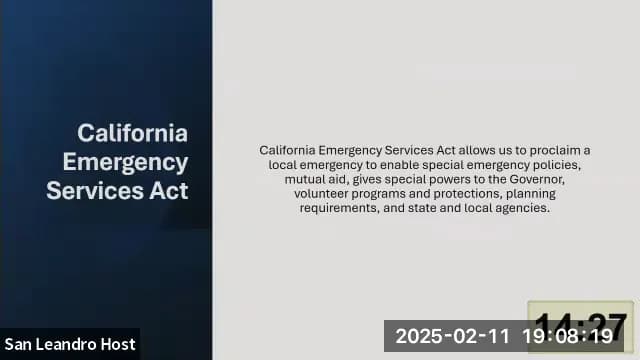
The San Leandro City Council held a work session on February 11, 2025, from 7:00 PM to 8:34 PM to receive a training presentation on emergency management for elected officials. The session, led by Emergency Management Specialist Libby Bassman, covered the National Incident Management System (NIMS), Incident Command System (ICS), the role of the Emergency Operations Center (EOC), and the specific responsibilities of council members before, during, and after a disaster. No formal votes or actions were taken, but the council discussed lessons learned from a recent gas leak incident and explored improvements to community preparedness and communication. Public Comments & Testimony - Kat (Bayo Vista resident): Expressed full support for wildfire preparedness efforts, noting their community has 3,500 residents, many with mobility issues, non‑English speakers, and limited smartphone/computer access. She called for a clear evacuation plan for their two‑exit neighborhood, block captains, and more drills, stating that gridlock during an actual event is inevitable and that residents need to know how they will be evacuated. - Online speaker (senior citizen): Expressed concern about the loss of landline service and the need for reliable emergency notifications. She requested that the police have pre‑recorded multilingual messages to broadcast during evacuations, and emphasized that many residents, especially seniors, lack smartphones and social media access. Discussion Items - Emergency Management Presentation (Libby Bassman): Bassman reviewed the California Emergency Services Act, NIMS, and ICS, explaining how they provide a scalable, consistent framework for all incidents (e.g., gas leaks, atmospheric rivers, earthquakes). She distinguished between everyday emergencies (quick, handled by first responders) and major incidents requiring EOC activation. The EOC (currently at Sterling Grant) supports the incident command post with coordination, resource allocation, and public information. Bassman stressed that council members form the “policy group” (purple box in the org chart), separate from operations, and their primary role during an emergency is to support the EOC director, stay home/safe, and share vetted information. She urged council members to prepare personally (register for Nixel, have a go‑bag, develop a neighborhood plan) and to encourage community self‑sufficiency, noting San Leandro has 90,000 residents but only about 400 city staff. - Council Questions & Clarifications: - Councilmember Simon asked about EOC director succession (city manager Janelle first, Mike second, Tom Liao third) and about how the California Emergency Services Act has been used (most recently during COVID and the 2022 atmospheric river). - Councilmember Aguilar asked how the policy group interacts with the EOC director. The city attorney clarified that the city manager (EOC director) can proclaim an emergency, which must be ratified by council within seven days. The policy group’s role is to make major policy decisions (e.g., curfew, declaration of emergency). - Councilmember Acevedo asked about communication channels: the EOC director will contact council members directly (especially for their districts) and provide email updates; for citywide events, regular email notifications will be sent. - Councilmember Bolt inquired about community drills. Bassman explained that large‑scale evacuation drills are complex and require careful planning, but exercises for staff are conducted. Councilmember Bolt suggested starting with small, area‑specific drills (e.g., east side fire, west side flood) to build participation and experience, even if gridlock occurs – residents would learn and be more likely to evacuate in a real event. - Councilmember Viveros‑Walton raised concerns about multilingual and multigenerational households, and the need for clear direction during emergencies (e.g., the gas leak email was vague). The city manager acknowledged that future communications should include specific guidance on whether council members should shelter in place or report to safe locations. - Councilmember Simon noted the gas leak shelter at the Marina Community Center, where council members went to show support. The city manager said that was acceptable because it was safe, but during an atmospheric river or similar, staying home is critical. - After‑Action Report from Gas Leak (Chief Kate): The police chief shared three key lessons from the recent gas leak incident: (1) the Nixel autocall feature was not used (an oversight); (2) multilingual messaging was not produced quickly enough – a plan is being developed; (3) evacuation maps were not included in initial notifications. The EOC was activated virtually. The city is now working on templates and pre‑recorded messages in multiple languages. - Mayor’s Comments: The mayor emphasized the need for frequent, consistent updates even when there is no new information, to prevent residents from turning to unverified social media. He also stressed the importance of a single source of truth for evacuation maps and pre‑canned multilingual press releases. Key Outcomes - No votes or formal actions were taken at this work session. - Directives and next steps identified: - The city manager and emergency management staff will prioritize creating multilingual pre‑canned templates for various emergency scenarios (tsunami, active shooter, large fire, etc.). - The city will improve the use of Nixel, including the autocall feature, and ensure that evacuation maps are included in all alerts. - The city will explore reinstating regular siren tests and developing different tones for shelter‑in‑place versus evacuation, as suggested by community members. - Council members are encouraged to sign up for Nixel (all zip codes), develop personal go‑bags and family communication plans, and work with their neighborhoods to identify residents with access and functional needs. - The city will consider expanding the role of resilience hubs and block captain programs to better track vulnerable populations. - A follow‑up community meeting on the gas leak incident was held the prior week (around February 5, 2025); additional community emergency preparedness events are planned (e.g., a joint event with the mayor and Supervisor Tam). Note: The agenda and transcript consistently state the meeting date as Tuesday, February 11, 2025, though the user instruction provided a date of February 12, 2025. This summary uses the date from the source materials.