The Stamford Planning Board held a regular meeting on Tuesday, April 14, 2026, at 3:45 PM. The meeting began with introductions of new board members and a discussion of the shift in board composition toward built-environment professionals. The board then considered a referral for a zoning map change (Melrose Place/Fairfield Avenue), two variance applications, and tabled items due to a brief loss of quorum. Consent Calendar - Minutes of March 24, 2026: Motion to table due to lack of quorum; later resumed and approved unanimously after quorum was restored. Discussion Items - Zoning Board Referral – Map Change (Melrose Place LLC, 27, 29, 31 Melrose Place and 445 Fairfield Avenue): The applicant, represented by Bill Hennessy and Madison Smith, presented a request to rezone four parcels on the north side of Melrose Place from R6 (one- and two-family) to MG (General Industrial). The properties are encumbered by nonconformities dating back decades; the applicant argued that the MG zone would conform with the industrial uses to the north and allow property owners to reuse or redevelop their lots. Board members asked about compatibility with adjacent residential uses and the potential for spot zoning. After discussion, the board voted unanimously to recommend approval. - ZBA Referral – Wishing Well Lane (Variance, Tables 12.6 & 12.5): Brian Cleveland, representing Paul G. Pulos and Georgia Menagios, sought a variance to allow parking in the front yard within nine feet of the street line (instead of ten) and to permit parking within the building line. The applicant wishes to convert a two-car garage into a fifth bedroom for a family member with mobility issues, requiring three parking spaces. The board clarified that the driveway would not be expanded and that the space lacks a full kitchen, making it not an ADU. The board approved the variance unanimously. - ZVA Application – Glenbrook Road (Variance, Table 2): Ben Alander requested a variance for a side yard setback of 3.9 feet (required 6 feet) to construct a second story over an existing finished garage that is non-conforming (built before zoning). The board approved the variance unanimously. - ZBA Referral – Taconic Road (Variance, Table 2): Joseph J. Capalbo representing Rafael Bassendowski sought a front yard setback variance of 57.8 feet (required 60 feet) and a front yard street center setback of 82.8 feet (required 85 feet) to complete construction of a single-family dwelling on a foundation built from an inaccurate survey. The board approved the variance unanimously. Key Outcomes - Melrose Place Rezoning: Approved unanimously to recommend approval to the Zoning Board. - Wishing Well Lane Variance: Approved unanimously. - Glenbrook Road Variance: Approved unanimously. - Taconic Road Variance: Approved unanimously. - Tabled Items: The lease for Courtland Avenue (school bus parking) was tabled due to incomplete documents.
Public Meetings - Stamford, Connecticut
Public Meetings - Stamford, ConnecticutThe Fiscal Committee of the Board of Representatives held a remote budget hearing to review funding requests from several city-affiliated organizations for fiscal year 2026-27. Co-chair Andrew Zachary opened the meeting at 5:31 PM. Present were committee members Eric Morrison, Representative Le Pine, Representative Bouchard, Representative Graham, Representative Goldberg, and later Representative Dorsey. Note on date discrepancy: The transcript indicates the meeting occurred on Tuesday, April 14, 2026, but the official date provided for this summary is April 15, 2026. Public Comments & Testimony - No separate public comment period was held; all testimony came from invited presenters. Presentations and Budget Requests Mayor's Multicultural Council - Carmen Hughes (Director of Diversity, Equity, and Inclusion) and Pilar Pelcz (Chair of the Mayor's Multicultural Council) presented. Requested $10,000, flat from the prior year. The council was created by the Board of Representatives over a decade ago. Noted that Stamford is the 19th most diverse city in the nation. Signature free events include Jazz at the Ferguson, Stamford Day (this year on May 31, 2026), and Rhythm and Rumba. Events aim to foster unity and combat rising hate crimes. Stamford Senior Center - Christina (Executive Director) and board chair Claire Bulldock presented. Requested $330,000; Mayor Simmons proposed $328,640, a 4% increase from the current $316,000 grant. The center serves an average of 200 seniors daily, with membership growing 21% to 1,152. Offers 50 programs weekly, including 20 fitness classes, language classes, a subsidized lunch program, and services in Spanish. 30-year anniversary this year. Facing space constraints due to double-digit growth. Average age is late 70s; largely serves low-income seniors (below 200% of federal poverty level). No plans to discontinue services. Curtain Call - Lou presented. Manages the former city golf course property under a 30-year management agreement. Requested $95,000 for utilities; actual costs are about $120,000 due to old, inefficient buildings. Recovering from COVID: 158 performances over 39 weekends this year, aiming for 175 performances over 44 weekends next season. Summer youth theater program fee is $50 (much lower than neighboring areas). Capital needs: outdoor Shakespeare stage destroyed by a microburst; a permanent structure could be shared for weddings. Request for $50,000 for an engineer to study water infiltration (capital project CP4000032). Also noted need for LED lighting and potential solar on the fly tower. Palace Theater (Stamford Center for the Arts) - Michael Moran, President and CEO. Requested $150,000; Mayor proposed $52,000 (last year received $50,000). The theater will turn 99 on June 2, 2026. Losing tenant at Rich Forum (NBC closing division). Annual local economic impact of $2.4 million based on 80,000 patrons. Capital request: $50,000 for an engineer to identify water infiltration sources (project CP4000032) to protect a planned $5 million ceiling plaster restoration. Safety netting installed with city cost-sharing after ceiling deemed unsafe. Annual gala with Smokey Robinson on Thursday. Stamford Youth Peace Foundation (Beyond Limits Academic Program) - Andrew Sklover presented. Requested $25,000. Serves over 250 students annually (4th-10th grade), 90% from families eligible for discounted government services. 95.2% parent satisfaction rate. Program includes peer tutoring, summer scholars program, and enrichment. 90% of sessions on-site. Focus on middle grades to close opportunity gaps. History Center (Stamford History Center) - Bill Ein, treasurer. Operating budget $100,000; expects a $10,000 loss this year due to no gala. Requested $125,000 in capital funds for parking lot repaving, outdoor lighting, and concrete repairs. Provided free educational programs to 2,200 students this academic year, on track for 2,300. Silver Source - Mary Ann Delaney, Chief Development Officer. Budget $2.8 million, staff of 17. Provides safety net for seniors 60+ (29,500 in Stamford). In 2025, provided $380,000 in direct financial assistance to 1,482 households, preventing over 220 evictions. The housing stability program is the core: 62% of assistance goes to housing. 70% of clients are women; 77% are at or below $23,000/year. Requested support to sustain the program. Also operates a medical transportation program providing 4,000 rides annually. Received city funding for the first time last year. Key Outcomes - No votes were taken. The committee heard presentations and will consider budget requests in future deliberations. - The next fiscal committee meeting is scheduled for April 27, 2026, in hybrid format. - Co-chairs Andrew Zachary and Eric Morrison thanked all participants. - Representative Goldberg raised a question about the impact of federal tax policy on Stamford residents, but discussion was deferred to a later meeting at Representative Morrison's request.
Date: April 14, 2026 Time: 6:33 PM (meeting called to order) Location: Zoom video conference Chair: David Stein The Zoning Board held a hybrid public hearing meeting on April 14, 2026. The meeting began with the election of officers, followed by a discussion of potential revisions to the city's Below Market Rate (BMR) regulations, centered on the low number of on-site affordable units in 2025 and the appropriate fee-in-lieu balance. The board then heard public testimony and deliberated on several zoning text amendments and map changes, including updates to temporary sign regulations, a rezoning of two parks, and a package of minor text changes covering fence heights, public waterfront access, BMR increases, and new smoke shop limits. A coastal site plan review for a pool and patio project was approved, and an extension of time for a cannabis dispensary special permit was granted. Election of Officers - David Stein was elected Chair of the Zoning Board (motion by Roseanne McManus, seconded by Jerry Bozak; approved unanimously). - Bill Morris was elected Secretary (motion by Jerry Bozak, seconded by Roseanne McManus; approved unanimously). Discussion Items - BMR Regulations Discussion: The board discussed potential revisions to the city's BMR (Below Market Rate) regulations, prompted by a report from Emily Gordon. Key issues raised included: - In 2025, almost no developers chose to provide on-site affordable units, instead using fee-in-lieu payments to satisfy their obligation. - A need for units affordable to households earning less than 50% of Area Median Income (AMI). - The AMI dropped 17.5% last year due to a change in federal census geography; the board froze rents and income limits to stabilize the program. - Members debated increasing the fee-in-lieu amount (including a suggestion to adjust it by the 17% AMI drop) and incentivizing on-site units through increased bonuses. - Concerns were raised about concentrating affordable housing in certain areas (Jerry Bozak emphasized the need for economic diversity across the city). - The board discussed the scarcity of land for affordable housing and the role of nonprofits like Charter Oak and St. John's, with some members cautioning against using trust fund money solely for renovations that do not add new units. - A suggestion was made to solicit developer input on how the fee-in-lieu influences their decisions. - Application 226-06 – Zoning Text Change (Temporary Signs & Cleanups): Ralph Blessing presented a package of minor corrections to the zoning regulations (updating references from "master plan" to "comprehensive plan," correcting a footnote, updating department names) and a new definition and regulations for temporary signs. Key provisions: - Definition: a temporary sign is displayed for 3 months or less. - Signs displayed for less than 7 days do not need a permit (e.g., lawn signs). - Signs up for 7 to 30 days require a permit with location/size standards. - A bond is required to ensure removal after 3 months. - Only one temporary sign per property per calendar year. - The Planning Board had recommended disapproval, arguing the regulations were overly complicated, but staff noted that without regulation, temporary signs would still be treated as permanent signs and could not be used. - Application 226-02 – Map Change (McKeithan Park & 0 Maitland Road): Ralph Blessing presented a proposal to rezone two city-owned parcels to the P (Park) district: McKeithan Park (currently R5) and 0 Maitland Road (currently R7.5). The change protects the land from future development and aligns zoning with actual use. A member of the public (David Adams) spoke in favor, noting the Maitland Road lot is a swampy area that would benefit from park status. - Application 226-03 – Zoning Text Change (Minor Updates, PAAS, BMR, Signs, etc.): Ralph Blessing presented a comprehensive package of minor text amendments: - Definitions & Use Changes: Allowed taller fences in industrial districts, simplified residential fence height increases, added bus/hiking shelters as permitted obstructions, limited flagpole heights to 30 feet, added definition for "change of use." - Mobility Section: Moved the street tree planting requirement to a new sustainability section (9G), with location standards for trees relative to the street. - BMR Requirements: Proposed increase in BMR requirement for office-to-residential conversions from 7% to 8%, and increase in fee-in-lieu per square foot from $125 to $150. (Noted as a starting point for larger revisions.) - Publicly Accessible Amenity Spaces (PAAS): Expanded districts where waterfront public access is required, created two standards (built-up areas: 12-foot path; natural areas: 3-foot trail). Added sign standards with city logo. - Smoke Shops: Proposed limit of one smoke shop per 15,000 residents (from over 60 existing, likely resulting in 8–9; existing shops grandfathered). Supported by the Health Department. - A new text change on sustainability and tree protection was filed but not yet before the board. - Application 226-04 – R6 District Zoning Text Change: Ralph Blessing presented amendments to the R6 (two-family) district regulations to align with the general zoning structure: - No changes to density, uses, or height. - New side yard requirement: one side must be 10 feet (instead of 6 feet both sides) to allow driveway parking, with front setback reduced from 25 to 15 feet, and rear setback increased from 30 to 35 feet. - Added lot coverage restrictions to limit impervious surfaces and improve stormwater management. - Added special standards for existing permitted non-residential uses (schools, houses of worship, etc.). - Coastal Site Plan Reviews: - CSPR 1224 (106 Carter Drive): Approved for a pool, patio expansion, and landscaping. Staff noted a $1,000 performance bond for erosion control drew concern from a board member; bond is standard for that element. - CSPR 1229 (34 Saddle Rock Road): Approved for a new pool, pergola, and patio, removing existing tennis court, reducing impervious coverage by about 4,000 square feet. Public Comments & Testimony - David Adams (Glenbrook Road) spoke in favor of the park rezoning (226-02), noting the Maitland Road lot is a swampy area that would benefit from park status and suggested naming it after a neighbor, Nina Sherwood. - Sue Halpern (30 Craft Road) supported the park rezoning and praised the concept of creating microforests. - David Adams also spoke during the R6 discussion, seeking clarification on commercial vehicle parking rules (distinction between light pickup trucks under 3/4 ton and heavier vehicles). Key Outcomes - Application 226-06 (Temporary Signs & Cleanups): Approved 5-0 (motion to take the agenda out of order and approve). - Application 226-02 (Map Change – Parks): Public hearing closed; vote deferred to the next meeting. - Application 226-03 (Text Change Package): Public hearing closed; vote deferred. - Application 226-04 (R6 District Amendments): Public hearing closed; vote deferred. - CSPR 1224 (106 Carter Drive): Approved 5-0 with standard conditions from EPB, Engineering, DEEP, and Harbor Management. - CSPR 1229 (34 Saddle Rock Road): Approved 5-0 with standard conditions. - Extension of Time for Application 223-4-6 (Butter Cannabis Dispensary): Approved 5-0, extending the special permit timeline to June 30, 2027. - Next Meeting: Scheduled for April 27, 2026 (special meeting at 6:30 PM via Zoom). The March 30, 2026 meeting minutes were not approved due to insufficient members present.
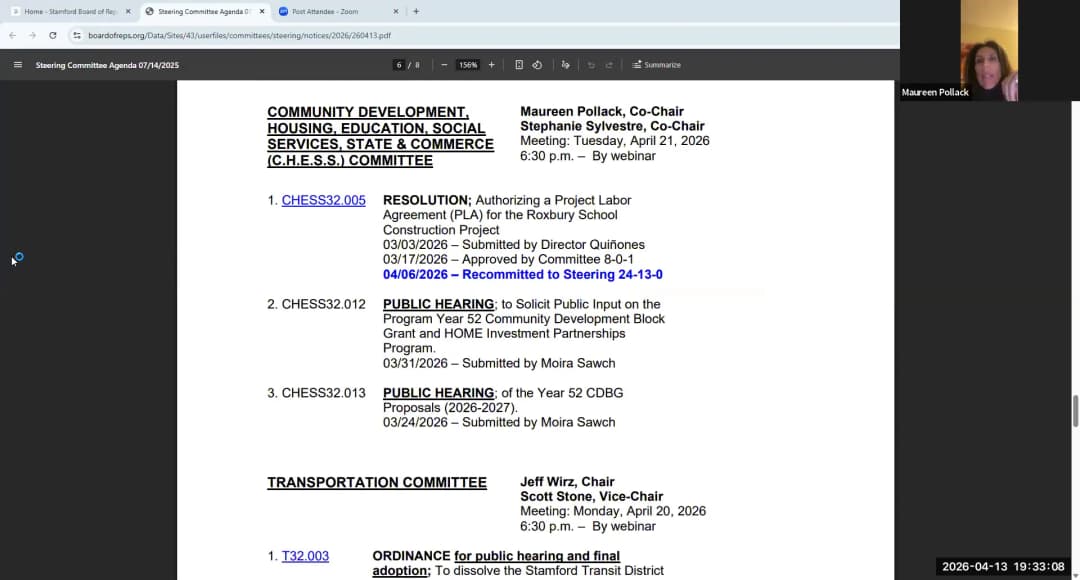
The steering committee met to set the agendas for each standing committee's April meetings. Chairs moved items for approval, with discussions focusing on procedural questions and scheduling adjustments. The meeting began at 7:01 PM and adjourned at 7:42 PM. Consent Calendar - Appointments Committee (Items 1-8): All eight appointments were moved to the consent agenda. Representative Weinberg raised a concern about an email from the parliamentarian regarding item 6 (Jennifer Gazeno, Planning Board reappointment), but co-chair Shore noted the response was satisfactory. The motion passed by voice vote. - Fiscal Committee (Items 1-9): All nine items were moved to the agenda, including additional appropriations for the town clerk, grants office, Boys & Girls Club, and school roof replacement projects. The meeting was scheduled for Monday, April 27, 2026 at 7:00 PM, hybrid. - Legislative and Rules Committee (Item 2, LR32.017): Chair McEwen moved only the new ordinance on reporting requirements, explaining that LR32.016 was automatically on the next agenda due to a prior postponement. The motion passed. Meeting: Tuesday, April 28, 2026 at 7:00 PM, hybrid. - Personnel Committee (Item P32.003): A review of HR policies and retirement programs was moved. Representative Goldberg suggested more frequent funding reviews. Motion passed. Meeting: Monday, April 20, 2026 at 7:00 PM, hybrid. - Land Use and Urban Redevelopment Committee (Items LU32.006, LU32.007): Both items moved. Representative Adams requested clarification on the Pembroke Drive street acceptance, noting that the homeowners association owns the road. Co-chair Price offered to invite attorney Toma. Motion passed. Meeting: Wednesday, April 22, 2026 at 7:00 PM, webinar. - Operations, Parks and Recreation Committee (Items 2, 3, 4): Chair Sanford moved items OPR32.008 (snow removal review), OPR32.009 (naming fields), and OPR32.010 (naming fields). Item 1 (grocery store fee exemption) was held as pending. The agenda was reordered: 009 first, 010 second, 008 third. Motion passed. Meeting: Thursday, April 23, 2026 at 7:00 PM, webinar. - Public Safety and Health Committee (Item PS32.006): An overview of the Stamford Police Department by Chief Shaw was moved. Chair Bouchard requested rescheduling from April 30 to April 29, 2026 at 6:30 PM (webinar) to avoid conflict with the fiscal committee. The change was noted as permissible with notice. Motion passed. - CHESS Committee (Items 1, 2, 3): Co-chair Pollock moved a project labor agreement for Roxbury School (recommitted), a public hearing on CDBG, and a public hearing on CDBG proposals. Discussion included submitting questions to Director Quinones and caution about inviting union representatives due to ongoing negotiations. Agenda reordered to items 2, 3, 1. Motion passed. Meeting: Tuesday, April 21, 2026 at 6:30 PM hybrid (changed from webinar). - Transportation Committee (Item T32.003): An ordinance to dissolve the Stamford Transit District was moved. Motion passed. Meeting: Monday, April 20, 2026 at 6:30 PM, webinar. - Approval of Minutes: The April 6, 2026 regular board meeting minutes were moved to the agenda for approval. Motion passed. Discussion Items - Appointments Committee – Item 6 (Gazeno): Representative Weinberg flagged an email from the parliamentarian regarding the reappointment. Co-chair Shore apologized for missing the email due to a personal matter and stated the parliamentarian had provided a satisfactory response. Representative Walston noted he had not received the email and asked for it to be forwarded. - Land Use Committee – Pembroke Drive (LU32.006): Representative Adams questioned whether the property owners' petition was valid since the homeowners association owns the road. Co-chair Price explained that attorney Toma advised the association must provide documentation on its decision-making process. Adams requested that Toma be invited to the committee meeting. - CHESS Committee – PLA (Item 1): Representative Delacruz suggested sending questions to Director Quinones in advance. Representative Camporelli asked to invite a union representative. Representative Morrison cautioned against it if negotiations are ongoing, recommending consultation with counsel. Co-chair Pollock agreed to coordinate with Quinones and to collect questions from all members. Key Outcomes - All committee agenda items were approved except for one held pending (Operations item 1). - The Public Safety and Health Committee meeting was rescheduled from April 30 to April 29, 2026 at 6:30 PM. - The CHESS Committee agenda was reordered to have public hearings first. - The Operations Committee agenda was reordered to place field naming items before the snow removal review. - No pending items from previous meetings were moved. - The meeting adjourned at 7:42 PM.
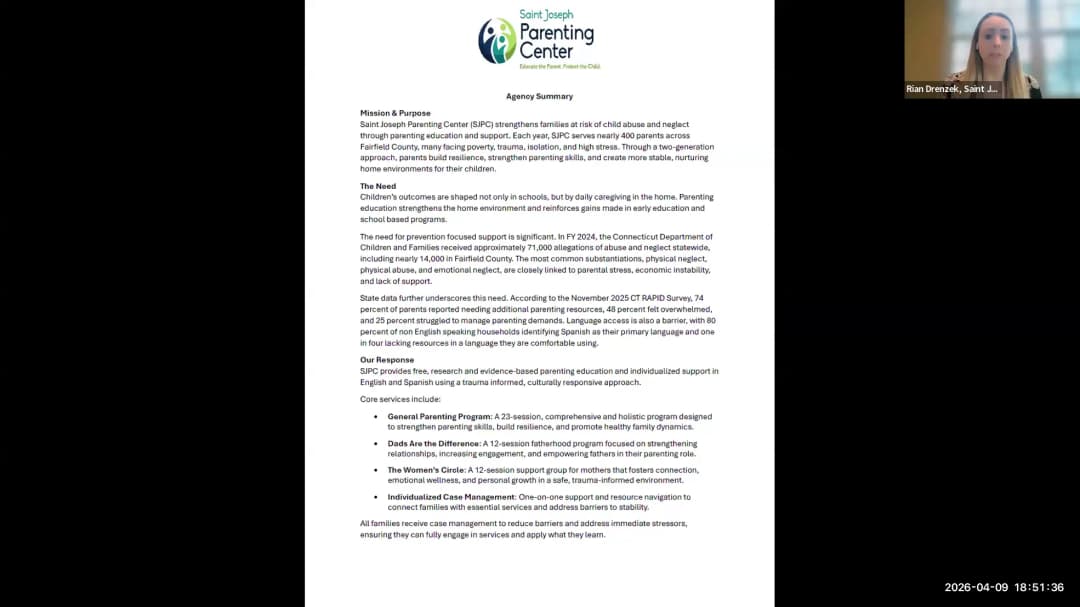
This meeting, held on April 10, 2026, featured a series of presentations from nonprofit organizations and city departments outlining their services, challenges, and funding requests for the upcoming fiscal year. Board members asked questions regarding funding gaps, cost drivers, and the impact of potential federal cuts. No votes were taken; the session was informational. Presentations from Nonprofit Organizations - New Covenant Center (John Gutman) – Requested $125,000 for case management. The center operates the largest soup kitchen and food pantry in Stamford, serving 300–350 daily meals (up from 175 pre-pandemic) and 1,500 individuals monthly through the pantry. A new facility is under construction on the east side, doubling space. Funds would support a second full-time case manager. - Senior Nutrition Program (John Gutman, on behalf of Catholic Charities) – Provides meals on wheels and congregate meals to over 400 seniors daily. Highlights the social connection provided by drivers. No specific dollar request stated; rather, the presentation described the program’s impact and need for continued support. - Inspirica (Executive Director) – Provides emergency and permanent supportive housing across 12 facilities, housing over 500 individuals nightly. Served nearly 4,200 community members in the past year. Challenges include food insecurity due to SNAP reductions, potential HUD funding changes, and lack of affordable housing. The organization is exploring building additional affordable housing on existing property. No specific dollar request noted; general support sought. - Domus (Tom Lang) – Operates Domus Works (workforce development) and a school engagement program for disconnected youth aged 12–26. Served 86 young people last year, on track for 106 this year. The youth service corps maintains 26 parks with the city. Retention rate is 86%. No explicit dollar amount requested; presentation focused on program outcomes. - Liberation Programs (Richard Liberano) – Requested $150,000 for Stamford services. Provides substance use treatment and prevention, primarily for opioid use disorder. Served 2,169 Stamford clients in FY2025, nearly double the number from three years prior. 87% of residential clients completed treatment plans. No capital requests through the city. - Pacific House (Sylvia Narvaez) – Requested $100,000 to expand street outreach capacity. Serving 157 unsheltered clients in FY2026 (to date), housing 55 directly from the street. Two outreach workers are insufficient; additional staffing would allow non‑traditional hours. Currently 53 homeless individuals known in Stamford (8 females, 3 families, 42 males). - Future Five (Amanda) – Requested $50,000 in general operating support. Connects motivated under‑resourced students to resources for college and career success. Serves 250 high school and 130 college students, with a waitlist of over 100. 100% high school graduation rate; 68% of entering freshmen had zero debt planned. Recently moved to a new facility. - Rowan Center (Sharon Walker Absolum & Cody) – Provides sexual assault crisis response, counseling, and prevention education. Crisis counseling demand up 30%, hospital accompaniments up 80%. The trauma recovery clinic doubled in size. Federal funding (VOCA) being cut 21% next year, with potential zero funding thereafter. No specific dollar request; presentation emphasized rising demand and funding uncertainty. - St. Joseph’s Parenting Center (Ryan Drenzik) – Requested support for the Stamford Center to strengthen families at risk of child abuse. Served 250 families (625 children) in Stamford last year. Lost $600,000 in federal funding in October 2025, forcing staff reductions and a lighter case management model. Programs are free and include parenting education, fatherhood groups, and women’s circles. Meals are provided before classes. - Building One Community (Marisa Munoz) – Serves the immigrant community with English classes, workforce development, immigration legal services, and an after‑school program. Served over 5,500 people last year. Growing demand for legal services due to political climate. No specific dollar request; presentation highlighted programs and need for continued support. - Person to Person (Nancy) – First time seeking city funding. Provides food pantries, emergency financial assistance, and a clothing center. 67% of clients are Stamford residents (over 15,000). Provides enough food for 1.5 million meals to Stamford residents annually. Also offers financial coaching and college scholarships. Projected 1,200 Stamford residents may lose SNAP benefits. The organization has a balanced budget and a $4 million endowment. City Department Budget Presentations - Technology Management (Persan) – Presented the FY2026‑27 IT budget. No increase in capital budget; operating budget up $236,000, mainly due to $250,000 increase in software maintenance (mostly contractual). Two requested analyst positions were not included in the mayor’s proposal; consultant contracts will continue. Key initiatives include migrating police records management to the cloud, replacing end‑of‑life servers, transitioning fiber to city‑owned, and implementing a data warehouse. An AI adoption roadmap is being developed with Babson College, expected in May. Board requested a follow‑up presentation on the AI roadmap. - Legal Department (Tom) – Requested two new positions: a full‑time assistant corporation counsel and a full‑time paralegal, driven by a doubling of contracts and increased CHRO/FOI complaints (partly due to AI‑generated filings). Salary line up 18% due to these positions and contractual increases. Software costs are decreasing as they transition from CityLaw to a new system (Matrix). - Human Resources (Paula) – Requested one new position (leave of absence administrator) and a functional realignment of existing roles. Total staffing increase of one body. Salary line up about 5% (contractual). Software maintenance increased due to implementing a new performance management system (NeoGov) and applicant tracking system. Six union contracts are expiring this year. The performance management system implementation is being managed by an existing Career Development Leadership and Training Manager. - Employee Benefits (Paula) – Presented health insurance projections. FY2026‑27 active employee benefits expected to increase 9.7% ($3.6 million), retiree benefits up 10% ($1.1 million), driven by State Partnership Plan rate adjustments and Medicare trends (assumed 15% increase). No plan design changes. The city is fully aligned with the Connecticut State Partnership Plan. Key Outcomes - No votes or formal decisions were taken; the meeting was for informational briefings and discussions. - Board members asked questions about funding gaps, cost control, and the impact of federal cuts, and requested follow‑up information (e.g., AI roadmap presentation, breakdown of benefits budget lines). - Several organizations noted significant increases in demand and uncertainty due to potential federal funding reductions. - The meeting concluded with thanks to presenters and staff.
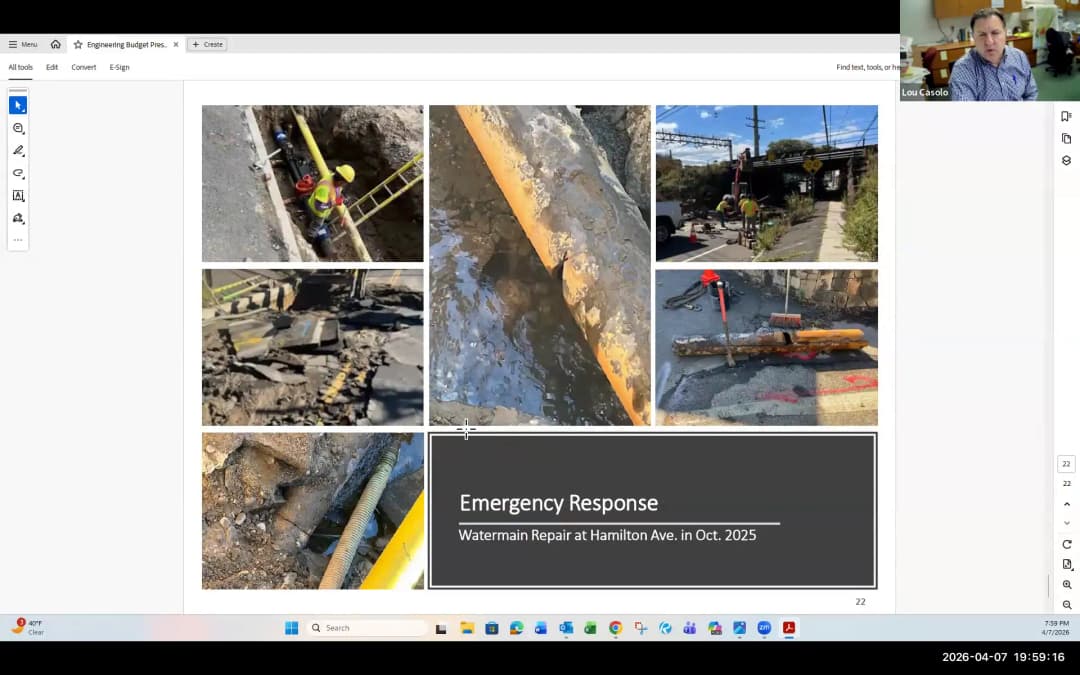
The Fiscal Committee of the Board of Representatives held budget hearings on April 8, 2026, at 6:31 p.m. (the meeting started at 6:31 p.m. on April 7th per the transcript, but the official date is April 8th per the instruction). Co-Chairs Eric Morrison and Andrew Zachary presided. Presentations were delivered by the Registrars of Voters, City and Town Clerk, Charter Oak Communities (Schofield Manor), Engineering Department, Building/Zoning/Anti-Blight divisions, Affordable Housing, and the Land Use Bureau. No votes were taken; the meeting was informational. Discussion Items Registrars of Voters - Monica Di Costanzo and Lucy Corelli presented. The budget is nearly identical to last year except for a 0.4% salary line increase due to a 5% pay plan increase and 1.2% FICA adjustment. No expanded services are proposed. Challenges include state-mandated new equipment (maintenance costs rising from $2,800 to over $45,000–$50,000), renovations affecting polling locations, and the need for state legislation to reduce early voting days (currently 14 days, no Sundays). Representative Virgil De La Cruz inquired about backup for ballots if federal authorities seize them; the registrars stated they cannot copy ballots per state statute and rely on legal and security protocols. Representative Emile Goldberg noted the department has minimal control over its budget due to state mandates. - Key statistics: 24 districts, primary on August 11, 2026, same number of elections as prior year. City and Town Clerk – David Hoke - Hoke presented staffing changes: converting deputy town clerk to assistant deputy town clerk, administrative coordinator to senior administrative coordinator, and upgrading one index clerk to index clerk 2. Budget increases requested: $30,000 seasonal, $10,000 professional consultant (portal software and archival specialist), $7,000 education/training, $40,000 contracted services (IQS system renewal), $20,000 office supplies (archival paper, binders), and $10,000 election expenses (ballots, postage, scanners, translation). Revenue from conveyance tax and fees totals $7.1 million year-to-date (through March), though large commercial transactions drove this and may not recur. Identified potential reductions if needed: contracted services, seasonal, and professional consultants. Challenges include filling a vacant index clerk position, addressing aging records and vault infrastructure, and planning a customer counter renovation for safety. Charter Oak Communities – Schofield Manor - Natalie Cord, Executive Director, presented the request for $578,820 in operating support for Stanford’s only residential care home (owned by the city). The mayor reduced the request to $511,680, resulting in an estimated $66,000 loss. The facility has 50 beds but occupancy is 88%, with reimbursement based on census. Rising costs include a 10% increase in food service vendor costs, utilities, and staffing (24/7 medical staff required). Medicaid reimbursement increased by only $4.76 per patient day, insufficient to cover inflation. A registered nurse is retiring and will need to be replaced. Co-chair Zachary asked how the deficit is covered; Cord replied that Charter Oak uses resources from other properties. Engineering Department – Lou Casello - Operating budget is down 3.7% ($124,000) from last year due to reduced electric rates and a FICA correction. Revenue from excavation and obstruction permits totals $1.6 million annually. Capital budget request is $5.9 million, composed of city bonds and state grants. Major projects: Mill Road Bridge ($1M, 50% state grant), Old Long Ridge Road Bridge ($1M, 50% state grant), Animal Control Shelter ($900,000 for contaminated soil removal and demolition), citywide drainage ($200,000), Cove Island seawall restoration ($350,000), John Bakutsi Park Phase II ($750,000 for soils management and amenities), and citywide roadway correction ($50,000). Casello highlighted completed projects: bridge replacements, animal shelter foundation, EV chargers, Cove Island Marina dredging, Cummings Park renovation, Scalzi Park tennis and pickleball courts, and school infrastructure work. Representative De La Cruz noted the master plan for Bakutsi Park is nearly 10 years old and urged support for funding. Building, Zoning, and Anti-Blight – Sean Reed - Building Department: No new programs. Requesting $16,500 for code books due to pending state code changes. Challenges include potential new Oracle permitting software (tested but not functional) and aging fleet vehicles. Efficiency: weekly walk-in permitting sessions and faster code interpretations. - Zoning Enforcement: Requesting $3,000 additional overtime for after-hours inspections, $1,000 for identification shirts, and $1,000 for office supplies (printing citations). No new programs. Challenges: sharing one vehicle among three inspectors and the zoning enforcement officer. Performance: reduced Fix It Stamford complaint backlog from 270 to about 20-25. - Anti-Blight: Requesting $25,000 for legal expenses due to increased citations from the mayor’s street-to-street initiative (record 192 citations last year, up from 75-80 average). Revenue from enforcement was nearly $470,000 last year. Cross-training completed between land use clerk and code enforcement coordinator. Affordable Housing – Emily Gordon - Requesting $3 million for the Affordable Housing Fund: $2 million for Stanford Manor rehabilitation (215 units, 100% affordable senior/disabled housing, expected completion 2028) and $1 million for St. John’s redevelopment (305 units, 100% affordable, completion 2029). The city subsidy is 2.7% of total project cost for Stanford Manor and 5.6% for St. John’s (assuming additional $2M from Affordable Housing Trust Fund). Representative Walston asked about recertification; John Gottlieb (Charter Oak) explained residents will temporarily move within the building and switch from public housing to Section 8 project-based, with no change in rent calculation. Representative Adams asked about vacancy payments under Section 8; Gottlieb stated that units would not remain vacant long due to lengthy waiting lists. Land Use Bureau – Ralph Blessing - No program expansion. Total department expenditures increase 4.5% due to requests for contract services ($75,000 for a downtown/Bulls Head land use study) and purchase property services. Capital budget requests: $500,000 for a citywide athletic fields assessment (85 facilities managed by Parks & Rec and Schools), and a Below Market Rate (BMR) management system (no dollar amount specified). The BMR system aims to create a single waitlist for 1,300 BMR units and improve compliance monitoring. Challenges include lack of an application management system (hoping for city-wide solution). Key Outcomes - No votes or formal decisions were taken during the hearing. The Fiscal Committee will continue deliberations. A joint public budget meeting with the Board of Finance is scheduled for April 9, 2026, at 7:00 p.m. at Rippowam School auditorium (receive mode only). Committee members and the public were encouraged to attend.
The regular meeting of the Stamford Board of Representatives was called to order at 7:31 PM on April 7, 2026 (the transcript states the meeting was held on Monday, April 6, 2026; this discrepancy is noted per instruction to use April 7, 2026 as the official date). The meeting included an invocation, roll call (37 present, 3 excused), moment of silence for seven fallen service members, committee reports, public comments, and votes on multiple resolutions. The meeting adjourned at 9:26 PM. Consent Calendar - Honorary Resolution: Honoring Melissa Mulroney for 20 years of service as CEO of the Stamford Museum and Nature Center – approved unanimously. - Appointments Committee: Seven appointments to boards and commissions (Board of Assessment Appeals, Zoning Board, Planning Board, Parks and Recreation) – approved with one abstention (Rep. Morrison on item 3). - Fiscal Committee Items (Items 1, 3–9): Including $50,000 for Boys & Girls Club (lost rental income), $75,000 for Wi-Fi at Latham Wider Center, $86,308 for dispatchers, $156,200 for cybersecurity consultant, and agreements with CT Division of Emergency Management – approved with abstentions from Rep. LePine (items 5,7) and President Shaw (items 5,6,7). - Operations Parks & Recreation Items 2 & 3: Excavation permit enforcement ordinance and street light LED conversion agreement – approved unanimously. - Chess Committee Items 2 & 3: Contracts for owner’s representative services at Rippowam and Newfield schools (indoor air quality) – approved unanimously. - Transportation Committee Item: Ordinance to dissolve the Stamford Transit District – approved unanimously. - Approval of March 2, 2026 Meeting Minutes – approved with one abstention (Rep. Camparelli). Public Comments & Testimony - Kieran Edmondson: Urged support for resolutions F32.055 and F32.056 to formalize emergency management agreements for better public safety response. - Chris Frixel (President, CT Chapter of Associated Builders & Contractors): Opposed the project labor agreement (PLA) for Roxbury School construction, citing cost increases of up to 20% and reduced competition; cited Strawberry Hill School example where removing the PLA brought bids on time and budget. - Mike Papa: Raised concerns about city maintenance (hollow tree damage, drainage issues at Mill River Park, traffic safety); criticized lack of follow-up on past complaints. - Sue Halper (South End resident): Requested board review of the 2020 Stormwater Management Plan, noting ongoing pollution from industrial sites and construction runoff near Harbor Point; urged educational campaigns. - Dave Adams: Opposed the East Side Library relocation to Cortland Park, citing deed restrictions for park use; recommended reopening the Glenbrook Community Center as an alternative library site. - Michael Batinelli (Glenbrook resident): Supported reopening the Glenbrook Community Center for library use, noting community support and existing city ownership; questioned why the city persists with Cortland Park. Discussion Items - Building Permit Fees (OPR 32.002): A resolution to lower the threshold for commercial building permit fees from $35 per $1,000 of construction value back to $25 per $1,000 for projects over $1 million. Debated extensively: - Supporters (Reps. Hughes, Boudreau, Weinberg, Goldberg, Didalo, Sanford, Finkel, Policia, and others) argued that lower fees encourage development, reduce housing costs, and align fees with actual city costs (noting a surplus in permit revenue vs. building department budget). They cited competitive pressures and studies linking fees to construction activity. - Opponents (Reps. Camparelli, Delacruz, and a few others) argued that fees are needed to cover rising city costs, that developers pass costs to tenants, and that the reduction would shift burden to taxpayers without evidence of need. Rep. Camparelli noted no cost-of-service analysis was provided. - Project Labor Agreement for Roxbury School (CHESS 32.005): A motion to recommit the resolution authorizing a PLA to the Steering Committee was debated. - Proponents (Reps. Finkel, Delacruz, LePine) argued additional study could explore alternatives to PLA to save costs, citing the Strawberry Hill example where PLA led to over-budget bids. Rep. Weinberg noted that prevailing wage requirements would still protect worker compensation without a PLA. - Opponents (Reps. Gross, McEwen, and others) argued the item had already passed committee 8-1 and that further study was unnecessary; debate could occur on the floor. - The motion to recommit passed by roll call vote: 24 in favor, 13 opposed. Key Outcomes - Building Permit Fee Reduction (OPR 32.002): Passed by roll call: 32 yes, 2 no (Reps. Camparelli, Delacruz), 3 abstentions (Reps. Bouchard, Bradford, Pollock). Effective for commercial projects over $1 million. - Fiscal Committee Item 2 – Refunding Bonds (F32.054): Amended to set an expiration date of October 2, 2026, requiring Board of Finance and fiscal committee re-approval for extension. The amendment passed 34-0-2 (abstentions: Reps. Gilbride, Walston). The amended resolution then passed. - Project Labor Agreement (CHESS 32.005): Recommitted to Steering Committee by vote of 24-13-0. Further consideration deferred. - Appointments confirmed and several additional appropriations/grant resolutions adopted (see Consent Calendar).
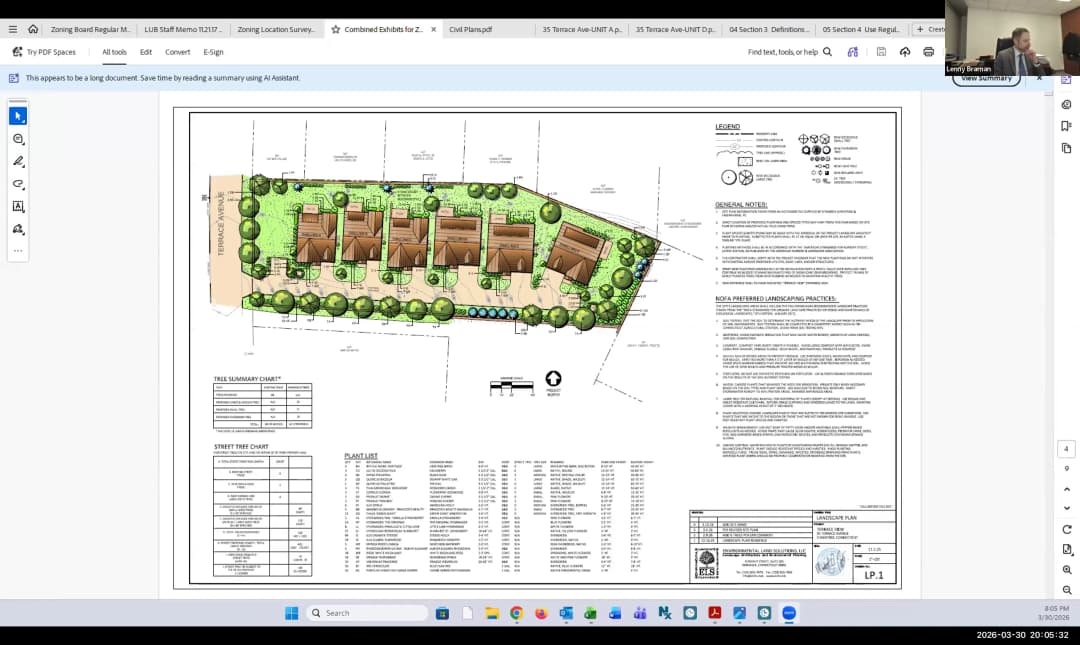
Note: The meeting was called to order at 6:41 PM on March 30, 2026, according to the transcript. The date in the meeting instructions (2026-03-31T12:45:00+00:00) differs; the summary below follows the transcript’s date for accuracy. The Stamford Zoning Board, chaired by David Stein, held a public hearing and regular meeting via Zoom. Agenda items included the annual Below Market Rate (BMR) program report, several text amendments, and a special permit application for a senior living community. The board also approved multiple administrative applications and continued one application. Public Comments & Testimony - Text Change 22547 (CL District): - Mike Moore (President, Stamford Downtown) expressed support, noting the amendment replaces an appendix-based framework with defined standards and tiered review. - Sue Halpern (30 Elm Craft Road) and Dave Adams (Glenbrook) raised concerns about the lack of public hearings for certain renovations and conversions, urging that such changes receive community input. - Application 22601 (35 Terrace Avenue – Senior Living): - Jaclyn Moeller (7 Jessup Street) read a petition with 22 signatures opposing the project, citing traffic, privacy, enforcement of age restrictions, and density. - James Yeager (246 High Ridge Road) emphasized traffic congestion and snow removal difficulties. - Frida Parmar (19 Jessup Street) objected to privacy loss and solar access. - Julia Riva (52 Terrace Avenue) invited board members to visit the street to see traffic and safety issues. - Tommy Muller (7 Jessup Street) questioned fire truck access and the project’s senior housing character. - Dina Suchu (28 Terrace Avenue) reported parked cars being hit and dangerous conditions. - Ruth Richards (25 Terrace Avenue) noted driveway access problems and property line encroachment concerns. - Sue Halpern (30 Elm Craft Road) offered an alternative site for the project. - Text Change 22605 (Corrections & Definitions): - Sue Halpern asked about alcohol service in the proposed “physical culture establishment” definition. - Dave Adams questioned the 20% increase in lot coverage for special permit uses in single-family districts and suggested the two changes should be separate. Discussion Items - Annual Below Market Rate (BMR) Program Report Emily Gordon, Principal Housing Planner, presented the required annual report. Key points: - In 2025, the Zoning Board approved 6 projects with BMR requirements, totaling 518 units, but only 12 on-site BMR units (down from 90 in 2024). 50% of projects used fee-in-lieu, compared to 100% on-site in 2024. - The Affordable Housing Trust Fund committed to four 100% affordable projects, providing 3 to 6 times greater value per dollar than on-site BMR units. - Vacancy rate in BMR units was 3.6% (double 2024's 1.8%), with three-bedroom units having the highest vacancy. - 62% of waitlists were closed. There is a mismatch between household incomes (many below 50% AMI) and unit affordability levels. - The geography used to calculate AMI changed, lowering the AMI; the board froze BMR limits at 2024 levels to avoid displacing tenants. - Board members discussed rebalancing fee-in-lieu and on-site production, and directed Ralph Blessing to prepare options for the next meeting. - Text Change 22547 (CL Limited Commercial District) Ralph Blessing reviewed the proposed comprehensive regulations, including updated dimensional standards, design requirements, and a tiered review procedure. The board discussed alignment with the CG district and added public hearing triggers for new construction on lots over 20,000 sq ft. The application was approved with conditions. - Text Change 22538 (CG General Commercial District) The board reviewed a similar text change for the CG district, aligning review procedures with the CL district. Key changes included requiring a public hearing for new construction on lots over 20,000 sq ft. Approved with modifications. - Application 22545 (177 Broad Street – Office to Residential Conversion) The applicant proposed converting a 16-story, 180,000 sq ft office building into 231 residential apartments. The board approved the application with conditions, including an affordability plan with at least 16 BMR units, 488 parking spaces, 36 street trees, and compliance with various city department comments. - Application 22601 (35 Terrace Avenue – Senior Living Community) The applicant proposed a 6-unit independent living facility on a 1.02-acre lot. The board heard public opposition and discussed traffic, privacy, and enforcement of senior occupancy requirements. The hearing was continued to April 13, 2026, to allow the applicant to provide additional renderings and a fence proposal. - Text Change 22605 (Corrections, Definitions, Lot Coverage) The board adopted a text change to correct errors, add a definition for “gymnasium or physical culture establishment,” and increase lot coverage standards for special permit uses in single-family districts (e.g., houses of worship, clubs). Approved. - Text Change 22606 (Temporary Signage – Continued) The planning board had recommended denial. The board continued this application to the April 13 meeting. - CSPR 1228 (1834 Chapan Avenue) An addition to a single-family home in the coastal area. Approved with conditions from EPB and Engineering. - Extension of Application 22224 Approved for one year until May 25, 2027. Key Outcomes - Annual BMR Report: Received. Board to discuss rebalancing fee-in-lieu and on-site BMR requirements at the next meeting (April 13). - Text Change 22547 (CL District): Approved with conditions, including public hearing for new construction on lots over 20,000 sq ft. - Text Change 22538 (CG District): Approved with modifications aligning review procedures. - Application 22601 (35 Terrace Avenue): Continued to April 13, 2026; applicant to provide fence renderings and privacy options. - Application 22545 (177 Broad Street): Approved with conditions (affordability plan, parking, trees, etc.). - Text Change 22605: Approved. - Text Change 22606: Continued. - CSPR 1228: Approved. - Extension 22224: Approved. - Minutes of March 9, 2026: Approved. - Next Meeting: April 13, 2026, at 6:30 PM on Zoom.
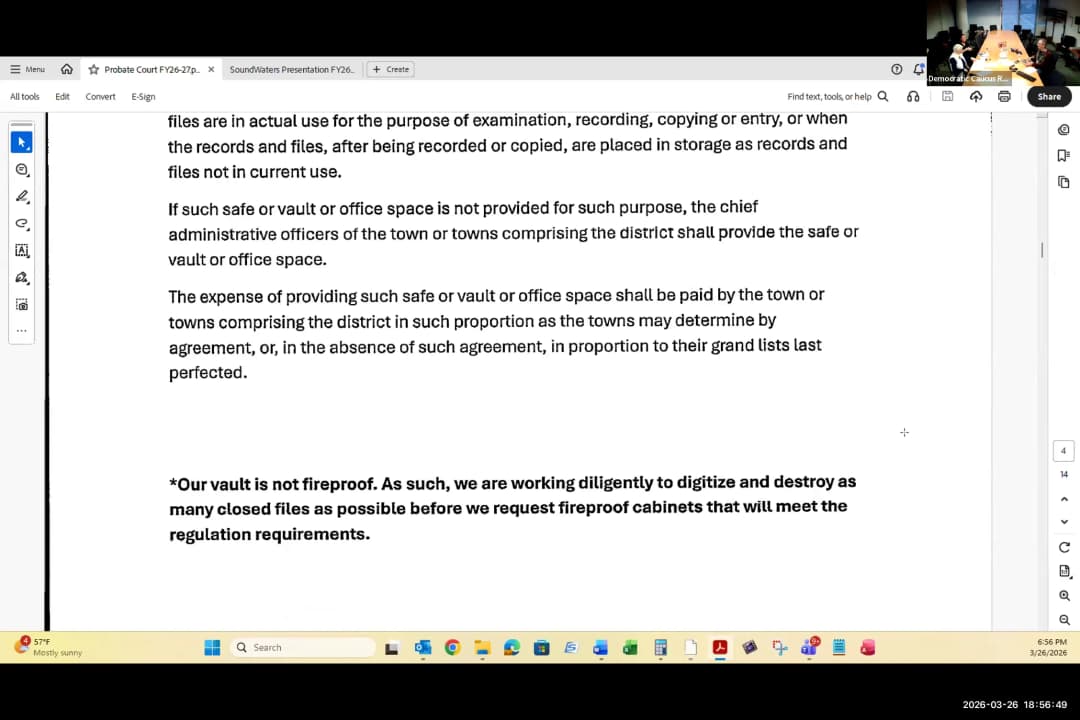
This meeting of the Fiscal Committee of the Board of Representatives took place on March 27, 2026, at 5:30 PM. Chairs Virgin La Cruz, Eric Morrison, and Andrew Zachary presided, with President Parker Johnson present. The committee heard presentations from multiple city-funded agencies and departments regarding their budget requests for fiscal year 2026-27. No votes were taken; the committee will consider the information for future budget decisions. The meeting adjourned at 7:13 PM. Stanford Museum Presentation - Melissa Alroni, retiring CEO of the Stanford Museum, presented the museum's budget request. She noted the museum originally requested a 7% increase, but Mayor Simmons proposed a 4% increase across most outside agencies. The museum receives less than one‑third of its funding from the city and raises 75% of its own operating funds (approximately $5.7 million annually). The requested 4% increase amounts to about $6,000, bringing city funding to nearly $1.5 million, which she argued returns over $4 million in community services. Alroni highlighted challenges from rising healthcare costs (25% increase this year after a 40% increase last year) and inflation. The museum’s preschool program generates $1 million per year, and since the new astronomy center opened, 6,000 additional students have been served. A capital request for a $670,000 pavilion was zeroed out, but $50,000 in non‑recurring funds was approved for technology conversion. Alroni expressed deep gratitude for the partnership and her 21 years of service. - Committee members (Virgil La Cruz, Parker Johnson, Eric Morrison) thanked Alroni for her service and expressed appreciation for the museum’s work. No questions or opposition were raised. Stanford Arts and Culture Commission Presentation - Eric Miller, special assistant to the mayor and arts program manager, presented on behalf of the Arts and Culture Commission. The commission administers the Stanford Arts and Culture grant program. In the current (2026) grant cycle, it received 31 applications requesting over $400,000, with only $200,000 available. Average grant was $6,400 (down $1,000 from the previous year); the largest grant was $14,000 and the smallest $1,000. Six new applicant groups were included, representing diverse communities (Latino, Black, Jewish, Polish, etc.). For FY2026-27, the commission is requesting $208,000, an $8,000 increase over the current year. - No questions or comments were raised. Stanford Partnership Presentation - Darrell Johnson, executive director of the Stanford Partnership (one year in role, 28‑year resident), presented. The partnership brings together business, government, and community to launch initiatives for local economic growth. Key programs include the Southwest Connecticut Tech Hub (placed over 200 individuals into tech roles in 22 months; federal funding sunsetting in June), the Stanford Tech Hub (place‑based training in partnership with Charter Spectrum), Start Lab (co‑working space for entrepreneurs), and Leadership Fairfield County (professional development for emerging leaders). The organization also recently launched a community engagement initiative for residents potentially affected by Medicaid changes (estimated 8,000 residents) and a free Wi‑Fi initiative at Latham Wilder and Cove Island. - No questions or comments were raised. Stanford Downtown (DSSD) Presentation - Mike Moore, president of Stanford Downtown (a special services district), described the organization’s expanded scope. Downtown now has over 5,200 residential units, with 2,200 more planned over the next three years. The district provides environmental maintenance (ambassador team, graffiti removal, snow clearing – 60 inches of snow this winter), hospitality and social service outreach, public realm beautification (20 gardens, 80 planters, 300 hanging baskets), and events (Touch a Truck, farmers market, balloon parade). Property owners pay an additional 1.39 mills above property taxes, funding two‑thirds of the budget; the remainder comes from contributions and event revenue. Moore highlighted two growing social service needs: outreach to teens, with 285 contacts in February alone via a partnership with Domus Kids (Project New Hope), and homeless outreach through Pacific House (20 hours/week of case management). The district is spending $67,000 on youth outreach this year, with only a $10,000 city grant. Moore requested increased city funding to expand these programs, including after‑school programming, camp enrollment, and workforce engagement. Downtown sees 1.9 million unique visitors annually (11.6 million visits). - Representatives Johnson and Hughes expressed strong support for the request and praised the district’s work. Another board member asked about rental units; Moore clarified that all property owners in the district are assessed. Department of Economic Development Presentation - Leah Kagan, director of economic development, presented the department’s budget request. The department currently has a special assistant and one program manager; it seeks a second program manager and a $50,000 increase in consulting funds for business attraction marketing. Key challenges include a commercial real estate vacancy rate of about 25% in the central business district, down from 30% at the pandemic peak. The department used remaining ARPA funds ($1.35 million distributed out of $1.5 million) for a small business support consultant. A $250,000 sustainability planning grant from the Connecticut Green Bank will help develop a public‑private partnership roadmap for reducing greenhouse gas emissions. Kagan also highlighted cross‑departmental work with tax assessors and the health department (single‑use plastic ordinance). - A committee member asked about class A vs. class B vacancy rates; Kagan said she would provide the breakdown later. The sustainability grant amount was confirmed as $250,000. Water Pollution Control Authority (WPCA) Presentation - Bill Brink, with WPCA, presented the authority’s operating and capital budgets. WPCA is an enterprise fund with 47 staff. The proposed operating budget is $29.7 million, a 2.75% increase (about $800,000). Staffing changes include adding one mechanic (from four to five) and increasing a customer service specialist’s hours from 30 to 35. Notable budget changes: electrical costs are down 5% due to energy savings and a fixed supply contract; natural gas costs up 13.5% due to higher prices and increased sludge volume; chemical costs rising from $400,000 to $700,000. Debt service is level. Capital projects include $1.1 million for major replacements (pumps, roofs, generator fuel tank, sludge dryer equipment), $2.45 million for sanitary sewer rehabilitation (including infiltration/inflow removal), and pump station upgrades. Two large projects will be funded by revenue bonds: replacement of plant water returns activated sludge pumps (new estimate $14.6 million, up from $9.9 million) and upgrade of Alver Lane/Commerce Drive pump stations ($6.5 million, up from $5.9 million). - No questions were raised. Probate Court Presentation - A representative (Nelly) from the Stanford Probate Court presented for the first time to the committee. The court is not a city department but a statutory entity. It is requesting $6,250 for FY2026-27, primarily for postage (about $2,000 annually). The representative noted they have been underfunded and have been “borrowing from tomorrow.” Additional needs include fireproof vaults (15–20 at roughly $5,000 each) and data ports (CAT6) for IT upgrades, but these are not part of the current request. The mayor has already approved the $6,250 request; the committee can only cut, not add. The representative pledged to prepare firmer estimates for future requests. Committee members advised asking for what is truly needed next year. - The chair noted that the probate court’s operating budget can be found on page 304 of the general operating budget. No questions were raised. Soundwaters Presentation - Lee Shemitz, executive director of Soundwaters, presented. Soundwaters uses Long Island Sound as a “million acre classroom” and reaches every Stanford public school student in multiple grades (1st, 3rd, 6th, and 9th) at no cost to the city. Programs take place on a schooner, a research vessel, at the harbor center in Bakutsi Park, and at Cove Island. Soundwaters also offers job training for high school students (including stipends and skills such as welding, small engine repair) and leads community cleanups (45 cleanups last year, over a ton of debris removed). The organization requests $100,000 in city support, which funds salaries and directly supports the scholarship value provided to Stanford students. Shemitz emphasized that the sound is a public resource and should not be a place of privilege. - Committee members (Morrison, La Cruz) thanked Shemitz and expressed strong support for Soundwaters’ work. Key Outcomes - No formal votes or decisions were taken on any budget requests. The committee will consider the presentations as part of the FY2026-27 budget deliberation. - The meeting adjourned at 7:13 PM.
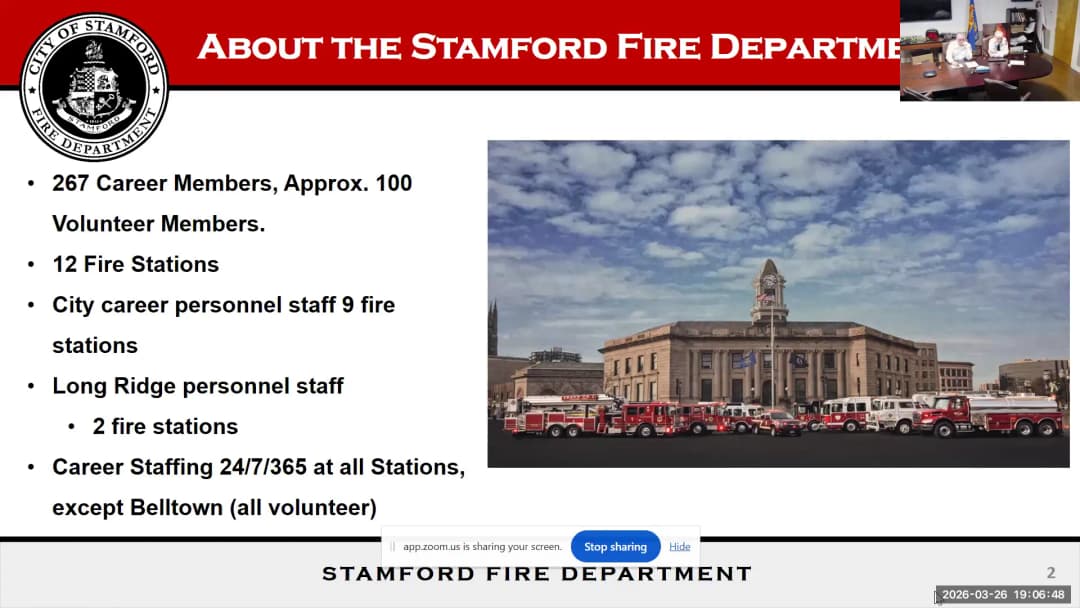
The Public Safety and Health Committee of the Stamford Board of Representatives held its third meeting on March 26, 2026, at 6:30 PM. The committee reviewed two items: public safety conditions at an abandoned building at 200 Henry Street (PS32.004) and an overview of the Stamford Fire Department (PS32.005). The meeting included presentations from city officials and department heads. Review of Abandoned Building at 200 Henry Street (PS32.004) - Representative Adams introduced the item following an incident where a body was found in the building on February 4, 2026 at 11:30 PM. The building is across from a men's shelter and was unsecure, allowing homeless individuals to enter. Adams thanked city officials for recent securing efforts and noted that one window had been compromised again. - Lou Derubis, Director of Public Safety, Health and Welfare, described an interdepartmental response and plans to install an 8-foot fence around the building. However, subsurface hazards from an environmental liner prevent digging fence posts, requiring alternative methods. - Sean Reed, Chief Building Official, reported he had issued three notices of violation to the property owner over the past one and a half years, ordering them to secure the building. The owner only acted after the death, boarding up windows, but bare-minimum compliance continues. - Lou Cast, Director of Operations, discussed additional security options, such as mounting barriers on concrete curbs, and recommended incorporating firefighter access in any fencing. - Representatives raised concerns: Rep Graham asked about blight citations (a citation was issued for garbage but closed after cleanup) and suggested surveillance cameras or patrols during shelter closing times. Rep Walston proposed inviting the property owner to a future committee meeting to explain their intentions. Rep DLO asked about structural stability; Reed confirmed an unsafe structure notice prohibits entry and a structural engineer periodically assesses the building externally. - Representative Adams emphasized that the boarding of windows could itself be considered blight, and requested additional resecuring of a compromised panel. - The committee concluded the item with a motion to move to the next agenda item. Chair Burchard indicated the suggestion to invite the owner would be taken under advisement. Overview of Stamford Fire Department (PS32.005) - Chief Robert Morris presented a comprehensive overview of the Stamford Fire Department. Key points: - The department has 267 career members and approximately 100 volunteer members, operating out of 12 stations across the city. - The department is a consolidated career-volunteer system covering all response disciplines including fire suppression, EMS, hazmat, high-angle rope rescue, scuba diving, and fireboat operations. - Stamford is the largest city in Connecticut by square miles among cities with over 100,000 population, with a complex geography that includes a non-hydrant district covering about one-third of the city. - The city has grown from 103,000 residents in 1981 to 141,000 today. Between 2010 and 2020, 40% of Connecticut's population growth occurred in Stamford, leading to increased density and fire risk. - Fire incidents have increased 35-36% over five years, outpacing population growth. The downtown area has the most high-rises in the state, with 50-60,000 people living in buildings five stories or taller, and 3,300 new housing units planned. - The department faces challenges from new construction types (large, wood-frame buildings) and emerging risks like lithium-ion battery fires. Chief Morris showed videos of battery fires and pledged educational efforts. - The smoke/CO detector program has installed almost 1,000 detectors. Residents can request free installation. - Chief Morris seeks additional staffing for the rescue company (two more firefighters) to enhance search and rescue capabilities. - Questions and discussion: - Rep Camparelli requested collaboration on battery safety education, given a recent city ordinance on electric lawn equipment. Chief Morris agreed and offered his email. - Rep DLO asked about a tanker apparatus replacement request; Chief Morris explained it would be a city asset assigned to Turn of River volunteer district, manned by volunteers, not requiring additional career staff. - Rep DLO also suggested exploring a city ordinance regulating non-UL listed batteries. - Rep Field thanked the chief for the informative presentation. Key Outcomes - The committee concluded the first item with a motion to move to the next agenda item. Chair Burchard will evaluate the authority to invite the property owner to a future meeting. - No formal votes were taken on the second item; the overview was received for informational purposes. - The meeting adjourned at 7:53 PM.