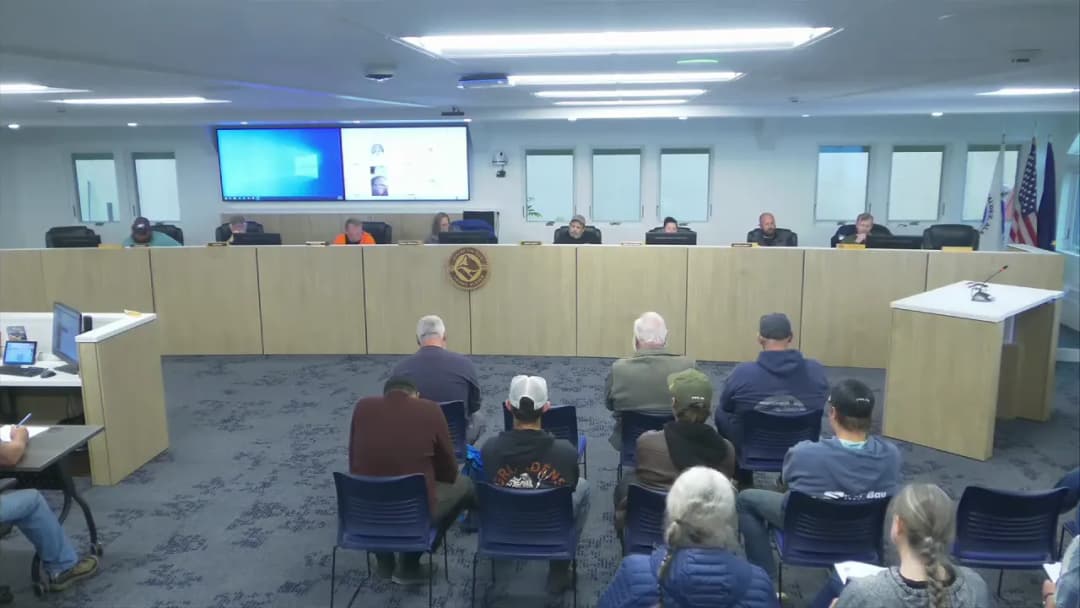
The Ports and Harbor Commission held a special meeting on June 29, 2026, to discuss proposed rates and fees for the use of Valdez Harbor facilities and to consider repealing Resolution No. 26-29. The meeting included public testimony from harbor users, followed by commissioner deliberation. The commission directed staff to remove several contested fees and to schedule a follow-up meeting for a final vote. Public Comments & Testimony - Catherine Walters (38-year harbor resident) requested a change to the nine-month upland storage rule, proposing an annual cycle to avoid winter boat launches. She noted the rule is impractical in Valdez due to ice. - Jim Gifford (annual boat ramp pass holder) opposed the new daily parking fee for trailers, arguing it punishes local users and that enforcement should apply equitably to all vehicles. He suggested a 48-hour free period. - Kyle Klaus (liveaboard for 4 years) criticized the 1,200% increase in liveaboard fees from $75 to $900, calling it poor public policy during high inflation. He argued that liveaboards paying property taxes should be exempt and that the fee unfairly taxes a low-value asset. He also noted that liveaboards provide security and maintenance benefits to the harbor. - Thane Miller (commercial fisherman) opposed the proposed $23-per-day skiff moorage fee, explaining that his skiff cannot be safely loaded onto his vessel and that the fee would force avoidance. He emphasized the commercial fleet’s economic contribution to Valdez. - Ethan Sandlin (commercial fishing captain) seconded Thane Miller's comments and suggested using the former Totem Inn site for a restaurant to generate revenue. - Bernie Culbertson (former commissioner) acknowledged the need for revenue but noted that safety concerns previously derailed similar fee proposals. - Anonymous speaker (harbor user) accused the harbor of operating as both a state entity and a private LLC, favoring certain users. He cited favoritism in enforcement of vessel fees and questioned the legality of parking fee notices. - Mike Baldon (commercial fisherman) suggested exempting skiffs or providing designated parking areas to avoid navigational hazards. - Dustin Klein (commercial fisherman) requested that skiff fees be included in the annual moorage fee rather than charged daily. - Paul Smith (incoming liveaboard) opposed mooring fee increases and new trailer fees, noting that trailers provide secure storage without cluttering parking lots. He also argued that fish-cleaning stations should not be charged a business license fee. - Hope Finley (commercial vessel owner) opposed the skiff fee, stating it would drive vessels to other ports and that many boats cannot safely carry skiffs. - Nikki (concerned harbor user of 43 years) attended but did not speak in detail. - Larry Cologne (recreational fisherman) opposed the additional parking pass requirement, questioning whether it would guarantee a parking spot during derbies. - Joe Prox (local business owner) expressed concern that parking fees would deter tourists and fishermen, harming the local economy. He noted the harbor is an enterprise fund but urged the commission to consider the negative impact. - Edward Mattson (commercial fisherman) opposed the skiff fee, noting that fish prices have only recently improved after years of struggle. He argued that the fee increase was implemented without adequate notice and that locals bear the burden. Discussion Items - Parking Fees (Section 2, Subsection H): Commissioner Steve moved to remove the daily parking fee for trailers, suggesting instead that the cost be bundled into launch or slip fees to simplify enforcement. The commission reached consensus to eliminate the parking fee. - Skiff Moorage Fees (Sections 1A and 2C): Commissioner Steve noted safety concerns if skiffs are parked perpendicular to docks. The consensus was to remove the skiff fee, provided that skiffs do not impede navigation. The commission agreed to return with language exempting skiffs tied alongside vessels. - Commercial Kayak Operators: The commission discussed that current codes do not differentiate between commercial kayak operations and personal auxiliary vessels. They directed staff to propose wording clarifying that a slip rented for commercial kayaks covers multiple kayaks within the same slip, without additional per-vessel charges. - Liveaboard Fees: Commissioners acknowledged that liveaboard fees had been set through a working group two years ago and had not been revisited. Given council priorities on housing and a potential primary home exemption, they expressed willingness to form a new working group or hold an annual liveaboard meeting to reassess the fee structure. Key Outcomes - Votes and Directives: - The commission directed staff to draft a revised resolution that removes the daily parking fee for trailers. - Staff to remove the skiff moorage fee, with a note that skiffs must not impede navigation. - Staff to clarify language for commercial kayak operators, allowing multiple kayaks in one slip without additional charges. - Next Steps: The commission will hold a special meeting on July 6, 2026, to review the revised resolution and vote on a recommendation to the City Council. If a quorum is not available, an alternative date will be posted. - Future Consideration: The commission may revisit liveaboard fees through a new working group, pending council actions on housing exemptions.
Public Meetings - Valdez, Alaska
Public Meetings - Valdez, AlaskaThe Valdez City Council held its regular meeting at 7:00 PM on Tuesday, June 16, 2026, in Council Chambers at 212 Chenega Ave. All council members were present except Councilmember Foster. The council approved the June 2, 2026 minutes, heard an update from the Alaska Women's Business Center, approved the consent calendar, three new business items, and two resolutions, then received reports and entered executive session. A work session on the Valdez Lighthouse Project was listed for 6:00 PM; no transcribed minutes were available for that session. Consent Calendar - Executive session authorization: Approved a motion to enter executive session to discuss implications for city revenues and litigation strategy regarding Trans Alaska Pipeline System ad valorem tax issues. Passed by unanimous voice vote (6 ayes, 1 absent). Public Appearances & Testimony - Alaska Women's Business Center update: Carrie Jean Shepard, director of the Alaska Women's Business Center at Business Impact Northwest, presented a three-year partnership update. She reported year-to-date results through June 9, 2026: 43 businesses served, over 50 jobs created or maintained, $21,000 in capital accessed, two capital infusions, and one new business start. She said the partnership included a $10,000 city contribution starting in 2024 and noted the center serves 25% men. - She shared success stories, including Sam's Spot (eight local employees) and three new LLCs formed last month (housekeeping, photography, construction management). She highlighted the Small Business Conference with approximately 50 attendees, 14 presenters, and an estimated $28,500 in expert value—a 3X return on the city's investment. She also mentioned that three of four winning teams at Alaska's Startup Weekend were led by Valdez residents and that a mini-startup sprint will be held at the community college. - She identified challenges: housing affects workforce recruitment/retention, and capital access is difficult for younger entrepreneurs. She expressed support for AI-focused training and planned to share an AI opportunity briefing for the council's retreat. - Multiple council members expressed appreciation for the program and its results; one recommended a LinkedIn contact reach out to the center. No formal action was taken. Discussion Items New Business - Property and casualty insurance renewal: Approved the annual insurance renewal beginning July 1, 2026, in the amount of $932,844, and authorized the city manager to execute related documents. Motion by Councilmember Lally, second by Councilmember Green. Passed 6-0-1 (Foster absent). - HDR Engineering services agreement: Approved a professional services agreement with HDR Engineering, Inc. for the City of Valdez Baler Replacement Project in the amount of $326,466. (The transcript spells the project 'Baylor,' while the agenda lists 'Baler.') Passed 6-0-1. - Alaska Scrap & Recycling contract amendment: Approved Contract Amendment 1 with Alaska Scrap & Recycling, LLC in the amount of $700,000 for the 2026 Scrap Metal Processing Project. Motion by Councilmember Lally, second by Councilmember Winnie. Passed 6-0-1. Resolutions - Resolution 26-33: Supported a constitutional amendment to restructure the Alaska Permanent Fund and stabilize the annual draw for state services. Motion by Councilmember Green, second by Councilmember Dice. Passed 6-0-1. - Resolution 26-34: Amended the 2026 city budget to accept a Rasmuson Tier One Grant of $25,000 for the Valdez Voices and Visions Placemaking Project. Motion by Councilmember Green, second by Councilmember Whitney. Passed 6-0-1. Reports - Financial and permit reports: The monthly treasury report (April 2026), quarterly financial summary reports (March 31, 2026), and temporary land use permits 26-06 through 26-12 were presented. No council member requested to pull or discuss any report, so they were accepted as submitted. City Manager / City Clerk / City Attorney / Mayor Reports - City Manager Nate Duval thanked staff and community for the 125th anniversary events, noted city staff cleanup day, reported the health center opened June 10, announced Fire Captain Mike Weber's retirement (proclamation planned for first July meeting), and said a department head meeting was underway. - City Clerk reminded council of the Citizens Academy application deadline of June 19 and the first session on June 25. - City Attorney noted attendance at the directors' retreat and indicated an executive session update. - Mayor and council members praised the 125th celebration, the town photo, the flyover eagle, and staff cleanup efforts. Mayor Fleming reported that Dave Tushnov delivered 214 signatures in support of raising the senior citizen property tax exemption; the mayor noted it is not an official petition and that House Bill 13 is still on the governor's desk. Key Outcomes - All approvals listed above passed with 6 ayes, 0 noes, and 1 absence (Foster). - Council entered executive session after reports. - Next steps: City manager to follow up on a state fire marshal inspection for Sugar Bigger daycare; retirement proclamation for Captain Weber at the first July meeting; council strategic planning retreat Thursday–Friday; AI briefing to be provided before the retreat; Citizens Academy applications due June 19.
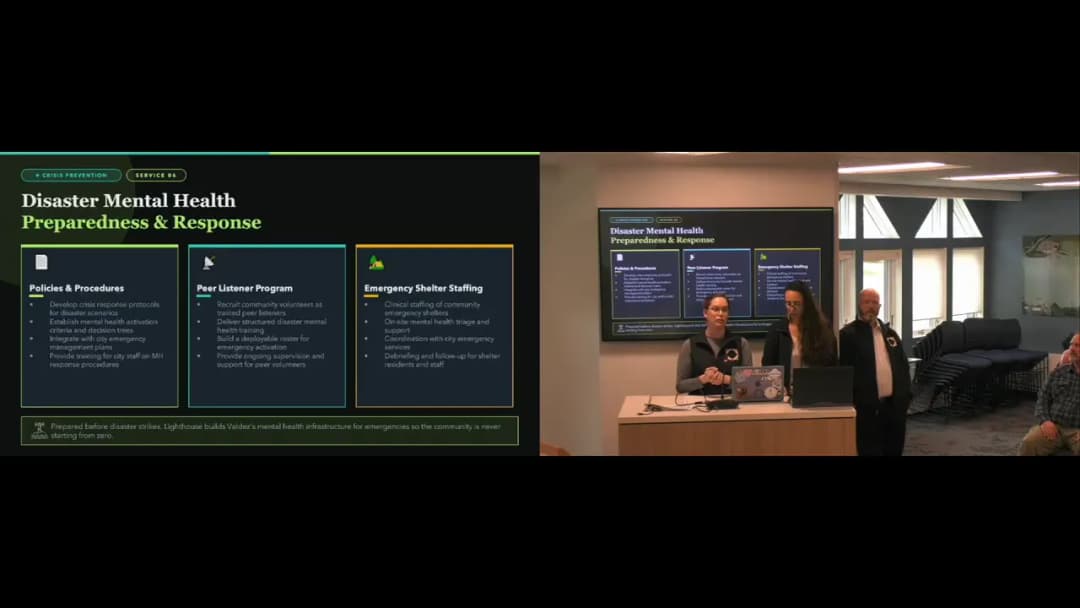
The Valdez City Council held a work session on June 16, 2026, to hear a presentation from Sound Mental Health and the newly formed nonprofit Valdez Lighthouse. The presentation focused on expanding mental health services, building community resilience, and shifting from crisis response to prevention. No formal votes were taken; the session was informational with an invitation for future partnership. Discussion Items - Presentation by Matt Wadsworth (Sound Mental Health): Wadsworth provided an update since March 2025, reporting that Sound Mental Health had opened in fall 2024 and achieved credentialing with major insurances by February 2025. He shared statistics for 2025: 2,715 total visits, including 141 intake assessments and 2,574 outpatient visits, plus 38 outreach events (e.g., school presentations, Coast Guard talks, suicide prevention discussions). He emphasized the need to move beyond the "ambulance at the bottom of the cliff" model toward prevention, introducing the Valdez Lighthouse nonprofit to seek grants and fund community mental health work. - Valdez Lighthouse Board Introductions: - Colleen Murphy (Treasurer): Shared her deep connection to Valdez and the mission to build "fences" (prevention infrastructure) so the community does not rely solely on crisis care. She read the mission and vision statements, focusing on supporting people before, during, and after crisis. - Bart Hinkle (Secretary): Described his 26-year career in Valdez law enforcement, highlighting how many calls are rooted in mental health. He gave an example of a man who sought help but could not access residential treatment for six months, later ending up in the criminal justice system. He stressed the need for flexible, timely services. - Katie Cornell (President): Shared personal experiences with therapy and her work in schools and foster care. She emphasized the impact of suicide in Valdez and the need for suicide prevention training, community education, and stigma reduction. - Clinical Framework: Presenters outlined two categories: crisis management (connecting people in crisis to clinicians) and crisis prevention (building resilience before crisis). Proposed initiatives included: - Community Partner Support Services: In-person crisis support, individualized care plans, and care consultation for community members. - Multidisciplinary Teams (MDTs): Formalizing existing collaboration among agencies (AVV, VNT, schools, housing, food bank, emergency responders) with Lighthouse clinicians chairing meetings to coordinate care and track outcomes. - Community Presentations and Stigma Reduction: Free monthly training, social media education (e.g., "Valdez gives me mental health" misconception), and events like coffee kindness and Puzzle Wars. - Suicide Prevention: Training in QPR, Safe Talk, and ASSIST for students, coaches, and trusted adults. - Disaster Mental Health Preparedness: Proposing a "Pure Listener" program to train community members to provide peer support in emergencies, integrating with existing city, Coast Guard, and school plans. Also ensuring debriefing and follow-up for caregivers. - Questions from Council: - Councilmember noted the importance of awareness and communication; Katie Cornell emphasized the need for skills to have hard conversations (e.g., asking about suicide). - Councilmember Shannon asked about barriers for minors; presenters affirmed they are pursuing grants to reach under-18 populations, including college students living away from home. - Councilmember Woody asked if Lighthouse would absorb SWAN; presenters clarified they are separate but collaborative, with Lighthouse focusing specifically on mental health prevention and crisis response, while SWAN covers broader wellness. Key Outcomes - No formal votes or decisions were taken at the work session. - The Valdez Lighthouse team stated they are not requesting immediate city funding but are seeking partnership and will continue pursuing grants and building coalitions. - Council members expressed appreciation for the passion and commitment, with several indicating interest in future collaboration. The council was encouraged to keep the Lighthouse in mind during upcoming budget processes.
The Valdez City Council met in regular session on Tuesday, June 2, 2026, at 7:00 p.m., following a 6:00 p.m. work session on the PVMC Community Advisory Council update. Six council members were present; Councilmember Whitty was absent and excused, and Councilmembers Lally and Foster participated online. The council approved consent items, four new-business purchases/agreements, two ordinances, and two resolutions, then moved into executive session. Consent Calendar - Approved the consent agenda (6-0, with Whitty absent), including the National Safety Month proclamation and approval to enter executive session to discuss Trans-Alaska Pipeline System ad valorem tax revenue implications and litigation strategy. - Mayor Dennis Fleming read the proclamation declaring June 2026 as National Safety Month, marking its 30th anniversary. Discussion Items - Kelsey Dock Dolphin/Bollard Temporary Install Change Order: Approved a $70,500 change order with Knik Construction (motion by Green, second by Lally; vote 6-0). - CAT 265 Tracked Skid Steer Purchase: Approved the purchase of a CAT 265 tracked skid steer and attachments from NC Machinery for $139,877; council noted it will help keep Meals Hill trails maintained for Parks and Recreation (vote 6-0). - Valdez Convention and Visitors Bureau Purchase and Sale Agreement: Approved the agreement between the City and VCVB, described as a positive step forward (vote 6-0). - Physician Retention Agreement: Approved a physician retention agreement with Dr. John Cullen (vote 6-0). Ordinances - Ordinance 26-03 (Public Accommodation Tax Amendment): Adopted on second reading, 5-1, with Councilmember Foster voting no and Whitty absent. Foster opposed the ordinance because RV parks are not included in the bed tax, stating she supports destination marketing through an equitable accommodations tax. Councilmember Devons agreed with equity concerns but opposed adding RV parks at this time, citing rising gas prices and potential harm to visitation; he favored revisiting equity later. Mayor Fleming expressed reluctance about taxation, suggesting the city could explore alternative funding for VCVB, but voted in favor to move the matter forward. Staff clarified the ordinance is mostly an administrative cleanup of an existing tax and does not change the current tax base, though it adds rental cabins already covered under city code. - Ordinance 26-05 (Planning and Zoning Commission Amendment): Adopted on second reading, 6-0. Resolutions - Resolution 26-31: Adopted 6-0, urging Alaska's Governor to sign Senate Bill 174 to establish an Alaska Invasive Species Council. Councilmember Devons noted invasive species are a major concern for the community. - Resolution 26-32: Adopted 6-0, amending the 2026 budget to accept $60,411 from the Pacific States Marine Fisheries Commission Fishery Disaster Program for 2020 Copper River and Prince William Sound salmon disaster relief. Reports & Council Business - City Manager Report: Head Start will begin operations on June 10; Valdez 125th anniversary events are June 11-12, including a community photo at Kelsey Dock on June 11 at 6:30 p.m., a time capsule, tours of the Alyeska terminal, and a reception with invited guests; Bart, formerly Chief Hinkle, has started as interim Public Works Director and will serve about two months while the city recruits a permanent director. - City Clerk Report: Boards, commissions, and council training is scheduled for Thursday at 6 p.m.; about 11 out-of-town RSVPs are expected for the anniversary; the council expressed interest in pursuing a resolution requested by the Permanent Fund Board of Trustees on combining the corpus and earnings reserve account, so it will be placed on a future agenda. - City Attorney Report: Deferred an update to executive session. - Mayor Report: Mayor Fleming visited a cruise ship to present a plaque and heard positive visitor feedback about Valdez's community character and trails; he also welcomed Bart. - Councilmember Updates: Shannon reported Prince William Sound College expects an interim director announcement by tomorrow and has hired a new CTE director; Jimmy praised trail maintenance; Lester thanked Providence Valdez Health Center for its work session and service; Olivia thanked staff for PFD information, raised harbor fee schedule concerns from Thane Miller, and noted feedback on parking and boat storage. City Manager will refer the harbor issue to the Port and Harbor Commission for consideration. Key Outcomes - Consent agenda and new business items approved 6-0. - Ordinance 26-03 adopted 5-1 (Foster no); Ordinance 26-05 adopted 6-0. - Resolutions 26-31 and 26-32 adopted 6-0. - Council members completed reports, and Mayor Fleming passed the gavel to Mayor Pro Tempore Green before the meeting entered executive session.
On June 2, 2026, the Valdez City Council held a work session with the Providence Valdez Medical Center (PVMC) Community Advisory Council. The presentation covered PVMC's governance, financial health, services, partnerships, and ongoing challenges. No formal actions were taken, but council members and advisory board members discussed strategic priorities and next steps. Presentation and Discussion - Critical Access Hospital Designation: PVMC is a Critical Access Hospital, the first in Alaska (since 2000). This designation brings an additional $9 million annually in Medicare reimbursements. Conditions include being 35 miles from another hospital, ≤25 acute care beds, and 24/7 emergency services. - Financial Overview: The city owns the facility; Providence manages it under a contract since 2005. Since 2007, PVMC has not required a city subsidy (previously $1 million/year). Current days cash on hand is 230 days (above the 90-day threshold). The hospital carries no debt, and recent capital projects (e.g., long-term care expansion) are paid in cash. - Services and Partnerships: PVMC offers emergency (trauma level 4), medical-surgical, primary care (taken over from private clinic in 2025), counseling, long-term care, and low-risk maternity. Key partnerships include Prince William Sound College (nursing pipeline: 40–50% of nurses and aides are program graduates), Safeway pharmacy, and local nonprofits. Community benefit grants (over $1.3 million since 2018) support organizations such as AVV, the food bank, and the college. - Health Advisory Board: The board is appointed by the city council and jointly approved by Providence. It advises on community health needs, administers community benefit grants, and advocates for services (e.g., advocating for Providence to take over the primary care clinic). The board meets seven times per year. - Recruitment and Retention Challenges: The highest priority is recruiting physicians and mid-level providers (physician assistants, nurse practitioners). Current staffing includes two physicians (with one retiring), one part-time PA, and a nurse practitioner coming on board. Credentialing takes 3–6 months for physicians, leading to candidate loss. The hospital also struggles with long-term care occupancy due to Medicaid eligibility requirements (look-back period on assets). - Nurse Licensure Compact: The advisory board discussed the failure of a state bill to join the nurse licensure compact, which would allow nurses licensed in other states to practice in Alaska without separate licensing. Opposition came from the nurses' union (citing job security) and concerns about state control and patient safety. Council members expressed interest in advocating for the compact. - Community Health Needs Assessment: A federally required assessment is underway (results expected by September 2026). The board encouraged council to promote widespread participation to inform strategic priorities. These priorities may align with federal Rural Health Transformation Funds available over the next four years. - Other Needs: Improved recruitment support (housing, family attraction), advocacy for the licensure compact, and addressing transportation barriers (airline restrictions on wheelchair transport). Key Outcomes - No formal votes or decisions; the work session was informational and strategic. - Council requested specific recommendations from the advisory board on how to improve physician recruitment, ideally before the city's strategic planning meeting in two weeks. - The advisory board will continue to advocate for the nurse licensure compact and share information with the council for state-level lobbying. - The city and hospital will collaborate on the Community Health Needs Assessment and explore Rural Health Transformation Funds. - Council members expressed appreciation for PVMC's financial health and the partnership model, noting the importance of sustaining local healthcare.
The Valdez City Council held its regular meeting on May 26, 2026, at 7:00 PM in the Council Chambers. The meeting began with a work session on the Valdez Fisheries Development Association at 6:00 PM. All council members were present except Councilmember Love, who was absent and excused. Key actions included approval of consent agenda items, new business items, first and second readings of ordinances, committee assignments, and reports on the TAPS valuation and Alaska Permanent Fund presentation. Swearing-In and Mayor Pro Tempore Election - Newly elected and re-elected council members (Green, Devins, and Sites) were sworn in by the clerk. - Councilmember Green was nominated and elected as Mayor Pro Tempore by acclamation. Alaska Permanent Fund Board of Trustees Presentation - Jason Bruni (Chair) and Devin Mitchell (CEO/Executive Director) presented on the Alaska Permanent Fund's 50th anniversary, current $90 billion corpus, and its role in funding 66% of state general fund. - They discussed the need for a constitutional amendment to combine the corpus and earnings reserve to allow a stable 5% of market value withdrawal, protecting the full $90 billion from simple majority legislative spending. - They noted Valdez's own permanent fund of $318 million (49th year) and offered support for a council resolution endorsing the state constitutional amendment. Public Comments from the Floor - Thane Miller (fisherman/business owner): Expressed strong opposition to new harbor fees for skiffs tied behind boats, stating the $23/day ($690/month) fee is unreasonable and dangerous for larger skiffs (10,000 lbs). He argued the harbor should not be the only city department expected to pay its own way, noting his industry contributes $600,000/year in raw fish tax directly to the harbor. He requested the council reconsider the fee. City Boards & Commissions Reports - Valdez Tourism Task Force (Colleen Stevens, Chair): Reported on draft Articles of Incorporation for Destination Valdez. The task force recommends seeking letters of interest for the initial board of directors rather than naming members. Council gave consensus to proceed with the call for letters. Consent Calendar (Approved unanimously, 7-0) - Approval of renewal of Marijuana Dispensary License - Herbal Outfitters LLC 10173 - Approval of renewal of Liquor License: The Fat Mermaid - Approval to go into Executive Session re: Trans Alaska Pipeline System Ad Valorem Tax Issues New Business (All approved unanimously, 7-0 unless noted) - Skate Park Upgrades: Approved service agreement with American Ramp Company for $189,925.17 to replace aging equipment (original ramps exceeded 25-year lifespan). Councilmember Devins questioned the cost of a 7-foot aluminum sign ($1,300); city manager noted pricing through the contract was consistent with other quotes. - Beautification Matching Grant – Radio Shack: Approved $12,500 for Tier 1 applicant. - Beautification Matching Grant – Magpies LLC: Approved $25,000 for Tier 1 applicant. Ordinances - Ordinance 26-03 – Public Accommodation Tax (First Reading): After public hearing and council discussion, the ordinance to amend Chapter 3.24 was approved with a vote of 6-1 (Councilmember Foster voted nay). The amendment exempts RV parks from the accommodations tax. Councilmember Lally explained the rationale: RV parks are disproportionately affected by fuel cost increases and were previously exempt; the exemption is intended to be temporary until fuel costs stabilize. Councilmember Foster expressed concern about equity, noting brick-and-mortar businesses remain taxed. The ordinance advances to second reading. - Ordinance 26-04 – Subdivisions Code (Second Reading/Adoption): Approved unanimously (7-0) to repeal and reenact Title 16. Councilmember Green commended Community Development for modernizing the code. - Ordinance 26-05 – Planning and Zoning Commission (First Reading): Approved unanimously (7-0) after public hearing and no discussion. Reports - City Manager (Nate Dunning): Reported on House Bill 13 analysis (property tax benefits), request for resolution supporting SB 174 (invasive species), no-camping sign deployment, Mills Avenue construction mobilization, Head Start daycare awaiting fire marshal approval, strategic planning session June 18-19 (Councilmember Foster unable to attend), and thanked participants in cleanup day. - City Clerk (Elise): Announced Citizens Academy registration (25 spots, 16 applications received). Presented committee assignments: - Permanent Fund Committee: Devins, Foster, Lally - Audit Committee: Mayor Fleming, Whitty, Green - Housing Subcommittee: Whitty, Devins, Sites - CSO Subcommittee: Whitty, Foster, Devins (Green stepped back due to multiple assignments) - City Attorney (Jake): Reported on successful SARB hearing for TAPS valuation – set at $13 billion, highest in history, up from $8 billion settled valuation. Also updated on Ables v. City of Valdez (trial set May 10, 2027) and C-Plan remand issues (secondary containment testing, oral argument July 8). - Mayor Fleming: Reported on scholarship awards, Alaska Telecom meeting at Civic Center. Council Business from the Floor - Councilmember Whitty thanked Parks & Rec for Glacier Lake Campground improvements and cleanup day participants. - Councilmember Lally noted Memorial Day observance and thanked participants. - Councilmember Green discussed SB 174 (Alaska Invasive Species Council) and noted RCAC concerns about invasive green crab migrating up the coast. - Councilmember Devins thanked city attorney for SARB work and tourism task force for open house. - Councilmember Foster expressed interest in supporting the permanent fund constitutional amendment (via resolution) and requested review of harbor fees raised by Thane Miller. Executive Session - The council adjourned the regular meeting and moved into executive session to discuss TAPS ad valorem tax litigation strategy, as authorized by the consent agenda.
The Valdez Beautification Commission met on May 18, 2026, at 5:00 PM in the City Council Chambers. The meeting lasted approximately 35 minutes, adjourning at 5:35 PM. Commissioners discussed and unanimously approved two matching grant recommendations to the City Council for the 2026 Beautification Matching Grant program. The commission also deliberated on future beautification projects, including wood carvings, murals, decorative lighting, and the need for a departmental liaison to advance their initiatives. Discussion Items - Approval of Recommendation for Magpies LLC Matching Grant ($25,000 per agenda): The commission considered a grant for landscaping around cabins on a corner lot at Hazel and Civic Center Hill. The applicant, Maggie, joined remotely. Questions focused on the extent of foliage relative to state right-of-ways and snow removal. The actual landscaping bid was $48,000, leading to discussion that the grant should be half ($12,500), but the agenda listed a $25,000 recommendation. The commission ultimately voted unanimously to approve the recommendation to the City Council for the amount stated on the agenda ($25,000), despite the discrepancy noted during discussion. The project includes geo-cells to prevent gravel washout and is contingent on structural work underway. - Approval of Recommendation for Radio Shack Matching Grant ($25,000 per agenda): Commissioners discussed the requested amount of $12,500 (as stated in the application), despite the agenda listing $25,000. The motion specifically approved $12,500. Comments were positive about new siding improving the corner appearance, though some wished the siding covered all sides. The grant was approved unanimously. - Commission Business from the Floor: Future projects were discussed: a potential wood carving trail (reviving an idea from years ago), a mural competition or portable mural program, larger snowflake decorations, and concerns about banners purchased by another department without commission input. Commissioners expressed frustration about the lack of a dedicated department liaison and agreed to update their project priority list, seek pricing, and work through the budget cycle. They also discussed contacting Nate about a wetlands/wildlife project and exploring a work session to solidify plans. Key Outcomes - Motion 1: Unanimously approved (all in favor, none opposed) the recommendation to the City Council to fund Magpies LLC for the 2026 Beautification Matching Grant in the amount of $25,000 (agenda amount), with the understanding that the actual grant disbursement would be half of the $48,000 landscaping cost. (Note: The agenda and transcript conflict on the exact amount; the agenda lists $25,000, while discussion suggested $12,500.) - Motion 2: Unanimously approved the recommendation to the City Council to fund Radio Shack for the 2026 Beautification Matching Grant in the amount of $12,500 (as stated in the application and motion), despite the agenda listing $25,000. (Discrepancy noted.) - Next Steps: Commissioners will email Nate to inquire about a previously discussed wetlands project, update and prioritize their beautification list, and consider holding a work session to develop concrete plans for future initiatives. They also plan to seek a departmental liaison to improve communication and advance projects.
The Board of Equalization convened on May 15, 2026, to hear four property tax appeals. Board members Whitty and Foster were absent and excused. Assessor Martin presented staff reports for each appeal. The board voted unanimously to uphold all assessments. Appeal 51 – Downing (124 Dadina Street) - Appellant appeared and was sworn in. The appeal cited market trends and lack of improvements. Assessor Martin reported the property sold in April 2025 for $430,000, with a deed of trust of $422,000. Staff recommended no change to the assessed value of $376,200 ($39,600 land + $336,600 building). The board voted 5-0 to uphold, citing failure to meet burden of proof. Appeal 59 – Elder (413 W Klutina) - Appellant did not appear despite multiple attempts by assessor. Appeal alleged wind damage and unjustified increase. Assessor noted a 2021 deed of trust of $255,000 and lack of damage documentation. Recommended value: $245,800 ($27,000 land + $218,800 building). Motion carried 5-0. Appeal 69 – Winchester (3037 Childs Street) - Appellant provided comparables; assessor discussed via phone. Assessor cited recent sales in Corbin Creek subdivision, including a nearly identical property at 3036 Child Street that sold for $620,000. Current assessed value $511,700 ($36,900 land + $474,800 building). Board upheld 5-0, noting comparables exceeded assessed value. Appeal 72 – Martin (312 Winter Park Circle) - Appellant stated no major updates in 16 years; original 1996 metal roof. Assessor adjusted building value by 1% to account for roof age, reducing total to $364,000 ($39,700 land + $324,300 building). Comparable homes with updates sold over $400,000. Motion carried 5-0. Key Outcomes - All four appeals were denied with unanimous votes (5-0, with two absent). - Assessor Martin thanked for efforts and noted reduction in appeals compared to previous years (down from 250+ to 75).
The Valdez City Council, sitting as the Board of Equalization, met on May 14, 2026, at 6:00 PM in the Council Chambers to hear ten property assessment appeals for the 2026 tax year. Board member Whitty was absent and excused. The hearing followed a structured process: each appellant was sworn in and presented their case, followed by the assessor (Martins), with opportunities for questions and rebuttal. The board voted on each appeal after hearing evidence. Several property owners did not appear; their appeals were either moved to the bottom of the list or decided based on written statements. Public Hearings (Appeal Decisions) Appeal 29 – Searles – 312 Birch Circle - Appellant Position: Steve Searles argued the assessment was excessive, noting a $35,800 increase for 2026 (following a similar increase the prior year). He cited uncertainty from nearby low-income housing and city acquisition of St. Patrick’s estate for future construction, and requested the value remain at the prior year’s level. - Assessor Position: Martins presented the property details (land $39,700, building $361,500, total $401,200). He explained that comparable sales showed 6–10% annual appreciation (down from 14–18% during COVID) and recommended a small adjustment based on age depreciation, reducing the building value to $354,100 (total $393,800). - Outcome: Motion to uphold the assessment (with the assessor’s reduction) because the appellant failed to meet the burden of proof. Vote: 6 yes, 1 absent. Motion carried. Appeal 46 – Sweirk – 5115 Richardson Highway - Appellant Position: The Sweirks argued that comparable properties used were in a different neighborhood (Alpine Woods) and did not account for poor neighboring property conditions, lack of legal road access (using a private driveway through six lots), and the city’s refusal to maintain the road. They provided photos of nearby junk and debris. They also noted that the property had to be owner-financed because banks would not lend due to access issues. - Assessor Position: Martins presented an overview of Alpine Woods sales (range $300,000–$495,000, average $404,000). The subject property (1,444 sq ft upstairs plus finished basement) was valued at $236,800 (land $16,100, building $220,700). He applied 52% depreciation, assuming earlier pipe issues had been repaired. He recommended no change, noting the assessed value was below market. - Outcome: After discussion, the assessor recalculated based on 1/3 unfinished basement, reducing the total value to $225,600. The appellants accepted that adjustment. Motion to uphold the adjusted assessment carried. Vote: 6 yes, 1 absent. Appeal 47 – Sweirk – 5325 Lake View Drive - Appellant Position: The Sweirks raised similar access and road quality issues, including city-caused damage (boulders, ripped road fabric) that forced them to make repairs at their own cost. They argued that rural properties (no city water, sewer, trash, snow removal) should not be compared to in-town comps. They also objected to the assessor using a “pie in the sky” listing they had posted on a personal website (1.5 million dollars) as a comparable, clarifying it was not a serious listing. - Assessor Position: The property is a 2,576 sq ft log home with garage and two cabins, valued at $560,600 (land $61,000, building $499,600). Martins cited a comparable sale in the same subdivision (sold for $540,000 in 2023, pending at $640,000 in 2026) and noted that listings do not directly drive assessments. He recommended no change, stating the current value already reflected the property’s characteristics. - Outcome: Motion to uphold the assessment because the appellant failed to meet the burden of proof. Vote: 6 yes, 1 absent. Motion carried. Appeal 48 – Sweirk – 5312 Lake View Drive - Appellant Position: Similar arguments about road quality. They questioned whether the assessment accounted for the property having a water tank instead of a well. - Assessor Position: The 680 sq ft home with 400 sq ft finished basement was valued at $250,100. Martins proposed a $7,500 reduction to account for the missing well, bringing the total to $242,600. He explained that the $7,500 was half of the combined well/septic assessed value (about $15,000). The appellants accepted this adjustment. - Outcome: Motion to uphold the adjusted assessment carried. Vote: 6 yes, 1 absent. Appeal 12 – Goodwin – 6479 Elias Street (Absent, written statement) - Appellant Position: The owner, residing in Florida, stated the land had been assessed at $0 from 2020 to 2025 because it is in a flood hazard area, unbuildable, and has no access. They requested the value remain at $0. - Assessor Position: Martins argued that vacant land almost always has some value; he noted that all similar lots in that subdivision are assessed at $500. He cited a 1999 sale of a nearby lot for $5,000 and stated that $500 is an appropriate minimal value. - Outcome: Motion to uphold the $500 assessment because the appellant failed to show the land has no value. Vote: 6 yes, 1 absent. Motion carried. Appeal 19 – Blancaflor – 359 Jago (Absent, written statement) - Appellant Position: Estimated $6,000 in flashing repair and $5,000 in fence replacement, claiming a devaluation of $16,500 due to condition issues. - Assessor Position: Martins noted the property was financed for $331,550 in 2023, while the current assessed value is $256,000 – a $75,000 gap that more than covers the claimed repair costs. He recommended no change. - Outcome: Motion to uphold the assessment based on the deed of trust showing significantly higher financing than assessed value. Vote: 6 yes, 1 absent. Motion carried. Appeal 30 – Devlin – 535 Valhalla Lane (Absent, written statement) - Appellant Position: Listed needed repairs (flooring, paint, windows, deck, doors) and argued the assessed value was too high given no significant improvements since purchase in 2016. - Assessor Position: Martins included three recent comparable sales in the same neighborhood: one at $319,000, another at $315,000. The current assessed value is $237,600 – well below those sales. He recommended no change, as the owner did not provide photos or evidence of damage. - Outcome: Motion to uphold the assessment because the appellant failed to provide evidence to justify a reduction. Vote: 6 yes, 1 absent. Motion carried. Appeal 31 – Hansen – 614 Pacific Avenue (Absent, written statement) - Appellant Position: Cited significant needed repairs (roof, railing, snow damage, original carpet, plumbing) and stated the home needs a complete renovation. - Assessor Position: Martins had discussed the appeal with the owner and recommended an adjustment: reducing the building value to $189,200 (land $42,100, total $231,300) to account for the condition. - Outcome: Motion to uphold the assessment (with the assessor’s reduction) because the appellant failed to provide evidence showing the assessment was still excessive. Vote: 6 yes, 1 absent. Motion carried. Appeal 39 – Gilbert – 441 Resurrection Loop (Absent, written statement) - Appellant Position: Questioned the basis for the increase and felt it did not reflect the housing market. The owner could not attend due to a death in the family. - Assessor Position: Martins provided comparable sales of similar homes ranging from $315,000 to $325,000; the current assessed value is $296,500, which is below those sales. He recommended no change. - Outcome: Motion to uphold the assessment because the appellant failed to meet the burden of proof. Vote: 6 yes, 1 absent. Motion carried. Appeal 40 – Gilbert – 330 Birch Circle (Absent, written statement) - Appellant Position: Similar concerns about the increase and lack of improvements. - Assessor Position: This property has a large attached garage/shop. Martins found mixed comparable sales and recommended a slight reduction from the initial $426,000 to $418,200 (building $378,400, land $39,800) to be conservative, given the difficulty in finding exact comparables. - Outcome: Motion to uphold the adjusted assessment because the appellant provided no evidence to contest the assessor’s revised value. Vote: 6 yes, 1 absent. Motion carried. Key Outcomes - The Board of Equalization upheld the assessor’s proposed values (including adjustments) on all ten appeals, with votes of 6–0 (one absent) on each. - Two appeals (Sweirk 46 and 48) and one appeal (Hansen) were resolved with the assessor’s recommended reductions, which the appellants accepted. - The hearing concluded with no adjournment noted, but all agenda items were addressed. - The assessor highlighted an average annual appreciation of 6–10% across Valdez (higher during COVID) and an average assessment-to-sales ratio of about 89% citywide, with some subdivisions slightly higher.
The Valdez City Council, sitting as the Board of Equalization, received annual training on May 14, 2026, conducted by Jake from the State Assessment Review Board. The session began at 5:00 PM and lasted approximately one hour, preparing council members for the upcoming property tax assessment appeals hearings scheduled for that evening and the following day. The training focused on legal procedures, the role of the board, and best practices for making decisions based on evidence. Training Overview - Jake led the training, emphasizing that the council acts in a quasi-judicial capacity when hearing appeals. - The training is held annually before the Board of Equalization hearings. - This year's appeal docket is limited, with few appeals filed. Assessment Process and Appeal Procedures - Assessments are conducted annually using mass appraisal techniques to ensure uniformity across properties. - The assessor (Mike and Martins) applies the same methodology to all properties. - The appeal process allows for recesses to facilitate resolution between the assessor and appellant before a board decision. - If an appellant is absent, their case is moved to the end of the line; if still absent, the board may proceed based on written submissions and assessor testimony. - The appellant bears the burden of proof by a preponderance of the evidence, needing to show the assessment is unequal, excessive, improper, or undervalued. Role of the Board of Equalization - The board acts as a judge, reviewing the assessor's work, not performing a new appraisal. - Decisions must be based solely on evidence presented during the hearing (written submissions and sworn testimony). - Ex parte communications about appeals are prohibited. - Deliberations should occur on the record whenever possible to build a clear record for potential judicial review. - The board may ask questions to clarify evidence but must not rely on personal knowledge of properties. Legal Standards and Examples - Terms defined: Unequal (disparate treatment by methodology), Excessive (overvaluation), Improper (incorrect methodology), Undervalued (undervaluation requiring adjustment). - Case law examples were provided: a decision stating only “appellant has not presented sufficient evidence” was overturned for lack of explanation. A sufficient decision discusses significant issues and demonstrates the basis for the conclusion. - The board was encouraged to round any adjusted valuations to the nearest $100 for administrative ease. Key Do's and Don'ts - Do: Be courteous, attentive, and base decisions only on evidence presented. Discuss the weight given to issues. Make a clear record with findings of fact. - Don't: Offer small deductions out of sympathy, use personal comparables, expect a full narrative from the assessor, re-appraise the property, or rely on unsupported assertions. - Disasters or significant condition changes occurring before the lien date (January 1) are valid grounds for adjustment. Q&A Session - Councilmember Lester asked how to frame a motion when upholding the assessor's valuation. Jake advised using language from a guidelines document: “Move to uphold the assessment because the appellant has failed to meet their burden,” and explaining why the evidence was not convincing. - Another question addressed how to handle evidence presented in a different appeal that might bear on the current one. Jake stated each case should be treated separately, like separate court cases. - It was clarified that appellants may bring additional evidence to the hearing even if not submitted in advance. Summary - The training concluded with a reminder that the board's role is to determine value based on the evidence, making adjustments only when the appellant meets the burden of proof. - The board was encouraged to make the best possible record to withstand any subsequent appeals. No formal decisions or votes were taken during the training session.