This meeting of the Virginia Beach City Council covered several major topics including electoral board recommendations for campaign tents at the new voting facility, the e-bike safety task force report, budget presentations from multiple departments, a planning agenda preview, and council discussions on public safety and community issues. Electoral Board Tents Recommendation - The Electoral Board (Chair Nanette Miller, Vice Chair Amy Myers, Secretary Laura Lee Grimm) presented a proposal to allow each major political party to erect a tent near the entrance of the new voting building to provide shade and shelter for volunteers. The proposal came after observing that the building lacks natural shade and that volunteers had previously stored items in trees, creating litter. - Council members discussed placement: some preferred tents spread apart rather than side-by-side, but the Board noted the north side is muddy and flood-prone, so side-by-side placement on dry ground was simplest. The Board clarified tents would be collapsible overnight and not used for signage; parties would alternate locations fairly. - Councilmember Michael questioned the impact on voters feeling intimidated by a "fort" of signs. He sought clarity on rules about volunteers standing on sidewalks, signs attached to chairs, and campaign vehicles with signs. City Attorney Mark Stiles noted that the most legally defensible position is to prohibit all signage and expressive activity except what is content-neutral. - Councilmember Henley asked about enforcement and fairness: if one party violates rules, the proposal would punish both parties by deeming the area a no-candidate zone. The Board agreed to revisit that language. - After debate, council expressed general support for the Electoral Board's recommendations and directed the city manager and attorney to draft an updated administrative directive, which will be circulated before finalizing. The goal is to have rules in place before the June 18 early voting start. E-Bike Safety Task Force Recommendations - Co-chairs Jeannie Cox Evans and Chuck Kidd presented the task force's findings after four meetings. The task force focused on education, enforcement, and state-level advocacy. - Key recommendations included: expanding signage in high-density areas and school zones; advocating for state legislation to allow local speed regulation and registration; supporting a statewide e-bike work group; and allowing e-bikes on the bike path adjacent to the boardwalk with a recommended speed limit (8-10 mph). - Council debate centered on the boardwalk bike path issue. Vice Mayor Wilson supported allowing e-bikes on the bike path to accommodate older riders, but Councilwoman Henley and others argued enforcement is already lacking and e-bikes would stray onto the pedestrian boardwalk, endangering visitors. Councilwoman Rosemary added that 14 million annual visitors cannot be educated easily. - Councilmember Josh noted concerns about e-bike gangs and high speeds in neighborhoods and school zones. Several members stressed the difficulty of distinguishing e-bike classes visually. - Ultimately, council agreed to accept the task force's recommendations and proceed with implementation, including pursuing state authority and improving local education and signage. Planning Agenda Preview (May 5 and May 19) - Planning staff briefed council on 14 pending items, including subdivision variances, street closures, conditional use permits (CUP) for a day care, e-bike rental, wildlife rehab, short-term rentals, and an ordinance amendment for crematories in industrial districts. No council action was taken; items will be heard on the respective meeting dates. Budget Presentations - Convention & Visitors Bureau (CVB): Director Nancy Hellman reported a $45 million budget with 116 FTE. Highlights included the Virginia Beach Sports Center generating 170,000 hotel room nights and new events like the Super Girls Surf Festival. A increased marketing spend from the TAP fund is planned. - Economic Development CIP: Acting Director Emily Archer presented 21 projects totaling $62.3 million over six years, with $35.9 million in FY27. Key changes included $5.5 million for Pembroke Square parking garage acquisition and $25 million for new resort parking. - Cultural Affairs: Director Emily LeBo highlighted the 20% meals tax dedication to arts, which funds grants and initiatives like the Francis Land House restoration and a new public art project in Kempsville. - Parks & Recreation: Director Michael Kirshn reported record visitation (7 million visits/year), an 8% year-over-year increase. Proposed budget includes: conversion of part-time to full-time positions; a new natural resources management unit to maintain parks like Bow Creek Stormwater Park; park rangers (3 full-time positions starting) to reduce police calls; and continued security camera installations. - Several council members (Henley, Wilson, Berlucci, Stacy) advocated for funding a cross-country practice track at the Princess Anne Complex (estimated $500,000 for a practice trail) and increased trail maintenance funding ($100,000 currently). The city manager noted the ITA update will provide a comprehensive plan; council may consider seed money in reconciliation. School Funding Formula Update - Budget Director Kevin Cherdelier presented a proposal to extend the existing revenue-sharing formula for one year (to June 30, 2027) and to add language requiring parity in health insurance premiums between city and school employees. If schools want lower premiums, they must submit a resolution explaining the change. - Council members (Henley, Wilson) supported the formula as a key tool to avoid past budget conflicts. Councilmember Henley asked about potential state windfalls for schools and whether the city could hold back some formula funding; staff noted that the city appropriates any additional state revenue after adoption. - Council gave consensus to move forward with the proposed extension and parity language. Council Comments - Public Safety: Mayor discussed the recent curfew decision for week 17, calling it a difficult but necessary step to prevent violence. He noted the city's police shortage (86 officers down) and the need for state and federal action. Councilmembers Stacy and Rosemary reported on a stakeholder meeting about traffic diversion at the Oceanfront; the city manager said the pilot program will not be used again this season due to implementation issues. Council discussed enforcing public cannabis smoking (civil penalty) and urged hospitality businesses to cooperate. - Other: Councilmember Henley announced the Crush Cancer event (Sunday, 10am-3pm, Cavalier Yacht & Country Club) and defended the meals tax as vital for debt service, schools, and police. She also proposed naming the Owl Creek boat ramp after the late Barry Knight. Councilmember Wilson reported on a State of the Region interview and a meeting with the NAACP housing committee. Key Outcomes - City council directed staff to update the administrative directive on campaign tents based on the Electoral Board's recommendations and to circulate before finalization. - Council accepted the e-bike task force recommendations and directed staff to proceed with implementation, including state advocacy. - Council gave consensus to extend the school funding formula through June 30, 2027, and to add health insurance parity language. - Parks & Recreation budget discussion included potential seed funding for a cross-country track and increased trail maintenance, to be determined during reconciliation. - Council acknowledged the need for improved traffic management and enforcement collaboration with Oceanfront stakeholders.
Public Meetings - Virginia Beach, Virginia
Public Meetings - Virginia Beach, VirginiaThe Virginia Beach City Council met on April 28, 2026, to discuss and act on a range of items including a major coastal storm risk management project, budget briefings for multiple departments, public hearings on the real estate tax rate, and the adoption of the Imagine VB 2040 comprehensive plan. The meeting included multiple proclamations and recognition of community groups. Council also approved a consent agenda with numerous routine items and considered several planning items. Consent Calendar - Franchise Agreements: Approved 20 sidewalk cafe and boardwalk cafe franchise agreements in the resort area (CETA Inc., Calabrese Management Group, Molar Liquid Assets 2, Courier LLC, Inga Mitt Inc., Planet Pizza Inc., Grow Crowley LLC, Hanichi Inc., KM Inc., Happy Meals LLC, Khoebes Raw Bar Inc., LEE Inc., Virginia George Company, Grill Virginia Beach LLC, Me Vista Virginia Beach LLC, Palmas Boardwalk Corporation, Boardwalk LC, 3001 Atlantic LLC, 3315 Atlantic Avenue LLC, Harrison Virginia Beach LLC). - Property Acquisitions: Authorized acquisition of property and easements for Lake View Drive improvements (CIP 100405 and 10652) and for Rosemont Road and Plaza Trail improvements. - Official City Song: Resolution designating "Driving East" by Celeste Kellogg as the official song of Virginia Beach, passed unanimously with a performance and presentation. - Sports District Resolution (Item 5): Deferred indefinitely; Councilmember Henley voted no, but the deferral was approved. - Short-Term Rental Overlay (Item 6): Resolution to refer zoning map amendments to reduce the Oceanfront Resort short-term rental overlay district passed with Councilmember Henley voting no. - Other Items: Approved housing choice voucher plan, police department position conversions, crisis intervention team funding, FEMA funds, and Sheriff's Office grant acceptance (Items 7-13 on consent). Public Comments & Testimony - Real Estate Tax Increase: Multiple residents spoke in opposition to the proposed real estate tax increase, citing rising assessments (e.g., one speaker noted a 12% increase from $3,704 to $4,131), fixed incomes, and the burden on homeowners. Speakers included Jackson Cazier, Terry Scott, Ray Beard, Courtney Pritchard, Jamie Moss, Diana Howard, Holly Martier, and Aaron Sandwell (via WebEx). They urged the council to find alternative budget solutions and cap increases for long-term homeowners. - Meal Tax: JB Moss, representing the Virginia Beach Restaurant Association and several boards, spoke in opposition to the city's 6% meals tax, calling it a "national outlier" and requesting a reduction to match other retailers. He offered a draft speech for council to announce a reduction. - Comprehensive Plan (Imagine VB 2040): - Jessica Windish (TAITA Citizens Advisory Committee) requested postponement, presenting four recommendations including restoring the "Green Line Context Area" name (changed to "Courthouse Context Area" by Planning Commission), removing industrial zoning from that area, and ensuring accuracy of maps and nomenclature. She noted the planning commission was told city council directed the name change, but council had not voted on it. - Melissa Drought (Responsible Growth VB) also requested postponement, asking to remove industrial zoning codes (I-1, I-2) and high-density apartment place types from the Green Line Context Area, and restore the names Green Line Context Area and Blue Line (renamed "Rural Area Boundary"). She cited over 100 resident messages supporting these changes. - Lisa Murphy (Virginia Beach Development Authority Chair) spoke in support of the plan as amended by the Planning Commission, arguing that commercial and industrial development in the transition area (ITA) would increase the tax base and support jobs, and that the term "Courthouse Context Area" is historically appropriate. - Umcha Eli Swarapu (Rutgers geography professor) suggested "Transition Area" as a compromise name, emphasizing that names indicate land-use intention and the current draft removes the green/blue line terminology. Discussion Items - Coastal Storm Risk Management (CSRM): Director LJ Hanson presented an update on the Army Corps feasibility study for coastal storm risk management. The study divides the city into six planning areas. The Corps now requires selection of one "early actionable element" for 35% design. Staff recommended the Lynnhaven Inlet surge barrier (tainer gates and rising sector gate) to protect against tidal surge from the Atlantic. Hanson explained the gate operation, closure frequency (e.g., 19 times in the 2010s vs. 7 in the 1930s), and estimated city share for design at $10–15 million, with construction costs in the hundred-million-dollar-plus range. Council discussed public outreach (Councilmember Remick requested more robust communication), aesthetics, and impacts on navigation. Council concurred with the recommendation, with direction to expedite public engagement. - Budget Briefings: - Planning Department: Presented by planning director. Key items: streamlining erosion/stormwater programs, comprehensive plan adoption (later approved), updates to Shore Drive Corridor Plan and microtransit program, short-term rental program improvements, zoning code update (last amended in 1988), and VA 250 commission events. No questions from council beyond compliments. - Public Works Operating Budget: Director Hanson highlighted technology improvements, parking initiatives (6,400 voucher applications, 1,000 approved), market conditions, and SPSA waste processing changes. Major budget changes: $2.185M for building utilities, $200K for custodial services, creation of a special events support group (3 FTE repurposed, $1M), $1.4M for beach tractor/cleaner, stormwater fund hires (pump maintenance, electricians, technical support), waste management fund changes (container fee increase from $75 to $100, yard debris trailer fee increase). Net zero for stormwater and refuse funds. Council discussed fee increases and technology use. - Roadway CIP: Total program $1.5 billion; six-year program $341 million. Newly funded projects: Holland Road widening to six lanes (construction 2031), Woodstock Road/Lookout Road sidewalks (speed camera revenue), Laskin Road phases, and Independence interchange improvements (VDOT project with $10M congressional earmark). Projects on hold: Rosemont Road, Indian River Road, Landstown Road (due to cost and funding). Council expressed concern about projects on hold in southern part of city (District 2) and request for bike lane inclusion. - Building & Assets CIP: 37 projects, focus on renovations and maintenance. Major requests: $250K for beach maintenance facility design, $2.7M for public safety equipment replacement (including courthouse security scanners), $4.1M for human services building and JDC roof, $5M for municipal center renovations, $300K for public works yards, funding for Virginia Aquarium and dome maintenance. Approved as part of consent agenda. - Comprehensive Plan Adoption (Imagine VB 2040): After extensive debate, council voted on a motion to defer for 60 days (failed 3-8) and then on the motion to approve as presented from the Planning Commission (approved 8-3). Key arguments: - Supporters (Councilmembers Berlucci, Wilson, Henley? Actually Henley voted no, so supporters included Berlucci, Wilson, Cummings, etc.) cited two years of public engagement, need to move forward, and that the green line remains in place. Councilmember Berlucci argued that the debate is about semantics and that the plan can be amended later. - Opponents (Councilmembers Henley, Rouse, and others) argued that the public had not commented on the Planning Commission's changes (including renaming the Green Line Context Area to Courthouse Context Area) and that industrial development should not be allowed south of the green line. Councilmember Henley moved to defer for 60 days to allow public input, but the motion failed. The plan was then adopted with Councilmembers Henley, Rouse, and one other voting no (8-3). - Zoning Amendments (Items 12 & 13): Two ordinances amending city zoning code and city code to reflect the adopted comprehensive plan were approved unanimously (11-0). - Planning Item – South Rosemont Storage Facility (Item 5): Conditional rezoning for a three-story mini-warehouse at 1756 South Rosemont Road. Multiple neighbors spoke in opposition citing traffic, privacy, lighting, and stormwater concerns. Applicant Eddie Bourdon addressed concerns: no rear entrance, motion-sensor lights, new fence and landscape buffer, low traffic. Council approved 11-0 with conditions. Key Outcomes - CSRM: Council concurred with selecting the Lynnhaven Inlet surge barrier as the early actionable element; direction given to enhance public engagement. - Comprehensive Plan: Imagine VB 2040 adopted by an 8-3 vote after a failed deferral motion (3-8). The plan replaces the 2016 comprehensive plan and includes revised context area names (e.g., Courthouse Context Area). - Consent Agenda: Approved with item 5 (Sports District) deferred indefinitely and item 6 (Short-Term Rental Overlay) approved over Councilmember Henley's no vote. - Storage Facility: Approved 11-0 on South Rosemont Road with proffers and conditions. - Official Song: "Driving East" by Celeste Kellogg designated as the official city song. - Proclamations: Issued for Autism Acceptance Month (April 2026), Month of the Military Child (April 2026), and Birthplace of American Cuisine Day (April 27, 2026). - Appointments: Approved multiple board and commission appointments including Bayfront Advisory Commission, Beaches & Waterways Advisory Commission, Community Criminal Justice Board, etc. - Budget Briefings: Presentations received; no votes taken on budget items during this meeting.
This meeting of the Virginia Beach City Council covered multiple key topics, including the Coastal Storm Risk Management (CSRM) project update, departmental budget briefings, and the adoption of the comprehensive plan "Imagine VB 2040." Public comments were heard regarding real estate tax increases, the meals tax, and specific zoning cases. The council voted on several items, with the most debated being the comprehensive plan adoption. Public Comments & Testimony - Real Estate Tax Increase: Multiple residents (Jackson Cazier, Terry Scott, Ray Beard, Courtney Pritchard, Diana Howard, Holly Martier) spoke against the proposed real estate tax increase, citing rising assessments (e.g., one speaker noted an increase from $3,704 to $4,131, a 12% jump vs. the stated 5.17%) and the burden on fixed incomes. They urged the council to cut spending rather than raise taxes. - Meals Tax: JB Moss, representing restaurant interests, opposed the 6% meals tax, calling it an outlier and unfair compared to other retailers. He suggested a reduction or eventual elimination, offering a 60% higher rate than retailers as an interim step. Jimmy Rogers supported a deferral for an economic study. - Zoning Case (Item 5): Residents Dorothy Carlisle, Jason Carlisle, Daniela Barone, and Ariana Stokes spoke against a proposed three-story storage facility on South Rosemont Road, citing traffic safety, privacy loss (due to tree removal), security concerns, and incompatibility with the residential neighborhood. Discussion Items Coastal Storm Risk Management (CSRM) Project Director LJ Hansen presented an update on the Army Corps of Engineers study for coastal flood protection. He outlined four stormwater program elements, emphasizing that the CSRM component lacks dedicated funding. The study has evolved from a $3M, 3-year "SMART" framework to a $13.5M "Complex" study (city share $6.67M) due to inflation and revised cost estimates. The current recommendation is to select the Lynnhaven Inlet surge barrier as the "early actionable element" for 35% design, which includes tainer gates and a rising sector gate. Staff and the Army Corps concur on this choice. The barrier is expected to protect against tidal surge, with estimated closures averaging 26 hours for hurricanes and 45 hours for nor’easters. Historical data suggests closures would have increased from 7 (1930s) to 19 (2010s). The council concurred with the recommendation, contingent on enhanced public engagement. Budget Briefings - Planning Department (Director Warren): Key points include the adoption of the comprehensive plan (later in meeting), upcoming zoning code update (first major update since 1988), and efforts to streamline permit reviews. The short-term rental program continues with added FTEs. - Public Works Department (Director Hansen): Presented operating and CIP budgets. Notable items: 6,400 parking voucher applications approved (1,000 so far); proposed refuse container fee increase from $75 to $100 (first since 2004); yard debris trailer fee increase from $40 to $50 daily, $75 to $150 weekends; three new FTEs for special events support; and a $1.5M one-time request for a fueling depot replacement. The roadway CIP totals $1.5B over six years, with $341M in the six-year plan. Projects like Holland Road widening and Woodstock Road sidewalks are funded. Several Southern city projects (Indian River Road, Landstown Road) are on hold, prompting concerns from Councilmember Henley. Adoption of Comprehensive Plan “Imagine VB 2040” The plan was the subject of significant debate. Public speakers (Jessica Wendish, Melissa Drought, Lisa Murphy, Usha El Sularpu) raised issues: the naming of the "Green Line Context Area" (changed to "Courthouse Context Area" by planning commission), inclusion of industrial development south of the green line, and perceived lack of public input on final changes. Councilmembers argued over the naming and process, with some advocating deferral. The motion to defer failed 3-8. The plan was then adopted 8-3. Key Outcomes - CSRM Project: Council concurred with the selection of the Lynnhaven Inlet surge barrier as the early actionable element. Staff will coordinate with Army Corps for enhanced public outreach. Local matching funds for design (estimated $10-15M) will be addressed in future budgets. - Consent Agenda: Approved 11-0, including a resolution designating “Driving East” by Celeste Kellogg as the official city song. - Zoning Case (Item 5): Approved 11-0 for the conditional rezoning at 1756 South Rosemont Road for a mini warehouse, with conditions addressing privacy, lighting, and fencing. - Comprehensive Plan: Adopted 8-3 (Councilmembers Henley, Ross, and Remick dissenting). The plan includes the Courthouse Context Area (formerly Green Line Context Area) and retains the green line and blue line boundaries. - Budget Items: Various budget requests were approved as part of the consent agenda and subsequent votes, including the $1.5M for the fueling depot and new FTEs for special events and stormwater operations. - Appointments: Approved appointments to various boards and commissions.
On April 17, 2026, the Virginia Beach City Council convened a special formal session, called by Mayor Bobby Dyer under Virginia Beach City Code 2-21, to consider an ordinance authorizing a temporary curfew and certain additional actions to assist law enforcement in the Oceanfront resort area. The measure followed two mass shootings — six people shot on March 6 and eight shot on April 11 in confrontations lasting roughly 12 seconds each — which Police Chief Newgate described as a public safety crisis rather than an acceptable level of crime. After extensive public testimony and council deliberation, the council approved an amended version of the ordinance by a vote of 10 to 1. Public Comments & Testimony - Matthew Knox (Keystone Place resident, 21-year military veteran) opposed the curfew, calling it an unconstitutional band-aid that fails to address root causes, and urged a no vote. - Jason Miller (District 7 resident) commended VBPD for a 27% crime reduction over two years, opposed the curfew as insufficient, and proposed a Virginia Beach Ocean Front Ambassadors volunteer program as a force multiplier to supplement police. - John Zirkle (President, Virginia Beach Hotel Association) voiced opposition, citing tourism's $3.9 billion economic impact, 34,000 jobs, and $1,823 in tax savings per family; he offered conditional support for a single weekend curfew but urged adjustments and no curfew during the Stars, Stripes & Spurs festival. - Neil Acor opposed the curfew on civil liberties grounds and criticized vague language in the ordinance — specifically the phrase "authorize certain additional actions" — asking that policy be stated plainly. - Darwin "Jimmy" Rogers (68-year resident) expressed support for the curfew as a necessary short-term measure and proposed a privately funded ($500,000) private security partnership to supplement police. - Dwayne Furlow (owner, Flipper McCoy's arcade) said police lack needed tools and resources, noting that between 22nd and 23rd Streets from 8 p.m. to 11:30 p.m. he counted only nine officers despite the 90-officer deployment. - Stephanie Vann (resident, 27 Atlantic high-rise) strongly opposed the curfew, citing First Amendment concerns, selective enforcement risks, direct impact on her daily life, and stated she and others are prepared to participate in legal action; she referenced Attorney Tim Anderson's warning of immediate litigation. - Brandon Ramsey (owner, Peabodies, in business 59 years) opposed the curfew, stating up to 90% of his business occurs during curfew hours and calling the proposal "a surrender" that defers rather than solves violence. - Kelly Griffiths (Title Events and Staffing) urged the city to enforce Virginia Code 6 VAC20-172 requiring licensed private security (rather than crowd managers) at venues, which she said would add trained observers working proactively with police. - Ahmed Hamashi presented a petition with approximately 600 signatures from business owners asking for a collaborative plan; he thanked the chief for his presence at the Oceanfront. - Dr. Janet Garcia (new owner, Sun Glass Shack) supported increased safety measures and police presence but opposed an all-ages curfew, warning that broad restrictions could signal the Oceanfront is no longer family-friendly and deter seasonal tourism. - January Windrow (Ocean Horizon Properties) represented two dozen mom-and-pop tenants, urging council to reject a "knee-jerk reaction" and instead explore programming such as extending park-after-dark activities to 17th and 24th Street Parks. - Deborah Casir (Ocean Horizon Properties) opposed the curfew as a blunt instrument that is difficult to enforce and harms nighttime commerce, citing the city's third-highest meal tax in the nation and recalling the 1989 post-riot police-state atmosphere she said was a public relations nightmare. - Norman Gauthier argued that if the situation is a true emergency, the city should use emergency alcohol-sale suspension statutes (4.1-225.1) and seek state liability legislation (like Chesapeake/Portsmouth 15.2-1130) against venues that fail to provide adequate security. - JD Johnson (owner, Nightmare Mansion and Lost Planet) opposed the curfew, saying it would decimate his business, questioned how the city can shut down 31 blocks while claiming inadequate manpower, and called for better, more numerous high-definition cameras. - Rhoda Young (Virginia Beach resident, nearly 60 years old) opposed the curfew as an infringement on adults' freedom, asserting the council lacks authority to tell grown adults when they may visit the Oceanfront and urging leaders to engage directly with the community via social media. - Kevin Bryan (manager, Atlantic Fun Park, 15 years) opposed the closure, noting 90% of business occurs after 9 p.m., workers would lose hours, and other cities (Panama City, Daytona, Miami, Myrtle Beach, Fort Lauderdale) did not shut down their business districts. - Stacey Braithwaite (fourth-generation native) said the response is not enough, called the situation a safety issue, supported police 110%, and argued that limited curfews merely shift or delay violence; she wanted harsher consequences for offenders. - Jamal Gunn (Chair, Virginia Beach Human Rights Commission) reported the commission was split; he expressed doubts about the curfew's immediate impact but acknowledged police need additional tools, and stressed the ordinance protects perpetrators, victims, and bystanders from potential deadly force situations. - Liz Rossi said the root problem is inadequate laws and a lack of backing for police, criticizing repeat fines and tickets as ineffective. - Tim Ritter (Family Fund Experience Theater) said families want their beach back and argued the curfew alone is not enough; he called for a consistent posture of broad enforcement of every small offense to crowd out bad actors. - Melissa Lucason called the curfew a reaction, not a solution, and asserted that underfunded commercial real estate assessment (honor-system reporting) deprives the city of revenue needed for proactive safety programming; she also noted she is a legal gun owner who supports common-sense gun laws. - Leah Marie (associate broker, resident since 1985) opposed the blanket curfew and presented a layered plan of strategic street closures, foot-based police presence, immediate disorderly-conduct enforcement, and business security coordination used by other tourist cities. - Rick Boyles (President, Virginia Beach Council of Civic Organizations) reluctantly supported the curfew, citing city data showing 62% of incidents occur between 9 p.m. and 5 a.m., and volunteered to serve on a task force. - Jason Bonner said the problem is decades old, that the curfew is a band-aid that would simply displace violence to Town Center, and urged a comprehensive community plan rather than a temporary fix. - Leslie Washington (Broadlawn Road resident and Oceanfront property owner) opposed the curfew, urging preventive measures, engagement with clergy walking the streets, and asking whether previously confiscated weapons offenders remain jailed. - Debbie Lou Haig (President, Virginia Beach Restaurant Association) opposed the curfew, questioned the 9 p.m. start given shootings occurred around 7 p.m., and asked that Stars, Stripes & Spurs weekend be exempt. - Bernita Richardson called the curfew a reaction rather than a strategy, arguing safety cannot mean shutting the city down and asking for a plan beyond the curfew. - Jack Majetti (23-year-old resident at 27 Atlantic) called the restriction absurd, argued crime will persist regardless of timing, and suggested the large crowd seen in video constituted an unlawful assembly that could have been dispersed. - Jerry Hun (25-year-old working resident) said young working people cannot attend daytime meetings and that the city lacks activities for youth; he argued the curfew pushes crime elsewhere and called for reallocating funds toward youth programming. Discussion Items - Chief Newgate's presentation: The chief described five years of prior efforts (ShotSpotter gunshot detection, three new resort liaison positions, electric trikes, partnerships with Virginia State Police and the Sheriff's Office) and legal limitations: open carry is legal, random stop-and-frisk is not permitted, jaywalking and loitering are not illegal, marijuana odor cannot justify a stop, and DUI checkpoints cannot be deployed arbitrarily. He stated the department is 88 officers short (nearly one full precinct) and that he overspent his overtime budget by $1 million last year. He noted the unaccompanied-minor curfew (lowered citywide from 11 p.m. to 10 p.m., with a 7 p.m. imminent-threat curfew after the March 7 shooting) reduced Saturday crowds from roughly 2,000–3,000 to about 1,000, yet shootings still occurred with 90 officers in a 10-block radius. He reported the third and final arrest had been made in the April 11 shooting. He cited Panama City Beach's experience — 7 shootings in 10 days last year, followed by a 2.5-week curfew — and one shooting with no one struck this year as evidence curfews work. - Councilman Ross (District 6) questioned the chief on technology, noting the council has provided $3–4 million for cameras and technology in recent years; the chief acknowledged lighting deficiencies and that city-owned cameras are lacking, and mentioned the upcoming drones-as-first-responders program. The chief said gun buybacks are not effective but he would support any effort to remove one gun from the street. - Vice Mayor Wilson asked about officer recruitment; the chief attributed shortages to a nationwide profession-wide crisis, the stigma of the defunding movement, qualified-immunity legislative threats, and the line-of-duty murders of two officers last year, which accelerated retirements. The chief confirmed the council has funded 100% of his requests. - Councilman Ross then moved an amended ordinance setting the curfew from 9:30 p.m. to 5 a.m. (rather than the chief's requested 9 p.m.), covering Friday and Saturday nights this weekend and the Friday night of Week 17 (the historically dangerous college beach weekend); the motion was seconded. - Council members' closing remarks: Councilwoman Rosemary noted 20 people were shot in a 35-day period with no fatalities and that bullets do not discriminate; she urged civility and supported a task force. Councilwoman Jennifer Rouse said she was leaning toward a no vote, preferred a different option (such as a gun-free zone), but acknowledged no option is ideal. Councilman (Cummings) framed the measure as a "strategic pause" during March–April crime peaks and urged state delegation engagement; Councilman Josh confirmed that nearly all suspects and victims in the two shootings were from Richmond/Henrico or more than 50–100 miles away, not Virginia Beach. Key Outcomes - Vote: The council approved the amended ordinance by a vote of 10 to 1. - Curfew specifics: A temporary curfew from 9:30 p.m. to 5 a.m. applies to all ages in the geographic zone from Rudy Loop to 31st Street and west of Pacific Avenue, on Friday and Saturday nights (with the Friday-night curfew ending Saturday morning at 5 a.m., and the Saturday-night curfew ending Sunday morning at 5 a.m.), plus the Friday night of Week 17 (ending Saturday morning at 5 a.m.). The existing 7 p.m. unaccompanied-minor curfew remains in effect in the same area. Exceptions include transit through the zone, travel to and from work or home, organized events and First Amendment activity (though walking a dog on public property during curfew was described as potentially challenging). - City Attorney Mark Stiles stated the curfew is a defensible time, place, and manner restriction: it addresses a demonstrated public safety concern, applies equally regardless of viewpoint, and is limited in dates, times, and geography. - Next steps: Council members committed to forming a community task force, hosting briefings on how other resort cities (Miami Beach, Panama City Beach, Myrtle Beach, Outer Banks) addressed similar violence, engaging the faith community and violence-prevention programs, and working with the state delegation to revive the failed pop-up event legislation in the next General Assembly session. Note: The transcript's opening references the meeting being called for "Thursday, April 26th" while later discussion refers to Saturday, April 18, creating a minor internal inconsistency; the date used here (April 17, 2026) follows the meeting metadata.
This special formal session was called to conduct public hearings on the Fiscal Year 2026-27 operating budget and capital improvement program, bond authorizations (totaling $72.8 million in general obligation bonds, $22.5 million in water and sewer revenue bonds, and $21.1 million in stormwater revenue bonds), boundary adjustments for the Town Center Special Service District, and creation of the Pembroke Square Special Service District. However, the overwhelming majority of the 15 public speakers focused on opposition to the city's 6% prepared meals tax, calling for reduction or elimination. Additional comments addressed personal property tax exemptions for people with disabilities, community organization grants, and general budget priorities. Public Comments & Testimony - Meals Tax Opposition (14 speakers): Multiple restaurant owners, employees, and residents voiced strong opposition to the 6% meals tax (stacked on top of the 6% state sales tax for a total of 12%). Key arguments included: - Marissa Ferguson (13-year restaurant industry veteran) described razor-thin profit margins (3-5%) and said the tax forces customers to skip items or stay home, leading to reduced employee hours. She noted that most U.S. cities charge 0-1% meals tax. - JB Moss (Virginia Beach Restaurant Association) criticized the tax as "cancerous" and called for fairness, stating 87% of U.S. cities have zero meals tax. He noted the restaurant association’s combined social media reach of 1.5 million followers and expressed desire for a partnership with Council. - Amber Costa (owner of The Stockpot) argued the tax is the third-highest household tax in FY 2026-27 and that restaurants pay credit card processing fees on the tax amount, absorbing the cost. She cited National Restaurant Association projections of 2-4% profit margins. - Rebecca Reese (working parent) said the tax adds 12% to family meals, forcing cutbacks on takeout and community dining events. - Emily Hake (restaurant industry worker) spoke against the tax. - Davis Steadman (Norfolk Academy senior) presented a school project titled "86 the Restaurant Tax," noting peers are struggling to find summer jobs due to reduced hours. - Courtney Pritchard criticized the tax and suggested budget cuts (e.g., bike path project, park spending) as alternatives. - Emily Johnson (employee of Oceanetti and Beach Pub) relayed that coworkers report decreased tips due to the tax; she asked for reduction to 3.5% with eventual elimination. - Debbie Lou Haig (President of Virginia Beach Restaurant Association) urged reducing the tax to 3.5%, noting tourism growth has already generated increased revenue. - Vanessa Berger asked to reduce the tax to 3.5% and eventually eliminate it, suggesting alternative funding sources. - Greg Alcala (District 8 restaurant owner) argued the tax reduces visitation and diner frequency, harming the tourism ecosystem. - Kevin Sharkey (owner/executive chef of 1608 Craft House, via WebEx) said the tax makes Virginia Beach less competitive and hurts reputation when guests see unexpected charges. - Other Topics: - Nicole Davis (Executive Director of the Independent Center) requested continued city investment in community organization grants, reporting outcomes such as 157 residents served, 19 home modifications, and 32 residents receiving benefits counseling. - Diana Howard (Virginia Beach Tea Party) opposed the 5.2% real estate tax increase, criticized dedicated taxes (e.g., open space, major projects), and said the budget contains sufficient reserves ($163.7 million unassigned fund balance) to reduce taxes. She mentioned a petition for a meals tax referendum. - Martha Thoreau urged Council to raise the personal property tax exemption threshold for individuals with disabilities (currently $29,000 total income), noting it discourages work and independence. She said the Commissioner of the Revenue recommended this change with minimal revenue impact. Discussion Items - No formal discussion by Council members occurred during this public hearing session. Mayor Bobby Dyer concluded by thanking speakers and stating "We hear you." Key Outcomes - No votes or formal decisions were taken during the special formal session. The hearing served solely to gather public input for Council’s consideration during the FY 2026-27 budget process.
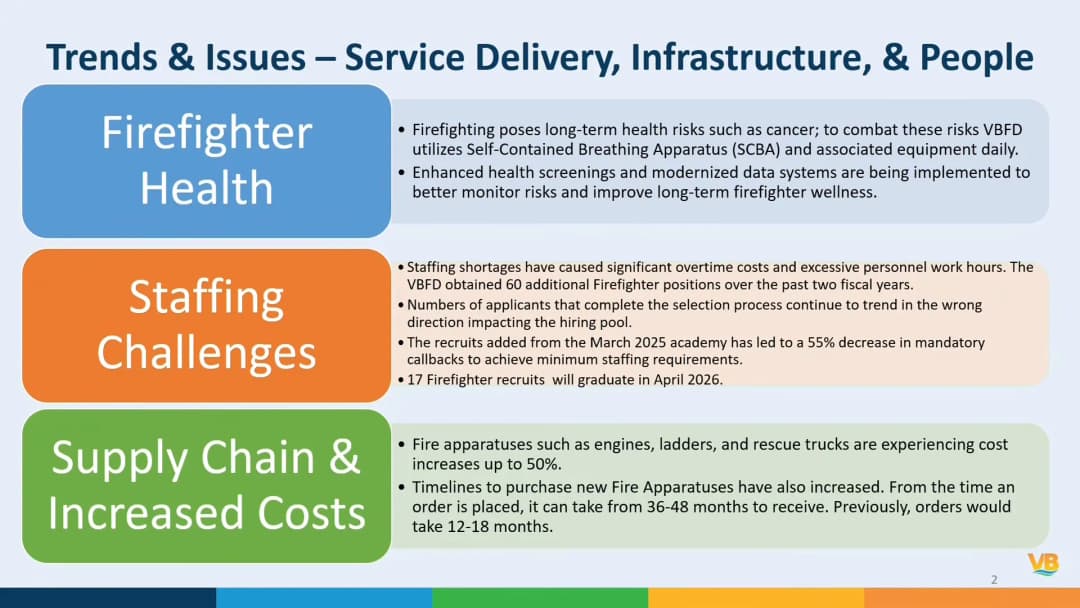
The Virginia Beach City Council held a special formal session on Tuesday, April 14, 2026, following its regularly scheduled formal session. The meeting featured budget presentations from the Housing and Neighborhood Services, Human Services, Fire, and Schools departments. Council members also discussed public safety concerns following recent violent incidents, addressed the Nemo Church matter, and considered recommendations from the Electoral Board regarding tents at the voter registration office. The meeting concluded with a motion to recess into closed session. Discussion Items Housing and Neighborhood Services Budget Presentation Director Ruthie Hill presented the proposed FY 2026-27 operating budget. She noted that one in three households in Virginia Beach are housing cost‑burdened (paying 30% or more of income toward housing). The median rent in 2024 was $1,750, requiring an income of $70,000 per year. Forty percent of seniors aged 75 and over are also housing cost‑burdened. The department has 612 attainable workforce housing units in the pipeline (372 funded at Grand Lakes and Whispering Pines; 240 awaiting funding at Concord Lake Apartments and Solus Springs). A new down payment and closing cost assistance program is planned, funded with $200,000 from freed‑up federal dollars, expected to serve four to five families. The budget also includes a $110,000 pilot for City Detect, an AI‑driven platform for proactive code enforcement, using two cameras on one vehicle. Six code enforcement positions were moved from federal to general fund to free up money for homeownership programs. Council member Stacy expressed strong support for the affordable housing grant program, noting the cost to the city is about $100 per unit per month in foregone tax revenue—a “home run” program. Council member Jennifer inquired about the housing choice voucher waiting list; Director Hill reported the list is being purged from 10,000 down to a target of 2,000, with three attempts to contact before purging. Council member Amelia asked about pet‑friendly sheltering; Hill described a foster program for pets of homeless individuals being explored with animal control. Human Services Budget Presentation Director Eileen Smith presented the Human Services budget. Key trends include opiate abatement programs funded through settlements, including a prevention van and a regional “WOW” treatment van (Wellness on Wheels) with a doctor, nurse, and clinician, expected in about six months. The Supplemental Nutrition Assistance Program (SNAP) serves 28,000–34,000 city residents monthly. New federal work requirements will extend to age 64 (80 hours/month of work, training, or volunteering), effective October 2026 for SNAP and January 2027 for Medicaid expansion enrollees. The state’s error rate of 10.49% could cost $180 million if the federal cost‑share rule takes effect. Medicaid expansion covers 26,000 of the city’s 88,000 Medicaid enrollees; they will face a $35 copay per service starting 2029 and six‑month renewal assessments starting January 2027, doubling staff workload. The department requested one family support specialist (65% state‑funded) and two benefit program assistants (funded by reducing contract staff). Permanent supported housing slots increased from 142 to 202; two vacancies remain. Council members thanked the department for its essential services. Fire Department Budget Presentation Chief Ken Privatz presented the FY 2026-27 operating budget. Key priorities: maintaining service delivery, investing in infrastructure (fleet, facilities, equipment), and investing in staff. Over 40 firefighters have cancer diagnoses; advanced health screenings have reached 60% of staff, expected completion by May. A diesel exhaust capture device was installed on Engine 19; expansion planned. Staffing lost time averages 42 firefighters annually (average 99 days each), resulting in 40,000 lost hours and $1.6 million in salary costs. Overtime is down 50% thanks to previous council approval of 60 positions. There are 35 current vacancies; 17 new firefighters just graduated, and 42 recruits are expected to start by end of April. Applications remain low. The chief requested funding to move toward a 48‑hour work week (from 56 hours). The original request was $4.7 million for a fourth shift, reduced to $3.7 million for incremental relief. Council members expressed support for studying the 48‑hour schedule. Vice Mayor Wilson noted the city has been supportive and suggested a study prior to a major policy change; City Manager Patrick Dehaney agreed that a study could be completed by the fall. Council member Rosemary praised the department. Council member Hutch suggested using any year‑end funds to hire additional recruits to stay ahead. Schools Budget Presentation School Board Chair Brown and CFO Crystal Payton presented the FY 2026-27 budget and capital improvement program (CIP). Total additional revenue of $33.9 million is projected from state (55%), city (12.5%), and other sources. The budget includes $22.6 million for teacher compensation (average 5.23% increase) and $11.1 million for unified staff (average 4.17% increase). Health fund contributions total $14.6 million ($9.2 million for projected employer increases, $5.4 million to strengthen reserve). The CIP funds Princess Anne High School at $330 million (with a progressive design‑build process considering both replacement and renovation options), Tri‑Campus additions set to open August 2028, and system‐wide roof/HVAC replacements. The school board approved the budget. Council members asked about health insurance parity; Payton assured that schools will remain in parity with the city going forward. Council member Stacy expressed concern about the $330 million price tag; Melissa Ingram explained that the progressive design‑build process will compare costs of replacement vs. renovation. Council member Jessica questioned the timeline and noted the need for a comprehensive plan for all aging schools. Council member Michael thanked the schools for their work. Council Comments on Public Safety Mayor Bobby Dyer opened a discussion on recent violence in the city, emphasizing that the problem is national and regional, not just local. He announced plans to reconvene the 757 Youth Violence Task Force, form a new community stakeholders task force, and seek state/federal partnerships, including expedited “pop‑up” legislation. He stated that police must be supported and not criticized unfairly. Council members Stacy, Rosemary, Josh, Amelia, Michael, and Hutch each expressed unified support for the police department and commitment to addressing violence. Council member Michael noted that violence interruptor programs should be part of the toolkit. Council member Josh said the problem is not homegrown and requires resource allocation to police and coordination with other localities. Council member Rosemary emphasized community and family involvement. Council member Hutch cautioned against unrealistic expectations and noted that the busy family season at the Oceanfront tends to dissipate problems. Several members highlighted the need for aggressive enforcement and prosecution. The mayor indicated the Commonwealth’s Attorney will be part of the task force. Other Business Council member Rosemary requested an indefinite deferral of the Nemo Church matter (request to be removed from the historic district) until the state budget is passed, as $500,000 in state funding is tied to it. Council concurred. Council member Rosemary also raised the Electoral Board’s recommendations on tents at the voter registration office, recommending two canopies for major parties. Council member Michael requested a briefing before accepting the recommendations, saying he had concerns and wanted full council discussion. The mayor concurred with scheduling a briefing. Key Outcomes - Nemo Church Deferral: Council agreed to indefinitely defer the Nemo Church item pending passage of the state budget (expected April 23). - Electoral Board Tent Recommendations: Council agreed to schedule a briefing to discuss the recommendations from the Electoral Board before taking action. - Public Safety Task Force: The mayor will form a community stakeholders task force and reconvene the 757 Youth Violence Task Force; the Commonwealth’s Attorney will be included. - Fire Department 48‑Hour Work Week Study: Council members expressed support for a study on moving to a 48‑hour work schedule, to be completed by fall 2026, with a report back to council. - Closed Session: The council voted unanimously to recess into closed session to discuss legal matters (Atlantic Park, public safety, real property in District 2, and personnel appointments).
The Virginia Beach Planning Commission held an all-day meeting on April 9, 2026, beginning with an informal session (briefing) followed by a formal public hearing. The commission reviewed 17 agenda items, heard public testimony on several, and voted on recommendations to City Council. A key topic was a briefing on data center proliferation and the need for updated regulations, leading to a motion to send a letter to City Council. Consent Calendar - Items 1, 3, 5, 12, 14, 15, 16 and the minutes of prior meetings were approved by consent. These included: adding cemeteries/columbariums/crematories/mausoleums to industrial districts (Item 1); a subdivision variance for a Seven Brew coffee shop at 1605 Laskin Road (Item 3); an alley closure for 4502 and 4504 Myrtle Avenue (Item 5); a conditional use permit for a home-based wildlife rehabilitation facility (Item 12); and three short-term rental conditional use permits at 213 16th Street and two units at 4005 Atlantic Avenue (Items 14-16). Public Comments & Testimony - Item 2 – Lighthouse Development LLC (Ash Avenue subdivision variance): Wayne Beagle and Shirley Williams, property owners on Ash Avenue, expressed strong opposition due to chronic flooding in the area. They described repeated flooding events and frustrations with city inaction. Councilmember Dr. Amelia Ross Hammond attended to hear the concerns. The applicants noted the proposal would not increase density but would improve lot sizes. - Item 4 – Schroeder alley closure (Croatan): Stephen Donini and Ashley Donini, owners of 624 Surfside Avenue, spoke in opposition. They stated they had invested over $60,000 in improvements on the alley, were unaware of the property lines, and argued the closure should reflect historical use. The applicant’s attorney countered that the Schroeders had legal rights to half the alley and the opponents were encroaching on city property. - Item 8 – Montessori Schoolhouse LLC family daycare home: No public speakers were signed up, but the commission noted eight letters of support and five letters of opposition from neighbors concerned about traffic, noise, and property values. - Item 10 – Colin Nannary e-bike rental business: Debbie Jeter and Hatcher Jeter, neighbors at 3700 Sandpiper Road, spoke in opposition citing safety concerns, reckless e-bike use, and lack of bike lanes. James Barton, the applicant’s father, spoke in support, emphasizing safety measures and economic benefits. The applicant clarified the business would rent only Class 1 and 2 e-bikes with geofencing and GPS tracking. - Item 11 – Southside Barbell LLC gym: No public speakers were present. The applicant requested an indefinite deferral to pursue a professional parking study. - Item 13 – Pembroke Square Associates (Pembroke Mall redevelopment): The applicant requested minor modifications to conditions regarding sidewalk width and the definition of “street” in the form-based code requirements. No public speakers. Discussion Items - Data Center Briefing: Zoning Administrator Hannah Sabo presented an overview of data centers, their energy and water use, noise impacts, and regulatory gaps. Commissioners discussed the lack of specific zoning tools in Virginia Beach compared to other localities (e.g., Fairfax, Loudoun, Prince William) and the urgency to address potential applications. The commission agreed to send a letter to City Council highlighting the need for updated regulations. - Comprehensive Plan Transition: Staff discussed how the pending adoption of the 2040 Comprehensive Plan (scheduled for City Council on April 21) would affect applications submitted under the 2016 plan. Staff noted that applications would still be evaluated against the 2016 plan but the commission could consider conformance with the new plan. Key Outcomes - Item 2 – Lighthouse Development LLC: Approved (10-0). The commission recognized the flooding concerns but noted the variance only slightly enlarges existing buildable lots and does not increase density. Councilmember Ross Hammond pledged to advocate for drainage improvements. - Item 4 – Schroeder alley closure: Approved (10-0). The commission determined the street closure was routine and that ownership disputes are a civil matter outside the commission’s purview. - Item 6 – Commonwealth Brewing Company extension: Approved (9-0) with a modified condition extending the deadline to 180 days from City Council approval (approximately November 2026). - Item 8 – Montessori Schoolhouse LLC: Approved (9-0) with a modified condition limiting the number of children to eight (instead of twelve) to address neighborhood concerns. The applicant agreed. - Item 10 – Colin Nannary e-bike rental: Approved (9-0) with added conditions limiting the fleet to 25 Class 1 and 2 e-bikes, requiring helmets and safety education, and enforcing geofencing within Sandbridge. - Item 11 – Southside Barbell LLC: Indefinite deferral granted (9-0) at the applicant’s request to allow time for a professional parking study. - Item 13 – Pembroke Square Associates: Approved (7-0-2) with the modified condition removing the word “sidewalks” from Condition 8, as requested by the applicant. Commissioners Biler and Plumley abstained due to business affiliations. - New Business – Data Centers: The commission voted (9-0) to authorize the chair to draft and send a letter to City Council regarding the secondary impacts of data centers and the need for updated zoning regulations. The letter will include reference to the Joint Legislative Audit and Review Commission (JLARC) study and other relevant materials.
The Virginia Beach City Council met on April 8, 2026, for an afternoon session that included a planning staff briefing on 17 items for the April 21 public hearing, presentations on the FY 2026-27 budgets for Emergency Communications and Citizen Services (ECCS), Emergency Medical Services (EMS), and the Police Department, followed by council liaison reports, a consent agenda, public hearings, and resolutions honoring Captain David L. Gray and the Virginia Beach Mustangs. The meeting also featured a public hearing and council debate on the open-space acquisition of five lots near Crab Creek for $2.6 million. Consent Calendar - Ordinance authorizing a lease agreement with Virginia Pickleball Classic LLC for city-owned property at 928 South Birdneck Road. - Ordinance to donate 75 Taser X2 handles and accessories to the Powhatan County Sheriff’s Department. - Ordinance to accept and appropriate $23,055.20 from the Virginia Office of Emergency Medical Services for EMS training programs. - Ordinance to accept and appropriate $5,000 from the Virginia State Police HEAT Program for motor vehicle theft reduction. - Ordinance to transfer $3.2 million within the FY 2025-26 Department of Public Works operating budget for capital outlays. - All consent items were approved by a vote of 9-0. Public Comments & Testimony - Crab Creek Open Space Acquisition (Item K2): - Christy Everett (Hampton Roads Director, Chesapeake Bay Foundation) spoke in strong support, stating the acquisition protects the integrity of Pleasure House Point, provides flood protection and habitat, and leverages $300,000 in state grants. She read comments from Wetlands Watch emphasizing long-term resilience. - Diana Howard (citizen) opposed, questioning the $2.6 million price for a half-acre property assessed at $152,000 and expressing concern about property tax impacts. - Karen Forget (Director, LRNow) spoke in support, highlighting public use, wildlife habitat, water quality benefits, and the careful vetting by the Open Space Advisory Committee. - Ronna Marsh (WebEx speaker) opposed, arguing the price vastly exceeds assessed value and raising conflict-of-interest concerns because several council members received campaign donations from the developer. She suggested recusal was needed. Discussion Items Planning Briefing (April 21 Hearing Preview) - Caitlin (Planning Staff) presented 16 items for the April 21 hearing, including: - Modification of proffers for a 244,000 sq ft VA outpatient facility on Northampton Boulevard (622 employees, 1,250 parking spaces, height deviation to 64 ft). Planning commission recommended approval unanimously. - Modification of proffers for an 81,000 sq ft retail center on the same parcel. No opposition; unanimous recommendation. - Conditional rezoning and CUP for a bulk storage yard on London Bridge Road. Council member Barbara questioned the definition of “light industrial”; staff agreed to review. - CUP for an indoor recreational facility parking lot expansion on Parliament Drive. Planning commission recommended approval with a condition on trail connection alignment. - Conditional rezoning and CUP for a three-story self-storage facility on South Rosemont Road (one letter of opposition; recommended approval on consent). - CUP for a home-based wildlife rehabilitation facility (one support, one opposition; recommended approval). - CUP for a 160-unit multifamily development in the Pembroke SGA (planning commission 10-0-1). - CUP for low-speed vehicle sales on Shore Drive (one opposition; recommended approval). - Alternative compliance request for a 131-unit condominium project at Pacific Ave and 22nd St (height increase to 110 ft; planning commission unanimous with condition prohibiting short-term rentals). - Ordinance to adopt the Imagined VB 2040 Comprehensive Plan; a modification to remove a Type 1 neighborhood from the Shore Drive North Great Neck Center boundary. Council member Barbara requested a transcript of prior discussion about the “green line” context area change. - Ordinance to remove the NIMO Church Historic and Cultural District: Planning commission recommended denial (8-3) after receiving three letters of opposition and hearing eight speakers evenly split. Council discussed the high cost of historic maintenance, state budget funds ($500,000 proposed), and the voluntary nature of the district. Council expressed desire to explore financial assistance mechanisms. - Ordinance to regulate roll-off containers in residential districts (one container allowed for 30 days per six months; CVBIA supportive; planning commission unanimous). Budget Presentations - ECCS (Jada Lee): - Reported use of AI for non-emergency call handling (18 months) and new AI software for 100% quality assurance of 911 calls, described as a “game changer.” - Staffing challenges: 7 vacancies reduced from budget due to longevity; using traveling dispatchers to fill gaps. Hiring and retention bonuses in place. Quarterly fireside chats and stay interviews conducted. - Budget transfer for 311 after-hours public utilities calls increased from $83,424 to $141,396 with a 3% annual escalator. - Projected academy starting July 9, 2026. - EMS (Chief Jason Stroud): - Requested 12 positions: 10 uniformed paramedics, a fleet/facilities coordinator, and an administrative volunteer support position, all funded by the self-sustaining Compassionate Building Program (projected $14.5M annual revenue). - Fleet of 47 ambulances on track; standardization policy endorsed by Rescue Council. - Facility overcrowding noted (3 people in rooms designed for 1 in older shared stations). - Staffing needs: 32 additional uniformed employees needed to reach goal of 20 ambulances during peak periods; incremental approach by adding 10 now. - Police Department (Chief Lantigate): - Reported 86 sworn vacancies (up from 45 a year ago), partly due to the trauma of losing officers in 2025. New recruiting campaign with Studio Center showing 15% increase in initial applications. - Funding requests: continued recruitment funding (initial allocation from asset forfeiture), Peregrine AI software platform (integrates 15 data sets for investigations), and 5 Special Conservators of the Peace (non-sworn) to handle transport of individuals under emergency custody orders (ECOs/TDOs), freeing up sworn officers. Currently 1.7% of CIT calls consume over 10-12% of officer time. - Drones as first responders program expected within 30 days. School zone camera program expanding. - Community engagement emphasized as key to trust and recruitment. Training facility needs (LEDA) noted as critical for future recruitment. - Goal of 5% reduction in part-one violent crime in 2026. Council Liaison Reports - Barbara reported on the ITA committee meeting and requested status of the ITA plan update. - Hutchison reported on COG grant committee: second round had $1.6 million in eligible requests; committee awarded $358,000 but seeks authority to add approximately $18,000 to fully fund recommended grants. Council agreed to allow budget transfer via city manager’s signature. - Michael reported visiting the 531 Memorial construction site (unveiling May 31) and holding a District 3 community summit. - Rosemary noted the voucher parking program is now live. Key Outcomes - Consent Agenda: Approved 9-0. - Crab Creek Open Space Acquisition (K2): Approved 10-0 after debate. Councilman Shulman defended the $2.6 million price as prudent due to strategic location, matching grant funds, and Open Space Advisory Committee vetting. No recusals despite campaign donation concerns raised by a speaker. - COG Grant Funding: Council approved the additional $18,000 allocation via budget transfer to balance grants awarded from the COG fund. - Direction to Staff: - Staff to review and report back on the definition of “light industrial” in zoning ordinance (requested by Council member Barbara). - Transcript of prior council discussion on “green line” context area change to be provided (requested by Council member Barbara). - City manager authorized to execute grant agreements for open space acquisition. - Honors: - Resolution recognizing Captain David L. Gray on his retirement, proclaiming April 8, 2026 as “Captain David L. Gray Day.” - Resolution honoring the Virginia Beach Mustangs Youth Football Organization for their 2025 national championships and community impact.
The Virginia Beach City Council held a special formal session on Tuesday, March 24, 2026, beginning at 5:00 PM, to conduct a public hearing and consider a conditional rezoning and modification of proffers for the former Signature at Westneck golf course property at 31 Arnold Palmer Drive. The proposal by Harrison & Lear Incorporated, JBWK LLC, and White Clover LLC sought to rezone approximately 200 acres from P1 Preservation and PDH1 to conditional P1 and PDH2 to allow development of 143 age-restricted (55+) single-family homes and restoration of a nine-hole golf course, clubhouse, and other amenities. The meeting was broadcast on cable TV, Virginia Beach.gov, and Facebook Live. Approximately 110 speakers signed up, and the hearing lasted several hours, including public testimony and council deliberation. Consent Calendar - No consent calendar items were noted; the sole item was the public hearing on the rezoning application. Public Comments & Testimony - Applicant’s Presentation (Chris Pocta, attorney for Harrison & Lear): Described the proposal as a compromise shaped over four years of community engagement, including 10 committee meetings, 8 hosted meetings with over 560 surrounding homeowners, direct outreach to over 1,200 households, and 6 village-level sessions. The plan entails 143 age-restricted homes on 62 acres (PDH2), with the remaining 135 acres preserved as P1, including a nine-hole golf course, multi-use trails, wet ponds, reforestation, and conservation. Pocta highlighted voluntary proffers requiring the golf course to be operational before homes can be completed, and future ownership of the golf course to be conveyed to a new HOA. He noted that the current open space accessible to residents is only 3.79%, while the plan would increase that to 40.1%. - Jonathan Skinner (President, Harrison & Lear): Emphasized extensive community outreach and modifications to the plan based on feedback. He described converting 14.66 acres of usable accessible open space to 154 acres, a tenfold increase. He also stressed stormwater improvements and a traffic signal at Signature Drive and West Neck, funded by the developer. - Audrey Leishman (IRP resident, co-visionary of the golf course): Expressed personal connection to the community (Virginia Beach native, built home on former 5th green) and described efforts to negotiate a 50-year lease with two 15-year extensions to operate the golf course. She confirmed ongoing talks with clubhouse owner Noel Gonzalez. - Mark Leishman (PGA Tour winner): Committed to investing several million dollars of personal funds into the golf course, aiming for a family-friendly, high-quality nine-hole course with practice facilities. He stated they want to start construction as soon as possible. - Mike Bennett (Commonwealth Golf Asset Management): Provided a construction timeline of 12–14 months, noting that the golf course corridors already exist and the restoration is straightforward. He cited his 30 years in the golf industry and role as Mid-Atlantic president of the National Golf Course Owners Association. - Billy Allman (land planner): Described the open space network, focusing on reforestation and managed meadows, with a natural pioneer forest emerging. The plan includes mowed edges for trails and selective vegetation management. - Gretchen Heel (Hampton Ridge Chamber): Expressed full support for the project, citing additional housing stock critical for economic development and the golf course as a tourist attraction. - Brian Bowers (IRP resident): Supported the proposal, citing a seven-year history of disrepair and calling the project the only viable option. He mentioned a nearby fire and rodent problems. - David Smith (IRP resident): Supported the proposal, describing the overgrown property as a “wild pest-ridden thicket” and expressing hope for restored green space and golf. - Heather Courtraye (IRP resident): Spoke about safety concerns from the abandoned property, including encounters with raccoons, homeless people, and a mentally troubled man. She supported the restoration as a way to regain safety. - Jenny Perry (Coastal Virginia Building Industry Association): Supported the proposal as a solution to the housing shortage (100,000 unit shortfall across Virginia). She noted that age-restricted housing helps free up homes for families. - Cheryl Land (Baylake Pines): Supported the project, citing the need for senior housing and the eyesore of the defunct golf course. - Marie Grendel (Rosecrest Village resident): Supported the balanced approach of nine-hole golf and limited housing, preserving green space and restoring a community centerpiece. - Mark Dewhurst (IRP resident): Supported the proposal as a “common sense practical compromise” that provides needed housing, restores open space, and improves stormwater management at no taxpayer cost. - Fred Giles (IRP resident): Initially opposed earlier proposals but now supports the nine-hole golf course concept, calling it a substantial improvement to the neighborhood. - Jim Cox (Westneck resident): Strongly supported, denouncing the SOTAR group (Save Our Transition Area) for aggressive tactics and intimidation. He said the proposal increases open space by 1000% and provides a top-level golf course. - Colleen Craig (Westneck resident): Supported the proposal, citing a 10% sales rate in Westneck since Harrison & Lear began work, and disputed SOTAR claims about lot premiums and community opposition. - Suzanne Feldman (Westneck resident): Supported the proposal, noting the need for a traffic light at the intersection (funded by developer) to improve safety, especially for older drivers. - Marcy Rush (Westneck resident): Represented the “silenced majority,” describing intimidation by SOTAR, including threats, social media attacks, and FOIA weaponization. She pleaded with council not to let the majority rule. - Mike Brewer (IRP resident): Recounted a fire on the property in March 2023, describing his panic and reliance on firefighters. He supported the proposal as the best available option. - Tim Keating (IRP resident, retired Navy four-star): Asked for support to restore Indian River Plantation and Westneck to the ambiance that attracted him to retire in Virginia Beach. - Brian Levine (IRP resident): Highlighted a key concession: the property owner will give the golf course and open space to the new HOA, ensuring community control. He argued no other option exists. - Ben Loyola (IRP resident, board member): Spoke on behalf of Indian River Plantation Homeowners Association, expressing full support. He described the abandoned property as a safety hazard (fire, rodents, snakes) and a financial burden, and said 100% of IRP residents in a poll wanted a solution. - Tom Scott (COMPASS): Pointed out that 86% of speakers at zoning hearings are typically opposed, but here over 50 speakers spoke in support, indicating strong community backing for the proposal. - Jeff Hunn (Attorney for Westneck HOA): Opposed the application, arguing it violates zoning ordinance Section 1100 (no new PDH districts) and density/open space guidelines. He claimed the developer used intimidation through a supplemental declaration that says the property is not intended for golf, and that litigation has established the HOA’s interest in the golf course. - Sharon Williams (Westneck HOA President): Opposed rezoning, stating the board supports maintaining transition area rules and that a golf course does not require rezoning. - Nancy Connew (Westneck resident): Opposed, saying P1 zoning should be honored and calling the proposal a “divide and conquer” tactic. - Joy Sharples (Westneck resident): Opposed, pointing out that the map shows construction access through Wordsworth, disrupting walking and quality of life. - Ted Quinter (Browningstone condominium board president): Opposed, arguing that approval would break the covenant with citizens, set a dangerous precedent, and that the proposal does not address affordable housing (homes priced $575–750K). He cited the Fourth Circuit Court ruling that Westneck HOA can enforce maintenance. - Numerous other opposition speakers raised concerns about construction duration, emergency access, health impacts on seniors (asthma, COPD), loss of property values, and the irreversibility of rezoning P1 land. - WebEx speakers: Deborah Schumate and John Schumate supported the proposal as a workable compromise; Ken Landville opposed, citing alternative legal remedies through the Fourth Circuit ruling. - Rebuttal (Chris Pocta): Noted that P1 land has been rezoned at least three times before; emphasized that the golf course sits between two communities and support came from both; argued that proffers are part of the rezoning process and not “broken promises.” Discussion Items - Councilmember Barbara Henley moved to deny the application, citing the rezoning request does not align with density/open space guidelines (2.79 units/acre vs. 1 unit/acre recommended) and would set a precedent threatening open space across the city. She stated the character of Westneck would be destroyed. - Councilmember Stacey (opposed): While respecting the applicant, he noted the animosity created by the owner’s neglect and the forced nature of the proposal. He worried about a precedent for developers if this is allowed. - Councilmember Ross (approved): Emphasized change is constant; the property is a nuisance; housing is a high priority (Navy request); and health/safety concerns compel approval. - Several other councilmembers spoke briefly. The first motion to deny failed 3-8. - A substitute motion to approve was made and seconded. It passed 9-2. Key Outcomes - The City Council voted 9-2 to approve the conditional rezoning and modification of proffers for the Preserve at Westneck, allowing development of 143 age-restricted homes and restoration of a nine-hole golf course. - The motion to deny the application failed 3-8. - The approval includes proffers requiring the golf course to be operational before home construction can complete, and future conveyance of the golf course and open space to a new HOA. - The developer will fund a traffic signal at Signature Drive and West Neck Road. - Council directed that the developer will be expected to be good neighbors, and the city will continue to monitor code compliance. - The decision sets a precedent for transitioning P1 preservation land to residential use within the transition area, which opponents argued could have far-reaching implications for other protected lands in Virginia Beach.
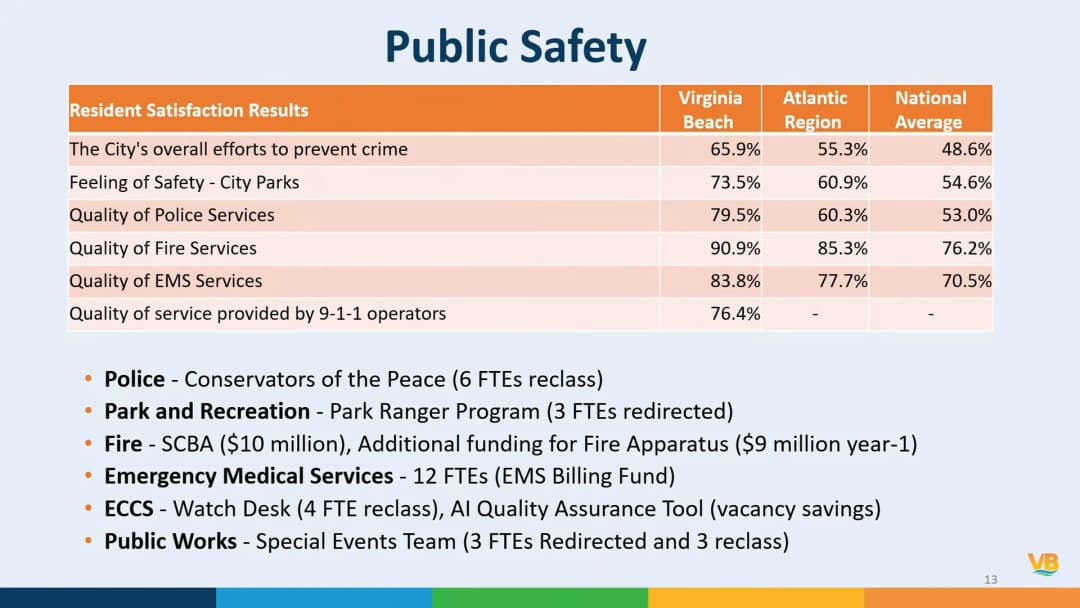
On March 25, 2026, the Virginia Beach City Council met to receive an award for resident satisfaction and to hear the proposed FY26-27 operating and capital budgets from the city manager and budget director. Council members discussed tax relief, infrastructure investments, and workforce compensation. Presentation of the ETC Resident Satisfaction Survey Award - City Manager Monica Krosky announced that Virginia Beach received the ETC Institute's "Leading the Way" award, which recognizes cities scoring at least 192 (composite across service quality, customer service, and value for tax dollars). Virginia Beach scored 195, placing it in the top 10% of large cities. - The award is 11 pounds, representing the 11 cities that initially participated in the survey. - Krosky noted that the city scored 20 percentage points or higher than other large cities in 15 service areas, including parks, libraries, schools, and bulky item pickup. - Mayor thanked all city employees, volunteers, and organizations for their contributions. FY26-27 Proposed Operating Budget - Budget Director Kevin presented the $2.88 billion operating budget, emphasizing that it maintains all existing services, avoids service interruption, and includes tax relief, workforce investments, and infrastructure funding. - Key revenue drivers: Real estate assessment growth projected at 6% (vs. assumed 2.8%) and a $11.3 million reduction in VRS contributions created an additional $33.4 million in capacity. - Tax relief: The proposed budget includes a 10.1% personal property tax credit (up to first $20,000 of vehicle value), estimated to save $96 per household, benefiting both homeowners and renters. This was chosen over a real estate tax rate reduction to reach more residents. The credit is sustainable for at least two years per council direction. - Workforce compensation: 3.5% general increase (step plan employees get step + 0.5%); additional $7.5 million for mid-year market salary adjustments for non-public safety employees (effective Jan 2027). - Infrastructure: Additional $42 million to fully fund Great Neck Rec Center construction; $4.5 million for design of Princess Anne and Bayside rec centers; $10 million for SCBA replacement; $11.2 million for fire apparatus; $250,000 for Linhaven Marina restrooms. - Public safety initiatives: Reclassification of six police officer positions to conservators of the peace; establishment of a three-FTE park ranger program; 12 new EMS FTEs (funded by EMS billing fund); AI tool for ECCS call audit logs. - Other departments: Parks & Rec redirected 12.5 vacancies; libraries propose non-resident digital access fee ($10-$35); housing department plans technology for remote code enforcement; special events team (6 FTEs) established in Public Works. - Health insurance: Employer contribution increases 15%; employee premium increases 10% (first increase since 2019) to maintain fund sustainability. - Schools budget: $33.9 million baseline revenue growth; proposed 5.2% average teacher raise and 4.2% for non-instructional staff; net reduction of 52.75 FTEs due to grant expirations. FY27-32 Capital Improvement Plan (CIP) - Six-year CIP totals $5.3 billion, with $49.8 million appropriated in year one. - 10 new projects added; no projects deferred for first time in three years. - Notable projects: Holland Road Phase 1 fully funded ($11.9 million addition); Aquarium modernization ($3 million for schematic design); courthouse reinvestment ($20.2 million for elevator/ADA); resort parking ($25 million); Pemphroke Square public parking (SSD establishment). - 47 projects totaling $547 million remain unfunded. Council Discussion and Comments - Councilmember Rosemary thanked staff and asked about the overall budget increase (3.27%), the $6 million debt service increase (attributed to general government bonds), and teacher salary components. He expressed concern about the 12% combined meals tax (city 6% + state 6%). - Councilmember Hutch agreed with the personal property tax credit as reaching more citizens and commended infrastructure reinvestment. He requested brief presentations from police and fire chiefs on LITA and potential fourth shift (Norfolk's move). - Councilmember Cash thanked staff and confirmed that the Chinnaval Ternpipe Phase 2 is fully funded. - Councilmember Jennifer praised the personal property tax relief for reaching renters and working families. - Councilmember Stacy noted the budget increase aligns with inflation and supported the PISC recommendations. - Mayor acknowledged that some council members still desire department-level presentations during budget workshops; staff will adjust format accordingly. Next Steps - Four budget workshops scheduled through May; public hearings will be held; budget adoption and vote scheduled for May 12, 2026. - Council will discuss regional grants, revenue sharing formula (parity for school employee health insurance), and arts/culture dedication fund allocation.