Browse by city
Date range
Search help

Search titles, summaries, topics and stored transcripts together. Keywords may match separately; put the whole query in double quotes for a phrase. Matching follows word analysis, so punctuation is not exact. Both dates are included. Documents are not searched.

SHOWING 11–20 ENTRIES
11
OCT 7, 2026 · WASHINGTON, DISTRICT OF COLUMBIA · COUNCIL OF THE DISTRICT OF COLUMBIA
Round Table on DYRS's Fifth Rulemaking on Community Placement - October 7, 2026

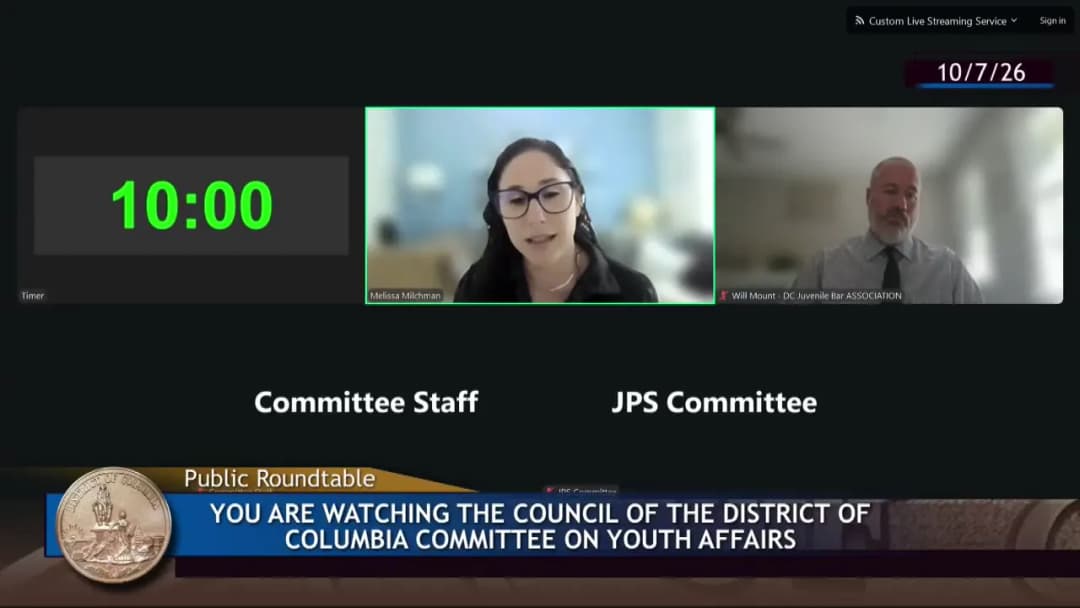
On October 7, 2026, from 12:02 PM to 4:00 PM, the Committee on Youth Affairs, chaired by Ward Five Councilmember Zachary Parker, held a round table in Room 412 of the John A. Wilson building and virtually via Zoom to discuss the Department of Youth Rehabilitation Services (DYRS) fifth rulemaking on community placement of juvenile offenders. The hearing featured testimony from advocates, youth, and government witnesses regarding proposed changes that critics argue undermine due process and increase secure detention. Opening Remarks Chairperson Parker delivered an opening statement expressing serious concerns about the proposed rules. He noted that research shows 70% of juveniles nationally are rearrested within two years of secure detention and 78% of those released from New Beginnings in 2023 had later justice system involvement. He argued that the rules reverse progress, remove safeguards, and make it extremely difficult for youth to remain in community placements. He questioned the timing of the rulemaking, coming months before a new administration. Public Comments & Testimony - Magdalena Chungas (Council for Court Excellence): Opposed the rulemaking, citing lack of engagement with advocates, expanded grounds for revocation, lengthy pre-hearing detention, and increased exposure to violence. She stated the changes misalign with DC code's least restrictive placement and due process requirements. - Whitney Lockheim (Open City Advocates): Described previous collaborative drafting efforts with DYRS that were abandoned. She criticized the three-business-day appeal timeline, the removal of the three-member panel, and the ability of the director to make unilateral decisions. She asked the committee to press DYRS not to finalize the rule before the new administration. - Raymond New (Open City Advocates): Argued the new regulations completely upend due process by allowing revocation for undefined reasons, placing decision-making solely with the deputy director, and permitting DYRS to appeal unfavorable decisions. He stated the process gives the director control over outcomes. - Melissa Milchman (Coalition for Juvenile Justice): Asserted the rule is inconsistent with national best practices, makes it easier to remove youth from community settings, weakens graduated responses, increases detention, and reduces youth and family participation. She urged alignment with evidence-based approaches. - William Mount (DC Juvenile Bar Association): Highlighted troubling practices where youth are forced to sign agreements without counsel, emergency removal lowered to a "reasonable basis", expansion of mandatory revocation categories from 13 to 20, and the elimination of a neutral panel. He supported recorded hearings and representation but said the rule overall moves in the wrong direction. - Moyanulua Adiosun (Youth Leaders in Action): A young person speaking on behalf of YLA, expressed concern that youth lack voice in placement decisions and that the definition of "danger to self" is too broad, contrary to the 2016 Comprehensive Youth Justice Amendment Act. She called for intervention before removal. - Isabel LeBlanc (Youth Leaders in Action): Criticized the constructive notice provision, which allows hearings without youth present, and the pre-hearing detention for indefinite periods. She argued the changes undermine trust and legitimacy. - Hadiah Bradford Ill (YLA): Testified about systemic failures, including youth sent out-of-state to unsafe facilities and housing discrimination against independent youth. She demanded guardrails and local trauma-informed care. - Tara Martin (Raised 1 Teacher 1 Delaney Martin Foundation): As a parent with experience in DYRS, she emphasized the need for family engagement and criticized the exclusion of parents from the process. - Aquarius Van Garson (former Commissioner, DCHA): Called for redaction of the Honorable Vincent Gray's "kids first" program and proposed a more integrated approach to funding and oversight. - Public Defender Service (PDS) Testimony (Caterina Seminova and Britney Mobley): Provided detailed legal analysis, arguing the rules violate due process by: allowing detention without notice, removing the three-member panel, permitting the deputy director to act as prosecutor and sentencer, and allowing the director to increase restrictiveness on appeal. They highlighted the elimination of the credible messenger program and the expansion of mandatory revocation categories. They noted the overwhelming majority of committed youth are Black and from disadvantaged backgrounds. They read statements from youth expressing distrust in the system. Government Testimony - Director Sam Abbott (DYRS): Stated the regulations were developed to balance due process, rehabilitation, and public safety. He acknowledged the need for changes and said the agency is open to reasonable modifications. He supported mandatory attorneys for hearings, recorded proceedings, and the placement review committee advising the deputy director. He defended the separation of violation determination (hearing officer) from placement decision (deputy director) as a more therapeutic and operationally efficient approach. - General Counsel Ayesha Braithwaite Fluker and Assistant General Counsel Millicent Jones: Explained the drafting process and responded to questions. They noted that the hearing officer would be a licensed attorney (a change they are adopting) and that the notice provision would be revised to include the youth directly. They clarified that the director would not increase restrictiveness on appeal of placement decisions, and agency appeal of violation findings would be limited to material errors of fact or law. Discussion and Outcomes Chairperson Parker pressed DYRS on specific provisions, including notice, detention timelines, the role of the placement review committee, the expansion of mandatory revocation categories (e.g., gang recruitment), and the appeals process. Director Abbott and General Counsel Fluker committed to several revisions: - Youth will receive direct notice of the hearing date and time (previously only counsel). - The hearing officer must be a licensed attorney (removing the possibility of unqualified staff). - The deputy director must "shall consider" the recommendation of the placement review committee (previously "may consider"). - The director will not be able to increase the level of restrictiveness on appeal of a placement decision; the director can only affirm or lower. - Agency appeal of a hearing officer's finding of no violation will be limited to material errors of fact or law. Director Abbott declined to give a specific timeline for finalizing the rules but agreed to provide a comprehensive list of changes to the committee by October 23, 2026. Chairperson Parker indicated he would schedule a follow-up meeting with stakeholders by the end of November. The meeting concluded at 4:00 PM.
JUVENILE JUSTICE 42% · JUVENILE JUSTICE OPERATIONS 33% · PUBLIC SAFETY 10% · YOUTH PROGRAMS 6%
12
OCT 6, 2026 · WASHINGTON, DISTRICT OF COLUMBIA · COUNCIL OF THE DISTRICT OF COLUMBIA
District of Columbia Council 37th Legislative Meeting - October 6, 2026

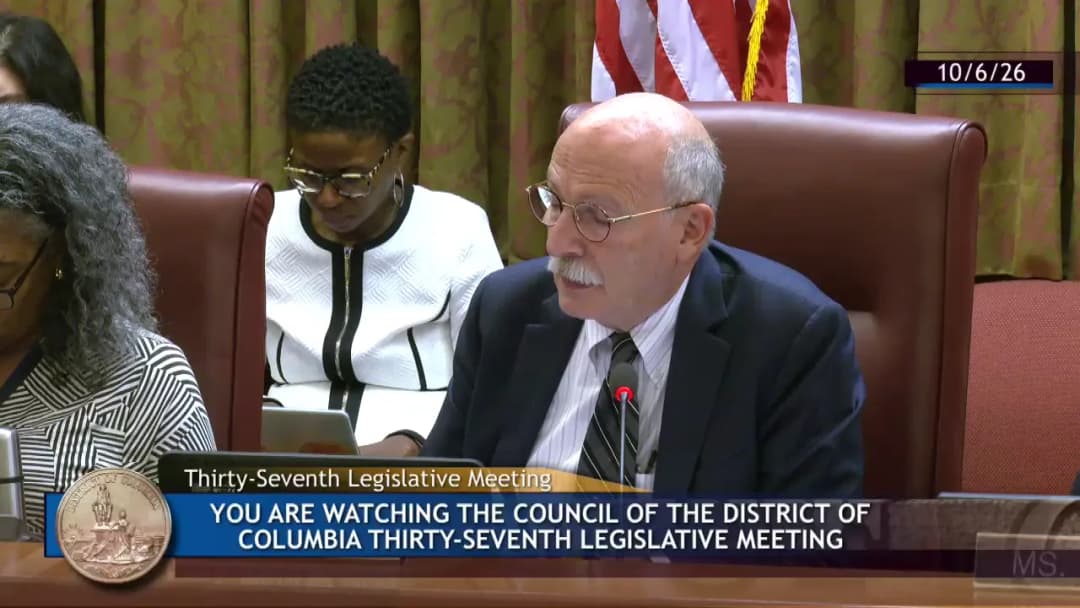
The Council of the District of Columbia held its 37th Legislative Meeting of Period 26 on October 6, 2026, commencing at 12:36 PM in the Johnny Wilson Building. The hybrid meeting addressed a wide range of legislation including utility affordability, parking enforcement, the initiative process, and major transportation funding agreements with WMATA. Consent Calendar - 22 ceremonial resolutions were approved without objection. - Final reading bills for property tax exemptions (Food & Friends, Archdiocese of Washington, Reservoir District) and several Congressional Review emergency measures were approved. - Bill 26-619, the Eric's ID Amendment Act, was pulled from the consent agenda to non-consent for remarks by its sponsors. Discussion Items - Eric's ID Amendment Act (Bill 26-619): Councilmember Allen removed the bill from the consent agenda to recognize advocates Eric Carpenter Grantham and Linda Carpenter Grantham. Councilmembers Allen, Lewis George, Parker, and Trayon White praised the Granthams for their advocacy establishing a non-apparent disability marker (a butterfly symbol) on DC licenses, modeled after a Maryland program that has enrolled over 30,000 residents. The bill passed its final reading unanimously. - Automatic Enrollment for Utility Affordability Programs Act (Bill 26-243): Councilmember Allen presented the bill, noting that energy costs surged 70% between 2017 and 2025 and that low-income households spend 16% of their income on energy. The bill directs DOEE to automatically enroll households eligible for SNAP, TANF, WIC, or Medicaid into utility affordability programs. DOEE estimates this will enroll 31,000 additional low- and median-income households, saving them up to $475 annually on electric bills and $276 on gas. Councilmember Frumin raised concerns about the impact on other ratepayers through tariff adjustments, requesting a specific estimate before the second vote. Councilmember Lewis George strongly supported the bill, citing 25,673 PEPCO disconnection notices in August 2026 (a 218% increase) and stating it is a common sense step to remove barriers to access relief. The bill passed first reading unanimously. - Strategic Parking Enforcement Enhancement Act (Bill 26-16): Councilmember Nadeau moved an amendment in the nature of a substitute, expanding the default list of entities eligible for reimbursable parking enforcement details to include universities and nonprofits, and requiring certification that campus police receive training comparable to DPW. Councilmember Robert White offered an amendment to cut all parking fines in half, citing a 5.7% unemployment rate, 0.8% economic growth, and residents \"drowning in costs.\" The fiscal impact statement estimated a revenue loss of $10-20 million. The amendment failed. Councilmember Silverman offered an amendment requiring a council hearing one year after implementation. Chairman Mendelson opposed legislating council process, stating he would hold a hearing as Chair of the Committee of the Whole if the next chair did not. The amendment failed. The underlying bill as amended passed with Councilmembers Trayon White and Robert White voting no, and Councilmembers Henderson, Parker, Felder, and Lewis George voting present. - Fair Initiatives Lend Transparency to Every Resident (FAIR ELECT) Amendment Act (Bill 26-436): Councilmember Bonds moved an amendment clarifying that the Board of Elections must accept an initiative measure unless specific statutory grounds for refusal exist. Councilmember Parker expressed concern the language was not clear enough to force a yes-or-no vote, but his competing amendment was not taken up after debate was closed on Bonds\' amendment. Councilmember Bonds confirmed her legislative intent was limited to grounds stipulated in existing law. Councilmembers Silverman and Parker voted against the final bill, with Silverman arguing the bill does not address the core issue of complex policy initiatives bypassing the legislature. - Climatizing Our Overheated Living Spaces Regulation Amendment Act (Bill 26-285): Councilmember Henderson moved a successful amendment changing the effective date to April 1, 2027, from May 1, 2027, to allow tenants to benefit from the cooling requirements during the spring of 2027. The bill passed unanimously. - Homeless Services Contract Adjustment Emergency Act (Bill 26-850): Councilmember Frumin presented the bill to address $3.9 million in 2026 federal Service Contract Act (SCA) compliance costs for homeless shelter providers. The bill creates an expedited equitable adjustment process at OCP. Councilmember Frumin amended the timeline from 45 to 60 days at the mayor\'s request. Councilmember Robert White added a technical amendment clarifying that the pet breed ban and pet rent/fee provisions from a previous act apply to leases beginning after October 1, 2026, rather than retroactively. The bill passed unanimously. - WMATA Emergency Legislation: Councilmember Allen presented three emergency measures at the request of the Mayor. - Stadium-Armory Station Improvements: Approved a reimbursable agreement up to $300 million for station capacity expansion related to the RFK campus redevelopment. - Gold Line Bus Rapid Transit Phase 1: Approved a $5.2 million agreement for planning, environmental review, and 30% design of a BRT route from Union Station to RFK Stadium, extended to Benning Road. Councilmember Felder urged inclusion of the Benning Road extension in Phase 1. - FY27-32 Dedicated Funding Grant Agreement: Approved the district\'s $178.5 million annual contribution to WMATA (not adjusted for inflation) for the next six years. An amendment corrected the measure from a resolution to an emergency act. All measures passed unanimously. Key Outcomes - Decisions and Votes: - Automatic Utility Enrollment (Bill 26-243): Passed first reading unanimously. - Cybersecurity Act (Bill 26-427): Passed final reading unanimously. - Parking Enforcement (Bill 26-16): Passed (Councilmembers Trayon White and Robert White voted no; 4 members voted present). - FAIR ELECT Act (Bill 26-436): Passed (Councilmembers Silverman and Parker voted no). - Cooling Regulation (Bill 26-285): Passed final reading unanimously. - Substance Use/Targeted Outreach Grants Temporary (Bill 26-792): Passed (Councilmembers Henderson and Bonds voted no). - All Emergency and Temporary Acts: Passed unanimously. - Next Steps: - The Automatic Enrollment bill will return for a second reading. - DOEE is directed to implement data-sharing protocols for automatic enrollment. - OCP is directed to process equitable adjustment requests for homeless service providers within 60 days. - WMATA will proceed with Stadium-Armory station improvements, Gold Line BRT planning, and the execution of the new dedicated funding grant agreement. - The next legislative meeting is scheduled for November 10, 2026, at 12:00 PM. The next Committee of the Whole meeting is October 20, 2026.

PROCEDURAL 20% · PARKING REGULATIONS 17% · PUBLIC ENGAGEMENT 11% · ENERGY AFFORDABILITY 10%
13
OCT 2, 2026 · WASHINGTON, DISTRICT OF COLUMBIA · COUNCIL OF THE DISTRICT OF COLUMBIA
Committee of the Whole Hearing on Nine Legislative Measures – October 2, 2026

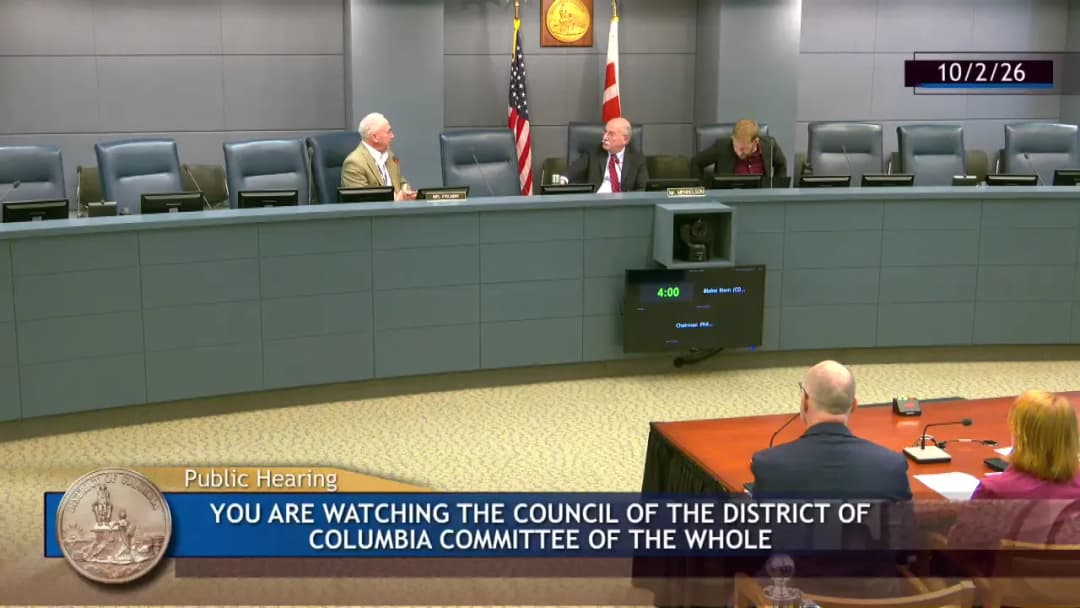
The Committee of the Whole of the Council of the District of Columbia, chaired by Phil Mendelson, held a public hearing on Friday, October 2, 2026, from 10:27 AM to approximately 2:30 PM (with a recess from 11:48 AM to 1:41 PM) in Room 412 of the John A. Wilson Building. The hearing covered nine legislative measures: three street naming designations, four public alley or street closures, and two transfers of jurisdiction from the National Park Service to the District. The record will remain open until 5:00 PM on October 16, 2026. Consent Calendar (Routine Approvals) - Bill 26-589 (William Brockenberry Way) – Symbolic designation of 4500 block Livingston Rd SE as William Brockenberry Sr. Way and 4600 block as William Brockenberry Jr. Way. DDOT supports; cost $1,030 for four signs (absorbed by DDOT). No objections. - Bill 26-626 (Dr. William Keelan Collins Sr. Way) – Symbolic designation of 100 block 49th St NE. DDOT supports; cost $380. No objections. - Bill 26-705 (William Spence Spencer IV Way) – Symbolic designation of 48th Pl NW. DDOT supports; cost $180. No objections. - Bill 26-689 (Closing of a Portion of a Public Alley in Square 785) – Closing a 261 sq ft unimproved pedestrian alley to be absorbed into two abutting residential lots at 308 and 310 A St NE. All adjacent property owners support; ANC 6C voted unanimously in favor; DDOT supports with no conditions; Surveyor notes no objections. Applicants Donna McLean and Joe Hanson testified in support. - PR 26-544 (Transfer of Jurisdiction – Square 1299, Wisconsin Ave) – Transfer of 709 sq ft of NPS land into DDOT right-of-way at Whitehaven St NW to facilitate redevelopment of a vacant office building into a multifamily residential building. DDOT supports; Surveyor awaiting NCPC review. Applicant (Grosvenor) testified. - PR 26-581 (Transfer of Jurisdiction – Francis Field) – Transfer of approximately 22,294 sq ft (0.51 acres) in Rock Creek Park to consolidate prior agreements and allow improvements to Francis Dog Park, Pool, basketball/tennis courts, and the John Francis Education Campus athletic field. Intentional exclusions: southern field and community gardens remain with NPS. ANC 2A (formerly 2B) supports. DDOT, DGS, and DPR testified in favor. No opposition. Public Comments & Testimony - William Brockenberry Way – Damon Brockenberry (son) and Teresa Brockenberry Lee (sister) offered heartfelt testimony about William Brockenberry Sr. and Jr., describing their decades of service to D.C. youth, seniors, and the bereaved. They urged passage of the bill. - Square 785 Alley Closing – Donna McLean and Joe Hanson, the applicants, testified about security and nuisance issues caused by the unsecured alley and the benefits of absorbing it into their properties. - Georgetown Boathouse Project – No public testimony opposing; witnesses included Christopher Cohen (applicant attorney) and councilmember Fruman (voicing support and clarifying land transfer sequence). Discussion Items - Bill 26-601 (Closing of a Portion of a Public Alley in Square 762, Capitol Hill) – Applicant Clear Plains LLC seeks to close a 918 sq ft dead-end alley to consolidate four lots for renovation of historic buildings into retail and office space. ANC 6B voted support in 2024; a community benefits agreement was reached. DDOT supports but with three conditions: (1) applicant compensates DDP $7,538 for public asset removal, (2) applicant demonstrates subdivision of lots 823, 839, 842, 843 into a single record lot, and (3) applicant files building permit application for a single building. Chair questioned why subdivision must occur before alley closing. Surveyor reported no objections from agencies or utilities. - Bill 26-642 (Closing of a Portion of a Public Alley in Square 571, CCNV Shelter) – CCNV seeks to close 300 sq ft of south east-west alley to unlock development potential for a modernized homeless shelter campus on D St NW. Original application also included a larger northern alley closure but was withdrawn after discussions with property owner First Potomac. CCNV will grant a non-exclusive easement to preserve access for the adjacent Federal Bureau of Prisons facility. ANC 6E supported in 2025. DDOT supports with three conditions: (1) record easement with BOP, (2) obtain building permit approval for new shelter, (3) receive public space construction permit for rerouting power feed to street lights and trash compactor. Chair expressed concern that condition 2 (building permit) is impractical because the alley closing is needed to create the required building site. The surveyor noted NCPC approval subject to the easement. Chair directed parties to resolve conditions. - Bill 26-772 (Closing of Unimproved Portion of 35th St NW, Georgetown Boathouse) – Closes 7,426 sq ft of a paper street under the Key Bridge to facilitate a tri-party agreement among Georgetown University, NPS, and the District for non-motorized boating activities and construction of a university boathouse. Proposed transfer of jurisdiction (PR 26-805) is companion legislation. ANC 2E, NCPC, and all utilities support; Washington Gas initially objected but later lifted objection after confirming no infrastructure in the closure area. Chair noted the bill is part of a larger land transaction that also includes a future disposition bill (B26-740). No opposition. - PR 26-805 (Transfer of Jurisdiction – Boathouse Sites D and E) – Transfers NPS jurisdiction over two parcels along the Potomac (approx. 70,000 sq ft) to the District to implement the boathouse project. Surveyor testified that NCPC and ANC 2E responses are still pending. DDOT provided written support. Chair stated a separate hearing on this resolution may not be held. Key Outcomes - Record will remain open until 5:00 PM on October 16, 2026, for additional written testimony. - Chair indicated most bills are likely to be moved (voted on) during the current council period (fall 2026), subject to resolution of outstanding conditions. - For Bill 26-601: Conditions from DDOT need to be addressed; chair suggested filing easement concurrently with alley closing plat. - For Bill 26-642: Chair voiced skepticism about the building permit condition and asked DDOT and applicant to reconcile; other conditions appear manageable. - For Bill 26-772 and PR 26-805: No obstacles; chair expects to move forward but noted the need for NCPC and ANC responses on the transfer resolution. - For PR 26-581: Surveyor highlighted that the transfer plat includes portions of lots 833 and 834 in Square 13, not only lots in Square 1299 as stated in the resolution title; language may need correction. - No votes were taken at the hearing.

LAND USE PLANNING 44% · PROCEDURAL 13% · ENGINEERING AND INFRASTRUCTURE 11% · PARKS AND RECREATION 11%
14
OCT 2, 2026 · WASHINGTON, DISTRICT OF COLUMBIA · COUNCIL OF THE DISTRICT OF COLUMBIA
DC Council Oversight Roundtable on DBH FY26 Budget Pressures – October 2, 2026

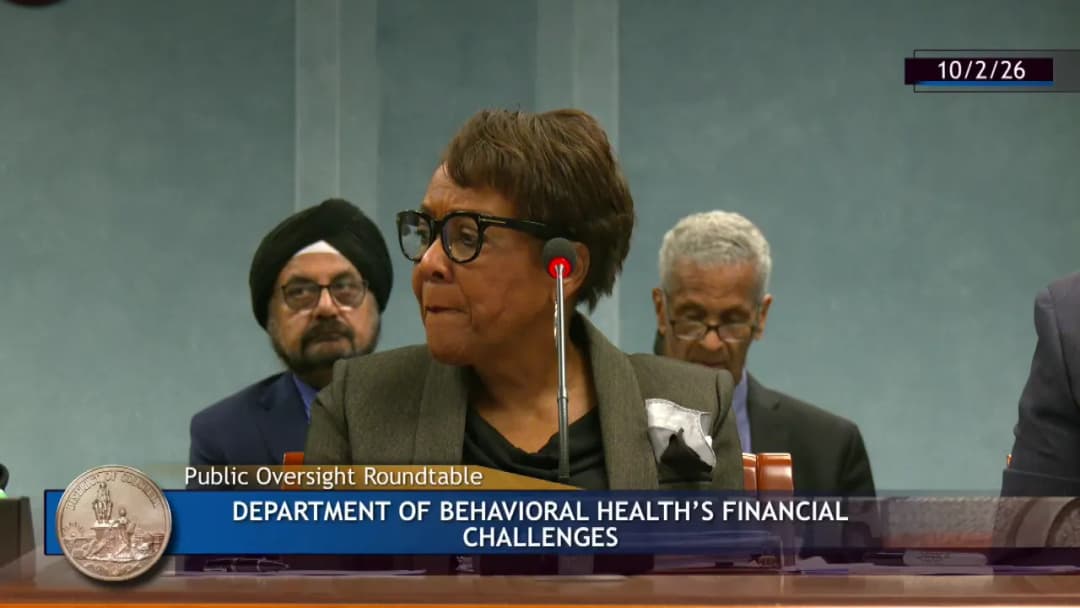
On Friday, October 2, 2026, at 9:32 AM, At-Large Councilmember Christina Henderson convened a public oversight roundtable in Room 123 of the John A. Wilson Building to examine the Department of Behavioral Health's (DBH) fiscal year 2026 budget pressures and their effects on residents, providers, and staff. The meeting lasted until 11:06 AM. DBH Director Dr. Barbara J. Bazron, agency fiscal officer Adrian Reid, interim COO Melvin Barry, and St. Elizabeth's Hospital CEO appeared to testify and answer questions. Discussion Items - FY26 Budget Pressure Overview: Dr. Bazron testified that DBH faced a $20.6 million budget pressure by the end of FY26. The primary drivers were a disproportionate use of community support services and higher-than-anticipated recovery support services. The Q1 Financial Review Process (FRP) initially projected a $33 million deficit, which was later reduced by $8.8 million in collective bargaining agreement (CBA) costs that were resolved through the workforce investment account. The narrative of the Q1 FRP had omitted the CBA, causing confusion. The Q3 FRP erroneously stated $16 million would be absorbed from the opioid abatement fund, but the correct amount was $5.7 million, which was ultimately not used. - Fraud and Oversight: Dr. Bazron detailed actions taken, including a hiring freeze (excluding direct care and critical positions), personally approving non-personnel spending, and increasing oversight. As of the hearing, DBH had 12 providers under investigation by the Medicaid Fraud Control Unit, three pending decertifications, four voluntary closures (two under investigation), and three cases at the Office of Administrative Hearings. Councilmember Henderson pressed on the timeline of fraud detection and action, noting that fraudulent billing had been flagged as early as February 2026. - Community Support Services Reduction: Effective late November 2026, DBH will reduce automatic authorization of community support services from 200 units per 180 days (2 hours per week) to 100 units per 100 days (about 1 hour per week), with an additional 50 supplemental units available with approval tied to a DLA-20 functional assessment. The policy was not yet finalized, causing frustration among providers who learned of the change after the budget was submitted to the Council. Dr. Bazron argued that most consumers receive about 105 units on average, and the reduction aligns with the service's original purpose as a non-clinical support. - Recovery Support Services: Expenditures rose from $2.7 million in FY24 to $21.4 million in FY25—an increase the agency described as 88%, though the precise percentage was not clarified. There was a significant increase in the number of people served, but the average service was about 3.5 hours. The state plan amendment currently has no limits on recovery support, and DBH is working with DHCF to address that. - Vacancies and Staffing: DBH has a 20% vacancy rate. Of the 57 mental health providers (out of 74 total providers), oversight is conducted by 25 staff across provider relations (5 staff), certification (9 staff), and data/performance management (11 staff). Vacancies are concentrated in administrative roles, not in grants management. St. Elizabeth's Hospital has approximately 80 vacancies (primarily nursing), with a current average daily census of 270+ patients, mostly forensic. - St. Elizabeth's Hospital Updates: CEO reported that a $6 million HVAC and fire safety upgrade project has begun and will take 18–24 months. Patient transport for off-site dental and specialty services is being finalized; dental will be provided via off-site appointments for all 270+ patients twice a year. Ten additional security staff positions have been created and recruitment is starting. The Councilmember acknowledged that past security concerns had been raised by the hospital but not transmitted to the Council due to the budget process. Key Outcomes - Budget Pressure Resolved: The FY26 budget pressure of $20.6 million was resolved through savings in the Department of Healthcare Finance due to declining enrollment in the Alliance program. No projected pressure for FY27 as of the hearing date. - Policy Changes: DBH will implement a reduction in community support service units (100 units per 100 days plus 50 supplemental) once the regulation is finalized (estimated late November 2026). This policy was baked into the FY27 budget. - Ongoing Fraud Investigations: DBH continues to work with DHCF, the Medicaid Fraud Control Unit, and law enforcement. Cases under investigation or in decertification/closure process. - Next Steps: Council will consider two bills (B26-0799 and B26-0809) at a future markup. Written testimony is accepted through October 16, 2026, at 5 PM via the Council's hearing management system.

BEHAVIORAL HEALTH SERVICES 30% · BUDGET 27% · PUBLIC HEALTH 14% · MENTAL HEALTH AWARENESS 13%
15
OCT 1, 2026 · WASHINGTON, DISTRICT OF COLUMBIA · COUNCIL OF THE DISTRICT OF COLUMBIA
Council Committee Holds Hearing on Utility Affordability, Consumer Protection, and DOEE Reporting Bills (October 1, 2026)

The Committee on Transportation and the Environment, chaired by Councilmember Charles Allen, held a public hearing on Thursday, October 1, 2026, to consider three bills addressing utility costs, third-party energy supplier practices, and agency reporting efficiency. The hearing included testimony from public witnesses, industry representatives, environmental advocates, and government agencies. Key themes included the disproportionate burden of rising energy bills on low-income households, the need for transparency in utility capital expenditures, and the impact of third-party supplier marketing. Public Comments & Testimony - Panel 1 – Third-Party Suppliers: Jennifer Spinosi (Clean Choice Energy) opposed price caps, arguing they would eliminate customer choice and innovation, as seen in Maryland. Todd Sanford (WGL Energy) warned that caps would force suppliers out, harming customers who saved on fixed-rate contracts. Maurice Simpson (Constellation) supported targeted protections but opposed the 110% cap, noting 70% of their DC customers currently pay below the standard offer. Frank Khaliva (Retail Energy Supply Association) argued price caps are fundamentally flawed due to the mismatch between forward-looking supplier offers and backwards-looking utility rates. - Panel 2 – Environmental and Advocacy Groups: Romita Biswas (Electrify DC) supported the consumer protection bill, citing predatory tactics harming low-income tenants. Claire Mills (CCAN Action Fund) supported all three bills, emphasizing that capital expenditures drive rate increases and that audits of utilities are overdue. Ann Scanley (Sierra Club) supported the price cap and urged strengthening consumer protections. Chris Weiss (DC Environmental Network) commented on the DOEE reporting bill, urging care to preserve transparency while reducing burdens. - Panel 3 – Community and Senior Advocates: Nathan Brown (Washington Interfaith Network) shared personal experience of being misled by a third-party supplier and urged passage of consumer protections. Charles Turner, Phyllis Love, Herb Jones, and Ron Hampton (AARP DC) testified in support of the retail market bill, detailing deceptive marketing, high rates for seniors, and the need for stronger enforcement. They recommended protecting LIHEAP recipients from third-party enrollment and exploring solar energy for seniors. - Government Witnesses: Richard Jackson (DOEE) supported the consumer protection bill, presenting DOEE data showing third-party supplier customers pay 70% more on average, and LIHEAP recipients pay 80% more. He supported the utility transparency bill with recommendations to include non-wire alternatives. Ted Trabue (Interim Chair, PSC) supported the consumer protections but noted the PSC already conducts many required audits and disclosures; he committed to improving accessibility of information. Jen Dickman (DOEE) explained the reporting requirements bill would streamline redundant reports and save agency resources. OAG and OPC witnesses strongly supported both utility bills, recommending additional amendments to require alternatives analysis and reliability metrics. Discussion Items - B26-0750 – Retail Energy Market Consumer Protection Amendment Act: Chair Allen and Councilmember Lewis George led discussion on balancing consumer choice with protection from predatory pricing. Debate focused on the 110% cap vs. higher exemptions for renewable suppliers, the administrative feasibility of a dual system for low-income customers, and the practice of suppliers selling customer arrears back to utilities, which drives up rates for all ratepayers. - B26-0704 – Public Trust and Utility Regulation Act: Discussion centered on whether existing PSC regulations already require the information the bill mandates. OAG and OPC argued that additional upfront disclosure and quantification of reliability benefits are needed to prevent unnecessary spending. PSC maintained that most data is already collected but acknowledged the need for better public presentation. - B26-0697 – DOEE Reporting Requirements Amendment Act: Testimony highlighted the tension between reducing agency burden and ensuring timely public access to key reports like the Carbon Neutrality Action Plan. DOEE stated the changes would allow more efficient use of staff time while maintaining transparency. Key Outcomes - No votes were taken; the hearing was for testimony and record-building. - The record will remain open until October 15, 2026, for written submissions. - Chairperson Allen committed to follow-up discussions with stakeholders, particularly on refining the price cap exemptions for renewable energy, protecting LIHEAP recipients, and strengthening audit and transparency requirements in the Public Trust Act. - PSC Interim Chair Trabue pledged to work with the committee to improve data accessibility and consider administrative adjustments for the consumer protection bill. - DOEE provided updates on the neighborhood microgrid pilot program finalist selection and agreed to send additional compliance data on third-party supplier enforcement actions.

UTILITY RATE REGULATION 25% · ENERGY REGULATION 18% · PUBLIC ENGAGEMENT 17% · CONSUMER PROTECTION 13%
16
SEP 30, 2026 · WASHINGTON, DISTRICT OF COLUMBIA · COUNCIL OF THE DISTRICT OF COLUMBIA
Transportation & Environment Committee Unanimously Passes Utility Auto-Enrollment Bill on Sept 30, 2026

The Committee on Transportation and the Environment, chaired by Councilmember Charles Allen (Ward 6), held an additional meeting on Wednesday, September 30, 2026, at 1:03 PM in Room 120 of the John A. Wilson Building and via Zoom. The committee unanimously approved Bill 26-243, the Automatic Enrollment for Utility Affordability Programs Act of 2025, which seeks to automatically enroll eligible low-income District residents in utility affordability programs based on their existing enrollment in other income-qualified programs like SNAP, TANF, WIC, and Medicaid. Discussion Items - Bill 26-243 – Automatic Enrollment for Utility Affordability Programs Act of 2025: Chairperson Allen introduced the committee print, explaining that DC energy costs surged nearly 70% from 2017 to 2025, and low-income households in the metro area face an energy burden exceeding 16% of income—over four times the median for other jurisdictions. The bill directs DOEE, in consultation with the Public Service Commission, Office of People's Counsel, utilities, and contractors, to create a process for automatically identifying and enrolling eligible households using data from DHS, DC Health, and the Department of Healthcare Finance. A data-sharing protocol must protect personally identifying information. DOEE estimates 31,000 additional low- to median-income residents would be enrolled. Households would receive notice of enrollment and a process to opt out. - Councilmember Janice Lewis George spoke in strong support, noting that in August 2026, PEPCO issued 25,673 disconnection notices—a 218% increase from the prior month—and electricity shutoffs rose 22% from July to August, leaving 840 households without power. She called the bill a common-sense step to remove barriers. - Councilmember Christina Henderson questioned coordination with agencies like the Department of Healthcare Finance and raised concerns about the fiscal impact statement (FIS) which showed new staffing needs at DHS, Healthcare Finance, and DOEE. Chairperson Allen responded that conversations with those agencies had occurred and that a data-sharing agreement would be developed. Henderson expressed skepticism about the need for additional FTEs for automatic enrollment of already-eligible individuals. - Councilmember Zachary Parker, a co-introducer, voiced frustration with technical barriers and asked about phasing in enrollments to reduce fiscal impact. He also noted the FIS projected a loss of over $10 million in special revenue funds, including $800,000 from the Sustainable Energy Trust Fund (SETF) and $2.6 million from the Mayor’s Energy Surcharge Fund. Chairperson Allen clarified that the $2.6 million represents overcharges to low-income households that should not have been collected, and he argued it is not a true revenue loss but a correction of overbilling. Parker agreed. Key Outcomes - Vote: The committee voted unanimously (all members present – Charles Allen, Zachary Parker, Janice Lewis George, Christina Henderson – voting aye) to approve the committee report and print for Bill 26-243, with leave for staff to make technical, editorial, and conforming changes. The bill will now move to the full Council for consideration. Note: No consent calendar or public testimony items were included in this meeting.

ENERGY AFFORDABILITY 76% · PUBLIC BENEFITS 12% · BUDGET 12%
17
SEP 30, 2026 · WASHINGTON, DISTRICT OF COLUMBIA · COUNCIL OF THE DISTRICT OF COLUMBIA
Public Hearing on RFK Campus Master Plan and Future Land Use Map Amendments – September 30, 2026

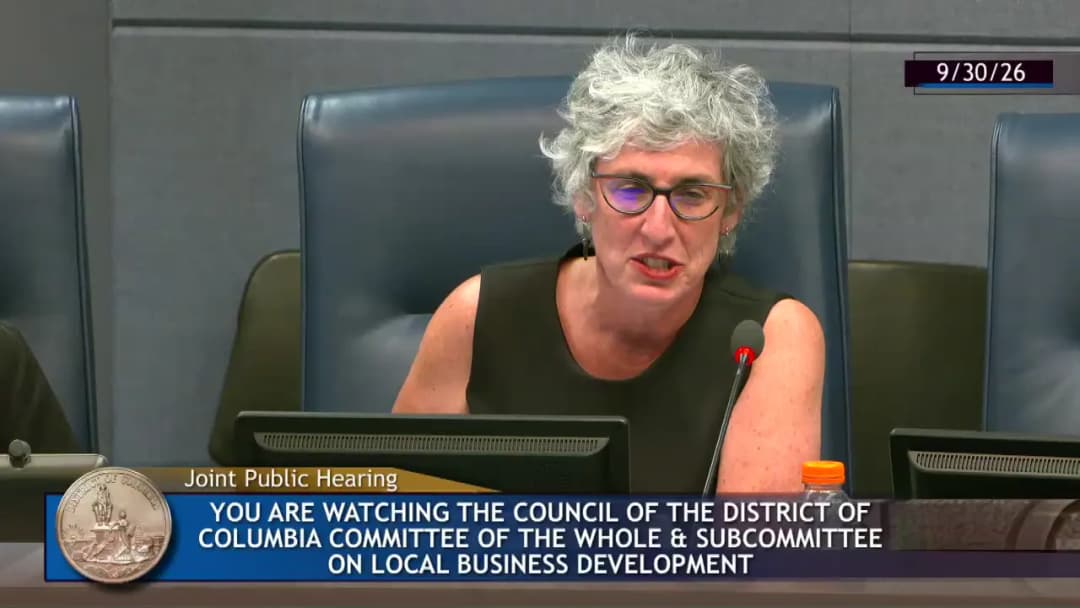
The Committee of the Whole of the Council of the District of Columbia, jointly with the Subcommittee on Local Business Development, held a public hearing on September 30, 2026, to receive testimony on the Robert F. Kennedy Memorial Stadium Campus Master Plan, Small Area Plan, and related amendments to the District's Comprehensive Plan Future Land Use Map. The hearing was chaired by Council Chair Phil Mendelson and co-chaired by Councilmember Wendell Felder. Sixty-seven witnesses registered to testify, addressing a wide range of concerns including parking garages, energy generation, transportation, housing affordability, displacement, and recreational facilities. The record remained open until October 14, 2026. Public Comments & Testimony - Energy and Fossil Fuels: Multiple witnesses, including Mark Rodifer (Sierra Club), Barbara Briggs (Friends Meeting of Washington), Matthew Gravat, Carol Spring, and others urged the council to explicitly prohibit combustion of fossil fuels on the RFK campus, citing DC laws (Clean Energy DC Act, Greener Government Buildings Act) and public health impacts. They expressed concern about a potential gas-fired combined heat and power plant, arguing it would violate existing laws and harm air quality, especially in Wards 7 and 8 which already have high asthma rates. Some called for battery storage and geothermal alternatives. - Parking Garages: A central theme was opposition to the massive G2 parking garage (3,600 spaces, 110 feet tall) in Kingman Commons. Witnesses from Kingman Park Civic Association (Alexis Pasmino, Ebony Payne), Committee of 100 (Laura Richards, Shelley Rep), and others argued that the garage is too large, too close to the neighborhood, lacks ground-floor retail, and should be moved or reduced. They proposed swapping G2 with G1 (located near the riverfront) or reducing parking counts. Testimony noted that eight thousand total parking spaces are planned, with only 6,000 in structures but the legislation allows up to 8,000. Councilmember Allen emphasized that the garages are five times larger than the structured parking at Nationals Park. - Displacement and Neighborhood Protections: Laura Richards and other witnesses called for concrete anti-displacement measures, including prohibiting eminent domain in surrounding census tracts and providing property tax relief for long-term homeowners. The master plan’s language on displacement was criticized as weak. - Transportation and Transit: Many witnesses supported the Gold Line Bus Rapid Transit but criticized the plan’s reliance on cars. Suggestions included an infill Metro station near Oklahoma Avenue, a transit plaza close to the stadium, and dedicated bus lanes. Some questioned the feasibility of center-running bus lanes on H Street. - Recreation and Pickleball: Representatives from DC Pickleball League (Maya Ben David, Eileen Doherty, Jesse Abraham) requested at least 24 dedicated pickleball courts with lighting and indoor capacity, noting that only four courts are currently shown in renderings. They highlighted the sport's rapid growth and community benefits. - Housing and Affordability: Witnesses emphasized the need for homeownership opportunities, mixed-income housing, and timely delivery of affordable units. Commissioner Alfred Swales (Black Business Task Force) called for binding requirements for local hiring and retail space for black-owned businesses. - Other Topics: Testimony also addressed the need for a veteran service center (Lenetia Shelton), universal design for hearing accessibility (Neil Snyder), preserving the Langston Golf Course (Vincent Orange), and the potential use of the DC Armory for a sportsplex and community uses (Dennis Chestnut, Ebony Payne). Discussion Items - Government Presentation: Brian Hanlon (Director, Department of Buildings and RFK Project Management Office) and Anita Cozart (Director, Office of Planning) presented the master plan. They noted over 30 community engagement events, 3,100 comments from 1,200 participants, and revisions based on feedback. The plan envisions six districts: Stadium, Plaza, Riverfront, Kingman Commons, Recreation, and Anacostia Commons. It includes up to 6,500 new homes (30% affordable), 30% open space, an expanded stadium, and new transportation connections. Key design guidelines address building heights (up to 130 feet in Riverfront), parking garages, and sustainability. - Parking Garage Debate: Councilmembers questioned the location and size of G2. Officials cited vehicular flow studies, utility constraints (Metro tunnel), and cost as reasons for the current placement. They stated that underground parking is not feasible due to the water table and WMATA infrastructure, and that ground-floor retail could be added through future zoning but not immediately due to legal exemptions. Councilmembers expressed frustration with inflexibility. - Energy Master Plan: Mr. Hanlon confirmed that an energy master plan contract was awarded about four weeks ago to SETI Engineers and is underway. The study will evaluate all options (solar, geothermal, battery storage, gas) and is expected to conclude with an RFP for an energy developer in late 2026. He stated that PEPCO can supply baseline electricity but that redundancy for NFL requirements (likely a redundant feed) is needed, possibly by 2030. Exemptions from the Green Building Advisory Committee may be sought, but no timeline was given. Councilmembers pressed for transparency and noted that a 26 MW peak demand for the stadium seemed high compared to other new NFL stadiums (10-12 MW). - Transit and Housing Timelines: The plan incorporates the Gold Line BRT and stadium armory metro expansion, but an infill metro station was deemed not feasible. Housing delivery: the commanders must meet development milestones starting three years after zoning is effective (estimated 2028), meaning housing likely won’t appear until 2031-2035. The district-owned Kingman Commons parcel has no set timeline. Councilmembers expressed concern about the gap between stadium opening (2030) and housing delivery. - Floodplain and Environmental: Mr. Hanlon acknowledged the riverfront district lies in a 100-year floodplain and that fill will be used to elevate buildings, but promised no increased flood risk. Several witnesses urged a full-site stormwater management plan. Key Outcomes - No votes were taken; the hearing was for public testimony and council discussion. - The record remains open until 5 p.m. on October 14, 2026. Written comments will be accepted. - Councilmembers indicated they would consider amendments to the Comprehensive Plan and the Small Area Plan resolution. Key areas for potential action include: limiting fossil fuel combustion on site, reducing parking garage sizes, improving transit connections, and strengthening displacement protections. - The council expects to receive the executed energy master plan contract and the parking garage lease from the administration. - Further hearings may be scheduled before a final vote on the master plan and land use map amendments later in fall 2026.

LAND USE PLANNING 20% · ENERGY POLICY 11% · PUBLIC ENGAGEMENT 9% · TRANSPORTATION SAFETY 9%
18
SEP 30, 2026 · WASHINGTON, DISTRICT OF COLUMBIA · COUNCIL OF THE DISTRICT OF COLUMBIA
Public Hearing on Uniform Mortgage Modification Amendment Act of 2026 – September 30, 2026

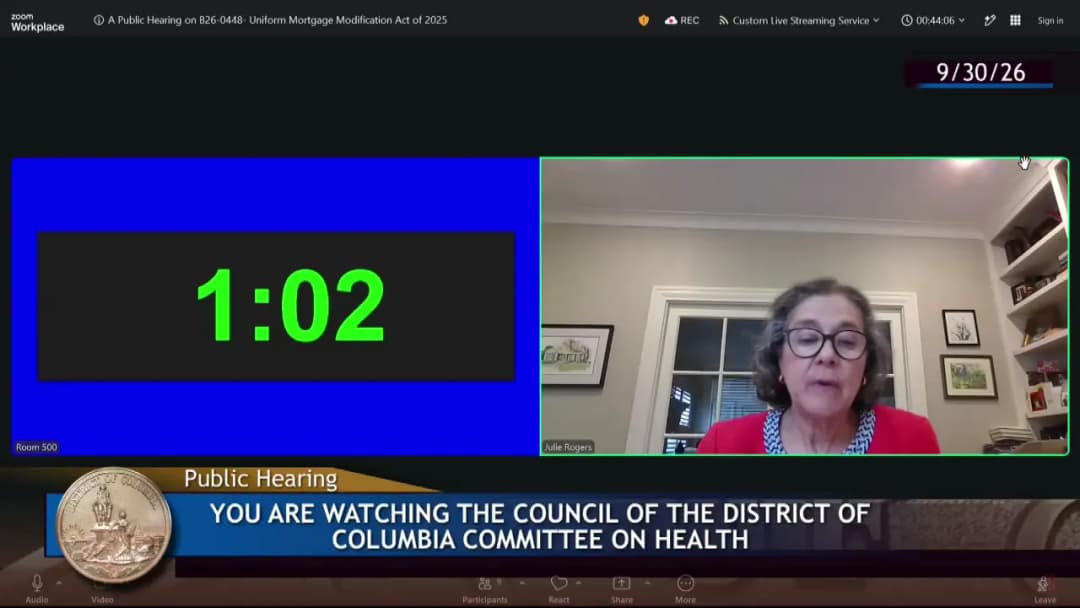
Chair Christina Henderson opened the public hearing of the Committee on Health to consider Bill 26-448, the Uniform Mortgage Modification Amendment Act of 2026, which aims to clarify and modernize the law governing mortgage modifications by creating safe harbors for common modifications and ensuring priority protection for lenders and borrowers. Public Comments & Testimony - Sean Hilgendorf (reading testimony for Chuck Berger, DC Association of Realtors) expressed strong support for the bill, stating it is an important step to allow common loan modifications without costly paperwork or disputes. He noted that the housing market is suffering from rising mortgage rates, shrinking workforce, and inflation, and that uniform legislation eases cross-state transactions. - Julie Forrester Rogers (Professor of Law, SMU) testified as the reporter for the Uniform Law Commission draft. She explained that the act addresses legal murkiness that often prevents lenders from agreeing to modifications, creating safe harbors for extending maturity, reducing interest rates, capitalizing unpaid interest, and forgiving debt. She stated that modifications not in the safe harbor are left to common law, providing certainty. - Jane Sterneck (Legislative Counsel, Uniform Law Commission) supported the bill, noting that modifications outside the safe harbor include releases of collateral, transfers, and changes to borrower/guarantor. She emphasized that the act builds on DC's existing mediation program. - Brian Flowers (Member, DC Uniform Law Commission) testified that the district has adopted over 100 uniform acts, and the Uniform Mortgage Modification Act has been enacted in five states and introduced in four more. He highlighted the importance of uniformity in the DMV region. Government Witness - Ben Arnold (Foreclosure Prevention and Mediation Administrator, DISB) voiced strong support for the bill. He reported that DISB prevented 136 foreclosures in FY25, preserving nearly $76 million in home values. He noted that foreclosure filings in the DC metro area jumped nearly 13% compared to 2025. The bill reduces uncertainty, delays, and costs, and provides a uniform interstate framework. He confirmed existing CFPB guidelines for lenders are not contradicted, and that DISB has adequate enforcement powers including civil penalties and license suspension. Discussion Items - Chair Henderson asked about the exclusion of condominium and cooperative housing association dues from the definition of mortgage. Professor Rogers explained that modifications of HOA liens are different because they require consent from other owners, and the act deals only with mortgage priority. - Chair asked about recording modifications. Professor Rogers noted that lenders can still require recording, but the act clarifies that failure to record does not affect priority. - Chair asked if any tweaks were needed based on other jurisdictions' experience. No issues were reported; the act was finalized in 2024 and is still new. - Chair noted the absence of commercial real estate testimony and encouraged written submission. - Chair asked about enforcement: Arnold stated DISB uses examination, CFPB complaint portal, and works with other agencies to track foreclosures and compliance. - Chair expressed concern that homeowners could lose homes over HOA fees, but clarified the act does not prevent modifications, only addresses priority. Key Outcomes - All witnesses (public and government) supported the bill without suggesting amendments. - The hearing record will remain open until 5 p.m. on Wednesday, October 14, 2026, for written testimony. - Chair Henderson indicated the committee will work to move the bill forward before the end of the two-year council period. - No votes were taken. The hearing adjourned at 10:41 AM.

HOUSING 52% · MORTGAGE MODIFICATION 27% · PROCEDURAL 10% · PUBLIC ENGAGEMENT 4%
19
SEP 30, 2026 · WASHINGTON, DISTRICT OF COLUMBIA · COUNCIL OF THE DISTRICT OF COLUMBIA
2026年9月30日委员会关于无家可归者机构间委员会未来的监督圆桌会议

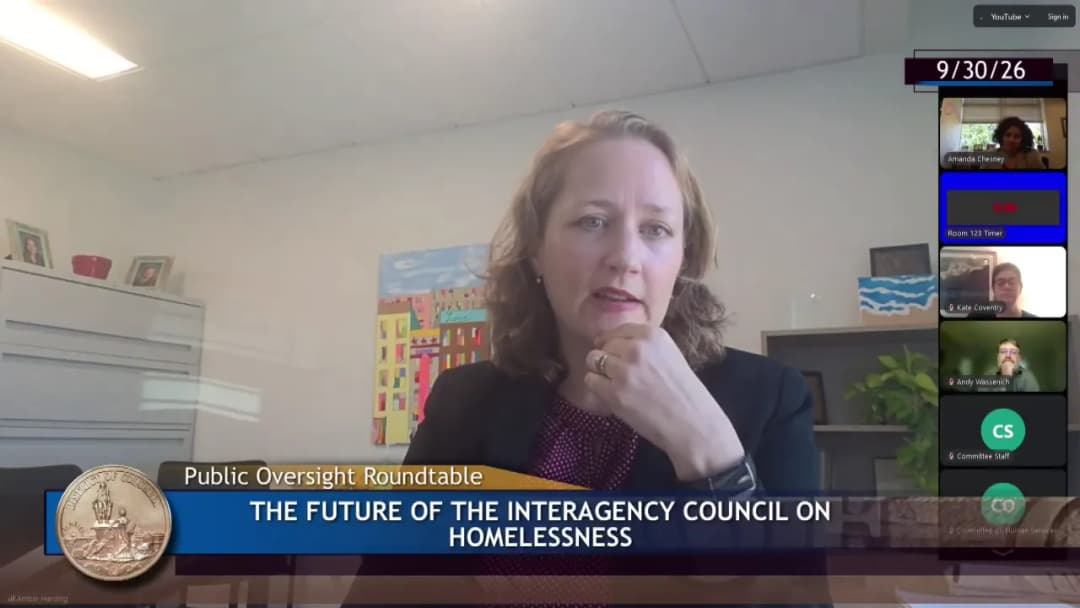
2026年9月30日上午9:36至下午1:13,在约翰·A·威尔逊大厦123室及Zoom平台上,人类服务委员会(主席Matt Freuman,第三选区议员)召开了监督圆桌会议,探讨无家可归者机构间委员会(ICH)的未来。会议旨在审议ICH的法定职责、组织结构、人员配置和预算角色,并考虑即将到来的市长政府和新的五年战略计划。公众证人包括利益相关方和倡导者,政府证人包括ICH执行主任和副卫生与人类服务市长办公室代表。未进行任何投票;会议仅收集信息以供未来立法参考。 公众证词与见证 - Jean-Michel Giraud(友谊之地总裁兼首席执行官):强调ICH自2005年成立以来已取得成就,但资金不足和人员不足限制了其能力。他主张ICH应在预算制定中发挥更积极的作用,加强与市长的直接联系,改善区域协调,并通过定期报告和明确责任分担提高透明度和问责制。 - Lena Mano(友谊之地倡导主任,ICH全委委员):支持Giraud的治理改革建议,并主张ICH应获得更大的权威和预算影响力,包括由执行主任与市长直接联系,有权召集机构负责人,以及建立年度综合预算建议以提交市长。 - Kelly Sweeney McShane(希望社区首席执行官):自2005年以来一直参与ICH工作,她建议修订立法,将ICH的核心职责聚焦于五项基本内容:五年战略计划、年度工作计划、年度更新、冬季计划和作为护理连续体(CoC)治理委员会。她指出,年度更新仅发布过一次,并建议根据人员配置能力重新调整立法要求。她估计,在明确优先事项和城市机构参与的情况下,2至3名全职员工可能足够。 - Rachel White(DC行动青年倡导副部长,ICH青年委员会联合主席):重点关注青年无家可归问题,呼吁重建ICH能力,恢复专门针对青年无家可归问题的战略,建立有偿青年咨询委员会,并加强问责机制。她指出,2025财年DHS报告了1600多名青年单人无家可归系统服务对象,另有1100多名通过成人系统寻求帮助的人曾接受过青年系统服务。 - Andy Wasnick(玛丽亚姆厨房政策主任):强调ICH在社区与政府合作中的重要性,主张至少应通过立法规定最低员工人数,并可将DHS或其他机构人员提供后勤支持作为应急措施。他呼吁赋予执行主任或政府官员更多权力以动员机构,并指出诸如住房券匹配过程中的问题可以更好解决。 - Amber Harding(华盛顿无家可归者法律诊所执行主任):提出结构性关切,认为ICH缺乏独立性,受市长政治议程影响过大。她建议由清晰价值观指导ICH工作,执行主任直接向市长报告并享有一定独立性,赋予主任权力要求机构和提供商解决问题,减少具有投票权的机构数量,并广泛咨询无家可归者意见。她批评了市长政府未有效执行HSRA,并举例说DHS拒绝为冬季计划提供数据。 - Amanda Chesney(天主教慈善机构住房与无家可归服务执行主任):指出ICH需要更明确的授权和权威,对TCP(社区合作机构)等非政府组织缺乏监督,并建议解决区域性问题。她认为ICH应更接近市长或拥有更多权力,并注意到近些年ICH共识建设多于成果实施。 - Kate Coventry(DC财政政策研究所立法策略主任,ICH投票成员):强调ICH在城市机构协调中的关键作用,例如冬季计划依赖多个机构合作。她建议增加带薪员工,并提供技术援助以提高ICH效率,特别是会议主持和反馈转化为解决方案的能力。她指出当前只有两名员工,可能难以完成新的战略计划和法定职责。 讨论项目 - 预算角色与权力:多个证人主张ICH应在预算制定中发挥更积极的作用,包括提前参与市政府预算审议并提出建议。主席Freuman和证人讨论了可能的结构,如年度报告或需求评估,既尊重市长最终权力,又确保社区意见得到考虑。 - ICH的位置与主任指挥线:讨论聚焦于ICH是否应设在副卫生与人类服务市长办公室内,还是移到城市管理员办公室更合适,以便直接联系市长。政府和公众证人对此看法不一,但普遍同意ICH需要更多的政治支持。 - 人员配置与能力:ICH执行主任Teresa Scylla证实,由于预算削减,她在10月1日后将仅剩一人。她解释说,已调整结构,将委员会和工作组从19个减少到11个,并交替安排会议,以应对人员不足。证人指出,缺乏人员配置导致职责履行不足,超过300人参与了Homeward DC 3.0计划开发。 - 问责与监督:讨论了关于TCP审计和HSRA要求的系统年度审计未执行的担忧。Scylla表示不知道有此类审计,并要求与DHS讨论以确定是否已执行。还提到ICH的投诉和报复处理机制未得到落实。 - 区域协调:多位证人建议ICH应加强区域合作,但Amber Harding和Andy Wasnick警告称,区域责任分配数据不足,且辖区间流动复杂,需更多数据支持。执行主任提到与PG县和蒙哥马利县的区域协议,并希望通过COG开展额外工作。 - 青年无家可归:Rachel White和议员Zachary Parker强调了青年无家可归问题需要专门策略,包括重新评估“坚实根基”计划,建立补偿性青年咨询委员会,并确保青年在决策中有实际发言权。执行主任承认需要更多青年参与,但指出当前缺乏联邦资金支持。 关键成果 - 圆桌会议未进行正式投票或做出决定,但记录了证词供未来立法参考。 - 主席表示将考虑对ICH进行立法改革,并可能举办额外听证会,包括与青年服务提供者进行交流。 - 会议记录提交截止日期为10月14日下午5点,通过在线听证系统提交。 - 初步一致意见包括需要增加ICH员工配置、明确核心职责、建立年度更新机制、促进区域协作和增强独立性的需求。

HOMELESSNESS 57% · BUDGET 11% · COMMUNITY ENGAGEMENT 8% · PROCEDURAL 6%
20
SEP 28, 2026 · WASHINGTON, DISTRICT OF COLUMBIA · COUNCIL OF THE DISTRICT OF COLUMBIA
Public Oversight Roundtable on RFK Campus Community Benefits Agreement – September 28, 2026

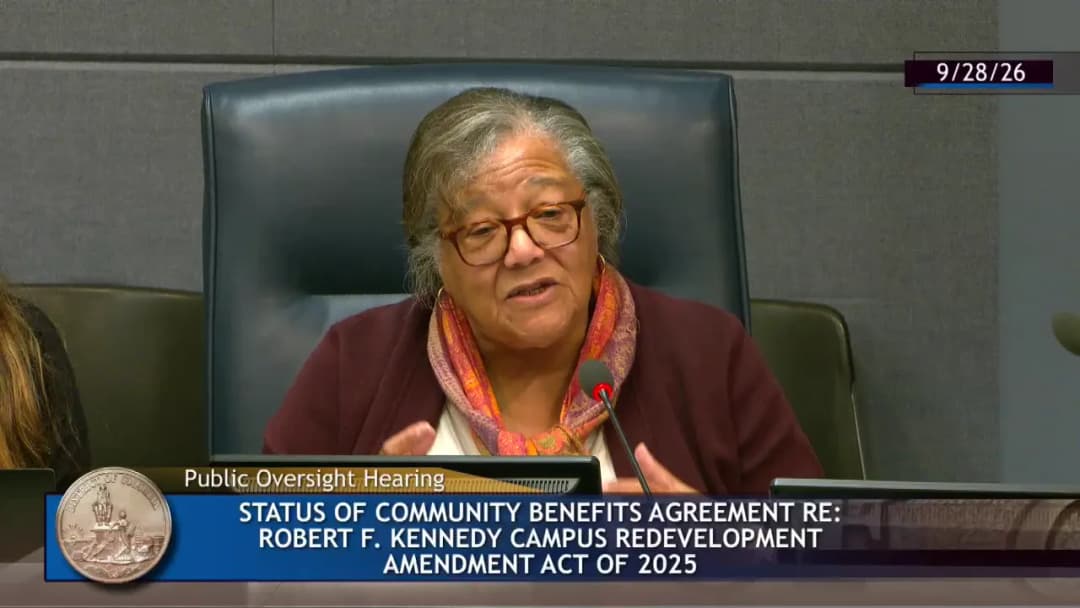
On Monday, September 28, 2026, at 1:05 PM, the Subcommittee on Local Business Development, chaired by Ward 7 Councilmember Wendell Felder, held a public oversight roundtable in Room 412 of the John A. Wilson Building and via Zoom. The hearing examined the status of the Community Benefits Agreement (CBA), the Community Benefits Oversight Committee (CBOC), and broader community commitments under the Robert F. Kennedy Campus Redevelopment Amendment Act of 2025. Government witness Brian Hanlin, Director of the DC Department of Buildings and Project Executive of the RFK Project Management Office (PMO), and Kirton Matza, Chief External Affairs Officer for the Washington Commanders, provided testimony and answered questions from Councilmembers Felder, Anita Bonds, and Brooke Pinto. Discussion Items Overview of RFK Stadium Progress - Director Hanlin reported that the stadium project remains on schedule for delivery before the 2030 NFL season. Mayor Bowser transmitted the final RFK campus master plan to the Council on September 24, incorporating input from over 1,200 DC residents. Demolition of the old RFK Stadium is expected to be completed by the end of October 2026. The Council will hold a public hearing on the master plan on September 30, with a vote on zoning and design guidelines anticipated before year-end. Groundbreaking for the new stadium is expected in early 2027. Community Benefits Agreement (CBA) Overview - Mr. Matza emphasized that the Commanders committed $50 million in community benefits over 30 years—the largest CBA in District history by orders of magnitude. The CBA includes $20 million for a youth sports academy, $7 million for small and local business support, $6 million for two full-service grocery stores (one on campus and one east of the river), $5 million for workforce training, $2 million for free or low-cost tickets, and funds for violence prevention, cultural programming, and other community priorities. The CBA’s formal obligations begin when the stadium opens in 2030, but the agreement permits preterm investments that can be credited against the $50 million commitment. Workforce Development and the CCAP Program - The Commanders’ Career Access Program (CCAP) is an umbrella strategy to connect District residents—including experienced workers, youth, returning citizens, and displaced federal workers—to career pathways in construction, hospitality, and related fields. The $5 million workforce training allocation will fund the setup of a workforce development connector (a third-party entity to be selected through a request for qualifications) and other training infrastructure. Clark Mortenson Smoot (CMS), the joint venture general contractor, will oversee CBE participation, with a target of 40% CBE utilization (aspiration of 50%). Councilmember Bonds pressed for details on how returning citizens will be engaged and how the workforce connector will avoid excessive overhead. Mr. Matza acknowledged that specific numbers on returning citizen participation are not yet available but confirmed that the workforce connector will eventually create an intake process for job seekers. Youth Academy and Junior Academy Pilot - The Commanders’ Youth Academy is the signature CBA investment. A junior academy pilot program launched earlier in September 2026 serves 50 fourth- and fifth-grade students at KIPP DC’s Ward 7 campus, three afternoons per week during the school year, providing academic support, athletic programming, mentorship, and meals. Mr. Matza stated that the pilot will inform expansion to additional schools or a central location in Ward 7, with the goal of having the full program operational by 2030. Attendance and personal growth metrics will determine success. Small and Local Business Engagement - Councilmember Felder and Councilmember Bonds focused on how the $7 million small business allocation and the 40% CBE goal will translate into real opportunities. Mr. Matza explained that the $7 million is intended to subsidize small businesses on the campus once development is built (post-2030), while immediate CBE opportunities exist in stadium construction through CMS. He noted that a formal small business engagement strategy similar to CCAP may be developed after the construction phase. Councilmember Bonds urged using some of the funds before 2030 to support existing Ward 7 businesses, and Mr. Matza agreed to review the CBA for such possibilities. Grocery Store Subsidies - Chair Felder highlighted the $6 million for two grocery stores ($3 million each). Mr. Matza confirmed the Commanders are open to making the off-site grocery store a preterm investment, as it could serve Ward 7 before stadium completion. The process for selecting and supporting grocery operators is still being formalized. Preterm Investments and Tracking - Chair Felder asked about existing preterm investments. Mr. Matza stated that most funds have not yet been drawn, but workforce training and the youth academy pilot are likely to be credited. He expressed willingness to consider the grocery store subsidy as a preterm investment. Director Hanlin noted that the PMO does not have a formal tracking role but will coordinate with the CBOC once formed. Chair Felder emphasized the need for transparent tracking of all preterm expenditures against the $50 million. Community Benefits Oversight Committee (CBOC) - The CBA and RFK Act require a nine-member CBOC to monitor implementation. Director Hanlin reported that most appointees have been identified, but the mayoral slate is still being finalized, and no timeline for completion was provided. Chair Felder expressed concern that the CBOC was required to be established within 30 days of the CBA’s execution (December 2025) and is now overdue. Both witnesses agreed that the CBOC, once convened, will define its oversight processes, including how to handle ambiguous terms like “endeavor” in the CBA. Community Reinvestment Fund - Chair Felder noted his legislation, unanimously passed by the Council, creates a Community Reinvestment Fund providing an additional $2 million annually for 30 years, separate from the CBA. An administrator for this fund has not yet been identified; Director Hanlin committed to looking into the timeline. Long-Term Vision - Mr. Matza articulated that success in 30 years would mean thousands of residents have gained career pathways, two grocery stores still serve the community, small businesses populate the campus, and the RFK site is woven into the Ward’s fabric. Chair Felder closed by acknowledging progress but calling for continued improvement in transparency and engagement. Key Outcomes - No votes or formal decisions were taken; the roundtable was informational. - The CBOC has not yet been fully constituted; mayoral appointments are pending. Chair Felder requested a timeline. - Preterm investments are beginning: the youth academy pilot launched in September 2026; the workforce development connector procurement is underway; a grocery store subsidy may be explored as a preterm investment. - The PMO will work with the incoming CBOC to track all preterm and ongoing community benefit expenditures. - A public hearing on the RFK campus master plan will be held September 30, 2026. - The CBA’s formal term will start in 2030, but workforce training and youth programming are being initiated immediately. - The Council’s Community Reinvestment Fund ($2 million/year for 30 years) still lacks an identified administrator.

WORKFORCE DEVELOPMENT 32% · ECONOMIC DEVELOPMENT 27% · COMMUNITY ENGAGEMENT 25% · YOUTH PROGRAMS 5%
OPENPUBLICA · PUBLIC MEETING INDEXUPDATED DAILY · openpublica.com