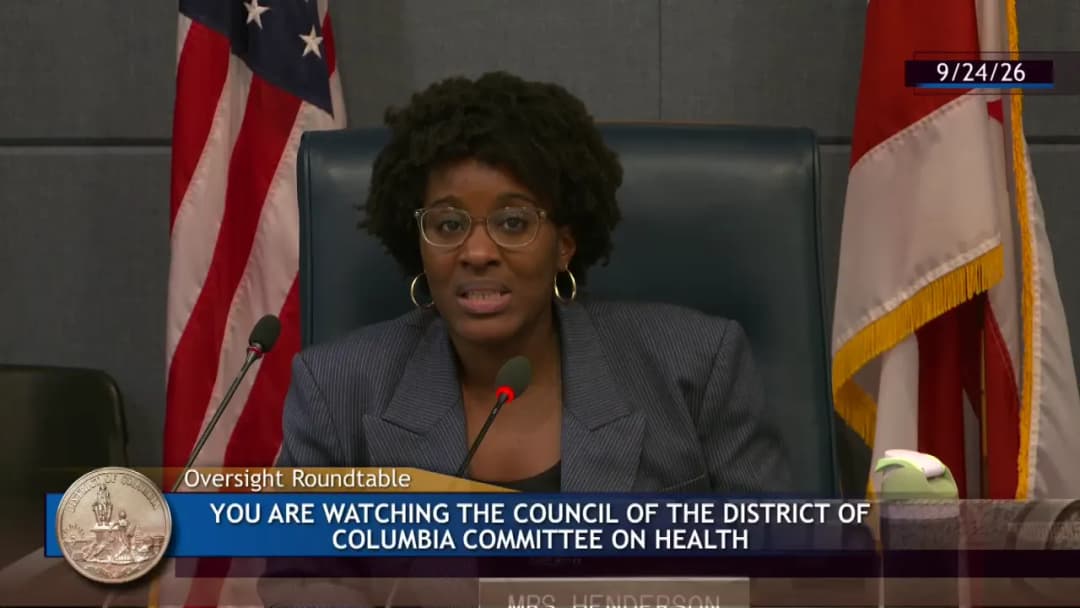
Councilmember Christina Henderson (Chair, Committee on Health) convened a public oversight roundtable on September 24, 2026, at 2:35 PM in Room 412 of the John A. Wilson Building to address the District's challenges in expanding the Certified Nurse Aide (CNA) workforce. The hearing focused on testing bottlenecks, agency coordination between DC Health and the Office of the State Superintendent of Education (OSSE), and long-term solutions. Government witnesses included Kathy Boris Hale (Interim Executive Director, DC Board of Nursing) and Kylan Boardman Schreuer (Assistant Superintendent for Post-Secondary and Career Education, OSSE). No public witnesses testified; written testimony was accepted until October 8, 2026. Discussion Items - Backlog and Testing Access: As of July 2026, approximately 484 individuals had completed CNA training but not taken the skills (psychomotor) exam. At the hearing, DC Health reported 550 eligible candidates, with 195 having scheduled no exam at all. Between June and August 2026, 355 students tested across 40 sessions through Credentia, with a 76% pass rate. However, scheduling cancellations by Credentia due to proctor shortages were a major frustration. Nine DC Health nurses were trained as evaluators to supplement Credentia's staff, and a new testing space at DC Health headquarters is expected by end of 2026. - New Testing Provider – Headmasters: The DC Board of Nursing approved a second testing vendor, Headmasters (already operating in 20 states, including Maryland). A letter of authorization was issued; implementation, including building a test bank of 700–1,500 questions, is anticipated by November 2026. Headmasters will offer testing five days a week plus Saturdays, with a simpler scheduling process and no requirement for a two-week advance registration (unlike Credentia). - Long-Term Shift to Portfolio-Based Assessment: DC Health is developing a psychomotor skills portfolio approach to replace the single high-stakes skills exam. Students would be evaluated throughout their training by faculty and an external clinical entity, with competency documented over time. The portfolio model received federal approval from CMS in August 2026. The DC Board of Nursing is expected to review the proposal in October and vote in November, with availability to training providers targeted for Q2 FY2027 (January–March 2027). - OSSE/ATC CNA Programs: OSSE's Advanced Technical Centers (ATCs) partner with Trinity Washington University and SUMA Prime to offer CNA training. A spring 2026 cohort of 21 students yielded 15 completers; 12 took both written and skills exams, but only 1 passed the skills exam. None from that cohort are yet licensed. A summer 2026 cohort of 18 students (funded by $300,000 from the Committee on Health) had 12 completers; 5 passed the written exam and 2 more are scheduled. Skills testing is pending. A dedicated CNA coordinator was hired to improve outcomes. A fall cohort of 8 students is underway, and a spring cohort of 40 is expected. - Barriers to Testing: Councilmembers highlighted that Credentia requires a two-week registration window and a minimum of six registrants per session, causing cancellations. The fee for the skills exam is $110 (often covered by vouchers). Many eligible candidates cited personal reasons, lack of preparation, or difficulty scheduling as reasons for not testing. DC Health admitted past failures in communication and coordination with training providers and committed to direct monthly outreach via email and text. - Data Gaps: DC Health acknowledged it does not track how many students start vs. complete training programs. A new form using RedCap will collect course start/end dates from providers to better align testing schedules. Key Outcomes - Agency Commitments: DC Health will begin directly communicating with all eligible candidates about testing opportunities, including monthly reminders and offers of boot camp refresher courses. OSSE will continue offering boot camps and work with SUMA Prime to provide evening/weekend CNA courses starting January 2027. - Headmasters Timeline: Testing through Headmasters is expected to launch by November 2026, with a test bank of at least 1,000 questions ready by that time. - Portfolio Approval Path: The DC Board of Nursing's Education Committee will review the portfolio proposal in October 2026, with full board vote in November. If approved, the portfolio model will be available for training providers in early 2027. - Follow-Up: Councilmember Henderson indicated a follow-up hearing or touchpoint in November 2026 to assess progress. Written testimony was accepted until October 8, 2026. The next Committee on Health hearing (on mortgage modification legislation) is scheduled for September 30, 2026.
Public Meetings - Washington, District Of Columbia
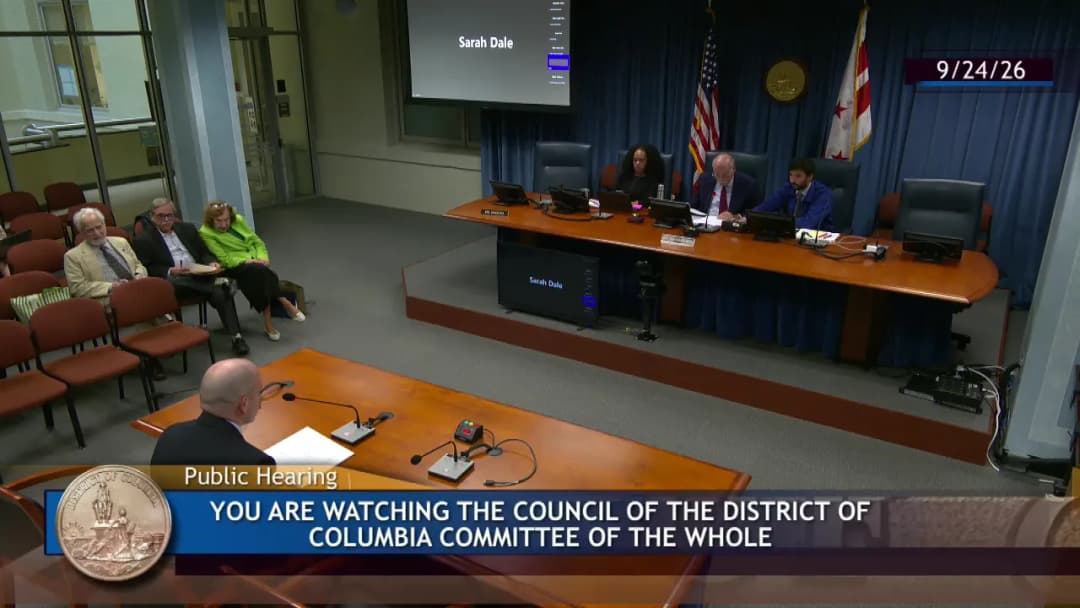
Public Meetings - Washington, District Of ColumbiaThe Committee of the Whole of the Council of the District of Columbia, chaired by Phil Mendelson, held a public hearing on September 24, 2026, to consider three bills related to naming and renaming DC public school buildings. The hearing covered proposed designations for a new middle school in Ward 1 (Alma Thomas Middle School replacing the initially proposed Dolores Tucker name), the Elizabeth M. Goodman Health School (renaming from C. Melvin Sharp Health School), and the Malcolm X Elementary School (official recognition of the commonly used name). The meeting began late due to security barriers around downtown. Public Comments & Testimony - Ward 1 & 2 Education Council (Sarah Dale): Supported naming the new middle school after Alma Thomas, a renowned DC artist and former educator at Shaw Junior High. Noted a community survey showed strong support; over 150 signatures from feeder schools. No opposition known. - Anne Louise Taylor (Seaton parent): Spoke in favor of Alma Thomas, citing her art accessible to children and her role as an educator. Shared a story about her son recognizing an Alma Thomas painting in a Senate office. - Swathi Bojedla (Seaton PTO President): Supported Alma Thomas, emphasizing her legacy as a Shaw Junior High teacher and her connection to the neighborhood. Also praised Dolores Tucker but supported honoring her via a street name. - Alexandra Cembrana (parent): Advocated for more community input in school planning, specifically dual-language programming for the new middle school and pedestrian safety concerns at other schools. Noted lack of focus on naming once the school site was secured. - Joan Goodman Churchill (daughter of Elizabeth Goodman): Testified in support of renaming Sharp Health School after her mother, highlighting her mother's work creating programs for hospitalized, homebound, suspended, and pregnant students. - Edridge Rich: Supported renaming Sharp to Goodman, recounting his father's advocacy with Goodman to build the accessible health school for children with disabilities. - Zara Barry Young (Principal of Malcolm X Elementary): Asked for official recognition as Malcolm X Elementary, noting the name is already on the new building and that materials honoring Mildred Green have been moved to the Sumner School Museum. No opposition known. - Selim Adolfo (ANC Commissioner): Expressed strong support for Malcolm X Elementary, stressing the importance of positive role models for students. - Stephen Lamb (pediatrician): Supported Goodman naming, citing the importance of honoring DC values and integration. Conducted a community survey that produced no alternative names. - Abraham Clayman (DCPS Deputy Chief for Intergovernmental Affairs): Stated DCPS has no objection to any of the three bills. Provided cost estimates: $0 fiscal impact for Malcolm X (already signed), no fiscal impact for Alma Thomas name if enacted by end of 2026 (covered by modernization budget), and $100,000 for renaming Sharp to Goodman (new pin letters, removal of old lettering, and new marquee). Discussion Items - New Middle School Name (Ward 1): Councilmember Nadeau initially introduced Bill 26-12 for Dolores Tucker Middle School. However, community feedback overwhelmingly favored Alma Thomas, a former Shaw Junior High art teacher and celebrated artist. Nadeau withdrew support for the original bill and introduced a companion street-naming bill for Dolores Tucker. Witnesses confirmed no opposition to Alma Thomas. Chairman Mendelson indicated a second hearing on the name change may not be necessary. - Elizabeth M. Goodman Health School: Councilmember Janice Lewis George introduced the bill to rename Sharp Health School. The current namesake, C. Melvin Sharp, was a segregationist school board president who refused to integrate DCPS (Bowling v. Sharp case). Elizabeth Goodman was the first principal of the health school, a pioneering educator who established programs for students with disabilities, pregnant students, and suspended students. Community engagement included ANC4C, Ward 4 Education Alliance, and petitions. No opposition reported. Chairman Mendelson questioned the $100,000 cost estimate, suggesting DCPS re-evaluate it. - Malcolm X Elementary School: Bill 26-698 would officially designate the school as Malcolm X Elementary, a name already in use on the new building. The original name Mildred Green Elementary is no longer used in signage. The school's principal and ANC commissioner voiced strong support. No opposition. Key Outcomes - Consensus on names: All three naming proposals received broad community support with no documented opposition. - Vote not taken: The hearing was for testimony only; no votes were held. The record will remain open until 5:00 p.m. on October 8, 2026, for additional written testimony. - DCPS position: No objection to any bill. For the Goodman renaming, DCPS requested $100,000 in funding, which would be pursued in FY2028-2029; Chairman Mendelson urged DCPS to review the cost estimate. - Next steps: The committee will consider the testimony and written submissions before reporting the bills to the full Council for a vote.
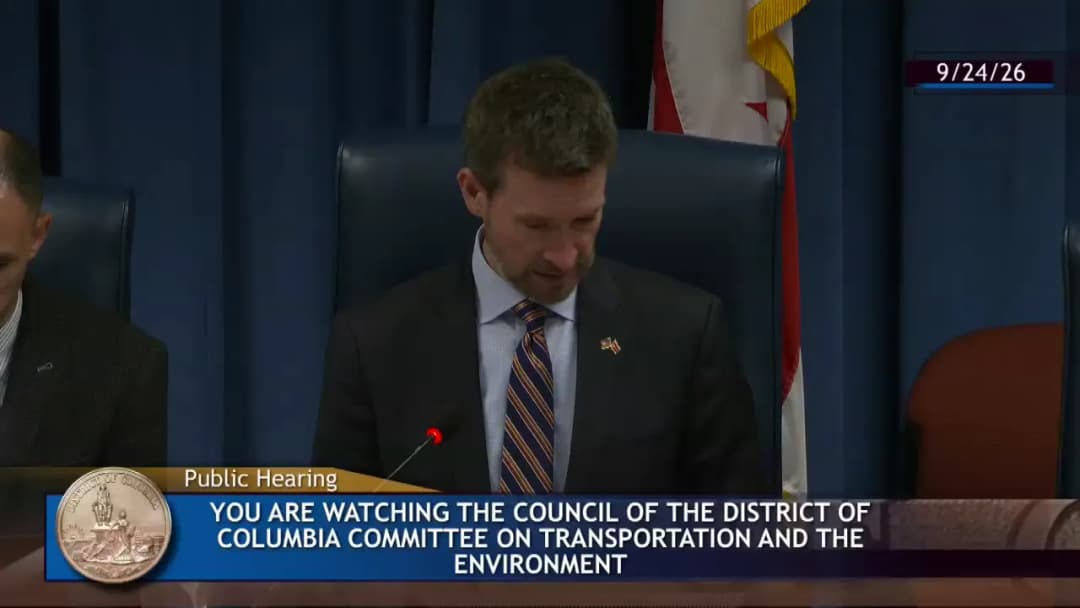
On Thursday, Sept. 24, 2026, at 10:09 a.m., the D.C. Council Committee on Transportation and the Environment, chaired by Ward 6 Councilmember Charles Allen, held a public hearing in Room 120 of the John A. Wilson Building and via Zoom. Councilmembers Brianna Doe (Ward 1), Brooke Pinto (Ward 2), and Denise Lewis George joined. The hearing examined Bill 26-90, the Neighborhood Management Authority Act of 2025, and Bill 26-424, the Porch Fest Permitting Amendment Act of 2025. No written agenda or minutes were available in the record. The transcript refers to the Ward 1 councilmember inconsistently as both "Brianna Doe" and "Nadeau." The written record remained open until Oct. 8, 2026. B26-90 would allow creation of neighborhood management authorities as district instrumentalities, with boards, annual budgets, audits, public meetings, and the possible authority to levy property or possessory-interest taxes; the introduced version also named the Duke District and Columbia Heights NMAs, created a Columbia Heights performance parking zone, and transferred the DC USA Garage Unit. B26-424 would let district residents request block party permits for Porch Fest or other distributed neighborhood festivals if music occurs on personal property, no fees are charged, and other block-party requirements are met. Opening Statements - Councilmember Brianna Doe said Columbia Heights needs a sustained place management entity and that a long-sought Duke District BID is now moving forward; she announced her intent to amend the bill to remove the proposed U Street/Duke District NMA. She said the NMA would not impose a new property tax unless established through a petition process, and it could work alongside Main Streets and BIDs. - Councilmember Brooke Pinto expressed initial concern about an NMA on U Street, welcomed the successful BID petition effort, and supported removing the U Street NMA so the Duke District BID can proceed. - Councilmember Denise Lewis George voiced support for both bills and highlighted Petworth Porch Fest as a beloved volunteer-led event that the Porch Fest bill would protect. Public Comments and Testimony Bill 26-90 - Neighborhood Management Authority Act - Billy Easley (ANC 1A10) supported the Columbia Heights NMA, linking it to safety and coordination, and recommended adding a local nonprofit seat to the NMA board. - Christine Miller (ANC 1A05) supported the bill for Columbia Heights with guardrails: expanded resident roles, accountability, a DC USA garage utilization study, emergency/construction parking processes, quarterly reporting, and reduced/free garage access for seniors and low-income residents. She said the garage is a roughly 1,000-space public asset with substantial unused capacity. - Gary Decker (ANC 1D07) supported the Columbia Heights NMA, comparing it to the D.C. Green Bank and saying an independent instrumentality can attract investment without becoming another permanent general fund claim. - Jeremy Sherman (ANC 1A04 and ANC 1A chair) strongly supported the NMA, saying BIDs' property-owner assessments can be passed to tenants, while the NMA's initial funding would come from garage and parking revenue. He noted the area has the twelfth-busiest Metro station, and that five ANCs passed resolutions, 24 commissioners reaffirmed support, and 52 neighbors/business leaders signed a petition. - Miguel Trinidad Duramo (ANC 1B chair) said U Street's extensive community engagement, including business roundtables and door-to-door outreach, produced a strong preference for a BID; he supported the Columbia Heights NMA and emphasized the 14th Street Latino corridor. - Matt Fay (ANC 1B) said the U Street preference was clearly for a BID and that he hoped the committee would strike U Street from the NMA legislation so the BID would be the only place management entity there. - Jess Ball Batea (ANC 1A01) and Daniela Kelly (ANC 1A09) supported the Columbia Heights NMA. Kelly recommended low-income set-asides in the DC USA garage and using micromobility company revenue or taxes to help fund the NMA. - Stacey Lee Banks (Lee's Flower and Card Shop), Kamal Ben Ali (Ben's Chili Bowl), Reggie Van Lee (Howard Theater Foundation), and Chip Ellis (Howard Theater Development Group) opposed the NMA for U Street as untested and insufficiently detailed. They said they had no objection to Columbia Heights pursuing an NMA and thanked Councilmember Doe for her press release proposing removal of U Street. - Michael Wagner (Quadrangle Development Corp.) supported the Duke District BID, reporting the petitioners secured 59% of assessed value and 31% of parcels, and planned to submit the BID application when the DSLBD application window opens Oct. 16. - Alexander M. Padro (Shaw Main Street) opposed creating NMAs altogether, saying existing agencies, Main Streets, and BIDs are sufficient if adequately funded; he cited a documented return of more than $3 per municipal dollar invested in Main Streets. In response to a question, he confirmed he also opposed an NMA for Columbia Heights. - Sarah Thompson (Queen's English) strongly supported the Columbia Heights NMA, describing safety, cleanliness, and vacancy problems; she said the buildings next to her restaurant had been vacant for about 3.5 of the last 7 years, including the last 3 years. - Francisco Ramos Meyer (former Columbia Heights/Mount Pleasant Main Street director) supported the NMA but asked for guaranteed board seats for residents, small-business owners, nonprofit directors, and street vendors, plus non-lapsing multi-year funding. - Colleen Hawkinson (D.C. BID Council) and Kristen Barden (Adams Morgan Partnership BID) did not oppose the NMA concept but objected to the bill's provision that would permanently bar a BID from forming in an NMA's boundaries. Barden urged preserving flexibility and supported the Porch Fest bill. - Rose Donna (Wonderland Ballroom), Emily Morrison (Studio Acting Conservatory), Allie OSeth (Dandelion Collective), and Claire Danenbaum (Columbia Heights resident) supported the Columbia Heights NMA. Danenbaum cited a Hollywood dispatch-center model that diverted 90% of nonviolent calls from police. - Frank Chauvin (former ANC commissioner) supported removing U Street and urged a five-year sunset/reauthorization, clear preservation of future BID options, and explicit assurance that residential properties would not be assessed. - Antonella Durateen and Reza Jafari (resident and owner of Trilogy Atelier and Zeba) supported the NMA, describing deteriorating conditions around the Civic Plaza/DC USA, including public drug use, trash, rodents, and business declines. - Keith Krasinski (candidate, ANC 1D06) supported the NMA and asked for boundaries covering areas north and south of the main corridor and representation from affected ANCs. - Tim Hampton (Columbia Heights resident) supported the NMA but asked for language barring NMA staff or board from lobbying on street-parking supply or revenue to avoid a conflict of interest. He also opposed a 51% business-owner board requirement and supported nonprofit participation without a mandatory seat. - Sheera Davidson (ANC 1A08) supported the NMA, calling public space economic infrastructure, and urged a nonprofit/cultural institution seat, advisory roles for all affected ANCs, no formal role in liquor licensing or parking decisions, and resources allocated to each commercial corridor. - Jean Hamza (930 Club/Atlantis/Lincoln Theater; Duke District BID steering committee) asked the committee to carve U Street out of the NMA bill and allow the BID to proceed, noting concerns about Lincoln Theater oversight and the NMA's lack of a sunset. - Jenna Russell, Yaya Sardari, and Aaron Palmer supported the Columbia Heights NMA, with Sardari emphasizing fair treatment of regulated businesses and vending, and Palmer citing fragmented agency responsibility for public spaces. Bill 26-424 - Porch Fest Permitting Amendment Act - Zachary Israel (Petworth Porch Fest Coordinating Committee) strongly supported the bill but said the May 30, 2026 Petworth Porch Fest still saw dozens of block-party permits rejected, often without explanation, despite a temporary law in effect. He asked for decision deadlines 10-15 business days before the event, written denial grounds, an appeal process, limited denial grounds, and an option for one consolidated application. He said Petworth Porch Fest drew thousands, with more than 430 musicians/bands on over 160 porches. - Kristen Barden said block-party permits are an important safety tool because participating porches and bands are not finalized until close to the event. - Sabrina Rhodes (Empower DC, ANC 5D02) supported easing block-party permitting, saying the current process discourages community gatherings in places like Ivy City, where over 70% of residents are renters. - A resident testifying as Ms. Stamper supported reducing administrative barriers to Porch Fest, asked for better snow removal and sidewalk safety, and noted planned investment around Benning Road and desire for safe access to RFK. - Sam Bonar (D.C. Community Wealth Builders) supported the Porch Fest bill and suggested residents should be able to close their own streets rather than requiring DPW/MPD-only closures. - Chair Allen noted Capitol Hill's first Porch Fest on Oct. 10 would have 164 bands and 53 front porches. Government Witnesses - Clint Osborne, Director of HSEMA, testified in opposition to the Porch Fest bill as written, saying multiple simultaneous street closures can impede first responders. He described the Mayor's Special Events Task Group process and recommended adding the word "solely" to the bill's line 48 to preserve other denial grounds. He also said HSEMA's vehicular terrorism prevention task force report had been sent to the City Administrator and recommended temporary/permanent barriers, with work underway at Capital One Arena and Eastern Market. - Sharon Kirschbaum, Director of DDOT, also opposed the bill in its current form, saying block-party permits are designed for isolated, single-block closures, and DDOT must retain discretion to evaluate cumulative safety and transit impacts. She noted MPD has final approval authority on street closures. - In response to committee questions, DDOT said Petworth Porch Fest generated roughly 30 block-party applications, with about 10-12 approved, and that there is no fixed numerical threshold; the design and location of closures matter. DDOT acknowledged a gap between single-block permits and full MSETG review and said it is looking at a lighter-touch process, not necessarily legislation. - Chair Allen pressed for faster progress on bollards and barriers, especially around Eastern Market. HSEMA said the report is in transmittal to the Council and that temporary barrier vendors and procurement are being pursued. Key Outcomes - Councilmember Doe committed to amending Bill 26-90 to remove the U Street/Duke District NMA, clearing the way for the Duke District BID, which met petition thresholds and may submit its application Oct. 16. - Multiple U Street business and ANC witnesses opposed the U Street NMA but, with one exception (Alexander Padro), did not oppose a Columbia Heights NMA; Columbia Heights witnesses and ANCs strongly supported the NMA. - BID representatives raised concerns about the bill's exclusivity provision, and Councilmember Doe said she wishes to work on language so BIDs and NMAs can complement each other. - DDOT and HSEMA opposed Bill 26-424 as drafted but offered to work with the Council and Porch Fest organizers on administrative improvements, including a potential lighter-touch coordinated review. - The committee left the hearing record open for written testimony through Oct. 8, 2026, and the hearing was adjourned.
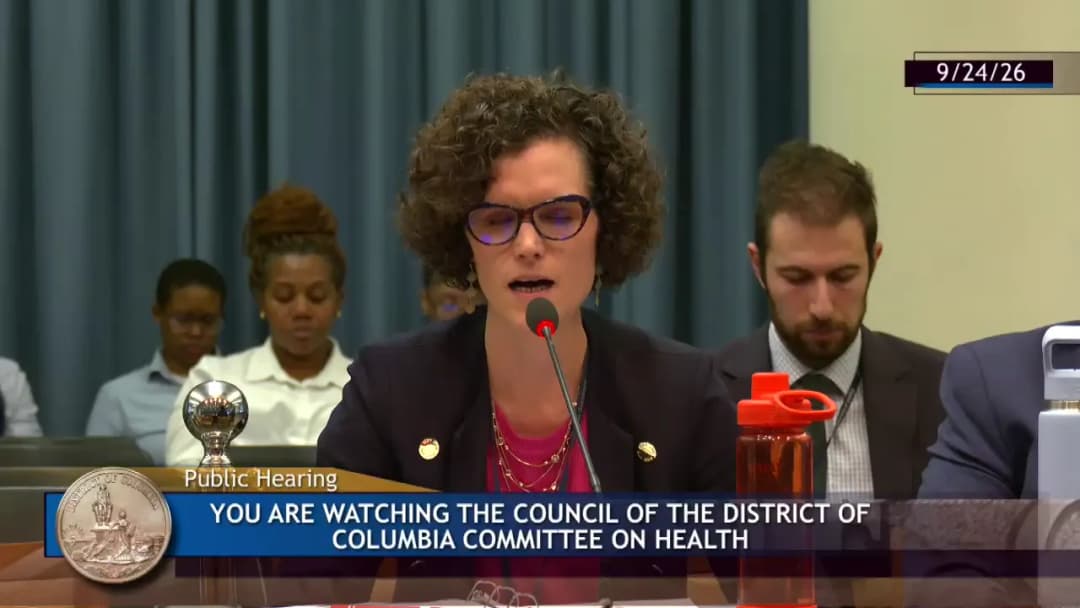
On September 24, 2026, at 10:05 a.m., the Committee on Health, chaired by Councilmember Christina Henderson, held a hybrid public hearing in Room 412 of the John A. Wilson Building to consider three permanent bills: Bill 26-606 (Vaccine Administration Protection Amendment Act of 2026), Bill 26-688 (Student Health Care Amendment Act of 2026), and Bill 26-725 (School Health Certificate Modernization Amendment Act of 2026). The hearing included testimony from public witnesses and government officials from DC Health. No votes were taken; the record remains open until October 8, 2026. Public Comments & Testimony - Sarah Buckley (parent, Parents United for School Health) supported both bills, noting that only 28% of students had a universal health certificate (UHC) on file in FY2025 and 13% in FY2026. She emphasized the need for an automated digital system, prohibition of provider fees, and inclusion of alternative epinephrine devices (e.g., nasal spray). - Robin Resch (parent, nurse, Parents United for School Health) supported both bills, citing that only 8,497 out of more than 84,000 students (10%) submitted a UHC this school year. She stressed the importance of digital submission and standardized emergency medication policies. - Justin Palmer (DC Hospital Association) supported B26-725’s digital system and fee prohibition but expressed concerns about the proposed tiered licensing fee structure, recommending adjustments to keep DC competitive with Maryland and Virginia. - Dr. George (pediatrician, DC AAP) strongly supported B26-606, noting rising vaccine exemptions and coverage gaps (e.g., MMR coverage 10 percentage points lower in private schools than public). He argued the bill protects providers administering evidence-based vaccines. - Rachel Johnston (DC Charter School Alliance) supported B26-725’s digital system and fee prohibition but recommended annual affirmation of health information and preserving standalone epinephrine training. - Anika Collins (school nurse, private school) opposed B26-725, arguing that a centralized digital system could create safety gaps and liability issues if data is inaccessible or inaccurate. She called for an opt-out pathway for schools with existing secure systems. - Chris Gamble (Children’s Law Center) testified on licensing fee provisions, advocating for a fee structure based on actual board costs rather than educational attainment, and recommended universal licensure recognition and periodic reviews. - Kristen Yokum (Paul Public Charter School) supported the digital system but highlighted implementation challenges: 54% of school days without a nurse, delayed access to DC Health’s DOSIS system, and need for simple epinephrine training. - Martita Fleming (Washington Latin Public Charter School) supported digital submission to reduce data entry burden on nurses and preserve annual health certificate requirements. - Dr. Clint Peebles (Medical Society of DC) supported B26-725’s goals but urged caution on blanket fee prohibition, suggesting distinctions for complex forms. He opposed using education alone to set licensing fees and supported lower fees overall. - Chris Alvia (Capital City Public Charter School) supported the digital system but urged separate digital tracks for lead and dental forms, preserving annual updates, and maintaining standalone epinephrine training. - Kurt Gallagher (DC Dental Society) supported tiered licensing fees and digital submission but strongly opposed prohibiting fees for completing oral health forms, citing administrative burden. - Pat Stamper (educator) shared a personal story about an anaphylaxis emergency without a nurse present, advocating for more school nurses and simplified epinephrine training. - Dr. Jessica Rubin (pediatric dentist) opposed the fee prohibition, explaining that completing forms requires significant staff time (e.g., 40-50 patients/day). She suggested a reasonable cap instead of a ban. - Maria Luisa Marquez (Clinica del Pueblo) supported B26-606, noting that falling MMR vaccination rates (92% average, below herd immunity) and regional measles cases make provider protection urgent. - Dr. Charlie Coulter (pediatric dentist) supported tiered licensing fees and digital submission but strongly opposed the fee ban, estimating 50-100 form requests per day in summer, costing $5,000/month in staff time. - Dr. Takisha Preston (dentist) supported the digital system only if integrated with existing EHRs, and opposed the fee ban. She noted that 100% of her patients request forms, and she questioned the reported 16% compliance rate. Discussion Items - Vaccine Administration Protection (B26-606): Councilmember Henderson asked about current protections, adverse event tracking, and the rationale for the bill given federal changes. DC Health’s Sarah Beckwith explained that federal vaccine injury compensation is at risk, and states like California and New York have passed similar laws. The bill protects providers and employers from liability for vaccines recommended by designated medical organizations. - School Health Certificate Modernization (B26-725): Discussion centered on the low compliance rates (10% UHC, 16% oral health), the burden on families and providers, and the need for a digital submission system. Councilmember Henderson challenged DC Health’s data, noting that private and charter schools may not be reporting. Multiple witnesses described fragmented processes: paper forms, manual data entry into multiple systems (Aspen, SHIMS, DOSIS, ICP). DC Health proposed a two-prong digital solution: EHR integration and a provider portal. - Student Health Care Amendment (B26-688): The bill transfers the undesignated epinephrine program from OSSE to DC Health, designates the Maryland Poison Center, and dissolves the never-established Perinatal and Infant Health Advisory Committee. Witnesses raised concerns about requiring lead testing before the digital system is operational and about enforcing annual health forms. - Licensing Fees: Councilmember Henderson pressed DC Health on the stalled audit of health professional fees, noting egregious disparities (e.g., dental assistant $190 in DC vs. $20 in Maryland). DC Health’s Sarah Beckwith stated they are working with West Virginia University on a study and propose a tiered fee structure based on regional average income, not education. Councilmember Henderson expressed frustration with the pace of reform. - School Health Suite Staffing: Vacancy rates remain high (18% overall, 25% of RN positions). DC Health reported 7 RNs in onboarding, but acknowledged turnover after implementing a cluster model. The councilmember noted that private schools have better staffing and digital systems. Key Outcomes - No votes were taken on any of the three bills. - The hearing record will remain open until 5:00 p.m. on Thursday, October 8, 2026, for written testimony. - Councilmember Henderson indicated that further conversations are needed on the digital system, fee prohibition, and annual vs. key-grade submission of health forms. - DC Health committed to developing a digital UHC system but did not provide a timeline; they will continue provider and school engagement. - The committee will hold a separate roundtable on certified nurse aide training challenges later in the day.
On September 23, 2026, the Council of the District of Columbia's Committee on Judiciary and Public Safety, chaired by Councilmember Pinto and joined by new member Councilmember Alyssa Silverman, held a public hearing on seven pieces of legislation. The hearing covered illegal occupancy enforcement, arena safety, first responder facilities modernization, smoke detector standards, judicial privacy, marriage licensing during federal shutdowns, and clemency board procedures. The committee heard testimony from government witnesses and acknowledged public witnesses. Public Comments & Testimony - Members of the public testified on the various bills. Councilmember Pinto thanked them, noting the "broad range of issues" covered. Topics raised by public witnesses and referenced by the committee included squatting enforcement, the ambiguity of oral contracts in short-term rentals, and the need for expedited judicial processes for property disputes. Discussion Items - Illegal Occupancy Enforcement Amendment Act (Bill 26-757): Deputy Mayor for Planning and Economic Development Nina Albert testified in support, arguing the bill clarifies that a short-term rental guest who overstays is trespassing, not a tenant. MPD Assistant Chief Nikki Lavenhaus stated the bill removes enforcement ambiguity. DLCP Director Tiffany Crow noted it distinguishes a business contract from a rental agreement. Discussion focused on the "gray area" of oral contracts. The Executive also committed to improved MPD training on squatting vs. tenancy enforcement. - Protecting Judicial Privacy Act of 2026: No government witnesses testified. Chair Pinto noted written testimony was received, including from Judge Robert Wilkins of the D.C. Court of Appeals. - Arena Safety Conformity Amendment Act (Bill 26-651): Assistant Chief Lavenhaus (MPD) testified in support. The bill prohibits unauthorized entry onto playing surfaces at Capital One and Care First Arenas, extending existing rules from Nationals Park and Audi Field. MPD stated it provides a clear basis for deterrence and arrest, citing a February 2026 incident during a Wizards game. The bill also aims to proactively cover the future Washington Commanders stadium. - First Responders Facilities Modernization Act (Bill 26-702): DGS Chief Operating Officer Danielle Metters and Deputy Director Osay Hedley testified in opposition to the bill's structure, arguing existing collaboration (45 MPD projects at $11M, 80 FEMS projects at $42M underway) works well and a new Office of Public Safety Facilities Planning would be duplicative. FEMS and MPD Assistant Chiefs expressed general satisfaction with the current process, acknowledging facility needs while preferring flexible planning. The Chair expressed concern that only 1 of 5 MPD projects submitted for funding was fully approved, slowing modernization. DGS recommended incorporating PACE Act lessons learned. - Smoke Detector Safety Amendment Act (Bill 26-93): Assistant Chief Brian Rudy and Fire Marshal Edward Kaufman testified in support. The bill mandates only tamper-resistant detectors with sealed 10-year batteries be sold or installed. The Executive supports the bill. FEMS cited FY25 data: 66 residential structure fires, with 23 homes lacking working alarms. Enforcement will be via the Fire Marshal's office. - Let Our Vows Endure (LOVE) Amendment Act of 2025: Victor Reed (Office of the Secretary) testified in support, codifying emergency marriage licensing during federal shutdowns (187 licenses in 2019, 601 in 2025). He recommended extending the post-shutdown record transfer timeline from 5 to 30 days, citing staffing constraints with his six-person team, and discussed the heightened urgency for couples in the 2025 shutdown. - Clemency Board Waiver Authority Amendment Act of 2025: Deputy General Counsel Kimberly (OGC) testified in support, explaining the bill allows the D.C. Clemency Board to waive its five-year waiting period if the DOJ has already granted a waiver. She cited six applicants from July 2024 whose state waivers were blocked by the current prohibition. Key Outcomes - The legislative hearing concluded with no final votes. The hearing record for all bills remains open for written testimony until Wednesday, October 7, 2026, at 5:30 PM. - The Committee signaled it will work with the Executive on amendments to several bills, including a potential 30-day transfer timeline for the LOVE Act and continued collaboration on the First Responders Facilities Modernization Act. - MPD committed to enhanced officer training on differentiating between tenants, short-term guests, and trespassers to improve enforcement of occupancy laws.
On Wednesday, September 23, 2026, the Council of the District of Columbia's Committee of the Whole, chaired by Phil Mendelson, held a public hearing on Bill 26-771, the Tax Sale Equity Amendment Act of 2026. The bill aims to amend Titles 47 and 42 of the D.C. Code to modernize the tax sale process and enhance equity protections for property owners in response to recent Supreme Court decisions (Tyler v. Hennepin County, 2023, and Pung v. Isabella County, 2026). The hearing featured two panels of public witnesses and a panel of government representatives from the Office of the Chief Financial Officer (OCFO) and the Office of the Attorney General (OAG). The record closed at 5:00 p.m. on Monday, October 5, 2026. Public Comments & Testimony - Sam Bonner (Policy Director, DC Community Wealth Builders) expressed support for the bill’s goals but questioned whether tax sales should exist at all, advocating for a land bank and phasing out private lien sales. He favored intentional government management of delinquent properties. - Jamie Kavanaugh (Senior State Policy Counsel, Pacific Legal Foundation) – represented Geraldine Tyler in the Supreme Court case; urged amendments to remove the opt-in requirement, apply surplus equity protections to all property owners (including non-owner-occupied), and impose an affirmative duty on the government to return surplus. She suggested an unclaimed property fund as a fallback. - Andrea Bop Stark (Senior Attorney, National Consumer Law Center) urged the committee to reject the bill as drafted, arguing the opt-in framework undermines constitutional rights, creates burdens for low-income and elderly homeowners, and risks catastrophic administrative errors (e.g., misclassification of owner-occupied homes as vacant). She called for automatic surplus rights for all property owners. - Deborah Cuevas Hill (Managing Attorney, Legal Counsel for the Elderly) echoed opposition to the opt-in system, stating homeowners should not have to navigate complex procedures to claim their own equity. She highlighted that properties labeled vacant are often family homes caught in probate or belong to seniors, and misclassifications are common. - Matt Sokol (Staff Attorney, Legal Aid DC) opposed the opt-in requirement, arguing it would cause homeowners—especially heirs, elderly, and low-income residents—to lose equity. He raised specific concerns about heirs property and insufficient notice to all individuals with an interest (e.g., those named in wills who are not “reasonably ascertainable heirs”). - Alex Long (public witness) testified on an unrelated matter (IHRA anti-Semitism definition) and did not address the bill. - Joe Bishop Henchman (Executive VP, National Taxpayers Union Foundation) supported the bill but urged removal of categorical exceptions (e.g., unimproved lots, high tax-to-value ratios) and the 90-day opt-in. He noted that D.C. and Michigan are the only jurisdictions not yet updated laws after Tyler. - Kevin Bailey (Board Member, D.C. Land Title Association) raised technical concerns about title insurability, including the complex multi-step trustee process, ambiguous “reasonably ascertainable heirs” standard, and conflicting provisions for challenging judgments. He suggested a streamlined judicial sale process like Virginia’s. - Seth Salovitz (Principal, Seth P. Slamovich PLLC) representing tax sale investors, warned that the bill’s presumption that nearly all properties have equity based on assessed value would reduce investor participation. He argued assessed value often exceeds market value, leading to losses for purchasers if a trustee sale fails. He proposed an opt-in for non-owner-occupied properties with a showing of likely equity before judgment. - TJ Ryan (Director, Alterna Tax Asset Group) supported equity protections but cautioned that expanding trustee sales to vacant/blighted properties (Class 3/4) would increase risk. He noted that under the proposed framework, fewer than 10 of 34 recent Class 3/4 liens would have been purchased, reducing collections. He recommended expedited foreclosure timelines and clear trustee sale procedures. - James Schneider (public witness) urged eliminating the 10% tax rate for blighted properties (effectively 20–30%), which he said confiscates equity and discourages repairs. He argued tax sale investors often rescue neglected properties and should be compensated fairly. - Tierney Bonds (Member, D.C. Association of Realtors Public Policy Committee) broadly supported the bill but expressed concern about increased fees and costs that could erode equity. She suggested allowing property owners to present evidence of market value to rebut the presumption of no equity. - Tara Toomey (Professor of Clinical Law, GWU) invoked the “Caesar what is Caesar’s” principle, arguing the bill’s procedural hurdles (opt-in, 90-day limit) risk violating due process under Nelson v. Colorado. She supported automatic return of surplus and offered to assist with amendments. Discussion Items - Bill Overview: Chair Mendelson explained the bill’s origin in Tyler v. Hennepin County, which held that governments cannot seize more than the tax debt from a property. The bill also responds to Pung v. Isabella County regarding fundamentally fair procedures. - Opt-in vs. Automatic Surplus: Testimony consistently criticized the bill’s requirement that certain property owners (e.g., of vacant/blighted properties) must file a claim within 90 days of service to receive surplus equity. Witnesses argued this shifts the burden to traumatized or unsophisticated owners. Government witnesses (OCFO and OAG) defended the opt-in for distressed properties, contending it preserves investor interest and prevents properties from remaining unsold and accruing more taxes. - Property Classification: Witnesses highlighted that many properties labeled “vacant” are actually occupied or in probate, and that misclassifications are frequent. The bill treats owner-occupied (Class 1A/1B) differently from vacant/blighted (Class 3/4) and other properties. - Trustee Sale Process: The bill expands trustee sales (post-foreclosure open market sales) to many properties, a process currently used in only 5–10 cases since 2014. The OCFO/OAG argued it maximizes equity for owners. Investors and title insurers raised concerns about costs, delays, and title clouding. - Investor Impacts: Purchasers like Mr. Ryan and Mr. Salovitz warned that the bill’s presumptions could reduce bidding, especially on distressed properties, leading to lower tax collections and more blight. They requested clearer timelines and compensation for bearing risk. - Fee Updates: The OCFO noted that capped legal fees for tax sale purchasers have been $1,500 since 2014, causing many attorneys to drop cases. The bill resets fees with a cost-of-living adjustment (COLA) and caps annual increases at 3% (per a proposed redline from OAG). - Alternative Models: Discussion explored Virginia’s direct deed sale and Maryland’s tax certificate system with high-bid premiums. Chair Mendelson questioned whether D.C. could simplify its process, but OCFO/OAG argued the current redemption-focused model aids owners. - Unclaimed Property: Ms. Kavanaugh suggested unclaimed property funds for surplus when owners cannot be located; Chair Mendelson noted D.C.’s escheatment period is short. Key Outcomes - No vote taken; this was a public hearing for testimony and discussion. - Record closes at 5:00 p.m. on Monday, October 5, 2026, for written testimony and supplemental materials. - Government redline: OAG presented a redline addressing some concerns (e.g., clarifying that failure to file an answer does not block a trustee sale where presumption applies; adjusting COLA formula). Chair Mendelson requested it be shared with the committee. - Chair Mendelson indicated that amendments may be considered, including removing the opt-in, extending deadlines, and simplifying the trustee process. He noted the bill may be “step one” of a broader reform over the next half-year. - Ongoing stakeholder engagement: Legal service providers, tax lien investors, and title insurers committed to working with the committee on technical fixes.
The Council of the District of Columbia met in an additional legislative session of Council Period 26 on Tuesday, September 22, 2026. Chairman Phil Mendelson called the meeting to order at 2:01 p.m. in Room 500 of the John A. Wilson Building; a quorum was present. The council handled consent-agenda removals, first-reading bills, a committee-membership resolution, and emergency legislation. It adjourned at 4:09 p.m.; the next scheduled meeting is October 6, 2026. Consent Agenda Removals - The chair removed Bill 26-427 (Cybersecurity and Accountability Act of 2026), Bill 26-244 (Micromobility Fire Safety Standards Act), and Bill 26-16 (Strategic Parking Enforcement Enhancement Act of 2026) from the consent agenda. The transcript records no separate vote on Bill 26-427. - Bill 26-244 (Micromobility Fire Safety Standards Act): A committee amendment updated the certification-body definition to Global Accreditation Cooperation Incorporated, the successor to the International Accreditation Forum; corrected the battery standard reference from EN5064 to EN50604; required testing by a certification body rather than only a nationally recognized testing laboratory; made conforming changes to the electric mobility device definition; excluded motorized bicycles from the District motor vehicle definition; and gave shared fleet operators a six-month alternative to test rental or lease electric bicycles to the UL 2849 standard. The amendment and the bill as amended were adopted unanimously. - Bill 26-16 (Strategic Parking Enforcement Enhancement Act of 2026): Reported from the Committee on Public Works and Operations. Councilmember Trayon White opposed it, saying residents are 'killed by the size and number' of parking fees, restaurants report aggressive ticketing, and the city took in $60 million from parking enforcement last year. Councilmember Silverman said a future review was important, and Councilmember Lewis George said a pilot would be more prudent. The bill was approved on first reading; Councilmember Felder was recorded as no, and Councilmembers Parker and Henderson were recorded as present. Discussion Items - Bill 26-436 (Fair Initiatives Lend Transparency to Every Resident Amendment Act of 2026): Councilmember Bonds described the amendment in the nature of a substitute as strengthening the initiative process through a single-subject requirement, early fiscal impact statements, defined review timelines, and safeguards; the earlier badge requirement for petition circulators was removed. Councilmember Allen moved an oral amendment, accepted without objection, to strike language requiring the Board of Elections to suspend work and toll deadlines when a lawsuit challenges an initiative. Allen said the provision could be weaponized. Parker opposed the bill, saying it would make it harder for the public to use initiatives. Felder supported it, emphasizing voter clarity and fiscal transparency. Henderson supported the single-subject requirement and cited Initiative 83 and special-election turnout data (11% in 2013 and 16.3% in 2015) as concerns. Silverman opposed the bill, said he preferred an indirect initiative process, and would ask counsel whether a Home Rule Charter change is required. Frumin supported the substitute, saying it improved the process even though it did not fix every problem. Robert White supported it. Mendelson said the bill does not go far enough but urged opponents to support it. The substitute, as amended, was approved, and the bill as amended was approved; Parker and Silverman were recorded as no and Lewis George as present. - Bill 26-547 (Posthumous Care Modernization Amendment Act of 2026): Councilmember Henderson moved a technical amendment to address DC Health concerns. It excludes alkaline hydrolysis products from the definition of human remains and replaces references to 'resimation' with 'alkaline hydrolysis.' The amendment and bill as amended passed unanimously. - PR 26-789 (Committee Membership Amendment Resolution of 2026): The council appointed Councilmember Silverman to the Committees on Executive Administration and Labor; Judiciary and Public Safety; Public Works and Operations; Transportation and the Environment; and Youth Affairs. Silverman thanked voters and introduced her staff. Councilmembers Pinto and Nadeau welcomed her; Nadeau requested her service on Public Works and Operations. The resolution passed unanimously. Emergency Legislation - FY2027 bond issuance (PR 26-802 and PR 26-803): Unanimously approved, authorizing the District to issue up to $2 billion in aggregate principal for income tax-secured revenue bonds, general obligation bonds, and bond anticipation notes for FY2027 capital projects. - Food and Friends property tax exemption (PR 26-786 and Bill 26-780): Unanimously approved. The chair clarified the emergency bill provides a 100 percent property tax exemption, not 97 percent, and mirrors permanent legislation that had gone through first reading earlier in the meeting. - Peer-to-peer car sharing rental sales tax clarification (PR 26-790 and Bill 26-785): Unanimously approved to maintain the status quo for peer-to-peer car sharing rentals under the District rental car sales tax, including rentals by operators with fewer than five vehicles, before the rental car tax rises to 12 percent. - Ballpark bonds loan repayment (PR 26-785 and Bill 26-778): Unanimously approved. It directs FY27 sports facilities fee revenue to the ballpark preservation and improvement fund for the same purposes currently in law, facilitating repayment of ballpark early-redemption borrowing and RFK project borrowing after the RFK Campus Infrastructure Fund was omitted from the FY27 enterprise agency list. - Community Schools Task Force (PR 26-791 and Bill 26-787): Approved, with Councilmember Parker recorded as no. The emergency measure permits appointment of non-District residents with relevant expertise to the task force so it can meet its February 28, 2027 reporting deadline before the Mayor's FY28 budget submission. - Substance Use and Targeted Outreach Grants (PR 26-793 and Bill 26-791): Councilmember Nadeau moved emergency legislation requiring the Department of Behavioral Health to issue FY27 grants to the same organizations that held FY26 targeted outreach grants at specified sites, extend FY26 awards before expiration, and allow additional locations. Her technical amendment changed 'continue grants' to 'reissue grants' and corrected the King Greenleaf Recreation Center address. Councilmember Henderson offered an amendment to create a shorter bridge using opioid abatement funds until the permanent place-based program designates new sites, with at least one high-need site in each current ward, but she withdrew it, saying she might return later with a directive for additional opioid abatement fund sites. Henderson cited about $21 million in the opioid fund and roughly $1.7 million for the existing sites. Pinto cited a 51 percent reduction in nonfatal overdoses at the T Street site and supported continuity. Frumin stressed that grants should not continue in perpetuity, and Bonds suggested a 90-120 day continuation. The bill was approved; Henderson and Bonds were recorded as no. - Duke District BID grant making (PR 26-792 and Bill 26-789): Approved, with Councilmember Felder recorded as no. The measure provides $1 million in FY27 seed funding for a new Greater U Street and Shaw BID, called the Duke District in honor of Duke Ellington, after organizers met the petition threshold. Nadeau said she would introduce permanent legislation to formally establish the BID in coming days. Pinto and Frumin supported it; Frumin urged support for BIDs in less-resourced areas too. Felder opposed, saying the BID is not yet formally established and due diligence was needed. - Broadband price transparency regulation (PR 26-787 and Bill 26-790): Approved, with Councilmembers Bonds and Henderson recorded as no. Nadeau explained the emergency bill provides a narrower-than-requested exception from the newly enumerated unlawful practices under the Enhancing Consumer Protection Procedures Amendment Act for broadband providers already subject to FCC 'nutrition label' price transparency requirements. Key Outcomes - First-reading bills approved: Bill 26-244, Bill 26-16, Bill 26-436, and Bill 26-547, with recorded opposition and present votes noted above. - Emergency declarations and underlying measures approved for bond issuance, Food and Friends, peer-to-peer car sharing, ballpark bonds, community schools task force, substance use outreach grants, Duke District BID, and broadband price transparency. - Councilmember Henderson withdrew her substance-use amendment and left open the possibility of a future opioid abatement fund directive for additional high-need sites. - Councilmember Silverman was appointed to five committees for Council Period 26. - The council adjourned at 4:09 p.m.; the next scheduled meeting is October 6, 2026.
The Committee of the Whole of the Council of the District of Columbia met on Tuesday, September 22, 2026, at 12:25 PM in Room 500 of the Council Chambers (Johnny Wilson Building). Chairman Phil Mendelson presided. The meeting lasted approximately 1 hour and 14 minutes, adjourning at 1:39 PM. All 13 councilmembers were present. The committee marked up four bills, considered measures from other committees, and placed items on the consent or non-consent agenda for the subsequent legislative meeting. Consent Calendar - Waiver of reading of the Secretary's report and the Secretary's log of introductions and referrals was approved unanimously. Discussion Items - Bill 26-285 – Climatizing Our Overheated Living Spaces Regulation Amendment Act of 2026 (Introduced by Councilmember Henderson) - Amends D.C. Municipal Regulations to shift the dates when rental housing providers must supply heat (no later than October 15, previously October 1) and air conditioning (no later than May 1, previously May 15 for buildings offering AC). Also sets minimum and maximum year-round temperature requirements where tenant-controlled. Provides flexibility for two-pipe systems. The current code has not been updated in over 20 years. - Councilmember Henderson noted that over the past 20 years, the District has experienced 8 of the 10 hottest years on record. The bill originated from constituent complaints during the 2023 extended heat wave. - Councilmember Allen questioned whether the Department of Buildings had taken proactive steps; they had not. He confirmed that for two-pipe buildings, the change shifts the cooling requirement from June 1 to May 1. - Councilmember Bonds raised concerns about tenant ability to request temperature adjustments on short notice. Henderson explained that two-pipe systems take days to switch, so rapid adjustment is not feasible. - Councilmember Fruman highlighted that the date changes are based on a scatterplot analysis of temperature data from the Department of Energy and Environment. - The bill passed unanimously on both the print and the report. - Bill 26-564 – Food and Friends Property Tax Exemption Amendment Act of 2026 (Introduced by Chairman Mendelson and Councilmember Parker) - Exempts 100% of real property taxes for Food and Friends' property at 219 Riggs Road NE. Previously, 3% was taxable due to a billboard lease (Clear Channel). The lease ended in 2023. Without exemption, the nonprofit would owe $250,000/year in property taxes. - In 2025, Food and Friends provided approximately 1,055,000 meals to over 3,000 District residents, of whom 67% are low-income and 48% live in D.C. - Councilmember Parker rebutted misinformation, stating the exemption allows reinvestment equivalent to 28,000 more meals annually. - Unanimous approval. - Bill 26-641 – Archdiocese of Washington Parish Real Property Deed Recordation and Transfer Tax Exemption Amendment Act of 2026 (Introduced by Councilmembers Parker and Allen) - Confirms recordation and transfer tax exemptions for deeds retitling 92 parish properties across all eight wards. The parishes (some dating to the 18th/19th centuries) could not hold title historically; titles were held by the Archdiocese of Baltimore. Starting in 2023, the Archdiocese of Washington began retitling to reflect parishes as true owners. The Office of Tax and Revenue (OTR) rejected supplemental deeds, requiring a lengthy exemption process. - The bill deems these deeds as supplemental, imposing no tax liability. The committee stated OTR's position is inconsistent with law and case law. - Unanimous approval. - Bill 26-700 – Reservoir District Tax Exemption Amendment Act of 2026 (Introduced by Councilmember Parker) - Amends the definition of
Chairman Phil Mendelson held a press conference on Monday, September 21, 2026, ahead of the Council's legislative meeting scheduled for Tuesday, September 22. He outlined the agenda for the Committee of the Whole (11:00 a.m.) and the legislative meeting (noon), then took questions from reporters on topics ranging from the Treyon White trial to ballot initiative reform, budget sustainability, and a planned October roundtable on revenue. Consent Calendar - In the Committee of the Whole, four bills are being marked up: (1) changing heating/air conditioning dates to October 1 and April 1; (2) permanent property tax exemption for Food and Friends; (3) clarifying real property tax exemption for Archdiocese of Washington parishes; (4) extending dates for the reservoir district tax exemption and clarifying affordable housing requirements. The strategic parking enhancement bill also clears committee. - Two confirmations (Board of Library trustees, Eric's ID amendment for invisible disability symbol) are on the legislative agenda. Media Q&A (Public Comments & Testimony Equivalent) - Treyon White Trial & Reinstatement: Reporters asked about the possibility of reinstating committee assignments for Councilmember White (Ward 8) if he is acquitted. Chairman repeatedly declined to speculate, stating he has not looked at the issue and will not until the trial concludes. When pressed that the Council had already acted on ethics violations (expulsion vote in January 2025), Chairman acknowledged it is possible the Council could act on those grounds independently of the criminal trial, but again declined to speculate. - Control Board Threat: Asked whether a White acquittal combined with election of a new mayor could give Congress pretext to impose a control board, Chairman said he has heard such speculation but considers it uncertain. He noted Congress would need to change the law and is preoccupied with budget and national security items. He has taken steps to improve federal relations, hiring a staff member and a firm to help react. - Ballot Initiative Reform (Councilmember Bonds' Bill): Chairman expressed general support for Bonds' bill, which adds single-subject and other requirements. He argued that the initiative process lacks the deliberative safeguards (hearings, markup, multiple readings) that Council legislation undergoes, making single-subject rules appropriate. He also supports clarifying that initiatives affecting the budget are out of order under the Home Rule Act. - Food and Friends Tax Exemption: Despite the CFO's determination that the organization no longer qualifies for property tax exemption, Chairman defended the Council's emergency approvals, noting that Food and Friends does important work and the exemption comes at no additional cost to the District. He attributed the CFO's position to technicalities about work performed outside the District. - Petition Challenges: In response to questions about two individuals repeatedly challenging candidate petitions, Chairman defended the current system as ensuring candidates demonstrate a baseline of support. He argued that a long ballot with many nonviable candidates confuses voters and depresses turnout. He emphasized that the Board of Elections registrar validates challenges, providing a safeguard against abuse. Discussion Items - Revenue Roundtable (October 16): Chairman announced a roundtable to gather testimony on the pros and cons of various revenue proposals. He strongly criticized Chairman Comer's federal bill that would freeze the District's tax code, calling it "a horrible, horrible piece of legislation" that would prevent tax cuts, business license changes, economic development incentives, and even oversight changes. He stated the roundtable is not about immediate tax increases but about preparing for possible budget pressures in FY28. He confirmed about 40 witnesses will be invited, primarily subject-matter experts and representatives of organizations with tax expertise; everyday citizens are not the target audience for this hearing. - Budget Cuts and Sustainability: Reporter Tom Sherwood pressed Chairman on an 8% cut in school funding and 7% cut in human services in the out-years of the financial plan, calling it "fantasy budgeting." Chairman responded that the cuts originated in the mayor's proposal, which the council adopted, and that two-thirds of the $650 million in one-time spending was the mayor's doing. He acknowledged the financial plan is not truly balanced but noted the council has avoided tax increases for the past two years. He indicated that if revenue growth or a surplus do not materialize, raising revenues next year becomes more likely. - Education Collaboration with New Mayor: Asked about working with a potential Mayor-elect Lewis George, Chairman said he looks forward to collaborating on issues like child care subsidy, pay equity, and the uniform per pupil funding formula. He acknowledged there will be disagreements but is optimistic about working through them. - Technology in Schools Roundtable: Chairman said the purpose is to hear from parents and educators about screen time overuse, inequities in access, and what DCPS and charter LEAs are doing. He does not have preset opinions but noted that Arlington County has imposed restrictions. - Housing Legislation: Regarding the mayor's "Rental Act 2.0," Chairman said it rehashes prior Council work and may not be a priority this fall due to limited time. He supports changes to the eviction process but is unsure if that can be enacted before the end of the council period. - Nationals Park Renovation: Chairman stated the mayor's description of a full renovation is "confused" and that nothing bigger is planned beyond discussions from over a year ago about typical ballpark upgrades. Key Outcomes - No votes were taken at the press conference. The Committee of the Whole will mark up bills on September 22, and the legislative meeting will include final reading of the FY26 supplemental budget temporary act, first reading of the fair initiatives bill, a rules change, and several emergency bills. - Chairman staked clear positions: supports Bonds' initiative reform bill; opposes Comer's federal tax freeze; defends petition challenge system; supports Food and Friends exemption; critical of mayor's budget cuts but acknowledges need to address out-year fiscal gaps. - The October 16 roundtable on revenue will proceed with invited experts; no immediate tax increase is planned.
On Wednesday, September 16, 2026, at 3:00 PM, the Committee on Human Services, chaired by Councilmember Matt Freuman (Ward 3), convened in Room 123 of the John A. Wilson Building and via Zoom. A quorum was present with Councilmembers Zachary Parker (Ward 5) and Christina Henderson (At-Large). The agenda included two confirmation resolutions for the Board of Library Trustees and one administrative staff appointment. All items passed unanimously, and the meeting adjourned at 3:08 PM. Confirmation Resolutions - PR 26-0671 – Denise Rolak Barnes Confirmation Resolution of 2026: Chair Freuman moved to confirm Denise Rolak Barnes to the Board of Library Trustees. Barnes is described as the second-generation owner and publisher of the Washington Informer, an award-winning community newspaper, and also runs the Washington Informer Charities, a nonprofit promoting literacy through internships, writing competitions, and scholarships. - PR 26-0672 – Mary Early Confirmation Resolution of 2026: Chair Freuman moved to confirm Mary Early to her first term on the Board of Library Trustees. Early is a fifth-generation Washingtonian, Ward 6 resident, and professional sculptor serving as director of Hemp Hill Artworks. Her work has been exhibited internationally and locally, including at American University Art Museum, DC Art Bank, and the U.S. State Department. She also serves on DCPL's Arts Advocacy Council. The chair expressed strong support for both nominees, citing Barnes' community journalism and literacy work and Early's contributions to making arts accessible across all eight wards. The two resolutions were moved en bloc and passed unanimously with leave for staff to make technical and conforming changes. Staff Appointment - Committee on Human Services Staff Appointment Resolution of 2026: Chair Freuman moved to appoint Daniel Segrera as a staff member to the Committee on Human Services. Segrera previously served on Councilmember McDuffie’s staff. The resolution passed unanimously with leave for staff to make technical and conforming changes. Key Outcomes - Both confirmation resolutions (PR 26-0671 and PR 26-0672) were reported favorably from committee unanimously. - The staff appointment of Daniel Segrera was approved unanimously. - The meeting concluded at 3:08 PM.