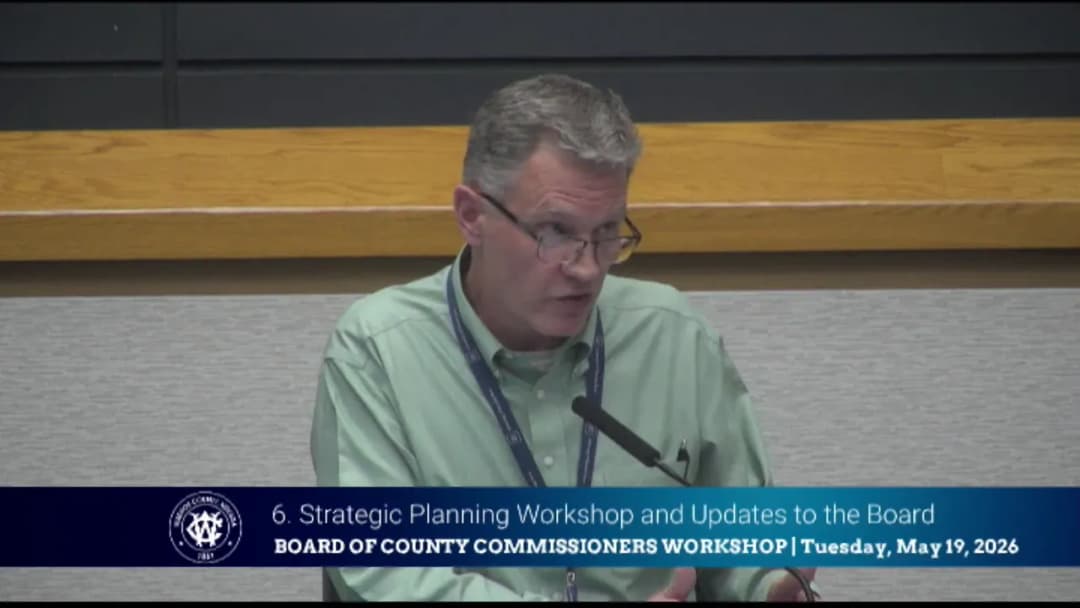
The Washoe County Board of Commissioners met on May 19, 2026, to conduct a public hearing and adopt the Fiscal Year 2027 Tentative and Final Budget, approve the five-year Capital Improvement Plan (CIP) for FY2027-2031, and hold a strategic planning workshop on housing capacity, growth constraints, and prioritized development areas. The meeting included public comments on election materials, disability rights, library services, and transparency concerns, followed by detailed presentations and board discussion. Consent Calendar No consent calendar items were listed or acted upon separately; the budget and CIP were considered individually. Public Comments & Testimony - Tammy Hold (public comment): Expressed confusion over sample ballot format (stars vs. bubbles) and argued the current system is not simple, transparent, or clear, especially for seniors and rural residents with limited internet access. Called for improvements. - Terry Brooks: Addressed discrimination against people with physical disabilities, urging the county to uphold social responsibility and not discriminate. - Randy McCort & Kelly McKinnon (Reno Sparks Chamber Leadership Class): Stated they were fulfilling a civic duty project by making public comment; no specific agenda item addressed. - Sean Sullivan: Spoke in favor of library services and applied for a library board position. Voiced support for providing access to all books, including controversial ones, and highlighted budget challenges for libraries. - Jacob Claudvelter (Nevada Department of Veterans Services): Also part of the leadership class; made a brief public comment. - Laura Wetherington: Expressed strong support for the Washoe County Library system, describing it as a beacon of democracy. Opposed restricting access to library materials and services, arguing the library should reflect diverse community interests. - Penny Brack: Raised transparency concerns: the Budget 101 PowerPoint not being posted, undisclosed taxpayer costs for a voter data project, and the lack of a commission vote or public comment for that project. Also questioned data privacy with the entity SIS. - Alexis Miren (Children's Advocacy Alliance): Introduced herself as a new health policy manager, stating the organization focuses on child welfare, health, and early childhood. Expressed interest in collaborating with Washoe County and other counties. Discussion Items - Fiscal Year 2027 Tentative and Final Budget (Item 4): CFO Abby Yacobin and Budget Director Lori Cook presented the $1.138 billion final budget. Key changes from tentative: no net new positions overall; general fund decline of 2.78 FTEs; library budget moved entirely to general fund; increased transfers to Northern Nevada Public Health ($11.5M) and road fund ($4M); contingency raised to 2% (statutory max 3% in forecast). The five-year forecast shows a structural deficit in outer years. Commissioners discussed the 27% population growth vs. 0.7% FTE decline, indigent tax levy history, and the difference between indigent and homeless funds. Commissioner Clark questioned when staff workload would become unsustainable. The board approved the budget (Commissioner Clark absent for vote). - Capital Improvement Plan FY2027-2031 (Item 5): Lori Cook presented the $123.2 million year-one CIP, covering roads, parks, utilities, facilities, and technology. Key new projects include Hawkins Amphitheater and North Valleys Regional Park (pending grants), ERP modernization, and public safety radio (P25). The long-term capital needs list totals $400–600 million without identified funding. Commissioners discussed payments to the state highway fund and economic slowdown protections. Motion to approve passed unanimously. - Strategic Planning Workshop – Housing, Growth, and Infrastructure (Item 6, discussion only): Assistant County Manager Dave Solero facilitated with presentations from TMRPA Director Jeremy Smith, Reno Housing Authority Executive Director Hilary Lopez, County Engineer Dwayne Smith, and Community Services Director Eric Crump. Topics covered: regional plan tiers (TMSA, Tier 1-3), housing needs and RHA's role (serving 11,000 Nevadans annually, 10,000 on wait list), infrastructure challenges (pavement condition index at 68, increasing maintenance costs), and the concept of prioritized development areas with incentives (land use, fees, tax incentives) to focus growth where infrastructure exists. Commissioners expressed interest in moving forward, convening stakeholders, and using data-driven approaches. No action taken; workshop to continue on June 2. Key Outcomes - Budget Adoption (Item 4): Approved the FY2027 Final Budget (estimated appropriations $1,138,146,582) with changes from tentative including one new FTE in Sheriff's alternative sentencing unit and de minimis adjustments. Commissioner Clark was absent from the vote; all other commissioners voted aye. - CIP Approval (Item 5): Approved the five-year Capital Improvement Plan for FY2027-2031, directing the County Manager to submit to the State by August 1, 2026. Motion passed unanimously. - Strategic Planning Direction (Item 6): Board provided guidance to staff to continue exploring prioritized development areas and incentives. Staff directed to convene stakeholders and return with more detailed analysis. The next workshop is scheduled for June 2, 2026.
Public Meetings - Washoe County, Nevada
Public Meetings - Washoe County, NevadaNote: The transcript states the meeting was held on May 14, 2026, but the official date provided for this summary is May 19, 2026. This discrepancy is noted. The Washoe County Parcel Map Review Committee met on May 19, 2026, at 2:06 PM to consider one project review item and handle routine business. The meeting was called to order by the Chair with a quorum present: Rob Pierce, Wayne Handrock, Eric Young, and Jennifer Williamson (Wes Rubio absent). The Chair led the ethics announcement and appeal procedure. No public comments were received. Approval of Agenda and Minutes - The agenda was approved without a formal vote after no changes were requested. - The March 12, 2026 draft minutes were approved unanimously (motion by Rob Pierce, second by Wayne Handrock; all ayes). Discussion Items - Project Review: WTPM26-0002 Rocky Mountain Vista Parcel Map Chris Frantic presented the request to subdivide a 5-acre parcel at 15990 Rocky Vista Road into four lots (ranging from 43,800 to 58,110 sq ft). The property is zoned Medium Density Suburban with Southeast Truckee Meadows modifiers requiring a minimum lot size of 21,780 sq ft. Staff found all criteria met and recommended approval. - Legal Context: Senior licensed engineer Janelle Thomas noted that this parcel map is adjacent to a recent approved parcel map under the same ownership, prompting staff to review it under subdivision standards per NRS 278.462. Wayne Handrock cited the statute, which allows reasonable improvements for second or subsequent parcel maps. The Chair emphasized the importance of recording this discussion. - No public comment was offered. - Motion by Wayne Handrock, second by Rob Pierce, to approve the map subject to conditions in Exhibit A. The motion passed unanimously. Key Outcomes - Approved: Parcel map case WTPM26-0002 (Rocky Mountain Vista) with conditions. - No action taken on the Chair’s suggestion to change the minutes approval process; further discussion deferred to a future meeting. - Meeting adjourned after reports and future agenda items.
The Washoe County Board of Commissioners met on May 12, 2026, at 10:02 AM, recessed at 11:51 AM, and reconvened at 1:00 PM, adjourning at 1:48 PM. The meeting included proclamations, public comments, consent items, presentations, and first/second readings of ordinances. Key topics included election transparency, housing incentives, stormwater fee reduction, and property nuisance abatement. Consent Calendar - Items 8.A.1 through 8.I.1 were approved unanimously. Notable items include: - 8.A.1: Acknowledgment of Interim Financial Report for nine months ended March 31, 2026, showing a $63 million year-to-date and $17 million year-over-year fund balance increase. - 8.B.1: Authorization to initiate forcible detainer action to remove unauthorized occupants from county-owned property at 520 Carnes Drive, Sun Valley. The District Attorney's office expected to serve notices by May 13-14, with a five-day deadline for occupants to respond, and eviction anticipated by end of June 2026. - 8.C.1 through 8.C.6: Acknowledgment of petty cash/change fund audits for Animal Services, Community Services (Building Services), Juvenile Services, Recorder's Office, Registrar of Voters, and Treasurer's Office. - 8.C.7: Certification of $118,645.53 in special assessments for groundwater basins for FY 2026/2027. - 8.D.1: Acceptance of a $37,309.80 Homemaker subgrant from ADSD (with $5,597 county match). - 8.F.1 and 8.F.2: Budget amendments for Hospital Acquired Infections grants (Sharp 1: $49,421; Sharp 2: $47,923; no county match). - 8.G.1: Approval for Animal Services volunteers to drive county vehicles. - 8.H.1 and 8.H.2: Approval of conference/ training costs for Reno Justice Court contracted personnel ($2,100 and $1,830, respectively). - 8.I.1: Appointment of Truckee Meadows Fire Chief Richard Edwards to the 911 Emergency Response Advisory Committee (term expiring June 30, 2027). - Items 11, 12, and 13 were voted on in a block (approved unanimously): - 11: Resolution R26-0000029 to augment the FY26 Library Expansion Fund budget by $457,956.43 for materials purchases. County Manager clarified this is an accounting function, not new funding. - 12: Award of contract (RFP 3287-25) to The Reno Initiative for Shelter and Equality (RISE) for Safe Camp and Resource Center Operations, with a two-year term (June 16, 2026 - June 30, 2028) and up to three one-year renewals. Total not to exceed $38,750 (June 2026), $2,010,417 (FY27), and $2,080,782 (FY28). - 13: Acknowledgment of code enforcement complaints and setting a public hearing for June 16, 2026, regarding public nuisances on multiple parcels in Sun Valley. Public Comments & Testimony - Tammy Holtzstill and Cliff Nellis criticized sample ballots for including Reno/Sparks races for unincorporated residents, and called for hand-counting paper ballots and an elected registrar. - Heidi Soper (Sun Valley resident, 38-year citizen) urged support for item 13 (nuisance parcels), noting fire hazards and illegal dumping, and thanked the county for action on 520 Carnes Drive. - Steve Letty (Field Creek HOA) thanked the board for completing the Arrow Creek soundwall repair after 20 years, and praised Commissioner Clark, Dwayne Smith, and Candy Ramos. - Cynthia Cooper, Maureen McElroy, Laura Wetherington, Ithni Marie Barton, and Marie Rodriguez spoke in favor of item 11 (library augmentation), emphasizing the library's value and the need to meet the 10% materials budget standard (currently 4.51%). - Oscar Williams and Penny Brock alleged election law violations by Registrar Andrew McDonald, including inaccurate sample ballots and improper ballot scanning processes, and demanded transparency. - Dora Martinez praised the county for making voting accessible for disabled individuals, including the use of the NVES system and tactile ballots. - Penny Brock also objected to the block vote on items 11-13, criticized the Safe Camp contract (RISE), questioned the lack of public presentation, and asked about Grant Denton's role. She also opposed the data transparency project as "just another layer" and demanded paper ballots and hand-counting. Discussion Items - Item 6.A.1: Jail Status Report (Q3 FY26) – Captain John Stewart presented statistics: average daily population decreased to 1,217 inmates; average length of stay dropped to 15.91 days; bookings increased (1,327, 1,192, 1,287 in the three months); inmate-on-staff assaults and fights up slightly; 21 suicides prevented; IAP program saved 5,355 jail days (approx. $867,000). Commissioner Garcia requested data on ICE detainee costs, which was not yet provided. - Item 9: First Reading – Small Unit Density Incentive (Bill 1948) – Staff presented a 25% density bonus for dwelling units under 1,200 sq. ft. in suburban/urban/commercial zones (excluding Tahoe Basin). Analysis showed reduced traffic and building bulk impacts. Planning Commission recommended approval. Public comment: Pat Davison (District 5 resident) supported the incentive, noting it addresses the mismatch of smaller households needing smaller homes. The board set a public hearing for June 16, 2026. - Item 10: First Reading – Regional Road Impact Fee (RRIF) Amendments (Bill 1949) – Dwayne Smith (Engineering Director) explained the 8th Edition RRIF General Administrative Manual and Capital Improvement Plan updates, reflecting an average 2.3% fee decrease. The board set a public hearing for May 26, 2026. - Item 14: Presentation – Data Transparency Project (Project Plain Sight) – Registrar Andrew McDonald, with Ira Victor (Discovery Technician), Justin Warren (ROV), and Josh Franklin (Center for Internet Security) introduced a public-facing tool allowing voters to download and verify voter registration data using SHA-256 hashing. The project is a pilot with no cost to the county. Commissioner Garcia and Chair Andriola expressed support; public comment from Penny Brock criticized the project as unnecessary. - Item 15: First Reading – Stormwater Fee Reduction (Bill 1950) – Ordinance to decrease stormwater management fees from $9.31 to $2.00 per residential ERU effective July 1, 2026, and to direct staff to design the North Spanish Springs Floodplain Detention Facility Phase 2. Public hearing set for May 26, 2026. - Item 16: First Reading – Groundwater Remediation District Bound ary and Fee (Bills 1951 and 1952) – Two ordinances: one amending District No. 24 boundaries, another imposing a fee for remediation of PCE contamination. Second readings set for June 16, 2026. - Item 17: Second Reading and Adoption – Residential Uses in Commercial Zones (Ordinance 1755) – Dr. Young presented the final ordinance to comply with AB 241, allowing multifamily residential by right in commercial zones, with minimum commercial percentages, 35-foot height limit, and municipal water/wastewater requirement. Vice Chair Garcia expressed concern about potential loss of essential services. The ordinance was adopted unanimously. Key Outcomes - Votes: All proclamations, donations, consent items, and block items (11-13) were approved unanimously. - First readings of Bills 1948, 1949, 1950, 1951, and 1952 were introduced and public hearings scheduled for May 26 or June 16, 2026. - Ordinance 1755 was adopted unanimously, completing the county's AB 241 compliance. - Public nuisance hearing set for June 16, 2026, for Sun Valley properties (APNs as listed in item 13). - Forcible detainer on 520 Carnes Drive: notices to be served by May 13-14; occupants have 5 days to respond; eviction expected by end of June. - Data Transparency Project launched as a pilot; no fiscal impact.
The Washoe County Community Homeless Advisory Board (CHAP) convened on May 11, 2026, at 9:00 AM. The meeting included public comment, approval of prior minutes, discussion on expanding board membership to include individuals with lived experience, a presentation on transforming the CARES campus, and updates on permanent supportive housing projects and street-based healthcare. The board also received presentations on supportive housing planning, the Hope Landing and Highway 40 projects, data from Our Place shelter, and the Street Reach street medicine program. The meeting adjourned at 11:34 AM. Consent Calendar - Approval of Minutes (March 16, 2026): Motion made and seconded; passed unanimously without public comment. Public Comments & Testimony - Paul White (Education Crusade): Proposed transferring the CARES campus to a nonprofit coalition of local churches. Argued the current program has zero success stories (defined as clean, sober, employed, and independent), is a $300 million failure, and results in high crime and public safety burdens. Advocated for enforced rules, sobriety, and work requirements. - Tammy Holtstill (Washoe County District 5 candidate): Criticized CARES campus for lack of accountability, citing personal experience with her son. Also opposed using local taxpayer funds to serve out-of-state homeless individuals, referencing a 2015 precedent (San Francisco v. Nevada). - Lawrence Dotson (ABLE, lived experience advisory board): Expressed that CARES campus saved his life, crediting a caseworker for connecting him to stable housing. Asked the board to include a person with lived experience on CHAP with full voting rights. - Pastor Pepe Gonzalez (Victory Outreach): Described his church's 70% success rate in rehab programs through accountability and faith, and stated that volunteers were previously asked to stop providing free services at CARES campus. He was never allowed inside. - Pam Dar: Called for mandatory treatment or removal of homeless individuals, citing safety concerns and a desire for clean streets. - Deanna Hover: Shared a positive story of receiving services from Our Place, including housing and case management, which helped her and her son rebuild their lives. - Taylor Balk (USC graduate student): Advocated for expanding peer mentorship and lived experience support within homelessness response systems, and urged the board to create clear mechanisms for integrating lived experience into CHAP decision-making. - Tim McGivney: Argued that CARES campus requires sobriety as a first step, stating that low-barrier approaches enable drug use and relapse. Supported the church coalition proposal. - Bob Chittester: Described his brother-in-law as a "vagrant by choice" and said the problem is worsened by buses bringing homeless individuals from other states. Called for a new approach. - Eddie Lorton (Reno Mayor candidate): Stated that current spending has not reduced homelessness, and suggested focusing help on those willing to accept it. - Drew Rebar (Assembly District 40 candidate): Blamed government regulations and drug policies for the crisis, arguing that the homeless problem is primarily a drug problem and that government programs have made housing unaffordable. - Tricia Creedon: Criticized city sweeps, saying they disrupt relationships and treat people like criminals. Called for social services, not police involvement. - Melanie Denny: Asked the board to direct staff to develop a comprehensive plan addressing homelessness and affordability, noting federal funding changes (CDBG, HOME, Continuum of Care) that threaten local programs. - Bruce Parks: Called CARES campus an "I don't care campus" and asserted it has produced zero success stories. Supported enforcement of laws as the only effective solution. - Phil McKay (Pastor): Supported the church coalition proposal, emphasizing that accountability and addressing the moral/spiritual dimension are essential. - Joni Hammond: Said CARES campus is a failure, and that half of sheriff's office time is spent responding there. Supported redirecting funds to the church proposal. - Clifford Thomas: Stated he lasted only a week at CARES due to contradictions and lack of accountability. Claimed many homeless are addicted to the lifestyle. - Teddy Craig (Catfish Kickstarter Program): Reported that the term "NRP" (not real people) is used on death records at CARES. Described seeing overdoses, drug dealing, and slow ambulance response. Supported the church coalition. - Trista Gomez: Provided cost data: $44 million annual spending on homeless services, $27 million county deficit, $40,000 per person per year. Criticized lack of sobriety, work, and residency requirements. Later offered solutions including balance between government and church-based programs. - Catherine Yarte: Raised concerns about a DMV kiosk at CARES making out-of-state individuals instant residents, and described law enforcement resistance when investigating a violent crime on campus. - Victoria Meyer: Supported transferring CARES to a church coalition, citing waste and lack of results. - Final public comment: Tammy Holtstill suggested using abandoned warehouses for housing. Teddy Craig reiterated the NRP issue and asked for funding for his reentry program. Trista Gomez advocated for balanced approaches and accountability. Discussion Items - Item 5 – Adding Members with Lived Experience to CHAP: The board discussed whether to recommend adding individuals with lived experience as voting or non-voting members. Councilmember Taylor suggested letting Washoe County take the lead on representation. The consensus was to bring a staff presentation with options to a future meeting, and then take a recommendation to the governing bodies. - Item 6 – Presentation by Paul White (Education Crusade): White proposed immediately canceling all CARES contracts, rejecting federal grants with restrictive rules, and deeding the property to a coalition of local churches. He claimed the church-run model would enforce sobriety, work, and time limits, leading to a 60-70% reduction in homeless population. Board members questioned the feasibility and the claim that 90-95% of homeless individuals are "vagrants by choice." - Item 7 – Supportive Housing Action Plan Update (Brooke Page, CSH): Page reported that the region is moving from planning to implementation, with a growing pipeline of supportive housing. She highlighted the need for formal agreements on definitions, target populations, and coordinated funding. She noted that the state has created supportive housing funds but capital remains a challenge. - Item 8 – Hope Landing Update (JD Clippenstein, Reno Housing Authority): Clippenstein announced that Hope Landing, a 15-unit permanent supportive housing project, is breaking ground in May 2026. Total development cost is $7.8 million, with over 75% funded by RHA. Services are funded by state grants. Units will have project-based vouchers and 24/7 staff. - Item 9 – Highway 40 Update (Juliana Glock, VOA): Glock reported that the 15-unit permanent supportive housing project (motel conversion) is complete and will begin housing residents in June 2026. Total construction cost was $6.9 million, funded by state and local sources. Services include case management and peer support. - Item 11 – Our Place Data Presentation (Penny Adams, VOA): Adams presented data from July 2025 to March 2026: 1,044 individuals served in emergency shelter, 363 families, 188 exited to permanent housing. Over 80,000 direct services provided. The safe parking pilot served 7 individuals, with an average stay of 1-2 nights; the program will continue. - Item 12 – Street Reach Presentation (Jane Fox, UNR Larson Institute): Fox described a new street medicine program providing wound care, bloodborne virus testing, and linkage to care. In April 2026, 172 interactions occurred, with 72 receiving services. 12% of blood draws showed active hepatitis C. The team operates without law enforcement and has been well-received. Key Outcomes - Approval of Minutes: Passed unanimously. - Item 5 – Lived Experience Members: The board agreed to place a staff-developed proposal on a future agenda, with options for one member per jurisdiction or a subcommittee, and to subsequently forward a recommendation to the county commission, Reno City Council, and Sparks City Council. - Board Member Requests for Future Agendas: - Councilmember Taylor requested an assessment of heat-related shelter and cooling center preparedness for the upcoming summer. - Chair Hill requested a presentation comparing low-barrier shelter models to the CARES campus, including successes and challenges. - Chair Clark requested information on tours of CARES campus and the reason why church groups (e.g., Victory Outreach) were asked to stop providing services. - No formal votes were taken on presentations (Items 6–12) as they were non-action items.
The Nevada Board of Wildlife Commissioners met on Friday, May 8, 2026, at 8:30 AM in Reno, with a roll call establishing a quorum. The meeting featured discussions on habitat status, predator management, archery regulations, a new wildlife salvage permit, and updates to commission policies. Key votes included approval of the agenda (moving an item from Saturday), approval of minutes, first reading of Commission Policy 24, and adoption of the FY2027 Predator Management Plan (8-1). Consent Calendar - Agenda Item 3 (Approval of the Agenda): Approved unanimously after a motion to move Agenda Item 21 (Biennial Big Game Release Plan) from Saturday to Friday, if time permits. - Agenda Item 4 (Approval of Minutes): Approved unanimously for the March 13-14, 2026 meeting. Public Comments & Testimony - Rebecca Goff (Nevada State Director, Humane World for Animals): Opposed the FY2027 Predator Management Plan (Agenda Item 10). Cited research showing predator control has "generally no effect in the long term on ungulate populations." Criticized the use of leg-hold traps, snares, aerial gunning, and calling devices, describing them as cruel. Submitted a written statement with peer-reviewed scientific citations. - Mel (Washoe County resident): Supported the predator management plan and the work of Mr. Bennett, noting positive results in Washoe County. - Henry Evans (member of the public): Presented a petition to remove the 80% compound bow let-off limit from NAC 503.144, arguing the regulation is outdated, unenforceable in the field, and that most new bows exceed the limit. - Chris Jasmine (Elko County resident): Opposed the petition to remove the let-off limit, arguing that higher let-off makes bows easier to hold and would increase archery success rates. Urged the commission not to change regulations based on manufacturer interests and to define legal bows if the change passes. - Larry Johnson (co-founding director, Outdoorsmen and Wheelchairs): Supported the disability permit revisions (CGR 529), stating the language is well-written and urging passage. - Senator Robin Titus: Supported the wildlife salvage permit regulation (CGR 527), calling it a "passion of mine" and thanking the commission for considering it. - Paul Dixon (Clark County CAB Chair): Provided multiple comments: (1) Requested a presentation on hounding in bear and mountain lion hunting; (2) Asked if NDOW has worked with NV Energy to raven-proof transmission lines near leks; (3) Supported the disability permit revisions; (4) Questioned clarity in Section 7 of the salvage permit regulation, specifically about moving unsalvageable parts of large animals 200 feet from the roadway. Discussion Items - Habitat Status and Trend Presentation: Matt Glenn presented on the loss of 71% of core sagebrush habitat in Nevada, the inverse relationship between mule deer populations and cheatgrass cover, and a poor snowpack year (reaching near zero by March 28, 2026, weeks early). Despite this, NDOW treated over 150,000 acres for winter annuals and aerial seeding. Commissioners discussed the need to bring habitat data down to the hunt-unit scale for management decisions. - Commission Policy 24 (First Reading): Sean Espinoza presented changes to hunting opportunities among weapons and hunter groups. Key changes included limiting junior hunters to one junior tag from the main draw (with a second possible via alternate draws), expanding the desired buck-to-doe ratio from 30:100 to 30-40:100, and increasing junior horn-shorter-than-ears antelope allocation from 50% to 60% (to be effective at a future meeting). Staff noted the absence of a statewide Mule Deer Management Plan, leading commissioners to request a future discussion. - FY2027 Predator Management Plan: Joe Bennett presented a $614,000 proposed budget (of $722,000 available), with realized savings allowing a reserve balance of at least $100,000. The plan includes six projects covering raven removal, mountain lion removal, coyote removal, and mesopredator control. Commissioner Munn questioned whether the plan meets the department's own goals for science-based, quantitative management. - Compound Bow Let-off Limit Petition: Henry Evans petitioned to remove the 80% let-off limit for compound bows. Game Warden Captain Kramer stated the regulation is unenforceable in the field and that 46 other states have removed it. Commissioner Cavilia moved to accept the petition for further workshop discussion (passed 8-1, with Commissioner Munn opposed). - Disability Permit Program Revisions (CGR 529): Matt Maples presented a third workshop on revisions to NAC 503.146 and NAC 502.429. Changes include restricting crossbow sights to non-variable power (e.g., red dot sights), expanding qualifying medical conditions to include severe spinal stenosis confirmed by imaging, and defining which medical professionals can sign off on permits. The regulation was moved forward for further review. - Wildlife Salvage Permit Regulation (CGR 527): Captain Kramer presented a first workshop on a regulation to implement SB 215, allowing salvage of game mammals (except black bear) and game birds (except crow) killed by vehicle collisions or incidental events. The commission directed staff to refine definitions, consider multiple photos, address 48-hour surrender deadlines, and consider urban disposal of remains. - Biennial Big Game Release Plan (Amendment 2): Sean Espinoza presented removals of several release proposals (e.g., Stillwater, Hot Creek, Quinn Canyon) and new recommendations, including 30 bighorn to the Tobin Range (Unit 045) and antelope releases to the Seven Troughs Range (Unit 041) and Garden/Coal Valley (Unit 133), contingent on habitat conditions. Approved unanimously. Key Outcomes - Votes and Decisions: - Agenda approved unanimously (Item 3). - Minutes approved unanimously (Item 4). - Commission Policy 24 (first reading) approved with a motion to pause Section 1A (mule deer buck ratios) for future discussion and increase junior horn-shorter-than-ears allocation to 60% (future implementation). - FY2027 Predator Management Plan adopted (8-1, Commissioner Munn opposed) (Item 10). - Petition to remove compound bow let-off limit accepted for workshop (8-1) (Item 11). - Disability permit program revisions (CGR 529) moved forward for further review (Item 12A). - Wildlife salvage permit regulation (CGR 527) directed for refinement (Item 12B). - Amendment 2 to the Biennial Big Game Release Plan approved unanimously (Item 21). - Directives and Next Steps: - Staff directed to refine language in the salvage permit regulation regarding definitions, multiple photos, 48-hour deadline (potentially change to working days), and urban disposal. - Staff to continue discussions on Commission Policy 24 Section 1A (mule deer) and the Mule Deer Management Plan at a future meeting. - The Mule Deer Enhancement Summit was announced for July 23-25, 2026, in Ely, Nevada. - Meeting adjourned at approximately 12:55 PM; reconvening at 8:30 AM on Saturday, May 9, 2026.
The Washoe County Board of Adjustment met on May 7, 2026 at 9:30 AM. A quorum was present (Peter Gashan, Rob Pierce, Kathy Julian, Pat Caldwell, Leo Harishni). The board approved the agenda and minutes from the April 2, 2026 meeting unanimously. Consent Calendar - Approved the agenda for May 7, 2026. - Approved the minutes of April 2, 2026 as presented. Public Comments & Testimony No public comments were received in chambers or via Zoom for any agenda item. Discussion Items 8A – WAC26-005: Black Rock 360 (Burning Man Project) Staff presented a request for a four-year extension (to May 4, 2030) of conditions for Special Use Permit WSUP210012, which allows inoperable vehicle storage, light wholesaling, and major grading on 360 acres north of Gerlach. The applicant cited delays due to obtaining an NDEP wastewater discharge permit (dry vac system, first-of-its-kind in Nevada) and resolving geothermal water rights challenges with Ormat. Significant grading, a water well, and building procurement are complete. Board members asked about water rights (sufficient, thousands of acre-feet, state engineer approval pending) and the need for a four-year extension (applicant wanted to avoid repeated shorter extensions). Staff added a condition requiring proof of water rights. The board unanimously approved the amendment with the added condition. 8B – WADMIN26-0004: Community Pancake Breakfast (North Lake Tahoe Fire Protection District) Staff presented an administrative permit for a pancake breakfast on July 3, 2026 from 8:00 AM to 10:00 AM at 875 Tanager Street, with an estimated 500 attendees. The event has been held for over 20 years and includes pancakes, sausage, fruit, coffee, and juice. The applicant requested approval via Zoom, noting no ham this year but promising syrup. The board unanimously approved the permit. 8C – WADMIN26-0003: League to Save Lake Tahoe Fashion Show and Luncheon Staff presented an administrative permit for an invitation-only fashion show and luncheon on August 1, 2026 from 10:00 AM to 3:00 PM on the beach at 1047-1055 Lakeshore Boulevard, with up to 475 guests and 50 support staff. No applicant was present. The board unanimously approved the permit. Key Outcomes - WAC26-005: Approved with an additional condition requiring proof of water rights. (Motion by Rob Pierce, second by Leo Harishni; vote: 5-0) - WADMIN26-0004: Approved as presented. (Motion by Pat Caldwell, second by Kathy Julian; vote: 5-0) - WADMIN26-0003: Approved as presented. (Motion by Leo Harishni, second by Rob Pierce; vote: 5-0) - The board acknowledged that the County Commission affirmed the board's prior approval of the Colter Wall Height variance on April 28, 2026. - Recording secretary Adriana was recognized for her service on her last meeting with the board.
The Washoe County Regional Water Management Planning Commission met on May 6, 2026 at 9:30 AM to review proposed updates to the 2026–2045 Comprehensive Regional Water Management Plan (RWMP). Commissioners approved the agenda and prior meeting minutes, received presentations on updated chapters of the plan, and discussed the project schedule. No public comments were made. Consent Calendar - Agenda approval: Motion by Commissioner Crump, second by Commissioner Flansburg; unanimous. - Approval of amendments from April 1, 2026 meeting: Motion by Commissioner Mincer, second by Commissioner Crump; unanimous. Discussion Items Chapter 5: Stormwater and Watershed Based Water Quality Planning Birgit Whittagren and consultant Jill Sutherland (Resource Concepts Inc.) presented updates. The chapter was reorganized to cover: regulatory framework (NPDES, TMDL), the Truckee Meadows stormwater management program, locally led watershed planning, resources and tools, and watershed restoration spotlights. Proposed removals include outdated state/federal regulatory generalities, references to the deprecated Truckee River Information Gateway (now TMRPA's Natural Resources Data Portal), and topics covered elsewhere (e.g., TMWA water conservation in Chapter 8). Key additions include links to TMStormwater.com, TMWA's forest-watershed initiatives, One Truckee River's 2025 Coordinated Vegetation Map, and completed projects (Chalk Creek Channel Restoration, Gold Ranch fire rehabilitation, Portland Lew installations). Staff requested feedback by June 30, 2026. Commissioner Flansburg commended the work. Chapter 6: Flood Management and Storm Water Drainage Birgit Whittagren presented updates developed with Reno, Sparks, Washoe County, and the Truckee River Flood Management Authority. The revised chapter covers: regional flood damage history, federal/state regulatory framework, flood control efforts (including the Truckee River Flood Management Project), local government programs, and a basin-by-basin overview. Proposed removals include older flood event data, outdated FEMA information, and a policy now included in Chapter 1. Key updates incorporate the latest FEMA flood insurance rate maps (FIRMs), open FEMA data, new flood types (post-fire flooding, 2017 Lemmon Valley Closed Basin flood), the 2026 Capital Improvement Plan, and Reno's revised Title 18. Feedback due June 30, 2026. Chapter 8: Water Conservation, Efficiency, and Use of Water Birgit Whittagren presented updates with TMWA and Sun Valley GID. The chapter was reorganized into: regional benefits of conservation, five-year progress overview, current programs (water usage review, advanced metering, leak detection), future opportunities (advanced purified water, recycled water), and drought response (referencing TMWA's plan). Proposed removals include outdated tables (1995–2015 history), obsolete programs (ultra-low-flow toilet retrofits), references to the closed Nevada Landscape Association, and repetitive figures from TMWA's conservation plan. Key updates highlight smart meter expansion, public-education partnerships (UNR Cooperative Extension, Sierra Nevada Journeys, Smart About Water Day), and alternative water supplies (American Flat, cross-referenced to Chapter 3). Feedback due June 30, 2026. Project Schedule and Status Birgit Whittagren reported the RWMP update is on schedule. Chapters 1, 3, and 4 were presented in April; feedback is due May 31, 2026. Chapters 5, 6, and 8 were presented today; feedback is due June 30, 2026. At the next meeting (June 3, 2026), staff will present revised Chapters 2, 7, and 9, along with the Truckee Meadows Regional Planning Agency's consensus forecast. The issues and action plan will be developed after all chapters are complete. Staff expressed gratitude for partner coordination. Key Outcomes - The commission received and discussed the three draft chapter updates; no formal vote was taken on the content, and no objections were raised. - Feedback deadlines: May 31, 2026 (Chapters 1, 3, 4); June 30, 2026 (Chapters 5, 6, 8). - Next meeting: June 3, 2026 at 1:30 PM in the Washoe County Chambers. - The meeting adjourned without further business.
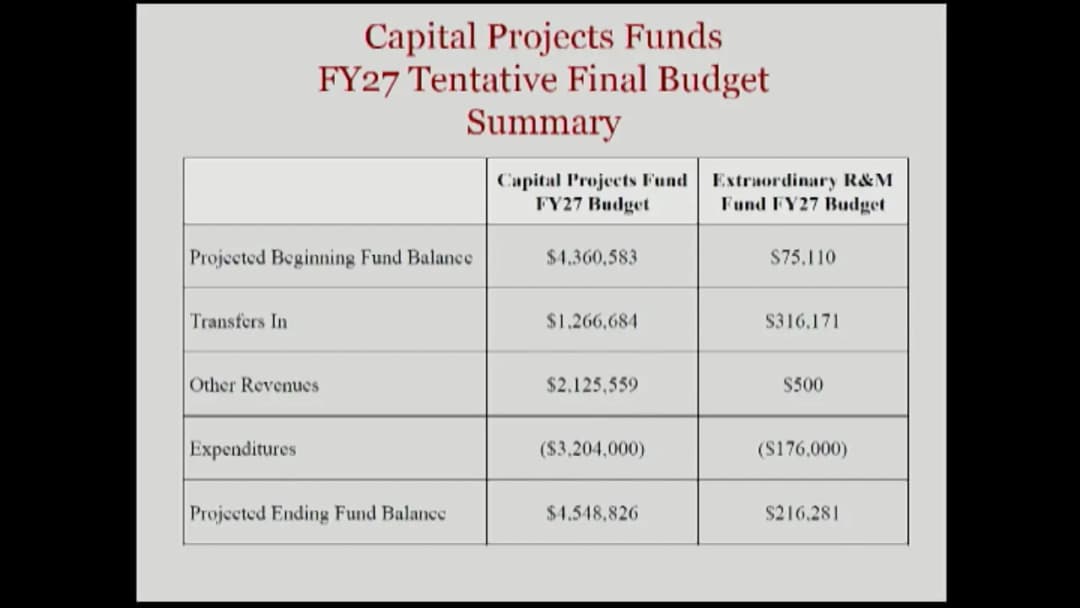
The Truckee Meadows Fire Protection District Board of Fire Commissioners met on Tuesday, May 5, 2026, at 10:01 a.m. at 1001 E. 9th Street, Reno, Nevada. The meeting included approval of consent items, receipt of the Single Audit Report, discussion of the Fire Chief's monthly report, approvals of major equipment purchases, a financial status update, and presentation and approval of the Fiscal Year 2026-2027 tentative budget. Consent Calendar - Approved Minutes of the April 7, 2026 meeting. - Approved Purchase Order to CMC Tire, Inc. for tires (not to exceed $140,000) for FY 2026-2027. - Approved Purchase Order to Dynamic Diesel for fleet maintenance and repair (not to exceed $150,000). - Approved Purchase Order to Life Assist for medical supplies (not to exceed $175,000). - Approved purchase of 43 Dell Pro Rugged 12-inch tablets and docking stations (total not to exceed $198,942.72). - Approved increase of $45,000 (total $130,000) for Marshall EMS Billing Services PO. - Ratified Fire Chief’s acceptance of two BLM/NV Fire Chief's Association grants: $70,415 for Silver Knolls Defensible Space and $75,000 for Steamboat-Via Bianca Fuel Break (no match required). - Approved modified Healthcare Education Program Rate Sheet. - Accepted donation of 15 manual blood pressure cuffs (estimated value $5,400) from Inter-Hospital Coordinating Council. - Approved participation in Hearts 4 Heroes USA Paw Platoon Placement Program for a facility canine. - Approved Resolution TM01-2026 authorizing overtime and portal-to-portal pay effective July 1, 2026. - Approved cancellation of the May 19, 2026 budget meeting and rescheduling to May 26, 2026, at 9 a.m. Public Comments & Testimony - No public comments were made during either public comment period. Discussion Items - Single Audit Report (Item 6): The auditor, Kurt Schlicker from Id Bailey, presented the FY2025 Single Audit. The audit found two internal control findings: (1) the district did not provide evidence of checking vendor suspension/debarment before purchases over $25,000, and (2) reporting errors in pass-through grants with the county. No unallowable costs or repayment requirements were identified. CFO Crystal Sublett noted the compliance supplement delay caused the late presentation. The board acknowledged receipt and approved distribution. - Fire Chief’s Report (Item 8): Chief Edwards highlighted the 2026 Community Report, noting a 42% increase in responses due to automatic/mutual aid agreements, a 14% increase in EMS responses, and a 28% increase in training hours. The wildland fuels division treated over 460 acres, collected over 4,500 cubic yards of vegetation, and treated 47 acres through prescribed burns. The fire prevention division completed 1,558 plan reviews and 354 defensible space inspections. A discussion ensued on the inefficiencies of the current CAD system, causing redundant dispatches. Commissioners expressed concerns about resource strain and safety. Chief Edwards noted the new Octave CAD system is delayed but expected to improve dispatch efficiency once implemented. - Equipment Purchases (Items 9-11): The board approved three equipment purchases: 71 KNG-M150 mobile wildland radios ($295,500), 62 self-contained breathing apparatuses ($560,220.22), and 65 R2400 Cradlepoint routers ($240,005 with 10% contingency). Commissioner Hill thanked the Pennington Foundation for grant funding supporting these purchases. - Financial Presentation (Item 12): CFO Sublett reported FY2025-2026 financials as of March 31, 2026: revenues at 77% of budget (property taxes at 95.8%), expenditures at 65% of budget. Salaries and benefits represent 79% of total annual budget. Capital projects revenues include $8 million from Apple reimbursement and $3.2 million from Pennington. The item was for information only. - FY2026-2027 Tentative Budget (Item 13): CFO Sublett presented the tentative budget with a projected General Fund revenue of $59.6 million and expenditures of $56.4 million. Key changes include a corrected tax revenue reduction of over $900,000 from the Department of Taxation, inclusion of $1.3 million from North Township 22, and a 3.25% COLA for labor groups. The projected ending fund balance for FY2027 is $6.45 million (11.44% of expenditures, below the 17-20% policy target). A five-year forecast indicates a negative fund balance trend if no changes are made. Chief Edwards noted that the district cannot afford to bond a new fire station (Washoe Valley) and must find alternative funding. The board approved the tentative budget unanimously. Key Outcomes - Consent Items (5A-L): Approved unanimously by voice vote. - Single Audit Report (Item 6): Motion by Commissioner Hill, second by Vice Chair Garcia. Approved unanimously. - Wildland Radios (Item 9): Motion by Commissioner Hill, second by Commissioner Herman. Approved unanimously. - SCBA Purchase (Item 10): Motion by Commissioner Hill, second by Vice Chair Garcia. Approved unanimously. - Cradlepoint Routers (Item 11): Motion by Vice Chair Garcia, second by Commissioner Herman. Approved unanimously. - Tentative Budget (Item 13): Motion by Commissioner Hill, second by Vice Chair Garcia. Approved unanimously. The final budget will be presented for public hearing and adoption on May 26, 2026. - Closed Session (Item 16): The board adjourned the open meeting at 11:27 a.m. to proceed to closed session upstairs to discuss labor issues per NRS 288.220.
The Washoe County Planning Commission met on Tuesday, May 5, 2026, at 2:00 PM. Commissioners present included Jim Barnes, Michael Flick, Daniel Lazareski, Kate Nelson, Amy Owens, and Rob Pierce; Linda Kennedy was absent. The meeting began with a pledge, ethics disclosures, and general public comment. The Commission then approved the consent agenda and minutes from the April 7 meeting before hearing two public hearing items: a condition amendment for Silverado Village at Eagle Canyon, and a major subdivision and special use permit for the Osage Road area. Both items were approved after discussion. Consent Calendar - The Commission approved the consent agenda as a single package, consisting of two routine items (extensions of time or similar), without any requests to pull items for separate discussion. - The minutes from the April 7, 2026 meeting were also approved as written. Public Comments & Testimony - Cliff Lowe (general comment): Thanked the Commission for their difficult work and their earlier unanimous decision to deny the “Year Reflections” development (January 6, 2026). He expressed disappointment that the Board of County Commissioners later reversed that decision on a 3–2 vote, and urged the Commission to make the same finding again if faced with the project. - Tammy Holt Still (general comment): Cautioned that when the Planning Commission denies a project and the County Commissioners overturn it without proper findings under NRS, residents lose their ability to seek judicial review. She cited personal experience of being sued by a developer after a similar reversal. - Russ Earl (on Item 9B – Osage Road): Opposed the development, stating that the applicant plans to move 92,926 cubic yards of fill and 122,158 cubic yards of cut on 53.22 acres, which he argued would remove 40 acre-feet of water storage and negatively impact surrounding properties and the Silver Knolls community. He warned of increased flood risk, insurance problems, and liability for Washoe County, referencing Reno’s costly experience in Lemon Valley. - Tammy Holt Still (on Item 9B): Argued that the development would connect Silver Lake to Swan Lake via the sewer lift station and that removing natural floodplain storage would increase flood risk for everyone. She claimed the developer has not fulfilled past promises and recommended that all developers be required to post performance bonds. - Catherine Yarte (on Item 9B): Questioned who would be responsible for maintaining retention ponds long-term if the HOA bylaws are amended, and noted that connecting sidewalks to Red Rock Road is of little value when Red Rock Road lacks sidewalks and is dangerous for pedestrians. - Kirk Johnson (via Zoom, on Item 9B): Raised concerns that on-site retention ponds are already full behind his property and that new paving would send water uphill, with emergency overflow directed into an already full pond. Discussion Items 9A – Amendment of Conditions for Silverado Village at Eagle Canyon (WAC 26-003) - The applicant (Silverado Homes Nevada Incorporated) requested to redesignate a 0.81-acre parcel (APN 5320219) from “common open space” to “common area” to allow a private roadway connecting the existing Silverado Village phases 1 and 2 to the proposed Silverado 3 subdivision to the south. - The parcel is part of a 21.56-acre senior housing community approved in 2022. Previous amendments changed the age restriction and unit count (from 136 to 134 units). The roadway will be private, maintained by the HOA. - Noticing: 45 property owners within 500 feet were notified; no comments were received. - The Commission approved the amendment for both the special use permit and the tentative subdivision map with conditions (unanimous votes). 9B – Tentative Subdivision Map (WTM 26-002) and Special Use Permit (WSUP 26-004) for Osage Road Infrastructure - The project by Lifestyle Homes TND LLC proposes a 131-lot common open space subdivision on 53.22 acres at 10600, 10100, and 10101 Osage Road, including grading of 122,158 cubic yards of cut and 92,926 cubic yards of fill (major grading). A sewer lift station is also requested. - Key features: on-site retention ponds designed to capture 30% more stormwater than existing conditions (per county code), connection of Echo Avenue to Osage Road (providing a second egress), extension of Osage Road (1.41 miles paved), and a sidewalk on the north side of Osage. The developer stated that the retention ponds will be maintained by the HOA. - Traffic: The project is estimated to generate 1,270 daily trips, 95 AM peak hour trips, and 127 PM peak hour trips. A Traffic Impact Study was approved. 70% of trips are expected to use Echo Avenue. - Public safety: The extension of Echo Avenue will allow Reno Fire Station 9 to respond, reducing emergency response times. The Sheriff’s Office stated staffing levels have not changed in the last three years. - Floodplain: The site is partially within FEMA Zone AE. The applicant must obtain a Conditional Letter of Map Revision (CLOMR) prior to grading, and a final LOMR after construction. Staff confirmed that the CLOMR review will evaluate impacts on the entire floodplain. - Discrepancy noted: Public commenters and Commissioner Flick highlighted that the Regional Transportation Commission (RTC) 2050 Regional Transportation Plan originally showed widening of Red Rock Road from US 395 to Placerville Drive as a 2026–2030 project, but it has since been reverted to 2035–2050. Staff contacted RTC and confirmed the current window is 2035–2050, but could not verify the earlier timeline. The project’s previous zoning applications relied on the accelerated timeline. - Staff recommendation: Approval with conditions, with all 20 findings for the tentative map and 5 findings for the special use permit. Key Outcomes - Approved (Item 9A): Amendment of Conditions for Silverado Village at Eagle Canyon (WAC 26-003) – Unanimous vote (6–0). - Approved (Item 9B, tentative map and special use permit): Osage Road Subdivision and Sewer Lift Station – Motion carried with one nay (Commissioner Flick voted opposed; the exact vote count was not clearly recorded as “aye” vs “nay” but described as “the motion carries” after a single nay). - Directive: Staff will contact RTC to investigate why the Red Rock Road widening timeline was pushed back from 2026–2030 to 2035–2050 and provide a memo to the Commission. - Future agenda: Commissioner Flick expressed interest in discussing code changes that could tie road capacity improvements to development approvals, echoing a public suggestion to make road capacity a required finding.
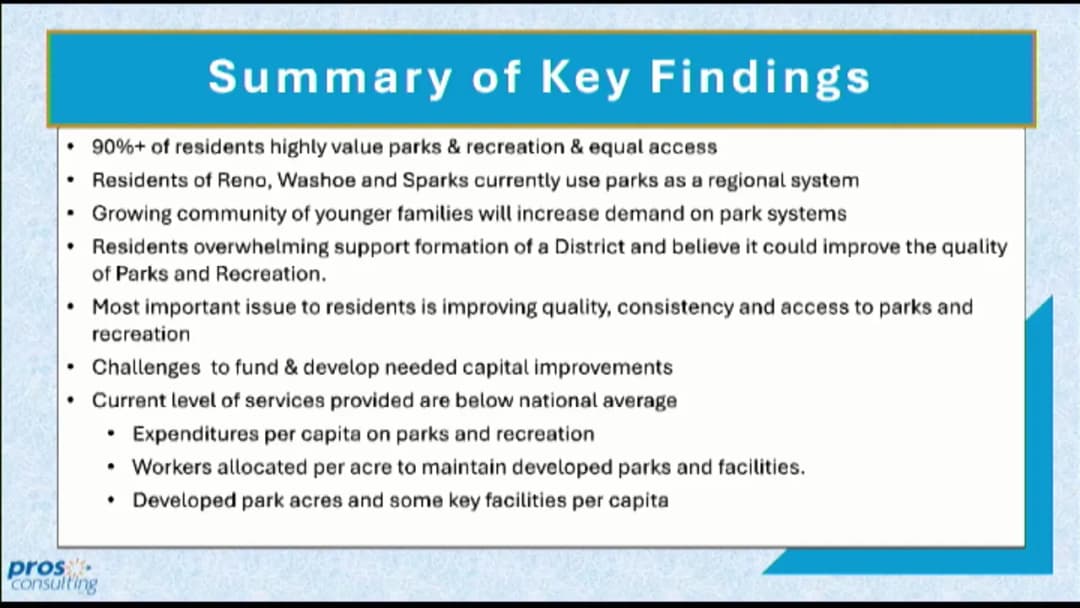
The joint meeting of the City of Sparks, City of Reno, and Washoe County Parks Commissions convened on April 30, 2026, to receive a progress report on the feasibility study for a regional parks and recreation service district. The meeting included approval of the agenda and prior minutes, substantial public testimony, and a detailed presentation from Pros Consulting outlining survey results, service level analysis, and next steps toward potentially forming a dedicated parks district under NRS 318A. No formal action was taken on the feasibility study; the presentation was received for discussion. Consent Calendar - Approval of the Agenda (April 30, 2026): Approved unanimously by the Sparks commission (motion by Sheena Harvey, second by Jill Short), the Reno advisory board (motion by Cheryl Gynan, second), and the Washoe County commission (motion by Sean Hill, second by Commissioner Daig). - Approval of the City of Sparks Draft Minutes (June 26, 2025): Approved by the Sparks commission (motion by Sheena Harvey, second by Jill Short). Public Comments & Testimony - Julie Conway (Washoe County resident, 19‑year resident): Expressed strong support for the special district proposal, emphasizing the need for sustainable, sufficient, and fair funding for maintenance and operations as well as new facilities. She thanked the commissions for their service and urged continued progress. - Iris Julie Peppard (Executive Director, One Truckee River): Stated that her organization’s 31‑partner coalition had reached consensus in May 2023 supporting sustainable and sufficient regional funding for parks, trails, and open space. She expressed excitement for item six (the feasibility study) and looked forward to future action. - Second public comment period (after the presentation): - Julie Conway: Commended the consultants and urged continued collaboration, noting that Bozeman, Montana successfully created a district in about five years. She stated that doing nothing is not an option. - Mac Rossi (Reno resident): Suggested that apartment owners should contribute additional revenue for park use by their tenants, possibly a few dollars per unit. - Tina Knappy (near Rancho San Rafael Park): Expressed excitement but questioned the statement that “maintaining existing parks must come before expansion,” arguing that the region needs more parks, open space, and trees. She urged clarification. - Karen Mullen: Thanked the team and encouraged the board to move forward, noting that 1,400 similar districts exist nationwide. She emphasized livability for young families and the importance of passing on a quality system. - Iris Julie Peppard: Reiterated that the Truckee River provides 85% of the region’s drinking water and that the district would benefit river improvements. Discussion Items - Feasibility Study Update for a Regional Parks & Recreation Special Service District (Item 6): - Presenter: Leon Younger (Pros Consulting), along with Andy Belknap (Baker Tilly) and Mike Shellito (formerly with the City of Roseville). - Context: Nathan Olivet (Reno Parks & Recreation Director) introduced the presentation, noting that this is a milestone in a process started over a decade ago. The study is a feasibility evaluation, not a final recommendation. - Survey Results: A statistically valid survey (748 responses, margin of error ±3.6%) found: - 70% of residents believe a single district would improve efficiency and service quality. - 72% support a dedicated funding source (very supportive or supportive). - 94% agree equal access to quality parks is important. - Most respondents comfortable with $25–$50 additional annual household cost. - “Very likely” to vote to establish a district: Reno 70%, Sparks 65%, Washoe 55%. - Level of Service Analysis: The region falls short of national standards in acres per 1,000 residents, trail mileage (29 miles short), and indoor recreation space. - Operational Assessment: Current per‑capita investment ranges from $21 to $58, well below the NRPA median of $77. Staffing levels are stressed, with varying FTE per acre across jurisdictions. - Legal Framework (Andy Belknap): NRS 318A (enacted in 2017) authorizes a parks, trails, and open space district but has never been used in Nevada. Formation requires a service plan, public hearings, consent from affected local governments, and no majority property owner protest. The initial board of trustees would be appointed by the local governments, transitioning to elected positions. - Guiding Principles (Mike Shellito): The district should improve service levels, not just maintain status quo. Current funding from cities and county should be transferred to the district, augmented by new revenue (potentially via voter‑approved assessments). A consolidated organizational plan should avoid adverse effects on employees. - Next Steps: Over the next few months, consultants will develop a framework including: menu of services, district boundaries, funding and governance structure (multiple options), staffing transition plans, asset lifecycle inventory, and a service plan with public engagement milestones. - Commissioner Questions: - Concerns about personnel (75% of budget) and efficiency were addressed; partnerships and evaluation of asset use can help. - Questions about how the district’s trustees would interact with existing planning commissions; answer: they would still go through local planning processes, and agreements can be embedded in founding documents. - Concerns about funding contribution levels and future flexibility—consultants agreed and noted potential need for state legislative changes. - Questions about employee unions and land ownership complexities; consultants stressed that employees would not be made worse off and that land dedication constraints would be respected through leases or agreements. - A question about heat mitigation planning (AB 96) was raised; consultants acknowledged the district would need to be a partner in regional climate planning. - In response to a question about dissolution, consultants confirmed that districts can be dissolved, but it is not easy; agreements in founding documents can address exit scenarios. Key Outcomes - The agenda and Sparks draft minutes were approved by voice votes in all necessary jurisdictions. - The feasibility study presentation was received for discussion; no formal action was taken to approve or reject the district proposal. - The commission acknowledged the complexity and directed consultants to continue developing a framework and service plan over the coming months, with further public and elected official engagement. - The meeting adjourned at 7:38 PM.