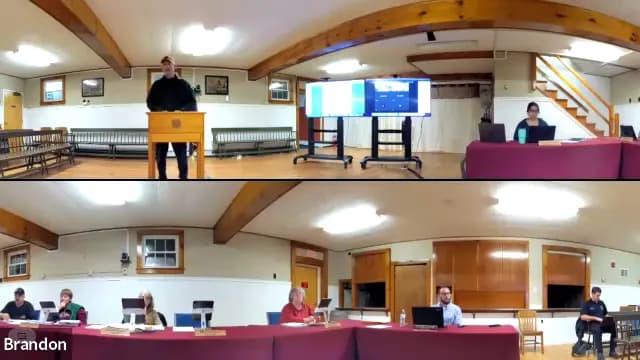
The Weathersfield Select Board met on November 15, 2025, to address a range of topics including the school budget, property reappraisal, public access television funding, capital planning, and employee compensation. Key decisions included extending deadlines for the Old Ball Road decision, setting the cost-of-living adjustment at 3.5%, approving new health insurance options, and advancing a memorial grove management plan. Consent Calendar - Minutes Approval: The board approved the minutes from October 27, 2025, with corrections for date (October 27 vs. October 14) and noted items regarding recusal vs. abstention. - Warrants Approved: Warrants dated November 10, 2025, totaling $34,017.27 payroll and $155,980.40 operating expenses across general, highway, solid waste, and reappraisal funds, passed unanimously. Public Comments & Testimony - School Board Report: John Ericsson, providing the monthly school board report, stated the SU budget is finalized with a 16.2% increase (1.4% administrative, 14.8% special education). He noted that Weathersfield’s portion increased 10% to $9.908 million, and that school choice is expensive for the town. He also raised the need for a crosswalk at Schoolhouse Road, suggesting a parallel town-school effort, though state officials typically require a sidewalk connection. - Reappraisal Update: Nate Sodter, project lead for the 2027 reappraisal, explained the process, timeline, and data collection. He emphasized that interior inspections are voluntary but beneficial, and that no-entry properties will be valued using cost calculations and exterior observations. He reported that only 24% of properties in recent reappraisals allowed interior access. The board and attendees discussed the impact of COVID-19 on sales trends and grievance procedures. - SAPA TV Funding Request: Kevin Paquette, Executive Director of Springfield Area Public Access Television (SAPA TV), and board president Marita Johnson requested $5,000 in funding. Paquette acknowledged past technical and communication issues, stating they have been resolved and that recordings are now done via Zoom. Marita Johnson noted the 25-year relationship with the town. August Murray criticized the prior director for partisan activities and suggested that modern technology (Zoom, YouTube) might make SAPA TV unnecessary. The board did not take a vote; the request will be considered as a special appropriation. Discussion Items - Old Ball Road Decision Extension: The board voted to extend the completion deadlines for the class four section of Old Ball Road by one year (to November 17, 2027, and November 17, 2028) due to ongoing legal matters. Motion passed unanimously. - Budget Committee Orientation: The town manager presented the FY27 budget development timeline, with key dates from November 2025 through January 2026. The board discussed aligning with the school budget process. August Murray and Chris Shires were later appointed to the budget committee. - Capital Plan Discussion: The board reviewed capital plans for highway motorized equipment, fire apparatus, paving, and technology. The proposed first-year contribution totaled $451,000. An alternative fixed-mix financing option would reduce first-year costs to $259,000 but increase long-term interest costs by an estimated $205,000 over 20 years. The board discussed the trade-offs and deferred detailed analysis to the budget committee, noting that skipping a component would raise future costs. - Cost of Living Adjustment (COLA): A motion was made to set FY27 COLA at 2.8%, but was amended to 3.5% (fiscal impact $6,600 difference). The amendment passed with three ayes and one nay. The final vote on the amended motion (3.5%) carried. - Health Insurance Options: The board approved three health insurance options for employees: Option 1 (Gold 3 plan with HRA), Option 2 (MVP Platinum with HRA), and Option 3 (MVP Platinum without HRA). The total maximum town cost increase is $13,000. Discussion included grandfathering existing HSA holders, but the board moved to phase out HSAs. The motion passed unanimously. - Memorial Grove Management Plan: The board accepted the second reading of the management plan and moved to a third reading with amendments to include the Civil War monument and Memorial Mill Wheel within the plan’s scope. The motion passed unanimously. Key Outcomes - Vote: Extended Old Ball Road deadlines by one year (unanimous). - Vote: Set FY27 COLA at 3.5% (3-1). - Vote: Approved three health insurance options for FY27 (unanimous). - Vote: Advanced Memorial Grove plan to third reading with amendments (unanimous). - Appointments: Chris Shires and August Murray appointed to the Budget Committee. - Next Steps: The budget committee will review capital plans and COLA impacts; the SAPA TV funding request will be considered as a special appropriation; the memorial grove plan will be revised for a third reading.
Public Meetings - Weathersfield, Vermont
Public Meetings - Weathersfield, VermontThe Weathersfield Select Board met on Tuesday, October 28, 2025, for a regular evening meeting. The board approved prior minutes, adopted the town ethics and personnel policies, received presentations on four capital plans, reviewed the FY27 budget outlook and COLA, and handled several administrative items. At one point during the meeting, the board noted the time was almost 8:30 p.m. Agenda Review and Minutes Approval - The agenda was reviewed and kept as presented; no changes were made. - Minutes of September 22, 2025 were approved with a correction: the vote on formation of the Memorial Grove Committee was deferred to the next select board meeting, not the next town meeting. - Minutes of October 14, 2025 were approved as presented. Public Comments and Testimony - Mr. Murray, representing the Veterans Memorial Committee, announced the Veterans Day ceremony at 11:00 a.m. on November 11, 2025, and proposed a January public meeting with other town committees to discuss the future of Veterans Memorial Park and possible fundraising for a bandstand or gazebo. He expressed support for partnering with parks and recreation, the garden club, and the historical society. - Julie Levy requested that the board add Governor Scott's Declaration of Inclusion to a future agenda, noting that 164 towns and municipalities have signed it and that most neighboring towns are on the list. She described it as complementary to the town's existing declaration of inclusion. - Susan Wilder supported the Declaration of Inclusion request and said it was a critical time for Weathersfield to step up, especially as DEI initiatives are being ended. The board said it could not add the item that evening but would discuss it and place it on a future agenda. Code of Ethics Ordinance - Third Reading - The board adopted the Town of Weathersfield Code of Ethics Investigation and Enforcement Ordinance as written on October 13, 2025, following the third and final reading. The vote was unanimous, with no opposition or abstentions. Personnel Policy - Third Reading - The board adopted the Personnel Policy on its third and final reading by roll call vote: 4 in favor, 0 opposed, 1 abstention. Rika Henderson, Nate McNaughton, Mike Todd, and Kelly O'Brien voted in favor; Deforest abstained. Capital Plans Presentations - The highway superintendent and town manager presented four capital plans: Paving Capital Plan, Highway Department Motorized Equipment Capital Plan, Fire Truck Capital Plan, and Technology Capital Plan. - Paving plan: uses a road-scoring system to prioritize work; for every dollar spent now, the town saves about $1.50 later. The plan covers crack sealing, shim and overlay, micro-milling, and reclaiming. This year, a $200,000 grant will be added to the Center Road project, with Airport Road deferred to next year. - Highway equipment plan: aims to replace trucks and graders before residual values drop and maintenance costs rise. Examples included a 2012 dump truck that cost $11,000 to prepare for winter and $14,000 for radiator and DEF-system repairs, totaling $26,000 in two years. A prior grader purchase delay added about $75,000 in cost and $23,000 in maintenance. Used or rebuilt equipment would be considered where practical. - Fire truck plan: the fleet has eight trucks, four purchased by individual fire departments and four by the town. The plan stretches replacements and increases by $15,000 per year. Cited costs included $800,000 for a new pumper, $450,000 for a rescue truck, and $1-2 million for a new aerial. The 1998 ladder truck is expected to be kept for another 10 years and eventually replaced with a rescue truck. The fire chief noted the fleet maintenance budget was already 70% spent for the fiscal year. - Technology plan: most equipment has a five-year useful life; first computer replacement costs $49,269 and second replacement costs $56,000. The proposal would contribute $9,500 per year to a reserve for three years, then reduce contributions by $500 each three-year period. Board members asked about cybersecurity training; the town manager said the town is moving to a cloud/serverless environment and adding another layer of security training. - Phase-one capital plans total about $591,000, including $20,000 for parks and recreation and a restructured $25,000 for the Bowen Hill culvert. The town manager said the plans would save more than $2 million in interest over 20 years, roughly $45,000-$50,000 per year. The initial tax impact would be about 18 cents per $100, potentially 20-24 cents with other budget increases. - Board members discussed three funding structures: a separate annual capital reserve fund vote, four annual special appropriations, or one special appropriation followed by annual budget transfers. Some board members leaned toward building the costs into operating budgets, but no decision was made. The town manager will restructure the numbers and return with options. Finance Report - The town manager reported the town's overall financial position is very good. General fund revenues were at 27% and expenses at 21%; highway fund revenues at 25% and expenses at 23%; solid waste fund revenues at 53%. No significant issues were identified. - Fund balance projections were about $150,000 in the general fund and $100,000 in the highway fund, totaling around $250,000. The town may use $20,000-$30,000 of fund balance this year. Board members suggested using fund balance strategically to reduce the capital-plan tax spike. FY27 Cost-of-Living Adjustment (COLA) - The town manager recommended a 3.5% COLA, citing the Social Security Administration's 2.9% and the latest compensation study. Options from 1% to 5% were presented with total costs. - Board members expressed concern about taxpayer burden and the gap between COLA and Social Security increases; others worried 3.5% might be too low to remain competitive. - A motion to approve 3.5% failed on a 2-2 vote: Nate McNaughton and Rika Henderson voted yes; Mike Todd and Kelly O'Brien voted no; Deforest recused. The board later approved a motion to record that vote. The board consensus was not to go below 2.8%. Memorial Grove Committee Policy - First Reading - The board accepted the first reading of the Memorial Grove Committee policy, including previously requested changes such as adding the historical society to the work plan. The motion carried by roll call. Political Sign Guide - The board reviewed a draft political sign guide based on a Brattleboro model. Members requested revisions: remove redundant public property language, define presiding officer, clarify the two-week display period, and have the town clerk and zoning administrator review it for compliance with state law and zoning ordinances before returning. Town Manager Report and Reappraisal Update - The town manager reported that the water line replacement project received approval; it is a $2 million project not funded by the town, with a bid opening on December 18 and most construction in the spring. - The town manager recommended $20,000 for parks and recreation in the FY27 budget and said the Bowen Hill culvert capital allocation would be restructured. - The fire department received 18 applications for firefighter positions; appointments and oaths will occur over the next few weeks. - Board members raised public concerns about the reappraisal and reports of interior and exterior inspections. They clarified that property assessments are exterior only and agreed to invite the assessor to a future meeting to explain the process. Budget Committee Policy Compliance - The board discussed the policy requiring the select board and town manager to hold an orientation meeting for the town budget committee. They agreed to follow the policy, schedule a joint orientation, and incorporate a timeline for receiving budget recommendations. Warrant Approval - The board approved the October 27, 2025 warrant. Payroll totaled $29,886.43 and operating expenses totaled $135,618.38, covering general fund, highway fund, solid waste fund, library, and grant/reserve project accounts. Executive Session - The board voted by roll call to enter executive session under 1 V.S.A. 313(1)(E) to discuss a legal matter involving a DRB appeal. The remote board member received a new Zoom invitation, the recording was stopped, and no public action was taken afterward in the open session. Key Outcomes - Approved the September 22 and October 14, 2025 minutes. - Adopted the Code of Ethics Investigation and Enforcement Ordinance on third reading. - Adopted the Personnel Policy on third reading by a 4-0-1 roll call. - Accepted the first reading of the Memorial Grove Committee policy. - Approved the October 27, 2025 warrant. - Did not set the FY27 COLA; the 3.5% motion failed 2-2, with consensus not below 2.8%. - Received capital plan presentations; no funding decision was made, and the town manager will return with restructured options. - Agreed to place the Declaration of Inclusion on a future agenda. - Agreed to invite the assessor to a future meeting on the reappraisal. - Scheduled review of the revised political sign guide after town clerk and zoning administrator input.
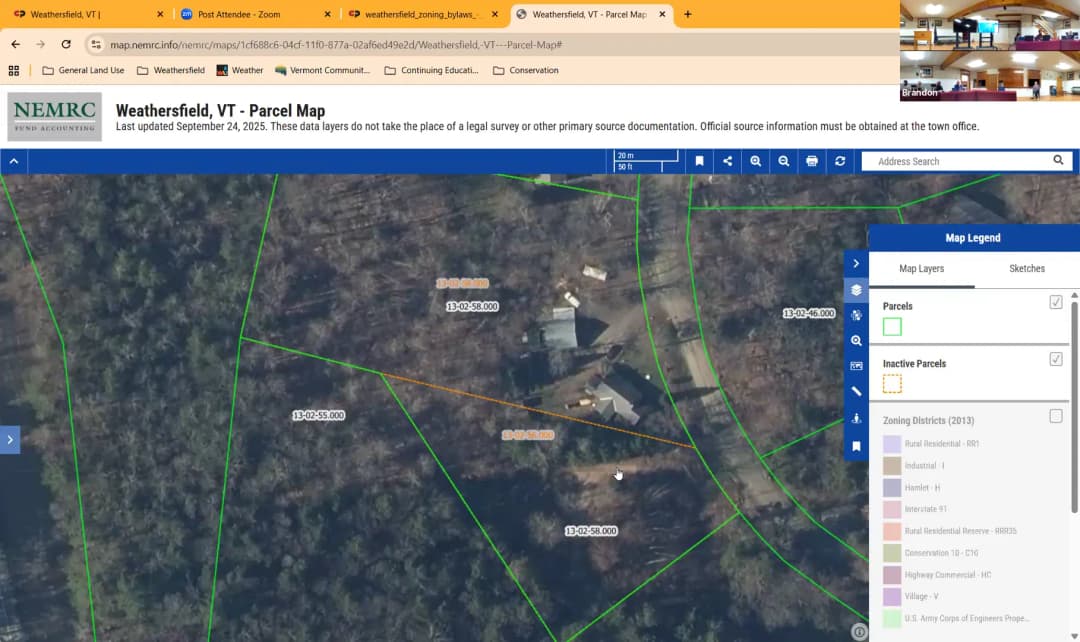
The Weathersfield Planning Commission met on October 25, 2025, at 6:30 PM. The meeting covered zoning interpretation for a Melody Lane parcel, review of the Education, Economic Development, and Utilities & Facilities chapters of the town plan, and future planning timelines. Key decisions included approving minutes, referring a zoning question to the town attorney, striking several paragraphs from the Economic Development chapter, and agreeing to finalize remaining chapters by year-end with a public hearing targeted for January 2026. Consent Calendar - Approved the meeting minutes of October 6, 2025, unanimously. Public Comments & Testimony - No members of the public spoke on items not on the agenda. Discussion Items - Melody Lane Parcel (Zoning Interpretation): The Land Use Administrator presented a lot comprising two tax parcels (one inactive) with a house near the boundary. The owner wants to build a barn on the inactive parcel, which lacks sufficient road frontage (non-conforming) but meets minimum lot size. Board discussed whether existing small-lot exemptions apply to frontage and whether the zoning bylaw's merger language automatically merges the lots when they come under common ownership. Members agreed that building a barn complying with setbacks would not worsen non-conformity and that frontage is primarily a subdivision issue. However, due to unclear bylaw language on merger, the board decided to refer the question to the town attorney for clarification. - Education Chapter: The board reviewed proposed changes from the school district (via BJ). A key point was the deletion of a paragraph on hands-on learning (lines 140-145). The board felt the paragraph had value but needed revision – specifically changing “taking children out of a classroom” to “involves students” and broadening references beyond the Weathersfield School to include other educational opportunities. The board also requested adding a description of the supervisory union’s structure and the town’s representation (two school board members) to help residents understand budget voting. Other minor additions were discussed (e.g., listing town forest as a non‑classroom resource). The board directed staff to rework the paragraph and incorporate the supervisory union description. - Economic Development Chapter: Several lines were flagged: - Line 58: Language about commercial development leading to “increased crime rates and decreased property values” was struck as inappropriate and potentially discriminatory. The sentence was ended after “rural character.” - Lines 85-92: An editorial paragraph describing “newer, wealthier people coming from better economic environments” was removed entirely as judgmental and not suitable for a town plan. - Line 173: A reference to a 2010 public outreach meeting was retained as historically significant (petition to eliminate zoning). - Line 22 (Section 2.1): The business inventory data from 2012 was noted as outdated; the board agreed to add a goal to update the inventory. - Utilities and Facilities Chapter: Staff presented a ridgeline map for cell tower siting, created using GIS and ground surveys. The map identifies prominent ridges (e.g., Hawks Mountain, Escutney, Butterfield Hill) where towers would be visually impactful. The board accepted the map and will reference it in policies to guide tower placement. The chapter’s description of a well at Deep Meadow Farm was simplified (removed lease details). Discussion of aging septic systems in Perkinsville and Scutney led to a decision to add language about new treatment technologies (e.g., mound systems, advanced tanks) and to note the ongoing water/sewer feasibility study. The board removed a sentence stating that private marinas on the Connecticut River are non-conforming, as the town lacks regulatory authority over the river. The implementation matrix was removed from this chapter. - Future Timeline: The board discussed completing the remaining three chapters (Transportation, Health & Human Services, Housing) by the end of 2025, with the goal of warning a public hearing on the full town plan in January 2026. The next meeting is scheduled for November 3 (upstairs due to election setup), then December 1 and December 15. Key Outcomes - Minutes of October 6, 2025, approved unanimously. - Melody Lane parcel zoning interpretation question referred to town attorney. - Economic Development chapter: crime-related language (line 58) and editorial paragraph (lines 85-92) struck; goal to update business inventory added. - Education chapter: staff to rework hands-on learning paragraph and add supervisory union description. - Utilities & Facilities chapter: ridgeline map accepted and will be referenced; well description simplified; new septic technology language to be added; marina sentence removed; implementation matrix removed. - Target to complete remaining chapters by end of 2025 and warn a public hearing in January 2026. - Meeting adjourned without formal adjournment time recorded.
The Planning Commission met to continue work on the town plan readoption, focusing on the Education, Utilities & Facilities, and Economic Development chapters. Members reviewed staff drafts, debated specific language, and made several decisions to advance the plan. Consent Calendar - Approval of September 15, 2025 minutes: Approved with a correction to include the attorney's letter wording and the motion for the September 29 special meeting. (Motion passed unanimously.) - Approval of September 29, 2025 minutes: Approved with corrections to remove overly specific language (e.g., “Mr. Bosenberg said”) and to reinsert line numbers and recording length. (Motion passed unanimously.) Public Comments & Testimony - No public comments were offered on items not on the agenda. Discussion Items - Education Chapter: Commissioner Joe presented proposed changes. The board debated: - Adding language to support preschool and child care facilities (agreed to add). - Including sidewalk references near the school (rejected due to past voter rejection of sidewalks; a compromise using “could be” was not accepted). - Maintaining text about community career exposure (deferred pending school feedback). - Changing “public or independent” to “independent or public” high school choice (left as-is since meaning unchanged). - Adding context on how the SU (Supervisory Union) budget works (agreed to draft explanatory language for future inclusion). - Utilities & Facilities Chapter: Commissioner Brian reported on water/sewer issues and cell tower regulations. Key points: - A 250+ gpm well on fire district land is leased to Deep Meadow Farm; status of lease renewal unknown. - Agreed to change “shall be required” to “may be required” for developer-funded infrastructure extensions. - Cell tower height reduced from 140 ft to 110 ft per consultant recommendation. - Setbacks: debated raising residential setback to 1500 ft (similar to schools) for consistency; board asked Brian to confirm rationale with expert Annette. - Ridgeline protection: discussion on naming specific ridgelines vs. leaving general language; board suggested Brian identify prominent ridgelines using GIS and existing tower coverage maps. - Economic Development Chapter: Commissioner Ryan presented minor edits: - Added language supporting home-based businesses under “present economic conditions” and “rural economy”. - Clarified wording on mixed-use areas (industrial/commercial with residential) to focus on working with businesses rather than mediating. - Added statement that lack of water/wastewater infrastructure limits economic scale (agreed to insert). Key Outcomes - Approved both sets of meeting minutes with noted corrections. - Agreed to incorporate preschool/child care language into Education chapter. - Deleted sidewalk reference from Education chapter. - Directed staff to contact the school about reasons for striking community career exposure section. - Directed Brian to draft SU budget context and consult with school on that language. - Reduced cell tower height to 110 ft and tasked Brian with confirming 1500 ft setback rationale. - Instructed Brian to develop a list of prominent ridgelines for cell tower siting. - Added home-based business references and infrastructure limitation statement to Economic Development chapter. - Next meeting will continue with Housing and Transportation chapters; no select board presentation planned until chapters are consolidated.
The Weathersfield Planning Commission met on October 6, 2025, at 6:31 PM. The meeting focused on the adoption of several town plan chapters, including the mission statement, natural scenic and historic resources, and flood resiliency. Extensive discussion also occurred on the land use chapter and future land use maps, pending further review. The board also reviewed permit data from the past two fiscal years. Note: The transcript references September dates, but the meeting date as provided is October 6, 2025. This discrepancy is not fully explained. Consent Calendar - Approval of Minutes (August 18, 2025): Approved with a correction to the spelling of a name ("Micheal" changed to "Michael"). Public Comments & Testimony - No members of the public spoke. Discussion Items - Interim Zoning Bylaws: The land use administrator read a legal opinion confirming that interim bylaws can be adopted even when the town plan has expired, provided certain prerequisites are met. The board decided to table the interim bylaws, concluding they did not rise to an emergency level. The administrator noted that work on the town plan should take priority. - Document Filing and Backup: A discussion on organizing digital files for continuity. The administrator confirmed files are stored in Microsoft OneDrive (cloud-backed up) and will add an explicit folder for bylaws. - Planning Commission Mission Statement: The board reviewed and extensively edited the mission and goals document, focusing on word choices (e.g., “conserve” vs. “preserve,” “economic development” vs. “growth,” and clarifying transportation language). The statement was adopted with amendments. - Town Plan Re‑adoption – Land Use Chapter and Future Land Use Maps: A lengthy discussion covered the distinction between “preservation” (no development) and “conservation” (responsible use, e.g., forestry). The board debated the appropriate density for neighborhood areas (one unit per three acres), the role of PUDs, and the need to better define map categories to avoid public confusion. The chapter was not adopted; a revised draft will be brought for final review. - Natural Scenic and Historic Resources Chapter: Brief discussion and minor edits. The board voted to move this chapter to final draft for presentation to the Selectboard. - Flood Resiliency Chapter: Minor changes, including revising language on driveway permits to indicate the town should create a permit process. Voted to adopt as final draft. - Utilities and Facilities Chapter: Tabled to the next meeting (set for September 29, 2025, though that date precedes this meeting). - Permit Data Summary: The land use administrator presented permit totals for FY2024 and FY2025: 42 permits in 2024, 51 in 2025; new dwelling units: nine in 2024, 11 in 2025 (including 6 ADUs over two years). The data was provided for informational purposes. - Future Agenda: The board decided to review the land use chapter, utilities/facilities, and education chapter at the next meeting. Key Outcomes - Motion to adopt the Planning Commission Mission Statement with amendments passed unanimously. - Motion to adopt the Natural Scenic and Historic Resources chapter as final draft passed unanimously. - Motion to adopt the Flood Resiliency chapter as final draft (with minor corrections) passed unanimously. - Motion to table the Utilities and Facilities chapter to the September 29, 2025 meeting was approved. (The next recorded meeting after this October 6 session is not explicitly set; the special meeting referenced would have already occurred.) - Motion to schedule the next regular meeting for September 29, 2025 was approved, but that date is before this meeting. The board will continue work on remaining town plan chapters.
The Weathersfield Planning Commission met on October 4, 2025, at 6:31 p.m. to continue the town plan readoption process. Commissioners reviewed two substantial chapters (Utilities and Facilities, and Economic Development), made edits, assigned follow-up tasks, and discussed the status of remaining chapters. The meeting adjourned at 8:38 p.m. Consent Calendar - None reported. The motion to approve the September 15, 2025, meeting minutes was withdrawn after discovering the packet contained the August 18, 2025 minutes. The item was tabled to the next meeting. Public Comments & Testimony - No public comments were offered. No citizens were present on the line during the public comment period. Discussion Items - Minutes Correction: Chair noted that the attorney's response regarding the interim bylaw from a prior meeting had not been included in the September 15 minutes. It was clarified that the attorney's opinion had been read into the record but not included. The board agreed to amend the minutes to include the attorney's response. The item was tabled pending correction. - Town Plan Readoption – Utilities and Facilities Chapter: Land Use Administrator Ryan led a detailed review. Key points included: - Wastewater: The chapter currently states there are no plans for a public wastewater system. The board agreed to revise the language to state that although no plans currently exist, the town should pursue future options, and to reference the ongoing feasibility study for the villages of Perkinsville and Scutney. The board also discussed changing the term "sewer" to "wastewater" and potentially combining the water and wastewater sections. - Storm drainage: The board debated language from Highway Superintendent Ray Stapleton about drainage easements. They decided to strike the word "only" from the sentence and confirm with Ray whether the language is factual and not just policy. - Wireless communication: The board agreed to send the revised wireless communication section to Annette Smith, a consultant, for review, given the technical subject matter. - Town buildings: The board discussed relocating fire department and police department content to the Health and Human Services chapter, and simplifying the section. They also noted that ARPA funds paid for roofs on several town buildings, including the highway garage, Martin Memorial Hall, and West Weathersfield Fire Station. - Cemeteries: Ken Blum provided updates; further information is pending. - Recreation: The board suggested reordering sections to put town-controlled assets first, and to group water-related activities together. They questioned the number of private campgrounds (three) and removed a specific number of child care facilities (five) to avoid outdated data. - Goals and policies: The board agreed to remove the implementation matrix, as it is too limiting and better handled through the select board's capital planning. They also debated a policy about developers paying for water storage, deciding to to clarify it to pertain to potable water storage only, and to discuss fire storage separately. - The board directed Ryan to rework the entire utilities chapter based on discussions and return a clean draft for the next meeting. - Town Plan Readoption – Economic Development Chapter: Ryan provided an overview, explaining the chapter's focus on rural and village economies. The board discussed: - Replacing "growth" with "vitality" in several places, particularly in goals related to economic vitality and agriculture. - The importance of home-based businesses; the board felt the chapter overstated agriculture and forestry while underrepresenting home-based businesses, despite a 2010 survey highlighting their importance. They asked Ryan to add more emphasis and possibly a dedicated section. - Trail management: The board discussed wording for a trail maintenance and management plan. They agreed to replace a specific list of allowed uses (hiking, biking, horse riding, etc.) with a broader reference to "low-impact recreation" and to designate a commission or organization for oversight, rather than an individual. They also emphasized respecting private property rights and landowner involvement. - The board accepted these edits and Ryan is to incorporate them. Key Outcomes - Motion to approve September 15 minutes was withdrawn (procedural) and tabled to the next meeting. - The board approved a motion to table the Education chapter discussion to Monday, October 6, 2025, at 6:30 p.m., due to Joe's absence. - Ryan will rework the Utilities and Facilities chapter and Economic Development chapter based on tonight's discussions, targeting completion by Thursday evening or Friday morning for the next meeting packet. - Ryan will resend email messages to the board, specifically referencing the transportation chapter video and other communications. - Hank volunteered to review the Health and Human Services chapter after Ryan sends it. - The board will schedule a future presentation to the Select Board for the Utilities and Facilities and Economic Development chapters, similar to previous chapters. - The next planning commission meeting is scheduled for Monday, October 6, 2025, at 6:30 p.m.
The Select Board of Weathersfield, Vermont, met on September 23, 2025, for a regular meeting. The meeting included a moment of silence for town resident Ernie Shane, a presentation from the Sheriff's Department, a discussion about transfer station punch ticket sales, an update on the Town Plan, a vote on the waterways naming project, and the approval of new memorial trees at the Memorial Grove. Consent Calendar - Minutes from September 8, 2025: Approved by voice vote. - Personnel Policy – First Reading: Approved unanimously to move to second reading at the next meeting. - Warrants for September 22, 2025: Approved after brief discussion about library payroll and a late fee entry. Total payroll $31,451.12; total operating expenses $90,751.23. Public Comments & Testimony - Community Event: A citizen praised the Weathersfield School PTO for their fourth annual Quad Drop community event held the previous Friday. - Stream Naming Opposition: Dave Fuller, a landowner and member of the Conservation Commission, objected to naming certain waterways, specifically Plains Brook and Little Scutney Brook, on the grounds that these were intermittent or man‑made ditches, not perennial streams. He argued that naming them could lead to unintended regulatory impacts and requested on‑the‑ground verification. Doug Johnstone, a former state official, supported the need for careful classification. Discussion Items - Sheriff's Department Update (Sheriff Palmer): - Addressed recent negative news stories, stating that a pending audit found no financial impropriety and that a deputy oath‑of‑office filing issue had been corrected. - Reported 749 calls for service since June 2025, including a home invasion and standoff. Provided a rough breakdown of call types (traffic stops, alarms, animal problems, etc.). - Highlighted proactive community engagement, such as attending school events and assisting elderly residents. - Responded to questions about mutual aid with neighboring police departments, confirming that calls are shared without budget impact. - Transfer Station Punch Ticket Sales (Brandon, Town Manager): - Downers Corner Store stopped selling punch tickets after a dispute over authorization and inventory issues. The town lost about $10,000–$12,000 per year in commissions. - Discussed alternatives: online sales, reloadable cards, kiosks, or selling tickets directly at the transfer station with new part‑time staff. - Board expressed concern about handling cash at the station (security and audit risks). Preferred options that avoid on‑site cash, such as online purchases or a card/kiosk system. - Decided to have staff research online and kiosk options and report back at the next meeting. - Town Plan Update (Planning Commission): - Presented two chapters: Natural Scenic and Historic Resources (Hank) and Flood Resiliency (Howard). - Hank noted the chapter largely continues existing themes; board member Beach suggested minor typos and clarified that policies need to be clearly defined, as the plan currently lists goals and objectives but not explicit policies. - Flood resiliency chapter mostly unchanged; the main action needed is adoption of a flood hazard and river corridor by‑law to align with state maps and improve the town’s ERAF rating from level 4 to level 5, saving the town an additional 17.5% on future disaster costs. - Board requested that all future chapter submissions be in writing and that the final plan be presented at a special meeting. - Waterways Naming Project (Ryan and Conservation Commission): - A 20‑year effort to name 47 major unnamed streams and wetlands (defined as watersheds ≥200 acres and wetlands ≥10 acres) using historical names. The goal is to submit names to the U.S. Geological Survey via the Vermont Department of Libraries. - The commission stated that naming has no regulatory impact; the features are already mapped and regulated under existing state and federal laws. - Dave Fuller and Doug Johnstone challenged that assertion, especially for intermittent features like Plains Brook and the man‑made ditch proposed as Little Scutney Brook. They argued that naming could affect agricultural buffers and future regulation. - Board member Nate moved to accept the waterways naming proposal as submitted. The motion carried on a voice vote (ayes vs. nays). - Memorial Grove Tree Plantings & Committee: - Tree Warden Ryan requested approval to plant two new sugar maples in the Memorial Grove: one to replace a dead tree and one in an open space. - The historical society had no objection, and the board approved the planting with the tree warden overseeing the work. - Discussion about forming a committee to develop a long‑term management plan for the grove. Board decided to first create a formal policy defining the committee’s mission, membership, and terms, then appoint members. Brandon will draft the policy for the next meeting. - Rules of Procedure: - Reviewed a model policy from VLCT. Board agreed to adopt it with amendments, including using Robert’s Rules of Order as the default for matters not covered. - Code of Ethics Investigation and Enforcement Ordinance – Second Reading: - Minor typos and a reference to non‑existent town officers (e.g., mayor, water commissioner) were noted. After corrections, the board approved moving to a third reading. - Route 106 Flood Repair Project: - Bids for repairing a collapsed bank came in at $90,000, more than double the $42,000 NRCS award. The project was pushed to spring 2026. The town manager will seek additional administrative cost reimbursement from NRCS. - Appointments and Personnel: - Town Manager Brandon announced new hires: Stephanie as executive secretary, Jeremy Curry as highway department worker and Escutney Water District operator, and four new fire captains (Ben Waters, Travis Compo, Zach Boyd, Tommy Seawall). - The transfer station position remains unfilled. - Political Sign Policy: Tabled until next meeting. Key Outcomes - Approved: Minutes of September 8, 2025. - Approved: First reading of personnel policy. - Approved: Planting two sugar maples in Memorial Grove. - Approved: Waterways naming proposal as presented. - Approved: Second reading of Code of Ethics ordinance (to third reading). - Approved: Warrants for September 22, 2025. - Approved: Moving to executive session under 1 V.S.A. § 313 for legal and personnel matters. - Deferred: Transfer station punch ticket system decision; staff to research online and kiosk options. - Deferred: Memorial Grove committee formation until a policy is drafted. - Deferred: Rules of procedure and code of ethics final adoption to next meeting. - Deferred: Political sign policy. - No Action: Electric gate request on John Jensen Road (withdrawn after state highway law explanation). - Direction: Town manager to push NRCS for increased funding on Route 106 project and explore other options.
The Weathersfield Select Board met on September 9, 2025, to discuss a school update, personnel policy revisions, website improvements, budget transfers, winter sand purchase, culvert repair, rules of procedure, political sign policy, an ethics ordinance first reading, and several appointments. The meeting included multiple votes and transfers of funds. Consent Calendar - Minutes Approval: The minutes from the August 25 and August 27 meetings were approved. Two members abstained from the August 25 minutes because they were not present. A typographical correction was made to the August 27 minutes: "reflects" corrected to "reflects" (original had "reflex with an exp"), and the motion wording on item number four was clarified. Discussion Items - Weathersfield School Update (John Harrison): Harrison reported enrollment of 159 students in K-5 and 80 in grades 6-8. The school bond has two years remaining; the budget for the coming year will include $845,000 for the bond, half of which will be needed. Fund balance is zero, and the district is facing a projected deficit of around $100,000. Act 73 implementation is underway, with potential impacts on class sizes and school structure. The school maintains a website link to the town budget; Harrison requested the town reciprocate. - Personnel Policy Revision: The board discussed three versions of a dress code policy. After debate, members favored a hybrid of versions two and three: "employees should dress in a manner suited to their duties and be consistent with the standards of a professional public service environment." The board also discussed the 15-minute break provision (on page 7) and liability concerns about employees leaving the premises during paid lunch breaks. It was decided to incorporate a clock-out requirement and clarify that time is unpaid. The policy will be revised and brought for a first reading at the next meeting. - Bi-Weekly Payroll Transition: Town Manager/Staff reported that employees at the town office, library, and highway department have been informed about the switch from weekly to bi-weekly payroll, effective January 1, 2026. Most employees were receptive; adjustments to tax withholdings were explained. The board will need to pass the policy through readings. - Website Improvement: A staff member (likely a new website coordinator) presented an action plan, including meeting with each department, surveying the public, and improving the calendar and e-alert features. The board supported the plan and noted that funding for the position would be considered during the budget process. - Line 25 Leftover Funds Transfer: The board approved transferring $63,639.87 from project savings to the Highway Equipment Acquisition Reserve Fund and $118,188.20 to the Highway Capital Maintenance and Improvements Reserve Fund. Additionally, $30,000 from a Local Economic Recovery Grant (received September 2024) was transferred to the capital maintenance reserve. - Winter Sand Purchase: The board authorized the purchase of sand from DMD Estimating in Hartland, Vermont for $52,500, plus $8,775 for engineering services from MSK Engineering, totaling $61,275, to be paid from the Highway Capital Maintenance Improvements Reserve Fund. Some members questioned whether sand purchase qualifies as "improvements" but accepted that it falls under maintenance. - Bowling Hill Culvert Repair: The board approved awarding a contract to Dan's Construction for repair of the culvert on Bowling Hill, not to exceed $82,000, to be paid from the Highway Capital Maintenance Improvements Reserve Fund. Discussion included a need to plan for full replacement in 30-35 years and set aside funds via the capital improvement plan. - Rules of Procedure: The board considered using VLCT's model rules of procedure. A public comment from August Murray recommended continuing with Robert's Rules of Order as a default, with modifications for time limits. The board agreed to set a meeting end time of 9:00 PM and require a vote to extend. The discussion will continue at a future meeting. - Political Sign Policy: The board discussed state statutes and VLCT guidance on signs. Public comment from Andrea Murray cautioned that regulating signs based on content (e.g., political vs. other) violates the First Amendment. The board decided to post information on the website explaining that signs on town or state rights-of-way require landowner permission and cannot be placed without consent, rather than adopting a separate ordinance. - Ethics Investigation and Enforcement Ordinance – First Reading: The board conducted a first reading of a new ordinance to enforce the town's code of ethics. Members noted that inserted names needed to be added and that the ordinance should reference both state and local ethics policies. The first reading was approved. - Town Manager Update: Highlights included: advertising for winter fuel (combined for all buildings), center road culvert replacement (to be discussed with trustees), transfer station attendant position (26 applicants, interview process underway), highway department position (15 applicants, interviews set), unlicensed dog enforcement (letters being sent with sheriff's office), and upcoming VLCT Town Fair (October 8). - Appointments: The board accepted August Murray's resignation from the Budget Committee (effective immediately) with regrets. Ashley Bunnell was appointed as a Martin Memorial Hall Trustee for a one-year term after volunteering. - Warrants: The board approved warrants dated September 4, 2025, including general fund payroll $16,242.39 and operating $107,225.93; solid waste payroll $2,213.91 and operating $27,251.89; library payroll $2,497.25 and no operating; grand totals payroll $30,883.42 and operating $176,895.34. Key Outcomes - Approved minutes of August 25 and 27, 2025, with corrections. - Approved transfer of $63,639.87 to Highway Equipment Acquisition Reserve and $118,188.20 to Highway Capital Maintenance and Improvements Reserve. - Approved transfer of $30,000 from LERG to Highway Capital Maintenance and Improvements Reserve. - Approved expenditure of $61,275 for winter sand ($52,500) and engineering ($8,775) from the capital maintenance reserve. - Approved award to Dan's Construction for Bowling Hill culvert repair at $82,000, funded from capital maintenance reserve. - Approved first reading of the Ethics Investigation and Enforcement Ordinance. - Accepted resignation of August Murray from Budget Committee. - Appointed Ashley Bunnell as Martin Memorial Hall Trustee for one year. - Approved warrants dated September 4, 2025. - Directed personnel policy revisions to be brought for first reading at next meeting. - Directed website updates to include unified calendar, e-alerts, and information on political signs. - Set meeting end time to 9:00 PM with need for vote to extend.
The Weathersfield Planning Commission met on September 3, 2025, to discuss several land use and planning items, including duplex and multifamily dwelling regulations, interim bylaws for campground standards, the town plan survey, future land use maps, and the Natural Scenic and Historic Resources chapter. The meeting included public testimony and resulted in several votes and directives. Public Comments & Testimony - Colin Oliver, a local resident and builder, testified in support of allowing triplexes in the RR1 district. He described his own project needing a triplex to efficiently house family members and future farm workers, emphasizing construction efficiencies and the need for more housing. He noted his parcel has sufficient acreage and soils for septic. - DeForest (speaker from the public) provided background on the Crown Point Road, explaining its status as a class four town highway and the role of the Crown Point Road Association. He noted that the earlier ancient roads process aimed to preserve the road for its historic nature but that maintenance should involve the highway superintendent and landowner coordination. - The chair also made a public notice regarding a burn ban in effect until further notice. Discussion Items - Duplex and Multifamily Dwellings in RR1 District: Land Use Administrator Ryan presented a preliminary discussion on whether to amend bylaws to allow multifamily dwellings (triplexes, etc.) in the Rural Residential 1 district, currently limited to single-family homes (with duplexes mandated by state statute). Board members expressed general support for allowing higher density in appropriate areas, noting that soil capacity would be a limiting factor. The board acknowledged that this issue would be revisited once the town plan is readopted. - Interim Bylaw for Campground Standards: Ryan shared correspondence with VLCT indicating that interim bylaws may be permissible even with an expired town plan, but recommended consulting the town attorney. Board members expressed skepticism that campground deck/awning regulations constituted an emergency. After discussion, the board voted to table the campground discussion until receiving an attorney's opinion on the validity of interim bylaws. - Town Plan Survey Feedback: The board briefly reviewed survey results, noting strong public interest in communication via Facebook and Front Porch Forum. Ryan was asked to distribute the survey data in Excel format for reference during town plan work. - Future Land Use Map: Ryan presented maps comparing the 2017 future land use map, the regional commission's draft, and the board's 2025 draft. Key points of discussion included the regional map's use of categories like "rural conservation" and "rural agriculture and forestry," which did not align with local parcels or conservation easements. The board expressed frustration with the regional map's inaccuracies and lack of clear definitions. Ryan was directed to obtain detailed category definitions from the regional commission and to invite regional planners to a future meeting. The board also debated the extent of the "village edge" boundary for Ascutney and Perkinsville, with some members favoring a broader inclusion of adjacent neighborhoods and others preferring to maintain separation. The term "growth area" was questioned; Ryan suggested renaming to "neighborhood" to avoid conflict with regional definitions. - Natural Scenic and Historic Resources Chapter: The board reviewed proposed edits. Specific points included: - Removing or restricting the pursuit of a scenic highway designation for Route 131 (from Cavendish line to Golden Ridge Road) due to unknown regulatory implications. Ryan will research the definition and report back. - Discussion on the Crown Point Road section (6.3). After debate, the board agreed to replace detailed provisions with a general statement acknowledging its historic significance and directing the Select Board to consider landowner participation when maintaining the road, consistent with the class four road policy. - Edits regarding water resources language were accepted as clarifying. - The board decided not to wait for conservation commission data on scenic resources to avoid delays, leaving existing language in place. - Future Agenda Items: Members were assigned chapters of the town plan for revision. Ryan noted he would have land use chapter updates ready by the next meeting. The housing and economic chapters may require a separate dedicated meeting due to their complexity. Key Outcomes - Approval of Minutes: The minutes of August 4, 2025, were approved unanimously by voice vote. - Motion to Table Campground Discussion: Passed unanimously. The campground interim bylaw discussion is tabled pending an opinion from the town attorney on the legality of interim bylaws with an expired town plan. - Directives to Staff: - Ryan will obtain definitions of regional land use categories and request regional planners attend a future meeting. - Ryan will research the regulatory implications of scenic highway designations for Route 131 and report back. - Ryan will distribute town plan survey results in an Excel summary to board members. - Board members will prepare drafts of assigned town plan chapters for upcoming meetings. - The board decided to leave the scenic highway designation language in the chapter pending further research, rather than striking it.
The Weathersfield Planning Commission met on September 3, 2025, to discuss updates to the town plan, regulations for home business permits and transfers of ownership, and campground-specific use standards. The meeting included public testimony from a campground owner and extensive deliberation on zoning bylaws. Discussion Items Town Plan Update - The board reviewed objectives in the town plan, including updating the 1992 inventory of biological and natural areas to include all rare, threatened, and endangered species. One member questioned whether "all" was too aggressive but supported the goal. - Discussion on pursuing scenic highway designation for Route 131 from the Cavendish town boundary to Golden Ridge Road, and scenic waterways for the North Branch and Black River. Members asked about regulatory impacts of state scenic designations, noting potential effects on development (e.g., solar panels, windmills, cell towers). They decided to research state program impacts before proceeding. - The board discussed designating Crown Point Military Road as a special status road for historic preservation and protection of landowners' rights. Members recounted past disputes over use of the road, with landowners objecting to unauthorized clearing. One member stressed the need for landowner permission and clearer town policies. Another noted that the road's legal status as a class four road is contested. - Discussion on buffers along rivers and streams. A member raised concerns about defining which streams are covered and balancing protection with landowners' rights. Another noted that the conservation commission is working on a stream naming project. The board agreed the objective is broad and should remain general. Home Business Permits and Transfer of Ownership - Mike, a board member with a home-based motorcycle repair business, raised questions about what happens to the permit when the owner sells or dies. He wanted clarity on whether a new owner can continue the same business without starting over. - Ryan, the land use administrator, explained that if the use remains unchanged, the new owner simply provides an affidavit and gets a new permit. The permit runs with the property, but there is a time limit (currently believed to be two years) for abandonment before the permit expires. - Discussion on enforcement: the town rarely knows when a business is abandoned or ownership changes. Some members suggested adding policies for time limits and requiring new permits after a period of non-use. Others argued the existing system works and no immediate changes are needed. The board agreed to add this to a future project list rather than treat it as a high priority. Campground Specific Use Standards - Ross Gerard, owner of a campground, presented an issue: a camper wanted to add a carport and deck, which triggered site plan review because the campground is a non-conforming use in the highway commercial district. Ross argued that such temporary structures should not require full site plan review, as they are seasonal and removed by the camper. - Ryan explained that adding any structure over 150 square feet requires a permit, and because the campground is non-conforming, site plan review is needed. The board debated whether temporary structures in campgrounds should be exempted, given the seasonal, transient nature of campers. - Several members expressed that site plan review for a carport or deck in a campground is excessive, but a building permit should still be required. They suggested that the campground owner (Ross) can enforce rules on his property, and the town should not micromanage. - The board discussed creating an interim bylaw to exempt temporary structures in campgrounds from site plan review. Ryan offered to draft language for the next meeting. However, Howard raised a concern that the town plan has expired, which may legally prevent adoption of new bylaws. The board acknowledged this and agreed to also verify the legality of making bylaw changes while the town plan is expired. Key Outcomes - Town Plan: The board will continue revising the plan, with Hank tasked to submit revisions. The plan update is seen as a high priority. - Home Business Permits: No immediate action; the topic will be added to a future project list for comprehensive bylaw review. - Campground Standards: Ryan will draft an interim bylaw to address temporary structures in campgrounds, and will research whether bylaw changes are allowed given the expired town plan. The interim bylaw would then go through three readings by the commission and a public hearing by the select board, likely taking one to two months. - Meeting concluded at 8:53 PM.