The West Linn City Council met on Tuesday, November 12, 2024, starting at 6:00 p.m. The meeting included a police lifesaving award ceremony, public comment, approval of consent agenda, a public hearing on parking reform ordinance, and city manager report on lead service line notifications. All votes were unanimous 5-0. Consent Calendar - Agenda Bill 2024-11-12-01: Meeting notes for October 14, 2024 were approved. - Agenda Bill 2024-11-12-02: Temporary Permit of Entry for Abernethy Bridge construction was approved. Public Comments & Testimony - Lori Bacon (West Linn resident) spoke about traffic safety in the Sunset neighborhood, specifically opposing the proposed closure of the pedestrian trail connecting White Salmon Street to Oxford Street. She urged the council to focus on addressing the root cause—speeding and lack of traffic controls on Cornwall/Summit artery—rather than reducing walkability. She asked that the trail be maintained. Major Agenda Item: Public Hearing and Ordinance Adoption - Ordinance 1754: Climate Friendly and Equitable Communities (CFEC) Parking Reform - Presentation: Planning Manager Darren Wyss presented the proposal to remove minimum parking requirements from 16 chapters of the West Linn Community Development Code, complying with state OAR 660-012. The state mandate requires reforms to reduce vehicle emissions; West Linn was required to either eliminate all parking mandates or adopt other options (paid on-street parking or parking lot tax). After review, staff and the Planning Commission recommended removing all mandates. Six of nine surveyed Metro area cities chose the same path. No public opposition was received during the process. - Staff clarified: The change does not prevent developers from providing parking; market forces will still drive parking provision. A check-in in two years was discussed to monitor unforeseen consequences. - Public Testimony: None. - Council Action: The council held a first reading and, due to unanimous consent, immediately conducted a second reading. Both readings passed 5-0. Key Outcomes - Lifesaving Awards: Police Officers Hayden Eickmeyer and Matthew Goode received Lifesaving Awards for performing CPR on a 68-year-old woman (September 4) and a 2-year-old child (September 11), both of whom survived and returned home. Deputy Chief Patrick Fale of Tualatin Valley Fire & Rescue reported that the TVF&R service area has a 45% cardiac arrest survival rate (neurologically intact), compared to the national average of less than 15%. West Linn Police was an early partner in this joint CPR program. The officers' actions were praised. - Consent Agenda: Approved unanimously (5-0). - Ordinance 1754: Adopted via two readings. The ordinance takes effect in 30 days. - City Manager Report: - A letter is being sent to approximately 4,000 West Linn households whose water service line material is unknown. This is required by the EPA as part of national lead service line inventory (2021 rule). Water Operations Supervisor Matt Kaatz explained that no lead has been found in West Linn; the letter is informational. The city will continue field verification over the next several years. A dedicated email, phone line, and webpage are available for questions. - Future agenda items: joint work session with Planning Commission (November 18), mandatory rent burdened housing hearing (December 2), business meeting (December 9), and community events including holiday market (Nov 16-17), tree lighting (Dec 6), and holiday parade (Dec 14). - Mayor and Council Reports: Mayor Bialostosky, Council President Baumgardner, and Councilor Bryck acknowledged reelections. Councilors expressed condolences for a pedestrian fatality. Council President reported on a visit to Yakima Nation and discussion with Kate Brown on Willamette Falls waterfront plans. - City Attorney Report: No report. - Adjournment: Meeting adjourned at approximately 8:05 p.m.
Public Meetings - West Linn, Oregon
Public Meetings - West Linn, OregonThe West Linn Planning Commission held a regular meeting on Wednesday, November 6, 2024, starting with a pre-meeting work session at 6:00 PM and the regular meeting at 6:30 PM. The primary agenda item was a public hearing for a quasi-judicial application (MIP-24-02/VAR-24-05) seeking a three-parcel minor partition and a Class II variance to allow five single-family homes to access a shared private driveway at 2830 Coeur D Alene Drive. The meeting also included planning commission announcements and staff updates. The hearing concluded with a unanimous vote to approve the variance subject to conditions. Pre-Meeting Work Session (6:00 PM - 6:30 PM) - Procedural Discussion: Commissioners discussed the scope of permissible topics during the pre-meeting. City Attorney Wygood clarified that only procedural questions could be addressed; substantive legal or regulatory matters were to be discussed on the record during the formal hearing. - Questions on the Variance Trigger: Commissioner Jones noted that a pre-application conference summary from March 7, 2024, stated "no public hearing is required," and asked what changed. City Planner Weiss explained that the applicant sought a variance to allow five lots on a shared private driveway, which elevated the decision from a staff-level three-parcel minor partition to a Planning Commission Class II variance hearing. - Easement and Plat Note References: Commissioner Jones referenced public comments about "unanimous consent" and plat notes 8, 9, and 24 from the Teresa's Vineyard plat. Staff confirmed these notes concern access restrictions and would be addressed during the formal hearing. - Lot Count Clarification: Commissioner Wolvante asked why the applicant referenced five lots when the partition map showed four. Mr. Goodell clarified that the partition creates three new lots, but two existing lots (22 and 23) already use the shared driveway, totaling five lots using the access. - Disclosure of Familiarity: Commissioner Evans stated he has some familiarity with the property but can remain impartial. Public Hearing (6:30 PM) Preliminary Legal Matters - City Attorney Wygood outlined the hearing process, noting the applicant bears the burden of proof under the West Linn Community Development Code (CDC) chapters 12, 48, 75, 85, 92, and 99. She advised that only testimony directed at these criteria would be considered, and that failure to raise issues with specificity may preclude appeal. - Ex Parte Contacts: Commissioner Evans reported site visits and walking his dog in the area but affirmed impartiality. No conflicts or jurisdictional challenges were declared. Staff Presentation - Mr. Goodell presented the application: - Subject property: 39,000 sq ft, R7 zoned lot, currently accessed via a shared 20-foot easement between lots 22 and 23 of the Teresa's Vineyard tract. - Proposed: Minor partition into three lots (one 19,636 sq ft, two 10,000 sq ft, meeting R7 minimum). No physical development is proposed. - Because the shared driveway would serve five lots total (three new plus two existing), CDC 48.030(D) requires a public street unless a variance is granted. - Staff recommends approval with four conditions: 1) Final site plan; 2) Shared access agreement signed by all five property owners; 3) Engineering standards compliance; 4) Reciprocal access and utility easements for the new lots. - Commissioner Questions: - Commissioner Wolvante asked about ownership of the easement land. Mr. Goodell confirmed the Alfsons have an easement over lots 22 and 23; the underlying land is owned by lots 22 and 23. - Wolvante expressed concern that maintenance cost sharing would shift from thirds to fifths, and that code would normally require a public street. He noted this issue was not resolved before the hearing. - Commissioner Jones asked if there is an HOA; staff said they are not aware of one for this tract. - Commissioner Evans asked about the timeline for condition fulfillment. City Attorney Wygood stated the plat must be recorded within three years; conditions must be met before recording. - Commissioner Jones noted the pre-application letter used "decommission" for the septic tank, while the applicant's narrative used "abandon." Staff said the terms are interchangeable but engineering staff will require proper decommissioning per county standards. - Commissioner Schulte Hillen asked about the legal weight of plat notes. Ms. Wygood explained that plat notes are private restrictions and can be modified by private parties; the city has not limited access counts in the easement. - Commissioner Evans clarified that septic tank decommissioning is a county matter, and the city will require certification. - Vice Chair Matlin asked if granting the variance would allow future development of more units on the new lots under middle housing rules. Staff confirmed that under recent code amendments (CFAC agreements), no minimum parking is required, and middle housing rules could allow additional units without further variance for access. Commissioner Wolvante noted this could increase density and traffic. Applicant Presentation - Gary and Susie Alfson testified: - Gary Alfson, a retired civil engineer, stated they have owned the property for 40 years and have watched development surround them. They want to partition into three lots (keeping their home) and use the existing shared driveway. - They claim the driveway is built to city standards (except sidewalks). Access via Track C to the north is infeasible due to steep grades, vertical curves, and the need to demolish their shop and a large tree. - They assert that when the Teresa's Vineyard development occurred, they worked with developer Jeff Smith and city staff to secure an access easement with no limitation on the number of lots. The plat notes stating a maximum of two lots were never discussed or agreed to. - They have no plans for multifamily; they intend to sell the two new lots as single-family building sites. - Commissioner Questions: - Commissioner Wolvante asked if they planned to develop the lots themselves. The Alfsons said they will sell them due to health reasons. - Commissioner Evans asked if they could place deed restrictions limiting development to single-family. They acknowledged they could try but noted buyers may not accept restrictions. - Commissioner Schulte Hillen asked about driveway standards; Mr. Alfson said the pavement width and base meet city standards. Public Comments & Testimony - Carlos Ugalde (owner of lot 22): Expressed safety concerns for his children playing near the easement. He stated he and his wife declined the Alfsons' request for additional access. He worried about cost sharing for maintenance and sewer upgrades. He noted the Teresa's Vineyard HOA exists but he was unsure of its bylaws; the HOA president may submit a letter. He opposed the variance. - Carmen Timberlake (co-owner of lot 23): Described their home as a peaceful sanctuary with views of the Alfson property. Development would decrease privacy, create noise, and increase traffic (construction and future homes). She stated the plat note limits access to a maximum of two lots via the private drive. She strongly opposed the variance. - David Baker (prospective buyer of lot 22): Argued the variance is self-created because the applicant has access to Track C. He cited CDC 75.020(C) requiring that the need for a variance not be created by the applicant. He said Track C offers a feasible alternative, and using the easement would shift burdens onto lots 22 and 23. He urged denial. - Tom Low (neighbor on Coeur D Alene Drive): Spoke in support of the Alfsons. He stated that the Alfsons were "pigeonholed" by surrounding development. He argued that the safety concerns are a matter of parental responsibility and that the driveway is sufficient. He asked the commission to grant the variance. Applicant Rebuttal - Mr. Alfson responded to testimony: - Noted that children playing in the street is due to small yards in the Teresa's Vineyard homes. - Stated that any improvement costs for the driveway and utilities would be borne by the new lot buyers, and maintenance would be shared among five owners (reducing each share from one-third to one-fifth). - Regarding views: "If you like the view, buy it. It's for sale." - Reiterated that the 2007 letter from developer Jeff Smith and city staff placed no limit on the number of lots accessing the easement; the "maximum two lots" language in the plat notes was added without his agreement. - Said they spoke to all neighbors backing their property; only two opposed. - Again emphasized that Track C is unsafe due to sharp vertical curves. - Commissioner Wolvante asked about the history of the plat notes; Mr. Alfson confirmed the notes were not discussed during the 2007 agreement. Continuance Request and Deliberation - Continuance Request: Rufus Timberlake and Carlos Ugalde indicated an HOA letter might be forthcoming. Commissioner Jones moved for a continuance, but after discussion with City Attorney Wygood, the motion was withdrawn because no party formally requested a continuance and the record had ample opportunity for testimony. - Deliberation: - Vice Chair Matlin: Focused on the variance criteria, particularly physical characteristics (lot shape, topography) making Track C infeasible. He found the variance necessary for reasonable use and supported approval. - Commissioner Wolvante: Agreed with Vice Chair Matlin, noting the applicants did not create the need—it arose from surrounding development. - Commissioner Jones: Expressed concern about septic decommissioning terminology but ultimately voted yes. - Commissioner Evans: Stated the applicants were "pigeonholed" and the variance is appropriate. - Motion: Commissioner Evans moved to approve MIP-24-02 and VAR-24-05 as presented, directing staff to prepare a final decision based on findings and conditions from the hearing and staff report. The motion was seconded and passed unanimously (6-0). Key Outcomes - Vote: The Planning Commission unanimously approved the minor partition and Class II variance (6-0) subject to the four conditions recommended by staff: 1) Final site plan, 2) Shared access agreement signed by all five property owners, 3) Engineering standards compliance, and 4) Reciprocal access and utility easements. - Appeal Deadline: Any appeal to the City Council must be filed within 14 days of the signing of the final decision. - Staff Updates: The next joint meeting with City Council is scheduled for Monday, November 18, 2024, at 6:00 PM to discuss the Housing Production Strategy and possible code amendments. The regular Planning Commission meeting of November 20, 2024, will be cancelled.
On Monday, Nov. 4, 2024, the West Linn City Council held a 1:00 p.m. work session in Council Chambers and virtually, one day before the 2024 general election. Council approved the agenda, received a Waterfront Project update, reviewed the proposed Code Process Amendment Package, discussed Safe Routes to School and long-term pedestrian-safety funding, heard the City Manager report, and discussed a possible community listening session on school closures. Formal action was limited to agenda approval; other items were discussion and direction to staff. Public Comments & Testimony - No oral public comments were offered. The agenda listed Rick Larson for public comment, but the transcript indicates no one spoke; Mayor acknowledged Jim and Holly from the West Linn Tidings in the audience. - Later in the meeting, councilors referenced a written public comment from Rick Larson, a Transportation Advisory Board member, praising a holistic approach to traffic-safety projects and cautioning against a reactive, squeaky-wheel process. The City Manager noted Larson was correct that pedestrian projects had been discussed at TAB throughout the year. Mayor and Council Reports - Mayor reported on the third Vision 43 planning meeting and said a technical advisory group involving Metro, ODOT, and other organizations would meet soon. No other council reports were offered. West Linn Waterfront Project Update - Planning staff member Darren presented the update, explaining that he had resumed managing the project after Senior Planner John Floyd left city employment. The project stems from 2016-2019 outreach and retains four guiding principles: reinvestment opportunities, river access, transportation improvements, and historic character. - After a COVID pause, City Council funded a consultant team, which was in place last fall. A draft vision plan was produced earlier in 2024 and taken through spring engagement, including a survey, map comments, and questions. The project working group reviewed the community engagement summary in early summer. Stakeholder meetings have included larger property owners and tribal interests. - The final draft vision plan is expected to be complete in the next week and a half to two weeks, followed by another round of public engagement, likely through a survey on the city engagement website with district-specific maps. The vision area runs from roughly 205 down to the Willamette neighborhood. - After the vision plan is finalized, next steps will include zoning and code analysis, transportation analysis, and a finance and redevelopment plan. The intent is to return to the Planning Commission and City Council in early 2025 for final review and endorsement. - Councilor Gruner asked how the waterfront project interacts with the TIF district. Darren said the TIF plan included waterfront-area improvements such as Willamette Falls Drive and a parking structure near historic city hall, and that waterfront development would increase TIF increment to help fund projects. - Council President Baumgartner praised the engagement with tribal interests and asked how floodplain, FERC easement, and other overlays would be conveyed. Darren said the vision maps align protected open space and natural areas with floodplain, water resource, and wetland protections, and include waterfront trails and viewing areas. - A tour in Vancouver, Washington is scheduled for Wednesday, Nov. 20. Code Process Amendment Package - Darren presented draft Ordinance 1755, the Code Process Amendment Package. The package arose from work by the city attorney and staff to make processes more efficient, equitable, clear, and compliant with state statute. - After a March 2024 City Council and Planning Commission work session, Council directed staff to work with the Planning Commission on four of five concepts: appeal process, extensions of approval, home occupations, and expedited/middle housing land divisions. A fifth concept, a hearings officer, was deferred. The Planning Commission discussed the topics over five meetings and, after a public hearing on Oct. 16, recommended adoption. - Appeal process: Current code does not require an appellant to identify grounds for an appeal, and recent appeals often lacked specificity beyond transportation impacts. The proposal would require identifying the code criteria believed to be misapplied, while retaining the de novo hearing process. Councilor Gruner questioned subsection 3B about aspects overlooked or incorrectly evaluated, calling it potentially redundant and vague. Staff agreed to have the new City Attorney, Ms. Klein, review and clarify that language. City Manager noted the de novo process was originally intended to help non-expert community members, but it can add uncertainty and extra hearings. Council asked for research on how other cities handle new evidence and arguments in appeals. - Extensions of approval: Current code lacks clarity on when extensions must be filed, allows unlimited extensions, and sends by-right extensions back to the Planning Commission. The proposal would require extensions to be filed and approved before the original three-year approval expires, limit extensions to one additional two-year period, and allow no-modification extensions to be processed as staff-level decisions with a 14-day notice. Extensions with modifications would still go to the original decision-maker. - Home occupations: Current code has ambiguous terms, and a prior swim-school appeal was a primary driver for this topic. The proposal would prohibit outdoor business activity, including outdoor storage; remove the exemption for businesses with pupils or students from the vehicle-trip cap; set a maximum of 12 vehicle trips per day for businesses with pupils or students; and redefine trips for those businesses so drop-off and pickup together count as one trip. The Planning Commission also considered a type one/type two review process but decided to keep the current application process. Staff said family daycare businesses are regulated under Oregon Revised Statutes and are not treated as home occupations. Staff agreed to research how many existing home-based businesses could become noncompliant. - Expedited and middle housing land divisions: Current code is not fully compliant with state statute and lacks submittal requirements and approval criteria for expedited and middle housing land divisions. The proposal would add definitions for middle housing, middle housing land divisions, and referee; make these staff-level decisions by the planning director; add submittal requirements and approval criteria; add referee authority for appeals; and update noticing requirements. Chapters 2, 37, 85, and 99 of the Community Development Code would be amended. - Council President asked about the perception of development difficulty in West Linn. Darren said West Linn has a reputation for appeals and delays, noting a six-lot subdivision first applied for in 2016 that is only now building houses. The City Manager said the community strongly values thorough review, the city code has been built up over many years, and a full code rewrite would be time-consuming. Councilor Bonington said the real estate community sees West Linn as more challenging, but because little land remains, careful development may have benefits. - Council agreed to continue the code discussion at the Nov. 18 joint work session with the Planning Commission, including the de novo process research and a possible hearings officer discussion. The public hearing before City Council remains scheduled for Dec. 9. Safe Routes to School Discussion - Eric, city staff lead, presented with Police Chief Mahuna, Jeremy Nichols from the school district, and city engineering staff. The Safe Routes to School program creates safe, convenient, and fun opportunities for children to walk, bike, or roll to school within school walking boundaries. - The Sunset Elementary walking boundary is roughly a quarter mile, tighter than the typical half-mile to one-mile boundary. Jeremy Nichols said boundaries were reassessed before the 2023-24 school year, and bus stops exist in neighborhoods south and west of Sunset. Council members noted confusion about whether the boundary line itself prevented some street crossings from being eligible for Safe Routes funding. - Funding history: In 2018, voters approved a $20 million general obligation bond for roads, parks, and facilities. One million dollars was authorized for Safe Routes projects, and council added funds in March 2022, bringing the total to $1,745,000. A 2019 DKS study with the school district identified 59 projects across six West Linn schools, totaling about $14.4 million in 2019 dollars. To date, four projects have been completed and two partially completed; about $1.2 million has been spent, leaving roughly $500,000 of allocated funds. - The 2019 study included an open house with about 30 parents surveyed. Their stated priorities were safety, accessibility, connectivity, proximity, and whether a project was in the Transportation Systems Plan. Staff clarified that accessibility in that context does not necessarily mean ADA compliance. - For Sunset Elementary, the study identified 17 projects: 15 sidewalk projects and 2 signing and striping projects, totaling roughly $4.4 million in 2019 dollars. Recent traffic-safety requests included a stop control at the Cornwall/Summit/Oxford intersection, a marked crosswalk at Oxford on Cornwall, additional school zone and pedestrian signage, sidewalks on Summit from Ridge Lane to Oxford, and sidewalks on Cornwall from Sunset to Oxford. - A design contract is underway for the Bittner-Long sidewalk. The community indicated a preference for the south side of Long down to Simpson, and the project is about 50 percent designed. A separate DKS study has been contracted to collect traffic volume, turning movement, and pedestrian crossing data at intersections including Knox, Oxford, Lancaster, Sunset, Sussex, and Norfolk. Staff expects recommendations after the first of the year because data collection needs to occur while school is in session. - Design considerations include ADA and PROWAG standards, curb, stormwater, driveway approaches, maintenance, tree roots, and existing topography. Staff noted rectangular rapid-flashing beacons can cost about $50,000 in equipment alone and $150,000 to $200,000 installed. - Funding options discussed included another voter-approved bond and a Milwaukie-style monthly sidewalk fee called Safe Access for Everyone, with rates of $6.75 for single-family, $5.41 for multifamily, a commercial formula based on trips, and a low-income exemption. Staff noted an alcohol tax is preempted locally. Council generally supported having the Transportation Advisory Board and/or Budget Committee examine long-term funding strategies; the City Manager said staff would develop a problem statement and bring it back for formal assignment. - Chief Mahuna said police had walked the Sunset routes, Sergeant Hosley had been leading the police response, and about 90 people responded to a survey on the issue. The department has installed moving radar in patrol cars and is considering speed cameras and red light cameras. Councilor Gruner requested extra speed enforcement on Sunset, and the request was added to the list. - Council President praised the written public comment from Rick Larson and emphasized the importance of not becoming purely reactive to the most recent complaint. Council members also suggested shared-street signage and education, and asked staff to communicate with the Sunset neighborhood association about ongoing work. - Staff described the Traffic Safety Committee as active, meeting on the third Wednesday of every other month, with internal off-month meetings. The online traffic concern form can put an issue on the next public agenda, and the city website now lists traffic complaints and their status. The Public Safety Advisory Board is currently inactive and may be reviewed at the January council retreat. City Manager Report - The City Manager reminded the community about winter weather preparedness, praised operations staff for cleaning catch basins, and pointed to the West Linn Ready website. He noted the next regular business meeting is Tuesday, Nov. 12, because Monday, Nov. 11 is Veterans Day. Life-saving awards and construction consent items are expected at that meeting. The wild animal feeding ordinance was moved to December. The Nov. 18 joint work session with the Planning Commission will continue the code amendment discussion. Additional Discussion: Possible School Closure Listening Session - The City Manager raised the school district's small schools task force and the possibility of closing small schools in West Linn. He proposed a listening session or town hall where community members could share comments with City Council, with the council then sending what it heard to the school board. - Councilor Gruner cautioned against giving people the impression that the city could influence school closure decisions, since the city has no role in them. Other councilors supported the idea as a way to hear community members because school closures would significantly affect neighborhoods. Council agreed this should be a separate meeting rather than added to the already long Nov. 18 agenda, and online participation should be offered. The Mayor and City Manager will work on scheduling and carefully communicate that the city is not the decision-maker. Key Outcomes - Agenda approved unanimously by roll-call vote. - Waterfront Project: final draft vision plan expected within 1.5-2 weeks, followed by final engagement, with Planning Commission and City Council review in early 2025 and a Vancouver tour on Nov. 20. - Code Process Amendment Package: council will continue discussion at the Nov. 18 joint work session with the Planning Commission; staff will clarify appeal-language concerns, research de novo processes in other cities, and include a hearings officer discussion. Public hearing remains scheduled for Dec. 9. - Safe Routes to School: DKS study of Sunset-area intersections will continue, with recommendations expected after the first of the year; staff will bring back a formal long-term funding question for TAB/Budget Committee consideration; speed enforcement request was logged; staff will reach out to the Sunset neighborhood. - No ordinances were adopted; the meeting was a work session.
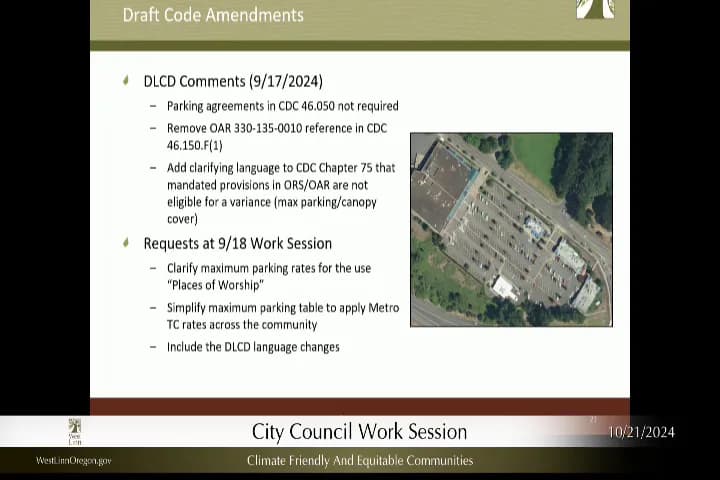
The City Council held a work session on October 21, 2024, addressing 2025 legislative priorities and proposed amendments related to Climate Friendly and Equitable Communities (CFEC). The meeting included council reports, a presentation by the city's contract lobbyist, and a detailed briefing from the Planning Manager on parking reform, EV infrastructure, and tree canopy requirements. No public comments were received, and no votes were taken. Mayor and Council Reports - Councillor Groener urged residents to vote in the upcoming election. - Councillor Bright reported on the October 16 Planning Commission public hearing regarding code amendments for home occupations, appeals, and expedited land use, as well as an update on middle housing. She also attended a Vision 43 event at the West Linn–Lake Oswego football game. - Council President Baumgartner attended the League of Oregon Cities 99th annual conference in Bend and offered to present a detailed report at a future meeting. He also attended the Willamette Falls Trust board meeting, noting progress on property near the falls. - Councillor Bonnington reported that the Oregon Parks Department State Committee on Historic Preservation unanimously recommended the McLean House for the National Register of Historic Places. - Councillor Groener participated in a Sustainability Advisory Board meeting via Zoom, where consultant Grace Thurkill from Parametrics discussed greenhouse gases, resiliency, and adaptation. The board expressed interest in a public scoreboard for ecological goals. - Mayor reported on a tour of the city's wastewater treatment facility and a meeting with Sunset neighborhood residents about safe school crossings, promising a broader traffic safety discussion. Discussion Items 2025 Legislative Priorities Discussion - City contract lobbyist Doug Riggs joined virtually to outline anticipated legislative themes for the 2025 long session (January–June). He identified four main topics: transportation (including a $1.8 billion ODOT funding gap), K–12 education funding, behavioral health (responding to Measure 110), and infrastructure. - Council discussed tolling. Riggs noted that tolling for I-205 and I-5 (other than the I-5 bridge) appears unlikely due to inefficiency—65–70 cents of every dollar spent on collection and administration. He advised continued vigilance. - Councillor questioned how the legislature might address the transportation funding gap; Riggs mentioned a list of 11–12 potential sources (e.g., EV registration fees, charging station fees, diesel fuel taxes). - Regarding housing, Riggs noted the legislature has allocated about $1.4 billion for housing but much remains unspent; a task force is exploring streamlining regulations. - Councillor Bright expressed concern about one-size-fits-all mandates given West Linn’s topography and limited infill potential. Riggs agreed that a menu of options would be preferable. - Councillor Groener advocated for orphan highway funding, specifically for Highway 43, as part of the transportation package. He argued that jurisdictional transfer would allow more efficient project delivery. Council President Baumgartner echoed the need, noting the corridor serves regional traffic. City Manager Williams cautioned that any transfer would require substantial rebuild, not just a band-aid. Riggs shared a case study from Prineville where ODOT’s contracting complexity delayed a project and reduced scope. - Council discussed the I-205 third lane. Councillor Bonnington and Councillor Bright expressed concerns about induced demand, blasting, and wildlife crossings. Council consensus placed Highway 43 as the top priority over I-205 expansion. Climate Friendly and Equitable Communities (CFEC) Amendments Discussion - Planning Manager Darren Weiss presented the background and status of CFEC code amendments, required by state rules adopted July 2022. The rules require cities to: reform parking mandates, prepare for electric vehicles, plan for future transportation options, and adopt Metro 2040 town center boundaries. - The city had to choose between eliminating all parking mandates or adopting a more complex option (paid on-street parking districts, parking lot tax, etc.). The Planning Commission, after work sessions and a public hearing, unanimously recommended eliminating all parking mandates. Reasons included: 90% of commercial properties would remain unaffected under either path; lack of support for paid parking in Bolton and Willamette town centers; feedback from four major commercial property owners/developers who all supported removal, stating they would continue providing parking due to tenant demand and financing requirements; and the possibility that future increased bus frequency on new TriMet routes (Rosemont, Line 76) could automatically extend no-mandate zones, rendering a more complex plan obsolete. - Council concurred with this direction at a July 15 meeting. - The draft ordinance (No. 1754) removes parking mandates across all land uses, adds EV service capacity definitions, updates design standards (40% tree canopy for large lots, soil vaults, pedestrian walkways), and clarifies that variances cannot override state administrative rules. - Staff will also update a reference from Portland’s stormwater manual to West Linn’s own Public Works Design Standards. - Council asked explanatory questions. Councillor Bonnington suggested a comparison of total parking spaces vs. registered cars to reassure the public. Councillor Groener noted he has never had trouble parking in West Linn. The Mayor noted that the high school area is a known challenge. - The public hearing on the ordinance is scheduled for November 12, 2024. Key Outcomes - Legislative Priorities: Council established Highway 43 as the top transportation priority, with a focus on seeking state funding for a substantial rebuild and potential jurisdictional transfer. The city will pursue coalition building with other affected cities. The I-205 third lane remains a lower priority. Council directed the lobbyist to advance these positions. - CFEC Amendments: Council received the briefing and expressed general support for the Planning Commission’s recommended ordinance eliminating parking mandates. The ordinance will proceed to a public hearing on November 12, 2024. No vote was taken at this work session. - Upcoming Meetings: The next work session is November 4, 2024 (1 p.m.), covering code process amendments, waterfront, and pedestrian safety. The November business meeting is November 12 (Tuesday, due to Veterans Day). City Manager Report - City Manager Williams noted upcoming events: Touch a Truck, Coffee with the Cop, Kindergarten Carnival, library Comic Con (October 23), holiday bazaar (November 16–17), and a series of short videos answering community questions (first: community recreation center update).
The West Linn Planning Commission met on Wednesday, October 16, 2024, in a hybrid in-person/remote meeting. A pre-meeting work session at 6:00 pm reviewed hearing logistics, and the regular meeting was called to order at 6:30 pm. The commission approved meeting notes, recommended approval of the CDC-24-02 legislative code amendment package to the City Council, heard the Middle Housing Two-Year Check-In briefing, and received staff schedule updates. All seven commission members were present and voting. The meeting adjourned at 7:46 pm. Pre-Meeting Work Session - Staff and commissioners reviewed the format for the legislative public hearing and agreed that staff planner Goodell would summarize the amendment package topic by topic. - Chair Carr thanked Vice Chair Metlin for filling in as chair at recent meetings. Approval of Meeting Notes - The commission approved the September 18, 2024, meeting notes as amended, after a correction changed Vice Metlin to Vice Chair Metlin. The motion passed unanimously. Public Comments & Testimony - No one appeared to give public comment on non-agenda items. - Staff reported that one written comment and one verbal comment from residents were included in the staff report. The written comment from Shannon Knight asked whether arguments made before the Planning Commission but not repeated before the City Council could be raised in a LUBA appeal; the City Attorney answered yes, because submitting testimony at the Planning Commission provides standing to appeal to LUBA. - No live testimony was offered during the CDC-24-02 public hearing. Public Hearing: CDC-24-02 Community Development Code Amendments - The proposed amendments to chapters 2, 37, 85, 96, and 99 of the West Linn Community Development Code address home occupations, extensions of approval, appeals of development permits, expedited land divisions (ELD), and middle housing land divisions (MHLD). - The amendments were developed through five Planning Commission work sessions on April 3, June 5, July 17, August 7, and August 21, 2024, and joint City Council work sessions on October 16, 2023, and March 18, 2024. - The staff presentation highlighted proposed changes: extension requests must be made before the original approval expires; only one extension is allowed, with a two-year maximum; unmodified extensions become staff-level decisions and modified extensions go to the original decision maker; appeal hearings retain de novo review but require the appellant to identify a code criterion not met or misapplied; home occupations remain staff-reviewed, may not conduct business or store materials outdoors, and home occupations with pupils/students are allowed 12 total vehicle trips while all other home occupations remain at 8 total vehicle trips; ELD and MHLD decisions are planning director decisions assigned to a land use referee and, under state statute, are not subject to a public hearing. - During questions, Commissioner Wolvante raised concern that the referee definition did not require land-use qualifications. Staff and the City Attorney responded that the referee will be selected through a city contract as a land-use attorney and that a broad definition preserves flexibility. - Commissioner Evans questioned the proposed change to home-occupation quiet hours from 6:00 pm to 5:00 pm. Staff replied that the 5:00 pm time and federal holiday reference were taken from municipal noise code Section 5.487 to maintain consistency, not in response to a specific complaint. - Commissioner Wolvante requested adding or designee after planning director in Section 99.060; staff agreed. The commission also agreed to a scrivener's correction capitalizing Referee as a defined term. Middle Housing Two-Year Check-In Report - Planning Manager Weiss presented an informational briefing on middle housing development from July 2022 through July 2024. - The city adopted middle housing code in June 2022 to comply with House Bill 2001, and Senate Bill 458 later added middle housing land divisions. - In the 14 approved middle housing projects, existing zoning would have produced 23 dwelling units, while the middle housing code allowed 43 units, nearly doubling the number of units. Most projects were in the R10 zone. - The report found that detached plexes often produced larger single-family-style homes at high price points, whereas projects that retained an existing home and built around it produced smaller lots, smaller units, and lower price points. - Staff noted policy questions for the Housing Production Strategy: whether to continue allowing detached plexes; whether to adjust floor area ratio (FAR) for plexes and townhouses in R7 and R10 zones; and whether to study tying SDCs to home size instead of similar flat fees. - Commissioners added comments about school enrollment, the need for younger families, the difficulty of downsizing for older homeowners, macroeconomic constraints on affordability, and the challenge of finding feasible housing sites in West Linn's constrained topography. The commission took no vote on the briefing. Planning Commission & Staff Announcements - Commissioner Wolvante reported that the Committee for Community Involvement has paused meetings while the city identifies a new staff lead. - Planning Manager Weiss announced a quasi-judicial public hearing for November 6 on a Class II variance, a joint Planning Commission/City Council meeting on November 18 to discuss the Housing Production Strategy, and the possibility that the November 20 regular meeting would be canceled. He also encouraged taking the Vision 43 survey before the end of October. Key Outcomes - Approved the September 18, 2024, meeting notes as amended, unanimously. - Recommended approval of CDC-24-02, Ordinance 1755, to the City Council with two minor amendments: capitalize Referee as a defined term and add or designee after planning director in Section 99.060. The motion passed unanimously. The City Council is scheduled to hold its hearing and decision on December 9, 2024. - Received the Middle Housing Two-Year Check-In as an informational briefing; no action was taken. It will inform the Housing Production Strategy discussion at a joint Planning Commission/City Council meeting on November 18, 2024.
The West Linn City Council held a business meeting on Monday, October 14, 2024, beginning at 6:00 p.m. following a pre-meeting at 5:30 p.m. The agenda was reordered to begin with an Indigenous Peoples' Day proclamation and a performance by a member of the Confederated Tribes of Grand Ronde. Topics included public comments on pedestrian safety near Sunset Primary School, the status of the Oppenlander property, and a personal dispute over a city grant. The council approved a one-year collective bargaining agreement with the police sergeants union (with a 4% cost-of-living adjustment), gave direction on the Arts & Culture Commission's request for up to $1,000 for artist renderings, and joined a regional river assets statement. All votes were unanimous. Consent Calendar - Meeting Minutes – Approved the minutes from September 9 and October 7, 2024 (motion carried unanimously). Public Comments & Testimony - Lori Bacon (Sunset neighborhood resident) – Described Cornwall Street and Summit Street approaches to Oxford Street as "treacherous, dangerous, hazardous, and perilous." Cited a 2022 traffic study showing motorists driving nearly 10 mph over the posted speed limit, noted 88 survey responses aligning with safety concerns, and requested prioritized sidewalk infill and pedestrian safety improvements near Sunset Primary School. - Dean Sir (West Linn resident) – Reported that neighbors testified at the school board meeting urging continued community access to the Oppenlander property, which has been used for 40 years. Announced the formation of a committee to raise private funds to purchase the property for a city park, and asked the council to remain engaged and transparent. - Bill Ramirez (West Linn resident) – Reminded the council of an ongoing problem with residents feeding wildlife and requested a charter amendment to address it. The council noted a draft ordinance had been sent to the city attorney for review. - Joy Mattar (West Linn resident) – Described a conflict with former co-chairs of a city-funded group, alleging that personal accusations harmed her family and cut off communication. She requested the council accept repayment of grant funds on behalf of the group because the co-chairs would not meet with her. She advocated for community-centered dispute resolution and acknowledged the challenges of activism. - Jen Petrin (Sunset neighborhood resident) – Supported Lori Bacon’s comments, adding that Sunset Avenue (referred to as "Sunset Highway") has a blind hill, zero police patrol, and no safe crosswalks despite being a safe route to school. She suggested incremental solutions such as pedestrian warning signs. - Gail Sanchez (Sunset area resident) – Asked the city to consider resident safety when choosing sidewalk locations for the Safe Routes to School project. Noted that two of three proposed sidewalk options would push the road closer to homes, and requested better public notification of such projects. Discussion Items - Indigenous Peoples' Day Proclamation – Council President Baumgartner read the proclamation designating October 14, 2024, as Indigenous Peoples' Day in West Linn. Mr. Dietrich Peters, Director of the Native American Cultural Encampment and member of the Confederated Tribes of Grand Ronde, gave a speech and performed a flute song. The proclamation recognized the nine federally recognized tribes in Oregon and affirmed the city's commitment to addressing systemic racism. - Shared River Assets and Opportunities Statement – Jerry Herman and Kent Ziegler presented a non-binding statement of support for increased river access, recreational economic development, and collaboration among West Linn, Oregon City, Canby, Gladstone, and other partners. They noted that the Confederated Tribes of Grand Ronde, Metro, several commercial users (e.g., Portland Spirit, Willamette Jet Boats), and former Governor Kate Brown (Lambert Falls Trust) have already signed. The council gave informal consensus to join, with Councilor Bunting volunteering to attend the next task force meeting on November 20, 2024. - Police Sergeants Union Contract (RES 2024-11) – Human Resources Director Alyssa Preston explained that recent state law allowed sergeants to unionize; the city and the Clackamas County Peace Officers Association Sergeants Unit reached a one-year tentative agreement with a 4% cost-of-living adjustment, retroactive to July 1, 2024. A typo in the resolution (date 2021 instead of 2024) was corrected by amendment. - Arts & Culture Commission – Process for Public Art Acquisition – Library and Community Services Director Doug Erickson and Arts Commissioner Shatrine Craig requested direction on using up to $1,000 from the 1% for arts acquisition fund to pay finalist artists for detailed renderings in future selections. City Attorney Kaylee Klein recommended that changes be memorialized in the existing "Percentage for the Arts Program Governing Guidelines" and brought back for approval. The council gave consensus to proceed with the $1,000 allowance and to return with revised guidelines at the next business meeting. Key Outcomes - Agenda approved – With the Indigenous Peoples' Day proclamation moved to first item (unanimous). - Consent agenda approved – Unanimous. - Indigenous Peoples' Day proclamation – Adopted and read; performance given. - Shared river assets statement – Council gave consensus to sign the statement on behalf of the city. - Police sergeants union contract – RES 2024-11 passed unanimously as amended, authorizing the city manager to sign the one-year collective bargaining agreement with CCPOA sergeants unit (4% COLA, retroactive to July 1, 2024). - Arts & Culture Commission direction – Council agreed to allow up to $1,000 for artist renderings in future acquisitions and directed staff to draft updates to the Percentage for the Arts Governing Guidelines for formal approval at a future meeting. - Next steps – The council’s work session on October 21, 2024 will discuss 2025 legislative priorities and climate-friendly amendments.
On October 10, 2024, at 6:00 p.m., the West Linn City Council, Economic Development Committee, and Chamber leadership met in Council Chambers for an economic development training led by Jerry Johnson of Johnson Economics. The session reviewed local economic data, regional forecasts, development constraints, tourism opportunities, and possible next steps. No formal votes or decisions were made; it was an informational workshop. Regional & Local Economic Context - Jerry Johnson presented city-level data from LEHD/LODES, noting that it is less reliable than QCEW data and shows erratic patterns around the 2020 pandemic. - West Linn's largest employment share is health care and social assistance, followed by professional, scientific, and technical services; public administration reportedly grew strongly while educational services declined sharply over an 11-year period, a finding participants questioned. - Roughly twice as many West Linn residents commute out for work as commute in; 15.7% of resident workers also work in West Linn, with others commuting to Portland and other regional hubs. - West Linn's population is aging and affluent: below the national average in ages 20–40, strong growth in ages 65 and over, high educational attainment (97.3% high school graduates), and household incomes well above average. Development Constraints & Market Conditions - Housing production has fallen sharply due to buildout; Metro's DSP model estimates only 500–1,100 additional residential units of capacity, mostly through redevelopment and infill. - The 2024 Metro Buildable Land Inventory shows 0.4 acres of vacant commercial land plus 0.1 acre of commercial redevelopment land, and 3.7 acres of vacant industrial land, 1.2 acres of assumed industrial infill, and 1.0 acre of industrial redevelopment land. - Johnson said higher-density and structured-parking development forms require high rents, and West Linn has few comparable rental projects; Lake Oswego comparables range from $1.80 to $2.25 per square foot, with outliers above $3.40 per square foot. - Retail vacancy has risen and lease rates are stagnant; the office market is weak; there is currently no hotel or lodging product in West Linn. - The PGE property was discussed as a potential major redevelopment site, but cleanup, access, and federal waterway issues are challenges; Metro capacity models treat it as unavailable or uneconomic. - Council President Mary Baumgartner asked about PGE's roughly 90 acres, and the discussion also touched on sensitive lands excluded from the buildable land inventory, unincorporated islands that could potentially be annexed, and the Stafford Basin reserve. Stafford Basin annexation was not favored by participants. Tourism as an Economic Development Tool - Johnson reviewed the benefits and drawbacks of tourism: it can bring net-new money, support restaurants and amenities, and diversify the economy, but it can also create seasonal employment, low wages, housing affordability pressure, and strain on local infrastructure. - Examples included the Oregon Coast, Bend, wine country, Hood River, Ashland, Hillsboro, and Spokane. He noted that West Linn's primary tourism asset is likely Willamette Falls access, but without overnight lodging the city may capture fewer tourism dollars. - Mary Baumgartner raised concerns about Airbnb and short-term rentals reducing housing inventory; an EDC member and small business owner noted there is real demand for short-term stays in West Linn, but current zoning makes them difficult and there are no nearby hotels. Regional Coordination & Next Steps - Johnson recommended coordinating with Business Oregon and Greater Portland Inc., though land scarcity limits traditional business recruitment; he also stressed the importance of having a clear city point of contact for business inquiries. - He suggested updating West Linn's 2016 Economic Opportunities Analysis and developing an economic development strategy or vision. An EOA would provide better, more authoritative employment data. - He cautioned against zoning and approval systems that leave developers no viable or profitable path, and advised making community vision clear enough that developers can pursue projects that fit. - One EDC member raised the risk of "bike-shedding" in large planning efforts and emphasized the need for clear ownership of specific elements in any strategy. Key Outcomes - No votes or formal decisions were taken. - Next steps discussed included: updating the Economic Opportunities Analysis, exploring a broader economic development strategy, considering tourism planning tied to Willamette Falls access and lodging or short-term rental policies, and possibly holding another training session.
The West Linn City Council convened a special meeting and work session on Monday, October 7, 2024, at City Hall. It approved two resolutions related to employee compensation, issued three proclamations, began discussion of a draft ordinance restricting the feeding and attracting of wild animals, and postponed legislative priorities and the city manager's report to later meetings. All votes on the agenda and resolutions were unanimous (5-0). Agenda Approval - Council President Mary Baumgardner moved to approve the agenda; Councilor Leo Groner seconded. The motion carried 5-0. Public Comments & Testimony - No public comments were made during the formal public comment period. - Later, during the work session, West Linn resident Jennifer Whittington spoke about an ongoing neighborhood nuisance involving a neighbor feeding feral cats, which she said attracted skunks, rats, and crows. She thanked the council for responding and expressed concern about selling her home because of the problem. Mayor and Council Reports - Councilor Groner reported on the Arts & Culture Commission, including a new library art exhibition and a request for funding for artists to create renderings for the bicycle kiosk on Willamette Falls Drive; he also noted Sunset Neighborhood Association concerns about crosswalks on Sunset. - Councilor Bonnington noted the same issues and said Public Works would attend a Sunset Neighborhood Association meeting that evening at 5:00 p.m. at the fire hall. - Councilor Bryck reported that the Planning Commission advanced a recommendation on Climate Friendly Equitable Communities (CFEC) and that the South Fork Water Board updated its Local Contracting Review Board rules. - Council President Baumgardner reported on the Metro Joint Policy Advisory Committee on Transportation, Willamette Falls Trust/Locks Authority efforts to reopen the locks in 3–5 years, and the TVF&R Community Academy; she praised first responders for their response to a major fire. - Mayor Bialostosky noted that the League of Oregon Cities needed a voting delegate and that Council President Baumgardner volunteered. Proclamations - Mayor Bialostosky read a proclamation declaring October 2024 as Dyslexia Awareness Month, noting that about 116,000 Oregon public school students may be affected by dyslexia or related learning disabilities. - Councilor Bryck read a joint proclamation with Oregon City declaring October 28, 2024 as Oregon City–West Linn Rivalry Day, marking the 104th football rivalry renewal. - Council President Baumgardner read a proclamation declaring October 28, 2024 as National First Responders Day, citing 4.6 million career and volunteer first responders in the U.S. Business Meeting: Resolution 2024-09 – AFSCME Collective Bargaining Agreement - Finance Director Lauren Breithaupt presented the three-year agreement with AFSCME, effective July 1, 2024, following negotiations from April to September. - The contract includes 5% COLA in FY25, 4% in FY26, and 3.5% in FY27; an increased VEBA account; 2% longevity pay for employees with 15 years of service; a 0.5% deferred compensation increase in July 2025; increases in Public Works standby pay of 15% on workdays and 20% on non-workdays; and a modified PPE reimbursement program. - Breithaupt stated the agreement is approximately $60,000 under budget. Councilor Groner remarked the margin was narrow. Mayor Bialostosky thanked staff and union members for their work. - Motion to adopt Resolution 2024-09 carried 5-0. Business Meeting: Resolution 2024-10 – Management and Non-Represented Compensation - Breithaupt explained that management and non-represented employees waited for AFSCME negotiations to conclude to avoid pay compression, and the city manager recommended matching the AFSCME COLA and benefits: 5% FY25, 4% FY26, 3.5% FY27, longevity pay, VEBA contributions, and 0.5% deferred compensation in July 2025. - A new pay range for the Captain position was created to address compression, resulting in 13.5% pay differentials between Sergeant and Captain and between Captain and Chief. A Sergeant's union contract was expected the following week. - The package is approximately $64,000 over original budget projections, requiring mitigation during the 2027 biennium budget process. Councilor Bryck noted vacant positions could provide some budget flexibility; Breithaupt agreed and noted projections were set about a year and a half earlier. - Motion to adopt Resolution 2024-10 carried 5-0. Work Session: 2025 Legislative Priorities - This item was postponed to the October 21 work session because lobbyist Doug Riggs was not present. Work Session: Amending Municipal Code Chapter 5 – Attracting and Feeding Wild Animals - Police Chief Peter Mahuna and Community Services Officer Nichola Higbee presented a draft ordinance prompted by community complaints about a neighbor feeding feral cats, which attracted skunks, rats, and large numbers of crows. - Chief Mahuna said the ordinance would be complaint-driven; enforcement could be difficult if the feeding occurred in constitutionally protected backyards, and citations could require neighbors to testify in court. He estimated about six similar situations existed in West Linn. - Council discussion included whether to list squirrels as wild animals. Councilor Bryck suggested adding squirrels; Council President Baumgardner noted squirrels could be contentious; Chief Mahuna said listing squirrels would allow enforcement if a complaint involved them. - Council consensus was to send the draft ordinance to the city attorney's office for legal review and comment, with the suggested addition of squirrels. City Manager Report - The council priorities update was postponed because the city manager was ill; it will be rescheduled. Key Outcomes - Agenda approved 5-0. - Resolution 2024-09 (AFSCME CBA) approved 5-0. - Resolution 2024-10 (Management/Non-Represented Compensation) approved 5-0. - Three proclamations issued: Dyslexia Awareness Month, Oregon City–West Linn Rivalry Day, and National First Responders Day. - Council directed staff to send the wild-animal feeding ordinance to the city attorney for review and to include squirrels. - 2025 Legislative Priorities discussion was moved to October 21, 2024. - City Manager Report was postponed; Councilor Groner requested a staff response on Sunset crosswalks by the next meeting.