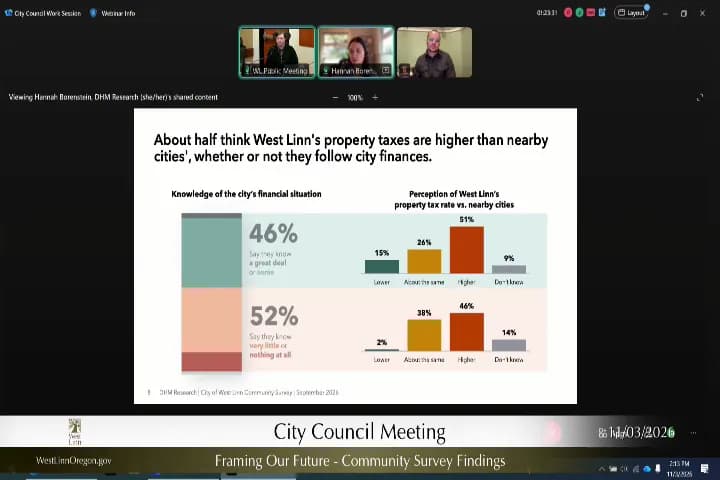
The West Linn City Council held a work session on Tuesday, November 3, 2026, from 1:00 PM to approximately 3:40 PM. The agenda included three proclamations, a contingency update on the I-205 waterline construction, a presentation on the 'Framing Our Future' community survey findings, and a review of financial tools for the Housing Production Strategy (HPS). Proclamations - Council President Baumgartner proclaimed November 2026 as Native American Heritage Month, noting the council will visit the Confederated Tribes of Grand Ronde on November 7. - Mayor Bilostowski proclaimed November 28, 2026, as Small Business Saturday, stating small businesses represent over 36 million US employers and 43% of the nation's GDP. - Councilor Groner, a Vietnam-era Army veteran, proclaimed November 11, 2026, as Veterans Day. I-205 Waterline Construction Update - Staff (Eric and Matt) presented the 5-month contingency plan for the bridge deck translation. The water main has been severed, and the city is fully relying on the Lake Oswego Intertie (LOT). - The LOT facility has a capacity of 4 million gallons a day against a current winter demand of 2.5 million. A 160-kilowatt generator is being secured for the site, which lacks backup power. - An interim 24-inch ductile iron pipe (NSF-certified for potable water) will be installed on the bridge in 1 to 2 months. Councilor Gruner confirmed the rate with LOT is the same under the existing IGA. - Councilor Baumgartner requested a tour of the LOT facility. Framing Our Future Community Survey - DHM Research presented findings from a statistically valid survey of 250 West Linn residents (margin of error +/-6.2 percentage points, conducted August-September 2026). - Satisfaction and Priorities: A minimum of 87% of residents are satisfied with their quality of life and the value of city services. Top priorities for funding are roads/traffic, water/sewer/stormwater, police, and parks maintenance. - Financial Perceptions: 51% of residents incorrectly believe West Linn's property tax rate is higher than nearby cities; only about 1 in 10 correctly knew it was lower. Councilmember Bonington characterized the perception gap as a 'Dunning-Kruger effect' challenge requiring careful communication. - Willingness to Fund: Eight in ten residents selected at least one service they would pay more for. 62% preferred funding based on property value. Seven in ten chose infrastructure as a priority for additional funding. - Council directed staff to use the findings to inform a strategic financial plan and continue public education on municipal finances, with City Manager Williams linking the issue to the structural limitations of state property tax measures. Housing Production Strategy Implementation - Consultants and planning staff presented financial tool recommendations from the adopted HPS. - SDC Adjustments: Staff recommended changing the Parks System Development Charge (SDC) methodology to be based on bedroom count and reclassifying middle housing for sewer SDCs. This could lower overall SDCs for multifamily/middle housing by 5% to 10%. - SDC Exemptions: Exempting qualifying affordable housing (at or below 60% AMI rental, 80% AMI ownership) and Accessory Dwelling Units (ADUs) from city SDCs was recommended. This could reduce development costs for affordable housing by 10% to 15%. - Tax Exemptions: Two state-authorized programs were reviewed: a 20-year property tax exemption for low-income rental housing and a 10-year exemption on improvements for first-time/low-income homebuyers. Staff targeted the home buyer program at homes around $480,000 (60% of median sale price) for households at or below 80% AMI. - The council requested a detailed budget briefing on the fiscal impacts of these incentive tools before final adoption, expected in spring 2027. City Manager Report - City Manager Williams reported a legislative breakfast with Senate President Wagner and peer cities is scheduled for early December. - The noise permit process for ODOT is progressing; the city is demanding granular data to justify any after-hours construction work before the special permit is issued. - A joint session with Lake Oswego's new City Manager, Denzel Maxwell, is being planned for early 2027 on shared infrastructure issues like Highway 43 and the LOT intertie. Key Outcomes - The council formally received the I-205 waterline update and Framing Our Future survey findings, directing staff to return with a strategic financial plan. - The council reviewed the HPS financial tools and requested a fiscal impact analysis before proceeding with SDC changes and tax exemptions. - Staff will continue the ODOT special permit application process and legislative outreach.
Public Meetings - West Linn, Oregon
Public Meetings - West Linn, OregonOn October 28, 2026, at 6:00 PM in West Linn City Hall, Hearings Officer Daniel Kearns presided over a de novo appeal hearing (AP-26-02). The appeal was filed by Tandler Holdings LLC seeking to overturn the Planning Commission's 5-0 decision to deny a Class II Design Review and Property Line Adjustment for a mixed-use development at 2410/2422/2444 Tannler Drive and 1800 Blankenship Road. The project proposes 320 residential units in 11 buildings with ground-floor commercial space, a realignment of Tannler Drive, and a traffic signal. The hearing extensively debated the applicability of state housing laws (SB 1537, HB 4037), the role of HAPO guidance, the jurisdiction of the Hearings Officer, and whether the project meets local code standards under the 'clear and objective' requirements of state law. Public Comments & Testimony Jurisdictional Objections - Andrew Mulkey (representing Ed and Roberta Schwartz) argued the City Council lacked the authority to delegate the appeal, citing Development Code Section 99.240 which assigns appeals to the City Council. He stated the Council resolution appointing the Hearings Officer conflicts with state land use statutes. - Mike Cap echoed this, stating the Development Code does not allow for a Hearings Officer in this context and that the Council should follow its own ordinances. - Ed Schwartz noted the City Council's oath of office requires members to hear land use appeals. Opposition Testimony - Roberta Schwartz argued the project is flawed, stating the Planning Commission's unanimous denial was correct. She contested the necessity of the Tannler Drive realignment, asserting the applicant's own planning manager described it as a street closure. She cited a 361-person petition and an ODOT letter indicating the realignment is not mandatory, advocating instead for TSP Project M23 (road widening). - Ed Schwartz (Savannah Oaks Neighborhood Association Treasurer) said the neighborhood voted unanimously to oppose. Concerns included density (50% larger than prior proposals), parking (400 spaces for 320 units), stormwater vaults over surface detention, 80% tree removal, impacts to White Oak Savannah Park, and the lack of affordable units (project rents of $1,988 to $3,200 per month are market-rate). - Shannon Knight argued the applicant's private driveways qualify as streets under the city's development code, triggering ground-floor commercial requirements. She stated the applicant is setting buildings 22-23 feet from the street to avoid the 20-foot statutory threshold, effectively eliminating commercial frontage. - Greg Hathaway (attorney for the Schwartzes) argued the TSP does not mandate the applicant's specific realignment. He stated the supporting traffic impact analysis was inadequate and requested time for expert review of late-filed evidence from the applicant. - Kathy Hallecky raised safety concerns regarding parking ratios (1.2 spaces per unit), traffic, and the lack of elevators in the buildings. - Vicki Constantino and Dave Farmer voiced concerns about fire access and existing traffic congestion on Salamo and Blankenship. Testimony in Support - No members of the public testified in favor of the appeal during the hearing. Discussion Items Hearings Officer Role and Process Daniel Kearns established the de novo nature of the hearing and the requirements for preserving rights for a LUBA appeal. He noted the statutory duty under ORS 197A.402 to allow the applicant to propose revisions or conditions if denial is considered. He also explained his impartial role, having been appointed by the City Council under Resolution 2026-08. Staff Presentation - Darren Wise (Principal Planner) provided a procedural timeline from the original application in September 2025 through the appeal and noted the 120-day clock extension. - Steve Cooper (Community Development Director) argued that the state's 'clear and objective' standards apply to the residential component, but the city can apply discretionary criteria to the commercial portion of this mixed-use project, directly contradicting the positions of the applicant and HAPO. He stated the TSP studies a level of service C today, while the applicant's traffic study finds the intersection fails (LOS F) currently. Applicant's Case (Carrie Richter, Bateman Seidel) - The applicant argued the project satisfies all criteria, facilitated by SB 1537. The HAPO letter of October 21 was cited as supporting the applicant's position that the city's grading and stormwater standards are not clear and objective and that the ground-floor commercial requirement is eligible for waiver. - Traffic and Proportionality: The applicant presented a new proportionality analysis proposing a 29% cost share for the roughly $5 million road realignment. The applicant argued the city's earlier estimate of a 51% share was based on flawed data that did not account for pass-by trips or background traffic from the adjacent office building. The applicant requested the Hearings Officer set the percentage as a condition of approval. - Block Length and Commercial Standards: The applicant argued the 800-foot block length standard is not clear and objective and offered alternative solutions (pedestrian path, topographic exception). The applicant defended its definition of 'street,' arguing private driveways should not be classified as public streets triggering commercial requirements. City Staff Rebuttal - Staff disagreed with the applicant's and HAPO's interpretation, differentiating the project from the ICON case (purely housing) and arguing the city could apply standards to the commercial component. Staff insisted the proportionality analysis is a negotiation topic for a Development Agreement and should not be decided by the Hearings Officer, as financial authorities were not delegated and the numbers are still in flux. Traffic Engineer Testimony (Chris Bremer, Kittelson & Associates) Bremer clarified no new traffic model was created; the new memos re-analyze existing data for the proportionality calculation. He detailed that the existing intersection operates at level of service F today and cannot be fixed without the realignment and signal. He stated the TSP realignment (Project M2) is the only feasible solution. Key Outcomes - Schedule for Decision: The Hearings Officer kept the record open under a strict schedule: Public and staff responses to new evidence due November 4, 2026; cross-responses due November 12, 2026; and the applicant's final written rebuttal due November 18, 2026. The written decision is due December 16, 2026. - Extension: The applicant agreed to a 35-day extension of the statutory 120-day clock. - Procedural Nuance: A discrepancy was noted in the hearing regarding the scope of the Planning Commission's denial. The Hearings Officer initially summarized it as a denial of the commercial component, but city staff clarified the final written decision denied the entire application in a single order. - Core Issues for Decision: The Hearings Officer identified the primary legal questions for the written decision: (1) the Hearings Officer's jurisdiction to hear the appeal; (2) whether state 'clear and objective' standards apply to the entire mixed-use project or only the residential component; (3) the definition of 'street' in relation to ground-floor commercial requirements; and (4) the proportionality of the required road improvements. No final decision or votes were taken.
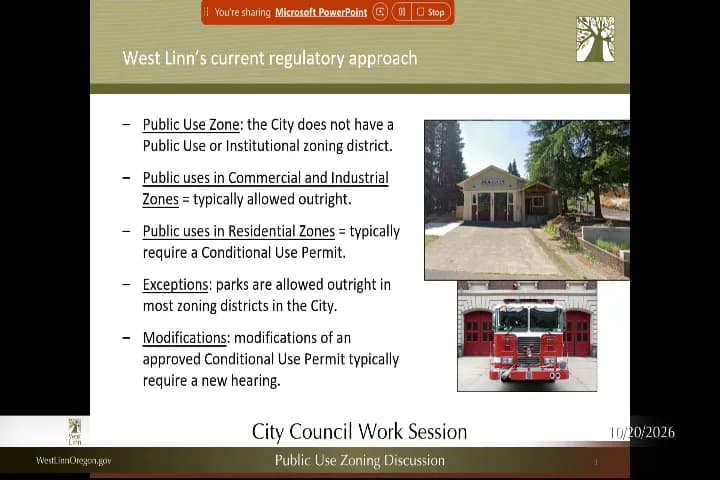
The West Linn City Council convened a joint work session with the Planning Commission on October 20, 2026, beginning at 6:00 PM. The meeting included a proclamation, discussions on the Planning Department's work plan and docket, and a review of potential public use zoning changes. Staffing capacity and budget constraints were recurring themes throughout the session's presentations and discussions. Public Comments & Testimony - Carrie Oakes: Questioned the city council regarding legal advice received during a previous special meeting (November 23, 2025) concerning the delegation of the Tandler Drive appeal hearing. Mayor Bielostowski stated he would check with the city attorney and respond within a few days. - Mike Capigan: Representing residents of the Robinwood and Bolton neighborhoods, expressed concern that the city had not conducted adequate outreach regarding the Vision 43 project, specifically requesting a physical open house. He criticized the budget constraints cited for not holding one and requested a staff analysis of how Senate Bill 1537 and House Bill 4037 would affect the proposed zone changes. Proclamations and Reports - Mayor Bielostowski issued a proclamation designating October 30, 2026, as Oregon City-West Linn Rivalry Day, marking the 106th meeting of the historic high school football rivalry. - Mayor Bielostowski reported attending a gala for The Caring Place, a homeless services center in Oregon City. - Councilor Graner reported attending the League of Cities conference, noting widespread municipal budget challenges across the state. Discussion Items - Planning Work Plan (Docket) Update: Community Development Director Steve Coper presented the planning department's work plan for 2026-2028. He detailed the department's staff capacity (5.15 FTE) and the significant constraints imposed by West Linn's low property tax rate relative to its high assessed value (Measures 5 and 50). Development review applications surged to 101 in the past fiscal year (up from 40), straining capacity. Long-range planning projects include the Housing Production Strategy, Vision 43 (delayed), the Waterfront Vision Implementation (supported by a new $392,000 Metro grant), and a potential Transportation System Plan (TSP) update for grant eligibility. - Planning Commission Feedback on Docket: Commissioners provided feedback to the council on the docket. Commissioner Salti raised concerns about reconciling Chapter 58 of the code with recent housing legislation. Commissioner Wolvotney urged updates to stormwater codes (Chapters 28/32) and a review of an 8-year-old Community Engagement and Land Use Process (CCI) report. Chair Salt Hillen requested an update to the city's tree code, citing frequent public complaints. - Path Forward on Docket: The Planning Commission requested additional time to review the full prioritized project list before making a formal recommendation. The council agreed, and the commission will make a formal recommendation at a subsequent meeting, which will then be forwarded to the council. - Public Use Zoning Discussion: Associate Planner Aaron Goodell presented three options for creating a public use zone to streamline permitting for public facilities. Option A would create the zone language only; Option B would also identify specific properties; Option C was no action. Staff recommended Option A to manage capacity. Council consensus leaned toward exploring Option A, as it is the most resource-efficient path forward. Key Outcomes - Agenda Approved: The meeting agenda was approved unanimously. - Proclamation Approved: The Oregon City-West Linn Rivalry Day proclamation approved. - Planning Docket: The planning docket and work plan were discussed but not formally set. The Planning Commission will conduct its own work session to finalize a recommendation. - Public Use Zoning: City Council expressed consensus to proceed with exploring Option A (creating a new public use zoning district). Staff was directed to draft the code for Planning Commission review. - Next Meeting: The next regular City Council meeting is scheduled for Tuesday, November 3, 2026.
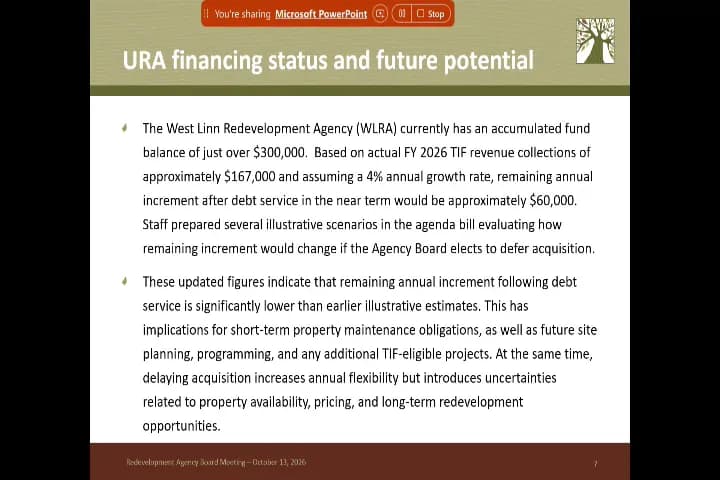
The West Linn Redevelopment Agency met on Tuesday, October 13, 2026, beginning at 7:30 p.m. The sole business item was a resolution making minor amendments to the Willamette Riverfront Tax Increment Finance (TIF) Area Plan to add a specific property for potential acquisition. The Agency heard public testimony, unanimously adopted the resolution, and directed staff to begin due diligence and negotiations for the property. Consent Calendar - Approval of Agenda: The agenda for the October 13, 2026 meeting was approved unanimously by a vote of 5-0. Public Comments & Testimony - Rebecca Hollenbeck (Executive Director, Historic Willamette Main Street): Expressed strong support for the proposed minor amendment and recommended the Agency acquire the property sooner rather than later, stating property prices continue to rise. - Dwight Reid (Adjacent property owner, chiropractor): Expressed support for the acquisition, stating it would be a community asset and money well spent that could serve generations. - Jody Carson (Chair, Design Committee, Historic Willamette Main Street): Voiced strong support for the resolution and moving forward with bond monies to acquire the property. She noted the community has long seen the site as an ideal location for a community center, public restrooms, markets, and events, and stated the organization would partner with the City and bring resources to the table. Discussion Items - Resolution URA-2026-01: Minor Amendments to the TIF Plan: Executive Director John Williams explained the Redevelopment Agency’s distinct role from the City Council. Community Development Director Steve Koper presented the minor amendments, which corrected the property address (1793 8th Avenue) and added a 6–18 month timeline for acquisition and disposition for public use. The accumulated TIF fund balance is $300,000, but actual revenue collections came in at $167,000, lower than projected. Financing a $1 million property would cost approximately $107,000 per year for 15 years, leaving roughly $45,000 in annual increment in the initial years. Staff assumed a 4% growth rate to account for modest growth above the Oregon standard of 3%. Council members universally expressed support. Chair Bialostosky reported encouraging conversations with Metro Councilor Christine Lewis about potential funding, the Rotary Club foundation, and Historic Willamette Main Street regarding partnership and grant opportunities. - Directing Staff on Next Steps: A discussion followed on whether to authorize the full acquisition immediately or begin with preliminary steps. Chair Bialostosky favored starting with negotiations and an appraisal. City Attorney Klein clarified that any final purchase would require a subsequent resolution and vote. Finance Director Breithaupt confirmed the City cannot issue debt without formal Council adoption. Staff committed to hitting the pause button and returning for additional Agency guidance before any binding commitments. Member Groner noted the risk of the seller leaving the market if the Agency delayed. Key Outcomes - Resolution URA-2026-01 adopted 5-0. The Agency approved the minor amendments to the West Linn Willamette Riverfront TIF Area Plan, officially adding the property at 1793 8th Avenue to the plan and authorizing its potential acquisition. - Motion to direct staff passed 5-0. The Agency directed staff to proceed with negotiations and due diligence for the potential acquisition of the property located at 1793 8th Avenue, including obtaining an appraisal, conducting necessary inspections, title review, and other appropriate legal and financial due diligence. No specific timeline was set, and staff will return to the Agency before any final purchase or issuance of debt.
On Tuesday, October 13, 2026, the West Linn City Council met in hybrid format at West Linn City Hall beginning with a 5:30 p.m. pre-meeting followed by the 6:00 p.m. business meeting. The Council postponed the Killarney Drive annexation to November 10, 2026, approved consent items, heard public testimony about the Oppenlander development and the Cedaroak Drive property, received the West Linn Chamber's annual performance update, adopted Resolution 2026-09 designating city-owned property as open space, and authorized the City Manager to sign a sub-regional transit service study intergovernmental agreement. All formal motions carried 5-0. Consent Calendar - Agenda approval: Council President Mary Baumgardner moved, Councilor Leo Groner seconded, to approve the October 13 agenda and move Business Item A, the proposed annexation of Killarney Drive (Ordinances 1779 and 1780), to the November 10, 2026 Council meeting. Carried 5-0. - Consent agenda: The Council approved the minutes from the September 8, 22, and 28, 2026 Council meetings. Carried 5-0. Public Comments and Testimony - Liz Dordal (Miles Drive resident, Rosemont Summit Neighborhood Association supporter and Friends of Oppenlander member) said the association adopted a resolution on August 20, 2026 under the grove of 28 trees at Oppenlander Field outlining eight requests about the proposed development. She said no meeting had yet been scheduled despite follow-ups and asked for a dedicated work session. She expressed concern that losing meaningful public space would be a significant loss for residents and called for partnership with Council, staff, and the developer. - Anthony Bracco (Robinwood Neighborhood Association president and Friends of Robinwood Station board member) thanked Council and staff and urged designation of the Trillium Creek property at 3955 Cedaroak Drive as green space. He credited Dylan Wells and volunteers for restoring the creek, removing blackberries, and rebuilding native habitat. - Linda Parker (Haverhill Street resident) raised street design and neighborhood safety concerns about the Oppenlander project, including a Northwest Street stub terminating against developed properties and the traffic impact of 43-plus homes entering Rosemont Road at the already congested Rosemont Summit/Santa Anita intersection. She said failing to address these concerns harms West Linn livability. - Abby Farber (Rosemont Summit Neighborhood Association president and Budget Committee member) stated the association is convinced development will occur and is not seeking to prevent it. She said residents want high-quality housing for future neighbors, along with preserved green space, possible cedar tree preservation, and a small play area. She described meetings with the developer as cordial and asked for continued dialogue and education. Council Response to Public Comments - Mayor Bialostosky said the city has been working on the Oppenlander property since 2021 and shares community interest in preserving trees and green space, but decisions now largely come down to financial considerations. He mentioned system development charges (SDCs) as one possible funding option for acquisition and was open to a work session briefing. - City Manager John Williams said a development application is now under review, which limits public discussion, and he would consult the City Attorney. Councilor Kevin Bonnington asked staff to explain how residents can raise concerns through the development review process. City Attorney Kaylie Klein suggested a staff-led community meeting, possibly led by the City Manager rather than planning staff, as a workable path. Mayor Bialostosky said staff would follow up with residents about a potential date and format. Mayor and Council Reports - Councilor Carol Bryck and Council President Baumgardner attended the Metro Future 50 conference on October 8, 2026, where high school and college students shared visions for the region in 2077. Baumgardner also attended a three-day Portland State University conference on inclusive structures and indigenous-informed design, which she said could inform waterfront planning. Councilor Groner planned to attend the League of Oregon Cities meeting in Salem later in the week. Councilor Bonnington attended a Parks and Recreation Board meeting on the emerald ash borer communications plan and gave a 2 Weeks Ready presentation at the Hidden Springs Neighborhood Association meeting. Mayor Bialostosky met with former Sustainability Advisory Board member Mike Carlson about emergency preparedness. - Mayor Bialostosky placed before Council the appointments of Dwight Reid and Kim Bria to the Utility Advisory Board. A motion to approve the appointments carried 5-0. West Linn Chamber Annual Performance Update and FY 26/27 Work Plan Review - Community Development Director Steve Koper introduced Victoria Meinig, executive director of the West Linn Area Chamber of Commerce for over a year and previously Oregon City Chamber director. The City contributes $35,000 per fiscal year to the Chamber. Meinig reported on the past fiscal year and current work plan, including business gatherings on the second and fourth Tuesdays, a new office in Historic City Hall shared with the Willamette Falls Heritage Area/Landing, coordination with the city, Economic Development Commission, library, Parks and Recreation, and Historic Willamette Main Street, ribbon cuttings, Old Time Fair participation, a chamber health plan for small businesses, business training, and promotion of city assets. No formal action was taken. Resolution 2026-09: Cedaroak Drive Open Space Designation - City Manager John Williams explained that the city-owned property at 3955 Cedaroak Drive is about 13,500 square feet, was purchased in 2008 using Environmental Services stormwater funds, and is important to the city's stream corridor and stormwater system. A previous proposal to sell the property was rejected. Designation under Chapter XI, Section 46 of the West Linn City Charter would restrict future uses and require voter approval before sale or undesignation. Williams noted that the city lacks a dedicated open space maintenance fund, making neighbor stewardship important. Staff recommended Resolution 2026-09. - Councilor Bryck recognized Dylan Wells for coordinating volunteers and noted that Trillium Creek, described as the longest creek in West Linn, winds through the property from the Rosemont area to the Willamette River. She said the site is intended as natural open space with native plant restoration, and Robinwood neighbors are committed to maintenance. Councilor Bonnington expressed strong support, calling the designation a good middle ground solution. Council President Baumgardner mentioned the West Willamette Watershed Council as a potential regional partner for habitat protection funding. Councilor Groner supported protecting natural land and praised the volunteer contribution. - Council adopted Resolution 2026-09 by a 5-0 vote. Sub-Regional Transit Service Study Intergovernmental Agreement (IGA) - Community Development Director Koper presented the proposed IGA for a sub-regional transit study with partner cities West Linn, Lake Oswego, Sherwood, and Tualatin. The study would address insufficient transit coverage and access, changing travel demand, recent TriMet service reductions including loss of Line 153, limited data, revenue efficiency, and alternative governance models. Deliverables would include a conditions analysis, service concepts, a presentation to Council, and a final report. West Linn's quarter share is anticipated to be $40,000. - Council discussion: Mayor Bialostosky said the work began after TriMet cuts and emphasized regional cooperation. Councilor Groner asked whether TriMet studies could be obtained; Koper said that would be a question for TriMet. Mayor Bialostosky recalled that the line was lost because of low ridership and supported studying travel patterns and frequency. Councilor Bryck shared an example of a resident who depended on Line 153 and suggested communications about riding the bus could help. Council President Baumgardner said she did not want West Linn to compete with TriMet or siphon funds from it and noted that larger transit funding issues may need state-level action; she linked Line 153 to the former tolling proposal and called the study useful for future advocacy. Councilor Bonnington cautioned against concluding the route failed solely from low ridership, because its roughly 8 a.m. to 5 p.m. hours did not match many commuters; he urged consideration of travel times. Councilor Bryck raised last-mile challenges and unsafe Highway 43 crossings, hoping Vision 43 improvements would help. - Koper added that one partner city will consider the IGA on November 3, 2026, a kickoff with consultant Nelson Nygard is tentatively planned that week, and preliminary work has begun. City Manager Williams said other cities are interested and West Linn is intentionally keeping the scope manageable; he noted Oregon has structural transit funding problems. Koper said the city is coordinating with Washington and Clackamas counties, and TriMet is aware and has been a partner. - Council authorized the City Manager to sign the IGA by a 5-0 vote. City Manager Report - Williams previewed the October 20, 2026 work session, which will include a joint meeting with the Planning Commission on public use zoning and discussion of the community survey results from DHM. He also announced the library's Kindergarten Carnival scheduled Wednesday through Saturday, described it as a popular, high-energy event, and praised library staff. Key Outcomes - The Council postponed the Killarney Drive annexation to the November 10, 2026 meeting. - The Council approved the September 8, 22, and 28, 2026 meeting minutes. - Dwight Reid and Kim Bria were appointed to the Utility Advisory Board. - Resolution 2026-09 was adopted, designating the city-owned property at 3955 Cedaroak Drive as open space and stream corridor. - The City Manager was authorized to sign the Sub-Regional Transit Service Study IGA, with West Linn contributing an estimated $40,000. - The Council agreed to explore a follow-up community discussion and potential use of system development charges regarding the Oppenlander property, subject to legal limits from the pending development application.
The West Linn City Council held a work session on Tuesday, October 6, 2026, beginning at 1:00 pm. The meeting included public testimony on a proposed flavored tobacco sales ban, proclamations for Indigenous Peoples' Day and Water Professionals Appreciation Week, a legislative strategy update from contract lobbyist Doug Riggs, a comprehensive review of council priorities by City Manager John Williams, and a presentation on the city manager evaluation process by Eric Jensen of Jensen Strategies. The meeting concluded with a report from the city manager on operations center construction, the noise ordinance permitting process for the Abernathy Bridge project, and upcoming agenda items. Public Comments & Testimony - Steve Birch (West Linn resident, representing West Linn Community Task Force and Community Living Above) urged support for a ban on flavored tobacco sales, citing youth protection. He read a written statement from Pam Pearson (Community Living Above) that emphasized the need for countywide restrictions, noting Washington and Multnomah counties have enacted bans and Wilsonville has voted support. The statement called for policies that reinforce prevention efforts. - Joe Ferroni (West Linn resident) expressed agreement, highlighting that over 15,000 flavors exist with candy-like names (e.g., gummy worm, mango, bubblegum) designed to appeal to youth, arguing the tobacco industry uses flavors to mask harshness and create addiction. He urged the council to protect the community. - Council President Baumgartner voiced support for restricting youth access but expressed concern about unintended consequences of a blanket ban on adults. Councilor Bonnington questioned where youth actually obtain products and whether a ban addresses root causes, calling for more research on enforcement and retailer responsibility. Proclamations - Council President Baumgartner read a proclamation declaring Monday, October 12, 2026, as Indigenous Peoples’ Day in West Linn, recognizing the city’s location on ancestral lands of indigenous peoples, affirming support for tribal nations, and acknowledging historic injustices. - Councilor Gorner read a proclamation declaring October 3–11, 2026, as Water Professionals Appreciation Week, honoring the city’s water and public works employees for their essential services. Legislative Update & Advocacy Strategy - Contract lobbyist Doug Riggs (Northwest Policy Advocates) presented a strategic plan for the 2027 legislative session. He discussed the political landscape (upcoming election, potential loss of Senate supermajority), key issues (transportation funding, healthcare, housing, water infrastructure, and the Willamette Falls Locks funding request for $11.49 million), and six strategic objectives: build legislative relationships, coordinate with regional cities (Lake Oswego, Tualatin, etc.), advocate for Highway 43 maintenance/jurisdictional transfer, pursue riverfront and locks funding, defend local control against state preemption (e.g., Oregon Homes rules), and improve information sharing. - Council discussed ODOT accountability, the Abernathy Bridge noise and tolling impacts, and support for the locks project. Mayor suggested hosting a legislative breakfast at Historic City Hall to build regional alignment. Council supported the plan. Council Priorities Update - City Manager John Williams provided a quarterly update on the 2026-28 priorities. Key points: - Financial Strategic Planning: “Framing Our Future” community survey results show high satisfaction but a knowledge gap about service funding. Budget process to start soon. - Transportation Safety & Funding: Proposed sub-regional transit study with Lake Oswego, Sherwood, and Tualatin to address transit service cuts. - Community Gathering Spaces: Redevelopment Agency to consider property purchase on Willamette Falls Drive at October 13 meeting. - Drinking Water: Significant capital needs at South Fork and city system; water rate discussions forthcoming. - Waterfront Vision: Metro awarded nearly $400,000 for updated zoning and development standards. - Vision 43: Online open house had 117 visitors; planning commission work sessions on code review this fall. - Environmental Protection: Emerald ash borer response, LED upgrades, HVAC replacement, regional coordination on gas-powered equipment. - DEIB: Internal committee working on proclamation policy; council visit to Grand Ronde scheduled for November 6. - New Operations Facility: Construction underway; future disposition of old site to be considered. - Councilor Bonnington requested closing the loop on cannabis dispensaries and flock camera topics via public communication. City Manager Evaluation Process - Eric Jensen (Jensen Strategies) outlined the evaluation process: 16 interviews (council, direct reports, others), online surveys for community and staff (launch October 12–26), draft report, two executive sessions (November 2 with council only, November 16 with city manager present), and goal-setting. Evaluation criteria are 12 ICMA core competencies (integrity, community engagement, equity, staff effectiveness, resiliency, strategic leadership, policy facilitation, service delivery, technological literacy, financial planning, HR management, communication) plus five goals set for City Manager Williams. Council approved the criteria and a 1–5 rating scale. City Manager Williams expressed comfort with the process. City Manager Report - Williams acknowledged art installation by artist Lindsay Boyer (origami paper sculptures). - Upcoming meetings: October 13 (business meeting with chamber update, annexation, transit study IGA, Cedar Oak property designation, redevelopment agency meeting) and October 20 (joint meeting with planning commission on public use zoning). - Noise ordinance update: Administrative rules completed; pre-application meeting with ODOT next week for noise mitigation plan; next noisy phase is “translation” of bridge components. City demanding specifics on timing, sound monitoring, reporting, and enforcement. Key Outcomes - Council directed the city manager to draft a letter supporting Clackamas County flavored tobacco sales ban, incorporating council discussion (including concerns about enforcement and adult access), and return with further research. - Council approved the city manager evaluation criteria and process as presented. - City will proceed with legislative advocacy plan, including coordinating with regional cities and hosting a legislative breakfast. - Council will receive Framing Our Future survey results in November. - City will close the loop on cannabis and flock camera topics through public communication. - Next regular meeting: October 13, 2026, at 6:00 pm (evening business meeting).
The West Linn City Council held a special meeting on September 22, 2026 at 1:00 p.m. to consider two significant items: a resolution to delegate the council’s appellate authority over a land use appeal to a hearings officer (Resolution 2026-08), and an ordinance to repeal the noise exemption for the Oregon Department of Transportation (ODOT) and subject them to the city’s noise permit process (Ordinance 1775). The meeting also included public comment on the Vision 43 project code changes and approval of a consent agenda item regarding a housing planning assistance grant. Consent Calendar - The agenda was approved unanimously. - The consent agenda, which included an Intergovernmental Agreement for a Housing Planning Assistance Grant, was approved unanimously. Public Comments & Testimony - Non-Agenda Public Comment: Mike Capigan, Chair of the Robinwood Neighborhood Association community development committee, requested the city hold a physical open house for the Vision 43 code changes, citing insufficient outreach and community concerns about high-density housing along Highway 43. - Public Comment on Resolution 2026-08 (Delegation of Appeal Authority): Multiple residents spoke against delegating the appeal authority to a hearings officer: - Ed Schwartz (representing Savannah Oaks Neighborhood Association) argued that the city code requires the council to hear appeals, that the process was being changed mid-appeal, that materials were not properly posted, and that the council should not shirk its duty. - Roberta Schwartz echoed those points, emphasizing the planning commission’s thorough work and the flawed application process, particularly regarding the closure of Tandler Drive. - Scott Atheridge supported the Schwartz’s comments and noted traffic concerns. - Karen Barendrick questioned the adequacy of traffic studies and the impact on Salamo Road. - Carol Mann urged the council to make the decision themselves, citing her experience as an HOA president and concerns about misleading information from the city. - Mary Ritzman asked the council to hear the appeal, raising unresolved issues like parking, deliveries, and street ownership. - Former Mayor David Dodds advised council to either hire a hearings officer as extra legal counsel rather than as decision-maker, or hear the appeal themselves, warning of political consequences if they delegate. - Mike Capigan reiterated Dodds’ advice and argued that council members are qualified by being elected and living in the city. - Carrie Oakes objected to insufficient transparency, noting that key documents (the appeal and HAPO complaint) were not included in the agenda packet, violating ORS 192.620. - Shannon Knight (via Webex) raised concerns about transparency in the public process, unclear deadlines for testimony, and lack of notice of the appeal filing. - Rebecca Van Horn, a local business owner, expressed concerns about the project’s impact on businesses and traffic. Discussion Items - Resolution 2026-08 – Delegating Appellate Authority for Project ID DR-25-04/LLA-25-02: The staff explained that this complex land use application (approx. 320 apartment units with commercial space on Tandler Drive) had been denied 5-0 by the Planning Commission. The applicant filed an appeal and also a complaint with the state Housing Accountability and Production Office (HAPO) – the first such complaint for the city. The staff recommended delegation to a hearings officer due to the complexity of new state laws, the voluminous record, and the need for impartiality. Council members expressed varied views: - Councillor Crowner opposed delegation, arguing he felt unbiased despite public communications, and drew a distinction from a prior case (operations center) where bias was clear. - Councillor Bright favored delegation because of the new state law and her lack of expertise on its overlap with city code. - Council President Baumgartner favored delegation, noting the new legal territory and the need for expert legal decision-making. - Councillor Bonington cited complexity, the expedited timeline, and the politicized environment as reasons to delegate. - Mayor Bialostowski acknowledged significant political pressure and argued that hiring a hearings officer would ensure a decision based on law rather than politics, upholding impartiality. - Council also discussed the city attorney’s legal basis for delegation under the city charter and home rule authority. The motion passed 4-1 (Councillor Crowner voting no). - Ordinance 1775 – Repeal of ODOT Noise Exemption: The staff presented the ordinance, which removes the blanket noise exemption for ODOT construction activities, requiring them to obtain a special permit and follow the same noise standards as other construction. The aim is to improve mitigation, monitoring, and enforcement, especially for nighttime girder installation work. Council discussion centered on enforcement mechanisms (e.g., citing the contractor rather than individual workers, using data from ODOT’s own monitoring), timelines for implementing the permit process, and the need for verification. Council members expressed frustration with ODOT’s past actions and lack of accountability. The ordinance was approved unanimously on first and second reading (emergency measure). A resident from the affected area thanked the council and reported continuing noise past 3 a.m. Key Outcomes - Consent Agenda: Approved unanimously, including the Housing Planning Assistance Grant IGA. - Resolution 2026-08: Adopted by a 4-1 vote, delegating the council’s appellate decision-making authority for the Tandler Drive project appeal to a hearings officer. Next steps include selecting a hearings officer, scheduling the appeal hearing, and creating a dedicated appeal website with public notice. - Ordinance 1775: Approved unanimously on first and second reading, adopting the repeal of the ODOT noise exemption and directing staff to develop special permit rules. The ordinance is effective immediately under emergency measures. Staff will work to have application forms available within the week and set a 30-day decision timeline. - The council also informally agreed on legislative priorities for the League of Oregon Cities, focusing on transportation funding, infrastructure, behavioral health, housing with local control, and administrative rulemaking reform.
The West Linn City Council held a work session on Tuesday, September 15, 2026, at 6:00 p.m. The meeting covered public comments on the Oppenlander development and Bolton School parking issues, a detailed discussion on repealing the noise exemption for ODOT's Abernethy Bridge project, and consideration of the League of Oregon Cities legislative priorities. Council took steps to repeal the blanket noise exemption and scheduled a special meeting for September 22, 2026. Public Comments & Testimony - Dean Sir (Miles Drive resident, representing neighbors and the RSNA) expressed frustration over lack of progress on the Oppenlander development, specifically regarding the Miles Gate question, the stub street design, wetland studies, and SDC (System Development Charges) funding. He requested city council instruct staff to open discussions for community engagement. City Manager Williams noted that Friends of Oppenlander had requested a work session, and council agreed to add it to an upcoming agenda. Dean Sir also thanked the city for its September 11 event and corrected the spelling of “Abernethy.” - Wendy Gorski (Buck Street, Bolton neighborhood resident) reported that the Clackamas ESD program now occupying the former Bolton Primary School has 97 staff members but only 42 approved parking spots, causing overflow into Hammerley Park and adjacent streets, creating traffic hazards and trapping residents for up to 40 minutes. She stated the Bolton Neighborhood Association filed code enforcement case LP 26042037 and requested the city clear Hammerley Park parking, stop traffic on Parent Street, and conduct a change of use review. Council committed to investigate conditional use requirements and follow up with school district leaders. - Jonathan Barton (neighborhood resident) thanked the council for its advocacy on the ODOT nighttime noise issue, noting the city's responsiveness and transparency. He urged repeal of the noise exemption and a comprehensive overhaul of the noise ordinance, having reviewed codes of other cities. He asked council to make this a priority. - Rachel (resident) reiterated gratitude for the council's work but reported that when neighbors called the ODOT hotline the night before, they were told the neighborhood had agreed to work until 12 a.m., which was false. - Josh (Bolton neighborhood resident, living directly under the bridge) described light trespass from bright stadium-style lights pointed at his home after midnight, which were turned off following complaints but then turned back on 30 minutes later. He reported loud scraping and banging noise at 1 a.m., causing his house to shake, and that work continued until 4:30 a.m. He questioned why work could not be done during the day when the site was often empty. Council expressed sympathy and concern. Discussion Items - Ordinance 1775 – Noise Exemption: Mayor Rory read a statement recounting the history of the Abernethy Bridge project, ODOT's failure to adhere to its own commitments (e.g., promising loud work would stop by midnight but continuing after midnight on September 11), and the need for accountability. He noted that ODOT had that day offered to reimburse affected residents for hotel accommodations and attempt 24-hour notice, but called for a reliable system rather than attempts. Council members (Groner, Bonnington, Bright) expressed strong frustration with ODOT's actions and supported repealing the blanket exemption. City Manager Williams and City Attorney Kaylee presented a draft ordinance that removes the blanket exemption and establishes a special permit process, with the city manager as the deciding authority. Key points: adding a provision allowing citation of entities authorizing noise violations; a six-month exemption for state agency construction projects (though Councilor Groner questioned the need for a time limit); a 30-business-day timeline for city manager decisions on permits; and an emergency effective date. Council agreed to the ordinance changes and scheduled a special meeting on September 22 for first and second readings and a vote. Chief Rollins expressed sympathy for residents and noted the police department would support enforcement but preferred an organizational solution. - League of Oregon Cities Priorities & Legislative Strategy Session: City Manager Williams explained that the deadline for LOC priority submissions is September 25, and council had previously asked for more time. He suggested council members send their top five priorities individually, then finalize at the September 22 special meeting. A draft legislative advocacy plan (by city lobbyist Doug Riggs, who could not attend) was included in the packet, proposing an outreach strategy including legislative breakfasts and coordination with Clackamas County. Council agreed to revisit last year's priorities and provide input. Councilor Binner noted that the LOC fall meeting will require a voting representative; Councilor Groner was the only one signed up to attend. - City Manager Report: City Manager Williams briefly reviewed upcoming meetings: a special meeting on September 22 (with consent IGA item and noise ordinance), a work session on October 6 (council priorities update, possibly with Doug Riggs), and a business meeting in October featuring an annexation on Killarney Drive and a sub-regional transit study update. Councilor Bonnington and the mayor highlighted the quick replacement of a downed stop sign at Lancaster and Cornwall, noting excellent staff response. Key Outcomes - Council directed staff to proceed with repealing the blanket noise exemption for ODOT and creating a special permit process. First and second readings of Ordinance 1775 are scheduled for the special meeting on September 22, 2026, with an intended immediate emergency effective date. - Council agreed to add a work session on Oppenlander development (including SDC funding for a potential park) to a future agenda; City Manager Williams will coordinate with Dean Sir. - Council will follow up on the Bolton School parking and traffic issues, including reviewing the conditional use waiver and working with school district and ESD leaders. - Council members will submit their top five legislative priorities to the city manager by September 25 for finalization at the September 22 special meeting. - Mayor announced that ODOT has agreed to reimburse affected residents for hotel accommodations during nighttime work and will attempt to provide 24-hour notice; further details will be communicated to neighbors.
The West Linn City Council met in a hybrid format on Tuesday, September 8, 2026, at 6:00 p.m. The meeting included public comments, mayor and council reports, a consent agenda, business items, and updates on the I-205 Abernethy Bridge construction noise issues. Key decisions included the adoption of a proclamation supporting affected residents and the approval of a 10-year Comcast franchise renewal. Consent Calendar - Unanimously approved (5-0) the minutes of the August 18, 2026 meeting and an intergovernmental agreement (IGA) amendment with Water Environmental Services for inflow and infiltration work, correcting a scrivener's error before the vote. Public Comments & Testimony - Dean Sirroy (President, Rosemont Summit Neighborhood Association / Friends of Oppenlander): Requested a working session between the Council and the neighborhood to discuss the Oppenlander Fields development before the application process moves further. He outlined eight issues including traffic studies, tree preservation, green space, and a wetlands delineation. He emphasized the neighborhood's goal is not to stop development but to ensure it is a good fit for the community. - Liz Dordal (Miles Drive resident): Expressed support for her neighbors and asked for a working session with the Council, reiterating the resolution voted on by the neighborhood. - Ted Nicholson (West Linn resident): Supported the Oppenlander concerns and highlighted the property's amenity value, particularly the mature tree grove and a potential wetland area. He urged a thorough investigation of the wetland question. - Amber (affected neighbor, spoke later during noise ordinance discussion): Strongly urged the Council to repeal the ODOT noise exemption immediately, arguing it would send a clear message and that enforcement concerns should not prevent the action. She asked for the repeal language to be posted and a vote taken the next week, and for a timeline on comprehensive noise ordinance reform. Discussion Items I-205 Abernethy Bridge Proclamation and Noise Ordinance Update - Councilor Bonnington introduced a proclamation affirming the city's commitment to residents affected by the I-205 Abernethy Bridge construction noise, vibration, and lighting impacts. The proclamation was unanimously adopted (5-0) after being read aloud. - Doug (Community Services Director) reported on ongoing discussions with ODOT and QIT, listing key requests: moving high-noise work to daytime, meaningful advance notice, noise/vibration monitoring, property damage process, and stopping interactions between QIT employees and residents. He noted ODOT promised a response within 48 hours. - City Attorney Kaylee outlined legal challenges: removing the ODOT exemption from the noise ordinance would be difficult to enforce because citations would need to target the actual worker, not the entity. Police Chief expressed concerns about enforceability and practical patrol limitations. The ordinance includes a variance process but only for 7-day permits. - Council members debated whether to immediately repeal the exemption or wait for negotiations. Councilor Bonnington cautioned against a simple repeal without enforceable follow-through. Council President Baumgartner expressed frustration with ODOT's past lack of accountability but supported a more comprehensive approach. Councilor Groner favored both avenues: repealing the exemption and continuing negotiations. The Mayor noted that a 48-hour deadline for ODOT commitments was already set. - After further public comment from Amber, the Council agreed to have staff post the repeal language for the next Tuesday work session (so it can be discussed but not voted on) and to continue working on a more comprehensive noise ordinance reform. Oppenlander Fields Development (Raised in Public Comments) - The Council acknowledged the request for a working session and committed to having the Community Development Director follow up on scheduling, as the matter involves land use policy. Key Outcomes - Abernethy Bridge Proclamation: Adopted unanimously (5-0), directing the city manager to continue engagement with ODOT and committing the Council to consider further legislative action if needed. - Noise Ordinance: The Council directed the city attorney to draft language removing the ODOT exemption for posting and discussion at the September 15 work session. No final vote was taken; comprehensive reform will be developed separately. A timeline for that reform was not set but will be addressed. - Angie Cole Appointment: Appointed to the Sustainability Advisory Board by a unanimous (5-0) vote. - Comcast Franchise Renewal (Ordinance 1774): Passed first and second readings unanimously (5-0), granting a 10-year non-exclusive franchise from July 1, 2026 to June 30, 2036, with fees at 5% of gross revenues and capital support increasing from $0.80/subscriber/month to 1.75% of gross revenues. Carriage of five PEG channels and continued MAC oversight were preserved. - Consent Agenda: Approved (5-0) as corrected. - Future Meeting: Next meeting scheduled as a work session on September 15, 2026, with posted noise ordinance repeal language for discussion.