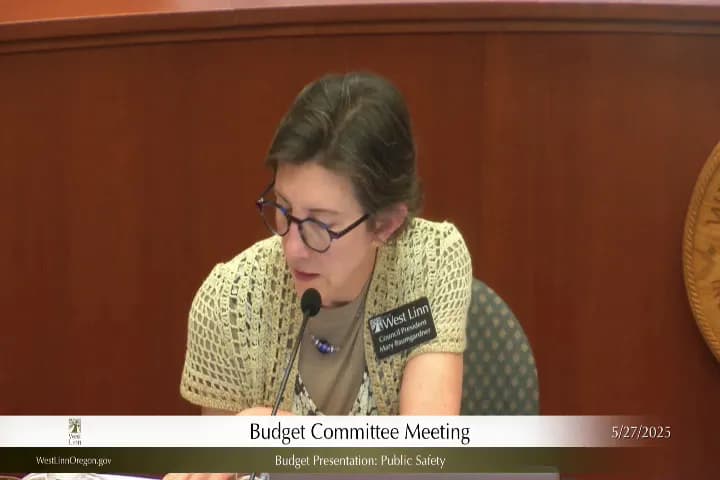
The West Linn Budget Committee met on Tuesday, May 27, 2025, at 6:15 p.m. in a hybrid format to review the proposed Biennial Budget for FY 2026-2027. The meeting included the election of committee officers, public testimony, the City Manager’s budget message, and presentations from most city departments. Discussion of the Non-Departmental budget – which includes requests from community organizations – was deferred to the next meeting on May 29, 2025. Consent Calendar - The agenda was approved unanimously by roll call vote (10–0). - Richard Larson was elected Chair and Brian Beadle Vice-Chair of the Budget Committee (unanimous). Public Comments & Testimony - Brad Holquist, President of Historic Willamette Main Street (HWMS), thanked the committee for past support and requested increased funding – a higher amount than previously requested – noting that the request is not in the current budget draft. He emphasized HWMS’s contributions to economic activity and community identity. - Rebecca Hollandbeck, Executive Director of HWMS, asked the committee to consider increasing the proposed $40,000/year to $70,000/year. She clarified that city support comprised only 29% of HWMS’s total income last year, and that they have increased donors by 100% and sponsors by 75% since the last budget cycle. The funding is tied to Oregon Main Street and Main Street America accreditation requirements (full-time director, physical office, continuing education). She noted rising costs for insurance, supplies, and services. - Ruth Alper (name misstated as “Ruth Offer”), Treasurer of HWMS, stated that if funding is not increased, the organization would have to cut salaries and programs. She explained that HWMS is now a fully accredited Main Street program and requires salary support for the executive director, market manager, and program assistant. - Robin May, owner of World Heart’s Fair Trade Retail Shop in Willamette, urged the committee to increase funding, noting the proposed amount is less than the previous two-year allocation. She described HWMS’s role in driving foot traffic and tourism and expressed concern that without adequate support the local business economy would decline. She serves as a board member and volunteer for HWMS. - The Mayor thanked the HWMS representatives and noted their request is on the agenda under Non-Departmental (Item 6.j). Discussion Items 1. City Manager’s Budget Message (John Williams) - Williams emphasized the budget’s transparency and its 100% public nature. Key themes: flat revenues, rising costs (liability insurance up 15%, power costs up 18%), and the city’s limited property tax base (only 13 cents per dollar goes to the city). West Linn’s tax base is overwhelmingly residential, with very little commercial/industrial compared to peers. The city has fewer employees per capita than peer cities. A five-year forecast projects a significant deficit in the next biennium. - The budget consolidates library, parks, planning, and public safety funds into the General Fund to simplify presentation. The document shows these both as separate historical funds and as part of the General Fund. Dedicated revenues (e.g., county library funds) are still shown as used for those purposes. - Personnel: 140 employees, 1.6 additional FTEs proposed, mostly in enterprise funds (one new admin assistant in building/planning/engineering, 25% general fund). A list of unmet needs is being developed. - Major capital: the city operations facility (largest project ever), I-205 water line, annual road program, water line replacement, pedestrian safety. Capital budget is mostly maintain-and-repair. 2. Personnel Services – All Funds - Presented by City Manager Williams. The organizational chart and staffing numbers were reviewed. The city has 140 employees; the 1.6 additional FTEs are highlighted. A comparison chart shows West Linn’s staffing per capita is lower than peers (e.g., Lake Oswego has 15 planners, West Linn has 4). 3. City Attorney, City Council & City Management - City Attorney Kayleigh Klein (in-house since September 2024) described building the legal department, with outside counsel Barry Elsner & Hammond (rates $285–$325/hour). The budget balances primarily because she has not yet hired a second attorney; she is recruiting an “honors attorney.” The Oppenlander field matter continues to drive legal costs. Professional and technical services will decline once that matter resolves. - City Council Budget: Stipends funded per voter approval; contract lobbyist now fully in this budget; travel/training set at $3,000 per council member per year. - City Management Budget: Includes DEI programming (co-sponsorship, contractor) and $60,000 to update the city’s Emergency Operations Plan (almost 10 years old, needed for federal fund eligibility). 4. Economic Development, Planning & Building - Williams presented, as he also serves as interim Community Development Director. A new full-time Community Development Director is being hired (90% general fund, 10% building fund) to provide dedicated leadership to planning, building, and economic development. The position is “cost neutral” by repurposing existing resources. - Building Department: An additional admin assistant is proposed (50% building, 25% engineering, 25% planning) to handle counter work and free up inspectors. Revenues are solid. - Planning Department: Now in the General Fund (salmon-colored rows show the former planning fund). Professional/technical services include funding for Vision 43 and waterfront implementation ($100,000 each over two years) and $50,000 for other long-range planning (e.g., tree code update). 5. Human Resources - Deputy City Manager/HR Director Alyssa Presson presented. The department has 2.55 FTEs. The budget includes modest increases for a new HRIS system (NeoGov) – modules being added for core HR, training, time/attendance, payroll, performance, and digital forms. Collective bargaining with police officer and sergeant unions begins next week (GCPOA). AFSME contract is in year two of three. Professional services include a benefits broker, COBRA/ unemployment administration, and labor law representation. 6. Finance & Municipal Court - Finance Director Lauren Breithaupt presented. Finance is fully staffed; the main cost driver is the external audit (contract expiring, new RFP forthcoming). Other items: bond counsel, arbitrage consultant, investment advisor, and NeoGov payroll conversion ($60,000 next year). - Municipal Court: Budget flat; professional services (public defenders, interpreters, witnesses, pro tem judges) are conservatively budgeted based on case volume. Fines and forfeitures revenue ($250,000/year) is recorded in General Fund. - Committee Member Brian Beadle asked about benefit costs relative to salaries; Breithaupt explained that PERS (30%), health insurance, dental, life/disability are major components. - Councillor Farber praised the budget presentation and the consolidation of funds; she noted a structural imbalance coming in future years. 7. Information Technology - IT Manager Sean Shimomoto (new in role) presented. The department has 3 FTEs. Budget decreases in some lines due to a vacant position (his former role). Increased costs for new hardware (workstations, network switches), security/data governance, multi-factor authentication, a new police evidence system, and website modernization. Managed services (e.g., RSM) monitor network and firewalls overnight, crucial for police dispatch. Increased security costs are tied to new project maintenance agreements. No current investigation into self-hosting data storage, but under consideration. 8. Public Safety - Acting Chief Otis Rollins presented. The West Linn Police Department is fully staffed (34 public safety employees, sworn and non-sworn – 1.05 officers per 1,000 residents – lowest in the metro area). In 2024, officers responded to 11,871 calls for service, including 2,986 traffic stops and 1,656 citations. Average response time to priority 1 & 2 calls was 8 minutes 48 seconds; target is 6 minutes. Daily minimum shift is one sergeant and two officers (sometimes two officers overnight). - Rising costs: Tasers (triple over five years), body cameras (12% increase), vehicle upfitting ($15,000 to $25,000), new evidence software, and fume hood for narcotics testing. Behavioral health unit (BHU) specialist Amber Hambrick is shared with Lake Oswego; she has provided 80+ hours of CIT training. Drone program started with one drone and one pilot; plans to expand. Exploring automatic license plate recognition (ALPR) – no current funding. Traffic enforcement grant funds from ODOT are not fully used due to staffing limitations. - Needs identified by Acting Chief: additional code enforcement officer (one currently for entire city), another traffic officer, replacement of a second captain, and additional patrol officers to allow proactive policing and reduce response times. - Council President Baumgartner asked for data on unmet needs; Rollins provided examples like dedicated teams for vehicle break-in hot spots. 9. Library - Library Director Doug (with Assistant Director Sarah Flatman and Library Manager Rebecca Mare) presented. The library is open 58 hours per week, seven days a week. It hosts 454 programs per year, has a circulating collection of physical and digital materials (circulation 475,000), and offers services like library of things, therapy dogs, Dolly Parton’s Imagination Library, outreach to schools (return boxes in every school), homebound delivery, and partnerships (Bike Kiosk with Arts Commission). The library is a net lender in the Clackamas County cooperative. - Budget requests: small increases for materials and staffing. The library is concerned about school district cuts to school librarians (going from 12–13 to 3–4); they are working with the city and a county task force to address the gap but cannot fully replace school services. - Councillor Farber praised the library’s resources and e-services (Libby, Kanopy). 10. Debt Service Fund - Presented by Lauren Breithaupt. The fund pays for two General Obligation bonds: 2012 bond (police station) and 2018 bond (city facilities, parks, transportation), both 20-year terms. Property taxes are the revenue source; a small fund balance is maintained to cover interest due in December before taxes arrive. A new bond for the operations center may be issued. 11. Non-Departmental Fund - Presented by Williams and Breithaupt. Includes: American Rescue Plan (fully expended), pass-through grant to West Linn Food Pantry ($34,000/year from Clackamas County), insurance costs (significant increase), League of Oregon Cities membership, grants to Historic Willamette Main Street (line item $40,000/year – the subject of public testimony), Willamette Falls Heritage Area Coalition, Willamette Falls Locks Authority, and a proposed community survey ($30,000 in FY26). A typo in the draft showed $2.4 million in miscellaneous – corrected to $50,000. - The committee discussed whether to consider community grant requests (including separate HWMS requests for programs) and a $75,000 request from the Chamber of Commerce (not yet received during budget drafting). These items were deferred to the May 29 meeting. - Breithaupt noted the budget is “very lean” and any additional funding would require offsets; the next biennium already projects a “fairly large deficit.” Key Outcomes - Election of Officers: Richard Larson elected Chair, Brian Beadle Vice-Chair (unanimous). - Adjournment: The meeting adjourned at approximately 8:50 p.m. without taking action on Non-Departmental items. - Next Meetings: Thursday, May 29, 2025, at 6:00 p.m. (Council Chambers & Virtual) – will begin with Non-Departmental discussion (including HWMS funding requests and Chamber of Commerce proposal) and continue presentations on enterprise/utility funds. Monday, June 2, 2025, at 1:00 p.m. – if needed for community grant program discussions. - Budget Direction: The Budget Committee will deliberate on the community grant requests and additional funding requests for Non-Departmental at the May 29 meeting. No decisions were made at this session.
Public Meetings - West Linn, Oregon
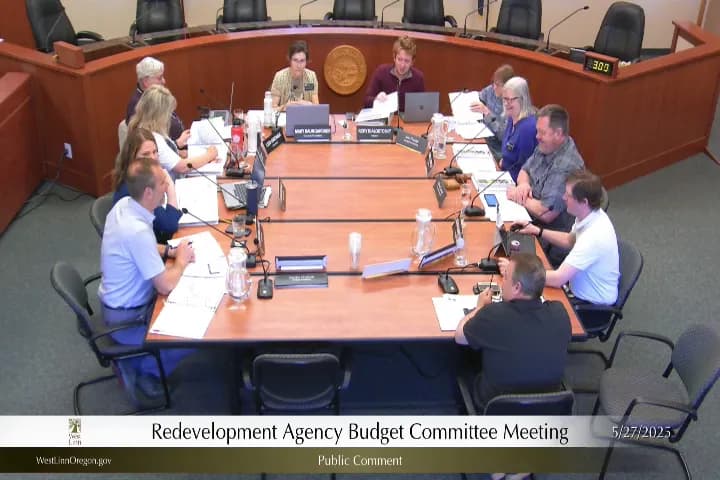
Public Meetings - West Linn, OregonThe West Linn Redevelopment Agency (RDA) Budget Committee met on May 27, 2025, to elect a chair and vice chair, approve minutes from the previous meeting, and consider the proposed biennium budget for fiscal years 2025–2027. The meeting was conducted in a hybrid format, with some members attending virtually. No public comments were received. Discussion Items - Election of Chair and Vice Chair: The committee elected citizen member Richard Larson as Chair and Brian Beadle as Vice Chair. Both votes were unanimous. - Approval of Previous Minutes: The committee unanimously approved the meeting minutes from May 20, 2024. - Budget Presentation: City Manager John Williams and Finance Director Lauren Breithaupt presented the RDA’s proposed budget. The RDA’s purpose is to stimulate redevelopment in the West Linn Waterfront area (from the Arch Bridge to the Pond area, including Willamette downtown and nearby commercial zones) using tax increment financing (TIF). For the upcoming biennium (July 1, 2025 – June 30, 2027), the budget projects approximately $437,000 in TIF revenue. The recommendation is to not spend any project funds until the waterfront vision plan is completed; the TIF district is seen as a tool to leverage grants and fund smaller infrastructure. The budget includes two funds: a general fund for administration and potential projects, and a debt service fund for property tax revenue and debt payments. - Questions and Clarifications: Budget Committee member Carol Bright asked about the distinction between the budget spreadsheets. Finance Director Lauren Breithaupt clarified that page 7 is a budget-at-a-glance summary of all funds, page 8 is a similar summary broken out by fund, the following page details the urban renewal general fund, and the last page details the urban renewal debt service fund. Key Outcomes - Unanimous Approval of Budget: The committee voted unanimously to approve the biennium budget for the period July 1, 2025 to June 30, 2027, in the amount of $674,000. The motion also authorized certifying to the county assessor a request for the maximum allowable tax increment revenue under ORS Chapter 457. - Elections: Richard Larson was elected Chair and Brian Beadle was elected Vice Chair, both by acclamation. - Meeting Adjourned: The RDA Budget Committee meeting was adjourned, with the city budget committee meeting to follow immediately after a brief technical pause.
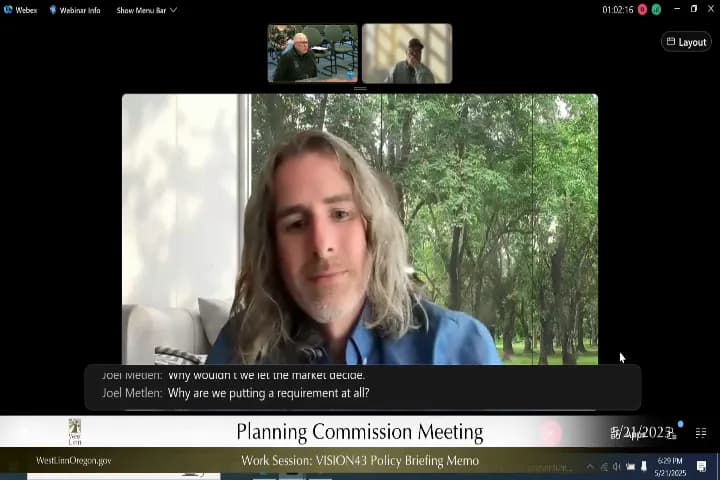
The West Linn Planning Commission held a regular meeting on May 21, 2025, at 6:00 PM. The meeting focused on a work session for the Vision 43 project, discussing policy questions 4 through 7 related to mixed-use zoning along Highway 43. Commissioners also approved meeting minutes and made scheduling adjustments for future meetings. Consent Calendar - Approved the meeting notes from March 19, 2025, April 2, 2025, and April 16, 2025 by unanimous vote (5-0). Public Comments & Testimony - No public comments were made. Discussion Items Work Session: Vision 43 Project – Policy Questions 4-7 Staff (Chris) presented four policy questions to guide the drafting of mixed-use zoning code for the Highway 43 corridor. Commissioners provided feedback on each: - Policy Question 4: Different development standards for properties on vs. off the highway Commissioners generally supported a "zone within a zone" approach, allowing more intense commercial use along Willamette Drive (Highway 43) and less intense, neighborhood-friendly mixed-use on back streets like Old River Drive and Walling Way. They emphasized preserving residential character while enabling small commercial uses (e.g., corner bodegas, coffee shops). Concerns included traffic impacts on residential streets and the need for a transition zone. - Policy Question 5: Require 100% of first floor to be commercial? Staff clarified the intent: commercial frontage on the highway, not necessarily full first-floor coverage. Commissioners favored requiring commercial uses facing Highway 43 but at a flexible percentage (suggested 15-40%). They stressed the importance of creating a "there" – a critical mass of retail and local businesses – and avoiding vacant storefronts. Examples from Lake Oswego and Portland's Pearl District were cited. Commissioners also noted the need to define "commercial" to include retail, services, and appointment-based businesses (e.g., therapists). Some advocated letting the market decide, but others worried that without requirements, desired community character might not materialize. - Policy Question 6: Allow single-use commercial buildings in focus areas? Commissioners agreed that large big-box stores (e.g., Target, Costco) are unlikely due to property constraints and community opposition expressed during outreach. However, they favored planning for size limits to prevent unexpected large developments. The existing 60,000 square foot limit in the commercial zone (OBC) was noted as a benchmark. - Policy Question 7: Maximum size for single-use buildings? Staff provided reference sizes (e.g., Trader Joe's 15-20k sq ft, Safeway 50k, Target 125-145k). Commissioners concurred that a 60,000 square foot maximum seems appropriate, as no existing building in West Linn approaches that size. They emphasized flexibility for grocery stores (e.g., Trader Joe's) but wanted to avoid large-format retailers that would change the corridor's character. Parking constraints and property shapes were noted as natural limitations. Throughout the discussion, staff noted that all policy questions are interconnected (e.g., height, residential requirement, parking mandates) and will be presented to City Council in July. Commissioners requested more data on developer preferences and industry standards for commercial percentages. Key Outcomes - Meeting schedule changes: The June 4, 2025 meeting was canceled. The next meeting is June 18, 2025 (code amendment work session and West Linn Waterfront project briefing). The July 2, 2025 meeting was rescheduled to July 9, 2025 to accommodate holidays; the July 16, 2025 meeting remains as scheduled. Commissioners approved these changes without objection. - No formal votes on policy questions – feedback will be compiled for City Council's consideration in July. - Staff will conduct further research on commercial percentage requirements and developer preferences for the next work session.
The West Linn City Council held a work session on Monday, May 19, 2025, starting at 6:00 p.m. The meeting included public comments, council reports, an ALS proclamation, a detailed update on the VISION43 project with three policy discussions, and two proposed ordinances related to parking enforcement and temporary storage containers. Public Comments & Testimony - Steve Light (resident) criticized parking enforcement near the high school, recounting a past incident where a student challenged a parking zone and the city removed it. He expressed concerns about livability and public safety, questioning perceived disparities in security between city facilities and private businesses. - Ben Erian (Bolton neighborhood resident) urged the council to support an amendment to the painted curb ordinance, stating that currently unenforced yellow curbs and expired permit parking near the school create unsafe conditions, including near-miss accidents involving pedestrians and drivers. Discussion Items - ALS Proclamation: Mayor read a proclamation designating May 2025 as Amyotrophic Lateral Sclerosis (ALS) Awareness Month, noting the disease's impact, lack of cure, and the ALS Association's $154 million in research funding. The proclamation was signed. - VISION43 Project Update (presented by Chris, planning staff): Three policy questions were discussed to guide the mixed-use zoning code for the Highway 43 corridor. Councilmembers voiced varied opinions, leaning toward incentives over mandates for housing and height requirements, with emphasis on avoiding unintended consequences and maintaining flexibility near residential zones. - Policy Question 1 (housing requirement): Most councilmembers favored encouraging rather than requiring housing, citing potential deterrents to development. Staff will research approaches from other cities and consult with developers. - Policy Question 2 (minimum two stories): Support emerged for requiring two stories along the highway, with possible exceptions for side or rear areas. Council President asked for visual examples; staff will bring back more detailed concepts. - Policy Question 3 (step-backs near residential zones): Councilmembers generally supported step-backs to reduce visual impact, but acknowledged the need for case-by-case flexibility, potentially triggered by topography or neighborhood input. - Ordinance Discussion – Painted Curbs (Chapter 6): Chief Mahuna and Attorney Klein presented a proposed amendment to allow enforcement of painted curbs (yellow/no parking) without additional signage, using only official city paint. Council discussed potential issues with unauthorized painting and enforcement consistency. The ordinance will return for adoption. - Ordinance Discussion – Temporary Storage Containers (PODS): A new section would limit PODS or similar containers on residential streets to 72 hours without a permit, with exceptions for permitted longer stays. Council supported the 72-hour limit as reasonable, citing complaint-driven enforcement. A related sub-section clarifying prohibition of unpermitted vehicles in residential parking zones (e.g., near high school) was added. A third ordinance establishes fines referenced in the master fee schedule. All three ordinances will be brought back for adoption at a future business meeting. Key Outcomes - VISION43: Staff will conduct further research on policy questions, bring back visual examples, and continue drafting the mixed-use code with council feedback. No formal vote taken. - Painted Curb Ordinance: Council agreed to bring the revised ordinance back for a vote, incorporating language about official city paint and enforcement. - Temporary Storage Container Ordinance: Council agreed to bring the ordinance back for adoption, including the 72-hour limit and the residential parking zone clarification. - Fine Ordinance: A new section (6.148) will be presented for adoption, standardizing penalties via the master fee schedule. - Future Meetings: Budget committee meetings set for May 27 and 29; June 9 meeting canceled; June 16 special meeting likely for parking ordinances.
The West Linn City Council held a business meeting on Monday, May 12, 2025, at 6:00 p.m. in Council Chambers. The meeting included a public hearing on the Housing Production Strategy, adoption of a new Stormwater Management Manual, deliberation on a land use appeal, and reports from council and staff. All votes were unanimous unless otherwise noted. Consent Calendar - Meeting Minutes (April 14, 2025): Approved 5-0 without discussion. Public Comments & Testimony - Clyde Farris (retired physician, 45-year resident) expressed concern about increased wildfire risk due to climate change and urged the council to take a more aggressive stance against illegal fireworks, including extra police patrols and fines around the Fourth of July. Council President Baumgardner responded that education should lead, as enforcement can sometimes have a resistant effect. Discussion Items - Public Hearing: West Linn Housing Production Strategy (HPS) - Mayor Bialostosky opened the hearing. Consultant Matt Hastie (MIG) presented the HPS, a six-year plan required by ORS 197A.100. The Planning Commission recommended adoption with two minor changes: delaying implementation of the Construction Excise Tax (CET) to the latter half of the period, and adding language in Strategies 2 and 9 to address accessible housing for people with disabilities and older residents (per DLCD request). No public testimony was offered. - Council discussion: Mayor Bialostosky supported the CET as a delayed strategy but wanted more study to avoid increasing housing costs. Councilor Groner noted that infill development sometimes replaces single-story homes (potentially accessible to elderly/disabled) with multi-story clusters. Council President Baumgardner emphasized the need to clarify what “affordable” means and to create options for young families to prevent school closures. The council adopted Resolution 2025-02 with the two changes (5-0). - Staff recognized: Planning Manager Darren Wyss for leading the 15-month effort, and consultant Matt Hastie’s team for finishing six weeks ahead of the grant deadline. - Adoption of City of West Linn Stormwater Management Manual - Assistant City Engineer Clark Ide presented Resolution 2025-01. The City previously used Portland’s manual but developed its own to better fit West Linn’s topography, soil types, and DEQ permit requirements. The draft was out for public comment for 30 days and received zero comments; only minor grammatical edits were made. Councilor Bryck thanked staff for tailoring the manual rather than “reinventing the wheel.” The council adopted Resolution 2025-01 unanimously (5-0). - Appeal AP-24-02: Planning Commission Decision on Minor Partition and Variance (2830 Coeur D Alene Drive) - Mayor Bialostosky recused himself due to relationships with parties; Council President Baumgardner presided. The appeal challenged the Planning Commission’s approval of a three-parcel minor partition and a Class II variance to allow five single-family homes to access a 20-foot shared private driveway. The public hearing and evidentiary record were closed on April 14, 2025, with a tentative decision to approve the appeal and remove Condition of Approval 2. - Deliberations: Council President Baumgardner noted a discrepancy between the original developer agreement and a plat note, making the case “very complicated.” Councilor Bryck observed that the code allows four accesses from a private drive, suggesting a private property issue. Councilor Bonnington moved to adopt a final decision denying the appeal and modifying Condition of Approval 2 per staff recommendation (effectively upholding the Planning Commission with a modification). The motion carried 4-0 (Mayor not voting). - Outcome: The appeal was denied, and Condition of Approval 2 was modified. Parties have standing to appeal to LUBA. Key Outcomes - Approved April 14, 2025, meeting minutes (Consent Agenda). - Adopted Resolution 2025-02: West Linn Housing Production Strategy (5-0). - Adopted Resolution 2025-01: City of West Linn Stormwater Management Manual (5-0). - Denied appeal AP-24-02 and modified Condition of Approval 2 (4-0). - Council received reports on community events (State of the City, Arts & Culture Commission sculpture, Highway 43 art corridor), state lobbying (Willamette Falls Locks/Trust, water infrastructure funding), waterfront planning, recreation center discussions, and recognition of Officer Matt Good receiving an award.
The West Linn City Council convened on Monday, May 5, 2025, at 1:00 p.m. for a work session covering a wide range of topics including multiple proclamations for May, an update on the City Operations Complex design, technical amendments to the Tree Code, the VISION43 corridor project, and a framework for Community Advisory Group work plans. The meeting included public comments from one online participant and several reports from council members. Consent Calendar - The agenda for the May 5th work session was approved unanimously (5-0). - All five proclamations were read and adopted by acclamation: Mental Health Awareness Month (May 2025), Congenital Disorders of Glycosylation Awareness Day (May 16, 2025), Jewish American Heritage Month (May 2025), National Police Week & Peace Officers Memorial Day (May 11–17, 2025, and May 15, 2025), and National Public Works Week (May 18–24, 2025). Public Comments & Testimony - One online participant, Mr. Barteroni, spoke in support of the Tree Code amendments, emphasizing the importance of tree preservation for the environment. No other public comments were made. Discussion Items - City Operations Complex Design Update (1:45 p.m.): Eric and the design team from Scott Edwards Architecture (SEA) presented a 70% design completion update. The project preserves a wetland and ravine on site, uses mass plywood (CLT) for structural systems, and includes 250 photovoltaic solar panels estimated to generate 133,000 kilowatt-hours per year. A LEED certification analysis suggests 21 assured points with up to 52 possible, but staff recommended not pursuing official certification due to $100,000 in administrative costs. The building is designed for resilience with a generator sized for three days of full operation and natural gas backup. Council questions addressed electric vehicle charging infrastructure (conduit for future expansion), a heated driveway idea, and potential geothermal options. No formal direction was requested; the next update will include a CMGC contractor award (June 16, 2025). - Tree Code, Technical Amendments (2:15 p.m.): Megan, Kaylee, and consulting arborist Todd Prager presented proposed technical updates focused on legal compliance, clarity, and administrative consistency. Key changes include: shifting burden of proof for tree removal from city arborist to applicant, clarifying permit approval criteria, updating definitions, and aligning fees with the city's master fee schedule. Policy considerations include revising heritage tree maintenance responsibilities (private vs. public), improving notification processes (online and email), and adopting a suggested street tree list. Council directed staff to bring the ordinance and manual back for adoption following a public comment period. - VISION43 Project Update (2:45 p.m.): Associate Planner Chris Myers provided an update on the Highway 43 corridor project. Council gave consensus to remove focus area 2 (West Linn Lutheran Church) as changes to state law now allow low-income housing without code changes. The boundaries for focus areas 1, 3, and 4 were presented with minor additions from the working group and Planning Commission; council approved the boundaries. Three policy questions were introduced for future discussion: (1) whether new development should be required to include a housing component, (2) whether there should be a minimum two-story height requirement, and (3) whether buildings should step back when adjacent to residential zones. Council requested pros and cons for each question to be presented at the May 19th work session. - Community Advisory Group Work Plans / Council Liaison Roles (3:15 p.m.): Staff presented a draft work plan template (using the Sustainability Advisory Board as an example) and a meeting report-back form for council liaisons. The work plans are designed to align CAG activities with council priorities and annual reports. Council supported the approach and directed staff to begin drafting work plans for each CAG, with approval anticipated in summer 2025. An annual CAG appreciation event was suggested. Key Outcomes - Agenda approved (5-0). - All five proclamations adopted. - City Operations Complex design update noted; CMGC contract award scheduled for June 16, 2025. - Tree Code amendments to be brought back for adoption after a public comment period. - VISION43 focus area boundaries approved; focus area 2 removed. - Three VISION43 policy questions to be further discussed on May 19, 2025. - Staff to draft community advisory group work plans and begin implementation of council liaison feedback forms. - City Manager announced upcoming meetings: State of the City (May 6), business meeting (May 12), and possible budget discussions on May 19.
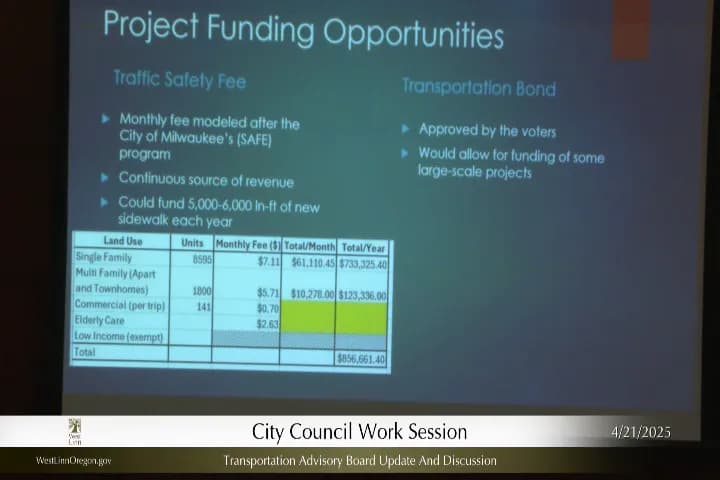
The West Linn City Council held a work session on April 21, 2025, starting at 6:00 PM. The meeting covered three major topics: pedestrian safety prioritization (joint with Transportation Advisory Board), draft Right-of-Way Code revisions, and the draft Housing Production Strategy. Council also received reports from members and the city manager. Consent Calendar - The agenda for the April 21, 2025, City Council work session was approved unanimously (motion moved, seconded, and roll call showed all ayes). Public Comments & Testimony - Meredith Papst (representing AT&T) spoke during the Right-of-Way Code discussion. She stated that AT&T now understands the city intends to charge wireless providers a percentage of revenue fee for use of the right-of-way even when they do not own or operate facilities in the right-of-way. She argued that state case law (Quest v. Portland) requires actual use (ownership/operation of facilities) for such a privilege tax, and that AT&T’s fiber backhaul is only indirect use. She also noted that local privilege taxes are preempted by the state’s corporate activity tax since 2019. - Leela Vega (representing Verizon) spoke during the Right-of-Way Code discussion. She echoed concerns about the fee basis, stating that charging providers (not infrastructure owners) could violate federal law (Section 253 of the Telecommunications Act) by creating an effective prohibition of service. She also noted administrative challenges with gross‑revenue fees for small cells and argued that percentage‑of‑revenue fees are not cost‑based and thus not FCC‑compliant. - Anamika Concola (Youth Advisory Council member) spoke during the Transportation Advisory Board discussion. She expressed strong support for pedestrian safety projects, emphasizing the YAC’s prior recommendation for increased sidewalk connectivity to make the community safer and more connected. Discussion Items 1. Transportation Advisory Board – Pedestrian Priority Information - Eric Layus (Public Works Director) and Clark Eide (Assistant City Engineer) presented an updated pedestrian project list, reprioritized using Oregon Administrative Rules (OAR 660‑012). The new criteria include proximity to schools, underserved populations, crash history, and connectivity. The list contains 107 projects split into Tier 1 (no sidewalk on either side) and Tier 2 (partial sidewalk). Eight high‑priority Tier 1 projects total about $7.3 million; four high‑priority Tier 2 projects total about $5.2 million. - TAB members (Jeff Krug, Rich Faith, Clayton Filter, Rick Larson, Alex Kraft, Logan Hart) commented on the process. They noted that the original 2016 list had 70% high priority (making prioritization meaningless) and that the new scoring, while objective, may need refinement—especially for projects in Metro 2040 centers that score high due to location but have low actual pedestrian demand. - TAB Chair Jeff Krug emphasized that the city has no dedicated funding for these projects and urged council to consider a stable funding source. Rick Larson suggested creating an overall financial plan and preparing a ranked list from highest to lowest priority. Rich Faith noted that the council has final decision authority. - Council members discussed combining sidewalk projects with crossings, water lines, and bike lanes for efficiency. They expressed interest in a consistent annual funding source (e.g., a traffic safety fee similar to Milwaukee’s) and possibly a bond measure for larger bundles. Councilor Bielostowski noted that a fee could generate $850,000/year (based on Milwaukee rates) and build 5,000‑6,000 linear feet of sidewalk annually. - Staff and TAB agreed to continue refining the list, focusing on the top‑scoring projects and verifying ground conditions before reporting back to council. 2. Draft Right‑of‑Way Code - Stephanie Hastings (Finance) and Lauren Breithaupt presented proposed code revisions to fill gaps identified since 2021, when the city moved utilities from franchise fees to a license‑based program. Key additions include clarification of definitions, registration requirements for providers, construction/relocation rules, audit language, insurance/indemnification, and penalty structures. - The changes would create a separate usage fee for providers and operators (both at the same percentage of gross revenue as current franchises) and add a minimum fee for operators with no gross revenue. A separate resolution will set fees after code adoption. - Two utilities submitted comments: Verizon requested exemptions for wireless from registration and usage fees; AT&T requested attachment fee exemptions and wireless record‑keeping exemptions. Both raised concerns about the city’s interpretation of “use of the right‑of‑way” for providers who do not own facilities. Staff noted that legal expert Nancy Warner will be available at the May 12 hearing. - Council asked clarifying questions about revenue sources (total about $2 million/year, mostly from PGE and Northwest Natural) and about whether water/sewer utilities are included (they are exempted). Councilor Groner asked about “undergrounding antennas,” which was clarified as a consistency edit. - Council gave consensus to bring the code back for formal adoption on May 12, 2025, after receiving written comments from AT&T and Verizon. 3. Draft Housing Production Strategy - Matt Hasty (MIG) and Darren Wise (Planning Manager) presented the final draft. The Housing Production Strategy contains 11 actions, including rezoning for mixed‑use, updating system development charges, multiple‑unit property tax exemptions, tax increment financing, land acquisition/banking, public‑private partnerships, low‑income rental exemptions, zoning incentives, a construction excise tax (CET), homeownership tax exemptions, and fair housing education. - The planning commission held a hearing in early April and recommended adoption with one change: delaying implementation of the CET until later in the six‑year schedule (about year 3–4) to allow other strategies to show results first. This change was supported by council discussion. - Council members asked about CET usage in neighboring cities (Milwaukee and Beaverton have it; Lake Oswego does not). It was noted that CET revenue must be used partly for SDC reductions and partly for affordable housing subsidies. - Council gave consensus to schedule the Housing Production Strategy for adoption on May 12, 2025. Mayor and Council Reports - Councilor Breich: Attended Bolton Neighborhood Association meeting (housing production strategy) and Planning Commission (Vision 43 update). - Council President Baumgartner: Attended Willamette Falls/Landing Heritage Area Coalition and Willamette Falls Trust meetings; noted restoration of historic city hall and efforts for indigenous/public access. - Mayor Bielostowski: Attended Clackamas Coordinating Committee (transit discussion) and met with Graymore (EV charging infrastructure). - Councilor Groner: Attended Sustainability Advisory Board; discussed public works center electrification, solar panels, tree code review, and Graymore EV chargers. - Councilor Bonington: Sunset Neighborhood Association needs a new president; Cars and Coffee event on May 31. - Council President added: Transportation committee in Salem discussing Willamette Falls locks funding. City Manager Report - John Williams previewed upcoming meetings: May 5 work session (operations complex design, tree code technical amendments, Highway 43 update, CAG work plans), May 12 business meeting (Right‑of‑Way Code, Housing Production Strategy, stormwater manual), May 19 open work session. Budget committee meetings May 27, 29, and June 2 if needed. June 9 meeting canceled; business moved to June 16. - He reported that of the year’s council to‑do items, only five remain unscheduled: storage container ordinance, budget homework, Lady B tugboat agreement, jurisdictional transfer, and tree code discussion. Several are already in progress. - He promoted upcoming community events: gardening at Robinwood Station, work party at Palomino Loop, writers group, Spice Club at library, and a talk on normalization of anti‑Semitism at the library on Wednesday at noon. Key Outcomes - Right‑of‑Way Code: Council directed staff to bring the ordinance and related fee resolution for formal adoption at the May 12 business meeting. Staff will incorporate written comments from AT&T and Verizon and ensure legal compliance. - Housing Production Strategy: Council directed staff to prepare the HPS for adoption at the May 12 business meeting, incorporating the planning commission’s change to delay the construction excise tax implementation. - Transportation Advisory Board Pedestrian Priority: Council asked staff and TAB to continue refining the project list, focusing on top‑scoring projects and verifying on‑the‑ground conditions. Staff will explore funding options (e.g., a utility fee, bond measure) and report back at a future work session. No formal vote was taken; consensus was to keep the process moving. - Council to‑do items: City manager will work with council to schedule remaining open items (storage container ordinance, budget homework, Lady B tugboat, jurisdictional transfer, tree code) for upcoming work sessions.
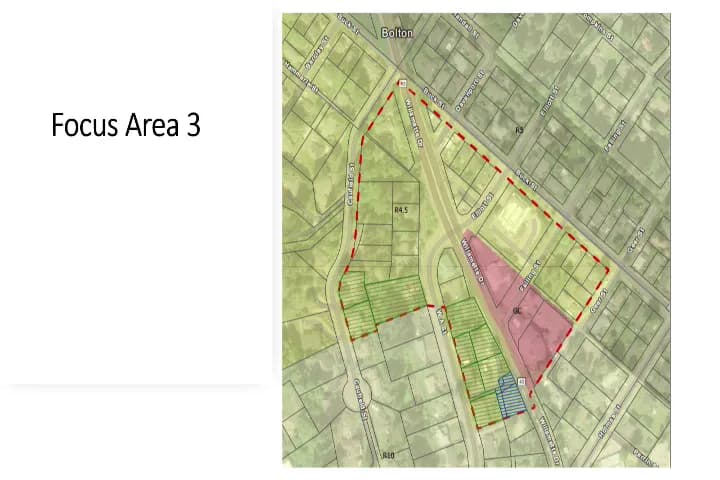
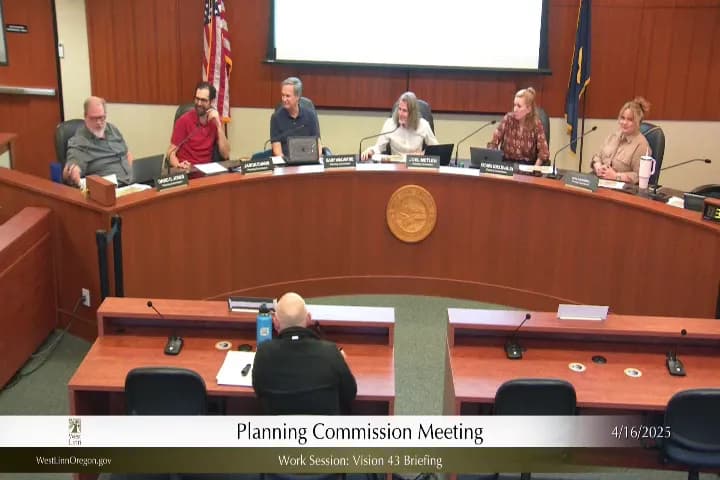
The West Linn Planning Commission held a work session on Wednesday, April 16, 2025, to discuss the Vision 43 project, focusing on focus area boundaries and three policy questions for the mixed-use code. The meeting included no public comment and no consent calendar items. Commissioners reached consensus on removing one focus area, adjusting another, and provided preliminary guidance on housing requirements, minimum building height, and stepbacks. Discussion Items - Removal of Focus Area 2: Staff proposed removing Focus Area 2 (the Westland Lutheran Church site) because state law changes already allow low-income housing on church properties. The commission unanimously agreed to remove it, reducing the focus areas from four to three. - Focus Area 1 Boundary: The proposed boundary includes commercial properties and some single-family residential lots (e.g., Walling Circle) to create cohesive development districts. Commissioners approved the boundary with support for including the Walling Circle properties as a group, noting the potential for future redevelopment. - Focus Area 3 Boundary: The proposed boundary near Bolton Elementary and the old firehouse was reviewed. Commissioner Evans suggested including three small undeveloped properties on the southeast corner. Others supported this adjustment, and staff agreed to incorporate them and present the updated boundary to council on May 2nd. - Focus Area 4 Boundary: The largest area, including the library and Market of Choice, was discussed. The working group added residential properties on Amy and Garden Streets to enable larger future projects. Commissioners expressed comfort with the boundary and did not seek further extension. - Policy Question 1 – Required Housing Component: Should new development within focus areas be required to include on-site housing? Commissioners voiced varied opinions. Commissioner Evans was a strong yes; Commissioner Kachirski noted nuances (e.g., Walmart location may not suit housing). Vice Chair Walbotney warned against concentrating affordable housing near the freeway. Commissioner Jones raised affordable housing credits. Staff noted that specific affordability targets may emerge later from the Housing Production Strategy. The consensus leaned toward requiring housing, with caveats. - Policy Question 2 – Minimum Height of Two Stories: Should new development have a minimum of two stories? All commissioners supported this, with some suggesting three or more stories be allowed. The goal is to move away from single-story strip malls and increase density. - Policy Question 3 – Stepbacks Adjacent to Residential Zones: Should new development step back when adjacent to existing residential zones? Commissioners generally supported stepbacks to avoid a “canyon effect” and to soften visual impact. Commissioner Evans was neutral but willing to go along. Others supported for light preservation and aesthetics. Key Outcomes - Consensus to Remove Focus Area 2 – Unanimous agreement to delete Focus Area 2 from the Vision 43 project. - Focus Area Boundaries Adjusted – Endorsed focus areas 1, 3, and 4 with minor changes (Focus Area 3 to include three additional properties). Staff will incorporate adjustments. - Policy Guidance for Council – The commission’s feedback on the three policy questions will be presented to City Council on May 2nd, 2025. Generally: support for requiring housing (with nuance), support for a minimum of two stories, and support for stepbacks adjacent to residential zones. - Next Steps – Staff will continue drafting the mixed-use code and bring more policy questions to the commission in about a month. Adoption is targeted for December 2025.
The West Linn City Council convened on Monday, April 14, 2025, at 6:00 p.m. for its regular business meeting, preceded by a pre-meeting at 5:30 p.m. The Council addressed a public hearing on a land-use appeal, approved a federal project intergovernmental agreement, awarded a waterline replacement contract, received a state legislative update, and adopted the 2025 planning docket. Mayor Rory Bialostosky recused himself from the public hearing due to a potential conflict of interest. All votes were unanimous except for one 3-1 decision on the appeal. Consent Calendar - Meeting Minutes: Approved minutes from the February 18, 25, and March 17, 2025, City Council meetings. - Agreement with Clackamas County: Approved an agreement regarding the Plastic Pollution and Recycling Modernization Act. - Lake Oswego Communications (LOCOM) Intergovernmental Agreement: Approved the LOCOM IGA. - Vote: Motion carried 5-0. Public Comments & Testimony - Brian Greenwood (West Linn resident): Raised concerns about gravel left on streets after a February snowstorm, stating it creates hazards in bike lanes and for pedestrians. He requested prompt cleanup. - Marylhurst Neighborhood Association: Scheduled to speak but no details provided in the minutes or transcript. - Teri Cummings: Scheduled to speak but no details provided. Discussion Items - Earth Day Proclamation: Council President Mary Baumgardner read a proclamation declaring April 22, 2025, as Earth Day in West Linn, emphasizing investment in sustainable practices and stewardship of green spaces. - Mayor and Council Reports: - Community Advisory Group Appointments: Council approved the appointment of Kent Wyatt to the CCI Committee, Shannen Knight to the Economic Development Committee (EDC), and Rob Kugler to the Sustainability Advisory Board (SAB). Motion carried 5-0. - Advisory Group Updates: Councilor Bryck reported on Utility Advisory Board discussions about water system master plan funding and Vision43 open houses. Councilor Bonnington attended Parks Board and EDC meetings. A joint meeting with the Transportation Advisory Board was announced for April 21. - Intergovernmental Agreement (IGA) with ODOT – Willamette Falls Drive Improvements: Public Works Director Erich Lais presented the IGA for multimodal improvements (separated bike/pedestrian facilities) on Willamette Falls Drive from 16th Street to Ostman Road. The project is funded by Metro's Regional Flexible Funds Allocation (RFFA) of $3,497,580 (awarded in 2022 for 2025-2027). The current phase covers design and right-of-way acquisition: $940,000 federal funds with a city match of $107,669 (10.27%), totaling $1,047,669. Construction is expected in FY 2028-2029. Motion carried 5-0. - Award of Contract for 2025 Waterline Replacement Project: Public Works Director Lais outlined the project, which replaces substandard water lines (cast iron, asbestos cement) in three phases: 1) Arbor Drive (relocating plastic services), 2) Parker/Sunset/Reed Streets (extending 8-inch main), and 3) Dollar Street and Santa Anita (rerouting exposed main). The project was bid under Local Contracting Review Board rules; Icon Construction & Development was the lowest responsible bidder at $1,463,679.04, funded by the water fund. Work is expected to start mid-May. Motion carried 5-0. - Public Hearing – Appeal of Planning Commission Decision (AP-24-02): A de novo hearing on the appeal by Gary and Susie Alfson of the Planning Commission's approval of a 3-parcel minor partition and Class II variance at 2830 Coeur D Alene Drive. The variance would allow five single-family homes (instead of the code-permitted four) to access a 20-foot shared private driveway. Mayor Bialostosky recused himself due to prior relationships with the attorney for the appellants and with a party involved. Special Counsel Ashleigh Dougill outlined the criteria (CDC Chapters 12, 48, 75, 85, 92, 99). Associate Planner Aaron Gudelj presented staff report. The Alfson family argued that condition 2 requiring signatures from all sharing the easement should be removed; they claimed the access limitation on the plat was never agreed to and that requiring access via Tract C would be costly and unsafe. Neighbors (Carmen and Rufus Timberlake, and David/Sarah Baker represented by Kyle Grant) opposed the variance, arguing that the plat notes limit access to two lots and that the Alfson's current access is sufficient; they requested denial of the appeal and the variance. Council voted 3-1 (Bryck, Baumgardner, Groner in favor; Bonnington opposed) to make a tentative decision to approve the appeal, overturn the Planning Commission's condition 2, and direct staff to bring back findings for adoption on May 12, 2025. - Oregon Legislative Session Update: City lobbyist Doug Riggs reported on the status of bills. Key topics included: a transportation package raising approximately $1.9 billion (including increased gas taxes, new vehicle fees, and road user fees on electric/delivery vehicles); jurisdictional transfer of Highway 43; recreational immunity (SB 179 passed Senate); middle housing mandates; Willamette Falls Locks funding; and transient lodging tax flexibility. The Council discussed the importance of securing substantial state funding before taking over Highway 43. Doug Riggs indicated tolling proposals appear dead. - 2025 Planning Docket Projects: Planning Manager Darren Wyss presented the docket as recommended by the Planning Commission. Proposed projects include continuing Vision43, Housing Production Strategy, CFEC/Metro 2040 town center boundary adoption, FEMA floodplain compliance, code cleanup, and implementation of Housing Production Strategy. The Council also added an update to the Economic Opportunities Analysis (EOA) as a prioritized project, noting grant funding availability. The docket was approved 5-0. Councilor Bonnington raised interest in updating the tree code; the City will schedule a future work session on the topic. Key Outcomes - Consent Agenda Approved (5-0): February/March meeting minutes, recycling agreement with Clackamas County, and LOCOM IGA. - ODOT IGA Approved (5-0): Authorized the IGA for federal project on Willamette Falls Drive; design and right-of-way phase funded at $1,047,669 (94% federal). - Waterline Replacement Contract Awarded (5-0): Contract with Icon Construction for $1,463,679.04; construction to begin mid-May 2025. - Appeal of Planning Commission Decision (3-1): Council voted to approve the appeal and remove condition 2, allowing the Alfson’s variance for five lots on the shared driveway. A final decision and findings will be presented on May 12, 2025. Parties may appeal to the Land Use Board of Appeals (LUBA). - 2025 Planning Docket Adopted (5-0): Set the docket as recommended by the Planning Commission with the addition of the Economic Opportunities Analysis as a prioritized project. A future work session on tree code updates was committed. - Legislative Priorities: Council will continue to monitor jurisdictional transfer and funding for Highway 43, Willamette Falls Locks, and other key bills.
The West Linn City Council held a work session on Monday, April 7, 2025, from 1:00 PM to 2:31 PM in the Council Chambers. The meeting included a presentation on the Stafford Road Improvements Project, four proclamations, updates on council priorities, and a city manager report on unmet staffing and capital needs. No public comments were made. Discussion Items County Transportation Stafford Update County project manager Jonathan Hangartner and traffic engineer Joseph Merrick presented an update on the Stafford Road Improvements Project, which will add a roundabout at Childs Road, realign Johnson Road to eliminate skew, add bike lanes, and improve habitat and fish passage. Construction is expected to begin as soon as May 1, 2025, and continue through winter 2026, with full road closures in five stages. The preferred signed detour route is via I-5 and Boones Ferry Road (through Lake Oswego), not Oregon 43. The county will monitor traffic patterns and coordinate with emergency services. Council members expressed strong support for the project, noting safety benefits, and asked about communication with GPS services (via ODOT TripCheck), the timeline for closures (e.g., Stage 1: May 1–July 14, 2025; Stage 2: July 15–September 30, 2025; winter shutdown with Childs Road closed), and curve improvements (widening, superelevation adjustment, guardrails). Proclamations - Child Abuse Prevention Month: Presented by Councilor Grohner. A representative from the Children's Center described their trauma-informed assessment and prevention services, noting they see about 500 children annually in Clackamas County, with funding from insurance, government contracts (at risk), and fundraising. No child or family is charged for services. - Distracted Driving Safety Awareness Month: Read by Council President Baumgartner. Statistics cited: In Oregon (2017-2021), 26,264 crashes involved distracted drivers, resulting in 194 fatalities and 24,264 injuries; 2,005 crashes involved mobile device use, with 15 fatalities and 1,775 injuries. - Volunteer Recognition Month: Read by Councilor Bright, honoring volunteer service in the community. - Arbor Month: The city celebrated its Tree City USA designation (since 1993). Parks department representatives reported spending over $400,000 last year on street tree replacement and tree care, and highlighted 3,700 volunteer hours from 1,300 volunteers in 2024, including 72 work parties. A video series on trees will be released throughout April. Council Priorities Update City Manager John Williams provided an update on all nine council priorities: - Transportation safety/funding: TAB meeting April 21 to discuss prioritized pedestrian safety projects and funding. - Indoor recreation/community center: Staff are talking to the YMCA about a potential partnership; no bond measure is planned at this time. - Community Advisory Groups (CAGs): Internal staff team working on consistent procedures and work programs. - Drinking water system capital needs: Utility Advisory Board meeting April 8 to discuss capital plan and funding; three water projects submitted to state legislature. - Waterfront vision plan: Draft final updates and zoning analysis due May; open houses this summer; adoption hearings anticipated Sept–Nov 2025. - Highway 43 vision plan: Draft mixed-use zoning code and quarter master plan in process; open house in June. - Environmental protection: Sustainability Advisory Board reviewing list of recommended strategies (e.g., EV charging, LED upgrades); municipal tree code update in progress. - DEIB: Internal committee developing 2025 work plan; inclusive leadership training planned. - Operations facility: Final design nearing completion; CM/GC bids close April 24; council work session May 5 on sustainability elements. City Manager Report City Manager Williams noted upcoming meetings (April 14, 21) and the Mayor's State of the City on May 6. He reported that staff are compiling a list of unmet staffing and capital needs in response to council's request, including: additional patrol officers, code enforcement, traffic safety officer, second school resource officer (SRO), a second facilities manager, outreach/communications staff, natural areas maintenance, parks project management, and pedestrian/traffic safety capital projects. The city faces ongoing fiscal uncertainty and may need to stabilize funding to maintain services. Key Outcomes - Agenda Approval: Council voted unanimously (5-0) to approve the agenda with a change moving the Stafford update after public comment. - No formal votes or decisions were taken on substantive items; all presentations and reports were for discussion and information. - Next Steps: The legislative update from lobbyist Doug Riggs was postponed to the April 14 meeting due to technical issues. Council will hold a work session on pedestrian/traffic safety with TAB on April 21. The city manager will present a refined list of unmet needs and cost estimates in May.