The West Linn Planning Commission met in hybrid format on Wednesday, March 19, 2025, at 6:00 PM. The meeting included roll call, approval of the March 5 meeting notes, commissioner and staff announcements, and a work session on the West Linn Housing Production Strategy (HPS) Public Review Draft. The chair initially read the meeting date as March 5 before correcting it to March 19. No final vote was taken on the HPS; the item was informational and deliberative. Consent Calendar - The meeting notes from the March 5, 2025 Planning Commission meeting were approved unanimously by roll call vote. Public Comments & Testimony - Darren Gusdorf, West Linn resident, general manager of Icon Construction and Development, and member of the HPS working group, expressed opposition to the proposed Construction Excise Tax (CET). He stated the working group supported all proposed strategies except the CET, on which the working group vote was split 50-50. He said West Linn had the highest System Development Charge (SDC) fees in the state, with over $70,000 in permits and SDC fees for a medium home product, and argued the CET would increase costs, push developers out of the community, and reduce housing supply. He also said there was no solidified implementation plan for CET fund allocation and urged adoption of the proposed strategies with the CET removed. Discussion Items - Commissioner Jones provided a brief update on Vision 43, describing the latest working group meeting as very productive and encouraging public input via the Vision 43 website. - Staff announced upcoming Planning Commission items: a follow-up public hearing on the HPS, which is not a legislative item and goes to the Oregon Department of Land Conservation and Development (DLCD) for compliance review after council adoption; Vision 43 updates; waterfront project work; FEMA code amendments; and code cleanup work sessions beginning in late April. The planning docket is scheduled to go to council in mid-April, and the waterfront working group is scheduled to meet the first Thursday in May. - Matt Hasty (city staff) and Brandon Crawford (MIG, participating remotely) presented the HPS. They reviewed the state requirement to adopt a Housing Production Strategy, following the housing capacity analysis adopted in November 2023, the six-year update cycle, and DLCD monitoring including a mid-term check at three years. They described twelve proposed strategies in three categories: housing options and choices (rezoning land, small dwelling unit development, SDC updates, multiple-unit property tax exemption); affordable housing actions (tax increment financing, land acquisition and banking, public-private partnerships, low-income rental housing tax exemption, zoning incentives for workforce and affordable housing, and the CET); and equitable housing opportunities (home buyer opportunity limited tax exemption, and fair housing education and referral). - On SDC scaling, the presenters reviewed three approaches used by other cities: direct scaling by dwelling square footage (King City, Albany), tiered approaches with floors and ceilings (Eugene, Portland, McMinnville, and Lake Oswego, which is considering tiers such as homes under 2,000 square feet paying 68 percent of the average SDC and homes above 3,600 square feet paying 113 percent), and scaling by number of bedrooms (Eugene, for multifamily). - On the CET, the presenters noted statutory requirements that 50 percent of revenues be used for developer incentives, 35 percent for affordable housing programs, and 15 percent remitted to the state. They noted a CET can apply to commercial and industrial development as well as residential, and that case studies in Corvallis and Milwaukie show CET funds were used for gap financing and local contributions for affordable housing projects. - Commissioners discussed the desire to disincentivize very expensive homes and incentivize smaller, more affordable units; interest in cottage communities and accessible, aging-in-place design, including strong demand for main-level bedrooms and bathrooms; the drivers of high SDCs, including low growth projections across much of the city with 10,000-square-foot lots spreading infrastructure costs over fewer units; the Metro housing bond, for which Clackamas County funds have been distributed but no projects built new housing in West Linn; and HOA restrictions on middle housing, including the possibility of pending state legislation addressing existing HOAs. Key Outcomes - No formal decision was made on the Housing Production Strategy; the item was a work session. - The public hearing on the HPS is scheduled for April 2, 2025, followed by a city council work session in late April and a council adoption hearing in mid-May. - Staff agreed to follow up with additional information on Clackamas County Metro housing bond allocations and on pending state legislation related to HOAs and middle housing.
Public Meetings - West Linn, Oregon
Public Meetings - West Linn, OregonThe West Linn City Council met on Monday, March 17, 2025, for a pre-meeting at 5:30 PM and a business meeting at 6:00 PM. The meeting included public comments, reports, proclamations, and several unanimous votes on ordinances, procurement exemptions, investment policy updates, and public art commissioning. Consent Calendar - Approval of Agenda: Unanimously approved (4-0) with Councilor Leo Groner excused. - February 10, 2025 Meeting Minutes: Approved. - Amendment to Cooperative Maintenance Agreement with ODOT for OR-43 Multimodal Improvements: Approved. Mayor Bialostosky expressed disappointment that cost increases reduced the original scope to only one intersection, arguing for city control of Highway 43. - Transient Lodging Tax Collection Intergovernmental Agreement with the State of Oregon: Approved. Public Comments & Testimony - Elizabeth Miller (West Linn resident) requested an ordinance limiting the time dumpsters and mini storage containers can be on city streets, citing a safety hazard from a unit left for over 11 months. The City Manager confirmed staff is reviewing the issue and will bring options to council. - Vicki Handy (co-chair, Parks & Recreation Advisory Board) presented the board's unanimous and strongly repeated opposition to the city acquiring and placing the tugboat Lady B in Willamette Park. Concerns included: location in an already overused park, lead-based paint liability, financial risks (only $25,000 of $200,000 budget raised), no exit strategy, environmental contamination, and additional burden on understaffed parks. She urged council to consider the board's due diligence and recommendations. Discussion Items - Mayor and Council Reports: Mayor Bialostosky reported on the Washington D.C. conference. Councilor Bryck attended Planning Commission and Vision43 meetings. Council President Baumgardner attended the National League of Cities conference and reported on the Willamette Falls Heritage Coalition and Willamette Falls Trust. Councilor Bonnington reported that the Parks and Recreation Advisory Board (PRAB) unanimously voted to advise council to seriously consider upgrade costs, community engagement, and ongoing maintenance for the Oppenlander project, and to weigh all city priorities. - Appoint Community Advisory Group Member: Council unanimously appointed Jared Dean to the Economic Development Committee, with discussion that the other applicant, Shannon Knight, already serves on another board. - Equal Pay Day Proclamation: Councilor Bryck read the proclamation declaring March 25, 2025 as Equal Pay Day, noting women earn about 83% of men's wages, with wider gaps for women of color. - ORD 1758 – Surface Water Management: First and second readings were approved unanimously. The ordinance gives the city authority to adopt, amend, and enforce its own stormwater management manual (previously using Portland's). The draft manual is out for 30-day public comment; final adoption expected in April. - Local Contracting Rule Exemption for CMGC Procurement: Council unanimously affirmed an exemption under section 10.105 of the city's contracting rules to use Construction Manager/General Contractor (CMGC) procurement for the new operations facility. Staff explained advantages include cost control, risk sharing, and earlier lead-time procurement. Next steps: RFP release for CMGC services, interviews, and contract award in early June, construction starting late summer/early fall 2025. - Investment Policy Update: Council unanimously approved the updated investment policy (last revised 2008). Finance Director Breithaupt noted the city is approaching the 15% cap on the Local Government Investment Pool (LGIP) due to higher reserves, $12 million in waterline bond proceeds, and GO bond balances. Government Portfolio Advisors (GPA) will help invest $10 million in U.S. Treasury and agency securities to diversify and lock in 4% returns. - Arts & Culture Commission – Bike Kiosk Art: Council unanimously authorized a contract with artist Travis Pond for $13,605.47 (increased from earlier quote due to tariffs, material costs, insurance, and new requirements). The art will be integrated into the Historic Willamette Main Street bicycle kiosk. The percent-for-arts fund has $130,000; this is the first public art contract. Council added a contingency for potential further material cost changes. Key Outcomes - Appointments: Jared Dean appointed to Economic Development Committee (4-0). - ORD 1758: Passed first and second readings, adopted unanimously (4-0). Ordinance effective in 30 days. - Local Contracting Rule Exemption: Approved findings and affirmed exemption for CMGC procurement (4-0). Staff to proceed with RFP. - Investment Policy: Approved unanimously (4-0). Implementation to begin with $10 million investment outside LGIP. - Bike Kiosk Art Contract: Authorized contract with Travis Pond at $13,605.47 (4-0), with understanding of possible material cost changes. - Future Meetings: City Manager noted upcoming April meetings including council priority updates, legislative session update, Stafford Road safety project, right-of-way code, continued appeal, pedestrian traffic safety project list, housing production strategy, and tree code. Budget draft is in design; budget meetings in late May. Staff will prepare a list of unfunded community service priorities for discussion as requested by council.
The West Linn Planning Commission met on Wednesday, March 5, 2025, at 6:00 PM in a hybrid format at City Hall. Commissioners present: Jones, Evans, Wolvotney (Vice Chair), Watton, Schulte Hillen, and Matlin (Chair). The meeting lasted approximately 45 minutes, adjourning at 6:45 PM. Consent Calendar - Approval of Meeting Notes (January 15, 2025): Unanimously approved by all commissioners (motion by Commissioner Wolvotney, seconded, voice vote: all yes). Public Comments & Testimony - No public comment was received for items not on the agenda. Discussion Items - 2025 Planning Docket: Staff planner Aaron Weiss presented the annual docket, which lists prioritized code and policy projects. The current active projects from 2024 (Waterfront, Vision 43, Housing Production Strategy) are recommended to continue. Staff proposed four new projects: (1) Climate-Friendly Equitable Communities (CFEC) Metro 2040 town center boundaries adoption (deadline end of 2025), (2) FEMA model code for salmon habitat (deadline July 31, 2025), (3) code cleanup (similar to 2024 process amendments), and (4) Housing Production Strategy implementation. Two optional projects were also discussed: an Economic Opportunities Analysis (EOA) update and updates to CDC Chapters 25 (historic resources) and 58 (Willamette Falls Commercial Design Overlay). Staff recommended removing two old projects: parking standards for high schools (now moot after CFEC parking reforms) and floodplain ordinance (to be replaced by FEMA model code). Commissioners expressed support for the staff recommendations and added the EOA and chapter updates as medium-priority items. Commissioner Walotney raised the topic of tree code cleanup (deferred to a larger future project) and reminded the commission of the long‑standing “Committee for Citizen Involvement” process review project. The commission gave general approval to forward the recommended docket to City Council. - Housing Production Strategy (HPS): Aaron Weiss reported that the HPS is moving toward adoption. A work session with the consultant team is scheduled for two weeks (focusing on the Construction Excise Tax – CET). A public hearing before the Planning Commission is set for April 2, 2025, followed by City Council consideration in late April with adoption expected in May 2025. Commissioners discussed CET (split views from the joint meeting), Strategy 6 on surplus land and land banking, and the three potential city‑owned properties identified for affordable housing: the Bolton fire station, the Skyline (Bolton reservoir) property, and the current public works yard (after the new facility is built). Commissioner Jones noted that the City is committed to implementing the strategies but can substitute strategies if needed. Commissioner Schulte Hillen asked about the timeline for Vision 43 implementation (currently working on a new mixed‑use chapter for Highway 43). The HPS adoption is a legislative resolution, not a land‑use action, so it is not appealable to LUBA. Key Outcomes - 2025 Planning Docket: The commission agreed to forward the staff’s recommended docket (three active projects plus four new projects) to City Council, and also to include the Economic Opportunities Analysis and historic code updates as medium‑priority items for future consideration. No formal vote was taken; consensus was expressed. - Housing Production Strategy: The commission confirmed the schedule: work session on March 19 (focus on CET), public hearing on April 2, and adoption process through council by May 2025. - Committee for Community Involvement Liaison: Commissioner Walotney continued as the liaison to the Committee for Community Involvement (CCI), which is developing a survey and marketing program to boost neighborhood association participation. - Staff Announcements: The first July 2025 meeting is likely canceled (July 2 near Independence Day), with a possible second meeting in July if needed. Commissioners were reminded to complete the Oregon Government Ethics Committee (OGEC) online training (about 1–1.5 hours). The McLean House was listed on the National Register of Historic Places, and a celebration will be held in late spring. A CLG grant application was submitted for a historic inventory of the Robinwood neighborhood.
The West Linn City Council held a work session on Monday, March 3, 2025, from 1:00 PM to 2:45 PM. The meeting covered several topics including proclamations, a stormwater management manual, a proposal to preserve the Lady B tugboat, and an update on state housing legislation. No formal votes were taken aside from approving the agenda. Consent Calendar - The council unanimously approved the agenda for the March 3, 2025 work session (motion by Councilor Bonnington, second by Councilor Groner). Public Comments & Testimony - No public comments were received. Discussion Items - Mayor and Council Reports: Council President Baumgartner reported on the Willamette Falls Locks Authority meeting, noting progress toward requesting state financial support to reopen the locks. Mayor Bielostowski provided an update on the ODOT Jurisdictional Transfer Advisory Committee, explaining the process for cities to transfer state highway ownership (e.g., Highway 43) with state funding for repairs. He highlighted the City of Tigard's successful application for a $50 million transfer of Highway 141, requiring a 20% local match (which Tigard met with maintenance credits). The mayor suggested West Linn could explore a similar transfer for Highway 43. Councilor Groner reported attending the Riverside High School science fair as a physics judge and a tour of the historic city hall renovation. - Proclamations: Council President Baumgartner read a proclamation declaring March 2025 Women's History Month. Mayor Bielostowski read a proclamation declaring March 17–23, 2025 as National Drug & Alcohol Facts Week. - Stormwater Management Manual: City Engineer Clark Eid and Jameson Lumpkin presented a proposed new Stormwater Management Manual to replace the current reference to Portland's manual. The manual aims to address gaps identified in a consultant's analysis, streamline submittal requirements, tailor rules to West Linn's terrain and infrastructure, and meet DEQ permit requirements. The city attorney noted the accompanying ordinance would adopt the manual and delegate authority to the city engineer. The council reached consensus to: (1) move forward with adoption of the ordinance at the March 17 special meeting, (2) post the manual for public comment, and (3) adopt the manual via resolution at the April 14 business meeting. - Lady B Tugboat Discussion: Jim Edwards, representing the Advocates for Willamette Falls Heritage, presented a proposal for the city to accept ownership and display the historic 77-year-old Lady B tugboat at Willamette Park. He explained that the owner (Wilsonville Concrete) has agreed to store the boat until April 2026, allowing time for site preparation. Edwards presented a budget of $200,000 to construct a display facility and cover maintenance for 20 years, including two paint jobs. The advocates have raised $25,000 from two grants, contingent on city ownership. Council members expressed general support and interest in a partnership, but raised concerns about site location (parks board opposition to Willamette Park) and long-term maintenance costs. The council directed staff to work with the advocates and prepare a revised analysis and potential letter of understanding, with a follow-up discussion expected at the March 17 or April 14 meeting. - City Manager Report: City Manager John Williams reported on upcoming meetings (March 17 special meeting with items on right-of-way vacation, finance policies, city operations facility), budget timelines (first meetings in late May), and legislative updates. He highlighted Senate Bill 49 and House Bill 2138, which propose to standardize zoning codes statewide and streamline housing processes. Council members expressed a preference to retain local control while supporting housing production. The mayor requested staff prepare testimony letters reflecting the council's nuanced position. Key Outcomes - Stormwater ordinance to be adopted on March 17; manual to be adopted on April 14 after public comment. - Council directed staff to work toward a partnership with Advocates for Willamette Falls Heritage on the Lady B tugboat, with further analysis and legal agreement to be prepared. - Council confirmed its position to oppose preemptive state housing mandates while supporting local housing efforts; staff to draft testimony. - Mayor noted the application deadline for jurisdictional transfer of Highway 43 is November 2025, and asked staff to explore feasibility in coordination with Vision 43 planning.
This special meeting of the West Linn City Council focused exclusively on providing direction regarding the future of Oppenlander Park, a 10-acre property owned by the West Linn-Wilsonville School District. After receiving public testimony and deliberating on financial constraints and community priorities, the council voted not to place a bond measure on the May 2025 ballot and instead directed staff to pursue a public-private partnership to acquire a portion of the property for park use. Consent Calendar - The council unanimously approved the agenda for the February 25, 2025 special meeting (motion by Council President Baumgardner, seconded by Councilor Groner; carried 5-0). Public Comments & Testimony - No speakers signed up for the general public comment period. - During the Oppenlander Park discussion, ten community members provided testimony, all expressing support for preserving the park: - Linda Parker (resident adjacent to park) urged the council to place a second bond measure on the ballot, stating the Friends of Oppenlander had successfully canvassed and carried the first measure by a significant majority. She felt confident they could pass another measure. - Stephanie Kendall (longtime West Linn resident) shared personal memories of using the park and urged the council to listen to voters who already supported preservation. She expressed disappointment and disgust with the school district and city council's handling. - Harlan Borough (Icon Construction) expressed willingness to work with the city on a compromise, noting they were exploring alternatives that could include a senior field. He emphasized that giving up a third of the area (and revenue) was already a significant concession from their original proposal. - Michael Hedges (West Linn resident) framed the decision as a legacy moment, urging the council to do everything possible to preserve the park for future generations. - Roberta Staff (Apollo Road resident) asked the council to consider opening further discussion or putting a bond vote to the community, emphasizing the park's historical value and the loss if developed. - Susan Nicholson (neighborhood resident) expressed concerns about the environmental and traffic impacts of development, urging consideration of open space for recreation and wildlife. - Dean Suhr (Friends of Oppenlander, joining via Zoom from Washington, DC) thanked the council for holding the special meeting. He stated the Friends group is fully committed to passing a bond measure and to continuing support for other city needs even if the bond is pursued. He argued that the bond is the only current solution and that the Icon proposal should remain a backstop. He also noted that the school district has not heard from enough community members and encouraged continued negotiations. Discussion Items - Oppenlander Park Direction: The council discussed the school district's firm stance on price and timeline, the city's critical infrastructure needs (water system, roads, public safety), bond fatigue, and the feasibility of a public-private partnership. - Mayor Bialostosky stated that a $10 million bond (including purchase and improvements) could jeopardize support for other essential projects, such as the $44 million water master plan, $20-30 million public works operations center, and $7 million intersection improvements. He noted the city has not had time to poll community support or assess trade-offs, and recent bond measures in the region have narrowly passed or failed. - Council President Baumgardner emphasized that the city needs water, safe roads, and adequate ball fields. She described the decision as a balancing act between wants, needs, and means, and expressed interest in finding other ball field locations. - Councilor Bonnington reminded the public that the city does not own the park and urged residents to direct their advocacy to the school board, which has shown receptivity on other issues like school closures. - Councilor Groner criticized the school district's short timeline and take-it-or-leave-it offer, noting that both the city and district have incurred significant legal costs. He called for thoughtful deliberation. - Councilor Bryck highlighted that the city already owns and maintains 600 acres of parkland (excluding Oppenlander) and faces budget constraints. She noted the cost of placing a measure on the ballot and cited past failures of police and water levies. - City Manager Williams confirmed the city's capital needs, including about $100 million in water system projects, $30 million for transportation, and $50 million for a potential recreation center. He stated the city does not have a large contingency fund and struggles to meet minimum reserves. - Public-Private Partnership: Several council members expressed support for exploring a partnership with Icon Construction to purchase part of the property for a park, using existing voter-approved funds or other sources. They emphasized this is not an endorsement of Icon's full proposal but a step toward a compromise. Key Outcomes - Council President Baumgardner moved, and Councilor Groner seconded, the following motion: "Not place a new bond measure to purchase Oppenlander on the May ballot for the reasons stated during this meeting, and direct staff to evaluate and pursue a public-private partnership for the City to purchase some of Oppenlander Field for use as a City park, utilizing existing voter-approved resources or other funding sources." - The motion passed unanimously (5-0). - The council clarified that this does not signal the end of efforts to acquire the park; negotiations with the school district and potential partners remain open. Councilors encouraged the public to continue engaging the school board regarding price and timeline.
The West Linn City Council held a special meeting on Tuesday, February 18, 2025, starting at 5:30 p.m. The agenda included a Youth Advisory Committee presentation on traffic safety, a joint work session with the Planning Commission on the Housing Production Strategy (HPS), and an open listening session on the future of the Oppenlander property. The Council also approved the consent agenda and made advisory group appointments. The meeting adjourned around 9:00 p.m. Consent Calendar - Approval of Agenda: Motion carried 5-0. - Consent Agenda: Approved (5-0), including Agenda Bill 2025-02-18-01: Oregon Department of Transportation (ODOT) Temporary Permit of Entry for Abernethy Bridge Construction. Council President Baumgardner raised a follow-up regarding homeowners near the bridge project whose dock was damaged; Council agreed to connect them with state legislators. Public Comments & Testimony - General Public Comment: None. - Youth Advisory Committee Traffic Safety: No public comment beyond the presentation. - Oppenlander Next Steps: Multiple speakers testified: - Seamus Barron (Vice President, West Linn Baseball Association): Expressed strong support for retaining Oppenlander, stating it provides three youth baseball fields and half of the city's senior-sized fields; loss would cripple the senior program (ages 13-18). - Dean Suhr (Friends of Oppenlander): Supported a second bond measure layered on the existing $3.5 million to meet the School District's $7.875 million price; estimated cost per household at $48/year. Urged action by February 28 deadline. - Youth speakers (Quinn Hogan, Alexandra Bacon, Derrick Peterson): Urged preservation for recreation, community, and wildlife. - Harlan Borow (Icon Construction): Proposed a public-private partnership: develop front 7 acres into 22 R-10 lots (with middle housing potential) and dedicate back 3 acres as a park with ballfields, parking, restroom, etc.; park cost estimated under $1 million; could be sold back to city using existing bond funds. - Keith Steele (former School Board member): Proposed swapping Parker Road land for Oppenlander, using proceeds plus existing bond to purchase, improve, and fund maintenance without new taxes. - Teri Cummings (former Councilor): Described historical agreement from 2010 where voters approved school redevelopment in exchange for keeping Oppenlander as a playfield annex; called School District's actions a betrayal; urged voters to hold school board candidates accountable. - Karie Oakes: Criticized the agenda as irregular and lacking sufficient notice; declined to comment on Oppenlander until proper materials were provided. - John McCabe: Supported a May bond measure and urged voters to oppose School District's general obligation bond due to lack of transparency. Discussion Items - Youth Advisory Committee Recommendation on Traffic Safety: YAC members presented on sidewalk connectivity issues, highlighting hazards in older neighborhoods (Bolton, Cedar Oak) and high-traffic areas (Pimlico, Rosemont/Summit). Council praised the alignment with recently adopted priorities and noted a joint meeting with the Transportation Advisory Board (TAB) on April 21st to explore funding. City Manager Williams confirmed TAB has been working on project lists and funding options. - Joint Meeting with Planning Commission: Housing Production Strategy (HPS): Matt Hastie (MIG) and Brendan Buckley (Johnson Economics) presented the draft HPS, focusing on the Construction Excise Tax (CET). Key points: - CET would be adopted by ordinance, no voter approval; estimated revenue $300,000/year at 1% rate, $400,000 at 1.5%. - Working group split 3-3 on CET (with two abstentions from Councilor Bonnington and Commissioner Watton). Affordable housing developers supported; homebuilders opposed. - Planning Commission and Council expressed unanimous support for all other strategies (SDC scaling, tax abatements, code updates, etc.). Concerns raised that CET would be passed to homebuyers and that West Linn has limited developable land. - Council asked Planning Commission to study CET and provide a recommendation. - The HPS will proceed through Planning Commission hearings and then to Council for adoption; public outreach will occur. - Open Session: Oppenlander Next Steps: - Opening statements: Mayor Bialostosky provided history (2021 School District offer, court battle, new appraisal at $7.875 million). Councilors expressed frustration with School District's lack of communication and rushed timeline. - Staff report: Parks Director Megan Big John presented ballpark estimates for capital improvements (restroom $800k, playground $400k, etc.) and annual maintenance ($65/hour for staff time, plus 25% increase for restroom cleaning). Emphasized no formal plan exists. - Four options: (i) use existing $3.5M bond to purchase part of property (e.g., 5 acres); (ii) explore alternative financing (private fundraising, developer partnership); (iii) ask voters for new bond to meet $7.875M price; (iv) do not pursue acquisition. - Council discussion: Consensus not to pursue a May ballot measure due to February 28 deadline, rushed process, and other capital needs (operations center, road safety, water infrastructure). Council will consider other options including a November ballot, public-private partnerships (Icon proposal), land swaps, and further community engagement. Key Outcomes - Council decisions: - Unanimously approved the agenda and consent agenda (including ODOT easements). - Appointed Alyssa Cruz (Economic Development Committee), Alex Kraft (Transportation Advisory Board), and Torsten Kieper and Jeff Stallard (Utility Advisory Board). - Decided not to move forward with a May 2025 ballot measure for Oppenlander acquisition; directed staff to explore alternative options and schedule future discussions. - Next steps: - Joint meeting with Transportation Advisory Board on April 21st to discuss transportation safety funding. - HPS will continue through Planning Commission and Council work sessions/hearings in April/May. - Staff will follow up on dock damage issue for Abernethy Bridge neighbors. - Future meetings: Work session March 3rd, special business meeting March 17th (right-of-way vacation, financial policies, operations center). - Other: Councilor Bonnington reported McLean House listed on National Historic Register; Council President Baumgardner attended Willamette Falls Trust meeting.
The West Linn City Council met on February 10, 2025, at 6:00 PM in Council Chambers. The meeting covered adoption of council priorities and city manager goals, approval of consent agenda items, a public hearing on a right-of-way vacation that was continued to March 17, adoption of an ordinance regulating wild animal feeding, approval of a historic inventory grant for the Robinwood neighborhood, and an update on the Stafford Area Urban Reserves. Consent Calendar - Approved meeting minutes from January 6 and 13, 2025, with a correction to Mayor Bialostosky's vote on MIP-24-02/VAR-24-05. - Approved the Public Works Operations Complex Construction Owners' Representative Contract. - Approved the City Attorney Employment Contract Amendment. - All items approved 5-0. Public Comments & Testimony - General Public Comment (non-hearing items): Michael Tayler addressed school bond amounts; Amelia Chapin spoke on poor street conditions; Dean Suhr discussed tolling opposition and Oppenlander Park; Anthony Bracco, representing Robinwood Neighborhood Association, invited council to a meeting; RJ Cook provided updates on Stafford Road construction and urged agricultural investment. - Public Hearing – Ordinance 1757 (ROW vacation): Multiple residents testified, primarily opposing the vacation. Speakers included Kathy Halicki (Willamette Neighborhood Association president) requesting a continuance; Michael Taylor supporting the vacation; Eric Griswold (Stafford Hamlet) presenting a photo compilation representing "No Voice"; Terence Shoemaker (Friends of Willamette Wetlands) urging denial; Nicole Jackson opposing, citing public interest and contamination concerns; Bruce Jackson raising concerns about the settling pond's structural integrity; Connie Johnson opposing; Larry Reed opposing; and Russ Axelrod opposing and asking the council to address code loopholes. - Ordinance 1756 (wild animal feeding): Tony Bracco expressed concerns about the ordinance being driven by complaints against a single person and questioned enforcement. Discussion Items - Adoption of City Council 2025-2027 Priorities: City Manager Williams explained the priorities were developed at a January 4 retreat and aligned with the biennial budget cycle. Councilor Bryck appreciated the introductory language and update process. Council voted 5-0 to adopt. - Adoption of City Manager Goals: The goals, prepared by the Mayor with input from Councilor Bryck, outlined five broad goals with implementation examples. Council voted 5-0 to adopt. - Public Hearing – Ordinance 1757 (VAC-24-01): Planning Manager Wyss presented the petition to vacate three portions of 5th Street and 4th Avenue rights-of-way totaling over one acre, noting the areas are within wetlands, floodplain, and habitat areas with no city plans for roads or utilities. Applicant representatives Mercedes Serra and Garrett Stephenson argued that the criteria under ORS 271 were met, emphasizing the ROWs were never used and are not needed for transportation, and that future development would be subject to separate land use approvals. Public testimony raised concerns about wetland protection, contamination of a settling pond, and consistency with the Waterfront Vision Plan. Council closed the public testimony and left the record open for written testimony until March 3, 2025, with applicant rebuttal due March 10, and continued the hearing to March 17, 2025, for deliberation and vote. - Ordinance 1756 – Wild Animal Feeding: Police Chief Mahuna described the ordinance as addressing public nuisances from feeding wild animals (e.g., skunks) and based on education-first approach. The council approved first and second readings and adopted the ordinance 5-0, with council members noting it was not intended for micromanagement but for health/safety situations. - Proposed 2025 Historic Inventory of Robinwood Neighborhood: City Manager Williams explained a grant-funded consultant inventory of 560 properties along Highway 43 would not designate properties but provide information for potential historic designations. Council approved the grant request with a 50% city match (staff/volunteer time) 5-0. - Stafford Area Urban Reserves Update: City Manager Williams and City Attorney Klein briefed council on three topics: (1) The Marks v. LCDC case, where LCDC staff recommended declining an enforcement order against the city and other parties; (2) Clackamas County's $1 million planning grant for a development readiness study, amended to be high-level and likely not including Stafford; (3) Senate Bill 592, which would require the state to study forming a new city in Stafford. Council discussed the need to stay informed and consider further discussions. Key Outcomes - Adopted the 2025-2027 City Council Priorities (5-0). - Adopted City Manager Goals for John Williams (5-0). - Approved the Consent Agenda, including meeting minutes, PW Ops contract, and City Attorney contract amendment (5-0). - Continued the public hearing on Ordinance 1757 (ROW vacation) to March 17, 2025, with written testimony due March 3 and applicant rebuttal due March 10. - Adopted Ordinance 1756 (wild animal feeding) on first and second readings (5-0). - Approved submitting a grant request for a Robinwood Neighborhood historic inventory with a 50% city match (5-0). - Received information on Stafford Area updates and agreed to consider future discussions.
The West Linn Planning Commission, joined by members of the Historic Review Board and City Council, held a land use law training session on February 5, 2025, from 6:00 PM to approximately 7:56 PM. The training was conducted in a hybrid format (in-person and via Webex) and was presented by Josh Soper, an attorney with Beery Elsner & Hammond who specializes in municipal land use law. The session covered the history of Oregon land use, distinctions between legislative and quasi-judicial decisions, bias, ex parte contacts, conflicts of interest, public meeting requirements, criteria and findings, conditions of approval, the 120-day rule, clear and objective standards, constitutional limits on exactions, and recent legislative changes. Discussion Items - History and Purpose of Oregon Land Use: Soper explained that Oregon's land use system originated with Senate Bill 100 in 1973 to protect farm and forest lands and prevent sprawl. He outlined the roles of state-level entities (DLCD, LCDC, LUBA) and local comprehensive plans and development codes. - Legislative vs. Quasi-Judicial Decisions: Using the Strawberry Hill Four-Wheelers case, Soper distinguished legislative decisions (broad policy, no bias/ex parte limits) from quasi-judicial decisions (based on pre-existing criteria, requires neutral decision-making, and must be based solely on the record). - Bias: Soper provided case examples (City of Depot Bay, Cottage Grove, Jacksonville, etc.) illustrating when bias is found—e.g., prejudging, conducting independent research, or introducing outside evidence. Commissioners asked about using professional experience; Soper advised that asking questions informed by experience is acceptable but acting as a second expert witness is not. - Ex Parte Contacts: Any communication outside the official record, including site visits, must be disclosed along with its substance. Soper recommended over-disclosure and careful note-taking during site visits. Communications with staff are exempt. Pre- or post-application contacts may be problematic if the matter returns. - Conflicts of Interest: Oregon ethics law defines conflicts only in financial terms. Actual financial conflicts require recusal; potential conflicts allow participation after disclosure. Soper strongly advised leaving the room entirely during deliberations. Personal liability can result from violations; the Oregon Government Ethics Commission should be consulted. - Public Meetings Law: All meetings must be publicly noticed and open. Serial meetings (via email, intermediaries) are prohibited. Staff uses blind copy to avoid accidental serial communication. - Hearing Requirements: Quasi-judicial hearings require notice, identification of criteria, and a “raise it or waive it” rule. The applicant has seven days for final written argument but typically waives it. Disruptions should be handled with warnings and recesses. - Criteria and Findings: Decisions must be supported by substantial evidence in the record. Findings must explain how evidence satisfies criteria. Conflicting evidence must be resolved. Staff typically drafts findings. - Conditions of Approval: Must relate to approval criteria. A 2024 state law requires that housing applicants be given an opportunity to propose conditions before denial. Conditions volunteered by applicants are generally binding if not challenged. - 120-Day Rule: A final local decision must be made within 120 days of the application being deemed complete. Failure triggers a refund of fees and potential writ of mandamus. Extensions must be in writing. - Clear and Objective Standards: Housing regulations must be clear and objective; unclear standards cannot be applied. Optional discretionary paths (e.g., planned unit developments) remain available. - Constitutional Issues – Takings and Exactions: Conditions requiring property dedication or improvements must have a nexus and be roughly proportional to the development’s impact (Nollan/Dolan standards). - Recent Legislation (SB 1537): Effective January 1, 2025, mandatory adjustments allow up to 10 variances from specified standards for housing applications (e.g., setbacks, lot sizes, facade materials). The definition of limited land use decisions was expanded to include replats, property line adjustments, and non-conforming use alterations, which can be processed without a hearing. Key Outcomes - No decisions, votes, or formal actions were taken. The meeting was entirely an educational training. - Staff indicated they would distribute summary notes and follow up on any outstanding questions.
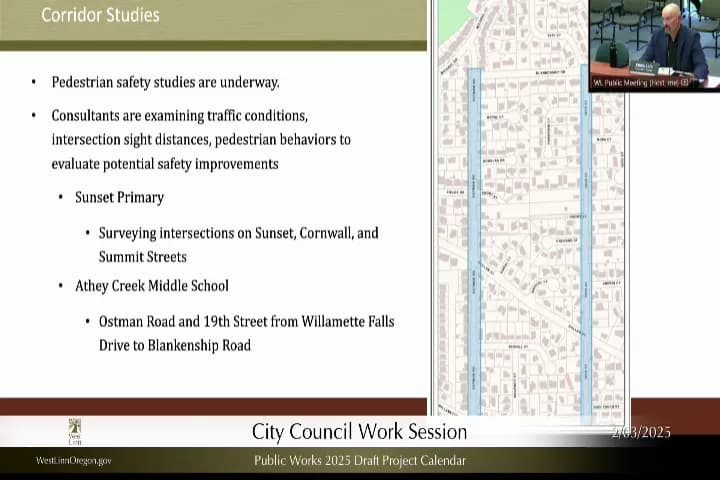
The West Linn City Council held a work session on Monday, February 3, 2025, at 1:00 PM in Council Chambers. The meeting covered a wide range of topics including a Black History Month proclamation, a proposed ordinance on feeding wild animals, a presentation from Metro Councilor Christine Lewis, a discussion on Flock Safety cameras, the 2025 Public Works project calendar, and the council's 2025 priorities. The session was informational, with no formal votes taken on most items, but direction was given to move several items forward. Consent Calendar - Approval of Agenda: Motion to approve the agenda for the February 3, 2025 work session passed unanimously (5-0). Public Comments & Testimony - Beau J. Genot (West Linn resident) spoke against the proposed Flock Safety cameras, citing Fourth Amendment concerns and noting that 37% of ALPR hits from fixed readers were reported as wrong. He expressed strong opposition, stating the cameras represent an unreasonable invasion of privacy and disproportionately target minority communities. Discussion Items Black History Month Proclamation - Council President Baumgartner read the proclamation declaring February 2025 as Black History Month, with the theme "African Americans and Labor." The proclamation highlighted the 100th anniversary of the Brotherhood of Sleeping Car Porters and Maids and encouraged citizens to participate in activities. Ordinance Related to Attracting & Feeding Wild Animals - Chief Mahuna and Code Compliance Specialist Nicola Higby presented a revised ordinance to prohibit large-scale wildlife feeding. Higby described multiple complaints (10-15 over the last few years) about issues like skunks spraying pets, rodent infestations, and poison affecting non-target animals. Current code lacks specific enforcement tools. The proposed ordinance includes an exception for bird feeders as long as it doesn't create a public nuisance. Council discussed potential abuse and enforcement approach; staff emphasized education-first. Council unanimously indicated support to bring the ordinance back for adoption at a future meeting. Metro Councilor Christine Lewis Presentation - Metro Councilor Lewis updated the council on regional affordable housing and supportive housing services. Key statistics: The 2018 affordable housing bond is on track to exceed production targets (130% of target), but all funds are already committed. The 2020 supportive housing services tax has placed over 6,000 households into housing, prevented over 15,000 evictions, and created/kept open 1,890 shelter beds. However, polling shows declining public confidence. Lewis discussed a draft framework for a potential renewal of the tax and improved oversight. Council expressed interest in scheduling a future work session to provide input to Metro. Flock Safety Cameras - Chief Mahuna and Flock Safety representatives David Johnson, Ashley Hickman, and Kristen McLeod presented the ALPR camera system. The cameras capture rear license plates from fixed locations, with 30-day data retention, no facial recognition, and data owned by the city. Real-time alerts for stolen vehicles, amber alerts, etc. Council discussed privacy concerns, data security, false positives, potential abuse, and policy safeguards. Councilor Bonton noted concerns about government tracking and unintended consequences. Chief Mahuna recommended pausing to gather community input before proceeding. Council agreed to take a pause for internal conversations and community engagement, with a potential budget discussion. Public Works 2025 Draft Project Calendar - Public Works Director Eric Leus presented the 2025 project calendar, including: water line replacement (6,000 feet of new main), summer road program (focused on upper midhill area, Hidden Springs, Santa Anita, Rosemont), 9th Street sidewalk project, pedestrian priority re-evaluation, corridor studies (Oman and 19th Street, Sunset Primary area), safe routes to school (Bittner and Long), and the operations facility (geotechnical work, wetland study). Also discussed ODOT's Highway 43 project (tree removal and construction starting March). Council discussed communication with ODOT and safety issues in the Robinwood neighborhood following a pedestrian fatality. City Council 2025 Priorities - City Manager Williams presented draft priorities from the January 4 retreat, organized into 9 items with strategies, council roles, and community advisory group roles. Themes included transportation safety and funding, basic infrastructure, waterfront implementation, and diversity/equity/inclusion. Council members suggested additions: include jurisdictional transfer for Highway 43, add Sustainability Advisory Board to water and Vision 43 items, and consider goats for vegetation management (humorous but serious). Council agreed to schedule adoption at the February 10 meeting with amendments submitted in writing. Key Outcomes - Feeding Wildlife Ordinance: Unanimous thumbs-up to bring the ordinance back for adoption at a future meeting. - Flock Safety Cameras: Council agreed to pause and gather community input before any decision, following the chief's recommendation. - 2025 Priorities: Set for adoption on February 10 with amendments to be submitted in writing before then. - Oppenlander Discussion: Scheduled as a special meeting on February 18, 2025, to discuss the school district's letter of intent and city's position. - City Manager Report: Upcoming meetings include February 10 business meeting, February 18 special meeting (Oppenlander and stormwater manual), and a joint work session with planning commission. Also noted a productive meeting with neighborhood association presidents on January 30, focusing on communication and emergency readiness.
The West Linn City Council held a work session on January 21, 2025, beginning at 6:00 p.m. The meeting included approval of the agenda, public comment, mayor and council reports, a presentation from the Police Review & Recommend Committee (PRRC) on its annual report, an update on the Vision43 corridor plan, and a city manager report on upcoming meetings and projects. Public Comments & Testimony - Dean Sir (Over Miles Drive, West Linn) spoke strongly in opposition to the West Linn-Wilsonville School District’s handling of the Oppenlander property. He stated that the district had abandoned its good-faith commitment to keep the land as a community park, offered a sale price of nearly $8 million (which he described as a developer price, not a park price), and was using the funds for short-term budget shortfalls instead of land banking. He urged the city to respond firmly and continue pursuing acquisition, expressed support for the Friends of Oppenlander group and the prior $3.5 million ballot measure, and called for a public-private partnership with community engagement to fill the funding gap. Discussion Items - Police Review & Recommend Committee (PRRC) Annual Report: Committee members Sarah Werbaff, Mary Carlson, Keisha Omlin, Steve Craig, and virtual member Mike Savaggio presented the group’s second annual report. Key points included: - The committee reviewed 6 complaints in 2024; 2 were closed because the complainant withdrew the complaint or passed away. Most complaints involved officer tone and demeanor (customer service issues); 2 included allegations of possible discrimination that were not supported. - The committee also provided a review of the West Linn Police Department’s handling of the Farley case earlier in the year. - Members discussed process challenges, including the lack of a formal chair (some members expressed desire for one to improve meeting efficiency), unclear voting rules (unanimity vs. majority), record-keeping practices, and the need to ensure independence while receiving materials from the department. City Manager John Williams noted that the committee is advisory to staff, not to council, and that any process changes would require legal review. - Council members praised the committee’s work and engaged in a robust discussion about potential improvements, including a rotating chair and formalized procedures. Councilor Grohner stressed that the process should be designed to survive a future crisis. - Vision43 Update: Associate Planner Chris Myers and Planning staff Lynn Schroeder presented an update on the community vision for the Highway 43 corridor. Highlights included: - The project is 15 months into an approximately 24-month timeline, on schedule and under budget (about $67,000 spent out of a $200,000 budget). - Community engagement has exceeded initial goals: over 40 events (up to 50 expected) including open houses, neighborhood meetings, surveys, and tabling at community events. Three surveys have received about 1,000 responses. - Two future development scenarios were shown: Scenario 1 (45-foot height limit, 80-90% lot coverage, parking underground/behind) and Scenario 2 (55-foot height limit, allowing four stories of housing above retail). Survey 3 feedback is being collected through the end of January. - Upcoming milestones: pedestrian/bicycle connection analysis (draft due by end of January), draft mixed-use zoning code (based on community input), transportation analysis by Kittelson & Associates, enhanced renderings, and a draft corridor master plan in early spring. - Staff presented potential 30-month goals for council consideration: finalizing and adopting the plan by end of 2025, exploring a Tax Increment Finance (TIF) feasibility study, studying a possible city-sponsored project at the old Bolton Firehouse, amending the Transportation System Plan, and creating marketing materials for commercial property owners. - Council discussed coordination with Tualatin Valley Fire & Rescue (TVF&R) regarding taller buildings, the need to ensure future development is financially feasible for landowners, and the importance of continued public education about TIF districts. Councilor Bright commended the robust engagement program. Key Outcomes - The council approved the agenda unanimously (roll call vote). - No formal votes were taken on substantive items, but the council received the PRRC annual report with appreciation and will consider process changes (e.g., adding a chair) after legal review. - The Vision43 update was received; staff will continue engagement, finalize survey results, and bring back draft code and the corridor master plan later in 2025. A potential TIF feasibility study will be discussed internally with a cost estimate for the next budget cycle. - The city manager outlined the February meeting schedule: a work session on February 3 (including wild animal feeding ordinance update, safety camera presentation, council priorities, and public works construction projects), a business meeting on February 10 (possible adoption of priorities and a road vacation hearing), and a work session on February 18 (Youth Advisory Council on traffic safety and a joint housing workshop with Planning Commission).