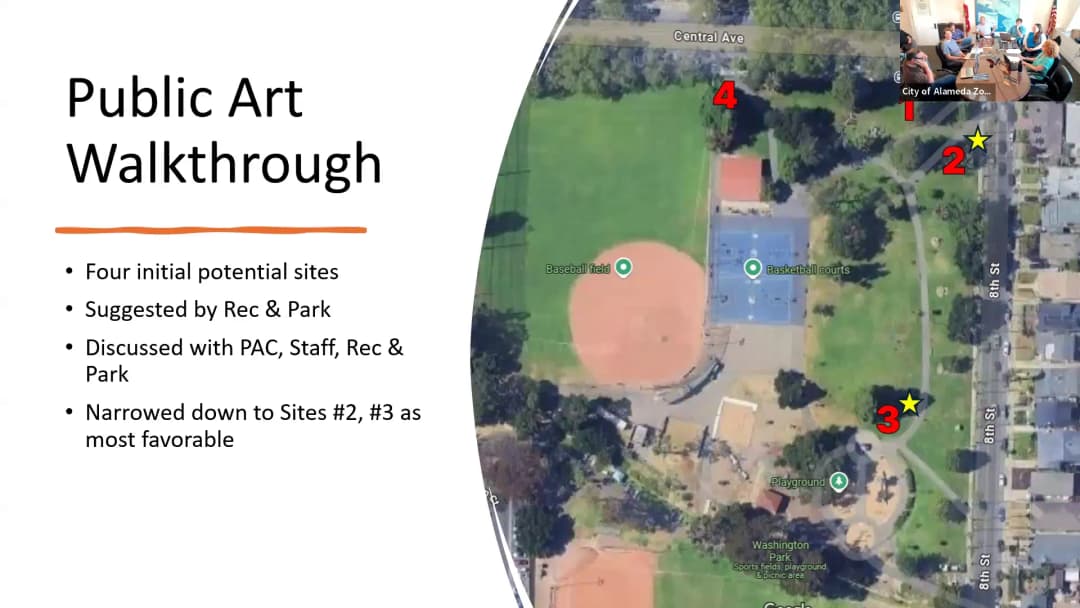
The Alameda Public Arts Commission (PAC) met on July 1, 2025, at 6:01 PM and adjourned at 7:36 PM. Commissioners present: Liz Rush, Commissioner Plots (likely Platz), Lisa Martin, and James Martin. Commissioner Robert Ferguson was absent. Staff present: Jackie Kleedy and Dwayne Dolan. The meeting covered approval of draft minutes, selection of a physical art site in Washington Park, approval of an on-site art proposal for Storehouse Lofts, and budget approval for the Washington Park public art project. Consent Calendar - Approval of April 14, 2024, draft minutes: Approved after an edit removing Commissioner Lisa Martin's name (motion by Lisa Martin, second by Liz Rush). - Approval of April 28, 2024, draft minutes: Approved (motion by Lisa Martin, second by James Martin). Public Comments & Testimony - Washington Park site selection: A public commenter expressed caution about selecting a site visible from the street, recommending a location that encourages people to walk around and enjoy the park, and suggested offering multiple sites in the RFQ to attract diverse proposals. - Making Waves sculpture: Rachel Campos (representing herself) spoke in support, noting the sculpture's connection to former Navy Waves housing and the Naval Air Museum, and highlighted that it could draw visitors to the museum. Discussion Items - Selection of a physical art site in Washington Park: Commissioners discussed two finalist sites (site 2 near the corner entrance and site 3 near the playground). Some favored site 2 for visibility and placemaking, while others preferred site 3 for potential interactive/sensory art. Concerns were raised about spending a large portion of the budget on an already active park and about future costs from the aquatic center project. After deliberation, a motion to select both sites 2 and 3 for the RFQ passed (vote: 3 in favor, 1 against). A motion to table was not seconded. - Estimated RFQ timeline: Staff presented a timeline from August 2025 (call for panelists) through installation in 2027. Discussed flexibility to cancel if no suitable proposals are found. A motion to accept the timeline passed (no vote count provided). - Making Waves on-site art proposal: Jonah Hendrickson (developer and artist) presented a bronze sculpture of a Navy Wave woman propping an airplane engine, to be installed at Storehouse Lofts near Alameda Point. The budget was $150,000. Commissioners praised the work's historical relevance and value. Motion to approve passed 4-0. - Budget for Washington Park public art call: Staff recommended an upper budget of $350,000. Commissioners debated reducing the amount due to economic uncertainty and upcoming aquatic center costs. A motion to approve up to $250,000 (inclusive of site prep) passed (vote: all in favor, none opposed). An advisory to include a minimum artist fee (5-10%) in proposals was noted. Key Outcomes - Consent calendar: Both sets of draft minutes approved. - Washington Park site: Two sites (site 2 and site 3) selected for the RFQ. - RFQ timeline: Approved as presented. - Making Waves sculpture: Approved with a vote of 4-0. - Washington Park budget: Approved with a cap of $250,000, with a recommendation to require an artist fee. - Staff communications: Reminded that all 10 arts programming grant awardees have been notified and contracts are in progress. One commissioner shared a positive experience at a Rhythmics concert at Harvard View Park.
Public Meetings - Alameda, California
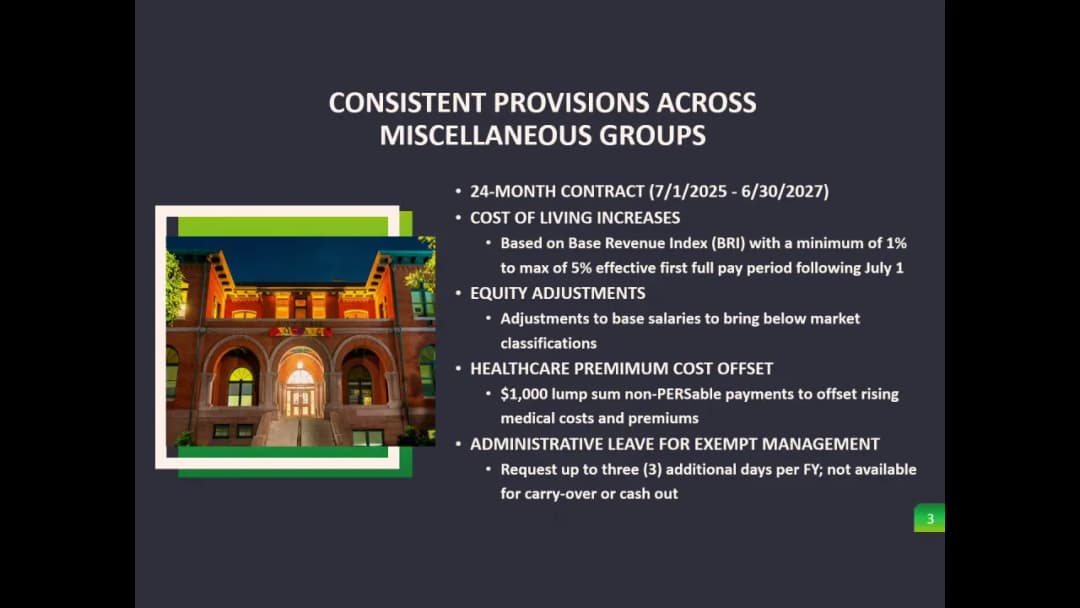
Public Meetings - Alameda, CaliforniaThe Alameda City Council met on Tuesday, July 1, 2025, beginning with a closed session at 5:30 PM and the regular meeting at 7:00 PM. The council approved the $35.5 million Aquatic Center project with a parking compromise, appointed seven commissioners, and passed the consent calendar over one councilmember's opposition on labor agreements. Closed Session (5:30 PM) - 3-A Conference with real property negotiators regarding 2151 Ferry Point (Little Opera House lease option). - 3-B Conference with legal counsel – potential litigation against Steeltown Winery LLC (Building 43 Winery). - 3-C Conference with legal counsel – potential litigation against Port of Oakland. - No action was announced on any closed session item except that the council adjourned from closed session. Proclamations & Special Orders - Ginny Kritluck Day – Mayor Ashcraft proclaimed Friday, July 4, 2025, as Ginny Kritluck Day in honor of her 100th birthday and decades of community service, including founding the Alameda Homeless Network and Midway Shelter. Oral Communications (Non-Agenda) – First Round - Velma Gay – Representing the homeless community, called for a neutral task force to oversee homelessness efforts, centralized data systems, training for management, and transparent community meetings. - Denai Lam – Opposed the recent painting of red curbs on Pacific Avenue (Arbor to J Street), stating 28 feet of parking was lost in front of her house; argued measurements were arbitrary and that no accidents have occurred there. - Joshua Altieri (Housing Authority of Alameda) – Announced the opening of the first North Housing building (45 units) and the Lynette Corner senior building (64 units) with supportive services; invited council to a grand opening on September 25, 2025. - William Morrison – Criticized the active transportation plan as overly favoring bicycles over automobiles; urged consideration of speed bumps for Gibbons Drive. - Gabriel Duncan (Alameda Native History Project) – Promoted the 2025 Acorn Granary Challenge and later requested Native American representation on the Historical Advisory Board. Consent Calendar - All items on the consent calendar (5-A through 5-O) were approved in a single motion, except that Councilmember Daysog voted no on items 5-G (MCEA MOU), 5-H (PANS MOU), 5-I (APOA MOU), 5-J (Executive Management Compensation), 5-K (AMP Unrepresented Management), and 5-L (ACEA MOU). Item 5-M (EUPA MOU) had been withdrawn. Councilmember Daysog explained his opposition was due to a revenue-indexed formula for pay raises and what he considered excessive equity adjustments (12%-18% for specific positions). - Items included: approval of minutes, bills, OpenGov software renewal ($143,546.91), storm drain trash capture services ($1,586,362.26), maintenance agreement for OAAP bike/ped components, Sewer System Management Plan, and multiple labor agreements. Discussion Items 7-A Appointment of Boards and Commissioners - The council unanimously approved resolutions appointing Julie Lyons (Commission on Persons with Disabilities), David Crotty (Historical Advisory Board), and reappointing Dimple Kanji and Sara Stricker (Library Board), Xiomara Cisneros and Andy Wang (Planning Board), and Christina McKenna (Public Utilities Board). - Public comment: Gabriel Duncan asked for Native American representation on the Historical Advisory Board, noting Alameda's Ohlone heritage and shell mounds. - Swearing-in ceremony: Each appointee spoke briefly. 7-B Aquatic Center Project and Funding Plan - Staff presentation (Recreation & Parks Director Justin Long): The project cost is $35.5 million (up from original $30M due to design changes and site conditions). Key changes: removed pavilion, reduced parking from 93 to 67 spaces, shrunk admin building, and used value engineering. The project is 100% electric. Parking was reduced to 67 spaces (seven more than the 60 envisioned in the 2014 Sweeney Park master plan). A shared parking agreement with Blue Rise Ventures/College of Alameda provides 126 spaces after 5 PM weekdays and all day weekends. - Public comments (split on parking): - Christy Cannon (CASA) – Opposed 67 spaces, citing Alameda's Climate Action and Resiliency Plan (CARP) and noting that 68 spaces at Washington Park are often underused. - Mitchell Ball – Argued the parking lot is too large, that 90%+ drive assumption is unrealistic, and that parking for non-disabled vehicles should be paid ($1/hour). - Drew Schwartz (Recreation & Parks Commissioner) – Supported the project as designed, emphasizing the need for pool space for masters swimming and community water safety. - Marla Koss (Alameda Backyard Growers) – Expressed concern that the community garden (diagonally across the trail) was omitted from maps and that reduced parking would harm seniors bringing tools and deliveries. - Tushawn Amariswardena – Supported the project but urged revisiting parking to align with CARP goals; noted that bike lockers cost money while car parking is free. - Chris Trioni – Advocated for 100 on-site spaces plus overflow for major tournaments; warned Alameda could lose regional events without adequate parking. - Cindy Johnson (Bike Walk Alameda) – Praised bike lockers and TDM elements but called for further parking reduction and paid parking from day one. - Amelia McDonald – Supported approval but urged continued conversation on parking to ensure access for families, seniors, and people with disabilities. - Council deliberation: - Councilmember Jensen asked about bike lockers and shared parking; noted that many Alameda households have only one car. - Councilmember Daysog praised the higher contingency (17% vs. 10% typical) and suggested phasing the parking lot (e.g., up to 67 spaces, but build fewer if savings needed). - Councilmember Bowler questioned whether 60 original spaces could work with TDM measures; staff noted it would require design adjustments. - Mayor Ashcraft strongly advocated for reducing parking to 50 or fewer, citing climate goals and the recently CARP plan; she noted the Piedmont aquatic center has no additional parking and uses active enforcement. - City Manager Ott recommended a bid alternate approach: bid for 67 spaces with an alternate for 50 spaces, allowing the council to choose at contract award (expected Oct 2025). This would also provide time to explore shared parking and TDM pricing. - Outcome: Councilmember Daysog moved to approve the staff recommendation (67 spaces) but include a bid alternate for 50 spaces, plus direct staff to work on shared parking. Councilmember Bowler seconded. The motion passed 4-1 (Mayor Ashcraft opposed, favoring a lower number from the start). The project funding plan and design were approved. City Manager Communications - New rates for ACI trash, Alameda Municipal Power, AC Transit, and ferry service effective July 1, 2025. - 4th of July parade details: 171 entries, same route, road closures from 7 AM; parking removal by 4 AM. - Central Avenue traffic pattern switch starting July 7 (westbound only for several months). - Woodstock Water Shuttle first birthday celebration on July 13. - Councilmember Jensen noted the Alameda minimum wage increased to $17.46. Council Communications - Councilmember Jensen reported attending Rhythmics Rising Seas event, being elected chair of Stop Waste, visiting AMP's Cartwright Substation, and a tour of the Least Tern Refuge. - Vice Mayor Pryor also visited Cartwright Substation and praised AMP's redundant loop system. - Councilmember Bowler attended the Innovation Island Excellence Awards. - Councilmember Daysog judged the Sand Sculpture Contest (57th year), praised Bayview Island Women's Club, and attended the Alameda Leisure Club art show. He also highlighted the problem of Mylar balloons causing power outages and called for a public education campaign. Key Outcomes - Closed session: No action reported. - Consent calendar: Approved with Councilmember Daysog voting no on six labor agreements. - Appointments: Julie Lyons, David Crotty, and reappointments all approved unanimously. - Aquatic Center: Project and funding plan approved (4-1). Parking: staff to bid for 67 spaces with a bid alternate for 50 spaces; council to decide at contract award in October 2025. Staff directed to pursue shared parking agreements and return with updated TDM/pricing details. - Next meeting: Not explicitly stated, but implied two weeks later (likely July 15, 2025).
A special meeting of the Alameda City Council was held on June 27, 2025, at 9:00 AM, for a site visit at the Cartwright Substation (360 W. Atlantic Ave.). The meeting was noticed under the City's Sunshine Ordinance because a majority of the Council was present. No formal action was taken, and no minutes were recorded. Members of the public were allowed to attend and offer comment, but no public testimony or discussion is documented in the available materials.
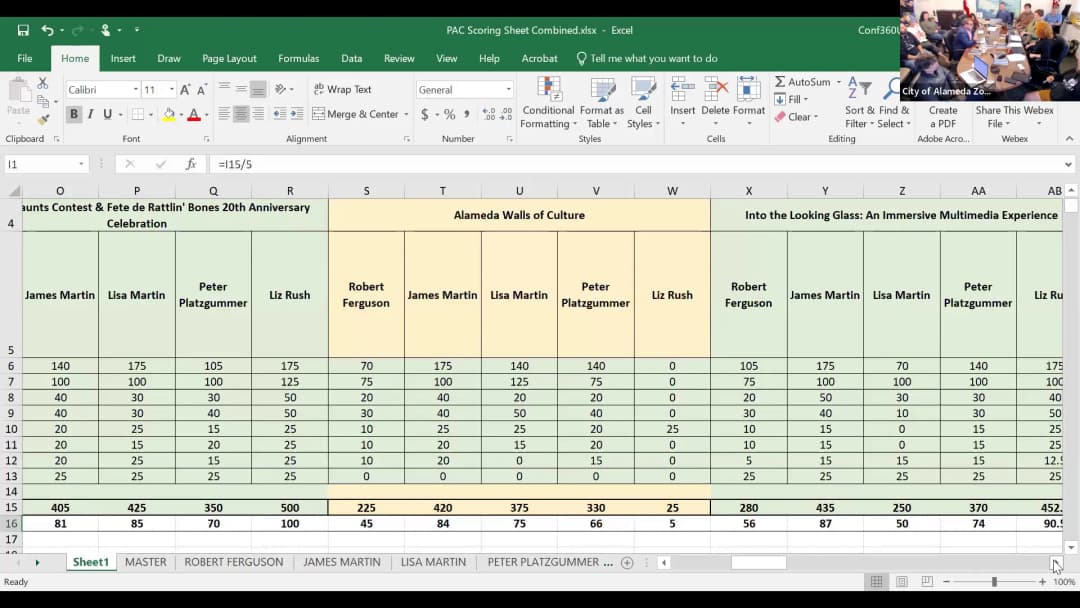
The meeting was called to order at 6:11 PM. Commissioners present: Chair Rush, Vice Chair Platzboomer, Robert Ferguson, Lisa Martin, and James Mark. Staff included Walker Toma, Dwayne Dahlman, and Jack Denham Conroy. The meeting addressed the approval of previous minutes, public comments, and the review and selection of 17 grant proposals for the 2025 Cultural Arts Programming RFP. After a technical delay in scoring, the commission successfully calculated weighted scores and voted to fund eight grants, increasing the total budget by $10,000. Consent Calendar - The minutes from the January 22, 2025 meeting were approved unanimously by all five commissioners. Public Comments & Testimony - Rachel Campos de Ivanov (Radium Runway) announced upcoming events: the "In Plain Site" photography gallery (May 9–June 1) and a fall 2025 big top tent for a performing arts center. - Jennifer Radikovich (Rhythmics Cultural Works) thanked the commission for grants and promoted the "Rising Seas" series at various waterfront parks from May to September 2025. - Gabriel Duncan (Alameda Native History Project) described the successful first year of the Acorns Project, including public workshops and community partnerships, and requested support. - Lani Sabino (Halal Makana, Polynesian Cultural Arts Center) expressed gratitude for the grant opportunity and highlighted the project's alignment with the city's equity goals. - Malaya (speaker, no organization stated) thanked all artists and urged the commission to increase future funding. - Dan Cloison (volunteer) supported both Rhythmics and Halal Makana. - Ryan Lalone (local artist, via remote) supported the Alameda Haunts 20th anniversary and the Acorns Project. Discussion Items - Scoring Process: Staff initially discovered that the weighted scoring spreadsheet was incorrectly applied, delaying final decisions. After a brief recess, the commission manually calculated scores and proceeded with discussions. - Grant Applications Review: Each of the 17 applications was introduced by a lead commissioner, with discussion of strengths and weaknesses. Key topics included budget clarity, community reach, equity, accessibility, leverage of other funds, and local preference. Notable projects included: - Radio Day by the Bay (California Historical Radio Society): Strong event but criticized for a superficial budget and high marketing costs. - Plain Air Paint Out (Frank Bette Center): Praised for tradition but criticized for limited inclusivity and confusing budget. - Alameda Haunts Contest (Funita Alameda Productions): Highly inclusive, 20th anniversary, but some commissioners questioned its cultural arts fit. - Alameda Walls of Culture (Bay Area Mural Program): Ambitious mural project with programming, but concerns over budget, venue permissions, and duplication of existing efforts. - Into the Looking Glass (Art Push): Immersive media experience, but lacked artist selection details and had equipment-heavy budget. - Rhythmics in the Park, Unity Fest (Rhythmics Cultural Works): Widely praised for community impact, strong leverage of funds, and multiple events. - Halal Makana Biennial Hoike: Strong cultural performance, but limited public engagement beyond observation. - Circus Bella at Radium Runway (Radium Presents): Enjoyed by families, but noted as not unique since it occurs elsewhere. - Deep Dive Under the Waves (West End Arts District): Highly praised for innovation, placemaking, and collaboration with Radium Runway. - Whispers of the Sanctuary (Alameda Civic Ballet): Original ballet, but limited venue capacity and low leverage of funds. - Alameda Food Bank Forever Home Mural: Considered ineligible due to lack of programming; commissioners expressed desire for a separate mural grant program. - Healing Heels Presents Read the Room Festival: Strong accessibility but weak Alameda connection and unrealistic timeline. - Words That Make a Difference – Brown v. Board of Education (Unity in Marin): Timely topic but budget issues and repeated performances elsewhere. - Acorns Project (Alameda Native History Project): High potential, strong community engagement, but slim budget and organizational capacity concerns. - Food Bank Players: Modest request, popular community theater, but low outreach and no leverage. - Creative Art Program (Art Push): Free workshops for children, but high cost per child and small reach. - Drawing on Earth: Simple chalk art project, but incomplete budget and vague venue. Key Outcomes - Budget Increase: The commission voted to increase the total funding pool by $10,000 (from $60,000 to $70,000) to support additional projects. - Grants Approved: The following eight grants were approved (four at $10,000 and four at $5,000, with the $10,000 increase used to fund two additional projects): 1. Rhythmics Cultural Works (Unity Fest) – $10,000 2. Alameda Haunts 20th Anniversary – $10,000 3. Deep Dive Under the Waves (West End Arts District) – $10,000 4. Radio Day by the Bay – $5,000 (adjusted from $10,000 request) 5. Whispers of the Sanctuary (Alameda Civic Ballet) – $5,000 6. Alameda Food Bank Players – $5,000 7. Plain Air Paint Out – $5,000 8. Alameda Native History Project (Acorns) – $5,000 - Next Steps: The recommendations will be forwarded to the City Council for final approval. The commission also noted the need to improve the use of the Submittable platform and to consider a separate mural grant program in the future.
The Alameda Planning Board held a public hearing on June 23, 2025, to consider Design Review and Use Permit application PLN24-0614 for a new 32,450-square-foot, all-electric aquatic center at 800 Atlantic Avenue, located at the northwest corner of the Jean Sweeney Open Space Park. After extensive public comment and deliberation, the board approved the project with conditions, including reducing on-site parking from 71 to 67 spaces. Consent Calendar - Item 4A – Approval of draft meeting minutes from May 27, 2025: The board could not approve the minutes due to abstentions and a lack of quorum. The item will be brought back at a future meeting. Public Comments & Testimony - Cindy Johnson (Bike Walk Alameda): Expressed support for the project but urged a stronger Transportation Demand Management (TDM) program with mode split targets, paid parking from day one, and joining the Alameda Transportation Management Association. She noted that current parking demand assumptions (90–95% auto trips) were inconsistent with the site’s transit- and trail-rich location. - Shayla (resident of 9th Street): Requested that the community garden originally envisioned for Jean Sweeney Park be fully included in the final plans, emphasizing its environmental, social, and food security benefits. - Marla Koss (Alameda Backyard Growers): Recounted the history of the community garden planning and noted that gardeners need parking to carry heavy materials (e.g., 50-pound bags of mulch). She supported the aquatic center but stressed that the garden should not be diminished. - John Waldman (resident of 8th Street): Expressed concern about increased on-street parking and traffic in his neighborhood, and requested that construction trucks avoid using 8th Street. - Emily Anderson (new resident): Asked whether the facility would be 100% solar powered (staff clarified that AMP provides green energy but on-site solar is not part of this project) and about seating capacity for large events. - Unnamed speaker (bike commuter): Supported paid parking to discourage driving and argued that free parking amounts to a subsidy for wealthier users, urging the board to prioritize land use efficiency over parking supply. Discussion Items - Project Presentation: Planning staff (Henry Dong) introduced the project, noting that the aquatic center is part of the Jean Sweeney Open Space Park, which had a mitigated negative declaration adopted in 2014. The project includes a 30-meter lap pool, activity pool, L-shaped building, 110 bicycle spaces, and 71 on-site vehicle spaces (later reduced to 67). A 125-space overflow parking agreement with the adjacent College of Alameda was described as a revocable license. Recreation and Parks Director Justin Long and architect Clarence Mayak (ELS Architecture) presented design revisions, including regrading to save oak trees, off-site traffic improvements, a drop-off zone, additional EV and bike parking, and a solid metal fence along Atlantic Avenue to attenuate noise. - Parking and Transportation Analysis: Board members questioned the parking demand memo, which assumed 90–95% auto mode share for daily use and 100% for large events. Board Member Wang noted the analysis did not account for the planned community garden or the site’s proximity to transit and trails, and that the parking supply appeared oversized for most hours of the year. Staff clarified that the zoning code does not have a parking standard for public aquatic centers, and the 71-space figure was derived from consultant recommendations and the shared-use context. Board Member Sahiba raised design concerns about the solid metal panel termination at the western end of the building and suggested material simplification. - Community Garden Integration: Staff confirmed that the community garden has been relocated to the southeast corner of the park and is not part of this project, but the aquatic center’s infrastructure (electricity, water) will support it. Additional funding has been committed for the garden. Key Outcomes - Motion to Approve: Board Member Ruiz moved to approve the CEQA addendum and design review/use permit with conditions, including updating the transportation memorandum to reflect multi-use parking demands and working with staff to refine design hierarchy and materials. After further discussion, the motion was amended to reduce on-site parking from 71 to 67 spaces (Board Member Sahiba suggested eliminating four stalls to improve arrival experience). The amended motion passed 5-0. - Conditions of Approval: (1) Reduce on-site parking to 67 spaces; (2) Update the transportation demand analysis to account for shared uses (community garden, park); (3) Work with staff to improve design hierarchy in wayfinding, signage, and material transitions, including resolving the two-dimensional appearance of the solid fence panel. - Next Steps: The project will proceed to building permits; the overflow parking agreement with College of Alameda remains in place but is revocable. The board also noted that parking will be monitored post-construction to assess actual demand.
The Alameda City Council met on Tuesday, June 17, 2025, beginning with a closed session at 5:00 PM, followed by a special joint meeting with the Successor Agency to the Community Improvement Commission (SACIC) at 6:59 PM, and the regular meeting at 7:00 PM. The council approved a two-year operating and capital budget for FY 2025-27 and authorized a purchase option agreement for the sale of 13 acres at Alameda Point to Pacific Fusion for a nuclear fusion research and demonstration facility. Both actions passed 4-1, with Councilmember Desag dissenting on the budget and the Pacific Fusion item. Consent Calendar - Approved the minutes of the May 20, 2025, special and regular city council meetings. - Ratified bills for payment. - Authorized several contracts and agreements, including: - A three-year subscription for Darktrace Enterprise Immune System ($428,475 total). - A three-year agreement with Environmental Systems Research Institute for GIS software ($180,900 total). - A one-year agreement with Alameda Journal for legal notices publication. - A five-year agreement with Citiguard, Inc. for security services at Alameda Point ($2,000,535). - A first amendment with Wittman Enterprises for ambulance and alarm billing services ($1,292,500 over five years). - Five on-call architectural services agreements ($750,000 each for five years). - Six on-call civil engineering services agreements ($750,000 each for five years). - Five on-call electrical engineering services agreements ($750,000 each for five years). - Three on-call geotechnical, environmental, and construction testing services agreements ($750,000 each for five years). - A five-year safety program compliance and training agreement with Du-All Safety ($234,183). - Four on-call land surveyor services agreements ($750,000 each for five years). - Five on-call transportation engineering services agreements ($750,000 each for five years). - Four on-call mechanical engineering services agreements ($750,000 each for five years). - A five-year vegetation management agreement with Clean Lakes, Inc. ($758,978.04). - Final passage of an ordinance revising sewer service charges. - Final passage of an ordinance adjusting universal design requirements for townhouse developments. - Approved resolutions for landscaping and lighting district assessments: Zone 7 (no assessment), Zones 1,4,5,6,8 (levy), and Marina Cove maintenance district (levy). - Approved continuation and collection of the Water Quality and Flood Protection Fee for FY 2025-26. Public Comments & Testimony Oral Communications, Non-Agenda - Jama Gay (Alameda resident) spoke about her experience as the first resident of Dignity Village, describing advocacy for resident rights, parking, laundry access, and kitchen storage. She reported aggressive behavior by some staff and her efforts to improve conditions. Public Hearing on Pacific Fusion - Over 30 speakers addressed the council, the majority expressing strong support for the Pacific Fusion project. Key supporters included: - Christina McKenna (President, Public Utilities Board) spoke in support, citing alignment with Alameda Municipal Power's 100% clean energy mission and climate goals. - Richard Bangert (resident) supported the project, noting safety assurances from state regulation and the need for jobs and infrastructure at Alameda Point. - Jeff Gould expressed skepticism, arguing that safety studies were incomplete and that fusion-specific regulatory frameworks are lacking. - Jonathan DeLong (Executive Director, REAP Climate Center) enthusiastically supported the project, citing community engagement and job creation. - Karen Bay (40-year West End resident) supported the sale, emphasizing the billion-dollar investment and 250 jobs. - Beth Remenap (25-year West End resident) supported fusion as the only energy source with no negatives in emissions, reliability, fuel supply, waste, and safety. - Kathy Weber (Executive Director, Downtown Alameda) supported the project for economic benefits and tax revenue. - Madeline Sadvick (President, Alameda Chamber and Economic Alliance) urged support, calling it a once-in-a-generation opportunity. - Daniel Macino (resident and mechanical engineer with nuclear experience) endorsed the project, citing safety of fusion technology. - Daniel Chin (lifelong Alameda resident) supported fusion for sustainability and potential to put Alameda on the map. - Sebastian Buenfil Rojas (lifelong resident) supported the research facility, distinguishing it from a power plant and noting low radioactivity comparable to UC Berkeley. - Henry Cooper (Alameda resident, Cal Poly SLO student) supported for local jobs and clean energy. - Jacqueline Zow (UC Berkeley student, raised in Alameda) supported after research, noting minimal risks and similarities to hospital regulations. - Zach Goldberger-Judd (recent high school graduate) supported fusion as a promising technology. - Doyle Saylor expressed high skepticism, questioning oversight and the use of tritium in an urban center. - Michael Orishkoff (lifelong Alamedan, Pitzer College student) supported the project for sustainability and attracting talent. - Finley Hayes (recent high school graduate) supported, differentiating fusion from fission and noting chain reaction impossibility. - Tu Shana Maris here Rodena (parent) supported the project for climate leadership and sparking development at Alameda Point. - Melanie Dixon (President, College of Alameda) strongly supported, emphasizing workforce development, internships, and student opportunities. - Kate Stirr (Alameda resident, VP at Natal Energy) supported, citing the ecosystem of clean energy startups at Alameda Point. - Nicole Porter (VP of Instruction, College of Alameda) supported for bridging education and industry. - Debbie Ryan (VP, Community Action for Sustainable Alameda) supported for climate goals and economic development. - Several other young residents and students spoke in favor, stressing climate urgency and local job opportunities. - No speakers opposed the Pacific Fusion item in person; one remote speaker (Jeff Gould) expressed concerns. Discussion Items Budget Adoption (FY 2025-27) - Finance Director Ross McCarthy presented a balanced budget with a $152.2 million general fund in year one and $153.8 million in year two. The budget draws down residual fund balance but preserves $9.3 million above the 25% reserve policy. - Public Works Director Aaron Smith presented the capital improvement program: $42.3 million in year one, $40.4 million in year two, with $17.6 million in grants. - Councilmember Desag raised concerns about capping sworn police officer hiring at 72, historically authorized at 88, calling it a reduction of 16 positions. He argued for maintaining the 88-authority level. - City Manager Jennifer Ott explained that the city has not been able to fill all 88 positions for years, and the budget effectively formalizes salary savings from unfilled positions. Fully funding 88 would require service cuts. - Councilmember Jensen asked about the consequences of maintaining a large number of unfilled positions; Ott responded that it would necessitate cuts elsewhere. - Councilmember Bowler supported the budget, noting that retaining existing officers and reaching 72 would be a strong achievement, and that crime prevention includes non-police investments. - Vice Mayor Pryor and Mayor Ashcraft supported the budget, highlighting responsible stewardship and trade-offs. - The budget (including SACIC and workforce changes) passed 4-1 with Councilmember Desag dissenting. Pacific Fusion Land Sale and Purchase Option - Abby Thorne Lyman (Director of Base Reuse and Economic Development) presented the staff recommendation to declare 13 acres as exempt surplus land and approve a purchase option agreement for $28.9 million in infrastructure improvements. The facility would be a 220,000 sq ft research and development facility with 250 jobs, operational by 2030. - Pacific Fusion representatives (Courtney Richardson, Alex Daniak, Keith Lachin) provided an overview of their technology, safety measures, community engagement, and economic benefits ($1 billion investment, $120 million in tax revenue over 10 years). They emphasized the facility is not a power plant. - Councilmembers asked clarifying questions about land use restrictions (no housing in Enterprise District), safety regarding tritium and groundwater, and sea level rise adaptation. - City Engineer Scott Wickstrom explained that the project must meet a 100-year floodplain plus three feet of sea level rise elevation (13 feet), which inherently addresses groundwater rise. - Assistant City Attorney Len Islanin stated that the Alameda Point EIR and General Plan EIR previously studied groundwater and contamination issues, and no further CEQA analysis is required. - Councilmember Desag expressed concern that the existing EIRs did not adequately analyze radiation effects on groundwater, especially given the high water table and tidal influences. He argued more analysis is needed before approving the sale. - Other councilmembers (Jensen, Pryor, Bowler, Ashcraft) expressed strong support, citing safety reviews, regulatory oversight, private funding, and the project's alignment with climate goals and community aspirations. - The resolution declaring the land exempt surplus and introducing the ordinance approving the purchase option passed 4-1 with Councilmember Desag dissenting. Key Outcomes - Consent Calendar (including final passage of two ordinances and resolutions for assessments) approved unanimously. - Operating and Capital Budget for FY 2025-27 and related SACIC budget and workforce changes adopted 4-1 (Desag opposed). - Pacific Fusion purchase option approved 4-1 (Desag opposed). The ordinance will come back for second reading; the purchase is contingent on future council approval of a development agreement. - Closed session actions: The council completed performance evaluations for the City Attorney and City Manager, both approved unanimously 5-0. - Mayor's appointments announced: Julie Lyons to Commission on Persons with Disabilities, David Crotty to Historical Advisory Board, and reappointments to Library Board, Planning Board, and Public Utilities Board. These will be formally voted on at a future meeting.
The Alameda Public Utilities Board (PUB) held its regular meeting on June 16, 2025, at 6:02 PM, adjourning at 7:31 PM. Commissioners present: President McKenna, Commissioner Hunter, City Manager Ott. Commissioners Bird and DeVries were absent. The meeting covered a tree trimming contract, commercial customer survey results, and labor agreements. Consent Calendar - Item 4F (pulled for discussion): Service provider agreement with West Coast Arborists, Inc. for tree trimming services. Not approved as part of consent; discussed and voted separately. - The balance of the consent calendar was approved by a unanimous motion (City Manager Ott, second Commissioner Hunter). Public Comments & Testimony - Christopher Buckley (via teleconference) addressed Item 4F. He expressed concerns about proposed clearance standards for secondary electrical lines (open wire vs. insulated), house hookups, and large branch cuts. He requested modifications: 4-foot clearance for uninsulated secondary, 1–2 feet for insulated secondary, 1 foot for house hookups, no clearance for sheath-grounded conductors except branches in tension, and avoiding cuts over 2 inches for AWAC secondary and communication lines. He asked for a breakdown of tree-related incidents (high voltage vs. secondary, private vs. public trees) and suggested more frequent pruning as an alternative. He also recommended that AMP include complete pruning (structural) beyond line clearance. Discussion Items - Item 4F – Tree Trimming Contract (West Coast Arborists): General Manager Haynes responded that the contract establishes minimum standards per CPUC guidelines, ANSI, and ISA, with flexibility to adjust clearance based on tree species, growth history, safety, and public concern. He clarified that AMP does not have granular incident data but could begin capturing it. He stated that AMP will not align its trimming cycle with Public Works. Lonnie (legal counsel) noted that staff can adjust work schedules within the contract without amendment. Commissioner Hunter and City Manager Ott supported approval, emphasizing flexibility and the certified arborist’s role. Board voted unanimously to approve (motion Commissioner Hunter, second City Manager Ott) the agreement for a five-year period in the amount of $3,995,500 with a 15% contingency ($599,325), total not to exceed $4,594,825, and found the action exempt from CEQA. - Item 5A – Great Blue Research Commercial Customer Survey Results: Catherine Vollmer presented findings from a digital survey of 73 commercial customers (margin of error ±11%). Key results: 90% positive for safety/reliability; 82.2% positive for affordability (up from 63% in 2022); overall satisfaction 80%+ (significantly higher than other California municipal utilities). Net positive score (NP+S) was 93.2% (above national average of 81%). Perceived value as a valued energy partner rose 32 percentage points to 75%. Power delivery ratings averaged 84.5%. Key account manager satisfaction at 87.5%. Interest in electrification: 25% considering fleet electrification, 40% building electrification. Awareness of AMP’s 100% clean energy generation at 63%. Recommendations included boosting awareness of EV and energy efficiency programs, sharing success stories, and tailoring marketing to segments. No action required; informational only. - Items 5B and 5C – Labor Agreements: Acting HR Director Noelle White presented. 5B (AMPU): Compensation plan for Alameda Municipal Power Unrepresented Management Employees, July 1, 2025–June 30, 2027. 5C (UPA): Memorandum of Understanding for Electrical Utility Professionals of Alameda, same term, with principles including general wage increases tied to a base revenue index (1%–5%), equity adjustments to market median, a $1,000 annual healthcare premium offset, and additional administrative leave for exempt staff. The total fiscal year 2026 financial impact across AMP units is $432,000. IBEW negotiations are ongoing, with status quo in place. Board approved both resolutions unanimously (motions by Commissioner Hunter, seconds by City Manager Ott). - General Manager’s Report (May 2025): General Manager Haynes reported a copper theft incident at Alameda Point on Thursday night prior, causing an outage affecting 10 customers. Power was restored within 12 hours, and temporary poles were set; permanent undergrounding will follow future infrastructure development. He commended staff across departments for the rapid response. Key Outcomes - Item 4F: Approved tree trimming contract with West Coast Arborists (unanimous 3-0). - Items 5B and 5C: Approved resolutions recommending adoption of AMPU compensation plan and UPA MOU by City Council (both unanimous 3-0). - Item 5A: Received and filed commercial customer survey results; no action taken. - Council Communications: City Manager Ott noted the City Council will consider the two-year biennial budget and a 13-acre campus option agreement for Pacific Fusion (clean tech company) at its June 17, 2025 meeting. - Board Communications: Commissioner Hunter will speak at the City Council meeting in support of the Pacific Fusion project, highlighting AMP’s collaboration and alignment with decarbonization goals. - Adjournment: Meeting adjourned at 7:31 PM.
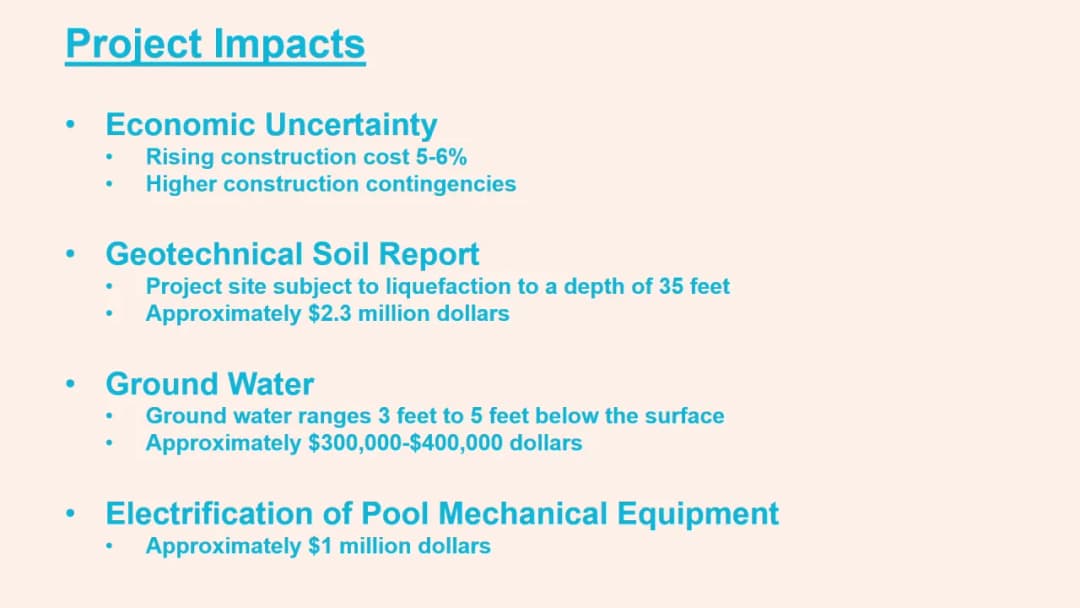
The Alameda Recreation and Park Commission held its regular monthly meeting on Thursday, June 12, 2025, at 7:00 PM in the City Hall Council Chambers. The meeting included non-agenda public comment, staff communications, commissioner communications, approval of minutes, a presentation on adult and youth athletic programming, and an update on the Aquatic Center project. No formal actions were taken on the discussion items. Consent Calendar - Approval of Minutes (May 8, 2025): The commission unanimously approved the minutes from the May 8, 2025 regular meeting. Public Comments & Testimony - Henry Song (non-agenda public comment): A long-time parks user and racket sports enthusiast spoke against the expansion of pickleball in Alameda parks. He raised concerns about equity (pickleball groups monopolizing courts and pressuring officials), environmental noise (70–80 decibels, akin to a vacuum running continuously), displacement of tennis players, and documented behavioral issues (e.g., a hitting partner was threatened at Ladecker Park). He urged the commission and city council to limit pickleball in certain areas if coexistence becomes impossible. Discussion Items 6-A: Adult and Youth Athletic Programming - Presentation: Joey Carroll, Recreation Supervisor, provided an overview of current and planned athletic programs. Youth programs include after-school pickleball (grades 6–8), homeschool PE (10–15 participants per session), and tennis lessons (ages 6–14; newly expanding to ages 15–17 in fall). Summer camps feature pickleball, volleyball, basketball, flag football, ultimate frisbee (pilot season), and all-sports camps. Adult offerings include tennis lessons (beginner/advanced beginner at Krusi Park), women’s flag football (64 participants, fills in minutes), open gym (Sundays, 6–10 PM at Alameda Point Gym, 15 attendees), pickleball classes and drop-in at the Hub, and softball (9 leagues, 45 teams). Future initiatives include a youth flag football league at Estuary Park (September), expanded pickleball for 3rd–5th graders, and adult dodgeball (pilot in fall) and kickball (spring/summer). Commissioners praised the pilots and expansion, and asked about use of school district facilities; Director Long noted school gyms are heavily rented, and overall program capacity is constrained until a sports complex expansion occurs. 6-B: Aquatic Center Project Update - Presentation: Director Long (also project manager) reported on design development progress. The two-pool solution (30-meter competition pool and activity pool with zero-depth entry) was selected after four community workshops and surveys with over 3,000 responses. Value engineering reduced the project cost from $42 million to $35.5 million while preserving all water space—a key priority. Reductions included removing the outdoor pavilion, shrinking the administration building, changing exterior materials from wood composite to split-face block with perforated metal accents, reducing parking by 20+ spaces, rotating the activity pool to tighten deck space, and eliminating a large storage structure (replaced by fenced covered area). The community room was reduced to 11×17 feet (lower rental revenue expected). Geotechnical challenges require soil stabilization to 35 feet for seismic resilience (designed for a 7.8 earthquake; more than 2 inches of settlement would render the pool unusable). Groundwater is 3–5 feet deep, requiring mechanical pumping systems. City Council directed full electrification (no gas), adding upfront cost but with long-term utility savings; the City Manager proposed $4.5 million from unassigned reserves to close the budget gap, and bond sales generated $1.1 million. Next steps: Planning Board (June 23) for conditional use permit, City Council (July 1) for project approval; construction documents continue, with bidding in December 2025 and construction start in January 2026. Director noted collaboration with Alameda Municipal Power for rebates and a demonstration project partnership. Commissioners asked about the smaller community room’s revenue impact and the feasibility of a future pavilion (deferred to the community garden area). No public comment was received. Key Outcomes - Minutes approved (unanimous). - Information received: Presentations on athletic programming and the Aquatic Center were received; no motions were made. - Next meeting: Scheduled for July 10, 2025. Agenda will include an update on the Gene Sweeney BMX/loop facility, an annual report from the Shrub Group (housing), and a workshop on the surf pool proposal. - Adjournment: The meeting was adjourned unanimously.
The Alameda Planning Board met on June 9, 2025, at 7:00 PM in the City Hall Council Chambers. The main agenda item was a Use Permit Amendment (PLN24-0094) for the gas station at 1310 Central Avenue, proposing extended operating hours and the sale of packaged foods and non-alcoholic beverages. After public comment and board deliberation, the board approved the amendment with a 4-1 vote, adding a condition to silence pump audio advertisements. Consent Calendar - Item 4A: Draft meeting minutes for May 12, 2025 were approved. Board Members Ruiz and Hom abstained. - Item 4B: Draft meeting minutes for May 27, 2025 were not acted upon due to insufficient voting members after three abstentions (Board Members Saheba, Ruiz, and Arisa). A correction was noted: Vice President Arisa was listed as both present and absent; she confirmed she was absent. Staff will correct the minutes for a future meeting. Public Comments & Testimony - In Favor: Eight speakers supported the amendment. - Qais Ahmed (applicant): Stated he is struggling to pay rent and taxes, and many customers are unhappy with early closing times on Saturdays and Sunday closure. He presented a petition with 300 customer signatures and 12 nearby neighbor signatures in support. - Marius Krubnik (neighbor): Initially expressed opposition, then later clarified his position. He noted many neighbors only had one week to respond and questioned the validity of signatures from more than two blocks away. - Kelly Bart (Territory Manager, Marathon Petroleum): Emphasized that typical gas stations operate 126 hours per week, and the current 67-hour schedule is unusual. She praised the applicant’s high standards and cleanliness. - Carol Randmeyer (resident for 28 years): Described the station as spotlessly clean and the staff as helpful, noting no loud music or commotion. - Kaolani (employee): Clarified that pumps are shut down after hours, preventing use. - Catherine Halder (customer): Said she feels safe using the station, especially in the evening, and supports extended hours. - David Satan (supporter): Argued extended hours could improve safety by providing more “eyes on the street.” - Marguerite Jacques (employee): Highlighted staff assistance to a mentally disabled person and stated pump videos can be silenced. - Opposed: Three speakers opposed the amendment. - Leland Price (resident at 1304 Morton): Argued the station is inappropriate for the residential neighborhood and would cause noise, light pollution, and attract drunk drivers from a nearby bar. He provided a video showing the quiet neighborhood at 9 PM. - Dorotta Krubnik (resident across the street): Reported increased garbage, cigarette butts, and noise, and said renters complain about the activity. She noted many police calls and accidents near the station. - Marius Krubnik (neighbor): Raised concerns about property values and conflict of interest, and mentioned the applicant had withdrawn a previous application due to expected opposition. Discussion Items - Item 5A: PLN24-0094 – 1310 Central Avenue Use Permit Amendment - Staff Presentation: Brian McGuire, Planner II, presented the proposal. The existing legal non-conforming gas station operates Monday–Friday 7 AM–8 PM, Saturday 9 AM–4 PM, and is closed Sunday. The amendment sought to allow Monday–Friday 6 AM–10 PM, Saturday 7 AM–8 PM, and Sunday 7 AM–8 PM, plus sale of packaged foods and non-alcoholic beverages (no alcohol or tobacco). The proposal is categorically exempt from CEQA (Class 1, Existing Facilities). Staff recommended approval with conditions. - Board Questions: - Board Member Hom asked whether the extended hours constitute an intensification of use. Staff noted the drastic decline in gallons sold (precipitous drop over 10 years) and argued it would not exceed historic use. Hom also clarified that other gas stations are in commercial zones, unlike this one. - Board Member Wang asked the applicant if pump audio could be turned off; the applicant agreed to silence them if approved. - Board Member Ruiz noted Alameda’s noise ordinance allows loading/unloading from 7 AM to 10 PM. - Board Deliberations: - Board Member Sue: Supported extended hours (Sundays and earlier mornings) but suggested an 8 PM close to respect neighbors’ quiet. - Board Member Ruiz: Noted the noise ordinance bracket (7 AM–10 PM) and expressed support for the full proposed extension. - Board Member Wang: Supported the extension, arguing an operating station is better than a derelict one and that more hours could reduce after-hours issues. - Board Member Hom: Favored extending hours but suggested 8 PM close on weekends to respect neighbors. He also asked the City Attorney to clarify whether a rezoning is needed to sell retail goods; the City Attorney confirmed it is not, as retail is auxiliary to the nonconforming gas station use. Key Outcomes - Vote: Motion to approve the Use Permit Amendment as drafted, with an added condition to silence all audio advertisements at the pumps. Approved 4-1 (Board Member Hom dissented). - Decision: The amendment allows the gas station to operate Monday–Friday 6 AM–10 PM, Saturday and Sunday 7 AM–8 PM, and to sell packaged foods and non-alcoholic beverages. No alcohol or tobacco products are permitted. The auto repair hours remain unchanged. - Next Steps: The decision is final unless appealed or called for review within 10 days to the Alameda City Council. - Future Meeting Dates: The next Planning Board meeting is set for June 23, 2025, with the aquatic center on the agenda. A residential project at Mariner Square and short-term rental regulations are expected on July 28, 2025.
Date: June 9, 2025 Time: 6:09 PM – 7:21 PM (approximate) Location: 2263 Santa Clara Avenue, Conference Room 391, Alameda, CA & via Zoom Attendance: Panel members Brock Runt, Gia Schneider, Joe Ernst, Madeline, Mark; Staff: Dwayne Dahlman (Economic Development Manager), Eric Fonstein (Development Manager). Chair and Vice Chair absent; meeting run by staff due to lack of designated chair. The panel convened to discuss two main topics: the impact of tariffs on local businesses and the marketing messages for the new 'Choose Alameda' business attraction website. No formal actions were taken due to lack of quorum for voting items. Approval of Minutes - The minutes from the March 5, 2025 meeting were tabled because fewer than six members who attended that previous meeting were present, preventing approval. Minutes will be revisited at the next meeting. Discussion Item: Tariffs Impact on Local Business Climate (Agenda Item 6-A) - Overview: Panel members shared how tariffs and economic uncertainty are affecting their industries. Key themes included a widespread ‘wait and see’ posture, supply chain disruptions, and the need for predictability. - Specific Impacts: - Real estate / development: The market is frozen; capital markets are locked up; companies are not expanding or seeking new space. Uncertainty around tariffs and interest rates has stalled projects. - Manufacturing / importers: Gold Bar (bottle importer from China) faced direct cost hits; retailers are struggling to lock in holiday pricing. Some companies pre-ordered inventory before tariff increases. - Defense / government contractors: Saildrone reported that contracts for hurricane monitoring in the Atlantic were not funded due to federal budget delays, forcing assets to remain in Alameda. Other suppliers have sent letters announcing price increases. - Education: College of Alameda cited construction cost overruns and delays for new hangar projects, with tariffs adding further uncertainty. - Energy / hydropower: No direct impact yet, but tariffs on imported manufacturing components could ripple through. - City Role: Members suggested the city advocate for federal budget certainty and convey that businesses need predictability. The overall message: businesses rely on stable conditions; volatility freezes decisions. Discussion Item: Marketing Messages for 'Choose Alameda' Website (Agenda Item 6-B) - Purpose: The new website is a partnership between the city and Chamber to brand Alameda for business attraction, focusing on strengths in biotech, cleantech, and blue tech. - Panel Feedback on Key Messages: - Top priorities: Certainty, speed, and ease of doing business. Members emphasized that the website should highlight: - Streamlined permitting and approval processes (e.g., dedicated project manager, clear timelines, self-certification options). - Infrastructure advantages: Alameda’s municipal power (low rates and fast connections compared to PG&E), water, sewer, and available land. - Cost certainty for both construction and operations (electricity rates, utility costs). - Access to a diverse talent pool (from software engineers to assemblers) and proximity to universities (UC Berkeley, Stanford, UC Davis, College of Alameda). - Secondary considerations: Quality of life, crime statistics, ferry access, and school quality were seen as supporting points, not the lead message. - Differentiation: Members noted most city websites focus on lifestyle; Alameda should stand out by being direct about process and cost advantages. The website should help brokers “look good” by providing quick answers on permitting and infrastructure. - Specific Suggestions: - Include an interactive tool that guides potential businesses through the setup process with estimated timelines (e.g., “six months to operation”). - Publish infrastructure standards and comparative utility rates. - Feature testimonials from existing businesses and a physical model of the Alameda Point vision. - Outcome: Staff will incorporate this feedback and aim to share a prototype with the panel by late June/early July, with an official launch at the fall economic forecast. Future Discussion Topics (Agenda Item 6-C) - Priorities identified: - Continue refining the Choose Alameda website as an ongoing item. - Shift to targeted business attraction (e.g., blue tech, cleantech). - Address business retention concerns: crime (break-ins, car vandalism), graffiti, homelessness, responsiveness of city services (e.g., building maintenance). - Improve survey response rates from businesses (recent email survey had low participation). - No action taken; topics will guide future agendas. Key Outcomes - No votes occurred; all items were discussion-only. - Minutes tabled to next meeting due to insufficient attendance of previous meeting members. - Website direction set: prioritize predictability, cost, and ease of doing business over lifestyle messaging. Staff will develop a prototype for panel review. - Future work will focus on targeted attraction and retention strategies, including ways to improve city services and communication with existing businesses.