The Transportation Commission met on September 23, 2026, to recognize departing commissioners, discuss the Complete Streets checklist for the Fernside Traffic Calming and Bikeways project as part of a grant application, and accept the mid-year Status Report on Transportation. The meeting included extensive public comment on the Fernside project, particularly regarding the Gibbons High Fernside intersection and a proposed left-turn restriction. The commission took action on consent items, resolutions of recognition, and the status report, but the Fernside checklist item was discussion only. Consent Calendar - Approval of July 22, 2026 Minutes (Item 5A): The draft minutes were approved by a roll call vote. Commissioners Piper and Abrams abstained because they were absent at the July meeting. (Commissioners Gloin, Dara Abrams, and Chair White Custer voted aye; the motion carried.) Public Comments & Testimony - Jim Stralo questioned the traffic circle at Maitland and McCartney, requesting before-and-after accident statistics. He also expressed frustration with unresponsive Clickfix reports and noted the lack of AC Transit service at Fernside and High Street during construction. - Mitch Ball corrected misinformation about the Gibbons Drive project, stating the left-turn restriction was proposed by staff, not council, and that the projected 300% traffic increase on Bayo Vista still leaves volumes well below greenway thresholds. He supported the long-term traffic calming plan. - Jake Olson urged the commission to permanently remove the left-turn restriction from the Fernside project, arguing it was never part of the original plan and would shift traffic to smaller, less-safe streets. - Cindy Johnson (representing BikeWalk Alameda) spoke in favor of the long-term Fernside project, noting it fixes gaps in the Bay Trail and the low-stress bicycle network. She stated that the left-turn prohibition addresses multiple safety issues and that neighbor concerns had been heard and accommodated. - Jay Garfinkel opposed the project, accusing staff of incremental changes and ignoring negative consequences. He argued the number of cyclists is small compared to motorists and that the project would cause traffic backups. - Lori Zupon argued the project is not ready for grant funding due to strong community opposition. She cited the city's own engineer acknowledging risk displacement and raised concerns about federal grant rescissions (referencing a New York Times article). She asked the commission to send the project back for further public engagement. - Vicky Tang, a parent and frequent cyclist, expressed concern that 500 additional cars would be forced onto streets with unprotected left turns. She said over 300 people had signed a petition against the restriction and asked for alternative routing options. - Elliot Blake opposed the roundabout at Southwood, Fairview, and Bayo Vista, stating it would block his driveway and eliminate parking. He argued the city's data shows the Gibbons High Fernside intersection is not among the top five high-impact intersections in Alameda. - Eileen Dubois noted that the city's 2025 Vision Zero Performance Metrics report shows zero severe or fatal accidents at the Gibbons High Fernside intersection, yet that report was omitted from the Complete Streets checklist. She requested a budget amendment to unappropriate $200,000 for the quick-build roundabouts. Discussion Items - Recognition of Geoffrey Johnson (Item 6A): The commission unanimously adopted a resolution honoring Johnson's four years of service, highlighting his focus on outreach, pedestrian access, and public transit. Commissioners praised his dedication. Roll call: all aye. - Recognition of Alysha Nachtigall (Item 6B): The commission unanimously adopted a resolution honoring Nachtigall's eight years of service, including two as vice chair, noting her strategic focus on safety and equity. Roll call: all aye. - Complete Streets Checklist for Fernside Traffic Calming and Bikeways Project (Item 6C): This was a discussion-only item. Staff presented the grant application for design funding ($3.5 million) for the long-term corridor concept (two-way separated bikeway, traffic calming, pedestrian and bus stop upgrades). The checklist is a required screening step for MTC's Safe Routes to Transit and Bay Trail program. Commissioners asked clarifying questions about the checklist, transit coordination (AC Transit involvement confirmed), stormwater improvements, and the public outreach process for the Gibbons High Fernside intersection. Chair White Custer emphasized the scope was limited to the checklist. No additions or deletions were requested. Commissioners expressed support for pursuing the grant. Public comment (detailed above) was divided. The item concluded without a vote. - Status Report on Transportation (Item 6D): Staff presented a mid-year update on transportation programs and capital projects. Highlights included: secured funding for a West End docked bike share pilot, parking program progress (paid parking at Seaplane Lagoon, rate study, new enforcement position), over 700 attendees at a bike festival, renewed bike education contract, water shuttle extension, and progress on multiple capital projects (Fernside restriping, Central Avenue safety, Tilden Way roundabout, etc.). Commissioners discussed performance metrics, before-after roundabout studies, neighborhood greenways, the wooden bridge repairs, and AC Transit line 19. The motion to accept the report passed unanimously (all aye, Commissioner Kim absent). Key Outcomes - Adopted resolutions recognizing Geoffrey Johnson and Alysha Nachtigall (unanimous). - Approved draft minutes of July 22, 2026 (two abstentions). - Accepted the Status Report on Transportation (unanimous). - No action taken on the Fernside Complete Streets checklist; staff will incorporate commissioner feedback and proceed with the grant application. Future public outreach and alternatives analysis for the Gibbons High Fernside intersection will occur if the grant is awarded.
Public Meetings - Alameda, California
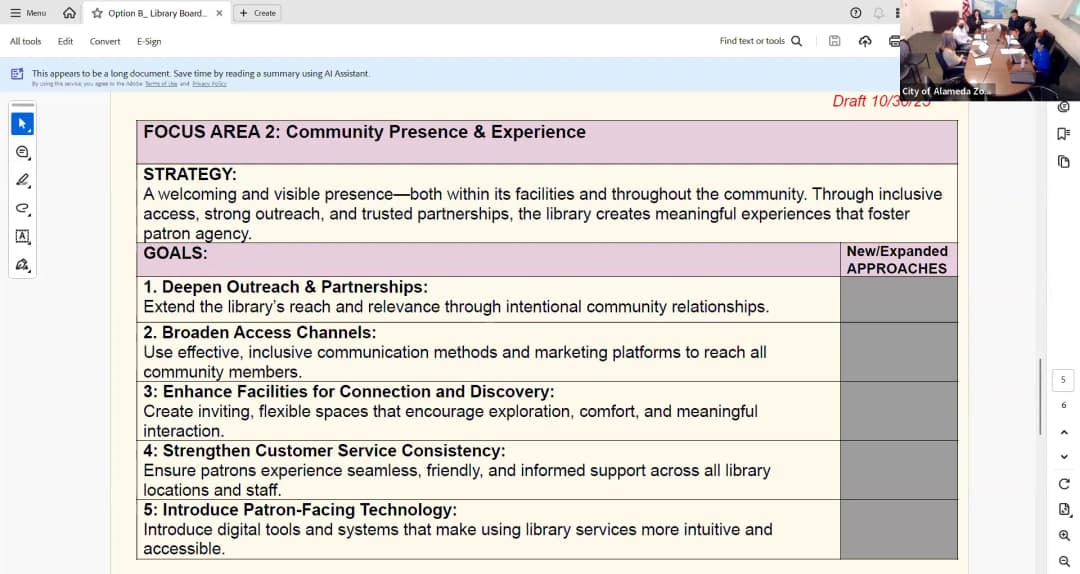
Public Meetings - Alameda, CaliforniaThe Alameda Library Board met on September 21, 2026. (Note: The transcription begins by referring to this as the "November meeting," creating a discrepancy with the official metadata date provided. This summary relies on the provided metadata.) President Amara Suri Wardena presided. Board members present included Bell and Panji. Vice President Gibbons and Board Member Striffler were absent. The board received a strategic planning update, discussed the library operations report, heard public comment, and unanimously approved the consent calendar. Public Comments & Testimony - Elise, a community member, addressed the board during the non-agenda public comment period. She provided the board with a packet of materials she compiled to assist in their strategic planning efforts, including definitions of mission versus vision statements, a creative brief framework, and a raw brainstorm document based on previous board discussions. Elise stated the materials were meant to be a helpful jumping-off point and expressed no specific positions on agenda items. The board thanked her for the contribution. Consent Calendar - The board unanimously approved the consent calendar, which included the draft minutes, financial reports, and bills for ratification. Discussion Items Strategic Planning Update (Item 4A) Kristen, the facilitating consultant, provided an update on the strategic planning process. She reviewed findings from the stakeholder report, noting the library is highly valued, but opportunities exist in facilities, hours, and targeted outreach. Board members discussed the methodology of the survey, particularly how staff feedback on workspaces (e.g., 20-year-old chairs, lack of laptops) was gathered. The three primary strategic focus areas were presented: Access (services and collections), Experience (community perception and outreach), and Internal Capacity (staff, technology, and infrastructure). Board members provided feedback on the language used. One member expressed strong concern that terms like "patron facing technology" and "facilities for connection and discovery" could be perceived as elitist and alienating to community members with lower levels of education or digital literacy, urging the use of simpler, more public-facing language. Another member stressed the need for concrete metrics and timelines to make the plan a usable operational tool. The Library Director confirmed that granular approaches and metrics exist in the appendices of the draft, which is expected to be ready for board review in January 2027. Staff and Library Operations Report (Item 4B) The Library Director provided an update on several key operational areas: - Book Vendor Disruption: Baker & Taylor, a primary book vendor for nearly 200 years, is going out of business. This creates a nationwide disruption for libraries, delaying the availability of physical materials as the library transitions to other vendors like Brodart and handles increased in-house processing (e.g., applying Mylar jackets). - New Catalog: A new, more intuitive catalog interface is launching later in the month. - Storytimes: For the first time, the library offers a standing story time every day of the week, including weekends, thanks to staffing changes. - Post-Hour Change Data: Initial data from the first full month of updated library hours (October) showed an increase in visits (19,886 vs. 19,397 in the previous October) and an increase in physical material checkouts at both branches. - Staffing: Interviews were held for the Bay Farm librarian position. The School Resource Services Librarian is leaving the position. The library expects to have both roles filled by the end of January 2027. - Student Library Cards: The partnership with AUSD to provide a library card to every student is progressing. The student's Google login will serve as their library card number. The program is targeted for an early 2027 launch. - Library Card Art Contest: The winning design has been selected. A gallery of all submissions will be created. The new cards are expected to be ordered late 2026 or early January 2027. Key Outcomes - Consent Calendar: Approved unanimously. - Strategic Plan: The board affirmed the general direction of the plan. Language will be revised for accessibility. The full draft is scheduled for board discussion and approval in January 2027. - Student Library Card Program: Targeted for an early 2027 launch. - Staffing: New hires for Bay Farm and the School Resource Services Librarian are anticipated by the end of January 2027. - Library Operations: The board acknowledged the initial success of the new hours based on early data and the ongoing disruption from the Baker & Taylor closure. - Meeting Adjourned.
The Alameda Library Board convened on Wednesday, January 14, 2026, at 7:09 p.m. The meeting included a report from the Library Director, a presentation on the draft strategic plan update, and discussion of library operations and statistics. Key topics included the new social work partnership, circulating statistics, and the proposal to approve a summary version of the strategic plan update. Consent Calendar - The board approved the consent calendar, which included the board minutes, financial reports, and the bills for ratification check register. Public Comments & Testimony - No members of the public were present for non-agenda public comment; the section was limited to in-person comments only. Discussion Items - Library Director's Report: The Director reported on a new social work partnership, noting that the social worker, who has prior experience in a library setting, has begun building relationships with library patrons in need of services or simply someone to talk to. The social worker makes rounds throughout the day and knows the names of regular patrons. The Director also mentioned a training recommendation to formalize a backup signal system for staff, using a simple “Q” code (1 if okay, 2 if not). The library plans to have four programs (two at the main library, one at each branch). Additionally, the Director reported that the Bay Farm branch had circulated more than 4,000 items in a month for the first time in recent memory, and said she believed updated hours are fitting community needs better. She added that staffing is in a good spot. - Strategic Plan Update Presentation: A consultant presented a draft strategic plan update, which the board was asked to approve in its summary form. The plan includes goals such as reducing processing time for new materials, maintaining a 3-to-1 digital title ratio, and creating a tool lending library funded by a $10,000 gift from the Carnegie Foundation. The plan includes year one, year two, and year three-plus implementation timelines. Board members discussed reporting cadence; the Director said yearly is too late to be actionable and agreed to provide updates every six months. Board members also asked for clarification on the status of the new check-in system (the Director said it is moving slower than expected), and they discussed the ability to use existing data, and potential for collaboration around centralized information. The consultant noted that the current plan does not include reporting automation, but the next plan may. - Staff and Board Communications: A board member praised a recent kids’ program, noting the children were super engaged, and highlighted a new partnership with ARPD. The meeting also noted the departing consultant lives in Alameda, which provides an ongoing local connection to the work. Key Outcomes - The board approved the consent calendar. - The board voted to approve the summary version of the strategic plan update. - The Library Director agreed to adopt a six-month reporting cadence for the strategic plan rather than quarterly or yearly; quarterly would create a reporting burden, while yearly is not actionable enough. - The next step discussed was to schedule a presentation to the City Council so they are aware of the strategic plan direction (no date was set).
The City Council of Alameda met on September 15, 2026, at 7:00 PM in open session. The meeting included proclamations, consent calendar approvals, appointments to boards and commissions, presentations on AC Transit, and policy deliberations on short-term rentals, accessory dwelling units, and tenant relocation payments. Key outcomes included the introduction of ordinances to establish short-term rental regulations and expand housing options, and a referral to staff to evaluate a potential large-format commercial vacancy fee. Consent Calendar - Minutes and routine financial items were approved. - Approval of a three-year agreement with M5 Services LLC for building engineer and maintenance services (up to $2,793,808). - Acceptance of work for the Lincoln Park Pathway Lighting Project. - Approval of a one-year agreement with Action Research for community-based social marketing to increase bulky pickup services by multi-family residences ($186,000). - Adoption of the 2026 City of Alameda Climate Adaptation and Hazard Mitigation Plan. - Approval of grant funds and amendments for the Public EV Charging Program. - Approval of a service provider agreement with Nicholson Strategic Services LLC for executive human resources services ($250,000). - Final passage of two ordinances authorizing lease amendments for Alameda Point properties. Proclamations - Mayor Ashcraft proclaimed September 15 through October 15, 2026, as National Hispanic Heritage Month, highlighting local demographics and library events. Appointments to Boards/Commissions - Council approved appointments: Alec Chavez (Civil Service Board), Katie Freed and Jimmy Ly (Planning Board), and reappointment of Jason Kim, Saravana Suthanthira, and appointment of Maria Piper and Bharat Singh (Transportation Commission). - Each appointee briefly addressed the council, sharing their background and goals for community service. Public Comments & Testimony - Action Research Agreement (5E): Councilmember Jensen raised questions about the necessity of community-based social marketing for bulky pickup services among multi-family residents. Staff explained it is a behavior change tool to reduce illegal dumping and improve participation; no public comment. - AC Transit Presentation (7B): Public speaker Mitch Ball supported the Connect Bay Area Act (SB 63) but recommended eliminating Line 19 to free resources, suggesting an alternative route for Line 30 to improve competitiveness and ridership. He emphasized the need for frequent, direct service. - Short-Term Rental Ordinance (7C): Donna Fisher (in person) urged reconsideration, arguing the restrictions would reduce transient occupancy tax revenue, harm local businesses, and eliminate lodging for medical professionals and others. Karen Miller (in person) questioned grandfathering provisions and said owners would sell rather than become landlords. Sophia DeWitt (Reverend, EBHO) supported the ordinance but called for platform accountability and suggested directing TOT to an affordable housing trust fund. Kevin Jordan (remote) opposed, calling the ordinance an attack on the middle class and favoring regulation of large investors over families. - ADU Conversion Ordinance (7D): Carmen Reed (remote) asked clarifying questions about square footage limits for junior and detached ADUs. Staff clarified the slide was a stock image and no square footage definitions were changed. - Rent Control Ordinance (7E): No public comment. - Council Referrals (10A): No additional public comment. Discussion Items - Short-Term Rental Ordinance (7C): Staff presented a text amendment to establish citywide zoning regulations for short-term rentals (STRs), limiting them to hosts on their primary residence, with exceptions for legacy operators (those operating for at least one year). Planning Board included good neighbor policies (noise, trash, occupancy limits). Council debated whether to adopt the full ordinance or phase it with good-neighbor policies first due to data gaps on the impact on housing supply. Councilmember Jensen expressed concerns about the blanket prohibition on off-site owners. Councilmember Daysog raised questions about multiple properties owned by one individual. The ordinance passed after adding a 90-day amnesty period (from 60) and a reporting requirement by January 2028 to review impacts on property owners with multiple STRs. The final vote was 3-1-1 (Mayor, Vice Mayor, Councilmember Daysog in favor; Councilmember Jensen abstained; Councilmember Bowler recused). - Accessory Dwelling Unit (ADU) Amendments (7D): Staff presented amendments to permit ADU condominium conversions (per State AB 1033), update regulations, and streamline processes. Council supported the measure as a tool to increase homeownership opportunities for first-time buyers. Councilmember Daysog expressed concern about the potential increase in ADU production and proposed a five-year sunset, but after discussion, the council opted for a report back as part of the next Housing Element update cycle rather than a sunset. The measure passed 4-0 (Councilmember Bowler recused). - Rent Control Ordinance Amendment (7E): Staff presented an amendment to clarify that tenants who vacate due to an invalid (unlawful) termination notice must be offered the unit back if they haven't found permanent housing, or receive a permanent relocation payment. This closes a loophole identified after previous updates. The council passed the first reading unanimously (4-0, Councilmember Bowler recused). - AC Transit Presentation (7B): General Manager Salvador Llamas and planner Owen Christopherson presented the financial challenges facing AC Transit, including a projected $200 million deficit over four years. They outlined a contingency service reduction plan (effective June 2027 if no new funding is secured) that would cut Alameda routes: Line 19 eliminated (due to low ridership), reduced frequencies on Lines 30, 31, 96, and O and W, and a proposed new East End line connecting Fruitvale BART to South Shore. Councilmember Jensen questioned impacts on transit-oriented development priorities and the role of the Alameda Transportation Management Association. The mayor and council noted the critical importance of the Connect Bay Area Act (SB 63) to avoid cuts. - Large-Format Commercial Vacancy Fee Referral (10A): Councilmember Daysog proposed directing staff to evaluate a vacancy tax on large anchor stores (grocery stores, pharmacies) that are vacant for extended periods, as a way to incentivize re-leasing and generate revenue. Council discussed legal and practical issues (retroactivity, effectiveness, need for voter approval). Councilmember Bowler supported the referral but stressed the need for near-term negotiations. Councilmember Jensen asked about the strategic plan reference. The council voted unanimously to direct staff to report back in March 2027 with findings and recommendations. Key Outcomes - Action Research Agreement: Approved with questions answered. - Climate Hazard Plan: Adopted. - Code Enforcement for Invalid Eviction Notices: The ordinance was introduced to clarify relocation payment requirements for tenants who vacate due to unlawful notices. (Unanimous first reading, 4-0). - ADU Condominium Conversions: Ordinance introduced to permit separate sale of ADUs, aiming to increase homeownership opportunities. (Passed 4-0). - Short-Term Rental Regulations: Ordinance introduced establishing citywide STR rules, including primary residence requirement, good neighbor policies, a 90-day amnesty period, and a reporting requirement by January 2028 to review impacts. (Passed 3-1-1). - 9090-day Amnesty Period: The amnesty period for existing STRs to register was extended from 60 to 90 days (through early 2027). - Vacancy Fee Referral: Council directed staff to evaluate a potential large-format commercial vacancy fee and report back in March 2027. (Unanimous). - Appointments: All appointments to boards/commissions approved unanimously. - Future Agenda Items: The council will revisit the Short-Term Rental impact report in January 2028, and receive the vacancy fee evaluation in March 2027.
The regular meeting of the Alameda Planning Board scheduled for Monday, September 14, 2026, at 7:00 PM was canceled due to a lack of a quorum. The cancellation was announced at 4:52 PM on the same day. No agenda items were discussed, and no actions were taken. Scheduled Agenda Items (Not Heard) - Consent Calendar: Approval of draft meeting minutes for June 22 and August 24, 2026. - Regular Agenda Item 5-A: Planned Development Amendment for South Shore Beach and Tennis Club (PLN26-0472). - Regular Agenda Item 5-B: Downtown Commercial Zoning Text Amendment (PLN26-0422). - Staff Communications and Board Communications. Outcome The meeting was canceled before convening; no votes, public testimony, or staff reports occurred.
Note: The raw transcript dates the meeting to September 9, 2026, but the official meeting date provided is September 14, 2026. This summary uses the latter. The Alameda Library Board held a regular meeting on September 14, 2026, at 6:03 PM local time. President Amar Saru Ordena was present, as were board members Battle, Gibbons, and Conji. Board member Strickler was absent. The meeting featured the first formal report from the newly appointed library director and covered strategic plan implementation, new state-mandated student library card program, upcoming events, and facility improvements. Consent Calendar - The consent calendar included Item 3A (draft minutes of the special and regular library board meetings of July 8, 2026), Item 3B (financial reporting for FY 2026–27 July and August expenditures), and Item 3C (bills for ratification for July and August). The board accepted these documents on a motion without discussion or opposition. Public Comments & Testimony - No members of the public spoke during either the opening or closing non-agenda public comment periods. Neither in-person nor virtual attendees offered testimony. Discussion Items - Library Director’s Report: The new library director expressed gratitude to interim director Marlon Romero for a smooth transition and provided updates on several initiatives: - Strategic Plan Committees: Final formation of staff-led committees aligned with the strategic plan is underway, with a launch planned for October 1, 2026. The board encouraged frequent data sharing and impact measurement beyond simple attendance counts. - Student Connect Code: A state-mandated program providing every Alameda Unified School District student with a barrier-free library card (up to five physical items plus digital access) launched earlier that week. The director also noted a free statewide tutoring service (Homework CA) now available 24/7 at no cost to the library. - Main Library Redesign: A redesign/envisioning project was being refined with Public Works; an ADA review triggered by the automated book-check (AMH) project may require accessibility improvements before proceeding. - Upcoming Events: The library will host author Lauren Tarshis on September 21, celebrate the main library’s 20th anniversary on November 7 (October 1 closure for staff appreciation), and plan a yearlong 150th anniversary celebration in 2027. Recent highlights included Pride Fest and Alameda BookCon (over 1,500 attendees). - Staffing: Recruitment for a full-time library assistant and a full-time librarian is underway, with strong internal and external candidate pools. - Board Communications: Board members discussed the importance of collecting both quantitative and qualitative data to demonstrate library impact, especially for children and families. Concerns were raised about after-hours programming at the Bay Farm branch—many neighborhood businesses close early, limiting the library’s ability to serve as a “third space.” The board also noted the need for multilingual translations of key instructions and stronger cross-library staff collaboration. Key Outcomes - The consent calendar was approved unanimously (no vote tally recorded, no opposition). - No formal votes or resolutions were taken on other agenda items. - The director will report back in November on strategic plan committee progress and data baseline measurements. - The automated book-check (AMH) project remains pending resolution of ADA accessibility issues with Public Works; a meeting was anticipated within two weeks. - Board members expressed interest in further discussions about expanding evening hours and increasing neighborhood integration, especially at Bay Farm.
The Recreation and Park Commission held its regular meeting on September 10, 2026, at 7:00 PM in City Hall. The meeting included the swearing-in of two new commissioners (Eric Bell and Rhonda Sorensen), staff and commissioner communications, approval of the July 9, 2026 minutes, a comprehensive Summer 2026 Recreation Division recap, and a preliminary overview of potential user fee adjustments for calendar year 2027. No votes were taken on agenda items; the meeting was informational. Consent Calendar - Item 5-A (Minutes of July 9, 2026): Approved unanimously with new commissioners abstaining. Motion by Commissioner Bernie, seconded by Vice Chair Schwartz. Roll call: Bernie – Approved, Schwartz – Yes, Chair ADES – Approved. Public Comments & Testimony - Adrian Alexander (non-agenda): Welcomed the two new commissioners and thanked them for volunteering. Offered advice on preparing for meetings, communicating with staff, visiting parks, and promoting parks in a potential bond measure. Emphasized that parks are vital infrastructure needing maintenance. - Mark Klein (non-agenda): Spoke about long-term field planning and shortages. Cited a 2012 parks improvement plan showing a deficiency of six baseball/softball diamonds and six rectangular fields. Noted that only Estuary Park (one diamond, one soccer field) has been added since, while fields at the Point are planned for removal. Urged the commission to advocate for long-term field availability, especially given Wood Middle School field loss. No public comments were made on the summer recap or fee preview items. Discussion Items - Staff Communications (Director Justin Long): Announced upcoming events: Coastal Cleanup (Sept. 19), Alameda Walk Series (Sept. 12 & 26), Starlight Movies (Jurassic Park at Gene Sweeney on Sept. 18), Blues Brews & Barbecue (Sept. 20), Filipino Island Fest (Oct. 3), Pride in the Park (Oct. 10). Provided program updates: Leisure Club baseball game, adult basketball leagues starting Sept. 21, teen haunted house planning, Tiny Tots fall registration, recreation after-school program availability, new Teen Underground Center After Dark program, roller skating, tennis lessons, senior programs at Mastic, fall swim lessons at NCL Swim Center. Recognized Essie DeVille and Ashley Canadis for summer teen volunteer program (118 volunteers) and Park Supervisor Oscar Ledezma for acceptance to Alameda County Local Government Leadership Academy. Project updates: Franklin Park basketball court renovation completed, Longfellow Recreation Center painted, Godfrey Park playground prepared, Lidecker Park playground replacement underway, AUSD joint use agreement and aquatic center construction updates. Confirmed ARPD will begin operating the new Emma Hood pool in January 2027, with a separate joint use agreement for the pool and a later broader agreement. - Commissioner Communications: New commissioners introduced themselves: Eric Bell (15-year resident, professor and CPA, interested in fiscal decisions and parks) and Rhonda Sorensen (lifelong resident, former park director, recreation degree, interests in tennis/pickleball, line dancing). Commissioner Bernie welcomed them. Commissioner Schwartz gave a shout-out to lifeguard Hero Short. Chair ADES reported visiting all 41 city parks and facilities over the break, highlighting Marina Village Park as a hidden gem. - Regular Agenda Item 6-A: Recreation Division Summer Recap 2026 (Patrick Russian, Recreation Manager): Presented a detailed overview of summer 2026 programs under the theme “Totally Rad Wreck Summer.” Key statistics: 280 part-time summer employees; preschool programs: We Play (165 kids), Tiny Tots (49 kids), Tenderfoot camp (94 kids); specialty classes (1,700 participants in dance, STEAM, cooking, etc.); World of Wonder (WoW) program (1,216 participants across 5 sites); Day Camp program (73-year tradition) with Trailblazer overnight (45 participants); Teen programs (356 individuals at free Underground Teen Center); Community Recreation (973 drop-in participants); Sports programs (1,500 campers, plus tennis, roller skating); Aquatics (over 1,000 swim lessons, new flexible swim program, partnership with Stacked Adventures, dive-in movie with 95 attendees, lifeguard spirit award). Community events: Sand Castle Contest (58th year, 95 entries, 492 participants, 2,000 spectators), Starlight Movies (5 events, 800 participants), 4th of July Parade (49th year, 185 entrants, 60,000 spectators), Rhythmix cultural series. Discussed challenges: TK program impact, marketing (department’s website inefficiency, need for better outreach), competition from other providers, and retaining part-time staff. Highlighted volunteer program (118 teen volunteers) and aquatic intern program as feeders for future staff. Scholarships: $20,000 set aside annually, with $12,000-$13,000 used in summer. Russian noted two programs needing attention: Tiny Tots (due to TK changes) and Day Camp (lower participation; marketing and busing costs are issues). Commissioners asked about capacity (not at full capacity), marketing strategies, and partnerships with youth sports leagues (e.g., Little League, AYB). Commissioner Schwartz praised the flexible swim program. Chair ADES requested year-over-year trend data in future reports. - Regular Agenda Item 6-B: Introduction and Preliminary Overview of Potential Recreation and Park User Fee Adjustments for Calendar Year 2027 (Director Justin Long): Provided context for the upcoming fee review process. Explained that ARPD is a general fund department with a cost recovery of about 50-55% of actual costs. Revenue ($5.5M) covers only part of total expenses ($16-17M). Outlined the fee structure: low fees for broad community benefit (e.g., group swim lessons, park rentals) and higher fees for individual/small group benefits (e.g., private tennis lessons). Fee setting considers market comparisons, inflation (3-5% annual increase needed to maintain service), and impact on user groups. Process: staff will review programs, conduct market research, draft recommendations, share with user groups, hold a workshop at the October 8 commission meeting for public and commissioner feedback, bring final proposal in November for commission recommendation to City Council in December. Also discussed scholarship program, importance of keeping programs affordable, and the subsidy for aquatics ($750K-$800K) and athletic fields ($430K subsidy based on revenue vs cost). Director Long emphasized that fee increases are incremental to avoid large shocks. Commissioners asked about timing, fee structures for for-profit vs. nonprofit, cost recovery calculation methods, and the importance of aligning fees with community values. Chair ADES suggested targeted outreach to affected groups before the October workshop. Key Outcomes - Consent Calendar Approved: Minutes of July 9, 2026 were approved unanimously. - No Formal Action on Summer Recap: Informational item; commissioners expressed appreciation and requested year-over-year trends in future reports. - No Formal Action on Fee Preview: Informational item; process outlined. The October 8, 2026 meeting will include a workshop on fee proposals. - Next Meeting Date: October 8, 2026. Proposed agenda items: user fee workshop, park tour (special meeting), election of chair/vice chair, and possible sports field allocation report. - Adjournment: Motion by Commissioner Bernie, seconded by Vice Chair Schwartz; roll call all in favor. Meeting adjourned.
The Alameda Recreation and Park Commission met on Thursday, September 10, 2026, at 7:00 PM in City Hall. The meeting included public comments, staff updates, a detailed summer program recap, and a preliminary discussion on 2027 user fee adjustments. Commissioners approved consent calendar items and set the next meeting for October 8, 2026. Consent Calendar - Minutes of July 9, 2026: Approved unanimously (4-0; new Commissioners Bell and Sorensen abstained). Public Comments & Testimony - Adrian Alexander (former commissioner): Welcomed the two new commissioners, offered advice on preparing for meetings and engaging with staff and parks, and urged the commission to advocate for a share of any future bond measure to fund park infrastructure improvements (roofs, gutters, interior maintenance). - Mark Klein (resident/parent): Expressed concern over the long-term shortage of athletic fields, noting that a 2012 city plan identified a deficit of six baseball/softball diamonds and six rectangular fields. He stated that only Estuary Park has been added since, while planned housing at the Point will remove several soccer fields, resulting in a net decrease by 2030. He asked the commission to advocate for long-term field availability. Discussion Items - Staff Communications: Director Justin Long presented a calendar of upcoming events (coastal cleanup, Alameda walks, Starlight Movies in the Park, blues/brews/barbecue, cultural festivals), program updates (after-school registration, teen programs, indoor roller skating, aquatics), staff recognition (Essie DeVille and Ashley Canadis for teen volunteer program, Park Supervisor Oscar Ledezma for leadership academy), and project updates (Franklin Park basketball court renovation completed, Longfellow center painted, Godfrey Park playground feature added, Lidecker Park playground construction underway). He also clarified that ARPD will begin operating the new Emma Hood pool on January 1, 2027, regardless of AUSD’s October opening target, and that the joint use agreement will be split into separate pool and general facility agreements. - Commissioner Communications: New Commissioners Eric Bell (15-year resident, professor and CPA) and Rhonda Sorensen (lifelong Alameda resident, recreation degree) introduced themselves. Vice Chair Schwartz praised lifeguard Hero Short; Chair Ades shared his experience visiting all 41 city parks and highlighted Marina Village Park. - Summer Recap 2026 (Item 6A): Recreation Manager Patrick Russian presented an extensive report on summer programs with the theme “Totally Rad Wreck Summer.” Key statistics: 280 part-time summer employees, 165 preschoolers in We Play, 49 in Tiny Tots, 94 in Tenderfoot Camp, 1,700 participants in specialty classes (STEAM, science, cooking most popular), 1,216 in World of Wonder (WOW) all-day rec care across five sites, 356 visitors to the free Underground Teen Center, over 1,000 swim lessons, 1,500 sports campers, and 973 drop-in community recreation participants. Signature events included the 58th annual Sand Castle and Sand Culture Contest (95 entries, 492 participants, 2,000 spectators) and the 49th annual 4th of July parade (60,000 spectators, 185 parade entries). Challenges included increased competition from other providers, shifting kindergarten/TK demographics, aging facilities, and the need for better marketing. Commissioners asked about capacity, endangered programs (Tiny Tots and day camp), marketing efforts, partnerships with youth sports leagues, swim lesson enrollment, and affordability (scholarship fund of $20,000 annually, fully utilized). Commissioner Schwartz praised the new flexible swim program and requested year-over-year comparisons in future reports. - User Fee Adjustments for 2027 (Item 6B): Director Long outlined the fee-setting process, noting that annual cost-of-living increases and program expenses require revenue growth of 3-5% to avoid service cuts. The department operates at 50-55% cost recovery, with revenue of about $5.5 million against total expenses of $16-17 million. Fee increases are targeted to minimize impact on broad community programs (e.g., group swim lessons) while higher individual services (private tennis lessons) approach full cost recovery. He explained the timeline: staff will conduct market comparisons, share proposals with user groups, present a workshop at the October 8 commission meeting, incorporate feedback, and bring a final recommendation to the commission in November for council approval in December. Commissioners clarified fee categories (resident/non-resident, nonprofit/for-profit), cost calculation methods, and the importance of understanding downstream effects on partner organizations. Chair Ades emphasized the need for policy principles to guide subsidies. Staff agreed to share preliminary proposals with commissioners and user groups before the October meeting. Key Outcomes - Consent Calendar approved (4-0; new commissioners abstained). - No motions on summer recap or fee preview; both items were informational. - Next meeting: October 8, 2026, with tentative agenda items: user fee workshop, park tour (special meeting date TBD), election of chair and vice chair for the upcoming term, and a brief report on fall sports field allocation.
The Alameda Library Board held a regular meeting on September 9, 2026, following a closed session to discuss library director candidates. The board approved the consent calendar, received a director’s report on summer programs and upcoming initiatives, held elections for officers, and discussed staff vacancies. Consent Calendar - The board approved the draft minutes from the previous meeting by a motion and unanimous vote. No other consent items were listed. Public Comments & Testimony - No public comments were made. The meeting had no in-person or remote attendees for oral communication. Discussion Items - Library Director’s Report (Item 4A): The interim library director provided updates: - Summer programs saw about a 5% increase in attendance over the previous year. Notable programs included a Baby Raid program with 40 attendees and a first annual Pride event at Bay Farm, featuring drag story time and arts and crafts. The director proactively contacted the police chief due to potential agitators, but the event proceeded without incident. No adverse comments were received. - Upcoming: The Alameda Book Convention on Saturday (date not specified) from 10:30 AM to 4:00 PM, featuring about 40 authors and content creators, with support from the Friends of the Library. - Several initiatives are on hold pending the arrival of a new library director in August: the strategic plan, space redesign (RFP ready), poet laureate program (awaiting input from the mayor), and tool lending relocation (exploring locations). - Ongoing projects: Vega Promote (newsletter and catalog app, expected December), Vega program (study room reservation launching in September), and a redesigned library website (mega map layout, also launching in September). A board member offered to assist with the website and app. - Friends of the Library Update: Executive Director Marcy resigned (last day mid-July). The Friends participated in a parade and will table at the ABC event. No further update was provided. - Election of Officers: The board elected officers for the upcoming year: - President: Sean (Mr. Sierra Wardena) nominated and seconded, elected unanimously. - Vice President: [board member name not clearly given] nominated and seconded, elected unanimously. - The slate was voted on as a whole. Incumbent Tushon was reappointed to his board seat. - Staff Communications: The library assistant job posting received 100 applicants within a day and a half and closed. The cap was lifted, and the deadline extended to July 15. A librarian opening is expected in September with no cap. Key Outcomes - The board approved the consent calendar (draft minutes) unanimously. - The board elected Sean as President and another member as Vice President for the upcoming year. - The interim director will pause strategic initiatives until the new library director arrives in August. - The library assistant job posting was extended with no cap due to high applicant demand.
The Historical Advisory Board (HAB) of Alameda, California, held a study session on the evening of September 8, 2026, to discuss the future of the historic buildings at 2320-2322 Lincoln Avenue. The board also approved prior meeting minutes and heard public comments on non-agenda items. Consent Calendar - Minutes Approval: The board unanimously approved the draft meeting minutes from June 4, 2026, and February 5, 2026, with Board Members Bevan, Brito, Lee, and Chair Hernandez all present and voting. Public Comments & Testimony - Non-Agenda Comment – Mark Douglas Minor (Fernside District advocate, fourth-generation Alamedan): Mr. Minor submitted a formal nomination dossier to designate the Gibbons Dry Sweet Gum Tree Canopy as a protected tree corridor. He argued that the canopy, originating from the Cohen estate's Fernside subdivision in 1925, meets the same preservation standards as other designated tree corridors in Alameda. - Agenda Item Comment – Woody Minor (historic preservation advocate): Mr. Minor stated that the building at 2320 Lincoln is likely the oldest commercial building in Alameda, possibly constructed in the 1860s and moved from the nearby train station. He urged the board to require a historic expert (e.g., an architectural historian or preservation architect) to evaluate the building's fabric and significance, rather than relying on the developer's structural analysis. He also criticized the presentation as overly pro-development. - Agenda Item Comment – Bernie (self-described tenured resident): Mr. Bernie argued that the building is a neglected treasure and that the board should avoid excessive bureaucracy, allowing the applicants to move forward with a preservation-minded redevelopment that would make the building a known community asset. Discussion Items - Study Session: 2320-2322 Lincoln Avenue Certificate of Approval – Staff member Tristan Swear presented updated structural information and five redevelopment options for the two buildings (Building A: historic saloon/residential, Building B: Gims Chinese restaurant). The options ranged from full demolition with interpretive signage to complete rehabilitation with minor exterior modifications. The board reviewed interior and exterior photographs, a structural analysis by RISE Design Group, and the building official's assessment that any work would require a Certificate of Approval (due to demolition of ≥30% of structure value). - Board Discussion: - Board Member Bevan noted the building's severe disrepair and raised the philosophical question of when reconstruction ceases to preserve a historic building's 'soul.' - Board Member Brito (newly appointed) emphasized the need for a comprehensive historic evaluation of both buildings, not just structural analysis. He requested a materials condition assessment, an updated historical significance report that considers the building's associations (e.g., early Chinatown), and clarity on zoning compatibility (e.g., residential next to gas station). - Board Member Lee expressed concern about further delays and suggested relocation as a potential option, noting the building has likely been moved before. He urged expediting a solution to avoid the building's eventual loss due to neglect. - Chair Hernandez supported the call for a professional historic evaluation and a concrete design proposal, emphasizing that the board is open to a balanced approach between preservation and adaptive reuse. - Staff Clarification: Swear confirmed that the applicant is open to feedback and intends to develop a more specific proposal informed by the board's expectations. Key Outcomes - No Formal Decision: The study session was held to gather board input; no vote on a Certificate of Approval was taken. The applicant will incorporate the board's guidance into a revised proposal. - Direction to Applicant: The board unanimously expects the applicant to commission an updated historic evaluation and materials assessment by a qualified preservation architect or architectural historian. This analysis should identify character-defining features of both buildings, including their association with Alameda's pioneer and Chinese-American history, and provide clear guidance on which elements can be preserved, rehabilitated, or reconstructed. - Board's Position on Options: Board members expressed openness to significant modifications of Building B (heavily altered) and to the removal of non-original rear additions. However, they emphasized that the Lincoln Avenue facades of Building A and any character-defining features of Building B should be retained or faithfully reconstructed to maintain the building's visual connection to its past. - Staff Announcement: Staff member Stephen announced his retirement at the end of September. Chair Hernandez thanked him for his service. - Next Steps: The applicant will work with a historic preservation expert and return to the HAB with a detailed design proposal for further review. Staff will assist in preparing the necessary environmental review and Certificate of Approval application.