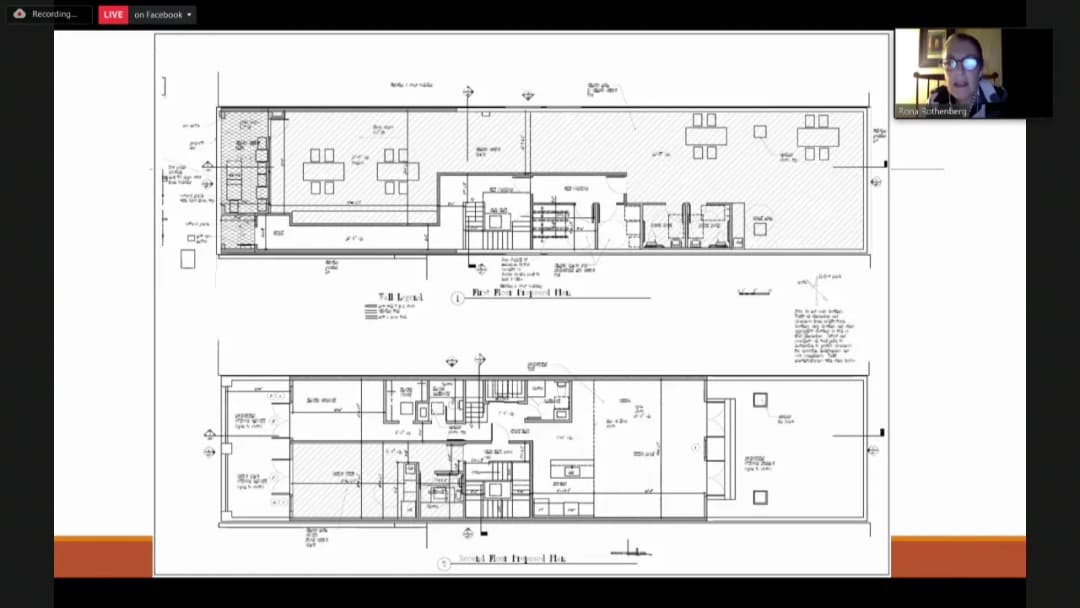
The Alameda Planning Board convened virtually on November 23, 2020, at 7:00 PM via Zoom. The board considered three regular agenda items: a development plan and density bonus for a mixed-use infill project on Santa Clara Avenue, a use permit and design review for a tavern on Webster Street, and a mitigated negative declaration and use permit for a solar facility at the Doolittle Landfill. Board members present: President Teague, Vice President Saheba, and members Cisneros, Curtis, Hom, Rothenberg, Ruiz. The meeting included public comment on various items and concluded with board communications and adjournment just before 11:00 PM. Consent Calendar - Item 6-A (2021 Planning Board Regular Meeting Schedule): Approved unanimously without discussion. Public Comments & Testimony - Oral Communications (non-agenda): Keith Weisson inquired about landscaping maintenance on the Cross Alameda Trail, noting weeds and infrequent mowing. Staff advised contacting the Parks Department. - Item 7A (Santa Clara Avenue project): Anisa Dominguez, a tenant at 1514 Broadway, expressed concerns about the proposed parking structure, stating it clashes with the 1908 Victorian home; she also cited traffic from the adjacent driveway and the lack of private common open space for existing tenants. - Item 7B (Webster Street tavern): Several public comments were received but not fully transcribed; the board acknowledged receiving two letters after the staff report. - Item 7C (Solar facility): No public speakers were recorded beyond the applicant's presentation. Discussion Items - Item 7A (PLN19-0448): Development Plan, Density Bonus, and Tentative Map for 2607-2619 Santa Clara Avenue and 1514-1518 Broadway. Applicant Branagh Development proposed subdividing the property into parcels, constructing nine townhomes (total 31 units) with two deed-restricted very low-income units, requiring numerous waivers under state density bonus law. Board members emphasized the importance of thorough design review, with member Hom noting the large number of waivers and the need for quality materials and massing. A motion to approve the development plan and density bonus passed 6-1 (Curtis opposed). A separate motion to recommend the city council approve the tentative map passed 6-1. The board stressed the design review packet must be complete. - Item 7B (PLN19-0237): Use Permit, Parking Waiver, and Design Review for 1929 Webster Street. Applicant proposed a tavern with outdoor seating and extended hours (until 2:00 AM). Due to site constraints, a parking waiver was debated; the board decided not to approve the parking waiver but instead directed the applicant to seek a parking variance through the zoning administrator. Design review was deferred to a future planning board meeting. The use permit was approved with conditions: hours until 2:00 AM, a noise review after one year (or sooner if needed), and encouragement to pursue a curb cut for drop-off. Motion carried unanimously (7-0). - Item 7C (PLN19-0601): Mitigated Negative Declaration (MND) and Use Permit for the Alameda Municipal Power Solar Facility at the Doolittle Landfill. The 2.0 megawatt photovoltaic facility would occupy 11 acres on a closed landfill with a 25-year use permit, after which the site would become a park. The board adopted the MND and Mitigation Monitoring Reporting Program unanimously. The use permit was approved unanimously with an added condition requiring visual screening or vegetation to reduce glare at the viewpoint OP1 intersection (the "if feasible" qualifier was removed due to safety concerns). Key Outcomes - Approved consent calendar (6-A) unanimously. - Item 7A: Approved development plan and density bonus (6-1); recommended city council approve tentative map (6-1). Staff and applicant to prepare a complete design review packet. - Item 7B: Approved use permit for tavern with 2:00 AM hours and noise review condition (7-0). Parking variance to be processed by zoning administrator; design review to return to planning board. - Item 7C: Adopted mitigated negative declaration (7-0); approved use permit with glare mitigation condition (7-0). - Board Communications: Member Ruiz inquired about compliance with AB 1486 (surplus land); staff to follow up offline. - Adjournment: Meeting adjourned at 11:00 PM.
Public Meetings - Alameda, California
Public Meetings - Alameda, CaliforniaThe City of Alameda Planning Board held its third public forum on the first draft General Plan on November 9, 2020, via Zoom. The meeting focused on Theme 3: Protecting the environment, responding to the climate crisis, and meeting regional responsibilities. The forum included a staff presentation, public Q&A, public comments, and board discussion. No formal action was taken on the General Plan; the board provided direction for the second draft. The board also approved the minutes from June 22, 2020, with corrections. Public Comments & Testimony - Oral Communications (non-agenda): Joe Cohen and David Vasquez, representing NORCAL Climate Action, spoke in support of establishing a "Climate Control Academy and Tower" at Alameda Point. They urged the city to take immediate, tangible climate action and proposed using the historic air navigation tower as a hub for green technologies, including moss walls, hydrogen power, and carbon sequestration. They offered to partner with the city. - Public Comment on Agenda Item: - Christopher Buckley (Alameda Architectural Preservation Society) raised four points: (1) policies CC12 and LU16 appear to call for upzoning and need clarification regarding historic neighborhoods; (2) add a resource conservation section for building material salvage and reuse; (3) strengthen the city's tree preservation ordinance to protect all large tree species; (4) correct inconsistencies between staff report policies and survey. - Rashid Shabazz (West End resident, UC Berkeley city planning student) called for an environmental justice element in the General Plan, better rainwater management in low-lying areas, maintaining the Easy Pass program for community college students, and exploring community land trusts and cooperative housing for affordability. He emphasized strategies for tenants and equitable investment. - Mary Spicer requested two actions: (1) add Marine Conservation Wildlife and Recreation Area (MCWRA) language to the open space element; (2) fund and support marine garbage cleanups around Alameda, noting she annually organizes cleanups pulling about 4,000 pounds of garbage from the Oakland Estuary. Discussion Items - Staff Presentation: Planning Director Andrew Thomas, consultant Amy McPhee, and Public Information Officer Sarah Henry presented the General Plan update process. They highlighted that Theme 3 aims to reduce greenhouse gas emissions (70% from transportation, 27% from buildings) and prepare for sea level rise. Key policies discussed include CC4 (net zero emissions by 2040), CC23 (living with water/sea level rise adaptation), CC20 (neighborhood-level flood protection), ME12 (climate-friendly transportation alternatives), CC12 (transit-oriented development), and building electrification. Staff noted the climate action plan (CARP) is embedded in the General Plan. They reported that nearly 1,900 survey responses have been received, but outreach needs to improve for younger, lower-income, and non-white demographics. - Board Discussion: - Board Member Rothenberg recommended aligning the General Plan with CARP more explicitly, adding an action to expand the moratorium on gas infrastructure and adopt all-electric reach codes, strengthening tree preservation and building reuse policies, and developing a long-term hazard mitigation plan for FEMA eligibility. - Board Member Curtis emphasized the need for priorities, timetables, and funding sources for each policy, and discussed challenges of affordable housing subsidization. - Board Member Cisneros expressed disappointment over the defeat of Measure Z (which would have removed Article 26 restrictions on multifamily housing), stating that the charter limits the city's ability to achieve climate and inclusive goals. She suggested expanding environmental justice language and revising parking requirements toward maximums. - Board Member Hom called for more aggressive, definitive action statements (replace "encourage" with mandates), promoting electrification and incentives from Alameda Municipal Power, telecommuting policies, and green jobs. He also supported parking maximums and building material recycling. - Vice President Saheba stressed partnerships (e.g., BCDC, Coast Guard) for sea level rise planning, funding strategies for policies, and considering height allowances in transit-oriented development areas. - Board Member Ruiz urged including environmental justice and healthy living narratives, specifying regional partners (e.g., Alameda County), creating a Chief Resilience Officer position, providing incentives for green power and solar, and addressing recycled water infrastructure. He cautioned that congestion pricing could disproportionately burden low-income workers. - President Teague noted that current climate impacts (smoke, heat, power outages) need more attention alongside sea level rise. He advocated for efficiency unit ordinances and making development less costly to achieve transit-oriented housing. Key Outcomes - No formal vote on the General Plan: This was a public forum to gather input for the second draft. Staff will incorporate board and public comments into the second draft, expected by March 2021. - Approval of June 22, 2020 Minutes: The board approved the minutes with corrections (changing "board member Kavanaugh" instead of "board cavanagh" and adjusting wording). Vote: 5 ayes (Curtis, Hom, Rothenberg, Ruiz, Saheba), 1 abstention (Cisneros), 1 absent (not specified). - Next Steps: The fourth forum (on mobility) is scheduled for December 14, 2020. Staff will continue outreach to underrepresented groups.
The Alameda Planning Board met via Zoom on Monday, October 26, 2020, at 7:00 PM. The board reviewed three major items: an annual review and proposed amendment to the Del Monte Development Agreement, a citywide conditional use permit amendment for commercial outdoor uses during the COVID-19 pandemic, and a development plan and design review for a new hotel at 1051 Harbor Bay Parkway. The board also approved draft meeting minutes and received staff reports. Consent Calendar - No consent calendar items were listed. Public Comments & Testimony - No members of the public spoke on any of the regular agenda items. One late caller briefly appeared but did not address the board during oral communications. Discussion Items - 7A: Del Monte Development Agreement Annual Review and Proposed Amendment - Planning Director Andrew Thomas presented an annual review of the 2014 Del Monte project development agreement and a proposed third amendment to extend the deadline for completing the Clement Avenue extension (part of the Cross Alameda Trail) by one year (until January 2022). The original deadline was 2019, extended previously to January 2021. Delays were attributed to East Bay MUD permit reissuance and COVID-19. Staff recommended extension plus monthly progress reports. - Board Member Cisneros suggested allowing the city manager to grant up to a one-year extension without a public hearing for minor delays, with reporting to the board. Board Member Teague proposed that such extensions be placed on the consent calendar for potential board review. - The applicant (represented by TL Partners and Wood Partners) expressed commitment to completion. - Board Member Curtis noted the developer's history of delays and supported board oversight. - 7B: Conditional Use Permit Amendment for Commercially Zoned Properties (COVID-19 Outdoor Use) - Planning Director Thomas presented an amendment to a June 2020 blanket use permit allowing commercial uses (e.g., outdoor dining, retail) on private parking lots and outdoor spaces citywide. The amendment added Alameda Point zoning districts inadvertently omitted and clarified that outdoor live music is allowed if compliant with city noise ordinance and county health orders. - Board Member Ruiz requested consistency in condition language regarding tents and umbrellas across conditions 4, 5, and 6, and that tents must comply with county health orders. Staff agreed. - 7C: 1051 Harbor Bay Parkway – Development Plan and Design Review for a 236-room Hotel - Staff (Henry Dong) presented a revised design for a five-story, 133,611-square-foot hotel with 236 guest rooms, restaurant, meeting rooms, and outdoor space. The project complies with zoning, general plan, FAA height/noise restrictions, and qualifies for a CEQA infill exemption. Parking is provided by 185 on-site spaces plus shared parking via reciprocal agreement with the Plaza One office park (over 400 additional spaces). - Applicant Adriana Cook (architecture firm) and owner Vijay Patel presented improvements from a 2018 review, including simplified massing, expanded entry canopy, solar roof, green roof, and modular construction to reduce impacts. - Board discussions focused on: - Parking adequacy: Board Member Sahaba questioned the accuracy of stating 295 spaces required when the reciprocal arrangement includes all office buildings; staff clarified shared parking analysis. - Fire access: Board Member Rothenberg raised concerns about single access for fire trucks; staff confirmed fire department approval. - Design refinements: Board Members Sahaba and Ruiz recommended adding sunshades to south-facing windows for solar heat gain, improving consistency of volumetric stepping at the north elevation, and enhancing the gateway corner (A3.3/A3.4) with public art or a welcoming element. Board Member Hom supported staff review. - Sustainability: Applicant noted guest room roller shades as passive measure but agreed to explore exterior awnings. - Board Member Ruiz requested a continuance to review proposed sunshade design visually, but motion failed for lack of a second. Key Outcomes - 7A (Del Monte Development Agreement): Approved (unanimous, with Board Member Teague recused). The resolution includes an amendment allowing the city manager to grant a one-year extension (beyond January 2022) for minor delays, subject to planning board review via consent calendar. The board accepted the annual report and recommended City Council approval of the third amendment. - 7B (COVID-19 Use Permit Amendment): Approved unanimously. The resolution was amended to ensure consistent language across conditions 4, 5, and 6 regarding tents/umbrellas, and to require compliance with county health orders. - 7C (Harbor Bay Parkway Hotel): Approved 6-1 (Board Member Ruiz dissenting). The approval includes conditions directing staff to work with the applicant on: - Extending sunshade treatment to all south-facing hotel room windows. - Refining volumetric massing at the north elevation for consistency between circulation and guest room zones. - Enhancing the gateway corner (southeast elevation) with a welcoming design or public art. - Updating material sheets (A5.0, A5.1) to reflect proposed materials (e.g., trespa panels). Staff will review final plans for compliance; if unresolved, the matter returns to the board. - Meeting Minutes: Approved with corrections, May 11 and June 8, 2020. Board Member Cisneros abstained from both votes as he was not present at those meetings. - Future Meetings: Announced: General Plan Workshop next; November meeting (Thanksgiving week) includes Alameda Municipal Power solar proposal (Mount Trashmore) and a residential subdivision on Santa Clara Avenue. December workshop will continue general plan update.
The Alameda Planning Board held a virtual meeting on October 13, 2020, which included a public forum on the second theme of the General Plan (preserving and enhancing Alameda's historic character), followed by a design review hearing for 22416 Lincoln Avenue. The meeting also addressed approval of draft minutes, staff communications, and board communications. Consent Calendar - The consent calendar was empty; no routine approvals were considered. Public Comments & Testimony - General Plan Forum: Multiple community members expressed support for preserving Alameda's historic and maritime character. Speakers urged stronger waterfront planning principles, highlighted the importance of small businesses and neighborhood-serving retail, and requested that new construction be contextual and sensitive to existing scale. One speaker noted the need for a spotlight page on waterfront heritage. Another speaker emphasized maintaining the historic grid and avoiding overly large developments. - Design Review (22416 Lincoln Avenue): One public speaker (Alan) had no comments. No other public testimony was offered. Discussion Items - General Plan Forum (Theme Two): Staff (Andrew Thomas and Amy) presented policies related to preserving Alameda's historic neighborhood character. Topics included building design, street design, waterfront connections, and gateways. The board and public discussed ensuring that policies support all four general plan themes. Board members noted the need to balance historic preservation with housing and sustainability goals. - Design Review (22416 Lincoln Avenue): The applicant returned with revised plans addressing previous board comments. Board members noted that most requirements were met, but requested a condition to highlight the crosswalk or driveway for pedestrian safety. The item was approved with that condition. - Draft Minutes (April 27, 2020): The minutes were approved with a minor correction (spelling of a board member's name). - Staff Communications: Staff reported approval of three design review applications since the last meeting, including a garage demolition certificate for the Lincoln Avenue property. - Board Communications: The board acknowledged the reappointment of Ron Curtis for another four-year term and welcomed new board member Cisneros (appointed to fill Jeff Kavanaugh's seat). Staff also noted upcoming items: Hilton hotel at Harbor Bay Business Park, development plan for 2607 Santa Clara, Del Monte development agreement amendment, and an amendment to the citywide use permit for outdoor business spaces during COVID-19. Key Outcomes - Design Review Approved: The design review for 22416 Lincoln Avenue was approved (motion by Curtis, seconded, passed unanimously with a condition to highlight the crosswalk/driveway for pedestrian safety). - Minutes Approved: The draft minutes from April 27, 2020 were approved with a minor correction. - General Plan Forum: The forum concluded with no formal action, but staff will incorporate board and public feedback into the draft General Plan. Board members were encouraged to submit written comments.
The Planning Board convened via Zoom at 7:00 PM on September 28, 2020, with President Teague and Board Member Rothenberg excused. The board considered three regular agenda items: a use permit for extended hours and outdoor dining at a proposed Starbucks, a recommendation to rezone a city-owned parcel for residential use, and a discussion on the format of upcoming General Plan forums. Public Comments & Testimony - Christy Wynn (Bay Farm Island resident) expressed concern that a Starbucks at 980 Island Drive would negatively affect Coffee & Tea Traders, a loyal local business that has been in the shopping center for over 20 years. - Marjorie (Alameda resident for 20+ years) worried about traffic safety near school crosswalks and the adverse effect on the longtime Coffee & Tea Traders tenant. She also noted that the 300-foot radius for community impact was too narrow. - Daniel Keaney (41 County Road resident, 150 feet from site) opposed the 5:30 AM opening, citing noise from the drive-through speaker system pointing at his home, outdoor seating, and early deliveries. He stated that applicant Jeff Newstatt had not contacted him, calling the applicant's credibility into question. - Christopher Buckley (Alameda Architectural Preservation Society) recommended that the upcoming General Plan forums clarify undefined terms such as "commuter transit line" and "neighborhood," show policy numbers on surveys, and rely more on oral testimony to avoid a digital divide. He supported board member participation in student outreach. Discussion Items 7-A – Use Permit – 980 Island Drive (Starbucks) - Staff Presentation (Deborah Diamond): The application is for extended hours (5:30 AM opening) and outdoor patio seating at a proposed Starbucks. The site already permits a drive-through and cafe by right; only the hours and outdoor seating require a use permit. Staff recommended approval subject to findings of compatibility, adequate facilities, no adverse impacts, and consistency with the General Plan. - Applicant (Jeff Newstatt): He stated that the immediate neighbors on County Road were supportive, that the site was re-noticed, and that Starbucks would be a responsible tenant with contactless pickup. He argued that 5:30 AM is needed to capture commuter traffic and noted several other Alameda businesses open before 7 AM. - Board Questions & Deliberation: - Board Member Hom asked about the drive-through speaker location (facing County Road), signage (not yet applied), and noise. He expressed concern about land-use compatibility given the proximity of homes. He suggested a compromise of 6 AM weekdays and 7 AM weekends, plus conditions on noise, lighting, and a one-year re-evaluation. - Board Member Ruiz asked about traffic queuing on Island Drive and the possibility of differentiating weekday/weekend hours. She noted that the roundabout planned for the intersection was years away. - Board Member Curtis argued that 5:30 AM is critical for success and that starting earlier allows future reduction if impacts are significant. - Vote: Motion by Hom, seconded by Ruiz, to approve the use permit with conditions: hours of operation 5:30 AM weekdays (Mon–Fri), 7 AM weekends (Sat–Sun); the outdoor dining permitted; noise from drive-through speakers not to exceed noise ordinance limits; lighting shielded from adjacent residences; and a staff review in 12 months after opening. Passed 3–0 (Hom, Curtis, Ruiz in favor; Teague and Rothenberg absent). 7-B – Recommendation to Adopt Mitigated Negative Declaration and Rezoning – 2350 Fifth Street - Staff Presentation (Andrew Thomas): The city seeks a recommendation to rezone a 0.82-acre remnant parcel from MX (Mixed Use) to R-4 (Neighborhood Residential) to allow residential development (likely 14–17 units). The site is a former Navy staging area, currently vacant. An Initial Study/Mitigated Negative Declaration (MND) found no significant unavoidable environmental impacts. The planning board serves an advisory role to the City Council. - Board Questions: - Board Member Curtis asked whether Measure Z would automatically increase density. Andrew Thomas clarified that Measure Z only allows conversation; the density would remain at 21 units/acre consistent with the adjacent Bayport neighborhood. - Board Member Ruiz asked about City College of Alameda’s response. Staff said the college had no objections. - Board Member Hom raised land-use compatibility with adjacent athletic fields and tennis courts (lit, with 11 PM cutoff per the Dark Skies ordinance). Staff noted that a disclosure statement would be required for future homeowners. - Board Member Hom also recommended incorporating the Mitigation Monitoring and Reporting Program (MMRP) explicitly in the resolution. Staff agreed. - Vote: Motion by Curtis to approve the resolution recommending rezoning, including the MMRP. Seconded by Ruiz. Passed 3–0. 7-C – General Plan Update Fall Forums - Staff (Andrew Thomas) requested feedback on the format for the next three forums (October 12, November 9, December 14). He noted the first forum was efficient but perhaps too structured; public participation was limited to chat comments until the end. - Board Suggestions: - Board Member Curtis emphasized the need to reach minorities, low-income residents, and underrepresented groups; suggested afternoon work sessions or an additional forum for high school students. - Board Member Ruiz suggested partnering with Alameda High School’s government/econ class and recommended that each forum include an overview of the General Plan framework to help the public see how topics interrelate. - Board Member Hom urged more dialogue with the public, allowing three‑minute oral comments earlier in the meeting, and asked staff to provide a list of planned changes to the draft General Plan before the second draft is published. - Board Member Teague (absent, but communicated through staff) thought the first forum worked well. - Outcome: The board agreed to try a modified format for the next forum: full presentation at the start, then open oral public comment, followed by board discussion. Staff will also review what was heard at the previous forum to demonstrate responsiveness. Consent Calendar - No items. Key Outcomes - Item 7-A (Starbucks Use Permit): Approved with conditions including 5:30 AM weekday/7 AM weekend hours, outdoor dining permitted, noise and lighting restrictions, and a mandatory staff review 12 months after opening. (Vote: 3–0) - Item 7-B (Rezoning 2350 Fifth Street): Recommended approval to the City Council, including the Mitigated Negative Declaration and Mitigation Monitoring Program. (Vote: 3–0) - Item 7-C (General Plan Forums): The board directed staff to adjust the next forum format to allow earlier oral public testimony and to provide feedback on proposed changes to the draft plan. Staff will also explore outreach to high school students and underrepresented communities. - Approval of Minutes: The draft meeting minutes from March 23, 2020, were approved as corrected (Rothenberg spelling). (Vote: 3–0)
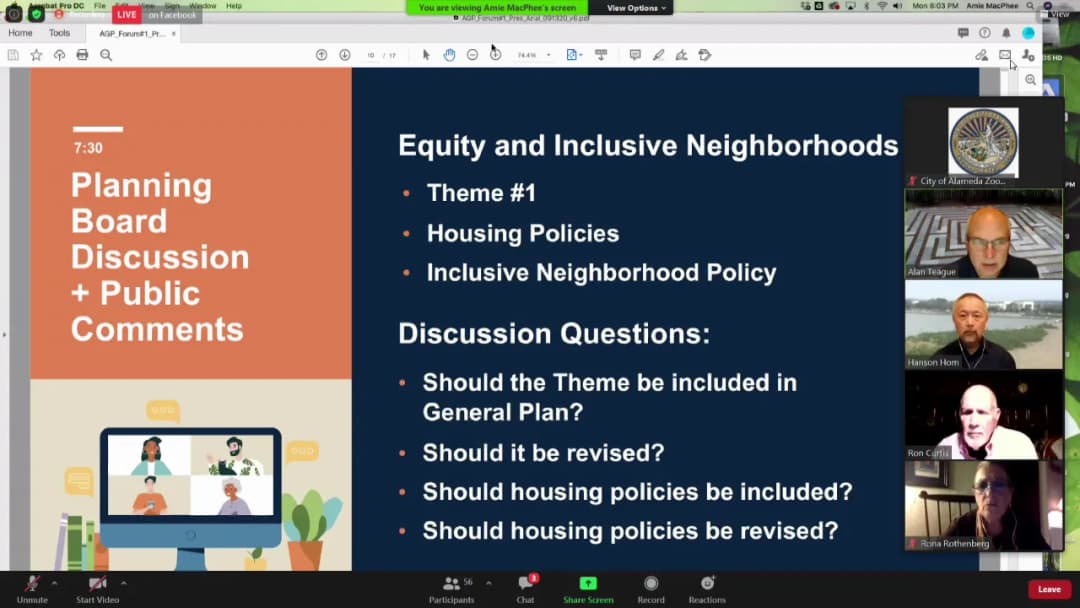
The Planning Board held its first of four public forums on the draft General Plan 2040 update, focusing on Theme 1: Developing a healthy, equitable, and inclusive city. The meeting, conducted via Zoom due to the COVID-19 pandemic, began at 7:00 PM. No formal decisions were made; the forum served to gather public and board input on the theme and associated policies. Staff presented survey results, proposed policies, and answered questions via chat. The board discussed tensions between housing density and neighborhood character, the need for clearer definitions, and improved outreach. Public comment included concerns about infrastructure, process transparency, and calls for more precise policy language. Public Comments & Testimony - Betsy (Matheson): Recommended determining actual existing density of every residential neighborhood before making changes, warning that increased density allowances could incentivize demolition of existing low-income housing. - David Burton (former planning board member): Suggested restating the four themes in plain language (e.g., “Everyone Belongs” for Theme 1) and emphasized that all policies must consistently reinforce these themes. - Jay Garfinkel: Expressed concern that the process was rushed, that not all residents received notice, and that infrastructure (e.g., traffic, bridges) should be addressed before adding housing. Opposed deferring to regional housing needs, comparing it to unfairly redistributing resources. - Dolores Kelleher (AAPS member): Called for a more robust, multi-step public process with detailed definitions and discussion of unintended consequences; suggested extending the timeline to build trust. - Roland Enkel: Raised health concerns about 5G antennas being installed on the island without health studies, urging the city to include 5G regulation in the general plan’s health considerations. - Rashid Shabazz (urban planning student and Alameda resident): Stressed the need for clear definitions of equity and inclusion, highlighted the legacy of racial segregation, and advocated for policies that preserve affordable housing and enable right of return for displaced residents. - Dori Miles (AAPS member): Supported the AAPS letter, cited technical difficulties joining the Zoom meeting, and argued that infrastructure (sewer, power grid) must be addressed before adding housing. Used Fort Lauderdale’s sewer crisis as a cautionary example. - Savannah Cheer: Thanked the board for the forum, emphasized the importance of including public health (e.g., air quality, stress from poverty) in equity discussions, and urged outreach to underrepresented groups. - Christopher Buckley (AAPS member): Requested clearer communication of survey deadlines, suggested alternative means (paper surveys) for those without digital access, questioned how form-based codes would interact with state density bonus law, and asked for a more open, interactive forum format. - Joyce Boyd (AAPS board member): Supported the AAPS letter, praised board comments, and asked if the Historical Advisory Board would provide input on the general plan. Discussion Items - Staff Presentation: Andrew Thomas (Planning Director) introduced the general plan update process, noting that the draft is early and no decisions were final. He presented survey results showing that about 60% of respondents agreed Alameda is a safe and healthy city for everyone, while nearly a third disagreed, with youth and people of color disproportionately in the latter group. Key policies discussed included: housing goals H1, H2, H3 (housing for all income levels); land use policy LU1 (complete and equitable neighborhoods); LU14 (regional coordination on climate change); and LU17 (focusing new housing in priority development areas like Alameda Point and the Northern Waterfront). Staff acknowledged the need for better outreach to underrepresented demographics and neighborhoods. - Planning Board Discussion: - Board Member Sahaba: Emphasized the importance of neighborhood-level nuances and linking housing to other community elements for sustainable growth. - Board Member Ruiz: Supported the theme but warned against broad wording that could have unintended consequences; suggested tabling site-specific housing discussions until after Measure Z election results. - Board Member Rothenberg: Noted that economic resilience is somewhat buried in the text and should be explicitly tied to equity; questioned whether density assumptions hold post-COVID. - Board Member Hom: Praised the draft’s comprehensiveness but highlighted a tension between Theme 1 (inclusive density) and Theme 3 (historic character), calling for more refinement. He also expressed concern that the term “affordable housing” carries misconceptions and that community outreach is itself an equity issue. He noted that transportation policies, like congestion pricing, raise equity concerns for low-income commuters. - Board Member Curtis: Cautioned that vague generalities fuel cynicism; advocated for precise, neighborhood-specific policies to build credibility. He also raised the need to study infrastructure capacity (emergency vehicle access) before adding units. - President Teague: Voiced support for the theme but requested that language like “provide” be changed to “encourage” or “support” since the city does not build housing directly. He also urged inclusion of protections against discrimination based on sexual orientation and gender identity, and asked that future drafts address air quality and heat issues. - Public Questions via Chat: Staff answered several questions, including clarification that ADUs count toward regional housing need, that the city will likely meet its total housing goals but not affordable housing goals, and that maximum densities will be defined in the second draft after input from stakeholders and Measure Z results. Key Outcomes - No formal votes or decisions were taken; this was a public input forum. - Staff will compile all public comments (chat, verbal, surveys) and board input to refine the draft general plan. - The next community forum (October 12, 2020) will focus on Theme 3: Preservation and enhancement of Alameda’s unique historic neighborhood character. - A second draft of the general plan is expected in spring 2021, followed by planning board public hearings and eventual city council adoption. - Staff will consider adjusting the forum format to allow more open discussion, as requested by multiple speakers. - The outreach plan will be expanded to include youth, lower-income residents, and underrepresented neighborhoods (e.g., South Shore, Bay Farm).
The Alameda Planning Board held a special virtual meeting on Monday, August 17, 2020, via Zoom, to consider several significant development applications. The meeting was called to order at 7:06 PM and included public comment, four regular agenda items, and administrative actions. Key decisions included approval of a 586-unit affordable housing development (North Housing), a cannabis retail dispensary, and a mixed-use commercial/residential project, while a rezoning item was deferred due to time constraints. Oral Communications (Non-Agenda) - Several residents of the Marina Village area spoke about the potential purchase of the Marina Village Inn by Alameda County for use as a homeless residence or SRO. Speakers included Nancy Schimmer, Thomas Sharon, Tiffany Lawrence, Steve McCessle, Bob Myscheck, and Benjamin Yamonica. They expressed support for the county's current operation but requested that the city enforce good neighbor policies, use permits, and CC&Rs if the purchase proceeds. Planning Director Andrew Thomas stated that staff had not yet been contacted by the county but would follow up and keep the community informed. Consent Calendar - No items were on the consent calendar. Discussion Items 7-A: North Housing Development Plan and Tentative Map (501 Mosley Avenue) - The Planning Board held a public hearing on the application by the Alameda Housing Authority for a development plan, density bonus, street naming, and tentative map for up to 586 housing units on 12.19 acres. The project is eligible for streamlined ministerial review under SB 35 (Government Code Section 65913.4). - Staff (Alan Tai) presented the proposal, highlighting the site plan, street connections, building heights (three to five stories), and a density bonus waiver for bicycle parking (converting per-unit spaces to square footage). The housing authority also requested an increase in lot coverage from 50% to 80% to allow for wrap buildings and improved design. - Public comments: Jay Garfinkle expressed concerns about the vagueness of approvals and the lack of detailed parking and bike data. William Smith and Josh Care spoke in support, emphasizing the need for affordable housing and the project's alignment with environmental and equity goals. - Board members asked questions about parking, bicycle facilities, street design, and the density bonus process. The board voted unanimously to approve the development plan, density bonus, street name (Mabuhe Street), and to recommend the tentative map to the City Council. 7-B: Use Permit and Design Review – 2416 Lincoln Avenue (Alameda NUG Shop) - The board considered a use permit and design review for a cannabis retail dispensary at 2416 Lincoln Ave. The applicant, NUG, proposed interior and exterior alterations, including demolition of a rear garage and exterior staircases, and creation of a five-space parking lot. - Staff (David Sablon) noted this would be the fourth and final dispensary allowed under city regulations. Public comments included strong support from the Alameda Chamber of Commerce, Downtown Alameda Business Association, local businesses (Daisy's, Spice Coma), and Alameda Meals on Wheels (which would receive 1% of gross revenue). A few residents opposed the project, citing concerns about traffic, hours, and proximity to sensitive uses. - Board discussion addressed security, hours of operation (applicant initially requested 9 AM–10 PM; staff recommended 9 PM), parking, and design completeness. The board approved the project with conditions: extension of hours to 10 PM, addition of a tree, extension of fencing, staff review of lighting and landscaping, and improved signage/marking for the driveway. - The motion passed unanimously (5-0, with Board Member Curtis's vote later recorded as yes). 7-C: Design Review, Use Permit, and Parking Reduction – 1820 Park Street - The board reviewed a proposal to add a three-story, 2,723-square-foot addition to an existing 1,750-square-foot commercial building, creating a mixed-use building with office and one residential unit. The project required a use permit for ground-floor office, design review, and a parking reduction (from 9 required spaces to 0). - Staff (Henry Dong) presented the design, emphasizing the zero setback, brick facade, and pedestrian orientation. Public comment was minimal; no one spoke during the public hearing. - Board members raised concerns about parking availability, the adequacy of TDM measures, and incomplete design details (lighting, landscaping, elevations). Board Member Curtis and President Teague voted against, citing parking and site constraints. The motion to approve with conditions (including completing design details and extending TDM to visitors) passed 4-2 (Hom, Ruiz, Rothenberg, Saheba in favor; Curtis, Teague opposed). 7-D: Mitigated Negative Declaration and Rezoning – 2350 Fifth Street - This item was deferred to a future meeting due to time constraints. The board voted to continue it and not take it up that evening. Key Outcomes - Approved (unanimous): North Housing Development Plan, density bonus, street name, and tentative map (recommendation to City Council). The project will include up to 586 rental units, with a mix of supportive, senior, and mixed-income housing. - Approved (unanimous): Use permit and design review for Alameda NUG Shop cannabis dispensary at 2416 Lincoln Ave, with conditions including extended hours to 10 PM, enhanced security, fencing, a tree, and staff review of lighting/landscaping. - Approved (4-2): Design review, use permit, and parking reduction for 1820 Park Street, with conditions to complete design details and expand TDM measures to visitors. - Deferred: Rezoning and Mitigated Negative Declaration for 2350 Fifth Street to a later meeting. - Approved (unanimous): Draft minutes from March 9, 2020. Staff Communications and Board Direction - Staff announced upcoming public workshops on the General Plan, to be held at the first meeting of each month from September through December 2020. - Board members requested staff to: (1) bring zoning code amendments to encourage housing development, (2) limit ministerial review items on future agendas, and (3) ensure applicants provide complete submittals and adhere to time limits for presentations (set at 10 minutes for applicants). - The meeting adjourned at approximately 11:30 PM.
The Alameda Planning Board met on June 22, 2020, at 7:00 PM (agenda time) via teleconference due to the COVID-19 emergency. The board approved a temporary outdoor use permit on consent, granted two cannabis retail dispensary use permits (one on Park Street, one on Webster Street), and recognized outgoing board member Jeffrey Kavanaugh. President Ron Curtis also stepped down, handing the virtual gavel to Vice President Alan Teague. Note: The transcript timestamp indicates 15:15 UTC (8:15 AM PDT), which conflicts with the agenda's 7:00 PM start time; this discrepancy is recorded but not resolved. Consent Calendar - Item 6-A – Conditional Use Permit for Temporary Outdoor Commercial Use During COVID-19: Approved unanimously (7-0) after a public hearing was opened and closed with no speakers. The permit allows temporary use of privately owned outdoor spaces, parking lots, city sidewalks, and on-street parking in commercially zoned districts. All received correspondence was in favor. The staff confirmed the public hearing requirement was met. Public Comments & Testimony - Item 7-B (1222 Park Street): No public speakers during the hearing, but written comments from the Alameda Business Association expressed support. Board member Rothenberg raised concerns about proximity to Jackson Park and potential cannabis litter; the applicant and staff addressed the distance requirements and security protocols. - Item 7-C (1616 Webster Street): No public speakers during the hearing. A pre-recorded video from community supporters (including the UFCW union and local business leaders) highlighted the applicant's local roots and community investment. Discussion Items - Item 7-A – Development Agreement Annual Reports: Continued to July 27, 2020; no discussion. - Item 7-B – Use Permit for Park Social, LLC (1222 Park Street): Applicant proposed a cannabis retail dispensary with off-site delivery in a former diner space. Key points: no on-site consumption (condition 1 prohibits a smoking lounge), interior modifications with a lobby and VIP education area, and window screening for the sales area. The board discussed security, shoulder-tapping prevention, and the applicant's plan to maintain transparency on the left side of the facade. The use permit was approved 6-1 (Board Member Rothenberg dissenting). - Item 7-C – Use Permit for Alameda Patients Group (1616 Webster Street): Applicant proposed a cannabis retail dispensary with off-site delivery. The board discussed window screening, delivery logistics, hours of operation, and concentration of dispensaries (Main Street Supply is 500 feet away). Board Member Ruiz moved to restrict hours from 7 AM–9 PM to 9 AM–9 PM to align with the nearby school (Island High). The board voted 4-3 against the hour restriction (yes: Ruiz, Rothenberg, Hom; no: Kavanaugh, Sahaba, Teague, Curtis). The main motion to approve the use permit with the original 7 AM–9 PM hours passed 6-1 (Board Member Ruiz dissenting). Key Outcomes - Item 6-A: Consent calendar approved unanimously (7-0). - Item 7-B: Use permit for 1222 Park Street approved 6-1 (Rothenberg nay). Conditions include prohibition of a smoking lounge, adherence to the good neighbor policy, and staff review of window screening. - Item 7-C: Use permit for 1616 Webster Street approved 6-1 (Ruiz nay). Hours remain 7 AM–9 PM. A subsequent motion to revise hours to 9 AM–9 PM failed 4-3. - Board Leadership Transition: President Curtis stepped down; Vice President Teague assumed the presidency. The board adopted a resolution honoring outgoing board member Jeffrey Kavanaugh for his service since 2017. - Staff Communications: The June 22 meeting was the last before a summer break. The next meeting is scheduled for July 27, 2020. Staff noted that the next RHNA cycle (2023–2030) will require Alameda to plan for 3,500–4,000 housing units, nearly double the previous allocation, and that the City Council is considering a ballot measure to repeal Section 26-1 of the city charter (the multifamily housing prohibition).
The Planning Board met virtually on June 8, 2020, at 7:00 PM to conduct elections for board officers, hear an appeal of a design review approval for a wellness center at 1245 McKay Avenue, and handle routine consent items. The board unanimously approved the consent calendar, elected new officers for the 2020-2021 term, and denied the appeal, upholding staff’s design review approval. Consent Calendar - Item 6-A: Street Naming for Alameda Landing Waterfront Residential Development – The board approved eleven street names from the Official Street Names List for streets within the approved Alameda Landing development at 2800 Fifth Street. The action was exempt from CEQA. Motion passed unanimously. Board Elections (Regular Agenda Item 7-A) - The board held elections for the term July 1, 2020 to June 30, 2021. A nomination for Jeff Cavanaugh as vice president was withdrawn after he announced he would be leaving Alameda. Ashish Saheba was nominated and elected vice president (vote: 6-0 with one absent). Alan Teague was nominated and elected president (vote: 6-0 with one absent). The election was conducted despite staff’s initial suggestion to table due to an absent member; the board chose to proceed. Appeal of Design Review (Regular Agenda Item 7-B) - Project: 1245 McKay Avenue – Rehabilitation of a 50,517-square-foot existing building for use as a senior convalescent/wellness center by Alameda Point Collaborative (APC). Staff had approved design review on March 16, 2020; appellant John Healy appealed on March 26, 2020. - Staff Presentation: Henry Dong presented the three findings for design review: consistency with General Plan and zoning, appropriateness for the site, and visual compatibility. Staff found the appeal raised no substantive architectural arguments and rehashed issues previously decided by the City Council and voters. Staff recommended denial of the appeal. - Appellant (John Healy): He argued that the process had not followed legal requirements, including historical preservation review and state licensing. He requested equal application of the law and expressed concern about toxic contamination and financial viability. - Applicant (Doug Biggs, APC): Responded that the design review was ministerial, the project followed all legal steps, and the appeal was an attempt to delay needed services for unhoused seniors. He emphasized the project preserves the existing building. - Public Comments: 94 written comments were received; over three-quarters supported the project. Oral comments read into the record included: Rosalind DeFortuna (opposed – cited density, parking, toxic contamination), League of Women Voters (supported), Harvey Rosenthal (opposed – alleged bait-and-switch on housing), Toba Fry (supported), Laura Gamble (supported), and Zach Bulland (supported). - Board Deliberation: Board members agreed the appeal did not meet the criteria for design review. Member Teague noted a phrasing issue in finding one (about architectural compatibility) and moved to strike that clause. City Attorney confirmed the board’s authority to make the findings and that other issues (hazardous materials, licensing, budget) were outside the scope of design review. - Vote: Motion to deny the appeal and uphold staff’s design review approval with the removal of the clause “and the proposed physical improvements to the building are architecturally compatible with the building existing architectural style” from finding one. Passed unanimously (6-0, one absent). Key Outcomes - Board Elections: Ashish Saheba elected Vice President, Alan Teague elected President for the 2020-2021 term. - Appeal Denied: The board denied the appeal of the design review for the McKay Avenue wellness center, allowing the project to proceed with the noted correction to the findings. - Minutes Approved: The draft minutes from February 24, 2020, were approved with a minor correction, with one abstention (member Rothenberg who was not present at that meeting). - Next Meeting: Scheduled for June 22, 2020, which will be Jeff Cavanaugh’s last meeting. Items include a use permit for commercial COVID-19 response and two use permits for cannabis dispensaries.
The Alameda Planning Board met on Monday, May 11, 2020, at 7:00 PM via teleconference under Governor's Executive Order N-29-20. The board conducted a public hearing on a Universal Design Ordinance waiver for the Boatworks project, held a study session for the North Housing proposals, approved meeting minutes, and received staff communications. Consent Calendar - No items were placed on the consent calendar. Public Comments & Testimony - For the Boatworks public hearing, no oral public comments were received. - For the North Housing study session, a written comment from Courtney Shepler, a homeowner in Alameda Landing, was read into the record. She expressed concerns about the project's density, insufficient parking and guest parking, enforcement of parking provisions, and the lack of communication and agreement with the Alameda Landing HOA regarding use of the private bike path as an amenity. Discussion Items Item 7A – Universal Design Waiver Request (Boatworks, 2229-2235 Clement Avenue) Planning Director Andrew Thomas presented the staff report. The applicant, Boatworks, LLC, requested a waiver from Alameda Municipal Code Section 30-18 (Universal Design Ordinance) for a previously approved 182-unit waterfront development. Due to site grading constraints (floodplain elevation, sea level rise, sewer/stormwater drainage) and the townhome-style housing type, only 28 of 182 units (15%) would meet universal design requirements (30% required) and 91 units (50%) would meet visitability requirements (100% required). The project would provide accessible routes to the waterfront open space, a new accessible sidewalk on Oak Street, and an accessible waterfront clubhouse and play equipment. The Disability Commission opposed the waiver and provided a list of potential conditions. Staff recommended approval with additional conditions, noting that full compliance would likely require a complete redesign, which could conflict with state density bonus law and the Housing Accountability Act. Board members expressed disappointment at the low percentages but acknowledged the genuine site constraints. Vice President Teague proposed a list of adaptability measures (lever handles, reinforced walls, adjustable shelving, etc.) to apply to all units. The applicant agreed to most items but flagged four or five needing further study: automatic stove shut-off, slip-resistant floors, low-glare counters, tactile edge detection, and 32-inch door clearances. The board crafted a motion to approve the waiver with conditions: all units must be adaptable per Teague's list, with uncertain items to be resolved during design review; the developer shall endeavor to make all other units visitable via front door or garage and provide detailed grading plans for units not meeting visitability during design review. Item 7B – North Housing Study Session (300-501 Mosley Avenue) Planner Alan Tye presented an overview of two residential proposals on the 14-acre former Navy housing site. Habitat for Humanity proposes up to 68 units of affordable ownership housing on a 2-acre parcel (100% affordable at or below 80% AMI). The Alameda Housing Authority proposes up to 580 units of mixed-income, permanent supportive, senior, and family housing on the remaining 12 acres, phased over 10 or more years. Both projects intend to qualify for SB 35 streamlined ministerial review. Board members asked about road modifications, unit distribution, CEQA exemption, Paseo design and fencing, density bonus eligibility, financing, and placement of support services. Several members encouraged broader income mixing and removal of the fence along the Paseo. No formal action was taken; the item was a study session. Key Outcomes - Approved the Universal Design Ordinance waiver for Boatworks with added conditions regarding adaptability, visitability, and design review follow-up. The vote was unanimous among board members present (5-0). - Held the North Housing study session with no formal action. - Approved the February 10, 2020 meeting minutes with a correction (5-0), changing “direction to refine an amendment” to “direction to refine and amend.” - Staff announced that the next regular meeting on May 25, 2020 (Memorial Day) is canceled; the next meeting is scheduled for June 8, 2020.