Browse by city
Date range
Search help

Search titles, summaries, topics and stored transcripts together. Keywords may match separately; put the whole query in double quotes for a phrase. Matching follows word analysis, so punctuation is not exact. Both dates are included. Documents are not searched.

SHOWING 51–60 ENTRIES
51
MAY 6, 2026 · ALAMEDA, CALIFORNIA · CITY COUNCIL
Alameda City Council Meeting - May 6, 2026: Bike Share Pilot and Lease Amendment Approved

The Alameda City Council met on May 6, 2026, at 8:30 PM and adjourned at 12:33 AM on May 7. The council unanimously approved a three-year bike share pilot program for West Alameda and a lease amendment for temporary electric vehicle storage at the NCNL terminals. Public comments were heard on both items. Public Comments & Testimony - Bike Share Pilot Program: An unnamed speaker highlighted the lack of bike infrastructure in the Webster Business District and suggested station locations at 5th and 9th Streets, and fixing the gap at Singleton Avenue. They also proposed a collaboration with Bay Wheels for a bike-to-work week sale. - Denise Trapinier (Bike Walk Alameda): Expressed strong support for the bike share pilot, noting that many Alamedans in multi-story buildings lack secure bike parking, and that the program would reduce car usage, especially during the OAP project. She emphasized regional connectivity and urged adoption of staff's recommendation. - Ars Singh Hothi (General Manager, Alameda Transportation Management Association): Spoke in strong support, stating the public good outweighs the cost, and that bike share closes the last-mile gap for transit users. He highlighted integration with the regional bike share network (San Francisco, Berkeley, Oakland, San Jose) and seamless intermodality. - Drew Record (Tasting Room Manager, St. George Spirits): Supported the pilot, noting the lack of robust transportation options and that bike share would provide last-mile connectivity from the ferry to businesses on the west end. - Lease Amendment (7D): Denise Chapman (Bike Walk Alameda) expressed support for the electric vehicle storage but raised a concern about the planned closure of a driveway that provides pedestrian and bicycle access to the waterfront. She noted the Planning Board had recommended improving pedestrian access instead of closing it for two additional parking stalls. Discussion Items - Bike Share Pilot Program (Item 7C): Staff presented a recommendation to endorse a three-year bike share pilot in West Alameda. Council members discussed and supported the program. Vice Mayor Prior moved to approve, seconded by Councilmember Bowler. The motion passed unanimously. - Lease Amendment (Item 7D): Staff recommended adopting a lease amendment with Bay View Landing LP for approximately 6.4 acres of city-owned public trust tidelands at 1527 Buena Vista Avenue (NCNL terminals) to allow temporary storage of electric vehicles, consistent with a use permit approved by the Planning Board in March. The amendment requires the lessee to pay the city approximately $4,500 per month. Councilmember Jensen moved to approve, seconded by Councilmember Bowler. The motion passed unanimously. Key Outcomes - Bike Share Pilot Program: The council unanimously approved a motion to endorse the program concept for a three-year bike share pilot in West Alameda, supporting staff's recommendation. - Lease Amendment (7D): The council unanimously approved the introduction of an ordinance authorizing the interim city manager to execute a third amendment to lease with Bay View Landing LP for approximately 6.4 acres at 1527 Buena Vista Avenue (NCNL terminals) for temporary electric vehicle storage, with a monthly payment of $4,500 to the city. The use permit conditions from the Planning Board apply, including improvements to the intersection of Clement and Entrance Road.

ACTIVE TRANSPORTATION 64% · ENGINEERING AND INFRASTRUCTURE 23% · ECONOMIC DEVELOPMENT 13%
52
MAY 6, 2026 · ALAMEDA, CALIFORNIA · CITY COUNCIL
City of Alameda City Council Meeting - May 6, 2026: Budget Workshop, Public Hearings, and Key Decisions

The meeting began with a closed session at 8:15 PM, followed by a special joint meeting of the city council and successor agency, a comprehensive budget workshop, and the regular city council meeting. The meeting adjourned at 12:33 AM on May 7, 2026. Key topics included the fiscal year 2026-27 mid-cycle budget update, an appeal of the Planning Board's decision regarding outdoor amplified music at Park Station, endorsement of a bike share pilot program, and approval of a lease amendment for electric vehicle storage at NCNL Terminals. Consent Calendar - Designation of negotiators for Building 11 at 1190 West Tower Avenue (closed session item) was approved with three affirmative votes and two absent. - Minutes from the previous successor agency meeting were approved. - Multiple consent calendar items were approved en bloc: 5C (annual ALPR data report), 5J (vehicle purchases including Rivian EVs), 5P (partial exemption from public art ordinance for McKay Respite Center, reducing fee from $244,117 to $100,000), 5V, 5W, 5X (public hearings for CDBG and business improvement areas), and others. Public Comments & Testimony - Closed Session Comment: Eight speakers (Tamara Sabella, Cameron Warren, Stephanie Warren, Iris Mitchell, Robin Lynn Wilson, John Risenweber, Chris Velutha Call, Manny Velutha Call, Caroline Brossard) spoke in strong support of Greenway Golf at Corica Park, highlighting inclusive programs, youth development, veteran support, and community use statistics (over 124,000 hours of shared use, 249 days activated in 2025, 90% youth from underserved communities). - Budget Workshop: One public comment: Katherine Schwartz (CEO of Alameda Family Services) advocated for renewing and expanding the library social worker contract, citing 107 therapeutic interventions and 53 resource referrals since December 2025. - Oral Communications: Tiffany Southwick (owner of Mary's Mercantile) requested action on public access closures affecting Grand Marina businesses. Josh Altieri (Housing Authority) reported on housing programs and upcoming affordable housing opportunities. Corinne Kirschbaum demanded an independent investigation into city officials' conduct regarding homeless services contracts. - Park Station Appeal: 29 speakers presented. Neighbors (Rebecca Davis, Kevin Durfee, Ann Argurio, Jeff Robus, etc.) described noise impacts (85 dB at residential receptors, difficulty sleeping, inability to enjoy homes). Supporters (Melody Tebow, Grant Uskin, owners; community members like Jen Denton from GrannyCon, Joseph Osborne, musicians, business advocates) emphasized Park Station's role in community vibrancy, economic vitality, and willingness to compromise. - Bike Share Pilot: Four speakers (Warren Linney, Denise Trepignier, Arshing Hothi, Drew Record) expressed strong support for the Bay Wheels pilot, noting connectivity benefits and first/last mile solutions. - NCNL Lease: One speaker (Denise Trepignier from Bike Walk Alameda) supported the EV storage lease but raised a concern about closing a pedestrian/bicycle access point. Discussion Items - Fiscal Year 2026-27 Mid-Cycle Budget Update (Item 3B): - Staff presented a structurally tight budget with a projected ending residual fund balance of $9.69 million above the 25% reserve policy. New costs include a $5 million increase for the Aquatic Center and potential impact from a November ballot measure on transfer tax. - Department presentations highlighted needs: police officer unfreezing (4 positions), IT cybersecurity tools ($145K annually for data protection and preparedness), library social worker ($155K), safety officer ($197K), public works division manager, parking technician (revenue-supporting), and various position upgrades. - Council debated trade-offs. Alternative recommendations were presented to save $841,440 by deferring most new positions and upgrades except for the four police officers and the parking technician. - After discussion, Vice Mayor Pryor made a motion to adopt the staff alternatives with modification: the safety officer changed from contracted to part-time position. The motion passed 3-2 (Mayor Ashcraft, Vice Mayor Pryor, Councilmember Bowler in favor; Councilmembers Jensen and Daysog opposed). Councilmember Daysog expressed concern about limiting sworn officer hiring to 76 instead of the budgeted 88. - The city attorney's budget was bifurcated due to a recusal. It was approved unanimously later in the meeting. - Appeal of Planning Board Decision on Park Station (Item 7A): - Staff recommended upholding the appeal, finding that the noise ordinance does not authorize the 85 dB limit. Recommendation: modify the use permit to require compliance with the noise ordinance (ambient noise standard) and direct staff to review the noise ordinance. - Appellants (Rebecca Davis and Kevin Durfee) argued the noise violated the ordinance and CEQA, and caused significant disruption to residents. - Applicants (Park Station owners) proposed a compromise of 75 dB indoor level, noting a weekend test at 75 dB resulted in 55-58 dB at the nearest residence. They requested an interim period during noise ordinance review. - After hearing 29 public comments, Vice Mayor Pryor moved to adopt the staff recommendation (revised resolution with conditions including compliance with noise ordinance, 4-hour event limits, sound monitoring, and a 4-month review by the Planning Board). The motion passed unanimously. - Bike Share Pilot Program (Item 7C): - Staff proposed endorsing a three-year pilot in West Alameda using the Bay Wheels regional program, funded by OAAP mitigation. Eight docks with 52 e-bikes, community outreach planned. - Council endorsed the concept, authorizing staff to execute agreements. Motion passed unanimously with support for interoperability and flexibility in future provider selection. - Lease Amendment for EV Storage at NCNL Terminals (Item 7D): - Staff recommended approving a third amendment to lease with Bay View Landing LP for temporary EV storage on 6.4 acres of public trust tidelands. Rent: $4,500/month. Planning Board use permit included conditions for intersection improvements and no on-street parking. - Motion to approve passed unanimously. Key Outcomes - Budget Direction: Approved the staff alternatives with the safety officer changed to part-time. The general fund excess residual is expected to increase to approximately $10.5 million. Motion passed 3-2. - City Attorney's Office Budget: Approved unanimously (with recusal). - Park Station Appeal: Unanimously upheld the appeal, adopting the revised use permit conditions requiring compliance with the city's noise ordinance (ambient noise standard), limits on event frequency and hours, sound monitoring equipment, and a four-month review by the Planning Board. - Bike Share Pilot: Unanimously endorsed the program concept and authorized staff to execute necessary agreements. - NCNL Lease Amendment: Unanimously approved the third amendment for temporary EV storage.

FISCAL SUSTAINABILITY 15% · PROCEDURAL 14% · PUBLIC SAFETY 10% · ENVIRONMENTAL PROTECTION 9%
53
MAY 5, 2026 · ALAMEDA, CALIFORNIA · CITY COUNCIL
Alameda City Council Meeting - May 5, 2026: Budget Workshop & Park Station Appeal

The Alameda City Council held a regular meeting on May 5, 2026, beginning at 1:00 PM (closed session) and reconvening for the regular agenda. The meeting included a budget workshop for the FY 26-27 mid-cycle budget, a public hearing on the appeal of a use permit for amplified outdoor music at Park Station Brewery, and several other routine and consent items. The council deliberated on budget requests from multiple departments, heard extensive public testimony on the Park Station noise dispute, and voted on a number of items. Consent Calendar - Approved the consent calendar (including designating negotiators for building 11 at 1190 West Tower Avenue) with three ayes and two absent, and later approved the regular consent calendar (items 5A-5X) with Councilmember Bowler abstaining from items 5O and 5X. Public Comments & Testimony - Non-Agenda Oral Communications: Residents spoke on various topics. Tiffany Southwick, owner of Mary's Mercantile at Grand Marina, requested urgent city action to address public access closures affecting her business. Josh Altieri of Alameda Housing Authority provided updates on housing programs and customer service survey results. Corinne Kirschbaum demanded an independent investigation into the mayor's conduct related to homeless services contracts. Kathleen Von Martins spoke about cybersecurity and urged the city to harden its systems. - Appeal of Park Station Use Permit: 29 speakers addressed the appeal. Appellants (represented by Rebecca Davis and Kevin Durfee) argued that the amplified outdoor music at Park Station violates the city's noise ordinance and CEQA, causing sleep disruption and an inability to enjoy their homes. Applicant Melody Taber and Grant Uskins (owners of Park Station) proposed a compromise 75 dB limit, noting that their Saturday bluegrass event at 75 dB measured 55-58 dB at the appellant's residence. Numerous community members, including Kathy Weber (Downtown Alameda), Bobby Centurion (neighbor of 36 years), Joseph Ozzie Osborne (Ozzy's Music Academy), and several residents, spoke in support of Park Station, emphasizing its role as a community gathering space and economic asset. Multiple neighbors like Ann Argyrio and Jeff Robus testified that the music was intrusive even with windows closed. Discussion Items - Mid-Cycle Budget Workshop (FY 26-27): The council heard a 45-minute presentation from Finance Director Ross McCarthy, Budget Manager E. Kat Burton, and department heads. The city faces a structural deficit with expenditures growing faster than revenues. The originally proposed residual fund balance of $9.69 million is threatened by a $5 million cost increase for the Aquatic Center, economic uncertainty, and a potential November ballot measure that could reduce transfer tax revenue. Staff presented alternatives to reduce new spending and preserve fund balances. Councilmembers debated priorities including police hiring (lifting the freeze from 72 to 76 sworn officers), adding a library social worker, cybersecurity tools, a part-time safety officer, and other departmental requests. - City Attorney's Office Budget: The council considered and approved the city attorney's budget, including a $40,000 transfer from the general fund to support housing voucher programs (Section 8) fee waivers. Assistant City Attorney Julia Gonzalez highlighted the office's national award from the American Bar Association for advocacy on behalf of Barn Hill Marina residents. - Appointment of City Manager: The council approved an agreement appointing Jared Jerry Bowden as City Manager effective June 30, 2026, with a modified compensation package (1% salary increase, reduced deferred compensation from 3% to 1%, reduced auto allowance from $550 to $400 per month, and removal of the word "facilitated" from the evaluation section). The vote was unanimous. - Park Station Appeal: After hearing public testimony, the council discussed staff's recommendation to uphold the appeal and require compliance with the city's existing noise ordinance (ambient noise standard), rather than the 85 dB limit previously granted. The council also discussed a future review of the noise ordinance itself. The council voted unanimously to direct staff to implement the new conditions and return for review in four months. Key Outcomes - Budget Direction: The council voted 3-2 (Mayor Ashcraft, Vice Mayor Pryor, Councilmember Bowler in favor; Councilmembers Jensen and Daysog opposed) to adopt the mid-cycle budget with staff's proposed alternatives, including: unfreezing four police officer positions, making the HR safety officer a part-time position, adding a library social worker, funding for cybersecurity tools, a permit system audit, and other adjustments, while deferring several requested new positions and upgrades. The vote preserved an estimated $10.5 million in excess reserves. - City Manager Contract: Approved unanimously with amendments reducing deferred compensation to 1% and auto allowance to $400/month. - Park Station Appeal: Upholds the appeal, requiring outdoor amplified music to comply with the city's noise ordinance (ambient noise level) instead of the previously allowed 85 dB. The council also directed staff to evaluate and potentially update the city's noise ordinance, with a check-in with the Planning Board in four months.

NOISE ORDINANCE 27% · PROCEDURAL 13% · FISCAL SUSTAINABILITY 12% · PUBLIC SAFETY 7%
54
APR 29, 2026 · ALAMEDA, CALIFORNIA · CITY COUNCIL
Special City Council Closed Session Meeting - April 29, 2026

The Alameda City Council held a special closed session meeting on April 29, 2026, at 5:30 PM in City Hall. The sole purpose was to consider the appointment/hiring of a City Manager under Government Code § 54957. The meeting included roll call, public comment on closed session items (none), closed session deliberations, and an announcement of action taken. Public Comments & Testimony - No public comments were made on closed session items. Discussion Items - The council adjourned to closed session to discuss Item 3-A: Public Employee Appointment/Hiring for the position of City Manager. Key Outcomes - After returning from closed session, the Mayor announced that by a vote of 3 in favor, 1 abstention, and 1 absent, the City Council voted to provide direction regarding the City Manager appointment. No further details on the direction were disclosed.

PROCEDURAL 100%
55
APR 29, 2026 · ALAMEDA, CALIFORNIA · CITY COUNCIL
Social Service Human Relations Board Meeting – April 29, 2026 (Date Discrepancy with Transcript)

Note: The meeting date is listed as April 29, 2026 per instruction, but the transcript indicates the meeting occurred on April 23, 2026. This discrepancy is noted here. The Social Service Human Relations Board (SSHRB) convened on April 23, 2026 (per transcript) at 7:07 PM to discuss CDBG funding recommendations, a UC Berkeley partnership for senior volunteer programs, the board's annual scope of work, and updates from task forces. The meeting included public comments, staff presentations, and board discussions, concluding at 8:30 PM. Consent Calendar - Approval of Minutes (March 26, 2026): Unanimously approved by voice vote. All members present. Public Comments & Testimony - Craig Browning (Vehicle Dweller): Expressed concerns about homelessness policies under Trump and Newsom, seeking clearer legal spaces for vehicle dwellers. Mentioned efforts to find semi-permanent parking with resources and noted issues with harassment at Village of Love. Provided video links to board member Gerald Bryant. - Corinne Kirschbaum: Criticized the board for ignoring unhoused voices, accusing members of not reading contracts, reports, or the city's "Road Home" plan. Alleged fraud and cover-up regarding Village of Love funding. Claimed board members publicly insulted her and physically blocked her from a meeting. Said the board is a "wall against the unhoused." Discussion Items - 4A: Fiscal Year 2026-27 CDBG Sub-Recipient Award Recommendation: - Staff (Andre Fairley) presented the draft action plan. The city will receive $1,080,816 in CDBG entitlement funding, a $15,400 reduction (1.4%) from the prior year. Public service providers face about $388 cuts per program (e.g., Alameda Family Services proposed at $20,400). - Board members questioned contingency plans for lower federal allocations, data-sharing processes (quarterly data collection), and the lack of flexible funding for homelessness prevention. Member Samantha Green expressed strong opposition to the BOOST program (technical assistance for child care providers), calling it ineffective. Gerald Bryant emphasized leveraging grants to prevent first-time homelessness. Staff noted that a full review of these programs is due next year. - No formal vote taken; the recommendation will go to City Council on May 5, 2026. - 4B: UC Berkeley Public Health Program Update (Age-Friendly Alameda Volunteer Program): - Board member (identified as Samantha Green) presented a student-designed volunteer program called "Ripple Effects" for adults 55+. The program aims to increase social inclusion through community coordinators, a buddy system for transportation, and volunteer stations at local centers. A short video was shown. Board members praised the program for not requiring new city funds and suggested pairing high school seniors with older adults. No vote needed. - 4C: Discussion of SSHRB Fiscal Year 2026-27 Scope of Work: - Staff (Simone Falls) proposed a revised scope with three subgroups: (1) Funding Review and Recommendations, (2) Program Oversight and Performance, and (3) Community Engagement and Public Participation. The goal is to focus on CDBG grant oversight, policy review, and community needs assessment. - Board members discussed balancing technical work with existing programs like United Against Hate and the Domestic Violence Task Force. Gerald Bryant expressed concern that these human relations programs could be lost if consolidated. Staff emphasized limited staff capacity and the need for board input on funding decisions. The board agreed to review the draft in their existing work groups and aim for approval at the May meeting. No vote taken. - 4D: Work Group Reports: - United Against Hate (Gerald Bryant): Reported on the recent open mic event (poetry, music, spoken word) with youth participation. Noted a national webinar on digital hate and algorithms. Encouraged board to share insights. - Domestic Violence Task Force (Bernie Wolf): Scheduled for May 4, 2026. Awaiting speaker confirmation from Alameda Family Services and APD for latest stats. - Road Home (Samantha Green): Third planning meeting canceled due to accessibility issues; staff will circulate the report for feedback. Upcoming overdose response training for city staff, later to open to the public. - Age-Friendly Survey (Samantha Green): Survey nearing final revisions, targeting mid-to-late May launch (Older Americans Month). Discussed challenges with survey wording and transportation barriers at Mastick Senior Center. - Dignity Village Community Garden: Member Samantha Green is working with 100,000 Trees and a West Oakland co-op to secure supplies for raised beds. Alameda Backyard Growers suggested as a resource. Key Outcomes - CDBG Recommendation: The board reviewed the FY 2026-27 funding plan, which will be forwarded to City Council on May 5, 2026, with a $15,400 reduction and $388 cuts per public service provider. No formal vote was taken by the board. - Scope of Work: The board will discuss the proposed scope of work in current work groups and aim to approve a final version at the May 2026 meeting, with a target to present to City Council in July 2026. - Staff Communications: Scott Means announced the reopening of the Day Center (operated by Restorative Pathways) on April 27, 2026, with a resource fair and voting for a new name. An RFP for residential rehabilitation was released April 14, 2026, with submissions due by May 14, 2026. - Board Communications: Gerald Bryant made a statement urging the board to refocus on work plans and avoid disruptions. Announced the ribbon cutting for Arnold's Place (Crab Cove Alameda Wellness Respite Center) on April 30, 2026, at 3:30 PM. Member Samantha Green noted a city survey on built environment and infrastructure bond planning, with concerns about postal mail access skewing responses.

COMMUNITY ENGAGEMENT 41% · HOMELESSNESS 20% · PROCEDURAL 18% · BUDGET 12%
56
APR 21, 2026 · ALAMEDA, CALIFORNIA · CITY COUNCIL
Alameda City Council Meeting - April 21, 2026: Little League Park MOU, Radium Arts Center, Building 92 Sale, and More

The Alameda City Council met on Tuesday, April 21, 2026, at 7:00 PM. The meeting covered a wide range of items including a contentious discussion on the Alameda Little League (ALL) field use agreement at Little John Park, the approval of a transformative performing arts center at Alameda Point, the sale of a historic warehouse building, and several other routine and policy matters. The meeting was largely civil, with council members emphasizing transparency and community engagement. Consent Calendar - Approved unanimously with one recusal: Councilmember Daysog recused from items 5J (Webster Street Business Improvement Area) due to his property's proximity. The consent calendar included routine approvals and a public hearing on an economic development subsidy for the Oakland Roots and Soul (no public comment). Public Comments & Testimony - Chris Ellsworth (1414 Pacific Avenue) requested the city clean street gutters on Buena Vista Avenue to prevent flooding, noting that street sweeping has been ineffective due to parked cars. - Rachel Kompostavanov (Weston Arts District board) highlighted Arts, Culture, and Creativity Month and thanked city staff for transforming an airplane hangar into a gallery for the Ocean Photographer of the Year exhibition. - Corinne Kirschbaum (recurring speaker) criticized the city's oversight of the Village of Love contract, alleging no financial or performance reports were provided despite millions in public funds, and called for accountability. - Jennifer Radakovich (Rhythmics Cultural Works) thanked the city for an East Bay EDA award and announced the summer Rhythmics in the Parks series. Discussion Items Little John Park – Alameda Little League (ALL) MOU (Item 5D) - Staff presentation: Recreation and Parks Director Justin Long detailed the trial agreement for ALL's majors (ages 10-12) to use Little John Park, including field improvements, fencing, and a parking plan. The MOU was for one year with community meetings held. Concerns included safety, parking, and restricted public access. - Public comment: Neighbors expressed frustration over lack of notice, intimidation at meetings, and the fence effectively privatizing the park. ALL supporters emphasized the need for fields due to school renovations and rising costs, and noted the long history of baseball at the park. - Council discussion: Council members questioned the selection of Little John Park over other sites, the adequacy of outreach, and the impact of the outfield fence. Mayor and council directed staff (with city manager and city attorney) to explore alternative locations and bring findings to the Recreation and Parks Commission before the August fall season. The MOU was not adopted. - Vote: Motion to direct staff passed 4–1 (Councilmember Daysog abstained). The current spring season continues unaffected. Radium Performing Arts Center (Item 7B) - Staff presentation: Walker Toma (Base Reuse and Economic Development) presented a 53,000 sq ft performing arts center on 1.87 acres at Alameda Point, with a $150 million philanthropic budget, a 66-year ground lease, and a purchase option after 10 years of operation. The city would contribute $4.5 million for a new roadway. Community benefits include public access to the lobby and rooftop, discounted tickets, and use of the facility for city events. - Public comment: Overwhelmingly supportive. Speakers included Joe Ernst (developer), parents, arts leaders, and the Chamber of Commerce. One speaker raised concerns about a parking commitment that could hinder future transit-oriented development. - Council discussion: All members expressed strong support, noting the project's transformative potential for Alameda Point and the arts community. Councilmember Daysog praised the permanent public access to the rooftop terrace. - Vote: Unanimous approval (5–0) to adopt the resolution declaring surplus land exemption and introduce the ordinance for the lease option. Restorative Pathways Day Center & Safe Parking (Item 7A) - Staff presentation: Simone Falls (Housing and Human Services) recommended a contract with Restorative Pathways to operate the day center and safe parking program at 431 Stardust Place, following a competitive RFP process. The site reopened after a month-long closure. The contract is for May 1, 2026 – June 30, 2027, with a one-year extension option (total not to exceed $3,022,000). - Public comment: None. - Council discussion: Vice Mayor Pryor commended the thorough vetting process. Councilmembers expressed support for providing services to vulnerable residents. - Vote: Unanimous approval. Sale of Building 92 (Item 7C) - Staff presentation: Nicole Franklin (Base Reuse Manager) recommended the sale of 650 West Ranger Avenue (Building 92) to Earnst Development Partners for $7.825 million (all-cash). The 89,000 sq ft warehouse is vacant and requires renovation. The sale supports the phase two infrastructure loop. The buyer must comply with zoning and CEQA for future use. - Public comment: Christopher Seywald (Radium Presents) spoke in support of the buyer's track record. - Council discussion: Councilmembers noted the buyer's experience with adaptive reuse (e.g., Building 9, 91) and the strategic importance of the sale. - Vote: Unanimous approval, including the surplus land resolution. Nitrous Oxide Ban (Item 5D – separate ordinance) - Staff presentation: Sarah Henry (Communications and Legislative Affairs) presented an ordinance prohibiting the sale and distribution of nitrous oxide (e.g., whippets) by tobacco retailers and convenience stores, citing health and safety risks. The city would become the first in Alameda County to adopt such a ban, effective 30 days after final reading. - Public comment: Rachel Gratz-Lazarus (parent) supported the ban, noting the products' appeal to youth and the city's leadership in public health. - Council discussion: Councilmembers noted the existing state law allowing sales with restrictions, and the new ordinance would ban sales outright. The ordinance includes penalties up to $1,000 and potential business license loss. - Vote: Unanimous to introduce the ordinance. Short-Term Rental Facilitator Ordinance (Item 7E) - Staff presentation: Carlos Figueroa (Revenue Supervisor) explained that SB 346 allows cities to require platforms like Airbnb to provide property-level data (e.g., addresses, TOT remittance) to improve enforcement of the 14% transient occupancy tax. The ordinance does not create new taxes or regulations. - Public comment: None. - Council discussion: Mayor noted the League of California Cities sponsored the bill and that it will help the city capture revenue, especially during the FIFA World Cup in 2026. - Vote: Unanimous to introduce the ordinance. Key Outcomes - Little League MOU: Directed staff to explore alternative fields and bring a report to the Recreation and Parks Commission before August 2026. The current spring season continues under the trial MOU with the fence to be removed outside of active use. - Radium Performing Arts Center: Approved the lease option and surplus land exemption, moving the project forward to fundraising and design. - Restorative Pathways: Authorized the contract for day center and safe parking operations. - Building 92 Sale: Approved the sale to Earnst Development Partners for $7.825 million. - Nitrous Oxide Ban: Introduced ordinance; final adoption expected June 4, 2026. - Short-Term Rental Transparency: Introduced ordinance to implement SB 346. - Council Communications: Councilmembers reported on community events, including the Oakland Alameda Access Project kickoff, the Corica golf tournament, and various arts and history events.

PARKS AND RECREATION 28% · ARTS AND CULTURE 17% · PROCEDURAL 10% · COMMUNITY ENGAGEMENT 10%
57
APR 20, 2026 · ALAMEDA, CALIFORNIA · CITY COUNCIL
Sixth Annual Fair Housing Conference - City of Alameda - April 20, 2026

The City of Alameda hosted its sixth annual Fair Housing Conference on April 20, 2026, organized by the City Attorney's Office. The conference included welcoming remarks from the California Attorney General (via video), Mayor Ezie Ashcraft, and City Attorney Ivan Shen. Expert panelists covered topics including eviction trends, federal fair housing enforcement under the Trump administration, immigrant tenant protections, the use of AI in tenant screening, utility billing via RUBS, and recent California Court of Appeal decisions on rent control. The event also introduced the city's new victim services advocate and announced grant funding for tenant-landlord legal clinics. Public Comments & Testimony - A property manager asked how to handle ICE officers arriving at a property, noting the difference between administrative and judicial warrants. Panelists advised consulting legal counsel and developing an organizational policy, and noted that administrative warrants lack judicial approval. - Another attendee raised the issue of landlords still refusing to accept Section 8 vouchers, despite source of income being a protected class since 2020. The city attorney's office encouraged reporting such cases to investigator Rico. - A tenant expressed concern about affordable housing policies that disadvantage single-person households, including pet restrictions and lack of a second income. Panelists noted that gender was added to fair housing protections in 1974 and referenced California's Unruh Civil Rights Act as a potential tool. - An attendee asked about disparate impact: whether a policy like a no-eviction history rule requires proof of intent. Gary Rhodes explained that disparate impact does not require intent, only that a facially neutral policy has a discriminatory effect on a protected class. - Another attendee asked about RUBS: whether installing individual meters qualifies under a capital improvement plan (CIP) or fair return petition. Ryan Halpern confirmed both are possible but case-specific. Discussion Items - City Attorney Ivan Shen welcomed attendees, highlighted the city's proactive rent control and tenant protection work, and announced a precedent-setting Court of Appeal decision affirming that former military housing is subject to rent control (Carmel Partners v. City of Alameda). He also shared that the rent program will receive grant funding to launch clinic-level services for tenants and landlords, and that program costs have been kept to an average CPI increase of 3.6% since 2022, with no additional fees despite expanded services. - Mayor Ezie Ashcraft spoke about the need for housing production, preservation, and renter protection, and the importance of tenant protections in preventing homelessness. She referenced her role on regional bodies and the passage of Alameda's rental protections in 2016. - Mark Janowitz (East Bay Community Law Center) reported eviction trends in Alameda County: eviction court has at least 50 cases per week, numbers have declined from post-moratorium peaks but remain above pre-pandemic levels. Most evictions are for non-payment of rent, with landlords bearing the burden to prove the lawful amount owed. He also described the network of free legal services (East Bay Community Law Center, Bay Area Legal Aid, Centro Legal, etc.) but noted that resources are insufficient, handling about 500 intake calls per month. - Gary Rhodes (fair housing attorney) discussed the erosion of federal fair housing enforcement under the Trump administration, including staff cuts at HUD, proposed gutting of the disparate impact rule, and the rise of algorithmic tenant screening that can perpetuate historical discrimination. He contrasted the situation in California, which retains strong state and local protections, with states like Missouri where such infrastructure is lacking. He also shared the story of Diane, a black tenant in Kansas City whose housing instability illustrates the cascading effects of discrimination and eviction. - Leah Simon-Weisberg (California Center for Movement Legal Services) covered protections under the Immigrant Tenant Protection Act (ITPA), which prohibits landlords from inquiring about immigration status, disclosing that information, threatening to call ICE, or allowing ICE to enter a unit without a judicial warrant. She described a lawsuit filed in Oakland against a landlord who harassed Latino tenants with threats about immigration status. She emphasized that all tenants, regardless of status, have the same rights under California law, and that education and community support are critical. - Ryan Halpern (Rent Program) presented on RUBS (Ratio Utility Billing System), a method for splitting shared utility bills among tenants. He outlined three policy options under consideration: 1) stronger disclosure and dispute rules; 2) a partial ban on new tenancies; 3) a full ban on RUBS for regulated units, requiring utilities to be folded into rent. A community survey is open to gather input before potential city council action before summer 2026. - Bill Chapin (Rent Program Director) analyzed two recent Court of Appeal decisions. The first (from Pasadena) held that large rent increases on units exempt from local rent control (e.g., single-family homes, condos, buildings less than 15 years old) are not considered constructive evictions, thus removing relocation payment requirements. The second (the Alameda case) confirmed that former military housing renovated and re-rented is subject to rent control, overturning a lower court ruling. He noted that 13% of Alameda's rental units (about 2,000 households) are not covered by local or state rent caps, though state law requires 90 days' notice for rent increases over 10%. - Val Sendel was introduced as the city's first victim services advocate, funded by a state grant and council support, to assist victims of crime with court accompaniment, restraining orders, and resource referrals. Key Outcomes - The Court of Appeal's decision in Carmel Partners v. City of Alameda is now a published precedent that former military housing is subject to rent control. The rent program is working to ensure refunds for affected tenants. - The rent program will launch a new legal clinic service for tenants and landlords within the next year, funded by a state grant and program savings. - A community survey on RUBS regulation is open; staff will draft ordinance language and aim to bring a proposal to city council before summer 2026. - The city council has allocated funding for victim services, which will be partially offset by a state grant. - Panelists urged attendees to submit comments on a proposed HUD rule that would deny rental assistance to households with undocumented immigrants (comment deadline the next day) and to enforce existing laws such as source of income discrimination.

HOUSING 53% · AFFORDABLE HOUSING 15% · FAIR HOUSING 13% · COMMUNITY ENGAGEMENT 5%
58
APR 20, 2026 · ALAMEDA, CALIFORNIA · CITY COUNCIL
Sixth Annual Fair Housing Conference - April 20, 2026

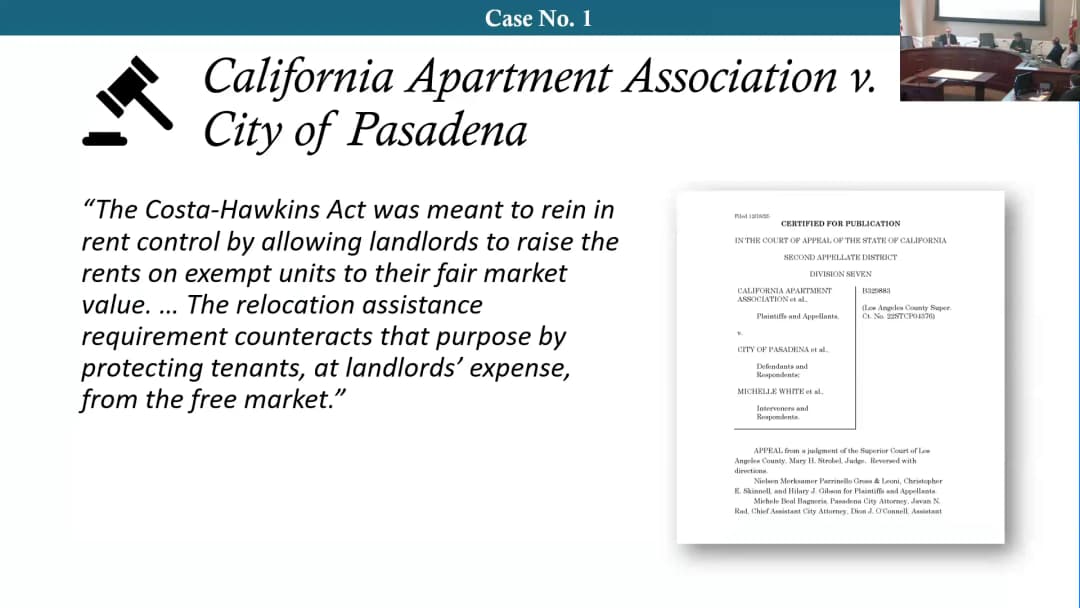
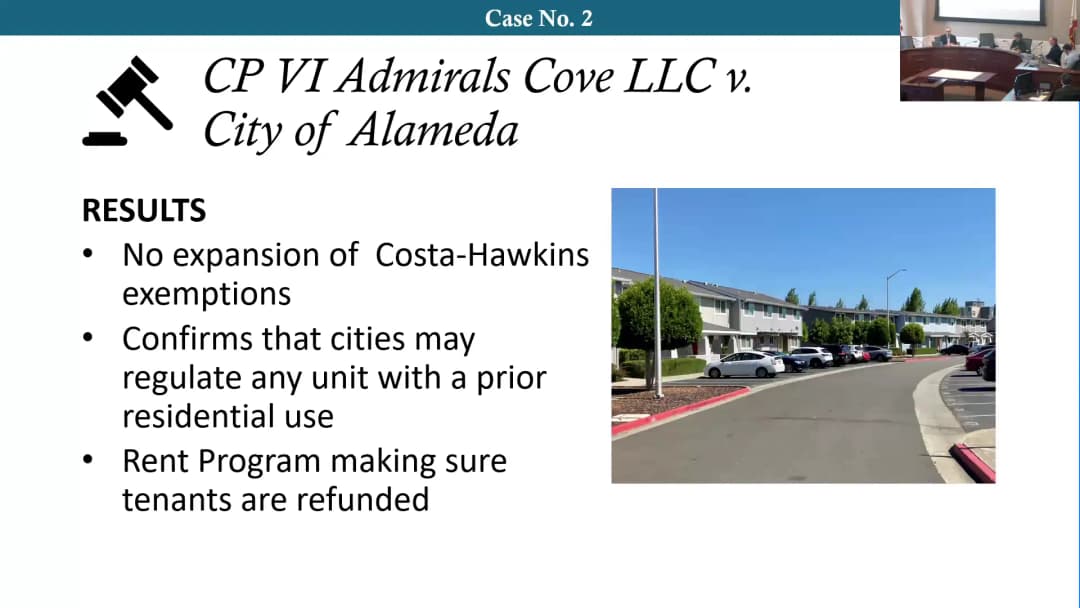
The City of Alameda hosted its sixth annual fair housing conference, bringing together city officials, attorneys, tenant advocates, property managers, and community members to discuss fair housing laws, tenant protections, and recent legal developments. Speakers included City Attorney Ibn Shen, Mayor Ashcraft, the California Attorney General (via video), and expert panelists covering eviction trends, federal fair housing challenges, immigrant tenant rights, utility billing policies, and new court rulings affecting rent control. Opening Remarks - City Attorney Ibn Shen welcomed attendees and introduced the California Attorney General, who emphasized the state's commitment to housing production and enforcement, noting that his team has led cities to plan for 44,000 new housing units. - Mayor Ashcraft highlighted the importance of tenant protections, referencing Alameda's 2016 rental protection laws and the three P's: produce, preserve, protect. She stressed that preventing homelessness is more economical than addressing it afterwards. City Attorney's Update: Program Successes and New Services - Admiral's Cove Court Victory: The California Court of Appeal issued a published decision holding that former military housing is subject to rent control, rejecting arguments that such housing is exempt. This precedent-setting ruling protects 150 units at Admiral's Cove and applies statewide. - Grant Funding for Clinics: The city's rent program expects to receive grant funding to launch clinic-level services where tenants and landlords can ask questions directly, reducing the need for expensive private consultations. - Program Costs: Since 2022, program fee increases have been kept to an average of 3.6% (CPI), while new services (mediation, rent increase checks) were added without additional fee hikes. Eviction Trends and Legal Resources (Mark Janowitz, East Bay Community Law Center) - Evictions in Alameda County remain above pre-pandemic levels, though they have declined from a post-moratorium surge. Weekly eviction calendars in Department 511 list at least 50 cases. - Non-payment of rent is the most common cause; landlords must prove the lawful amount owed, considering tenant defenses (retaliation, discrimination, warranty of habitability). - The East Bay Community Law Center receives 500 intake calls per month but cannot serve everyone, highlighting the need for education and resources. A resource sheet was distributed. National Fair Housing Landscape (Gary Rhodes) - Federal fair housing enforcement has been weakened by the Trump administration: HUD staffing cuts, funding reductions, and a proposed rule to gut the disparate impact standard. The comment period on that rule ends April 21, 2026. - In California, disparate impact remains protected under state law, and the Civil Rights Department continues enforcement. AI tenant screening tools risk perpetuating historical discrimination through algorithmic bias. - Rhodes contrasted Kansas City, Missouri (where state preemption limits local protections) with California's robust framework. Immigrant Tenant Protections (Leah Simon Weisberg) - California law (Immigrant Tenant Protection Act) prohibits landlords from asking about immigration status or threatening to report tenants to ICE. Landlords cannot enter units with ICE without a judicial warrant. - A case study was presented of an Oakland landlord who threatened tenants about immigration status, leading to a lawsuit filed by Movement Legal. The panel emphasized that all tenants, regardless of status, share the same housing rights. - Tenants are urged to document threats and contact legal aid organizations. Victim Services Introduction - City Attorney Shen introduced Val Sindel, the city's first victim services advocate, funded by a state grant and council support. The advocate assists victims of crime, including those with rental issues, with court accompaniment, restraining orders, and connecting to resources. RUBS (Ratio Utility Billing Systems) Policy Review (Ryan Halpern) - RUBS allows landlords to split shared utility bills among tenants. In Alameda, it is permitted only if part of the original rental agreement; unbundling mid-tenancy is not allowed. - Due to increased complaints, the rent program is considering three policy options: 1. Reform: Require disclosure, itemized bills, fee caps, and a formal dispute process. 2. Partial Ban: Ban RUBS for new tenancies while grandfathering existing ones. 3. Full Ban: Prohibit RUBS entirely for regulated units, requiring utilities to be folded into rent with a utility adjustment petition. - A community survey is open until a yet-to-be-determined date. Staff aim to bring a recommendation to City Council before summer 2026. Costa-Hawkins Updates (Bill Chapin) - Two recent California Court of Appeal decisions have implications for rent control. - Pasadena Case (Dec. 2025): The court struck down Pasadena's relocation assistance requirement for large rent increases on units exempt from local rent control (post-1995, single-family homes). The court held that such increases are not constructive evictions. This eliminates limits on rent increases for buildings built after 2009 (15-year rolling exemption) and single-family homes not owned by corporations (unless proper exemption notice was given). - Admiral's Cove Case (City of Alameda victory): The court ruled that former military housing renovated and re-rented remains subject to rent control if it had prior residential use, rejecting the argument that vacancy or renovation creates a new exemption. - Implications: Tenants in single-family homes and newer units have fewer protections. The rent program will work to ensure refunds for overpayments at Admiral's Cove. Closing Remarks (Gary Rhodes) - Rhodes connected current struggles to the history of the Fair Housing Act, noting that California and Kansas City continue to push back against discrimination. He urged attendees to remain engaged and to report violations. Questions and Answers - Property manager on ICE visits: Panel advised to have a policy in place and to distinguish between judicial warrants and administrative warrants. Landlords can refuse entry without a judicial warrant. - Source of income discrimination: Panel encouraged reporting refusals to accept Section 8 to the city attorney's office (Rico) or the Civil Rights Department. - Habitability and eviction burden: Mark Janowitz explained that landlords must prove rent lawfully owed; tenants can raise habitability defenses. - RUBS and fair return: Ryan Halpern confirmed that installing individual meters could qualify as a capital improvement or be included in a fair return petition. - Single renters and fair housing: A participant raised concerns about protections for single people; panel noted that gender protections exist and that California's Unruh Act prohibits arbitrary discrimination. - Applicability of laws to government housing: Both private and government housing providers must generally comply with fair housing laws, though certain affordable housing may be exempt from some rent control provisions. - Application fees: Mark Janowitz described existing laws requiring refunds and disclosure of screening reports, but noted enforcement often relies on small claims court. Key Outcomes - The city will continue to enforce the Admiral's Cove ruling to ensure refunds and stability for 150 households. - The rent program will complete a survey and public input process on RUBS, with a council proposal expected before summer 2026. - The city attorney's office launched a victim services program with a dedicated advocate. - Attendees were encouraged to utilize resource sheets, contact the rent program for specific issues, and report fair housing violations to Rico or the Civil Rights Department.

FAIR HOUSING 40% · HOUSING 22% · IMMIGRANT RIGHTS 12% · VICTIM SERVICES 11%
59
APR 16, 2026 · ALAMEDA, CALIFORNIA · CITY COUNCIL
City of Alameda Fair Housing Forum – April 16, 2026

The City of Alameda hosted its annual Fair Housing Forum on April 16, 2026, featuring presentations from legal experts on fair housing laws, tenant protections, recent court decisions, and emerging issues such as RUBS (Residential Utility Billing Systems) and immigrant tenant rights. The event included a public Q&A session with landlords, tenants, and property managers. Public Comments & Testimony - A single woman expressed concerns about discrimination against single renters and the lack of recognition for single-person households as families, noting challenges with affordable housing location and pet policies. - An audience member asked how property managers should handle ICE officers arriving with administrative warrants; panelists advised consulting attorneys and having a clear organizational policy, noting the distinction between judicial and administrative warrants. - A property manager raised the issue of persistent discrimination against Section 8 voucher holders, calling for stronger enforcement. The city attorney's office confirmed such discrimination is illegal and urged reporting to the Rent Program (RICO). - Questions were asked about RUBS fair return petitions, application fee refunds, and the applicability of housing laws to nonprofit and government-owned housing. Discussion Items - Mark (East Bay Community Law Center) highlighted the importance of city-funded tenant education and enforcement, noting that existing legal aid resources are insufficient and that underfunded housing inspection departments contribute to larger problems. He distributed a resource sheet. - Gary Rhodes (Fair Housing Attorney) discussed the erosion of federal fair housing enforcement under the Trump administration, including cuts to HUD and the threat to the disparate impact rule. He contrasted California’s strong protections with the lack of enforcement in Missouri, and described how algorithmic tenant screening reproduces historic discrimination. He urged attendees to comment on a HUD proposed rule affecting immigrant households. - Leah Simon-Weisberg (California Center for Movement Legal Services) presented on the Immigrant Tenant Protection Act (AB 2918) and described a lawsuit filed against a landlord who threatened immigrant tenants with ICE. She emphasized that all tenants, regardless of immigration status, have the same housing rights under California law and that landlords cannot ask about or disclose immigration status. - Ryan Halpern (Rent Program) presented three policy options for regulating RUBS: (1) enhanced disclosure and caps on administrative fees, (2) a partial ban for new tenancies after a cutoff date, and (3) a full ban for rent-controlled units (with utility adjustment petitions). A community survey is open for input, and a proposal is expected before City Council by summer 2026. - Bill Chapin (Rent Program Director) updated on two California Court of Appeal decisions: (1) California Apartment Association v. Pasadena, which held that large rent increases on units exempt from local rent control (e.g., post-1995 construction, single-family homes) are not constructive evictions, thus eliminating relocation payment requirements for such increases; (2) Is This Mouthful an LLC v. City of Alameda, which affirmed that renovated former military housing (Admiral’s Cove) is subject to local rent control, requiring refunds for overpayments. He also explained the overlapping exemptions under Costa Hawkins and AB 1482, noting that about 2,000 tenant households in Alameda have no rent cap. - The city introduced its first Victim Services Advocate, Val Findel, who will assist crime victims, accompany them to court, and connect them with resources including the rent program. Key Outcomes - No formal votes were taken, but several key updates and policy directions were announced: - The Rent Program is considering RUBS regulatory changes and will bring a proposal to City Council before summer 2026; public input is being collected via survey. - The City Attorney’s Office successfully defended rent control applicability to former military housing at Admiral’s Cove, ensuring refunds for tenants who overpaid. - The forum served as an educational opportunity to inform landlords, tenants, and advocates about current fair housing obligations and protections, including the Immigrant Tenant Protection Act and the implications of recent court decisions. - Attendees were encouraged to report fair housing violations to the Rent Program (RICO) and to contact the Civil Rights Department for enforcement.

FAIR HOUSING 34% · LANDLORD MISCONDUCT 16% · IMMIGRANT RIGHTS 12% · COMMUNITY ENGAGEMENT 11%
60
APR 13, 2026 · ALAMEDA, CALIFORNIA · CITY COUNCIL
Alameda Recreation and Park Commission Meeting - April 13, 2026

Note: The transcript indicates the meeting date as April 9, 2026, but the provided metadata specifies April 13, 2026. This summary uses the metadata date. The Alameda Recreation and Park Commission (ARPD) convened on April 13, 2026, to receive a director's report on upcoming events and project updates, hear commissioner communications, approve minutes from the previous meeting, and consider a new Memorial Amenity Policy. The commission approved the policy with an amendment to the renewal fee. Consent Calendar - Approval of Minutes (March 12, 2026): The minutes were approved via roll call vote. Commissioner Alexander abstained due to absence at the prior meeting. Vice Chair Schwartz and Chair Radies voted in favor, and Commissioner Burney voted in favor. The motion carried. Public Comments & Testimony - No members of the public spoke during non-agenda public comment or on the memorial amenity policy item. Director's Report and Project Updates - Upcoming Events: Earth Day celebration, Alameda Sings Spring concert (April 18), Home Electrification Fair and Bike Festival (May 2), Play for the Parks Golf Fun (May 18), Community Rec programs (Wednesdays at various parks), Starlight Movies in the Park (starting May 8 with "Honey I Shrunk the Kids" at Crown Memorial Beach), National Kids to Parks Day (May 16 at Sweeney Park), and Alameda Walk Series (Saturdays starting May 16). - Project Updates: - Aquatic Center: Out for bid; bids due April 21; contract award and start date pending. - Estuary Park Phase 2: Construction progressing; walkways and courts being paved; bathroom building installation in late April; completion expected late fall 2026, with public opening after a growing period. - Sweeney Park Trail Connectors: North and south connectors under construction; expected completion in early May, opening two new entrances. - Community Garden: Meeting with Backyard Growers on April 10 for site walkthrough. - Lidecker Playground: Contract going to council in late April/early May; installation expected by end of 2026. - Programs and Registration: Summer registration open; many programs filling quickly. Hiring for summer jobs (ages 16+). Aquatics: swim lessons, open swim, summer camps. Spring break camps at Harrison Center and Alameda Point Gym. Teen programs: Queer Teen Alameda Center (Fridays at 6 p.m.). Volunteer programs: Every Act Matters, Operation Green Sweep, Junior Leader Program. Youth programs: after-school pickleball, homeschool PE. Adult programs: open gym, tennis, indoor pickleball, indoor roller skating. New programs: Intro to AI (April 20-29), Strength Training and Cardio (May 6-June 24). Mastic Spring Art Boutique (April 25). Leisure Club Talent Show (June 11). - Park Improvements: Littlejohn dugouts made ADA-compliant with safety netting and benches; Bohol Circle trellises repainted; Harrison Rec Center being painted. - Staff Training and Recognition: Four staff attended CPRS conference in Long Beach (March 10-13). Staff training on laser level equipment (March 18). Spring sports field maintenance underway. Dana Archibald recognized for 14 years of service. Nick Casenda and Oscar Ledezma passed Certified Playground Safety Inspector program. Commissioner Communications - Commissioner Alexander: Delivered belated Women's History Month tribute to women of ARPD; visited Estuary Park, Little John Field, and Franklin tennis courts; commended the activity guide as creative and comprehensive; promoted the Play for the Parks golf tournament on May 18. - Commissioner Burney: Thanked ARPD for maintaining runner-friendly parks; announced he will run the Boston Marathon in two weeks for Cat Town, a cat shelter in Oakland. - Commissioner Schwartz: Enjoyed time at Franklin Park with his son's T-ball; observed connector work at Sweeney Park and Cruzy; noted that noon water aerobics classes have ended but patrons still ask for them, requesting the program be brought back sooner than summer. Discussion Items - Memorial Amenity Policy (Item 6A): Director Long presented a new policy to replace the existing procedure for donating memorial benches, tables, and other amenities. Key features: - Term: 10-year dedication or life of the amenity, with a renewal option for another 10 years at a fee (proposed $1,000, later amended). - Eligibility: Individuals, families, and organizations; no commercial use. - Locations: Subject to availability, accessibility, master plan fit, and no interference with park use. Some parks at capacity; 150 of 700+ benches currently have dedications. - Costs: Concrete bench $5,000, ironwood bench $6,000 (transcript stated "$0,000" assumed typo), picnic table $5,500. Breakdown: bench/table cost $2,000, concrete slab $1,000-$1,500, 10-year maintenance $2,000-$2,400. Renewal fee initially $1,000. - Application: Form submission, review, installation within 8-16 weeks. - Existing Dedications: Extended a full 10-year term from policy adoption, regardless of original donation date. - Vandalism: City will repair or replace destroyed amenities at no cost to donor; plaque replacement is donor's responsibility. - Commission Discussion: - Questions about contact information for existing donors, fee adjustments for inflation, renewal fee adequacy, and pricing for adding plaques to existing benches vs. new installations. - Commissioner Alexander expressed concern about high costs but understood the need to cover expenses. She abstained from voting due to owning two benches and a picnic table in a park. - Commissioner Burney suggested itemizing costs for donors to clarify the breakdown. - Chair Radies proposed increasing the renewal fee from $1,000 to $1,500 to account for 3-5% annual inflation, and keeping it locked at the time of original purchase. - Commissioners supported the policy with the amendment. Key Outcomes - Approved Memorial Amenity Policy with a $1,500 renewal fee (instead of $1,000), locked at the time of the original purchase. The motion passed 3-0-1 (Commissioner Alexander abstained). - Next Meeting: Scheduled for May 14, 2026. Agenda items will include project updates for the Aquatic Center and Estuary Park. - Adjournment: The meeting was adjourned unanimously.

PARKS AND RECREATION 97% · PROCEDURAL 3%
OPENPUBLICA · PUBLIC MEETING INDEXUPDATED DAILY · openpublica.com