111
APR 16, 2026 · ALAMEDA COUNTY, CALIFORNIA · BOARD OF SUPERVISORS
Alameda County Board of Supervisors Special Meeting - April 16, 2026 (Recessed)
PROCEDURAL 100%
The special meeting was called to order at 2:00 p.m. on Thursday, April 16, 2026. Roll call confirmed all five supervisors present: President Haubert, Supervisors Márquez, Tam, Miley, and Fortunato Bas. The President then immediately recessed the meeting to Monday, April 20, 2026 at 9:30 a.m. No public comments, discussion items, or votes on substantive matters occurred in open session. The agenda included closed session items (labor negotiations, potential litigation, existing litigation, and real property negotiations), but no report on closed session action was provided before the recess.
The Eden Area Municipal Advisory Council (MAC) met on April 15, 2026, at 2:00 PM to discuss and vote on four major agenda items: zoning ordinance updates for housing element implementation, a parcel subdivision for new housing, renewal of a conditional use permit for a cell tower, and a report and recommendations for creating an Office of Unincorporated Communities. The meeting included public comment and unanimous or near-unanimous votes on most items. Consent Calendar - Minutes Approval: The council approved the minutes from the January 13, 2026, meeting (moved by Councilmember Elizabeth, seconded by Ray, unanimous roll call) and the February 10, 2026, meeting (moved by Megan, seconded by Elizabeth, unanimous roll call). Minutes are now action-only format as per county practice. Public Comments & Testimony - CHP Officer Jen Pepst reported enforcement statistics for March 2026: 226 traffic citations, 26 vehicles towed, 12 DUI arrests, 3 felony arrests, 8 misdemeanor arrests, 57 non-injury and 22 injury crash reports. Upcoming enforcement events include distracted driving and speeding operations. - Randy Wage spoke in support of Sky West negotiations between Hayward Rec and City of Hayward, advocated to preserve the clubhouse with its commercial kitchen for community use, urged renewal of the Flock camera contract (coming to Board of Supervisors April 21), and promoted Earth Day cleanup and market. - Public on Office of Unincorporated Communities: Multiple speakers expressed strong support, emphasizing the need for representation, transparency, budget input, language access, and a central point of contact. Speakers included youth leaders (Romero, Raimundo Archuletta, Aidan Matias, Oscar G.), community organizers (Juliana Weiser Leon, Kimberly Victorio, Dave Thompson), and Spanish-speaking residents (Gladys Validez, Esperanza). Many urged that the office have independence or strong authority, and prioritize multilingual staff and community engagement. Discussion Items 1. Zoning Ordinance Updates for Multifamily Residential Development Standards (PLN 2025-00167): - Presentation by Rodrigo Arduña (Planning) and Tom Ford (M Group) on minor zoning code and objective design standards amendments to facilitate densities already adopted in the six-cycle housing element. Key changes: reduced setbacks, increased FAR, and modified open space requirements for housing element opportunity sites. For the Bayfair BART site (the only site affected by SB 79), an incentive allows developers to exceed 75 feet (up to 12 stories) if they limit height to three stories within 45 feet of single-family property lines. - Councilmembers discussed impact on greenery, community outreach, and the incentive rationale. A motion to recommend approval to the Board of Supervisors passed 6-1 (Chair Weidler dissenting, expressing discomfort with approving changes to a housing element she did not originally support). 2. Parcel Subdivision for New Housing Units (PLN 2025-00167): - Proposed vesting tentative parcel map to divide 21164 Garden Avenue into three lots, allowing one existing home plus two new single-family homes and two attached ADUs. Staff recommended approval. Councilmembers expressed general support for infill housing. Some discussion about ADU regulations and state mandates. Motion to recommend approval passed unanimously. 3. Conditional Use Permit Renewal – Cell Tower (PLN 2025-00217): - Renewal of an existing expired permit for a T-Mobile monopole at 2114 Mission Boulevard. No physical changes proposed. Staff recommended approval. Concerns raised about RF emissions near a YMCA child care center and the tower operating without a permit since August 2022. Staff noted the applicant is late but catching up, and a new telecom ordinance with penalties is being developed. Motion to recommend approval to Board of Zoning Adjustments passed 6-1 (Councilmember Stanley opposed). 4. Report and Recommendations for Office of Unincorporated Communities: - Consultant Brienne Gala presented extensive research, proposing a three-year pilot office housed in the County Administrator’s Office with three staff (director, project manager, administrator) focused on coordination, communication hub, MAC support, and budget engagement. Key findings: fragmented governance, coordination challenges, lack of centralized communication, and decoupled policy/budget processes. - Councilmembers and public broadly supported moving forward. Some preferred amendments for independence or stronger authority, but the motion to recommend approval of the proposal (Option 1) to the Board of Supervisors and advance to Phase 2 planning passed unanimously. Key Outcomes - Zoning Ordinance Updates: Recommended approval to Board of Supervisors (6-1 vote). - Parcel Subdivision: Recommended approval to Planning Director (unanimous). - Cell Tower CUP Renewal: Recommended approval to Board of Zoning Adjustments (6-1 vote). - Office of Unincorporated Communities: Recommended approval to Board of Supervisors to advance to Phase 2 planning (unanimous). Staff will incorporate feedback from all MACs before final presentation. - Next meeting will include subcommittee reports.
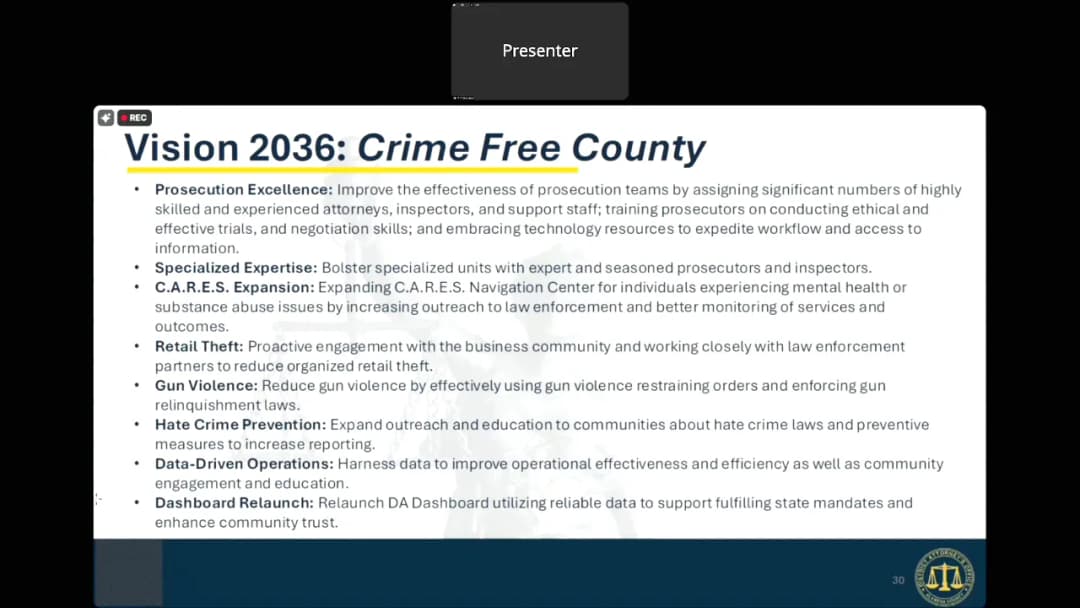
The Alameda County Board of Supervisors held a special meeting on April 14, 2026, for its annual early budget work session for fiscal year 2026-27. Chief Administration Officer Susan Moranishi opened the session, noting the preliminary maintenance of effort (MOE) budget addresses baseline changes such as salary adjustments, increased operating costs, and revenue constraints. Key uncertainties include federal and state policy changes (e.g., HR1, Prop 1), federal funding cuts, and rising insurance and litigation costs. Departments presented their MOE budgets, highlighting challenges in funding mandates, staffing vacancies, and growing service demands. Public Comments & Testimony - Dr. Jeffrey Watson (Oakland Private Industry Council / Oakland Chinese Industry Council) requested budget support for a collaborative housing project to house 150 people in 17 units, emphasizing wraparound services and peer advocacy. - Jane Kramer urged creative, non-linear thinking in budget development, suggesting the board discard cherished assumptions to find new resources and improve effectiveness. - Alison Monroe (Families Advocating for the Seriously Mentally Ill) called for a shift in mental health spending toward the most seriously ill—increasing subacute beds, expanding first-episode psychosis programs, and involving families in treatment—to reduce deaths and incarceration. Discussion Items CAO Overview and Budget Context - The county faces a structural deficit with operational costs outpacing revenue. In the current year, a $105.7 million gap was closed using $61 million in one-time and $45 million in ongoing strategies. - State constraints: Prop 98 and Gann limit restrict spending. Federal changes (HR1) will reduce administrative funding and may shift costs to counties for benefits and eligibility redeterminations. - Pending factors: labor negotiations, rising insurance costs, litigation, FEMA disallowances, unfunded capital needs, and potential economic downturn. - The budget timeline includes a proposed budget in late May and final adoption by June 30. Health Care Services Agency (Anika Chalk) - Total appropriation: $1.369 billion (1.97% increase); net county cost increase of $8.58 million (4.4%). - Behavioral Health accounts for 60% of the budget; 65% of BH funding goes to CBO contracts. - 408 contracts with 197 CBOs totaling $794 million. - Key investments: $124.75 million for housing/homelessness (Measure W excluded), $85.3 million for HealthPAC, $44.8 million for CARE Court, $35.83 million for environmental health, and $17.11 million for EPIC electronic health record. - Challenges: Prop 1 (BHSA) cuts of $53 million; HR1 cost shifts for indigent care; potential federal grant clawbacks ($16 million at Public Health); state HAP funding cut by 50% and HUD funding reductions of $30–60 million. - Supervisor Marquez requested an economic impact analysis of the agency. Social Services Agency (Andrea Ford) - Total appropriation: $1.1 billion (increase of $13.5 million). Net county cost increase of $5.9 million. - Serves 1 in 3 residents; issues over $460 million in annual benefits. - New interactive data dashboard launched showing caseload trends: MediCal enrollment down 9.2% YoY; CalFresh down 6%; IHSS up 6.3%; child welfare placements down 4–5%. - Key investments: $27.1 million for Adult Protective Services; $37 million for General Assistance; $11 million for CalFresh (new inclusion, due to HR1 admin cost shift). - Vacancy rates: Workforce & Benefits Admin 20.19%; Children & Family Services 21.51%; Adult & Aging Services 4.68%. - Federal HR1 will increase workload; state realignment revenues are flat to negative. Child Support Services (Interim Director) - Total appropriation: $35.13 million; net county cost of zero (state/federally funded). - Serves 25,754 children; collected $78 million in support, with 94% ($74 million) directly to families (6% increase from prior year). - Challenges: caseload decline, unfunded mandates (SB 343), and potential funding formula changes. General Services Agency (Kimberly Gasway) - General fund appropriation: $27.1 million (4.4% increase); net county cost increase of $606,000. - Internal service funds (ISF) total $206 million; largest increase in building maintenance ($11 million) and motor vehicles fuel (75% increase due to Iran conflict). - Underutilized buildings cost: Glen Dyer Jail $1.2 million/year, Arena Center $446,000/year; disposition efforts ongoing. - Accomplishments: EV charging grants, vehicle consolidation (135 vehicles transitioned to motor pool), climate action plan update, and 40% apprenticeship hours on construction projects. Public Works Agency (Daniel Woldesenbet) - Total appropriation: $403.9 million; net county cost $1.7 million (increase of $64,000). - Accomplishments: 22.7 miles of road rehab, 11 transportation projects ($42M), 13 flood control projects ($18M), and permits fully online. - Challenges: failed flood control assessment increases for Zones 2/4/9, unfunded mandates (zero trash TMDL, zero-emission fleet), 25% vacancy rate. - Supervisor Tam requested clearer communication on restricted fund uses. Community Development Agency (Sandy Rivera) - Total appropriation: $82 million (0.7% increase); net county cost increase of 2.2%. - Key investments: Housing & Community Development $43.1 million; Healthy Homes $12 million; Planning $11.6 million; Ag Weights & Measures $11 million; Economic & Civic Development $3.7 million. - Measure A1 GO bond: 98% committed, balance winding down by 2032; no successor measure in current cycle. - Tenant protections: mediation program funded, proactive rental inspection and rental registry planned for Measure W; just cause ordinance adopted. - Homelessness funding: $124.75 million in Health agency budget plus Measure W. Information Technology Department (Ram Gurumurti) - ITD is an ISF department; general fund budget (CRIMES) $4.31 million. - Key investments: radio upgrade $8.23 million; cybersecurity; digital accessibility; Gen AI integration. - 83% of budget is ITD main; 4% turnover rate (half national average); 1 national ranking in 2025 Chime County Survey. Assessor (Phong La) - $129 billion in assessed value in dispute (1.29 billion potential refunds). Appeals rose from 2,000/year to 5,500 in 2024, projected 7,500 next year. - Assessment roll growth: 2.2% (lowest in eight years); some cities near 0% growth. - Tesla appeal from 2018–2025 is largest single appeal (1% of county property tax roll). - Staffing: moving bodies to appeals team; may request more resources. Sheriff (Yesenia Sanchez) - Total appropriation: $678 million; net county cost $529 million (2.96% increase). - 20% sworn vacancy rate; jail population 1,290 (capacity 3,400); federal inmate population dropped from 260 to 19, losing $16 million in revenue. - Key investments: $19.1 million increase in ISFs (building maintenance, radios); Axon contract extension from $14M to $37.7M over five years (if not approved by 2026). - Accomplishments: CalAIM go-live July 2026; 336 lives saved at jail in 2025; re-entry programs (Layuna, Freedom Braiders); cold case unit arrested two in 1993 homicide. - Needs: EVOC track expansion ($4.5M), new Eden Township substation, dispatch center. District Attorney (Ursula Jones Dickson) - Total appropriation: $116 million (3.85% increase); net county cost increase of 4.06%. - 322 pending homicide/manslaughter cases; prosecutors per 100,000 residents (9) are below national average (12.5) and peer counties. - Unfunded mandates: race-blind charging, Racial Justice Act (1 attorney vs 6 in Contra Costa), Prop 36 (300+ new felony theft cases, no treatment funding). - Victim services: 80% of victim witness advocates are grant-funded; trauma recovery center grant lost. - Expert witness costs: $10,000 per murder trial for pathologists. Probation Department (Brian Ford) - Total appropriation: $234.8 million; net county cost $160.8 million (2% increase). - 13.5% vacancy rate; 40 youth at JJCF, 11 at Camp Sweeney. - Investments: $39 million in CBO contracts ($22M youth, $17M adult). - Prop 36: minimal direct impact but unfunded; state and federal funding uncertainties. Public Defender (Breon Woods) - Total appropriation: $76.4 million (4.2% increase); net county cost increase of $4 million. - 27,000 new files in 2025; 129 attorneys. Using national workload study, need 104 additional attorneys; AB 625 recommends 45 investigators, 21 social workers, 32 paralegals. - Prop 36: 1,400 more felony cases/year with no staffing increase; misdemeanor cases up 1,400. - Clean Slate unit: 1,800 petitions filed, 93% granted; caseload reduced from 730 to 425 per attorney. - Immigration unit: 214 removal defense cases; increasing demand under Trump administration. Fire Department (Willie McDonald) - Total appropriation: $243.7 million (31.4 million increase); no general fund, funded by property tax and contracts. - Service area includes unincorporated areas and contract cities; 550 staff, 27 stations. - Capital projects: new training center (Jan 2027), Station 7 (Jan 2027), Station 25 (Apr 2027). - Dispatch center project delayed; exploring interim solution. Concerns about property tax revenue contraction and city budget pressures. Auditor-Controller (Melissa Wilk) - Total appropriation: $49.37 million (3.45% increase); net county cost decrease due to revenue decline from property transfer taxes. - Accomplishments: 42nd year of Certificate of Excellence in Financial Reporting; 90% customer satisfaction; recovered $5 million in delinquent debt; implemented AI model for racially restrictive covenant detection. Treasurer-Tax Collector (presented by staff) - Net county cost increase of $105,755 (2.73%). Revenue decline expected from property tax and recording fees. - Key initiatives: migrating banking from US Bank to JP Morgan; ethical investment policy; purchasing Freddie Mac/Fannie Mae loans for local housing. Registrar of Voters (Cynthia Carnejo) - Total appropriation: $33.88 million; net county cost decrease of $12.5 million due to high revenue election year. - November 2026 general election budgeted; special election for CD14 (June 16 primary, possible Aug 18 runoff) estimated cost $6 million (unfunded state mandate). - Youth voting: costs for Berkeley and Oakland youth voting were $148,000 and $78,000 respectively; lower turnout expected for future. - Implementing AB 626 (vote-by-mail your way) to improve processing. Human Resource Services (Margarita Samora) - Total appropriation: $15.3 million; net county cost increase of $2.28 million (28%). - Key investments: recruitment automation, job fairs (500 pre-registered for April 24), wellness position, centralizing disability functions. - Challenges: meeting increased demand for services, 14 pending MOUs. Library (Debbie Sica) - Total appropriation: $50.9 million (3.57% increase); net zero county cost, funded by property tax and available fund balance. - 1.4 million e-materials borrowed, 1.4 million library visits, 24,000 new cards. - Challenges: digital licensing costs rising; infrastructure needs; federal funding uncertainty (IMLS). Key programs: literacy, youth poet laureate, summer lunch, re-entry services. Key Outcomes - Supervisor Fortunato Bas requested the CAO provide an accounting of trusts and reserve funds, similar to last year. - Supervisor Marquez emphasized the need for city partnerships on homelessness and tenant protections, and requested an economic impact analysis from Health. - Supervisor Tam requested clearer communication on restricted fund uses and asked for a report on RJA attorney workload. - Supervisor Miley expressed concerns about unfunded mandates, particularly Prop 36, and supported the sheriff’s EVOC track and substation. - President Halbert noted the public defender’s severe understaffing and asked for a plan to achieve parity over time. - No formal votes were taken; the work session serves as input for the proposed budget to be presented in late May 2026. - The board recessed into closed session earlier with no reportable action. Meeting adjourned at 8:38 PM.
The Alameda County Board of Supervisors held a special joint meeting of the Social Service and Health Committee on Monday, April 13, 2026, to receive updates on two informational items: the impacts of HR1 and state policy changes on the Health PAC program, and a new site opportunity guide for homeless housing. A quorum was present with Supervisors Portonado Bass and Town, while Supervisor Miley was excused. Public Comments & Testimony - Lily Kelly (La Clinica de la Rasa) strongly supported allocating $34 million in Measure W funds to increase Health PAC funding, citing imminent losses from Medi-Cal freezes and work requirements. She shared stories of patients suffering without coverage. - Lucy Hernandez (Bay Area Community Health) urged increased Health PAC funding, describing a mother who delayed care due to immigration fears and ended up in the emergency room. - Two Quark (Asian Health Services) supported the $34 million allocation, warning that 6,000 of their patients may lose coverage, causing $6 million annual losses and forcing service cuts and layoffs. - Andy Martinez Patterson (Community Health Center Network) noted the PPS penalty for FQHCs under capitation in Alameda County and supported the funding increase. - Hong Kong bin (patient of Asian Health Services) expressed personal support for Health PAC funding, emphasizing the value of culturally-linguistic care. - Tony Panetta (Alameda Health Consortium) testified in support of augmenting the Health PAC budget beyond maintenance of effort to offset HR1, Prop 1, and state instability. - Robert Phillips (Baywell Health) associated with support, noting that clinics have absorbed independent practices and that protecting the budget protects access. - Cyrus Martinez (Access Community Health) urged increased Health PAC funding over two years, highlighting the July 2026 state rate cuts for FQHCs serving immigrants. - Ella Schwartz (Tiburcio Vasquez Health Center) expressed appreciation for Health PAC and Measure W support, sharing a story of a 19-year-old diabetes patient helped by the program. - Dr. Harsha Ramchandani (Bay Area Community Health) strongly supported the $34 million allocation, recounting a gardener with an infected wound and a diabetic woman who avoided hospitalization due to timely care. Discussion Items HR1 Implementation and Health PAC Recommendations Dr. Kathleen Klan, Medical Director of Alameda County Health, presented a detailed history of Health PAC, a low-cost health access program for low-income adults (below 200% FPL) not eligible for other insurance. Enrollment peaked at 90,000 before the ACA, dropped sharply after 2014, and now has 2,456 enrollees with a budget of $70.5 million (from county general fund). She outlined federal HR1 changes (asset tests, revised immigrant definitions, six-month redeterminations, work requirements) and state changes (enrollment freeze, monthly premiums, formulary cuts, dental coverage elimination) expected to cause tens of thousands to lose Medi-Cal. Recommendations: maintain current eligibility and scope of services, augment funding this year and next to mitigate provider financial challenges, and expand the provider network to two additional safety net clinics. Supervisors asked about state advocacy (data sharing and support for undocumented groups), sustainability of funding, and the impact of losing Prop 1 funds. Dr. Klan noted that the $70.5 million baseline has not shrunk with enrollment because clinics now provide more comprehensive, whole-person care. Staff clarified that a $20 million placeholder from Measure W Essential Services Fund had been discussed but final allocations are pending. Site Opportunity Guide and Site Assessment Tool for Homeless Use Jennifer Pierce (Deputy Housing Director) and Selima Jones (Housing Finance Manager) presented a new guide and Excel-based tool developed with cities to evaluate publicly and privately owned sites for homeless housing. The tool addresses legal status, physical attributes, and timeline for use, and covers short-term (safe parking, community cabins), mid-term (navigation centers, motel conversions), and long-term (tiny home villages, commercial conversions) uses. Supervisor Fortunato Bass asked about the surplus property list (still being compiled) and the inclusion of amenities like storage and pet areas. Supervisor Tam noted that HAP funding requires a surplus property list and referenced a meeting with Senator Grayson about partnering with Caltrans and seeking state pilot funding for interim shelter with wraparound services. Staff confirmed past RFPs for capital costs and that a future rehab/acquisition RFP may be available. Key Outcomes - No formal votes were taken; both items were informational. - The Health PAC recommendation to maintain current eligibility and augment funding with Measure W funds (targeting $34 million over two years) was presented and discussed, with strong public and supervisor support. Final budget decisions are pending further workshops, including a Measure W Essential Services Fund work session scheduled for April 28, 2026. - The site opportunity guide and assessment tool were accepted as a resource to assist cities and the county in identifying sites for homeless uses. Staff will continue to compile the surplus property list and explore partnerships with the state, including potential pilot funding from Senator Grayson.
The Fairview Municipal Advisory Council (MAC) met on April 8, 2026, at 5:00 PM. The meeting covered a presentation from the Alameda County Sheriff’s Office on crime technology (informational) and a presentation and vote on recommendations to establish an Office of Unincorporated Communities (OOUC). Public comments were heard on both items and on the Orinda redistricting process. Consent Calendar - Approval of March 3, 2026, meeting minutes: The minutes were approved unanimously. Roll call: Councilmember Philbin (aye), Councilmember Rhodes (aye), Chair Englin (aye). (Councilmember Farmer and Higgins were excused.) Public Comments & Testimony - Officer Popst (CHP): Reported on March traffic enforcement in Fairview: 35 traffic citations, 5 non-injury crashes, 3 injury crashes, 1 DUI arrest, zero stolen vehicles recovered. Announced upcoming speed enforcement period (April 28–29) and new CHP officers arriving April 20. - Matt Turner and Rita Duncan: Spoke in support of community participation in the Orinda Sanitary District’s redistricting process (shifting from at-large to by-district elections). Encouraged residents to use youmapit.com and attend the April 14 board meeting. - Peter Rosen: Criticized the complexity of county government structures and urged residents to understand the actual org chart rather than make assumptions. - Keith Barrows: Raised concern that some proposed redistricting maps for Orinda split San Lorenzo in half; urged community input. - On Item 1 (crime technology): - Keith Barrows: Expressed strong support for continuing license plate reader (LPR) technology, calling it a “no-brainer” and warning that losing it would make Fairview a “Mecca for car thefts.” - Mimi Dean: Expressed support for technology but raised questions about 24/7 staffing, use for red-light enforcement, and drone flight restrictions near airports. - Rita Duncan: Voiced support for the technology, asking about data baseline, incident categories, camera locations, human trafficking use, drone hijacking risks, and cost. - Peter Rosen: Had questions about projected staff growth and noted that “San Leandro Hill” is actually Castro Valley (Fairmont Terrace/Fairmont Ridge). - On Item 2 (Office of Unincorporated Communities): - Peter Rosen: Lauded the report, expressed initial skepticism but became supportive. Emphasized need for measurable outcomes, transparency in county budget spending, and ensuring the OOUC doesn’t bypass MACs. - Chuck Meadows: Called for the office to be independent, with direct regular meetings with the Board of Supervisors (BOS) and authority to enforce action. Cited the sidewalk vending ordinance as an example of cross-agency failure. - Mimi Dean: Highlighted a five-year unresolved issue (Bachman Road sidewalks) and stressed accountability. Asserted that unincorporated residents deserve same services as cities and that funding is available (citing discretionary funds). - Rita Duncan: Emphasized need for the office to have real authority over entrenched department heads, and suggested staff live in the unincorporated area. - Matt Turner: Praised the report for taking a systemic view, but warned that past county initiatives (e.g., Baker Tilly report) gathered dust; hoped this time would be different. - Keith Barrows: Recalled that the OOUC idea dates back to the Eden Area Livability Initiative and now is the right time; supported moving forward with amendments discussed. - Brenda Clark: Expressed frustration with lack of clear contact points for county services; endorsed a centralized hub/brochure. - Charles: Supported a single entry point for county services, especially for non-English speakers; favored Option 2 (approve with amendments). Discussion Items - Item 1: Alameda County Sheriff’s Office Use of Crime Technology (Informational) Sergeant Cully presented the Real-Time Information Center (ARTIC) which integrates automated license plate readers (Flock LPRs), pan-tilt-zoom Condor cameras, and a drone first responder program. Emphasized that data is not shared with ICE or federal agencies and is used only for law enforcement. Reported that since implementing LPRs, auto theft in unincorporated areas dropped from over 1,000 (2022) to under 200 annually. The drone program (since November 2025) has responded to 149 calls, located 77 people, and cleared 16 calls without patrol. Stressed that the Board of Supervisors will vote on the LPR program on April 21 and that opposition came from outside the unincorporated area. Council members asked about staff capacity (three people, not 24/7), integration with schools, use for fireworks enforcement, and security concerns. Sergeant Cully confirmed that Castro Valley drones will cover Fairview and that the D Street camera was vandalized and will be relocated. - Item 2: Recommendations for Establishing an Office of Unincorporated Communities (Action Item) Brianne Gialla presented findings from interviews, research, and case studies from other counties. Key findings: fragmented governance, coordination challenges, communication breakdowns, organizational culture focused on compliance rather than outcomes, and disconnect between policy and budgeting. Recommended a three-year pilot office within the County Administrator’s Office with five core functions: representing unincorporated communities, leading cross-agency initiatives (starting with development permit reform), serving as a communications hub, administering the MACs, and engaging in budget processes. Emphasized need for BOS-granted convening authority and a lean three-person staff. Council and public comments raised concerns about authority, independence, and accountability. After discussion, the MAC voted to recommend the office to the Board of Supervisors with specific amendments. Key Outcomes - Vote on Office of Unincorporated Communities: The MAC voted to recommend (motion by Councilmember Rhodes, second by Councilmember Philbin) that the BOS approve the proposed OOUC and move to Phase 2 planning with amendments: 1. The office should be independent (not embedded in the CAO’s office) with its own budget line item. 2. The office must provide at least quarterly status reports to the Board of Supervisors. 3. The coordinator/administrator should reside in the unincorporated area of Alameda County. 4. The current consultant, Brianne Gialla, should be retained as coordinator during the pilot period. Roll call: Councilmember Philbin (aye), Councilmember Rhodes (aye), Chair Englin (aye). (Councilmember Farmer and Higgins were excused.) Motion passed 3-0. - Chair’s report: Noted that the fireworks ordinance roadshow is complete and will go to BOS in April. CHP speed enforcement days April 28–29. Weed abatement notices coming soon in Fairview. - Councilmember Philbin: Announced annual Veterans Day event at Lone Tree Cemetery on Sunday, November 8, 2026, at 1:00 PM. - Staff update: Sidewalk work on 2nd Street ongoing; HARD (Housing and Community Development) and parking lot update not yet ready for presentation. Meeting adjourned at 8:56 PM.
The Alameda County Board of Supervisors Ad Hoc Committee on Reparations (Supervisors Miley and Marquez) met jointly with the Reparations Commission on April 8, 2026. The commission presented an extensive update on its 18-month process, including community engagement results, survey data, a draft action plan with 12 prioritized recommendations, budget status, and a timeline. Supervisors provided feedback on presentation strategy, prioritization, and realistic next steps. The committee voted to recommend bringing the full report to the full Board of Supervisors as a set matter on June 30, 2026. Discussion Items - Opening remarks and tribute: Chair Terry Gore acknowledged the passing of Commissioner Jesse Burleson (District 5) and thanked the Board for a commendation presented to his family. A moment of silence was held. - Process and community engagement: Chair Gore outlined the mandate, the five UN pillars of reparation (compensation, return of power, healing, thriving, shaping futures), and the harms report framework developed by graduate student Alisa Knight. The commission held 22 events (6 listening sessions, 14 pop-ups, 2 feedback sessions) across all five districts, with 400+ surveys collected online and in person. The library was praised for critical support. - Survey data (presented by Michael Arnold, Informing Change): Among 285+ respondents (now over 400), 83% identified as Black/African American, 70% as women, and 83% as descendants of enslaved persons. Key findings: 66% had been stopped, searched, or questioned by police; 58% reported county agencies directly damaged their emotional well-being; 60% experienced housing hardships; 48% felt forced to move due to gentrification; 85% demanded reparations focus on rebuilding historically Black neighborhoods, schools, and institutions. The data is high quality with broad age and income representation, but geographically concentrated in Oakland and Hayward, with District 1 underrepresented. - Social media and digital engagement: Consultant Tassian reported organic growth on Facebook and Instagram, with 1,100 Facebook followers and high engagement. Most followers were women aged 45–55. The digital survey received the most organic engagement. - Project management (Letitia Henderson, Exceptional Community Connections): The commission has three subcommittees (Admin & Budget, Community Feedback, Data Analysis & Reporting) and held a planning retreat in January 2026. They are on track to finalize the report by the June deadline. Commissioners identified 12 recommendations in March. - Budget and resources (Vice Chair Larry McClendon): The Board allocated $500,000. To date, $307,000 has been spent, with $192,247.48 remaining (61% of budget). Largest expenditures: consultants, communication/design/printing, facilitation/community engagement, documentation/media, and wellness/food/participation support. Vendor discounts due to mission alignment contributed to savings. McClendon noted that the compressed timeline (funding received after a year of work) limited deeper outreach. The commission will adjust budget line items at its full commission meeting later that day. Supervisors requested a lessons-learned section in the final report. - Recommendations (Chair Gore and Vice Chair McClendon): The commission presented 12 recommendations following the state task force format, ranked by priority and timed as short-term (1–12 months), medium-term (1–3 years), and long-term (3–5 years). Top five short-term priorities: 1) Housing and economic opportunity/closing the wealth gap, 2) Administrative (establish an Office of Reparations with dedicated funding), 3) Health equity, 4) Family and youth, 5) Justice and public safety. Other priorities include education, accountability (harms report, equity tracking), culture/memory, civic power, data transparency, and climate/environment. The commission emphasized that the plan is a living document. - Supervisor feedback: - Supervisor Miley praised the work but cautioned that the Board is unlikely to adopt the action plan on June 30. He noted that past similar reports (e.g., Office of Immigrant Services from 2021) took years to implement. He advised narrowing the focus to one to three critical priorities for the first fiscal year and highlighted the need for realistic cost estimates. He also questioned the $2.6 billion public safety figure cited in the presentation (the county budget shows public safety at about 26%, not that dollar amount). He requested a lessons-learned case study to improve future commissions. - Supervisor Marquez echoed the timeline concerns, noting June is chaotic (budget, HR 1, Prop 1). She recommended a 20–30 minute presentation at the full board, with the report delivered three weeks in advance, and a separate subsequent meeting for adoption discussion. She suggested the commission connect its recommendations to pending county initiatives (e.g., Fair Chance Housing Ordinance) and improve outreach to District 1 to address criticisms of geographic imbalance. She also expressed support for commissioner stipends if funds remain. - Commissioner responses: - Commissioner Dr. Philip Gardner acknowledged District 1 underrepresentation and reported that an online blog from that district is mobilizing opposition to reparations. - Chair Gore pushed back on the request to narrow priorities, arguing the mandate was for a comprehensive plan, and noted that the commission could instead recommend a handoff body to continue work. - Vice Chair McClendon proposed that the commission explicitly recommend the next governance step (e.g., a smaller task force) to avoid the report sitting on a shelf. - Commissioner Gardner emphasized that the report is the beginning, not the end, and that the commission should make a recommendation on a successor body. Key Outcomes - Motion: Supervisor Miley moved to recommend that the full report be brought to the full Board of Supervisors as a set matter on June 30, 2026. Supervisor Marquez seconded. The motion passed unanimously (aye: Miley, Marquez). - Clarification: The June 30 presentation will be for receiving the report, not for adoption. The Board will likely refer it to a committee or schedule a future work session for action. - Next steps: The commission will refine the report and coordinate with the supervisors' offices on presentation content and timing. The committee may meet again before June 30 for a final preview. The commission is to include recommendations on next governance steps (e.g., a continuing task force or office) and lessons learned for future commissions.
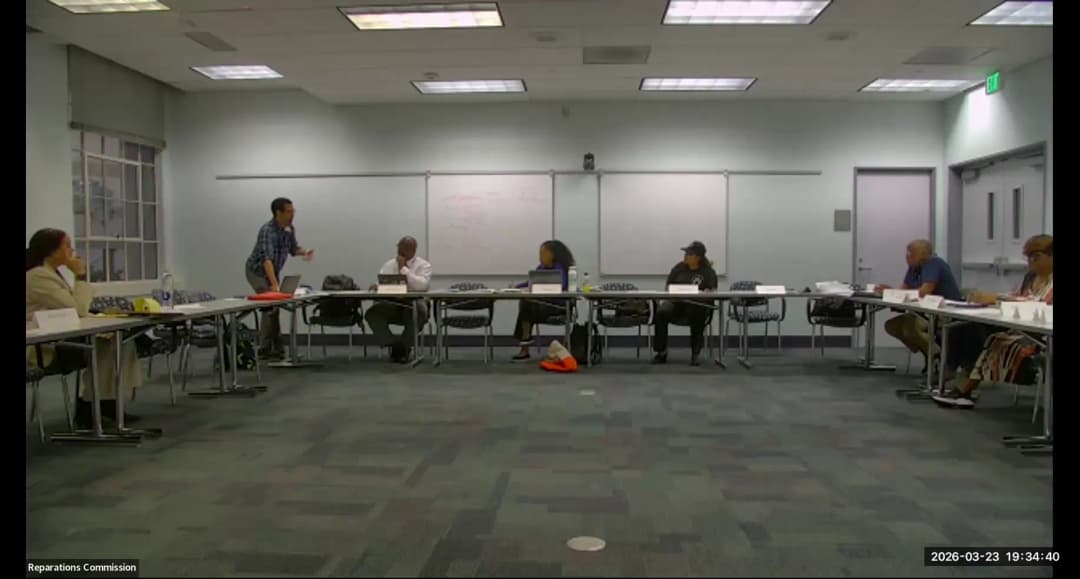
The Alameda County Reparations Commission met on April 8, 2026, to finalize the prioritization of their 12 recommendation categories, assign short-, medium-, and long-term timelines, and plan for a community feedback session. After extensive deliberation, the commission passed a motion to adopt a tiered timeline and a framework for implementation, and also discussed the scheduling of an in-person feedback event on No Kings Day (April 12, 2026). Discussion Items Prioritization of Recommendation Categories Commissioners reviewed a consolidated list of 12 priority areas, initially ranked from housing and property (priority 1) through environmental and infrastructure (priority 12). Commissioner Shed presented a text analysis of the recommendations, suggesting that the categories be reorganized around mechanisms (e.g., direct restitution, data, reallocation, oversight) rather than topic areas. Other commissioners emphasized the need to align with the state report and UN principles, and to avoid losing focus on specific harms (e.g., black youth). The commission ultimately decided to keep the 12 categories but add a framework to each. Short-, Medium-, and Long-Term Timeline After debate, the commission agreed to the following timeline based on a motion by Commissioner McClendon and seconded by Commissioner Small: - Short-term (first year): Priorities 1–5 (housing, economic opportunity, reparations office/administration, health/well-being, family/youth) - Medium-term (years 1–3): Priorities 6–9 (education, legal system/public safety, harm/equity reports, creative culture) - Long-term (years 3–5): Priorities 10–12 (political disenfranchisement, data transparency, remaining items) - Additionally, item 6.5 (requiring equity reports and assessment) was moved to the preamble as an initial step to inform all other actions. Data and Assessment as a Preamble Commissioner Chad argued that data collection and assessment should be a prerequisite for all work. After discussion, the commission agreed to include a preamble stating that the county must immediately begin collecting and assessing equity data across departments, and that this effort should be ongoing and inform the implementation of all priorities. Framework for Implementation (Second Motion) Commissioner Shed proposed a second motion to establish a consistent framework for each recommendation category, consisting of four elements: direct restitution, data/archives, reallocation of funds, and oversight. This framework would be applied to each of the 12 priority areas in the report. The motion was seconded by Commissioner Brandon and passed unanimously (with Commissioner Shed abstaining from the first motion but voting on the second). Community Feedback Session Planning Commissioners discussed the upcoming in-person feedback session scheduled for Saturday, April 12, 2026 (No Kings Day) at 2323 Broadway, Oakland. Concern was raised about conflicts with planned No Kings Day protests. Some commissioners felt it was important to participate in the protests, while others argued that the reparations work must continue. The commission decided to proceed with the in-person event and also plan a virtual feedback session to accommodate those unable to attend. Commissioners Bazille, Berry, Gardner, Gore, Johnson, McClendon, and Varla expressed willingness to participate. Commissioner Gardner noted that about 50 RSVPs had been received as of earlier that day. Key Outcomes - Motion 1 (passed): Adopt the timeline: 1–5 short-term, 6–9 medium-term, 10–12 long-term, with 6.5 (equity assessment) as a preamble. (Vote: 8 ayes, 1 abstention) - Motion 2 (passed): Adopt the framework of restitution, data, reallocation, and oversight for each recommendation category. (Vote: unanimous with ayes from all present) - Decision: Proceed with the in-person community feedback session on April 12, 2026, and schedule a virtual session to supplement feedback. - Directive: Staff to finalize the agenda and materials for the feedback session, including voting stickers for priority and timeline.
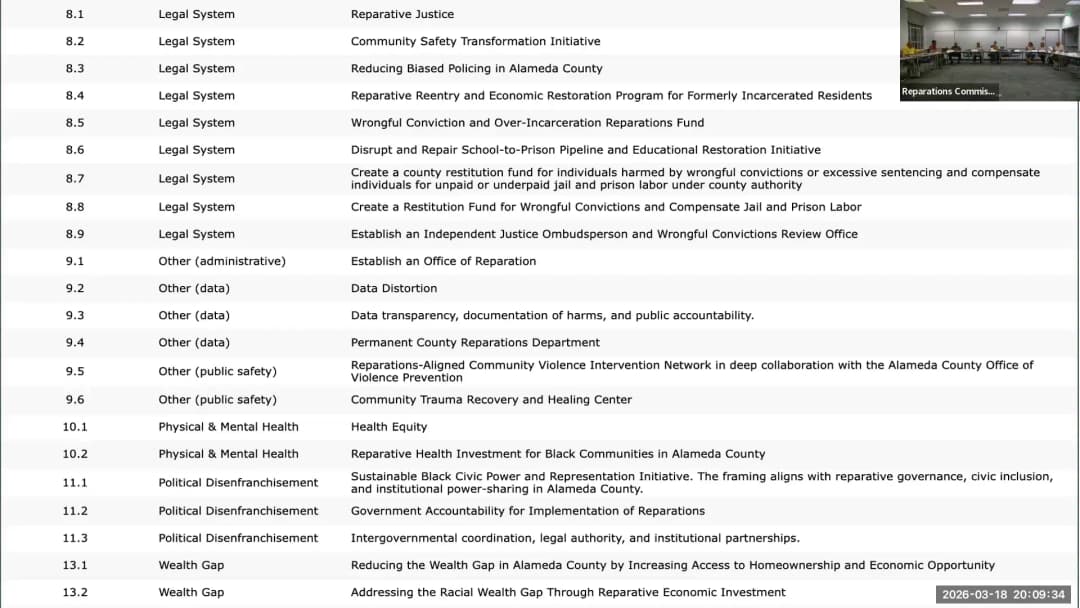
The Alameda County Reparations Commission met to discuss reparations recommendations, review survey data, prioritize action items, and address the legacy of Commissioner Jesse Clyde Burleson. The meeting included a moment of silence, a public comment, approval of February minutes, a presentation on survey findings, subcommittee updates, and an extensive prioritization discussion. Due to loss of quorum, final votes on priorities were deferred to a special meeting scheduled for Monday, April 13, 2026. Note: The transcript indicates this meeting occurred in March 2026 (references to "March reparations commission meeting" and an upcoming March 20 memorial), but the provided meeting date is April 8, 2026. The summary uses the latter per instruction. Consent Calendar - Minutes of February 11, 2026: Approved unanimously. Commissioners Knowles, McClernon, Triplett, and Varlack were excused; all others present voted aye. Public Comments & Testimony - Eric Sapp, friend and former colleague of Jesse Clyde Burleson, urged the commission to continue Mr. Burleson's vision of engaging incarcerated populations (currently and formerly) for input on reparations, specifically through jail visits at Santa Rita Jail. He asked the commission to explore or continue such efforts. Discussion Items - Moment of Silence and Commendation: The commission held a moment of silence for Jesse Clyde Burleson. President Gore read a formal commendation from the Alameda County Board of Supervisors honoring his life and advocacy. The memorial service was noted for Friday, March 20, 5–8 PM at Albany Community Center. - Survey Data Presentation: Michael from Informing Change presented early findings from the Descendant Assessment and Repair (DAR) survey (428 responses as of meeting; 285 at time of analysis). Demographics: 70% women, 83% descendants of enslaved persons, broad age and income range. Majority reported harms in housing (mixed), education (cultural exclusion), employment, and policing (harassment and unfair treatment). Qualitative responses to question 36 (protect/restore Black history places) were categorized into 12 areas. Commissioners requested youth-specific data and noted the survey remains open. Further data from paper surveys and youth sessions will be added by Wednesday of the following week. - Subcommittee Reports: - Admin & Budget: Completed 17 recommendations, monitored budget, supported Black Joy Parade engagement (nearly 200 surveys), and prepared for June 30 Board of Supervisors presentation. - Community Listening Sessions: Concluded formal listening sessions; planning two feedback sessions (in-person and virtual) in April. Discussed canceling a Saturday virtual session due to Commissioner Burleson's memorial and repurposing it as a feedback session on the action plan. - Data Analysis & Reporting: Compiled recommendations aligned with state task force; handled survey workflow and social media analytics. Subcommittee also worked on alignment with other jurisdictions. - Timeline Adjustment: The target for presenting the action plan to the Board of Supervisors was confirmed as June 30, 2026 (per Supervisor Miley's request). The draft report originally expected April 8 was moved to end of April due to data analysis needs; Michael noted a rough draft with outstanding questions could be available April 8. - Recommendation Review and Prioritization: The commission reviewed 13 categories of recommendations. Lengthy discussion on each category, including creative culture, economic opportunity, education, environment, housing, legal system, health, etc. Commissioners debated whether to prioritize immediate actionable items (e.g., housing, economic opportunity) versus aspirational long-term goals. Key themes: need for a permanent Office of Reparations to ensure accountability, addressing housing and wealth gap, legal system reform, and centering Black youth. The commission informally ranked priorities: 1. Housing, 2. Economic opportunity/wealth gap, 3. Office of Reparations/harms report, 4. Health, 5. Family/Black youth, 6. Education, 7. Legal system, 8. General/harms, 9. Creative culture/intellectual, 10. Political disenfranchisement, but could not vote due to loss of quorum. A special meeting was scheduled to finalize and vote. Key Outcomes - Approved: Minutes of February 11, 2026. - Deferred: Voting on recommendation priorities to a special meeting on Monday, April 13, 2026 at 6:00 PM (location to be determined, possibly a library). The agenda will include a roll call vote on the prioritized list. - Timeline: Final action plan and budget due to ad hoc committee by May 15, full commission approval by May 27, presentation to Board of Supervisors on June 30. - Survey Data: Additional data from youth and paper surveys to be collected and included in final report by end of April. Youth surveys to be tagged appropriately. - Special Meeting: Scheduled to achieve quorum and conduct roll call vote on priority rankings. Commissioners unable to attend Saturday due to travel plans; Monday evening was selected.
The Alameda County Board of Supervisors met on Tuesday, April 7, 2026, at approximately 5:30 PM (the meeting began in the morning and continued into the afternoon). The meeting included a recess into closed session, reconvening for 1:00 PM set matters, proclamations, public hearings, and a full regular calendar. Key actions included a unanimous vote opposing the reopening of FCI Dublin, approval of settlements from prior closed sessions, and adoption of a fee schedule for curb markings. Consent Calendar - Items 60 through 63 were approved unanimously on a motion by Supervisor Tam, seconded by Supervisor Miley. Public Comments & Testimony - Closed Session & Non-Agenda Items: Several speakers addressed closed session items and non-agenda issues. One speaker, who identified as an unhoused resident, described being forcefully evicted on December 8, 2025, from a property run by Bay Area Community Services (BACS), alleging corruption and abuse by BACS leadership. Another speaker criticized the county’s discretionary funding process, referencing a 2017 grand jury report and alleging inequitable distribution in District 1. - Item 58.1 – Opposition to FCI Dublin Reopening: Over 60 public speakers participated (in person, online, and from an overflow room) with nearly unanimous support for the resolution opposing reopening FCI Dublin for any detention or correctional purpose. Commenters included survivors of FCI Dublin, members of Jewish, Japanese American, and immigrant rights organizations, healthcare workers, students, and faith leaders. Several speakers highlighted documented abuses at FCI Dublin and in ICE detention nationwide, citing statistics: 32 deaths in ICE custody in 2025, 14 deaths in the first three months of 2026, and research showing that proximity to a detention center increases ICE arrests by up to seven times. One speaker noted that the Japanese American community’s incarceration during World War II was driven by hysteria and racism. Another speaker questioned Supervisor Miley’s earlier remarks, expressing concern about any future correctional use. A small number of speakers focused on other items, such as senior nutrition contracts. - Item 59 – Curb Marking Fee Schedule: One speaker criticized the county for not enforcing its fee policy in a specific instance involving a roadway straddling Fremont and county land, alleging preferential treatment. Discussion Items - Item 37 – Coliseum Negotiations (Continued): The board continued this item to April 28, 2026, as requested by Supervisor Miley. - Item 2 – Senior Nutrition Contracts: Supervisor Marquez raised concerns about potential gaps in services due to the timing of RFP release. Staff from the Social Services Agency confirmed they are working to avoid any lapse and will return to the board for an extension if needed. Supervisor Marquez stressed no funding or service gaps should occur. - Item 9 – EPIC Electronic Health Record System Positions: The board approved 7 full-time equivalent positions to support EPIC implementation. Staff noted EPIC will improve care coordination for behavioral health and jail health, enhance data exchange with hospitals, and support revenue generation. - Item 45 – Medi-Cal Enrollment for Re-entry Population: This sheriff’s department item aims to connect individuals leaving Santa Rita Jail to Medi-Cal for whole-person care. Supervisor Marquez indicated the board will closely track the July 2026 launch. - Item 35 – ACMEA MOU and Salary Ordinance: The board adopted the second reading of the MOU with the Alameda County Management Employees Association and introduced salary ordinance amendments. - Item 38 – Appointment of Anika Chaudry as Director of Alameda County Health: The board formally approved the appointment effective April 12, 2026, at a biweekly salary of $12,974.40. Ms. Chaudry thanked the board and committed to continuing county service. - Item 48 – Floodplain Management Ordinance: The board introduced an ordinance amending floodplain management provisions to comply with FEMA requirements. Staff clarified the changes formalize existing practices and maintaining the CRS rating, which provides a 5–15% discount on flood insurance for residents. - Proclamations (Items 57 & 58): The board proclaimed April 2026 as Arts, Culture, and Creativity Month and April 2026 as Child Abuse Prevention Month. During the latter, staff reported that in 2025 over 250 families were referred to Another Road to Safety, 24 organizations trained 750 individuals, and $800,000 in state prevention funding assisted over 2,100 families. Key Outcomes - Unanimous Vote (5-0) on Resolution Opposing Reopening FCI Dublin (Item 58.1): The resolution opposes reopening or repurposing the former Federal Correctional Institution in Dublin for any future detention or correctional operations. The vote was 5-0 (Supervisors Marquez, Tan, Miley, Fortunato Bass, and President Halbert all voting aye). Supervisor Miley expressed support after receiving clarification that the resolution applies to any correctional use, not just ICE detention. - Closed Session Settlements (Reported Out): Two settlements approved on October 28, 2025, were reported: Sky Decker v. County of Alameda – $175,000; Hernandez et al. v. County of Alameda – $150,000. Both were approved by Supervisors Miley, Marquez, and Fortunato Bass (with Halbert and Tan excused). Also, by a 5-0 vote, the board approved signing onto amicus briefs in U.S. v. Weber (9th Cir.) and U.S. v. Benson (6th Cir.). - Fee Schedule Adopted (Item 59): The board closed the public hearing and unanimously adopted the resolution confirming the fee schedule for installing curb markings and signs for fiscal year 2025-2026. - Minutes Approved: Minutes from March 17 and March 24, 2026, were approved unanimously. - Continued Item: Item 37 (Coliseum negotiations) was continued to April 28, 2026.
The Personnel Administration and Legislation (PAL) Committee met on Monday, April 6, 2026, at 9:30 AM (roll call at meeting start). Supervisors Fortunato Bass and Town were present, establishing a quorum. The agenda included federal and state legislative updates, a continuation of SB 1193, and approvals of multiple legislative positions and funding requests. No public comments were received. Consent Calendar - Workforce Innovation and Opportunity Act (WIOA) Funding Request: The Social Services Agency requested approval to submit a letter seeking programmatic funding for WIOA to support compliance with new HR1 workforce navigation requirements. The committee unanimously approved a motion to advance this request to the full Board of Supervisors. - Legislative Positions (4 items): The committee concurred on the following positions and approved forwarding them to the full board: 1. Support a budget allocation of $8.3 million in one-time general funds for the CNA workforce initiative (Social Services Agency). 2. Oppose AB 195 (requested by Child Support Services) to maintain child support enforcement tools. 3. Support AB 1643 to amend family code sections related to child support. 4. Support SB 1264 regarding notice of death for child support obligations (Child Support Services). All motions passed unanimously (2-0). Public Comments & Testimony - No public comments were offered during the federal legislative update, state legislative update, on the legislative positions, or on non-agendized items. Discussion Items - Federal Legislative Update (CJ Lake): John Asini reported on recent federal developments, including President Trump’s firing of Attorney General Pam Bondi and the nomination speculation, the ongoing DHS shutdown (51st day, longest in U.S. history), and the FY27 budget proposal. The budget includes $2.2 trillion in discretionary spending with a 10% cut to domestic programs and record defense increases. Supervisor Fortunato Bass expressed frustration over the political use of federal workers as leverage in the shutdown. A question about TSA back pay clarified that future funding still requires congressional action. - State Legislative Update (Fulham Strategies): Jael Dent reported that the legislature resumed after spring recess, with 920 bills to consider by end of April. Alameda County’s sponsored bill, SB 1400 (Senator Arragoni), is scheduled for a hearing on April 15th. A tracker of 38 ballot initiatives was provided. Upcoming subcommittee hearings will address state responses to HR1 and Calfresh. Supervisor Town asked about the May Revise (scheduled for May 14) and the potential state backfill for HR1 impacts. - SB 1193 Continuation: Supervisor Town announced a one-week continuance of SB 1193 to the next PAL meeting to allow further due diligence. Key Outcomes - WIOA Funding Letter: Motion to advance to full board passed (Fortunato Bass: aye, Town: aye). - Legislative Positions 1-4: Motion to forward to full board passed (same votes). - SB 1193: Continued to the next PAL meeting (no vote recorded; Chair’s decision). - Next Steps: The committee will receive further updates on the DHS shutdown, FY27 budget process, and state budget negotiations. Staff will coordinate with federal and state lobbyists on advocacy efforts.