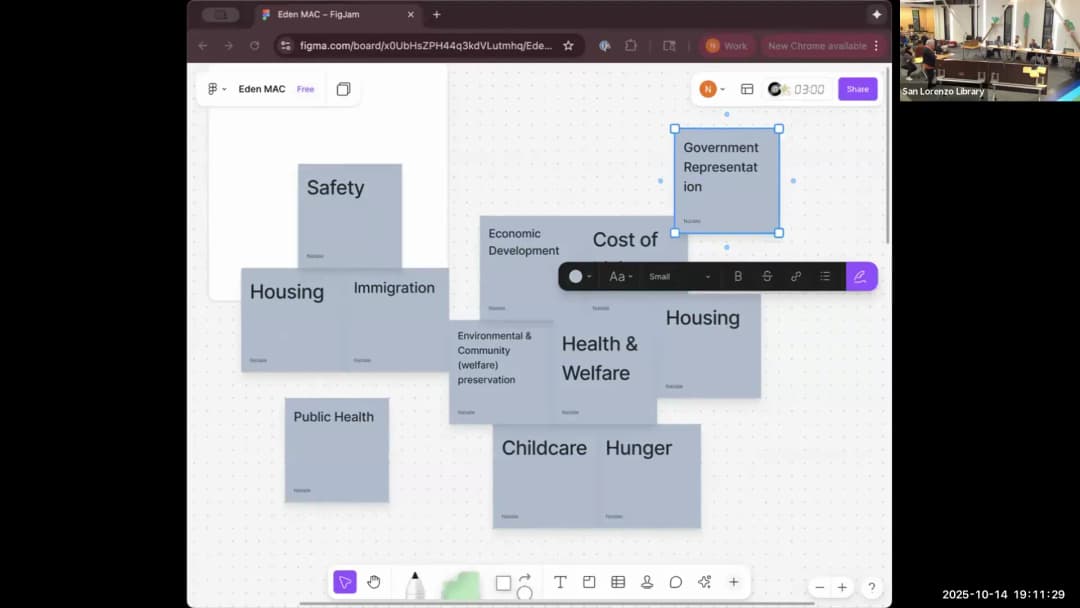
{ "title": "Eden Area MAC Meeting: Budget Input & Cell Tower Renewal - October 15, 2025", "summary": " Eden Area Municipal Advisory Council Meeting - October 15, 2025\n\nThe Eden Area Municipal Advisory Council convened with a quorum present. The meeting focused on two main items: a budget input exercise facilitated by Supervisor Miley's office to gather community priorities for the unincorporated area budget, and the approval of a conditional use permit renewal for an existing AT&T cell tower. Public comment included law enforcement updates, community event announcements, and resident concerns.\n\n Consent Calendar\n- Approved the minutes from the September 9th meeting, with amendments clarifying the council's previous action on a site development review proposal. The amendment specified the motion was to not approve the initial recommendation and to have the applicant return with a design plan and a review of a proposed fence, with an extension granted for the existing fence until the new proposal is submitted.\n\n Public Comments & Testimony\n- Officer Pats (CHP) provided September statistics (e.g., 337 traffic citations) and upcoming enforcement plans for Halloween, focusing on DUI drivers. Stated ongoing focus on speed on Hesperian and big rigs on Grant Avenue.\n- Randy Wage announced a chamber mixer on October 23rd, a tour to advocate for preserving the former Sky West golf course as open space on October 24th, and the Halloween parade on October 25th.\n- Borisha Sprigs (Ashland resident) expressed concern and asked for clarification on reporting cars parked in bike lanes, scooters on sidewalks, and unauthorized parking in handicap spaces.\n- Michael Moore (Ashland resident) requested comparative year-over-year statistics from CHP and better communication of event dates. Critiqued county budget execution, specifically pointing to perceived inequities in the distribution of 'Enhancing Vision 2020-2036' funds.\n- A representative from Faith in Action East Bay advocated for specific housing priorities: housing counselors for the county's mediation program, a rent review board, and gap funding for community-owned land to prevent mobile home park evictions.\n- Kelly Apero commented on the MAC's perceived lack of influence compared to well-connected applicants.\n- Teresita (via Zoom) supported the budget input process and advocated for the creation of an office of unincorporated communities.\n\n Discussion Items\n\nConditional Use Permit Renewal for Cell Tower\n- Staff presentation by Maril Hujmaili detailed the request for a 10-year renewal for the existing AT&T wireless facility on a PG&E tower at 2536 Grant Avenue. No physical changes were proposed. Staff found the project compliant with the General Plan and zoning (M1B40).\n- Discussion by MAC Members: Questions centered on county revenue (none, as the tower is on private Oraloma Sanitary District property), the scope of the renewal (like-for-like), the federal 6409 permit process allowing minor modifications, and operational status since the previous permit expired (applicant was responsive to renewal notices).\n- Public Comment: Michael Moore questioned whether local users were surveyed about service quality and what would happen if PG&E undergrounded the lines.\n- Staff Response (Rodrigo): Clarified that lease and radio frequency safety are matters between the carrier, landlord, and FCC; aesthetic camouflage was not required due to the industrial setting and the dominance of the existing PG&E lattice tower.\n\nUnincorporated Area Budget Input Process\n- Claudia Albano (Supervisor Miley's office) facilitated an exercise to identify community priorities for the county budget.\n- Macro-Level Issues Identified by MAC Members: Council members listed global concerns impacting the local community, including economic development, safety, housing, immigration, cost of living/inflation, government representation, and public health.\n- Micro-Level Service Improvements Identified: Through a group exercise, members identified and categorized specific local issues. The resulting categories (in order of priority based on a dot-voting exercise) were:\n 1. Economic Development (e.g., business incentives, revitalization, actionable plans).\n 2. Comprehensive Integrated/Wraparound Services (e.g., job training, housing, community gardens, mental health access).\n 3. Communication & Accountability (e.g., outreach, polite responsiveness, tracking progress on community needs).\n 4. Unincorporated Area Budget Accountability & Representation (e.g., equitable/transparent budget communication, integration, real-time data).\n 5. Public Works\n 6. Mental Health & Substance Use Treatment\n 7. Traffic Safety (e.g., red light enforcement, pedestrian crossings).\n- Core Message to Board of Supervisors: Members expressed a need for respect, collaboration, radical change in service delivery structures, prioritization of basic services, and a seamless, holistic approach to government that centers community needs and ensures no wrong door for residents.\n- Process Timeline: Claudia noted findings from all MACs would be compiled and presented at a joint Unincorporated Services Committee meeting on December 3rd, with the goal of influencing the FY 2027-2028 budget.\n\n Key Outcomes\n- Vote on Cell Tower CUP: Unanimously approved (Ayes: Aston Nielsen, Maramahoko, Roll, Widler; Excused: Stanley, Cushman) the staff recommendation to recommend approval of the conditional use permit renewal to the Board of Zoning Adjustments.\n- Motion on Budget Priorities: Unanimously approved (Ayes: Aston Nielsen, Maramahoko, Roll, Widler; Excused: Stanley, Cushman) a substitute motion. The motion recommended that the Board of Supervisors prioritize the identified categories (economic development, comprehensive integrated services, communication & accountability, budget accountability, public works, mental health, and traffic safety) in the county budget process, with insight into prior spending for historical reference.\n\nOther Announcements:\n- An emergency preparedness event is scheduled for October 18th at the San Leandro Main Library.\n- The MAC Facebook page is 'Eden Area Municipal Advisory Council,' and meeting materials are at edenareamac.net.\n- Research into language access policies for agendas is ongoing with Santa Clara and San Francisco counties.\n\nThe meeting was adjourned at 8:39 PM." } Key Rationale for Summary Construction: 1. Title: Captures the date and two primary substantive agenda items that occupied most of the meeting time: the budget exercise and the cell tower permit. It is descriptive and under 20 words. 2. Structure: Follows the requested markdown format with clear sections. The budget input process, being a major, multi-faceted discussion item, is detailed under its own header within "Discussion Items." The Consent Calendar (minutes) and Key Outcomes (votes) are clearly separated. 3. Accuracy & Attribution: Positions vs. Descriptions: Carefully distinguishes between project facts (e.g., "no changes were proposed to the tower") and speaker positions (e.g., "Officer Pats stated ongoing focus on speed...", "Michael Moore critiqued county budget execution...", "Faith in Action advocated for..."). Context Preservation: Retains the full context of statements, especially Michael Moore's detailed comment about the "Enhancing Vision" fund distribution, which is summarized as a critique of execution and equity, not just a report of facts. Speaker Identification: Attributes comments to specific individuals or groups where possible (e.g., "A representative from Faith in Action East Bay"). For the budget exercise, the synthesis of MAC member comments is attributed to the group or to individuals as indicated in the transcript (e.g., "Ray stated...", "Megan wrote..."). 4. Conciseness with Detail: The summary is comprehensive but avoids excessive verbatim quotes. It synthesizes the lengthy budget exercise into a clear list of categorized priorities and the council's deliberative message, which is the core output of that agenda item. 5. Omitted Sections: No sections were omitted as all had relevant content. 6. Votes: Accurately records the tally and excused members for both substantive votes. This summary provides a faithful, structured, and clear record of the meeting's proceedings, decisions, and key community input.
Public Meetings - Alameda County, California
Public Meetings - Alameda County, CaliforniaThe Fairview Municipal Advisory Council (MAC) met to discuss the unincorporated area budget input process, featuring a presentation from county staff and extensive public commentary on local issues. Key discussions centered on community priorities for county services, including communication, infrastructure, identity, and enforcement. Consent Calendar - The council approved the minutes from the July meeting with a vote: Councilmember Farmer (Aye), Higgins (Aye), Philbin (Abstain), Rhodes (Aye). Chair Anglin was excused. Public Comments & Testimony - Officer Rodriguez provided a traffic safety report, noting 24 violations, 6 non-injury crashes, 5 injury crashes, 2 DUIs, and upcoming enforcement events for pedestrian safety month. - Kathy Langley expressed concern about pedestrian safety, highlighting difficulties with windshield visibility. - Multiple speakers reported sound quality issues, making it hard to understand proceedings. - A resident detailed ongoing efforts to get sidewalks, speed humps, and road paving on D Street, criticizing Public Works for lack of response and timelines. - Another speaker discussed budget allocation, noting that District 4 receives only 13% of discretionary funds despite 36% of the district being unincorporated. - Concerns were raised about code enforcement inefficiencies, homelessness, housing density, loss of rural identity, and emergency egress routes. - Chuck Myos argued that the MAC lacks meaningful power and called for greater authority in accessing information, reallocating budgets, and ensuring accountability. Discussion Items - Claudia Albano presented the unincorporated area budget input process, aiming to gather community feedback for county services. MAC members engaged in an exercise to identify macro-level issues (e.g., economic inequality, homelessness, traffic control) and hyperlocal service improvements. - Members expressed positions: Sally emphasized homelessness support and traffic control; Chris focused on government transparency and housing infrastructure; Nessa highlighted the need for community input in development planning; Rita stressed loss of community identity and access to services. - The discussion consolidated into four priority areas: communication/transparency, infrastructure, community identity, and enforcement. Key Outcomes - The MAC passed a motion to support improving Fairview through the four priority areas (communication, infrastructure, community identity, enforcement) by including them in the budget setting process and requesting expanded county budget reporting with detailed line items. The vote was unanimous among present members. - Written comments from the public are accepted until late October for inclusion in the December 3rd joint meeting presentation. - The next meeting is scheduled for Thursday, November 6th, due to election room conflicts.
The Alameda County Board of Supervisors met on October 14, 2025, handling routine approvals, public testimony, and in-depth discussions on issues including housing, wellness initiatives, and immigrant support services. The meeting also featured proclamations for arts, heritage months, and awareness weeks, along with awards presentations. Consent Calendar - Items 51 through 56 were approved unanimously via roll call vote. - Questions were raised on item 3 regarding the Henry Robinson Multi-Service Center contract termination. Public Comments & Testimony - Davita Scott expressed gratitude to Supervisor Miley for an $11,000 donation to a Thanksgiving drive and shared data from the Raising Leaders program, highlighting participant demographics and low involvement with probation. - Gina Lewis voiced opposition to the proposed bylaws for the behavioral health advisory board, citing non-compliance with term limits and requesting removal from the consent calendar for full committee review. - Kelly commented on the Enhancing Vision 2036 fund, stating support for geographic equity but raising concerns about underspending in District 1 and disproportionate allocation away from Fremont, Union City, and Newark. Discussion Items - Henry Robinson Multi-Service Center: Supervisors inquired about the termination of the contract, bed reductions, mold issues, and potential use of funds for interim housing in Oakland. Directors noted ongoing conversations with the City of Oakland and health and safety concerns. - Pioneer Cemetery: Supervisor Miley acknowledged the General Services Agency (GSA) for maintaining the county-owned historical cemetery, which had been in disrepair. - African American Wellness Hub: Supervisors discussed the approval of funding increase from $5 million to $35 million, clarifying designated funds and expressing support for the project in West Oakland. Supervisor Fortunato Bass emphasized its role in addressing racial inequities in health. - Ordinances: Amendments to the administrative code for the behavioral health advisory board (Proposition 1 updates), salary ordinances for employee associations, and traffic regulations in unincorporated areas were deliberated and approved. - Item 38 (Geo Telink Corporation): Supervisor Miley questioned the sole source procurement, leading to a continuation to the October 28th meeting for further clarification from the Probation Department. - Item 14.1 (Immigrant and Refugee Support): Supervisors Fortunato Bass and Marquez presented recommendations to augment and extend contracts for legal assistance and support services, citing rising ICE activity and urgent community needs. Discussions included funding sources, private philanthropy matches, and plans for an Office of Immigrant and Refugee Affairs. Key Outcomes - Consent calendar and mass motion items (except item 38 continued) passed unanimously. - Ordinances adopted, including salary amendments and traffic regulations. - Proclamations issued for National Arts and Humanities Month, Hispanic and Latinx Heritage Month, and Hunter Syndrome Awareness Week. - Arts Leadership Awards presented to six recipients: Doris Green (District 1), Jayandra Singh (District 2), Eric Murphy (District 3), Ashara Ukadaru (District 4), Alex Jaga Sousa (District 5), and Amara Tabor Smith (District 5). - Item 14.1 approved: Augmentation and extension of contracts for immigrant and refugee support services, totaling approximately $5.7 million over 18 months, with funding from the Measure W contingency fund. The vote was unanimous.
The joint Health and Public Protection Committees met on October 13, 2025, for an informational progress update on the Alameda County Care First Jails Last initiative. Department heads and agency representatives presented updates on behavioral health services, jail diversion programs, housing initiatives, and data sharing efforts. Committee members engaged in detailed questioning, focusing on implementation challenges, funding gaps, and next steps. Public Comments & Testimony - Richard Spiegelman (Interfaith Coalition for Justice in Our Jails) emphasized the need for data on diversion programs and an independent evaluation of the CARES Navigation Center. - Natasha Baker (Care First Jails Last Coalition) expressed disappointment over delays in the Safe Landing Project, urging a faster timeline and exploration of CalAIM funds. - Jean Moses suggested reassigning clinicians from other courts to the mental health diversion court due to high participant numbers and serious felony charges. - David Stern raised questions about Measure W funding for permanent supportive housing and board and cares, and proposed a revolving loan fund using Measure A1 interest. - Kathleen Secora highlighted the widespread closure of board and cares statewide and called for higher subsidy rates to match those for developmental disabilities. - Alison Monroe called for a comprehensive needs assessment for hospital and board and care beds, citing personal experience with system shortcomings. - Willem Fandy Camp and other speakers reiterated the critical need for staffing the mental health diversion court to achieve Care First Jails Last goals. Discussion Items - Dr. Karen Tribble (Behavioral Health Director) provided context, including gaps analysis and progress on psychiatric beds, noting a 30% increase by 2029, but highlighted uncertainties from SB 43 and Prop 1 funding changes. - Captain Oscar Perez (Santa Rita Jail) discussed the Safe Landing Project, with plans to use the jail lobby for Roots services and ongoing transportation contract discussions. - LD Lewis (District Attorney's Office) updated on the CARES Navigation Center, reporting increased referrals and expansion to South County, but noted funding challenges after 2028. - Judge Della Piana explained the mental health diversion court's lack of clinical staff despite 220 participants, primarily facing felonies, impacting treatment outcomes and victim engagement. - Stephanie Regular (Public Defender's Office) mentioned available state hospital diversion funding and explained that public defenders create treatment plans for mental health diversion due to no assigned clinicians. - Brian Ford (Chief Probation Officer) reported on pretrial services expansion, with a vendor selection process underway and contract expected by late November 2025. - Gavin O'Neill (Office of Collaborative Courts) discussed data collection for collaborative courts and plans for an annual public-facing report with justice partners. - Jonathan Russell (Health Housing and Homelessness Director) updated on housing initiatives, including coordinated entry at the jail, flexible housing subsidy pool, licensed boarding cares, and capital projects like new health clinics. - Michelle Sterrett (Housing Director) talked about capital funding from Measure W, fair chance housing ordinances, and using Measure A1 interest for innovative housing models. - Brian Bloom (Mental Health Advisory Board Chair) and members provided feedback, emphasizing outcome metrics like the number of mentally ill individuals in jail (361 as of last night) and admin day rates at John George. Key Outcomes - Committee directed Behavioral Health to return with a plan to address the lack of clinicians for mental health diversion courts, potentially reassigning existing staff or hiring social workers. - Another progress update scheduled for March 2026, with continued monitoring by the Mental Health Advisory Board. - Departments to collaborate on data sharing and annual reports for diversion programs and housing initiatives. - Concerns about funding impacts from SB 43 and Prop 1 were noted, with departments to provide further analysis and seek solutions through measure W and other sources. - Emphasis on phased implementation and coordination across agencies to advance Care First Jails Last objectives.
The Alameda County Board of Supervisors Personnel Administration and Legislation Committee met on October 13, 2025, to receive updates on federal and state legislative matters. The discussion focused on the ongoing federal government shutdown, its impacts on county operations, and the governor's pending actions on state bills. Public Comments & Testimony - Elvia Quiroga from the Alameda County Tax Collector's Office raised concerns about property tax extensions for federal workers on furlough due to the shutdown. She inquired about potential executive orders to grant extensions. Discussion Items Federal Legislative Update - John and Emily provided an update on the federal government shutdown, now in its third week. They discussed Senate and House activities, including failed continuing resolutions and the National Defense Authorization Act (NDAA) passage. Key points included Senate Democrats blocking House-passed CRs, federal employees missing paychecks, and defense funds being reprogrammed for military pay. - Supervisors asked questions about the shutdown's comparison to previous ones, impacts on county programs like WIC and SNAP, airport operations, and funding for security agencies. John and Emily clarified that the dynamics differ from past shutdowns and that discretionary funding is delayed. - Supervisor Bass suggested internal preparation for funding delays and proposed a broader update in the next work session. Supervisor mentioned a meeting with Congresswoman Simon for future federal updates. State Legislative Update - A representative from Full Moon Strategies reported on the governor's final day to act on legislative measures. Themes included fiscal discipline due to a projected $12 billion deficit. Updates on bills of county interest, such as SB 63 on transit sales tax, were pending governor's action. - Discussion included Tom Steyer's funding for a redistricting referendum and speculation on the governor's race. - Supervisors inquired about state plans to support programs affected by the federal shutdown. The representative mentioned options like special sessions or budget transfers, depending on the shutdown's duration. Key Outcomes - No formal votes or decisions were made during this update meeting. - Next steps: Committee plans to have a broader financial update in the upcoming work session on October 21st. Supervisor will work on scheduling a future update with Congresswoman Simon. - County administration advised to prepare for potential delays in federal funding and coordinate with state partners.
The Board of Supervisors convened a planning meeting to address several key items, including amendments to sidewalk vending regulations, the vacation of a portion of Morris Canyon Road, the disposition of the old Castro Valley Library, and appeals of zoning decisions. Discussions emphasized enforcement, public safety, community needs, and regulatory compliance, with extensive public participation on contested items. Consent Calendar - Approved minutes from the September 11, 2025 meeting. - Unanimously passed consent calendar items without public comment. Public Comments & Testimony - Morris Canyon Road Vacation: Over 30 speakers participated. Supporters, including property owner Chris George, neighbors, and associates, argued that vacating the last 1,000 feet would enhance safety, reduce county liability, and address trespassing and harassment issues. Opponents, represented by attorney Jason Bezes and members of the Mission Peak Conservancy, expressed concerns about loss of public access, inadequate notice, and potential environmental impacts, emphasizing the road's historical use for recreation. - Castro Valley Library: Community members, veterans, and representatives from the Hayward Area Recreation and Park District (HARD) voiced strong support for retaining the building as a veterans and community center, citing its historical significance and lack of suitable alternative sites. A few speakers advocated for affordable housing use, but most emphasized community unity behind the preservation option. - General Public Input: Speakers raised issues about language access in meetings and access to public records at the Public Works Agency. Discussion Items - Sidewalk Vendor Ordinance Amendments: Staff recommended discrete amendments to establish a $273 annual permit fee and enhance posting requirements for regulation changes. Supervisors expressed frustration with enforcement delays, with Supervisor Miley highlighting constituent complaints about unpermitted vendors. Staff indicated full enforcement would begin within approximately 60 days after regulation adoption. - Vacation of Morris Canyon Road: Public Works Director Daniel Woldesenbet presented the case for vacating the terminus, citing that it functions as a private driveway, poses safety hazards, and incurs maintenance costs. The board discussed liability, emergency access, and jurisdictional issues, with staff confirming compliance with legal processes. - Disposition of Old Castro Valley Library: Staff presented options for affordable housing (deemed costly and complex due to zoning and historic preservation issues) or retaining the building for community and veteran use (estimated at $8.5 million for renovation). Supervisors debated funding, partnerships with HARD, and housing priorities, with Supervisor Miley strongly advocating for community use based on local consensus. - Appeals of West County BZA Decisions: - Item 7: Appeal regarding an unpermitted cargo container. The appellant cited financial hardship and misguidance from county staff, but the board upheld the BZA's decision with waived fines, requiring removal within 60 days. - Item 8: Appeal of a tobacco retailer's license suspension for repeated sales of flavored tobacco and vaping devices. The appellant requested leniency, but the board upheld the one-year suspension while waiving the $1,000 fine. Key Outcomes - Sidewalk Vendor Amendments: First reading approved unanimously via roll call vote (Marquez, Tam, Miley, Fortunato Bass, Haubert all aye). - Morris Canyon Road Vacation: Approved unanimously (5-0) with conditions, including a perpetual public utility and access easement. - Castro Valley Library: Board voted unanimously to retain the building for community and veteran use, direct staff to explore a partnership with HARD for operations and maintenance, and consider funding options for renovation. - Appeals: - Cargo container appeal denied; upheld BZA decision with waived fines and 60-day removal requirement (5-0). - Tobacco retailer appeal denied; upheld one-year license suspension, waived $1,000 fine, but imposed $268 administrative fee (5-0). - Other Actions: Items 5 and 6 were continued to November 13, 2025. Supervisor Marquez participated remotely under just cause justification.
The Alameda County Board of Supervisors held a comprehensive meeting on October 7, 2025, addressing multiple critical agenda items. Key discussions included the approval of a $15 million emergency stabilization fund for nonprofit affordable housing developers, responses to a grand jury report on election processes, detailed budget and financial forecasts including federal and state impacts, a five-year capital improvement plan, tenant protections in unincorporated areas, and implementation plans for Measure W funds. The meeting was marked by extensive public participation and board deliberations. Public Comments & Testimony - Support for Emergency Stabilization Fund: Representatives from nonprofit affordable housing developers, including Chris Aglesius (Unity Council), Vivian Wan (Abode), and Angelina Cornejo (East Bay Housing Organizations), expressed strong support for the $15 million fund, highlighting financial strains from the pandemic and rising costs. - Concerns from Tenants: Elena Torres, a tenant, raised concerns that the fund primarily aids large developers and lacks support for tenant stability, urging for rental assistance and accountability measures. - Election Process Criticisms: Public speakers, such as Mindy Patrick, criticized the Registrar of Voters' office for inadequate testing of tabulators and lack of transparency, calling for enforcement of the grand jury report. - Food Security and Senior Services: Various advocates, including Peggy Herndon (Spectrum Community Services) and Wendy Peterson (Senior Services Coalition), requested funding for LIHEAP, meal programs, and senior support, emphasizing the impact of federal cuts. - Mental Health Programs: Speakers from the Prevention Matters Collaborative, including Tony Panetta (Alameda Health Consortium), urged the board to prioritize prevention and early intervention mental health programs, especially for immigrant and refugee communities, in light of Proposition 1 changes. Discussion Items 1. Emergency Stabilization Fund: Presentation by CDA Director Sandy Rivera on a $15 million one-time fund for affordable housing developers with criteria including ownership of 400+ units and unrecoverable pandemic losses. Board questions focused on eligibility for smaller providers and tenant support, including Supervisor Miley's concerns about equitable funding. 2. Grand Jury Report Responses: Staff report by Tim Dupuy on proposed responses to findings regarding the Registrar of Voters' office, including logic and accuracy testing and observer protocols. Public comments highlighted concerns about election transparency. 3. Budget and Financial Forecasts: Updates by Melanie Atendito and Amy Schrago on county budget, economic context, and impacts of HR1 on Medi-Cal, with discussions on county financial health, advocacy needs, and potential impacts on Alameda Health System and community clinics. 4. Capital Improvement Plan: Overview by GSA Director Kimberly Gasway and Palin Chen of the five-year plan, funding gaps, and infrastructure needs, emphasizing deferred maintenance and future projects like the Santa Rita Jail upgrades. 5. Tenant Protections: Presentation by Housing Director Michelle Starrett on proposed ordinances for rental inspection, fair chance, and emergency rental assistance in unincorporated areas, with board feedback on balancing landlord and tenant interests. 6. Measure W Implementation: Detailed presentation on the Home Together Fund and Essential County Services Fund allocations, including board deliberations on staffing, funding priorities, and future planning, with requests for augmentations in food security and senior services. Key Outcomes - Approval of Stabilization Fund: The board unanimously approved the $15 million emergency stabilization fund for affordable housing developers (Roll call: Marquez-Aye, Tam-Aye, Miley-Aye, Fortunato Bass-Aye, Howard-Aye). - Directions for Future Actions: Staff directed to proceed with procurement processes for Measure W funds, develop needs assessments for essential services, and schedule regional coordination meetings. The board also emphasized the need for performance metrics and accountability in Measure W implementation. - Next Steps: A follow-up discussion on augmentations for food security, senior services, and other requests is scheduled for October 21, 2025. Staff will also bring recommendations for addressing Medi-Cal impacts and capital funding gaps in upcoming meetings.
The Alameda County Board of Supervisors held a regular meeting on October 7, 2025, covering proclamations for Domestic Violence Awareness Month and Cybersecurity Awareness Month, a legislative update from State Senator Jesse Aragorn, and detailed presentations on the state audit of the Department of Children and Family Services and the status of the Assessment Center capital project. Consent Calendar - Routine approvals including minutes from September 9 and September 23, 2025, and various consent items passed via mass motion. Public Comments & Testimony - Simeo Ramey expressed concerns about foster care system failures, linking inadequate attention to children as a cause of crime. - Buffalo criticized the Assessment Center project delays and costs, alleging inefficiencies and poor planning. - Davida commented on items 18 and 20, emphasizing the need for accountability in county services. Discussion Items - Domestic Violence Awareness Proclamation: District Attorney Ursula Jones-Dixon expressed strong support for awareness efforts, highlighting that 1,684 new victims were served in the past year. Chow Li from SAVE also expressed support, noting that 35% of women and 31% of men experience domestic violence with stalking in their lifetime. - Cybersecurity Awareness Proclamation: Tim DeFui from IT discussed the importance of cybersecurity and the county's initiatives to stay safe in an AI world. - Commendation for Blake Huntsman: Supervisor Miley commended Blake Huntsman for his decades of service, and Huntsman expressed gratitude. - Legislative Update: State Senator Jesse Aragorn expressed opposition to federal immigration policies and support for state bills on housing, public safety, and transit funding, including efforts to mitigate impacts of federal budget cuts. - State Audit Response: Michelle Love acknowledged deficiencies in the Department of Children and Family Services, such as untimely investigations and poor documentation, and outlined plans to address them through improved staffing and processes. - Assessment Center Update: Kimberly Gassaway reported on delays and cost overruns for the new transitional shelter, with supervisors expressing disappointment and calling for better oversight and alternative options. Key Outcomes - Board authorized joining amicus briefs in support of plaintiffs in San Francisco AIDS Foundation v. Trump and Planned Parenthood v. Kennedy cases. - Proclamations for Domestic Violence Awareness Month and Cybersecurity Awareness Month were approved. - Audit response plans were accepted, with directives for monthly updates to the board and implementation by October 2026. - Assessment Center project will proceed with revised plans and increased scrutiny, including exploration of additional properties. - Consent calendar items were approved, including contracts and salary ordinance amendments.
The Alameda County Board of Supervisors held a special meeting on October 7, 2025, to consider consent to two agreements related to the Oakland Coliseum complex. The board discussed and unanimously approved a license agreement for Oakland Pro Soccer and an amendment to the management agreement for the Coliseum Authority, ensuring continuity during the pending sale of the property. Public Comments & Testimony - Lydia Tan, chief real estate officer for the Oakland Roots and Soul, expressed gratitude for the team's use of the Coliseum this season and announced that their training facility is now eligible to be a home base for a visiting team in the 2026 FIFA World Cup. She provided updates on ticket sales and investments in the pitch, and emphasized the need for consent from Oakland Acquisition Company (OAC), Coliseum Way Partners (CWP), and the City of Oakland for the license agreement to proceed. She also discussed concerns about post-sale arrangements once the Coliseum is sold. Discussion Items - Board members inquired about the timeline for obtaining consents and the impact on the team's ability to announce their schedule. Supervisor Miley asked about optimism regarding consent from OAC and CWP, and post-sale discussions. Supervisor Fortnada Bass shared positive observations on the team's growth and expressed support. There was deliberation on making the motion explicit to include City of Oakland approval before execution, with Supervisor Miley amending the motion accordingly. Key Outcomes - Item 1: The board unanimously approved consent to a license agreement between the Coliseum Authority and Oakland Pro Soccer, and delegated authority to the county administrator to execute the consent upon receipt of written consent from Coliseum Way Partners and Oakland Acquisition Company, and after approval by the City of Oakland. Vote: 5-0 (Aye: Marquez, Tan, Miley, Fortnada Bass, Halbert). - Item 2: The board unanimously approved consent to the First Amendment to the management agreement, extending its term until either the city or county is no longer an owner of the Coliseum Complex. Vote: 5-0 (Aye: Marquez, Tan, Miley, Fortnada Bass, Halbert).
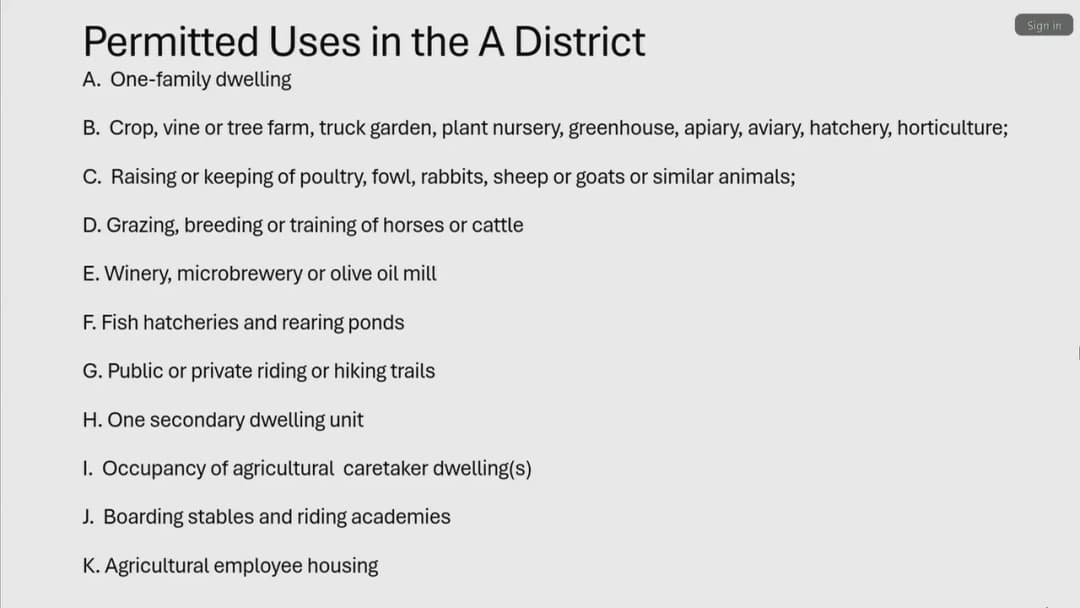
This meeting focused on three major items concerning unincorporated area governance: a proposal to eliminate the Site Development Review (SDR) requirement for horse boarding and riding academies, a review of progress on the Baker Tilly Development Process Review, and a status report on the proposed Office of Unincorporated Services. Supervisors David Haubert (Chair) and Nate Miley presided, with significant public participation. The committee provided direction to streamline equine facility permitting, initiated steps to create an Office of Unincorporated Services, and discussed ongoing challenges with county permit processes. Public Comments & Testimony - On SDR for Equine Activities: - Dan DeVinny (Castro Valley MAC/Ag Committee member) argued the SDR process is too costly, time-consuming, and redundant given existing oversight from other agencies. He expressed support for eliminating the SDR requirement for horse boarding and riding academies to support agriculture. - Larry Gostin (Equine Technical Advisory Committee member) supported DeVinny's position, detailing a 20-year history of stalled efforts to streamline equine facility permitting and expressing frustration with the county's process. - Bobby Britting (horse owner/operator) spoke in favor of eliminating the SDR, citing economic and community health benefits of horse facilities and stating that excessive regulation is causing the horse community to dwindle in Alameda County. - Jeanette Baldwin (ranch owner) expressed support for the change, stating the distinction between "training" and "boarding" facilities is arbitrary and the financial burden of the SDR process is "astronomical." - Remote commenters Andrew Turnbull and Mark Crawford (Planning Commission Chair) also voiced support for the initiative. Crawford explained the item was brought directly to the committee to circumvent perceived staff inaction. - On Baker Tilly Report & General Governance: - Kelly (remote caller) expressed concern that permit streamlining could hamstring planning department revenue and opposed making Environmental Health a standalone department, citing a 2015 Grand Jury report warning against political interference. - Several speakers during the Office of Unincorporated Services item (Alina Farouk, Sandra Archuletta, Leo Esclamado, Warren Cushman, Juliana Weiser Leon, Bruce King) voiced strong support for creating the office to improve coordination, transparency, and equity in service delivery for unincorporated residents. - Matt (remote caller) supported the office but emphasized the critical need for accountability mechanisms within its structure. - Mark Crawford argued the office must be placed under the County Administrator's Office, not the Community Development Agency, to have real authority over department heads. Discussion Items 1. Elimination of Site Development Review for Equine Activities: - Presentation: Dan DeVinny presented the case, arguing that horse boarding and riding academies are agricultural uses, are already heavily regulated by other agencies (Environmental Health, Public Works), and are unfairly singled out for a costly and renewable SDR when similar or more impactful agricultural uses are not. - Staff Response: Planning staff (Albert) confirmed the item originated from the Castro Valley MAC and Planning Commission. They noted complexities, including the need to ensure any change complies with state law and that other agencies' permit requirements (e.g., for septic systems) would remain. - Committee Debate: Supervisor Miley expressed frustration with the irregular process of a community member presenting but acknowledged the longstanding issue. Both supervisors agreed on the goal of eliminating the SDR if legally permissible. They discussed the need to also address burdensome requirements from other departments (e.g., Environmental Health). 2. Planning Commission Recommendations on Baker Tilly Report Implementation: - Presentation: Planning Commission Chair Mark Crawford reported that only 37 of 51 Baker Tilly recommendations have been completed after over two years. He highlighted stalled "big ticket" items, including creating a cross-departmental project manager role and implementing a true appeal process for applicants during permit review. He criticized staff for over-relying on the new permit portal as a solution and for providing inconsistent progress reports. - Committee Debate: Supervisors agreed on the need for a dedicated project manager or "ombudsman" to guide applicants and break logjams. They directed staff to prepare an item for the full Board of Supervisors to direct the County Administrator to resolve this staffing need, rather than waiting for a future Office of Unincorporated Services. 3. Office of Unincorporated Services Status Report: - Presentation: Claudia Albano (Supervisor Miley's office) detailed a 20-year history of building civic infrastructure in unincorporated areas (MACs, community groups) and argued a dedicated county office is the next logical step to provide administrative continuity, inter-agency coordination, and a home for issues like the Baker Tilly implementation. Three potential locations for the office were outlined: status quo (in Supervisors' offices), in the County Administrator's Office, or in the Community Development Agency. - Committee Debate: Supervisors Haubert and Miley agreed the office should serve the entire unincorporated area, both urban and rural. Supervisor Miley committed $50,000 from his office budget to hire a consultant for a 6-month design phase. Key Outcomes 1. SDR for Equine Facilities: The committee directed planning staff to proceed with the goal of eliminating the Site Development Review requirement for horse boarding and riding academies. The next step is for staff to analyze state law compliance and then bring the issue to the Agricultural Advisory Committee for a consolidated review, inviting all MACs and interested parties, before proceeding to the Planning Commission and ultimately the full Board. 2. Baker Tilly Implementation: The committee approved a motion to recommend the full Board of Supervisors direct the County Administrator to secure a project manager (via hire or reassignment) to oversee and implement the Baker Tilly recommendations, serving as an ombudsman for permit applicants. 3. Office of Unincorporated Services: The committee approved a motion to recommend the full Board of Supervisors support the creation of an Office of Unincorporated Services and authorize Phase One: a 6-month consultant-led design study, funded by Supervisor Miley's office, to determine the office's structure, location, and functions. 4. Other Directives: Supervisor Haubert indicated a future discussion is needed regarding Environmental Health Department processes and the perception of "gotcha" enforcement, possibly including its reorganization.