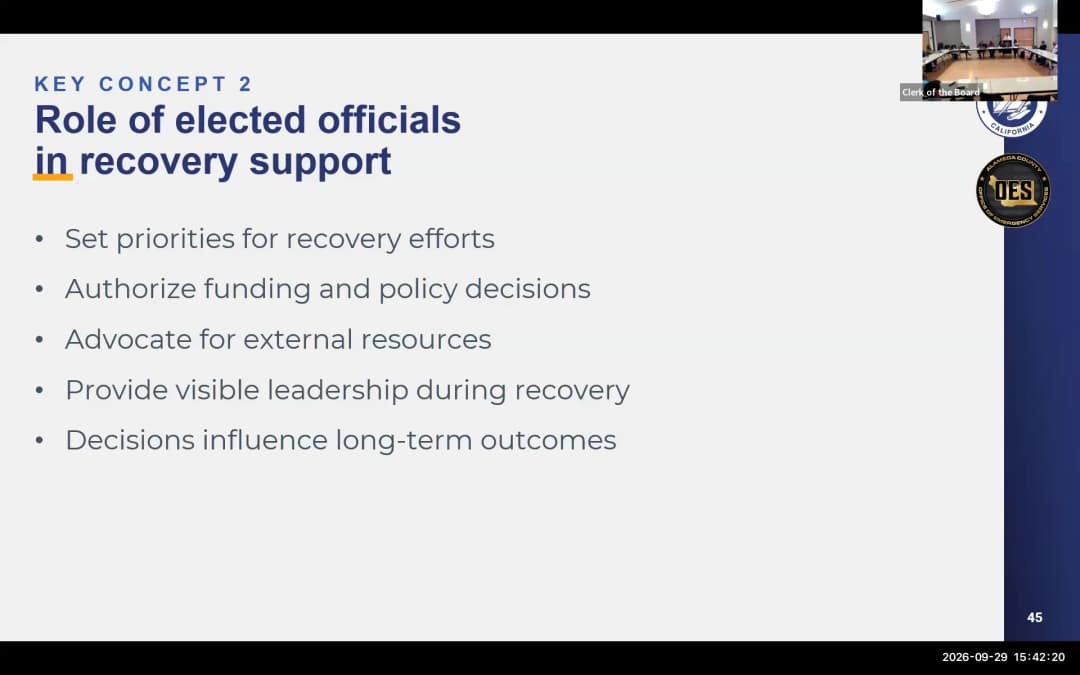
The Alameda County Board of Supervisors convened a special meeting to receive reports on federal/state/county budget and financial conditions, an update on the Home Together and homelessness system, and disaster preparedness training for the Board and department heads. The meeting opened with closed session conferences on labor negotiations, potential and existing litigation, and real property negotiations for the Oakland-Alameda County Coliseum and Arena Complex. No formal votes were taken during open session. Note: the agenda for this meeting is dated Tuesday, September 29, 2026, while the source metadata provided for this summary identifies the meeting date as October 2, 2026. Public Comments & Testimony - One in-person speaker during the homelessness item made largely unintelligible remarks referencing financial donations, property ownership, bankruptcy proceedings, and pending court litigation. - A later public commenter made similarly unclear remarks referencing compliance directives, the SLAPP Act, and what appeared to be references to burial/military standards; the transcript is too garbled to establish a clear position. Discussion Items Federal, State and County Budget/Financial Updates - County staff reported the FY 2026-27 final adopted budget totals approximately $6.7 billion across all funds, a 10% increase over the prior year. - The county closed roughly half of a $185 million maintenance-of-effort funding gap with $93 million in retirement savings and prepayments of pension liabilities. - Budget components include $2.2 billion in salaries and benefits for approximately 10,000 employees; $1.25 billion in community-based organization (CBO) contracts, including $140 million for Alameda Health System contracts; $440 million for housing and homelessness programs; $347 million in Measure W investments; $387 million for direct municipal services; and $477 million in drug-related payments (transcription unclear). - The Federal Reserve raised its benchmark interest rate on September 16, its first increase since July 2023, in an effort to address a surge in oil prices; inflation remains more than a percentage point above the Fed's 2% target. - Nearly 13,000 area layoffs were reported by early September 2026, notably higher than last year; globally, technology layoffs affected more than 76,000 workers as of July 2026. - Housing market data (August): median single-family home price of $1.285 million, up 0.8% from the previous month; home sales down about 14% from last month and down 9% year over year; inventory up about 15% compared to July but down about 12% from a year ago; median time on market of 14 days, down 7% from the previous month; the statewide median time on market was 53 days. - A supervisor reported that a prior committee advanced, for full Board decision: support for the Veterans Affordable Housing Bond Act of 2026; support for Proposition 40, a one-time wealth tax for state-funded health care, education, and food assistance; opposition to Proposition 43, a two-thirds vote requirement for local special tax initiatives; and support for the regional transportation measure. Fourteen statewide ballot propositions are qualified for the November ballot. - A supervisor noted reports that the health care provider identified in the transcript as "ISER" will lay off 147 employees in Pleasanton and Oakland and asked whether other regional providers are affected. - Supervisors requested: CBO employment data; updates on departmental fee increases; an assessment appeals timeline that meets the next lookback period; Measure W revenue overages above the anticipated $170 million once books close; budget-to-actual information for the last fiscal year; a deeper revenue analysis, particularly sales tax tracking; and continued attention to charging back hospital service costs while controlling costs. Update on Board Initiatives: Home Together and Homelessness System - The draft Home Together 2030 plan is out for a 45-day public comment period ending October 1; it will be presented to the Mayors Conference on October 14, with a final draft submitted to the Board for adoption in November and city endorsements to follow. - The plan's five pillars are prevention, access, shelters, housing, and health care, supported by system foundations; headline goals are reducing overall homelessness by one-third and reducing unsheltered homelessness by 50%. - Year-four system data show, for the first time, more people exiting to housing than entering or returning to homelessness; the county also saw improvements in racial equity in returns to homelessness, with most populations at or below the system-wide average. - FY 2024-25 funding proportions were approximately 43% state, 28% local, and 28% federal, prior to the rollout of Measure A investment. - The HUD Continuum of Care application, submitted after more than 100 hours of work by the team over 10 business days following a surprise court ruling, seeks $74 million (up to $10 million more than last year). Roughly $64 million of base annual funding is at risk; $38 million is expected to be renewed; more than $26 million of currently funded grants were ineligible under new policy; and about $19.5 million has no current funding disposition. The county also proposed $26 million in new projects. - Home Together Fund staffing is at 122 total FTE, including 45 funded positions, 36 new positions created over the last fiscal year, and 19-plus positions still under discussion; more than 100 positions are currently filled. - Over the life of the measure, projected impacts include more than 1,400 new subsidies, 1,400 new housing units, and 300 new shelter beds. - Shelter stabilization: the Social Services Agency maintains 813 shelter beds at a rate of $36 per night, unchanged since 2018; the Board approved a one-time $13 million allocation. New rates take effect January 1, 2027; the expanded rates will cost roughly $38 million per year (transcript reads "to fund equally 113 beds"). Contracts will run 18 months with a three-month ramp-up period, a four-person compliance team, and temporary 75% rate withholding for sustained non-compliance, though staff stated shelters would not be closed and residents would not be put back on the street. - Homelessness prevention: since July, more than $8 million annually has been added to housing resource centers for flexible financial assistance, case management, and legal services; a forthcoming prevention hub procurement will create a centralized access point. The goal is $20 million total in prevention investments each year, separate from the $150 million flexible fund for people currently experiencing homelessness. - Approximately 300 behavioral health bridge housing beds, opened with one-time state Care Court funding, are at risk of sunsetting; staff are exploring sustaining a subset. - In District 1 (Tri-Valley), the point-in-time count has increased while the county overall declined; 12% of Home Together Fund investments to date have gone to District 1, double its share of the point-in-time count. Staff are waiting on a proposal from three Tri-Valley cities and emphasized the need for city partnership on siting. - Supervisors raised concerns about: hiring speed and civil service constraints despite the declared housing emergency; enforcement of shelter standards and rules at housing sites (one supervisor warned of a "backlash of support" for Measure W if public safety concerns at program sites are not resolved); the voluntary nature of treatment services; coordination with cities on capital procurement for acquisition, rehab, and conversion of existing properties; capacity building for smaller community-based organizations; vehicular homelessness and safe parking; and the Home Stretch coordinated entry system, which staff described as a matching system for a queue of about 4,000 prioritized individuals, not a source of new housing. Disaster Preparedness Training - The training was led by County Emergency Manager Brent Blazer and introduced by Hayes Stokes; the Board and department heads received an electronic emergency handbook. - Key concepts: elected officials serve a governance role (policy, funding, advocacy, public leadership) distinct from operational command; the Emergency Operations Center is an information management and coordination function; officials should plug into briefings and liaisons rather than self-deploy or direct field operations; and public statements should rely on verified information coordinated with the Public Information Officer. - Emergency proclamations are governance tools tied to resource needs and authorities, generally made within about 10 days of a disaster, with ratification by the Board within up to seven days when urgent; documentation of emergency expenditures is essential for reimbursement. - Recovery transitions should begin as soon as the immediate threat ends; recovery typically spans five to seven years, with public assistance supporting government infrastructure and individual assistance supporting affected residents and businesses. - Scenario discussions covered earthquakes, wildfire season, flooding, public information/media inquiries, offers of donations and volunteers, and disaster service workers. - Supervisors discussed the Urban Shield training program, praising its multidisciplinary value and noting the loss of federal funding after a 3-2 Board vote; the sheriff's office is working to bring back smaller-scale training. - OES staffing: the Board previously approved 14 positions; nine have been hired, five vacancies remain with interviews scheduled in two weeks, and OES now has 10 staff. Nearly 1,300 people have newly signed up for AC Alert as of the day before the meeting. - Supervisors requested a tabletop exercise for the Board and department heads, ongoing training, clearer media protocols for directing press inquiries, and continued coordination with cities on preparedness; all county employees are disaster service workers. Key Outcomes - No formal open-session votes were taken; the agenda items were informational/presentational. - Closed session conferences were held on labor negotiations with all labor organizations and Teamsters Local 856, potential and existing litigation (including Goolsby, Mendoza, and Boyette cases), and Coliseum property negotiations with Oakland Acquisition Company, LLC, Coliseum Way Partners, LLC, and the City of Oakland; County Counsel reported but the transcript does not detail actions. - The final Home Together 2030 plan is expected to go to the Board for adoption in November, following the October 14 Mayors Conference presentation. - New shelter reimbursement rates take effect January 1, 2027, under 18-month contracts. - The HUD Continuum of Care application, seeking $74 million, was to be submitted on the day after the meeting per the presentation. - The County Administrator's Office was asked to return with CBO employment data, budget-to-actual analysis, deeper sales tax/revenue reporting, Measure W overage figures, and prioritized departmental fee studies. - OES will fill five vacancies, pursue a Board tabletop exercise, and continue developing city coordination and public preparedness resources.
Public Meetings - Alameda County, California
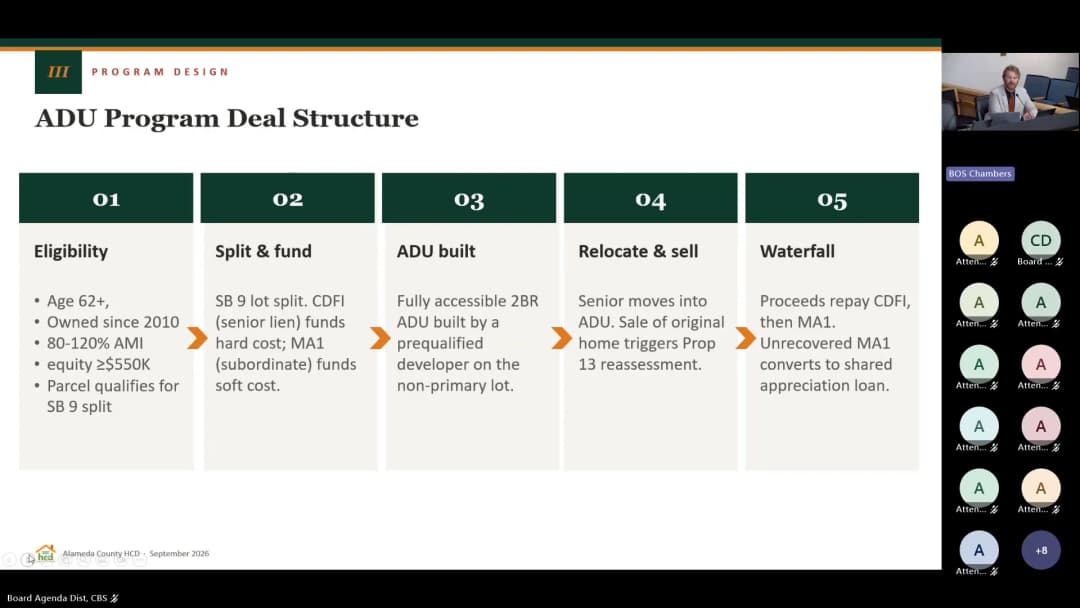
Public Meetings - Alameda County, CaliforniaNote on Date: The official record provided for this summary sets the meeting date as October 1, 2026. However, the meeting's published agenda and the Chair's opening remarks during the proceedings identify the date as Monday, September 28, 2026. Supervisor Lena Tam, Chair, presided over the meeting. Supervisor Nate Miley was excused. The Health Committee received two informational presentations: the annual report on the Measure A1 Affordable Housing Bond for fiscal years 2022–2023 and 2023–2024, and an update on the Scalable Housing Infill Funding Toolkit (SHIFT) Senior Age in Place Accessory Dwelling Unit (ADU) Pilot Program. Public Comments & Testimony - No members of the public spoke on either agenda item or on non-agenda matters during the public comment period. Discussion Items Measure A1 Affordable Housing Bond Annual Report (FY 2022–2024) - Presentation: Dylan Sweeney from the Housing and Community Development Department (HCD) presented the report, which covers performance data through June 30, 2024. Jennifer Pearce and Michelle Starratt were also listed on the agenda as presenters. - Key Statistics: - $405 million of the $580 million bond allocation had been expended (70% of funds) by June 30, 2024. - 724 new affordable rental homes were completed and leased up during the covered fiscal years. - 164 new units were committed, bringing the total pipeline of affordable rental homes under development to almost 1,000 units by the end of 2024. - The bond funds achieved significant leverage; staff noted that projects typically involve 5.4 public funding sources and provided an example where a $1 million Measure A1 investment supported a $10 million total project cost, reflecting a 9-to-1 leverage ratio. - An estimated $10.56 in rental savings will accrue to residents for every $1 invested by Measure A1. - Workforce participation goals were exceeded, including outperforming the local hire goal by 11 percentage points. - Homeownership programs: AC Boost provided 237 lifetime down payment assistance loans (with nearly 70% of funds dispersed by end of 2024), and Renew AC committed 127 loans. - Supervisor Deliberation: - Supervisor Lena Tam questioned the presentation's methodology of attributing 100% of the units in a development to Measure A1 funding. The department clarified that while they take program credit for 100% of units in funded buildings, they can provide finite per-unit accounting. - Supervisor Tam raised the difficulty that affordable rents set at 80% of Area Median Income (AMI) can exceed market rates in the unincorporated county. HCD acknowledged this, stating the bond has been highly effective in high-cost communities but less optimized for lower-cost but struggling communities where the 60% to 80% AMI gap is difficult to bridge with available subsidies. SHIFT Senior Age in Place ADU Pilot Program - Presentation: Erin Tudman, program manager, updated the committee on the SHIFT pilot, initially approved by the Board in March 2026. - Program Design: The pilot provides financing and project administration for moderate-income senior homeowners (estimated 23,000 eligible households countywide). Using a CDFI construction loan and a county soft loan, the program funds the construction of an accessible ADU on the senior's property. The senior moves into the ADU, their original home is sold, the construction loan is repaid, and the senior retains equity through a shared appreciation loan. - Benefits to Cities: The sale of the primary residence triggers a Prop 13 reassessment, generating new property tax revenue for the city. Seniors can transfer their existing property tax base to the ADU. - Funding & Timeline: An RFQ for a program administrator has been launched. The county received a $3 million award from the state's Strategic Growth Council to support the SHIFT program. A framework update will be brought to the Board for approval. - Supervisor Deliberation: - Supervisor Tam asked about typical ADU construction costs. The estimated cost range is approximately $400,000, which the department contrasted with the roughly $1 million per unit cost of traditional affordable housing, emphasizing the program's goal of cost efficiency. - Supervisor Tam asked about coordinating with the 14 cities and unincorporated areas on permitting and SB9 compliance. HCD confirmed active outreach to city partners, noting the program helps cities meet their Regional Housing Needs Allocation (RHNA) goals. Key Outcomes - Measure A1 Report: As the sole Committee member present, Supervisor Tam forwarded the informational report to the full Board of Supervisors for final adoption. The report is anticipated to be heard at the Board meeting in November 2026, the 10-year anniversary of the Measure A1 bond passage. - SHIFT ADU Pilot: No formal action was taken by the Committee. The department will proceed with launching the program administrator RFQ and seeking full Board approval of the framework update.
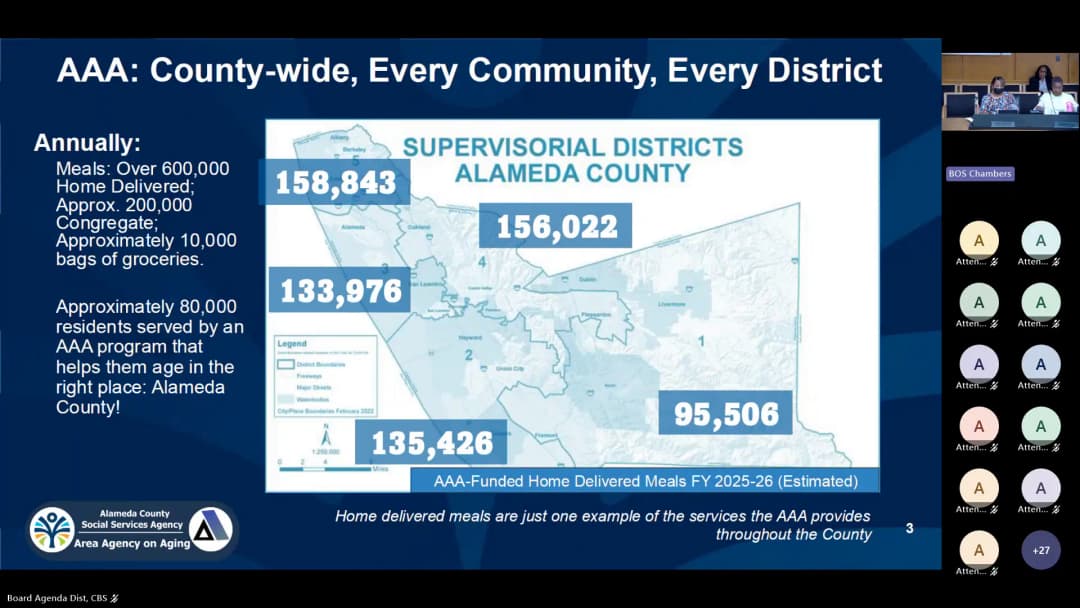
The Social Services Committee of the Alameda County Board of Supervisors convened on October 1, 2026, to receive annual updates from the Public Guardian, the Area Agency on Aging, the Department of Child Support Services, and the 12th status update on the State Auditor’s findings regarding the Department of Children and Family Services. No votes were taken; all items were informational. Public Comments & Testimony - Marilyn Harris spoke on Agenda Item I (Public Guardian Annual Update). No other public comments were made. Discussion Items I. Public Guardian Annual Update - Presenters: Vincent Gordon (Program Manager, Dept. of Adult & Aging Services), Samantha N. Stonework-Hand (Assistant County Counsel), Kirsten Voyles (Legal Director, Legal Assistance for Seniors). - Overview of the Public Guardian’s role in probate and LPS conservatorships, governed by the Probate Code (dating to 1931) and the Lanterman-Petris-Short Act. - Staffing: Two probate units with 6 vacancies; average probate caseload rose 40%—from 19 to 27 cases per worker over two years. - Financial oversight: The Public Guardian manages approximately $27.7 million in assets, serving about 155 conservatees (majority over age 70 in skilled nursing facilities). - LPS program: Caseloads remained consistent (avg. 44 cases per worker) but challenging due to mental health recidivism and placement difficulties. - Care Court (presented earlier by Judge Bean) has not increased LPS referrals and may offer a less restrictive alternative. II. Area Agency on Aging Annual Update - Presenter: Kim Fogle (Management Analyst, substituting for Jennifer Stephens-Pierre). - The AAA network provides about 200,000 congregate meals and distributes nearly 10,000 bags of groceries annually; an estimated 80,000 older adults rely on AAA-funded programs. - Contracts: 77 contracts totaling $17.5 million in the last four-year cycle; new RFP awarded 53 contracts worth $15 million for the next four years. - Accomplishments: 140 new Certified Nursing Assistants graduated from the healthcare career pathways program in three years; supported passage of AB 1069 (emergency shelter access for older adults). - Upcoming events: Holiday basket distribution (Dec. 11) and Aging Well & Planning Ahead Forum (Apr. 16, 2027). - Staffing: AAA has two vacancies (clerk and administrative specialist). Assistant Agency Director Faith Battles noted significant understaffing in IHSS social worker positions (caseloads over 400) and ongoing fines for failing to complete annual assessments. III. Department of Child Support Services Annual Update - Presenter: Vangeria Harvey (Acting Director). - Caseload: Over 25,000 families, including 4,000+ currently on CalWORKs; over $72 million collected and distributed in the current federal fiscal year (through August). - Performance metrics: Parentage establishment 98.8%; order establishment 91.2%; current support collections 68.3%; arrears collections 63.9%—ranking in the top quarter of California counties. - Legislation: SB 1264 (expanded notification of estate for child support arrears), AB 2195 (protects low-income parents from commercial license suspension), AB 747 (effective Jan. 1, 2027, requires GPS‑stamped photos for service of process). - Outreach: First Family Resource Fair (200+ families), Dad discussions, and participation in the “Together We Give” campaign. IV. Department of Children and Family Services Status Update 12 - Presenter: Michelle Love (Assistant Agency Director, DCFS). - Progress on State Auditor’s recommendations (2024-108) and the California Department of Social Services Corrective Action Plan (CAP). - Timeliness of investigations: Digital assignment board implemented; supervisor oversight strengthened; vacancy rate in emergency response reduced to 5.8% (down from higher levels in September 2025). - Staffing: Expanding emergency response from 31 staff (Aug. 2024) to 59 by end of 2026; new four-week on-the-job training added. - Family finding contract: From June 1 to Sept. 1, 2026, 394 relatives identified; 91 youth served (ages 14–26); 33 youth completed services. - Transitional shelter care facility: Reopened April 3, 2026; 19 intakes through August; policies submitted; meetings now occurring. - Training compliance: 92.6% of supervisors and 82.5% of workers completed required hours. - Safety culture survey: Response rate 53% in 2026 (similar to 54% in 2025); emotional exhaustion slightly increased (37%); physical safety improved; scores comparable to national benchmarks. - CDSS will oversee the CAP with monthly meetings for two years; the CAP is due October 1, 2026. Key Outcomes - No formal motions or votes occurred; all items were received as information. - Supervisor Fortunato Bas recommended establishing an advisory board (composed of the Interagency Coordinating Council and additional experts) to guide long‑term transformation of child welfare services. Discussion highlighted existing oversight from CDSS and the ICC, with caution about adding extra demands on DCFS staff. - The committee will receive continued updates on the Corrective Action Plan and the organizational assessment by Baker Tilly.
(Note: The agenda and transcript list the meeting date as September 22, 2026, but the provided date for the summary is September 23, 2026.) The Alameda County Board of Supervisors held its regular meeting on September 23, 2026. The meeting included a report on closed session actions, approval of a consent calendar, a mass motion approval of numerous contracts and policy items, and two informational set matters. Key topics included a $1.3 million settlement in a wrongful death lawsuit, extensive public testimony in support of immigrant services, an update on child welfare system improvements, and negotiations over the Alameda County Fair Association contract. Consent Calendar - Unanimously approved items 54–61, including meeting minutes, conflict of interest codes for the Alameda County Water District, Human Resource Services, and Information Technology Department, the Treasurer-Tax Collector’s July 2026 Investment Report, the District Attorney’s annual report on Real Estate Fraud, and reappointment of Virginia Harrington to the Source Reduction & Recycling Board. Public Comments & Testimony - Item 9 (Immigrant Services Contract Amendments): Sixteen speakers, representing organizations such as Trabajadores Unidos Workers United, Asian Health Services, California Collaborative for Immigrant Justice, and Filipino Advocates for Justice, urged the board to sustain Act for All Coalition funding and establish a permanent Office of Immigrant and Refugee Affairs. Speakers emphasized the ongoing threat of deportation, the need for trusted legal services, and the importance of prevention over crisis response. Several speakers noted that the coalitions have reached thousands of residents with know-your-rights trainings, legal consultations, and mutual aid. - Item 53 (Alameda County Fair Association Update): Seven speakers offered mixed views. The Fair Association president and CEO highlighted the fair’s financial success, agricultural investments, and community impact. Critics, including George Schmidt and Amy Ash, accused the association of lacking transparency, ignoring contract terms, and de-emphasizing agriculture. Some called for termination of the contract and issuance of an RFP, while others urged improved governance. - Public Input on Non-Agenda Items: Two speakers addressed substance abuse treatment and food security efforts. Discussion Items - Item 9 – Immigrant Services Contracts: Supervisor Marquez asked about hiring for the Office of Immigrant and Refugee Affairs. Director Ford reported that a management analyst position is being reclassified and a director job description is under development. Charles Sanchez, interim senior management analyst, outlined plans for an RFP to be released September 28, 2026, with new contracts starting July 1, 2027. Supervisors emphasized the need for broader outreach to Asian, African, and other non-Spanish-speaking communities and accountability measures. - Items 2, 3, 5, 6 – Social Services Contracts: Questions were raised about regional coverage for emergency meals, CalWORKs job training eligibility, and refugee integration services. Supervisor Fortunato Bass requested a January 2027 update on the North County workforce contract. Supervisor Tam asked for demographic data on refugees served; Director Ford pledged to provide that by September 28. - Item 10 – Baker Tilly Child Welfare Assessment: Director Andrea Ford presented a rapid organizational assessment and transformation roadmap for the Department of Children and Family Services. Supervisors discussed the need for child welfare expertise in the assessment, community engagement, and direct reporting to the board. The contract was approved (5-0). - Item 17 – Behavioral Health Bridge Housing: Supervisor Miley noted alignment with housing-first principles and the urgency of addressing homelessness. The amendments increase funding for housing and services for individuals with mental illness and substance use disorders. - Item 20 – Fall Prevention Training: Supervisor Marquez requested outreach information for District 2. - Item 21 – Environmental Health Fee Study: Supervisor Miley supported the study to update fees not revised since 2014, noting its importance for code enforcement. - Item 38 – Meeder Public Funds Contract Extension: President Haubert asked about measurable results and performance benchmarks. Treasurer confirmed monthly reports and expressed satisfaction with services. The extension was approved. - Item 39 – Appointment of Cynthia Cornejo as Registrar of Voters: Approved unanimously (5-0). Cornejo, who had served as acting ROV since March 2026, was praised for her integrity and experience. - Item 45 – Fire Department Cybersecurity and AI Policies: Supervisor Miley clarified that these policies mirror the county’s existing ones; the fire department operates its own network. - Item 53 – Alameda County Fair Association Update: Lori from the County Administrator’s Office reported ongoing negotiations focused on permitting, code compliance, committee structure, and communication protocols. The deadline for non-renewal of the current contract is September 30, 2026. Supervisors expressed support for continued negotiations but stressed the need for transparency and health and safety provisions. - Closed Session Report: County Counsel announced a settlement of $1.3 million in Estate of Jesus Eric Magana v. Alameda County, approved unanimously on July 28, 2026. Key Outcomes - Consent Calendar: Approved unanimously. - Mass Motion (Items 2–51 except 10, 27, 34, 35, 39, 49): Approved with specific votes recorded. Item 27 (Supervisor Fortunato Bas recusal on United Seniors funding) was approved 4-0. - Item 10 (Baker Tilly Contract): Approved 5-0. Final report due by December 2026, to be presented to the full board. - Item 39 (Registrar of Voters): Approved 5-0. - Items 34, 35, 49 (Salary Ordinance and Traffic Code): Approved after second/first readings. - Fair Association: No formal action taken. Staff will continue negotiations; board expects a resolution or update before the September 30 deadline. - Next Steps: RFP for immigrant services to be released September 28, 2026, with new contracts aimed for July 1, 2027. Child welfare update on September 28, 2026, from Assistant Agency Director Michelle Love. The board’s finance subcommittee will receive a report on the ethical investment policy RFP before full board consideration.
Note: The agenda and transcript list this meeting as Monday, September 21, 2026; however, the provided timestamp indicates the meeting took place on September 22, 2026. This summary uses the date given but notes the discrepancy. The Castro Valley Municipal Advisory Council (CVMAC) met at the Castro Valley Library on September 22, 2026 (as recorded), at 6:00 p.m. The meeting included public comment, approval of minutes, informational presentations on updated fire hazard maps and fire station rebuilding projects, and approval of the 2027 meeting schedule. Consent Calendar - Minutes of May 18, 2026 – Approved unanimously (6 ayes, 2 excused) with a request to include speaker names in future minutes. - Minutes of July 20, 2026 – Approved unanimously with a correction to Councilmember Mota’s attendance status. Public Comments & Testimony - Monica Carr (Groveway resident) – Requested that the council add the ACPWA Groveway Improvement Project to a future agenda. She argued that the proposed widening for class II bike lanes is unsafe and that class III bike lanes should be installed instead. She stated that the community has received insufficient communication and that similar projects on Somerset received more outreach. - Devana Belser (Outsiders Coalition) – Presented a formal grievance regarding health, safety, and civil rights violations at the First Presbyterian Church Shelter (2490 Groveway). She reported chronic plumbing failures, lack of ADA-compliant restrooms, and dismissive staff, placing the council and county on notice. - Linda Honeyman – Opposed class II bike lanes on Groveway, citing safety risks from door zones and the burden of right-of-way widening. She supported class III bike lanes with shared road space. - Dr. Ann Maris (longtime Groveway resident) – Opposed the project, noting that CEQA documents were filed in 2024 as categorically exempt, but the public learned of the project only in 2026. She stated that the project would remove approximately 30 mature trees, relocate sidewalks, and reconfigure travel lanes. She requested more than the standard 72-hour notice for affected residents. Discussion Items I. Zone Zero and Recent Changes to California Fire Hazard Maps (Informational) - Presenters: Aaron P. Panfilio, Division Chief, and Breanne Slimick, Public Education Assistant, Alameda County Fire Department. - Overview: Explained the shift from 2009 fire hazard severity zones to updated 2025 maps using better data and technology. In Castro Valley, the number of very-high-hazard parcels dropped from 2,348 to 984, with an additional 1,531 parcels designated high, 838 moderate, and about 1,000 reclassified as non-wildland. The new “Zone Zero” rule (0–5 feet around structures) was adopted by the state on August 19, 2026, and will be phased in over 3–5 years for existing properties. - Q&A: Councilmembers asked about evacuation planning, annual inspections (only for very-high zones), insurance impacts, the relationship between zones and PG&E shutoffs, and the chipper program. Slimick explained that she personally inspects 984 very-high-zone homes annually. Panfilio and Slimick committed to follow up on questions about remodels, tree requirements in Zone Zero, and the Diablo Fire Safe Council. II. Update on Fire Station Rebuilding Projects Funded by Measure X (Informational) - Presenter: Deputy Chief Eric Moore, Alameda County Fire Department. - Updates: - Fire Station 7 (Palomares Hills): Located at 6855 Villarreal Drive. The structure is nearly complete; sheetrock installation is underway. Expected completion around January 15, 2027. A ribbon-cutting event is planned for late February/early March. The station will house a fire engine and a Type III wildland engine, plus an apparatus storage building. - Fire Station 25 (San Miguel): Slab pouring scheduled for tomorrow. The project includes a vapor mitigation system due to soil contamination. An underground pool observed is groundwater. Will house a Type I engine, tiller truck, and battalion chief. - Fire Station 26 (Castro Valley): Demolition of the former public market has begun. Design and environmental studies are underway. Estimated total cost $25 million. The current Station 26 property (Lake Chabot) is owned by ACFD and future use is undetermined. - Budget: The four stations will use $90 million from Measure X. ACFD will fund Station 24 (Ashland) from reserves. Stations 7 and 25 are currently tracking under budget despite unexpected soil remediation costs at Station 25. - Council comments: Members expressed appreciation, asked about traffic impacts near Castro Valley Elementary, and urged partnership on zoning for the Station 26 site. III. Approval of 2027 CVMAC Meeting Schedule (Action) - Presenter: Chair Bill Mulgrew. The schedule (including both general purpose and land use meetings) was presented. Councilmember Mota requested ensuring technology functions on Thursday meeting dates. The motion was seconded and passed unanimously (6 ayes, 2 excused). Key Outcomes - Minutes of May 18 and July 20, 2026 – Approved with minor corrections. - 2027 Meeting Schedule – Approved unanimously. - Directives/Follow-up: Chief Panfilio will provide answers on fire-resistant construction requirements for remodels, tree pruning rules, and Diablo Fire Safe Council contacts. Councilmember Mota requested a formal tracking process for council requests and follow-up items. Staff agreed to share responses via email to the full council. - Next meeting: The regular meeting for September 28, 2026, was canceled.
The Alameda County Elections Commission was scheduled to meet on September 22, 2026, at 4:00 p.m. at 1225 Fallon Street, Room G-1, Oakland, CA, and via Zoom. The meeting was called to order at approximately 4:26 p.m. After roll call, it was determined that a quorum was not present, and the meeting could not take place. As a result, no official business, discussion, or votes occurred. Note: The agenda and raw transcript are dated September 17, 2026, which conflicts with the meeting date of September 22, 2026 provided for this summary. Call to Order / Roll Call - The meeting was called to order at approximately 4:26 p.m.; Commissioner Butter answered present. Because a quorum was not achieved, the meeting could not proceed. Key Outcomes - No quorum was present, so the meeting was unable to take place. - No consent calendar items, public comments, staff reports, or discussion items were considered. - No motions were made and no votes were taken. - The commission will need to meet at a future date to conduct the business listed on the agenda.
On September 22, 2026, the Alameda County Board of Supervisors' Procurement and Contracting Policy Committee convened but lacked a quorum, so no formal actions were taken. The committee heard a quarterly report from the Auditor-Controller's office on contractor payments, discussed vendor pool data, and scheduled future agenda items. Public comment was opened but no speakers came forward. Discussion Items - Quarterly Report on Contractor Payments (July 1, 2009 – June 30, 2026): Auditor-Controller Melissa Wilk presented the report. For payments up to $500,000, total payments reached $2.6 billion, with $1.51 billion paid to local contractors (stated as 88.2% of those dollars) and $1.26 billion to MWSLBE contractors (48.55%). Category breakdowns for MWSLBE payments: Construction $1.272 million (37.88%), Architecture & Engineering $39.5 million (56.49%), Professional Services $512.6 million (58.53%), and Goods & Services $581.7 million (44.2%). For all payments (including over $500,000), totals were $5.89 billion; local contractors received $3.11 billion (stated as 52.82%) and MWSLBE contractors received $2.06 billion (just over 35%). Category breakdowns: Construction $345.2 million (27%), A&E $58 million (49.36%), Professional Services $709.3 million (31.95%), and Goods & Services $950.4 million (41.23%). - Streamlining Future Reports: Chair Miley and staff discussed shifting to a five-year look-back (instead of back to 2009) and a condensed format (from 64 pages to 20). The next report will cover July 1, 2026 – September 30, 2026, and a draft will be shared at the October work group meeting. - Vendor Pool Inquiry: Chair Miley asked what percentage of the 12,391 registered vendors actually receive county contracts. The auditor's office agreed to run a report showing contractors currently receiving payments or purchase orders, and to bring it to the next meeting. - Disparity Study Update: Chair Miley requested a report/update on the disparity study be agendized for the November meeting; it was confirmed for that date. - Deed Redaction Project: Chair Miley requested an update on the auditor's office project redacting restrictive covenants from deeds, also for the November meeting. Public Comments & Testimony - No public speakers offered comments on the report or on non-agendized items. Key Outcomes - No formal votes or actions were taken due to the lack of a quorum. - The committee heard the quarterly report and accepted it as informational. - Next meeting scheduled for November 16, 2026 at 5:00 p.m. (evening session). - Future agenda items will include: the streamlined quarterly report, vendor pool contracting data, disparity study update, and redaction project update.
The meeting began with roll call and public participation instructions. The committee received federal and state legislative updates from The Picard Group and Full Moon Strategies, and voted on one action item: to support H.R. 8355/S.5267. An informational item on EEOC rulemaking was noted. The state legislative update covered end-of-session activities, governor actions, and wildfire legislation, but no action was taken on the state action items listed in the agenda during the portion of the meeting captured in the transcript. Consent Calendar (No consent calendar items identified.) Public Comments & Testimony - No public comments were made during the federal legislative update. No other public comment periods are recorded in the transcript. Discussion Items - Federal Legislative Update (The Picard Group): Emily Bacche Desilva reported on Congress's schedule, the continuing resolution funding through December 11, 2026, and issues including LIHEAP funding (90% allocation by November 1, 2026, per statutory deadline), HUD CoC NOFO for FY26 ($4.04 billion available) with legal challenges to reduced renewal protections, and Senate Agriculture Committee markup of farm bill including SNAP cost-sharing changes. Supervisor Tam asked about LIHEAP funding levels; it was clarified that current levels are flat under the CR. - Action Item – H.R. 8355/S.5267 (Accountable Produce is Medicine Act): The committee considered a recommendation to support the legislation, which would account for the effects of produce-as-medicine programs. Supervisor Bas moved to forward a support recommendation to the full board, seconded by Supervisor Tam. The motion passed unanimously (2-0). - Informational Item – EEOC Rulemaking: The committee was informed that opposition comments had already been submitted regarding a proposed rule that would remove reporting requirements for workplace discrimination data. No formal board position was required. - State Legislative Update (Full Moon Strategies): The update covered the end of the 2025-2026 legislative session, governor actions pending by September 30, key bills (SB 1193 signed, SB 1400 and SB 811 pending), the budget bill junior ($92.1M for OES, $89.8M for HCD), and wildfire legislation including the governor’s proposals that would have limited local government recovery costs and the failure of SB 492. A special session on wildfire liability may be called. The update also noted 14 statewide ballot propositions for November 2026. Key Outcomes - Vote on H.R. 8355/S.5267: Motion to recommend support passed 2-0 (Supervisor Fortunato Bas and Supervisor Tam both voting aye). - EEOC Rulemaking: No action taken; opposition comments already submitted. - State Action Items Not Addressed: The agenda listed action items on AB 152 (Oppose) and Proposition 44 (Oppose), but the provided transcript does not include any discussion or vote on these items. Note: The agenda date is September 21, 2026, but the instruction specifies using September 22, 2026 as the meeting date for the summary.
(This meeting was originally scheduled for September 16, 2026 per the agenda and transcript, but the provided timestamp indicates September 17, 2026. The summary uses the given date.) The Sunol Citizens Advisory Council (SCAC) met on September 17, 2026, to receive law enforcement and fire reports, discuss progress on downtown revitalization and wayfinding signs, consider a funding request from the Sunol Business Guild, review Caltrans' response to community concerns, and honor Fenestra Winery's 50th anniversary. Public Comments & Testimony - Andrew Turnbull thanked the SCAC for standing up to Caltrans on the tree issue, praised the quick response from Mobile Citizen for a crosswalk repair, and also thanked Caltrans for freeway improvements. - Tom Pittman raised concerns about repeated phone service outages on Killcare Road, urging the council to pursue communication alternatives (e.g., radios or antennas). He also criticized traffic light timing on Main Street and requested recontacting Caltrans. - Kelly A. Bruce commented on traffic light programming issues observed elsewhere, urged the council to verify project outcomes via satellite imagery, and reminded attendees of the Hotlock picnic on Saturday. Discussion Items - Law Enforcement Report (Sgt. Franco, ACSO): Since July 15, 2026, deputies responded to 135 calls in Sunol, conducted 97 traffic stops, and handled a small fire and an incident on Niles Canyon (subject under influence in wheelchair). No major incidents. Franco noted a planned Caltrans closure on September 26-27 and coordinated notification. - CHP Report (Officer Landers): Low staffing levels and upcoming transfers will reduce presence; officer asked community to report issues and they will respond as able. Traffic light timing on Main Street was again flagged. - Fire Report (Chief Terra, ACFD): From July 1 to September 16, Station 14 handled 101 calls: 48% medical, 13% fires, 39% other. New federal reporting system (NERUS) delayed data. Defensible space rule changes pending. - Progress Reports: - Fire Safety Workgroup: No update. - Tree Advisory: Jim O’Laughlin unavailable; need volunteer. Planning department workshop on trees in unincorporated areas announced. - Downtown Revitalization Workgroup: Wayfinding signs in production; community voting on nameplates for two signs (at Foothill/Killcare and Main/Bond). Third sign at Main/84 delayed until construction finishes. Restrooms: Design made period-appropriate (1920s) using salvaged tiles from depot roof, coordinated with Niles Canyon Railway. - Proclamation: SCAC presented a proclamation to the Replogle family honoring Fenestra Winery’s 50 years of leadership in the Livermore Viticultural Area and Sunol. Family members spoke and thanked the council. - Funding Request ($1,000 from Community Improvement Fund for Sunol Business Guild’s Stroll in Sunol): Veena Rossler reported the event sold over 200 tickets, netting about $5,000. Several public comments opposed the request, arguing the fund was intended for physical infrastructure. Council debated semantics of “project” vs “physical improvements.” A motion to approve passed 4-1 (Councilmember Start opposed). The council noted approval with encouragement to contribute to park improvements. - Caltrans Response (Item 4C): Chair DeGrange summarized the 122-page response as dismissive—self-certifying “no effect” on cultural resources, ignoring concerns about traffic signal systems, heritage oak tree, and proposing a 42-inch concrete barrier at the Water Temple gate. Council members expressed frustration and recommended escalating to state legislators (Senator McDermott, Assemblymember Lee) and possibly involving Alameda Creek Alliance. No formal action taken, but next steps include contacting representatives. - Wayfinding Signs Location (Item 4D): Benjamin Harrison reported community voting results: top nameplates are Little Brown Church, Bosco statue, Elliston, and Sunol Train Depot. Signs will be placed at two locations; third location pending construction completion. Key Outcomes - Funding Approved: $1,000 from the SCAC Community Improvement Fund to the Sunol Business Guild for the Stroll in Sunol event (vote 4-1). - Wayfinding Signs: Top five nameplates selected; signs to be installed at Foothill/Killcare and Main/Bond. Third sign deferred. - Caltrans Escalation: Council will contact state representatives (Senator McDermott, Assemblymember Lee) and explore legal options regarding Caltrans’ treatment of historical resources. - Minutes Approved: The minutes of July 15, 2026, were approved unanimously. - Adjournment: Meeting adjourned in memory of Al Ducharm, a volunteer at Sunol Depot Gardens. Note: Date discrepancy – agenda and transcript state September 16, 2026; however, the provided timestamp indicates September 17, 2026. The summary uses the given date.
This special meeting of the Alameda County Board of Supervisors convened at 4:30 p.m. The sole agenda item was the appointment of Frank J. Imhof to the Alameda County Agricultural Fair Association Board of Directors, including a waiver of the 12-year term limit. The meeting included a closed session (reported separately) and public comment on both closed session and the appointment item. After five public speakers expressing strong support and board discussion, the appointment was approved on a 3-1-1 vote. Public Comments & Testimony - Amelia Ferrario (Union City/Fremont/Newark area, 4-H participant) expressed full support for Frank Imhof, stating he is the only producer who has offered hands-on experience with commercial cattle and gives a voice to students and families in agriculture. - Krista Murphy (Pleasanton, former 4-H participant) voiced support, emphasizing Imhof’s knowledge, experience, and accessibility in helping families and the fair community. - Julie Ferrario (Union City, parent of 4-H participants) supported the appointment, citing Imhof’s hands-on support for 4-H, his role as ringman at the junior livestock auction, and his deep agricultural knowledge. - Anonymous caller (phone ending 3929, Pleasanton resident since 1979, parent of 4-H participants) expressed support, stating Imhof would be a true person for the fair board. - Barbara Gallie (caller) voiced strong support, highlighting Imhof’s wealth of knowledge, expertise, accessibility, and willingness to help, and urged the board to appoint him. - Sherry Walden attempted to speak on a closed session item but was informed the public comment period was for closed session only; her comment was not taken. Discussion Items - Appointment of Frank J. Imhof to the Alameda County Agricultural Fair Association Board of Directors, with waiver of 12-year term limit - Supervisor David Haubert made the motion, stating the appointment is important to retain historical knowledge and deep community ties, and noted Imhof has served close to 20 years with volunteerism and financial contributions. - Supervisor Nate Miley seconded the motion but explained he had previously appointed Sean Becton to the board to bring fresh perspective and minority representation. He supported the motion out of deference to his colleague. - Supervisor Elisa Márquez requested background and expressed concern about lengthy service; she later voted no, stating a preference for giving new people opportunities and noting other board members have served over 12 years as well. - President Haubert argued that maintaining experienced members is critical given divisions within the fair board. - Supervisor Lena Tam supported the motion. Key Outcomes - Vote: 3-1-1 (Supervisor Márquez – no; Supervisor Tam – aye; Supervisor Miley – aye; Supervisor Fortunato Bass – excused; President Haubert – aye). Motion passed. - Decision: Frank J. Imhof is appointed to the Alameda County Agricultural Fair Association Board of Directors for a term ending September 15, 2030, with the 12-year term limit waived. - Closed Session: The board did not recess into closed session; no report was given. (Note: The agenda and transcript list the meeting date as September 15, 2026; however, per the instruction provided, the title and summary use the date September 16, 2026.)